
A English
Morphology of Frog Questions in English
Class 11 Biology · Structural Organisation In Animals · Morphology of Frog
60+
Questions
English
Language
100%
With Solutions
Showing 10 of 60 questions in English
51
MediumMCQ
Which of the following animals maintain ecological balance?
A
Frog
B
Rabbit
C
Earthworm
D
Cockroach
Solution
(A) The $Frog$ plays a crucial role in maintaining ecological balance. It serves as an important link in the food chain and food web within the ecosystem. By acting as both a predator (consuming insects) and prey (for larger animals like snakes and birds), it helps regulate insect populations and supports biodiversity.
0 likes
View Solution52
MediumMCQ
Which one of the following is not a characteristic feature of a frog?
A
The skin is moist and slimy
B
Each of the forelimbs and hindlimbs end in five digits
C
Hepatic portal and renal portal systems are present
D
Skin,buccal cavity,and lungs are the respiratory organs
Solution
(B) In frogs,the forelimbs and hindlimbs are attached to the trunk. The forelimb consists of the proximal upper arm,the middle forearm,the wrist,and a hand bearing four digits (fingers). The hindlimb consists of the proximal thigh,the middle shank,a long ankle,and a foot bearing five digits (toes). Therefore,the statement that forelimbs end in five digits is incorrect.
0 likes
View Solution53
MediumMCQ
The sensory papillae in frogs are associated with
A
smell
B
hearing
C
taste
D
touch
Solution
(D) In frogs,various sense organs are present to perceive the environment.
Sensory papillae are specialized structures associated with the sense of touch.
Taste buds are responsible for taste,the nasal epithelium is for smell,eyes are for vision,and the tympanum with internal ears is for hearing.
Sensory papillae are specialized structures associated with the sense of touch.
Taste buds are responsible for taste,the nasal epithelium is for smell,eyes are for vision,and the tympanum with internal ears is for hearing.
0 likes
View Solution54
MediumMCQ
Choose the correct option regarding the skin of a frog.
A
The frog absorbs water through its skin.
B
The skin of a frog is smooth and slippery due to the presence of mucus.
C
The dorsal side of the frog is olive green with irregular dark spots,and the ventral side is pale yellow.
D
All of the above.
Solution
(D) The skin of a frog is smooth and slippery because it is always maintained in a moist condition by the presence of mucus.
It is the primary site for cutaneous respiration,and the frog also absorbs water through its skin.
The dorsal side of the frog is generally olive green with irregular dark spots,while the ventral side is uniformly pale yellow.
Therefore,all the given statements are correct.
It is the primary site for cutaneous respiration,and the frog also absorbs water through its skin.
The dorsal side of the frog is generally olive green with irregular dark spots,while the ventral side is uniformly pale yellow.
Therefore,all the given statements are correct.
0 likes
View Solution55
MediumMCQ
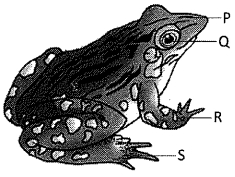
In the given diagram of a frog,where is the nictitating membrane located?
A
$P$
B
$Q$
C
$R$
D
$S$
Solution
(B) In the given diagram of a frog:
$P$ represents the external nostril.
$Q$ represents the eye,which is protected by a nictitating membrane.
$R$ represents the forelimb.
$S$ represents the hindlimb.
The nictitating membrane is a transparent,movable eyelid that protects the eye of the frog while it is underwater. Therefore,the correct label is $Q$.
$P$ represents the external nostril.
$Q$ represents the eye,which is protected by a nictitating membrane.
$R$ represents the forelimb.
$S$ represents the hindlimb.
The nictitating membrane is a transparent,movable eyelid that protects the eye of the frog while it is underwater. Therefore,the correct label is $Q$.
0 likes
View Solution56
EasyMCQ
Which of the following statements is correct about the location of the male frog's copulatory pad?
A
First and second digit of forelimb
B
First digit of hind limb
C
Second digit of forelimb
D
First digit of the forelimb
Solution
(D) In male frogs,the copulatory pad (also known as the nuptial pad) is a specialized structure found on the ventral side of the first digit of the forelimb. This pad helps the male in clasping the female during the process of amplexus (mating). Therefore,the correct location is the first digit of the forelimb.
0 likes
View Solution57
EasyMCQ
Frog can protect itself from enemies by?
A
Teeth
B
Camouflage
C
Clawed digit
D
Both $(1)$ and $(2)$
Solution
(B) Frogs protect themselves from enemies primarily through a phenomenon known as camouflage (also called cryptic coloration).
This allows them to blend into their surroundings,making them difficult for predators to detect.
Frogs do not use their teeth for defense,as their teeth are primarily used for holding prey rather than biting enemies.
They also lack claws on their digits,which further rules out option $(C)$.
Therefore,the correct mechanism for protection is camouflage.
This allows them to blend into their surroundings,making them difficult for predators to detect.
Frogs do not use their teeth for defense,as their teeth are primarily used for holding prey rather than biting enemies.
They also lack claws on their digits,which further rules out option $(C)$.
Therefore,the correct mechanism for protection is camouflage.
0 likes
View Solution58
EasyMCQ
During the breeding season,the nuptial pad is present on:
A
Last digit of male frog
B
Last digit of female frog
C
First digit of female frog
D
First digit of male frog
Solution
(D) In male frogs,the nuptial pad (also known as the thumb pad) is a specialized glandular structure found on the ventral side of the first digit of the forelimb.
This structure develops during the breeding season and is used to grasp the female frog during the process of amplexus (mating).
Therefore,the correct location is the first digit of the male frog.
This structure develops during the breeding season and is used to grasp the female frog during the process of amplexus (mating).
Therefore,the correct location is the first digit of the male frog.
0 likes
View Solution59
EasyMCQ
How do you differentiate a frog from a toad?
A
Frog has no exoskeleton but toad has scales
B
Frog respires through lungs but toad respires through skin
C
Frog has a tail but toad has no tail.
D
Frog has no parotid glands but toad has a pair of parotid glands
Solution
(D) The correct answer is $D$.
Frogs and toads are both amphibians belonging to the order $Anura$.
They can be differentiated by several morphological features:
$1$. Frogs typically have smooth,moist skin,while toads have dry,warty skin.
$2$. Frogs have long,powerful hind legs for jumping,whereas toads have shorter legs and tend to walk or hop.
$3$. The most distinct anatomical difference is that toads possess a pair of large,prominent parotid glands behind their eyes,which secrete toxins for defense,whereas frogs lack these specific glands.
Frogs and toads are both amphibians belonging to the order $Anura$.
They can be differentiated by several morphological features:
$1$. Frogs typically have smooth,moist skin,while toads have dry,warty skin.
$2$. Frogs have long,powerful hind legs for jumping,whereas toads have shorter legs and tend to walk or hop.
$3$. The most distinct anatomical difference is that toads possess a pair of large,prominent parotid glands behind their eyes,which secrete toxins for defense,whereas frogs lack these specific glands.
0 likes
View Solution60
MediumMCQ
Male frogs can be distinguished from female frogs due to the presence of:
$A$. Bulging eyes
$B$. Vocal sacs
$C$. Webbed digits in feet
$D$. Copulatory pad on first digit of fore limbs
$E$. Olive green-coloured skin with dark irregular spots
Choose the correct answer from the options given below:
$A$. Bulging eyes
$B$. Vocal sacs
$C$. Webbed digits in feet
$D$. Copulatory pad on first digit of fore limbs
$E$. Olive green-coloured skin with dark irregular spots
Choose the correct answer from the options given below:
A
$(1)$ $A$ and $B$ only
B
$(2)$ $C$ and $E$ only
C
$(3)$ $B$ and $D$ only
D
$(4)$ $B$ and $C$ only
Solution
(C) Male frogs can be distinguished from female frogs by the presence of specific secondary sexual characteristics.
$1$. Vocal sacs $(B)$: These are present in male frogs and help in producing loud croaking sounds to attract females.
$2$. Copulatory (nuptial) pads $(D)$: These are present on the first digit of the forelimbs in male frogs and are used to grip the female during the process of amplexus (mating).
Therefore,the correct combination is $B$ and $D$.
$1$. Vocal sacs $(B)$: These are present in male frogs and help in producing loud croaking sounds to attract females.
$2$. Copulatory (nuptial) pads $(D)$: These are present on the first digit of the forelimbs in male frogs and are used to grip the female during the process of amplexus (mating).
Therefore,the correct combination is $B$ and $D$.
0 likes
View SolutionStructural Organisation In Animals — Morphology of Frog · Frequently Asked Questions
1Are these Structural Organisation In Animals questions useful for JEE and NEET?
Yes. All questions in this section are mapped to JEE Main and NEET exam patterns. Previous year questions from JEE Main, NEET, GUJCET and state-level exams are included with full solutions.
2Can I switch to Hindi or Gujarati for these questions?
Yes. Use the language tabs in the hero section or the sidebar to view the same questions and solutions in English, Hindi or Gujarati.
3How do I generate a question paper from this subtopic?
Use the Vedclass Exam Paper Generator — select the chapter and subtopic, set difficulty, and generate Sets A, B, C, D automatically. First 3 chapters of every subject are free.
Vedclass Products
For Students
Vedclass Test Series
Mock tests in real JEE/NEET style with performance analysis. 5-day free trial.
Start Free TrialFor Teachers
Exam Paper Generator
Generate Set A/B/C/D papers from this chapter in 2 minutes. 3 chapters free.
Try FreeFor Institutes
Online Exam Module
Live online exams with unlimited students, 360° analytics & white-label branding.
See DemoFor Teachers & Institutes
Generate a Structural Organisation In Animals Exam Paper in 2 Minutes
Select subtopic & difficulty — Sets A, B, C, D auto-generated with No Repeat logic.
First 3 chapters of every subject are free — no payment required.