
A English
Glycolysis Questions in English
Class 11 Biology · Respiration in Plants · Glycolysis
214+
Questions
English
Language
100%
With Solutions
Showing 50 of 214 questions in English
151
MediumMCQ
In which of the following reactions of glycolysis,a molecule of water is removed from the substrate?
A
Fructose-$6$-phosphate $\rightarrow$ Fructose-$1,6$-bisphosphate
B
$3$-phosphoglyceraldehyde $\rightarrow 1,3$-bisphosphoglyceric acid
C
$PEP \rightarrow$ Pyruvic acid
D
$2$-phosphoglycerate $\rightarrow PEP$
Solution
(D) In glycolysis,the enzyme enolase catalyzes the conversion of $2$-phosphoglycerate to phosphoenolpyruvate $(PEP)$.
During this reaction,a molecule of water $(H_2O)$ is removed from the substrate,which is known as a dehydration reaction.
Option $A$ involves phosphorylation,option $B$ involves oxidation and phosphorylation,and option $C$ involves the removal of a phosphate group.
During this reaction,a molecule of water $(H_2O)$ is removed from the substrate,which is known as a dehydration reaction.
Option $A$ involves phosphorylation,option $B$ involves oxidation and phosphorylation,and option $C$ involves the removal of a phosphate group.
0 likes
View Solution152
EasyMCQ
Phase common in aerobic and anaerobic respiration is
A
Krebs' cycle
B
Glycolysis
C
Glycogenolysis
D
$ETS$
Solution
(B) Glycolysis is the initial and fundamental pathway of cellular respiration. It is common to both aerobic and anaerobic respiration and occurs in the cytosol of all living cells,including both prokaryotes and eukaryotes.
0 likes
View Solution153
MediumMCQ
The instantaneous source of energy is
A
Protein
B
Lipid
C
Fats
D
Glucose
Solution
(D) In cellular respiration,whether aerobic or anaerobic,$Glucose$ is the primary substrate that undergoes oxidation to produce energy in the form of $ATP$.
In plants,$Glucose$ is derived from $Sucrose$,which is the end product of photosynthesis or from stored carbohydrates.
$Sucrose$ is converted into $Glucose$ and $Fructose$ by the enzyme $Invertase$ to enter the first step of respiration,known as the $Glycolytic$ pathway.
Because $Glucose$ is a simple sugar that enters the respiratory pathway directly,it serves as the most immediate or instantaneous source of energy for the cell.
In plants,$Glucose$ is derived from $Sucrose$,which is the end product of photosynthesis or from stored carbohydrates.
$Sucrose$ is converted into $Glucose$ and $Fructose$ by the enzyme $Invertase$ to enter the first step of respiration,known as the $Glycolytic$ pathway.
Because $Glucose$ is a simple sugar that enters the respiratory pathway directly,it serves as the most immediate or instantaneous source of energy for the cell.
0 likes
View Solution154
MediumMCQ
Which of the following is true regarding glycolysis?
$I.$ Takes place in cytosol
$II.$ Produces no $ATP$
$III.$ Has no connection with electron transport chain
$IV.$ Reduces three molecules of $NAD^+$ for every glucose molecule processed
Choose the correct option.
$I.$ Takes place in cytosol
$II.$ Produces no $ATP$
$III.$ Has no connection with electron transport chain
$IV.$ Reduces three molecules of $NAD^+$ for every glucose molecule processed
Choose the correct option.
A
Only $I$
B
$I, II$ and $III$
C
$I$ and $II$
D
None of these
Solution
(A) Glycolysis is the process where one molecule of $6$-carbon glucose is broken down into two molecules of $3$-carbon pyruvic acid.
This process occurs in the cytosol of the cell.
During glycolysis,$2$ molecules of $ATP$ are produced (net gain),and $2$ molecules of $NAD^+$ are reduced to $NADH$ for every glucose molecule.
Since $NADH$ produced in glycolysis enters the electron transport chain $(ETC)$ to produce $ATP$,it has a direct connection with the $ETC$.
Therefore,only statement $I$ is correct.
This process occurs in the cytosol of the cell.
During glycolysis,$2$ molecules of $ATP$ are produced (net gain),and $2$ molecules of $NAD^+$ are reduced to $NADH$ for every glucose molecule.
Since $NADH$ produced in glycolysis enters the electron transport chain $(ETC)$ to produce $ATP$,it has a direct connection with the $ETC$.
Therefore,only statement $I$ is correct.
0 likes
View Solution155
MediumMCQ
Glycolysis is a part of
A
Anaerobic respiration only
B
Aerobic respiration only
C
Both $(a)$ and $(b)$
D
Krebs' cycle
Solution
(C) Glycolysis is the process of the breakdown of a glucose molecule into two molecules of pyruvic acid.
It results in a net gain of $2$ $ATP$ molecules per glucose molecule.
Glycolysis occurs in the cytoplasm of the cell and is common to both aerobic and anaerobic respiration,as it does not require oxygen.
It results in a net gain of $2$ $ATP$ molecules per glucose molecule.
Glycolysis occurs in the cytoplasm of the cell and is common to both aerobic and anaerobic respiration,as it does not require oxygen.
0 likes
View Solution156
EasyMCQ
Glycolysis,the conversion of glucose to pyruvic acid,involves more than seven reactions. Each individual reaction requires:
A
One molecule of $ATP$
B
One molecule of $ADP$
C
One molecule of $NAD^+$
D
One molecule of a specific enzyme
Solution
(D) Glycolysis is a metabolic pathway consisting of $10$ distinct enzymatic steps. Each step in this pathway is catalyzed by a specific enzyme to facilitate the conversion of substrates into products,ensuring the process proceeds efficiently toward the formation of pyruvic acid.
0 likes
View Solution157
MediumMCQ
In which of the following steps is $ATP$ synthesised in glycolysis?
A
When $1,3$-bisphosphoglycerate is converted into $3$-phosphoglycerate.
B
When glucose is converted into glucose-$6$-phosphate.
C
When glyceraldehyde-$3$-phosphate is converted into $1,3$-bisphosphoglycerate.
D
When fructose-$1,6$-bisphosphate is broken into triose phosphates.
Solution
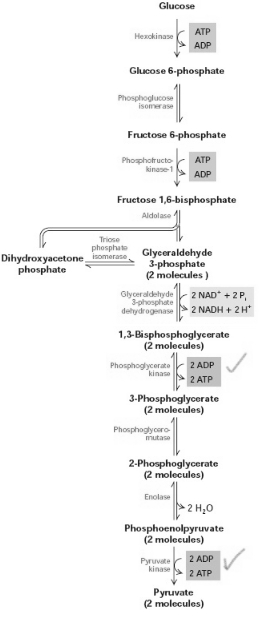
(A) In glycolysis,$ATP$ is synthesised via substrate-level phosphorylation at two specific steps:
$(i)$ Conversion of $1,3$-bisphosphoglycerate to $3$-phosphoglycerate,catalyzed by phosphoglycerate kinase.
$(ii)$ Conversion of phosphoenolpyruvate $(PEP)$ to pyruvate,catalyzed by pyruvate kinase.
Among the given options,the conversion of $1,3$-bisphosphoglycerate to $3$-phosphoglycerate is a step where $ATP$ is produced.
$(i)$ Conversion of $1,3$-bisphosphoglycerate to $3$-phosphoglycerate,catalyzed by phosphoglycerate kinase.
$(ii)$ Conversion of phosphoenolpyruvate $(PEP)$ to pyruvate,catalyzed by pyruvate kinase.
Among the given options,the conversion of $1,3$-bisphosphoglycerate to $3$-phosphoglycerate is a step where $ATP$ is produced.
0 likes
View Solution158
MediumMCQ
Glycolysis:
$I$. Causes partial oxidation of glucose (one molecule) to form $2$ molecules of pyruvic acid and $2$ $ATP$ as net gain.
$II$. Takes place in all living cells.
$III$. Uses $2$ $ATP$ at two steps.
$IV$. Scheme was given by Gustav Embden,Otto Meyerhof,and $J$. Parnas.
Choose the correct option containing appropriate statements from the above.
$I$. Causes partial oxidation of glucose (one molecule) to form $2$ molecules of pyruvic acid and $2$ $ATP$ as net gain.
$II$. Takes place in all living cells.
$III$. Uses $2$ $ATP$ at two steps.
$IV$. Scheme was given by Gustav Embden,Otto Meyerhof,and $J$. Parnas.
Choose the correct option containing appropriate statements from the above.
A
$I, II$ and $III$
B
$I, II$ and $IV$
C
$I, II, III$ and $IV$
D
Only $I$
Solution
(C) $I$. Glycolysis is the partial oxidation of one molecule of glucose into two molecules of pyruvic acid. It results in a net gain of $2$ $ATP$ molecules.
$II$. Glycolysis occurs in the cytoplasm of all living cells,whether prokaryotic or eukaryotic.
$III$. During the preparatory phase of glycolysis,$2$ $ATP$ molecules are consumed: one during the phosphorylation of glucose to glucose-$6$-phosphate and another during the phosphorylation of fructose-$6$-phosphate to fructose-$1,6$-bisphosphate.
$IV$. The metabolic pathway of glycolysis is also known as the $EMP$ pathway,named after its discoverers: Gustav Embden,Otto Meyerhof,and $J$. Parnas.
Since all four statements are correct,the correct option is $C$.
$II$. Glycolysis occurs in the cytoplasm of all living cells,whether prokaryotic or eukaryotic.
$III$. During the preparatory phase of glycolysis,$2$ $ATP$ molecules are consumed: one during the phosphorylation of glucose to glucose-$6$-phosphate and another during the phosphorylation of fructose-$6$-phosphate to fructose-$1,6$-bisphosphate.
$IV$. The metabolic pathway of glycolysis is also known as the $EMP$ pathway,named after its discoverers: Gustav Embden,Otto Meyerhof,and $J$. Parnas.
Since all four statements are correct,the correct option is $C$.
0 likes
View Solution159
MediumMCQ
Which of the following reactions does not take place in the cell organelle that is referred to as the 'Powerhouse of the cell'?
A
Glycine decarboxylation
B
Glyceraldehyde $3$-phosphate dehydrogenation
C
Fumaric acid hydration
D
Cytochrome oxidation
Solution
(B) Mitochondria are known as the powerhouse of the cell.
$1$. Glyceraldehyde-$3$-phosphate dehydrogenation is a key step in glycolysis,which occurs in the cytoplasm,not in the mitochondria.
$2$. Glycine decarboxylation occurs in the mitochondria during photorespiration.
$3$. Fumaric acid hydration is a step in the Krebs cycle ($TCA$ cycle),which occurs in the mitochondrial matrix.
$4$. Cytochrome oxidation is a part of the Electron Transport System $(ETS)$,which occurs on the inner mitochondrial membrane.
$1$. Glyceraldehyde-$3$-phosphate dehydrogenation is a key step in glycolysis,which occurs in the cytoplasm,not in the mitochondria.
$2$. Glycine decarboxylation occurs in the mitochondria during photorespiration.
$3$. Fumaric acid hydration is a step in the Krebs cycle ($TCA$ cycle),which occurs in the mitochondrial matrix.
$4$. Cytochrome oxidation is a part of the Electron Transport System $(ETS)$,which occurs on the inner mitochondrial membrane.
0 likes
View Solution160
MediumMCQ
In which of the following reactions of glycolysis, oxidation takes place?
A
Glucose $6-PO_4$ to fructose $6-PO_4$
B
Glyceraldehyde $3$-phosphate to $1,3$-diphosphoglycerate
C
$1,3$-diphosphoglycerate to $3$-phosphoglycerate
D
$2$-phosphoglycerate to phosphoenolpyruvate
Solution
(B) In the glycolytic pathway, Glyceraldehyde $3$-phosphate ($3$-$PGAL$) is converted into $1,3$-bisphosphoglycerate ($1,3$-$BPG$) by the enzyme glyceraldehyde $3$-phosphate dehydrogenase.
This reaction involves the oxidation of $3$-$PGAL$ and the addition of an inorganic phosphate group $(P_i)$.
During this process, $NAD^+$ is reduced to $NADH + H^+$.
The reaction is: $3$-phosphoglyceraldehyde $+ NAD^+ + P_i \rightarrow 1,3$-bisphosphoglycerate $+ NADH + H^+$.
This reaction involves the oxidation of $3$-$PGAL$ and the addition of an inorganic phosphate group $(P_i)$.
During this process, $NAD^+$ is reduced to $NADH + H^+$.
The reaction is: $3$-phosphoglyceraldehyde $+ NAD^+ + P_i \rightarrow 1,3$-bisphosphoglycerate $+ NADH + H^+$.
0 likes
View Solution161
EasyMCQ
The common step of both aerobic and anaerobic respiration is:
A
$EMP$ pathway
B
Tricarboxylic acid cycle
C
Acetyl $CoA$ formation
D
Citric acid cycle
Solution
(A) The common step for both aerobic and anaerobic respiration is Glycolysis,also known as the $EMP$ pathway (Embden-Meyerhof-Parnas pathway).
In this process,one molecule of glucose is broken down into two molecules of pyruvic acid in the cytoplasm.
After glycolysis,the fate of pyruvic acid depends on the availability of oxygen,leading either to aerobic respiration (Krebs cycle) or anaerobic respiration (fermentation).
In this process,one molecule of glucose is broken down into two molecules of pyruvic acid in the cytoplasm.
After glycolysis,the fate of pyruvic acid depends on the availability of oxygen,leading either to aerobic respiration (Krebs cycle) or anaerobic respiration (fermentation).
0 likes
View Solution162
MediumMCQ
Which of the following pathways was described by Embden,Meyerhof,and Parnas?
A
Glycolysis
B
Acetyl $CoA$ formation step
C
Krebs cycle
D
Pentose phosphate pathway
Solution
(A) The pathway described by Embden,Meyerhof,and Parnas is known as the $EMP$ pathway,which is another name for Glycolysis. This metabolic process occurs in the cytoplasm and involves the breakdown of one molecule of glucose into two molecules of pyruvic acid.
0 likes
View Solution163
MediumMCQ
Glycolysis occurs in
A
All living cells
B
Only eukaryotic cells
C
Nerve cells
D
Only muscle cells
Solution
(A) Glycolysis is the first stage of cellular respiration. It takes place in the cytoplasm of all living cells,regardless of whether they are prokaryotic or eukaryotic,as it does not require oxygen.
0 likes
View Solution164
MediumMCQ
All are true about glycolysis,except:
A
Oxygen independent pathway
B
It produces one pyruvic acid molecule from each glucose
C
It occurs in the cytoplasm of cell
D
It can operate by using both glucose and fructose
Solution
(B) Glycolysis is the partial oxidation of one molecule of glucose $(6C)$ into two molecules of pyruvic acid $(3C)$.
Option $A$ is true because glycolysis does not require oxygen.
Option $B$ is false because one molecule of glucose produces two molecules of pyruvic acid,not one.
Option $C$ is true because glycolysis takes place in the cytoplasm of the cell.
Option $D$ is true because other hexose sugars like fructose can also enter the glycolytic pathway after being phosphorylated.
Option $A$ is true because glycolysis does not require oxygen.
Option $B$ is false because one molecule of glucose produces two molecules of pyruvic acid,not one.
Option $C$ is true because glycolysis takes place in the cytoplasm of the cell.
Option $D$ is true because other hexose sugars like fructose can also enter the glycolytic pathway after being phosphorylated.
0 likes
View Solution165
EasyMCQ
In $EMP$ pathway,hexose sugar splits into two molecules of triose sugar by the catalytic activity of
A
Phosphofructokinase
B
Aldolase
C
Dehydrogenase
D
Transphosphorylase
Solution
(B) In the $EMP$ pathway (Glycolysis),the enzyme $Aldolase$ catalyzes the cleavage of the $6$-carbon sugar $Fructose-1,6-bisphosphate$ into two $3$-carbon molecules: $Dihydroxyacetone$ $phosphate$ $(DHAP)$ and $Glyceraldehyde-3-phosphate$ $(G3P)$.
Glucose $\longrightarrow$ $Glucose-6-phosphate$ $\longrightarrow$ $Fructose-6-phosphate$ $\longrightarrow$ $Fructose-1,6-bisphosphate$ $\xrightarrow{\text{Aldolase}}$ $2$ molecules of $Triose$ $phosphate$.
Glucose $\longrightarrow$ $Glucose-6-phosphate$ $\longrightarrow$ $Fructose-6-phosphate$ $\longrightarrow$ $Fructose-1,6-bisphosphate$ $\xrightarrow{\text{Aldolase}}$ $2$ molecules of $Triose$ $phosphate$.
0 likes
View Solution166
EasyMCQ
Interconversion of glyceraldehyde-$3$-phosphate and dihydroxyacetone phosphate is catalysed by which enzyme?
A
Phosphotriose isomerase
B
Phosphohexose isomerase
C
Phosphoglyceromutase
D
Triose kinase
Solution
(A) During glycolysis,the fructose-$1,6$-bisphosphate is cleaved into two $3$-carbon compounds: glyceraldehyde-$3$-phosphate ($G$-$3$-$P$) and dihydroxyacetone phosphate $(DHAP)$.
These two triose phosphates are isomers of each other.
The enzyme that catalyses the reversible interconversion between glyceraldehyde-$3$-phosphate and dihydroxyacetone phosphate is known as triose phosphate isomerase (also referred to as phosphotriose isomerase).
Therefore,the correct option is $A$.
These two triose phosphates are isomers of each other.
The enzyme that catalyses the reversible interconversion between glyceraldehyde-$3$-phosphate and dihydroxyacetone phosphate is known as triose phosphate isomerase (also referred to as phosphotriose isomerase).
Therefore,the correct option is $A$.

0 likes
View Solution167
MediumMCQ
Reducing power $NADH + H^+$ is produced during which conversion step of glycolysis?
A
$3$-phosphoglyceric acid to $2$-phosphoglycerate
B
Glyceraldehyde-$3$-phosphate to $1,3$-bisphosphoglyceric acid
C
$2$-phosphoglycerate to phosphoenol pyruvate
D
Phosphoenol pyruvate to pyruvic acid
Solution
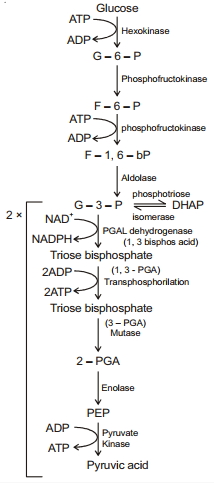
(B) In the process of glycolysis,the oxidation of Glyceraldehyde-$3$-phosphate $(G3P)$ to $1,3$-bisphosphoglyceric acid $(1,3-BPGA)$ is catalyzed by the enzyme Glyceraldehyde-$3$-phosphate dehydrogenase.
During this reaction,$NAD^+$ is reduced to $NADH + H^+$,which serves as a crucial reducing power for subsequent metabolic processes.
During this reaction,$NAD^+$ is reduced to $NADH + H^+$,which serves as a crucial reducing power for subsequent metabolic processes.
0 likes
View Solution168
MediumMCQ
Which enzyme of glycolysis is also called as the pacemaker enzyme?
A
Hexokinase
B
Enolase
C
Phosphofructokinase
D
Pyruvate kinase
Solution
(C) Phosphofructokinase $(PFK)$ is known as the pacemaker enzyme of glycolysis.
It catalyzes the irreversible conversion of fructose-$6$-phosphate to fructose-$1,6$-bisphosphate.
This step is the rate-limiting step of the glycolytic pathway,which determines the overall flux of the process based on the cell's energy requirements.
It catalyzes the irreversible conversion of fructose-$6$-phosphate to fructose-$1,6$-bisphosphate.
This step is the rate-limiting step of the glycolytic pathway,which determines the overall flux of the process based on the cell's energy requirements.
0 likes
View Solution169
MediumMCQ
During cellular respiration,the number of $ATP$ molecules used during the conversion of glucose into glyceraldehyde-$3$-phosphate is:
A
$1$
B
$2$
C
$3$
D
$4$
Solution
(B) In the process of glycolysis,the conversion of glucose to glyceraldehyde-$3$-phosphate occurs in the preparatory phase.
$1$. First,glucose is phosphorylated to glucose-$6$-phosphate by the enzyme hexokinase,which consumes $1$ $ATP$ molecule.
$2$. Then,glucose-$6$-phosphate is isomerized to fructose-$6$-phosphate.
$3$. Finally,fructose-$6$-phosphate is phosphorylated to fructose-$1,6$-bisphosphate by the enzyme phosphofructokinase,which consumes another $1$ $ATP$ molecule.
$4$. Fructose-$1,6$-bisphosphate is then split into glyceraldehyde-$3$-phosphate and dihydroxyacetone phosphate.
Thus,a total of $2$ $ATP$ molecules are consumed in this phase.
$1$. First,glucose is phosphorylated to glucose-$6$-phosphate by the enzyme hexokinase,which consumes $1$ $ATP$ molecule.
$2$. Then,glucose-$6$-phosphate is isomerized to fructose-$6$-phosphate.
$3$. Finally,fructose-$6$-phosphate is phosphorylated to fructose-$1,6$-bisphosphate by the enzyme phosphofructokinase,which consumes another $1$ $ATP$ molecule.
$4$. Fructose-$1,6$-bisphosphate is then split into glyceraldehyde-$3$-phosphate and dihydroxyacetone phosphate.
Thus,a total of $2$ $ATP$ molecules are consumed in this phase.

0 likes
View Solution170
EasyMCQ
Which of the given enzymes of glycolysis is required at the beginning of the process?
A
Hexokinase
B
Aldolase
C
Isomerase
D
Mutase
Solution
(A) Glycolysis begins with the phosphorylation of glucose to form glucose-$6$-phosphate. This reaction is catalyzed by the enzyme $Hexokinase$ in the presence of $ATP$ and $Mg^{2+}$.
Equation: $\text{Glucose} \xrightarrow{\text{Hexokinase}} \text{Glucose-}6\text{-Phosphate}$.
Equation: $\text{Glucose} \xrightarrow{\text{Hexokinase}} \text{Glucose-}6\text{-Phosphate}$.
0 likes
View Solution171
EasyMCQ
The conversion of fructose-$6$-phosphate to fructose-$1,6$-bisphosphate during respiration requires which of the following enzymes?
A
Hexokinase
B
Enolase
C
Phosphofructokinase
D
Pyruvate kinase
Solution
(C) In the process of glycolysis,the conversion of fructose-$6$-phosphate to fructose-$1,6$-bisphosphate is an irreversible step.
This reaction is catalyzed by the enzyme Phosphofructokinase $(PFK)$.
This step consumes one molecule of $ATP$ and is a key regulatory point in the glycolytic pathway.
The reaction is represented as: Fructose-$6$-phosphate + $ATP$ $\xrightarrow{\text{Phosphofructokinase}}$ Fructose-$1,6$-bisphosphate + $ADP$.
This reaction is catalyzed by the enzyme Phosphofructokinase $(PFK)$.
This step consumes one molecule of $ATP$ and is a key regulatory point in the glycolytic pathway.
The reaction is represented as: Fructose-$6$-phosphate + $ATP$ $\xrightarrow{\text{Phosphofructokinase}}$ Fructose-$1,6$-bisphosphate + $ADP$.
0 likes
View Solution172
MediumMCQ
How many redox equivalents are removed from two molecules of $3$-$PGAL$?
A
$3$
B
$4$
C
$1$
D
$2$
Solution
(B) In the process of glycolysis,$3$-$PGAL$ (glyceraldehyde $3$-phosphate) is oxidized to $1,3$-bisphosphoglycerate. During this reaction,$2$ redox equivalents (in the form of $2H^+$ and $2e^-$) are removed from each molecule of $3$-$PGAL$ to reduce $NAD^+$ to $NADH + H^+$. Therefore,for two molecules of $3$-$PGAL$,a total of $4$ redox equivalents are removed.
0 likes
View Solution173
MediumMCQ
Substrate level phosphorylation does not occur in which of the following reactions of aerobic respiration?
A
$1,3-bisphosphoglycerate \longrightarrow 3-phosphoglycerate$
B
$3-phosphoglycerate \longrightarrow 2-phosphoglycerate$
C
$Phosphoenolpyruvate \longrightarrow Pyruvate$
D
$Succinyl-CoA \longrightarrow Succinic acid$
Solution
(B) Substrate level phosphorylation is the direct transfer of a phosphate group from a substrate molecule to $ADP$ to form $ATP$.
In the reaction $1,3-bisphosphoglycerate \longrightarrow 3-phosphoglycerate$,$ATP$ is produced.
In the reaction $Phosphoenolpyruvate \longrightarrow Pyruvate$,$ATP$ is produced.
In the reaction $Succinyl-CoA \longrightarrow Succinic acid$,$GTP$ (or $ATP$) is produced.
In the reaction $3-phosphoglycerate \longrightarrow 2-phosphoglycerate$,there is no phosphate transfer to $ADP$; instead,the phosphate group is simply shifted from the $3^{rd}$ carbon to the $2^{nd}$ carbon by the enzyme phosphoglyceromutase.
In the reaction $1,3-bisphosphoglycerate \longrightarrow 3-phosphoglycerate$,$ATP$ is produced.
In the reaction $Phosphoenolpyruvate \longrightarrow Pyruvate$,$ATP$ is produced.
In the reaction $Succinyl-CoA \longrightarrow Succinic acid$,$GTP$ (or $ATP$) is produced.
In the reaction $3-phosphoglycerate \longrightarrow 2-phosphoglycerate$,there is no phosphate transfer to $ADP$; instead,the phosphate group is simply shifted from the $3^{rd}$ carbon to the $2^{nd}$ carbon by the enzyme phosphoglyceromutase.
0 likes
View Solution174
MediumMCQ
How is $PGA$ formed from $PGAL$?
A
By oxidation and phosphorylation
B
By reduction and phosphorylation
C
By oxidation and dephosphorylation
D
By reduction and dephosphorylation
Solution
(A) During glycolysis,$PGAL$ (glyceraldehyde-$3$-phosphate) is oxidized to $BPGA$ ($1,3$-bisphosphoglyceric acid).
In this step,two redox-equivalents are removed from $PGAL$ in the form of hydrogen atoms and transferred to a molecule of $NAD^{+}$ to form $NADH + H^{+}$.
$PGAL$ also reacts with inorganic phosphate $(Pi)$ to form $BPGA$.
Subsequently,$BPGA$ is converted into $3$-phosphoglyceric acid $(PGA)$ by the enzyme phosphoglycerate kinase,a process that yields $ATP$ from $ADP$.
In this step,two redox-equivalents are removed from $PGAL$ in the form of hydrogen atoms and transferred to a molecule of $NAD^{+}$ to form $NADH + H^{+}$.
$PGAL$ also reacts with inorganic phosphate $(Pi)$ to form $BPGA$.
Subsequently,$BPGA$ is converted into $3$-phosphoglyceric acid $(PGA)$ by the enzyme phosphoglycerate kinase,a process that yields $ATP$ from $ADP$.
0 likes
View Solution175
MediumMCQ
The products of aerobic glycolysis in skeletal muscle and anaerobic fermentation in yeast are respectively $..........$ and $..........$.
A
Lactic acid and Ethanol + $CO_{2}$
B
Pyruvic acid and Ethanol + $CO_{2}$
C
Ethanol + $CO_{2}$ and Lactic acid
D
Pyruvic acid and Lactic acid
Solution
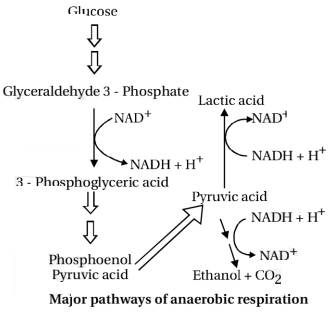
(B) Glycolysis is a common pathway for both aerobic and anaerobic respiration,where glucose is broken down into two molecules of pyruvic acid.
In skeletal muscle cells,under aerobic conditions,the end product of glycolysis is pyruvic acid,which then enters the Krebs cycle.
In yeast,during anaerobic fermentation,the pyruvic acid produced by glycolysis is further converted into ethanol and $CO_{2}$.
Therefore,the products are pyruvic acid and ethanol + $CO_{2}$ respectively.
In skeletal muscle cells,under aerobic conditions,the end product of glycolysis is pyruvic acid,which then enters the Krebs cycle.
In yeast,during anaerobic fermentation,the pyruvic acid produced by glycolysis is further converted into ethanol and $CO_{2}$.
Therefore,the products are pyruvic acid and ethanol + $CO_{2}$ respectively.
0 likes
View Solution176
MediumMCQ
What is the net gain of $ATP$ when each molecule of glucose is converted to two molecules of pyruvic acid?
A
Six
B
Two
C
Eight
D
Four
Solution
(B) The process of converting one molecule of glucose into two molecules of pyruvic acid is known as glycolysis.
During glycolysis,$2$ molecules of $ATP$ are consumed in the preparatory phase.
In the payoff phase,$4$ molecules of $ATP$ are produced via substrate-level phosphorylation.
Therefore,the net gain of $ATP$ is $4 - 2 = 2$ molecules of $ATP$ per molecule of glucose.
During glycolysis,$2$ molecules of $ATP$ are consumed in the preparatory phase.
In the payoff phase,$4$ molecules of $ATP$ are produced via substrate-level phosphorylation.
Therefore,the net gain of $ATP$ is $4 - 2 = 2$ molecules of $ATP$ per molecule of glucose.
0 likes
View Solution177
MediumMCQ
Glycolysis is a $........$ process and is completed in $......$ steps.
A
Anabolic,$10$
B
Catabolic,$10$
C
Anabolic,$20$
D
Catabolic,$20$
Solution
(B) Glycolysis is a catabolic process because it involves the breakdown of glucose into two molecules of pyruvic acid.
It is a series of $10$ enzyme-catalyzed reactions that occur in the cytoplasm of the cell.
It is a series of $10$ enzyme-catalyzed reactions that occur in the cytoplasm of the cell.
0 likes
View Solution178
EasyMCQ
How many types of enzymes are required for the completion of the process of glycolysis?
A
$1$
B
$5$
C
$10$
D
$20$
Solution
(C) Glycolysis is a metabolic pathway that converts glucose $(C_6H_{12}O_6)$ into pyruvate $(CH_3COCOO^-)$.
This process consists of a series of $10$ enzyme-catalyzed reactions.
Each step in the glycolytic pathway is mediated by a specific enzyme,such as hexokinase,phosphofructokinase,and pyruvate kinase,among others.
Therefore,a total of $10$ different enzymes are required to complete the process of glycolysis.
This process consists of a series of $10$ enzyme-catalyzed reactions.
Each step in the glycolytic pathway is mediated by a specific enzyme,such as hexokinase,phosphofructokinase,and pyruvate kinase,among others.
Therefore,a total of $10$ different enzymes are required to complete the process of glycolysis.
0 likes
View Solution179
MediumMCQ
Glycolysis is $................$
A
Anaerobic phase of aerobic respiration
B
$EMP$ pathway
C
First stage of respiration
D
All of the above
Solution
(D) Glycolysis is the process of breakdown of glucose into two molecules of pyruvic acid.
It is known as the $EMP$ pathway,named after its discoverers Embden,Meyerhof,and Parnas.
It is the first stage of respiration that occurs in the cytoplasm of the cell.
Since it does not require oxygen,it is considered the anaerobic phase of respiration,even in aerobic organisms.
Therefore,all the given statements are correct.
It is known as the $EMP$ pathway,named after its discoverers Embden,Meyerhof,and Parnas.
It is the first stage of respiration that occurs in the cytoplasm of the cell.
Since it does not require oxygen,it is considered the anaerobic phase of respiration,even in aerobic organisms.
Therefore,all the given statements are correct.
0 likes
View Solution180
MediumMCQ
Identify the incorrect reaction from the following processes.
A
Glucose-$6$-phosphate $\rightarrow$ Fructose-$6$-phosphate
B
$PGAL \rightarrow DHAP$
C
$3-PGA \rightarrow 2-PGA$
D
$PEP \rightarrow$ Pyruvic acid
Solution
(A) In the process of glycolysis,the conversion of Glucose-$6$-phosphate to Fructose-$6$-phosphate is catalyzed by the enzyme phosphoglucose isomerase.
Option $A$ states 'Glucose-$6$-phosphate $\rightarrow$ Phosphate-$6$-phosphate',which is chemically incorrect and does not represent a standard step in glycolysis.
Option $B$ $(PGAL \rightarrow DHAP)$ is a reversible reaction catalyzed by triose phosphate isomerase.
Option $C$ $(3-PGA \rightarrow 2-PGA)$ is catalyzed by phosphoglyceromutase.
Option $D$ ($PEP \rightarrow$ Pyruvic acid) is the final step of glycolysis catalyzed by pyruvate kinase.
Therefore,option $A$ is the incorrect reaction.
Option $A$ states 'Glucose-$6$-phosphate $\rightarrow$ Phosphate-$6$-phosphate',which is chemically incorrect and does not represent a standard step in glycolysis.
Option $B$ $(PGAL \rightarrow DHAP)$ is a reversible reaction catalyzed by triose phosphate isomerase.
Option $C$ $(3-PGA \rightarrow 2-PGA)$ is catalyzed by phosphoglyceromutase.
Option $D$ ($PEP \rightarrow$ Pyruvic acid) is the final step of glycolysis catalyzed by pyruvate kinase.
Therefore,option $A$ is the incorrect reaction.
0 likes
View Solution181
EasyMCQ
Which enzyme catalyzes the conversion of glucose into glucose-$6$-phosphate?
A
Phosphorylase
B
Hexokinase
C
Invertase
D
Isomerase
Solution
(B) The conversion of glucose into glucose-$6$-phosphate is the first step of glycolysis.
This reaction is catalyzed by the enzyme hexokinase.
In this process,one molecule of $ATP$ is consumed to provide the phosphate group,and the reaction is irreversible under physiological conditions.
This reaction is catalyzed by the enzyme hexokinase.
In this process,one molecule of $ATP$ is consumed to provide the phosphate group,and the reaction is irreversible under physiological conditions.
0 likes
View Solution182
MediumMCQ
What type of process is glycolysis?
A
Reductive
B
Oxidative
C
Redox
D
None of these
Solution
(C) Glycolysis is a metabolic pathway that converts glucose $(C_6H_{12}O_6)$ into pyruvate $(CH_3COCOO^-)$.
During this process,$NAD^+$ is reduced to $NADH + H^+$,while glucose is oxidized to pyruvate.
Since both oxidation and reduction reactions occur simultaneously in this pathway,it is classified as a redox process.
During this process,$NAD^+$ is reduced to $NADH + H^+$,while glucose is oxidized to pyruvate.
Since both oxidation and reduction reactions occur simultaneously in this pathway,it is classified as a redox process.
0 likes
View Solution183
MediumMCQ
Which of the following processes is completed by dehydration?
A
$2$-Phosphoglycerate $\rightarrow$ Phosphoenolpyruvate
B
Phosphoenolpyruvate $\rightarrow$ Pyruvic acid
C
$1,3-BPGA \rightarrow 3-PGA$
D
$DHAP \rightarrow PGAL$
Solution
(A) In the process of glycolysis,the conversion of $2$-phosphoglycerate $(2-PGA)$ to phosphoenolpyruvate $(PEP)$ is catalyzed by the enzyme enolase.
This reaction involves the removal of a water molecule $(H_2O)$,which is known as a dehydration reaction.
Therefore,the correct process completed by dehydration is $2$-phosphoglycerate $\rightarrow$ phosphoenolpyruvate.
This reaction involves the removal of a water molecule $(H_2O)$,which is known as a dehydration reaction.
Therefore,the correct process completed by dehydration is $2$-phosphoglycerate $\rightarrow$ phosphoenolpyruvate.
0 likes
View Solution184
EasyMCQ
Where does glycolysis take place?
A
Mitochondria
B
Cell membrane
C
Cytoplasm
D
Nucleus
Solution
(C) Glycolysis is the first stage of cellular respiration. It involves the breakdown of glucose into two molecules of pyruvate. This process occurs in the cytoplasm of the cell,as the enzymes required for the ten steps of glycolysis are present in the cytosol.
0 likes
View Solution185
MediumMCQ
Match the following columns:
| Column-$I$ (Molecules) | Column-$II$ (Number of Carbon and Phosphorus) |
| $P$. Fructose $1, 6$-bisphosphate | $I$. $(C-3), (P-2)$ |
| $Q$. Glucose-$6$-phosphate | $II$. $(C-3), (P-1)$ |
| $R$. $DHAP$ | $III$. $(C-6), (P-2)$ |
| $S$. $BPGA$ | $IV$. $(C-6), (P-1)$ |
A
$(P-III), (Q-IV), (R-II), (S-I)$
B
$(P-III), (Q-IV), (R-I), (S-II)$
C
$(P-IV), (Q-III), (R-I), (S-II)$
D
$(P-IV), (Q-III), (R-II), (S-I)$
Solution
(A) The correct matching is based on the carbon skeleton and phosphate groups present in the intermediates of glycolysis:
$P$. Fructose $1, 6$-bisphosphate: It is a $6$-carbon sugar with $2$ phosphate groups. Hence, $(P-III)$.
$Q$. Glucose-$6$-phosphate: It is a $6$-carbon sugar with $1$ phosphate group. Hence, $(Q-IV)$.
$R$. $DHAP$ (Dihydroxyacetone phosphate): It is a $3$-carbon triose sugar with $1$ phosphate group. Hence, $(R-II)$.
$S$. $BPGA$ ($1, 3$-bisphosphoglyceric acid): It is a $3$-carbon molecule with $2$ phosphate groups. Hence, $(S-I)$.
Therefore, the correct sequence is $(P-III), (Q-IV), (R-II), (S-I)$.
$P$. Fructose $1, 6$-bisphosphate: It is a $6$-carbon sugar with $2$ phosphate groups. Hence, $(P-III)$.
$Q$. Glucose-$6$-phosphate: It is a $6$-carbon sugar with $1$ phosphate group. Hence, $(Q-IV)$.
$R$. $DHAP$ (Dihydroxyacetone phosphate): It is a $3$-carbon triose sugar with $1$ phosphate group. Hence, $(R-II)$.
$S$. $BPGA$ ($1, 3$-bisphosphoglyceric acid): It is a $3$-carbon molecule with $2$ phosphate groups. Hence, $(S-I)$.
Therefore, the correct sequence is $(P-III), (Q-IV), (R-II), (S-I)$.
0 likes
View Solution186
EasyMCQ
Select the correct option for glycolysis.
A
Glycolysis means the splitting of sugar.
B
This process was given by Gustav Embden,Otto Meyerhof,and $J$. Parnas.
C
Glycolysis occurs in all living organisms.
D
All of the above.
Solution
(D) Glycolysis is the partial oxidation of glucose into two molecules of pyruvic acid.
$1$. The term 'Glycolysis' has originated from the Greek words 'glycos' (sugar) and 'lysis' (splitting),meaning the splitting of sugar.
$2$. This metabolic pathway was discovered by Gustav Embden,Otto Meyerhof,and $J$. Parnas,and is often referred to as the $EMP$ pathway.
$3$. Glycolysis is the only process of respiration in anaerobic organisms and is the first step of respiration in aerobic organisms. Thus,it occurs in all living organisms.
$1$. The term 'Glycolysis' has originated from the Greek words 'glycos' (sugar) and 'lysis' (splitting),meaning the splitting of sugar.
$2$. This metabolic pathway was discovered by Gustav Embden,Otto Meyerhof,and $J$. Parnas,and is often referred to as the $EMP$ pathway.
$3$. Glycolysis is the only process of respiration in anaerobic organisms and is the first step of respiration in aerobic organisms. Thus,it occurs in all living organisms.
0 likes
View Solution187
MediumMCQ
In how many steps is glycolysis completed?
A
$8$
B
$9$
C
$10$
D
$11$
Solution
(C) Glycolysis,also known as the $EMP$ pathway,is the process of breaking down one molecule of glucose into two molecules of pyruvic acid.
This metabolic pathway consists of a series of $10$ enzyme-catalyzed reactions.
These reactions occur in the cytoplasm of the cell and do not require oxygen.
Therefore,the correct number of steps in glycolysis is $10$.
This metabolic pathway consists of a series of $10$ enzyme-catalyzed reactions.
These reactions occur in the cytoplasm of the cell and do not require oxygen.
Therefore,the correct number of steps in glycolysis is $10$.
0 likes
View Solution188
MediumMCQ
In the process of glycolysis,the number of $ATP$ molecules produced and consumed are,respectively:
A
$4, 4$
B
$2, 2$
C
$2, 4$
D
$4, 2$
Solution
(D) During glycolysis,$4$ molecules of $ATP$ are produced through substrate-level phosphorylation (two in the conversion of $1,3$-bisphosphoglycerate to $3$-phosphoglycerate and two in the conversion of phosphoenolpyruvate to pyruvate).
$2$ molecules of $ATP$ are consumed during the preparatory phase (one in the phosphorylation of glucose to glucose-$6$-phosphate and one in the phosphorylation of fructose-$6$-phosphate to fructose-$1,6$-bisphosphate).
Therefore,the number of $ATP$ produced is $4$ and consumed is $2$.
$2$ molecules of $ATP$ are consumed during the preparatory phase (one in the phosphorylation of glucose to glucose-$6$-phosphate and one in the phosphorylation of fructose-$6$-phosphate to fructose-$1,6$-bisphosphate).
Therefore,the number of $ATP$ produced is $4$ and consumed is $2$.
0 likes
View Solution189
MediumMCQ
How many $NADH + H^+$ molecules are produced during the process of glycolysis?
A
$1$
B
$2$
C
$3$
D
$4$
Solution
(B) Glycolysis is the breakdown of glucose into two molecules of pyruvic acid.
During the conversion of glyceraldehyde$-3-$phosphate $(G3P)$ to $1,3-$bisphosphoglycerate,the enzyme glyceraldehyde$-3-$phosphate dehydrogenase catalyzes the reduction of $NAD^+$ to $NADH + H^+$.
Since one molecule of glucose produces two molecules of $G3P$,this step occurs twice per glucose molecule.
Therefore,a total of $2$ $NADH + H^+$ molecules are produced during glycolysis.
During the conversion of glyceraldehyde$-3-$phosphate $(G3P)$ to $1,3-$bisphosphoglycerate,the enzyme glyceraldehyde$-3-$phosphate dehydrogenase catalyzes the reduction of $NAD^+$ to $NADH + H^+$.
Since one molecule of glucose produces two molecules of $G3P$,this step occurs twice per glucose molecule.
Therefore,a total of $2$ $NADH + H^+$ molecules are produced during glycolysis.
0 likes
View Solution190
EasyMCQ
Which stage is common to lactic acid fermentation,alcoholic fermentation,and aerobic respiration?
A
Glycolysis
B
Krebs cycle
C
Oxidative phosphorylation
D
All of the above
Solution
(A) Glycolysis is the common pathway for both aerobic and anaerobic respiration (including lactic acid and alcoholic fermentation).
In glycolysis,$1$ molecule of glucose $(6C)$ is broken down into $2$ molecules of pyruvic acid $(3C)$.
This process occurs in the cytoplasm of the cell and does not require oxygen.
Since all three processes (lactic acid fermentation,alcoholic fermentation,and aerobic respiration) start with the breakdown of glucose into pyruvic acid,glycolysis is the common stage.
In glycolysis,$1$ molecule of glucose $(6C)$ is broken down into $2$ molecules of pyruvic acid $(3C)$.
This process occurs in the cytoplasm of the cell and does not require oxygen.
Since all three processes (lactic acid fermentation,alcoholic fermentation,and aerobic respiration) start with the breakdown of glucose into pyruvic acid,glycolysis is the common stage.
0 likes
View Solution191
MediumMCQ
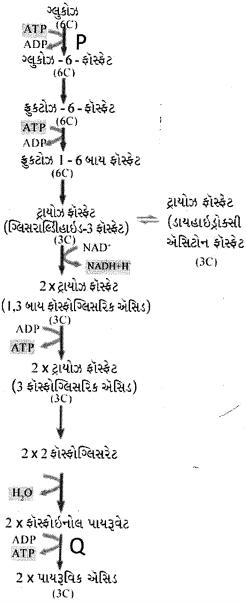
In the given process,which enzymes control $P$ and $Q$?
A
Hexokinase,Aldolase
B
Aldolase,Hexokinase
C
Hexokinase,Enolase
D
Enolase,Hexokinase
Solution
(C) In the process of glycolysis:
$1$. The conversion of Glucose to Glucose$-6-$phosphate is catalyzed by the enzyme Hexokinase $(P)$.
$2$. The conversion of Phosphoenolpyruvate to Pyruvic acid is catalyzed by the enzyme Pyruvate kinase $(Q)$.
$3$. Among the given options,the enzyme Enolase is involved in the step preceding the formation of Phosphoenolpyruvate (conversion of $2-$phosphoglycerate to phosphoenolpyruvate). However,looking at the options provided,the most appropriate choice for $P$ is Hexokinase. Since Pyruvate kinase is not listed,we evaluate the options based on the provided choices. Option $C$ lists Hexokinase for $P$ and Enolase for $Q$,which is the closest match in the context of glycolytic enzymes provided in the options.
$1$. The conversion of Glucose to Glucose$-6-$phosphate is catalyzed by the enzyme Hexokinase $(P)$.
$2$. The conversion of Phosphoenolpyruvate to Pyruvic acid is catalyzed by the enzyme Pyruvate kinase $(Q)$.
$3$. Among the given options,the enzyme Enolase is involved in the step preceding the formation of Phosphoenolpyruvate (conversion of $2-$phosphoglycerate to phosphoenolpyruvate). However,looking at the options provided,the most appropriate choice for $P$ is Hexokinase. Since Pyruvate kinase is not listed,we evaluate the options based on the provided choices. Option $C$ lists Hexokinase for $P$ and Enolase for $Q$,which is the closest match in the context of glycolytic enzymes provided in the options.
0 likes
View Solution192
MediumMCQ
$ATP$ is not produced during this stage.
A
$PEP \rightarrow$ Pyruvic acid
B
$1, 3-BPGA \rightarrow 3-PGA$
C
Fructose-$6$-phosphate $\rightarrow$ Fructose-$1, 6$-bisphosphate
D
All of the above
Solution
(C) In glycolysis,$ATP$ is produced during the conversion of $1, 3$-bisphosphoglyceric acid $(1, 3-BPGA)$ to $3$-phosphoglyceric acid $(3-PGA)$ and during the conversion of phosphoenolpyruvate $(PEP)$ to pyruvic acid. These steps are examples of substrate-level phosphorylation. However,the conversion of Fructose-$6$-phosphate to Fructose-$1, 6$-bisphosphate is an energy-consuming step where $ATP$ is utilized (hydrolyzed to $ADP$),not produced. Therefore,$ATP$ is not produced in option $C$.
0 likes
View Solution193
MediumMCQ
What is the net gain of $ATP$ molecules produced during glycolysis in aerobic respiration?
A
$2$
B
$4$
C
$8$
D
$10$
Solution
(A) During the process of glycolysis,$1$ molecule of glucose ($6$ carbons) is broken down into $2$ molecules of pyruvic acid ($3$ carbons each).
In the energy-payoff phase,$4$ $ATP$ molecules are produced through substrate-level phosphorylation.
However,$2$ $ATP$ molecules are consumed during the preparatory phase (investment phase) to phosphorylate glucose and fructose$-6-$phosphate.
Therefore,the net gain of $ATP$ molecules in glycolysis is $4 - 2 = 2$ $ATP$.
In the energy-payoff phase,$4$ $ATP$ molecules are produced through substrate-level phosphorylation.
However,$2$ $ATP$ molecules are consumed during the preparatory phase (investment phase) to phosphorylate glucose and fructose$-6-$phosphate.
Therefore,the net gain of $ATP$ molecules in glycolysis is $4 - 2 = 2$ $ATP$.
0 likes
View Solution194
MediumMCQ
What is the net gain of $ATP$ molecules produced by glycolysis in anaerobic respiration?
A
$2$
B
$4$
C
$8$
D
$10$
Solution
(A) During the process of glycolysis,one molecule of glucose $(C_6H_{12}O_6)$ is broken down into two molecules of pyruvic acid.
In this pathway,a total of $4$ $ATP$ molecules are produced through substrate-level phosphorylation.
However,$2$ $ATP$ molecules are consumed during the preparatory phase (phosphorylation of glucose and fructose$-6-$phosphate).
Therefore,the net gain of $ATP$ molecules in glycolysis is $4 - 2 = 2$ $ATP$ per glucose molecule.
In this pathway,a total of $4$ $ATP$ molecules are produced through substrate-level phosphorylation.
However,$2$ $ATP$ molecules are consumed during the preparatory phase (phosphorylation of glucose and fructose$-6-$phosphate).
Therefore,the net gain of $ATP$ molecules in glycolysis is $4 - 2 = 2$ $ATP$ per glucose molecule.
0 likes
View Solution195
MediumMCQ
Given below are two statements: One is labelled as Assertion $A$ and the other is labelled as Reason $R$:
Assertion $A:$ $ATP$ is used at two steps in glycolysis.
Reason $R:$ First $ATP$ is used in converting glucose into glucose-$6$-phosphate and second $ATP$ is used in conversion of fructose-$6$-phosphate into fructose-$1,6$-bisphosphate.
In the light of the above statements,choose the correct answer from the options given below:
Assertion $A:$ $ATP$ is used at two steps in glycolysis.
Reason $R:$ First $ATP$ is used in converting glucose into glucose-$6$-phosphate and second $ATP$ is used in conversion of fructose-$6$-phosphate into fructose-$1,6$-bisphosphate.
In the light of the above statements,choose the correct answer from the options given below:
A
$A$ is false but $R$ is true.
B
Both $A$ and $R$ are true and $R$ is the correct explanation of $A$.
C
Both $A$ and $R$ are true but $R$ is $NOT$ the correct explanation of $A$.
D
$A$ is true but $R$ is false.
Solution
(B) $ATP$ is consumed in glycolysis at two specific phosphorylation steps:
$1$. Conversion of Glucose to Glucose-$6$-phosphate (catalyzed by hexokinase).
$2$. Conversion of Fructose-$6$-phosphate to Fructose-$1,6$-bisphosphate (catalyzed by phosphofructokinase).
Since both statements correctly describe the process of phosphorylation in glycolysis,Assertion $A$ is true,and Reason $R$ provides the correct explanation for why $ATP$ is used.
$1$. Conversion of Glucose to Glucose-$6$-phosphate (catalyzed by hexokinase).
$2$. Conversion of Fructose-$6$-phosphate to Fructose-$1,6$-bisphosphate (catalyzed by phosphofructokinase).
Since both statements correctly describe the process of phosphorylation in glycolysis,Assertion $A$ is true,and Reason $R$ provides the correct explanation for why $ATP$ is used.
0 likes
View Solution196
MediumMCQ
We find that in glycolysis there is one step where $NADH + H^{+}$ is formed from $NAD^{+}$; this is when:
A
Fructose-$6$-Phosphate is converted into fructose-$1,6$-bisphosphate.
B
Fructose-$1,6$-bisphosphate is converted into triose phosphate.
C
Phosphoglyceraldehyde is converted into $1,3$-bisphosphoglycerate.
D
Phosphoenol pyruvate is converted into pyruvic acid.
Solution
(C) In the process of glycolysis,the oxidation of $3$-phosphoglyceraldehyde (also known as glyceraldehyde-$3$-phosphate) to $1,3$-bisphosphoglycerate is a crucial step.
During this reaction,the enzyme glyceraldehyde-$3$-phosphate dehydrogenase catalyzes the oxidation of the aldehyde group to a carboxylic acid group.
Simultaneously,$NAD^{+}$ is reduced to $NADH + H^{+}$ by accepting electrons and protons released during the oxidation process.
This is the only step in the glycolytic pathway where $NADH$ is produced.
During this reaction,the enzyme glyceraldehyde-$3$-phosphate dehydrogenase catalyzes the oxidation of the aldehyde group to a carboxylic acid group.
Simultaneously,$NAD^{+}$ is reduced to $NADH + H^{+}$ by accepting electrons and protons released during the oxidation process.
This is the only step in the glycolytic pathway where $NADH$ is produced.
0 likes
View Solution197
MediumMCQ
Glycolytic process is characterised by all of these except $:-$
A
Breakdown of $\text{C}-\text{C}$ bonds
B
Oxidation
C
Dehydration
D
$\text{PGAL}$ as final product
Solution
(D) Glycolysis is the partial oxidation of glucose into two molecules of pyruvic acid.
It involves the breakdown of $\text{C}-\text{C}$ bonds during the conversion of fructose$-1,6-$bisphosphate into $\text{DHAP}$ and $\text{PGAL}$.
Oxidation occurs during the conversion of $\text{PGAL}$ to $1,3$-bisphosphoglyceric acid,where $\text{NAD}^+$ is reduced to $\text{NADH} + \text{H}^+$.
Dehydration occurs during the conversion of $2$-phosphoglycerate to phosphoenolpyruvate $(PEP)$ by the enzyme enolase.
However,$\text{PGAL}$ (Phosphoglyceraldehyde) is an intermediate product of glycolysis,not the final product. The final product of the glycolytic pathway is pyruvic acid.
It involves the breakdown of $\text{C}-\text{C}$ bonds during the conversion of fructose$-1,6-$bisphosphate into $\text{DHAP}$ and $\text{PGAL}$.
Oxidation occurs during the conversion of $\text{PGAL}$ to $1,3$-bisphosphoglyceric acid,where $\text{NAD}^+$ is reduced to $\text{NADH} + \text{H}^+$.
Dehydration occurs during the conversion of $2$-phosphoglycerate to phosphoenolpyruvate $(PEP)$ by the enzyme enolase.
However,$\text{PGAL}$ (Phosphoglyceraldehyde) is an intermediate product of glycolysis,not the final product. The final product of the glycolytic pathway is pyruvic acid.
0 likes
View Solution198
MediumMCQ
All are true about glycolysis except :
A
Oxygen independent pathway
B
It produces two pyruvic acid molecules from each molecule of $3-PGAL$
C
It occurs in the cytoplasm of the cell
D
This process is completed with both glucose and fructose.
Solution
(D) Glycolysis is the breakdown of glucose into two molecules of pyruvic acid.
$1$. It is an oxygen-independent pathway,meaning it can occur in both aerobic and anaerobic conditions.
$2$. In the pathway,one molecule of glucose $(6C)$ is converted into two molecules of $3-PGAL$ $(3C)$,which eventually produces two molecules of pyruvic acid $(3C)$.
$3$. It occurs in the cytoplasm of the cell.
$4$. The statement 'This process is completed with both glucose and fructose' is incorrect because glycolysis specifically refers to the degradation of glucose. While fructose can enter the glycolytic pathway after being converted into fructose-$6$-phosphate,the process itself is defined as the breakdown of glucose.
$1$. It is an oxygen-independent pathway,meaning it can occur in both aerobic and anaerobic conditions.
$2$. In the pathway,one molecule of glucose $(6C)$ is converted into two molecules of $3-PGAL$ $(3C)$,which eventually produces two molecules of pyruvic acid $(3C)$.
$3$. It occurs in the cytoplasm of the cell.
$4$. The statement 'This process is completed with both glucose and fructose' is incorrect because glycolysis specifically refers to the degradation of glucose. While fructose can enter the glycolytic pathway after being converted into fructose-$6$-phosphate,the process itself is defined as the breakdown of glucose.
0 likes
View Solution199
MediumMCQ
Glycolytic catabolism forms:
A
$NADPH_2$
B
Ethanol
C
Carbon dioxide
D
Pyruvates
Solution
(D) Glycolysis is the process of the partial oxidation of glucose into two molecules of pyruvic acid.
In this process,one molecule of glucose $(C_6H_{12}O_6)$ is broken down into two molecules of pyruvate $(CH_3COCOOH)$ through a series of ten enzyme-catalyzed reactions.
Therefore,the end product of glycolysis is pyruvate.
In this process,one molecule of glucose $(C_6H_{12}O_6)$ is broken down into two molecules of pyruvate $(CH_3COCOOH)$ through a series of ten enzyme-catalyzed reactions.
Therefore,the end product of glycolysis is pyruvate.
0 likes
View Solution200
MediumMCQ
Number of $CO_2$ molecules released in glycolysis is $:-$
A
$2$
B
$1$
C
$3$
D
$0$
Solution
(D) Glycolysis is the process of the breakdown of glucose into two molecules of pyruvic acid.
This process occurs in the cytoplasm of the cell and does not require oxygen.
During the entire pathway of glycolysis,there is no decarboxylation step.
Therefore,no $CO_2$ molecules are released during glycolysis.
The release of $CO_2$ occurs during the link reaction (pyruvate oxidation) and the Krebs cycle ($TCA$ cycle) in the mitochondria.
This process occurs in the cytoplasm of the cell and does not require oxygen.
During the entire pathway of glycolysis,there is no decarboxylation step.
Therefore,no $CO_2$ molecules are released during glycolysis.
The release of $CO_2$ occurs during the link reaction (pyruvate oxidation) and the Krebs cycle ($TCA$ cycle) in the mitochondria.
0 likes
View SolutionRespiration in Plants — Glycolysis · Frequently Asked Questions
1Are these Respiration in Plants questions useful for JEE and NEET?
Yes. All questions in this section are mapped to JEE Main and NEET exam patterns. Previous year questions from JEE Main, NEET, GUJCET and state-level exams are included with full solutions.
2Can I switch to Hindi or Gujarati for these questions?
Yes. Use the language tabs in the hero section or the sidebar to view the same questions and solutions in English, Hindi or Gujarati.
3How do I generate a question paper from this subtopic?
Use the Vedclass Exam Paper Generator — select the chapter and subtopic, set difficulty, and generate Sets A, B, C, D automatically. First 3 chapters of every subject are free.
Vedclass Products
For Students
Vedclass Test Series
Mock tests in real JEE/NEET style with performance analysis. 5-day free trial.
Start Free TrialFor Teachers
Exam Paper Generator
Generate Set A/B/C/D papers from this chapter in 2 minutes. 3 chapters free.
Try FreeFor Institutes
Online Exam Module
Live online exams with unlimited students, 360° analytics & white-label branding.
See DemoFor Teachers & Institutes
Generate a Respiration in Plants Exam Paper in 2 Minutes
Select subtopic & difficulty — Sets A, B, C, D auto-generated with No Repeat logic.
First 3 chapters of every subject are free — no payment required.