
A English
Glycolysis Questions in English
Class 11 Biology · Respiration in Plants · Glycolysis
214+
Questions
English
Language
100%
With Solutions
Showing 50 of 214 questions in English
51
MediumMCQ
Where does glycolysis occur?
A
Cytoplasm
B
Nucleus
C
Plastid
D
Mitochondria
Solution
(A) Glycolysis is the first step of cellular respiration,which involves the breakdown of glucose into two molecules of pyruvate.
This process occurs in the $Cytoplasm$ of the cell.
It is an anaerobic process,meaning it does not require oxygen,and it takes place in both prokaryotic and eukaryotic cells.
This process occurs in the $Cytoplasm$ of the cell.
It is an anaerobic process,meaning it does not require oxygen,and it takes place in both prokaryotic and eukaryotic cells.
0 likes
View Solution52
EasyMCQ
What is active glucose?
A
$FAD$ glucose
B
$NAD$ glucose
C
Glucose $6-P$
D
Glycerophosphate
Solution
(C) In the process of glycolysis, the first step is the phosphorylation of glucose to form glucose $6-phosphate$. This reaction is catalyzed by the enzyme hexokinase. This phosphorylation makes the glucose molecule reactive and traps it inside the cell, which is why glucose $6-phosphate$ is often referred to as 'active glucose'.
0 likes
View Solution53
EasyMCQ
During respiration,pyruvic acid is formed from which of the following processes?
A
Glycolysis
B
Krebs cycle
C
$TCA$ cycle
D
None of the above
Solution
(A) Glycolysis is the first step of cellular respiration,which occurs in the cytoplasm of the cell.
In this process,one molecule of glucose $(C_6H_{12}O_6)$ is partially oxidized to form two molecules of pyruvic acid $(CH_3COCOOH)$.
This pathway is common to both aerobic and anaerobic respiration.
The Krebs cycle and $TCA$ cycle are the same process,which occurs in the mitochondrial matrix and involves the oxidation of acetyl-$CoA$.
In this process,one molecule of glucose $(C_6H_{12}O_6)$ is partially oxidized to form two molecules of pyruvic acid $(CH_3COCOOH)$.
This pathway is common to both aerobic and anaerobic respiration.
The Krebs cycle and $TCA$ cycle are the same process,which occurs in the mitochondrial matrix and involves the oxidation of acetyl-$CoA$.
0 likes
View Solution54
MediumMCQ
Which of the following is the first step of glycolysis?
A
Splitting of glucose
B
Phosphorylation of glucose
C
Conversion of glucose to fructose
D
Dehydrogenation of glucose
Solution
(B) The first step of glycolysis is the phosphorylation of glucose.
In this reaction,glucose is converted into glucose-$6$-phosphate by the enzyme hexokinase.
This process consumes one molecule of $ATP$ and requires $Mg^{2+}$ as a cofactor.
This step is essential to trap glucose within the cell and initiate the glycolytic pathway.
In this reaction,glucose is converted into glucose-$6$-phosphate by the enzyme hexokinase.
This process consumes one molecule of $ATP$ and requires $Mg^{2+}$ as a cofactor.
This step is essential to trap glucose within the cell and initiate the glycolytic pathway.
0 likes
View Solution55
MediumMCQ
Which mineral is required as an activator for enzymes during glycolysis?
A
$Mn^{++}$
B
$Fe^{++}$
C
$Ca^{++}$
D
$Mg^{++}$
Solution
(D) Glycolysis is the process of breaking down glucose into pyruvate.
Several enzymes involved in this pathway,such as hexokinase and phosphofructokinase,require divalent metal ions as cofactors for their catalytic activity.
Specifically,$Mg^{++}$ (magnesium ions) acts as an essential activator for these enzymes by stabilizing the phosphate groups of $ATP$ and facilitating the transfer of phosphate groups during the phosphorylation steps of glycolysis.
Several enzymes involved in this pathway,such as hexokinase and phosphofructokinase,require divalent metal ions as cofactors for their catalytic activity.
Specifically,$Mg^{++}$ (magnesium ions) acts as an essential activator for these enzymes by stabilizing the phosphate groups of $ATP$ and facilitating the transfer of phosphate groups during the phosphorylation steps of glycolysis.
0 likes
View Solution56
EasyMCQ
......... is the common phase between aerobic and anaerobic respiration.
A
$TCA$ cycle
B
Krebs cycle
C
Glycolysis
D
Photorespiration
Solution
(C) Glycolysis is the process of the partial oxidation of glucose into two molecules of pyruvic acid.
It occurs in the cytoplasm of the cell and does not require oxygen.
Since it occurs in both aerobic and anaerobic organisms,it is considered the common pathway for both aerobic and anaerobic respiration.
It occurs in the cytoplasm of the cell and does not require oxygen.
Since it occurs in both aerobic and anaerobic organisms,it is considered the common pathway for both aerobic and anaerobic respiration.
0 likes
View Solution57
MediumMCQ
Which of the following scientists discovered the scheme of anaerobic glycolysis?
A
Embden,Meyerhof,and Parnas
B
Emerson,Hoffman,and Peterson
C
Embden,Morrison,and Peter
D
Warburg,Dickens,and Horecker
Solution
(A) The scheme of glycolysis was given by Gustav Embden,Otto Meyerhof,and $J$. Parnas.
This metabolic pathway is often referred to as the $EMP$ pathway,named after the initials of these three scientists.
Glycolysis is the partial oxidation of glucose into two molecules of pyruvic acid,which occurs in the cytoplasm of the cell and does not require oxygen.
This metabolic pathway is often referred to as the $EMP$ pathway,named after the initials of these three scientists.
Glycolysis is the partial oxidation of glucose into two molecules of pyruvic acid,which occurs in the cytoplasm of the cell and does not require oxygen.
0 likes
View Solution58
EasyMCQ
Glycolysis is the conversion of:
A
Glucose to glycogen
B
Glycogen to glucose
C
Glucose to pyruvic acid
D
Glucose to citric acid
Solution
(C) Glycolysis is the first step of cellular respiration,occurring in the cytoplasm of the cell.
In this process,one molecule of glucose $(C_6H_{12}O_6)$ is partially oxidized through a series of ten enzyme-catalyzed reactions to produce two molecules of pyruvic acid $(CH_3COCOOH)$.
This pathway is also known as the $EMP$ pathway (Embden-Meyerhof-Parnas pathway).
Therefore,the correct conversion is glucose to pyruvic acid.
In this process,one molecule of glucose $(C_6H_{12}O_6)$ is partially oxidized through a series of ten enzyme-catalyzed reactions to produce two molecules of pyruvic acid $(CH_3COCOOH)$.
This pathway is also known as the $EMP$ pathway (Embden-Meyerhof-Parnas pathway).
Therefore,the correct conversion is glucose to pyruvic acid.
0 likes
View Solution59
EasyMCQ
Glycolysis occurs in the ...... .
A
Cytoplasm
B
Nucleus
C
Mitochondria
D
Both $(A)$ and $(C)$
Solution
(A) Glycolysis is the first step of cellular respiration,where one molecule of glucose is broken down into two molecules of pyruvic acid.
This process takes place in the cytoplasm of the cell.
It is an anaerobic process,meaning it does not require oxygen,and it occurs in both prokaryotic and eukaryotic cells.
Therefore,the correct option is $(A)$.
This process takes place in the cytoplasm of the cell.
It is an anaerobic process,meaning it does not require oxygen,and it occurs in both prokaryotic and eukaryotic cells.
Therefore,the correct option is $(A)$.
0 likes
View Solution60
MediumMCQ
How many $ATP$ molecules are produced directly during the glycolysis of $1$ molecule of glucose?
A
$4$
B
$2$
C
$36$
D
$38$
Solution
(B) During the process of glycolysis,$1$ molecule of glucose is broken down into $2$ molecules of pyruvic acid.
In the energy-yielding phase of glycolysis,$4$ $ATP$ molecules are produced via substrate-level phosphorylation.
However,$2$ $ATP$ molecules are consumed during the preparatory phase (investment phase) of glycolysis.
Therefore,the net gain of $ATP$ molecules produced directly during glycolysis is $4 - 2 = 2$ $ATP$ molecules.
In the energy-yielding phase of glycolysis,$4$ $ATP$ molecules are produced via substrate-level phosphorylation.
However,$2$ $ATP$ molecules are consumed during the preparatory phase (investment phase) of glycolysis.
Therefore,the net gain of $ATP$ molecules produced directly during glycolysis is $4 - 2 = 2$ $ATP$ molecules.
0 likes
View Solution61
MediumMCQ
The net gain of $ATP$ molecules during glycolysis is ......... .
A
Zero
B
Two
C
Four
D
Eight
Solution
(B) During the process of glycolysis,$2$ molecules of $ATP$ are consumed in the preparatory phase (phosphorylation of glucose and fructose$-6-$phosphate).
In the payoff phase,$4$ molecules of $ATP$ are produced through substrate-level phosphorylation.
Therefore,the net gain of $ATP$ molecules is $4 - 2 = 2$ $ATP$ molecules per molecule of glucose.
In the payoff phase,$4$ molecules of $ATP$ are produced through substrate-level phosphorylation.
Therefore,the net gain of $ATP$ molecules is $4 - 2 = 2$ $ATP$ molecules per molecule of glucose.
0 likes
View Solution62
MediumMCQ
The location of the $EMP$ pathway in the cell is ...... .
A
Peroxisome
B
Cytoplasm
C
Mitochondrial matrix
D
Inner mitochondrial membrane
Solution
(B) The $EMP$ pathway stands for the $Embden-Meyerhof-Parnas$ pathway,which is another name for glycolysis.
Glycolysis is the process of breaking down glucose into two molecules of pyruvate.
This metabolic pathway occurs in the cytoplasm of the cell in both prokaryotic and eukaryotic organisms.
Since it does not require oxygen,it is the first step of cellular respiration.
Glycolysis is the process of breaking down glucose into two molecules of pyruvate.
This metabolic pathway occurs in the cytoplasm of the cell in both prokaryotic and eukaryotic organisms.
Since it does not require oxygen,it is the first step of cellular respiration.
0 likes
View Solution63
MediumMCQ
During glycolysis or the $EMP$ pathway,how many net $ATP$ molecules are produced directly from one mole of glucose (in $ATP$)?
A
$2$
B
$6$
C
$36$
D
$38$
Solution
(A) In the process of glycolysis,one molecule of glucose $(6C)$ is broken down into two molecules of pyruvic acid $(3C)$.
During the preparatory phase,$2\ ATP$ molecules are consumed.
During the payoff phase,$4\ ATP$ molecules are produced via substrate-level phosphorylation.
Therefore,the net gain of $ATP$ molecules directly produced in glycolysis is $4 - 2 = 2\ ATP$ per molecule of glucose.
During the preparatory phase,$2\ ATP$ molecules are consumed.
During the payoff phase,$4\ ATP$ molecules are produced via substrate-level phosphorylation.
Therefore,the net gain of $ATP$ molecules directly produced in glycolysis is $4 - 2 = 2\ ATP$ per molecule of glucose.
0 likes
View Solution64
MediumMCQ
What is the net yield of glycolysis?
A
$8 \ ATP, 2 \ NADH_2, 2 \ \text{pyruvate}$
B
$2 \ ATP, 2 \ CoA, 2 \ NADH_2$
C
$2 \ ATP, 2 \ NADH_2, 2 \ \text{pyruvate}$
D
$2 \ ATP, 2 \ \text{acetate}, 2 \ NADPH_2$
Solution
(C) Glycolysis is the process of breakdown of glucose into two molecules of pyruvate.
During this process, $2 \ ATP$ molecules are consumed in the preparatory phase and $4 \ ATP$ molecules are produced in the payoff phase, resulting in a net gain of $2 \ ATP$.
Additionally, $2 \ NADH_2$ (or $2 \ NADH + H^+$) molecules are produced from the reduction of $NAD^+$.
Therefore, the net yield of glycolysis per molecule of glucose is $2 \ ATP, 2 \ NADH_2$, and $2 \ \text{pyruvate}$.
During this process, $2 \ ATP$ molecules are consumed in the preparatory phase and $4 \ ATP$ molecules are produced in the payoff phase, resulting in a net gain of $2 \ ATP$.
Additionally, $2 \ NADH_2$ (or $2 \ NADH + H^+$) molecules are produced from the reduction of $NAD^+$.
Therefore, the net yield of glycolysis per molecule of glucose is $2 \ ATP, 2 \ NADH_2$, and $2 \ \text{pyruvate}$.
0 likes
View Solution65
MediumMCQ
The enzyme that converts glucose into glucose-$6$-phosphate is ......... .
A
Phosphorylase
B
Gluco-phosphorylase
C
Hexokinase
D
Phosphoglucomutase
Solution
(C) In the first step of glycolysis,glucose is phosphorylated to form glucose-$6$-phosphate by the enzyme hexokinase.
This reaction requires $ATP$ as a phosphate donor and $Mg^{2+}$ as a cofactor.
This is an irreversible reaction that traps glucose inside the cell.
This reaction requires $ATP$ as a phosphate donor and $Mg^{2+}$ as a cofactor.
This is an irreversible reaction that traps glucose inside the cell.
0 likes
View Solution66
MediumMCQ
During oxidation in glycolysis,electrons are removed by .........
A
Molecular oxygen
B
$ATP$
C
Glyceraldehyde
D
$NAD^+$
Solution
(D) In the process of glycolysis,the oxidation of glyceraldehyde-$3$-phosphate $(G3P)$ to $1,3$-bisphosphoglycerate is a key step. During this reaction,electrons and protons are removed from $G3P$ and are accepted by the coenzyme $NAD^+$ to form $NADH + H^+$. Therefore,$NAD^+$ acts as the electron acceptor during this oxidation step.
0 likes
View Solution67
EasyMCQ
Which enzyme breaks down fructose-$1,6$-bisphosphate?
A
Hexokinase
B
Phosphatase
C
Aldolase
D
None of these
Solution
(C) In the process of glycolysis,the enzyme $Aldolase$ catalyzes the cleavage of fructose-$1,6$-bisphosphate into two triose phosphate molecules: glyceraldehyde-$3$-phosphate and dihydroxyacetone phosphate. This is a crucial step in the energy-yielding phase of cellular respiration.
0 likes
View Solution68
MediumMCQ
Which enzyme is inhibited by high levels of $ATP$?
A
Phosphofructokinase
B
Hexokinase
C
Aldolase
D
Pyruvate decarboxylase
Solution
(A) Phosphofructokinase $(PFK)$ is a key regulatory enzyme in glycolysis. It catalyzes the conversion of fructose$-6-$phosphate to fructose$-1,6-$bisphosphate. High levels of $ATP$ act as an allosteric inhibitor of $PFK$. When $ATP$ levels are high,the cell has sufficient energy,so it inhibits $PFK$ to slow down the rate of glycolysis and conserve resources.
0 likes
View Solution69
MediumMCQ
Mature $RBC$s contain.......
A
Enzymes of $TCA$ cycle
B
Glycolytic enzymes
C
Enzymes of Krebs cycle
D
All of the above
Solution
(B) Mature mammalian $RBC$s (Red Blood Cells) lack mitochondria and other cell organelles to maximize space for hemoglobin.
Because they lack mitochondria,they cannot perform aerobic respiration (which includes the $TCA$ cycle or Krebs cycle).
However,they rely entirely on anaerobic respiration to generate $ATP$ for their survival.
Therefore,they contain glycolytic enzymes required for the process of glycolysis.
Because they lack mitochondria,they cannot perform aerobic respiration (which includes the $TCA$ cycle or Krebs cycle).
However,they rely entirely on anaerobic respiration to generate $ATP$ for their survival.
Therefore,they contain glycolytic enzymes required for the process of glycolysis.
0 likes
View Solution70
EasyMCQ
What is the full form of $DHAP$?
A
Diacetone phosphate
B
Dihydroxyacetone phosphate
C
Dihydroxyacetyl phosphate
D
Dihydrogen acetone phosphate
Solution
(B) $DHAP$ stands for Dihydroxyacetone phosphate.
It is a three-carbon sugar phosphate intermediate produced during the process of glycolysis.
In glycolysis,the six-carbon molecule fructose-$1,6$-bisphosphate is cleaved by the enzyme aldolase into two three-carbon molecules: glyceraldehyde-$3$-phosphate $(G3P)$ and dihydroxyacetone phosphate $(DHAP)$.
It is a three-carbon sugar phosphate intermediate produced during the process of glycolysis.
In glycolysis,the six-carbon molecule fructose-$1,6$-bisphosphate is cleaved by the enzyme aldolase into two three-carbon molecules: glyceraldehyde-$3$-phosphate $(G3P)$ and dihydroxyacetone phosphate $(DHAP)$.
0 likes
View Solution71
MediumMCQ
Which of the following is an example of a ketose sugar formed during respiration?
A
Glyceraldehyde
B
Dihydroxyacetone phosphate
C
Ribose
D
Glucose
Solution
(B) During the process of glycolysis,$1$ molecule of glucose ($6$ carbons) is broken down into $2$ molecules of glyceraldehyde-$3$-phosphate ($3$ carbons) and dihydroxyacetone phosphate ($3$ carbons).
Dihydroxyacetone phosphate $(DHAP)$ is a ketose sugar,as it contains a ketone functional group $(C=O)$ at the second carbon position.
Glyceraldehyde-$3$-phosphate is an aldose sugar.
Ribose is a pentose sugar (aldose).
Glucose is a hexose sugar (aldose).
Therefore,the correct answer is dihydroxyacetone phosphate.
Dihydroxyacetone phosphate $(DHAP)$ is a ketose sugar,as it contains a ketone functional group $(C=O)$ at the second carbon position.
Glyceraldehyde-$3$-phosphate is an aldose sugar.
Ribose is a pentose sugar (aldose).
Glucose is a hexose sugar (aldose).
Therefore,the correct answer is dihydroxyacetone phosphate.
0 likes
View Solution72
MediumMCQ
Name the phosphorylated ketotriose synthesized during respiration.
A
$DHAP$
B
$GAL$
C
$PGAP$
D
$PGAL$
Solution
(A) During the process of glycolysis,the $6$-carbon sugar fructose-$1,6$-bisphosphate is cleaved by the enzyme aldolase into two $3$-carbon compounds: glyceraldehyde-$3$-phosphate $(PGAL)$ and dihydroxyacetone phosphate $(DHAP)$.
$PGAL$ is an aldotriose,whereas $DHAP$ is a ketotriose.
Both are phosphorylated compounds and are interconvertible by the enzyme triose phosphate isomerase.
Therefore,the phosphorylated ketotriose synthesized during respiration is $DHAP$ (Dihydroxyacetone phosphate).
$PGAL$ is an aldotriose,whereas $DHAP$ is a ketotriose.
Both are phosphorylated compounds and are interconvertible by the enzyme triose phosphate isomerase.
Therefore,the phosphorylated ketotriose synthesized during respiration is $DHAP$ (Dihydroxyacetone phosphate).
0 likes
View Solution73
EasyMCQ
Glucose + $ATP$ $\rightarrow$ Glucose-$6$-phosphate. Which enzyme catalyzes this reaction?
A
Hexokinase
B
Fructokinase
C
Aldolase
D
Hydrolase
Solution
(A) The reaction Glucose + $ATP$ $\rightarrow$ Glucose-$6$-phosphate is the first step of glycolysis.
This reaction involves the phosphorylation of glucose,where a phosphate group is transferred from $ATP$ to glucose.
This process is catalyzed by the enzyme $Hexokinase$ in the presence of $Mg^{2+}$ ions.
Therefore,the correct option is $A$.
This reaction involves the phosphorylation of glucose,where a phosphate group is transferred from $ATP$ to glucose.
This process is catalyzed by the enzyme $Hexokinase$ in the presence of $Mg^{2+}$ ions.
Therefore,the correct option is $A$.
0 likes
View Solution74
EasyMCQ
The enzyme that catalyzes the conversion of glucose into glucose-$6$-phosphate is:
A
Oxidase
B
Phosphorylase
C
Hexokinase
D
Lyases
Solution
(C) The first step of glycolysis involves the phosphorylation of glucose to form glucose-$6$-phosphate.
This reaction is catalyzed by the enzyme $Hexokinase$ in the presence of $ATP$ and $Mg^{2+}$ ions.
$Hexokinase$ transfers a phosphate group from $ATP$ to the glucose molecule.
Therefore,the correct option is $C$.
This reaction is catalyzed by the enzyme $Hexokinase$ in the presence of $ATP$ and $Mg^{2+}$ ions.
$Hexokinase$ transfers a phosphate group from $ATP$ to the glucose molecule.
Therefore,the correct option is $C$.
0 likes
View Solution75
MediumMCQ
In the presence of which enzyme does fructose $1, 6$-bisphosphate split into two molecules of triose phosphate?
A
Maltase
B
Fructose isomerase
C
Aldolase
D
Synthetase
Solution
(C) In the process of glycolysis,the enzyme $Aldolase$ catalyzes the reversible cleavage of fructose $1, 6$-bisphosphate into two triose phosphate molecules: glyceraldehyde $3$-phosphate $(G3P)$ and dihydroxyacetone phosphate $(DHAP)$. This is a key step in the energy-yielding phase of respiration.
0 likes
View Solution76
EasyMCQ
Which of the following processes occurs during glycolysis?
A
Maltose + $H_2O \rightarrow$ Glucose + Glucose
B
Glucose-$6$-phosphate $\rightarrow$ Fructose-$6$-phosphate
C
Fructose-$1,6$-bisphosphate $\rightarrow$ $2$ Triose phosphate
D
Both $(B)$ and $(C)$
Solution
(D) Glycolysis is the breakdown of glucose into pyruvic acid.
Step $1$: Glucose is converted to Glucose-$6$-phosphate.
Step $2$: Glucose-$6$-phosphate is isomerized to Fructose-$6$-phosphate.
Step $3$: Fructose-$6$-phosphate is converted to Fructose-$1,6$-bisphosphate.
Step $4$: Fructose-$1,6$-bisphosphate is split into two triose phosphates (Dihydroxyacetone phosphate and Glyceraldehyde-$3$-phosphate).
Since both processes mentioned in $(B)$ and $(C)$ occur during the glycolytic pathway,the correct answer is $(D)$.
Step $1$: Glucose is converted to Glucose-$6$-phosphate.
Step $2$: Glucose-$6$-phosphate is isomerized to Fructose-$6$-phosphate.
Step $3$: Fructose-$6$-phosphate is converted to Fructose-$1,6$-bisphosphate.
Step $4$: Fructose-$1,6$-bisphosphate is split into two triose phosphates (Dihydroxyacetone phosphate and Glyceraldehyde-$3$-phosphate).
Since both processes mentioned in $(B)$ and $(C)$ occur during the glycolytic pathway,the correct answer is $(D)$.
0 likes
View Solution77
MediumMCQ
Glucose $+ ATP \rightarrow$ Glucose-$6$-phosphate. Which enzyme is active in this reaction?
A
Hexolyases
B
Hexoligases
C
Hexo-oxidases
D
Hexokinase
Solution
(D) The conversion of glucose to glucose-$6$-phosphate is the first step of glycolysis.
This reaction is catalyzed by the enzyme hexokinase.
This enzyme facilitates the transfer of a phosphate group from $ATP$ to glucose,making the molecule more reactive and trapping it inside the cell.
Therefore,the correct option is $D$.
This reaction is catalyzed by the enzyme hexokinase.
This enzyme facilitates the transfer of a phosphate group from $ATP$ to glucose,making the molecule more reactive and trapping it inside the cell.
Therefore,the correct option is $D$.
0 likes
View Solution78
MediumMCQ
Which enzyme catalyzes the reaction: Fructose $1,6$-bisphosphate $\to$ $DHAP$ $(3C)$ + $PGAL$ $(3C)$?
A
Hexo dehydrogenase
B
Hexo oxidase
C
Aldolase
D
Hexokinase
Solution
(C) The conversion of Fructose $1,6$-bisphosphate into two triose phosphate molecules,namely Dihydroxyacetone phosphate $(DHAP)$ and Glyceraldehyde $3$-phosphate $(PGAL)$,is a key step in the process of glycolysis.
This reaction is catalyzed by the enzyme Aldolase (specifically Fructose-$1,6$-bisphosphate aldolase).
This enzyme belongs to the class of lyases,which catalyze the breaking of chemical bonds by means other than hydrolysis or oxidation.
This reaction is catalyzed by the enzyme Aldolase (specifically Fructose-$1,6$-bisphosphate aldolase).
This enzyme belongs to the class of lyases,which catalyze the breaking of chemical bonds by means other than hydrolysis or oxidation.
0 likes
View Solution79
MediumMCQ
Which enzyme catalyzes the reaction: Glucose-$6$-phosphate $(6C)$ $\rightarrow$ Fructose-$6$-phosphate $(6C)$?
A
Hexokinase
B
Phosphoglucose isomerase
C
Fructose isomerase
D
Lyases
Solution
(B) The conversion of Glucose-$6$-phosphate to Fructose-$6$-phosphate is the second step of glycolysis.
This reaction is an isomerization process where an aldose sugar is converted into a ketose sugar.
The enzyme responsible for this interconversion is Phosphoglucose isomerase (also known as Phosphohexose isomerase).
Therefore,the correct option is $B$.
This reaction is an isomerization process where an aldose sugar is converted into a ketose sugar.
The enzyme responsible for this interconversion is Phosphoglucose isomerase (also known as Phosphohexose isomerase).
Therefore,the correct option is $B$.
0 likes
View Solution80
MediumMCQ
Which enzyme is active only in the presence of $Mg^{2+}$, $Mn^{2+}$, or $Zn^{2+}$?
A
Aldolase
B
Invertase
C
Dehydrogenase
D
Enolase
Solution
(D) The enzyme $Enolase$ (phosphopyruvate hydratase) is a metalloenzyme that catalyzes the reversible conversion of $2-phosphoglycerate$ to $phosphoenolpyruvate$ in the glycolytic pathway. This enzyme requires divalent metal ions, specifically $Mg^{2+}$, $Mn^{2+}$, or $Zn^{2+}$, as cofactors to maintain its structural integrity and catalytic activity.
0 likes
View Solution81
MediumMCQ
Identify the odd one out based on the number of carbon atoms.
A
$DHAP$
B
Glucose
C
$PGAL$
D
$PEP$
Solution
(B) $DHAP$ (Dihydroxyacetone phosphate) is a $3$-carbon compound.
Glucose is a $6$-carbon compound.
$PGAL$ (Phosphoglyceraldehyde) is a $3$-carbon compound.
$PEP$ (Phosphoenolpyruvate) is a $3$-carbon compound.
Therefore,Glucose is the odd one out because it contains $6$ carbon atoms,while the others contain $3$ carbon atoms.
Glucose is a $6$-carbon compound.
$PGAL$ (Phosphoglyceraldehyde) is a $3$-carbon compound.
$PEP$ (Phosphoenolpyruvate) is a $3$-carbon compound.
Therefore,Glucose is the odd one out because it contains $6$ carbon atoms,while the others contain $3$ carbon atoms.
0 likes
View Solution82
MediumMCQ
The first product of glycolysis is:
A
Glucose
B
$BPGA$
C
Glucose-$6$-Phosphate
D
Pyruvic acid
Solution
(C) Glycolysis is the first stage of cellular respiration,occurring in the cytoplasm of the cell.
In the first step of glycolysis,a molecule of glucose is phosphorylated by the enzyme hexokinase (or glucokinase) in the presence of $ATP$ and $Mg^{2+}$ ions.
This reaction converts glucose into glucose-$6$-phosphate.
Therefore,glucose-$6$-phosphate is the first stable product formed in the glycolytic pathway.
In the first step of glycolysis,a molecule of glucose is phosphorylated by the enzyme hexokinase (or glucokinase) in the presence of $ATP$ and $Mg^{2+}$ ions.
This reaction converts glucose into glucose-$6$-phosphate.
Therefore,glucose-$6$-phosphate is the first stable product formed in the glycolytic pathway.
0 likes
View Solution83
MediumMCQ
Sucrose is converted into glucose and......
A
$PGAL$
B
$DHAP$
C
Fructose
D
Pyruvic acid
Solution
(C) Sucrose is a disaccharide composed of glucose and fructose.
In plants,sucrose is broken down into its constituent monosaccharides,glucose and fructose,by the enzyme invertase.
These monosaccharides then enter the glycolytic pathway to undergo respiration.
In plants,sucrose is broken down into its constituent monosaccharides,glucose and fructose,by the enzyme invertase.
These monosaccharides then enter the glycolytic pathway to undergo respiration.
0 likes
View Solution84
MediumMCQ
Which of the following is the first process that occurs in the first phase of glycolysis?
A
Glucose $\rightarrow$ Fructose
B
Dehydrogenation of glucose
C
Phosphorylation of glucose
D
Glucose $\rightarrow$ Protein
Solution
(C) Glycolysis is the first step of cellular respiration,occurring in the cytoplasm of the cell.
The first phase of glycolysis involves the activation of glucose.
In this step,glucose is phosphorylated by the enzyme hexokinase in the presence of $ATP$ and $Mg^{2+}$ ions to form glucose-$6$-phosphate.
This reaction is irreversible and traps the glucose molecule inside the cell.
Therefore,the first process is the phosphorylation of glucose.
The first phase of glycolysis involves the activation of glucose.
In this step,glucose is phosphorylated by the enzyme hexokinase in the presence of $ATP$ and $Mg^{2+}$ ions to form glucose-$6$-phosphate.
This reaction is irreversible and traps the glucose molecule inside the cell.
Therefore,the first process is the phosphorylation of glucose.
0 likes
View Solution85
MediumMCQ
The end product of glycolysis in anaerobic respiration in humans is:
A
Citric acid
B
Glyceraldehyde
C
Phosphoglyceraldehyde
D
Pyruvic acid
Solution
(D) Glycolysis is the process of the breakdown of glucose into pyruvic acid.
This process occurs in the cytoplasm of the cell and is common to both aerobic and anaerobic respiration.
Regardless of whether the subsequent pathway is aerobic (leading to the Krebs cycle) or anaerobic (leading to lactic acid fermentation in humans),the initial end product of the glycolysis pathway itself remains pyruvic acid.
This process occurs in the cytoplasm of the cell and is common to both aerobic and anaerobic respiration.
Regardless of whether the subsequent pathway is aerobic (leading to the Krebs cycle) or anaerobic (leading to lactic acid fermentation in humans),the initial end product of the glycolysis pathway itself remains pyruvic acid.
0 likes
View Solution86
MediumMCQ
Which $3C$ sugars are interconvertible during phosphorylation?
A
Glucose $\rightleftharpoons$ Glucose-$6$-phosphate
B
Glucose $\rightleftharpoons$ Fructose-$6$-phosphate
C
$3$-phosphoglyceric acid $\rightleftharpoons$ $2$-phosphoglyceric acid
D
Dihydroxyacetone phosphate $\rightleftharpoons$ Phosphoglyceraldehyde
Solution
(D) During the process of glycolysis,the $6C$ fructose-$1,6$-bisphosphate is split into two $3C$ compounds: Dihydroxyacetone phosphate $(DHAP)$ and Phosphoglyceraldehyde ($PGAL$ or $GAP$).
These two $3C$ sugars are isomers of each other and are interconvertible by the enzyme triose phosphate isomerase.
Therefore,the correct pair of interconvertible $3C$ sugars is Dihydroxyacetone phosphate $\rightleftharpoons$ Phosphoglyceraldehyde.
These two $3C$ sugars are isomers of each other and are interconvertible by the enzyme triose phosphate isomerase.
Therefore,the correct pair of interconvertible $3C$ sugars is Dihydroxyacetone phosphate $\rightleftharpoons$ Phosphoglyceraldehyde.
0 likes
View Solution87
MediumMCQ
In which of the following steps of glycolysis is $ATP$ utilized?
A
$DHAP \rightarrow$ biphosphoglyceric acid
B
$3$-phosphoglyceric acid $\rightarrow$ $2$-phosphoglycerate
C
Fructose-$6$-phosphate $\rightarrow$ Fructose-$1,6$-bisphosphate
D
Fructose-$1,6$-bisphosphate $\rightarrow$ $DHAP$ and $PGAL$
Solution
(C) Glycolysis involves two phases: the preparatory phase (energy-consuming) and the payoff phase (energy-yielding).
In the preparatory phase,$ATP$ is consumed in two steps:
$1$. Conversion of Glucose to Glucose-$6$-phosphate by hexokinase.
$2$. Conversion of Fructose-$6$-phosphate to Fructose-$1,6$-bisphosphate by phosphofructokinase.
Among the given options,the conversion of Fructose-$6$-phosphate to Fructose-$1,6$-bisphosphate involves the utilization of $ATP$.
In the preparatory phase,$ATP$ is consumed in two steps:
$1$. Conversion of Glucose to Glucose-$6$-phosphate by hexokinase.
$2$. Conversion of Fructose-$6$-phosphate to Fructose-$1,6$-bisphosphate by phosphofructokinase.
Among the given options,the conversion of Fructose-$6$-phosphate to Fructose-$1,6$-bisphosphate involves the utilization of $ATP$.
0 likes
View Solution88
MediumMCQ
Select the correct pair:
A
$4$ carbon compound $\rightarrow$ $\alpha$-ketoglutaric acid
B
$5$ carbon compound $\rightarrow$ citric acid
C
$6$ carbon compound $\rightarrow$ oxaloacetic acid
D
$3$ carbon compound $\rightarrow$ pyruvate
Solution
(D) In the process of cellular respiration,specifically the Krebs cycle ($TCA$ cycle),various intermediate compounds are formed with different numbers of carbon atoms.
$1$. $\alpha$-ketoglutaric acid is a $5$-carbon compound,not a $4$-carbon compound.
$2$. Citric acid is a $6$-carbon compound,not a $5$-carbon compound.
$3$. Oxaloacetic acid is a $4$-carbon compound,not a $6$-carbon compound.
$4$. Pyruvate is the end product of glycolysis and is a $3$-carbon compound.
Therefore,the correct pair is $3$ carbon compound $\rightarrow$ pyruvate.
$1$. $\alpha$-ketoglutaric acid is a $5$-carbon compound,not a $4$-carbon compound.
$2$. Citric acid is a $6$-carbon compound,not a $5$-carbon compound.
$3$. Oxaloacetic acid is a $4$-carbon compound,not a $6$-carbon compound.
$4$. Pyruvate is the end product of glycolysis and is a $3$-carbon compound.
Therefore,the correct pair is $3$ carbon compound $\rightarrow$ pyruvate.
0 likes
View Solution89
MediumMCQ
Which of the following enzymes is involved in the process of glycolysis?
A
Decarboxylase
B
Lactate dehydrogenase
C
Pyruvate dehydrogenase
D
Hexokinase
Solution
(D) Glycolysis is the first step of cellular respiration,occurring in the cytoplasm of the cell.
In the first step of glycolysis,glucose is phosphorylated to glucose-$6$-phosphate by the enzyme $Hexokinase$.
This reaction requires $ATP$ and is irreversible.
$Decarboxylase$ is involved in fermentation or the link reaction.
$Lactate dehydrogenase$ is involved in lactic acid fermentation.
$Pyruvate dehydrogenase$ is involved in the link reaction (conversion of pyruvate to acetyl-$CoA$).
In the first step of glycolysis,glucose is phosphorylated to glucose-$6$-phosphate by the enzyme $Hexokinase$.
This reaction requires $ATP$ and is irreversible.
$Decarboxylase$ is involved in fermentation or the link reaction.
$Lactate dehydrogenase$ is involved in lactic acid fermentation.
$Pyruvate dehydrogenase$ is involved in the link reaction (conversion of pyruvate to acetyl-$CoA$).
0 likes
View Solution90
MediumMCQ
The first product of the dephosphorylation phase of glycolysis is...
A
$1,3-BPGA$
B
Pyruvic acid
C
$3-PGA$
D
$PEP$
Solution
(C) Glycolysis consists of two main phases: the preparatory phase and the payoff (dephosphorylation) phase.
In the payoff phase, the first reaction involves the conversion of $1,3-bisphosphoglycerate$ $(1,3-BPGA)$ into $3-phosphoglycerate$ $(3-PGA)$ by the enzyme phosphoglycerate kinase.
During this step, a phosphate group is removed from $1,3-BPGA$ and transferred to $ADP$ to form $ATP$.
Since this is the first step where a phosphate group is removed (dephosphorylation) to generate $ATP$, the first product formed in this phase is $3-PGA$.
In the payoff phase, the first reaction involves the conversion of $1,3-bisphosphoglycerate$ $(1,3-BPGA)$ into $3-phosphoglycerate$ $(3-PGA)$ by the enzyme phosphoglycerate kinase.
During this step, a phosphate group is removed from $1,3-BPGA$ and transferred to $ADP$ to form $ATP$.
Since this is the first step where a phosphate group is removed (dephosphorylation) to generate $ATP$, the first product formed in this phase is $3-PGA$.
0 likes
View Solution91
MediumMCQ
$A-$ In plant or animal cells,the first respiratory phase is $EMP$.
$R-$ The other name of $EMP$ is $TCA$.
$R-$ The other name of $EMP$ is $TCA$.
A
$A$ and $R$ both are correct.
B
$A$ and $R$ both are incorrect.
C
$A$ is correct,$R$ is incorrect.
D
$A$ is incorrect,$R$ is correct.
Solution
(C) $A-$ The $EMP$ pathway (Embden-Meyerhof-Parnas pathway) is another name for glycolysis. Glycolysis is the first stage of cellular respiration that occurs in the cytoplasm of both plant and animal cells.
$R-$ The $TCA$ cycle (Tricarboxylic Acid cycle),also known as the Krebs cycle,is the second stage of aerobic respiration that occurs in the mitochondrial matrix. It is not the same as $EMP$.
Therefore,$A$ is correct and $R$ is incorrect.
$R-$ The $TCA$ cycle (Tricarboxylic Acid cycle),also known as the Krebs cycle,is the second stage of aerobic respiration that occurs in the mitochondrial matrix. It is not the same as $EMP$.
Therefore,$A$ is correct and $R$ is incorrect.
0 likes
View Solution92
MediumMCQ
$A-$ During glycolysis,$2$ $ATP$ and $2$ $NADH_2$ are formed.
$R-$ $2$ $ATP + 2$ $FADH_2 + 4$ $NADH_2$ are produced during glycolysis.
$R-$ $2$ $ATP + 2$ $FADH_2 + 4$ $NADH_2$ are produced during glycolysis.
A
$A$ and $R$ both are correct.
B
$A$ and $R$ both are incorrect.
C
$A$ is correct,$R$ is incorrect.
D
$A$ is incorrect,$R$ is correct.
Solution
(C) Glycolysis is the process of breakdown of glucose to pyruvic acid.
In this process,$1$ molecule of glucose is converted into $2$ molecules of pyruvic acid.
The net gain of energy during glycolysis is $2$ $ATP$ molecules and $2$ $NADH_2$ (or $NADH + H^+$) molecules.
Therefore,statement $A$ is correct.
Statement $R$ claims that $2$ $ATP + 2$ $FADH_2 + 4$ $NADH_2$ are produced,which is incorrect because $FADH_2$ is not produced during glycolysis,and the amount of $NADH_2$ is also incorrect.
Thus,$A$ is correct and $R$ is incorrect.
In this process,$1$ molecule of glucose is converted into $2$ molecules of pyruvic acid.
The net gain of energy during glycolysis is $2$ $ATP$ molecules and $2$ $NADH_2$ (or $NADH + H^+$) molecules.
Therefore,statement $A$ is correct.
Statement $R$ claims that $2$ $ATP + 2$ $FADH_2 + 4$ $NADH_2$ are produced,which is incorrect because $FADH_2$ is not produced during glycolysis,and the amount of $NADH_2$ is also incorrect.
Thus,$A$ is correct and $R$ is incorrect.
0 likes
View Solution93
MediumMCQ
During phosphorylation in glycolysis,which $3C$ sugars are transformed into each other?
A
Glucose $\rightleftharpoons$ Glucose-$6$-phosphate
B
Glucose $\rightleftharpoons$ Fructose-$6$-phosphate
C
$3$-$PGA$ $\rightleftharpoons$ $2$-$PGA$
D
$DHAP$ $\rightleftharpoons$ $GAP$ (Glyceraldehyde-$3$-phosphate)
Solution
(D) In glycolysis,the $6C$ fructose-$1,6$-bisphosphate is cleaved by the enzyme aldolase into two $3C$ triose phosphates: Dihydroxyacetone phosphate $(DHAP)$ and Glyceraldehyde-$3$-phosphate ($GAP$ or $3$-$PGAL$).
These two $3C$ sugars are isomers of each other and are interconverted by the enzyme triose phosphate isomerase.
Therefore,$DHAP$ $\rightleftharpoons$ $GAP$ is the correct transformation between $3C$ sugars during this phase of glycolysis.
Note: Option $D$ in the original prompt was corrected to reflect the standard biochemical pathway.
These two $3C$ sugars are isomers of each other and are interconverted by the enzyme triose phosphate isomerase.
Therefore,$DHAP$ $\rightleftharpoons$ $GAP$ is the correct transformation between $3C$ sugars during this phase of glycolysis.
Note: Option $D$ in the original prompt was corrected to reflect the standard biochemical pathway.
0 likes
View Solution94
EasyMCQ
What is the first product formed during the process of glycolysis?
A
Glucose
B
$BPGA$
C
Glucose-$6$-phosphate
D
Pyruvic acid
Solution
(C) Glycolysis is the first step of cellular respiration,occurring in the cytoplasm of the cell.
In the first step of glycolysis,glucose is phosphorylated by the enzyme hexokinase in the presence of $ATP$ and $Mg^{2+}$ to form glucose-$6$-phosphate.
Therefore,glucose-$6$-phosphate is the first product formed in the glycolytic pathway.
In the first step of glycolysis,glucose is phosphorylated by the enzyme hexokinase in the presence of $ATP$ and $Mg^{2+}$ to form glucose-$6$-phosphate.
Therefore,glucose-$6$-phosphate is the first product formed in the glycolytic pathway.
0 likes
View Solution95
MediumMCQ
$A-$ In plants and animals,the first respiratory phase is $EMP$ pathway.
$R -$ The other name of $EMP$ is $TCA$ cycle.
$R -$ The other name of $EMP$ is $TCA$ cycle.
A
$A$ and $R$ both are correct.
B
$A$ and $R$ both are incorrect.
C
$A$ is incorrect,$R$ is correct.
D
$A$ is correct,$R$ is incorrect.
Solution
(D) The $EMP$ pathway stands for Embden-Meyerhof-Parnas pathway,which is another name for glycolysis.
Glycolysis is the first phase of respiration in both plants and animals,occurring in the cytoplasm.
Therefore,statement $A$ is correct.
The $TCA$ cycle (Tricarboxylic Acid cycle),also known as the Krebs cycle,is a separate process that occurs in the mitochondrial matrix after glycolysis.
Thus,the $EMP$ pathway is not the $TCA$ cycle. Statement $R$ is incorrect.
Glycolysis is the first phase of respiration in both plants and animals,occurring in the cytoplasm.
Therefore,statement $A$ is correct.
The $TCA$ cycle (Tricarboxylic Acid cycle),also known as the Krebs cycle,is a separate process that occurs in the mitochondrial matrix after glycolysis.
Thus,the $EMP$ pathway is not the $TCA$ cycle. Statement $R$ is incorrect.
0 likes
View Solution96
EasyMCQ
What is the final product of glycolysis?
A
Glucose
B
$BPGA$
C
Glucose-$6$-phosphate
D
Pyruvic acid
Solution
(D) Glycolysis is the process of the breakdown of glucose into two molecules of pyruvic acid.
It occurs in the cytoplasm of the cell.
The overall reaction is: $Glucose + 2NAD^+ + 2ADP + 2Pi \rightarrow 2 \text{Pyruvic acid} + 2NADH + 2H^+ + 2ATP + 2H_2O$.
Therefore, the final product of the glycolytic pathway is pyruvic acid.
It occurs in the cytoplasm of the cell.
The overall reaction is: $Glucose + 2NAD^+ + 2ADP + 2Pi \rightarrow 2 \text{Pyruvic acid} + 2NADH + 2H^+ + 2ATP + 2H_2O$.
Therefore, the final product of the glycolytic pathway is pyruvic acid.
0 likes
View Solution97
MediumMCQ
Identify $A$ and $B$ respectively from the given glycolysis pathway.
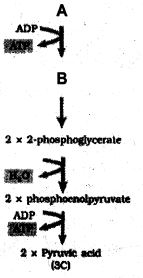
A
Fructose $1, 6$-bisphosphate,oxaloacetate
B
$1, 3$-bisphosphoglyceric acid,fructose $6$-phosphate
C
$2 \times 1, 3$-bisphosphoglyceric acid,$2 \times 3$-phosphoglyceric acid ($3$-$PGA$)
D
Acetaldehyde,glucose $1, 6$-bisphosphate
Solution
(C) In the glycolysis pathway,$1, 3$-bisphosphoglyceric acid is converted into $3$-phosphoglyceric acid ($3$-$PGA$) by the enzyme phosphoglycerate kinase. During this step,a phosphate group is transferred to $ADP$ to form $ATP$. Since the pathway involves two molecules of $1, 3$-bisphosphoglyceric acid,it produces two molecules of $3$-phosphoglyceric acid. Thus,$A$ represents $2 \times 1, 3$-bisphosphoglyceric acid and $B$ represents $2 \times 3$-phosphoglyceric acid ($3$-$PGA$).
0 likes
View Solution98
MediumMCQ
If $3$ molecules of $PGAL$ complete glycolysis,how much $ATP$ and $NADH_2$ will be formed?
A
$4 \ ATP, 2 \ NADH_2$
B
$6 \ ATP, 3 \ NADH_2$
C
$2 \ ATP, 1 \ NADH_2$
D
$8 \ ATP, 4 \ NADH_2$
Solution
(B) In the process of glycolysis,$1$ molecule of $PGAL$ (Phosphoglyceraldehyde) is converted into $1$ molecule of Pyruvic acid.
During this conversion,$2$ molecules of $ATP$ are produced (via substrate-level phosphorylation) and $1$ molecule of $NADH_2$ is formed.
Since the question asks for the yield from $3$ molecules of $PGAL$ completing the process:
Total $ATP = 3 \times 2 = 6 \ ATP$.
Total $NADH_2 = 3 \times 1 = 3 \ NADH_2$.
Therefore,the correct answer is $6 \ ATP$ and $3 \ NADH_2$.
During this conversion,$2$ molecules of $ATP$ are produced (via substrate-level phosphorylation) and $1$ molecule of $NADH_2$ is formed.
Since the question asks for the yield from $3$ molecules of $PGAL$ completing the process:
Total $ATP = 3 \times 2 = 6 \ ATP$.
Total $NADH_2 = 3 \times 1 = 3 \ NADH_2$.
Therefore,the correct answer is $6 \ ATP$ and $3 \ NADH_2$.
0 likes
View Solution99
MediumMCQ
Choose the correct sentences for glycolysis.
$(1)$ Glycolysis occurs in the cytoplasm of the cell.
$(2)$ During this,one molecule of glucose is converted into two molecules of pyruvic acid.
$(3)$ $O_2$ is not used in this phase.
$(4)$ This phase is known as $TCA$.
$(1)$ Glycolysis occurs in the cytoplasm of the cell.
$(2)$ During this,one molecule of glucose is converted into two molecules of pyruvic acid.
$(3)$ $O_2$ is not used in this phase.
$(4)$ This phase is known as $TCA$.
A
$(2, 3, 4)$
B
$(1, 2, 4)$
C
$(1, 2, 3)$
D
$(1, 3, 4)$
Solution
(C) Glycolysis is the first stage of cellular respiration.
$(1)$ It occurs in the cytoplasm of the cell,which is correct.
$(2)$ In this process,one molecule of glucose $(6C)$ is broken down into two molecules of pyruvic acid $(3C)$,which is correct.
$(3)$ Glycolysis is an anaerobic process and does not require $O_2$,which is correct.
$(4)$ The $TCA$ cycle (Tricarboxylic Acid cycle) is a different process that occurs in the mitochondrial matrix,not glycolysis. Therefore,statement $(4)$ is incorrect.
Thus,the correct statements are $(1, 2, 3)$.
$(1)$ It occurs in the cytoplasm of the cell,which is correct.
$(2)$ In this process,one molecule of glucose $(6C)$ is broken down into two molecules of pyruvic acid $(3C)$,which is correct.
$(3)$ Glycolysis is an anaerobic process and does not require $O_2$,which is correct.
$(4)$ The $TCA$ cycle (Tricarboxylic Acid cycle) is a different process that occurs in the mitochondrial matrix,not glycolysis. Therefore,statement $(4)$ is incorrect.
Thus,the correct statements are $(1, 2, 3)$.
0 likes
View Solution100
MediumMCQ
Choose the incorrect statement regarding glycolysis.
A
Glycolysis occurs in the cytoplasm of the cell.
B
In plants,during glycolysis,sucrose is formed from glucose.
C
Glycolysis is also known as the $EMP$ pathway.
D
In this phase,$O_2$ is not utilized.
Solution
(B) Glycolysis is the process of breaking down glucose into two molecules of pyruvate.
It occurs in the cytoplasm of all living cells.
It is also known as the $EMP$ pathway,named after its discoverers Embden,Meyerhof,and Parnas.
Glycolysis is an anaerobic process,meaning it does not require $O_2$.
In plants,sucrose is converted into glucose and fructose by the enzyme invertase before entering the glycolytic pathway; glucose is not converted into sucrose during glycolysis.
Therefore,the statement that sucrose is formed from glucose during glycolysis is incorrect.
It occurs in the cytoplasm of all living cells.
It is also known as the $EMP$ pathway,named after its discoverers Embden,Meyerhof,and Parnas.
Glycolysis is an anaerobic process,meaning it does not require $O_2$.
In plants,sucrose is converted into glucose and fructose by the enzyme invertase before entering the glycolytic pathway; glucose is not converted into sucrose during glycolysis.
Therefore,the statement that sucrose is formed from glucose during glycolysis is incorrect.
0 likes
View SolutionRespiration in Plants — Glycolysis · Frequently Asked Questions
1Are these Respiration in Plants questions useful for JEE and NEET?
Yes. All questions in this section are mapped to JEE Main and NEET exam patterns. Previous year questions from JEE Main, NEET, GUJCET and state-level exams are included with full solutions.
2Can I switch to Hindi or Gujarati for these questions?
Yes. Use the language tabs in the hero section or the sidebar to view the same questions and solutions in English, Hindi or Gujarati.
3How do I generate a question paper from this subtopic?
Use the Vedclass Exam Paper Generator — select the chapter and subtopic, set difficulty, and generate Sets A, B, C, D automatically. First 3 chapters of every subject are free.
Vedclass Products
For Students
Vedclass Test Series
Mock tests in real JEE/NEET style with performance analysis. 5-day free trial.
Start Free TrialFor Teachers
Exam Paper Generator
Generate Set A/B/C/D papers from this chapter in 2 minutes. 3 chapters free.
Try FreeFor Institutes
Online Exam Module
Live online exams with unlimited students, 360° analytics & white-label branding.
See DemoFor Teachers & Institutes
Generate a Respiration in Plants Exam Paper in 2 Minutes
Select subtopic & difficulty — Sets A, B, C, D auto-generated with No Repeat logic.
First 3 chapters of every subject are free — no payment required.