
A English
Algae (General) Questions in English
Class 11 Biology · Plant Kingdom · Algae (General)
526+
Questions
English
Language
100%
With Solutions
Showing 50 of 526 questions in English
201
MediumMCQ
Seaweeds belong to which of the following groups?
A
Red algae
B
Brown algae
C
Green algae
D
Blue-green algae
Solution
(B) Seaweeds are large marine multicellular algae that are visible to the naked eye.
They are primarily classified into three groups based on their pigmentation:
$1$. Chlorophyceae (Green algae)
$2$. Phaeophyceae (Brown algae)
$3$. Rhodophyceae (Red algae).
While all three groups can be referred to as seaweeds,the term 'seaweed' is most commonly and predominantly associated with the large brown algae (Phaeophyceae) such as $Laminaria$ and $Fucus$,which form extensive underwater forests. Therefore,among the given options,Brown algae is the most appropriate answer.
They are primarily classified into three groups based on their pigmentation:
$1$. Chlorophyceae (Green algae)
$2$. Phaeophyceae (Brown algae)
$3$. Rhodophyceae (Red algae).
While all three groups can be referred to as seaweeds,the term 'seaweed' is most commonly and predominantly associated with the large brown algae (Phaeophyceae) such as $Laminaria$ and $Fucus$,which form extensive underwater forests. Therefore,among the given options,Brown algae is the most appropriate answer.
0 likes
View Solution202
MediumMCQ
If you are asked to classify different algae into distinct groups,which of the following characteristics would you choose?
A
Chemical composition of the cell wall
B
Types of pigments present in the cell
C
Nature of stored food materials in the cell
D
Structural organization of the thallus
Solution
(B) The classification of algae is primarily based on the types of pigments present in their cells (such as chlorophyll $a, b, c, d$,fucoxanthin,phycoerythrin,etc.). These pigments are responsible for the process of photosynthesis and the specific color of the algae,which helps in dividing them into three main classes: Chlorophyceae (green algae),Phaeophyceae (brown algae),and Rhodophyceae (red algae). Therefore,the types of pigments are the most significant characteristic for classification.
0 likes
View Solution203
MediumMCQ
Polyuronic acids and polysulphate esters are characteristic of the cell wall of ........
A
Brown algae
B
Red algae
C
Dinoflagellates
D
Diatoms
Solution
(B) The cell wall of red algae (Rhodophyceae) is composed of cellulose,pectin,and phycocolloids. These phycocolloids include substances like agar,carrageenan,and other sulphated polysaccharides (polysulphate esters) and polyuronic acids. Brown algae (Phaeophyceae) cell walls contain cellulose and algin (phycocolloids),but they are distinct from the specific composition found in red algae. Therefore,the presence of polyuronic acids and polysulphate esters is a characteristic feature of red algae.
0 likes
View Solution204
MediumMCQ
The stored food in Phaeophyceae is .....
A
Laminarin or Mannitol
B
Starch
C
Cellulose
D
Algin
Solution
(A) In Phaeophyceae (brown algae),the food is stored as complex carbohydrates,in the form of laminarin or mannitol.
$A$ is the correct option because these are the characteristic storage products of brown algae.
Starch is the storage product of Chlorophyceae (green algae),while cellulose is a structural component of the cell wall.
$A$ is the correct option because these are the characteristic storage products of brown algae.
Starch is the storage product of Chlorophyceae (green algae),while cellulose is a structural component of the cell wall.
0 likes
View Solution205
MediumMCQ
The disease known as "Red rust of tea" is caused by a parasite belonging to which of the following groups?
A
Algae
B
Fungi
C
Bacteria
D
Bryophyta
Solution
(A) The disease known as "Red rust of tea" is caused by the green alga $Cephaleuros$ $virescens$.
This organism is a parasitic alga that infects the leaves of tea plants, leading to the formation of reddish-brown patches.
Therefore, the correct group is $Algae$.
This organism is a parasitic alga that infects the leaves of tea plants, leading to the formation of reddish-brown patches.
Therefore, the correct group is $Algae$.
0 likes
View Solution206
MediumMCQ
Non-motile gametes are found in .......
A
Blue-green algae
B
Red algae
C
Both $(A)$ and $(B)$
D
Green algae
Solution
(B) In the plant kingdom,specifically within the algae group,the presence of non-motile gametes is a characteristic feature of Red algae (Rhodophyceae).
Unlike Green algae (Chlorophyceae) and Brown algae (Phaeophyceae),which typically produce flagellated,motile gametes,Red algae produce non-motile male gametes (spermatia) and non-motile female gametes (carpogonia).
Blue-green algae (Cyanobacteria) are prokaryotic organisms and do not reproduce via gametes in the eukaryotic sense; they reproduce via binary fission,fragmentation,or spores.
Therefore,the correct answer is Red algae.
Unlike Green algae (Chlorophyceae) and Brown algae (Phaeophyceae),which typically produce flagellated,motile gametes,Red algae produce non-motile male gametes (spermatia) and non-motile female gametes (carpogonia).
Blue-green algae (Cyanobacteria) are prokaryotic organisms and do not reproduce via gametes in the eukaryotic sense; they reproduce via binary fission,fragmentation,or spores.
Therefore,the correct answer is Red algae.
0 likes
View Solution207
MediumMCQ
Which group of algae best illustrates the evolution of sexual reproduction?
A
Green algae
B
Red algae
C
Brown algae
D
Blue-green algae
Solution
(A) The evolution of sexual reproduction,ranging from isogamy to anisogamy and finally oogamy,is best illustrated by the green algae (Chlorophyceae). In this group,we observe a clear progression:
$1$. Isogamy: Fusion of morphologically similar gametes (e.g.,$Chlamydomonas$).
$2$. Anisogamy: Fusion of morphologically dissimilar gametes (e.g.,$Eudorina$).
$3$. Oogamy: Fusion of a large,non-motile female gamete and a small,motile male gamete (e.g.,$Volvox$,$Spirogyra$ showing conjugation).
$1$. Isogamy: Fusion of morphologically similar gametes (e.g.,$Chlamydomonas$).
$2$. Anisogamy: Fusion of morphologically dissimilar gametes (e.g.,$Eudorina$).
$3$. Oogamy: Fusion of a large,non-motile female gamete and a small,motile male gamete (e.g.,$Volvox$,$Spirogyra$ showing conjugation).
0 likes
View Solution208
DifficultMCQ
Which type of algae possesses food-conducting tubes similar to the phloem found in vascular plants?
A
Red algae
B
Brown algae
C
Blue-green algae
D
Green algae
Solution
(B) Some large brown algae,specifically members of the order $Laminariales$ (such as $Macrocystis$ and $Nereocystis$),possess specialized cells known as trumpet hyphae. These cells are structurally and functionally analogous to the phloem sieve tubes found in vascular plants,as they facilitate the long-distance transport of photosynthates (sugars) from the blades to the holdfast.
0 likes
View Solution209
MediumMCQ
The main plant body in Thallophyta is .........
A
Gametophyte
B
Sporophyte
C
Diploid plant body
D
Leafy plant body
Solution
(A) In the plant kingdom,Thallophyta (which includes algae) is characterized by a simple,thalloid plant body.
This plant body is haploid and represents the gametophytic phase of the life cycle.
Therefore,the main plant body in Thallophyta is the gametophyte.
This plant body is haploid and represents the gametophytic phase of the life cycle.
Therefore,the main plant body in Thallophyta is the gametophyte.
0 likes
View Solution210
MediumMCQ
The most advanced group of algae is........
A
Myxophyta
B
Chlorophyta
C
Brown algae
D
Phaeophyta
Solution
(B) The most advanced group of algae is considered to be the $Chlorophyta$ (Green algae).
This is because they exhibit complex organizational structures,diverse life cycles,and are believed to be the evolutionary ancestors of higher land plants (embryophytes).
They share several characteristics with higher plants,such as the presence of chlorophyll $a$ and $b$,starch as a storage product,and cellulose in their cell walls.
This is because they exhibit complex organizational structures,diverse life cycles,and are believed to be the evolutionary ancestors of higher land plants (embryophytes).
They share several characteristics with higher plants,such as the presence of chlorophyll $a$ and $b$,starch as a storage product,and cellulose in their cell walls.
0 likes
View Solution211
MediumMCQ
In $Rhodophyta$,the stored food is .........
A
Floridean starch
B
Mannitol
C
Leucosin
D
All of the above
Solution
(A) $Rhodophyta$ are commonly known as red algae.
In red algae,the food is stored as $Floridean$ $starch$,which is very similar to $amylopectin$ and $glycogen$ in structure.
$Mannitol$ is the stored food in $Phaeophyceae$ (brown algae),and $Leucosin$ is found in $Chrysophyceae$ (diatoms).
In red algae,the food is stored as $Floridean$ $starch$,which is very similar to $amylopectin$ and $glycogen$ in structure.
$Mannitol$ is the stored food in $Phaeophyceae$ (brown algae),and $Leucosin$ is found in $Chrysophyceae$ (diatoms).
0 likes
View Solution212
MediumMCQ
In brown algae,asexual reproduction occurs primarily through:
A
Biflagellate zoospores
B
Uniflagellate zoospores
C
Aplanospores
D
None of these
Solution
(A) In brown algae (Phaeophyceae),asexual reproduction takes place by biflagellate zoospores that are pear-shaped and have two laterally attached flagella.
0 likes
View Solution213
MediumMCQ
Which pigments are found in Phaeophyceae?
A
Chlorophyll $a, c$ and Fucoxanthin
B
Chlorophyll $a, d$ and Violaxanthin
C
$\gamma$-carotene and Phycocyanin
D
None of the above
Solution
(A) Phaeophyceae,commonly known as brown algae,are primarily marine organisms.
Their characteristic color is due to the presence of large amounts of the xanthophyll pigment known as Fucoxanthin.
In addition to Fucoxanthin,they contain Chlorophyll $a$ and Chlorophyll $c$ as their primary photosynthetic pigments.
Therefore,the correct combination of pigments found in Phaeophyceae is Chlorophyll $a, c$ and Fucoxanthin.
Their characteristic color is due to the presence of large amounts of the xanthophyll pigment known as Fucoxanthin.
In addition to Fucoxanthin,they contain Chlorophyll $a$ and Chlorophyll $c$ as their primary photosynthetic pigments.
Therefore,the correct combination of pigments found in Phaeophyceae is Chlorophyll $a, c$ and Fucoxanthin.
0 likes
View Solution214
MediumMCQ
The characteristics of Thallophyta are .........
A
Plant body is a thallus
B
Non-vascular plants
C
Reproductive organs are unicellular and non-jacketed
D
All of the above
Solution
(D) Thallophyta (specifically algae) are characterized by:
$1$. The plant body is a thallus,meaning it is not differentiated into roots,stems,and leaves.
$2$. They are non-vascular plants,lacking xylem and phloem.
$3$. Their reproductive organs are typically unicellular and lack a sterile protective jacket layer (non-jacketed).
Therefore,all the given options are correct.
$1$. The plant body is a thallus,meaning it is not differentiated into roots,stems,and leaves.
$2$. They are non-vascular plants,lacking xylem and phloem.
$3$. Their reproductive organs are typically unicellular and lack a sterile protective jacket layer (non-jacketed).
Therefore,all the given options are correct.
0 likes
View Solution215
MediumMCQ
Autotrophic thallophytes are called .........
A
Fungi
B
Lichens
C
Algae
D
Microbes
Solution
(C) Thallophytes are plants that have an undifferentiated body, known as a thallus.
Among these, organisms that are autotrophic (capable of photosynthesis) are classified as $Algae$.
$Fungi$ are heterotrophic, $Lichens$ are a symbiotic association between algae and fungi, and $Microbes$ is a broad term not specific to thallophytes.
Among these, organisms that are autotrophic (capable of photosynthesis) are classified as $Algae$.
$Fungi$ are heterotrophic, $Lichens$ are a symbiotic association between algae and fungi, and $Microbes$ is a broad term not specific to thallophytes.
0 likes
View Solution216
MediumMCQ
Which of the following statements is true for algae?
A
Algae possess roots,stems,and leaves.
B
Algae possess true roots but lack leaves.
C
Algae possess rhizoids and leaves.
D
The plant body of algae is a thallus.
Solution
(D) Algae are simple,thalloid,autotrophic,and largely aquatic organisms.
They do not have a well-differentiated plant body like roots,stems,or leaves.
Instead,their plant body is referred to as a $thallus$,which means it is not differentiated into true roots,stems,or leaves.
Therefore,the statement that the plant body of algae is a thallus is correct.
They do not have a well-differentiated plant body like roots,stems,or leaves.
Instead,their plant body is referred to as a $thallus$,which means it is not differentiated into true roots,stems,or leaves.
Therefore,the statement that the plant body of algae is a thallus is correct.
0 likes
View Solution217
MediumMCQ
Oogamous fertilization involves .......
A
Large motile female gametes and small non-motile male gametes
B
Small non-motile female gametes and large motile male gametes
C
Large non-motile female gametes and small motile male gametes
D
Large non-motile female gametes and small non-motile male gametes
Solution
(C) Oogamy is a form of sexual reproduction where the gametes are morphologically distinct (anisogamy).
In oogamous fertilization,the female gamete is large and non-motile (stationary),while the male gamete is small and motile.
This type of reproduction is commonly observed in various algae such as $Volvox$ and $Fucus$,as well as in higher plants.
In oogamous fertilization,the female gamete is large and non-motile (stationary),while the male gamete is small and motile.
This type of reproduction is commonly observed in various algae such as $Volvox$ and $Fucus$,as well as in higher plants.
0 likes
View Solution218
EasyMCQ
The disease known as "Red Rust of Tea" is caused by $Cephaleuros$ which is a:
A
Red alga
B
Brown alga
C
Dinoflagellate
D
Green alga
Solution
(D) $Cephaleuros$ is a genus of parasitic green algae (Chlorophyta).
It causes the "Red Rust of Tea" disease, which affects the leaves of tea plants.
Although it is a green alga, it appears reddish-orange due to the presence of carotenoid pigments in its cells.
Therefore, the correct option is $D$.
It causes the "Red Rust of Tea" disease, which affects the leaves of tea plants.
Although it is a green alga, it appears reddish-orange due to the presence of carotenoid pigments in its cells.
Therefore, the correct option is $D$.
0 likes
View Solution219
EasyMCQ
Pyrenoids are typically found in algae. $A$ pyrenoid is made up of:
A
$A$ central core of starch surrounded by protein
B
$A$ central core of protein surrounded by starch
C
$A$ central core of fatty acids surrounded by starch
D
Nucleic acids and protein
Solution
(B) Pyrenoids are specialized proteinaceous storage bodies found in the chloroplasts of many algae.
They consist of a central core of protein,which is the site of the enzyme RuBisCO,surrounded by a sheath of starch.
They are involved in the concentration of $CO_2$ around the enzyme RuBisCO to facilitate efficient carbon fixation.
They consist of a central core of protein,which is the site of the enzyme RuBisCO,surrounded by a sheath of starch.
They are involved in the concentration of $CO_2$ around the enzyme RuBisCO to facilitate efficient carbon fixation.
0 likes
View Solution220
EasyMCQ
What is the cell wall of $Spirogyra$ made of?
A
Cellulose
B
Suberin
C
Lignin
D
Chitin
Solution
(A) The cell wall of $Spirogyra$,which is a green alga,is primarily composed of $Cellulose$.
$Cellulose$ is a polysaccharide consisting of a linear chain of several hundred to many thousands of $\beta(1\rightarrow4)$ linked $D$-glucose units.
It provides structural support and rigidity to the algal cell.
$Cellulose$ is a polysaccharide consisting of a linear chain of several hundred to many thousands of $\beta(1\rightarrow4)$ linked $D$-glucose units.
It provides structural support and rigidity to the algal cell.
0 likes
View Solution221
EasyMCQ
Zygotic meiosis occurs in ...........
A
Higher plants
B
Algae
C
Animals
D
Bacteria
Solution
(B) Zygotic meiosis is a type of life cycle where the zygote undergoes meiosis immediately after fertilization to produce haploid spores. This process is characteristic of many algae (e.g.,Chlamydomonas,Spirogyra) and some fungi. In contrast,higher plants exhibit sporic meiosis,and animals exhibit gametic meiosis. Bacteria do not undergo meiosis as they reproduce primarily through binary fission.
0 likes
View Solution222
MediumMCQ
In oogamy,fertilization involves:
A
$A$ small non-motile female gamete and a large motile male gamete
B
$A$ large non-motile female gamete and a small motile male gamete
C
$A$ large non-motile female gamete and a small non-motile male gamete
D
$A$ large motile female gamete and a small non-motile male gamete
Solution
(B) Oogamy is a form of sexual reproduction in which there is a fusion between a large,non-motile (static) female gamete and a small,motile male gamete.
This type of reproduction is commonly observed in algae like $Volvox$ and $Fucus$,as well as in higher plants.
Therefore,the correct option is $B$.
This type of reproduction is commonly observed in algae like $Volvox$ and $Fucus$,as well as in higher plants.
Therefore,the correct option is $B$.
0 likes
View Solution223
EasyMCQ
Spermatia are the male gametes of ........
A
Red algae
B
Diatoms
C
Spermatophyta
D
Euglena
Solution
(A) Spermatia are non-motile,unicellular male gametes produced in specialized structures called spermatangia in Red algae (Rhodophyceae). These gametes are carried by water currents to the receptive female organ known as the carpogonium.
0 likes
View Solution224
MediumMCQ
Which of the following algae produces carpospores?
A
$Chlamydomonas$
B
Green algae
C
$Chlorella$
D
Red algae
Solution
(D) Carpospores are specialized diploid spores produced by the carposporophyte generation in the life cycle of red algae (Rhodophyceae).
These spores are formed after the fertilization of the carpogonium by the male gamete (spermatium).
Therefore,the production of carpospores is a characteristic feature of red algae.
These spores are formed after the fertilization of the carpogonium by the male gamete (spermatium).
Therefore,the production of carpospores is a characteristic feature of red algae.
0 likes
View Solution225
EasyMCQ
Which of the following is known as 'Sea Lettuce'?
A
Laminaria
B
Fucus
C
Sargassum
D
Ulva
Solution
(D) The genus $Ulva$ belongs to the class Chlorophyceae (green algae). It is commonly known as 'Sea Lettuce' because its thallus is thin,flat,and leaf-like,resembling a lettuce leaf. Therefore,the correct option is $D$.
0 likes
View Solution226
EasyMCQ
$Irish$ moss is a member of ........
A
True moss
B
Lichen
C
Algae
D
Bryophyte
Solution
(C) $Irish$ moss is the common name for $Chondrus$ $crispus$,which is a species of red algae $(Rhodophyceae)$.
It is found abundantly along the rocky parts of the Atlantic coast of Europe and North America.
Despite its name,it is not a moss (bryophyte) or a lichen.
It is found abundantly along the rocky parts of the Atlantic coast of Europe and North America.
Despite its name,it is not a moss (bryophyte) or a lichen.
0 likes
View Solution227
MediumMCQ
In which plant group are the reproductive organs not surrounded by a layer of sterile cells?
A
Pteridophytes
B
Thallophyta
C
Angiosperms
D
Gymnosperms
Solution
(B) In the plant kingdom,the reproductive organs of $Thallophyta$ (such as algae) are typically unicellular or,if multicellular,they lack a protective jacket or layer of sterile cells around the gametes. In contrast,$Bryophytes$,$Pteridophytes$,$Gymnosperms$,and $Angiosperms$ possess multicellular reproductive organs that are surrounded by a sterile jacket of cells.
0 likes
View Solution228
DifficultMCQ
The largest unicellular plant,$Acetabularia$,belongs to which of the following groups?
A
Chlorophyta
B
Rhodophyta
C
Pyrrophyta
D
Phaeophyta
Solution
(A) $Acetabularia$ is a genus of single-celled green algae.
It is famous for its large size and complex structure,despite being unicellular.
It belongs to the class Chlorophyceae (green algae),which falls under the division Chlorophyta.
Therefore,the correct option is $A$.
It is famous for its large size and complex structure,despite being unicellular.
It belongs to the class Chlorophyceae (green algae),which falls under the division Chlorophyta.
Therefore,the correct option is $A$.
0 likes
View Solution229
EasyMCQ
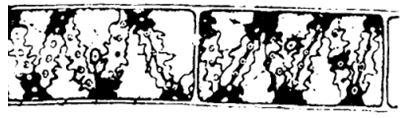
Identify the organism shown in the given figure.
A
Spirogyra
B
Nostoc
C
Oscillatoria
D
Anabaena
Solution
(A) The figure shows a filamentous green alga with a characteristic spiral-shaped chloroplast. This is a diagnostic feature of the genus $Spirogyra$. The spiral chloroplast contains pyrenoids,which are storage bodies for starch. Other options like $Nostoc$,$Oscillatoria$,and $Anabaena$ are cyanobacteria (blue-green algae) and do not possess such spiral chloroplasts.
0 likes
View Solution230
EasyMCQ
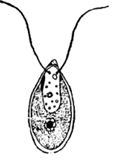
Identify the organism shown in the given figure.
A
Nostoc
B
Spirogyra
C
Chlamydomonas
D
Volvox
Solution
(C) The figure shows a unicellular,flagellated green alga.
Based on the morphological characteristics,such as the pear-shaped body,presence of two flagella at the anterior end,and a cup-shaped chloroplast,the organism is identified as $Chlamydomonas$.
$Nostoc$ is a filamentous cyanobacterium.
$Spirogyra$ is a filamentous green alga.
$Volvox$ is a colonial green alga.
Therefore,the correct option is $C$.
Based on the morphological characteristics,such as the pear-shaped body,presence of two flagella at the anterior end,and a cup-shaped chloroplast,the organism is identified as $Chlamydomonas$.
$Nostoc$ is a filamentous cyanobacterium.
$Spirogyra$ is a filamentous green alga.
$Volvox$ is a colonial green alga.
Therefore,the correct option is $C$.
0 likes
View Solution231
EasyMCQ
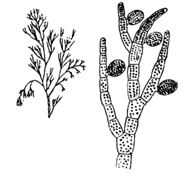
Identify the alga shown in the figure.
A
Chara
B
Fucus
C
Ectocarpus
D
Batrachospermum
Solution
(D) The figure shows the morphology of the red alga $Batrachospermum$.
It is a freshwater alga characterized by its branched,filamentous thallus that appears beaded due to the presence of whorls of branches at the nodes.
$Chara$ is a green alga,$Fucus$ is a brown alga,and $Ectocarpus$ is also a brown alga.
Therefore,the correct option is $D$.
It is a freshwater alga characterized by its branched,filamentous thallus that appears beaded due to the presence of whorls of branches at the nodes.
$Chara$ is a green alga,$Fucus$ is a brown alga,and $Ectocarpus$ is also a brown alga.
Therefore,the correct option is $D$.
0 likes
View Solution232
MediumMCQ
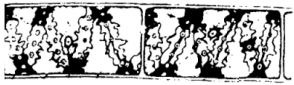
Which method of sexual reproduction is observed in the alga shown in the given figure?
A
Fragmentation
B
Spore formation
C
Conjugation
D
Budding
Solution
(C) The figure shows the spiral chloroplasts characteristic of the green alga $Spirogyra$. In $Spirogyra$,sexual reproduction occurs through a process called conjugation. During conjugation,two filaments come together,and the protoplast of one cell acts as a gamete and moves into the other cell through a conjugation tube to form a zygospore.
0 likes
View Solution233
MediumMCQ
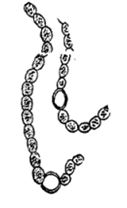
Identify the alga shown in the given figure.
A
Oscillatoria
B
Anabaena
C
Batrachospermum
D
Spirogyra
Solution
(B) The figure shows a filamentous cyanobacterium (blue-green alga) with specialized cells called heterocysts.
Heterocysts are large,thick-walled cells specialized for nitrogen fixation.
Among the given options,$Anabaena$ is a genus of filamentous cyanobacteria that possesses heterocysts.
$Oscillatoria$ is a filamentous cyanobacterium but lacks heterocysts.
$Batrachospermum$ is a red alga,and $Spirogyra$ is a green alga,neither of which matches the morphology shown in the figure.
Heterocysts are large,thick-walled cells specialized for nitrogen fixation.
Among the given options,$Anabaena$ is a genus of filamentous cyanobacteria that possesses heterocysts.
$Oscillatoria$ is a filamentous cyanobacterium but lacks heterocysts.
$Batrachospermum$ is a red alga,and $Spirogyra$ is a green alga,neither of which matches the morphology shown in the figure.
0 likes
View Solution234
DifficultMCQ
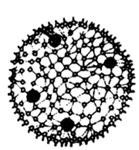
Which of the following is correct for the given figure?
A
Blue-green algae
B
Unicellular algae
C
Filamentous algae
D
Colonial algae
Solution
(D) The figure shows $Volvox$,which is a green alga. $Volvox$ is a colonial form of algae,where individual cells are organized into a spherical colony held together by a gelatinous matrix. Therefore,it is classified as colonial algae.
0 likes
View Solution235
DifficultMCQ
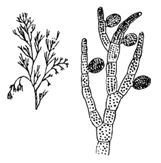
What type of algae is shown in the figure?
A
Green algae
B
Blue-green algae
C
Red algae
D
Brown algae
Solution
(A) The figure shows the structure of $Chara$,which is a genus of green algae (Chlorophyceae).
$Chara$ is a multicellular,branched,and macroscopic green alga often found in freshwater habitats.
It exhibits a complex body structure with nodes and internodes,resembling higher plants.
Therefore,the correct option is $A$.
$Chara$ is a multicellular,branched,and macroscopic green alga often found in freshwater habitats.
It exhibits a complex body structure with nodes and internodes,resembling higher plants.
Therefore,the correct option is $A$.
0 likes
View Solution236
DifficultMCQ
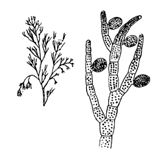
What type of life cycle is observed in the algae shown in the figure?
A
Haplontic
B
Diplontic
C
Haplo-diplontic
D
Triplontic
Solution
(A) The figure shows the algae $Chara$.
$Chara$ is a green alga that exhibits a haplontic life cycle.
In a haplontic life cycle,the dominant phase is the haploid gametophyte,and the sporophyte generation is represented only by the zygote,which undergoes meiosis to produce haploid spores.
$Chara$ is a green alga that exhibits a haplontic life cycle.
In a haplontic life cycle,the dominant phase is the haploid gametophyte,and the sporophyte generation is represented only by the zygote,which undergoes meiosis to produce haploid spores.
0 likes
View Solution237
MediumMCQ
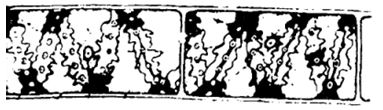
What is correct for the given figure?
A
Filamentous and Blue-green algae
B
Filamentous and Green algae
C
Colonial and Blue-green algae
D
Ribbon-shaped and Brown algae
Solution
(B) The provided figure shows the spiral,ribbon-shaped chloroplast characteristic of the genus $Spirogyra$.
$Spirogyra$ is a filamentous green alga belonging to the class $Chlorophyceae$.
Therefore,the organism is filamentous and a type of green algae.
$Spirogyra$ is a filamentous green alga belonging to the class $Chlorophyceae$.
Therefore,the organism is filamentous and a type of green algae.
0 likes
View Solution238
MediumMCQ
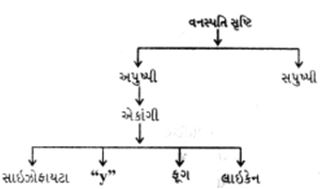
What does $''Y''$ represent in the given chart?
A
Bryophyta
B
Pteridophyta
C
Algae
D
Gymnosperms
Solution
(C) The provided chart classifies the Plant Kingdom into non-flowering (Cryptogamae) and flowering (Phanerogamae) plants.
Under non-flowering plants,the category 'Thallophyta' (Ekangi) includes organisms with a simple,undifferentiated body structure.
The groups listed under Thallophyta are Schizophyta (bacteria),$Y$,Fungi,and Lichens.
In this context,$Y$ represents Algae,which is a major group of thalloid organisms.
Under non-flowering plants,the category 'Thallophyta' (Ekangi) includes organisms with a simple,undifferentiated body structure.
The groups listed under Thallophyta are Schizophyta (bacteria),$Y$,Fungi,and Lichens.
In this context,$Y$ represents Algae,which is a major group of thalloid organisms.
0 likes
View Solution239
DifficultMCQ
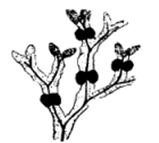
Identify the algae shown in the given figure.
A
Sargassum
B
Fucus
C
Ectocarpus
D
Batrachospermum
Solution
(B) The figure shows the brown alga $Fucus$.
$Fucus$ is a genus of brown algae found in the intertidal zones of rocky seashores.
The characteristic features visible in the diagram include the dichotomously branched thallus and the presence of air bladders (vesicles) which help in buoyancy.
Therefore,the correct option is $B$.
$Fucus$ is a genus of brown algae found in the intertidal zones of rocky seashores.
The characteristic features visible in the diagram include the dichotomously branched thallus and the presence of air bladders (vesicles) which help in buoyancy.
Therefore,the correct option is $B$.
0 likes
View Solution240
DifficultMCQ
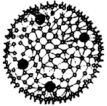
Identify the algae shown in the given figure.
A
Chlamydomonas
B
Volvox
C
Nostoc
D
Anabaena
Solution
(B) The figure shows a spherical,colonial form of green algae.
This specific structure,characterized by a large colony containing smaller daughter colonies,is typical of $Volvox$.
$Chlamydomonas$ is unicellular,while $Nostoc$ and $Anabaena$ are filamentous cyanobacteria (blue-green algae) that do not form such spherical colonies.
This specific structure,characterized by a large colony containing smaller daughter colonies,is typical of $Volvox$.
$Chlamydomonas$ is unicellular,while $Nostoc$ and $Anabaena$ are filamentous cyanobacteria (blue-green algae) that do not form such spherical colonies.
0 likes
View Solution241
MediumMCQ
What is $Chlamydomonas$?
A
Virus
B
Fungi
C
Algae
D
Protozoa
Solution
(C) $Chlamydomonas$ is a genus of unicellular flagellated green algae. It belongs to the class $Chlorophyceae$ within the kingdom $Plantae$. It is commonly found in stagnant water,damp soil,and freshwater environments.
0 likes
View Solution242
MediumMCQ
Which of the following is $NOT$ a component of the algal cell wall?
A
Calcium carbonate
B
Galactans
C
Mannans
D
Pectin
Solution
(D) The algal cell wall is composed of cellulose,galactans,mannans,and minerals like calcium carbonate. Pectin is a primary component of the cell wall in higher plants,not algae. Therefore,pectin is not a characteristic component of the algal cell wall.
0 likes
View Solution243
EasyMCQ
Which mineral element is present in the cell wall of algae?
A
Calcium pectate
B
Calcium carbonate
C
Calcium bicarbonate
D
Calcium phosphate
Solution
(B) The cell wall of algae is primarily composed of cellulose,galactans,and mannans. In addition to these,certain minerals like calcium carbonate $(CaCO_3)$ are often deposited in the cell walls of specific algae,such as those belonging to the class $Rhodophyceae$ (red algae) and some $Charophytes$.
0 likes
View Solution244
EasyMCQ
Which of the following organisms has a cell wall composed of galactans?
A
Fungi
B
Algae
C
Animal cell
D
Bacteria
Solution
(B) The cell wall of algae is composed of cellulose,galactans,mannans,and minerals like calcium carbonate. In contrast,fungal cell walls are made of chitin,and bacterial cell walls are made of peptidoglycan. Animal cells lack a cell wall entirely. Therefore,the correct answer is $B$ (Algae).
0 likes
View Solution245
MediumMCQ
The cell wall of algae is composed of which of the following substances?
A
Mannans
B
Galactans
C
Calcium carbonate
D
All of the above $(A), (B), (C)$
Solution
(D) The cell wall of algae is composed of cellulose,galactans,mannans,and minerals like calcium carbonate.
Since all three substances listed in the options are components of the algal cell wall,the correct answer is $(D)$.
Since all three substances listed in the options are components of the algal cell wall,the correct answer is $(D)$.
0 likes
View Solution246
EasyMCQ
Which of the following is an example of a unicellular plant?
A
Chlamydomonas
B
Yeast
C
Amoeba
D
Both $A$ and $B$
Solution
(A) unicellular organism is an organism that consists of a single cell.
$Chlamydomonas$ is a genus of unicellular green algae,which are classified as plants.
$Yeast$ is a unicellular fungus. While fungi were historically classified as plants,in the modern $5$-kingdom classification system,they are placed in a separate kingdom,$Fungi$.
$Amoeba$ is a unicellular protozoan,which belongs to the kingdom $Protista$.
Therefore,among the given options,$Chlamydomonas$ is the most accurate example of a unicellular plant. However,in many biological contexts,$Yeast$ is also considered a unicellular eukaryotic organism. Given the options,if we strictly consider the plant kingdom,$Chlamydomonas$ is the correct answer. If the question implies unicellular eukaryotes,both $A$ and $B$ are often grouped together in older textbooks.
$Chlamydomonas$ is a genus of unicellular green algae,which are classified as plants.
$Yeast$ is a unicellular fungus. While fungi were historically classified as plants,in the modern $5$-kingdom classification system,they are placed in a separate kingdom,$Fungi$.
$Amoeba$ is a unicellular protozoan,which belongs to the kingdom $Protista$.
Therefore,among the given options,$Chlamydomonas$ is the most accurate example of a unicellular plant. However,in many biological contexts,$Yeast$ is also considered a unicellular eukaryotic organism. Given the options,if we strictly consider the plant kingdom,$Chlamydomonas$ is the correct answer. If the question implies unicellular eukaryotes,both $A$ and $B$ are often grouped together in older textbooks.
0 likes
View Solution247
MediumMCQ
Which of the following components are present in the cell wall of algae?
$(1)$ Cellulose $(2)$ Protein $(3)$ Galactans $(4)$ Mannans $(5)$ Suberin
$(6)$ Pectin $(7)$ Hemicellulose $(8)$ Calcium carbonate
$(1)$ Cellulose $(2)$ Protein $(3)$ Galactans $(4)$ Mannans $(5)$ Suberin
$(6)$ Pectin $(7)$ Hemicellulose $(8)$ Calcium carbonate
A
$1, 2, 6, 7$
B
$3, 4, 6, 7$
C
$7, 8, 2, 1$
D
$1, 3, 4, 8$
Solution
(D) According to the $NCERT$ textbook,the cell wall of algae is composed of cellulose,galactans,mannans,and minerals like calcium carbonate.
Therefore,the components are $(1)$ Cellulose,$(3)$ Galactans,$(4)$ Mannans,and $(8)$ Calcium carbonate.
The correct option is $D$.
Therefore,the components are $(1)$ Cellulose,$(3)$ Galactans,$(4)$ Mannans,and $(8)$ Calcium carbonate.
The correct option is $D$.
0 likes
View Solution248
MediumMCQ
Agar-agar is commercially obtained from which of the following?
A
Red algae
B
Blue-green algae
C
Brown algae
D
Green algae
Solution
(A) Agar-agar is a gelatinous substance obtained from certain species of red algae (Rhodophyceae),such as $Gelidium$ and $Gracilaria$. It is widely used in laboratories as a culture medium for growing microorganisms and in the food industry as a thickening agent.
0 likes
View Solution249
EasyMCQ
In the plant kingdom,which of the following plants does not form an embryo?
A
Bryophytes
B
Pteridophytes
C
Gymnosperms
D
Algae
Solution
(D) In the plant kingdom,the formation of an embryo is a characteristic feature of embryophytes,which include Bryophytes,Pteridophytes,Gymnosperms,and Angiosperms.
Algae are considered thallophytes and do not form an embryo after fertilization.
In algae,the zygote undergoes meiosis to form haploid spores,whereas in other groups,the zygote develops into an embryo.
Algae are considered thallophytes and do not form an embryo after fertilization.
In algae,the zygote undergoes meiosis to form haploid spores,whereas in other groups,the zygote develops into an embryo.
0 likes
View Solution250
MediumMCQ
Which plant group is considered 'thalloid' and lacks embryo formation (embryophyta)?
A
Gymnosperms
B
Bryophytes
C
Algae
D
Pteridophytes
Solution
(C) The plant kingdom is broadly classified based on the presence or absence of embryos.
$1$. Algae are considered 'thalloid' because their plant body is not differentiated into true roots,stems,or leaves,and they do not form embryos after fertilization.
$2$. Bryophytes,Pteridophytes,Gymnosperms,and Angiosperms are collectively known as 'Embryophyta' because they produce embryos during their life cycle.
Therefore,Algae is the correct group that lacks embryo formation.
$1$. Algae are considered 'thalloid' because their plant body is not differentiated into true roots,stems,or leaves,and they do not form embryos after fertilization.
$2$. Bryophytes,Pteridophytes,Gymnosperms,and Angiosperms are collectively known as 'Embryophyta' because they produce embryos during their life cycle.
Therefore,Algae is the correct group that lacks embryo formation.
0 likes
View SolutionPlant Kingdom — Algae (General) · Frequently Asked Questions
1Are these Plant Kingdom questions useful for JEE and NEET?
Yes. All questions in this section are mapped to JEE Main and NEET exam patterns. Previous year questions from JEE Main, NEET, GUJCET and state-level exams are included with full solutions.
2Can I switch to Hindi or Gujarati for these questions?
Yes. Use the language tabs in the hero section or the sidebar to view the same questions and solutions in English, Hindi or Gujarati.
3How do I generate a question paper from this subtopic?
Use the Vedclass Exam Paper Generator — select the chapter and subtopic, set difficulty, and generate Sets A, B, C, D automatically. First 3 chapters of every subject are free.
Vedclass Products
For Students
Vedclass Test Series
Mock tests in real JEE/NEET style with performance analysis. 5-day free trial.
Start Free TrialFor Teachers
Exam Paper Generator
Generate Set A/B/C/D papers from this chapter in 2 minutes. 3 chapters free.
Try FreeFor Institutes
Online Exam Module
Live online exams with unlimited students, 360° analytics & white-label branding.
See DemoFor Teachers & Institutes
Generate a Plant Kingdom Exam Paper in 2 Minutes
Select subtopic & difficulty — Sets A, B, C, D auto-generated with No Repeat logic.
First 3 chapters of every subject are free — no payment required.