
A English
Gibberellins Questions in English
Class 11 Biology · Plant Growth and Development · Gibberellins
116+
Questions
English
Language
100%
With Solutions
Showing 49 of 116 questions in English
51
MediumMCQ
The enzyme that induces seed germination in barley seeds is . . . . . . .
A
$\alpha$-amylase
B
Lipase
C
Protease
D
Invertase
Solution
(A) During the germination of barley seeds,the embryo releases gibberellins.
These gibberellins move to the aleurone layer of the seed.
In the aleurone layer,they induce the synthesis of the enzyme $\alpha$-amylase.
This $\alpha$-amylase then hydrolyzes the stored starch in the endosperm into simple sugars,which provide energy for the growing embryo.
These gibberellins move to the aleurone layer of the seed.
In the aleurone layer,they induce the synthesis of the enzyme $\alpha$-amylase.
This $\alpha$-amylase then hydrolyzes the stored starch in the endosperm into simple sugars,which provide energy for the growing embryo.
0 likes
View Solution52
MediumMCQ
Which of the following pairs is correctly matched?
A
Passive transport of nutrients - $ATP$
B
Apoplast - $Plasmodesmata$
C
Potassium - Actively immobile
D
Bakane in rice seedlings - $F. fujikuroi$
Solution
(D) $1$. Passive transport of nutrients does not require $ATP$ as it occurs along the concentration gradient.
$2$. Apoplast is the system of adjacent cell walls that is continuous throughout the plant,excluding the cytoplasm. $Plasmodesmata$ are involved in the symplastic pathway.
$3$. Potassium is an actively mobile element in plants,not immobile.
$4$. Bakane (foolish seedling) disease in rice is caused by the fungus $Gibberella fujikuroi$ (anamorph: $Fusarium fujikuroi$),which produces gibberellins. Thus,this pair is correctly matched.
$2$. Apoplast is the system of adjacent cell walls that is continuous throughout the plant,excluding the cytoplasm. $Plasmodesmata$ are involved in the symplastic pathway.
$3$. Potassium is an actively mobile element in plants,not immobile.
$4$. Bakane (foolish seedling) disease in rice is caused by the fungus $Gibberella fujikuroi$ (anamorph: $Fusarium fujikuroi$),which produces gibberellins. Thus,this pair is correctly matched.
0 likes
View Solution53
MediumMCQ
Which of the following can be used to control dwarfism in plants?
A
Cytokinin
B
Gibberellic acid
C
Auxin
D
Antigibberellin
Solution
(B) Gibberellins are a group of plant growth regulators that promote stem elongation.
In genetically dwarf plants, the application of $Gibberellic \text{ } acid$ $(GA_3)$ induces internode elongation, thereby overcoming the dwarf phenotype and allowing the plant to grow to a normal height.
Therefore, $Gibberellic \text{ } acid$ is used to control or reverse dwarfism in plants.
In genetically dwarf plants, the application of $Gibberellic \text{ } acid$ $(GA_3)$ induces internode elongation, thereby overcoming the dwarf phenotype and allowing the plant to grow to a normal height.
Therefore, $Gibberellic \text{ } acid$ is used to control or reverse dwarfism in plants.
0 likes
View Solution54
MediumMCQ
Gibberellins stimulate $..........$.
A
Flowering
B
Production of hydrolyzing enzymes in germinating seeds
C
Cell division
D
Premature leaf senescence
Solution
(B) Gibberellins are plant growth regulators that play a crucial role in seed germination.
In germinating cereal seeds,gibberellins are released from the embryo and diffuse into the aleurone layer.
This triggers the synthesis of hydrolyzing enzymes,such as $\alpha$-amylase,which break down stored starch into simple sugars to provide energy for the growing embryo.
Therefore,the correct answer is the production of hydrolyzing enzymes in germinating seeds.
In germinating cereal seeds,gibberellins are released from the embryo and diffuse into the aleurone layer.
This triggers the synthesis of hydrolyzing enzymes,such as $\alpha$-amylase,which break down stored starch into simple sugars to provide energy for the growing embryo.
Therefore,the correct answer is the production of hydrolyzing enzymes in germinating seeds.
0 likes
View Solution55
MediumMCQ
Which of the following is used to break the dormancy of potato tubers?
A
Gibberellins
B
$IAA$
C
$ABA$
D
Zeatin
Solution
(A) Gibberellins are plant hormones that play a crucial role in breaking seed and bud dormancy. Specifically,$GA_3$ (Gibberellic acid) is widely used in agriculture to break the dormancy of potato tubers,thereby promoting their sprouting. $ABA$ (Abscisic acid) acts as an antagonist to gibberellins and promotes dormancy,while $IAA$ (Indole$-3-$acetic acid) is an auxin involved in cell elongation and root initiation.
0 likes
View Solution56
MediumMCQ
Which enzyme stimulates the germination of barley seeds?
A
Lipase
B
Protease
C
Invertase
D
$\alpha$-amylase
Solution
(D) During the germination of barley seeds,the embryo releases gibberellins.
These gibberellins diffuse to the aleurone layer of the seed.
In the aleurone layer,they stimulate the synthesis of the enzyme $\alpha$-amylase.
This $\alpha$-amylase enzyme then hydrolyzes the stored starch in the endosperm into simple sugars,which provide energy for the growing embryo,thus stimulating germination.
These gibberellins diffuse to the aleurone layer of the seed.
In the aleurone layer,they stimulate the synthesis of the enzyme $\alpha$-amylase.
This $\alpha$-amylase enzyme then hydrolyzes the stored starch in the endosperm into simple sugars,which provide energy for the growing embryo,thus stimulating germination.
0 likes
View Solution57
EasyMCQ
The 'bakanae' (foolish seedling) disease in rice was discovered by whom?
A
$ABA$
B
$2,4-D$
C
$IAA$
D
$GA$
Solution
(D) The 'bakanae' or 'foolish seedling' disease in rice is caused by the fungus $Gibberella \text{ fujikuroi}$.
In $1926$, $E$. Kurosawa reported the appearance of symptoms of this disease in uninfected rice seedlings when they were treated with sterile filtrates of the fungus.
The active substance responsible for this growth was later identified as Gibberellic Acid $(GA)$.
Therefore, the discovery of the cause of this disease led to the identification of $GA$.
In $1926$, $E$. Kurosawa reported the appearance of symptoms of this disease in uninfected rice seedlings when they were treated with sterile filtrates of the fungus.
The active substance responsible for this growth was later identified as Gibberellic Acid $(GA)$.
Therefore, the discovery of the cause of this disease led to the identification of $GA$.
0 likes
View Solution58
MediumMCQ
During seed germination,the mobilization of stored food is triggered by:
A
Gibberellin
B
Ethylene
C
Cytokinin
D
$ABA$
Solution
(A) During seed germination,the embryo produces $Gibberellin$ $(GA)$.
This hormone diffuses into the endosperm and stimulates the synthesis of hydrolytic enzymes,such as $\alpha-amylase$.
These enzymes break down stored starch into simple sugars,which are then transported to the growing embryo to provide energy and nutrients for germination.
This hormone diffuses into the endosperm and stimulates the synthesis of hydrolytic enzymes,such as $\alpha-amylase$.
These enzymes break down stored starch into simple sugars,which are then transported to the growing embryo to provide energy and nutrients for germination.
0 likes
View Solution59
EasyMCQ
In order to increase the yield of sugarcane crop,which of the following plant growth regulators should be sprayed?
A
Ethylene
B
Auxins
C
Gibberellins
D
Cytokinins
Solution
(C) Gibberellins are a group of plant growth regulators that promote stem elongation.
Spraying sugarcane crops with Gibberellins increases the length of the stem,which significantly increases the yield of the crop by as much as $20$ tonnes per acre.
Therefore,Gibberellins are used in the sugarcane industry to enhance productivity.
Spraying sugarcane crops with Gibberellins increases the length of the stem,which significantly increases the yield of the crop by as much as $20$ tonnes per acre.
Therefore,Gibberellins are used in the sugarcane industry to enhance productivity.
0 likes
View Solution60
Easy
What are the full names of the following plant hormones?
$(1)$ $GA$
$(2)$ $ABA$
$(1)$ $GA$
$(2)$ $ABA$
Solution
(N/A) $(1)$ $GA$ stands for $Gibberellic \, Acid$. It is a plant hormone that promotes stem elongation, seed germination, and flowering.
$(2)$ $ABA$ stands for $Abscisic \, Acid$. It is a plant hormone that acts as a growth inhibitor, promotes seed dormancy, and helps the plant respond to stress, such as drought.
$(2)$ $ABA$ stands for $Abscisic \, Acid$. It is a plant hormone that acts as a growth inhibitor, promotes seed dormancy, and helps the plant respond to stress, such as drought.
0 likes
View Solution61
Easy
Many discoveries in science have been accidental. This is true for plant hormones also. Can you justify this statement by giving an example? Also,what term is used for such accidental findings?
Solution
(N/A) The discovery of the plant hormone $Gibberellins$ was made by chance. It happened in rice fields where some rice plants were observed to be unusually taller than the normal ones.
Scientific investigation revealed that these plants were infected with a fungus known as $Gibberella$ $fujikuroi$.
This fungus releases the plant hormone $Gibberellic$ $acid$ $(GA)$ in excess concentrations,which causes the plant to grow unusually tall.
The term used for such accidental findings is $Serendipity$,which means a fortunate happenstance. It was coined by $Horace$ $Walpole$ in $1754$. He defined it as making discoveries by accident and sagacity.
Scientific investigation revealed that these plants were infected with a fungus known as $Gibberella$ $fujikuroi$.
This fungus releases the plant hormone $Gibberellic$ $acid$ $(GA)$ in excess concentrations,which causes the plant to grow unusually tall.
The term used for such accidental findings is $Serendipity$,which means a fortunate happenstance. It was coined by $Horace$ $Walpole$ in $1754$. He defined it as making discoveries by accident and sagacity.
0 likes
View Solution62
EasyMCQ
Name the plant growth regulator which,upon spraying on sugarcane crop,increases the length of stem,thus increasing the yield of sugarcane crop.
A
Abscisic acid
B
Cytokinin
C
Gibberellin
D
Ethylene
Solution
(C) Gibberellins are a group of plant growth regulators that promote stem elongation. When sprayed on sugarcane crops,they increase the length of the stem,which can increase the yield by as much as $20$ tonnes per acre.
0 likes
View Solution63
MediumMCQ
Cell elongation in internodal regions of green plants takes place due to
A
Indole acetic acid
B
Cytokinins
C
Gibberellins
D
Ethylene
Solution
(C) Gibberellins are plant growth hormones that promote internodal elongation in many plant species. This specific phenomenon of rapid internodal elongation,especially just prior to flowering,is known as bolting. Gibberellins were first discovered in the fungus $Gibberella$ $fujikuroi$ ($Fusarium$ $moniliforme$).
0 likes
View Solution64
MediumMCQ
Bolting may be induced by
A
Gibberellins
B
$ABA$
C
Auxin
D
Cytokinin
Solution
(A) The rapid growth of internodes in rosette plants just before flowering is known as Bolting.
This process is typically triggered by environmental factors such as long days or cold nights.
Exogenous application of Gibberellins is known to induce bolting in these plants,effectively promoting stem elongation.
This process is typically triggered by environmental factors such as long days or cold nights.
Exogenous application of Gibberellins is known to induce bolting in these plants,effectively promoting stem elongation.
0 likes
View Solution65
MediumMCQ
The chemical nature of gibberellins is
A
Acidic
B
Alkaline
C
Proteinaceous
D
Amines
Solution
(A) Gibberellins are a group of plant growth regulators that are chemically classified as diterpenes.
They are known to be weakly acidic in nature due to the presence of carboxyl groups in their structure.
Therefore,the correct chemical nature of gibberellins is acidic.
They are known to be weakly acidic in nature due to the presence of carboxyl groups in their structure.
Therefore,the correct chemical nature of gibberellins is acidic.
0 likes
View Solution66
MediumMCQ
Rapid and dramatic increase in shoot length is called
A
Triple response growth
B
Bolting
C
Scarification
D
Night break effect
Solution
(B) Rapid and dramatic increase in shoot length is called $Bolting$.
$Gibberellins$ induce stem elongation in 'rosette plants'.
For example,in plants like cabbage and henbane,such plants show retarded internodal growth and profuse leaf development.
In these plants,just prior to the reproductive phase,the internodes elongate enormously,causing a marked increase in stem height,which is known as $Bolting$.
$Gibberellins$ induce stem elongation in 'rosette plants'.
For example,in plants like cabbage and henbane,such plants show retarded internodal growth and profuse leaf development.
In these plants,just prior to the reproductive phase,the internodes elongate enormously,causing a marked increase in stem height,which is known as $Bolting$.
0 likes
View Solution67
MediumMCQ
The 'Bakane' (foolish seedling) disease of rice seedlings was caused by:
A
Fungi
B
Protozoa
C
Bacteria
D
Virus
Solution
(A) The effect of gibberellins had been known in Japan for over a century, where certain rice plants were found to suffer from the 'Bakane' (foolish seedling) disease.
This disease was identified by $E$. Kurosawa in $1926$.
It is caused by a fungus named $Gibberella$ $fujikuroi$ (a pathogen).
The infected seedlings grew excessively tall and became weak, which led to the discovery of the plant growth regulator known as gibberellin.
This disease was identified by $E$. Kurosawa in $1926$.
It is caused by a fungus named $Gibberella$ $fujikuroi$ (a pathogen).
The infected seedlings grew excessively tall and became weak, which led to the discovery of the plant growth regulator known as gibberellin.
0 likes
View Solution68
MediumMCQ
The hormone involved in the metabolism of food material in cereal grains during germination is
A
Auxin
B
Cytokinin
C
Gibberellin
D
None of these
Solution
(C) The germination of seeds,especially in cereals,is triggered by soaking the seeds in water.
After the imbibition of water,the embryo secretes $Gibberellin$,which diffuses into the aleurone layer.
This hormone stimulates the synthesis of hydrolytic enzymes such as $amylase$,$protease$,and $lipase$.
These enzymes solubilize the stored food reserves within the endosperm of the seed to provide energy for the growing embryo.
After the imbibition of water,the embryo secretes $Gibberellin$,which diffuses into the aleurone layer.
This hormone stimulates the synthesis of hydrolytic enzymes such as $amylase$,$protease$,and $lipase$.
These enzymes solubilize the stored food reserves within the endosperm of the seed to provide energy for the growing embryo.
0 likes
View Solution69
MediumMCQ
To make stored food available for germination,with which hormone should a seed be treated?
A
Gibberellins
B
Auxin
C
Abscisic acid
D
Cytokinin
Solution
(A) Gibberellins are the hormones that induce seed germination.
These hormones stimulate the synthesis of $mRNA$ and various hydrolytic enzymes such as amylases,lipases,and proteases.
These enzymes decompose the stored food reserves within the seed,providing the necessary nutrients for the embryo to grow during germination.
These hormones stimulate the synthesis of $mRNA$ and various hydrolytic enzymes such as amylases,lipases,and proteases.
These enzymes decompose the stored food reserves within the seed,providing the necessary nutrients for the embryo to grow during germination.
0 likes
View Solution70
EasyMCQ
Which of the following induces flowering in long-day plants?
A
Gibberellins
B
Cytokinin
C
Auxins
D
Ethylene
Solution
(A) Gibberellins are a group of plant hormones that were first isolated from the fungus $Gibberella$ $fujikuroi$.
They play a crucial role in plant development,including the induction of flowering.
Specifically,gibberellins can induce flowering in long-day plants even under short-day conditions,effectively substituting for the required photoperiod.
They play a crucial role in plant development,including the induction of flowering.
Specifically,gibberellins can induce flowering in long-day plants even under short-day conditions,effectively substituting for the required photoperiod.
0 likes
View Solution71
EasyMCQ
The phytohormone that induces cell elongation is known to be produced by a fungus. The asexual stage of this fungus is called
A
Rhizopus sexualis
B
Fusarium moniliformae
C
Gibberella fujikuroi
D
Fusarium oxysporum
Solution
(B) The phytohormone that induces cell elongation is $Gibberellin$ $(GA)$.
It was first discovered by $E. Kurosawa$ from the rice seedlings infected with the fungus $Gibberella$ $fujikuroi$ (the sexual stage).
The asexual stage of this fungus is known as $Fusarium$ $moniliformae$.
It was first discovered by $E. Kurosawa$ from the rice seedlings infected with the fungus $Gibberella$ $fujikuroi$ (the sexual stage).
The asexual stage of this fungus is known as $Fusarium$ $moniliformae$.
0 likes
View Solution72
MediumMCQ
Genetically dwarf plants can be induced to grow tall by using
A
Gibberellins
B
Phycobillins
C
Auxins
D
Cytokinins
Solution
(A) The application of $Gibberellins$ to certain dwarf mutants is known to restore normal growth and development in many plants,such as dwarf pea and dwarf maize. $Gibberellins$ stimulate internode elongation,which helps dwarf plants reach their normal height. In contrast,$Auxins$ are primarily involved in cell enlargement and apical dominance,while $Cytokinins$ promote cell division and organ formation.
0 likes
View Solution73
MediumMCQ
Which gibberellin was discovered first?
A
$GA_{1}$
B
$GA_{2}$
C
$GA_{3}$
D
$GA_{4}$
Solution
(C) The correct answer is $GA_{3}$.
More than $100$ gibberellins have been reported from widely different organisms,such as fungi and higher plants.
They are denoted as $GA_{1}, GA_{2}, GA_{3}$,and so on.
However,$GA_{3}$ was the first gibberellic acid to be discovered and is the most intensively studied form.
More than $100$ gibberellins have been reported from widely different organisms,such as fungi and higher plants.
They are denoted as $GA_{1}, GA_{2}, GA_{3}$,and so on.
However,$GA_{3}$ was the first gibberellic acid to be discovered and is the most intensively studied form.
0 likes
View Solution74
MediumMCQ
Fruits can be left on the tree longer,so as to increase the market period. This is due to the function of
A
Delay senescence by auxin
B
Delay senescence by $C_2H_4$
C
Delay senescence by cytokinin
D
Delay senescence by $GA$
Solution
(D) $GA$ (Gibberellic Acid) is known to delay the senescence of fruits. By delaying the aging process,the fruits can be left on the tree for a longer duration,which helps in extending the market period for the produce.
0 likes
View Solution75
EasyMCQ
The hormone that replaces the requirement of vernalization is
A
ethylene
B
auxin
C
gibberellins
D
cytokinin
Solution
(C) Vernalization is the process of inducing flowering in plants by exposing them to low temperatures for a specific period.
In many biennial plants,the requirement for cold treatment (vernalization) to induce flowering can be replaced by the application of the plant hormone $Gibberellins$ $(GA)$.
$Gibberellins$ promote stem elongation and can trigger the transition from the vegetative phase to the reproductive phase,effectively bypassing the need for cold exposure.
In many biennial plants,the requirement for cold treatment (vernalization) to induce flowering can be replaced by the application of the plant hormone $Gibberellins$ $(GA)$.
$Gibberellins$ promote stem elongation and can trigger the transition from the vegetative phase to the reproductive phase,effectively bypassing the need for cold exposure.
0 likes
View Solution76
MediumMCQ
Which one of the following is not an effect of gibberellin?
A
Increase grapes stalk
B
Delay senescence of fruit
C
Induce dormancy
D
Increase sugarcane stem
Solution
(C) The functions of Gibberellin are as follows:
$(i)$ Increase in the length of the axis (used to increase the length of grape stalks).
$(ii)$ Causes fruits like apples to elongate and improve their shape.
$(iii)$ Delays senescence of fruits,allowing them to stay on the tree longer.
$(iv)$ Used to speed up the malting process in the brewing industry.
$(v)$ Spraying sugarcane crops with gibberellins increases the stem length,thereby increasing the yield.
$(vi)$ Promotes early seed production in conifers.
$(vii)$ Promotes bolting (internode elongation just prior to flowering) in rosette plants like beet and cabbage.
Gibberellins generally break seed dormancy rather than inducing it. Therefore,inducing dormancy is not an effect of gibberellin.
$(i)$ Increase in the length of the axis (used to increase the length of grape stalks).
$(ii)$ Causes fruits like apples to elongate and improve their shape.
$(iii)$ Delays senescence of fruits,allowing them to stay on the tree longer.
$(iv)$ Used to speed up the malting process in the brewing industry.
$(v)$ Spraying sugarcane crops with gibberellins increases the stem length,thereby increasing the yield.
$(vi)$ Promotes early seed production in conifers.
$(vii)$ Promotes bolting (internode elongation just prior to flowering) in rosette plants like beet and cabbage.
Gibberellins generally break seed dormancy rather than inducing it. Therefore,inducing dormancy is not an effect of gibberellin.
0 likes
View Solution77
MediumMCQ
$A$ phytohormone,which increases the production of starch hydrolyzing enzymes during the germination of maize seeds,is employed for the following:
A
Increasing the vase-life period of flowers
B
Induction of seedless fruits in grapes
C
Acceleration of ripening of banana fruits
D
Eradication of dicot weeds
Solution
(B) The phytohormone that increases the production of starch-hydrolyzing enzymes (like $\alpha$-amylase) during the germination of maize seeds is $Gibberellin$.
$Gibberellins$ are widely used in agriculture for various purposes.
Specifically,they are employed to increase the length of stalks and induce the production of seedless fruits (parthenocarpy) in grapes.
Therefore,the correct application among the given options is the induction of seedless fruits in grapes.
$Gibberellins$ are widely used in agriculture for various purposes.
Specifically,they are employed to increase the length of stalks and induce the production of seedless fruits (parthenocarpy) in grapes.
Therefore,the correct application among the given options is the induction of seedless fruits in grapes.
0 likes
View Solution78
MediumMCQ
Which of the following is not a function of gibberellic acid?
A
Bolting
B
Delayed senescence
C
Seed germination
D
Ripening
Solution
(D) Gibberellic acid $(GA)$ is a plant growth regulator that promotes seed germination,bolting (internode elongation just prior to flowering),and delays senescence in leaves and fruits. Ripening of fruits is primarily promoted by the gaseous plant hormone ethylene. Therefore,ripening is not a function of gibberellic acid.
0 likes
View Solution79
MediumMCQ
Select a correct match.
A
$GA_3$ - Early seed production in conifers.
B
Cytokinin - Synchronise fruit set in pineapples.
C
Auxin - Overcomes senescence.
D
Ethylene - Seed maturation and development.
Solution
(A) Gibberellins like $GA_3$ are used to speed up the malting process in brewing industry and are also used to hasten the maturity period in conifers,thus leading to early seed production. Therefore,the match $GA_3$ - Early seed production in conifers is correct.
0 likes
View Solution80
MediumMCQ
Specific property attributed to $GA$ is
A
Shortening of genetically tall plants
B
Elongation of genetically dwarf plants
C
Rooting of stem cuttings
D
Promotion of leaf and fruit fall
Solution
(B) Gibberellins $(GA)$ are plant hormones that promote internodal elongation. One of their most well-known physiological effects is the ability to cause stem elongation in genetically dwarf plants,effectively overcoming the dwarfism trait.
0 likes
View Solution81
MediumMCQ
The hormone which can replace long days and low temperature requirement for flowering in some plants is
A
Gibberellin
B
Cytokinin
C
Vernalin
D
Ethylene
Solution
(A) Gibberellins are a group of plant hormones that can substitute for the requirement of long days and low temperatures (vernalization) to induce flowering in many plant species. By applying gibberellins,plants that normally require specific environmental cues to flower can be induced to flower prematurely or under non-inductive conditions.
0 likes
View Solution82
MediumMCQ
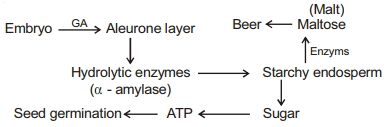
$A$ : Gibberellic acid increases the yield of malt from barley grain.
$R$ : Gibberellins stimulate the synthesis of amylase,protease and other hydrolytic enzymes for mobilisation of reserve food.
$R$ : Gibberellins stimulate the synthesis of amylase,protease and other hydrolytic enzymes for mobilisation of reserve food.
A
Assertion and Reason both are correct and also correct explanation.
B
Assertion and Reason both are correct but not explanation of assertion.
C
Assertion is correct,but Reason is incorrect.
D
Both Assertion and Reason are incorrect.
Solution
(A) The Assertion is correct because Gibberellic acid $(GA)$ is widely used in the brewing industry to speed up the malting process of barley grains.
The Reason is also correct because $GA$ induces the synthesis of hydrolytic enzymes like $\alpha$-amylase,protease,and others in the aleurone layer of germinating cereal seeds.
These enzymes break down the stored starch and proteins in the endosperm into simpler sugars and amino acids,which are essential for the growth of the embryo and the production of malt.
Therefore,the Reason correctly explains why Gibberellic acid increases the yield of malt.
The Reason is also correct because $GA$ induces the synthesis of hydrolytic enzymes like $\alpha$-amylase,protease,and others in the aleurone layer of germinating cereal seeds.
These enzymes break down the stored starch and proteins in the endosperm into simpler sugars and amino acids,which are essential for the growth of the embryo and the production of malt.
Therefore,the Reason correctly explains why Gibberellic acid increases the yield of malt.
0 likes
View Solution83
MediumMCQ
$A$ : Seeds do not sprout when $ABA$ is overcome by Gibberellins. $R$ : $GA$ inhibits protein and $RNA$ synthesis.
A
Assertion and Reason both are correct and Reason is the correct explanation of Assertion.
B
Assertion and Reason both are correct but Reason is not the correct explanation of Assertion.
C
Assertion is correct,but Reason is incorrect.
D
Both Assertion and Reason are incorrect.
Solution
(D) The Assertion is incorrect because seeds actually sprout when the inhibitory effect of $ABA$ (Abscisic Acid) is overcome by Gibberellins $(GA)$. Gibberellins promote seed germination by counteracting the dormancy induced by $ABA$.
The Reason is also incorrect because $GA$ (Gibberellins) promotes protein and $RNA$ synthesis,which is essential for germination. It is $ABA$ that inhibits protein and $RNA$ synthesis,thereby inducing dormancy.
The Reason is also incorrect because $GA$ (Gibberellins) promotes protein and $RNA$ synthesis,which is essential for germination. It is $ABA$ that inhibits protein and $RNA$ synthesis,thereby inducing dormancy.
0 likes
View Solution84
Medium
Describe the discovery of gibberellins.
Solution
(N/A) In the early part of the $20^{\text{th}}$ century,the 'bakane' (foolish seedling) disease of rice was reported to be caused by a fungal pathogen,$Gibberella$ $fujikuroi$.
The symptoms shown by the infected plants were abnormally elongated stems,little or no production of grains,and the plants became weak.
Later,it was identified by $E$. Kurosawa that the active substance secreted by the fungus,which caused these symptoms,was gibberellic acid.
The symptoms shown by the infected plants were abnormally elongated stems,little or no production of grains,and the plants became weak.
Later,it was identified by $E$. Kurosawa that the active substance secreted by the fungus,which caused these symptoms,was gibberellic acid.
0 likes
View Solution85
Medium
Give scientific reasons: Gibberellic acid induces reversal of dwarfism in many genetically dwarf plants.
Solution
(N/A) In genetically dwarf plants,the endogenous level of $GA$ (Gibberellic acid) is typically low.
When $GA$ is supplied externally to these plants,it stimulates internode elongation by promoting both cell division and cell enlargement.
This rapid growth overcomes the genetic limitation,resulting in the reversal of the dwarf phenotype.
When $GA$ is supplied externally to these plants,it stimulates internode elongation by promoting both cell division and cell enlargement.
This rapid growth overcomes the genetic limitation,resulting in the reversal of the dwarf phenotype.
0 likes
View Solution86
Medium
Give scientific reasons: Rice plants infected by the fungus $Gibberella$ $fujikuroi$ grow foolishly tall.
Solution
(N/A) The fungus $Gibberella$ $fujikuroi$ causes 'bakanae' (foolish seedling) disease in rice plants.
This fungus secretes a plant growth regulator known as $Gibberellin$.
$Gibberellins$ are responsible for internode elongation,which leads to the excessive and abnormal height increase in the infected rice plants.
This fungus secretes a plant growth regulator known as $Gibberellin$.
$Gibberellins$ are responsible for internode elongation,which leads to the excessive and abnormal height increase in the infected rice plants.
0 likes
View Solution87
Easy
Define or explain: Gibberellins.
Solution
(N/A) Minute quantities of gibberellins profoundly stimulate the growth of many plants.
The major sites of $GA$ production in plants are embryos,roots,and young leaves close to the shoot tip.
Gibberellins are chemically gibberellic acid $(GA_3)$.
They are of isoprenoid nature and possess the same general carbon skeleton.
The major sites of $GA$ production in plants are embryos,roots,and young leaves close to the shoot tip.
Gibberellins are chemically gibberellic acid $(GA_3)$.
They are of isoprenoid nature and possess the same general carbon skeleton.
0 likes
View Solution88
Medium
Gibberellins were first discovered in Japan when rice plants were suffering from bakane (the foolish seedling disease) caused by a fungus $Gibberella$ $fujikuroi$.
$(a)$ Give two functions of this phytohormone.
$(b)$ Which property of Gibberellin caused foolish seedling disease in rice?
$(a)$ Give two functions of this phytohormone.
$(b)$ Which property of Gibberellin caused foolish seedling disease in rice?
Solution
(N/A) The hormone,gibberellin:
$(i)$ Produces the phenomenon of bolting,i.e.,the growth of the internodal region of the stem in rosette plants.
$(ii)$ Induces seed germination and breaks bud and seed dormancy.
$(b)$ The rice seedling/plant shows excessive growth in its internodal region when infected with the fungus $Gibberella$ $fujikuroi$.
$(i)$ This fungus produces an excessive amount of the plant hormone $GA$ (Gibberellic Acid),which causes the plants to grow taller than normal,leading to the 'foolish seedling' appearance and often resulting in the death of the plant.
$(i)$ Produces the phenomenon of bolting,i.e.,the growth of the internodal region of the stem in rosette plants.
$(ii)$ Induces seed germination and breaks bud and seed dormancy.
$(b)$ The rice seedling/plant shows excessive growth in its internodal region when infected with the fungus $Gibberella$ $fujikuroi$.
$(i)$ This fungus produces an excessive amount of the plant hormone $GA$ (Gibberellic Acid),which causes the plants to grow taller than normal,leading to the 'foolish seedling' appearance and often resulting in the death of the plant.
0 likes
View Solution89
EasyMCQ
Gibberellins promote the formation of $.......$ flowers on genetically $.......$ plants in $Cannabis$,whereas ethylene promotes the formation of $.......$ flowers on genetically $.......$ plants.
A
Male,female,female,male
B
Female,male,male,female
C
Male,male,female,female
D
Female,female,male,male
Solution
(A) In $Cannabis$,gibberellins are known to promote the development of male flowers on genetically female plants.
Conversely,ethylene promotes the development of female flowers on genetically male plants.
This demonstrates the role of plant growth regulators in sex expression.
Conversely,ethylene promotes the development of female flowers on genetically male plants.
This demonstrates the role of plant growth regulators in sex expression.
0 likes
View Solution90
MediumMCQ
The rice seedlings infected with the fungus $Gibberella$ $fujikuroi$ are called 'foolish seedlings'. What was the reason behind this?
A
They grow excessively in height and become weak.
B
They stop growing completely.
C
They change their color to yellow.
D
They produce excessive grains prematurely.
Solution
(A) Rice plants infected with the fungus $Gibberella$ $fujikuroi$ exhibit abnormal and excessive elongation of the stem.
This rapid growth makes the plants too tall and weak to support their own weight.
Consequently,the plants collapse and eventually die.
Due to this characteristic appearance of weak,elongated,and dying seedlings,the disease is known as the 'foolish seedling' disease or 'bakanae' disease.
This rapid growth makes the plants too tall and weak to support their own weight.
Consequently,the plants collapse and eventually die.
Due to this characteristic appearance of weak,elongated,and dying seedlings,the disease is known as the 'foolish seedling' disease or 'bakanae' disease.
0 likes
View Solution91
MediumMCQ
Choose the correct option regarding the discovery of $Gibberellic$ $Acid$.
A
'$Bakanae$' is a disease of rice seedlings.
B
'$Bakanae$' disease is caused by the fungus $Gibberella$ $fujikuroi$.
C
Cell-free filtrate of the fungus induces symptoms of the disease in healthy rice seedlings.
D
All of the above.
Solution
(D) The discovery of $Gibberellic$ $Acid$ occurred during the study of the '$Bakanae$' (foolish seedling) disease.
$E. Kurosawa$ $(1926)$ observed that this disease in rice plants is caused by the fungus $Gibberella$ $fujikuroi$.
When he applied the cell-free filtrate of this fungus to healthy rice seedlings,they exhibited the same symptoms of the disease (excessive elongation).
Therefore,all the given options are correct.
$E. Kurosawa$ $(1926)$ observed that this disease in rice plants is caused by the fungus $Gibberella$ $fujikuroi$.
When he applied the cell-free filtrate of this fungus to healthy rice seedlings,they exhibited the same symptoms of the disease (excessive elongation).
Therefore,all the given options are correct.
0 likes
View Solution92
MediumMCQ
Which of the following gibberellic acids was discovered first?
A
$GA_1$
B
$GA_2$
C
$GA_3$
D
$GA_4$
Solution
(C) Gibberellins are a group of plant growth regulators.
More than $100$ gibberellins have been reported from widely different organisms such as fungi and higher plants.
They are denoted as $GA_1, GA_2, GA_3$ and so on.
$GA_3$ (Gibberellic acid) was one of the first gibberellins to be discovered and remains the most intensively studied form.
More than $100$ gibberellins have been reported from widely different organisms such as fungi and higher plants.
They are denoted as $GA_1, GA_2, GA_3$ and so on.
$GA_3$ (Gibberellic acid) was one of the first gibberellins to be discovered and remains the most intensively studied form.
0 likes
View Solution93
MediumMCQ
Select the correct option for $GA_3$.
A
It hastens maturity period in conifers.
B
It leads to early seed production.
C
It promotes bolting in beet,cabbages,and plants with rosette habit.
D
All of the above.
0 likes
View Solution94
MediumMCQ
Which of the following is responsible for inducing internode elongation in sugarcane stems?
A
Auxins
B
Gibberellins
C
Ethylene
D
Cytokinins
Solution
(B) Gibberellins are a group of plant growth regulators that promote various physiological processes. One of their most significant roles is the elongation of internodes in plants. In sugarcane,spraying the crop with $GA_3$ (a type of Gibberellin) increases the length of the stem,thereby increasing the yield of sugar by as much as $20$ tonnes per acre.
0 likes
View Solution95
MediumMCQ
Which plant hormone is responsible for improving the shape and length of fruits like apples?
A
Auxins
B
Gibberellins
C
Cytokinins
D
Ethylene
Solution
(B) Gibberellins are a class of plant hormones that promote growth and development. One of their specific physiological effects is the elongation of stems and the improvement of fruit shape. In commercial fruit production,gibberellins (specifically $GA_3$) are used to increase the length and improve the shape of fruits like apples,allowing them to elongate and improve in quality.
0 likes
View Solution96
MediumMCQ
The process of increasing the length of internodes prior to flowering is called $........$.
A
Malting
B
Bolting
C
Dormancy
D
Dominance
Solution
(B) The process of increasing the length of internodes just before flowering is known as $Bolting$. This phenomenon is typically induced by the application of $Gibberellins$ in rosette plants like cabbage and beet. $Bolting$ helps the plant to elevate its flowers for better pollination and seed dispersal.
0 likes
View Solution97
MediumMCQ
Spraying of which of the following phytohormone on juvenile conifers helps in hastening the maturity period, which leads to early seed production?
A
Abscisic Acid
B
Indole-3-butyric Acid
C
Gibberellic Acid
D
Zeatin
Solution
(C) Spraying juvenile conifers with $Gibberellic Acid$ $(GA)$ hastens the maturity period of the plants.
This physiological effect leads to early seed production in these conifers.
Therefore, $Gibberellic Acid$ is used in forestry to shorten the breeding cycle.
This physiological effect leads to early seed production in these conifers.
Therefore, $Gibberellic Acid$ is used in forestry to shorten the breeding cycle.
0 likes
View Solution98
MediumMCQ
Spraying sugarcane crop with which of the following plant growth regulators increases the length of the stem,thus increasing the yield?
A
Gibberellin
B
Cytokinin
C
Abscisic acid
D
Auxin
Solution
(A) Sugarcanes store carbohydrates as sugar in their stems. Spraying sugarcane crops with gibberellins increases the length of the stem,which leads to an increase in the yield by as much as $20$ tonnes per acre.
0 likes
View Solution99
MediumMCQ
The rosette habit of cabbage can be changed by inducing stem elongation by the application of.
A
Ethylene
B
$GA$
C
$CK$
D
$ABA$
Solution
(B) Gibberellins $(GA)$ are plant hormones that promote stem elongation. In plants like cabbage,which exhibit a rosette habit (short internodes),the application of $GA$ induces 'bolting',which is the rapid elongation of the internodes just before the reproductive phase. Therefore,the rosette habit can be changed by inducing stem elongation using $GA$.
0 likes
View SolutionPlant Growth and Development — Gibberellins · Frequently Asked Questions
1Are these Plant Growth and Development questions useful for JEE and NEET?
Yes. All questions in this section are mapped to JEE Main and NEET exam patterns. Previous year questions from JEE Main, NEET, GUJCET and state-level exams are included with full solutions.
2Can I switch to Hindi or Gujarati for these questions?
Yes. Use the language tabs in the hero section or the sidebar to view the same questions and solutions in English, Hindi or Gujarati.
3How do I generate a question paper from this subtopic?
Use the Vedclass Exam Paper Generator — select the chapter and subtopic, set difficulty, and generate Sets A, B, C, D automatically. First 3 chapters of every subject are free.
Vedclass Products
For Students
Vedclass Test Series
Mock tests in real JEE/NEET style with performance analysis. 5-day free trial.
Start Free TrialFor Teachers
Exam Paper Generator
Generate Set A/B/C/D papers from this chapter in 2 minutes. 3 chapters free.
Try FreeFor Institutes
Online Exam Module
Live online exams with unlimited students, 360° analytics & white-label branding.
See DemoFor Teachers & Institutes
Generate a Plant Growth and Development Exam Paper in 2 Minutes
Select subtopic & difficulty — Sets A, B, C, D auto-generated with No Repeat logic.
First 3 chapters of every subject are free — no payment required.