
A English
Differentiation, Dedifferentiation and Redifferentiation Questions in English
Class 11 Biology · Plant Growth and Development · Differentiation, Dedifferentiation and Redifferentiation
55+
Questions
English
Language
100%
With Solutions
Showing 5 of 55 questions in English
51
MediumMCQ
How many of the following tissues in a dicot plant are formed due to redifferentiation?
Cork,Secondary cortex,Cork cambium,Vascular cambium,Secondary medullary rays
Cork,Secondary cortex,Cork cambium,Vascular cambium,Secondary medullary rays
A
$2$
B
$3$
C
$4$
D
$5$
Solution
(B) Redifferentiation is the process where cells that have already differentiated lose their ability to divide and become mature tissues to perform specific functions.
$1$. Cork (Phellem): Formed by the activity of cork cambium (redifferentiation).
$2$. Secondary cortex (Phelloderm): Formed by the activity of cork cambium (redifferentiation).
$3$. Cork cambium (Phellogen): Formed by dedifferentiation of cortical cells.
$4$. Vascular cambium: Formed by dedifferentiation of parenchyma cells.
$5$. Secondary medullary rays: Formed by the activity of vascular cambium (redifferentiation).
The tissues formed due to redifferentiation are Cork,Secondary cortex,and Secondary medullary rays.
Therefore,the total number of tissues formed by redifferentiation is $3$.
$1$. Cork (Phellem): Formed by the activity of cork cambium (redifferentiation).
$2$. Secondary cortex (Phelloderm): Formed by the activity of cork cambium (redifferentiation).
$3$. Cork cambium (Phellogen): Formed by dedifferentiation of cortical cells.
$4$. Vascular cambium: Formed by dedifferentiation of parenchyma cells.
$5$. Secondary medullary rays: Formed by the activity of vascular cambium (redifferentiation).
The tissues formed due to redifferentiation are Cork,Secondary cortex,and Secondary medullary rays.
Therefore,the total number of tissues formed by redifferentiation is $3$.
0 likes
View Solution52
MediumMCQ
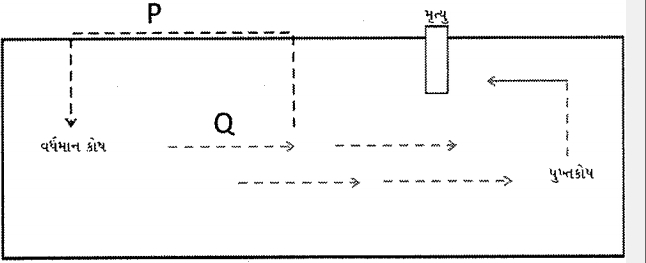
The sequence of developmental processes in a plant cell is given below. What are $P$ and $Q$?
A
Differentiation,Senescence
B
Differentiation,Maturation
C
Cell division,Differentiation
D
Cell division,Cytoplasmic growth
Solution
(C) In plant development,the process begins with cell division (meristematic activity),which increases the number of cells.
Following this,the cells undergo elongation and maturation,eventually leading to differentiation,where they acquire specific structures and functions.
Finally,the cells undergo senescence and death.
In the provided diagram,$P$ represents the phase of cell division (meristematic activity) and $Q$ represents the phase of differentiation.
Therefore,the correct sequence is Cell division and Differentiation.
Following this,the cells undergo elongation and maturation,eventually leading to differentiation,where they acquire specific structures and functions.
Finally,the cells undergo senescence and death.
In the provided diagram,$P$ represents the phase of cell division (meristematic activity) and $Q$ represents the phase of differentiation.
Therefore,the correct sequence is Cell division and Differentiation.
0 likes
View Solution53
EasyMCQ
The phenomenon by which the undividing parenchyma cells start to divide mitotically during plant tissue culture is called as:
A
Differentiation
B
Dedifferentiation
C
Redifferentiation
D
Secondary growth
Solution
(B) In plant tissue culture,the process where mature,differentiated parenchyma cells regain the capacity to divide mitotically is known as $Dedifferentiation$.
This process leads to the formation of a mass of undifferentiated cells called $Callus$.
$Differentiation$ is the process where cells undergo structural changes to mature into specialized cells.
$Redifferentiation$ is the process where dedifferentiated cells (like those in the callus) undergo further changes to become specialized again.
Therefore,the correct phenomenon is $Dedifferentiation$.
This process leads to the formation of a mass of undifferentiated cells called $Callus$.
$Differentiation$ is the process where cells undergo structural changes to mature into specialized cells.
$Redifferentiation$ is the process where dedifferentiated cells (like those in the callus) undergo further changes to become specialized again.
Therefore,the correct phenomenon is $Dedifferentiation$.
0 likes
View Solution54
MediumMCQ
In tissue culture experiments, leaf mesophyll cells are put in a culture medium to form callus. This phenomenon may be called as
A
Senescence
B
Differentiation
C
Dedifferentiation
D
Development
Solution
(C) In tissue culture experiments, leaf mesophyll cells are put in a culture medium to form callus. This phenomenon is called $Dedifferentiation$.
$Dedifferentiation$ is a biological phenomenon by which living differentiated plant cells, which have lost the capacity to divide, regain the capacity of division under certain experimental conditions.
$Dedifferentiation$ is a biological phenomenon by which living differentiated plant cells, which have lost the capacity to divide, regain the capacity of division under certain experimental conditions.
0 likes
View Solution55
MediumMCQ
Formation of interfascicular cambium from fully developed parenchyma cells is an example for
A
Redifferentiation
B
Dedifferentiation
C
Maturation
D
Differentiation
Solution
(B) The phenomenon where fully differentiated parenchyma cells regain the capacity to divide and form interfascicular cambium is known as dedifferentiation.
This process allows mature cells to return to a meristematic state to facilitate secondary growth.
This process allows mature cells to return to a meristematic state to facilitate secondary growth.
2 likes
View SolutionPlant Growth and Development — Differentiation, Dedifferentiation and Redifferentiation · Frequently Asked Questions
1Are these Plant Growth and Development questions useful for JEE and NEET?
Yes. All questions in this section are mapped to JEE Main and NEET exam patterns. Previous year questions from JEE Main, NEET, GUJCET and state-level exams are included with full solutions.
2Can I switch to Hindi or Gujarati for these questions?
Yes. Use the language tabs in the hero section or the sidebar to view the same questions and solutions in English, Hindi or Gujarati.
3How do I generate a question paper from this subtopic?
Use the Vedclass Exam Paper Generator — select the chapter and subtopic, set difficulty, and generate Sets A, B, C, D automatically. First 3 chapters of every subject are free.
Vedclass Products
For Students
Vedclass Test Series
Mock tests in real JEE/NEET style with performance analysis. 5-day free trial.
Start Free TrialFor Teachers
Exam Paper Generator
Generate Set A/B/C/D papers from this chapter in 2 minutes. 3 chapters free.
Try FreeFor Institutes
Online Exam Module
Live online exams with unlimited students, 360° analytics & white-label branding.
See DemoFor Teachers & Institutes
Generate a Plant Growth and Development Exam Paper in 2 Minutes
Select subtopic & difficulty — Sets A, B, C, D auto-generated with No Repeat logic.
First 3 chapters of every subject are free — no payment required.