
A English
C3 and Dark reaction Questions in English
Class 11 Biology · Photosynthesis in Higher Plants · C3 and Dark reaction
227+
Questions
English
Language
100%
With Solutions
Showing 27 of 227 questions in English
201
EasyMCQ
Who discovered the biosynthetic phase of photosynthesis?
A
Hans Krebs
B
Melvin Calvin
C
Hatch and Slack
D
Robert Hill
Solution
(B) The biosynthetic phase of photosynthesis,also known as the dark reaction or the Calvin cycle,involves the fixation of $CO_2$ into sugars.
This process was elucidated by Melvin Calvin and his colleagues using radioactive $^{14}C$ in algal photosynthesis studies.
Therefore,Melvin Calvin is credited with the discovery of the biosynthetic phase of photosynthesis.
This process was elucidated by Melvin Calvin and his colleagues using radioactive $^{14}C$ in algal photosynthesis studies.
Therefore,Melvin Calvin is credited with the discovery of the biosynthetic phase of photosynthesis.
0 likes
View Solution202
MediumMCQ
What are $RuBP$ and $RuBisCO$ respectively?
A
Enzyme and hexose sugar
B
Hexose sugar and enzyme
C
Enzyme and pentose sugar
D
Pentose sugar and enzyme
Solution
(D) $RuBP$ stands for Ribulose$-1,5-$bisphosphate,which is a $5$-carbon ketose sugar (pentose sugar).
$RuBisCO$ stands for Ribulose$-1,5-$bisphosphate carboxylase-oxygenase,which is the enzyme responsible for the primary carboxylation step in the Calvin cycle.
Therefore,$RuBP$ is a pentose sugar and $RuBisCO$ is an enzyme.
$RuBisCO$ stands for Ribulose$-1,5-$bisphosphate carboxylase-oxygenase,which is the enzyme responsible for the primary carboxylation step in the Calvin cycle.
Therefore,$RuBP$ is a pentose sugar and $RuBisCO$ is an enzyme.
0 likes
View Solution203
MediumMCQ
$RuBP + CO_2 + H_2O \xrightarrow{RuBisCO} \dots$
A
$2$ molecules of $3$-phosphoglycerate
B
$1$ molecule of $3$-phosphoglycerate and $1$ molecule of phosphoglycolate
C
$2$ molecules of phosphoglycolate
D
None of these
Solution
(A) In the $C_3$ cycle (Calvin cycle),the enzyme $RuBisCO$ (Ribulose$-1,5-$bisphosphate carboxylase-oxygenase) catalyzes the carboxylation of $RuBP$ (Ribulose$-1,5-$bisphosphate).
When $RuBisCO$ acts as a carboxylase,it reacts $RuBP$ with $CO_2$ and $H_2O$ to produce $2$ molecules of $3$-phosphoglycerate ($3$-$PGA$).
This is the primary step of carbon fixation in $C_3$ plants.
When $RuBisCO$ acts as a carboxylase,it reacts $RuBP$ with $CO_2$ and $H_2O$ to produce $2$ molecules of $3$-phosphoglycerate ($3$-$PGA$).
This is the primary step of carbon fixation in $C_3$ plants.
0 likes
View Solution204
MediumMCQ
In the $C_3$ pathway,the first stable product is $P$,and in the $C_4$ pathway,the first stable product is $Q$. Choose the correct option for $P$ and $Q$.
A
$RuBP, PEP$
B
$PGA, OAA$
C
$OAA, PGA$
D
$PEP, RuBP$
Solution
(B) In the $C_3$ cycle (Calvin cycle),the primary carboxylation reaction involves the fixation of $CO_2$ by $RuBP$ to form two molecules of $3$-phosphoglyceric acid $(PGA)$,which is the first stable product $(P = PGA)$.
In the $C_4$ cycle (Hatch-Slack pathway),the primary carboxylation occurs in the mesophyll cells where $PEP$ combines with $CO_2$ to form oxaloacetic acid $(OAA)$,which is a $4$-carbon compound and the first stable product $(Q = OAA)$.
In the $C_4$ cycle (Hatch-Slack pathway),the primary carboxylation occurs in the mesophyll cells where $PEP$ combines with $CO_2$ to form oxaloacetic acid $(OAA)$,which is a $4$-carbon compound and the first stable product $(Q = OAA)$.
0 likes
View Solution205
MediumMCQ
How many $ATP$ and $NADPH$ molecules are required for the reduction step in the Calvin cycle to produce one molecule of glucose?
A
$12 \, NADPH$ and $18 \, ATP$
B
$18 \, NADPH$ and $12 \, ATP$
C
$18 \, NADPH$ and $18 \, ATP$
D
$12 \, NADPH$ and $12 \, ATP$
Solution
(D) The Calvin cycle consists of three main stages: carboxylation,reduction,and regeneration.
To produce one molecule of glucose $(C_6H_{12}O_6)$,the cycle must turn $6$ times because each turn fixes one molecule of $CO_2$.
In the reduction phase,for every $CO_2$ molecule fixed,$2 \, ATP$ are used for phosphorylation and $2 \, NADPH$ are used for reduction.
Since $6$ turns are required for one glucose molecule,the total requirement for the reduction phase is $6 \times 2 = 12 \, ATP$ and $6 \times 2 = 12 \, NADPH$.
To produce one molecule of glucose $(C_6H_{12}O_6)$,the cycle must turn $6$ times because each turn fixes one molecule of $CO_2$.
In the reduction phase,for every $CO_2$ molecule fixed,$2 \, ATP$ are used for phosphorylation and $2 \, NADPH$ are used for reduction.
Since $6$ turns are required for one glucose molecule,the total requirement for the reduction phase is $6 \times 2 = 12 \, ATP$ and $6 \times 2 = 12 \, NADPH$.
0 likes
View Solution206
MediumMCQ
The conversion of $1,3$-bisphosphoglycerate to $3$-phosphoglycerate involves:
A
Reduction
B
Oxidation
C
Phosphorylation
D
Dephosphorylation
Solution
(D) In the Calvin cycle,the conversion of $1,3$-bisphosphoglycerate to $3$-phosphoglycerate is a step where a phosphate group is removed from the molecule. This process is catalyzed by the enzyme phosphoglycerate kinase. Since a phosphate group is removed,the reaction is termed as dephosphorylation. This step also results in the formation of $ATP$ from $ADP$.
0 likes
View Solution207
MediumMCQ
Arrange the stages of the Calvin cycle in the correct order.
A
Regeneration $\rightarrow$ Carboxylation $\rightarrow$ Reduction
B
Reduction $\rightarrow$ Carboxylation $\rightarrow$ Regeneration
C
Carboxylation $\rightarrow$ Reduction $\rightarrow$ Regeneration
D
Regeneration $\rightarrow$ Reduction $\rightarrow$ Carboxylation
Solution
(C) The Calvin cycle consists of three main stages:
$1$. Carboxylation: The fixation of $CO_2$ into a stable organic intermediate,where $CO_2$ is utilized for the carboxylation of $RuBP$.
$2$. Reduction: $A$ series of reactions that lead to the formation of glucose,involving the utilization of $ATP$ and $NADPH$ for the reduction of $3-PGA$.
$3$. Regeneration: The formation of the $CO_2$ acceptor molecule $(RuBP)$ again,which is crucial for the cycle to continue.
Therefore,the correct sequence is Carboxylation $\rightarrow$ Reduction $\rightarrow$ Regeneration.
$1$. Carboxylation: The fixation of $CO_2$ into a stable organic intermediate,where $CO_2$ is utilized for the carboxylation of $RuBP$.
$2$. Reduction: $A$ series of reactions that lead to the formation of glucose,involving the utilization of $ATP$ and $NADPH$ for the reduction of $3-PGA$.
$3$. Regeneration: The formation of the $CO_2$ acceptor molecule $(RuBP)$ again,which is crucial for the cycle to continue.
Therefore,the correct sequence is Carboxylation $\rightarrow$ Reduction $\rightarrow$ Regeneration.
0 likes
View Solution208
MediumMCQ
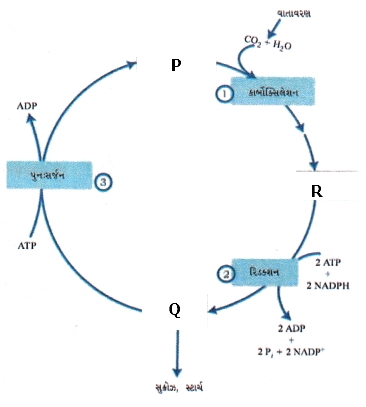
The stages of the Calvin cycle are given below. Identify $P, Q$ and $R$.
A
Pentose sugar,$3$-carbon acid,Triose sugar
B
Triose sugar,$3$-carbon acid,Pentose sugar
C
Pentose sugar,Triose sugar,Triose sugar
D
Pentose sugar,Triose sugar,$3$-carbon acid
Solution
(A) The Calvin cycle consists of three main stages: Carboxylation,Reduction,and Regeneration.
$1$. Carboxylation: $CO_2$ combines with a $5$-carbon sugar called Ribulose $1,5$-bisphosphate $(RuBP)$ (represented by $P$) to form a $3$-carbon acid,$3$-phosphoglycerate ($3$-$PGA$) (represented by $R$).
$2$. Reduction: $3$-$PGA$ is converted into Triose phosphate (represented by $Q$) using $ATP$ and $NADPH$.
$3$. Regeneration: Triose phosphate is used to regenerate $RuBP$ to continue the cycle.
Therefore,$P$ is Pentose sugar $(RuBP)$,$R$ is $3$-carbon acid ($3$-$PGA$),and $Q$ is Triose sugar (Triose phosphate).
$1$. Carboxylation: $CO_2$ combines with a $5$-carbon sugar called Ribulose $1,5$-bisphosphate $(RuBP)$ (represented by $P$) to form a $3$-carbon acid,$3$-phosphoglycerate ($3$-$PGA$) (represented by $R$).
$2$. Reduction: $3$-$PGA$ is converted into Triose phosphate (represented by $Q$) using $ATP$ and $NADPH$.
$3$. Regeneration: Triose phosphate is used to regenerate $RuBP$ to continue the cycle.
Therefore,$P$ is Pentose sugar $(RuBP)$,$R$ is $3$-carbon acid ($3$-$PGA$),and $Q$ is Triose sugar (Triose phosphate).
0 likes
View Solution209
MediumMCQ
How many $ATP$ and $NADPH$ molecules are required for the fixation of three $CO_2$ molecules in the Calvin cycle?
A
$9\,ATP, 6\,NADPH$
B
$18\,ATP, 12\,NADPH$
C
$6\,ATP, 9\,NADPH$
D
$12\,ATP, 18\,NADPH$
Solution
(A) In the Calvin cycle,the fixation of one molecule of $CO_2$ requires $3\,ATP$ and $2\,NADPH$ molecules.
For the fixation of three $CO_2$ molecules,the calculation is as follows:
$ATP$ required = $3 \times 3 = 9\,ATP$
$NADPH$ required = $3 \times 2 = 6\,NADPH$
Therefore,to fix three $CO_2$ molecules,$9\,ATP$ and $6\,NADPH$ are required.
For the fixation of three $CO_2$ molecules,the calculation is as follows:
$ATP$ required = $3 \times 3 = 9\,ATP$
$NADPH$ required = $3 \times 2 = 6\,NADPH$
Therefore,to fix three $CO_2$ molecules,$9\,ATP$ and $6\,NADPH$ are required.
0 likes
View Solution210
MediumMCQ
State the location of the light reaction and the Calvin cycle in $C_3$ plants.
A
Light reaction - Grana of mesophyll chloroplasts
Calvin cycle - Stroma of mesophyll chloroplasts
Calvin cycle - Stroma of mesophyll chloroplasts
B
Light reaction - Grana of bundle sheath chloroplasts
Calvin cycle - Stroma of bundle sheath chloroplasts
Calvin cycle - Stroma of bundle sheath chloroplasts
C
Light reaction - Grana of mesophyll chloroplasts
Calvin cycle - Stroma of bundle sheath chloroplasts
Calvin cycle - Stroma of bundle sheath chloroplasts
D
Light reaction - Grana of bundle sheath chloroplasts
Calvin cycle - Stroma of mesophyll chloroplasts
Calvin cycle - Stroma of mesophyll chloroplasts
Solution
(A) In $C_3$ plants,the entire process of photosynthesis occurs within the mesophyll cells.
The light-dependent reaction (light reaction) takes place in the thylakoid membranes (grana) of the chloroplasts.
The Calvin cycle (dark reaction) takes place in the stroma of the same chloroplasts within the mesophyll cells.
Therefore,both processes are localized in the mesophyll cells of $C_3$ plants.
The light-dependent reaction (light reaction) takes place in the thylakoid membranes (grana) of the chloroplasts.
The Calvin cycle (dark reaction) takes place in the stroma of the same chloroplasts within the mesophyll cells.
Therefore,both processes are localized in the mesophyll cells of $C_3$ plants.
0 likes
View Solution211
DifficultMCQ
When one $CO_2$ molecule is fixed as one molecule of triose phosphate,which of the following photochemically made,high energy chemical intermediates are used in the reduction phase?
A
$1\,ATP + 1\,NADPH$
B
$1\,ATP + 2\,NADPH$
C
$2\,ATP + 1\,NADPH$
D
$2\,ATP + 2\,NADPH$
Solution
(A) In the Calvin cycle,the reduction phase involves the conversion of $3$-phosphoglycerate ($3$-$PGA$) to glyceraldehyde $3$-phosphate (triose phosphate).
For the fixation of one molecule of $CO_2$,the reduction phase requires $1$ molecule of $ATP$ (for phosphorylation) and $1$ molecule of $NADPH$ (for reduction).
However,the overall stoichiometry for the production of one molecule of triose phosphate from $3$ molecules of $CO_2$ requires $6$ $ATP$ and $6$ $NADPH$ in the reduction phase.
Therefore,for the fixation of a single $CO_2$ molecule,the requirement is $1$ $ATP$ and $1$ $NADPH$ specifically for the reduction step.
For the fixation of one molecule of $CO_2$,the reduction phase requires $1$ molecule of $ATP$ (for phosphorylation) and $1$ molecule of $NADPH$ (for reduction).
However,the overall stoichiometry for the production of one molecule of triose phosphate from $3$ molecules of $CO_2$ requires $6$ $ATP$ and $6$ $NADPH$ in the reduction phase.
Therefore,for the fixation of a single $CO_2$ molecule,the requirement is $1$ $ATP$ and $1$ $NADPH$ specifically for the reduction step.
1 likes
View Solution212
MediumMCQ
How many $ATP$ and $NADPH_2$ are required for the synthesis of one molecule of glucose during the Calvin cycle?
A
$18\,ATP$ and $16\,NADPH_2$
B
$12\,ATP$ and $12\,NADPH_2$
C
$18\,ATP$ and $12\,NADPH_2$
D
$12\,ATP$ and $16\,NADPH_2$
Solution
(C) For every $CO_2$ molecule entering the Calvin cycle,$3$ molecules of $ATP$ and $2$ molecules of $NADPH_2$ are required.
To synthesize one molecule of glucose $(C_6H_{12}O_6)$,$6$ turns of the Calvin cycle are necessary because each turn fixes one carbon atom.
Therefore,the total requirement is calculated as:
$6 \times (3\,ATP + 2\,NADPH_2) = 18\,ATP$ and $12\,NADPH_2$.
To synthesize one molecule of glucose $(C_6H_{12}O_6)$,$6$ turns of the Calvin cycle are necessary because each turn fixes one carbon atom.
Therefore,the total requirement is calculated as:
$6 \times (3\,ATP + 2\,NADPH_2) = 18\,ATP$ and $12\,NADPH_2$.
0 likes
View Solution213
MediumMCQ
Which of the following are required for the dark reaction of photosynthesis?
$A$. Light $B$. Chlorophyll $C$. $CO_2$ $D$. $ATP$ $E$. $NADPH$
Choose the correct answer from the options given below:
$A$. Light $B$. Chlorophyll $C$. $CO_2$ $D$. $ATP$ $E$. $NADPH$
Choose the correct answer from the options given below:
A
$B, C$ and $D$ only
B
$C, D$ and $E$ only
C
$D$ and $E$ only
D
$A, B$ and $C$ only
Solution
(B) The dark reaction of photosynthesis,also known as the Calvin cycle or light-independent reaction,takes place in the stroma of the chloroplast.
It does not directly require light,chlorophyll,or the light-harvesting apparatus.
Instead,it utilizes the products of the light-dependent reactions to fix carbon dioxide into glucose.
The essential requirements for the dark reaction are:
$1$. $CO_2$: Acts as the carbon source for the synthesis of sugars.
$2$. $ATP$: Provides the necessary energy for the reduction process.
$3$. $NADPH$: Acts as a reducing agent to convert $3-PGA$ to $G3P$.
Therefore,$C, D,$ and $E$ are the correct requirements.
It does not directly require light,chlorophyll,or the light-harvesting apparatus.
Instead,it utilizes the products of the light-dependent reactions to fix carbon dioxide into glucose.
The essential requirements for the dark reaction are:
$1$. $CO_2$: Acts as the carbon source for the synthesis of sugars.
$2$. $ATP$: Provides the necessary energy for the reduction process.
$3$. $NADPH$: Acts as a reducing agent to convert $3-PGA$ to $G3P$.
Therefore,$C, D,$ and $E$ are the correct requirements.
2 likes
View Solution214
MediumMCQ
How many molecules of $ATP$ and $NADPH$ are required for every molecule of $CO_2$ fixed in the Calvin cycle?
A
$2$ molecules of $ATP$ and $2$ molecules of $NADPH$
B
$3$ molecules of $ATP$ and $3$ molecules of $NADPH$
C
$3$ molecules of $ATP$ and $2$ molecules of $NADPH$
D
$2$ molecules of $ATP$ and $3$ molecules of $NADPH$
Solution
(C) In the Calvin cycle,the fixation of $1$ molecule of $CO_2$ involves three stages: carboxylation,reduction,and regeneration.
During the reduction phase,$2$ molecules of $ATP$ and $2$ molecules of $NADPH$ are used for the reduction of $1$ molecule of $3-PGA$ to $G3P$.
Additionally,$1$ molecule of $ATP$ is required during the regeneration phase to convert $RuMP$ back into $RuBP$.
Therefore,for the fixation of $1$ molecule of $CO_2$,a total of $3$ molecules of $ATP$ and $2$ molecules of $NADPH$ are consumed.
During the reduction phase,$2$ molecules of $ATP$ and $2$ molecules of $NADPH$ are used for the reduction of $1$ molecule of $3-PGA$ to $G3P$.
Additionally,$1$ molecule of $ATP$ is required during the regeneration phase to convert $RuMP$ back into $RuBP$.
Therefore,for the fixation of $1$ molecule of $CO_2$,a total of $3$ molecules of $ATP$ and $2$ molecules of $NADPH$ are consumed.
0 likes
View Solution215
EasyMCQ
Which of the following statements about $RuBisCO$ is true?
A
It is active only in the dark.
B
It has higher affinity for oxygen than carbon dioxide.
C
It is an enzyme involved in the photolysis of water.
D
It catalyzes the carboxylation of $RuBP$.
Solution
(D) $RuBisCO$ (Ribulose$-1,5-$bisphosphate carboxylase-oxygenase) is the most abundant enzyme on Earth.
It acts as a carboxylase in the Calvin cycle,where it catalyzes the carboxylation of $RuBP$ (Ribulose$-1,5-$bisphosphate) by adding $CO_2$ to it.
Option $A$ is incorrect because $RuBisCO$ is light-dependent and active during the day.
Option $B$ is incorrect because although it can bind to both,it has a much higher affinity for $CO_2$ than for $O_2$ under normal physiological conditions.
Option $C$ is incorrect because the photolysis of water is catalyzed by the oxygen-evolving complex associated with Photosystem $II$,not $RuBisCO$.
Therefore,the correct statement is that it catalyzes the carboxylation of $RuBP$.
It acts as a carboxylase in the Calvin cycle,where it catalyzes the carboxylation of $RuBP$ (Ribulose$-1,5-$bisphosphate) by adding $CO_2$ to it.
Option $A$ is incorrect because $RuBisCO$ is light-dependent and active during the day.
Option $B$ is incorrect because although it can bind to both,it has a much higher affinity for $CO_2$ than for $O_2$ under normal physiological conditions.
Option $C$ is incorrect because the photolysis of water is catalyzed by the oxygen-evolving complex associated with Photosystem $II$,not $RuBisCO$.
Therefore,the correct statement is that it catalyzes the carboxylation of $RuBP$.
0 likes
View Solution216
MediumMCQ
Which stage of the Calvin cycle utilizes $\text{ATP}$?
A
Carboxylation
B
Regeneration
C
Reduction
D
Both $2$ and $3$
Solution
(D) The Calvin cycle consists of three main stages: Carboxylation,Reduction,and Regeneration.
$1$. Carboxylation: $\text{CO}_2$ is fixed to $\text{RuBP}$ by the enzyme $\text{RuBisCO}$. No $\text{ATP}$ is used here.
$2$. Reduction: This stage utilizes both $\text{ATP}$ and $\text{NADPH}$ to convert $3$-phosphoglycerate into glyceraldehyde-$3$-phosphate.
$3$. Regeneration: This stage requires $\text{ATP}$ to regenerate $\text{RuBP}$ from triose phosphates so that the cycle can continue.
Therefore,both the Reduction and Regeneration stages utilize $\text{ATP}$.
$1$. Carboxylation: $\text{CO}_2$ is fixed to $\text{RuBP}$ by the enzyme $\text{RuBisCO}$. No $\text{ATP}$ is used here.
$2$. Reduction: This stage utilizes both $\text{ATP}$ and $\text{NADPH}$ to convert $3$-phosphoglycerate into glyceraldehyde-$3$-phosphate.
$3$. Regeneration: This stage requires $\text{ATP}$ to regenerate $\text{RuBP}$ from triose phosphates so that the cycle can continue.
Therefore,both the Reduction and Regeneration stages utilize $\text{ATP}$.
0 likes
View Solution217
EasyMCQ
In $C_3$-cycle,how many $\text{ATP}$ molecules are used for the formation of $3$ molecules of hexose (glucose) sugar?
A
$54$
B
$30$
C
$33$
D
$37$
Solution
(A) In the $C_3$-cycle (Calvin cycle),the synthesis of $1$ molecule of glucose $(C_6H_{12}O_6)$ requires $18$ $\text{ATP}$ and $12$ $\text{NADPH}$.
To form $3$ molecules of glucose,we multiply the requirements by $3$.
Total $\text{ATP}$ required $= 3 \times 18 = 54$ $\text{ATP}$.
Therefore,the correct option is $A$.
To form $3$ molecules of glucose,we multiply the requirements by $3$.
Total $\text{ATP}$ required $= 3 \times 18 = 54$ $\text{ATP}$.
Therefore,the correct option is $A$.
0 likes
View Solution218
MediumMCQ
The biosynthetic phase of photosynthesis includes ?
$(A)$ Use of $ATP$
$(B)$ Synthesis of $NADPH + H^{+}$
$(C)$ Formation of sugar
$(D)$ Release of oxygen
$(E)$ Reduction of $CO_2$
$(A)$ Use of $ATP$
$(B)$ Synthesis of $NADPH + H^{+}$
$(C)$ Formation of sugar
$(D)$ Release of oxygen
$(E)$ Reduction of $CO_2$
A
$A, C$ and $E$ only
B
$A, B, C$ and $E$ only
C
$A, B$ and $C$ only
D
$A, C$ and $D$ only
Solution
(A) The biosynthetic phase of photosynthesis is also known as the dark reaction or the Calvin cycle.
This phase does not directly require light but depends on the products of the light-dependent reaction ($ATP$ and $NADPH$).
Key processes in the biosynthetic phase include:
$1$. Use of $ATP$ (energy source).
$2$. Use of $NADPH + H^{+}$ (reducing agent).
$3$. Reduction of $CO_2$ to form carbohydrates (sugars).
Options $(A)$,$(C)$,and $(E)$ are correct components of this phase.
Option $(B)$ (Synthesis of $NADPH + H^{+}$) and $(D)$ (Release of oxygen) occur during the light-dependent phase (photochemical phase).
Therefore,the correct combination is $A, C$ and $E$ only.
This phase does not directly require light but depends on the products of the light-dependent reaction ($ATP$ and $NADPH$).
Key processes in the biosynthetic phase include:
$1$. Use of $ATP$ (energy source).
$2$. Use of $NADPH + H^{+}$ (reducing agent).
$3$. Reduction of $CO_2$ to form carbohydrates (sugars).
Options $(A)$,$(C)$,and $(E)$ are correct components of this phase.
Option $(B)$ (Synthesis of $NADPH + H^{+}$) and $(D)$ (Release of oxygen) occur during the light-dependent phase (photochemical phase).
Therefore,the correct combination is $A, C$ and $E$ only.
0 likes
View Solution219
MediumMCQ
Consider the given two statements:
Statement $I$: Carbon reactions during photosynthesis in higher plants are called as dark reactions.
Statement $II$: They always occur in darkness and they are not light-dependent.
Statement $I$: Carbon reactions during photosynthesis in higher plants are called as dark reactions.
Statement $II$: They always occur in darkness and they are not light-dependent.
A
Both Statement $I$ and Statement $II$ are correct and Statement $II$ explains Statement $I$
B
Both Statement $I$ and Statement $II$ are correct but Statement $II$ does not explain Statement $I$
C
Statement $I$ is correct but Statement $II$ is incorrect
D
Statement $I$ and Statement $II$ are incorrect
Solution
(C) Statement $I$ is correct because the biosynthetic phase of photosynthesis,where $CO_2$ is fixed into sugars,is traditionally referred to as the dark reaction.
Statement $II$ is incorrect because these reactions do not require darkness; they occur in the presence of light. They are called 'dark reactions' simply because they do not directly require light energy (photons) to drive the enzymatic steps,but they are indirectly dependent on the products of the light-dependent reactions ($ATP$ and $NADPH$). Therefore,they can occur during the day as well.
Statement $II$ is incorrect because these reactions do not require darkness; they occur in the presence of light. They are called 'dark reactions' simply because they do not directly require light energy (photons) to drive the enzymatic steps,but they are indirectly dependent on the products of the light-dependent reactions ($ATP$ and $NADPH$). Therefore,they can occur during the day as well.
0 likes
View Solution220
EasyMCQ
Which stage of the Calvin cycle does not involve the dephosphorylation of $\text{ATP}$?
A
Carboxylation
B
Reduction
C
Regeneration of $\text{RuBP}$
D
Regeneration of primary $CO_2$ acceptor
Solution
(A) The Calvin cycle consists of three main stages: Carboxylation,Reduction,and Regeneration.
$1$. Carboxylation: In this stage,$CO_2$ is fixed by $\text{RuBP}$ with the help of the enzyme $\text{RuBisCO}$. This step does not require $\text{ATP}$ or $\text{NADPH}$.
$2$. Reduction: This stage involves the utilization of $2$ molecules of $\text{ATP}$ and $2$ molecules of $\text{NADPH}$ for the reduction of each molecule of $3$-phosphoglycerate ($3$-$PGA$) to glyceraldehyde $3$-phosphate.
$3$. Regeneration: This stage requires $1$ molecule of $\text{ATP}$ for the phosphorylation of ribulose $5$-phosphate to regenerate $\text{RuBP}$.
Therefore,the Carboxylation stage is the only one that does not involve the dephosphorylation of $\text{ATP}$.
$1$. Carboxylation: In this stage,$CO_2$ is fixed by $\text{RuBP}$ with the help of the enzyme $\text{RuBisCO}$. This step does not require $\text{ATP}$ or $\text{NADPH}$.
$2$. Reduction: This stage involves the utilization of $2$ molecules of $\text{ATP}$ and $2$ molecules of $\text{NADPH}$ for the reduction of each molecule of $3$-phosphoglycerate ($3$-$PGA$) to glyceraldehyde $3$-phosphate.
$3$. Regeneration: This stage requires $1$ molecule of $\text{ATP}$ for the phosphorylation of ribulose $5$-phosphate to regenerate $\text{RuBP}$.
Therefore,the Carboxylation stage is the only one that does not involve the dephosphorylation of $\text{ATP}$.
0 likes
View Solution221
EasyMCQ
How many molecules of $NADPH_2$ will be required for the synthesis of $10$ glucose molecules?
A
$120$
B
$100$
C
$200$
D
$180$
Solution
(A) The synthesis of one molecule of glucose $(C_6H_{12}O_6)$ via the Calvin cycle requires $18$ molecules of $ATP$ and $12$ molecules of $NADPH_2$.
To synthesize $10$ molecules of glucose,we multiply the requirement per glucose molecule by $10$.
Calculation: $12 \text{ molecules of } NADPH_2 \times 10 \text{ glucose molecules} = 120 \text{ molecules of } NADPH_2$.
Therefore,$120$ molecules of $NADPH_2$ are required.
To synthesize $10$ molecules of glucose,we multiply the requirement per glucose molecule by $10$.
Calculation: $12 \text{ molecules of } NADPH_2 \times 10 \text{ glucose molecules} = 120 \text{ molecules of } NADPH_2$.
Therefore,$120$ molecules of $NADPH_2$ are required.
0 likes
View Solution222
EasyMCQ
The outcome of the Calvin cycle includes:
A
$6 CO_2, 18 ATP, 12 NADPH$
B
$1$ glucose,$18 ATP, 12 NADPH$
C
$6 CO_2, 18 ADP, 12 NADP$
D
$1$ glucose,$18 ADP, 12 NADP$
Solution
(D) The correct answer is $D$.
The Calvin cycle (also known as the $C_3$ cycle) is the light-independent reaction of photosynthesis.
For the synthesis of one molecule of glucose $(C_6H_{12}O_6)$,the cycle must turn six times.
The overall stoichiometry for the production of one glucose molecule is:
$6 CO_2 + 18 ATP + 12 NADPH + 12 H^+ \rightarrow 1 C_6H_{12}O_6 + 18 ADP + 18 Pi + 12 NADP^+ + 6 H_2O$.
Thus,the net outcome includes $1$ glucose,$18 ADP$,and $12 NADP^+$.
The Calvin cycle (also known as the $C_3$ cycle) is the light-independent reaction of photosynthesis.
For the synthesis of one molecule of glucose $(C_6H_{12}O_6)$,the cycle must turn six times.
The overall stoichiometry for the production of one glucose molecule is:
$6 CO_2 + 18 ATP + 12 NADPH + 12 H^+ \rightarrow 1 C_6H_{12}O_6 + 18 ADP + 18 Pi + 12 NADP^+ + 6 H_2O$.
Thus,the net outcome includes $1$ glucose,$18 ADP$,and $12 NADP^+$.
0 likes
View Solution223
EasyMCQ
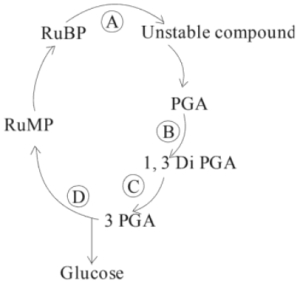
In the condensed schematic representation of the dark reaction of photosynthesis given below,steps are indicated by alphabets. Select the option where the alphabets are correctly identified.
A
$A = CO_2$ fixation,$B =$ Phosphorylation,$C =$ Reduction,$D =$ Regeneration
B
$A =$ Regeneration,$B = CO_2$ fixation,$C =$ Reduction,$D =$ Phosphorylation
C
$A = CO_2$ fixation,$B =$ Reduction,$C =$ Phosphorylation,$D =$ Regeneration
D
$A =$ Phosphorylation,$B = CO_2$ fixation,$C =$ Reduction,$D =$ Regeneration
Solution
(A) The correct option is $A$.
In the Calvin cycle (dark reaction),the process consists of three main stages:
$1$. Carboxylation $(A)$: $CO_2$ is fixed by $RuBP$ to form an unstable compound which breaks down into $PGA$.
$2$. Reduction ($B$ and $C$): This involves two steps:
- Phosphorylation $(B)$: $PGA$ is converted to $1,3$-bisphosphoglycerate using $ATP$.
- Reduction $(C)$: $1,3$-bisphosphoglycerate is reduced to $G3P$ (or $3-PGA$ aldehyde) using $NADPH$.
$3$. Regeneration $(D)$: $RuBP$ is regenerated from $RuMP$ using $ATP$ to continue the cycle.
In the Calvin cycle (dark reaction),the process consists of three main stages:
$1$. Carboxylation $(A)$: $CO_2$ is fixed by $RuBP$ to form an unstable compound which breaks down into $PGA$.
$2$. Reduction ($B$ and $C$): This involves two steps:
- Phosphorylation $(B)$: $PGA$ is converted to $1,3$-bisphosphoglycerate using $ATP$.
- Reduction $(C)$: $1,3$-bisphosphoglycerate is reduced to $G3P$ (or $3-PGA$ aldehyde) using $NADPH$.
$3$. Regeneration $(D)$: $RuBP$ is regenerated from $RuMP$ using $ATP$ to continue the cycle.
0 likes
View Solution224
EasyMCQ
Identify the incorrect statement with respect to Calvin cycle.
A
$18$ molecules of $ATP$ are synthesised during carbon fixation.
B
$NADPH + H^+$ produced in light reaction is used to reduce diphosphoglycerate.
C
The carboxylation of $RuBP$ is catalysed by $RuBisCO$.
D
The first stable intermediate compound formed is phosphoglycerate.
Solution
(A) The incorrect statement is $A$.
In the Calvin cycle,$18$ molecules of $ATP$ are not synthesized during carbon fixation; rather,$ATP$ is consumed.
To produce one molecule of glucose ($6$ carbons),the Calvin cycle must turn $6$ times.
Each turn requires $3$ $ATP$ and $2$ $NADPH$ molecules.
Therefore,a total of $18$ $ATP$ and $12$ $NADPH$ are consumed,not synthesized,during the process.
Option $B$ is correct as $NADPH$ is used for the reduction of $1,3$-bisphosphoglycerate to glyceraldehyde-$3$-phosphate.
Option $C$ is correct as $RuBisCO$ is the enzyme responsible for the carboxylation of $RuBP$.
Option $D$ is correct as $3$-phosphoglycerate ($3$-$PGA$) is the first stable product of the Calvin cycle.
In the Calvin cycle,$18$ molecules of $ATP$ are not synthesized during carbon fixation; rather,$ATP$ is consumed.
To produce one molecule of glucose ($6$ carbons),the Calvin cycle must turn $6$ times.
Each turn requires $3$ $ATP$ and $2$ $NADPH$ molecules.
Therefore,a total of $18$ $ATP$ and $12$ $NADPH$ are consumed,not synthesized,during the process.
Option $B$ is correct as $NADPH$ is used for the reduction of $1,3$-bisphosphoglycerate to glyceraldehyde-$3$-phosphate.
Option $C$ is correct as $RuBisCO$ is the enzyme responsible for the carboxylation of $RuBP$.
Option $D$ is correct as $3$-phosphoglycerate ($3$-$PGA$) is the first stable product of the Calvin cycle.
0 likes
View Solution225
EasyMCQ
$A$ plant is provided with ideal conditions for photosynthesis and supplied with isotope $^{14}CO_2$. When the products of the process are analysed carefully,what would be the nature of products?
A
Both glucose and oxygen are labelled
B
Only glucose and oxygen are normal
C
Both glucose and oxygen are normal
D
Only glucose is labelled and oxygen is normal
Solution
(D) The correct answer is $D$.
In the process of photosynthesis,the carbon source is $CO_2$,which is incorporated into the glucose molecule during the Calvin cycle.
Since the plant is supplied with the radioactive isotope $^{14}CO_2$,the carbon atoms in the resulting glucose molecule will be radioactive (labelled).
Oxygen released during photosynthesis is derived from the photolysis of water $(H_2O)$,not from $CO_2$.
Therefore,the oxygen released will be normal $(^{16}O)$ and not labelled.
In the process of photosynthesis,the carbon source is $CO_2$,which is incorporated into the glucose molecule during the Calvin cycle.
Since the plant is supplied with the radioactive isotope $^{14}CO_2$,the carbon atoms in the resulting glucose molecule will be radioactive (labelled).
Oxygen released during photosynthesis is derived from the photolysis of water $(H_2O)$,not from $CO_2$.
Therefore,the oxygen released will be normal $(^{16}O)$ and not labelled.
0 likes
View Solution226
EasyMCQ
The enzyme required for carboxylation in the Calvin cycle is:
A
$(1)$ $PEP$ carboxylase
B
$(2)$ RuBP carboxylase-oxygenase
C
$(3)$ Carboxypeptidase
D
$(4)$ Hexokinase
Solution
(B) In the Calvin cycle,the enzyme RuBisCO (RuBP carboxylase-oxygenase) catalyzes the carboxylation step.
This enzyme facilitates the fixation of atmospheric $CO_2$ into a $5$-carbon sugar called Ribulose $1,5$-bisphosphate (RuBP).
This enzyme facilitates the fixation of atmospheric $CO_2$ into a $5$-carbon sugar called Ribulose $1,5$-bisphosphate (RuBP).
0 likes
View Solution227
MediumMCQ
How many $ATP$ and $NADPH$ molecules are required to make one molecule of glucose through the Calvin pathway?
A
$(1)$ $12$ $ATP$ and $18$ $NADPH$
B
$(2)$ $18$ $ATP$ and $12$ $NADPH$
C
$(3)$ $6$ $ATP$ and $12$ $NADPH$
D
$(4)$ $24$ $ATP$ and $18$ $NADPH$
Solution
(B) For the synthesis of one molecule of glucose $(C_6H_{12}O_6)$ via the Calvin cycle,$6$ turns are required.
Each turn fixes one $CO_2$ molecule,consuming $3$ $ATP$ and $2$ $NADPH$.
Therefore,for $6$ $CO_2$ molecules,the total requirement is:
$6 \times 3 = 18$ $ATP$
$6 \times 2 = 12$ $NADPH$
Thus,$18$ $ATP$ and $12$ $NADPH$ molecules are required to produce one molecule of glucose.
Each turn fixes one $CO_2$ molecule,consuming $3$ $ATP$ and $2$ $NADPH$.
Therefore,for $6$ $CO_2$ molecules,the total requirement is:
$6 \times 3 = 18$ $ATP$
$6 \times 2 = 12$ $NADPH$
Thus,$18$ $ATP$ and $12$ $NADPH$ molecules are required to produce one molecule of glucose.
0 likes
View SolutionPhotosynthesis in Higher Plants — C3 and Dark reaction · Frequently Asked Questions
1Are these Photosynthesis in Higher Plants questions useful for JEE and NEET?
Yes. All questions in this section are mapped to JEE Main and NEET exam patterns. Previous year questions from JEE Main, NEET, GUJCET and state-level exams are included with full solutions.
2Can I switch to Hindi or Gujarati for these questions?
Yes. Use the language tabs in the hero section or the sidebar to view the same questions and solutions in English, Hindi or Gujarati.
3How do I generate a question paper from this subtopic?
Use the Vedclass Exam Paper Generator — select the chapter and subtopic, set difficulty, and generate Sets A, B, C, D automatically. First 3 chapters of every subject are free.
Vedclass Products
For Students
Vedclass Test Series
Mock tests in real JEE/NEET style with performance analysis. 5-day free trial.
Start Free TrialFor Teachers
Exam Paper Generator
Generate Set A/B/C/D papers from this chapter in 2 minutes. 3 chapters free.
Try FreeFor Institutes
Online Exam Module
Live online exams with unlimited students, 360° analytics & white-label branding.
See DemoFor Teachers & Institutes
Generate a Photosynthesis in Higher Plants Exam Paper in 2 Minutes
Select subtopic & difficulty — Sets A, B, C, D auto-generated with No Repeat logic.
First 3 chapters of every subject are free — no payment required.