
A English
C3 and Dark reaction Questions in English
Class 11 Biology · Photosynthesis in Higher Plants · C3 and Dark reaction
227+
Questions
English
Language
100%
With Solutions
Showing 50 of 227 questions in English
151
Medium
Provide the full names for the following abbreviations:
$(1)$ $RuBP$
$(2)$ $PGAL$
$(1)$ $RuBP$
$(2)$ $PGAL$
Solution
(N/A) $(1)$ $RuBP$ stands for Ribulose $1,5$-bisphosphate.
$(2)$ $PGAL$ stands for Phosphoglyceraldehyde (also known as Glyceraldehyde $3$-phosphate).
$(2)$ $PGAL$ stands for Phosphoglyceraldehyde (also known as Glyceraldehyde $3$-phosphate).
0 likes
View Solution152
Easy
Do reactions of photosynthesis called as 'Dark Reaction' need light? Explain.
Solution
(N/A) The term 'Dark Reaction' is a misnomer because it does not require light directly to proceed.
These reactions involve the fixation of $CO_{2}$ to form glucose through the Calvin cycle.
However,the dark reaction is indirectly dependent on the light reaction because it requires the products of the light reaction,specifically $ATP$ and $NADPH$,to drive the reduction of $CO_{2}$ into carbohydrates.
These reactions involve the fixation of $CO_{2}$ to form glucose through the Calvin cycle.
However,the dark reaction is indirectly dependent on the light reaction because it requires the products of the light reaction,specifically $ATP$ and $NADPH$,to drive the reduction of $CO_{2}$ into carbohydrates.
0 likes
View Solution153
Medium
Find out how Melvin Calvin worked out the complete biosynthetic pathway for the synthesis of sugar.
Solution
(N/A) Melvin Calvin used the green alga $Chlorella$ to study the biosynthetic pathway of sugar synthesis.
- He used $C^{14}$ radioactive isotope labeling to trace the path of carbon during photosynthesis.
- He employed the technique of paper chromatography and autoradiography to identify the intermediate compounds.
- He discovered that the first stable product formed during the dark reaction of photosynthesis is a $3$-carbon compound called $3$-Phosphoglyceric acid $(3-PGA)$.
- By further analyzing the chromatograms,he mapped the entire cycle,now known as the Calvin cycle,which leads to the formation of various sugars like hexose,tetrose,and pentose.
- He used $C^{14}$ radioactive isotope labeling to trace the path of carbon during photosynthesis.
- He employed the technique of paper chromatography and autoradiography to identify the intermediate compounds.
- He discovered that the first stable product formed during the dark reaction of photosynthesis is a $3$-carbon compound called $3$-Phosphoglyceric acid $(3-PGA)$.
- By further analyzing the chromatograms,he mapped the entire cycle,now known as the Calvin cycle,which leads to the formation of various sugars like hexose,tetrose,and pentose.
0 likes
View Solution154
Medium
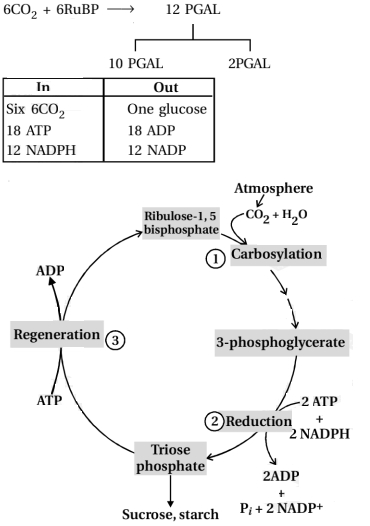
Six turns of the Calvin cycle are required to generate one mole of glucose. Explain.
Solution
(N/A) The Calvin cycle is the primary pathway for carbon fixation in $C_3$ plants,occurring in three main stages: Carboxylation,Reduction,and Regeneration.
$1$. Carboxylation: This is the fixation of $CO_2$ into a stable organic intermediate. $CO_2$ is utilized for the carboxylation of $RuBP$ (Ribulose$-1,5-$bisphosphate) by the enzyme $RuBisCO$,resulting in the formation of two molecules of $3-PGA$ ($3$-phosphoglycerate).
$2$. Reduction: This stage involves a series of reactions leading to the formation of glucose. For every molecule of $CO_2$ fixed,$2$ molecules of $ATP$ are used for phosphorylation and $2$ molecules of $NADPH$ are used for reduction. This converts $2$ molecules of $PGA$ into $2$ molecules of Triose phosphate $(PGAL)$.
$3$. Regeneration: To keep the cycle running,the $CO_2$ acceptor molecule $RuBP$ must be regenerated. This step requires $1$ $ATP$ molecule per $CO_2$ fixed.
Calculation for one glucose molecule:
- Each turn of the Calvin cycle fixes one molecule of $CO_2$.
- Glucose is a $6$-carbon sugar $(C_6H_{12}O_6)$.
- Therefore,to synthesize one molecule of glucose,$6$ molecules of $CO_2$ must be fixed.
- Since one turn of the cycle fixes one $CO_2$,$6$ turns of the cycle are required to produce one molecule of glucose.
$1$. Carboxylation: This is the fixation of $CO_2$ into a stable organic intermediate. $CO_2$ is utilized for the carboxylation of $RuBP$ (Ribulose$-1,5-$bisphosphate) by the enzyme $RuBisCO$,resulting in the formation of two molecules of $3-PGA$ ($3$-phosphoglycerate).
$2$. Reduction: This stage involves a series of reactions leading to the formation of glucose. For every molecule of $CO_2$ fixed,$2$ molecules of $ATP$ are used for phosphorylation and $2$ molecules of $NADPH$ are used for reduction. This converts $2$ molecules of $PGA$ into $2$ molecules of Triose phosphate $(PGAL)$.
$3$. Regeneration: To keep the cycle running,the $CO_2$ acceptor molecule $RuBP$ must be regenerated. This step requires $1$ $ATP$ molecule per $CO_2$ fixed.
Calculation for one glucose molecule:
- Each turn of the Calvin cycle fixes one molecule of $CO_2$.
- Glucose is a $6$-carbon sugar $(C_6H_{12}O_6)$.
- Therefore,to synthesize one molecule of glucose,$6$ molecules of $CO_2$ must be fixed.
- Since one turn of the cycle fixes one $CO_2$,$6$ turns of the cycle are required to produce one molecule of glucose.
0 likes
View Solution155
Easy
Provide the full names for the following abbreviations:
$(1)$ $Pi$
$(2)$ $PGAL$
$(1)$ $Pi$
$(2)$ $PGAL$
Solution
(N/A) $(1)$ $Pi$ stands for Inorganic Phosphate.
$(2)$ $PGAL$ stands for Phosphoglyceraldehyde (also known as Glyceraldehyde-$3$-phosphate).
$(2)$ $PGAL$ stands for Phosphoglyceraldehyde (also known as Glyceraldehyde-$3$-phosphate).
0 likes
View Solution156
MediumMCQ
The entire process of photosynthesis consists of a number of reactions. Where in the cell does the fixation of $CO_2$ take place?
A
Thylakoid lumen
B
Stroma of chloroplast
C
Cytoplasm
D
Mitochondrial matrix
Solution
(B) The process of photosynthesis is divided into light-dependent reactions and light-independent reactions (Calvin cycle).
$1$. Light-dependent reactions occur in the thylakoid membranes of the chloroplast.
$2$. The fixation of $CO_2$ occurs during the light-independent reactions (Calvin cycle),which take place in the stroma of the chloroplast.
$1$. Light-dependent reactions occur in the thylakoid membranes of the chloroplast.
$2$. The fixation of $CO_2$ occurs during the light-independent reactions (Calvin cycle),which take place in the stroma of the chloroplast.
0 likes
View Solution157
MediumMCQ
The entire process of photosynthesis consists of a number of reactions. Where in the cell does the synthesis of sugar molecules take place?
A
Stroma
B
Thylakoid membrane
C
Lumen of thylakoid
D
Cytoplasm
Solution
(A) The process of photosynthesis is divided into two main phases: the light-dependent reactions and the light-independent reactions (Calvin cycle).
$1$. The light-dependent reactions occur in the thylakoid membranes of the chloroplast.
$2$. The synthesis of sugar molecules (glucose) occurs during the Calvin cycle,which is a light-independent reaction.
$3$. The Calvin cycle takes place in the stroma of the chloroplast,where the necessary enzymes for carbon fixation are located.
$1$. The light-dependent reactions occur in the thylakoid membranes of the chloroplast.
$2$. The synthesis of sugar molecules (glucose) occurs during the Calvin cycle,which is a light-independent reaction.
$3$. The Calvin cycle takes place in the stroma of the chloroplast,where the necessary enzymes for carbon fixation are located.
0 likes
View Solution158
MediumMCQ
The entire process of photosynthesis consists of a number of reactions. Where in the cell do each of these take place? Synthesis of starch takes place in:
A
Chloroplast stroma
B
Cytoplasm
C
Mitochondria
D
Chloroplast thylakoids
Solution
(A) The process of photosynthesis is divided into two main phases: the light-dependent reactions and the light-independent reactions (Calvin cycle).
$1$. The light-dependent reactions occur in the thylakoid membranes of the chloroplast,where $ATP$ and $NADPH$ are produced.
$2$. The light-independent reactions (Calvin cycle) occur in the stroma of the chloroplast,where $CO_2$ is fixed to produce sugars.
$3$. The synthesis of starch from the glucose produced during the Calvin cycle also occurs within the stroma of the chloroplast,where enzymes for starch biosynthesis are located.
$1$. The light-dependent reactions occur in the thylakoid membranes of the chloroplast,where $ATP$ and $NADPH$ are produced.
$2$. The light-independent reactions (Calvin cycle) occur in the stroma of the chloroplast,where $CO_2$ is fixed to produce sugars.
$3$. The synthesis of starch from the glucose produced during the Calvin cycle also occurs within the stroma of the chloroplast,where enzymes for starch biosynthesis are located.
0 likes
View Solution159
MediumMCQ
Why is the $RuBisCo$ enzyme more appropriately called $RuBP$ Carboxylase-Oxygenase and what important role does it play in photosynthesis?
A
It acts only as a carboxylase.
B
It acts only as an oxygenase.
C
It can bind to both $CO_2$ and $O_2$ depending on their relative concentrations.
D
It is not involved in photosynthesis.
Solution
(C) $RuBisCo$ is called $RuBP$ Carboxylase-Oxygenase because it exhibits dual catalytic activity,meaning it can bind to both $CO_2$ and $O_2$. Its function depends on the relative concentration of these two gases:
$(i)$ When $CO_2$ concentration is high relative to $O_2$,the enzyme acts as a carboxylase,facilitating the fixation of $CO_2$ with $RuBP$ to initiate the $C_3$ cycle (Calvin cycle),leading to the production of glucose.
$(ii)$ When $O_2$ concentration is high relative to $CO_2$,the enzyme acts as an oxygenase,initiating photorespiration ($C_2$ cycle) by binding $RuBP$ with $O_2$ to form phosphoglycolate,which is an energy-consuming process.
$(iii)$ In $C_4$ plants,the enzyme is protected from oxygenase activity because they possess a mechanism to concentrate $CO_2$ around the $RuBisCo$ enzyme,ensuring it functions primarily as a carboxylase.
$(i)$ When $CO_2$ concentration is high relative to $O_2$,the enzyme acts as a carboxylase,facilitating the fixation of $CO_2$ with $RuBP$ to initiate the $C_3$ cycle (Calvin cycle),leading to the production of glucose.
$(ii)$ When $O_2$ concentration is high relative to $CO_2$,the enzyme acts as an oxygenase,initiating photorespiration ($C_2$ cycle) by binding $RuBP$ with $O_2$ to form phosphoglycolate,which is an energy-consuming process.
$(iii)$ In $C_4$ plants,the enzyme is protected from oxygenase activity because they possess a mechanism to concentrate $CO_2$ around the $RuBisCo$ enzyme,ensuring it functions primarily as a carboxylase.
0 likes
View Solution160
Easy
Why is $RuBisCo$ enzyme the most abundant enzyme in the world?
Solution
(N/A) $RuBisCo$ (Ribulose$-1,5-$bisphosphate carboxylase-oxygenase) is the most abundant enzyme in the world because it plays a critical role in the primary step of carbon fixation during the Calvin cycle in all photosynthetic plants.
It is estimated that $RuBisCo$ accounts for approximately $20-25\%$ of the total soluble protein content in the leaves of plants.
Since photosynthesis is the fundamental process for biomass production in almost all ecosystems,and $RuBisCo$ is essential for this process,it is present in massive quantities across the globe.
It is often cited that for every $1000 \text{ kg}$ of protein produced on Earth,a significant portion is represented by this enzyme.
It is estimated that $RuBisCo$ accounts for approximately $20-25\%$ of the total soluble protein content in the leaves of plants.
Since photosynthesis is the fundamental process for biomass production in almost all ecosystems,and $RuBisCo$ is essential for this process,it is present in massive quantities across the globe.
It is often cited that for every $1000 \text{ kg}$ of protein produced on Earth,a significant portion is represented by this enzyme.
0 likes
View Solution161
Medium
$3 CO_{2} + 9 ATP + 6 NADPH + \text{water} \rightarrow \text{glyceraldehyde 3-phosphate} + 9 ADP + 6 NADP^{+} + 8 Pi$. Analyse the above reaction and answer the following questions:
$(a)$ How many molecules of $ATP$ and $NADPH$ are required to fix one molecule of $CO_{2}$?
$(b)$ Where in the chloroplast does this process occur?
$(a)$ How many molecules of $ATP$ and $NADPH$ are required to fix one molecule of $CO_{2}$?
$(b)$ Where in the chloroplast does this process occur?
Solution
$(a)$ To fix one molecule of $CO_{2}$ in the Calvin cycle, $3$ molecules of $ATP$ and $2$ molecules of $NADPH$ are required.
$(b)$ This process, known as the Calvin cycle or the dark reaction, occurs in the stroma of the chloroplast.
$(b)$ This process, known as the Calvin cycle or the dark reaction, occurs in the stroma of the chloroplast.
0 likes
View Solution162
MediumMCQ
What is the site of $C_{3}$ cycle in $C_{3}$ and $C_{4}$ plants?
A
In $C_{3}$ plants $-$ mesophyll cells and in $C_{4}$ plants $-$ bundle sheath cells.
B
In $C_{3}$ plants $-$ bundle sheath cells and in $C_{4}$ plants $-$ mesophyll cells.
C
In $C_{4}$ plants $-$ bundle sheath cells and in $C_{3}$ plants $-$ bundle sheath cells.
D
In $C_{3}$ plants $-$ mesophyll cells and in $C_{4}$ plants $-$ mesophyll cells.
Solution
(A) The Calvin cycle ($C_{3}$ cycle) is the primary pathway for carbon fixation.
In $C_{3}$ plants,the entire process of the Calvin cycle takes place within the mesophyll cells,which contain chloroplasts.
In $C_{4}$ plants,the process is partitioned: the initial carbon fixation occurs in the mesophyll cells,but the Calvin cycle ($C_{3}$ cycle) specifically occurs in the bundle sheath cells to maintain a high concentration of $CO_{2}$ around the enzyme RuBisCO.
In $C_{3}$ plants,the entire process of the Calvin cycle takes place within the mesophyll cells,which contain chloroplasts.
In $C_{4}$ plants,the process is partitioned: the initial carbon fixation occurs in the mesophyll cells,but the Calvin cycle ($C_{3}$ cycle) specifically occurs in the bundle sheath cells to maintain a high concentration of $CO_{2}$ around the enzyme RuBisCO.
0 likes
View Solution163
MediumMCQ
In Calvin cycle,if one molecule of $RuBP$ is carboxylated then how many $PGA$ molecules will be formed?
A
$2$
B
$3$
C
$4$
D
$5$
Solution
(A) In the Calvin cycle,the primary carboxylation step involves the enzyme $RuBisCO$,which catalyzes the reaction between one molecule of $RuBP$ ($5$-carbon sugar) and one molecule of $CO_2$.
This reaction forms an unstable $6$-carbon intermediate,which immediately undergoes hydrolysis to produce $2$ molecules of $3$-phosphoglyceric acid ($PGA$,a $3$-carbon compound).
Therefore,the carboxylation of one molecule of $RuBP$ results in the formation of $2$ molecules of $PGA$.
This reaction forms an unstable $6$-carbon intermediate,which immediately undergoes hydrolysis to produce $2$ molecules of $3$-phosphoglyceric acid ($PGA$,a $3$-carbon compound).
Therefore,the carboxylation of one molecule of $RuBP$ results in the formation of $2$ molecules of $PGA$.
0 likes
View Solution164
MediumMCQ
In $C_{3}$ plants, the first stable product of photosynthesis during dark reaction is
A
$PGAL$
B
$RuBP$
C
$PGA$
D
$OAA$
Solution
(C) The first step in the dark reaction of $C_{3}$ plants is the carboxylation of ribulose $1,5$-bisphosphate by atmospheric $CO_{2}$ in the presence of the enzyme Rubisco to form $PGA$.
The reaction is: $\text{Ribulose } 1,5\text{-bisphosphate} + CO_{2} + H_{2}O \xrightarrow{\text{Rubisco}} 2 \times 3\text{-PGA}$.
Thus, $3$-phosphoglyceric acid $(PGA)$ is the first stable product formed in the Calvin cycle.
The reaction is: $\text{Ribulose } 1,5\text{-bisphosphate} + CO_{2} + H_{2}O \xrightarrow{\text{Rubisco}} 2 \times 3\text{-PGA}$.
Thus, $3$-phosphoglyceric acid $(PGA)$ is the first stable product formed in the Calvin cycle.
0 likes
View Solution165
MediumMCQ
Carbon dioxide fixation in the Calvin cycle is catalyzed by:
A
$PEP$ carboxylase
B
$RUBISCO$
C
Pyruvate decarboxylase
D
Both $(b)$ and $(c)$
Solution
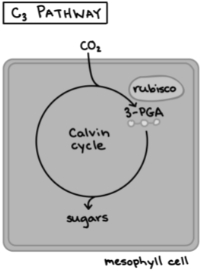
(B) In the Calvin cycle,the primary step of carbon fixation involves the carboxylation of $RuBP$ (Ribulose$-1,5-$bisphosphate).
This reaction is catalyzed by the enzyme Ribulose bisphosphate carboxylase-oxygenase,commonly known as $RUBISCO$.
$RUBISCO$ is the most abundant enzyme in the world and is responsible for fixing atmospheric $CO_2$ into organic compounds.
This reaction is catalyzed by the enzyme Ribulose bisphosphate carboxylase-oxygenase,commonly known as $RUBISCO$.
$RUBISCO$ is the most abundant enzyme in the world and is responsible for fixing atmospheric $CO_2$ into organic compounds.
0 likes
View Solution166
MediumMCQ
Radioactive $C^{14}$ is given to carbon dioxide and released into the atmosphere. This carbon dioxide is taken up by $RuBP$ in a $C_{3}$ plant. In which compound is the radioactive $C^{14}$ first observed?
A
$PGAL$
B
$PEP$
C
$RMP$
D
$PGA$
Solution
(D) $C^{14}$ is a radioactive isotope of carbon. It is used to trace the path of carbon fixation during the process of photosynthesis.
When $^{14}CO_{2}$ is taken up by the plant,it reacts with $RuBP$ (Ribulose$-1,5-$bisphosphate) in the presence of the enzyme $RuBisCO$.
This reaction results in the formation of two molecules of $3$-phosphoglyceric acid $(3-PGA)$,which is a $3$-carbon compound.
Since $3-PGA$ is the first stable product formed during the Calvin cycle,the radioactive $C^{14}$ is first detected in $PGA$.
When $^{14}CO_{2}$ is taken up by the plant,it reacts with $RuBP$ (Ribulose$-1,5-$bisphosphate) in the presence of the enzyme $RuBisCO$.
This reaction results in the formation of two molecules of $3$-phosphoglyceric acid $(3-PGA)$,which is a $3$-carbon compound.
Since $3-PGA$ is the first stable product formed during the Calvin cycle,the radioactive $C^{14}$ is first detected in $PGA$.
0 likes
View Solution167
EasyMCQ
$RUBISCO$ stands for:
A
Ribulose bisphosphate carboxylase oxygenase
B
Ribulose phosphate carboxylase oxygenase
C
Ribulose phosphate carboxylic oxygenase
D
None of the above
Solution
(A) $RUBISCO$ stands for Ribulose bisphosphate carboxylase oxygenase.
It is an enzyme that plays a crucial role in the Calvin cycle.
Ribulose $1,5$-bisphosphate $(RuBP)$ acts as the primary carbon dioxide acceptor in $C_{3}$ plants,and $RUBISCO$ catalyzes the carboxylation of $RuBP$.
It is an enzyme that plays a crucial role in the Calvin cycle.
Ribulose $1,5$-bisphosphate $(RuBP)$ acts as the primary carbon dioxide acceptor in $C_{3}$ plants,and $RUBISCO$ catalyzes the carboxylation of $RuBP$.
0 likes
View Solution168
MediumMCQ
Number of carboxylation reactions that occur in the Calvin cycle is
A
Zero
B
One
C
Two
D
Three
Solution
(B) The Calvin cycle occurs in the stroma of the chloroplast of $C_{3}$ plants and consists of three main stages: carboxylation,reduction,and regeneration.
Carboxylation involves the addition of carbon dioxide to ribulose $1,5-$bisphosphate $(RuBP)$ in the presence of the $RUBISCO$ enzyme to form $3$-$PGA$ ($3$-phosphoglyceric acid).
Since this process occurs once per cycle to fix one molecule of $CO_{2}$,only a single carboxylation reaction takes place in the Calvin cycle.
Carboxylation involves the addition of carbon dioxide to ribulose $1,5-$bisphosphate $(RuBP)$ in the presence of the $RUBISCO$ enzyme to form $3$-$PGA$ ($3$-phosphoglyceric acid).
Since this process occurs once per cycle to fix one molecule of $CO_{2}$,only a single carboxylation reaction takes place in the Calvin cycle.
0 likes
View Solution169
MediumMCQ
Which of the following is concerned with carbon dioxide fixation?
A
Krebs cycle
B
Calvin cycle
C
Ornithine cycle
D
Glycolysis
Solution
(B) The conversion of atmospheric carbon dioxide into simple,reduced organic compounds is known as carbon dioxide fixation,carbon dioxide assimilation,or carbon fixation.
This metabolic pathway,which occurs in the stroma of chloroplasts,was elucidated by Melvin Calvin and is therefore referred to as the Calvin cycle.
In this cycle,$CO_2$ is fixed into a $3$-carbon sugar called $3$-phosphoglycerate ($3$-$PGA$) using the enzyme RuBisCO.
This metabolic pathway,which occurs in the stroma of chloroplasts,was elucidated by Melvin Calvin and is therefore referred to as the Calvin cycle.
In this cycle,$CO_2$ is fixed into a $3$-carbon sugar called $3$-phosphoglycerate ($3$-$PGA$) using the enzyme RuBisCO.
0 likes
View Solution170
EasyMCQ
$RuBisCo$ is found in
A
Cytoplasm
B
Nucleus
C
Mitochondria
D
Chloroplast
Solution
(D) $RuBisCo$ (Ribulose$-1,5-$bisphosphate carboxylase-oxygenase) is the most abundant enzyme on Earth.
It is a key enzyme involved in the Calvin cycle during the light-independent reactions of photosynthesis.
Since the Calvin cycle takes place in the stroma of the chloroplast,$RuBisCo$ is localized within the chloroplast.
It is a key enzyme involved in the Calvin cycle during the light-independent reactions of photosynthesis.
Since the Calvin cycle takes place in the stroma of the chloroplast,$RuBisCo$ is localized within the chloroplast.
0 likes
View Solution171
MediumMCQ
The enzymatic reactions incorporate $CO_2$ into the plants leading to the synthesis of sugar in:
A
Stroma
B
Stroma lamella
C
Grana
D
Both $(a)$ and $(b)$
Solution
(A) In the stroma,enzymatic reactions incorporate $CO_2$ into the plant,leading to the synthesis of sugar,which in turn forms starch. The stroma is the site of the dark reaction (Calvin cycle) where carbon fixation occurs.
0 likes
View Solution172
EasyMCQ
Members of the family Crassulaceae perform:
A
$C_{3}$-photosynthesis
B
$CAM$-photosynthesis
C
$C_{4}$-photosynthesis
D
All of these
Solution
(B) Members of the family Crassulaceae exhibit $CAM$ (Crassulacean Acid Metabolism) photosynthesis. This metabolic pathway is an adaptation to arid environments,allowing plants to fix $CO_{2}$ at night to minimize water loss through transpiration.
0 likes
View Solution173
MediumMCQ
In dark reaction,regeneration of $RuBP$ needs
A
$2$ molecules of $ATP$
B
$1$ molecule of $ATP$
C
$3$ molecules of $ATP$
D
$4$ molecules of $ATP$
Solution
(B) The Calvin cycle proceeds in three stages: $(1)$ Carboxylation,during which $CO_2$ combines with ribulose $1,5$-bisphosphate. $(2)$ Reduction,during which carbohydrates are formed at the expense of photochemically produced $ATP$ and $NADPH$. $(3)$ Regeneration,during which the $CO_2$ acceptor,ribulose $1,5$-bisphosphate,is formed again so that the cycle continues.
For every $CO_2$ molecule fixed in the Calvin cycle,the regeneration of the $CO_2$ acceptor molecule,$RuBP$,requires $1$ molecule of $ATP$ for the phosphorylation of ribulose $5$-phosphate to form $RuBP$.
For every $CO_2$ molecule fixed in the Calvin cycle,the regeneration of the $CO_2$ acceptor molecule,$RuBP$,requires $1$ molecule of $ATP$ for the phosphorylation of ribulose $5$-phosphate to form $RuBP$.
0 likes
View Solution174
MediumMCQ
Calvin cycle can be described under three stages. These stages are
$I.$ Carboxylation $II.$ Ligation $III.$ Reduction $IV.$ Regeneration
Select the correct option.
$I.$ Carboxylation $II.$ Ligation $III.$ Reduction $IV.$ Regeneration
Select the correct option.
A
$II, III$ and $IV$
B
$I, III$ and $IV$
C
$I, II$ and $IV$
D
$I, II$ and $III$
Solution
(B) The Calvin cycle consists of three distinct stages:
$(i)$ Carboxylation: This is the fixation of $CO_2$ into a stable organic intermediate,$3$-phosphoglyceric acid ($3$-$PGA$),catalyzed by the enzyme RuBisCO.
$(ii)$ Reduction: This stage involves a series of reactions that lead to the formation of glucose. It utilizes $ATP$ and $NADPH$ generated during the light reactions.
$(iii)$ Regeneration: This stage is crucial for the continued operation of the cycle,where the $CO_2$ acceptor molecule,Ribulose $1,5$-bisphosphate $(RuBP)$,is regenerated,which requires $ATP$ for phosphorylation.
Therefore,the three stages are Carboxylation $(I)$,Reduction $(III)$,and Regeneration $(IV)$.
$(i)$ Carboxylation: This is the fixation of $CO_2$ into a stable organic intermediate,$3$-phosphoglyceric acid ($3$-$PGA$),catalyzed by the enzyme RuBisCO.
$(ii)$ Reduction: This stage involves a series of reactions that lead to the formation of glucose. It utilizes $ATP$ and $NADPH$ generated during the light reactions.
$(iii)$ Regeneration: This stage is crucial for the continued operation of the cycle,where the $CO_2$ acceptor molecule,Ribulose $1,5$-bisphosphate $(RuBP)$,is regenerated,which requires $ATP$ for phosphorylation.
Therefore,the three stages are Carboxylation $(I)$,Reduction $(III)$,and Regeneration $(IV)$.
0 likes
View Solution175
MediumMCQ
$ATP$ and $NADPH$ produced in the light reaction by the movement of electrons in the $ETC$ are used immediately for:
A
Oxidation of carbohydrate
B
Synthesis of sugar
C
Reduction of carbon dioxide
D
Both $(b)$ and $(c)$
Solution
(D) During the light reaction of photosynthesis,$ATP$ and $NADPH$ are generated through the electron transport chain $(ETC)$.
These molecules are essential for the biosynthetic phase (Calvin cycle) of photosynthesis.
In the Calvin cycle,$ATP$ provides energy and $NADPH$ provides reducing power for the reduction of carbon dioxide $(CO_2)$ to form carbohydrates (sugars).
Therefore,both the synthesis of sugar and the reduction of carbon dioxide are the processes for which these molecules are used.
These molecules are essential for the biosynthetic phase (Calvin cycle) of photosynthesis.
In the Calvin cycle,$ATP$ provides energy and $NADPH$ provides reducing power for the reduction of carbon dioxide $(CO_2)$ to form carbohydrates (sugars).
Therefore,both the synthesis of sugar and the reduction of carbon dioxide are the processes for which these molecules are used.
0 likes
View Solution176
MediumMCQ
The enzyme responsible for primary carboxylation in $C_{3}$-plants is
A
Hexokinase
B
Succinic dehydrogenase
C
Pyruvate carboxylase
D
RuBP carboxylase oxygenase
Solution
(D) $RuBP$ carboxylase-oxygenase $(RUBISCO)$ is an enzyme present in the stroma of the chloroplast.
This enzyme is responsible for primary carboxylation in $C_{3}$-plants.
$A$ $5C$ sugar,$RuBP$,acts as a carbon dioxide acceptor in the presence of this enzyme and produces a $6C$ unstable compound.
This unstable compound then splits into two molecules of $3$-phosphoglyceric acid ($3C$ compound),which is the first stable product of the $C_{3}$-cycle.
This enzyme is responsible for primary carboxylation in $C_{3}$-plants.
$A$ $5C$ sugar,$RuBP$,acts as a carbon dioxide acceptor in the presence of this enzyme and produces a $6C$ unstable compound.
This unstable compound then splits into two molecules of $3$-phosphoglyceric acid ($3C$ compound),which is the first stable product of the $C_{3}$-cycle.
0 likes
View Solution177
MediumMCQ
During the dark reaction,the acceptor of $CO_{2}$ is
A
$NADPH_{2}$
B
$RuBP$
C
$PGA$
D
$CO_{2}$
Solution
(B) During the dark reaction,the primary acceptor of $CO_{2}$ is $RuBP$ (Ribulose $1,5$-bisphosphate).
Upon carboxylation,$RuBP$ combines with $CO_{2}$ to form an unstable $6$-carbon intermediate compound.
This intermediate compound immediately breaks down into two molecules of a $3$-carbon stable compound called $3$-phosphoglyceric acid $(3-PGA)$.
Upon carboxylation,$RuBP$ combines with $CO_{2}$ to form an unstable $6$-carbon intermediate compound.
This intermediate compound immediately breaks down into two molecules of a $3$-carbon stable compound called $3$-phosphoglyceric acid $(3-PGA)$.
0 likes
View Solution178
MediumMCQ
Synthesis of one molecule of glucose requires
A
$6 CO_{2}, 18 ATP$ and $12 NADPH$
B
$6 CO_{2}, 12 ATP$ and $18 NADPH$
C
$6 CO_{2}, 30 ATP$ and $12 NADPH$
D
$6 CO_{2}, 38 ATP$ and $12 NADPH$
Solution
(A) In the Calvin cycle,for every molecule of carbon dioxide $(CO_{2})$ fixed,$3$ molecules of $ATP$ and $2$ molecules of $NADPH$ are required.
Since one molecule of glucose $(C_{6}H_{12}O_{6})$ contains $6$ carbon atoms,the cycle must turn $6$ times to synthesize one molecule of glucose.
Therefore,the total requirement is: $6 \times 3 ATP = 18 ATP$ and $6 \times 2 NADPH = 12 NADPH$.
Thus,the synthesis of one molecule of glucose requires $6 CO_{2}, 18 ATP$,and $12 NADPH$.
Since one molecule of glucose $(C_{6}H_{12}O_{6})$ contains $6$ carbon atoms,the cycle must turn $6$ times to synthesize one molecule of glucose.
Therefore,the total requirement is: $6 \times 3 ATP = 18 ATP$ and $6 \times 2 NADPH = 12 NADPH$.
Thus,the synthesis of one molecule of glucose requires $6 CO_{2}, 18 ATP$,and $12 NADPH$.
0 likes
View Solution179
MediumMCQ
How many Calvin cycles are required to produce $5$ molecules of glucose?
A
$60$
B
$15$
C
$30$
D
$90$
Solution
(C) Glucose is a hexose sugar,which contains $6$ carbon atoms per molecule.
In the Calvin cycle,each turn fixes $1$ molecule of $CO_2$.
To produce $1$ molecule of glucose $(C_6H_{12}O_6)$,$6$ turns of the Calvin cycle are required.
Therefore,to produce $5$ molecules of glucose,the number of cycles required is $5 \times 6 = 30$ cycles.
In the Calvin cycle,each turn fixes $1$ molecule of $CO_2$.
To produce $1$ molecule of glucose $(C_6H_{12}O_6)$,$6$ turns of the Calvin cycle are required.
Therefore,to produce $5$ molecules of glucose,the number of cycles required is $5 \times 6 = 30$ cycles.
0 likes
View Solution180
EasyMCQ
Every $CO_{2}$ molecule entering the Calvin cycle needs:
A
$2$ molecules of $NADPH$ and $3$ molecules of $ATP$ for its fixation.
B
$2$ molecules of $NADPH$ and $2$ molecules of $ATP$ for its fixation.
C
Variable amount of $ATP$.
D
Only $NADPH$.
Solution
(A) For every $CO_{2}$ molecule entering the Calvin cycle,$3$ molecules of $ATP$ and $2$ molecules of $NADPH$ are required for the reduction and regeneration phases.
Specifically,$2$ molecules of $ATP$ and $2$ molecules of $NADPH$ are used during the reduction phase,and $1$ molecule of $ATP$ is used during the regeneration phase of $RuBP$.
The difference in the number of $ATP$ and $NADPH$ used in the dark reaction is balanced by cyclic photophosphorylation.
Specifically,$2$ molecules of $ATP$ and $2$ molecules of $NADPH$ are used during the reduction phase,and $1$ molecule of $ATP$ is used during the regeneration phase of $RuBP$.
The difference in the number of $ATP$ and $NADPH$ used in the dark reaction is balanced by cyclic photophosphorylation.
0 likes
View Solution181
EasyMCQ
Calvin cycle is also called
A
Calvin-Benson cycle
B
$C_{3}-$ cycle
C
Reductive pentose phosphate pathway
D
All of the above
Solution
(D) The Calvin cycle is a series of biochemical redox reactions that take place in the stroma of chloroplasts in photosynthetic organisms.
It is also known as the Calvin-Benson cycle,named after Melvin Calvin and Andrew Benson.
Since the first stable product formed is a $3$-carbon compound ($3$-phosphoglycerate),it is referred to as the $C_{3}$-cycle.
Additionally,it is called the reductive pentose phosphate pathway because it involves the reduction of carbon dioxide using $ATP$ and $NADPH$ generated during the light-dependent reactions.
It is also known as the Calvin-Benson cycle,named after Melvin Calvin and Andrew Benson.
Since the first stable product formed is a $3$-carbon compound ($3$-phosphoglycerate),it is referred to as the $C_{3}$-cycle.
Additionally,it is called the reductive pentose phosphate pathway because it involves the reduction of carbon dioxide using $ATP$ and $NADPH$ generated during the light-dependent reactions.
0 likes
View Solution182
EasyMCQ
Stroma in the chloroplasts of higher plants contains:
A
Biosynthetic enzymes
B
Electron Transport Chain particles
C
$80 S$ ribosomes
D
Chlorophyll
Solution
(A) In higher plants,the enzymes required for the biosynthetic pathway,also known as light-independent reactions or dark reactions,are located in the stroma of the chloroplasts.
Light-dependent reactions occur in the grana of the chloroplasts.
The ribosomes found within the stroma of chloroplasts are of the $70 S$ type,which are essential for protein synthesis.
Chlorophyll is a green photosynthetic pigment located on the thylakoid membranes of the chloroplasts.
Light-dependent reactions occur in the grana of the chloroplasts.
The ribosomes found within the stroma of chloroplasts are of the $70 S$ type,which are essential for protein synthesis.
Chlorophyll is a green photosynthetic pigment located on the thylakoid membranes of the chloroplasts.
0 likes
View Solution183
MediumMCQ
Identify the correct sequence of enzymes given below which participate in the regeneration phase of the Calvin cycle.
$I.$ Ribulose-$5$-phosphate isomerase
$II.$ Ribulose-$5$-phosphate epimerase
$III.$ Transketolase
$IV.$ Triose phosphate isomerase
$I.$ Ribulose-$5$-phosphate isomerase
$II.$ Ribulose-$5$-phosphate epimerase
$III.$ Transketolase
$IV.$ Triose phosphate isomerase
A
$I, II, III, IV$
B
$IV, III, II, I$
C
$IV, III, I, II$
D
$II, I, IV, III$
Solution
(C) The regeneration phase of the Calvin cycle involves the conversion of various sugar phosphates back into Ribulose-$1,5$-bisphosphate.
$1$. First, $Triose \text{ } phosphate \text{ } isomerase$ $(IV)$ converts Glyceraldehyde-$3$-phosphate into Dihydroxyacetone phosphate.
$2$. Next, $Transketolase$ $(III)$ acts on these molecules to form Sedoheptulose-$7$-phosphate and other intermediates.
$3$. Subsequently, $Ribulose-5-phosphate \text{ } isomerase$ $(I)$ converts Ribose-$5$-phosphate into Ribulose-$5$-phosphate.
$4$. Finally, $Ribulose-5-phosphate \text{ } epimerase$ $(II)$ converts Xylulose-$5$-phosphate into Ribulose-$5$-phosphate.
Thus, the sequence is $IV, III, I, II$.
$1$. First, $Triose \text{ } phosphate \text{ } isomerase$ $(IV)$ converts Glyceraldehyde-$3$-phosphate into Dihydroxyacetone phosphate.
$2$. Next, $Transketolase$ $(III)$ acts on these molecules to form Sedoheptulose-$7$-phosphate and other intermediates.
$3$. Subsequently, $Ribulose-5-phosphate \text{ } isomerase$ $(I)$ converts Ribose-$5$-phosphate into Ribulose-$5$-phosphate.
$4$. Finally, $Ribulose-5-phosphate \text{ } epimerase$ $(II)$ converts Xylulose-$5$-phosphate into Ribulose-$5$-phosphate.
Thus, the sequence is $IV, III, I, II$.
0 likes
View Solution184
MediumMCQ
The $CO_2$ acceptor in $C_3$ plants is
A
$RuBP$
B
$PGA$
C
$PEP$
D
$OAA$
Solution
(A) In $C_3$ plants,the primary $CO_2$ acceptor is a $5$-carbon ketose sugar called Ribulose $1,5$-bisphosphate $(RuBP)$.
This reaction is catalyzed by the enzyme $RuBisCO$,which leads to the formation of two molecules of $3$-phosphoglyceric acid $(PGA)$.
This reaction is catalyzed by the enzyme $RuBisCO$,which leads to the formation of two molecules of $3$-phosphoglyceric acid $(PGA)$.
0 likes
View Solution185
MediumMCQ
In $C_3$ plants,the first stable product of $CO_2$ fixation is:
A
$3-PGA$
B
Starch
C
$OAA$
D
Pyruvate
Solution
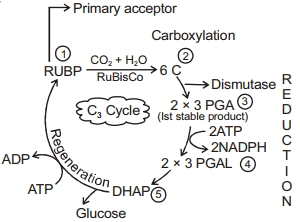
(A) In the Calvin cycle ($C_3$ cycle),the enzyme RuBisCO catalyzes the carboxylation of Ribulose$-1,5-$bisphosphate $(RuBP)$ with $CO_2$ to form an unstable $6$-carbon intermediate.
This intermediate immediately breaks down into two molecules of $3$-phosphoglyceric acid $(3-PGA)$.
Since $3-PGA$ is the first stable compound formed during this process,it is known as the first stable product of $CO_2$ fixation in $C_3$ plants.
This intermediate immediately breaks down into two molecules of $3$-phosphoglyceric acid $(3-PGA)$.
Since $3-PGA$ is the first stable compound formed during this process,it is known as the first stable product of $CO_2$ fixation in $C_3$ plants.
0 likes
View Solution186
MediumMCQ
Which among the following is not a step in the Calvin cycle?
A
Carboxylation
B
Reduction
C
Photophosphorylation
D
Regeneration
Solution
(C) The Calvin cycle consists of three main stages: $1$. Carboxylation,$2$. Reduction,and $3$. Regeneration of RuBP.
Photophosphorylation is a process that occurs during the light-dependent reactions of photosynthesis,where $ATP$ is synthesized from $ADP$ and inorganic phosphate using light energy. Therefore,it is not a part of the Calvin cycle (dark reaction).
Photophosphorylation is a process that occurs during the light-dependent reactions of photosynthesis,where $ATP$ is synthesized from $ADP$ and inorganic phosphate using light energy. Therefore,it is not a part of the Calvin cycle (dark reaction).
0 likes
View Solution187
MediumMCQ
The enzyme responsible for the carboxylation reaction ($CO_2$ fixation) in $C_3$ plants is:
A
$RuBP$ oxygenase
B
Pyruvate decarboxylase
C
$RuBP$ carboxylase
D
$PEP$ carboxylase
Solution
(C) In $C_3$ plants,the primary carboxylation reaction,which involves the fixation of atmospheric $CO_2$ into a stable organic intermediate,is catalyzed by the enzyme Ribulose$-1,5-$bisphosphate carboxylase-oxygenase,commonly known as $RuBP$ carboxylase or $RuBisCO$. This enzyme facilitates the addition of $CO_2$ to $RuBP$ to form $3$-phosphoglycerate ($3$-$PGA$).
0 likes
View Solution188
MediumMCQ
Regeneration of four molecules of $RuBP$ in $C_3$ cycle requires the expenditure of . . . . . . $ATP$.
A
$1$
B
$4$
C
$3$
D
$2$
Solution
(B) In the $C_3$ cycle (Calvin cycle),the regeneration phase involves the conversion of triose phosphates back into $RuBP$.
For the regeneration of $1$ molecule of $RuBP$,$1$ molecule of $ATP$ is consumed.
Therefore,for the regeneration of $4$ molecules of $RuBP$,the expenditure required is $4 \times 1 = 4$ molecules of $ATP$.
For the regeneration of $1$ molecule of $RuBP$,$1$ molecule of $ATP$ is consumed.
Therefore,for the regeneration of $4$ molecules of $RuBP$,the expenditure required is $4 \times 1 = 4$ molecules of $ATP$.
0 likes
View Solution189
MediumMCQ
The enzyme $RuBP$ carboxylase:
A
Activity occurs in $C_3$ and $C_4$ plants
B
Is present in the inner thylakoid membrane
C
Is a low-temperature sensitive enzyme
D
Shows greater affinity for $O_2$ than for $CO_2$
Solution
(A) $RuBP$ carboxylase (also known as $RuBisCO$) is the primary enzyme involved in the Calvin cycle. It is present in the stroma of chloroplasts in both $C_3$ and $C_4$ plants. In $C_3$ plants,it performs carboxylation directly,while in $C_4$ plants,it is found in the bundle sheath cells to perform the Calvin cycle. Therefore,its activity occurs in both $C_3$ and $C_4$ plants.
0 likes
View Solution190
MediumMCQ
$C_3$ cycle (reductive pentose phosphate cycle) is basically a
A
$CO_2$ reduction cycle
B
$CO_2$ oxidising cycle
C
Photochemical reaction
D
Both $(b) \& (c)$
Solution
(A) The $C_3$ cycle,also known as the Calvin cycle or reductive pentose phosphate cycle,is the primary pathway for carbon fixation in plants.
During this process,$CO_2$ is reduced to form carbohydrates (glucose).
Since the cycle involves the reduction of $CO_2$ using $ATP$ and $NADPH$ produced in the light-dependent reactions,it is fundamentally a $CO_2$ reduction cycle.
During this process,$CO_2$ is reduced to form carbohydrates (glucose).
Since the cycle involves the reduction of $CO_2$ using $ATP$ and $NADPH$ produced in the light-dependent reactions,it is fundamentally a $CO_2$ reduction cycle.
0 likes
View Solution191
MediumMCQ
To reduce $1$ $CO_2$ in $C_3$ cycle,assimilatory power needed is
A
$3 ATP, 2 NADPH + H^+$
B
$2 ATP, 3 NADPH + H^+$
C
$5 ATP, 2 NADPH + H^+$
D
$6.5 ATP, 2 NADPH + H^+$
Solution
(A) In the $C_3$ cycle (Calvin cycle),the fixation and reduction of $1$ molecule of $CO_2$ requires $3$ molecules of $ATP$ and $2$ molecules of $NADPH + H^+$.
Specifically,$2$ $ATP$ are used during the reduction phase and $1$ $ATP$ is used during the regeneration phase of $RuBP$.
Specifically,$2$ $ATP$ are used during the reduction phase and $1$ $ATP$ is used during the regeneration phase of $RuBP$.
0 likes
View Solution192
MediumMCQ
$C_3$ plants mein $CO_2$ acceptor aur carboxylating enzyme kramashah kaun se hain?
A
$PEP, PEPCO$
B
$RuBP, RUBISCO$
C
$OAA, RUBISCO$
D
$3-PGA, RUBISCO$
Solution
(B) In $C_3$ plants,the primary $CO_2$ acceptor is a $5$-carbon compound called Ribulose $1,5$-bisphosphate $(RuBP)$.
The enzyme responsible for the carboxylation step,where $CO_2$ is fixed into an organic molecule,is Ribulose bisphosphate carboxylase-oxygenase $(RUBISCO)$.
The enzyme responsible for the carboxylation step,where $CO_2$ is fixed into an organic molecule,is Ribulose bisphosphate carboxylase-oxygenase $(RUBISCO)$.
0 likes
View Solution193
MediumMCQ
The methodology,which has been most useful for investigating the Calvin cycle,is
A
Radioactive isotope technique
B
Inverted funnel experiment
C
Half leaf experiment
D
Flash light experimental technique
Solution
(A) The Calvin cycle was elucidated by Melvin Calvin and his colleagues using the radioactive isotope technique. They used $^{14}C$ (a radioactive isotope of carbon) in algal photosynthesis studies (specifically with Chlorella and Scenedesmus) to trace the path of carbon fixation,which led to the discovery of the $C_3$ cycle.
0 likes
View Solution194
MediumMCQ
Select the correct option for photosynthesis in $C_3$-plants.
A
Bifunctional nature of $PEP$case enzyme
B
Regeneration of each $RUBP$ requires $6$ $ATP$
C
First stable product of Calvin cycle undergoes phosphorylation in dark reaction
D
Optimum temperature is $30-40^{\circ}C$
Solution
(C) In the Calvin cycle of $C_3$-plants,the first stable product is $3$-phosphoglyceric acid $(3-PGA)$.
During the reduction phase,$3-PGA$ is phosphorylated using $ATP$ to form $1,3$-bisphosphoglycerate,which is then reduced to $3$-phosphoglyceraldehyde $(3-PGAL)$.
The reaction is: $2 \times 3-PGA + 2 ATP \longrightarrow 2 \times 1,3-bisphosphoglycerate + 2 ADP \longrightarrow 2 \times 3-PGAL + 2 Pi$.
Thus,the first stable product undergoes phosphorylation.
During the reduction phase,$3-PGA$ is phosphorylated using $ATP$ to form $1,3$-bisphosphoglycerate,which is then reduced to $3$-phosphoglyceraldehyde $(3-PGAL)$.
The reaction is: $2 \times 3-PGA + 2 ATP \longrightarrow 2 \times 1,3-bisphosphoglycerate + 2 ADP \longrightarrow 2 \times 3-PGAL + 2 Pi$.
Thus,the first stable product undergoes phosphorylation.
0 likes
View Solution195
MediumMCQ
$A$: Biosynthetic phase of photosynthesis depends directly on the presence of light.
$R$: Both $ATP$ and $NADPH$ are not essential for the assimilation of $CO_2$ to carbohydrates.
$R$: Both $ATP$ and $NADPH$ are not essential for the assimilation of $CO_2$ to carbohydrates.
A
Assertion and Reason both are correct and Reason is the correct explanation of Assertion.
B
Assertion and Reason both are correct but Reason is not the correct explanation of Assertion.
C
Assertion is correct,but Reason is incorrect.
D
Both Assertion and Reason are incorrect.
Solution
(D) The biosynthetic phase (dark reaction) of photosynthesis does not depend directly on light; rather,it depends on the products of the light reaction ($ATP$ and $NADPH$).
Both $ATP$ and $NADPH$ are essential for the assimilation of $CO_2$ into carbohydrates during the Calvin cycle.
Therefore,both Assertion $(A)$ and Reason $(R)$ are incorrect.
Both $ATP$ and $NADPH$ are essential for the assimilation of $CO_2$ into carbohydrates during the Calvin cycle.
Therefore,both Assertion $(A)$ and Reason $(R)$ are incorrect.
0 likes
View Solution196
MediumMCQ
What is the basis for designating $C_{3}$ and $C_{4}$ pathways of photosynthesis?
A
The number of $CO_{2}$ molecules fixed.
B
The number of carbon atoms in the first stable product formed during the dark reaction.
C
The number of $ATP$ molecules consumed.
D
The type of pigments involved.
Solution
(B) The classification of photosynthetic pathways into $C_{3}$ and $C_{4}$ is based on the number of carbon atoms present in the first stable product formed during the carbon fixation process of the Calvin cycle and the Hatch-Slack pathway respectively.
| $C_{3}$ Pathway | $C_{4}$ Pathway |
|---|---|
| The first stable product formed is a $3$-carbon compound called $3-PGA$ ($3-\text{phosphoglyceric}$ acid). | The first stable product formed in the mesophyll cells is a $4$-carbon compound called $OAA$ ($\text{Oxaloacetic}$ acid). |
0 likes
View Solution197
MediumMCQ
What is the source of oxygen present in the structure of glucose produced during photosynthesis?
A
$CO_2$
B
$H_2O$
C
$O_2$
D
All of the above
Solution
(A) During photosynthesis,the chemical equation is $6CO_2 + 12H_2O \xrightarrow{Light} C_6H_{12}O_6 + 6H_2O + 6O_2$.
In this process,the carbon and oxygen atoms from $CO_2$ are incorporated into the glucose molecule $(C_6H_{12}O_6)$.
The oxygen released as a byproduct comes from the photolysis of water $(H_2O)$.
Therefore,the oxygen atoms found in the glucose structure originate from the carbon dioxide $(CO_2)$ used during the dark reaction (Calvin cycle).
In this process,the carbon and oxygen atoms from $CO_2$ are incorporated into the glucose molecule $(C_6H_{12}O_6)$.
The oxygen released as a byproduct comes from the photolysis of water $(H_2O)$.
Therefore,the oxygen atoms found in the glucose structure originate from the carbon dioxide $(CO_2)$ used during the dark reaction (Calvin cycle).
0 likes
View Solution198
MediumMCQ
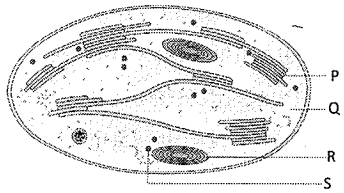
In the given organelle,where does the dark reaction take place?
A
$P$
B
$Q$
C
$R$
D
$S$
Solution
(B) The given organelle is a chloroplast.
In the diagram,$P$ represents the thylakoid/grana,$Q$ represents the stroma,$R$ represents the outer membrane,and $S$ represents a starch granule or lipid droplet.
The light-dependent reactions occur in the thylakoids $(P)$,while the dark reaction (Calvin cycle) occurs in the stroma $(Q)$.
Therefore,the correct answer is $Q$.
In the diagram,$P$ represents the thylakoid/grana,$Q$ represents the stroma,$R$ represents the outer membrane,and $S$ represents a starch granule or lipid droplet.
The light-dependent reactions occur in the thylakoids $(P)$,while the dark reaction (Calvin cycle) occurs in the stroma $(Q)$.
Therefore,the correct answer is $Q$.
0 likes
View Solution199
MediumMCQ
Select the incorrect option for the dark reaction.
A
The dark reaction is enzyme-controlled.
B
It depends on the products of the light reaction.
C
This process occurs in the dark.
D
Glucose is synthesized during this process.
Solution
(C) The dark reaction,also known as the $C_3$ cycle or Calvin cycle,is a light-independent reaction.
It does not require light directly,but it is not restricted to occurring only in the dark.
It relies on the products of the light reaction,specifically $ATP$ and $NADPH$,to fix $CO_2$ into glucose.
Therefore,the statement that it occurs in the dark is incorrect,as it typically occurs during the day when the light reaction provides the necessary energy carriers.
It does not require light directly,but it is not restricted to occurring only in the dark.
It relies on the products of the light reaction,specifically $ATP$ and $NADPH$,to fix $CO_2$ into glucose.
Therefore,the statement that it occurs in the dark is incorrect,as it typically occurs during the day when the light reaction provides the necessary energy carriers.
0 likes
View Solution200
MediumMCQ
Where is $NADPH+H^{+}$ used?
A
In light reaction
B
In dark reaction
C
In Krebs cycle
D
In oxidative phosphorylation
Solution
(B) $NADPH+H^{+}$ and $ATP$ are the products of the light-dependent reactions of photosynthesis. These molecules are essential for the biosynthetic phase (dark reaction or Calvin cycle) of photosynthesis,where they are used to reduce $CO_2$ into sugars (glucose).
0 likes
View SolutionPhotosynthesis in Higher Plants — C3 and Dark reaction · Frequently Asked Questions
1Are these Photosynthesis in Higher Plants questions useful for JEE and NEET?
Yes. All questions in this section are mapped to JEE Main and NEET exam patterns. Previous year questions from JEE Main, NEET, GUJCET and state-level exams are included with full solutions.
2Can I switch to Hindi or Gujarati for these questions?
Yes. Use the language tabs in the hero section or the sidebar to view the same questions and solutions in English, Hindi or Gujarati.
3How do I generate a question paper from this subtopic?
Use the Vedclass Exam Paper Generator — select the chapter and subtopic, set difficulty, and generate Sets A, B, C, D automatically. First 3 chapters of every subject are free.
Vedclass Products
For Students
Vedclass Test Series
Mock tests in real JEE/NEET style with performance analysis. 5-day free trial.
Start Free TrialFor Teachers
Exam Paper Generator
Generate Set A/B/C/D papers from this chapter in 2 minutes. 3 chapters free.
Try FreeFor Institutes
Online Exam Module
Live online exams with unlimited students, 360° analytics & white-label branding.
See DemoFor Teachers & Institutes
Generate a Photosynthesis in Higher Plants Exam Paper in 2 Minutes
Select subtopic & difficulty — Sets A, B, C, D auto-generated with No Repeat logic.
First 3 chapters of every subject are free — no payment required.