
A English
C3 and Dark reaction Questions in English
Class 11 Biology · Photosynthesis in Higher Plants · C3 and Dark reaction
227+
Questions
English
Language
100%
With Solutions
Showing 47 of 227 questions in English
101
MediumMCQ
Which enzyme is the most abundant protein in the whole biosphere?
A
Ribulose bisphosphate
B
Ribulose bisphosphate carboxylase
C
Ribulose bisphosphate carboxylase-oxygenase
D
Ribulose bisphosphatase
Solution
(C) $RuBisCO$ (Ribulose bisphosphate carboxylase-oxygenase) is the most abundant protein in the whole biosphere.
It is the key enzyme in the Calvin cycle,responsible for the fixation of $CO_2$ in plants.
It constitutes a significant portion of the total soluble protein in plant leaves.
It is the key enzyme in the Calvin cycle,responsible for the fixation of $CO_2$ in plants.
It constitutes a significant portion of the total soluble protein in plant leaves.
0 likes
View Solution102
EasyMCQ
What is the full form of $RuBisCO$?
A
Ribulose bisphosphate carboxylase-oxygenase
B
Ribulose bicarboxylase
C
Ribulose bisphosphate oxygenase
D
Ribulose carboxylase oxygenase
Solution
(A) $RuBisCO$ stands for Ribulose-$1,5$-bisphosphate carboxylase-oxygenase.
It is the most abundant enzyme on Earth.
It plays a crucial role in the Calvin cycle during photosynthesis by catalyzing the carboxylation of Ribulose-$1,5$-bisphosphate $(RuBP)$.
It is the most abundant enzyme on Earth.
It plays a crucial role in the Calvin cycle during photosynthesis by catalyzing the carboxylation of Ribulose-$1,5$-bisphosphate $(RuBP)$.
0 likes
View Solution103
EasyMCQ
What is the full form of $RUBISCO$?
A
Ribose bisphosphate carboxylase oxygenase
B
Ribose bisphosphate carboxylase oxylase
C
Ribulose bisphosphate carboxylase oxygenase
D
Ribulose bisphosphate carboxylase oxidase
Solution
(C) $RUBISCO$ stands for Ribulose-$1,5$-bisphosphate carboxylase-oxygenase.
It is the most abundant enzyme on Earth.
It plays a critical role in the Calvin cycle by catalyzing the carboxylation of Ribulose-$1,5$-bisphosphate $(RuBP)$ with $CO_2$.
It is the most abundant enzyme on Earth.
It plays a critical role in the Calvin cycle by catalyzing the carboxylation of Ribulose-$1,5$-bisphosphate $(RuBP)$ with $CO_2$.
0 likes
View Solution104
MediumMCQ
Which conjugated protein is essential for photosynthesis in plants?
A
RuBP
B
RuBisCO
C
Magnesium
D
$PGAL$
Solution
(B) The correct answer is $RuBisCO$ (Ribulose$-1,5-$bisphosphate carboxylase-oxygenase).
$RuBisCO$ is a conjugated protein (a holoenzyme) consisting of a protein part (apoenzyme) and a non-protein cofactor,which is essential for the carbon fixation step in the Calvin cycle of photosynthesis.
$RuBP$ is a five-carbon sugar substrate,$Magnesium$ is a mineral ion (cofactor),and $PGAL$ is a three-carbon sugar intermediate. Therefore,$RuBisCO$ is the correct biological answer.
$RuBisCO$ is a conjugated protein (a holoenzyme) consisting of a protein part (apoenzyme) and a non-protein cofactor,which is essential for the carbon fixation step in the Calvin cycle of photosynthesis.
$RuBP$ is a five-carbon sugar substrate,$Magnesium$ is a mineral ion (cofactor),and $PGAL$ is a three-carbon sugar intermediate. Therefore,$RuBisCO$ is the correct biological answer.
0 likes
View Solution105
MediumMCQ
In photosynthesis,the light-independent reactions take place at
A
photosystem $II$
B
stromal matrix
C
thylakoid lumen
D
photosystem $I$
Solution
(B) The light-independent reactions (also known as dark reactions or Blackman's reactions) of photosynthesis occur in the stroma or matrix of the chloroplasts.
These reactions are enzymatic processes that catalyze the assimilation of $CO_2$ into carbohydrates.
These reactions are enzymatic processes that catalyze the assimilation of $CO_2$ into carbohydrates.
0 likes
View Solution106
MediumMCQ
Stroma in the chloroplasts of higher plants contains
A
light-dependent reaction enzymes
B
ribosomes
C
chlorophyll
D
light-independent reaction enzymes
Solution
(D) The correct answer is $D$. The light-independent reactions (also known as the Calvin cycle or dark reactions) of photosynthesis are purely enzymatic and occur in the stroma of the chloroplast. These reactions are independent of light,meaning they can occur in the presence or absence of light,provided that the necessary assimilatory power ($ATP$ and $NADPH$) is available. While the stroma may contain ribosomes,the defining functional characteristic of the stroma in the context of photosynthesis is the presence of enzymes required for the light-independent reactions.
0 likes
View Solution107
MediumMCQ
Which of the following is the most crucial step of the Calvin cycle?
A
Carboxylation
B
Decarboxylation
C
Reduction
D
Regeneration
Solution
(A) The Calvin cycle consists of three main stages: Carboxylation,Reduction,and Regeneration.
$1$. Carboxylation is the most crucial step of the Calvin cycle where $CO_2$ is utilized for the carboxylation of $RuBP$.
$2$. This reaction is catalyzed by the enzyme $RuBisCO$,resulting in the formation of two molecules of $3-PGA$.
$3$. Since this step involves the fixation of atmospheric $CO_2$ into a stable organic molecule,it is considered the most critical step for carbon assimilation.
$1$. Carboxylation is the most crucial step of the Calvin cycle where $CO_2$ is utilized for the carboxylation of $RuBP$.
$2$. This reaction is catalyzed by the enzyme $RuBisCO$,resulting in the formation of two molecules of $3-PGA$.
$3$. Since this step involves the fixation of atmospheric $CO_2$ into a stable organic molecule,it is considered the most critical step for carbon assimilation.
0 likes
View Solution108
MediumMCQ
How many $NADPH$ are required for the synthesis of one glucose molecule in the Calvin cycle?
A
$6$
B
$12$
C
$18$
D
$24$
Solution
(B) The Calvin cycle involves the fixation of $CO_2$ to produce glucose.
To synthesize one molecule of glucose $(C_6H_{12}O_6)$,$6$ molecules of $CO_2$ must be fixed.
For every molecule of $CO_2$ fixed,$2$ molecules of $NADPH$ and $3$ molecules of $ATP$ are consumed during the reduction and regeneration phases.
Therefore,for $6$ molecules of $CO_2$,the total requirement is $6 \times 2 = 12$ molecules of $NADPH$ and $6 \times 3 = 18$ molecules of $ATP$.
To synthesize one molecule of glucose $(C_6H_{12}O_6)$,$6$ molecules of $CO_2$ must be fixed.
For every molecule of $CO_2$ fixed,$2$ molecules of $NADPH$ and $3$ molecules of $ATP$ are consumed during the reduction and regeneration phases.
Therefore,for $6$ molecules of $CO_2$,the total requirement is $6 \times 2 = 12$ molecules of $NADPH$ and $6 \times 3 = 18$ molecules of $ATP$.
0 likes
View Solution109
MediumMCQ
The carbon dioxide acceptor in Calvin cycle ($C_3$ plants) is:
A
Phosphoenolpyruvate $(PEP)$
B
Ribulose $1, 5$-bisphosphate $(RuBP)$
C
Phosphoglyceric acid $(PGA)$
D
Ribulose monophosphate $(RMP)$
Solution
(B) In the Calvin cycle,which occurs in $C_3$ plants,the primary carbon dioxide acceptor is a $5$-carbon sugar phosphate called Ribulose $1, 5$-bisphosphate $(RuBP)$.
This molecule reacts with $CO_2$ in the presence of the enzyme RuBisCO to form two molecules of $3$-phosphoglyceric acid $(PGA)$,which is the first stable product of the cycle.
This molecule reacts with $CO_2$ in the presence of the enzyme RuBisCO to form two molecules of $3$-phosphoglyceric acid $(PGA)$,which is the first stable product of the cycle.
0 likes
View Solution110
MediumMCQ
$C_3$ plants show optimum photosynthesis at:
A
High $O_2$
B
High $CO_2$
C
Low $O_2$
D
High temperature $= 45^{\circ}C$
Solution
(B) $C_3$ plants exhibit optimum photosynthesis under conditions of high $CO_2$ concentration.
In $C_3$ plants,the enzyme $RuBisCO$ has an affinity for both $CO_2$ and $O_2$.
When $CO_2$ levels are high,$RuBisCO$ acts as a carboxylase,facilitating the Calvin cycle and efficient carbon fixation.
Conversely,high $O_2$ levels lead to photorespiration,which reduces the efficiency of photosynthesis.
Therefore,high $CO_2$ concentration is the limiting factor that promotes optimal photosynthetic rates in $C_3$ plants.
In $C_3$ plants,the enzyme $RuBisCO$ has an affinity for both $CO_2$ and $O_2$.
When $CO_2$ levels are high,$RuBisCO$ acts as a carboxylase,facilitating the Calvin cycle and efficient carbon fixation.
Conversely,high $O_2$ levels lead to photorespiration,which reduces the efficiency of photosynthesis.
Therefore,high $CO_2$ concentration is the limiting factor that promotes optimal photosynthetic rates in $C_3$ plants.
0 likes
View Solution111
MediumMCQ
Which of the following is not a product of the dark reaction (Calvin cycle) in photosynthesis?
A
$6CO_2$
B
$18 ADP$
C
$C_6H_{12}O_6$
D
$12 NADP^+$
Solution
(A) The dark reaction,also known as the Calvin cycle,utilizes $ATP$ and $NADPH$ produced in the light reaction to fix $CO_2$ into glucose $(C_6H_{12}O_6)$.
In the overall stoichiometry of the Calvin cycle for the synthesis of one molecule of glucose,the inputs are $6CO_2$,$18ATP$,and $12NADPH$.
The products formed are $1$ molecule of glucose $(C_6H_{12}O_6)$,$18ADP$,$18Pi$,and $12NADP^+$.
$CO_2$ is a reactant (substrate) used in the Calvin cycle,not a product.
Therefore,$6CO_2$ is not a product of the dark reaction.
In the overall stoichiometry of the Calvin cycle for the synthesis of one molecule of glucose,the inputs are $6CO_2$,$18ATP$,and $12NADPH$.
The products formed are $1$ molecule of glucose $(C_6H_{12}O_6)$,$18ADP$,$18Pi$,and $12NADP^+$.
$CO_2$ is a reactant (substrate) used in the Calvin cycle,not a product.
Therefore,$6CO_2$ is not a product of the dark reaction.
0 likes
View Solution112
MediumMCQ
In the dark reaction,the regeneration of $6$ $RuBP$ molecules requires how many molecules of $ATP$?
A
$2$ molecules of $ATP$
B
$6$ molecules of $ATP$
C
$3$ molecules of $ATP$
D
$4$ molecules of $ATP$
Solution
(B) In the Calvin cycle (dark reaction),the regeneration phase is essential to maintain the cycle.
To regenerate $6$ molecules of $RuBP$ (Ribulose $1,5$-bisphosphate) from the triose phosphates,$6$ molecules of $ATP$ are consumed.
Specifically,for every $CO_2$ molecule fixed,$1$ $ATP$ is used in the regeneration step. Since $6$ $CO_2$ molecules are required to produce one molecule of glucose,$6$ $ATP$ molecules are utilized for the regeneration of $6$ $RuBP$ molecules.
To regenerate $6$ molecules of $RuBP$ (Ribulose $1,5$-bisphosphate) from the triose phosphates,$6$ molecules of $ATP$ are consumed.
Specifically,for every $CO_2$ molecule fixed,$1$ $ATP$ is used in the regeneration step. Since $6$ $CO_2$ molecules are required to produce one molecule of glucose,$6$ $ATP$ molecules are utilized for the regeneration of $6$ $RuBP$ molecules.
0 likes
View Solution113
MediumMCQ
How many $ATP$ and $NADPH$ molecules will be required to make one molecule of glucose in the $C_3$ pathway?
A
$3 \, ATP$ and $2 \, NADPH$
B
$18 \, ATP$ and $12 \, NADPH$
C
$28 \, ATP$ and $22 \, NADPH$
D
$38 \, ATP$ and $32 \, NADPH$
Solution
(B) In the $C_3$ cycle (Calvin cycle),the fixation of one molecule of $CO_2$ requires $3 \, ATP$ and $2 \, NADPH$ molecules.
To synthesize one molecule of glucose $(C_6H_{12}O_6)$,$6$ molecules of $CO_2$ must be fixed.
Therefore,the total requirement is $6 \times (3 \, ATP) = 18 \, ATP$ and $6 \times (2 \, NADPH) = 12 \, NADPH$.
Thus,the correct answer is $18 \, ATP$ and $12 \, NADPH$.
To synthesize one molecule of glucose $(C_6H_{12}O_6)$,$6$ molecules of $CO_2$ must be fixed.
Therefore,the total requirement is $6 \times (3 \, ATP) = 18 \, ATP$ and $6 \times (2 \, NADPH) = 12 \, NADPH$.
Thus,the correct answer is $18 \, ATP$ and $12 \, NADPH$.
0 likes
View Solution114
MediumMCQ
How many turns of the Calvin cycle are required for the formation of one molecule of glucose?
A
$2$
B
$4$
C
$6$
D
$8$
Solution
(C) The Calvin cycle is a process that fixes $CO_2$ into organic compounds.
Each turn of the Calvin cycle fixes one molecule of $CO_2$ into a three-carbon sugar (G3P).
Since one molecule of glucose $(C_6H_{12}O_6)$ contains $6$ carbon atoms,the cycle must run $6$ times to incorporate $6$ molecules of $CO_2$ to produce one molecule of glucose.
Therefore,$6$ turns of the Calvin cycle are required for the synthesis of one glucose molecule.
Each turn of the Calvin cycle fixes one molecule of $CO_2$ into a three-carbon sugar (G3P).
Since one molecule of glucose $(C_6H_{12}O_6)$ contains $6$ carbon atoms,the cycle must run $6$ times to incorporate $6$ molecules of $CO_2$ to produce one molecule of glucose.
Therefore,$6$ turns of the Calvin cycle are required for the synthesis of one glucose molecule.
0 likes
View Solution115
MediumMCQ
When a $CO_2$ molecule enters the Calvin cycle,how many molecules of $ATP$ and $NADPH$ are required,respectively?
A
$CO_2, NADPH$
B
$ATP, NADPH$
C
$PGA, NAD$
D
$CO_2, NH_3$
Solution
(B) In the Calvin cycle,the fixation of one molecule of $CO_2$ requires $3$ molecules of $ATP$ and $2$ molecules of $NADPH$.
These molecules are consumed during the reduction phase of the cycle to convert $3$-phosphoglycerate $(PGA)$ into triose phosphate.
These molecules are consumed during the reduction phase of the cycle to convert $3$-phosphoglycerate $(PGA)$ into triose phosphate.
0 likes
View Solution116
MediumMCQ
What is the primary product of the dark reactions (Calvin cycle) in photosynthesis?
A
$CO_2$
B
$C_6H_{12}O_6$ (Glucose)
C
$ATP$
D
$NADPH$
Solution
(B) The dark reactions,also known as the Calvin cycle or light-independent reactions,occur in the stroma of the chloroplast.
During this process,the energy stored in $ATP$ and $NADPH$ (produced during the light reactions) is used to fix atmospheric $CO_2$ into organic compounds.
The primary stable product formed at the end of the Calvin cycle is a triose phosphate sugar,which is subsequently used to synthesize glucose $(C_6H_{12}O_6)$.
Therefore,among the given options,$C_6H_{12}O_6$ represents the final organic product of the dark reactions.
During this process,the energy stored in $ATP$ and $NADPH$ (produced during the light reactions) is used to fix atmospheric $CO_2$ into organic compounds.
The primary stable product formed at the end of the Calvin cycle is a triose phosphate sugar,which is subsequently used to synthesize glucose $(C_6H_{12}O_6)$.
Therefore,among the given options,$C_6H_{12}O_6$ represents the final organic product of the dark reactions.
0 likes
View Solution117
MediumMCQ
$ATP$ and $NADH$ (or $NADPH$),which are synthesized in the photochemical reaction,are used in which phase?
A
Calvin cycle
B
Hatch-Slack pathway
C
Cyclic photophosphorylation
D
Photorespiration
Solution
(A) The photochemical reaction (light-dependent reaction) of photosynthesis produces $ATP$ and $NADPH$.
These products are essential for the biosynthetic phase (dark reaction) of photosynthesis.
The $Calvin$ cycle is the primary pathway for carbon fixation in $C_3$ plants,where $ATP$ and $NADPH$ are utilized to reduce $CO_2$ into sugars.
Therefore,the correct phase is the $Calvin$ cycle.
These products are essential for the biosynthetic phase (dark reaction) of photosynthesis.
The $Calvin$ cycle is the primary pathway for carbon fixation in $C_3$ plants,where $ATP$ and $NADPH$ are utilized to reduce $CO_2$ into sugars.
Therefore,the correct phase is the $Calvin$ cycle.
0 likes
View Solution118
MediumMCQ
For the fixation of $1$ $CO_2$ molecule,the amount of energy required is:
A
$2$ $NADPH_2$ and $3$ $ATP$
B
$6$ $NADPH_2$ and $3$ $ATP$
C
$4$ $NADPH_2$ and $3$ $ATP$
D
$5$ $NADPH_2$ and $3$ $ATP$
Solution
(A) In the Calvin cycle,the fixation of $1$ molecule of $CO_2$ requires $3$ $ATP$ and $2$ $NADPH_2$ molecules.
To synthesize one molecule of glucose $(C_6H_{12}O_6)$,the cycle must turn $6$ times,requiring a total of $18$ $ATP$ and $12$ $NADPH_2$ molecules.
Therefore,for the fixation of a single $CO_2$ molecule,the requirement is $3$ $ATP$ and $2$ $NADPH_2$.
To synthesize one molecule of glucose $(C_6H_{12}O_6)$,the cycle must turn $6$ times,requiring a total of $18$ $ATP$ and $12$ $NADPH_2$ molecules.
Therefore,for the fixation of a single $CO_2$ molecule,the requirement is $3$ $ATP$ and $2$ $NADPH_2$.
0 likes
View Solution119
MediumMCQ
In Calvin cycle,......... $ATP$ and ......... $NADPH$ are required for the formation of four molecules of glucose,and the cycle turns for ......... times.
A
$72 \, ATP, 48 \, NADPH, 24$ times
B
$36 \, ATP, 24 \, NADPH, 24$ times
C
$54 \, ATP, 48 \, NADPH, 12$ times
D
$72 \, ATP, 48 \, NADPH, 12$ times
Solution
(A) To synthesize one molecule of glucose $(C_6H_{12}O_6)$ in the Calvin cycle,$6$ turns of the cycle are required.
Each turn of the Calvin cycle consumes $3 \, ATP$ and $2 \, NADPH$ molecules.
Therefore,for $1$ molecule of glucose:
$ATP$ required = $6 \times 3 = 18 \, ATP$
$NADPH$ required = $6 \times 2 = 12 \, NADPH$
For $4$ molecules of glucose:
$ATP$ required = $4 \times 18 = 72 \, ATP$
$NADPH$ required = $4 \times 12 = 48 \, NADPH$
Total turns required = $4 \times 6 = 24$ times.
Thus,the correct requirement is $72 \, ATP, 48 \, NADPH$ and $24$ turns.
Each turn of the Calvin cycle consumes $3 \, ATP$ and $2 \, NADPH$ molecules.
Therefore,for $1$ molecule of glucose:
$ATP$ required = $6 \times 3 = 18 \, ATP$
$NADPH$ required = $6 \times 2 = 12 \, NADPH$
For $4$ molecules of glucose:
$ATP$ required = $4 \times 18 = 72 \, ATP$
$NADPH$ required = $4 \times 12 = 48 \, NADPH$
Total turns required = $4 \times 6 = 24$ times.
Thus,the correct requirement is $72 \, ATP, 48 \, NADPH$ and $24$ turns.
0 likes
View Solution120
MediumMCQ
$A-$ RuBisCO,which is the most abundant enzyme in the world,is characterized by the fact that its active site can bind to both $CO_2$ and $O_2$.
$R-$ RuBisCO is the most abundant enzyme in the world.
$R-$ RuBisCO is the most abundant enzyme in the world.
A
$A$ and $R$ are correct.
B
$A$ and $R$ are incorrect.
C
$A$ is correct,$R$ is incorrect.
D
$A$ is incorrect,$R$ is correct.
Solution
(A) $1$. RuBisCO (Ribulose$-1,5-$bisphosphate carboxylase-oxygenase) is indeed the most abundant enzyme in the world because it is essential for the primary step of carbon fixation in the Calvin cycle.
$2$. The enzyme is unique because it has a dual nature; its active site can bind to both $CO_2$ (carboxylase activity) and $O_2$ (oxygenase activity).
$3$. Therefore,statement $A$ is correct as it accurately describes the enzyme's function and nature.
$4$. Statement $R$ is also correct as it states the well-established fact that RuBisCO is the most abundant enzyme on Earth.
$5$. Since both statements are correct and $R$ provides context for the enzyme mentioned in $A$,both are true.
$2$. The enzyme is unique because it has a dual nature; its active site can bind to both $CO_2$ (carboxylase activity) and $O_2$ (oxygenase activity).
$3$. Therefore,statement $A$ is correct as it accurately describes the enzyme's function and nature.
$4$. Statement $R$ is also correct as it states the well-established fact that RuBisCO is the most abundant enzyme on Earth.
$5$. Since both statements are correct and $R$ provides context for the enzyme mentioned in $A$,both are true.
0 likes
View Solution121
MediumMCQ
Which enzyme is responsible for primary carboxylation in $C_3$ plants?
A
Hexokinase
B
$RuBP$ carboxylase
C
Succinate dehydrogenase
D
$PEP$ carboxylase
Solution
(B) In $C_3$ plants,the primary carboxylation reaction occurs during the Calvin cycle.
This process involves the fixation of atmospheric $CO_2$ into a stable organic intermediate.
The enzyme responsible for this reaction is Ribulose$-1,5-$bisphosphate carboxylase-oxygenase,commonly known as $RuBP$ carboxylase or $RuBisCO$.
It catalyzes the carboxylation of $RuBP$ ($5$-carbon sugar) with $CO_2$ to form two molecules of $3$-phosphoglycerate ($3$-$PGA$).
This process involves the fixation of atmospheric $CO_2$ into a stable organic intermediate.
The enzyme responsible for this reaction is Ribulose$-1,5-$bisphosphate carboxylase-oxygenase,commonly known as $RuBP$ carboxylase or $RuBisCO$.
It catalyzes the carboxylation of $RuBP$ ($5$-carbon sugar) with $CO_2$ to form two molecules of $3$-phosphoglycerate ($3$-$PGA$).
0 likes
View Solution122
MediumMCQ
In the photosynthetic pathway,carbon dioxide is fixed during:
A
$PS-I$
B
$PS-II$
C
Light reaction
D
Dark reaction
Solution
(D) In photosynthesis,the process is divided into two main stages: the light-dependent reaction and the light-independent reaction (also known as the dark reaction or Calvin cycle).
During the light reaction,light energy is captured to produce $ATP$ and $NADPH$.
Carbon dioxide fixation occurs during the dark reaction (Calvin cycle),where the $ATP$ and $NADPH$ produced in the light reaction are utilized to convert $CO_2$ into glucose.
Therefore,carbon dioxide is fixed during the dark reaction.
During the light reaction,light energy is captured to produce $ATP$ and $NADPH$.
Carbon dioxide fixation occurs during the dark reaction (Calvin cycle),where the $ATP$ and $NADPH$ produced in the light reaction are utilized to convert $CO_2$ into glucose.
Therefore,carbon dioxide is fixed during the dark reaction.
0 likes
View Solution123
MediumMCQ
Which technique was used for the discovery of the Calvin cycle?
A
$X$-ray crystallography
B
$X$-ray technique
C
Radioactive isotope technique
D
Inter-light source
Solution
(C) The Calvin cycle was discovered by Melvin Calvin and his colleagues.
They used radioactive $C^{14}$ isotope in algal photosynthesis studies to trace the path of carbon in the dark reaction of photosynthesis.
This technique is known as the radioactive isotope technique or carbon labeling.
They used radioactive $C^{14}$ isotope in algal photosynthesis studies to trace the path of carbon in the dark reaction of photosynthesis.
This technique is known as the radioactive isotope technique or carbon labeling.
0 likes
View Solution124
MediumMCQ
Where does the dark reaction of photosynthesis take place?
A
In the thylakoid membranes
B
In the stroma
C
On the photosynthetic lamellae outside the stroma
D
In the peripheral space of the organelle
Solution
(B) The process of photosynthesis is divided into two main phases: the light-dependent reaction and the light-independent reaction (also known as the dark reaction or Calvin cycle).
$1$. The light-dependent reaction occurs in the thylakoid membranes of the chloroplast,where $ATP$ and $NADPH$ are produced.
$2$. The dark reaction (Calvin cycle) occurs in the stroma of the chloroplast,where the $ATP$ and $NADPH$ produced in the light reaction are used to fix $CO_2$ into carbohydrates.
Therefore,the correct location for the dark reaction is the stroma.
$1$. The light-dependent reaction occurs in the thylakoid membranes of the chloroplast,where $ATP$ and $NADPH$ are produced.
$2$. The dark reaction (Calvin cycle) occurs in the stroma of the chloroplast,where the $ATP$ and $NADPH$ produced in the light reaction are used to fix $CO_2$ into carbohydrates.
Therefore,the correct location for the dark reaction is the stroma.
0 likes
View Solution125
EasyMCQ
In the Calvin cycle of $C_3$ plants,which molecule acts as the primary $CO_2$ acceptor?
A
Phosphoenolpyruvate $(PEP)$
B
Ribulose $1,5$-bisphosphate $(RuBP)$
C
Phosphoglyceric acid $(PGA)$
D
Ribulose monophosphate $(RMP)$
Solution
(B) In the Calvin cycle,which occurs in the stroma of chloroplasts,the primary $CO_2$ acceptor is a $5$-carbon ketose sugar called Ribulose $1,5$-bisphosphate $(RuBP)$.
This reaction is catalyzed by the enzyme Ribulose bisphosphate carboxylase-oxygenase $(RuBisCO)$.
$PEP$ is the primary $CO_2$ acceptor in $C_4$ plants,while $PGA$ is the first stable product of the Calvin cycle.
This reaction is catalyzed by the enzyme Ribulose bisphosphate carboxylase-oxygenase $(RuBisCO)$.
$PEP$ is the primary $CO_2$ acceptor in $C_4$ plants,while $PGA$ is the first stable product of the Calvin cycle.
0 likes
View Solution126
MediumMCQ
Which of the following represents the Calvin cycle?
A
Reductive carboxylation
B
Oxidative carboxylation
C
Photophosphorylation
D
Oxidative phosphorylation
Solution
(A) The Calvin cycle,also known as the $C_3$ cycle,is the light-independent reaction of photosynthesis.
It involves the fixation of $CO_2$ into organic compounds.
The process consists of three main stages: carboxylation,reduction,and regeneration.
During the reduction phase,$3$-phosphoglyceric acid ($3$-$PGA$) is reduced to glyceraldehyde-$3$-phosphate $(G3P)$ using $ATP$ and $NADPH$.
Because this step involves the reduction of carbon compounds,the Calvin cycle is collectively referred to as reductive carboxylation.
It involves the fixation of $CO_2$ into organic compounds.
The process consists of three main stages: carboxylation,reduction,and regeneration.
During the reduction phase,$3$-phosphoglyceric acid ($3$-$PGA$) is reduced to glyceraldehyde-$3$-phosphate $(G3P)$ using $ATP$ and $NADPH$.
Because this step involves the reduction of carbon compounds,the Calvin cycle is collectively referred to as reductive carboxylation.
0 likes
View Solution127
MediumMCQ
Which is the most abundant enzyme on Earth?
A
Catalase
B
RuBisCO
C
Nitrogenase
D
Invertase
Solution
(B) The enzyme $RuBisCO$ (Ribulose$-1,5-$bisphosphate carboxylase-oxygenase) is the most abundant protein and enzyme on Earth.
It plays a critical role in the Calvin cycle of photosynthesis,where it catalyzes the fixation of atmospheric $CO_2$ into organic compounds.
Because it is essential for the primary production of biomass in almost all plants,it is found in massive quantities in the chloroplasts of photosynthetic organisms.
It plays a critical role in the Calvin cycle of photosynthesis,where it catalyzes the fixation of atmospheric $CO_2$ into organic compounds.
Because it is essential for the primary production of biomass in almost all plants,it is found in massive quantities in the chloroplasts of photosynthetic organisms.
0 likes
View Solution128
MediumMCQ
What is required for the fixation of one $CO_2$ molecule in the Calvin cycle?
A
$1\, ATP$ and $2\, NADPH$
B
$2\, ATP$ and $2\, NADPH$
C
$3\, ATP$ and $2\, NADPH$
D
$2\, ATP$ and $1\, NADPH$
Solution
(C) In the Calvin cycle,the fixation of one molecule of $CO_2$ requires $3\, ATP$ molecules and $2\, NADPH$ molecules.
Specifically,the process involves two stages of energy consumption:
$1$. Reduction phase: $2\, ATP$ and $2\, NADPH$ are used per $CO_2$ molecule.
$2$. Regeneration phase: $1\, ATP$ is used per $CO_2$ molecule to regenerate $RuBP$.
Therefore,the total requirement for the fixation of one $CO_2$ molecule is $3\, ATP$ and $2\, NADPH$.
Specifically,the process involves two stages of energy consumption:
$1$. Reduction phase: $2\, ATP$ and $2\, NADPH$ are used per $CO_2$ molecule.
$2$. Regeneration phase: $1\, ATP$ is used per $CO_2$ molecule to regenerate $RuBP$.
Therefore,the total requirement for the fixation of one $CO_2$ molecule is $3\, ATP$ and $2\, NADPH$.
0 likes
View Solution129
MediumMCQ
How many turns of the Calvin cycle are required for the formation of one molecule of glucose?
A
Eight
B
Two
C
Six
D
Four
Solution
(C) The Calvin cycle operates to fix $CO_2$ into organic compounds.
Each turn of the Calvin cycle fixes one molecule of $CO_2$ into a three-carbon sugar $(G3P)$.
Since one molecule of glucose $(C_6H_{12}O_6)$ contains $6$ carbon atoms,the cycle must turn $6$ times to incorporate $6$ molecules of $CO_2$ to produce one molecule of glucose.
Therefore,$6$ turns are required.
Each turn of the Calvin cycle fixes one molecule of $CO_2$ into a three-carbon sugar $(G3P)$.
Since one molecule of glucose $(C_6H_{12}O_6)$ contains $6$ carbon atoms,the cycle must turn $6$ times to incorporate $6$ molecules of $CO_2$ to produce one molecule of glucose.
Therefore,$6$ turns are required.
0 likes
View Solution130
MediumMCQ
Which is the first stable product formed in $C_3$ plants during the dark reaction of photosynthesis?
A
Malic acid
B
Oxalic acid
C
$3$-Phosphoglyceric acid ($3$-$PGA$)
D
Phosphoglyceraldehyde
Solution
(C) In $C_3$ plants,the primary carbon fixation step occurs during the Calvin cycle.
During this process,the enzyme $RuBisCO$ catalyzes the carboxylation of $RuBP$ $(Ribulose-1,5-bisphosphate)$ with $CO_2$.
This reaction results in the formation of two molecules of $3$-phosphoglyceric acid ($3$-$PGA$),which is a $3$-carbon compound.
$3$-$PGA$ is the first stable product of the Calvin cycle in $C_3$ plants.
During this process,the enzyme $RuBisCO$ catalyzes the carboxylation of $RuBP$ $(Ribulose-1,5-bisphosphate)$ with $CO_2$.
This reaction results in the formation of two molecules of $3$-phosphoglyceric acid ($3$-$PGA$),which is a $3$-carbon compound.
$3$-$PGA$ is the first stable product of the Calvin cycle in $C_3$ plants.
0 likes
View Solution131
MediumMCQ
The stroma of the chloroplasts in higher plants contains ...........
A
Enzymes for light-dependent reactions
B
Enzymes for light-independent reactions
C
Ribosomes
D
Chlorophyll
Solution
(B) In higher plants,the chloroplast consists of two main parts: the thylakoids and the stroma.
$1$. The thylakoid membranes contain the pigments (like chlorophyll) and the enzymes required for the light-dependent reactions.
$2$. The stroma is the fluid-filled matrix surrounding the thylakoids.
$3$. The stroma contains the enzymes required for the biosynthesis of carbohydrates,which is known as the light-independent reaction or the Calvin cycle.
$4$. Therefore,the stroma contains enzymes for light-independent reactions.
$1$. The thylakoid membranes contain the pigments (like chlorophyll) and the enzymes required for the light-dependent reactions.
$2$. The stroma is the fluid-filled matrix surrounding the thylakoids.
$3$. The stroma contains the enzymes required for the biosynthesis of carbohydrates,which is known as the light-independent reaction or the Calvin cycle.
$4$. Therefore,the stroma contains enzymes for light-independent reactions.
0 likes
View Solution132
EasyMCQ
In photosynthesis,where do the reactions that do not require light occur?
A
Stroma
B
Thylakoid lumen
C
Photosystem-$I$
D
Photosystem-$II$
Solution
(A) The reactions of photosynthesis that do not directly require light are known as the dark reactions or the biosynthetic phase (Calvin cycle).
These reactions occur in the stroma of the chloroplast.
In the stroma,enzymes are present that utilize the products of the light-dependent reactions ($ATP$ and $NADPH$) to fix $CO_2$ into sugars.
These reactions occur in the stroma of the chloroplast.
In the stroma,enzymes are present that utilize the products of the light-dependent reactions ($ATP$ and $NADPH$) to fix $CO_2$ into sugars.
0 likes
View Solution133
DifficultMCQ
The total requirement of $ATP$ and $NADPH$ for each molecule of $CO_2$ fixed and reduced in photosynthesis in the Calvin cycle is
A
$2\, ATP$ and $2\, NADPH$
B
$2\, ATP$ and $3\, NADPH$
C
$3\, ATP$ and $2\, NADPH$
D
$4\, ATP$ and $3\, NADPH$
Solution
(C) In the Calvin cycle,the fixation and reduction of one molecule of $CO_2$ involves three distinct phases: carboxylation,reduction,and regeneration.
During the reduction phase,$2$ molecules of $ATP$ and $2$ molecules of $NADPH$ are used for the reduction of $1,3$-bisphosphoglycerate to glyceraldehyde-$3$-phosphate.
Additionally,$1$ molecule of $ATP$ is required during the regeneration phase to convert ribulose-$5$-phosphate back into ribulose-$1,5$-bisphosphate.
Therefore,the total requirement for fixing one molecule of $CO_2$ is $3$ molecules of $ATP$ and $2$ molecules of $NADPH$.
During the reduction phase,$2$ molecules of $ATP$ and $2$ molecules of $NADPH$ are used for the reduction of $1,3$-bisphosphoglycerate to glyceraldehyde-$3$-phosphate.
Additionally,$1$ molecule of $ATP$ is required during the regeneration phase to convert ribulose-$5$-phosphate back into ribulose-$1,5$-bisphosphate.
Therefore,the total requirement for fixing one molecule of $CO_2$ is $3$ molecules of $ATP$ and $2$ molecules of $NADPH$.
0 likes
View Solution134
MediumMCQ
Assertion : Dark reaction is purely enzymatic reaction.
Reason : It occurs only in absence of light.
Reason : It occurs only in absence of light.
A
If both Assertion and Reason are correct and the Reason is a correct explanation of the Assertion.
B
If both Assertion and Reason are correct but Reason is not a correct explanation of the Assertion.
C
If the Assertion is correct but Reason is incorrect.
D
If the Assertion is incorrect but the Reason is correct.
Solution
(C) The dark reaction of photosynthesis is a series of enzymatic reactions that reduce $CO_2$ into carbohydrates using the assimilatory power ($ATP$ and $NADPH_2$) generated during the light reaction.
Since these reactions do not directly require light energy to proceed,they are termed 'dark reactions' or 'light-independent reactions'.
However,the term 'dark reaction' is a misnomer because these reactions can occur in the presence of light as well,provided the necessary $ATP$ and $NADPH_2$ are available.
Therefore,the assertion that the dark reaction is purely enzymatic is correct,but the reason that it occurs only in the absence of light is incorrect.
Since these reactions do not directly require light energy to proceed,they are termed 'dark reactions' or 'light-independent reactions'.
However,the term 'dark reaction' is a misnomer because these reactions can occur in the presence of light as well,provided the necessary $ATP$ and $NADPH_2$ are available.
Therefore,the assertion that the dark reaction is purely enzymatic is correct,but the reason that it occurs only in the absence of light is incorrect.
0 likes
View Solution135
MediumMCQ
Assertion : Each molecule of ribulose $-1, 5-$ bisphosphate fixes one molecule of $CO_2$.
Reason : Three molecules of $NADPH$ and two $ATP$ are required for fixation of one molecule of $CO_2$.
Reason : Three molecules of $NADPH$ and two $ATP$ are required for fixation of one molecule of $CO_2$.
A
If both Assertion and Reason are correct and the Reason is a correct explanation of the Assertion.
B
If both Assertion and Reason are correct but Reason is not a correct explanation of the Assertion.
C
If the Assertion is correct but Reason is incorrect.
D
If both the Assertion and Reason are incorrect.
Solution
(C) Each molecule of ribulose $-1, 5-$ bisphosphate $(RuBP)$ fixes one molecule of carbon dioxide $(CO_2)$ during the carboxylation step of the Calvin cycle,resulting in the formation of two molecules of $3-$phosphoglyceric acid $(3-PGA)$.
The fixation and reduction of one molecule of $CO_2$ requires three molecules of $ATP$ and two molecules of $NADPH$ (for the reduction phase and regeneration of $RuBP$).
Therefore,the Assertion is correct,but the Reason states the requirement as three $NADPH$ and two $ATP$,which is the reverse of the actual requirement (two $NADPH$ and three $ATP$). Thus,the Reason is incorrect.
The fixation and reduction of one molecule of $CO_2$ requires three molecules of $ATP$ and two molecules of $NADPH$ (for the reduction phase and regeneration of $RuBP$).
Therefore,the Assertion is correct,but the Reason states the requirement as three $NADPH$ and two $ATP$,which is the reverse of the actual requirement (two $NADPH$ and three $ATP$). Thus,the Reason is incorrect.
0 likes
View Solution136
Medium
Explain: Where are $ATP$ and $NADPH$ used?
Solution
(N/A) $ATP$ and $NADPH$ are the primary products of the light-dependent reactions of photosynthesis. They are utilized in the biosynthetic phase (also known as the dark reaction or Calvin cycle) to drive the synthesis of sugars from $CO_{2}$ and $H_{2}O$.
$1$. Biosynthetic Phase: This phase does not directly require light but depends on the $ATP$ and $NADPH$ produced during the light reaction. These molecules provide the necessary energy and reducing power to convert $CO_{2}$ into carbohydrates.
$2$. Calvin Cycle ($C_{3}$ Pathway): In this pathway,$CO_{2}$ is fixed into a $3$-carbon compound called $3$-phosphoglyceric acid $(PGA)$. $ATP$ and $NADPH$ are consumed to reduce $PGA$ into triose phosphates,which are eventually converted into glucose.
$3$. $C_{4}$ Pathway: In plants following the $C_{4}$ pathway,$CO_{2}$ is initially fixed into a $4$-carbon acid called oxaloacetic acid $(OAA)$. $ATP$ is specifically required to regenerate the $CO_{2}$ acceptor molecule $(PEP)$ in these plants,in addition to the requirements of the Calvin cycle.
$1$. Biosynthetic Phase: This phase does not directly require light but depends on the $ATP$ and $NADPH$ produced during the light reaction. These molecules provide the necessary energy and reducing power to convert $CO_{2}$ into carbohydrates.
$2$. Calvin Cycle ($C_{3}$ Pathway): In this pathway,$CO_{2}$ is fixed into a $3$-carbon compound called $3$-phosphoglyceric acid $(PGA)$. $ATP$ and $NADPH$ are consumed to reduce $PGA$ into triose phosphates,which are eventually converted into glucose.
$3$. $C_{4}$ Pathway: In plants following the $C_{4}$ pathway,$CO_{2}$ is initially fixed into a $4$-carbon acid called oxaloacetic acid $(OAA)$. $ATP$ is specifically required to regenerate the $CO_{2}$ acceptor molecule $(PEP)$ in these plants,in addition to the requirements of the Calvin cycle.
0 likes
View Solution137
Medium
Write an introduction to the biosynthetic process of photosynthesis.
Solution
(N/A) The products of the light reaction are $ATP$,$NADPH$,and $O_{2}$. Of these,$O_{2}$ diffuses out of the chloroplast,while $ATP$ and $NADPH$ are used to drive the processes leading to the synthesis of food.
This is the biosynthetic phase of photosynthesis. This process does not directly depend on the presence of light,but is dependent on the products of the light reaction,i.e.,$ATP$ and $NADPH$,besides $CO_{2}$ and $H_{2}O$.
Testing: Immediately after light becomes unavailable,the biosynthetic process continues for some time and then stops. If light is made available again,the synthesis restarts. Thus,the biosynthetic phase is dependent on the products of the light reaction,which is why it is also called the dark reaction.
Research of $C_{3}$ reaction: $CO_{2}$ is combined with $H_{2}O$ to produce $(CH_{2}O)n$ or sugars,for which $ATP$ and $NADPH$ are utilized.
Scientists were interested in determining how this reaction proceeds and what the first product formed is when $CO_{2}$ is fixed.
After World War $II$,radioisotopes were put to beneficial use in research.
The discoverer: The use of radioactive $^{14}C$ by Melvin Calvin in algal photosynthesis studies led to the discovery that the first $CO_{2}$ fixation product was a $3$-carbon organic acid. He also contributed to working out the complete biosynthetic pathway,which is why it is called the Calvin cycle.
The first product identified was $3$-phosphoglyceric acid,or in short,$PGA$.
Scientists conducted experiments on a wide range of plants,leading to the discovery of another group of plants where the first stable product was an organic acid with $4$ carbon atoms. This acid was identified as oxaloacetic acid,or $OAA$.
Since then,$CO_{2}$ assimilation during photosynthesis is classified into two main types:
$(1)$ Plants in which the first product of $CO_{2}$ fixation is a $C_{3}$ acid,i.e.,the $C_{3}$ pathway.
$(2)$ Plants in which the first product is a $C_{4}$ acid $(OAA)$,i.e.,the $C_{4}$ pathway.
This is the biosynthetic phase of photosynthesis. This process does not directly depend on the presence of light,but is dependent on the products of the light reaction,i.e.,$ATP$ and $NADPH$,besides $CO_{2}$ and $H_{2}O$.
Testing: Immediately after light becomes unavailable,the biosynthetic process continues for some time and then stops. If light is made available again,the synthesis restarts. Thus,the biosynthetic phase is dependent on the products of the light reaction,which is why it is also called the dark reaction.
Research of $C_{3}$ reaction: $CO_{2}$ is combined with $H_{2}O$ to produce $(CH_{2}O)n$ or sugars,for which $ATP$ and $NADPH$ are utilized.
Scientists were interested in determining how this reaction proceeds and what the first product formed is when $CO_{2}$ is fixed.
After World War $II$,radioisotopes were put to beneficial use in research.
The discoverer: The use of radioactive $^{14}C$ by Melvin Calvin in algal photosynthesis studies led to the discovery that the first $CO_{2}$ fixation product was a $3$-carbon organic acid. He also contributed to working out the complete biosynthetic pathway,which is why it is called the Calvin cycle.
The first product identified was $3$-phosphoglyceric acid,or in short,$PGA$.
Scientists conducted experiments on a wide range of plants,leading to the discovery of another group of plants where the first stable product was an organic acid with $4$ carbon atoms. This acid was identified as oxaloacetic acid,or $OAA$.
Since then,$CO_{2}$ assimilation during photosynthesis is classified into two main types:
$(1)$ Plants in which the first product of $CO_{2}$ fixation is a $C_{3}$ acid,i.e.,the $C_{3}$ pathway.
$(2)$ Plants in which the first product is a $C_{4}$ acid $(OAA)$,i.e.,the $C_{4}$ pathway.
0 likes
View Solution138
Medium
Explain: Who is the primary acceptor of $CO_2$?
Solution
(N/A) The primary acceptor of $CO_2$ in $C_3$ plants is a $5$-carbon ketose sugar known as Ribulose $1,5$-bisphosphate $(RuBP)$.
Initially,scientists hypothesized that since the first stable product of the Calvin cycle is a $3$-carbon compound ($3$-phosphoglycerate),the primary acceptor must be a $2$-carbon compound.
However,after extensive research,it was discovered that the actual acceptor is the $5$-carbon molecule $RuBP$,which reacts with $CO_2$ to form two molecules of $3$-phosphoglycerate.
Initially,scientists hypothesized that since the first stable product of the Calvin cycle is a $3$-carbon compound ($3$-phosphoglycerate),the primary acceptor must be a $2$-carbon compound.
However,after extensive research,it was discovered that the actual acceptor is the $5$-carbon molecule $RuBP$,which reacts with $CO_2$ to form two molecules of $3$-phosphoglycerate.
0 likes
View Solution139
Medium
Describe the Calvin cycle.
Solution
(N/A) Melvin Calvin and his co-workers worked out the whole pathway and showed that the pathway operated in a cyclic manner,where the $RuBP$ was regenerated.
The Calvin pathway occurs in all photosynthetic plants,regardless of whether they have $C_3$ or $C_4$ (or any other) pathways.
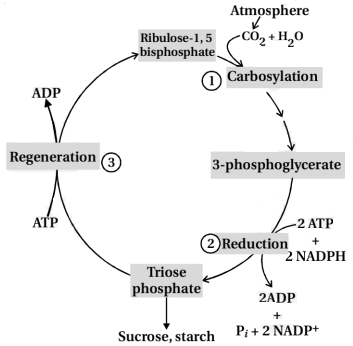
The Calvin cycle can be described under three stages: $(1)$ Carboxylation,$(2)$ Reduction,and $(3)$ Regeneration.
$(1)$ Carboxylation: Carboxylation is the fixation of $CO_2$ into a stable organic intermediate. It is the most crucial step of the Calvin cycle where $CO_2$ is utilised for the carboxylation of $RuBP$. This reaction is catalysed by the enzyme $RuBP$ carboxylase,which results in the formation of two molecules of $3-PGA$. Since this enzyme also has an oxygenation activity,it is more correctly called $RuBP$ carboxylase-oxygenase or $RuBisCO$.
$(2)$ Reduction: These are a series of reactions that lead to the formation of glucose. These steps involve the utilisation of $2$ molecules of $ATP$ for phosphorylation and $2$ molecules of $NADPH$ for reduction per $CO_2$ molecule fixed.
$3-PGA + 2 ATP + 2 NADPH \rightarrow 2$ Triose phosphate $(PGAL)$
The fixation of six molecules of $CO_2$ and $6$ turns of the cycle are required for the removal of one molecule of glucose from the pathway.
$(3)$ Regeneration: Regeneration of the $CO_2$ acceptor molecule $RuBP$ is crucial if the cycle is to continue uninterrupted. The regeneration steps require one $ATP$ for phosphorylation to form $RuBP$.
$PGAL \xrightarrow{ATP} RuBP$
Hence,for every $CO_2$ molecule entering the Calvin cycle,$3$ molecules of $ATP$ and $2$ molecules of $NADPH$ are required. It is probably to meet this difference in the number of $ATP$ and $NADPH$ used in the dark reaction that cyclic photophosphorylation takes place. To make one molecule of glucose,$6$ turns of the cycle are required.
The Calvin pathway occurs in all photosynthetic plants,regardless of whether they have $C_3$ or $C_4$ (or any other) pathways.
The Calvin cycle can be described under three stages: $(1)$ Carboxylation,$(2)$ Reduction,and $(3)$ Regeneration.
$(1)$ Carboxylation: Carboxylation is the fixation of $CO_2$ into a stable organic intermediate. It is the most crucial step of the Calvin cycle where $CO_2$ is utilised for the carboxylation of $RuBP$. This reaction is catalysed by the enzyme $RuBP$ carboxylase,which results in the formation of two molecules of $3-PGA$. Since this enzyme also has an oxygenation activity,it is more correctly called $RuBP$ carboxylase-oxygenase or $RuBisCO$.
$(2)$ Reduction: These are a series of reactions that lead to the formation of glucose. These steps involve the utilisation of $2$ molecules of $ATP$ for phosphorylation and $2$ molecules of $NADPH$ for reduction per $CO_2$ molecule fixed.
$3-PGA + 2 ATP + 2 NADPH \rightarrow 2$ Triose phosphate $(PGAL)$
The fixation of six molecules of $CO_2$ and $6$ turns of the cycle are required for the removal of one molecule of glucose from the pathway.
$(3)$ Regeneration: Regeneration of the $CO_2$ acceptor molecule $RuBP$ is crucial if the cycle is to continue uninterrupted. The regeneration steps require one $ATP$ for phosphorylation to form $RuBP$.
$PGAL \xrightarrow{ATP} RuBP$
Hence,for every $CO_2$ molecule entering the Calvin cycle,$3$ molecules of $ATP$ and $2$ molecules of $NADPH$ are required. It is probably to meet this difference in the number of $ATP$ and $NADPH$ used in the dark reaction that cyclic photophosphorylation takes place. To make one molecule of glucose,$6$ turns of the cycle are required.
0 likes
View Solution140
MediumMCQ
Who discovered the $C_3$ cycle of photosynthesis?
A
Melvin Calvin
B
Hans Krebs
C
Robert Hill
D
Jan Ingenhousz
Solution
(A) The $C_3$ cycle,also known as the Calvin cycle,was discovered by Melvin Calvin and his colleagues at the University of California,Berkeley.
They used the radioactive isotope $^{14}C$ in algal photosynthesis research to trace the path of carbon in the process.
For this pioneering work,Melvin Calvin was awarded the Nobel Prize in Chemistry in $1961$.
They used the radioactive isotope $^{14}C$ in algal photosynthesis research to trace the path of carbon in the process.
For this pioneering work,Melvin Calvin was awarded the Nobel Prize in Chemistry in $1961$.
0 likes
View Solution141
Medium
Describe the research work of Melvin Calvin regarding photosynthesis.
Solution
(N/A) Melvin Calvin,an American biochemist,conducted pioneering research on the path of carbon in photosynthesis using the radioactive isotope $C^{14}$.
$1$. He used the unicellular green alga $Chlorella$ and $Scenedesmus$ for his experiments.
$2$. He employed the technique of paper chromatography and autoradiography to trace the movement of carbon.
$3$. He discovered that the first stable product formed after $CO_2$ fixation in the dark reaction is a $3$-carbon compound called $3$-phosphoglyceric acid ($3$-$PGA$).
$4$. This discovery led to the identification of the $C_3$ cycle,which is now famously known as the Calvin Cycle.
$5$. For his significant contribution to understanding the mechanism of photosynthesis,he was awarded the Nobel Prize in Chemistry in $1961$.
$1$. He used the unicellular green alga $Chlorella$ and $Scenedesmus$ for his experiments.
$2$. He employed the technique of paper chromatography and autoradiography to trace the movement of carbon.
$3$. He discovered that the first stable product formed after $CO_2$ fixation in the dark reaction is a $3$-carbon compound called $3$-phosphoglyceric acid ($3$-$PGA$).
$4$. This discovery led to the identification of the $C_3$ cycle,which is now famously known as the Calvin Cycle.
$5$. For his significant contribution to understanding the mechanism of photosynthesis,he was awarded the Nobel Prize in Chemistry in $1961$.
0 likes
View Solution142
EasyMCQ
What is the full name of $RuBisCO$?
A
Ribulose bisphosphate carboxylase oxygenase
B
Ribulose biphosphate carboxylase oxygenase
C
Ribulose bisphosphate carboxyl oxygenase
D
Ribulose bisphosphate carboxylase oxidase
Solution
(A) $RuBisCO$ stands for Ribulose$-1,5-$bisphosphate carboxylase-oxygenase.
It is the most abundant enzyme on Earth.
It plays a crucial role in the Calvin cycle during photosynthesis by catalyzing the carboxylation of ribulose$-1,5-$bisphosphate.
It is the most abundant enzyme on Earth.
It plays a crucial role in the Calvin cycle during photosynthesis by catalyzing the carboxylation of ribulose$-1,5-$bisphosphate.
0 likes
View Solution143
MediumMCQ
What is the process of carboxylation in the context of photosynthesis?
A
The addition of $CO_2$ to $RuBP$ catalyzed by the enzyme $RuBisCO$.
B
The release of $O_2$ during the light-dependent reactions.
C
The reduction of $3-PGA$ to form triose phosphate.
D
The regeneration of $RuBP$ from $G3P$.
Solution
(A) Carboxylation is the most crucial step of the Calvin cycle (dark reaction) in photosynthesis.
During this process,$CO_2$ is utilized for the carboxylation of $RuBP$ (Ribulose$-1,5-$bisphosphate).
This reaction is catalyzed by the enzyme $RuBisCO$ (Ribulose$-1,5-$bisphosphate carboxylase-oxygenase),which results in the formation of two molecules of $3-PGA$ ($3$-phosphoglyceric acid).
This is the primary step where atmospheric carbon is fixed into organic compounds.
During this process,$CO_2$ is utilized for the carboxylation of $RuBP$ (Ribulose$-1,5-$bisphosphate).
This reaction is catalyzed by the enzyme $RuBisCO$ (Ribulose$-1,5-$bisphosphate carboxylase-oxygenase),which results in the formation of two molecules of $3-PGA$ ($3$-phosphoglyceric acid).
This is the primary step where atmospheric carbon is fixed into organic compounds.
0 likes
View Solution144
MediumMCQ
What is the change in reduction in Calvin cycle?
A
Conversion of $3-PGA$ to $G3P$
B
Conversion of $RuBP$ to $3-PGA$
C
Conversion of $G3P$ to $RuBP$
D
Conversion of $CO_2$ to $RuBP$
Solution
(A) The Calvin cycle consists of three main stages: Carboxylation,Reduction,and Regeneration.
$1$. Carboxylation: $CO_2$ is fixed to $RuBP$ to form $3-PGA$.
$2$. Reduction: This stage involves the utilization of $2$ molecules of $ATP$ for phosphorylation and $2$ molecules of $NADPH$ for reduction per molecule of $3-PGA$ fixed. This process converts $3-phosphoglycerate$ $(3-PGA)$ into $glyceraldehyde-3-phosphate$ ($G3P$ or $triose$ $phosphate$).
$3$. Regeneration: $RuBP$ is regenerated to continue the cycle.
Therefore,the reduction step involves the conversion of $3-PGA$ to $G3P$.
$1$. Carboxylation: $CO_2$ is fixed to $RuBP$ to form $3-PGA$.
$2$. Reduction: This stage involves the utilization of $2$ molecules of $ATP$ for phosphorylation and $2$ molecules of $NADPH$ for reduction per molecule of $3-PGA$ fixed. This process converts $3-phosphoglycerate$ $(3-PGA)$ into $glyceraldehyde-3-phosphate$ ($G3P$ or $triose$ $phosphate$).
$3$. Regeneration: $RuBP$ is regenerated to continue the cycle.
Therefore,the reduction step involves the conversion of $3-PGA$ to $G3P$.
0 likes
View Solution145
MediumMCQ
Why is regeneration necessary in the Calvin cycle?
A
To produce glucose
B
To fix carbon dioxide
C
To maintain the supply of RuBP for continued carbon fixation
D
To release oxygen
Solution
(C) In the Calvin cycle,the regeneration phase is essential to ensure the continuous fixation of $CO_2$.
During this phase,the $3$-carbon sugar molecules (G3P) are converted back into Ribulose-$1,5$-bisphosphate $(RuBP)$,which is the primary $CO_2$ acceptor.
Without the regeneration of $RuBP$,the cycle would stop because there would be no molecule available to accept the incoming $CO_2$ molecules,thereby halting the entire process of photosynthesis.
During this phase,the $3$-carbon sugar molecules (G3P) are converted back into Ribulose-$1,5$-bisphosphate $(RuBP)$,which is the primary $CO_2$ acceptor.
Without the regeneration of $RuBP$,the cycle would stop because there would be no molecule available to accept the incoming $CO_2$ molecules,thereby halting the entire process of photosynthesis.
0 likes
View Solution146
Medium
Give information about $RuBisCO$.
Solution
(N/A) $RuBisCO$ is the most abundant enzyme in the world.
- Characteristic: It is characterized by the fact that its active site can bind to both $CO_{2}$ and $O_{2}$ - hence the name (Ribulose bisphosphate carboxylase-oxygenase).
- Speciality: $RuBisCO$ has a much greater affinity for $CO_{2}$ than for $O_{2}$.
- Mechanism: It is the relative concentration of $O_{2}$ and $CO_{2}$ that determines which of the two will bind to the enzyme.
- Impact: In $C_{3}$ plants,some $O_{2}$ does bind to $RuBisCO$ instead of $CO_{2}$,leading to photorespiration,which decreases the efficiency of $CO_{2}$ fixation.
- Characteristic: It is characterized by the fact that its active site can bind to both $CO_{2}$ and $O_{2}$ - hence the name (Ribulose bisphosphate carboxylase-oxygenase).
- Speciality: $RuBisCO$ has a much greater affinity for $CO_{2}$ than for $O_{2}$.
- Mechanism: It is the relative concentration of $O_{2}$ and $CO_{2}$ that determines which of the two will bind to the enzyme.
- Impact: In $C_{3}$ plants,some $O_{2}$ does bind to $RuBisCO$ instead of $CO_{2}$,leading to photorespiration,which decreases the efficiency of $CO_{2}$ fixation.
0 likes
View Solution147
Medium
Provide the full names for the following abbreviations:
$(1)$ $RuBisCO$
$(2)$ $KOH$
$(1)$ $RuBisCO$
$(2)$ $KOH$
Solution
(N/A) $(1)$ $RuBisCO$: Ribulose-$1,5$-bisphosphate carboxylase-oxygenase.
$(2)$ $KOH$: Potassium hydroxide.
$(2)$ $KOH$: Potassium hydroxide.
0 likes
View SolutionPhotosynthesis in Higher Plants — C3 and Dark reaction · Frequently Asked Questions
1Are these Photosynthesis in Higher Plants questions useful for JEE and NEET?
Yes. All questions in this section are mapped to JEE Main and NEET exam patterns. Previous year questions from JEE Main, NEET, GUJCET and state-level exams are included with full solutions.
2Can I switch to Hindi or Gujarati for these questions?
Yes. Use the language tabs in the hero section or the sidebar to view the same questions and solutions in English, Hindi or Gujarati.
3How do I generate a question paper from this subtopic?
Use the Vedclass Exam Paper Generator — select the chapter and subtopic, set difficulty, and generate Sets A, B, C, D automatically. First 3 chapters of every subject are free.
Vedclass Products
For Students
Vedclass Test Series
Mock tests in real JEE/NEET style with performance analysis. 5-day free trial.
Start Free TrialFor Teachers
Exam Paper Generator
Generate Set A/B/C/D papers from this chapter in 2 minutes. 3 chapters free.
Try FreeFor Institutes
Online Exam Module
Live online exams with unlimited students, 360° analytics & white-label branding.
See DemoFor Teachers & Institutes
Generate a Photosynthesis in Higher Plants Exam Paper in 2 Minutes
Select subtopic & difficulty — Sets A, B, C, D auto-generated with No Repeat logic.
First 3 chapters of every subject are free — no payment required.