
A English
Human Neural System Questions in English
Class 11 Biology · Neural Control and Coordination · Human Neural System
69+
Questions
English
Language
100%
With Solutions
Showing 19 of 69 questions in English
51
MediumMCQ
Choose the incorrect statement regarding the autonomic nervous system.
A
Acts on skeletal muscles.
B
Acts on smooth muscles.
C
Consists of ganglia formed by pre- and post-ganglionic neurons.
D
Consists of sympathetic and parasympathetic nervous systems.
Solution
(A) The autonomic nervous system $(ANS)$ is a part of the peripheral nervous system that transmits impulses from the $CNS$ to involuntary organs and smooth muscles of the body.
It does not act on skeletal muscles,as skeletal muscles are controlled by the somatic nervous system.
It is classified into the sympathetic and parasympathetic nervous systems.
Therefore,the statement that it acts on skeletal muscles is incorrect.
It does not act on skeletal muscles,as skeletal muscles are controlled by the somatic nervous system.
It is classified into the sympathetic and parasympathetic nervous systems.
Therefore,the statement that it acts on skeletal muscles is incorrect.
0 likes
View Solution52
MediumMCQ
On the basis of the nature of nerve fibres,the nerves are classified as:
A
Medullated and non-medullated nerves
B
Myelinated and non-myelinated nerves
C
Sensory,motor and mixed nerves
D
Sensory and motor nerves
Solution
(C) On the basis of the nature of nerve fibres,nerves are classified into three types:
$(i)$ Sensory (Afferent) Nerves: These contain only sensory nerve fibres,which carry impulses from sense organs to the central nervous system.
$(ii)$ Motor (Efferent) Nerves: These contain only motor nerve fibres,which carry impulses from the central nervous system to the effector organs (muscles or glands).
$(iii)$ Mixed Nerves: These contain both sensory and motor nerve fibres,allowing them to perform both functions.
$(i)$ Sensory (Afferent) Nerves: These contain only sensory nerve fibres,which carry impulses from sense organs to the central nervous system.
$(ii)$ Motor (Efferent) Nerves: These contain only motor nerve fibres,which carry impulses from the central nervous system to the effector organs (muscles or glands).
$(iii)$ Mixed Nerves: These contain both sensory and motor nerve fibres,allowing them to perform both functions.
0 likes
View Solution53
MediumMCQ
The human neural system comprises
A
$PNS$ only
B
$CNS$ only
C
Both $(a)$ and $(b)$
D
None of these
Solution
(C) The human neural system is divided into two parts: the Central Neural System $(CNS)$ and the Peripheral Neural System $(PNS)$.
$CNS$ includes the brain and the spinal cord,which act as the site of information processing and control.
$PNS$ consists of all the nerves associated with the $CNS$ (cranial nerves and spinal nerves).
Therefore,the human neural system comprises both $CNS$ and $PNS$.
$CNS$ includes the brain and the spinal cord,which act as the site of information processing and control.
$PNS$ consists of all the nerves associated with the $CNS$ (cranial nerves and spinal nerves).
Therefore,the human neural system comprises both $CNS$ and $PNS$.
0 likes
View Solution54
EasyMCQ
The autonomic nervous system affects:
A
Reflex actions
B
Sensory organs
C
Internal organs
D
None of these
Solution
(C) The autonomic nervous system $(ANS)$ is a part of the peripheral nervous system that controls and coordinates the involuntary activities of various internal organs,such as the heart,smooth muscles,and glands.
This system is divided into two main parts:
$1$. Sympathetic nervous system
$2$. Parasympathetic nervous system
This system is divided into two main parts:
$1$. Sympathetic nervous system
$2$. Parasympathetic nervous system
0 likes
View Solution55
MediumMCQ
The system that transmits impulses from the $CNS$ to the involuntary organs and smooth muscles of the body is:
A
Sympathetic neural system
B
Parasympathetic neural system
C
Somatic neural system
D
Autonomic neural system
Solution
(D) The $Autonomic$ $neural$ $system$ is a division of the peripheral nervous system that transmits impulses from the $CNS$ to the involuntary organs and smooth muscles of the body.
It regulates involuntary physiological processes such as heart rate, digestion, and respiratory rate.
It regulates involuntary physiological processes such as heart rate, digestion, and respiratory rate.
0 likes
View Solution56
MediumMCQ
The system,responsible for providing an organized network of point-to-point connections for quick coordination,is called:
A
Endocrine system
B
Circulatory system
C
Digestive system
D
Neural system
Solution
(D) The system responsible for providing an organized network of point-to-point connections for quick coordination is called the neural system.
This system is composed of highly specialized cells called neurons,which detect stimuli throughout the body and transmit them to the brain for processing.
This system is composed of highly specialized cells called neurons,which detect stimuli throughout the body and transmit them to the brain for processing.
0 likes
View Solution57
MediumMCQ
Which of the following statements is incorrect?
A
$CNS$ is the site of information processing and control.
B
$CNS$ includes the brain and spinal cord.
C
The $PNS$ consists of the nerves and ganglia outside the brain and spinal cord.
D
None of the above
Solution
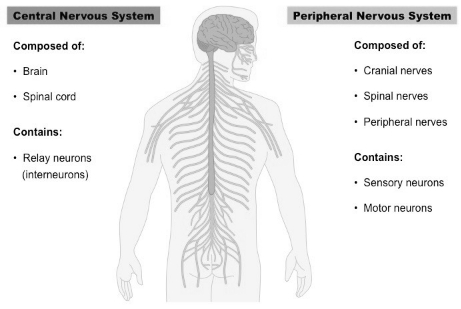
(D) The Central Nervous System $(CNS)$ comprises the brain and the spinal cord and is the site of information processing and control.
The Peripheral Nervous System $(PNS)$ comprises all the nerves of the body associated with the $CNS$ (brain and spinal cord).
Since all the given statements ($A$,$B$,and $C$) are scientifically correct according to the human neural system,the correct answer is $D$.
The Peripheral Nervous System $(PNS)$ comprises all the nerves of the body associated with the $CNS$ (brain and spinal cord).
Since all the given statements ($A$,$B$,and $C$) are scientifically correct according to the human neural system,the correct answer is $D$.
0 likes
View Solution58
MediumMCQ
The sympathetic nervous system controls:
A
Erection of hairs
B
Whitening of hairs
C
Withdrawal of hairs
D
All of the above
Solution
(A) The sympathetic nervous system is a division of the autonomic nervous system that prepares the body for 'fight-or-flight' responses.
It innervates the arrector pili muscles,which are small muscles attached to hair follicles.
When the sympathetic nervous system is activated,these muscles contract,causing the hairs to stand upright,a phenomenon known as 'piloerection' or erection of hairs.
It innervates the arrector pili muscles,which are small muscles attached to hair follicles.
When the sympathetic nervous system is activated,these muscles contract,causing the hairs to stand upright,a phenomenon known as 'piloerection' or erection of hairs.
0 likes
View Solution59
MediumMCQ
The somatic neural system relays impulses:
A
From $CNS$ to involuntary organs
B
From $CNS$ to skeletal muscles
C
From $PNS$ to smooth muscles
D
From $PNS$ to voluntary organs
Solution
(B) The human neural system is divided into two parts: the Central Neural System $(CNS)$ and the Peripheral Neural System $(PNS)$.
The $PNS$ is further divided into the somatic neural system and the autonomic neural system.
The somatic neural system relays impulses from the $CNS$ to skeletal muscles,which are under voluntary control.
The autonomic neural system transmits impulses from the $CNS$ to the involuntary organs and smooth muscles of the body.
The $PNS$ is further divided into the somatic neural system and the autonomic neural system.
The somatic neural system relays impulses from the $CNS$ to skeletal muscles,which are under voluntary control.
The autonomic neural system transmits impulses from the $CNS$ to the involuntary organs and smooth muscles of the body.
0 likes
View Solution60
MediumMCQ
The autonomic neural system is a division of
A
Sympathetic neural system
B
Central neural system
C
Peripheral neural system
D
Somatic neural system
Solution
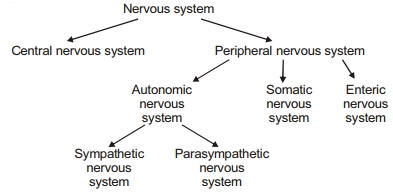
(C) The human neural system is divided into two parts: the Central Neural System $(CNS)$ and the Peripheral Neural System $(PNS)$.
The Peripheral Neural System $(PNS)$ is further divided into the Somatic Neural System and the Autonomic Neural System.
The Autonomic Neural System is responsible for transmitting impulses from the $CNS$ to the involuntary organs and smooth muscles of the body.
Therefore,the autonomic neural system is a division of the peripheral neural system.
The Peripheral Neural System $(PNS)$ is further divided into the Somatic Neural System and the Autonomic Neural System.
The Autonomic Neural System is responsible for transmitting impulses from the $CNS$ to the involuntary organs and smooth muscles of the body.
Therefore,the autonomic neural system is a division of the peripheral neural system.
0 likes
View Solution61
MediumMCQ
Neural crest cells break off from the . . . . . . and later move to the sides of the developing embryo to form . . . . . . .
A
Placodes,sense organs of head
B
Ectoderm,sense organs of head
C
Notochord,vertebral column
D
Neural tube,autonomic ganglia
Solution
(D) Neural crest cells are a specialized population of cells that detach from the dorsal edges of the neural tube during neurulation. As the neural tube closes,these cells migrate away and differentiate into various structures,including the peripheral nervous system,specifically the autonomic ganglia,sensory ganglia,and adrenal medulla. Therefore,the correct sequence is that they break off from the neural tube and form structures like autonomic ganglia.
0 likes
View Solution62
MediumMCQ
Which nervous system activity promotes proper digestion?
A
Sympathetic nervous system
B
Parasympathetic nervous system
C
Both
D
Somatic nervous system
Solution
(B) The digestive system is regulated by the autonomic nervous system $(ANS)$, which consists of two divisions: the sympathetic and parasympathetic nervous systems.
The parasympathetic nervous system is responsible for the 'rest and digest' response.
It stimulates digestive activities, such as increasing the secretion of digestive enzymes, promoting peristalsis, and increasing blood flow to the gastrointestinal tract to facilitate nutrient absorption.
In contrast, the sympathetic nervous system is associated with the 'fight or flight' response, which inhibits digestive processes to redirect energy to other vital organs.
The parasympathetic nervous system is responsible for the 'rest and digest' response.
It stimulates digestive activities, such as increasing the secretion of digestive enzymes, promoting peristalsis, and increasing blood flow to the gastrointestinal tract to facilitate nutrient absorption.
In contrast, the sympathetic nervous system is associated with the 'fight or flight' response, which inhibits digestive processes to redirect energy to other vital organs.
0 likes
View Solution63
MediumMCQ
Match the following columns:
| Column-$I$ | Column-$II$ |
| $P$. Hydra | $I$. Nerve net |
| $Q$. Insect | $II$. Brain, ganglia, nerve tissues |
| $R$. Human | $III$. Brain and spinal cord |
A
$(P-I), (Q-III), (R-II)$
B
$(P-I), (Q-II), (R-III)$
C
$(P-II), (Q-III), (R-I)$
D
$(P-III), (Q-II), (R-I)$
Solution
(B) The correct matching is as follows:
$1$. Hydra: It possesses a simple nervous system consisting of a network of neurons known as a nerve net $(P-I)$.
$2$. Insect: Their nervous system is more complex, consisting of a brain, ganglia, and a network of nerve tissues $(Q-II)$.
$3$. Human: Humans have a highly developed central nervous system comprising the brain and spinal cord $(R-III)$.
Therefore, the correct sequence is $(P-I), (Q-II), (R-III)$.
$1$. Hydra: It possesses a simple nervous system consisting of a network of neurons known as a nerve net $(P-I)$.
$2$. Insect: Their nervous system is more complex, consisting of a brain, ganglia, and a network of nerve tissues $(Q-II)$.
$3$. Human: Humans have a highly developed central nervous system comprising the brain and spinal cord $(R-III)$.
Therefore, the correct sequence is $(P-I), (Q-II), (R-III)$.
0 likes
View Solution64
MediumMCQ
The visceral nervous system $(VNS)$ is a part of the ...... .
A
Peripheral nervous system
B
Central nervous system
C
Both
D
None of these
Solution
(A) The human neural system is divided into two parts: the Central Neural System $(CNS)$ and the Peripheral Neural System $(PNS)$.
The $PNS$ comprises all the nerves of the body associated with the $CNS$.
The nerve fibers of the $PNS$ are of two types: afferent fibers and efferent fibers.
The efferent nerve fibers may be further classified into the Somatic Neural System $(SNS)$ and the Visceral Neural System $(VNS)$ (or Autonomic Neural System).
Therefore,the $VNS$ is a part of the Peripheral Neural System $(PNS)$.
The $PNS$ comprises all the nerves of the body associated with the $CNS$.
The nerve fibers of the $PNS$ are of two types: afferent fibers and efferent fibers.
The efferent nerve fibers may be further classified into the Somatic Neural System $(SNS)$ and the Visceral Neural System $(VNS)$ (or Autonomic Neural System).
Therefore,the $VNS$ is a part of the Peripheral Neural System $(PNS)$.
0 likes
View Solution65
MediumMCQ
$P$ nerve fibers transmit impulses from tissues/organs to the $CNS$ and $Q$ nerve fibers transmit regulatory impulses from the $CNS$ to the concerned peripheral tissues/organs.
$\quad\quad\quad P\quad\quad\quad Q$
$\quad\quad\quad P\quad\quad\quad Q$
A
Efferent nerve fibers $\quad\quad$ Efferent nerve fibers
B
Afferent nerve fibers $\quad\quad$ Afferent nerve fibers
C
Afferent nerve fibers $\quad\quad$ Efferent nerve fibers
D
Efferent nerve fibers $\quad\quad$ Afferent nerve fibers
Solution
(C) The peripheral nervous system $(PNS)$ consists of two types of nerve fibers:
$1$. Afferent nerve fibers: These fibers transmit impulses from tissues/organs to the central nervous system $(CNS)$.
$2$. Efferent nerve fibers: These fibers transmit regulatory impulses from the $CNS$ to the concerned peripheral tissues/organs.
Therefore,$P$ represents Afferent nerve fibers and $Q$ represents Efferent nerve fibers.
$1$. Afferent nerve fibers: These fibers transmit impulses from tissues/organs to the central nervous system $(CNS)$.
$2$. Efferent nerve fibers: These fibers transmit regulatory impulses from the $CNS$ to the concerned peripheral tissues/organs.
Therefore,$P$ represents Afferent nerve fibers and $Q$ represents Efferent nerve fibers.
0 likes
View Solution66
MediumMCQ
Select the incorrect option for the Autonomic Neural System $(ANS)$.
A
It is a part of the Peripheral Neural System $(PNS)$.
B
It is classified into Sympathetic and Parasympathetic neural systems.
C
It is a part of the Central Neural System $(CNS)$.
D
It is also known as the involuntary neural system.
Solution
(C) The human neural system is divided into two parts: the Central Neural System $(CNS)$ and the Peripheral Neural System $(PNS)$.
$CNS$ includes the brain and the spinal cord.
$PNS$ comprises all the nerves of the body associated with the $CNS$.
The $PNS$ is further divided into two divisions: the Somatic Neural System and the Autonomic Neural System $(ANS)$.
Therefore,the $ANS$ is a part of the $PNS$,not the $CNS$.
Option $C$ is incorrect because the $ANS$ is not a part of the $CNS$.
$CNS$ includes the brain and the spinal cord.
$PNS$ comprises all the nerves of the body associated with the $CNS$.
The $PNS$ is further divided into two divisions: the Somatic Neural System and the Autonomic Neural System $(ANS)$.
Therefore,the $ANS$ is a part of the $PNS$,not the $CNS$.
Option $C$ is incorrect because the $ANS$ is not a part of the $CNS$.
0 likes
View Solution67
MediumMCQ
$P$ - The nervous system that relays impulses from the $CNS$ to skeletal muscles.
$Q$ - The nervous system that transmits impulses from the $CNS$ to involuntary organs and smooth muscles of the body.
$\quad\quad\quad P \quad\quad Q$
$Q$ - The nervous system that transmits impulses from the $CNS$ to involuntary organs and smooth muscles of the body.
$\quad\quad\quad P \quad\quad Q$
A
Autonomic Neural System $\quad$ Somatic Neural System
B
Somatic Neural System $\quad$ Autonomic Neural System
C
Sympathetic Neural System $\quad$ Parasympathetic Neural System
D
Parasympathetic Neural System $\quad$ Sympathetic Neural System
Solution
(B) The peripheral nervous system is divided into two divisions: the somatic neural system and the autonomic neural system.
$1$. The $Somatic$ $Neural$ $System$ relays impulses from the $CNS$ to skeletal muscles.
$2$. The $Autonomic$ $Neural$ $System$ transmits impulses from the $CNS$ to the involuntary organs and smooth muscles of the body.
Therefore,$P$ represents the Somatic Neural System and $Q$ represents the Autonomic Neural System.
$1$. The $Somatic$ $Neural$ $System$ relays impulses from the $CNS$ to skeletal muscles.
$2$. The $Autonomic$ $Neural$ $System$ transmits impulses from the $CNS$ to the involuntary organs and smooth muscles of the body.
Therefore,$P$ represents the Somatic Neural System and $Q$ represents the Autonomic Neural System.
0 likes
View Solution68
MediumMCQ
$P$ - Contains unmyelinated nerve fibers.
$Q$ - Contains myelinated nerve fibers.
$I$ - Spinal nerves
$II$ - Autonomic neural system
$III$ - Somatic nerve fibers
$IV$ - Cranial nerves
Select the correct option for $P$ and $Q$.
$\quad\quad P$ $\quad$ $\quad$ $Q$
$Q$ - Contains myelinated nerve fibers.
$I$ - Spinal nerves
$II$ - Autonomic neural system
$III$ - Somatic nerve fibers
$IV$ - Cranial nerves
Select the correct option for $P$ and $Q$.
$\quad\quad P$ $\quad$ $\quad$ $Q$
A
$II, III \quad\quad I, IV$
B
$I, IV \quad\quad II, III$
C
$I, III \quad\quad II, IV$
D
$II, IV \quad\quad I, III$
Solution
(A) The neural system is classified based on the presence or absence of a myelin sheath around the axons.
$1$. Myelinated nerve fibers are found in spinal and cranial nerves ($I$ and $IV$).
$2$. Unmyelinated nerve fibers are commonly found in the autonomic and the somatic neural systems ($II$ and $III$).
Therefore,$P$ (unmyelinated) corresponds to $II$ and $III$,and $Q$ (myelinated) corresponds to $I$ and $IV$.
$1$. Myelinated nerve fibers are found in spinal and cranial nerves ($I$ and $IV$).
$2$. Unmyelinated nerve fibers are commonly found in the autonomic and the somatic neural systems ($II$ and $III$).
Therefore,$P$ (unmyelinated) corresponds to $II$ and $III$,and $Q$ (myelinated) corresponds to $I$ and $IV$.
0 likes
View Solution69
EasyMCQ
The covering of a bundle of nerves is . . . . . . .
A
endoneurium
B
perineurium
C
epineurium
D
endothecium
Solution
(C) $Endoneurium$: It is the delicate connective tissue layer that surrounds individual nerve fibers (axons).
$Perineurium$: It is the connective tissue layer that surrounds a bundle of nerve fibers,known as a nerve fascicle.
$Epineurium$: It is the outermost layer of dense connective tissue that encloses the entire nerve,which consists of multiple bundles (fascicles) of nerve fibers.
Therefore,the covering of a bundle of nerves (a nerve trunk) is the $epineurium$.
$Perineurium$: It is the connective tissue layer that surrounds a bundle of nerve fibers,known as a nerve fascicle.
$Epineurium$: It is the outermost layer of dense connective tissue that encloses the entire nerve,which consists of multiple bundles (fascicles) of nerve fibers.
Therefore,the covering of a bundle of nerves (a nerve trunk) is the $epineurium$.
0 likes
View SolutionNeural Control and Coordination — Human Neural System · Frequently Asked Questions
1Are these Neural Control and Coordination questions useful for JEE and NEET?
Yes. All questions in this section are mapped to JEE Main and NEET exam patterns. Previous year questions from JEE Main, NEET, GUJCET and state-level exams are included with full solutions.
2Can I switch to Hindi or Gujarati for these questions?
Yes. Use the language tabs in the hero section or the sidebar to view the same questions and solutions in English, Hindi or Gujarati.
3How do I generate a question paper from this subtopic?
Use the Vedclass Exam Paper Generator — select the chapter and subtopic, set difficulty, and generate Sets A, B, C, D automatically. First 3 chapters of every subject are free.
Vedclass Products
For Students
Vedclass Test Series
Mock tests in real JEE/NEET style with performance analysis. 5-day free trial.
Start Free TrialFor Teachers
Exam Paper Generator
Generate Set A/B/C/D papers from this chapter in 2 minutes. 3 chapters free.
Try FreeFor Institutes
Online Exam Module
Live online exams with unlimited students, 360° analytics & white-label branding.
See DemoFor Teachers & Institutes
Generate a Neural Control and Coordination Exam Paper in 2 Minutes
Select subtopic & difficulty — Sets A, B, C, D auto-generated with No Repeat logic.
First 3 chapters of every subject are free — no payment required.