
A English
Human Neural System Questions in English
Class 11 Biology · Neural Control and Coordination · Human Neural System
69+
Questions
English
Language
100%
With Solutions
Showing 50 of 69 questions in English
1
MediumMCQ
Axons form nerves in
A
Autonomic nervous system
B
Central nervous system
C
Both $A$ and $B$
D
Peripheral nervous system
Solution
(D) In the $Peripheral \ Nervous \ System$ $(PNS)$,bundles of axons are enclosed in connective tissue sheaths to form structures known as nerves.
In the $Central \ Nervous \ System$ $(CNS)$,bundles of axons are referred to as tracts,not nerves.
Therefore,axons form nerves specifically within the $PNS$.
In the $Central \ Nervous \ System$ $(CNS)$,bundles of axons are referred to as tracts,not nerves.
Therefore,axons form nerves specifically within the $PNS$.
0 likes
View Solution2
EasyMCQ
The brain develops from which of the following embryonic germ layers?
A
Ectoderm
B
Mesoderm
C
Endoderm
D
Meso-endoderm
Solution
(A) The human brain and the entire nervous system develop from the $Ectoderm$,which is the outermost germ layer of the developing embryo. During neurulation,the ectoderm folds to form the neural tube,which eventually differentiates into the brain and spinal cord.
0 likes
View Solution3
MediumMCQ
Release of gastro-intestinal secretion and movement after ingestion of food is brought about by
A
Sympathetic nervous system
B
Parasympathetic nervous system
C
Central nervous system
D
Thyroid membrane
Solution
(B) The stimulation of the parasympathetic nervous system is responsible for the 'rest and digest' response.
$1.$ It increases gastro-intestinal $(GI)$ secretions,such as salivary,gastric,and pancreatic juices.
$2.$ It increases $GI$ motility,which includes processes like peristalsis to move food through the digestive tract.
Therefore,the correct option is $B$.
$1.$ It increases gastro-intestinal $(GI)$ secretions,such as salivary,gastric,and pancreatic juices.
$2.$ It increases $GI$ motility,which includes processes like peristalsis to move food through the digestive tract.
Therefore,the correct option is $B$.
0 likes
View Solution4
EasyMCQ
The brain is derived from which embryonic germ layer?
A
Ectodermal
B
Mesodermal
C
Endodermal
D
Mesendodermal
Solution
(A) The nervous system,including the brain and spinal cord,is derived from the ectoderm. During embryonic development,the neural plate forms from the ectoderm,which then folds to form the neural tube,eventually giving rise to the central nervous system.
0 likes
View Solution5
EasyMCQ
Which nervous system is activated in stress conditions?
A
Sympathetic
B
Parasympathetic
C
Somatic
D
Whole $ANS$
Solution
(A) The $Sympathetic$ nervous system is responsible for the 'fight-or-flight' response,which increases the body's defense mechanisms against adverse conditions.
It is activated during stress conditions,such as pain,fear,and anger.
It is activated during stress conditions,such as pain,fear,and anger.
0 likes
View Solution6
MediumMCQ
The autonomic nervous system has control over
A
Reflex action
B
Skeletal muscles
C
Sense organs
D
Internal organs
Solution
(D) The autonomic nervous system $(ANS)$ regulates and coordinates involuntary activities such as heart beating,homeostasis,body temperature,breathing,gut peristalsis,and the secretion of glands. It primarily controls the smooth muscles and glands of the internal organs.
0 likes
View Solution7
MediumMCQ
Parasympathetic nerves increase the mobility in
A
Small intestine
B
Heart
C
Brain
D
None of the above
Solution
(A) The parasympathetic nervous system is responsible for the 'rest and digest' activities of the body.
It stimulates the activity of the digestive tract,including increasing the peristaltic movements and mobility of the small intestine to facilitate digestion and absorption.
In contrast,it decreases the heart rate,unlike the sympathetic nervous system which increases it.
It stimulates the activity of the digestive tract,including increasing the peristaltic movements and mobility of the small intestine to facilitate digestion and absorption.
In contrast,it decreases the heart rate,unlike the sympathetic nervous system which increases it.
0 likes
View Solution8
MediumMCQ
Neural stimulation in visceral organs in human beings is done by:
A
Sympathetic and parasympathetic nerves and is under involuntary action
B
Sympathetic nerves and is under voluntary action
C
Sympathetic and parasympathetic nerves and is under voluntary action
D
Parasympathetic nerves and is under voluntary action
Solution
(A) The human neural system is divided into the Central Neural System $(CNS)$ and the Peripheral Neural System $(PNS)$.
The $PNS$ is further divided into the Somatic Neural System and the Autonomic Neural System $(ANS)$.
The $ANS$ transmits impulses from the $CNS$ to the involuntary organs and smooth muscles of the body.
The $ANS$ is classified into the Sympathetic and Parasympathetic neural systems.
These systems regulate the activities of visceral organs,which are not under the conscious control of the individual,meaning they are under involuntary action.
The $PNS$ is further divided into the Somatic Neural System and the Autonomic Neural System $(ANS)$.
The $ANS$ transmits impulses from the $CNS$ to the involuntary organs and smooth muscles of the body.
The $ANS$ is classified into the Sympathetic and Parasympathetic neural systems.
These systems regulate the activities of visceral organs,which are not under the conscious control of the individual,meaning they are under involuntary action.
0 likes
View Solution9
EasyMCQ
The number of cranial nerves in a rabbit/mammal is: (in $pairs$)
A
$10$
B
$12$
C
$24$
D
$36$
Solution
(B) The correct answer is $(b)$.
In mammals, including rabbits and humans, there are $12$ pairs of cranial nerves.
These nerves are: $I$ (Olfactory), $II$ (Optic), $III$ (Oculomotor), $IV$ (Trochlear), $V$ (Trigeminal), $VI$ (Abducens), $VII$ (Facial), $VIII$ (Vestibulocochlear/Auditory), $IX$ (Glossopharyngeal), $X$ (Vagus), $XI$ (Spinal accessory), and $XII$ (Hypoglossal).
In mammals, including rabbits and humans, there are $12$ pairs of cranial nerves.
These nerves are: $I$ (Olfactory), $II$ (Optic), $III$ (Oculomotor), $IV$ (Trochlear), $V$ (Trigeminal), $VI$ (Abducens), $VII$ (Facial), $VIII$ (Vestibulocochlear/Auditory), $IX$ (Glossopharyngeal), $X$ (Vagus), $XI$ (Spinal accessory), and $XII$ (Hypoglossal).
0 likes
View Solution10
MediumMCQ
The nerves leading to the central nervous system are called:
A
Efferent
B
Afferent
C
Motor
D
None
Solution
(B) The nerves that carry impulses from the receptor organs to the $CNS$ (Central Nervous System) are known as afferent or sensory nerves. These nerves consist exclusively of sensory nerve fibers that transmit sensory information toward the brain and spinal cord.
0 likes
View Solution11
MediumMCQ
The self-governing nervous system is known as:
A
Central nervous system
B
Peripheral nervous system
C
Autonomic nervous system
D
Sympathetic nervous system
Solution
(C) The $Autonomic$ $nervous$ $system$ $(ANS)$ is the part of the peripheral nervous system that controls visceral functions, which occur below the level of consciousness. It is often referred to as the self-governing or involuntary nervous system because it regulates internal organs such as the heart, digestive system, and respiratory tract without conscious effort.
0 likes
View Solution12
MediumMCQ
The autonomic nervous system consists of:
A
Paired chain ganglia
B
Brain and spinal cord
C
Sense organs
D
Cerebral hemispheres
Solution
(A) The autonomic nervous system $(ANS)$ is a part of the peripheral nervous system that controls involuntary bodily functions. It consists of a network of nerves and ganglia,including the sympathetic and parasympathetic divisions. The sympathetic nervous system is characterized by a pair of sympathetic chain ganglia located along the spinal cord. Therefore,the presence of paired chain ganglia is a key feature of the autonomic nervous system.
0 likes
View Solution13
EasyMCQ
The $VI$ cranial nerve of a rabbit is:
A
Abducens
B
Optic
C
Olfactory
D
Oculomotor
Solution
(A) The $VI$ cranial nerve is the Abducens nerve.
It is a motor nerve that supplies the external rectus muscle of the eye,which is responsible for the lateral movement of the eyeball.
It is a motor nerve that supplies the external rectus muscle of the eye,which is responsible for the lateral movement of the eyeball.
0 likes
View Solution14
EasyMCQ
How many pairs of cranial nerves in mammals are purely sensory?
A
Five
B
Four
C
Three
D
Two
Solution
(C) In mammals,there are $12$ pairs of cranial nerves. Among these,the purely sensory nerves are the olfactory $(I)$,optic $(II)$,and vestibulocochlear/auditory $(VIII)$ nerves. Therefore,there are $3$ pairs of purely sensory cranial nerves.
0 likes
View Solution15
EasyMCQ
Contraction of involuntary muscles, secretion of digestive glands and rate of heart beats are under the control of
A
Cranial system
B
Reflex system
C
Autonomic nervous system
D
Central nervous system
Solution
(C) The $Autonomic \text{ } Nervous \text{ } System$ $(ANS)$ is a part of the peripheral nervous system that controls visceral functions which occur automatically without conscious effort.
These functions include the contraction of involuntary (smooth) muscles, the secretion of digestive glands, and the regulation of the heart rate.
The $ANS$ is further divided into the sympathetic and parasympathetic nervous systems, which work antagonistically to maintain homeostasis.
These functions include the contraction of involuntary (smooth) muscles, the secretion of digestive glands, and the regulation of the heart rate.
The $ANS$ is further divided into the sympathetic and parasympathetic nervous systems, which work antagonistically to maintain homeostasis.
0 likes
View Solution16
MediumMCQ
Nerve impulse is:
A
Carried by afferent and efferent fibres
B
Not carried by any afferent or efferent fibres
C
Carried away by afferent fibres and brought about by efferent fibres
D
Brought by afferent fibres and carried away by efferent fibres
Solution
(D) The human neural system consists of the Central Neural System $(CNS)$ and the Peripheral Neural System $(PNS)$.
Afferent nerve fibres transmit impulses from tissues/organs to the $CNS$.
Efferent nerve fibres transmit regulatory impulses from the $CNS$ to the concerned peripheral tissues/organs.
Therefore,nerve impulses are brought to the $CNS$ by afferent fibres and carried away from the $CNS$ by efferent fibres.
Afferent nerve fibres transmit impulses from tissues/organs to the $CNS$.
Efferent nerve fibres transmit regulatory impulses from the $CNS$ to the concerned peripheral tissues/organs.
Therefore,nerve impulses are brought to the $CNS$ by afferent fibres and carried away from the $CNS$ by efferent fibres.
0 likes
View Solution17
MediumMCQ
Afferent nerve fibres carry impulses from
A
Effector organs to central nervous system
B
Receptors to central nervous system
C
Central nervous system to muscles
D
Central nervous system to receptors
Solution
(B) The peripheral nervous system is divided into two types of nerve fibres: afferent and efferent.
Afferent nerve fibres transmit impulses from tissues or organs (receptors) to the central nervous system $(CNS)$.
Efferent nerve fibres transmit regulatory impulses from the central nervous system to the concerned peripheral tissues or organs (effectors).
Therefore,the correct option is $B$.
Afferent nerve fibres transmit impulses from tissues or organs (receptors) to the central nervous system $(CNS)$.
Efferent nerve fibres transmit regulatory impulses from the central nervous system to the concerned peripheral tissues or organs (effectors).
Therefore,the correct option is $B$.
0 likes
View Solution18
MediumMCQ
$A$ motor nerve carries impulses from
A
$CNS$ to the effectors
B
Effectors to the $CNS$ (central nervous system)
C
Cranial nerves to the effectors
D
Effectors to the cranial nerves
Solution
(A) Motor nerves consist of efferent nerve fibers.
These fibers are responsible for conducting nerve impulses from the $CNS$ (Central Nervous System) to the peripheral tissues or organs known as effectors (such as muscles or glands).
Therefore,the correct pathway is $CNS$ to effectors.
These fibers are responsible for conducting nerve impulses from the $CNS$ (Central Nervous System) to the peripheral tissues or organs known as effectors (such as muscles or glands).
Therefore,the correct pathway is $CNS$ to effectors.
0 likes
View Solution19
MediumMCQ
Which of the following is a function of the parasympathetic nervous system in mammals?
A
Acceleration of heart beat
B
Constriction of pupil
C
Stimulation of sweat glands
D
Contraction of arrector pili muscles
Solution
(B) The parasympathetic nervous system is responsible for 'rest and digest' activities.
$1$. It promotes the constriction of the pupil (miosis).
$2$. It decreases the heart rate,whereas the sympathetic nervous system increases it.
$3$. Stimulation of sweat glands and contraction of arrector pili muscles are functions of the sympathetic nervous system.
Therefore,the correct function of the parasympathetic nervous system among the given options is the constriction of the pupil.
$1$. It promotes the constriction of the pupil (miosis).
$2$. It decreases the heart rate,whereas the sympathetic nervous system increases it.
$3$. Stimulation of sweat glands and contraction of arrector pili muscles are functions of the sympathetic nervous system.
Therefore,the correct function of the parasympathetic nervous system among the given options is the constriction of the pupil.
0 likes
View Solution20
EasyMCQ
The brain originates from which germ layer?
A
Ectoderm
B
Mesoderm
C
Endoderm
D
Ectomesoderm
Solution
(A) The human brain is derived from the ectoderm,which is the outermost germ layer formed during embryonic development. The neural tube,which eventually develops into the central nervous system (including the brain and spinal cord),originates from the ectodermal tissue.
0 likes
View Solution21
MediumMCQ
What are the histiocytes of the brain?
A
Reticular cells
B
Microglial cells
C
Hassall's corpuscles
D
Monocytes
Solution
(B) Histiocytes are generally defined as tissue macrophages. In the central nervous system,the specialized macrophages that perform phagocytosis and immune surveillance are known as microglial cells. These cells are derived from the yolk sac during embryonic development and act as the resident immune cells of the brain.
0 likes
View Solution22
MediumMCQ
The $PNS$ (Peripheral Nervous System) comprises:
A
Autonomic nervous system
B
Peripheral nerves
C
Central nervous system
D
Somatic nervous system
Solution
(B) The human neural system is divided into two parts: the $CNS$ (Central Nervous System) and the $PNS$ (Peripheral Nervous System).
The $CNS$ includes the brain and the spinal cord.
The $PNS$ comprises all the nerves of the body associated with the $CNS$ (cranial nerves and spinal nerves).
Therefore,the cranial and spinal nerves are components of the $PNS$.
The $CNS$ includes the brain and the spinal cord.
The $PNS$ comprises all the nerves of the body associated with the $CNS$ (cranial nerves and spinal nerves).
Therefore,the cranial and spinal nerves are components of the $PNS$.
0 likes
View Solution23
MediumMCQ
The autonomic neural system in humans is composed of which of the following?
A
Parasympathetic and sympathetic nerves
B
Cranial and spinal nerves
C
Brain and spinal cord
D
Myelinated and non-myelinated nerves
Solution
(A) The human neural system is divided into two main parts: the Central Neural System $(CNS)$ and the Peripheral Neural System $(PNS)$.
The $PNS$ is further divided into the Somatic Neural System and the Autonomic Neural System $(ANS)$.
The Autonomic Neural System transmits impulses from the $CNS$ to the involuntary organs and smooth muscles of the body.
The $ANS$ is classified into two divisions: the Sympathetic Neural System and the Parasympathetic Neural System.
Therefore,the autonomic neural system is composed of sympathetic and parasympathetic nerves.
The $PNS$ is further divided into the Somatic Neural System and the Autonomic Neural System $(ANS)$.
The Autonomic Neural System transmits impulses from the $CNS$ to the involuntary organs and smooth muscles of the body.
The $ANS$ is classified into two divisions: the Sympathetic Neural System and the Parasympathetic Neural System.
Therefore,the autonomic neural system is composed of sympathetic and parasympathetic nerves.
0 likes
View Solution24
MediumMCQ
Which nervous system carries impulses from the $CNS$ to the involuntary organs and smooth muscles of the body?
A
Sympathetic nervous system
B
Parasympathetic nervous system
C
Autonomic nervous system
D
Somatic nervous system
Solution
(C) The human neural system is divided into two parts: the Central Neural System $(CNS)$ and the Peripheral Neural System $(PNS)$.
The $PNS$ is further divided into the Somatic Neural System and the Autonomic Neural System.
The Somatic Neural System relays impulses from the $CNS$ to skeletal muscles.
The Autonomic Neural System transmits impulses from the $CNS$ to the involuntary organs and smooth muscles of the body.
Therefore,the correct answer is the Autonomic nervous system.
The $PNS$ is further divided into the Somatic Neural System and the Autonomic Neural System.
The Somatic Neural System relays impulses from the $CNS$ to skeletal muscles.
The Autonomic Neural System transmits impulses from the $CNS$ to the involuntary organs and smooth muscles of the body.
Therefore,the correct answer is the Autonomic nervous system.
0 likes
View Solution25
MediumMCQ
The autonomic neural system controls:
A
Conditioned reflexes
B
Functions of the spinal cord
C
Functions of visceral organs
D
Reflex actions
Solution
(C) The human neural system is divided into two parts: the Central Neural System $(CNS)$ and the Peripheral Neural System $(PNS)$.
The $PNS$ is further divided into the Somatic Neural System and the Autonomic Neural System $(ANS)$.
The Somatic Neural System relays impulses from the $CNS$ to skeletal muscles.
The Autonomic Neural System transmits impulses from the $CNS$ to the involuntary organs and smooth muscles of the body,collectively known as visceral organs.
Therefore,the $ANS$ controls the functions of visceral organs.
The $PNS$ is further divided into the Somatic Neural System and the Autonomic Neural System $(ANS)$.
The Somatic Neural System relays impulses from the $CNS$ to skeletal muscles.
The Autonomic Neural System transmits impulses from the $CNS$ to the involuntary organs and smooth muscles of the body,collectively known as visceral organs.
Therefore,the $ANS$ controls the functions of visceral organs.
0 likes
View Solution26
MediumMCQ
Which of the following is a sensory nerve?
A
Auditory
B
Abducens
C
Optic
D
Trigeminal
Solution
(C) The cranial nerves are classified as sensory,motor,or mixed based on their function.
$1$. The $Auditory$ (vestibulocochlear) nerve is a sensory nerve involved in hearing and balance.
$2$. The $Abducens$ nerve is a motor nerve that controls eye movement.
$3$. The $Optic$ nerve is a sensory nerve responsible for vision.
$4$. The $Trigeminal$ nerve is a mixed nerve (both sensory and motor).
Since both $Auditory$ and $Optic$ are sensory nerves,in the context of standard biology multiple-choice questions where only one answer is expected,$Optic$ is the primary sensory nerve associated with vision. However,both $A$ and $C$ are sensory. Given the standard classification,$Optic$ is the most commonly cited pure sensory nerve.
$1$. The $Auditory$ (vestibulocochlear) nerve is a sensory nerve involved in hearing and balance.
$2$. The $Abducens$ nerve is a motor nerve that controls eye movement.
$3$. The $Optic$ nerve is a sensory nerve responsible for vision.
$4$. The $Trigeminal$ nerve is a mixed nerve (both sensory and motor).
Since both $Auditory$ and $Optic$ are sensory nerves,in the context of standard biology multiple-choice questions where only one answer is expected,$Optic$ is the primary sensory nerve associated with vision. However,both $A$ and $C$ are sensory. Given the standard classification,$Optic$ is the most commonly cited pure sensory nerve.
0 likes
View Solution27
EasyMCQ
The nerve that carries impulses towards the Central Nervous System $(CNS)$ is called ....
A
Afferent
B
Efferent
C
Motor
D
None of these
Solution
(A) The peripheral nervous system $(PNS)$ is divided into two types of nerve fibers: afferent and efferent.
$1$. Afferent nerve fibers transmit impulses from tissues or organs towards the Central Nervous System $(CNS)$.
$2$. Efferent nerve fibers transmit regulatory impulses from the Central Nervous System $(CNS)$ to the concerned peripheral tissues or organs.
Therefore,the nerve that carries impulses towards the $CNS$ is known as an afferent nerve.
$1$. Afferent nerve fibers transmit impulses from tissues or organs towards the Central Nervous System $(CNS)$.
$2$. Efferent nerve fibers transmit regulatory impulses from the Central Nervous System $(CNS)$ to the concerned peripheral tissues or organs.
Therefore,the nerve that carries impulses towards the $CNS$ is known as an afferent nerve.
0 likes
View Solution28
MediumMCQ
What does the $ANS$ (Autonomic Neural System) affect?
A
Reflex action
B
Sensory organs
C
Internal organs
D
None of these
Solution
(C) The $ANS$ (Autonomic Neural System) is a part of the peripheral nervous system that controls involuntary bodily functions. It transmits impulses from the central nervous system to the involuntary organs,smooth muscles,and glands of the body. Therefore,it primarily affects the internal organs.
0 likes
View Solution29
EasyMCQ
Which of the following two systems are antagonistic to each other in their action?
A
Neural - Sensory
B
Neural - Endocrine
C
Sensory - Endocrine
D
Parasympathetic - Sympathetic
Solution
(D) The autonomic nervous system is divided into two main divisions: the $Sympathetic$ nervous system and the $Parasympathetic$ nervous system.
These two systems work in an antagonistic manner to maintain homeostasis in the body.
The $Sympathetic$ nervous system is responsible for the '$fight-or-flight$' response,increasing heart rate and dilating pupils.
Conversely,the $Parasympathetic$ nervous system is responsible for the '$rest-and-digest$' response,decreasing heart rate and promoting digestion.
Therefore,they act in opposition to each other.
These two systems work in an antagonistic manner to maintain homeostasis in the body.
The $Sympathetic$ nervous system is responsible for the '$fight-or-flight$' response,increasing heart rate and dilating pupils.
Conversely,the $Parasympathetic$ nervous system is responsible for the '$rest-and-digest$' response,decreasing heart rate and promoting digestion.
Therefore,they act in opposition to each other.
0 likes
View Solution30
EasyMCQ
Which of the following nerves originates from the brain?
A
Cranial nerves
B
Spinal nerves
C
Sciatic nerve
D
Sacral nerves
Solution
(A) The nerves that originate directly from the brain are known as $Cranial \text{ nerves}$.
In humans, there are $12$ pairs of cranial nerves.
Spinal nerves originate from the spinal cord, while the sciatic nerve is the largest nerve in the body, originating from the sacral plexus.
In humans, there are $12$ pairs of cranial nerves.
Spinal nerves originate from the spinal cord, while the sciatic nerve is the largest nerve in the body, originating from the sacral plexus.
0 likes
View Solution31
MediumMCQ
Which system transmits impulses from the $C.N.S.$?
A
Somatic neural system
B
Autonomic neural system
C
Peripheral neural system
D
All of the above
Solution
(D) The human neural system is divided into two parts: the Central Neural System $(C.N.S.)$ and the Peripheral Neural System $(P.N.S.)$.
The $P.N.S.$ comprises all the nerves of the body associated with the $C.N.S.$ (brain and spinal cord).
The nerve fibers of the $P.N.S.$ are of two types: afferent fibers and efferent fibers.
Afferent nerve fibers transmit impulses from tissues/organs to the $C.N.S.$,while efferent nerve fibers transmit regulatory impulses from the $C.N.S.$ to the concerned peripheral tissues/organs.
The efferent system is further divided into the Somatic Neural System and the Autonomic Neural System.
Therefore,both the Somatic and Autonomic neural systems are components of the $P.N.S.$ that transmit impulses from the $C.N.S.$ to peripheral organs.
The $P.N.S.$ comprises all the nerves of the body associated with the $C.N.S.$ (brain and spinal cord).
The nerve fibers of the $P.N.S.$ are of two types: afferent fibers and efferent fibers.
Afferent nerve fibers transmit impulses from tissues/organs to the $C.N.S.$,while efferent nerve fibers transmit regulatory impulses from the $C.N.S.$ to the concerned peripheral tissues/organs.
The efferent system is further divided into the Somatic Neural System and the Autonomic Neural System.
Therefore,both the Somatic and Autonomic neural systems are components of the $P.N.S.$ that transmit impulses from the $C.N.S.$ to peripheral organs.
0 likes
View Solution32
MediumMCQ
The effect of oxygen deficiency is primarily observed in which organ?
A
Brain
B
Skin
C
Kidney
D
Intestine
Solution
(A) The brain is the most metabolically active organ in the human body,consuming approximately $20\%$ of the body's total oxygen supply. Because neurons have a very high metabolic rate and limited capacity for anaerobic respiration,they are extremely sensitive to hypoxia (oxygen deficiency). Even a brief interruption in oxygen supply can lead to irreversible damage or death of brain cells,making the brain the primary organ affected by oxygen deficiency.
0 likes
View Solution33
MediumMCQ
Which system is responsible for the conservation of energy?
A
Sympathetic nervous system
B
Parasympathetic nervous system
C
Reflex action
D
None of the above
Solution
(B) The $Parasympathetic$ $nervous$ $system$ is responsible for the conservation of energy.
It promotes 'rest and digest' activities, which slow down the heart rate, increase intestinal and glandular activity, and relax sphincter muscles in the gastrointestinal tract.
This system helps the body conserve energy and maintain homeostasis during periods of rest.
It promotes 'rest and digest' activities, which slow down the heart rate, increase intestinal and glandular activity, and relax sphincter muscles in the gastrointestinal tract.
This system helps the body conserve energy and maintain homeostasis during periods of rest.
0 likes
View Solution34
MediumMCQ
Which one of the following organs in the human body is most affected due to shortage of oxygen?
A
Intestine
B
Skin
C
Kidney
D
Brain
Solution
(D) The $Brain$ is the most metabolically active organ in the human body, consuming approximately $20\%$ of the total oxygen supply.
Because the $Brain$ has very limited capacity for anaerobic respiration and cannot store oxygen, it is extremely sensitive to hypoxia (shortage of oxygen).
Even a brief interruption in oxygen supply can lead to irreversible damage to neurons, making it the organ most affected by oxygen deprivation.
Because the $Brain$ has very limited capacity for anaerobic respiration and cannot store oxygen, it is extremely sensitive to hypoxia (shortage of oxygen).
Even a brief interruption in oxygen supply can lead to irreversible damage to neurons, making it the organ most affected by oxygen deprivation.
0 likes
View Solution35
EasyMCQ
The somatic neural system relays impulses from the $CNS$ to the ........
A
$CNS$ to skeletal muscles
B
$CNS$ to involuntary organs
C
Skeletal muscles to involuntary organs
D
Involuntary organs to skeletal muscles
Solution
(A) The human neural system is divided into two parts: the Central Neural System $(CNS)$ and the Peripheral Neural System $(PNS)$.
The $PNS$ is further divided into the Somatic Neural System and the Autonomic Neural System.
The Somatic Neural System relays impulses from the $CNS$ to skeletal muscles,which are under voluntary control.
In contrast,the Autonomic Neural System transmits impulses from the $CNS$ to the involuntary organs and smooth muscles of the body.
The $PNS$ is further divided into the Somatic Neural System and the Autonomic Neural System.
The Somatic Neural System relays impulses from the $CNS$ to skeletal muscles,which are under voluntary control.
In contrast,the Autonomic Neural System transmits impulses from the $CNS$ to the involuntary organs and smooth muscles of the body.
0 likes
View Solution36
MediumMCQ
The sympathetic and parasympathetic neural system combines from
A
Somatic neural system
B
Autonomic neural system
C
Central neural system
D
Endocrine system
Solution
(B) The human neural system is divided into two main parts: the Central Neural System $(CNS)$ and the Peripheral Neural System $(PNS)$.
The $PNS$ is further divided into the Somatic Neural System and the Autonomic Neural System $(ANS)$.
The Autonomic Neural System is responsible for involuntary functions and is subdivided into the Sympathetic Neural System and the Parasympathetic Neural System.
Therefore,the sympathetic and parasympathetic systems are components of the Autonomic Neural System.
The $PNS$ is further divided into the Somatic Neural System and the Autonomic Neural System $(ANS)$.
The Autonomic Neural System is responsible for involuntary functions and is subdivided into the Sympathetic Neural System and the Parasympathetic Neural System.
Therefore,the sympathetic and parasympathetic systems are components of the Autonomic Neural System.
0 likes
View Solution37
MediumMCQ
Choose the correct pair:
A
$CNS = \text{Brain} + \text{Spinal cord}$
B
$PNS = \text{Somatic neural system} + \text{Autonomic neural system}$
C
$\text{Autonomic neural system} = CNS + PNS$
D
$\text{Hindbrain} = \text{Thalamus} + \text{Cerebrum} + \text{Hypothalamus}$
Solution
(A) The human neural system is divided into two parts: the Central Neural System $(CNS)$ and the Peripheral Neural System $(PNS)$.
$CNS$ includes the brain and the spinal cord.
$PNS$ comprises all the nerves of the body associated with the $CNS$. The $PNS$ is further divided into the Somatic neural system and the Autonomic neural system.
Therefore,the correct pair is $CNS = \text{Brain} + \text{Spinal cord}$.
$CNS$ includes the brain and the spinal cord.
$PNS$ comprises all the nerves of the body associated with the $CNS$. The $PNS$ is further divided into the Somatic neural system and the Autonomic neural system.
Therefore,the correct pair is $CNS = \text{Brain} + \text{Spinal cord}$.
0 likes
View Solution38
MediumMCQ
Which of the following is a function of the parasympathetic nervous system?
A
Contraction of hair muscles
B
Stimulation of sweat glands
C
Increase in heart rate
D
Constriction of the pupil
Solution
(D) The parasympathetic nervous system is responsible for 'rest and digest' activities.
It promotes functions that conserve energy.
Constriction of the pupil (miosis) is a characteristic parasympathetic response.
In contrast,contraction of hair muscles (piloerection),stimulation of sweat glands,and increase in heart rate are functions associated with the sympathetic nervous system.
It promotes functions that conserve energy.
Constriction of the pupil (miosis) is a characteristic parasympathetic response.
In contrast,contraction of hair muscles (piloerection),stimulation of sweat glands,and increase in heart rate are functions associated with the sympathetic nervous system.
0 likes
View Solution39
MediumMCQ
Efferent nerve fibers carry impulses from:
A
Effector organ to $CNS$
B
$CNS$ to muscle
C
$CNS$ to sensory receptor
D
Sensory receptor to $CNS$
Solution
(B) The human neural system is divided into two parts: the Central Neural System $(CNS)$ and the Peripheral Neural System $(PNS)$.
$PNS$ consists of nerve fibers that are classified into two types: afferent nerve fibers and efferent nerve fibers.
Afferent nerve fibers transmit impulses from tissues/organs to the $CNS$.
Efferent nerve fibers transmit regulatory impulses from the $CNS$ to the concerned peripheral tissues/organs (such as muscles or glands).
Therefore,efferent nerve fibers carry impulses from the $CNS$ to the effector organs like muscles.
$PNS$ consists of nerve fibers that are classified into two types: afferent nerve fibers and efferent nerve fibers.
Afferent nerve fibers transmit impulses from tissues/organs to the $CNS$.
Efferent nerve fibers transmit regulatory impulses from the $CNS$ to the concerned peripheral tissues/organs (such as muscles or glands).
Therefore,efferent nerve fibers carry impulses from the $CNS$ to the effector organs like muscles.
0 likes
View Solution40
MediumMCQ
In humans,the visceral organs are innervated by:
A
Sympathetic nerves and conscious control
B
Parasympathetic nerves and conscious control
C
Both $A$ and $B$
D
Both sympathetic and parasympathetic nerves but without conscious control
Solution
(D) The human neural system is divided into the Central Neural System $(CNS)$ and the Peripheral Neural System $(PNS)$.
The $PNS$ is further divided into the Somatic Neural System and the Autonomic Neural System $(ANS)$.
The Somatic Neural System relays impulses from the $CNS$ to skeletal muscles,which are under conscious control.
The Autonomic Neural System $(ANS)$ transmits impulses from the $CNS$ to the involuntary organs and smooth muscles of the body.
The $ANS$ consists of two divisions: the sympathetic neural system and the parasympathetic neural system.
These systems regulate the visceral organs (involuntary organs) and operate independently of conscious control.
The $PNS$ is further divided into the Somatic Neural System and the Autonomic Neural System $(ANS)$.
The Somatic Neural System relays impulses from the $CNS$ to skeletal muscles,which are under conscious control.
The Autonomic Neural System $(ANS)$ transmits impulses from the $CNS$ to the involuntary organs and smooth muscles of the body.
The $ANS$ consists of two divisions: the sympathetic neural system and the parasympathetic neural system.
These systems regulate the visceral organs (involuntary organs) and operate independently of conscious control.
0 likes
View Solution41
Easy
Provide information on the evolution of the neural system in animals.
Solution
(N/A) The neural system of all animals is composed of highly specialized cells called neurons.
It can receive,transmit,and detect various kinds of stimuli.
In lower invertebrates,the neural organization is very simple.
For example,in $Hydra$,it consists of a network of neurons. In insects,the neural system is better organized,where a brain is present along with a number of ganglia and neural tissues.
The vertebrates have a more developed neural system.
In higher organisms,the neural system performs three basic functions:
$(i)$ It receives sensory impulses from the external and internal environment and sends them to the brain.
$(ii)$ The brain analyzes the type of stimuli.
$(iii)$ Responses,according to the stimuli,are transported in the form of nerve impulses to various body parts or cells.
It can receive,transmit,and detect various kinds of stimuli.
In lower invertebrates,the neural organization is very simple.
For example,in $Hydra$,it consists of a network of neurons. In insects,the neural system is better organized,where a brain is present along with a number of ganglia and neural tissues.
The vertebrates have a more developed neural system.
In higher organisms,the neural system performs three basic functions:
$(i)$ It receives sensory impulses from the external and internal environment and sends them to the brain.
$(ii)$ The brain analyzes the type of stimuli.
$(iii)$ Responses,according to the stimuli,are transported in the form of nerve impulses to various body parts or cells.
0 likes
View Solution42
Medium
Describe briefly the types of neural system in humans.
Solution
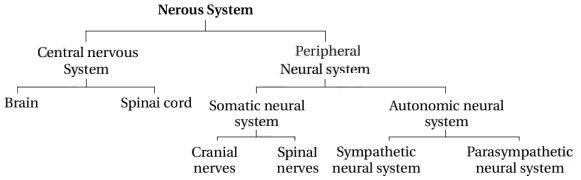
(N/A) The human neural system is divided into two main parts:
$(i)$ The Central Neural System $(CNS)$
$(ii)$ The Peripheral Neural System $(PNS)$
$(1)$ The $CNS$ includes the brain and the spinal cord. It is the site of information processing and control.
$(2)$ The $PNS$ comprises all the nerves of the body associated with the $CNS$ (brain and spinal cord). The nerve fibres of the $PNS$ are of two types:
$(a)$ Afferent nerve fibres: These transmit impulses from tissues/organs to the $CNS$.
$(b)$ Efferent nerve fibres: These transmit regulatory impulses from the $CNS$ to the peripheral tissues/organs.
The $PNS$ is further divided into two subdivisions:
$(i)$ Somatic Neural System: This relays impulses from the $CNS$ to skeletal muscles.
$(ii)$ Autonomic Neural System: This transmits impulses from the $CNS$ to involuntary organs and smooth muscles of the body. The autonomic neural system is further classified into the Sympathetic Neural System and the Parasympathetic Neural System.
Additionally,the Visceral Nervous System is a part of the peripheral nervous system that comprises the whole complex of nerves,fibres,ganglia,and plexuses by which impulses travel from the $CNS$ to the viscera and from the viscera to the $CNS$.
$(i)$ The Central Neural System $(CNS)$
$(ii)$ The Peripheral Neural System $(PNS)$
$(1)$ The $CNS$ includes the brain and the spinal cord. It is the site of information processing and control.
$(2)$ The $PNS$ comprises all the nerves of the body associated with the $CNS$ (brain and spinal cord). The nerve fibres of the $PNS$ are of two types:
$(a)$ Afferent nerve fibres: These transmit impulses from tissues/organs to the $CNS$.
$(b)$ Efferent nerve fibres: These transmit regulatory impulses from the $CNS$ to the peripheral tissues/organs.
The $PNS$ is further divided into two subdivisions:
$(i)$ Somatic Neural System: This relays impulses from the $CNS$ to skeletal muscles.
$(ii)$ Autonomic Neural System: This transmits impulses from the $CNS$ to involuntary organs and smooth muscles of the body. The autonomic neural system is further classified into the Sympathetic Neural System and the Parasympathetic Neural System.
Additionally,the Visceral Nervous System is a part of the peripheral nervous system that comprises the whole complex of nerves,fibres,ganglia,and plexuses by which impulses travel from the $CNS$ to the viscera and from the viscera to the $CNS$.
0 likes
View Solution43
Easy
Differentiate between the invertebrate neural system and the vertebrate neural system.
Solution
(N/A)
| Invertebrate Neural System | Vertebrate Neural System |
|---|---|
| $1$. The most primitive neural system is observed in $Hydra$, which is in the form of a nerve net. | $1$. The structural and functional unit of the neural system is the neuron. |
| $2$. It is highly developed in insects, consisting of ganglia and brain-like structures. | $2$. It is organized into a Central Neural System $(CNS)$ and a Peripheral Neural System $(PNS)$. |
0 likes
View Solution44
Easy
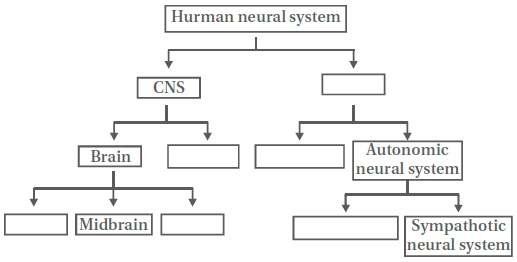
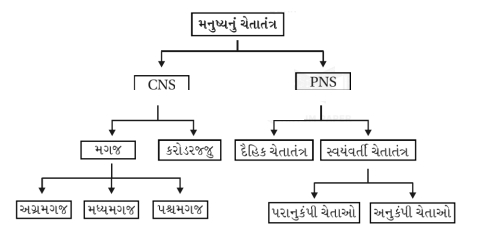
The major parts of the human neural system are depicted below. Fill in the empty boxes with appropriate words.
Solution
(N/A) The human neural system is divided into two main parts: the Central Neural System $(CNS)$ and the Peripheral Neural System $(PNS)$.
$1$. The $CNS$ consists of the brain and the spinal cord.
$2$. The $PNS$ is further divided into the somatic neural system and the autonomic neural system.
$3$. The brain is divided into the forebrain,midbrain,and hindbrain.
$4$. The autonomic neural system is further classified into the sympathetic neural system and the parasympathetic neural system.
Following the hierarchy:
- The box next to $CNS$ is $PNS$.
- Under $CNS$,the box next to Brain is Spinal cord.
- Under $PNS$,the box next to Autonomic neural system is Somatic neural system.
- Under Brain,the boxes are Forebrain,Midbrain,and Hindbrain.
- Under Autonomic neural system,the box next to Sympathetic neural system is Parasympathetic neural system.
$1$. The $CNS$ consists of the brain and the spinal cord.
$2$. The $PNS$ is further divided into the somatic neural system and the autonomic neural system.
$3$. The brain is divided into the forebrain,midbrain,and hindbrain.
$4$. The autonomic neural system is further classified into the sympathetic neural system and the parasympathetic neural system.
Following the hierarchy:
- The box next to $CNS$ is $PNS$.
- Under $CNS$,the box next to Brain is Spinal cord.
- Under $PNS$,the box next to Autonomic neural system is Somatic neural system.
- Under Brain,the boxes are Forebrain,Midbrain,and Hindbrain.
- Under Autonomic neural system,the box next to Sympathetic neural system is Parasympathetic neural system.
0 likes
View Solution45
Medium
Select the correct option:
$(1)$ The cell body contains typical cell organelles and Nissl's granules / neurotransmitters.
$(2)$ The nervous system of Hydra is composed of a nerve net / ganglia.
$(1)$ The cell body contains typical cell organelles and Nissl's granules / neurotransmitters.
$(2)$ The nervous system of Hydra is composed of a nerve net / ganglia.
Solution
(A) $(1)$ The cell body (cyton) contains typical cell organelles and Nissl's granules. Nissl's granules are rough endoplasmic reticulum with ribosomes,which are sites of protein synthesis.
$(2)$ The nervous system of Hydra is composed of a nerve net. It is a primitive type of nervous system consisting of a network of neurons spread throughout the body,lacking a centralized brain or ganglia.
$(2)$ The nervous system of Hydra is composed of a nerve net. It is a primitive type of nervous system consisting of a network of neurons spread throughout the body,lacking a centralized brain or ganglia.
0 likes
View Solution46
EasyMCQ
What is included in the $PNS$?
A
Only $CNS$
B
Afferent and Efferent nerve fibers
C
Only brain and spinal cord
D
Only autonomic nervous system
Solution
(B) The $PNS$ (Peripheral Nervous System) consists of all the nerves of the body associated with the $CNS$ (Central Nervous System) comprising the brain and the spinal cord.
It includes two types of nerve fibers:
$(a)$ Afferent nerve fibers: These transmit impulses from tissues/organs to the $CNS$.
$(b)$ Efferent nerve fibers: These transmit regulatory impulses from the $CNS$ to the concerned peripheral tissues/organs.
It includes two types of nerve fibers:
$(a)$ Afferent nerve fibers: These transmit impulses from tissues/organs to the $CNS$.
$(b)$ Efferent nerve fibers: These transmit regulatory impulses from the $CNS$ to the concerned peripheral tissues/organs.
0 likes
View Solution47
EasyMCQ
Which are the two parts of the $PNS$?
A
Somatic and Autonomic neural systems
B
Central and Peripheral neural systems
C
Sympathetic and Parasympathetic neural systems
D
Brain and Spinal cord
Solution
(A) The $PNS$ (Peripheral Neural System) is divided into two main divisions: the Somatic Neural System and the Autonomic Neural System.
$1$. The Somatic Neural System relays impulses from the $CNS$ to skeletal muscles.
$2$. The Autonomic Neural System transmits impulses from the $CNS$ to involuntary organs and smooth muscles of the body.
$1$. The Somatic Neural System relays impulses from the $CNS$ to skeletal muscles.
$2$. The Autonomic Neural System transmits impulses from the $CNS$ to involuntary organs and smooth muscles of the body.
0 likes
View Solution48
EasyMCQ
What is the visceral nervous system?
A
$A$ part of the central nervous system.
B
$A$ part of the peripheral nervous system that connects the $CNS$ to internal organs.
C
$A$ system exclusively for voluntary muscle control.
D
$A$ system that only controls the brain.
Solution
(B) The visceral nervous system is a component of the peripheral nervous system $(PNS)$.
It facilitates the transmission of nerve impulses through nerves,ganglia,and plexuses (nerve networks).
It acts as a communication pathway between the central nervous system $(CNS)$ and the internal organs (viscera).
It consists of the entire complex of nerves and plexuses that regulate involuntary functions of the internal organs.
It facilitates the transmission of nerve impulses through nerves,ganglia,and plexuses (nerve networks).
It acts as a communication pathway between the central nervous system $(CNS)$ and the internal organs (viscera).
It consists of the entire complex of nerves and plexuses that regulate involuntary functions of the internal organs.
0 likes
View Solution49
EasyMCQ
Which system in mammals develops from the ectoderm?
A
Reproductive system
B
Muscular system
C
Nervous system
D
All of the above
Solution
(C) In mammals,the three primary germ layers are the ectoderm,mesoderm,and endoderm.
$1$. The ectoderm gives rise to the nervous system,epidermis of the skin,hair,nails,and sensory organs.
$2$. The mesoderm gives rise to the muscular system,skeletal system,circulatory system,and reproductive system.
$3$. The endoderm gives rise to the lining of the digestive tract and respiratory system.
Therefore,the nervous system is derived from the ectoderm.
$1$. The ectoderm gives rise to the nervous system,epidermis of the skin,hair,nails,and sensory organs.
$2$. The mesoderm gives rise to the muscular system,skeletal system,circulatory system,and reproductive system.
$3$. The endoderm gives rise to the lining of the digestive tract and respiratory system.
Therefore,the nervous system is derived from the ectoderm.
0 likes
View Solution50
MediumMCQ
Skeletal muscles are controlled by
A
Sympathetic nervous system
B
Parasympathetic nervous system
C
Somatic nervous system
D
Sympathetic and parasympathetic both
Solution
(C) The nervous system is divided into the central nervous system and the peripheral nervous system.
The peripheral nervous system is further divided into the somatic nervous system and the autonomic nervous system.
The somatic nervous system is responsible for relaying information from the central nervous system to the skeletal muscles,thereby controlling voluntary movements.
Therefore,skeletal muscles are under the control of the somatic nervous system.
The peripheral nervous system is further divided into the somatic nervous system and the autonomic nervous system.
The somatic nervous system is responsible for relaying information from the central nervous system to the skeletal muscles,thereby controlling voluntary movements.
Therefore,skeletal muscles are under the control of the somatic nervous system.
0 likes
View SolutionNeural Control and Coordination — Human Neural System · Frequently Asked Questions
1Are these Neural Control and Coordination questions useful for JEE and NEET?
Yes. All questions in this section are mapped to JEE Main and NEET exam patterns. Previous year questions from JEE Main, NEET, GUJCET and state-level exams are included with full solutions.
2Can I switch to Hindi or Gujarati for these questions?
Yes. Use the language tabs in the hero section or the sidebar to view the same questions and solutions in English, Hindi or Gujarati.
3How do I generate a question paper from this subtopic?
Use the Vedclass Exam Paper Generator — select the chapter and subtopic, set difficulty, and generate Sets A, B, C, D automatically. First 3 chapters of every subject are free.
Vedclass Products
For Students
Vedclass Test Series
Mock tests in real JEE/NEET style with performance analysis. 5-day free trial.
Start Free TrialFor Teachers
Exam Paper Generator
Generate Set A/B/C/D papers from this chapter in 2 minutes. 3 chapters free.
Try FreeFor Institutes
Online Exam Module
Live online exams with unlimited students, 360° analytics & white-label branding.
See DemoFor Teachers & Institutes
Generate a Neural Control and Coordination Exam Paper in 2 Minutes
Select subtopic & difficulty — Sets A, B, C, D auto-generated with No Repeat logic.
First 3 chapters of every subject are free — no payment required.