
A English
Ear Questions in English
Class 11 Biology · Neural Control and Coordination · Ear
222+
Questions
English
Language
100%
With Solutions
Showing 22 of 222 questions in English
201
EasyMCQ
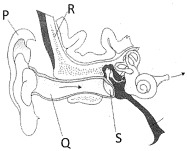
The following figure shows a diagrammatic view of the human ear. Which part represents the external ear?
A
$P$
B
$P$ and $Q$
C
$P, Q$ and $R$
D
$P, Q, R$ and $S$
Solution
(B) The human ear is anatomically divided into three main parts: the external ear,the middle ear,and the inner ear.
$1$. The external ear consists of the pinna $(P)$ and the external auditory meatus $(Q)$.
$2$. The middle ear consists of the tympanic membrane $(S)$ and the ear ossicles.
$3$. The inner ear consists of the labyrinth,which includes the cochlea and vestibular apparatus.
Therefore,the external ear is represented by $P$ (pinna) and $Q$ (external auditory meatus).
$1$. The external ear consists of the pinna $(P)$ and the external auditory meatus $(Q)$.
$2$. The middle ear consists of the tympanic membrane $(S)$ and the ear ossicles.
$3$. The inner ear consists of the labyrinth,which includes the cochlea and vestibular apparatus.
Therefore,the external ear is represented by $P$ (pinna) and $Q$ (external auditory meatus).
0 likes
View Solution202
EasyMCQ
The fluid-filled inner part of the ear is called the .........
A
Middle ear
B
Outer ear
C
Inner ear
D
All of the above
Solution
(C) The human ear is divided into three sections: the outer ear,the middle ear,and the inner ear. The inner ear,also known as the labyrinth,consists of a system of fluid-filled cavities. It contains the cochlea and the vestibular apparatus,which are filled with fluids called perilymph and endolymph. Therefore,the fluid-filled part of the ear is the inner ear.
0 likes
View Solution203
MediumMCQ
$.....P.....$ ends at the oval window,while $.....Q.....$ ends at the round window,which opens to the middle ear.
$\quad\quad\quad P\quad\quad \quad Q$
$\quad\quad\quad P\quad\quad \quad Q$
A
Scala tympani $\quad$ $\quad$ Scala vestibuli
B
Scala vestibuli $\quad$ $\quad$ Scala tympani
C
Scala vestibuli $\quad$ $\quad$ Scala media
D
Scala media $\quad$ $\quad$ Scala vestibuli
Solution
(B) The cochlea of the human ear consists of three fluid-filled chambers: the $Scala$ $vestibuli$,$Scala$ $media$,and $Scala$ $tympani$.
$1$. The $Scala$ $vestibuli$ begins at the oval window and extends to the apex of the cochlea.
$2$. The $Scala$ $tympani$ extends from the apex of the cochlea and terminates at the round window,which connects to the middle ear.
Therefore,$P$ is $Scala$ $vestibuli$ and $Q$ is $Scala$ $tympani$.
$1$. The $Scala$ $vestibuli$ begins at the oval window and extends to the apex of the cochlea.
$2$. The $Scala$ $tympani$ extends from the apex of the cochlea and terminates at the round window,which connects to the middle ear.
Therefore,$P$ is $Scala$ $vestibuli$ and $Q$ is $Scala$ $tympani$.
0 likes
View Solution204
MediumMCQ
$P$ is a continuous tubular structure. Inside these tubes, $Q$ is arranged.
$\quad\quad\quad P \quad\quad\quad Q$
$(A)$ $Scala \text{ vestibuli} \quad$ $Scala \text{ media}$
$(B)$ $Scala \text{ media} \quad$ $Scala \text{ tympani}$
$(C)$ $Scala \text{ tympani} \quad$ $Scala \text{ media}$
$(D)$ $Scala \text{ media} \quad$ $Scala \text{ vestibuli}$
$\quad\quad\quad P \quad\quad\quad Q$
$(A)$ $Scala \text{ vestibuli} \quad$ $Scala \text{ media}$
$(B)$ $Scala \text{ media} \quad$ $Scala \text{ tympani}$
$(C)$ $Scala \text{ tympani} \quad$ $Scala \text{ media}$
$(D)$ $Scala \text{ media} \quad$ $Scala \text{ vestibuli}$
A
$Scala \text{ vestibuli} \quad$ $Scala \text{ media}$
B
$Scala \text{ media} \quad$ $Scala \text{ tympani}$
C
$Scala \text{ tympani} \quad$ $Scala \text{ media}$
D
$Scala \text{ media} \quad$ $Scala \text{ vestibuli}$
Solution
(A) The cochlea is a coiled structure of the inner ear.
It consists of three fluid-filled chambers: $Scala \text{ vestibuli}$, $Scala \text{ media}$, and $Scala \text{ tympani}$.
$Scala \text{ media}$ is the central duct containing endolymph, while $Scala \text{ vestibuli}$ and $Scala \text{ tympani}$ contain perilymph.
In the context of the structure of the cochlea, the $Scala \text{ media}$ is located between the $Scala \text{ vestibuli}$ and $Scala \text{ tympani}$.
Therefore, the correct relationship is that the $Scala \text{ media}$ is the tubular structure containing the organ of Corti, and it is positioned between the other two.
It consists of three fluid-filled chambers: $Scala \text{ vestibuli}$, $Scala \text{ media}$, and $Scala \text{ tympani}$.
$Scala \text{ media}$ is the central duct containing endolymph, while $Scala \text{ vestibuli}$ and $Scala \text{ tympani}$ contain perilymph.
In the context of the structure of the cochlea, the $Scala \text{ media}$ is located between the $Scala \text{ vestibuli}$ and $Scala \text{ tympani}$.
Therefore, the correct relationship is that the $Scala \text{ media}$ is the tubular structure containing the organ of Corti, and it is positioned between the other two.
0 likes
View Solution205
MediumMCQ
Select the incorrect option regarding the hair cells present in the inner ear.
A
These cells are arranged in rows on the internal side of the Organ of Corti.
B
The basal end of the hair cell is in close contact with the afferent nerve fibers.
C
Projections emerge from the apical part of each hair cell,which are called stereocilia.
D
They act as auditory receptors.
Solution
(A) The Organ of Corti contains hair cells that act as auditory receptors.
$1$. These hair cells are present in rows on the internal side of the Organ of Corti.
$2$. The basal end of the hair cell is in close contact with the afferent nerve fibers.
$3$. $A$ large number of processes called stereocilia are projected from the apical part of each hair cell.
$4$. Above the rows of the hair cells is a thin elastic membrane called the tectorial membrane.
Option $A$ is incorrect because the hair cells are arranged on the internal side of the Organ of Corti,but the statement implies a restricted arrangement that is often described as being present on the basilar membrane,and the specific phrasing in some contexts regarding their exact row position can be misleading; however,in standard biology,the most accurate description is that they are present on the basilar membrane.
$1$. These hair cells are present in rows on the internal side of the Organ of Corti.
$2$. The basal end of the hair cell is in close contact with the afferent nerve fibers.
$3$. $A$ large number of processes called stereocilia are projected from the apical part of each hair cell.
$4$. Above the rows of the hair cells is a thin elastic membrane called the tectorial membrane.
Option $A$ is incorrect because the hair cells are arranged on the internal side of the Organ of Corti,but the statement implies a restricted arrangement that is often described as being present on the basilar membrane,and the specific phrasing in some contexts regarding their exact row position can be misleading; however,in standard biology,the most accurate description is that they are present on the basilar membrane.
0 likes
View Solution206
EasyMCQ
$A$ thin elastic membrane is present above the rows of hair cells,which is called ......
A
Tectorial membrane
B
Basilar membrane
C
Reissner's membrane
D
Malpighian membrane
Solution
(A) The organ of Corti is a structure located on the basilar membrane which contains hair cells that act as auditory receptors. The hair cells are present in rows on the internal side of the organ of Corti. $A$ thin elastic membrane called the $Tectorial$ $membrane$ is present above the rows of hair cells. Therefore,the correct option is $A$.
0 likes
View Solution207
EasyMCQ
The organ of Corti is situated on the .......
A
Tectorial membrane
B
Basilar membrane
C
Reissner's membrane
D
Malpighian membrane
Solution
(B) The organ of Corti is a structure located in the cochlea of the inner ear.
It rests on the basilar membrane.
It contains hair cells that act as auditory receptors.
When sound waves cause vibrations in the basilar membrane,the hair cells are pushed against the tectorial membrane,which leads to the generation of nerve impulses.
It rests on the basilar membrane.
It contains hair cells that act as auditory receptors.
When sound waves cause vibrations in the basilar membrane,the hair cells are pushed against the tectorial membrane,which leads to the generation of nerve impulses.
0 likes
View Solution208
MediumMCQ
Structures filled with perilymph - $P$
Structures filled with endolymph - $Q$
$I -$ Scala vestibuli,$II -$ Scala tympani,$III -$ Scala media
Select the correct option for $P$ and $Q$.
$P \quad\quad Q$
Structures filled with endolymph - $Q$
$I -$ Scala vestibuli,$II -$ Scala tympani,$III -$ Scala media
Select the correct option for $P$ and $Q$.
$P \quad\quad Q$
A
$I, III \quad\quad II$
B
$III \quad\quad I, II$
C
$I, II \quad\quad III$
D
$II \quad\quad I, III$
Solution
(C) The inner ear contains the cochlea,which is divided into three fluid-filled chambers:
$1$. Scala vestibuli: Filled with perilymph $(P)$.
$2$. Scala tympani: Filled with perilymph $(P)$.
$3$. Scala media: Filled with endolymph $(Q)$.
Therefore,$P$ includes Scala vestibuli $(I)$ and Scala tympani $(II)$,while $Q$ includes Scala media $(III)$.
Thus,the correct option is $C$.
$1$. Scala vestibuli: Filled with perilymph $(P)$.
$2$. Scala tympani: Filled with perilymph $(P)$.
$3$. Scala media: Filled with endolymph $(Q)$.
Therefore,$P$ includes Scala vestibuli $(I)$ and Scala tympani $(II)$,while $Q$ includes Scala media $(III)$.
Thus,the correct option is $C$.
0 likes
View Solution209
EasyMCQ
Reissner's membrane separates $ \text{scala vestibuli} $ and $ \text{scala media} $.
A
Scala vestibuli and scala media
B
Scala vestibuli and scala tympani
C
Scala media and scala tympani
D
All of the above
Solution
(A) The cochlea is divided into three fluid-filled chambers: the $ \text{scala vestibuli} $, $ \text{scala media} $, and $ \text{scala tympani} $.
Reissner's membrane (also known as the vestibular membrane) separates the $ \text{scala vestibuli} $ from the $ \text{scala media} $.
Conversely, the basilar membrane separates the $ \text{scala media} $ from the $ \text{scala tympani} $.
Reissner's membrane (also known as the vestibular membrane) separates the $ \text{scala vestibuli} $ from the $ \text{scala media} $.
Conversely, the basilar membrane separates the $ \text{scala media} $ from the $ \text{scala tympani} $.
0 likes
View Solution210
EasyMCQ
The basilar membrane separates .......... .
A
Scala vestibuli and scala media
B
Scala vestibuli and scala tympani
C
Scala media and scala tympani
D
All of the above
Solution
(C) The cochlea is divided into three fluid-filled chambers: the $Scala$ $vestibuli$,$Scala$ $media$,and $Scala$ $tympani$.
$1$. The $Reissner's$ membrane separates the $Scala$ $vestibuli$ from the $Scala$ $media$.
$2$. The $Basilar$ membrane separates the $Scala$ $media$ from the $Scala$ $tympani$.
Therefore,the correct option is $C$.
$1$. The $Reissner's$ membrane separates the $Scala$ $vestibuli$ from the $Scala$ $media$.
$2$. The $Basilar$ membrane separates the $Scala$ $media$ from the $Scala$ $tympani$.
Therefore,the correct option is $C$.
0 likes
View Solution211
EasyMCQ
Select the correct option for the vestibular apparatus.
A
It is located above the cochlea.
B
The vestibular apparatus is composed of three semicircular canals and the otolith organ consisting of the saccule and utricle.
C
It is a part of the inner ear.
D
All of the above.
Solution
(D) The vestibular apparatus is a complex sensory system located in the inner ear,situated above the cochlea.
It is composed of two main parts: the three semicircular canals and the otolith organ (which includes the saccule and the utricle).
These structures are responsible for maintaining the balance of the body and posture.
Therefore,all the given statements are correct.
It is composed of two main parts: the three semicircular canals and the otolith organ (which includes the saccule and the utricle).
These structures are responsible for maintaining the balance of the body and posture.
Therefore,all the given statements are correct.
0 likes
View Solution212
EasyMCQ
The saccule and utricle contain a projecting ridge,which is called the ....
A
Crista
B
Ampulla
C
Macula
D
Vestibule
Solution
(C) The vestibular apparatus is composed of the semicircular canals and the otolith organ (consisting of the saccule and utricle).
Inside the saccule and utricle,there is a projecting ridge known as the $Macula$.
The $Macula$ is the sensory receptor responsible for maintaining balance and posture by detecting linear acceleration and the position of the head relative to gravity.
Inside the saccule and utricle,there is a projecting ridge known as the $Macula$.
The $Macula$ is the sensory receptor responsible for maintaining balance and posture by detecting linear acceleration and the position of the head relative to gravity.
0 likes
View Solution213
MediumMCQ
Select the incorrect option regarding the semicircular canals.
A
The bony canals are embedded in the perilymph of the membranous canals.
B
Each semicircular canal lies in a different plane at right angles to each other.
C
The base of the canal is swollen and is called the ampulla.
D
The ampulla contains a projecting ridge called crista ampullaris,which has hair cells.
Solution
(A) The correct answer is $A$.
In the inner ear,the bony labyrinth consists of channels that contain a fluid called perilymph.
Inside the bony labyrinth lies the membranous labyrinth,which is filled with endolymph.
Therefore,the statement that 'bony canals are embedded in the perilymph of the membranous canals' is incorrect; rather,the membranous canals are suspended in the perilymph of the bony canals.
Each of the three semicircular canals is arranged at right angles to each other in different planes.
The base of each canal is swollen,known as the ampulla.
Inside the ampulla,there is a projecting ridge called the crista ampullaris,which contains sensory hair cells responsible for maintaining dynamic equilibrium.
In the inner ear,the bony labyrinth consists of channels that contain a fluid called perilymph.
Inside the bony labyrinth lies the membranous labyrinth,which is filled with endolymph.
Therefore,the statement that 'bony canals are embedded in the perilymph of the membranous canals' is incorrect; rather,the membranous canals are suspended in the perilymph of the bony canals.
Each of the three semicircular canals is arranged at right angles to each other in different planes.
The base of each canal is swollen,known as the ampulla.
Inside the ampulla,there is a projecting ridge called the crista ampullaris,which contains sensory hair cells responsible for maintaining dynamic equilibrium.
0 likes
View Solution214
MediumMCQ
Select the correct sequence for the mechanism of hearing.
$I -$ Sound waves,$II -$ Oval window,$III -$ Hair cells press against the tectorial membrane,$IV -$ Auditory cortex,$V -$ Auditory nerve,$VI -$ Waves in lymph,$VII -$ Tympanic membrane,$VIII -$ Movement in basilar membrane,$IX -$ Ear ossicles,$X -$ Generation of nerve impulses.
$I -$ Sound waves,$II -$ Oval window,$III -$ Hair cells press against the tectorial membrane,$IV -$ Auditory cortex,$V -$ Auditory nerve,$VI -$ Waves in lymph,$VII -$ Tympanic membrane,$VIII -$ Movement in basilar membrane,$IX -$ Ear ossicles,$X -$ Generation of nerve impulses.
A
$I \rightarrow VII \rightarrow IX \rightarrow II \rightarrow VIII \rightarrow VI \rightarrow III \rightarrow V \rightarrow X \rightarrow IV$
B
$I \rightarrow IX \rightarrow VII \rightarrow II \rightarrow VI \rightarrow VIII \rightarrow X \rightarrow III \rightarrow V \rightarrow IV$
C
$I \rightarrow VII \rightarrow IX \rightarrow II \rightarrow VI \rightarrow VIII \rightarrow III \rightarrow X \rightarrow V \rightarrow IV$
D
$I \rightarrow VII \rightarrow II \rightarrow IX \rightarrow VIII \rightarrow VI \rightarrow X \rightarrow III \rightarrow V \rightarrow IV$
Solution
(C) The mechanism of hearing follows this sequence:
$1$. Sound waves $(I)$ enter the ear canal and strike the tympanic membrane $(VII)$.
$2$. The vibrations are transmitted through the ear ossicles $(IX)$ to the oval window $(II)$.
$3$. The oval window transmits vibrations to the fluid in the cochlea,creating waves in the lymph $(VI)$.
$4$. These waves cause movement in the basilar membrane $(VIII)$.
$5$. This movement causes the hair cells to press against the tectorial membrane $(III)$.
$6$. This mechanical stimulation leads to the generation of nerve impulses $(X)$.
$7$. These impulses are transmitted via the auditory nerve $(V)$ to the auditory cortex $(IV)$ of the brain for processing.
Thus,the correct sequence is $I \rightarrow VII \rightarrow IX \rightarrow II \rightarrow VI \rightarrow VIII \rightarrow III \rightarrow X \rightarrow V \rightarrow IV$.
$1$. Sound waves $(I)$ enter the ear canal and strike the tympanic membrane $(VII)$.
$2$. The vibrations are transmitted through the ear ossicles $(IX)$ to the oval window $(II)$.
$3$. The oval window transmits vibrations to the fluid in the cochlea,creating waves in the lymph $(VI)$.
$4$. These waves cause movement in the basilar membrane $(VIII)$.
$5$. This movement causes the hair cells to press against the tectorial membrane $(III)$.
$6$. This mechanical stimulation leads to the generation of nerve impulses $(X)$.
$7$. These impulses are transmitted via the auditory nerve $(V)$ to the auditory cortex $(IV)$ of the brain for processing.
Thus,the correct sequence is $I \rightarrow VII \rightarrow IX \rightarrow II \rightarrow VI \rightarrow VIII \rightarrow III \rightarrow X \rightarrow V \rightarrow IV$.
0 likes
View Solution215
EasyMCQ
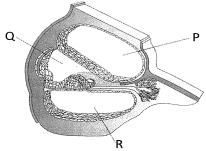
The following figure shows a cross-section of the cochlea. Identify the canals labeled $P$,$Q$,and $R$.
A
$P$: Scala tympani,$Q$: Scala media,$R$: Scala vestibuli
B
$P$: Scala vestibuli,$Q$: Scala media,$R$: Scala tympani
C
$P$: Scala media,$Q$: Scala vestibuli,$R$: Scala tympani
D
$P$: Scala media,$Q$: Scala tympani,$R$: Scala vestibuli
Solution
(B) The cochlea is a coiled structure of the inner ear. $A$ cross-section of the cochlea reveals three fluid-filled chambers or canals:
$1$. The upper chamber is the $Scala$ $vestibuli$ (labeled $P$ in the diagram).
$2$. The middle chamber is the $Scala$ $media$ (labeled $Q$ in the diagram),which contains the organ of Corti.
$3$. The lower chamber is the $Scala$ $tympani$ (labeled $R$ in the diagram).
Therefore,the correct sequence is $P$: $Scala$ $vestibuli$,$Q$: $Scala$ $media$,$R$: $Scala$ $tympani$.
$1$. The upper chamber is the $Scala$ $vestibuli$ (labeled $P$ in the diagram).
$2$. The middle chamber is the $Scala$ $media$ (labeled $Q$ in the diagram),which contains the organ of Corti.
$3$. The lower chamber is the $Scala$ $tympani$ (labeled $R$ in the diagram).
Therefore,the correct sequence is $P$: $Scala$ $vestibuli$,$Q$: $Scala$ $media$,$R$: $Scala$ $tympani$.
0 likes
View Solution216
DifficultMCQ
The ear is an organ of $...........$ as well as $...........$ in frog $:-$
A
Touch,Taste
B
Vision,Hearing
C
Hearing,Balancing
D
Smell,Touch
Solution
(C) In frogs,the ear is a sense organ that performs two primary functions: hearing and balancing (equilibrium).
It consists of an internal ear and a tympanum (eardrum) which receives sound vibrations.
Therefore,the ear acts as an organ of hearing and balancing.
It consists of an internal ear and a tympanum (eardrum) which receives sound vibrations.
Therefore,the ear acts as an organ of hearing and balancing.
0 likes
View Solution217
EasyMCQ
Select the correct statement from the following with reference to the human ear.
A
Organ of Corti rests on the tectorial membrane.
B
The scala media is filled with perilymph.
C
Organ of Corti acts as a transducer.
D
The sensory spot of the vestibule is called Crista.
Solution
(C) The correct statement is that the Organ of Corti acts as a transducer.
$1$. The Organ of Corti rests on the basilar membrane,not the tectorial membrane.
$2$. The scala media is filled with endolymph,not perilymph.
$3$. The Organ of Corti contains hair cells that convert mechanical vibrations into nerve impulses,thus acting as a transducer.
$4$. The sensory spot of the vestibule is called the macula,while the sensory spot of the semicircular canals is called the crista.
$1$. The Organ of Corti rests on the basilar membrane,not the tectorial membrane.
$2$. The scala media is filled with endolymph,not perilymph.
$3$. The Organ of Corti contains hair cells that convert mechanical vibrations into nerve impulses,thus acting as a transducer.
$4$. The sensory spot of the vestibule is called the macula,while the sensory spot of the semicircular canals is called the crista.
0 likes
View Solution218
EasyMCQ
Read the following statements regarding the structure of the human ear and select the correct option.
Statement $I$: The tympanic membrane is covered with mucous membrane on the inner side,to the surface of which is attached the $1^{\text{st}}$ ear ossicle,namely the incus.
Statement $II$: Scala vestibuli and scala tympani are filled with perilymph and form a part of the cochlea.
Statement $I$: The tympanic membrane is covered with mucous membrane on the inner side,to the surface of which is attached the $1^{\text{st}}$ ear ossicle,namely the incus.
Statement $II$: Scala vestibuli and scala tympani are filled with perilymph and form a part of the cochlea.
A
Both statement $I$ and statement $II$ are correct.
B
Both statement $I$ and statement $II$ are incorrect.
C
Statement $I$ is correct but statement $II$ is incorrect.
D
Statement $I$ is incorrect but statement $II$ is correct.
Solution
(D) Statement $I$ is incorrect because the tympanic membrane is attached to the $1^{\text{st}}$ ear ossicle,which is the malleus,not the incus. The incus is the $2^{\text{nd}}$ ear ossicle.
Statement $II$ is correct because the cochlea consists of three fluid-filled chambers: scala vestibuli,scala media,and scala tympani. The scala vestibuli and scala tympani are filled with perilymph.
Statement $II$ is correct because the cochlea consists of three fluid-filled chambers: scala vestibuli,scala media,and scala tympani. The scala vestibuli and scala tympani are filled with perilymph.
0 likes
View Solution219
EasyMCQ
Minute particles made up of $CaCO_3$ and protein present in the internal ear are called . . . . . . .
A
stereocilia
B
Crista
C
otoconia
D
organ of Corti
Solution
(C) The internal ear contains specialized structures called the macula,which are found in the utricle and saccule.
These structures contain minute,calcium carbonate $(CaCO_3)$ crystals embedded in a gelatinous matrix,known as otoconia or otoliths.
These particles play a crucial role in maintaining balance and detecting linear acceleration and gravity.
Therefore,the correct term for these particles is otoconia.
These structures contain minute,calcium carbonate $(CaCO_3)$ crystals embedded in a gelatinous matrix,known as otoconia or otoliths.
These particles play a crucial role in maintaining balance and detecting linear acceleration and gravity.
Therefore,the correct term for these particles is otoconia.
0 likes
View Solution220
EasyMCQ
The $Scala \text{ } tympani$ of the membranous labyrinth ends at $A$, which opens into $B$. Identify $A$ and $B$ and select the correct option.
A
$A - \text{Oval window}, B - \text{pharynx}$
B
$A - \text{Round window}, B - \text{middle ear}$
C
$A - \text{Round window}, B - \text{external auditory meatus}$
D
$A - \text{Oval window}, B - \text{middle ear}$
Solution
(B) The inner ear consists of a bony labyrinth filled with perilymph and a membranous labyrinth filled with endolymph.
$Scala \text{ } vestibuli$ ends at the oval window, while the $Scala \text{ } tympani$ terminates at the round window (fenestra rotunda).
The round window is a membrane-covered opening that separates the middle ear cavity from the inner ear.
Therefore, $A$ is the round window and $B$ is the middle ear.
$Scala \text{ } vestibuli$ ends at the oval window, while the $Scala \text{ } tympani$ terminates at the round window (fenestra rotunda).
The round window is a membrane-covered opening that separates the middle ear cavity from the inner ear.
Therefore, $A$ is the round window and $B$ is the middle ear.
0 likes
View Solution221
EasyMCQ
Organ of Corti is located on the . . . . . . .
A
Basilar membrane
B
Basement membrane
C
Reissner membrane
D
Synovial membrane
Solution
(A) The Organ of Corti is a structure located within the cochlea of the inner ear.
It rests on the basilar membrane.
It contains hair cells that act as auditory receptors.
When sound vibrations cause the basilar membrane to move,the hair cells are stimulated against the tectorial membrane,converting mechanical energy into nerve impulses.
It rests on the basilar membrane.
It contains hair cells that act as auditory receptors.
When sound vibrations cause the basilar membrane to move,the hair cells are stimulated against the tectorial membrane,converting mechanical energy into nerve impulses.
0 likes
View Solution222
EasyMCQ
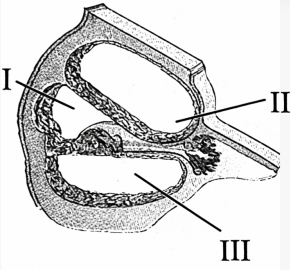
Select the $CORRECT$ identification group of labelled parts $I, II, III$.
A
$I$ - Scala vestibuli, $II$ - Scala media, $III$ - Scala tympani
B
$I$ - Scala vestibuli, $II$ - Scala tympani, $III$ - Scala media
C
$I$ - Scala tympani, $II$ - Scala media, $III$ - Scala vestibuli
D
$I$ - Scala media, $II$ - Scala tympani, $III$ - Scala media
Solution
(A) The provided image represents a cross-section of the cochlea.
In the structure of the cochlea, the three fluid-filled chambers are arranged as follows:
$1$. The upper chamber is the $Scala \text{ vestibuli}$.
$2$. The middle chamber, which contains the organ of Corti, is the $Scala \text{ media}$.
$3$. The lower chamber is the $Scala \text{ tympani}$.
Looking at the labels in the diagram:
- Label $I$ points to the upper chamber, which is the $Scala \text{ vestibuli}$.
- Label $II$ points to the middle chamber, which is the $Scala \text{ media}$.
- Label $III$ points to the lower chamber, which is the $Scala \text{ tympani}$.
Therefore, the correct identification is $I$ - $Scala \text{ vestibuli}$, $II$ - $Scala \text{ media}$, $III$ - $Scala \text{ tympani}$.
In the structure of the cochlea, the three fluid-filled chambers are arranged as follows:
$1$. The upper chamber is the $Scala \text{ vestibuli}$.
$2$. The middle chamber, which contains the organ of Corti, is the $Scala \text{ media}$.
$3$. The lower chamber is the $Scala \text{ tympani}$.
Looking at the labels in the diagram:
- Label $I$ points to the upper chamber, which is the $Scala \text{ vestibuli}$.
- Label $II$ points to the middle chamber, which is the $Scala \text{ media}$.
- Label $III$ points to the lower chamber, which is the $Scala \text{ tympani}$.
Therefore, the correct identification is $I$ - $Scala \text{ vestibuli}$, $II$ - $Scala \text{ media}$, $III$ - $Scala \text{ tympani}$.
0 likes
View SolutionNeural Control and Coordination — Ear · Frequently Asked Questions
1Are these Neural Control and Coordination questions useful for JEE and NEET?
Yes. All questions in this section are mapped to JEE Main and NEET exam patterns. Previous year questions from JEE Main, NEET, GUJCET and state-level exams are included with full solutions.
2Can I switch to Hindi or Gujarati for these questions?
Yes. Use the language tabs in the hero section or the sidebar to view the same questions and solutions in English, Hindi or Gujarati.
3How do I generate a question paper from this subtopic?
Use the Vedclass Exam Paper Generator — select the chapter and subtopic, set difficulty, and generate Sets A, B, C, D automatically. First 3 chapters of every subject are free.
Vedclass Products
For Students
Vedclass Test Series
Mock tests in real JEE/NEET style with performance analysis. 5-day free trial.
Start Free TrialFor Teachers
Exam Paper Generator
Generate Set A/B/C/D papers from this chapter in 2 minutes. 3 chapters free.
Try FreeFor Institutes
Online Exam Module
Live online exams with unlimited students, 360° analytics & white-label branding.
See DemoFor Teachers & Institutes
Generate a Neural Control and Coordination Exam Paper in 2 Minutes
Select subtopic & difficulty — Sets A, B, C, D auto-generated with No Repeat logic.
First 3 chapters of every subject are free — no payment required.