
A English
Ear Questions in English
Class 11 Biology · Neural Control and Coordination · Ear
222+
Questions
English
Language
100%
With Solutions
Showing 50 of 222 questions in English
151
MediumMCQ
Arrange the following in the order of reception and transmission of sound wave from the ear drum. Cochlear nerve,External auditory canal,ear drum,stapes,incus,malleus,cochlea.
A
External auditory canal $\rightarrow$ ear drum $\rightarrow$ malleus $\rightarrow$ incus $\rightarrow$ stapes $\rightarrow$ cochlea $\rightarrow$ cochlear nerve
B
External auditory canal $\rightarrow$ ear drum $\rightarrow$ incus $\rightarrow$ malleus $\rightarrow$ stapes $\rightarrow$ cochlea $\rightarrow$ cochlear nerve
C
External auditory canal $\rightarrow$ ear drum $\rightarrow$ malleus $\rightarrow$ stapes $\rightarrow$ incus $\rightarrow$ cochlea $\rightarrow$ cochlear nerve
D
External auditory canal $\rightarrow$ ear drum $\rightarrow$ stapes $\rightarrow$ incus $\rightarrow$ malleus $\rightarrow$ cochlea $\rightarrow$ cochlear nerve
Solution
(A) The transmission of sound waves through the ear follows a specific pathway:
$1$. Sound waves enter through the External auditory canal.
$2$. They strike the ear drum (tympanic membrane),causing it to vibrate.
$3$. These vibrations are transmitted to the ear ossicles in the order: Malleus $\rightarrow$ Incus $\rightarrow$ Stapes.
$4$. The stapes transmits the vibrations to the oval window of the cochlea.
$5$. Inside the cochlea,the vibrations are converted into electrical impulses.
$6$. These impulses are transmitted to the brain via the Cochlear nerve.
Therefore,the correct sequence is: External auditory canal $\rightarrow$ ear drum $\rightarrow$ malleus $\rightarrow$ incus $\rightarrow$ stapes $\rightarrow$ cochlea $\rightarrow$ cochlear nerve.
$1$. Sound waves enter through the External auditory canal.
$2$. They strike the ear drum (tympanic membrane),causing it to vibrate.
$3$. These vibrations are transmitted to the ear ossicles in the order: Malleus $\rightarrow$ Incus $\rightarrow$ Stapes.
$4$. The stapes transmits the vibrations to the oval window of the cochlea.
$5$. Inside the cochlea,the vibrations are converted into electrical impulses.
$6$. These impulses are transmitted to the brain via the Cochlear nerve.
Therefore,the correct sequence is: External auditory canal $\rightarrow$ ear drum $\rightarrow$ malleus $\rightarrow$ incus $\rightarrow$ stapes $\rightarrow$ cochlea $\rightarrow$ cochlear nerve.
0 likes
View Solution152
MediumMCQ
Which sensory organ is involved in vertigo (sensation of one self or objects spinning around)?
A
Eye
B
Ear
C
Nose
D
Skin
Solution
(B) Vertigo is a sensation of spinning or dizziness,often caused by problems with the inner ear.
The inner ear contains the vestibular apparatus,which is responsible for maintaining body balance and posture.
The vestibular apparatus consists of the semicircular canals and the otolith organs (utriculus and sacculus).
Any disturbance in these structures or the fluid within them (endolymph) can lead to a loss of balance and the sensation of vertigo.
The inner ear contains the vestibular apparatus,which is responsible for maintaining body balance and posture.
The vestibular apparatus consists of the semicircular canals and the otolith organs (utriculus and sacculus).
Any disturbance in these structures or the fluid within them (endolymph) can lead to a loss of balance and the sensation of vertigo.
0 likes
View Solution153
MediumMCQ
While travelling at a higher altitude,a person complains of dizziness and vomiting sensation. Which part of the inner ear is disturbed during the journey?
A
Cochlea
B
Vestibular apparatus
C
Organ of Corti
D
Tympanic membrane
Solution
(B) The inner ear consists of two main functional parts: the cochlea,which is responsible for hearing,and the vestibular apparatus,which is responsible for maintaining the balance of the body and posture.
During travel,especially at higher altitudes or on winding roads,the vestibular apparatus (comprising the semicircular canals and the otolith organs,i.e.,the saccule and utricle) gets disturbed due to rapid changes in motion and orientation.
This disturbance leads to symptoms like dizziness,nausea,and vomiting,commonly known as motion sickness.
Therefore,the correct option is $B$.
During travel,especially at higher altitudes or on winding roads,the vestibular apparatus (comprising the semicircular canals and the otolith organs,i.e.,the saccule and utricle) gets disturbed due to rapid changes in motion and orientation.
This disturbance leads to symptoms like dizziness,nausea,and vomiting,commonly known as motion sickness.
Therefore,the correct option is $B$.
0 likes
View Solution154
MediumMCQ
What is the function of the Eustachian tube?
A
To protect the inner ear from loud sounds.
B
To equalize the pressure on either side of the eardrum.
C
To transmit sound vibrations to the inner ear.
D
To produce earwax for cleaning the ear canal.
Solution
(B) The Eustachian tube connects the middle ear cavity with the pharynx.
Its primary function is to equalize the air pressure on both sides of the tympanic membrane (eardrum).
This equalization is essential for the proper vibration of the eardrum and the effective transmission of sound waves to the inner ear.
Its primary function is to equalize the air pressure on both sides of the tympanic membrane (eardrum).
This equalization is essential for the proper vibration of the eardrum and the effective transmission of sound waves to the inner ear.
0 likes
View Solution155
Medium
Explain the structure of the middle and internal ear with the help of a diagram.
Solution
(N/A) The ear is divided into three parts: the outer ear,the middle ear,and the inner ear.
$1$. Middle Ear: The middle ear contains three ossicles called malleus,incus,and stapes (collectively known as ear ossicles). These are attached to one another in a chain-like fashion. The malleus is attached to the tympanic membrane and the stapes is attached to the oval window of the cochlea. The ear ossicles increase the efficiency of transmission of sound waves to the inner ear. An Eustachian tube connects the middle ear cavity with the pharynx,which helps in equalizing the pressures on either side of the ear drum.
$2$. Internal Ear: The fluid-filled inner ear is called the labyrinth,which consists of two parts: the bony labyrinth and the membranous labyrinth. The bony labyrinth is a series of channels. Inside these channels lies the membranous labyrinth,which is surrounded by a fluid called perilymph and filled with a fluid called endolymph. The coiled portion of the labyrinth is called the cochlea. The membranes constituting the cochlea,the Reissner's and basilar,divide the surrounding perilymph-filled bony labyrinth into an upper scala vestibuli and a lower scala tympani. The space within the cochlea called scala media is filled with endolymph. At the base of the cochlea,the scala vestibuli ends at the oval window,while the scala tympani terminates at the round window which opens to the middle ear.
$1$. Middle Ear: The middle ear contains three ossicles called malleus,incus,and stapes (collectively known as ear ossicles). These are attached to one another in a chain-like fashion. The malleus is attached to the tympanic membrane and the stapes is attached to the oval window of the cochlea. The ear ossicles increase the efficiency of transmission of sound waves to the inner ear. An Eustachian tube connects the middle ear cavity with the pharynx,which helps in equalizing the pressures on either side of the ear drum.
$2$. Internal Ear: The fluid-filled inner ear is called the labyrinth,which consists of two parts: the bony labyrinth and the membranous labyrinth. The bony labyrinth is a series of channels. Inside these channels lies the membranous labyrinth,which is surrounded by a fluid called perilymph and filled with a fluid called endolymph. The coiled portion of the labyrinth is called the cochlea. The membranes constituting the cochlea,the Reissner's and basilar,divide the surrounding perilymph-filled bony labyrinth into an upper scala vestibuli and a lower scala tympani. The space within the cochlea called scala media is filled with endolymph. At the base of the cochlea,the scala vestibuli ends at the oval window,while the scala tympani terminates at the round window which opens to the middle ear.
0 likes
View Solution156
Medium
Analogy type question:
$(1)$ Inner ear : Vestibular apparatus :: Cochlea : .........
$(2)$ Organ of Corti : Hair cells :: Tectorial membrane : ........
$(1)$ Inner ear : Vestibular apparatus :: Cochlea : .........
$(2)$ Organ of Corti : Hair cells :: Tectorial membrane : ........
Solution
(A) $(1)$ The vestibular apparatus is a part of the inner ear. Similarly,the cochlea is the part of the inner ear that contains the organ of Corti,which consists of three fluid-filled chambers: the scala vestibuli,scala media,and scala tympani.
$(2)$ The organ of Corti contains hair cells that act as auditory receptors. The tectorial membrane is a thin,elastic membrane that lies above the hair cells and plays a crucial role in the transduction of sound waves into nerve impulses.
$(2)$ The organ of Corti contains hair cells that act as auditory receptors. The tectorial membrane is a thin,elastic membrane that lies above the hair cells and plays a crucial role in the transduction of sound waves into nerve impulses.
0 likes
View Solution157
Medium
Analogy type question:
$(1)$ Malleus of middle ear : Attached to tympanic membrane :: Stapes : .......
$(2)$ In the retina of the eye : Blind spot :: Lateral to the blind spot : ......
$(1)$ Malleus of middle ear : Attached to tympanic membrane :: Stapes : .......
$(2)$ In the retina of the eye : Blind spot :: Lateral to the blind spot : ......
Solution
(A) $(1)$ The stapes is attached to the oval window (fenestra ovalis).
$(2)$ The macula lutea (fovea centralis) is located lateral to the blind spot.
$(2)$ The macula lutea (fovea centralis) is located lateral to the blind spot.
0 likes
View Solution158
EasyMCQ
Match the following columns and select the correct option.
| Column-$I$ | Column-$II$ |
| $(a)$ Organ of Corti | $(i)$ Connects middle ear and pharynx |
| $(b)$ Cochlea | $(ii)$ Coiled part of the labyrinth |
| $(c)$ Eustachian tube | $(iii)$ Attached to the oval window |
| $(d)$ Stapes | $(iv)$ Located on the basilar membrane |
A
$(i), (ii), (iv), (iii)$
B
$(ii), (iii), (i), (iv)$
C
$(iii), (i), (iv), (ii)$
D
$(iv), (ii), (i), (iii)$
Solution
(D) The correct matches are as follows:
$(a)$ Organ of Corti is located on the basilar membrane $(iv)$.
$(b)$ Cochlea is the coiled part of the labyrinth $(ii)$.
$(c)$ Eustachian tube connects the middle ear and the pharynx $(i)$.
$(d)$ Stapes is the ear ossicle attached to the oval window $(iii)$.
Therefore,the correct sequence is $(a)-(iv), (b)-(ii), (c)-(i), (d)-(iii)$.
$(a)$ Organ of Corti is located on the basilar membrane $(iv)$.
$(b)$ Cochlea is the coiled part of the labyrinth $(ii)$.
$(c)$ Eustachian tube connects the middle ear and the pharynx $(i)$.
$(d)$ Stapes is the ear ossicle attached to the oval window $(iii)$.
Therefore,the correct sequence is $(a)-(iv), (b)-(ii), (c)-(i), (d)-(iii)$.
0 likes
View Solution159
MediumMCQ
Match the columns and select the correct option:
$(a)\quad (b)\quad (c)\quad (d)$
| $(a)$ Organ of Corti | $(i)$ Connects middle ear to pharynx |
| $(b)$ Cochlea | $(ii)$ Coiled portion of the labyrinth |
| $(c)$ Eustachian tube | $(iii)$ Attached to the oval window |
| $(d)$ Stapes | $(iv)$ Located on the basilar membrane |
$(a)\quad (b)\quad (c)\quad (d)$
A
$(ii)\quad (iii)\quad (i)\quad (iv)$
B
$(iii)\quad (i)\quad (iv)\quad (ii)$
C
$(iv)\quad (ii)\quad (i)\quad (iii)$
D
$(i)\quad (ii)\quad (iv)\quad (iii)$
Solution
(C) The correct matches are as follows:
$(a)$ Organ of Corti: It is a structure located on the basilar membrane which contains hair cells that act as auditory receptors. Thus, $(a) - (iv)$.
$(b)$ Cochlea: It is the coiled portion of the labyrinth of the inner ear. Thus, $(b) - (ii)$.
$(c)$ Eustachian tube: It connects the middle ear cavity with the pharynx, which helps in equalizing the pressures on either side of the ear drum. Thus, $(c) - (i)$.
$(d)$ Stapes: It is the third ear ossicle, which is attached to the oval window of the cochlea. Thus, $(d) - (iii)$.
Therefore, the correct sequence is $(a)-(iv), (b)-(ii), (c)-(i), (d)-(iii)$.
$(a)$ Organ of Corti: It is a structure located on the basilar membrane which contains hair cells that act as auditory receptors. Thus, $(a) - (iv)$.
$(b)$ Cochlea: It is the coiled portion of the labyrinth of the inner ear. Thus, $(b) - (ii)$.
$(c)$ Eustachian tube: It connects the middle ear cavity with the pharynx, which helps in equalizing the pressures on either side of the ear drum. Thus, $(c) - (i)$.
$(d)$ Stapes: It is the third ear ossicle, which is attached to the oval window of the cochlea. Thus, $(d) - (iii)$.
Therefore, the correct sequence is $(a)-(iv), (b)-(ii), (c)-(i), (d)-(iii)$.
0 likes
View Solution160
EasyMCQ
Which maintains static equilibrium?
A
Cerebrum
B
Utricle $\&$ Saccule
C
Cerebellum
D
Semicircular canal
Solution
(B) Static equilibrium refers to the perception of the orientation of the head with respect to gravity. The macula,which is the sensory receptor located within the utricle and saccule of the inner ear,is responsible for detecting linear acceleration and the position of the head,thereby maintaining static equilibrium.
0 likes
View Solution161
MediumMCQ
The middle ear contains three tiny bones:
$I.$ Maxillae
$II.$ Malleus
$III.$ Incus
$IV.$ Stapes
$V.$ Vomer
$I.$ Maxillae
$II.$ Malleus
$III.$ Incus
$IV.$ Stapes
$V.$ Vomer
A
$I, II$ and $III$
B
$II, III$ and $IV$
C
$III, IV$ and $V$
D
$I, II$ and $V$
Solution
(B) The middle ear contains three tiny bones: $(ii)$ Malleus,$(iii)$ Incus,and $(iv)$ Stapes. These bones are collectively known as ear ossicles.
0 likes
View Solution162
MediumMCQ
From outer to inside,the sequence of three bones present in the middle ear of mammals is:
A
Malleus,stapes and incus
B
Stapes,malleus and incus
C
Malleus,incus and stapes
D
Incus,malleus and stapes
Solution
(C) The middle ear cavity in mammals characteristically contains a chain of three small bones called ear ossicles,which extend between the tympanic membrane and the fenestra ovalis.
These bones,in order from the outside to the inside,are the malleus (hammer),incus (anvil),and stapes (stirrup).
They are named based on their characteristic shapes.
These bones,in order from the outside to the inside,are the malleus (hammer),incus (anvil),and stapes (stirrup).
They are named based on their characteristic shapes.
0 likes
View Solution163
EasyMCQ
Match the following:
| Column-$I$ | Column-$II$ |
| $(a)$. Incus | $(i)$. Hammer shaped |
| $(b)$. Malleus | $(ii)$. Stirrup shaped |
| $(c)$. Stapes | $(iii)$. Anvil shaped |
A
$a(iii), b(ii), c(i)$
B
$a(ii), b(i), c(iii)$
C
$a(i), b(iii), c(ii)$
D
$a(iii), b(i), c(ii)$
Solution
(D) The middle ear contains three small bones known as ear ossicles: Malleus,Incus,and Stapes.
$1$. Malleus: It is the outermost bone and is hammer-shaped.
$2$. Incus: It is the middle bone and is anvil-shaped.
$3$. Stapes: It is the innermost bone and is stirrup-shaped.
Therefore,the correct matching is:
$(a) - (iii)$ (Incus - Anvil shaped)
$(b) - (i)$ (Malleus - Hammer shaped)
$(c) - (ii)$ (Stapes - Stirrup shaped)
Thus,the correct option is $D$.
$1$. Malleus: It is the outermost bone and is hammer-shaped.
$2$. Incus: It is the middle bone and is anvil-shaped.
$3$. Stapes: It is the innermost bone and is stirrup-shaped.
Therefore,the correct matching is:
$(a) - (iii)$ (Incus - Anvil shaped)
$(b) - (i)$ (Malleus - Hammer shaped)
$(c) - (ii)$ (Stapes - Stirrup shaped)
Thus,the correct option is $D$.
0 likes
View Solution164
EasyMCQ
Eustachian tube connects $A$ cavity with $B$. Choose the correct option for $A$ and $B$.
A
$A-$ outer ear; $B-$ pharynx
B
$A-$ inner ear; $B-$ pharynx
C
$A-$ pinna; $B-$ pharynx
D
$A-$ middle ear; $B-$ pharynx
Solution
(D) The Eustachian tube is a canal that connects the middle ear cavity to the nasopharynx.
Its primary function is to equalize the air pressure on both sides of the tympanic membrane (eardrum),which is essential for proper hearing and preventing damage to the eardrum.
Its primary function is to equalize the air pressure on both sides of the tympanic membrane (eardrum),which is essential for proper hearing and preventing damage to the eardrum.
0 likes
View Solution165
EasyMCQ
Which is thickened to form the organ of Corti?
A
Reissner's membrane
B
Basilar membrane
C
Tectorial membrane
D
All of these
Solution
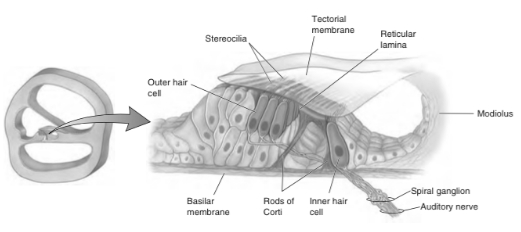
(B) The organ of Corti is a structure located on the basilar membrane.
Along its median longitudinal line,the floor of the scala media,which is the basilar membrane,is thickened inwards.
This thickened region bulges into the endolymph as a sensory ridge known as the organ of Corti,which acts as the primary organ of hearing.
Along its median longitudinal line,the floor of the scala media,which is the basilar membrane,is thickened inwards.
This thickened region bulges into the endolymph as a sensory ridge known as the organ of Corti,which acts as the primary organ of hearing.
0 likes
View Solution166
EasyMCQ
The labyrinth,a fluid-filled inner ear,consists of:
A
Bony labyrinth
B
Membranous labyrinth
C
Both $(a)$ and $(b)$
D
Ear drum
Solution
(C) The inner ear,also known as the labyrinth,consists of two main parts: the bony labyrinth and the membranous labyrinth. The bony labyrinth is a series of channels inside which lies the membranous labyrinth. These channels are filled with a fluid called perilymph,while the membranous labyrinth is filled with a fluid called endolymph. Therefore,the correct answer is both $(a)$ and $(b)$.
0 likes
View Solution167
EasyMCQ
The pressure on either sides of the ear drum is equalized by
A
Pinna
B
Eustachian tube
C
Cochlea
D
Labyrinth
Solution
(B) The $Eustachian$ \text{ tube} connects the middle ear cavity with the pharynx. Its primary function is to equalize the air pressure on both sides of the tympanic membrane (ear drum), which is essential for the proper vibration of the ear drum and effective hearing.
0 likes
View Solution168
EasyMCQ
Scala vestibuli, scala media and scala tympani of the human ear contain:
A
Perilymph, endolymph and perilymph respectively
B
Endolymph, perilymph and endolymph respectively
C
Perilymph, endolymph and endolymph respectively
D
Perilymph, haemolymph and endolymph respectively
Solution
(A) The inner ear, or labyrinth, consists of a bony labyrinth and a membranous labyrinth.
The bony labyrinth is a series of channels filled with a fluid called perilymph.
The membranous labyrinth is suspended within the bony labyrinth and is filled with a fluid called endolymph.
The cochlea is the coiled portion of the labyrinth. It is divided into three chambers by the Reissner's membrane and the basilar membrane:
$1$. The upper chamber is the $Scala \text{ } vestibuli$, which is filled with perilymph.
$2$. The middle chamber is the $Scala \text{ } media$, which is filled with endolymph.
$3$. The lower chamber is the $Scala \text{ } tympani$, which is filled with perilymph.
Therefore, the correct sequence is perilymph, endolymph, and perilymph.
The bony labyrinth is a series of channels filled with a fluid called perilymph.
The membranous labyrinth is suspended within the bony labyrinth and is filled with a fluid called endolymph.
The cochlea is the coiled portion of the labyrinth. It is divided into three chambers by the Reissner's membrane and the basilar membrane:
$1$. The upper chamber is the $Scala \text{ } vestibuli$, which is filled with perilymph.
$2$. The middle chamber is the $Scala \text{ } media$, which is filled with endolymph.
$3$. The lower chamber is the $Scala \text{ } tympani$, which is filled with perilymph.
Therefore, the correct sequence is perilymph, endolymph, and perilymph.
0 likes
View Solution169
EasyMCQ
Wax gland present in the human ear canal is called
A
Tympanic gland
B
Mucous gland
C
Ceruminous gland
D
Sweat gland
Solution
(C) The wax gland present in the human ear canal is known as the $Ceruminous$ gland.
These glands are specialized modified sweat glands located in the skin of the external auditory meatus.
They secrete a brownish,waxy,semisolid substance called cerumen (earwax).
This substance helps to lubricate the ear canal and protects the lining of the meatus from dust,foreign particles,and microorganisms.
These glands are specialized modified sweat glands located in the skin of the external auditory meatus.
They secrete a brownish,waxy,semisolid substance called cerumen (earwax).
This substance helps to lubricate the ear canal and protects the lining of the meatus from dust,foreign particles,and microorganisms.
0 likes
View Solution170
EasyMCQ
The human ear is equipped to register sounds of frequencies between
A
$20$ to $20,000$ cycles per second
B
$1000$ to $2000$ cycles per second
C
$5000$ to $7000$ cycles per second
D
$5,000$ to $10,000$ cycles per second
Solution
(A) The human ear is capable of hearing sounds within the frequency range of $20$ to $20,000$ cycles per second (or $20$ to $20,000 \text{ Hz}$).
This range is known as the audible range for humans.
Low-frequency sounds stimulate the sensory hair cells located near the apex (tip) of the cochlea.
High-frequency sounds stimulate the sensory hair cells located near the base of the cochlea,closer to the oval window.
This range is known as the audible range for humans.
Low-frequency sounds stimulate the sensory hair cells located near the apex (tip) of the cochlea.
High-frequency sounds stimulate the sensory hair cells located near the base of the cochlea,closer to the oval window.
0 likes
View Solution171
EasyMCQ
The part of the ear where sound is transduced is:
A
Tympanic membrane
B
Malleus,incus and stapes
C
Semi-circular canal
D
Cochlea
Solution
(D) The $Organ$ of $Corti$,located within the $Cochlea$ of the internal ear,is the site where sound waves are transduced into nerve impulses. These impulses are then transmitted to the brain via the $8^{th}$ cranial nerve (vestibulocochlear nerve).
0 likes
View Solution172
EasyMCQ
The vestibular apparatus of the human ear is composed of:
A
Oval window
B
Otolith organs
C
Three semicircular canals
D
Both $(b)$ and $(c)$
Solution
(D) The inner ear contains a complex system called the vestibular apparatus,located above the cochlea.
The vestibular apparatus is composed of three semicircular canals and the otolith organ,which consists of the saccule and utricle.
Each semicircular canal lies in a different plane at right angles to each other.
The membranous canals are suspended in the perilymph of the bony canals. The base of each canal is swollen and is called the ampulla,which contains a projecting ridge called the crista ampullaris,containing hair cells.
The saccule and utricle contain a projecting ridge called the macula.
The crista and macula are the specific receptors of the vestibular apparatus,which are responsible for the maintenance of the balance of the body and posture.
The vestibular apparatus is composed of three semicircular canals and the otolith organ,which consists of the saccule and utricle.
Each semicircular canal lies in a different plane at right angles to each other.
The membranous canals are suspended in the perilymph of the bony canals. The base of each canal is swollen and is called the ampulla,which contains a projecting ridge called the crista ampullaris,containing hair cells.
The saccule and utricle contain a projecting ridge called the macula.
The crista and macula are the specific receptors of the vestibular apparatus,which are responsible for the maintenance of the balance of the body and posture.
0 likes
View Solution173
EasyMCQ
The sequence of ear ossicles from outside to inside is
A
malleus $\rightarrow$ incus $\rightarrow$ stapes
B
incus $\rightarrow$ stapes $\rightarrow$ malleus
C
stapes $\rightarrow$ incus $\rightarrow$ malleus
D
malleus $\rightarrow$ stapes $\rightarrow$ incus
Solution
(A) The middle ear contains three tiny bones called ear ossicles: the malleus,incus,and stapes.
These bones are arranged in a chain-like sequence starting from the tympanic membrane (eardrum) towards the inner ear.
The outermost bone is the malleus (hammer),which is attached to the tympanic membrane.
The middle bone is the incus (anvil),which connects the malleus to the stapes.
The innermost bone is the stapes (stirrup),which is attached to the oval window of the inner ear.
Therefore,the correct sequence from outside to inside is malleus $\rightarrow$ incus $\rightarrow$ stapes.
These bones are arranged in a chain-like sequence starting from the tympanic membrane (eardrum) towards the inner ear.
The outermost bone is the malleus (hammer),which is attached to the tympanic membrane.
The middle bone is the incus (anvil),which connects the malleus to the stapes.
The innermost bone is the stapes (stirrup),which is attached to the oval window of the inner ear.
Therefore,the correct sequence from outside to inside is malleus $\rightarrow$ incus $\rightarrow$ stapes.
0 likes
View Solution174
MediumMCQ
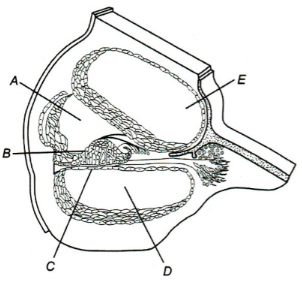
Below is the diagram of the sectional view of the cochlea of the human ear. Identify $A$ and $E$. Choose the correct option.
A
$A-$ Scala media,$B-$ Organ of Corti,$C-$ Basilar membrane,$D-$ Scala tympani,$E-$ Scala vestibuli
B
$A-$ Scala vestibuli,$B-$ Organ of Corti,$C-$ Basilar membrane,$D-$ Scala tympani,$E-$ Scala media
C
$A-$ Scala vestibuli,$B-$ Basilar membrane,$C-$ Organ of Corti,$D-$ Scala tympani,$E-$ Scala media
D
$A-$ Scala vestibuli,$B-$ Basilar membrane,$C-$ Scala tympani,$D-$ Organ of Corti,$E-$ Scala media
Solution
(B) The cochlea is the coiled portion of the labyrinth. It consists of three fluid-filled chambers separated by membranes:
$1$. The upper chamber is the $Scala$ $vestibuli$,which is labeled as $A$.
$2$. The middle chamber is the $Scala$ $media$,which is labeled as $E$.
$3$. The lower chamber is the $Scala$ $tympani$,which is labeled as $D$.
$4$. The $Organ$ $of$ $Corti$ is located on the $Basilar$ $membrane$ $(C)$ within the $Scala$ $media$,and is labeled as $B$.
Therefore,the correct identification is: $A-$ $Scala$ $vestibuli$,$B-$ $Organ$ $of$ $Corti$,$C-$ $Basilar$ $membrane$,$D-$ $Scala$ $tympani$,$E-$ $Scala$ $media$.
$1$. The upper chamber is the $Scala$ $vestibuli$,which is labeled as $A$.
$2$. The middle chamber is the $Scala$ $media$,which is labeled as $E$.
$3$. The lower chamber is the $Scala$ $tympani$,which is labeled as $D$.
$4$. The $Organ$ $of$ $Corti$ is located on the $Basilar$ $membrane$ $(C)$ within the $Scala$ $media$,and is labeled as $B$.
Therefore,the correct identification is: $A-$ $Scala$ $vestibuli$,$B-$ $Organ$ $of$ $Corti$,$C-$ $Basilar$ $membrane$,$D-$ $Scala$ $tympani$,$E-$ $Scala$ $media$.
0 likes
View Solution175
EasyMCQ
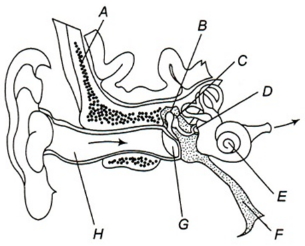
The given diagram represents the human ear. Identify the parts labeled $A$ to $H$ and choose the correct option.
A
$A-$ Temporal bone,$B-$ Malleus,$C-$ Incus,$D-$ Stapes,$E-$ Cochlea,$F-$ Eustachian tube,$G-$ Tympanic membrane,$H-$ External auditory canal
B
$A-$ Tympanic membrane,$B-$ Malleus,$C-$ Incus,$D-$ Stapes,$E-$ Cochlea,$F-$ Eustachian tube,$G-$ Temporal bone,$H-$ External auditory canal
C
$A-$ Tympanic membrane,$B-$ Incus,$C-$ Malleus,$D-$ Stapes,$E-$ Cochlea,$F-$ Eustachian tube,$G-$ Temporal bone,$H-$ External auditory canal
D
$A-$ Temporal bone,$B-$ Malleus,$C-$ Incus,$D-$ Cochlea,$E-$ Stapes,$F-$ Eustachian tube,$G-$ Tympanic membrane,$H-$ External auditory canal
Solution
(A) Based on the anatomical structure of the human ear:
$A$ points to the Temporal bone,which houses the inner ear.
$B$ is the Malleus (hammer),the first of the three ear ossicles.
$C$ is the Incus (anvil),the second ear ossicle.
$D$ is the Stapes (stirrup),the third ear ossicle.
$E$ is the Cochlea,the coiled part of the inner ear.
$F$ is the Eustachian tube,which connects the middle ear to the pharynx.
$G$ is the Tympanic membrane (eardrum),which separates the external ear from the middle ear.
$H$ is the External auditory canal (meatus),which leads sound waves to the eardrum.
Therefore,the correct labeling is $A-$ Temporal bone,$B-$ Malleus,$C-$ Incus,$D-$ Stapes,$E-$ Cochlea,$F-$ Eustachian tube,$G-$ Tympanic membrane,$H-$ External auditory canal.
$A$ points to the Temporal bone,which houses the inner ear.
$B$ is the Malleus (hammer),the first of the three ear ossicles.
$C$ is the Incus (anvil),the second ear ossicle.
$D$ is the Stapes (stirrup),the third ear ossicle.
$E$ is the Cochlea,the coiled part of the inner ear.
$F$ is the Eustachian tube,which connects the middle ear to the pharynx.
$G$ is the Tympanic membrane (eardrum),which separates the external ear from the middle ear.
$H$ is the External auditory canal (meatus),which leads sound waves to the eardrum.
Therefore,the correct labeling is $A-$ Temporal bone,$B-$ Malleus,$C-$ Incus,$D-$ Stapes,$E-$ Cochlea,$F-$ Eustachian tube,$G-$ Tympanic membrane,$H-$ External auditory canal.
0 likes
View Solution176
MediumMCQ
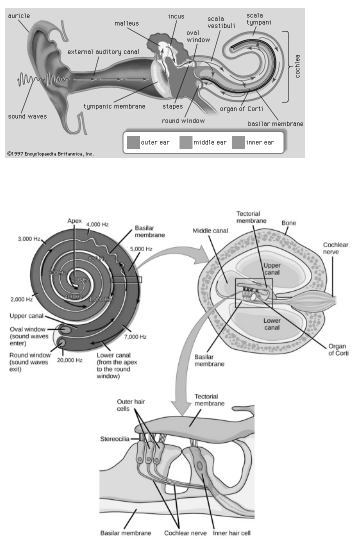
Arrange the following events in a correct order that lead to the formation of an auditory impulse in human ears from the codes given below:
$I.$ Vibration is transferred from the malleus to the incus and then to stapes
$II.$ Basilar membrane moves up and down
$III.$ Nerve impulse is transmitted by cochlear nerve to auditory cortex of brain for impulse analysis and recognition
$IV.$ Sound waves pass through ear canal
$V.$ Stereocilia of hair cells of organ of Corti rub against tectorial membrane
$VI.$ Sound waves cause ear drum to vibrate
$VII.$ Nerve impulse is generated
$VIII.$ Vibrations move from fluid of vestibular canal to the fluid of tympanic canal
$IX.$ Membrane at oval window vibrates
$I.$ Vibration is transferred from the malleus to the incus and then to stapes
$II.$ Basilar membrane moves up and down
$III.$ Nerve impulse is transmitted by cochlear nerve to auditory cortex of brain for impulse analysis and recognition
$IV.$ Sound waves pass through ear canal
$V.$ Stereocilia of hair cells of organ of Corti rub against tectorial membrane
$VI.$ Sound waves cause ear drum to vibrate
$VII.$ Nerve impulse is generated
$VIII.$ Vibrations move from fluid of vestibular canal to the fluid of tympanic canal
$IX.$ Membrane at oval window vibrates
A
$IV, VI, I, IX, VIII, II, V, VII, III$
B
$I, II, III, IV, V, VI, VII, VIII, IX$
C
$IX, VIII, VII, VI, V, IV, III, II, I$
D
$IV, VI, I, VIII, IX, II, V, VII, III$
Solution
(A) The correct sequence of events in the mechanism of hearing is as follows:
$1$. Sound waves enter the ear and pass through the ear canal $(IV)$.
$2$. Sound waves cause the ear drum (tympanic membrane) to vibrate $(VI)$.
$3$. Vibrations are transferred from the malleus to the incus and then to the stapes $(I)$.
$4$. The stapes vibrates the membrane at the oval window $(IX)$.
$5$. Vibrations are transmitted from the fluid of the vestibular canal to the fluid of the tympanic canal $(VIII)$.
$6$. This movement causes the basilar membrane to move up and down $(II)$.
$7$. As the basilar membrane moves,the stereocilia of the hair cells of the organ of Corti rub against the tectorial membrane $(V)$.
$8$. This mechanical stimulation generates a nerve impulse $(VII)$.
$9$. The nerve impulse is transmitted by the cochlear nerve to the auditory cortex of the brain for analysis and recognition $(III)$.
Thus,the correct order is $IV, VI, I, IX, VIII, II, V, VII, III$.
$1$. Sound waves enter the ear and pass through the ear canal $(IV)$.
$2$. Sound waves cause the ear drum (tympanic membrane) to vibrate $(VI)$.
$3$. Vibrations are transferred from the malleus to the incus and then to the stapes $(I)$.
$4$. The stapes vibrates the membrane at the oval window $(IX)$.
$5$. Vibrations are transmitted from the fluid of the vestibular canal to the fluid of the tympanic canal $(VIII)$.
$6$. This movement causes the basilar membrane to move up and down $(II)$.
$7$. As the basilar membrane moves,the stereocilia of the hair cells of the organ of Corti rub against the tectorial membrane $(V)$.
$8$. This mechanical stimulation generates a nerve impulse $(VII)$.
$9$. The nerve impulse is transmitted by the cochlear nerve to the auditory cortex of the brain for analysis and recognition $(III)$.
Thus,the correct order is $IV, VI, I, IX, VIII, II, V, VII, III$.
0 likes
View Solution177
EasyMCQ
The Eustachian tube connects . . . . . . with the . . . . . . .
A
External auditory canal,middle ear cavity
B
Middle ear cavity,pharynx
C
External auditory canal,labyrinth
D
Cochlea,larynx
Solution
(B) The Eustachian tube is a narrow passage that connects the middle ear cavity to the nasopharynx.
Its primary function is to equalize the air pressure on both sides of the tympanic membrane (eardrum),which is essential for proper hearing.
Its primary function is to equalize the air pressure on both sides of the tympanic membrane (eardrum),which is essential for proper hearing.
0 likes
View Solution178
MediumMCQ
Which of the following is the function of ear ossicles?
A
To collect the vibrations in the air
B
To equalise the pressures on either sides of the ear drum
C
To secrete ear wax
D
To increase the efficiency of transmission of sound waves to the inner ear
Solution
(D) The middle ear contains three tiny bones called ear ossicles: malleus,incus,and stapes.
These bones form a lever system that acts to amplify the sound vibrations.
By increasing the force of the vibrations,they increase the efficiency of transmission of sound waves from the air to the fluid-filled inner ear.
These bones form a lever system that acts to amplify the sound vibrations.
By increasing the force of the vibrations,they increase the efficiency of transmission of sound waves from the air to the fluid-filled inner ear.
0 likes
View Solution179
EasyMCQ
The membranous labyrinth is surrounded by a fluid called
A
Perilymph
B
Endolymph
C
Cerebrospinal fluid
D
Vitreous humor
Solution
(A) The inner ear consists of a bony labyrinth and a membranous labyrinth.
The bony labyrinth is a series of channels inside which lies the membranous labyrinth.
The membranous labyrinth is filled with a fluid called endolymph.
However,the space between the bony labyrinth and the membranous labyrinth is filled with a fluid called perilymph.
Therefore,the membranous labyrinth is surrounded by perilymph.
The bony labyrinth is a series of channels inside which lies the membranous labyrinth.
The membranous labyrinth is filled with a fluid called endolymph.
However,the space between the bony labyrinth and the membranous labyrinth is filled with a fluid called perilymph.
Therefore,the membranous labyrinth is surrounded by perilymph.
0 likes
View Solution180
MediumMCQ
The lower membrane of the $scala$ $vestibuli$ is the:
A
Tympanic membrane
B
Reissner's membrane
C
Basilar's membrane
D
Tectorial membrane
Solution
(B) The cochlea is divided into three fluid-filled chambers: $scala$ $vestibuli$,$scala$ $media$,and $scala$ $tympani$.
$Reissner's$ membrane separates the $scala$ $vestibuli$ from the $scala$ $media$.
The $basilar$ membrane separates the $scala$ $media$ from the $scala$ $tympani$.
Since the $scala$ $vestibuli$ is the uppermost chamber,its lower boundary is formed by the $Reissner's$ membrane (also known as the vestibular membrane).
However,in the context of the entire cochlear duct structure,the $basilar$ membrane is the primary lower membrane supporting the organ of Corti.
$Reissner's$ membrane separates the $scala$ $vestibuli$ from the $scala$ $media$.
The $basilar$ membrane separates the $scala$ $media$ from the $scala$ $tympani$.
Since the $scala$ $vestibuli$ is the uppermost chamber,its lower boundary is formed by the $Reissner's$ membrane (also known as the vestibular membrane).
However,in the context of the entire cochlear duct structure,the $basilar$ membrane is the primary lower membrane supporting the organ of Corti.
0 likes
View Solution181
EasyMCQ
The scala vestibuli ends at the . . . . . . ,while the scala tympani terminates at the . . . . . . . Find the correct option.
A
Scala media,temporal bone
B
Oval window,round window
C
Pinna,tympanic membrane
D
Eustachian tube,external auditory meatus
Solution
(B) The inner ear contains a complex structure called the cochlea,which is divided into three fluid-filled chambers: the scala vestibuli,scala media,and scala tympani.
$1$. The scala vestibuli begins at the oval window,which receives vibrations from the stapes bone of the middle ear.
$2$. The scala tympani terminates at the round window,which acts as a pressure relief valve for the fluid waves within the cochlea.
Therefore,the scala vestibuli ends at the oval window and the scala tympani terminates at the round window.
$1$. The scala vestibuli begins at the oval window,which receives vibrations from the stapes bone of the middle ear.
$2$. The scala tympani terminates at the round window,which acts as a pressure relief valve for the fluid waves within the cochlea.
Therefore,the scala vestibuli ends at the oval window and the scala tympani terminates at the round window.
0 likes
View Solution182
EasyMCQ
Which of the following act as auditory receptors in the ear?
A
Semicircular canals
B
Cristae
C
Hair cells of organ of Corti
D
Saccule and utricle
Solution
(C) The organ of Corti is a structure located on the basilar membrane of the cochlea. It contains hair cells that act as auditory receptors. These hair cells convert sound vibrations into nerve impulses.
0 likes
View Solution183
EasyMCQ
The stereocilia are projected from which part of the hair cell?
A
Basal part
B
Apical part
C
Lateral part
D
Front part
Solution
(B) Stereocilia are specialized sensory projections found on the surface of hair cells in the inner ear. These structures are projected from the apical part of the hair cells,which is the top surface facing the endolymph in the cochlear duct.
0 likes
View Solution184
EasyMCQ
The components of the vestibular apparatus are:
A
Semicircular canals and otolith organs (saccule and utricle)
B
Organ of Corti and Eustachian tube
C
Malleus,incus and stapes
D
Saccule and cochlea
Solution
(A) The vestibular apparatus is a complex sensory system located in the inner ear that helps in maintaining body balance.
It is composed of two main parts:
$1$. Three semicircular canals.
$2$. The otolith organs,which consist of the saccule and the utricle.
Therefore,the correct components are the semicircular canals and the otolith organs.
It is composed of two main parts:
$1$. Three semicircular canals.
$2$. The otolith organs,which consist of the saccule and the utricle.
Therefore,the correct components are the semicircular canals and the otolith organs.
0 likes
View Solution185
MediumMCQ
The hair cells present on the crista ampullaris receive the stimuli of
A
Audition
B
Change in the body posture
C
Vision
D
Olfaction
Solution
(B) The crista ampullaris is located within the ampulla of the semicircular canals in the inner ear. These structures contain sensory hair cells that detect rotational movements of the head. By sensing the movement of endolymph,these hair cells help the body maintain balance and detect changes in body posture.
0 likes
View Solution186
EasyMCQ
In which of the following parts of the brain are the nerve impulses of sound analyzed?
A
Visual cortex area
B
Olfactory cortex area
C
Auditory cortex area
D
Tactile cortex area
Solution
(C) The nerve impulses generated by sound are transmitted to the brain via the auditory nerve. These signals are then processed and analyzed in the auditory cortex area,which is located within the temporal lobe of the cerebral cortex.
0 likes
View Solution187
EasyMCQ
What is the function of the ear pinna?
A
To amplify sound waves
B
To collect vibrations in the air
C
To maintain body balance
D
To transmit sound to the brain
Solution
(B) The ear pinna is the visible part of the external ear. Its primary function is to collect sound waves (vibrations in the air) and direct them into the external auditory canal,which then leads to the eardrum (tympanic membrane).
0 likes
View Solution188
MediumMCQ
Where is the round window located?
A
In the middle ear cavity
B
On the inner wall of the tympanic cavity
C
At the apex of the cochlea
D
In the external auditory canal
Solution
(B) The inner wall of the middle ear (tympanic cavity) contains two membrane-covered openings: the oval window (fenestra ovalis) and the round window (fenestra rotunda).
The round window is located below the oval window and serves to dissipate the pressure waves generated in the perilymph of the cochlea by the movement of the stapes.
The round window is located below the oval window and serves to dissipate the pressure waves generated in the perilymph of the cochlea by the movement of the stapes.
0 likes
View Solution189
EasyMCQ
What are ear ossicles?
A
Bones of the inner ear
B
Bones of the middle ear
C
Bones of the outer ear
D
Cartilaginous structures of the pinna
Solution
(B) The middle ear contains three tiny bones known as ear ossicles: $Malleus$,$Incus$,and $Stapes$.
These bones are attached to one another in a chain-like fashion.
Their primary function is to amplify the sound vibrations received from the tympanic membrane before they are transmitted to the inner ear.
These bones are attached to one another in a chain-like fashion.
Their primary function is to amplify the sound vibrations received from the tympanic membrane before they are transmitted to the inner ear.
0 likes
View Solution190
EasyMCQ
Which parts are included in the labyrinth?
A
Bony labyrinth and membranous labyrinth
B
Cochlea and semicircular canals
C
Utricle and saccule
D
Malleus,incus,and stapes
Solution
(A) The internal ear,also known as the labyrinth,consists of two main parts:
$1$. The bony labyrinth: $A$ series of channels filled with a fluid called perilymph.
$2$. The membranous labyrinth: $A$ series of sacs and ducts located inside the bony labyrinth,filled with a fluid called endolymph.
$1$. The bony labyrinth: $A$ series of channels filled with a fluid called perilymph.
$2$. The membranous labyrinth: $A$ series of sacs and ducts located inside the bony labyrinth,filled with a fluid called endolymph.
0 likes
View Solution191
EasyMCQ
What is the function of the organ of Corti?
A
To maintain body balance
B
To act as auditory receptors
C
To regulate pressure in the middle ear
D
To transmit sound waves to the eardrum
Solution
(B) The organ of Corti is a structure located on the Basilar membrane within the cochlea of the inner ear. It contains specialized hair cells that act as auditory receptors. When sound waves cause vibrations in the Basilar membrane,these hair cells bend,generating nerve impulses that are transmitted to the brain via the auditory nerve,allowing us to perceive sound.
0 likes
View Solution192
Easy
What is the tectorial membrane?
Solution
(N/A) The tectorial membrane is a thin,elastic,gelatinous structure that overlies the hair cells of the organ of Corti in the inner ear. It plays a crucial role in the process of hearing by interacting with the stereocilia of the hair cells when sound vibrations cause the basilar membrane to move.
0 likes
View Solution193
Medium
Write short notes on the following:
$(a)$ Ear ossicles
$(b)$ Cochlea
$(c)$ Organ of Corti
$(d)$ Synapse
$(a)$ Ear ossicles
$(b)$ Cochlea
$(c)$ Organ of Corti
$(d)$ Synapse
Solution
(N/A) Ear ossicles: The middle ear contains three tiny bones called malleus,incus,and stapes,collectively known as ear ossicles. They are attached to one another in a chain-like fashion and increase the efficiency of transmission of sound waves to the inner ear.
$(b)$ Cochlea: The cochlea is the coiled portion of the labyrinth of the inner ear. It is filled with fluid and contains the sensory receptors for hearing.
$(c)$ Organ of Corti: It is a structure located on the basilar membrane of the cochlea. It contains hair cells that act as auditory receptors. The hair cells press against the tectorial membrane when sound waves cause vibrations in the basilar membrane,generating nerve impulses.
$(d)$ Synapse: $A$ synapse is a junction between two neurons. It is formed by the membranes of a pre-synaptic neuron and a post-synaptic neuron,which may or may not be separated by a gap called the synaptic cleft. It allows the transmission of nerve impulses from one neuron to another via chemical or electrical signals.
$(b)$ Cochlea: The cochlea is the coiled portion of the labyrinth of the inner ear. It is filled with fluid and contains the sensory receptors for hearing.
$(c)$ Organ of Corti: It is a structure located on the basilar membrane of the cochlea. It contains hair cells that act as auditory receptors. The hair cells press against the tectorial membrane when sound waves cause vibrations in the basilar membrane,generating nerve impulses.
$(d)$ Synapse: $A$ synapse is a junction between two neurons. It is formed by the membranes of a pre-synaptic neuron and a post-synaptic neuron,which may or may not be separated by a gap called the synaptic cleft. It allows the transmission of nerve impulses from one neuron to another via chemical or electrical signals.
0 likes
View Solution194
MediumMCQ
Which of the following sensory organs is responsible for maintaining the balance of a frog's body?
A
Skin
B
Eye
C
Nose
D
Ear
Solution
(D) In frogs,the ear $(ear)$ acts as a dual-purpose organ. It is responsible for both hearing and maintaining the balance of the body $(equilibrium)$. The internal ear contains structures that detect changes in position and movement,which helps the frog maintain its posture and balance.
0 likes
View Solution195
MediumMCQ
What are the functions of the ear?
$I -$ Hearing
$II -$ Analysis of impulses
$III -$ Body balance
$IV -$ Olfaction
$I -$ Hearing
$II -$ Analysis of impulses
$III -$ Body balance
$IV -$ Olfaction
A
$I$
B
$I, II, III, IV$
C
$I, III$
D
$I, IV$
Solution
(C) The human ear performs two primary sensory functions:
$1$. Hearing: The external,middle,and inner ear (cochlea) work together to convert sound waves into nerve impulses,which are then interpreted by the brain.
$2$. Body Balance: The vestibular apparatus,located in the inner ear,consists of the semicircular canals and the otolith organs (utricle and saccule),which are responsible for maintaining the balance and posture of the body.
Analysis of impulses $(II)$ is a function of the brain,and olfaction $(IV)$ is the function of the nose. Therefore,the correct functions are $I$ and $III$.
$1$. Hearing: The external,middle,and inner ear (cochlea) work together to convert sound waves into nerve impulses,which are then interpreted by the brain.
$2$. Body Balance: The vestibular apparatus,located in the inner ear,consists of the semicircular canals and the otolith organs (utricle and saccule),which are responsible for maintaining the balance and posture of the body.
Analysis of impulses $(II)$ is a function of the brain,and olfaction $(IV)$ is the function of the nose. Therefore,the correct functions are $I$ and $III$.
0 likes
View Solution196
EasyMCQ
The ear is mainly divided into three parts in terms of .........
A
External structure
B
Internal structure
C
Tissue structure
D
All of the above
Solution
(B) The human ear is anatomically divided into three main sections based on its external and internal structural organization:
$1$. The Outer Ear $(External \text{ } Ear)$: Includes the pinna and the external auditory meatus.
$2$. The Middle Ear $(Middle \text{ } Ear)$: Contains the ossicles $(malleus, \text{ } incus, \text{ } stapes)$.
$3$. The Inner Ear $(Inner \text{ } Ear)$: Contains the cochlea and vestibular apparatus.
Therefore, the ear is divided into three parts based on its internal structure and anatomical organization.
$1$. The Outer Ear $(External \text{ } Ear)$: Includes the pinna and the external auditory meatus.
$2$. The Middle Ear $(Middle \text{ } Ear)$: Contains the ossicles $(malleus, \text{ } incus, \text{ } stapes)$.
$3$. The Inner Ear $(Inner \text{ } Ear)$: Contains the cochlea and vestibular apparatus.
Therefore, the ear is divided into three parts based on its internal structure and anatomical organization.
0 likes
View Solution197
EasyMCQ
Identify the correct sequence of ear ossicles from the outer ear to the inner ear.
A
Malleus $\rightarrow$ Stapes $\rightarrow$ Incus
B
Incus $\rightarrow$ Stapes $\rightarrow$ Malleus
C
Stapes $\rightarrow$ Incus $\rightarrow$ Malleus
D
Malleus $\rightarrow$ Incus $\rightarrow$ Stapes
Solution
(D) The middle ear contains three tiny bones known as ear ossicles: the Malleus (hammer),Incus (anvil),and Stapes (stirrup).
These bones are arranged in a specific sequence to transmit sound vibrations from the tympanic membrane (eardrum) to the inner ear.
The sequence from the outer ear towards the inner ear is: Malleus $\rightarrow$ Incus $\rightarrow$ Stapes.
Therefore,the correct option is $D$.
These bones are arranged in a specific sequence to transmit sound vibrations from the tympanic membrane (eardrum) to the inner ear.
The sequence from the outer ear towards the inner ear is: Malleus $\rightarrow$ Incus $\rightarrow$ Stapes.
Therefore,the correct option is $D$.
0 likes
View Solution198
EasyMCQ
The external ear consists of $..........$
A
Pinna $+$ Eustachian tube
B
Pinna
C
Pinna $+$ External auditory meatus
D
Pinna $+$ External auditory meatus $+$ Ear ossicles
Solution
(C) The human ear is anatomically divided into three parts: the external ear,the middle ear,and the inner ear.
The external ear consists of the pinna (auricle) and the external auditory meatus (ear canal).
The pinna collects the vibrations in the air which produce sound.
The external auditory meatus leads inwards and extends up to the tympanic membrane (the ear drum).
Therefore,the correct composition of the external ear is Pinna $+$ External auditory meatus.
The external ear consists of the pinna (auricle) and the external auditory meatus (ear canal).
The pinna collects the vibrations in the air which produce sound.
The external auditory meatus leads inwards and extends up to the tympanic membrane (the ear drum).
Therefore,the correct composition of the external ear is Pinna $+$ External auditory meatus.
0 likes
View Solution199
EasyMCQ
Choose the correct option for the tympanic membrane.
A
Composed of connective tissue,covered with skin on the outside and mucous membrane on the inside.
B
Composed of muscle tissue,covered with skin on the outside and mucous membrane on the inside.
C
Composed of connective tissue,covered with mucous membrane on the outside and skin on the inside.
D
Composed of muscle tissue,covered with mucous membrane on the outside and skin on the inside.
Solution
(A) The tympanic membrane (eardrum) is a thin,semi-transparent,cone-shaped membrane that separates the external ear from the middle ear.
It is composed of connective tissue.
The outer surface of the tympanic membrane is covered by skin,while the inner surface is lined by a mucous membrane.
It is composed of connective tissue.
The outer surface of the tympanic membrane is covered by skin,while the inner surface is lined by a mucous membrane.
0 likes
View Solution200
MediumMCQ
Select the incorrect statement from the following.
A
The Eustachian tube connects the middle ear cavity with the pharynx.
B
The Eustachian tube helps in equalizing the pressures on either side of the eardrum.
C
The pinna collects the vibrations in the air which produce sound.
D
The skin of the pinna and the meatus contains very fine hairs and wax-secreting sebaceous glands.
Solution
(D) The correct answer is $D$.
Statement $A$ is correct: The Eustachian tube connects the middle ear cavity with the pharynx.
Statement $B$ is correct: It helps in equalizing the pressure on both sides of the tympanic membrane (eardrum).
Statement $C$ is correct: The pinna collects the vibrations in the air which produce sound.
Statement $D$ is incorrect: The skin of the external auditory meatus (not the pinna) contains very fine hairs and wax-secreting sebaceous glands (ceruminous glands). The pinna is the external cartilaginous flap.
Statement $A$ is correct: The Eustachian tube connects the middle ear cavity with the pharynx.
Statement $B$ is correct: It helps in equalizing the pressure on both sides of the tympanic membrane (eardrum).
Statement $C$ is correct: The pinna collects the vibrations in the air which produce sound.
Statement $D$ is incorrect: The skin of the external auditory meatus (not the pinna) contains very fine hairs and wax-secreting sebaceous glands (ceruminous glands). The pinna is the external cartilaginous flap.
0 likes
View SolutionNeural Control and Coordination — Ear · Frequently Asked Questions
1Are these Neural Control and Coordination questions useful for JEE and NEET?
Yes. All questions in this section are mapped to JEE Main and NEET exam patterns. Previous year questions from JEE Main, NEET, GUJCET and state-level exams are included with full solutions.
2Can I switch to Hindi or Gujarati for these questions?
Yes. Use the language tabs in the hero section or the sidebar to view the same questions and solutions in English, Hindi or Gujarati.
3How do I generate a question paper from this subtopic?
Use the Vedclass Exam Paper Generator — select the chapter and subtopic, set difficulty, and generate Sets A, B, C, D automatically. First 3 chapters of every subject are free.
Vedclass Products
For Students
Vedclass Test Series
Mock tests in real JEE/NEET style with performance analysis. 5-day free trial.
Start Free TrialFor Teachers
Exam Paper Generator
Generate Set A/B/C/D papers from this chapter in 2 minutes. 3 chapters free.
Try FreeFor Institutes
Online Exam Module
Live online exams with unlimited students, 360° analytics & white-label branding.
See DemoFor Teachers & Institutes
Generate a Neural Control and Coordination Exam Paper in 2 Minutes
Select subtopic & difficulty — Sets A, B, C, D auto-generated with No Repeat logic.
First 3 chapters of every subject are free — no payment required.