
A English
Ear Questions in English
Class 11 Biology · Neural Control and Coordination · Ear
222+
Questions
English
Language
100%
With Solutions
Showing 50 of 222 questions in English
101
MediumMCQ
What is the primary function of the semicircular canals of the inner ear?
A
Balance and hearing
B
To maintain high-frequency sound vibrations
C
To maintain dynamic equilibrium of the body
D
To transmit sound vibrations to the auditory nerve
Solution
(C) The inner ear contains a complex system called the vestibular apparatus,which is located above the cochlea. The vestibular apparatus is composed of three semicircular canals and the otolith organ (consisting of the saccule and utricle). The primary function of the semicircular canals is to maintain the dynamic equilibrium of the body by detecting rotational movements of the head. Each canal is filled with endolymph and contains a sensory structure called the crista ampullaris,which responds to changes in the position of the head.
0 likes
View Solution102
EasyMCQ
The cochlea is primarily responsible for:
A
Balance only
B
Hearing only
C
Both balance and hearing
D
Color recognition
Solution
(B) The human ear is divided into three parts: the outer ear,the middle ear,and the inner ear.
The inner ear contains a complex system called the labyrinth,which consists of two main parts: the bony labyrinth and the membranous labyrinth.
The bony labyrinth is a series of channels,inside which lies the membranous labyrinth.
The cochlea is the coiled portion of the labyrinth,which is the main hearing organ.
It contains the organ of Corti,which converts sound vibrations into nerve impulses.
In contrast,the vestibular apparatus (consisting of semicircular canals and the otolith organ) is responsible for maintaining body balance.
Therefore,the cochlea is primarily responsible for hearing.
The inner ear contains a complex system called the labyrinth,which consists of two main parts: the bony labyrinth and the membranous labyrinth.
The bony labyrinth is a series of channels,inside which lies the membranous labyrinth.
The cochlea is the coiled portion of the labyrinth,which is the main hearing organ.
It contains the organ of Corti,which converts sound vibrations into nerve impulses.
In contrast,the vestibular apparatus (consisting of semicircular canals and the otolith organ) is responsible for maintaining body balance.
Therefore,the cochlea is primarily responsible for hearing.
0 likes
View Solution103
EasyMCQ
The passage connecting the middle ear to the pharynx is called ....
A
Cochlear duct
B
Eustachian tube
C
Tympanic duct
D
Pharyngotympanic tube
Solution
(B) The middle ear is connected to the pharynx by a tube known as the Eustachian tube (also called the pharyngotympanic tube).
Its primary function is to equalize the air pressure on both sides of the tympanic membrane (eardrum),which is essential for proper hearing.
Its primary function is to equalize the air pressure on both sides of the tympanic membrane (eardrum),which is essential for proper hearing.
0 likes
View Solution104
EasyMCQ
The ear ossicles in the middle ear, from outside to inside, are:
A
Stapes, Incus, Malleus
B
Malleus, Incus, Stapes
C
Incus, Stapes, Malleus
D
Malleus, Stapes, Incus
Solution
(B) The middle ear contains three tiny bones known as ear ossicles. These are the Malleus (hammer), Incus (anvil), and Stapes (stirrup).
They are arranged in a chain starting from the tympanic membrane (eardrum) towards the inner ear.
The sequence from outside to inside is $Malleus \rightarrow Incus \rightarrow Stapes$.
They are arranged in a chain starting from the tympanic membrane (eardrum) towards the inner ear.
The sequence from outside to inside is $Malleus \rightarrow Incus \rightarrow Stapes$.
0 likes
View Solution105
EasyMCQ
Which cranial nerve helps in maintaining the balance of the body?
A
Oculomotor nerve
B
Abducens nerve
C
Vestibulocochlear nerve
D
Facial nerve
Solution
(C) The $VIII^{th}$ cranial nerve is known as the Vestibulocochlear nerve. It consists of two branches: the vestibular nerve,which is responsible for maintaining body balance and equilibrium,and the cochlear nerve,which is responsible for hearing. Therefore,the Vestibulocochlear nerve is the correct answer.
0 likes
View Solution106
EasyMCQ
The pharynx and the middle ear are connected to each other by the .........
A
Tympanic membrane
B
Eustachian tube
C
Cochlear duct
D
Auditory nerve
Solution
(B) The $Eustachian$ $tube$ (also known as the pharyngotympanic tube) is a canal that connects the middle ear to the nasopharynx. Its primary function is to equalize the air pressure on both sides of the tympanic membrane,which is essential for proper hearing and preventing damage to the ear.
0 likes
View Solution107
EasyMCQ
The cochlea of the mammalian ear is associated with:
A
Balance of the body
B
Hearing
C
Maintenance of atmospheric pressure
D
Both $(A)$ and $(B)$
Solution
(B) The mammalian ear consists of three parts: the outer ear,the middle ear,and the inner ear.
The inner ear contains a complex system called the bony labyrinth,which includes the cochlea and the vestibular apparatus.
The cochlea is a coiled structure that contains the organ of Corti,which is the primary receptor for hearing.
The vestibular apparatus (consisting of semicircular canals and the otolith organ) is responsible for the maintenance of body balance.
Therefore,the cochlea is specifically associated with the sense of hearing.
The inner ear contains a complex system called the bony labyrinth,which includes the cochlea and the vestibular apparatus.
The cochlea is a coiled structure that contains the organ of Corti,which is the primary receptor for hearing.
The vestibular apparatus (consisting of semicircular canals and the otolith organ) is responsible for the maintenance of body balance.
Therefore,the cochlea is specifically associated with the sense of hearing.
0 likes
View Solution108
MediumMCQ
Which of the following structures is $NOT$ associated with body balance?
A
Malleus
B
Crista
C
Organ of Corti
D
Ampulla
Solution
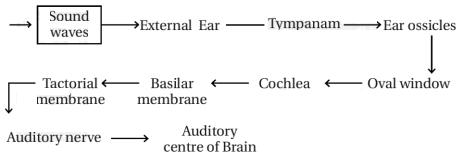
(C) The human ear is divided into three parts: the outer ear,the middle ear,and the inner ear.
$1$. The $Malleus$ is an ear ossicle located in the middle ear,primarily involved in the transmission of sound vibrations.
$2$. The $Crista$ and $Ampulla$ are structures found in the semicircular canals of the inner ear,which are responsible for dynamic balance.
$3$. The $Organ$ of $Corti$ is located in the cochlea of the inner ear and is primarily responsible for hearing,not body balance.
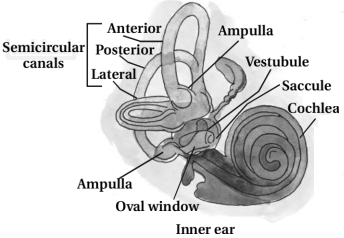
Therefore,the $Organ$ of $Corti$ is not associated with body balance.
$1$. The $Malleus$ is an ear ossicle located in the middle ear,primarily involved in the transmission of sound vibrations.
$2$. The $Crista$ and $Ampulla$ are structures found in the semicircular canals of the inner ear,which are responsible for dynamic balance.
$3$. The $Organ$ of $Corti$ is located in the cochlea of the inner ear and is primarily responsible for hearing,not body balance.
Therefore,the $Organ$ of $Corti$ is not associated with body balance.
0 likes
View Solution109
EasyMCQ
The Organ of Corti is a modification of the:
A
Tectorial membrane
B
Reissner's membrane
C
Basilar membrane
D
Meissner's membrane
Solution
(C) The Organ of Corti is a structure located within the cochlea of the inner ear. It rests on the $Basilar membrane$. It contains hair cells that act as auditory receptors. When sound waves cause vibrations in the $Basilar membrane$, the hair cells are pushed against the $Tectorial membrane$, generating nerve impulses. Therefore, the Organ of Corti is considered a modification or specialized structure associated with the $Basilar membrane$.
0 likes
View Solution110
MediumMCQ
The ear ossicle 'incus' is a modified form of which bone?
A
Quadrate
B
Articular
C
Hyomandibula
D
Stapes
Solution
(A) In the evolution of vertebrates,the middle ear ossicles are derived from the bones of the jaw apparatus.
Specifically,the $incus$ (anvil) is homologous to the $quadrate$ bone of the reptilian jaw.
The $malleus$ (hammer) is derived from the $articular$ bone,and the $stapes$ (stirrup) is derived from the $hyomandibula$.
Specifically,the $incus$ (anvil) is homologous to the $quadrate$ bone of the reptilian jaw.
The $malleus$ (hammer) is derived from the $articular$ bone,and the $stapes$ (stirrup) is derived from the $hyomandibula$.
0 likes
View Solution111
MediumMCQ
The $Oval$ $Window$ (fenestra ovalis) is an opening of the .....
A
Cranium
B
Tympanic membrane
C
Tympanic cavity
D
Brain
Solution
(C) The $Oval$ $Window$ (also known as the $fenestra$ $ovalis$) is a membrane-covered opening that leads from the middle ear to the inner ear.
Specifically, it acts as the interface between the middle ear's $Tympanic$ $cavity$ and the $Cochlea$ of the inner ear.
The stapes bone of the middle ear transmits vibrations to the $Oval$ $Window$, which then transfers these vibrations into the fluid of the inner ear.
Therefore, it is an opening of the $Tympanic$ $cavity$.
Specifically, it acts as the interface between the middle ear's $Tympanic$ $cavity$ and the $Cochlea$ of the inner ear.
The stapes bone of the middle ear transmits vibrations to the $Oval$ $Window$, which then transfers these vibrations into the fluid of the inner ear.
Therefore, it is an opening of the $Tympanic$ $cavity$.
0 likes
View Solution112
MediumMCQ
The middle ear and Eustachian tube of a rabbit are derived from.....
A
Ectoderm
B
Endoderm
C
Mesoderm
D
All of the above
Solution
(B) The middle ear cavity and the Eustachian tube are derived from the first pharyngeal pouch,which is lined by endoderm. Therefore,the correct embryonic origin for these structures is the endoderm.
0 likes
View Solution113
EasyMCQ
Which of the following muscles are associated with the middle ear?
A
Tensor tympani
B
Stapedius
C
Both $(A)$ and $(B)$
D
External and internal muscles
Solution
(C) The middle ear contains two small skeletal muscles that help protect the inner ear from loud sounds by dampening vibrations.
$1$. The $Tensor \ tympani$ muscle is attached to the $malleus$ bone.
$2$. The $Stapedius$ muscle is attached to the $stapes$ bone.
Both of these muscles are located within the middle ear cavity. Therefore,both $(A)$ and $(B)$ are correct.
$1$. The $Tensor \ tympani$ muscle is attached to the $malleus$ bone.
$2$. The $Stapedius$ muscle is attached to the $stapes$ bone.
Both of these muscles are located within the middle ear cavity. Therefore,both $(A)$ and $(B)$ are correct.
0 likes
View Solution114
MediumMCQ
The internal ear of a rabbit is derived from which of the following germ layers?
A
Ectoderm
B
Endoderm
C
Mesoderm
D
All of the above
Solution
(A) The internal ear (inner ear) of vertebrates,including rabbits,is primarily derived from the ectoderm. Specifically,the otic placode,which develops into the membranous labyrinth of the inner ear,originates from the surface ectoderm during embryonic development.
0 likes
View Solution115
MediumMCQ
The function of the Eustachian tube is to..........
A
Supply air to the ear ossicles
B
Remove wax from the middle ear
C
Maintain the shape of the middle ear
D
Equalize the air pressure on both sides of the tympanic membrane and protect the middle ear from damage by loud sounds
Solution
(D) The Eustachian tube connects the middle ear cavity with the pharynx.
Its primary function is to equalize the air pressure on both sides of the tympanic membrane (eardrum).
By maintaining this pressure balance,it ensures the proper vibration of the eardrum and protects the middle ear structures from damage caused by sudden changes in atmospheric pressure or loud sounds.
Its primary function is to equalize the air pressure on both sides of the tympanic membrane (eardrum).
By maintaining this pressure balance,it ensures the proper vibration of the eardrum and protects the middle ear structures from damage caused by sudden changes in atmospheric pressure or loud sounds.
0 likes
View Solution116
EasyMCQ
In the mammalian ear,the membranous structure that separates the scala vestibuli and the scala media is:
A
Basilar membrane
B
Reissner's membrane
C
Tectorial membrane
D
Both $(A)$ and $(B)$
Solution
(B) The inner ear consists of a bony labyrinth filled with perilymph and a membranous labyrinth filled with endolymph.
Inside the cochlea,the bony labyrinth is divided into three chambers: the scala vestibuli,the scala media,and the scala tympani.
The scala vestibuli and the scala media are separated by the Reissner's membrane.
The scala media and the scala tympani are separated by the basilar membrane.
Therefore,the structure separating the scala vestibuli and the scala media is the Reissner's membrane.
Inside the cochlea,the bony labyrinth is divided into three chambers: the scala vestibuli,the scala media,and the scala tympani.
The scala vestibuli and the scala media are separated by the Reissner's membrane.
The scala media and the scala tympani are separated by the basilar membrane.
Therefore,the structure separating the scala vestibuli and the scala media is the Reissner's membrane.
0 likes
View Solution117
EasyMCQ
The organ of Corti is located in the .....
A
Scala vestibuli
B
Scala media
C
Scala tympani
D
Semicircular canal
Solution
(B) The organ of Corti is a structure located within the cochlea of the inner ear.
Specifically,it rests on the basilar membrane within the $Scala \ media$ (also known as the cochlear duct).
It contains hair cells that act as mechanoreceptors,which convert sound vibrations into nerve impulses.
Specifically,it rests on the basilar membrane within the $Scala \ media$ (also known as the cochlear duct).
It contains hair cells that act as mechanoreceptors,which convert sound vibrations into nerve impulses.
0 likes
View Solution118
MediumMCQ
Damage to the ear caused by a sudden loud noise (blast) is prevented by:
A
Eustachian tube
B
Tensor tympani muscle
C
Stapedius muscle
D
All of the above
Solution
(D) The ear possesses a protective mechanism known as the acoustic reflex to prevent damage from sudden loud sounds.
This reflex involves the contraction of two small muscles in the middle ear: the $Tensor \, tympani$ and the $Stapedius$ muscle.
When a loud sound occurs,these muscles contract,which stiffens the ossicular chain (the bones of the middle ear).
This stiffening reduces the transmission of sound vibrations to the inner ear,thereby protecting the delicate structures from damage.
Therefore,both the $Tensor \, tympani$ and $Stapedius$ muscles play a crucial role in this protective mechanism.
This reflex involves the contraction of two small muscles in the middle ear: the $Tensor \, tympani$ and the $Stapedius$ muscle.
When a loud sound occurs,these muscles contract,which stiffens the ossicular chain (the bones of the middle ear).
This stiffening reduces the transmission of sound vibrations to the inner ear,thereby protecting the delicate structures from damage.
Therefore,both the $Tensor \, tympani$ and $Stapedius$ muscles play a crucial role in this protective mechanism.
0 likes
View Solution119
EasyMCQ
The fluid found in the semicircular canals of the internal ear of a rabbit is .....
A
Perilymph
B
Endolymph
C
Haemolymph
D
Lymph
Solution
(B) The internal ear of a rabbit (and other mammals) consists of a bony labyrinth and a membranous labyrinth.
The bony labyrinth is filled with a fluid called $Perilymph$.
The membranous labyrinth,which includes the semicircular canals,is filled with a fluid called $Endolymph$.
Therefore,the fluid found inside the semicircular canals is $Endolymph$.
The bony labyrinth is filled with a fluid called $Perilymph$.
The membranous labyrinth,which includes the semicircular canals,is filled with a fluid called $Endolymph$.
Therefore,the fluid found inside the semicircular canals is $Endolymph$.
0 likes
View Solution120
MediumMCQ
In mammals, the middle ear and inner ear are enclosed by which of the following bones?
A
Squamosal
B
Stapes
C
Tympanic bulla
D
Tympanic bulla and periotic bone
Solution
(D) In mammals, the middle ear and the inner ear are protected by a bony structure known as the $Tympanic$ bulla. The inner ear, specifically the cochlea and vestibular apparatus, is housed within the $Periotic$ bone (also known as the $Petrous$ part of the temporal bone). Together, these structures provide the necessary protection for the delicate sensory organs of hearing and balance.
0 likes
View Solution121
EasyMCQ
In mammals,what has developed as the external ear?
A
Pinna
B
Ear ossicles
C
Tympanic membrane
D
Auditory meatus
Solution
(A) In mammals,the external ear is represented by the pinna (auricle).
$1$. The pinna is a cartilaginous structure that helps in collecting sound waves from the environment.
$2$. Ear ossicles ($Malleus$,$Incus$,$Stapes$) are part of the middle ear.
$3$. The tympanic membrane (eardrum) separates the external ear from the middle ear.
$4$. The auditory meatus is the canal leading to the eardrum.
Therefore,the correct answer is $A$.
$1$. The pinna is a cartilaginous structure that helps in collecting sound waves from the environment.
$2$. Ear ossicles ($Malleus$,$Incus$,$Stapes$) are part of the middle ear.
$3$. The tympanic membrane (eardrum) separates the external ear from the middle ear.
$4$. The auditory meatus is the canal leading to the eardrum.
Therefore,the correct answer is $A$.
0 likes
View Solution122
MediumMCQ
$A$ gymnast is able to balance his body upside down even in total darkness because of:
A
tectorial membrane
B
organ of Corti
C
cochlea
D
vestibular apparatus
Solution
(D) : The vestibular apparatus is a part of the inner ear located above the cochlea.
It consists of three semicircular canals,which detect head movements,and the utriculus and sacculus,which detect the position of the head.
It does not play any role in hearing but is responsible for maintaining the balance of the body and posture.
It consists of three semicircular canals,which detect head movements,and the utriculus and sacculus,which detect the position of the head.
It does not play any role in hearing but is responsible for maintaining the balance of the body and posture.
0 likes
View Solution123
MediumMCQ
Which part of the human ear plays no role in hearing as such but is otherwise very much required?
A
Eustachian tube
B
Organ of Corti
C
Vestibular apparatus
D
Ear ossicles
Solution
(C) The correct answer is $C$.
The vestibular apparatus is a complex structure located in the inner ear,positioned above the cochlea.
It is composed of three semicircular canals,which are responsible for detecting rotational movements of the head,and the utriculus and sacculus,which detect the orientation and position of the head relative to gravity.
While the cochlea is the primary organ for hearing,the vestibular apparatus does not contribute to the process of hearing.
However,it is essential for maintaining the body's equilibrium,balance,and posture,making it a vital component of the human ear.
The vestibular apparatus is a complex structure located in the inner ear,positioned above the cochlea.
It is composed of three semicircular canals,which are responsible for detecting rotational movements of the head,and the utriculus and sacculus,which detect the orientation and position of the head relative to gravity.
While the cochlea is the primary organ for hearing,the vestibular apparatus does not contribute to the process of hearing.
However,it is essential for maintaining the body's equilibrium,balance,and posture,making it a vital component of the human ear.
0 likes
View Solution124
MediumMCQ
Given below is a diagrammatic cross-section of a single loop of the human cochlea. Which one of the following options correctly represents the names of three different parts?
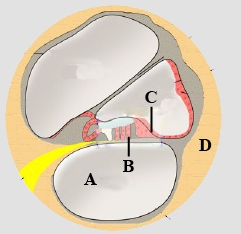
A
$D$: Sensory hair cells,$A$: Endolymph,$B$: Tectorial membrane.
B
$A$: Perilymph,$B$: Tectorial membrane,$C$: Endolymph.
C
$B$: Tectorial membrane,$C$: Perilymph,$D$: Sensory hair cells.
D
$C$: Endolymph,$D$: Sensory hair cells,$A$: Serum.
Solution
(B) Based on the anatomical structure of the human cochlea:
$A$ represents the Perilymph,which fills the scala vestibuli and scala tympani.
$B$ represents the Tectorial membrane,which overlies the hair cells of the organ of Corti.
$C$ represents the Endolymph,which fills the scala media.
$D$ represents the Sensory hair cells,which act as auditory receptors.
Therefore,the correct option is $B$.
$A$ represents the Perilymph,which fills the scala vestibuli and scala tympani.
$B$ represents the Tectorial membrane,which overlies the hair cells of the organ of Corti.
$C$ represents the Endolymph,which fills the scala media.
$D$ represents the Sensory hair cells,which act as auditory receptors.
Therefore,the correct option is $B$.
0 likes
View Solution125
MediumMCQ
What is the function of crista and macula?
A
Maintenance of balance of body and posture
B
Collects the vibrations in the air
C
Increase the efficiency of transmission of sound waves
D
All of the above
Solution
(A) The crista and macula are the specific sensory receptors located within the vestibular apparatus of the inner ear.
Specifically,the cristae are found in the ampullae of the semicircular canals and are responsible for dynamic equilibrium (detecting rotational acceleration).
The maculae are found in the utricle and saccule and are responsible for static equilibrium (detecting linear acceleration and the position of the head relative to gravity).
Therefore,both structures are primarily involved in the maintenance of the balance of the body and posture.
Specifically,the cristae are found in the ampullae of the semicircular canals and are responsible for dynamic equilibrium (detecting rotational acceleration).
The maculae are found in the utricle and saccule and are responsible for static equilibrium (detecting linear acceleration and the position of the head relative to gravity).
Therefore,both structures are primarily involved in the maintenance of the balance of the body and posture.
0 likes
View Solution126
EasyMCQ
Which of the following ossicles is adhered to the oval window of the cochlea?
A
Malleus
B
Incus
C
Stapes
D
Macula
Solution
(C) The middle ear contains three tiny bones called ear ossicles: $Malleus$,$Incus$,and $Stapes$.
These ossicles are arranged in a chain-like structure.
The $Malleus$ is attached to the tympanic membrane (eardrum).
The $Incus$ acts as a bridge between the $Malleus$ and the $Stapes$.
The $Stapes$ (stirrup-shaped bone) is the innermost ossicle and is attached to the oval window of the cochlea.
Therefore,the correct option is $C$.
These ossicles are arranged in a chain-like structure.
The $Malleus$ is attached to the tympanic membrane (eardrum).
The $Incus$ acts as a bridge between the $Malleus$ and the $Stapes$.
The $Stapes$ (stirrup-shaped bone) is the innermost ossicle and is attached to the oval window of the cochlea.
Therefore,the correct option is $C$.
0 likes
View Solution127
EasyMCQ
The vestibular apparatus is composed of $.......$ and $....$
A
Three semi-circular canals and otolith organ
B
Ampulla and otolith organ
C
Crista ampullaris and macula
D
Ampulla and crista ampullaris
Solution
(A) The vestibular apparatus is a part of the inner ear responsible for maintaining body balance and posture.
It consists of two main components: the semi-circular canals and the otolith organ.
$1$. The semi-circular canals are three in number and are responsible for dynamic equilibrium.
$2$. The otolith organ consists of the saccule and utricle,which contain a projecting ridge called the macula,responsible for static equilibrium.
Therefore,the correct composition is three semi-circular canals and the otolith organ.
It consists of two main components: the semi-circular canals and the otolith organ.
$1$. The semi-circular canals are three in number and are responsible for dynamic equilibrium.
$2$. The otolith organ consists of the saccule and utricle,which contain a projecting ridge called the macula,responsible for static equilibrium.
Therefore,the correct composition is three semi-circular canals and the otolith organ.
0 likes
View Solution128
EasyMCQ
Which structure of the ear is responsible for the maintenance of the balance of the body?
A
Labyrinth
B
Oval window
C
Organ of Corti
D
Crista and macula
Solution
(D) The inner ear contains a complex system called the vestibular apparatus,which is responsible for the maintenance of the balance of the body and posture.
The vestibular apparatus is composed of three semicircular canals and the otolith organ (consisting of the saccule and utricle).
Each semicircular canal contains a projecting ridge called the crista ampullaris,and the saccule and utricle contain a projecting ridge called the macula.
Both the crista and macula are the specific receptors of the vestibular apparatus responsible for maintaining the balance of the body and posture.
The vestibular apparatus is composed of three semicircular canals and the otolith organ (consisting of the saccule and utricle).
Each semicircular canal contains a projecting ridge called the crista ampullaris,and the saccule and utricle contain a projecting ridge called the macula.
Both the crista and macula are the specific receptors of the vestibular apparatus responsible for maintaining the balance of the body and posture.
0 likes
View Solution129
MediumMCQ
Given below is a diagrammatic cross-section of a single loop of the human cochlea. Which one of the following options correctly represents the names of three different parts?
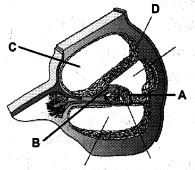
A
$B$: Tectorial membrane,$C$: Scala media,$D$: Scala tympani
B
$C$: Endolymph,$D$: Sensory hair cells,$A$: Organ of Corti
C
$D$: Sensory hair cells,$A$: Organ of Corti,$B$: Tectorial membrane
D
$A$: Organ of Corti,$B$: Tectorial membrane,$C$: Scala vestibuli
Solution
(D) Based on the anatomical structure of the human cochlea cross-section:
$A$ points to the Organ of Corti,which is the organ of hearing located on the basilar membrane.
$B$ points to the Tectorial membrane,which overlies the hair cells of the Organ of Corti.
$C$ points to the Scala vestibuli,which is the upper compartment of the cochlea.
$D$ points to the Scala media,which is the middle compartment containing endolymph.
Therefore,option $D$ correctly identifies $A$ as the Organ of Corti,$B$ as the Tectorial membrane,and $C$ as the Scala vestibuli.
$A$ points to the Organ of Corti,which is the organ of hearing located on the basilar membrane.
$B$ points to the Tectorial membrane,which overlies the hair cells of the Organ of Corti.
$C$ points to the Scala vestibuli,which is the upper compartment of the cochlea.
$D$ points to the Scala media,which is the middle compartment containing endolymph.
Therefore,option $D$ correctly identifies $A$ as the Organ of Corti,$B$ as the Tectorial membrane,and $C$ as the Scala vestibuli.
0 likes
View Solution130
EasyMCQ
What is the location of the crista ampullaris?
A
Ampulla
B
Iris
C
Tectorial membrane
D
Retina
Solution
(A) The crista ampullaris is a sensory organ located within the ampulla of each semicircular canal in the inner ear.
It contains hair cells and supporting cells that are covered by a gelatinous mass called the cupula.
Its primary function is to detect rotational movements of the head,playing a crucial role in maintaining balance.
It contains hair cells and supporting cells that are covered by a gelatinous mass called the cupula.
Its primary function is to detect rotational movements of the head,playing a crucial role in maintaining balance.
0 likes
View Solution131
EasyMCQ
In humans,the tympanic membrane is composed of connective tissues which is covered with:
A
Skin outside and with mucus membrane inside
B
Mucus membrane only
C
Mucus membrane outside and with skin inside
D
Skin only
Solution
(A) The tympanic membrane (eardrum) is a thin,semi-transparent,cone-shaped membrane that separates the external ear from the middle ear.
It is composed of connective tissues.
The outer surface of the tympanic membrane is covered with skin,which is continuous with the lining of the external auditory canal.
The inner surface is covered with a mucous membrane,which is continuous with the lining of the middle ear cavity.
It is composed of connective tissues.
The outer surface of the tympanic membrane is covered with skin,which is continuous with the lining of the external auditory canal.
The inner surface is covered with a mucous membrane,which is continuous with the lining of the middle ear cavity.
0 likes
View Solution132
EasyMCQ
The Eustachian tube connects $A$ cavity with $B$. Choose the correct option for $A$ and $B$.
A
$A-$ outer ear,$B-$ pharynx
B
$A-$ inner ear,$B-$ pharynx
C
$A-$ pinna,$B-$ pharynx
D
$A-$ middle ear,$B-$ pharynx
Solution
(D) The Eustachian tube (also known as the pharyngotympanic tube) is a canal that connects the middle ear cavity to the nasopharynx.
Its primary function is to equalize the air pressure on both sides of the tympanic membrane (eardrum).
Therefore,$A$ represents the middle ear and $B$ represents the pharynx.
The correct option is $D$.
Its primary function is to equalize the air pressure on both sides of the tympanic membrane (eardrum).
Therefore,$A$ represents the middle ear and $B$ represents the pharynx.
The correct option is $D$.
0 likes
View Solution133
EasyMCQ
Eustachian tube connects .......$A$......... cavity with ......$B$......
A
$A-$ outer ear,$B -$ pharynx
B
$A-$ inner ear,$B -$ pharynx
C
$A-$ pinna,$B -$ pharynx
D
$A-$ middle ear,$B -$ pharynx
Solution
(D) The Eustachian tube (also known as the auditory tube) is a canal that connects the middle ear cavity to the nasopharynx.
Its primary function is to equalize the air pressure on both sides of the tympanic membrane (eardrum).
Therefore,$A$ represents the middle ear cavity and $B$ represents the pharynx.
Its primary function is to equalize the air pressure on both sides of the tympanic membrane (eardrum).
Therefore,$A$ represents the middle ear cavity and $B$ represents the pharynx.
0 likes
View Solution134
MediumMCQ
Choose the correct sequence for the mechanism of hearing.
A
Auditory canal - Cochlea - middle ear bones - tectorial membrane - cortex of brain
B
Cornea - lens - ganglionated layer - Bipolar nerve cell - Cortex of brain - optic nerve
C
Lens - cornea - Bipolar nerve cell - ganglionated layer - cortex of brain - optic nerve
D
External ear - Auditory canal - tympanic membrane - bones of middle ear - cochlea - tectorial membrane - auditory nerves - cortex of brain
Solution
(D) The process of hearing involves the following sequence:
$1$. Sound waves enter the $External \text{ } ear$ (pinna).
$2$. They pass through the $Auditory \text{ } canal$.
$3$. They strike the $Tympanic \text{ } membrane$ (eardrum), causing it to vibrate.
$4$. Vibrations are transmitted to the $Bones \text{ } of \text{ } middle \text{ } ear$ (malleus, incus, stapes).
$5$. These vibrations reach the $Cochlea$ via the oval window.
$6$. Inside the cochlea, the fluid movement stimulates the $Tectorial \text{ } membrane$ and hair cells.
$7$. Nerve impulses are generated and transmitted via $Auditory \text{ } nerves$ to the $Cortex \text{ } of \text{ } brain$ for processing.
$1$. Sound waves enter the $External \text{ } ear$ (pinna).
$2$. They pass through the $Auditory \text{ } canal$.
$3$. They strike the $Tympanic \text{ } membrane$ (eardrum), causing it to vibrate.
$4$. Vibrations are transmitted to the $Bones \text{ } of \text{ } middle \text{ } ear$ (malleus, incus, stapes).
$5$. These vibrations reach the $Cochlea$ via the oval window.
$6$. Inside the cochlea, the fluid movement stimulates the $Tectorial \text{ } membrane$ and hair cells.
$7$. Nerve impulses are generated and transmitted via $Auditory \text{ } nerves$ to the $Cortex \text{ } of \text{ } brain$ for processing.
0 likes
View Solution135
EasyMCQ
Which of the following ossicles is attached to the tympanic membrane of the middle ear?
A
Incus
B
Stapes
C
Utricle
D
Malleus
Solution
(D) The middle ear contains three tiny bones called ear ossicles: the $Malleus$,$Incus$,and $Stapes$.
These ossicles are attached to one another in a chain-like fashion.
The $Malleus$ (hammer) is the outermost ossicle and is attached to the tympanic membrane (eardrum).
The $Incus$ (anvil) is the middle bone,and the $Stapes$ (stirrup) is the innermost bone,which is attached to the oval window of the cochlea.
These ossicles are attached to one another in a chain-like fashion.
The $Malleus$ (hammer) is the outermost ossicle and is attached to the tympanic membrane (eardrum).
The $Incus$ (anvil) is the middle bone,and the $Stapes$ (stirrup) is the innermost bone,which is attached to the oval window of the cochlea.
0 likes
View Solution136
MediumMCQ
Which of the following is not involved in the mechanism of hearing?
A
Ear drum
B
Malleus
C
Cochlea
D
Otolith
Solution
(D) The mechanism of hearing involves the transmission of sound waves through the outer,middle,and inner ear.
$1$. The ear drum (tympanic membrane) vibrates in response to sound waves.
$2$. The Malleus is one of the three ear ossicles in the middle ear that transmits these vibrations.
$3$. The Cochlea is the primary organ of hearing in the inner ear,containing the organ of Corti.
$4$. Otoliths are calcium carbonate crystals found in the utricle and saccule of the vestibular system. They are involved in the sense of balance (equilibrium) and gravity detection,not in the mechanism of hearing.
$1$. The ear drum (tympanic membrane) vibrates in response to sound waves.
$2$. The Malleus is one of the three ear ossicles in the middle ear that transmits these vibrations.
$3$. The Cochlea is the primary organ of hearing in the inner ear,containing the organ of Corti.
$4$. Otoliths are calcium carbonate crystals found in the utricle and saccule of the vestibular system. They are involved in the sense of balance (equilibrium) and gravity detection,not in the mechanism of hearing.
0 likes
View Solution137
EasyMCQ
Which of the following is not included in the middle ear ossicles?
A
Malleus
B
Incus
C
Stapes
D
Frontal bone
Solution
(D) The middle ear contains three tiny bones known as ear ossicles,which are collectively called the $Malleus$,$Incus$,and $Stapes$.
These bones are responsible for transmitting sound vibrations from the tympanic membrane to the inner ear.
The $Frontal$ $bone$ is a bone of the cranium (skull),not an ear ossicle.
Therefore,the correct option is $D$.
These bones are responsible for transmitting sound vibrations from the tympanic membrane to the inner ear.
The $Frontal$ $bone$ is a bone of the cranium (skull),not an ear ossicle.
Therefore,the correct option is $D$.
0 likes
View Solution138
EasyMCQ
An eustachian tube connects the cavity with the
A
Middle ear,pharynx
B
Internal ear,larynx
C
Middle ear,larynx
D
Internal ear,pharynx
Solution
(A) The eustachian tube (also known as the auditory tube) is a canal that connects the middle ear cavity to the nasopharynx.
Its primary function is to equalize the air pressure on both sides of the tympanic membrane (eardrum),which is essential for proper hearing and preventing damage to the ear.
Therefore,the correct connection is between the middle ear and the pharynx.
Its primary function is to equalize the air pressure on both sides of the tympanic membrane (eardrum),which is essential for proper hearing and preventing damage to the ear.
Therefore,the correct connection is between the middle ear and the pharynx.
0 likes
View Solution139
EasyMCQ
The fluid-filled inner ear is called .......
A
Labyrinth
B
Vitreous chamber
C
Perilymph
D
Aqueous chamber
Solution
(A) The inner ear consists of a complex system of fluid-filled channels and cavities known as the bony and membranous labyrinth.
It is located within the temporal bone of the skull.
The labyrinth contains two main fluids: perilymph and endolymph,which are essential for hearing and maintaining body balance.
It is located within the temporal bone of the skull.
The labyrinth contains two main fluids: perilymph and endolymph,which are essential for hearing and maintaining body balance.
0 likes
View Solution140
MediumMCQ
The diagram shows a cross-section of the human cochlea. Which one of the following options correctly identifies the three parts labeled $A$,$B$,and $C$?
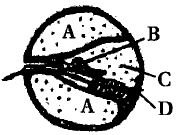
A
$B$ - Tectorial membrane,$C$ - Perilymph,$D$ - Hair cells.
B
$C$ - Endolymph,$D$ - Hair cells,$A$ - Serum.
C
$D$ - Hair cells,$A$ - Endolymph,$B$ - Tectorial membrane.
D
$A$ - Perilymph,$B$ - Tectorial membrane,$C$ - Endolymph.
Solution
(D) The provided diagram represents a cross-section of the cochlea.
$A$ represents the perilymph,which fills the scala vestibuli and scala tympani.
$B$ represents the tectorial membrane,which lies above the hair cells.
$C$ represents the endolymph,which fills the scala media.
$D$ represents the hair cells,which act as auditory receptors.
Therefore,the correct identification is $A$ - Perilymph,$B$ - Tectorial membrane,$C$ - Endolymph.
$A$ represents the perilymph,which fills the scala vestibuli and scala tympani.
$B$ represents the tectorial membrane,which lies above the hair cells.
$C$ represents the endolymph,which fills the scala media.
$D$ represents the hair cells,which act as auditory receptors.
Therefore,the correct identification is $A$ - Perilymph,$B$ - Tectorial membrane,$C$ - Endolymph.
0 likes
View Solution141
MediumMCQ
Which part of the human ear does not play a role in hearing but is essential for maintaining body balance?
A
Eustachian tube
B
Organ of Corti
C
Vestibular apparatus
D
Ear ossicles
Solution
(C) The human ear consists of three parts: the outer ear,middle ear,and inner ear.
The inner ear contains the cochlea and the vestibular apparatus.
The cochlea is primarily responsible for hearing.
The vestibular apparatus,which consists of the semicircular canals and the otolith organ (saccule and utricle),is responsible for maintaining the balance of the body and posture.
Therefore,the vestibular apparatus does not play a direct role in hearing but is essential for equilibrium.
The inner ear contains the cochlea and the vestibular apparatus.
The cochlea is primarily responsible for hearing.
The vestibular apparatus,which consists of the semicircular canals and the otolith organ (saccule and utricle),is responsible for maintaining the balance of the body and posture.
Therefore,the vestibular apparatus does not play a direct role in hearing but is essential for equilibrium.
0 likes
View Solution142
MediumMCQ
Fenestra ovalis is the opening of
A
Cranium
B
Tympanum
C
Tympanic cavity
D
Brain
Solution
(C) The $Fenestra ovalis$ (also known as the oval window) is a membrane-covered opening that connects the middle ear (tympanic cavity) to the inner ear (vestibule).
It allows the vibrations from the ossicles to be transmitted to the fluid within the cochlea.
It allows the vibrations from the ossicles to be transmitted to the fluid within the cochlea.
0 likes
View Solution143
MediumMCQ
Which of the following receptors are specifically responsible for the maintenance of balance of the body and posture?
A
Basilar membrane and otoliths
B
Hair cells and organ of Corti
C
Tectorial membrane and macula
D
Crista ampullaris and macula
Solution
(D) The vestibular apparatus,located in the inner ear,is responsible for the maintenance of balance and posture.
It consists of two main parts: the semicircular canals and the otolith organ (consisting of the saccule and utricle).
$1$. The crista ampullaris is located in the ampulla of each semicircular canal and is responsible for dynamic equilibrium (detecting rotational movement).
$2$. The macula is the sensory receptor located in the saccule and utricle,responsible for static equilibrium (detecting gravity and linear acceleration).
Therefore,the crista ampullaris and macula are the specific receptors responsible for the maintenance of body balance and posture.
It consists of two main parts: the semicircular canals and the otolith organ (consisting of the saccule and utricle).
$1$. The crista ampullaris is located in the ampulla of each semicircular canal and is responsible for dynamic equilibrium (detecting rotational movement).
$2$. The macula is the sensory receptor located in the saccule and utricle,responsible for static equilibrium (detecting gravity and linear acceleration).
Therefore,the crista ampullaris and macula are the specific receptors responsible for the maintenance of body balance and posture.
0 likes
View Solution144
EasyMCQ
The three tiny bones present in the middle ear are called ear ossicles. Write them in the correct sequence beginning from the ear drum.
A
Malleus,Incus,Stapes
B
Stapes,Incus,Malleus
C
Incus,Malleus,Stapes
D
Malleus,Stapes,Incus
Solution
(A) The middle ear contains three small bones known as ear ossicles. These bones are the $Malleus$ (hammer),$Incus$ (anvil),and $Stapes$ (stirrup).
They are arranged in a chain-like sequence to transmit sound vibrations from the ear drum (tympanic membrane) to the inner ear.
The correct sequence starting from the ear drum is: $Malleus \rightarrow Incus \rightarrow Stapes$.
They are arranged in a chain-like sequence to transmit sound vibrations from the ear drum (tympanic membrane) to the inner ear.
The correct sequence starting from the ear drum is: $Malleus \rightarrow Incus \rightarrow Stapes$.
0 likes
View Solution145
Medium
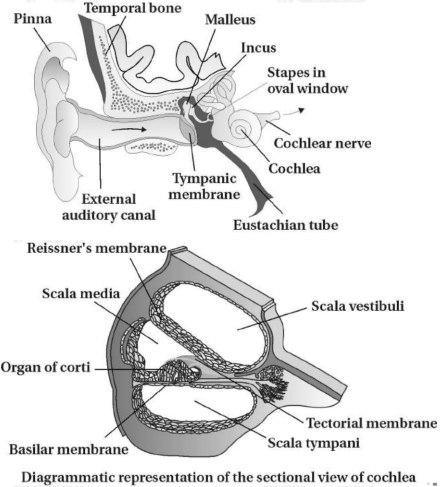
Describe the various parts of the human ear and their functions.
Solution
(N/A) The ears perform two primary sensory functions: hearing and the maintenance of body balance. Hence,they are also called phonoreceptors.
Anatomically,the ear can be divided into three main regions:
$(a)$ Outer ear $(b)$ Middle ear $(c)$ Inner ear
$(a)$ Outer ear: Consists of the pinna and the external auditory canal.
The pinna is a funnel-shaped structure that collects vibrations in the air,which produce sound. The auditory canal is '$S$'-shaped and extends up to the tympanic membrane (eardrum).
There are very fine hairs and wax-secreting glands (ceruminous glands) in the auditory canal. These glands secrete a brown-coloured fatty substance known as earwax,which protects and lubricates the inner lining of the auditory canal.
$(b)$ Middle ear: The tympanic membrane is a thin,double-layered epithelial partition between the external auditory canal and the middle ear. It is made of fibrous connective tissue.
The middle ear contains three ossicles: Malleus,Incus,and Stapes,attached in a chain-like fashion. The malleus is attached to the tympanic membrane,and the stapes is attached to the oval window of the cochlea. These ossicles increase the efficiency of sound wave transmission to the inner ear.
An Eustachian tube connects the middle ear cavity with the pharynx,helping to equalize the pressure on both sides of the eardrum.
$(c)$ Inner ear: The fluid-filled inner ear,called the labyrinth,consists of two parts: the bony and the membranous labyrinths.
The bony labyrinth is a series of channels containing the membranous labyrinth,which is surrounded by a fluid called perilymph. The membranous labyrinth is filled with a fluid called endolymph.
$(i)$ The coiled portion of the labyrinth is called the cochlea. The Reissner's membrane and basilar membrane divide the perilymph-filled bony labyrinth into an upper Scala Vestibuli and a lower Scala Tympani. The space within the cochlea,called the Scala Media,is filled with endolymph.
The Organ of Corti is a structure located on the basilar membrane that contains hair cells,which act as auditory receptors. Above the rows of hair cells is a thin elastic membrane called the tectorial membrane.
$(ii)$ The inner ear also contains a vestibular apparatus located above the cochlea. It is composed of three semi-circular canals and the otolith organ (saccule and utricle). The crista ampullaris (in the ampulla of the canals) and the macula (in the saccule and utricle) are the specific receptors responsible for the maintenance of body balance and posture.
Anatomically,the ear can be divided into three main regions:
$(a)$ Outer ear $(b)$ Middle ear $(c)$ Inner ear
$(a)$ Outer ear: Consists of the pinna and the external auditory canal.
The pinna is a funnel-shaped structure that collects vibrations in the air,which produce sound. The auditory canal is '$S$'-shaped and extends up to the tympanic membrane (eardrum).
There are very fine hairs and wax-secreting glands (ceruminous glands) in the auditory canal. These glands secrete a brown-coloured fatty substance known as earwax,which protects and lubricates the inner lining of the auditory canal.
$(b)$ Middle ear: The tympanic membrane is a thin,double-layered epithelial partition between the external auditory canal and the middle ear. It is made of fibrous connective tissue.
The middle ear contains three ossicles: Malleus,Incus,and Stapes,attached in a chain-like fashion. The malleus is attached to the tympanic membrane,and the stapes is attached to the oval window of the cochlea. These ossicles increase the efficiency of sound wave transmission to the inner ear.
An Eustachian tube connects the middle ear cavity with the pharynx,helping to equalize the pressure on both sides of the eardrum.
$(c)$ Inner ear: The fluid-filled inner ear,called the labyrinth,consists of two parts: the bony and the membranous labyrinths.
The bony labyrinth is a series of channels containing the membranous labyrinth,which is surrounded by a fluid called perilymph. The membranous labyrinth is filled with a fluid called endolymph.
$(i)$ The coiled portion of the labyrinth is called the cochlea. The Reissner's membrane and basilar membrane divide the perilymph-filled bony labyrinth into an upper Scala Vestibuli and a lower Scala Tympani. The space within the cochlea,called the Scala Media,is filled with endolymph.
The Organ of Corti is a structure located on the basilar membrane that contains hair cells,which act as auditory receptors. Above the rows of hair cells is a thin elastic membrane called the tectorial membrane.
$(ii)$ The inner ear also contains a vestibular apparatus located above the cochlea. It is composed of three semi-circular canals and the otolith organ (saccule and utricle). The crista ampullaris (in the ampulla of the canals) and the macula (in the saccule and utricle) are the specific receptors responsible for the maintenance of body balance and posture.
0 likes
View Solution146
Medium
Describe the mechanism of hearing briefly.
Solution
The mechanism of hearing involves the following steps:
$1$. The external ear receives sound waves and directs them to the tympanic membrane (eardrum).
$2$. The tympanic membrane vibrates in response to the sound waves and these vibrations are transmitted through the ear ossicles (malleus,incus,and stapes) to the oval window.
$3$. The vibrations are passed through the oval window to the fluid-filled cochlea,where they generate waves in the lymphs.
$4$. These waves induce a ripple in the basilar membrane,which causes the hair cells to bend against the tectorial membrane.
$5$. This bending of hair cells generates nerve impulses in the associated afferent neurons.
$6$. These impulses are transmitted via the auditory nerve to the auditory cortex of the brain,where the sound is analyzed and recognized.
$1$. The external ear receives sound waves and directs them to the tympanic membrane (eardrum).
$2$. The tympanic membrane vibrates in response to the sound waves and these vibrations are transmitted through the ear ossicles (malleus,incus,and stapes) to the oval window.
$3$. The vibrations are passed through the oval window to the fluid-filled cochlea,where they generate waves in the lymphs.
$4$. These waves induce a ripple in the basilar membrane,which causes the hair cells to bend against the tectorial membrane.
$5$. This bending of hair cells generates nerve impulses in the associated afferent neurons.
$6$. These impulses are transmitted via the auditory nerve to the auditory cortex of the brain,where the sound is analyzed and recognized.
0 likes
View Solution147
Medium
What is earwax? What is its function?
Solution
(N/A) Earwax,also known as cerumen,is a yellowish,waxy substance secreted by the ceruminous glands located in the outer part of the auditory canal.
Its primary functions include:
$1$. Protection: It traps dust,debris,and microorganisms,preventing them from reaching the delicate eardrum.
$2$. Lubrication: It keeps the skin lining of the auditory canal moisturized,preventing it from becoming dry and itchy.
$3$. Antimicrobial properties: It contains substances that help inhibit the growth of certain bacteria and fungi.
Its primary functions include:
$1$. Protection: It traps dust,debris,and microorganisms,preventing them from reaching the delicate eardrum.
$2$. Lubrication: It keeps the skin lining of the auditory canal moisturized,preventing it from becoming dry and itchy.
$3$. Antimicrobial properties: It contains substances that help inhibit the growth of certain bacteria and fungi.
0 likes
View Solution148
Medium
Distinguish between:
$(1)$ Tectorial membrane and Reissner's membrane.
$(1)$ Tectorial membrane and Reissner's membrane.
Solution
(N/A) Tectorial membrane: The organ of Corti is located on the basilar membrane,which contains hair cells. Above the rows of hair cells lies a thin,elastic membrane called the tectorial membrane.
Reissner's membrane: The cochlea of the internal ear contains a space called the scala media. The roof of the scala media is formed by Reissner's membrane.
Reissner's membrane: The cochlea of the internal ear contains a space called the scala media. The roof of the scala media is formed by Reissner's membrane.
0 likes
View Solution149
EasyMCQ
State the location and function of the Organ of Corti.
A
Located on the basilar membrane; acts as auditory receptors.
B
Located in the middle ear; helps in sound amplification.
C
Located in the semicircular canals; helps in body balance.
D
Located in the eustachian tube; helps in pressure equalization.
Solution
(A) Location: The Organ of Corti is a structure located on the basilar membrane within the cochlea of the inner ear.
Function: It contains hair cells that act as auditory receptors,which convert mechanical vibrations into nerve impulses.
Function: It contains hair cells that act as auditory receptors,which convert mechanical vibrations into nerve impulses.
0 likes
View Solution150
Medium
Comment upon the role of the ear in maintaining the balance of the body and posture.
Solution
(N/A) The vestibular apparatus,located in the inner ear,is the primary sensory structure responsible for maintaining body balance and posture.
The vestibular apparatus consists of two main components:
$1$. Semicircular canals: There are three semicircular canals,each containing a swollen base called the ampulla. The ampulla contains a projecting ridge called the crista ampullaris,which has hair cells. These canals are sensitive to rotational or angular movements of the head.
$2$. Otolith organ (Utricle and Saccule): These are located within the vestibule and contain a projecting ridge called the macula. The macula contains hair cells and is covered by a gelatinous layer containing calcium carbonate crystals called otoliths. These structures are sensitive to linear acceleration and changes in head position relative to gravity.
Mechanism: When the head moves,the endolymph within the semicircular canals or the otoliths in the utricle and saccule shift. This movement causes the displacement of the gelatinous membrane,which in turn bends the hair cells. This bending generates nerve impulses that are transmitted to the brain via the vestibular nerve,allowing the body to adjust its posture and maintain balance.
The vestibular apparatus consists of two main components:
$1$. Semicircular canals: There are three semicircular canals,each containing a swollen base called the ampulla. The ampulla contains a projecting ridge called the crista ampullaris,which has hair cells. These canals are sensitive to rotational or angular movements of the head.
$2$. Otolith organ (Utricle and Saccule): These are located within the vestibule and contain a projecting ridge called the macula. The macula contains hair cells and is covered by a gelatinous layer containing calcium carbonate crystals called otoliths. These structures are sensitive to linear acceleration and changes in head position relative to gravity.
Mechanism: When the head moves,the endolymph within the semicircular canals or the otoliths in the utricle and saccule shift. This movement causes the displacement of the gelatinous membrane,which in turn bends the hair cells. This bending generates nerve impulses that are transmitted to the brain via the vestibular nerve,allowing the body to adjust its posture and maintain balance.
0 likes
View SolutionNeural Control and Coordination — Ear · Frequently Asked Questions
1Are these Neural Control and Coordination questions useful for JEE and NEET?
Yes. All questions in this section are mapped to JEE Main and NEET exam patterns. Previous year questions from JEE Main, NEET, GUJCET and state-level exams are included with full solutions.
2Can I switch to Hindi or Gujarati for these questions?
Yes. Use the language tabs in the hero section or the sidebar to view the same questions and solutions in English, Hindi or Gujarati.
3How do I generate a question paper from this subtopic?
Use the Vedclass Exam Paper Generator — select the chapter and subtopic, set difficulty, and generate Sets A, B, C, D automatically. First 3 chapters of every subject are free.
Vedclass Products
For Students
Vedclass Test Series
Mock tests in real JEE/NEET style with performance analysis. 5-day free trial.
Start Free TrialFor Teachers
Exam Paper Generator
Generate Set A/B/C/D papers from this chapter in 2 minutes. 3 chapters free.
Try FreeFor Institutes
Online Exam Module
Live online exams with unlimited students, 360° analytics & white-label branding.
See DemoFor Teachers & Institutes
Generate a Neural Control and Coordination Exam Paper in 2 Minutes
Select subtopic & difficulty — Sets A, B, C, D auto-generated with No Repeat logic.
First 3 chapters of every subject are free — no payment required.