
A English
Symbiotic biological nitrogen fixation Questions in English
Class 11 Biology · Mineral Nutrition · Symbiotic biological nitrogen fixation
92+
Questions
English
Language
100%
With Solutions
Showing 41 of 92 questions in English
51
EasyMCQ
Which of the following is a symbiotic nitrogen fixer?
A
Azotobacter
B
Frankia
C
Azolla
D
Glomus
Solution
(B) : $Frankia$ is a symbiotic nitrogen-fixing bacterium.
It induces root nodules in a manner similar to $Rhizobium$.
It forms a symbiotic association with the root nodules of several non-leguminous plants such as $Casuarina$,$Alnus$,and $Rubus$.
It is unable to fix nitrogen in a free-living state.
It induces root nodules in a manner similar to $Rhizobium$.
It forms a symbiotic association with the root nodules of several non-leguminous plants such as $Casuarina$,$Alnus$,and $Rubus$.
It is unable to fix nitrogen in a free-living state.
0 likes
View Solution52
MediumMCQ
Leguminous plants are able to fix atmospheric nitrogen through the process of symbiotic nitrogen fixation. Which one of the following statements is not correct during this process of nitrogen fixation?
A
Leghaemoglobin scavenges oxygen and is pinkish in colour.
B
Nodules act as sites for nitrogen fixation.
C
The enzyme nitrogenase catalyses the conversion of atmospheric $N_2$ to $NH_3$.
D
Nitrogenase is insensitive to oxygen.
Solution
(D) The enzyme nitrogenase is highly sensitive to molecular oxygen and requires anaerobic conditions to function effectively. Leghaemoglobin acts as an oxygen scavenger to protect the nitrogenase enzyme from oxygen damage,creating an anaerobic environment within the root nodules. Therefore,the statement that nitrogenase is insensitive to oxygen is incorrect.
0 likes
View Solution53
EasyMCQ
Nitrogen fixation in root nodules of $Alnus$ is brought about by
A
$Frankia$
B
$Azorhizobium$
C
$Bradyrhizobium$
D
$Clostridium$
Solution
(A) $Frankia$ is a filamentous,nitrogen-fixing bacterium that forms a symbiotic relationship with the roots of various non-leguminous plants,including $Alnus$ (alder) and $Casuarina$.
These bacteria induce the formation of root nodules,where they fix atmospheric nitrogen into ammonia,which the plant can utilize for growth.
While $Rhizobium$ is typically associated with leguminous plants,$Frankia$ is specifically known for its association with non-leguminous woody plants.
Therefore,the correct answer is $Frankia$.
These bacteria induce the formation of root nodules,where they fix atmospheric nitrogen into ammonia,which the plant can utilize for growth.
While $Rhizobium$ is typically associated with leguminous plants,$Frankia$ is specifically known for its association with non-leguminous woody plants.
Therefore,the correct answer is $Frankia$.
0 likes
View Solution54
MediumMCQ
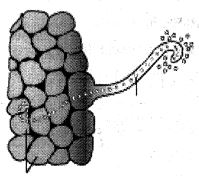
Identify the following process from the diagram.
A
Soil particles,Root hair and bacteria
B
Hook and bacteria
C
Infection thread containing bacteria
D
Mature nodule
Solution
(C) The provided diagram illustrates the early stages of root nodule formation in legumes,specifically the process of infection by Rhizobium bacteria.
$1$. The bacteria accumulate around the root hair and attach to the epidermal and root hair cells.
$2$. The root hair curls due to the bacterial infection,forming a structure known as a 'hook'.
$3$. An infection thread is then formed,which carries the bacteria into the cortex of the root,where they will eventually induce cell division to form a nodule.
$4$. The specific part indicated by the arrow pointing to the tube-like structure extending into the root is the 'Infection thread containing bacteria'.
$1$. The bacteria accumulate around the root hair and attach to the epidermal and root hair cells.
$2$. The root hair curls due to the bacterial infection,forming a structure known as a 'hook'.
$3$. An infection thread is then formed,which carries the bacteria into the cortex of the root,where they will eventually induce cell division to form a nodule.
$4$. The specific part indicated by the arrow pointing to the tube-like structure extending into the root is the 'Infection thread containing bacteria'.
0 likes
View Solution55
MediumMCQ
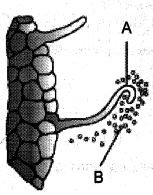
Identify $A$ and $B$ in the figure.
A
$A$ - Root hair,$B$ - Hook
B
$A$ - Hook,$B$ - Root hair
C
$A$ - Bacteria,$B$ - Hook
D
$A$ - Hook,$B$ - Bacteria
Solution
(D) The provided figure illustrates the process of nodule formation in legumes,specifically the infection of root hairs by Rhizobium bacteria.
In this process,the root hair curls around the bacteria to form a structure known as a 'hook'.
Label $A$ points to the curled tip of the root hair,which is the 'hook'.
Label $B$ points to the cluster of bacteria surrounding the root hair.
Therefore,$A$ represents the hook and $B$ represents the bacteria.
In this process,the root hair curls around the bacteria to form a structure known as a 'hook'.
Label $A$ points to the curled tip of the root hair,which is the 'hook'.
Label $B$ points to the cluster of bacteria surrounding the root hair.
Therefore,$A$ represents the hook and $B$ represents the bacteria.
0 likes
View Solution56
EasyMCQ
$Frankia$ is free-living in soil,but as symbionts,can fix atmospheric nitrogen.
A
$Azotobacter$
B
$Cyanobacteria$
C
$Beijerinckia$
D
$Frankia$
Solution
(D) $Frankia$ is a genus of bacteria that is capable of nitrogen fixation.
It exists as a free-living organism in the soil.
However,it also forms symbiotic associations with the root nodules of several non-leguminous plants (such as $Alnus$).
In these symbiotic associations,it effectively fixes atmospheric nitrogen.
It exists as a free-living organism in the soil.
However,it also forms symbiotic associations with the root nodules of several non-leguminous plants (such as $Alnus$).
In these symbiotic associations,it effectively fixes atmospheric nitrogen.
0 likes
View Solution57
EasyMCQ
Which of the following is responsible for nitrogen fixation in an aquatic fern?
A
Azolla
B
Nostoc
C
Salvia
D
Salvinia
Solution
(A) The aquatic fern $Azolla$ maintains a symbiotic relationship with the cyanobacterium $Anabaena$ $azollae$.
This cyanobacterium resides in the leaf cavities of $Azolla$ and is responsible for fixing atmospheric nitrogen.
Therefore,$Azolla$ is the aquatic fern associated with nitrogen fixation.
This cyanobacterium resides in the leaf cavities of $Azolla$ and is responsible for fixing atmospheric nitrogen.
Therefore,$Azolla$ is the aquatic fern associated with nitrogen fixation.
0 likes
View Solution58
MediumMCQ
In which of the following angiosperms do the root nodules contain filamentous nitrogen-fixing microorganisms?
A
Casuarina equisetifolia
B
Crotalaria juncea
C
Cycas revoluta
D
Cicer arietinum
Solution
(A) The correct answer is $A$.
$Casuarina equisetifolia$ is a non-leguminous angiosperm that forms a symbiotic relationship with the filamentous actinomycete $Frankia$.
This bacterium resides in the root nodules of the plant and is responsible for nitrogen fixation.
$Crotalaria juncea$ and $Cicer arietinum$ are legumes that form nodules with $Rhizobium$,which is not a filamentous bacterium.
$Cycas revoluta$ is a gymnosperm,not an angiosperm,and it forms coralloid roots with $Anabaena$ or $Nostoc$.
$Casuarina equisetifolia$ is a non-leguminous angiosperm that forms a symbiotic relationship with the filamentous actinomycete $Frankia$.
This bacterium resides in the root nodules of the plant and is responsible for nitrogen fixation.
$Crotalaria juncea$ and $Cicer arietinum$ are legumes that form nodules with $Rhizobium$,which is not a filamentous bacterium.
$Cycas revoluta$ is a gymnosperm,not an angiosperm,and it forms coralloid roots with $Anabaena$ or $Nostoc$.
0 likes
View Solution59
MediumMCQ
The free-living nitrogen-fixing cyanobacterium that forms a symbiotic association with the aquatic fern Azolla is ............. .
A
Tolypothrix
B
Chlorella
C
Nostoc
D
Anabaena
Solution
(D) The aquatic fern $Azolla$ maintains a symbiotic relationship with the cyanobacterium $Anabaena$ $azollae$.
This cyanobacterium lives in the leaf cavities of the fern.
It fixes atmospheric nitrogen,which is then utilized by the fern for its growth.
Therefore,$Anabaena$ is the correct answer.
This cyanobacterium lives in the leaf cavities of the fern.
It fixes atmospheric nitrogen,which is then utilized by the fern for its growth.
Therefore,$Anabaena$ is the correct answer.
0 likes
View Solution60
MediumMCQ
Leghaemoglobin helps in
A
nitrogen fixation
B
protecting nitrogenase from $O_2$
C
destroys bacteria
D
transport of food in plants
Solution
(B) The root nodules of leguminous plants contain symbiotic nitrogen-fixing bacteria called $Rhizobium$.
Root nodules are small,irregular outgrowths on the roots which appear pinkish internally due to the presence of a pigment called leghaemoglobin.
This pigment is structurally related to the blood pigment haemoglobin.
Leghaemoglobin acts as an oxygen scavenger,which creates an anaerobic environment by binding to oxygen.
This is crucial because the nitrogen-fixing enzyme,nitrogenase,is highly sensitive to molecular oxygen $(O_2)$ and is inactivated in its presence.
Therefore,leghaemoglobin protects nitrogenase from $O_2$ to ensure efficient nitrogen fixation.
Root nodules are small,irregular outgrowths on the roots which appear pinkish internally due to the presence of a pigment called leghaemoglobin.
This pigment is structurally related to the blood pigment haemoglobin.
Leghaemoglobin acts as an oxygen scavenger,which creates an anaerobic environment by binding to oxygen.
This is crucial because the nitrogen-fixing enzyme,nitrogenase,is highly sensitive to molecular oxygen $(O_2)$ and is inactivated in its presence.
Therefore,leghaemoglobin protects nitrogenase from $O_2$ to ensure efficient nitrogen fixation.
0 likes
View Solution61
MediumMCQ
Assertion : Leguminous plants are nitrogen fixers.
Reason : Leguminous plants have $Rhizobium$ in their root nodules.
Reason : Leguminous plants have $Rhizobium$ in their root nodules.
A
If both Assertion and Reason are correct and the Reason is a correct explanation of the Assertion.
B
If both Assertion and Reason are correct but Reason is not a correct explanation of the Assertion.
C
If the Assertion is correct but Reason is incorrect.
D
If both the Assertion and Reason are incorrect.
Solution
(A) Leguminous plants are known as nitrogen fixers because they establish a symbiotic relationship with nitrogen-fixing bacteria.
These bacteria,such as $Rhizobium$,reside in the root nodules of leguminous plants.
The bacteria fix atmospheric nitrogen into ammonia,which the plant can utilize for growth.
Therefore,the presence of $Rhizobium$ in the root nodules is the direct reason why these plants are capable of nitrogen fixation.
Thus,both the Assertion and the Reason are correct,and the Reason is the correct explanation of the Assertion.
These bacteria,such as $Rhizobium$,reside in the root nodules of leguminous plants.
The bacteria fix atmospheric nitrogen into ammonia,which the plant can utilize for growth.
Therefore,the presence of $Rhizobium$ in the root nodules is the direct reason why these plants are capable of nitrogen fixation.
Thus,both the Assertion and the Reason are correct,and the Reason is the correct explanation of the Assertion.
0 likes
View Solution62
MediumMCQ
Assertion : Nitrogen-fixing enzyme in legume root nodules functions at low oxygen concentration.
Reason : Low oxygen concentration is provided by leghaemoglobin.
Reason : Low oxygen concentration is provided by leghaemoglobin.
A
If both Assertion and Reason are correct and the Reason is a correct explanation of the Assertion.
B
If both Assertion and Reason are correct but Reason is not a correct explanation of the Assertion.
C
If the Assertion is correct but Reason is incorrect.
D
If both the Assertion and Reason are incorrect.
Solution
(A) The enzyme nitrogenase,which is responsible for nitrogen fixation in legume root nodules,is highly sensitive to molecular oxygen $(O_2)$.
To function effectively,it requires an anaerobic environment.
Leghaemoglobin acts as an oxygen scavenger,binding to oxygen and maintaining a low oxygen concentration within the nodules.
Therefore,both the Assertion and the Reason are correct,and the Reason correctly explains why the enzyme functions at a low oxygen concentration.
To function effectively,it requires an anaerobic environment.
Leghaemoglobin acts as an oxygen scavenger,binding to oxygen and maintaining a low oxygen concentration within the nodules.
Therefore,both the Assertion and the Reason are correct,and the Reason correctly explains why the enzyme functions at a low oxygen concentration.
0 likes
View Solution63
Medium
What are the conditions necessary for fixation of atmospheric nitrogen by $Rhizobium$? What is their role in $N_2$-fixation?
Solution
(N/A) $Rhizobium$ is a symbiotic bacteria present in the root nodules of leguminous plants.
The basic requirements for $Rhizobium$ to carry out nitrogen fixation are as follows:
$(a)$ Presence of the enzyme nitrogenase.
$(b)$ Presence of leghaemoglobin.
$(c)$ Non-haem iron protein,ferredoxin as the electron carrier.
$(d)$ Constant supply of $ATP$.
$(e)$ $Mg^{2+}$ ions as co-factors.
$Rhizobium$ contains the enzyme nitrogenase,a $Mo-Fe$ protein,which helps in the conversion of atmospheric free nitrogen into ammonia.
The reaction is as follows:
$N_2 + 8e^- + 8H^+ + 16ATP \rightarrow 2NH_3 + H_2 + 16ADP + 16Pi$
The $Rhizobium$ bacteria live as aerobes under free-living conditions,but require anaerobic conditions during nitrogen fixation. This is because the enzyme nitrogenase is highly sensitive to molecular oxygen. The nodules contain leghaemoglobin,which acts as an oxygen scavenger and protects nitrogenase from oxygen.
The basic requirements for $Rhizobium$ to carry out nitrogen fixation are as follows:
$(a)$ Presence of the enzyme nitrogenase.
$(b)$ Presence of leghaemoglobin.
$(c)$ Non-haem iron protein,ferredoxin as the electron carrier.
$(d)$ Constant supply of $ATP$.
$(e)$ $Mg^{2+}$ ions as co-factors.
$Rhizobium$ contains the enzyme nitrogenase,a $Mo-Fe$ protein,which helps in the conversion of atmospheric free nitrogen into ammonia.
The reaction is as follows:
$N_2 + 8e^- + 8H^+ + 16ATP \rightarrow 2NH_3 + H_2 + 16ADP + 16Pi$
The $Rhizobium$ bacteria live as aerobes under free-living conditions,but require anaerobic conditions during nitrogen fixation. This is because the enzyme nitrogenase is highly sensitive to molecular oxygen. The nodules contain leghaemoglobin,which acts as an oxygen scavenger and protects nitrogenase from oxygen.
0 likes
View Solution64
Medium
What are the steps involved in the formation of a root nodule?
Solution
(N/A) The formation of root nodules involves a series of complex interactions between the host plant and $Rhizobium$ bacteria:
$1$. $Rhizobium$ bacteria multiply and form colonies,which attach to the root hairs and epidermal cells.
$2$. The root hairs curl due to bacterial infection and are subsequently invaded by the bacteria.
$3$. An infection thread is formed,which carries the bacteria into the cortex of the root.
$4$. The bacteria are released into the cortical cells,where they differentiate into rod-shaped structures called bacteroids.
$5$. The infection triggers cell division in the cortex and pericycle,leading to the formation of root nodules.
$6$. Finally,these nodules establish a direct vascular connection with the host plant to facilitate nutrient exchange.
$1$. $Rhizobium$ bacteria multiply and form colonies,which attach to the root hairs and epidermal cells.
$2$. The root hairs curl due to bacterial infection and are subsequently invaded by the bacteria.
$3$. An infection thread is formed,which carries the bacteria into the cortex of the root.
$4$. The bacteria are released into the cortical cells,where they differentiate into rod-shaped structures called bacteroids.
$5$. The infection triggers cell division in the cortex and pericycle,leading to the formation of root nodules.
$6$. Finally,these nodules establish a direct vascular connection with the host plant to facilitate nutrient exchange.
0 likes
View Solution65
Medium
Which steps are associated with nodule formation?
Solution
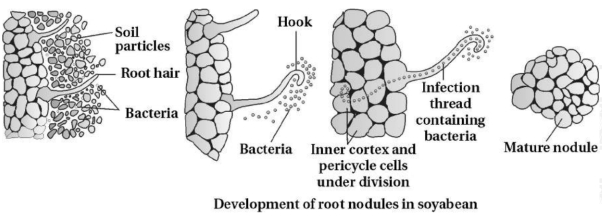
(N/A) Nodule formation involves a sequence of multiple interactions between Rhizobium and the roots of the host plant.
The steps are as follows:
$1$. Rhizobia multiply and colonize the surroundings of roots,attach to epidermal and root hair cells,and cause the root hair to curl. The bacteria then invade the root hair.
$2$. An infection thread is produced,carrying the bacteria into the cortex of the root.
$3$. The bacteria are released from the thread into the cells,leading to their differentiation into specialized nitrogen-fixing cells.
$4$. The nodule thus formed establishes a direct vascular connection with the host for the exchange of nutrients.
The steps are as follows:
$1$. Rhizobia multiply and colonize the surroundings of roots,attach to epidermal and root hair cells,and cause the root hair to curl. The bacteria then invade the root hair.
$2$. An infection thread is produced,carrying the bacteria into the cortex of the root.
$3$. The bacteria are released from the thread into the cells,leading to their differentiation into specialized nitrogen-fixing cells.
$4$. The nodule thus formed establishes a direct vascular connection with the host for the exchange of nutrients.
0 likes
View Solution66
Medium
Give scientific reasons:
$(1)$ Leguminous plants are rich in protein.
$(1)$ Leguminous plants are rich in protein.
Solution
(N/A) Nodules are present on the roots of leguminous plants. Symbiotic bacteria,$Rhizobium$,reside within these nodules. These bacteria fix atmospheric nitrogen into ammonia. Plants synthesize amino acids using this ammonia. Many such amino acids connect with each other via peptide bonds to form polypeptides,which ultimately form proteins. Thus,leguminous plants possess protein in abundance.
0 likes
View Solution67
MediumMCQ
We find that $Rhizobium$ forms nodules on the roots of leguminous plants. Also,$Frankia$,another microbe,forms nitrogen-fixing nodules on the roots of the non-leguminous plant $Alnus$. What kind of relationship is observed between mycorrhiza and pine trees?
A
Parasitic
B
Symbiotic
C
Commensalism
D
Amensalism
Solution
(B) The relationship between mycorrhiza and pine trees is a classic example of symbiosis (mutualism).
In this association,the fungal hyphae of the mycorrhiza absorb phosphorus and other minerals from the soil and provide them to the pine tree.
In return,the pine tree provides the fungus with carbohydrates and a suitable environment for growth.
Both organisms benefit from this association,which is essential for the survival of pine trees in many environments.
In this association,the fungal hyphae of the mycorrhiza absorb phosphorus and other minerals from the soil and provide them to the pine tree.
In return,the pine tree provides the fungus with carbohydrates and a suitable environment for growth.
Both organisms benefit from this association,which is essential for the survival of pine trees in many environments.
0 likes
View Solution68
Medium
We find that $Rhizobium$ forms nodules on the roots of leguminous plants. Also,$Frankia$,another microbe,forms nitrogen-fixing nodules on the roots of the non-leguminous plant $Alnus$. Is it necessary for a microbe to be in close association with a plant to provide mineral nutrition? Explain with the help of one example.
Solution
(A) Yes,it is necessary for a microbe to be in close association with a plant to provide mineral nutrition in cases of symbiotic nitrogen fixation.
$1$. Symbiotic nitrogen fixation requires a specialized environment where the microbe can function effectively without being inhibited by oxygen.
$2$. For example,$Rhizobium$ bacteria enter the root hairs of leguminous plants and form root nodules.
$3$. Inside these nodules,the bacteria differentiate into bacteroids and produce the enzyme nitrogenase,which fixes atmospheric nitrogen into ammonia.
$4$. The plant provides the bacteria with carbohydrates and a protected environment,while the bacteria provide the plant with fixed nitrogen,demonstrating that close physical association is essential for this mutualistic interaction.
$1$. Symbiotic nitrogen fixation requires a specialized environment where the microbe can function effectively without being inhibited by oxygen.
$2$. For example,$Rhizobium$ bacteria enter the root hairs of leguminous plants and form root nodules.
$3$. Inside these nodules,the bacteria differentiate into bacteroids and produce the enzyme nitrogenase,which fixes atmospheric nitrogen into ammonia.
$4$. The plant provides the bacteria with carbohydrates and a protected environment,while the bacteria provide the plant with fixed nitrogen,demonstrating that close physical association is essential for this mutualistic interaction.
0 likes
View Solution69
Difficult
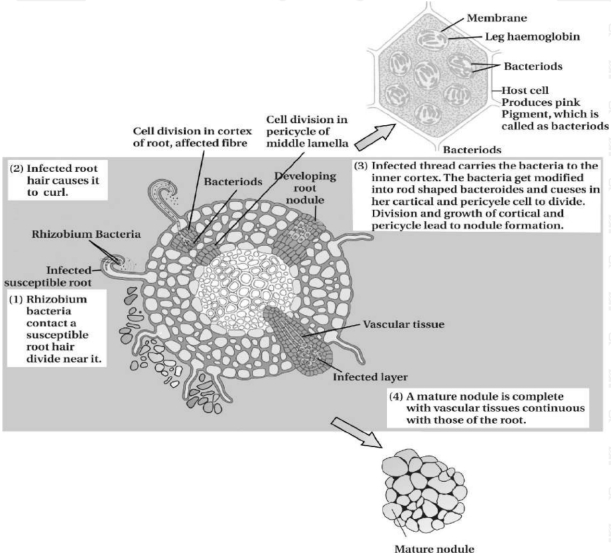
Trace the events starting from the coming in contact of Rhizobium to a leguminous root till nodule formation. Add a note on the importance of leghemoglobin.
Solution
(N/A) The process of nodule formation involves the following steps:
$1$. Rhizobium bacteria contact a susceptible root hair and divide near it.
$2$. The infected root hair curls,and the bacteria invade the root hair.
$3$. An infection thread is produced,which carries the bacteria into the inner cortex of the root.
$4$. The bacteria are released from the thread into the cells,where they differentiate into rod-shaped bacteroids.
$5$. This triggers cell division in the cortex and pericycle,leading to the formation of root nodules.
$6$. The mature nodule establishes a direct vascular connection with the host plant for nutrient exchange.
Importance of Leghemoglobin:
Leghemoglobin is a pink-colored pigment found in the root nodules of leguminous plants. Its primary function is to act as an oxygen scavenger. The enzyme nitrogenase,which is responsible for nitrogen fixation,is highly sensitive to molecular oxygen. Leghemoglobin creates a low-oxygen environment within the nodule,protecting the nitrogenase enzyme from oxidative damage while allowing sufficient oxygen for bacterial respiration.
$1$. Rhizobium bacteria contact a susceptible root hair and divide near it.
$2$. The infected root hair curls,and the bacteria invade the root hair.
$3$. An infection thread is produced,which carries the bacteria into the inner cortex of the root.
$4$. The bacteria are released from the thread into the cells,where they differentiate into rod-shaped bacteroids.
$5$. This triggers cell division in the cortex and pericycle,leading to the formation of root nodules.
$6$. The mature nodule establishes a direct vascular connection with the host plant for nutrient exchange.
Importance of Leghemoglobin:
Leghemoglobin is a pink-colored pigment found in the root nodules of leguminous plants. Its primary function is to act as an oxygen scavenger. The enzyme nitrogenase,which is responsible for nitrogen fixation,is highly sensitive to molecular oxygen. Leghemoglobin creates a low-oxygen environment within the nodule,protecting the nitrogenase enzyme from oxidative damage while allowing sufficient oxygen for bacterial respiration.
0 likes
View Solution70
MediumMCQ
In leguminous plants,root nodules are formed by which of the following?
A
Symbiotic fungi
B
Symbiotic lichens
C
Free-living bacteria
D
Symbiotic bacteria
Solution
(D) Root nodules in leguminous plants are formed due to a symbiotic relationship between the roots of the host plant and nitrogen-fixing bacteria,such as $Rhizobium$.
These bacteria infect the root hairs,leading to the formation of nodules where they fix atmospheric nitrogen into ammonia,which the plant can utilize.
Since this is a mutually beneficial association,these are classified as symbiotic bacteria.
These bacteria infect the root hairs,leading to the formation of nodules where they fix atmospheric nitrogen into ammonia,which the plant can utilize.
Since this is a mutually beneficial association,these are classified as symbiotic bacteria.
0 likes
View Solution71
MediumMCQ
Which of the following plants does not have $Rhizobium$-containing root nodules?
A
Phaseolus
B
Pinus
C
Pisum
D
Cicer
Solution
(B) $Rhizobium$ is a symbiotic nitrogen-fixing bacterium that forms root nodules in leguminous plants (family $Fabaceae$).
$Phaseolus$ (bean),$Pisum$ (pea),and $Cicer$ (chickpea) are all legumes.
$Pinus$ is a gymnosperm and does not form root nodules with $Rhizobium$. Instead,it forms a symbiotic association with fungi known as mycorrhiza.
$Phaseolus$ (bean),$Pisum$ (pea),and $Cicer$ (chickpea) are all legumes.
$Pinus$ is a gymnosperm and does not form root nodules with $Rhizobium$. Instead,it forms a symbiotic association with fungi known as mycorrhiza.
0 likes
View Solution72
MediumMCQ
Select the correct statement.
A
Legumes are incapable of fixing nitrogen.
B
Legumes fix nitrogen through bacteria living in fruits.
C
Legumes fix nitrogen only by bacteria present in root nodules.
D
None of the above.
Solution
(C) Legumes (papilionaceous plants) are themselves incapable of nitrogen fixation.
Rhizobium bacteria live symbiotically within the root nodules of these plants.
These bacteria possess the enzyme nitrogenase,which enables them to fix atmospheric nitrogen into ammonia,which the plant can then utilize.
Rhizobium bacteria live symbiotically within the root nodules of these plants.
These bacteria possess the enzyme nitrogenase,which enables them to fix atmospheric nitrogen into ammonia,which the plant can then utilize.
0 likes
View Solution73
MediumMCQ
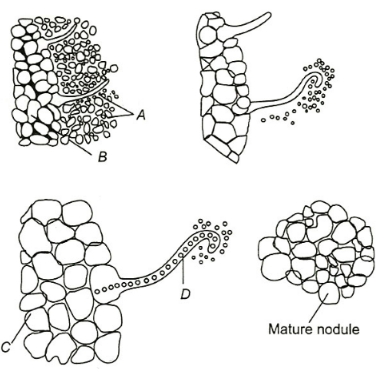
Identify the $A$ to $D$ correctly in the given diagram of root nodule development and choose the correct option accordingly.
A
$A-$ Rhizobial bacteria,$B-$ Cortex cell,$C-$ Outer cortex,$D-$ Infection thread
B
$A-$ Rhizobial bacteria,$B-$ Cortex cell,$C-$ Inner cortex,$D-$ Infection thread
C
$A-$ Rhizobial bacteria,$B-$ Endodermal cell,$C-$ Inner endodermis,$D-$ Infection thread
D
$A-$ Nitrosomonas bacteria,$B-$ Cortex cell,$C-$ Inner cortex,$D-$ Infection thread
Solution
(B) The diagram illustrates the process of root nodule formation in leguminous plants.
$A$ represents the Rhizobial bacteria that accumulate around the root hair.
$B$ represents the cortical cells of the root.
$C$ represents the inner cortex where the bacteria are released to initiate nodule formation.
$D$ represents the infection thread through which the bacteria travel into the root cortex.
Therefore,the correct identification is $A-$ Rhizobial bacteria,$B-$ Cortex cell,$C-$ Inner cortex,$D-$ Infection thread.
$A$ represents the Rhizobial bacteria that accumulate around the root hair.
$B$ represents the cortical cells of the root.
$C$ represents the inner cortex where the bacteria are released to initiate nodule formation.
$D$ represents the infection thread through which the bacteria travel into the root cortex.
Therefore,the correct identification is $A-$ Rhizobial bacteria,$B-$ Cortex cell,$C-$ Inner cortex,$D-$ Infection thread.
0 likes
View Solution74
MediumMCQ
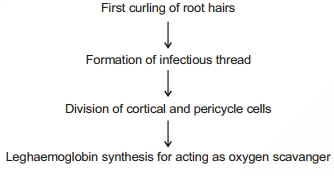
Mark the correct sequence of steps for the development of root nodules in legumes:
$a.$ Formation of infection thread.
$b.$ Division of cortical and pericyclic cells.
$c.$ Curling of root hairs.
$d.$ Leghaemoglobin synthesis.
$a.$ Formation of infection thread.
$b.$ Division of cortical and pericyclic cells.
$c.$ Curling of root hairs.
$d.$ Leghaemoglobin synthesis.
A
$a, c, b, d$
B
$b, d, a, c$
C
$c, b, a, d$
D
$c, a, b, d$
Solution
(D) The process of root nodule formation in legumes involves the following sequential steps:
$1$. First,the bacteria colonize the root surface and cause the curling of root hairs $(c)$.
$2$. This is followed by the formation of an infection thread that carries the bacteria into the cortex of the root $(a)$.
$3$. The bacteria then reach the inner cortex and pericycle,triggering the division of cortical and pericyclic cells,which leads to nodule formation $(b)$.
$4$. Finally,the nodule matures and leghaemoglobin is synthesized to act as an oxygen scavenger,creating an anaerobic environment for nitrogenase activity $(d)$.
Therefore,the correct sequence is $c, a, b, d$.
$1$. First,the bacteria colonize the root surface and cause the curling of root hairs $(c)$.
$2$. This is followed by the formation of an infection thread that carries the bacteria into the cortex of the root $(a)$.
$3$. The bacteria then reach the inner cortex and pericycle,triggering the division of cortical and pericyclic cells,which leads to nodule formation $(b)$.
$4$. Finally,the nodule matures and leghaemoglobin is synthesized to act as an oxygen scavenger,creating an anaerobic environment for nitrogenase activity $(d)$.
Therefore,the correct sequence is $c, a, b, d$.
0 likes
View Solution75
EasyMCQ
The pigment leghaemoglobin is present in the roots of
A
Maize
B
Rice
C
Alfalfa
D
Potato
Solution
(C) Leghaemoglobin is an oxygen-scavenging pigment found in the root nodules of leguminous plants. Among the given options,$Alfalfa$ (Medicago sativa) is a legume,and therefore,its root nodules contain leghaemoglobin to protect the nitrogenase enzyme from oxygen.
0 likes
View Solution76
EasyMCQ
Leghemoglobin is found in which one of the following organisms?
A
Anthoceros
B
Aulosira
C
Nostoc
D
Groundnut
Solution
(D) Leghemoglobin is an oxygen-scavenging pigment found in the root nodules of leguminous plants, such as groundnut $(Arachis hypogaea)$. It creates an anaerobic environment necessary for the activity of the enzyme nitrogenase, which is responsible for biological nitrogen fixation.
0 likes
View Solution77
MediumMCQ
Select the correct statements from the given:
$(a)$ Nitrogenase is a heterodimeric protein.
$(b)$ Root hairs curl by action of nitrogenase and plant 'nod factors'.
$(c)$ During symbiotic $N_2$ fixation,$ATP$ is provided by the legume plant.
$(a)$ Nitrogenase is a heterodimeric protein.
$(b)$ Root hairs curl by action of nitrogenase and plant 'nod factors'.
$(c)$ During symbiotic $N_2$ fixation,$ATP$ is provided by the legume plant.
A
$(b), (c)$
B
$(a), (c)$
C
only $(c)$
D
$(a), (b)$
Solution
(B) Statement $(a)$ is correct: Nitrogenase is a heterodimeric protein consisting of two subunits,$Mo-Fe$ protein and $Fe$ protein.
Statement $(b)$ is incorrect: Root hair curling is caused by the interaction between bacterial 'nod factors' and plant root hair receptors,not by nitrogenase.
Statement $(c)$ is correct: During symbiotic $N_2$ fixation,the host legume plant provides the necessary $ATP$ and carbon source to the bacteria for the energy-intensive process of nitrogen fixation.
Therefore,statements $(a)$ and $(c)$ are correct.
Statement $(b)$ is incorrect: Root hair curling is caused by the interaction between bacterial 'nod factors' and plant root hair receptors,not by nitrogenase.
Statement $(c)$ is correct: During symbiotic $N_2$ fixation,the host legume plant provides the necessary $ATP$ and carbon source to the bacteria for the energy-intensive process of nitrogen fixation.
Therefore,statements $(a)$ and $(c)$ are correct.
0 likes
View Solution78
MediumMCQ
$A$: Bacteria enter only the polyploid cells of the root cortex.
$R$: These cells provide cytokinins to bacteria,which promote bacterial cell division.
$R$: These cells provide cytokinins to bacteria,which promote bacterial cell division.
A
Assertion and Reason both are correct and Reason is the correct explanation of Assertion.
B
Assertion and Reason both are correct but Reason is not the correct explanation of Assertion.
C
Assertion is correct,but Reason is incorrect.
D
Both Assertion and Reason are incorrect.
Solution
(C) The assertion is correct because,during the process of root nodule formation in legumes,the bacteria (e.g.,$Rhizobium$) specifically infect and enter the polyploid cells of the root cortex.
However,the reason is incorrect because it is the bacteria that produce cytokinins,which in turn induce polyploidy in the host plant cells,rather than the host cells providing cytokinins to the bacteria to promote bacterial cell division.
However,the reason is incorrect because it is the bacteria that produce cytokinins,which in turn induce polyploidy in the host plant cells,rather than the host cells providing cytokinins to the bacteria to promote bacterial cell division.
0 likes
View Solution79
MediumMCQ
Quite often,pulse crops are not manured with nitrogenous fertilizers. This is because:
A
These do not require nitrogen
B
These do not need nitrates or nitrites
C
These have nodulated roots
D
These do not have nodulated roots
Solution
(C) Pulse crops belong to the family $Fabaceae$ (legumes).
These plants have a symbiotic relationship with nitrogen-fixing bacteria such as $Rhizobium$.
These bacteria reside in the root nodules of the plants.
They convert atmospheric nitrogen into ammonia,which the plant can utilize for growth.
Therefore,because of these nodulated roots,pulse crops can fix their own nitrogen and do not require external nitrogenous fertilizers.
These plants have a symbiotic relationship with nitrogen-fixing bacteria such as $Rhizobium$.
These bacteria reside in the root nodules of the plants.
They convert atmospheric nitrogen into ammonia,which the plant can utilize for growth.
Therefore,because of these nodulated roots,pulse crops can fix their own nitrogen and do not require external nitrogenous fertilizers.
0 likes
View Solution80
MediumMCQ
Which of the following are the part or example of symbiotic mutualistic association?
$I.$ Yeast
$II.$ Rhizobium
$III.$ Mycorrhiza
$IV.$ Oscillatoria
$I.$ Yeast
$II.$ Rhizobium
$III.$ Mycorrhiza
$IV.$ Oscillatoria
A
$I$ and $II$
B
$I$ and $III$
C
$II$ and $III$
D
$III$ and $IV$
Solution
(C) Mycorrhiza and Rhizobium both show symbiotic mutualistic association.
In the Mycorrhizal association,fungi form a symbiotic relationship with the roots of higher plants. The fungi help the plant in the absorption of phosphorus and other nutrients from the soil,while the plant provides the fungi with carbohydrates (glucose) produced through photosynthesis.
Rhizobium is a nitrogen-fixing bacterium that forms a symbiotic relationship with the roots of leguminous plants. The bacteria reside in root nodules,where they fix atmospheric nitrogen into a form usable by the plant. In exchange,the plant provides the bacteria with carbohydrates and a protected environment.
In the Mycorrhizal association,fungi form a symbiotic relationship with the roots of higher plants. The fungi help the plant in the absorption of phosphorus and other nutrients from the soil,while the plant provides the fungi with carbohydrates (glucose) produced through photosynthesis.
Rhizobium is a nitrogen-fixing bacterium that forms a symbiotic relationship with the roots of leguminous plants. The bacteria reside in root nodules,where they fix atmospheric nitrogen into a form usable by the plant. In exchange,the plant provides the bacteria with carbohydrates and a protected environment.
0 likes
View Solution81
MediumMCQ
Which of the following is not a symbiotic nitrogen-fixing bacterium?
A
Clostridium
B
Rhizobium leguminosarum
C
Frankia
D
Mycobacterium
Solution
(A) $Rhizobium$ and $Frankia$ are well-known symbiotic nitrogen-fixing bacteria. $Rhizobium$ forms nodules in the roots of leguminous plants,while $Frankia$ forms symbiotic associations with the root nodules of non-leguminous plants like $Alnus$. $Clostridium$ is a free-living,anaerobic,nitrogen-fixing bacterium. $Mycobacterium$ is not involved in nitrogen fixation. Therefore,among the given options,$Clostridium$ is the correct answer as it is free-living,not symbiotic.
0 likes
View Solution82
Medium
Explain the stages of root nodule formation.
Solution
(N/A) The process of root nodule formation occurs in the following stages:
$1$. $Rhizobia$ multiply and colonize the surroundings of roots,attaching themselves to epidermal and root hair cells. The root hairs curl,and the bacteria invade the root hair.
$2$. An infection thread is produced,carrying the bacteria into the cortex of the root,where they initiate nodule formation.
$3$. The bacteria are then released from the infection thread into the cortical cells.
$4$. This leads to the differentiation of specialized nitrogen-fixing cells. The nodule thus formed establishes a direct vascular connection with the host for the exchange of nutrients.
$1$. $Rhizobia$ multiply and colonize the surroundings of roots,attaching themselves to epidermal and root hair cells. The root hairs curl,and the bacteria invade the root hair.
$2$. An infection thread is produced,carrying the bacteria into the cortex of the root,where they initiate nodule formation.
$3$. The bacteria are then released from the infection thread into the cortical cells.
$4$. This leads to the differentiation of specialized nitrogen-fixing cells. The nodule thus formed establishes a direct vascular connection with the host for the exchange of nutrients.
0 likes
View Solution83
EasyMCQ
The given organism is symbiotic with the roots of $Alnus$ plants.
A
Anabaena
B
Nostoc
C
Rhizobium
D
Frankia
Solution
(D) The actinomycete $Frankia$ is a nitrogen-fixing bacterium that forms a symbiotic relationship with the roots of non-leguminous plants such as $Alnus$ (Alder).
It induces the formation of root nodules in these plants,where it fixes atmospheric nitrogen into ammonia,which the plant can utilize for growth.
$Anabaena$ and $Nostoc$ are cyanobacteria,while $Rhizobium$ is typically associated with leguminous plants.
It induces the formation of root nodules in these plants,where it fixes atmospheric nitrogen into ammonia,which the plant can utilize for growth.
$Anabaena$ and $Nostoc$ are cyanobacteria,while $Rhizobium$ is typically associated with leguminous plants.
0 likes
View Solution84
MediumMCQ
What type of bacteria are $Rhizobium$ and $Frankia$?
A
Symbiotic only
B
Free-living only
C
Symbiotic and free-living
D
None of these
Solution
(C) $Rhizobium$ and $Frankia$ are nitrogen-fixing bacteria.
$Rhizobium$ is a symbiotic bacterium that forms root nodules in leguminous plants.
$Frankia$ is also a symbiotic bacterium that produces nitrogen-fixing nodules on the roots of non-leguminous plants like $Alnus$.
Both of these bacteria can also exist in a free-living state in the soil,where they are capable of nitrogen fixation,although they are primarily known for their symbiotic associations.
$Rhizobium$ is a symbiotic bacterium that forms root nodules in leguminous plants.
$Frankia$ is also a symbiotic bacterium that produces nitrogen-fixing nodules on the roots of non-leguminous plants like $Alnus$.
Both of these bacteria can also exist in a free-living state in the soil,where they are capable of nitrogen fixation,although they are primarily known for their symbiotic associations.
0 likes
View Solution85
MediumMCQ
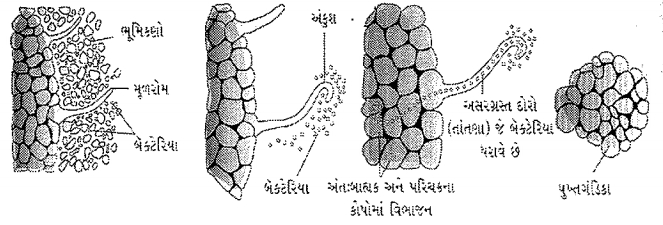
Which kingdom of organisms is responsible for the development shown in the plant below?
A
Monera
B
Protista
C
Fungi
D
Animalia
Solution
(A) The image illustrates the process of root nodule formation in leguminous plants.
This process involves a symbiotic relationship between the plant roots and nitrogen-fixing bacteria,such as $Rhizobium$.
$Rhizobium$ belongs to the kingdom $Monera$ as it is a prokaryotic organism.
Therefore,the correct kingdom responsible for this development is $Monera$.
This process involves a symbiotic relationship between the plant roots and nitrogen-fixing bacteria,such as $Rhizobium$.
$Rhizobium$ belongs to the kingdom $Monera$ as it is a prokaryotic organism.
Therefore,the correct kingdom responsible for this development is $Monera$.
0 likes
View Solution86
MediumMCQ
Arrange the stages of root nodule formation in the correct sequence:
$I-$ Infection thread is produced.
$II-$ Bacteria are carried to the cortex of the root.
$III-$ Bacteria attach to the root hair.
$IV-$ Bacteria are released from the thread into the cells.
$V-$ Differentiation into nitrogen-fixing cells occurs.
$I-$ Infection thread is produced.
$II-$ Bacteria are carried to the cortex of the root.
$III-$ Bacteria attach to the root hair.
$IV-$ Bacteria are released from the thread into the cells.
$V-$ Differentiation into nitrogen-fixing cells occurs.
A
$III \rightarrow II \rightarrow I \rightarrow IV \rightarrow V$
B
$III \rightarrow II \rightarrow I \rightarrow V \rightarrow IV$
C
$III \rightarrow I \rightarrow II \rightarrow IV \rightarrow V$
D
$III \rightarrow I \rightarrow II \rightarrow V \rightarrow IV$
Solution
(C) The process of root nodule formation occurs in the following sequence:
$1$. $III-$ Bacteria attach to the root hair and epidermal cells.
$2$. $I-$ The root hair curls and an infection thread is produced.
$3$. $II-$ The infection thread carries the bacteria into the cortex of the root.
$4$. $IV-$ The bacteria are released from the thread into the cortical cells.
$5$. $V-$ The bacteria differentiate into specialized nitrogen-fixing cells (bacteroids) and the nodule is formed.
Thus,the correct sequence is $III \rightarrow I \rightarrow II \rightarrow IV \rightarrow V$.
$1$. $III-$ Bacteria attach to the root hair and epidermal cells.
$2$. $I-$ The root hair curls and an infection thread is produced.
$3$. $II-$ The infection thread carries the bacteria into the cortex of the root.
$4$. $IV-$ The bacteria are released from the thread into the cortical cells.
$5$. $V-$ The bacteria differentiate into specialized nitrogen-fixing cells (bacteroids) and the nodule is formed.
Thus,the correct sequence is $III \rightarrow I \rightarrow II \rightarrow IV \rightarrow V$.
0 likes
View Solution87
EasyMCQ
The anaerobic condition for nitrogen fixation is maintained by ..........
A
Nitrogenase
B
Hemoglobin
C
Leghemoglobin
D
Hydrogenase
Solution
(C) Nitrogen fixation is carried out by the enzyme $Nitrogenase$,which is highly sensitive to molecular oxygen $(O_2)$.
In the root nodules of leguminous plants,the anaerobic environment required for the activity of $Nitrogenase$ is maintained by a pigment called $Leghemoglobin$.
$Leghemoglobin$ acts as an oxygen scavenger,binding to $O_2$ and preventing it from inactivating the $Nitrogenase$ enzyme complex.
In the root nodules of leguminous plants,the anaerobic environment required for the activity of $Nitrogenase$ is maintained by a pigment called $Leghemoglobin$.
$Leghemoglobin$ acts as an oxygen scavenger,binding to $O_2$ and preventing it from inactivating the $Nitrogenase$ enzyme complex.
0 likes
View Solution88
MediumMCQ
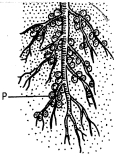
Which bacteria are present in the structure shown below?
A
Rhizobium
B
Azospirillum
C
Nostoc
D
Anabaena
Solution
(A) The image shows root nodules on the roots of leguminous plants.
These nodules are formed due to a symbiotic association between the roots of leguminous plants and the nitrogen-fixing bacteria $Rhizobium$.
$Rhizobium$ bacteria infect the roots of leguminous plants,leading to the formation of root nodules,which are the sites of biological nitrogen fixation.
Therefore,the correct option is $A$.
These nodules are formed due to a symbiotic association between the roots of leguminous plants and the nitrogen-fixing bacteria $Rhizobium$.
$Rhizobium$ bacteria infect the roots of leguminous plants,leading to the formation of root nodules,which are the sites of biological nitrogen fixation.
Therefore,the correct option is $A$.
0 likes
View Solution89
EasyMCQ
Which of the following protects nitrogenase inside the root nodule of a leguminous plant?
A
Catalase
B
Leghemoglobin
C
Transaminase
D
Glutamate dehydrogenase
Solution
(B) The enzyme $Nitrogenase$,which is responsible for biological nitrogen fixation,is highly sensitive to molecular oxygen $(O_2)$.
In leguminous plants,the root nodules contain a pink-colored pigment called $Leghemoglobin$.
$Leghemoglobin$ acts as an oxygen scavenger,binding to $O_2$ and maintaining a low oxygen concentration within the nodule.
This low oxygen environment is essential to protect the $Nitrogenase$ enzyme from oxidative damage,allowing it to function efficiently in the process of nitrogen fixation.
In leguminous plants,the root nodules contain a pink-colored pigment called $Leghemoglobin$.
$Leghemoglobin$ acts as an oxygen scavenger,binding to $O_2$ and maintaining a low oxygen concentration within the nodule.
This low oxygen environment is essential to protect the $Nitrogenase$ enzyme from oxidative damage,allowing it to function efficiently in the process of nitrogen fixation.
0 likes
View Solution90
EasyMCQ
With reference to the root nodules shown in the following diagram,select the correct option.
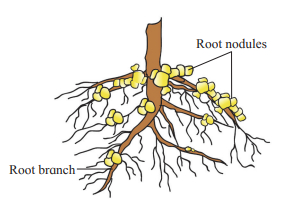
A
Galls containing Anabaena
B
Root nodules having Rhizobium phaseoli
C
Root nodules having Rhizobium leguminosarum
D
Galls containing Azospirillum
Solution
(C) The diagram shows the root system of a leguminous plant with root nodules.
Root nodules are symbiotic structures formed on the roots of leguminous plants by nitrogen-fixing bacteria.
$Rhizobium$ species are the most common bacteria involved in this symbiotic relationship.
Specifically,$Rhizobium$ $leguminosarum$ is a well-known species that forms root nodules in leguminous plants to fix atmospheric nitrogen.
Therefore,the correct option is $C$.
Root nodules are symbiotic structures formed on the roots of leguminous plants by nitrogen-fixing bacteria.
$Rhizobium$ species are the most common bacteria involved in this symbiotic relationship.
Specifically,$Rhizobium$ $leguminosarum$ is a well-known species that forms root nodules in leguminous plants to fix atmospheric nitrogen.
Therefore,the correct option is $C$.
0 likes
View Solution91
EasyMCQ
Symbiotic nitrogen-fixing bacterium is . . . . . . .
A
Nitrosomonas
B
Nitrosococcus
C
Nitrobacter
D
Rhizobium
Solution
(D) The process of biological nitrogen fixation involves the conversion of atmospheric nitrogen into ammonia.
$Rhizobium$ is a well-known symbiotic bacterium that lives in the root nodules of leguminous plants and fixes atmospheric nitrogen.
$Rhizobium$ is a well-known symbiotic bacterium that lives in the root nodules of leguminous plants and fixes atmospheric nitrogen.
| $Nitrosomonas, Nitrosococcus$ | Convert ammonia into nitrite. |
| $Nitrobacter$ | Convert nitrite into nitrate. |
0 likes
View SolutionMineral Nutrition — Symbiotic biological nitrogen fixation · Frequently Asked Questions
1Are these Mineral Nutrition questions useful for JEE and NEET?
Yes. All questions in this section are mapped to JEE Main and NEET exam patterns. Previous year questions from JEE Main, NEET, GUJCET and state-level exams are included with full solutions.
2Can I switch to Hindi or Gujarati for these questions?
Yes. Use the language tabs in the hero section or the sidebar to view the same questions and solutions in English, Hindi or Gujarati.
3How do I generate a question paper from this subtopic?
Use the Vedclass Exam Paper Generator — select the chapter and subtopic, set difficulty, and generate Sets A, B, C, D automatically. First 3 chapters of every subject are free.
Vedclass Products
For Students
Vedclass Test Series
Mock tests in real JEE/NEET style with performance analysis. 5-day free trial.
Start Free TrialFor Teachers
Exam Paper Generator
Generate Set A/B/C/D papers from this chapter in 2 minutes. 3 chapters free.
Try FreeFor Institutes
Online Exam Module
Live online exams with unlimited students, 360° analytics & white-label branding.
See DemoFor Teachers & Institutes
Generate a Mineral Nutrition Exam Paper in 2 Minutes
Select subtopic & difficulty — Sets A, B, C, D auto-generated with No Repeat logic.
First 3 chapters of every subject are free — no payment required.