
A English
Biological Nitrogen Fixation Questions in English
Class 11 Biology · Mineral Nutrition · Biological Nitrogen Fixation
159+
Questions
English
Language
100%
With Solutions
Showing 50 of 159 questions in English
101
MediumMCQ
If all $Nitrogenase$ enzymes are destroyed by radiation,what will not occur?
A
Nitrogen fixation by leguminous plants will not occur.
B
Nitrogen fixation in the atmosphere will not occur.
C
Conversion of nitrate to nitrite in leguminous plants will not occur.
D
Conversion of ammonium to nitrate in the soil will not occur.
Solution
(A) $Nitrogenase$ is a critical enzyme complex responsible for the biological nitrogen fixation process,where atmospheric $N_2$ is converted into ammonia $(NH_3)$.
This process is primarily carried out by diazotrophic bacteria,such as $Rhizobium$,which live in symbiotic association with the root nodules of leguminous plants.
If $Nitrogenase$ enzymes are destroyed,the biological reduction of atmospheric nitrogen cannot take place.
Therefore,leguminous plants will be unable to fix atmospheric nitrogen into a usable form.
This process is primarily carried out by diazotrophic bacteria,such as $Rhizobium$,which live in symbiotic association with the root nodules of leguminous plants.
If $Nitrogenase$ enzymes are destroyed,the biological reduction of atmospheric nitrogen cannot take place.
Therefore,leguminous plants will be unable to fix atmospheric nitrogen into a usable form.
0 likes
View Solution102
MediumMCQ
If all the $Nitrogenase$ enzymes are inactivated by radiation,then which of the following will not occur?
A
Nitrogen fixation in legume plants
B
Nitrogen fixation in the atmosphere
C
Conversion of nitrate to nitrite in legume plants
D
Conversion of ammonium to nitrate in the soil
Solution
(A) The enzyme $Nitrogenase$ is essential for the process of biological nitrogen fixation,where atmospheric $N_2$ is converted into $NH_3$ (ammonia).
Legume plants form a symbiotic relationship with $Rhizobium$ bacteria,which contain the $Nitrogenase$ enzyme to fix atmospheric nitrogen.
If $Nitrogenase$ is inactivated,the plant will be unable to perform biological nitrogen fixation.
Therefore,nitrogen fixation in legume plants will not occur.
Legume plants form a symbiotic relationship with $Rhizobium$ bacteria,which contain the $Nitrogenase$ enzyme to fix atmospheric nitrogen.
If $Nitrogenase$ is inactivated,the plant will be unable to perform biological nitrogen fixation.
Therefore,nitrogen fixation in legume plants will not occur.
0 likes
View Solution103
EasyMCQ
Which element plays an important role in nitrogen fixation?
A
$Mn$
B
$Mo$
C
$Zn$
D
$Cu$
Solution
(B) Molybdenum $(Mo)$ is a crucial micronutrient that plays an essential role in nitrogen fixation.
It is a key component of the enzyme nitrogenase,which is responsible for the reduction of atmospheric nitrogen to ammonia in leguminous plants.
Plants typically require molybdenum in concentrations ranging from $0.1$ to $2.5 \, ppm$ in their tissues for normal growth and metabolic processes.
The availability of molybdenum in the soil is highly dependent on soil type,being highest in organic soils,lower in clay soils,and least in sandy soils.
It is a key component of the enzyme nitrogenase,which is responsible for the reduction of atmospheric nitrogen to ammonia in leguminous plants.
Plants typically require molybdenum in concentrations ranging from $0.1$ to $2.5 \, ppm$ in their tissues for normal growth and metabolic processes.
The availability of molybdenum in the soil is highly dependent on soil type,being highest in organic soils,lower in clay soils,and least in sandy soils.
0 likes
View Solution104
MediumMCQ
The function of leghaemoglobin during biological nitrogen fixation in root nodules of legumes is to
A
convert atmospheric $N_2$ to $NH_3$
B
convert ammonia to nitrite
C
transport oxygen for activity of nitrogenase
D
protect nitrogenase from oxygen
Solution
(D) Leghaemoglobin acts as an oxygen scavenger in the root nodules of legumes.
It has a high affinity for oxygen and binds with it,thereby maintaining a low oxygen concentration in the nodule.
This is essential because the enzyme nitrogenase,which is responsible for biological nitrogen fixation,is highly sensitive to oxygen and functions only under anaerobic conditions.
It has a high affinity for oxygen and binds with it,thereby maintaining a low oxygen concentration in the nodule.
This is essential because the enzyme nitrogenase,which is responsible for biological nitrogen fixation,is highly sensitive to oxygen and functions only under anaerobic conditions.
0 likes
View Solution105
Medium
Explain: Biological Nitrogen Fixation.
Solution
(N/A) Definition: The reduction of nitrogen to ammonia by living organisms is called biological nitrogen fixation.
Explanation: Very few living organisms can utilize the nitrogen in the form of $N_{2}$,which is available abundantly in the air.
Only certain prokaryotic species are capable of fixing nitrogen. Thus,nitrogen is reduced into ammonia. This process is exclusively found in prokaryotic organisms. These microbes are called $N_{2}$ fixers.
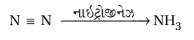
$N \equiv N \xrightarrow{\text{Nitrogenase}} NH_{3}$
The nitrogen-fixing microbes could be free-living or symbiotic. Examples of free-living nitrogen-fixing aerobic microbes are $Azotobacter$ and $Beijerinckia$. While $Rhodospirillum$ is anaerobic and $Bacillus$ is free-living.
$A$ number of cyanobacteria such as $Anabaena$ and $Nostoc$ are also free-living nitrogen fixers.
Symbiotic Biological Nitrogen Fixation: Several types of symbiotic biological nitrogen-fixing associations are known. The most prominent among them is the legume-bacteria relationship.
Species of rod-shaped $Rhizobium$ have such a relationship with the roots of several legumes such as alfalfa,sweet clover,sweet pea,lentils,garden pea,broad bean,clover beans,etc.
The most common association on roots is in the form of nodules. These nodules are small outgrowths on roots. The microbe,$Frankia$,also produces nitrogen-fixing nodules on the roots of non-leguminous plants (e.g.,$Alnus$).
Both $Rhizobium$ and $Frankia$ are free-living in the soil,but as symbionts,they can fix atmospheric nitrogen.
Explanation: Very few living organisms can utilize the nitrogen in the form of $N_{2}$,which is available abundantly in the air.
Only certain prokaryotic species are capable of fixing nitrogen. Thus,nitrogen is reduced into ammonia. This process is exclusively found in prokaryotic organisms. These microbes are called $N_{2}$ fixers.
$N \equiv N \xrightarrow{\text{Nitrogenase}} NH_{3}$
The nitrogen-fixing microbes could be free-living or symbiotic. Examples of free-living nitrogen-fixing aerobic microbes are $Azotobacter$ and $Beijerinckia$. While $Rhodospirillum$ is anaerobic and $Bacillus$ is free-living.
$A$ number of cyanobacteria such as $Anabaena$ and $Nostoc$ are also free-living nitrogen fixers.
Symbiotic Biological Nitrogen Fixation: Several types of symbiotic biological nitrogen-fixing associations are known. The most prominent among them is the legume-bacteria relationship.
Species of rod-shaped $Rhizobium$ have such a relationship with the roots of several legumes such as alfalfa,sweet clover,sweet pea,lentils,garden pea,broad bean,clover beans,etc.
The most common association on roots is in the form of nodules. These nodules are small outgrowths on roots. The microbe,$Frankia$,also produces nitrogen-fixing nodules on the roots of non-leguminous plants (e.g.,$Alnus$).
Both $Rhizobium$ and $Frankia$ are free-living in the soil,but as symbionts,they can fix atmospheric nitrogen.
0 likes
View Solution106
Medium
Explain the process/mechanism of biological nitrogen fixation.
Solution
(N/A) $ \Rightarrow $ The root nodule contains all the necessary biochemical components such as the enzyme nitrogenase and leg-haemoglobin.
$ \Rightarrow $ The nitrogenase enzyme is a $Mo-Fe$ protein and catalyzes the conversion of atmospheric nitrogen to ammonia.
$ \Rightarrow $ Ammonia is the first stable product of nitrogen fixation.
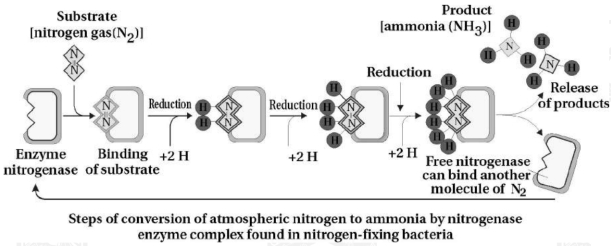
$ \Rightarrow $ The steps of conversion of atmospheric nitrogen to ammonia by the nitrogenase enzyme complex found in nitrogen-fixing bacteria are shown in the figure.
$ \Rightarrow $ The overall chemical reaction is as follows: $N_{2} + 8e^{-} + 8H^{+} + 16ATP \rightarrow 2NH_{3} + H_{2} + 16ADP + 16Pi$
$ \Rightarrow $ The enzyme nitrogenase is highly sensitive to molecular oxygen. It requires anaerobic conditions to function.
$ \Rightarrow $ To protect these enzymes from oxygen, the nodule contains an oxygen scavenger called leg-haemoglobin.
$ \Rightarrow $ It is interesting to note that these microbes live as aerobes under free-living conditions (where nitrogenase is not operational), but during nitrogen-fixing events, they become anaerobic (thus protecting the nitrogenase enzyme).
$ \Rightarrow $ As per the equation, the ammonia synthesis by nitrogenase requires a very high input of energy ($8ATP$ for each $NH_{3}$ produced).
$ \Rightarrow $ The energy required is obtained from the respiration of the host cells.
$ \Rightarrow $ The nitrogenase enzyme is a $Mo-Fe$ protein and catalyzes the conversion of atmospheric nitrogen to ammonia.
$ \Rightarrow $ Ammonia is the first stable product of nitrogen fixation.
$ \Rightarrow $ The steps of conversion of atmospheric nitrogen to ammonia by the nitrogenase enzyme complex found in nitrogen-fixing bacteria are shown in the figure.
$ \Rightarrow $ The overall chemical reaction is as follows: $N_{2} + 8e^{-} + 8H^{+} + 16ATP \rightarrow 2NH_{3} + H_{2} + 16ADP + 16Pi$
$ \Rightarrow $ The enzyme nitrogenase is highly sensitive to molecular oxygen. It requires anaerobic conditions to function.
$ \Rightarrow $ To protect these enzymes from oxygen, the nodule contains an oxygen scavenger called leg-haemoglobin.
$ \Rightarrow $ It is interesting to note that these microbes live as aerobes under free-living conditions (where nitrogenase is not operational), but during nitrogen-fixing events, they become anaerobic (thus protecting the nitrogenase enzyme).
$ \Rightarrow $ As per the equation, the ammonia synthesis by nitrogenase requires a very high input of energy ($8ATP$ for each $NH_{3}$ produced).
$ \Rightarrow $ The energy required is obtained from the respiration of the host cells.
0 likes
View Solution107
Easy
Provide definitions/explanations for the following terms:
$(1)$ Biological Nitrogen Fixation
$(2)$ Root Nodules
$(1)$ Biological Nitrogen Fixation
$(2)$ Root Nodules
Solution
(N/A) $(1)$ The process of reduction of atmospheric nitrogen $(N_2)$ into ammonia $(NH_3)$ by living organisms is known as biological nitrogen fixation.
$(2)$ Root nodules are small,rounded outgrowths or swellings found on the roots of leguminous plants,which house nitrogen-fixing bacteria such as $Rhizobium$.
$(2)$ Root nodules are small,rounded outgrowths or swellings found on the roots of leguminous plants,which house nitrogen-fixing bacteria such as $Rhizobium$.
0 likes
View Solution108
Medium
Name the most crucial enzyme found in root nodules for $N_2$ fixation. Does it require a special pink-coloured pigment for its functioning? Elaborate.
Solution
(N/A) The most crucial enzyme found in root nodules for $N_2$ fixation is Nitrogenase.
Nitrogenase is a Mo-Fe protein that catalyzes the conversion of atmospheric nitrogen $(N_2)$ into ammonia $(NH_3)$.
Yes,it requires a special pink-coloured pigment called leghaemoglobin for its functioning.
Nitrogenase is highly sensitive to molecular oxygen $(O_2)$.
Leghaemoglobin acts as an oxygen scavenger,creating an anaerobic (oxygen-free) environment within the root nodules,which is essential for the activity of the nitrogenase enzyme.
Nitrogenase is a Mo-Fe protein that catalyzes the conversion of atmospheric nitrogen $(N_2)$ into ammonia $(NH_3)$.
Yes,it requires a special pink-coloured pigment called leghaemoglobin for its functioning.
Nitrogenase is highly sensitive to molecular oxygen $(O_2)$.
Leghaemoglobin acts as an oxygen scavenger,creating an anaerobic (oxygen-free) environment within the root nodules,which is essential for the activity of the nitrogenase enzyme.
0 likes
View Solution109
Advanced
We find that $Rhizobium$ forms nodules on the roots of leguminous plants. Also,$Frankia$,another microbe,forms nitrogen-fixing nodules on the roots of the non-leguminous plant $Alnus$. Can we artificially induce the property of nitrogen fixation in a plant,whether leguminous or non-leguminous?
Solution
(N/A) Scientists have attempted to adopt artificial methods to induce nitrogen fixation in both leguminous and non-leguminous plants. However,the success rate is very low because the genetic makeup and the specific host-microbe signaling pathways play a critical and complex role in the formation of functional nitrogen-fixing nodules.
0 likes
View Solution110
MediumMCQ
Analogy type questions:
$(1)$ Reduction of nitrogen to ammonia : Biological nitrogen fixation : Nitrogenase : ........
$(2)$ Free-living bacteria : Rhodospirillum : Free-living blue-green algae : ........
$(1)$ Reduction of nitrogen to ammonia : Biological nitrogen fixation : Nitrogenase : ........
$(2)$ Free-living bacteria : Rhodospirillum : Free-living blue-green algae : ........
A
$1$: Nitrogen reduction,$2$: Anabaena
B
$1$: Nitrogen oxidation,$2$: Nostoc
C
$1$: Nitrogen fixation,$2$: Rhizobium
D
$1$: Denitrification,$2$: Azotobacter
Solution
(A) $(1)$ The process of converting atmospheric nitrogen into ammonia is known as biological nitrogen fixation,which is catalyzed by the enzyme nitrogenase. Therefore,the missing term is nitrogen reduction.
$(2)$ Rhodospirillum is an example of a free-living nitrogen-fixing bacterium. Similarly,Anabaena or Nostoc are examples of free-living nitrogen-fixing blue-green algae (cyanobacteria).
$(2)$ Rhodospirillum is an example of a free-living nitrogen-fixing bacterium. Similarly,Anabaena or Nostoc are examples of free-living nitrogen-fixing blue-green algae (cyanobacteria).
0 likes
View Solution111
Medium
Nitrogen fixation is shown by prokaryotes and not eukaryotes. Comment.
Solution
(N/A) $1$. Nitrogen fixation is a biological process exclusively performed by certain prokaryotes because they possess the specialized enzyme complex known as $Nitrogenase$.
$2$. Examples of such prokaryotes include $Rhizobium$,$Anabaena$,and $Nostoc$.
$3$. Eukaryotic organisms lack the genetic machinery to synthesize the $Nitrogenase$ enzyme complex; therefore,they are incapable of performing biological nitrogen fixation independently.
$2$. Examples of such prokaryotes include $Rhizobium$,$Anabaena$,and $Nostoc$.
$3$. Eukaryotic organisms lack the genetic machinery to synthesize the $Nitrogenase$ enzyme complex; therefore,they are incapable of performing biological nitrogen fixation independently.
0 likes
View Solution112
EasyMCQ
The product$(s)$ of the reaction catalyzed by nitrogenase in the root nodules of leguminous plants is/are:
A
Ammonia and hydrogen
B
Ammonia alone
C
Nitrate alone
D
Ammonia and oxygen
Solution
(A) The enzyme nitrogenase catalyzes the biological nitrogen fixation process in the root nodules of leguminous plants. The chemical reaction is represented as: $N_2 + 8e^- + 8H^+ + 16ATP \rightarrow 2NH_3 + H_2 + 16ADP + 16Pi$. As shown in the equation,the products of this reaction are ammonia $(NH_3)$ and hydrogen $(H_2)$.
0 likes
View Solution113
MediumMCQ
The enzyme nitrogenase,present in the root nodules of leguminous plants,catalyzes the conversion of atmospheric nitrogen into which of the following products?
A
Only ammonia
B
Only nitrate
C
Ammonia and oxygen
D
Ammonia and hydrogen
Solution
(D) The enzyme nitrogenase is responsible for biological nitrogen fixation in the root nodules of leguminous plants.
The chemical reaction catalyzed by nitrogenase is: $N_2 + 8e^- + 8H^+ + 16ATP \rightarrow 2NH_3 + H_2 + 16ADP + 16Pi$.
As shown in the equation,the products of this reaction are ammonia $(NH_3)$ and hydrogen $(H_2)$.
The chemical reaction catalyzed by nitrogenase is: $N_2 + 8e^- + 8H^+ + 16ATP \rightarrow 2NH_3 + H_2 + 16ADP + 16Pi$.
As shown in the equation,the products of this reaction are ammonia $(NH_3)$ and hydrogen $(H_2)$.
0 likes
View Solution114
MediumMCQ
Which of the following organisms is a nitrogen fixer?
A
Rhizobium
B
Trichoderma
C
Azospirillum
D
Azotobacter
Solution
(A) Nitrogen fixation is the process of converting atmospheric nitrogen $(N_2)$ into ammonia $(NH_3)$,which can be utilized by plants.
$Rhizobium$,$Azospirillum$,and $Azotobacter$ are all well-known nitrogen-fixing bacteria.
However,in the context of multiple-choice questions where one must identify the most representative answer or if the question implies a single choice among options that are all correct,it is important to note that $Rhizobium$ is a symbiotic nitrogen fixer,while $Azospirillum$ and $Azotobacter$ are free-living nitrogen fixers.
Since $Rhizobium$,$Azospirillum$,and $Azotobacter$ are all nitrogen fixers,this question is technically flawed as it contains multiple correct options.
Assuming the question asks for a common example,$Rhizobium$ is the most classic example taught in textbooks.
$Rhizobium$,$Azospirillum$,and $Azotobacter$ are all well-known nitrogen-fixing bacteria.
However,in the context of multiple-choice questions where one must identify the most representative answer or if the question implies a single choice among options that are all correct,it is important to note that $Rhizobium$ is a symbiotic nitrogen fixer,while $Azospirillum$ and $Azotobacter$ are free-living nitrogen fixers.
Since $Rhizobium$,$Azospirillum$,and $Azotobacter$ are all nitrogen fixers,this question is technically flawed as it contains multiple correct options.
Assuming the question asks for a common example,$Rhizobium$ is the most classic example taught in textbooks.
0 likes
View Solution115
MediumMCQ
How many of the following organisms are capable of nitrogen fixation?
Azospirillum, Glomus, Nostoc, Monascus purpureus, Yeast, Anabaena, Oscillatoria, Azotobacter, Trichoderma
Azospirillum, Glomus, Nostoc, Monascus purpureus, Yeast, Anabaena, Oscillatoria, Azotobacter, Trichoderma
A
$5$
B
$7$
C
$6$
D
$4$
Solution
(A) To determine the number of nitrogen-fixing organisms, let us analyze the list:
$1$. $Azospirillum$: Free-living nitrogen-fixing bacteria.
$2$. $Glomus$: A genus of arbuscular mycorrhizal fungi (not nitrogen-fixing).
$3$. $Nostoc$: Cyanobacteria capable of nitrogen fixation.
$4$. $Monascus \text{ } purpureus$: A fungus used for cholesterol-lowering statins (not nitrogen-fixing).
$5$. $Yeast$: A fungus used in fermentation (not nitrogen-fixing).
$6$. $Anabaena$: Cyanobacteria capable of nitrogen fixation.
$7$. $Oscillatoria$: Cyanobacteria capable of nitrogen fixation.
$8$. $Azotobacter$: Free-living nitrogen-fixing bacteria.
$9$. $Trichoderma$: A fungus used as a biocontrol agent (not nitrogen-fixing).
The nitrogen-fixing organisms are: $Azospirillum$, $Nostoc$, $Anabaena$, $Oscillatoria$, and $Azotobacter$.
Total count = $5$.
$1$. $Azospirillum$: Free-living nitrogen-fixing bacteria.
$2$. $Glomus$: A genus of arbuscular mycorrhizal fungi (not nitrogen-fixing).
$3$. $Nostoc$: Cyanobacteria capable of nitrogen fixation.
$4$. $Monascus \text{ } purpureus$: A fungus used for cholesterol-lowering statins (not nitrogen-fixing).
$5$. $Yeast$: A fungus used in fermentation (not nitrogen-fixing).
$6$. $Anabaena$: Cyanobacteria capable of nitrogen fixation.
$7$. $Oscillatoria$: Cyanobacteria capable of nitrogen fixation.
$8$. $Azotobacter$: Free-living nitrogen-fixing bacteria.
$9$. $Trichoderma$: A fungus used as a biocontrol agent (not nitrogen-fixing).
The nitrogen-fixing organisms are: $Azospirillum$, $Nostoc$, $Anabaena$, $Oscillatoria$, and $Azotobacter$.
Total count = $5$.
0 likes
View Solution116
EasyMCQ
The $nif$ gene is associated with which of the following?
A
Carbon fixation
B
Nitrogen fixation
C
Oxygen production
D
Both $A$ and $C$
Solution
(B) The $nif$ gene stands for 'nitrogen fixation' gene.
These genes are found in various bacteria,such as $Rhizobium$ and $Azotobacter$,which are capable of biological nitrogen fixation.
The $nif$ genes encode the enzymes (such as nitrogenase) required to convert atmospheric nitrogen $(N_2)$ into ammonia $(NH_3)$,a form usable by plants.
Therefore,the $nif$ gene is directly associated with nitrogen fixation.
These genes are found in various bacteria,such as $Rhizobium$ and $Azotobacter$,which are capable of biological nitrogen fixation.
The $nif$ genes encode the enzymes (such as nitrogenase) required to convert atmospheric nitrogen $(N_2)$ into ammonia $(NH_3)$,a form usable by plants.
Therefore,the $nif$ gene is directly associated with nitrogen fixation.
0 likes
View Solution117
MediumMCQ
Find out a set of common $N_2$ fixing fodder plants.
A
$Trifolium$,$Atropa$
B
$Withania$,$Abrus$
C
$Sesbania$,$Trifolium$
D
$Aloe$,$Gloriosa$
Solution
(C) $Sesbania$ and $Trifolium$ are well-known leguminous plants that possess root nodules containing nitrogen-fixing bacteria. These plants are widely used as high-quality fodder for livestock.
0 likes
View Solution118
EasyMCQ
Which of the following genes is responsible for biological nitrogen fixation?
A
Nitrogenase
B
Nif gene
C
Yeast alanine $tRNA$ synthetase
D
$RNA$ synthetase
Solution
(B) The $nif$ gene (nitrogen fixation gene) is responsible for biological nitrogen fixation.
This gene encodes the proteins required for the synthesis of the nitrogenase enzyme complex,which catalyzes the conversion of atmospheric nitrogen $(N_2)$ into ammonia $(NH_3)$.
This gene encodes the proteins required for the synthesis of the nitrogenase enzyme complex,which catalyzes the conversion of atmospheric nitrogen $(N_2)$ into ammonia $(NH_3)$.
0 likes
View Solution119
EasyMCQ
Enzyme nitrogenase is responsible for
A
Nitrification
B
Nitrogen fixation
C
Nitrite reduction
D
Nitrate reduction
Solution
(B) The fixation of atmospheric nitrogen into ammonia in the root nodules of leguminous plants is catalyzed by the enzyme complex known as 'nitrogenase'.
This enzyme is a molybdenum-iron protein complex consisting of two components: $protein-1$ (dinitrogenase) and $protein-2$ (dinitrogenase reductase).
The active nitrogenase complex functions effectively in the presence of these two components,typically in a specific ratio,to convert $N_2$ into $NH_3$.
This enzyme is a molybdenum-iron protein complex consisting of two components: $protein-1$ (dinitrogenase) and $protein-2$ (dinitrogenase reductase).
The active nitrogenase complex functions effectively in the presence of these two components,typically in a specific ratio,to convert $N_2$ into $NH_3$.
0 likes
View Solution120
EasyMCQ
For nitrogen fixation,the useful pigment is
A
Nitrogenase
B
Haemoglobin
C
Myoglobin
D
Leghaemoglobin
Solution
(D) Leghaemoglobin is a red,oxygen-binding,iron-containing protein pigment present in the root nodules of leguminous plants.
It is essential for nitrogen fixation because it acts as an oxygen scavenger (or oxygen buffer).
It maintains a low concentration of free oxygen within the nodule,which is necessary to protect the enzyme $Nitrogenase$ from oxidative damage,as $Nitrogenase$ is highly sensitive to oxygen.
It is essential for nitrogen fixation because it acts as an oxygen scavenger (or oxygen buffer).
It maintains a low concentration of free oxygen within the nodule,which is necessary to protect the enzyme $Nitrogenase$ from oxidative damage,as $Nitrogenase$ is highly sensitive to oxygen.
0 likes
View Solution121
EasyMCQ
Molybdenum is the essential constituent of
A
Nitrogenase
B
Respiratory chain
C
Growth regulators
D
Chlorophyll
Solution
(A) The enzyme $Nitrogenase$ is essential for biological nitrogen fixation.
It is a metalloprotein that contains molybdenum as a cofactor.
Therefore,molybdenum is an indispensable element for the process of nitrogen fixation in plants.
It is a metalloprotein that contains molybdenum as a cofactor.
Therefore,molybdenum is an indispensable element for the process of nitrogen fixation in plants.
0 likes
View Solution122
EasyMCQ
Which enzyme is involved in nitrogen metabolism?
A
Phosphoenol pyruvate carboxylase
B
Ribulose bisphosphate carboxylase oxygenase
C
Nitrogenase
D
Alcohol dehydrogenase
Solution
(C) Nitrogenase is the key enzyme involved in biological nitrogen fixation,which is a critical process in nitrogen metabolism. It catalyzes the conversion of atmospheric nitrogen $(N_2)$ into ammonia $(NH_3)$.
0 likes
View Solution123
EasyMCQ
The enzyme responsible for the reduction of molecular nitrogen to the level of ammonia in leguminous root nodule is
A
Nitrogenase
B
Nitrate reductase
C
Nitrite reductase
D
Hydrogenase
Solution
(A) The enzyme responsible for biological nitrogen fixation is known as nitrogenase.
This enzyme complex is found in the root nodules of leguminous plants and catalyzes the conversion of atmospheric nitrogen $(N_2)$ into ammonia $(NH_3)$.
The nitrogenase enzyme complex consists of two components: the $Fe$-protein (dinitrogenase reductase) and the $Mo-Fe$ protein (dinitrogenase).
The $Fe$-protein contains an iron-sulphur cluster ($4Fe$ and $4S$) which participates in the redox reactions required for the reduction process.
This enzyme complex is found in the root nodules of leguminous plants and catalyzes the conversion of atmospheric nitrogen $(N_2)$ into ammonia $(NH_3)$.
The nitrogenase enzyme complex consists of two components: the $Fe$-protein (dinitrogenase reductase) and the $Mo-Fe$ protein (dinitrogenase).
The $Fe$-protein contains an iron-sulphur cluster ($4Fe$ and $4S$) which participates in the redox reactions required for the reduction process.
0 likes
View Solution124
MediumMCQ
Identify the non-leguminous plants that form nodules to fix nitrogen.
A
Alnus
B
Casuarina
C
Xanthomonas
D
$A$ અને $B$
Solution
(D) Nitrogen fixation is a process carried out by certain microorganisms. While legumes are well-known for forming root nodules with $Rhizobium$,some non-leguminous plants also form symbiotic associations with nitrogen-fixing bacteria. $Alnus$ and $Casuarina$ are classic examples of non-leguminous plants that form root nodules to fix atmospheric nitrogen in association with the actinomycete $Frankia$. $Xanthomonas$ is a genus of bacteria,but it is not a plant. Therefore,the question contains an error in the options provided. However,based on the context of non-leguminous nitrogen-fixing plants,$Alnus$ and $Casuarina$ are correct.
0 likes
View Solution125
MediumMCQ
The function of leghaemoglobin during biological nitrogen fixation in root nodules of legumes is to
A
Convert atmospheric nitrogen to ammonia
B
Convert ammonia to nitrite
C
Transport oxygen for activity of nitrogenase
D
Protect nitrogenase from oxygen
Solution
(D) Biological nitrogen fixation is carried out by the enzyme nitrogenase,which is highly sensitive to molecular oxygen.
In the root nodules of leguminous plants,leghaemoglobin acts as an oxygen scavenger.
It binds to oxygen and maintains a low oxygen concentration in the nodules,thereby protecting the nitrogenase enzyme from oxidative damage and ensuring its functional activity.
In the root nodules of leguminous plants,leghaemoglobin acts as an oxygen scavenger.
It binds to oxygen and maintains a low oxygen concentration in the nodules,thereby protecting the nitrogenase enzyme from oxidative damage and ensuring its functional activity.
0 likes
View Solution126
MediumMCQ
Which of the following reactions shows nitrogen fixation?
A
$2 NH_{4}^{+} + 2 O_{2} + 8 e^{-} \rightarrow N_{2} + 4 H_{2}O$
B
$2 NH_{3} \rightarrow N_{2} + 3 H_{2}$
C
$N_{2} + 8 H^{+} + 8 e^{-} + 16 ATP \rightarrow 2 NH_{3} + H_{2} + 16 ADP + 16 Pi$
D
$2 N_{2} + \text{Glucose} \rightarrow 2 \text{Amino acids}$
Solution
(C) Nitrogen fixation is the process of converting atmospheric nitrogen $(N_{2})$ into ammonia $(NH_{3})$,which can be utilized by plants.
The biological nitrogen fixation reaction is represented as:
$N_{2} + 8 H^{+} + 8 e^{-} + 16 ATP \rightarrow 2 NH_{3} + H_{2} + 16 ADP + 16 Pi$
This process is catalyzed by the enzyme nitrogenase,which is found in certain prokaryotes like cyanobacteria and Rhizobium.
The biological nitrogen fixation reaction is represented as:
$N_{2} + 8 H^{+} + 8 e^{-} + 16 ATP \rightarrow 2 NH_{3} + H_{2} + 16 ADP + 16 Pi$
This process is catalyzed by the enzyme nitrogenase,which is found in certain prokaryotes like cyanobacteria and Rhizobium.
0 likes
View Solution127
MediumMCQ
$N_{2} + 8e^{-} + 8H^{+} \rightarrow 2NH_{3} + H_{2}$
The above equation refers to:
The above equation refers to:
A
Ammonification
B
Nitrification
C
Nitrogen fixation
D
Denitrification
Solution
(C) The equation $N_{2} + 8e^{-} + 8H^{+} \rightarrow 2NH_{3} + H_{2}$ represents the biological nitrogen fixation process.
In this process,the enzyme nitrogenase catalyzes the reduction of atmospheric dinitrogen $(N_{2})$ into ammonia $(NH_{3})$.
This is a crucial step in the nitrogen cycle where inert atmospheric nitrogen is converted into a form that can be utilized by living organisms.
In this process,the enzyme nitrogenase catalyzes the reduction of atmospheric dinitrogen $(N_{2})$ into ammonia $(NH_{3})$.
This is a crucial step in the nitrogen cycle where inert atmospheric nitrogen is converted into a form that can be utilized by living organisms.
0 likes
View Solution128
MediumMCQ
If by radiation all nitrogenase enzymes are inactivated,then there will be no
A
Fixation of nitrogen in legumes
B
Fixation of atmospheric nitrogen
C
Conversion from nitrate to nitrite in legumes
D
Conversion from ammonium to nitrate in soil
Solution
(A) The enzyme nitrogenase is essential for the process of biological nitrogen fixation,which is the conversion of atmospheric $N_2$ into ammonia $(NH_3)$.
Legumes form a symbiotic relationship with bacteria like $Rhizobium$,which utilize the nitrogenase enzyme to fix atmospheric nitrogen into a form usable by the plant.
If all nitrogenase enzymes are inactivated,the biological fixation of nitrogen in legumes will be completely halted.
While other forms of nitrogen fixation (like industrial or electrical) exist,the specific biological process mediated by nitrogenase in legumes would cease.
Legumes form a symbiotic relationship with bacteria like $Rhizobium$,which utilize the nitrogenase enzyme to fix atmospheric nitrogen into a form usable by the plant.
If all nitrogenase enzymes are inactivated,the biological fixation of nitrogen in legumes will be completely halted.
While other forms of nitrogen fixation (like industrial or electrical) exist,the specific biological process mediated by nitrogenase in legumes would cease.
0 likes
View Solution129
MediumMCQ
Which of the following gene clusters in bacteria is responsible for nitrogen fixation?
A
$Nod, nif, fix$
B
$Nod, ndf, nfx$
C
$Nod, nix, nfx$
D
$Ndx, nif, fix$
Solution
(A) The process of biological nitrogen fixation in bacteria,particularly in symbiotic rhizobia,is controlled by specific gene clusters.
$1$. $Nod$ genes: These genes are responsible for the nodulation process,which includes root hair curling,infection thread formation,and nodule development.
$2$. $nif$ genes: These genes encode the enzymes (such as nitrogenase) and regulatory proteins required for the actual reduction of atmospheric nitrogen $(N_2)$ into ammonia $(NH_3)$.
$3$. $fix$ genes: These genes are involved in the regulation and maintenance of the symbiotic nitrogen-fixing state,particularly in the bacteroid form within the nodule.
Therefore,the correct cluster of genes involved in these processes is $Nod, nif, fix$.
$1$. $Nod$ genes: These genes are responsible for the nodulation process,which includes root hair curling,infection thread formation,and nodule development.
$2$. $nif$ genes: These genes encode the enzymes (such as nitrogenase) and regulatory proteins required for the actual reduction of atmospheric nitrogen $(N_2)$ into ammonia $(NH_3)$.
$3$. $fix$ genes: These genes are involved in the regulation and maintenance of the symbiotic nitrogen-fixing state,particularly in the bacteroid form within the nodule.
Therefore,the correct cluster of genes involved in these processes is $Nod, nif, fix$.
0 likes
View Solution130
MediumMCQ
How many $ATP$ are required for the formation of one molecule of $NH_3$ by the nitrogenase enzyme?
A
Six
B
Eight
C
Twelve
D
Sixteen
Solution
(B) The biological nitrogen fixation reaction catalyzed by the nitrogenase enzyme is represented as follows:
$N_2 + 8e^- + 8H^+ + 16ATP \longrightarrow 2NH_3 + H_2 + 16ADP + 16Pi$
From the stoichiometry of the equation,it is evident that $16$ molecules of $ATP$ are required for the production of $2$ molecules of $NH_3$.
Therefore,for the formation of $1$ molecule of $NH_3$,the number of $ATP$ required is $16 / 2 = 8$ $ATP$ molecules.
$N_2 + 8e^- + 8H^+ + 16ATP \longrightarrow 2NH_3 + H_2 + 16ADP + 16Pi$
From the stoichiometry of the equation,it is evident that $16$ molecules of $ATP$ are required for the production of $2$ molecules of $NH_3$.
Therefore,for the formation of $1$ molecule of $NH_3$,the number of $ATP$ required is $16 / 2 = 8$ $ATP$ molecules.
0 likes
View Solution131
EasyMCQ
Which of the following is a non-symbiotic nitrogen-fixing prokaryote?
A
Frankia
B
Azotobacter
C
Acetobacter
D
Rhizobium
Solution
(B) $Azotobacter$ is a free-living,aerobic,non-symbiotic nitrogen-fixing bacterium. It fixes atmospheric nitrogen while living independently in the soil. In contrast,$Rhizobium$ and $Frankia$ are symbiotic nitrogen fixers.
0 likes
View Solution132
EasyMCQ
The enzyme nitrogenase is:
A
$A$ $Cu-Fe$ protein
B
Found in prokaryotes only
C
An $O_2$ requiring enzyme
D
Essential to convert $NO_{2}^{-}$ to $NO_{3}^{-}$
Solution
(B) The enzyme nitrogenase is a $Mo-Fe$ protein complex that catalyzes the reduction of atmospheric nitrogen $(N_{2})$ to ammonia $(NH_{3})$. This enzyme is highly sensitive to molecular oxygen $(O_{2})$ and is found exclusively in prokaryotes (such as $Rhizobium$,$Azotobacter$,etc.). Therefore,the correct statement is that it is found in prokaryotes only.
0 likes
View Solution133
MediumMCQ
The function of leghaemoglobin during $N_2$-fixation is
A
To convert $N_2$ to $NH_3$
B
To convert $NH_3$ to $N_2$
C
To supply $O_2$ for nitrogenase activity
D
To protect nitrogenase from oxygen
Solution
(D) Leghaemoglobin $(LHb)$ is a red pigment found in the root nodules of leguminous plants.
Nitrogenase,the enzyme responsible for $N_2$-fixation,is highly sensitive to molecular oxygen $(O_2)$ and is inactivated by it.
$LHb$ acts as an oxygen scavenger,binding to $O_2$ and maintaining a low oxygen concentration in the nodule environment.
This protects the nitrogenase enzyme from the inhibitory effects of oxygen,allowing the fixation process to proceed efficiently.
Nitrogenase,the enzyme responsible for $N_2$-fixation,is highly sensitive to molecular oxygen $(O_2)$ and is inactivated by it.
$LHb$ acts as an oxygen scavenger,binding to $O_2$ and maintaining a low oxygen concentration in the nodule environment.
This protects the nitrogenase enzyme from the inhibitory effects of oxygen,allowing the fixation process to proceed efficiently.
0 likes
View Solution134
EasyMCQ
The given equation refers to:
$N_{2} + 8e^{-} + 8H^{+} + 16ATP \rightarrow 2NH_{3} + H_{2} + 16ADP + 16P_{i}$
$N_{2} + 8e^{-} + 8H^{+} + 16ATP \rightarrow 2NH_{3} + H_{2} + 16ADP + 16P_{i}$
A
Ammonification
B
Nitrification
C
Denitrification
D
Nitrogen fixation
Solution
(D) The given equation represents the biological nitrogen fixation process,which is catalyzed by the enzyme nitrogenase.
In this process,atmospheric nitrogen $(N_{2})$ is reduced to ammonia $(NH_{3})$ using energy in the form of $ATP$ and electrons.
This reaction is a critical step in the nitrogen cycle,allowing atmospheric nitrogen to be converted into a form that plants can utilize.
In this process,atmospheric nitrogen $(N_{2})$ is reduced to ammonia $(NH_{3})$ using energy in the form of $ATP$ and electrons.
This reaction is a critical step in the nitrogen cycle,allowing atmospheric nitrogen to be converted into a form that plants can utilize.
0 likes
View Solution135
MediumMCQ
Select the incorrect statement with respect to the biological nitrogen fixation by Rhizobium.
A
Nitrogenase may require oxygen for its functioning.
B
Nitrogenase is a $Mo-Fe$ protein.
C
Leg-haemoglobin is a pink-coloured pigment.
D
Nitrogenase helps to convert $N_2$ gas into two molecules of ammonia.
Solution
(A) The enzyme nitrogenase is highly sensitive to molecular oxygen and requires anaerobic conditions for its functioning. Therefore,the statement that nitrogenase requires oxygen for its functioning is incorrect. Leg-haemoglobin acts as an oxygen scavenger to create these anaerobic conditions in the root nodules.
0 likes
View Solution136
EasyMCQ
Which of the following is/are diazotrophs?
A
Rhizobium and Azotobacter
B
Frankia and Klebsiella
C
Anabaena and Nostoc
D
All of these
Solution
(D) Diazotrophs are organisms that can fix atmospheric nitrogen into a usable form such as ammonia.
$Rhizobium$ and $Azotobacter$ are well-known nitrogen-fixing bacteria.
$Frankia$ and $Klebsiella$ also possess the ability to fix atmospheric nitrogen.
$Anabaena$ and $Nostoc$ are cyanobacteria that fix nitrogen in specialized cells called heterocysts.
Therefore,all the listed organisms are diazotrophs.
$Rhizobium$ and $Azotobacter$ are well-known nitrogen-fixing bacteria.
$Frankia$ and $Klebsiella$ also possess the ability to fix atmospheric nitrogen.
$Anabaena$ and $Nostoc$ are cyanobacteria that fix nitrogen in specialized cells called heterocysts.
Therefore,all the listed organisms are diazotrophs.
0 likes
View Solution137
MediumMCQ
Which is not true for nitrogenase enzyme in root nodules in legumes?
A
Synthesized by $nif$ genes of $Rhizobium$
B
Site of reduction of $N_2$ into $NH_3$
C
It is a $Mo-Fe$ protein
D
Resistant to $O_2$ conc.
Solution
(D) The nitrogenase enzyme is highly sensitive to molecular oxygen $(O_2)$.
It is not resistant to oxygen concentration.
In root nodules,the enzyme requires an anaerobic environment to function effectively,which is maintained by the protein leghemoglobin that acts as an oxygen scavenger.
Therefore,the statement that it is resistant to $O_2$ concentration is incorrect.
It is not resistant to oxygen concentration.
In root nodules,the enzyme requires an anaerobic environment to function effectively,which is maintained by the protein leghemoglobin that acts as an oxygen scavenger.
Therefore,the statement that it is resistant to $O_2$ concentration is incorrect.
0 likes
View Solution138
MediumMCQ
How many electrons and protons are required to fix a molecule of dinitrogen $(N_2)$ (in each)?
A
$32$
B
$8$
C
$16$
D
$4$
Solution
(B) The biological nitrogen fixation process is catalyzed by the enzyme nitrogenase. The overall equation for the reduction of one molecule of dinitrogen $(N_2)$ is:
$N_2 + 8e^- + 8H^+ + 16ATP \rightarrow 2NH_3 + H_2 + 16ADP + 16Pi$
According to this equation, the reduction of one molecule of $N_2$ requires $8$ electrons and $8$ protons.
$N_2 + 8e^- + 8H^+ + 16ATP \rightarrow 2NH_3 + H_2 + 16ADP + 16Pi$
According to this equation, the reduction of one molecule of $N_2$ requires $8$ electrons and $8$ protons.
0 likes
View Solution139
EasyMCQ
The nitrogenase enzyme found in the root nodules of legumes contains:
A
$Mo, Mn, S$
B
$Co, Mo, Ca$
C
$Mo, Fe, S$
D
$Mo, B, S$
Solution
(C) The nitrogenase enzyme is a complex metalloprotein responsible for biological nitrogen fixation. It consists of two components: the $Fe$ protein (dinitrogenase reductase) and the $Mo-Fe$ protein (dinitrogenase). The active site of the enzyme contains a molybdenum-iron cofactor $(MoFeCo)$,which includes molybdenum $(Mo)$,iron $(Fe)$,and sulfur $(S)$ atoms. Therefore,the correct composition is $Mo, Fe, S$.
0 likes
View Solution140
MediumMCQ
Ureides are preferred forms for storage and transport of nitrogen in
A
Triticum aestivum
B
Solanum nigrum
C
Glycine max
D
Allium cepa
Solution
(C) Ureides are organic compounds that have a very high nitrogen to carbon ratio. They are the preferred forms for the storage and transport of nitrogen in certain leguminous plants,such as $Glycine \ max$ (Soybean). These compounds are synthesized in the root nodules during nitrogen fixation and then transported through the xylem to other parts of the plant.
0 likes
View Solution141
EasyMCQ
Nitrogen fixing genes are called
A
$Nif$ genes
B
Plasmid genes
C
Leg genes
D
$cos$ gene
Solution
(A) The genes responsible for nitrogen fixation in bacteria (such as $Rhizobium$) are known as $Nif$ genes (Nitrogen fixation genes).
These genes encode the enzymes,specifically nitrogenase,required to convert atmospheric nitrogen into ammonia.
These genes encode the enzymes,specifically nitrogenase,required to convert atmospheric nitrogen into ammonia.
0 likes
View Solution142
EasyMCQ
Nif genes are a group of:
A
$15$ genes
B
$15$ nucleotides
C
$15$ proteins
D
$10$ genes
Solution
(A) The $nif$ genes (nitrogen fixation genes) are a cluster of genes found in many bacteria,such as $Klebsiella\; pneumoniae$ and $Azotobacter$,that are responsible for nitrogen fixation.
These genes encode the enzymes required for the reduction of atmospheric nitrogen $(N_2)$ into ammonia $(NH_3)$.
The $nif$ gene cluster in $Klebsiella\; pneumoniae$ consists of $17$ genes organized into $7$ or $8$ operons,but historically and in many textbook contexts,it is often referred to as a group of $15$ genes involved in the nitrogenase complex and its regulation.
Therefore,the most appropriate answer among the given options is $15$ genes.
These genes encode the enzymes required for the reduction of atmospheric nitrogen $(N_2)$ into ammonia $(NH_3)$.
The $nif$ gene cluster in $Klebsiella\; pneumoniae$ consists of $17$ genes organized into $7$ or $8$ operons,but historically and in many textbook contexts,it is often referred to as a group of $15$ genes involved in the nitrogenase complex and its regulation.
Therefore,the most appropriate answer among the given options is $15$ genes.
0 likes
View Solution143
MediumMCQ
$A$ farmer adds Azotobacter culture to soil before sowing maize. Which mineral element is being replenished?
A
Phosphorus
B
Nitrogen
C
Potassium
D
Iron
Solution
(B) $\Rightarrow$ Azotobacter is a free-living,nitrogen-fixing bacterium found in the soil.
$\Rightarrow$ It converts atmospheric nitrogen into ammonia,which can be absorbed by plants.
$\Rightarrow$ By adding Azotobacter culture to the soil,the farmer is enhancing the biological nitrogen fixation process.
$\Rightarrow$ Therefore,the mineral element being replenished in the soil is Nitrogen.
$\Rightarrow$ It converts atmospheric nitrogen into ammonia,which can be absorbed by plants.
$\Rightarrow$ By adding Azotobacter culture to the soil,the farmer is enhancing the biological nitrogen fixation process.
$\Rightarrow$ Therefore,the mineral element being replenished in the soil is Nitrogen.
0 likes
View Solution144
MediumMCQ
What type of conditions are created by leghaemoglobin in the root nodule of a legume?
A
Aerobic conditions
B
Anaerobic conditions
C
Oxidative conditions
D
Neutral conditions
Solution
(B) $\Rightarrow$ Leghaemoglobin creates an anaerobic environment within the root nodules of leguminous plants.
It acts as an oxygen scavenger.
It binds with $O_{2}$ and protects the enzyme nitrogenase from the inhibitory effects of oxygen.
This allows the nitrogenase enzyme to efficiently fix atmospheric nitrogen into ammonia.
It acts as an oxygen scavenger.
It binds with $O_{2}$ and protects the enzyme nitrogenase from the inhibitory effects of oxygen.
This allows the nitrogenase enzyme to efficiently fix atmospheric nitrogen into ammonia.
0 likes
View Solution145
EasyMCQ
Name one non-symbiotic nitrogen-fixing prokaryote.
A
Azotobacter
B
Rhizobium
C
Frankia
D
Anabaena
Solution
(A) $Azotobacter$ is a well-known example of a free-living (non-symbiotic) nitrogen-fixing prokaryote.
It is a soil bacterium that fixes atmospheric nitrogen into ammonia independently,without forming a symbiotic relationship with plants.
It is commonly found in agricultural soils,such as paddy fields,where it contributes to soil fertility.
It is a soil bacterium that fixes atmospheric nitrogen into ammonia independently,without forming a symbiotic relationship with plants.
It is commonly found in agricultural soils,such as paddy fields,where it contributes to soil fertility.
0 likes
View Solution146
EasyMCQ
What is the composition of the enzyme nitrogenase?
A
Fe-$S$ protein
B
Mo-Fe protein
C
Cu-Fe protein
D
Mg-Fe protein
Solution
(B) $\Rightarrow$ The enzyme nitrogenase is a complex $Mo-Fe$ protein.
$\Rightarrow$ It is found in nitrogen-fixing microorganisms and is responsible for the reduction of atmospheric nitrogen $(N_2)$ to ammonia $(NH_3)$.
$\Rightarrow$ This enzyme is highly sensitive to molecular oxygen and requires anaerobic conditions for its activity.
$\Rightarrow$ It is found in nitrogen-fixing microorganisms and is responsible for the reduction of atmospheric nitrogen $(N_2)$ to ammonia $(NH_3)$.
$\Rightarrow$ This enzyme is highly sensitive to molecular oxygen and requires anaerobic conditions for its activity.
0 likes
View Solution147
EasyMCQ
Which one of the following produces nitrogen-fixing nodules on the roots of $Alnus$?
A
$Frankia$
B
$Rhodospirillum$
C
$Beijerinckia$
D
$Rhizobium$
Solution
(A) The microbe $Frankia$ is a filamentous bacterium that forms symbiotic nitrogen-fixing root nodules in non-leguminous plants such as $Alnus$ (alder).
$Rhizobium$ typically forms nodules in leguminous plants.
$Rhodospirillum$ is a photosynthetic nitrogen-fixing bacterium.
$Beijerinckia$ is a free-living nitrogen-fixing bacterium.
$Rhizobium$ typically forms nodules in leguminous plants.
$Rhodospirillum$ is a photosynthetic nitrogen-fixing bacterium.
$Beijerinckia$ is a free-living nitrogen-fixing bacterium.
0 likes
View Solution148
MediumMCQ
Categorize the following nitrogen-fixing microorganisms into symbiotic and free-living types:
$I-$ Rhizobium
$II-$ Azotobacter
$III-$ Beijerinckia
$IV-$ Rhodospirillum
$V-$ Frankia
$VI-$ Bacillus
$VII-$ Anabaena (free-living)
$VIII-$ Nostoc (symbiotic)
Select the correct grouping for (Symbiotic) and (Free-living) respectively.
$I-$ Rhizobium
$II-$ Azotobacter
$III-$ Beijerinckia
$IV-$ Rhodospirillum
$V-$ Frankia
$VI-$ Bacillus
$VII-$ Anabaena (free-living)
$VIII-$ Nostoc (symbiotic)
Select the correct grouping for (Symbiotic) and (Free-living) respectively.
A
$I, V, VIII \quad II, III, IV, VI, VII$
B
$II, III, IV, VI, VII \quad I, V, VIII$
C
$I, V, VII, VIII \quad II, III, IV, VI$
D
$I, III, IV, VI \quad I, V, VII, VIII$
Solution
(A) Nitrogen-fixing microorganisms are classified based on their association with plants:
$1.$ Symbiotic nitrogen fixers: These live in association with plants (e.g.,root nodules). Examples include $I-$ Rhizobium,$V-$ Frankia,and $VIII-$ Nostoc (when in symbiotic association).
$2.$ Free-living nitrogen fixers: These live independently in the soil. Examples include $II-$ Azotobacter,$III-$ Beijerinckia,$IV-$ Rhodospirillum,$VI-$ Bacillus,and $VII-$ Anabaena (when free-living).
Therefore,the correct grouping is (Symbiotic: $I, V, VIII$) and (Free-living: $II, III, IV, VI, VII$).
$1.$ Symbiotic nitrogen fixers: These live in association with plants (e.g.,root nodules). Examples include $I-$ Rhizobium,$V-$ Frankia,and $VIII-$ Nostoc (when in symbiotic association).
$2.$ Free-living nitrogen fixers: These live independently in the soil. Examples include $II-$ Azotobacter,$III-$ Beijerinckia,$IV-$ Rhodospirillum,$VI-$ Bacillus,and $VII-$ Anabaena (when free-living).
Therefore,the correct grouping is (Symbiotic: $I, V, VIII$) and (Free-living: $II, III, IV, VI, VII$).
0 likes
View Solution149
EasyMCQ
The enzyme nitrogenase is a $....................$.
A
$Mo - Fe$ containing polypeptide
B
$Mn - Fe$ containing polypeptide
C
$Mo - Fe$ containing polysaccharide
D
$Mn - Fe$ containing polysaccharide
Solution
(A) The enzyme nitrogenase,which is responsible for biological nitrogen fixation,is a complex protein. It is a $Mo - Fe$ (Molybdenum-Iron) containing protein,specifically a polypeptide. It catalyzes the conversion of atmospheric nitrogen $(N_2)$ into ammonia $(NH_3)$.
0 likes
View Solution150
MediumMCQ
Select the correct option for the fixation of $1$ molecule of ammonia.
A
$8$ molecules of $ATP$ are produced.
B
$8$ molecules of $ATP$ are consumed.
C
$16$ molecules of $ATP$ are produced.
D
$16$ molecules of $ATP$ are consumed.
Solution
(B) Biological nitrogen fixation is catalyzed by the enzyme nitrogenase. The overall equation for the reduction of $N_2$ to $NH_3$ is:
$N_2 + 8e^- + 8H^+ + 16ATP \rightarrow 2NH_3 + H_2 + 16ADP + 16Pi$.
According to this equation,the reduction of $1$ molecule of $N_2$ requires $16$ molecules of $ATP$ to produce $2$ molecules of $NH_3$.
Therefore,for the fixation of $1$ molecule of $NH_3$,$8$ molecules of $ATP$ are consumed.
$N_2 + 8e^- + 8H^+ + 16ATP \rightarrow 2NH_3 + H_2 + 16ADP + 16Pi$.
According to this equation,the reduction of $1$ molecule of $N_2$ requires $16$ molecules of $ATP$ to produce $2$ molecules of $NH_3$.
Therefore,for the fixation of $1$ molecule of $NH_3$,$8$ molecules of $ATP$ are consumed.
0 likes
View SolutionMineral Nutrition — Biological Nitrogen Fixation · Frequently Asked Questions
1Are these Mineral Nutrition questions useful for JEE and NEET?
Yes. All questions in this section are mapped to JEE Main and NEET exam patterns. Previous year questions from JEE Main, NEET, GUJCET and state-level exams are included with full solutions.
2Can I switch to Hindi or Gujarati for these questions?
Yes. Use the language tabs in the hero section or the sidebar to view the same questions and solutions in English, Hindi or Gujarati.
3How do I generate a question paper from this subtopic?
Use the Vedclass Exam Paper Generator — select the chapter and subtopic, set difficulty, and generate Sets A, B, C, D automatically. First 3 chapters of every subject are free.
Vedclass Products
For Students
Vedclass Test Series
Mock tests in real JEE/NEET style with performance analysis. 5-day free trial.
Start Free TrialFor Teachers
Exam Paper Generator
Generate Set A/B/C/D papers from this chapter in 2 minutes. 3 chapters free.
Try FreeFor Institutes
Online Exam Module
Live online exams with unlimited students, 360° analytics & white-label branding.
See DemoFor Teachers & Institutes
Generate a Mineral Nutrition Exam Paper in 2 Minutes
Select subtopic & difficulty — Sets A, B, C, D auto-generated with No Repeat logic.
First 3 chapters of every subject are free — no payment required.