
A English
Joints Questions in English
Class 11 Biology · Locomotion and Movement · Joints
118+
Questions
English
Language
100%
With Solutions
Showing 18 of 118 questions in English
101
MediumMCQ
This joint is made for power.
A
Joint between vertebrae
B
Mandibular joint
C
Knee joint
D
Suture in cranium
Solution
(B) Movement of organs occurs due to the pulling of bones caused by the force generated by contracting muscles.
The mandibular joint is designed for power, specifically during the $CLENCHING$ $OF$ $TEETH$.
It is a synovial joint formed between the head of the mandible and the mandibular fossa and articular tubercle of the temporal bone.
The mandibular joint is designed for power, specifically during the $CLENCHING$ $OF$ $TEETH$.
It is a synovial joint formed between the head of the mandible and the mandibular fossa and articular tubercle of the temporal bone.
0 likes
View Solution102
MediumMCQ
Which of the following pairs is correctly matched?
A
Cartilaginous Joint - Sutures between Cranial Bones
B
Hinge Joint - Between Successive Vertebrae
C
Fibrous Joint - Between Successive Phalanges
D
Gliding Joint - Between Zygapophyses of Vertebrae
Solution
(D) The correct match is the Gliding Joint between the zygapophyses of vertebrae.
In a gliding joint,the articular surfaces of the bones are flat or slightly curved,which allows the bones to slide or glide over each other.
Cartilaginous joints are found between adjacent vertebrae in the vertebral column,not in cranial sutures.
Hinge joints allow movement in one plane,such as in the elbow or between phalanges,not between vertebrae.
Fibrous joints are immovable joints found in the cranial sutures,not between phalanges.
In a gliding joint,the articular surfaces of the bones are flat or slightly curved,which allows the bones to slide or glide over each other.
Cartilaginous joints are found between adjacent vertebrae in the vertebral column,not in cranial sutures.
Hinge joints allow movement in one plane,such as in the elbow or between phalanges,not between vertebrae.
Fibrous joints are immovable joints found in the cranial sutures,not between phalanges.
0 likes
View Solution103
MediumMCQ
Synovial fluid is present in
A
Fibrous joints
B
Cartilaginous joints
C
Freely movable joints
D
Intervertebral joints
Solution
(C) Synovial fluid is present in freely movable joints,also known as synovial joints.
The synovial membrane secretes synovial fluid,which acts as a lubricant to reduce friction between the articulating surfaces of the bones.
Additionally,it provides nourishment to the articular cartilage.
The synovial membrane secretes synovial fluid,which acts as a lubricant to reduce friction between the articulating surfaces of the bones.
Additionally,it provides nourishment to the articular cartilage.
0 likes
View Solution104
MediumMCQ
Choose the correct statements.
A
Synovial joints are freely movable.
B
Ball and socket,and hinge joints are the synovial joints.
C
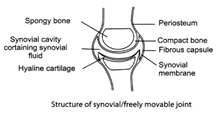
Synovial joints are characterized by a synovial cavity with fluid between the articulating surfaces of the two bones.
D
All of the above.
Solution
(D) Synovial joints are characterized by the presence of a fluid-filled synovial cavity between the articulating surfaces of the two bones. Such an arrangement allows for considerable movement. These joints are freely movable. Examples include ball and socket joints,hinge joints,pivot joints,gliding joints,and saddle joints. Therefore,all the given statements are correct.
0 likes
View Solution105
EasyMCQ
The joint present between radius and ulna is
A
Gliding joint
B
Saddle joint
C
Pivot joint
D
Angular joint
Solution
(C) Pivot joint: One bone rotates around another.
$e.g.$,radius over ulna.
Gliding joint: Two bones can glide over each other; surfaces are flat or curved.
$e.g.$,wrist / tarsal bones.
Saddle joint: The convex end of one bone fits into the saddle-like depression of the other bone.
$e.g.$,human thumb and carpals.
Angular joint: Allows movement in two planes.
$e.g.$,between metacarpals and phalanges.
$e.g.$,radius over ulna.
Gliding joint: Two bones can glide over each other; surfaces are flat or curved.
$e.g.$,wrist / tarsal bones.
Saddle joint: The convex end of one bone fits into the saddle-like depression of the other bone.
$e.g.$,human thumb and carpals.
Angular joint: Allows movement in two planes.
$e.g.$,between metacarpals and phalanges.
0 likes
View Solution106
MediumMCQ
$A$: Maximum movement is possible at the amphiarthroses joint.
$R$: Such joints are also called synovial joints and have almost frictionless movement due to synovial fluid.
$R$: Such joints are also called synovial joints and have almost frictionless movement due to synovial fluid.
A
Assertion and Reason both are correct and Reason is the correct explanation of Assertion.
B
Assertion and Reason both are correct but Reason is not the correct explanation of Assertion.
C
Assertion is correct,but Reason is incorrect.
D
Both Assertion and Reason are incorrect.
Solution
(C) The Assertion is incorrect because maximum movement is possible at the $diarthroses$ (synovial) joints,not $amphiarthroses$ joints.
$Amphiarthroses$ are cartilaginous joints that allow only limited or slight movement.
The Reason is correct because synovial joints contain synovial fluid,which acts as a lubricant to provide almost frictionless movement.
Therefore,the Assertion is incorrect,but the Reason is correct.
$Amphiarthroses$ are cartilaginous joints that allow only limited or slight movement.
The Reason is correct because synovial joints contain synovial fluid,which acts as a lubricant to provide almost frictionless movement.
Therefore,the Assertion is incorrect,but the Reason is correct.
0 likes
View Solution107
Medium
Describe the pubic symphysis.
Solution
(N/A) The pubic symphysis is a cartilaginous joint located at the midline of the body.
It is formed by the junction of the two halves of the pelvic girdle ventrally.
This joint contains fibrous cartilage,which provides limited movement and helps in absorbing shock during activities like walking or running.
It is formed by the junction of the two halves of the pelvic girdle ventrally.
This joint contains fibrous cartilage,which provides limited movement and helps in absorbing shock during activities like walking or running.
0 likes
View Solution108
MediumMCQ
Which of the following is present between the adjacent bones of the vertebral column?
A
Cartilage
B
Areolar tissue
C
Smooth muscle
D
Intercalated discs
Solution
(A) The vertebral column consists of several vertebrae that are connected by cartilaginous joints.
Specifically,the intervertebral discs,which are composed of fibrocartilage,are located between the adjacent vertebrae.
These discs act as shock absorbers and allow for limited movement of the vertebral column.
Therefore,cartilage is the tissue present between the adjacent bones of the vertebral column.
Specifically,the intervertebral discs,which are composed of fibrocartilage,are located between the adjacent vertebrae.
These discs act as shock absorbers and allow for limited movement of the vertebral column.
Therefore,cartilage is the tissue present between the adjacent bones of the vertebral column.
0 likes
View Solution109
MediumMCQ
Match the following columns:
| Column-$I$ | Column-$II$ |
| $P$. Fibrous joint | $I$. Immovable joint |
| $Q$. Cartilaginous joint | $II$. Slightly movable joint |
| $R$. Synovial joint | $III$. Freely movable joint |
A
$(P-II), (Q-I), (R-III)$
B
$(P-I), (Q-II), (R-III)$
C
$(P-I), (Q-III), (R-II)$
D
$(P-II), (Q-III), (R-I)$
Solution
(B) The joints are classified based on their mobility:
$1$. Fibrous joints $(P)$ do not allow any movement and are known as immovable joints $(I)$. Example: Sutures in the skull.
$2$. Cartilaginous joints $(Q)$ allow limited or slight movement due to the presence of cartilage between bones,known as slightly movable joints $(II)$. Example: Joints between adjacent vertebrae.
$3$. Synovial joints $(R)$ are characterized by a fluid-filled synovial cavity,allowing for significant movement,known as freely movable joints $(III)$. Example: Ball and socket joint,hinge joint.
Therefore,the correct matching is $(P-I), (Q-II), (R-III)$.
$1$. Fibrous joints $(P)$ do not allow any movement and are known as immovable joints $(I)$. Example: Sutures in the skull.
$2$. Cartilaginous joints $(Q)$ allow limited or slight movement due to the presence of cartilage between bones,known as slightly movable joints $(II)$. Example: Joints between adjacent vertebrae.
$3$. Synovial joints $(R)$ are characterized by a fluid-filled synovial cavity,allowing for significant movement,known as freely movable joints $(III)$. Example: Ball and socket joint,hinge joint.
Therefore,the correct matching is $(P-I), (Q-II), (R-III)$.
0 likes
View Solution110
MediumMCQ
Which type of joint is present between the frontal bone and the parietal bone?
A
Fibrous joint
B
Cartilaginous joint
C
Synovial joint
D
None of these
Solution
(A) The joint between the frontal bone and the parietal bone is a type of fibrous joint known as a suture.
Fibrous joints are characterized by the presence of dense fibrous connective tissue that holds the bones together.
These joints are immovable (synarthrosis) and provide protection to the brain by firmly interlocking the bones of the cranium.
Therefore,the correct option is $A$.
Fibrous joints are characterized by the presence of dense fibrous connective tissue that holds the bones together.
These joints are immovable (synarthrosis) and provide protection to the brain by firmly interlocking the bones of the cranium.
Therefore,the correct option is $A$.
0 likes
View Solution111
MediumMCQ
Which type of joint is present between the first and second vertebrae?
A
Fibrous joint
B
Cartilaginous joint
C
Synovial joint
D
All of the above
Solution
(C) The joint between the first vertebra (atlas) and the second vertebra (axis) is known as the atlanto-axial joint.
This joint is a type of pivot joint.
Pivot joints are a sub-category of synovial joints,which allow for rotational movement (such as shaking the head 'no').
Therefore,the correct answer is a synovial joint.
This joint is a type of pivot joint.
Pivot joints are a sub-category of synovial joints,which allow for rotational movement (such as shaking the head 'no').
Therefore,the correct answer is a synovial joint.
0 likes
View Solution112
MediumMCQ
Match the following columns:
| Column-$I$ (Joints) | Column-$II$ (Location) |
| $P$. Ball and socket joint | $I$. Elbow joint |
| $Q$. Hinge joint | $II$. Between carpals |
| $R$. Pivot joint | $III$. Between carpal and metacarpal of thumb |
| $S$. Gliding joint | $IV$. Between atlas and axis |
| $T$. Saddle joint | $V$. Between humerus and pectoral girdle |
A
$(P-I), (Q-V), (R-IV), (S-II), (T-III)$
B
$(P-V), (Q-I), (R-III), (S-IV), (T-II)$
C
$(P-V), (Q-I), (R-IV), (S-II), (T-III)$
D
$(P-V), (Q-I), (R-IV), (S-III), (T-II)$
Solution
(C) The correct matches are as follows:
$P$. Ball and socket joint is found between the humerus and pectoral girdle $(V)$.
$Q$. Hinge joint is found in the elbow $(I)$.
$R$. Pivot joint is found between the atlas and axis vertebrae $(IV)$.
$S$. Gliding joint is found between the carpals $(II)$.
$T$. Saddle joint is found between the carpal and metacarpal of the thumb $(III)$.
Therefore, the correct sequence is $(P-V), (Q-I), (R-IV), (S-II), (T-III)$.
$P$. Ball and socket joint is found between the humerus and pectoral girdle $(V)$.
$Q$. Hinge joint is found in the elbow $(I)$.
$R$. Pivot joint is found between the atlas and axis vertebrae $(IV)$.
$S$. Gliding joint is found between the carpals $(II)$.
$T$. Saddle joint is found between the carpal and metacarpal of the thumb $(III)$.
Therefore, the correct sequence is $(P-V), (Q-I), (R-IV), (S-II), (T-III)$.
0 likes
View Solution113
MediumMCQ
Which type of joint is characterized by the presence of a fluid-filled cavity?
A
Fibrous joint
B
Cartilaginous joint
C
Synovial joint
D
All of the above
Solution
(C) Synovial joints are characterized by the presence of a fluid-filled synovial cavity between the articulating surfaces of the two bones.
This fluid,known as synovial fluid,reduces friction between the articular cartilages and allows for considerable movement.
Fibrous joints do not allow any movement,and cartilaginous joints allow only limited movement; neither contains a fluid-filled cavity.
This fluid,known as synovial fluid,reduces friction between the articular cartilages and allows for considerable movement.
Fibrous joints do not allow any movement,and cartilaginous joints allow only limited movement; neither contains a fluid-filled cavity.
0 likes
View Solution114
MediumMCQ
Match List-$I$ with List-$II$.
Choose the correct answer from the options given below:
| List-$I$ | List-$II$ |
|---|---|
| $A$. Cartilaginous Joint | $I$. Between flat skull bones |
| $B$. Ball and Socket Joint | $II$. Between adjacent vertebrae in vertebral column |
| $C$. Fibrous Joint | $III$. Between carpal and metacarpal of thumb |
| $D$. Saddle Joint | $IV$. Between Humerus and Pectoral girdle |
Choose the correct answer from the options given below:
A
$A-II, B-IV, C-III, D-I$
B
$A-III, B-I, C-II, D-IV$
C
$A-II, B-IV, C-I, D-III$
D
$A-I, B-IV, C-III, D-II$
Solution
(C) The correct matching is as follows:
$A$. Cartilaginous Joint: These joints are found between adjacent vertebrae in the vertebral column $(A-II)$.
$B$. Ball and Socket Joint: This joint is found between the humerus and the pectoral girdle,allowing for rotational movement $(B-IV)$.
$C$. Fibrous Joint: These joints do not allow any movement and are found between the flat skull bones,which fuse end-to-end with the help of dense fibrous connective tissues $(C-I)$.
$D$. Saddle Joint: This joint is found between the carpal and metacarpal of the thumb,allowing for greater range of motion $(D-III)$.
Therefore,the correct sequence is $A-II, B-IV, C-I, D-III$.
$A$. Cartilaginous Joint: These joints are found between adjacent vertebrae in the vertebral column $(A-II)$.
$B$. Ball and Socket Joint: This joint is found between the humerus and the pectoral girdle,allowing for rotational movement $(B-IV)$.
$C$. Fibrous Joint: These joints do not allow any movement and are found between the flat skull bones,which fuse end-to-end with the help of dense fibrous connective tissues $(C-I)$.
$D$. Saddle Joint: This joint is found between the carpal and metacarpal of the thumb,allowing for greater range of motion $(D-III)$.
Therefore,the correct sequence is $A-II, B-IV, C-I, D-III$.
0 likes
View Solution115
MediumMCQ
Match List $I$ with List $II$ :
Choose the correct answer from the options given below:
| List $I$ | List $II$ |
| $A$. Fibrous joints | $I$. Adjacent vertebrae, limited movement |
| $B$. Cartilaginous joints | $II$. Humerus and Pectoral girdle, rotational movement |
| $C$. Hinge joints | $III$. Skull, don't allow any movement |
| $D$. Ball and socket joints | $IV$. Knee, help in locomotion |
Choose the correct answer from the options given below:
A
$A-I, B-III, C-II, D-IV$
B
$A-II, B-III, C-I, D-IV$
C
$A-III, B-I, C-IV, D-II$
D
$A-IV, B-II, C-III, D-I$
Solution
(C) The correct matching is:
- $A$. Fibrous joints: These joints do not allow any movement. They are found in the flat skull bones, which fuse end-to-end with the help of dense fibrous connective tissues in the form of sutures $(A-III)$.
- $B$. Cartilaginous joints: These joints are present between the adjacent vertebrae in the vertebral column and permit limited movements $(B-I)$.
- $C$. Hinge joints: This is a type of synovial joint present in the knee, which helps in locomotion $(C-IV)$.
- $D$. Ball and socket joints: This is a type of synovial joint present between the humerus and the pectoral girdle, allowing rotational movement $(D-II)$.
Therefore, the correct sequence is $A-III, B-I, C-IV, D-II$.
- $A$. Fibrous joints: These joints do not allow any movement. They are found in the flat skull bones, which fuse end-to-end with the help of dense fibrous connective tissues in the form of sutures $(A-III)$.
- $B$. Cartilaginous joints: These joints are present between the adjacent vertebrae in the vertebral column and permit limited movements $(B-I)$.
- $C$. Hinge joints: This is a type of synovial joint present in the knee, which helps in locomotion $(C-IV)$.
- $D$. Ball and socket joints: This is a type of synovial joint present between the humerus and the pectoral girdle, allowing rotational movement $(D-II)$.
Therefore, the correct sequence is $A-III, B-I, C-IV, D-II$.
0 likes
View Solution116
MediumMCQ
Which of the following joints allows considerable movement and therefore plays a significant role in locomotion $:-$
A
Cartilaginous joint
B
Synovial joints
C
Fibrous joint
D
Sutures
Solution
(B) Joints are points of contact between bones or between bones and cartilages.
$1$. Fibrous joints do not allow any movement (e.g.,sutures in the skull).
$2$. Cartilaginous joints allow limited movement due to the presence of cartilage between bones (e.g.,between vertebrae).
$3$. Synovial joints are characterized by the presence of a fluid-filled synovial cavity between the articulating surfaces of the two bones. Such an arrangement allows for considerable movement. These joints help in locomotion and many other movements.
Therefore,the correct option is $B$.
$1$. Fibrous joints do not allow any movement (e.g.,sutures in the skull).
$2$. Cartilaginous joints allow limited movement due to the presence of cartilage between bones (e.g.,between vertebrae).
$3$. Synovial joints are characterized by the presence of a fluid-filled synovial cavity between the articulating surfaces of the two bones. Such an arrangement allows for considerable movement. These joints help in locomotion and many other movements.
Therefore,the correct option is $B$.
0 likes
View Solution117
MediumMCQ
The type of joint present between the humerus bone and pectoral girdle is $:-$
A
Pivot Joint
B
Ball-and-Socket Joint
C
Hinge Joint
D
Gliding Joint
Solution
(B) The joint present between the head of the humerus and the glenoid cavity of the pectoral girdle is known as the $Ball-and-Socket$ joint.
In this type of joint,the rounded head of one bone fits into the cup-like cavity of another bone.
This arrangement allows for multi-axial movement,including rotation,which provides a wide range of motion to the shoulder joint.
In this type of joint,the rounded head of one bone fits into the cup-like cavity of another bone.
This arrangement allows for multi-axial movement,including rotation,which provides a wide range of motion to the shoulder joint.
0 likes
View Solution118
EasyMCQ
The knee joint is an example of:
A
pivot joint
B
ball and socket joint
C
gliding joint
D
hinge joint
Solution
(D) The correct answer is $D$.
The knee joint is an example of a hinge joint.
$A$ hinge joint is a type of synovial joint that allows movement primarily in one plane,similar to the hinge of a door.
It is characterized by the presence of a fluid-filled synovial cavity between the articulating surfaces of the two bones,which facilitates smooth movement.
The knee joint is an example of a hinge joint.
$A$ hinge joint is a type of synovial joint that allows movement primarily in one plane,similar to the hinge of a door.
It is characterized by the presence of a fluid-filled synovial cavity between the articulating surfaces of the two bones,which facilitates smooth movement.
0 likes
View SolutionLocomotion and Movement — Joints · Frequently Asked Questions
1Are these Locomotion and Movement questions useful for JEE and NEET?
Yes. All questions in this section are mapped to JEE Main and NEET exam patterns. Previous year questions from JEE Main, NEET, GUJCET and state-level exams are included with full solutions.
2Can I switch to Hindi or Gujarati for these questions?
Yes. Use the language tabs in the hero section or the sidebar to view the same questions and solutions in English, Hindi or Gujarati.
3How do I generate a question paper from this subtopic?
Use the Vedclass Exam Paper Generator — select the chapter and subtopic, set difficulty, and generate Sets A, B, C, D automatically. First 3 chapters of every subject are free.
Vedclass Products
For Students
Vedclass Test Series
Mock tests in real JEE/NEET style with performance analysis. 5-day free trial.
Start Free TrialFor Teachers
Exam Paper Generator
Generate Set A/B/C/D papers from this chapter in 2 minutes. 3 chapters free.
Try FreeFor Institutes
Online Exam Module
Live online exams with unlimited students, 360° analytics & white-label branding.
See DemoFor Teachers & Institutes
Generate a Locomotion and Movement Exam Paper in 2 Minutes
Select subtopic & difficulty — Sets A, B, C, D auto-generated with No Repeat logic.
First 3 chapters of every subject are free — no payment required.