
A English
Axial skeleton Questions in English
Class 11 Biology · Locomotion and Movement · Axial skeleton
215+
Questions
English
Language
100%
With Solutions
Showing 50 of 215 questions in English
101
MediumMCQ
In humans,the sacrum is formed by the fusion of how many vertebrae?
A
$3$ vertebrae
B
$5$ vertebrae
C
$8$ vertebrae
D
$6$ vertebrae
Solution
(B) The human vertebral column consists of $33$ vertebrae in total. The sacrum is a large,triangular bone located at the base of the spine. It is formed by the fusion of $5$ sacral vertebrae during development. Therefore,the correct answer is $5$ vertebrae.
0 likes
View Solution102
EasyMCQ
How many bones are present in the human cranium?
A
$8$
B
$10$
C
$12$
D
$16$
Solution
(A) The human skull is composed of two sets of bones: cranial and facial bones.
The cranium (brain box) is formed by $8$ bones.
These bones are: $1$ frontal bone,$2$ parietal bones,$2$ temporal bones,$1$ occipital bone,$1$ sphenoid bone,and $1$ ethmoid bone.
Therefore,the total number of bones in the human cranium is $8$.
The cranium (brain box) is formed by $8$ bones.
These bones are: $1$ frontal bone,$2$ parietal bones,$2$ temporal bones,$1$ occipital bone,$1$ sphenoid bone,and $1$ ethmoid bone.
Therefore,the total number of bones in the human cranium is $8$.
0 likes
View Solution103
MediumMCQ
Which is the single bone of the lower jaw in humans?
A
Maxilla
B
Mandible
C
Zygomatic bone
D
Pterygoid bone
Solution
(B) In the human skull,the lower jaw is formed by a single,$U$-shaped bone known as the $Mandible$.
It is the largest and strongest bone of the human face.
It is the only movable bone of the skull,which allows for chewing and speech.
Other options like $Maxilla$ (upper jaw),$Zygomatic$ (cheek bone),and $Pterygoid$ are paired bones of the facial skeleton.
It is the largest and strongest bone of the human face.
It is the only movable bone of the skull,which allows for chewing and speech.
Other options like $Maxilla$ (upper jaw),$Zygomatic$ (cheek bone),and $Pterygoid$ are paired bones of the facial skeleton.
0 likes
View Solution104
EasyMCQ
What is the total number of bones in the human face?
A
$10$
B
$12$
C
$14$
D
$16$
Solution
(C) The human skull is composed of cranial and facial bones.
There are $8$ cranial bones and $14$ facial bones.
The facial bones include the nasal $(2)$,maxillae $(2)$,zygomatic $(2)$,mandible $(1)$,lacrimal $(2)$,palatine $(2)$,inferior nasal conchae $(2)$,and vomer $(1)$.
Therefore,the total number of bones in the human face is $14$.
There are $8$ cranial bones and $14$ facial bones.
The facial bones include the nasal $(2)$,maxillae $(2)$,zygomatic $(2)$,mandible $(1)$,lacrimal $(2)$,palatine $(2)$,inferior nasal conchae $(2)$,and vomer $(1)$.
Therefore,the total number of bones in the human face is $14$.
0 likes
View Solution105
EasyMCQ
Which is the largest vertebra in mammals?
A
Thoracic vertebra
B
Sacral vertebra
C
Lumbar vertebra
D
Cervical vertebra
Solution
(C) In mammals,the vertebral column consists of different types of vertebrae: cervical,thoracic,lumbar,sacral,and coccygeal.
Among these,the lumbar vertebrae are the largest and strongest because they have to support the weight of the upper body and provide stability.
Therefore,the lumbar vertebra is the largest vertebra in the mammalian vertebral column.
Among these,the lumbar vertebrae are the largest and strongest because they have to support the weight of the upper body and provide stability.
Therefore,the lumbar vertebra is the largest vertebra in the mammalian vertebral column.
0 likes
View Solution106
MediumMCQ
How many vertebrae fuse to form the coccyx in humans?
A
$3$
B
$4$
C
$5$
D
$6$
Solution
(B) The human vertebral column consists of $33$ vertebrae in total. The coccyx,also known as the tailbone,is a small,triangular bone located at the base of the vertebral column. It is formed by the fusion of $4$ coccygeal vertebrae. Therefore,the correct answer is $4$.
0 likes
View Solution107
EasyMCQ
In humans,the knob-like projection of the second cervical vertebra helps in the rotational movement of the head. What is it called?
A
Proatlas
B
Parapophysis
C
Both $(A)$ and $(B)$
D
Odontoid process
Solution
(D) The second cervical vertebra is known as the $Axis$.
It features a prominent,tooth-like projection called the $Odontoid$ $process$ or $dens$.
This process acts as a pivot around which the first cervical vertebra $(Atlas)$ rotates,allowing the head to perform rotational movements.
It features a prominent,tooth-like projection called the $Odontoid$ $process$ or $dens$.
This process acts as a pivot around which the first cervical vertebra $(Atlas)$ rotates,allowing the head to perform rotational movements.
0 likes
View Solution108
EasyMCQ
What is the total number of bones in the human skull skeleton?
A
$29$
B
$49$
C
$39$
D
$35$
Solution
(A) The human skull is composed of a set of bones that protect the brain and support the facial structure.
It consists of $8$ cranial bones,$14$ facial bones,$6$ auditory ossicles ($3$ in each ear),and $1$ hyoid bone.
Total number of bones = $8 + 14 + 6 + 1 = 29$ bones.
Therefore,the correct answer is $29$.
It consists of $8$ cranial bones,$14$ facial bones,$6$ auditory ossicles ($3$ in each ear),and $1$ hyoid bone.
Total number of bones = $8 + 14 + 6 + 1 = 29$ bones.
Therefore,the correct answer is $29$.
0 likes
View Solution109
EasyMCQ
What is the total number of vertebrae in humans?
A
$30$
B
$26$
C
$40$
D
$35$
Solution
(B) The human vertebral column is formed by $26$ serially arranged units called vertebrae.
These are categorized as follows:
$1$. Cervical vertebrae: $7$
$2$. Thoracic vertebrae: $12$
$3$. Lumbar vertebrae: $5$
$4$. Sacral (fused): $1$
$5$. Coccygeal (fused): $1$
Total = $7 + 12 + 5 + 1 + 1 = 26$ vertebrae.
These are categorized as follows:
$1$. Cervical vertebrae: $7$
$2$. Thoracic vertebrae: $12$
$3$. Lumbar vertebrae: $5$
$4$. Sacral (fused): $1$
$5$. Coccygeal (fused): $1$
Total = $7 + 12 + 5 + 1 + 1 = 26$ vertebrae.
0 likes
View Solution110
EasyMCQ
The zygomatic bone is a part of which of the following?
A
Pelvic girdle
B
Skull
C
Pectoral girdle
D
Vertebral column
Solution
(B) The zygomatic bone,also known as the cheekbone,is a paired bone that articulates with the maxilla,the temporal bone,the sphenoid bone,and the frontal bone. It forms the prominent part of the cheek and the lateral wall and floor of the orbit. It is a component of the facial skeleton,which is part of the skull.
0 likes
View Solution111
MediumMCQ
Where are the Haversian canals found?
A
Humerus
B
Pubis
C
Scapula
D
Clavicle
Solution
(A) The Haversian canals are a series of microscopic tubes in the outermost region of bone called cortical bone.
These canals allow blood vessels and nerve fibers to travel through the bone.
Among the given options,the $Humerus$ is a long bone of the arm,which contains compact bone tissue where Haversian systems (osteons) are present.
Therefore,Haversian canals are found in the $Humerus$.
These canals allow blood vessels and nerve fibers to travel through the bone.
Among the given options,the $Humerus$ is a long bone of the arm,which contains compact bone tissue where Haversian systems (osteons) are present.
Therefore,Haversian canals are found in the $Humerus$.
0 likes
View Solution112
EasyMCQ
What type of bone is the axis?
A
Membranous bone
B
Cartilaginous bone
C
Visceral bone
D
Sesamoid bone
Solution
(B) The axis ($C2$ vertebra) is a cartilaginous bone. Cartilaginous bones (also known as replacing bones or endochondral bones) are formed by the replacement of a pre-existing cartilage model by bone tissue. Most of the bones in the human skeleton,including the vertebrae,are cartilaginous bones.
0 likes
View Solution113
EasyMCQ
Bones are primarily composed of which elements?
A
Calcium and Magnesium
B
Calcium and Phosphorus
C
Calcium and Sulfur
D
Calcium and Iron
Solution
(B) Bones are specialized connective tissues that provide structural support to the body. The matrix of the bone is rich in calcium salts and collagen fibers. Specifically,the mineral component of the bone matrix is primarily composed of calcium and phosphorus,which form hydroxyapatite crystals $(Ca_{10}(PO_4)_6(OH)_2)$. These minerals provide hardness and strength to the bones.
0 likes
View Solution114
EasyMCQ
The epiphysis and diaphysis of a bone are...
A
the end part and the shaft of a long bone,respectively.
B
the shaft and the end part of a long bone,respectively.
C
the head and the neck region of a long bone,respectively.
D
only spongy bones.
Solution
(A) long bone consists of three main parts:
$1$. $Epiphysis$: This is the rounded end of a long bone,at its joint with an adjacent bone.
$2$. $Diaphysis$: This is the main or midsection (shaft) of a long bone.
$3$. $Metaphysis$: This is the narrow portion between the epiphysis and the diaphysis.
Therefore,the epiphysis refers to the end part,and the diaphysis refers to the shaft of a long bone.
$1$. $Epiphysis$: This is the rounded end of a long bone,at its joint with an adjacent bone.
$2$. $Diaphysis$: This is the main or midsection (shaft) of a long bone.
$3$. $Metaphysis$: This is the narrow portion between the epiphysis and the diaphysis.
Therefore,the epiphysis refers to the end part,and the diaphysis refers to the shaft of a long bone.
0 likes
View Solution115
MediumMCQ
The femur and humerus are examples of ...... bones.
A
Membranous bones
B
Investing bones
C
Cartilaginous bones
D
Sesamoid bones
Solution
(C) The femur (thigh bone) and humerus (upper arm bone) are long bones that develop from a cartilaginous model during embryonic development. This process is known as endochondral ossification. Therefore,they are classified as cartilaginous bones (or replacing bones).
0 likes
View Solution116
MediumMCQ
The skeletal system provides support and protection to body parts. Which of the following bones is distinct in its function?
A
Ribs
B
Atlas vertebra
C
Malleus
D
Sternum
Solution
(C) The $Ribs$,$Atlas$ vertebra,and $Sternum$ are primarily involved in providing structural support and protection to vital organs (like the heart,lungs,and spinal cord).
However,the $Malleus$ is one of the three auditory ossicles located in the middle ear.
Its primary function is the transmission of sound vibrations from the tympanic membrane to the $Incus$,which is essential for the process of hearing,rather than providing structural support or protection to the body.
However,the $Malleus$ is one of the three auditory ossicles located in the middle ear.
Its primary function is the transmission of sound vibrations from the tympanic membrane to the $Incus$,which is essential for the process of hearing,rather than providing structural support or protection to the body.
0 likes
View Solution117
EasyMCQ
The box-like bony structure that protects the brain is called:
A
Cranium
B
Pericardium
C
Peritoneum
D
None of the above
Solution
(A) The brain is protected by a bony box-like structure known as the $Cranium$ (or brain box).
It is part of the skull that encloses and protects the brain from mechanical injury.
$Pericardium$ is the membrane enclosing the heart,and $Peritoneum$ is the membrane lining the abdominal cavity.
Therefore,the correct option is $A$.
It is part of the skull that encloses and protects the brain from mechanical injury.
$Pericardium$ is the membrane enclosing the heart,and $Peritoneum$ is the membrane lining the abdominal cavity.
Therefore,the correct option is $A$.
0 likes
View Solution118
EasyMCQ
Through which aperture does the spinal cord pass out of the cranium?
A
Foramen of Monro
B
Foramen of Panizza
C
Foramen magnum
D
None of the above
Solution
(C) The cranium (skull) has a large opening at its base known as the $Foramen \ magnum$.
This aperture allows the medulla oblongata to continue as the spinal cord,connecting the brain to the rest of the central nervous system.
Therefore,the spinal cord passes out of the cranium through the $Foramen \ magnum$.
This aperture allows the medulla oblongata to continue as the spinal cord,connecting the brain to the rest of the central nervous system.
Therefore,the spinal cord passes out of the cranium through the $Foramen \ magnum$.
0 likes
View Solution119
MediumMCQ
Identify the group of minerals associated with bones:
A
$Ca, P, Mn$
B
$Ca, Mn, Zn$
C
$Ca, Mg, Zn$
D
$Ca, P, Zn$
Solution
(D) Bones are primarily composed of a mineral matrix known as hydroxyapatite,which is a crystalline form of calcium phosphate,represented as $Ca_{10}(PO_4)_6(OH)_2$.
Calcium $(Ca)$ and Phosphorus $(P)$ are the major structural components of the bone matrix.
Zinc $(Zn)$ is also present in trace amounts and is essential for bone metabolism,enzyme activity,and skeletal development.
Therefore,the group $Ca, P, Zn$ represents the minerals most significantly associated with bone composition and health.
Calcium $(Ca)$ and Phosphorus $(P)$ are the major structural components of the bone matrix.
Zinc $(Zn)$ is also present in trace amounts and is essential for bone metabolism,enzyme activity,and skeletal development.
Therefore,the group $Ca, P, Zn$ represents the minerals most significantly associated with bone composition and health.
0 likes
View Solution120
EasyMCQ
In vertebrate animals,where is $80 \%$ of the total phosphorus incorporated?
A
Legs,arms
B
Muscles,tissues
C
Blood,lymph
D
Teeth and bones
Solution
(D) In vertebrate animals,phosphorus is a critical mineral component. Approximately $80 \%$ of the total phosphorus in the body is found in the skeletal system,specifically stored within the bones and teeth in the form of calcium phosphate (hydroxyapatite). The remaining $20 \%$ is distributed in soft tissues,blood,and cellular fluids where it plays a vital role in energy metabolism $(ATP)$,nucleic acid structure $(DNA/RNA)$,and cell membrane composition $(phospholipids)$.
0 likes
View Solution121
MediumMCQ
Out of $X$ pairs of ribs in humans,only $Y$ pairs are true ribs. Select the option that correctly represents the values of $X$ and $Y$ and provides their explanation.
A
$X = 12, Y = 5 \implies$ True ribs are attached dorsally to the vertebral column and sternum on the two ends.
B
$X = 24, Y = 2 \implies$ The true ribs are dorsally attached to the vertebral column but are free on the ventral side.
C
$X = 24, Y = 12 \implies$ True ribs are dorsally attached to the vertebral column but are free on the ventral side.
D
$X = 12, Y = 7 \implies$ True ribs are attached dorsally to the vertebral column and ventrally to the sternum.
Solution
(D) Humans have $12$ pairs of ribs.
These are classified based on their attachment to the sternum.
The first $7$ pairs of ribs are called 'true ribs'.
They are attached dorsally to the thoracic vertebrae and ventrally connected to the sternum with the help of hyaline cartilage.
Therefore,$X = 12$ and $Y = 7$.
These are classified based on their attachment to the sternum.
The first $7$ pairs of ribs are called 'true ribs'.
They are attached dorsally to the thoracic vertebrae and ventrally connected to the sternum with the help of hyaline cartilage.
Therefore,$X = 12$ and $Y = 7$.
0 likes
View Solution122
MediumMCQ
Which one of the following items gives its correct total number?
A
Types of diabetes - $3$
B
Cervical vertebrae in humans - $8$
C
Floating ribs in humans - $4$
D
Amino acids found in proteins - $16$
Solution
(C) The correct answer is $C$.
$1$. Types of diabetes: There are primarily $2$ main types of diabetes mellitus ($Type-I$ and $Type-II$), though gestational diabetes is also recognized.
$2$. Cervical vertebrae in humans: There are $7$ cervical vertebrae in humans.
$3$. Floating ribs in humans: There are $2$ pairs ($4$ ribs in total) of floating ribs. These are the $11^{th}$ and $12^{th}$ pairs of ribs, which do not attach to the sternum.
$4$. Amino acids found in proteins: There are $20$ standard amino acids that are commonly found in proteins.
$1$. Types of diabetes: There are primarily $2$ main types of diabetes mellitus ($Type-I$ and $Type-II$), though gestational diabetes is also recognized.
$2$. Cervical vertebrae in humans: There are $7$ cervical vertebrae in humans.
$3$. Floating ribs in humans: There are $2$ pairs ($4$ ribs in total) of floating ribs. These are the $11^{th}$ and $12^{th}$ pairs of ribs, which do not attach to the sternum.
$4$. Amino acids found in proteins: There are $20$ standard amino acids that are commonly found in proteins.
0 likes
View Solution123
MediumMCQ
In the human body,which one of the following is anatomically correct?
A
Collar bones $\Rightarrow 3$ pairs
B
Salivary glands $\Rightarrow 1$ pair
C
Cranial nerves $\Rightarrow 10$ pairs
D
Floating ribs $\Rightarrow 2$ pairs
Solution
(D) The correct anatomical counts in the human body are as follows:
$1$. Collar bones (Clavicles): There are $2$ collar bones in total,which form $1$ pair.
$2$. Salivary glands: There are $3$ pairs of salivary glands (parotid,submandibular,and sublingual).
$3$. Cranial nerves: There are $12$ pairs of cranial nerves originating from the brain.
$4$. Floating ribs: The $11^{th}$ and $12^{th}$ pairs of ribs are not connected ventrally to the sternum and are known as floating ribs,totaling $2$ pairs.
Therefore,the statement regarding floating ribs is anatomically correct.
$1$. Collar bones (Clavicles): There are $2$ collar bones in total,which form $1$ pair.
$2$. Salivary glands: There are $3$ pairs of salivary glands (parotid,submandibular,and sublingual).
$3$. Cranial nerves: There are $12$ pairs of cranial nerves originating from the brain.
$4$. Floating ribs: The $11^{th}$ and $12^{th}$ pairs of ribs are not connected ventrally to the sternum and are known as floating ribs,totaling $2$ pairs.
Therefore,the statement regarding floating ribs is anatomically correct.
0 likes
View Solution124
MediumMCQ
In the human body,which one of the following is anatomically correct?
A
Collar bones - $3$ pairs
B
Kidney - $2$ pairs
C
Cranial nerves - $10$ pairs
D
Floating ribs - $2$ pairs
Solution
(D) The human skeletal system consists of various bones.
$1$. Collar bones (clavicles) are present as $1$ pair ($2$ bones total),not $3$ pairs.
$2$. Humans have $1$ pair of kidneys,not $2$ pairs.
$3$. There are $12$ pairs of cranial nerves in humans,not $10$ pairs.
$4$. The rib cage consists of $12$ pairs of ribs. The first $7$ pairs are true ribs,the $8th, 9th,$ and $10th$ pairs are false ribs,and the last $2$ pairs ($11th$ and $12th$) are floating ribs because they do not attach to the sternum. Thus,$2$ pairs of floating ribs is anatomically correct.
$1$. Collar bones (clavicles) are present as $1$ pair ($2$ bones total),not $3$ pairs.
$2$. Humans have $1$ pair of kidneys,not $2$ pairs.
$3$. There are $12$ pairs of cranial nerves in humans,not $10$ pairs.
$4$. The rib cage consists of $12$ pairs of ribs. The first $7$ pairs are true ribs,the $8th, 9th,$ and $10th$ pairs are false ribs,and the last $2$ pairs ($11th$ and $12th$) are floating ribs because they do not attach to the sternum. Thus,$2$ pairs of floating ribs is anatomically correct.
0 likes
View Solution125
MediumMCQ
Identify the odd one out:
A
Sternum
B
Thoracic vertebra
C
Lumbar vertebra
D
Cervical vertebra
Solution
(A) The human skeletal system is divided into the axial skeleton and the appendicular skeleton.
The axial skeleton consists of the skull,vertebral column,ribs,and sternum.
$A$,$B$,and $D$ are all components of the axial skeleton.
However,the question asks to identify the odd one out among the given options.
$Sternum$ is a flat bone located in the center of the chest,while $Thoracic$,$Lumbar$,and $Cervical$ are all types of vertebrae that make up the vertebral column.
Therefore,$Sternum$ is the odd one out as it is not a vertebra.
The axial skeleton consists of the skull,vertebral column,ribs,and sternum.
$A$,$B$,and $D$ are all components of the axial skeleton.
However,the question asks to identify the odd one out among the given options.
$Sternum$ is a flat bone located in the center of the chest,while $Thoracic$,$Lumbar$,and $Cervical$ are all types of vertebrae that make up the vertebral column.
Therefore,$Sternum$ is the odd one out as it is not a vertebra.
0 likes
View Solution126
MediumMCQ
How many total numbers of bones remain in an adult human after removing the rib cage?
A
$181$
B
$174$
C
$154$
D
$169$
Solution
(A) The total number of bones in an adult human skeleton is $206$.
The rib cage consists of $12$ pairs of ribs ($24$ bones) and $1$ sternum,totaling $25$ bones.
To find the number of bones remaining after removing the rib cage,we subtract the total number of bones in the rib cage from the total number of bones in the human body.
Calculation: $206 - 25 = 181$.
Therefore,$181$ bones remain.
The rib cage consists of $12$ pairs of ribs ($24$ bones) and $1$ sternum,totaling $25$ bones.
To find the number of bones remaining after removing the rib cage,we subtract the total number of bones in the rib cage from the total number of bones in the human body.
Calculation: $206 - 25 = 181$.
Therefore,$181$ bones remain.
0 likes
View Solution127
MediumMCQ
...... form the hard protective outer covering for the brain.
A
Cranial bones and facial bones
B
Only cranial bones
C
Only facial bones
D
Hyoid bone
Solution
(B) The human skull is composed of two sets of bones: cranial and facial bones.
The cranial bones,which are $8$ in number,form the hard protective outer covering for the brain,known as the cranium or brain box.
The facial bones,which are $14$ in number,form the front portion of the skull.
Therefore,only the cranial bones are responsible for protecting the brain.
The cranial bones,which are $8$ in number,form the hard protective outer covering for the brain,known as the cranium or brain box.
The facial bones,which are $14$ in number,form the front portion of the skull.
Therefore,only the cranial bones are responsible for protecting the brain.
0 likes
View Solution128
MediumMCQ
Select the correct pair.
A
Cervical $- 12 $
B
Thoracic $- 07 $
C
Lumbar $- 05 $
D
Sacral $- 09 $
Solution
(C) The human vertebral column consists of $33$ vertebrae arranged in different regions:
$1$. Cervical vertebrae: $7$ in number.
$2$. Thoracic vertebrae: $12$ in number.
$3$. Lumbar vertebrae: $5$ in number.
$4$. Sacral vertebrae: $1$ (fused,$5$ segments).
$5$. Coccygeal vertebrae: $1$ (fused,$4$ segments).
Comparing these with the given options,the Lumbar region has $5$ vertebrae,which is the correct pair.
$1$. Cervical vertebrae: $7$ in number.
$2$. Thoracic vertebrae: $12$ in number.
$3$. Lumbar vertebrae: $5$ in number.
$4$. Sacral vertebrae: $1$ (fused,$5$ segments).
$5$. Coccygeal vertebrae: $1$ (fused,$4$ segments).
Comparing these with the given options,the Lumbar region has $5$ vertebrae,which is the correct pair.
0 likes
View Solution129
MediumMCQ
Which of the following is $NOT$ a paired bone of the skull?
A
Occipital
B
Temporal
C
Sphenoid
D
Frontal
Solution
(A) The human skull consists of cranial and facial bones.
Most cranial bones are paired,but some are unpaired.
The unpaired cranial bones are the $Frontal$,$Occipital$,$Sphenoid$,and $Ethmoid$ bones.
The paired cranial bones are the $Temporal$ and $Parietal$ bones.
In this question,$Occipital$,$Sphenoid$,and $Frontal$ are all unpaired bones. However,in standard multiple-choice questions of this type,the $Occipital$ bone is the most classic example of a single,unpaired bone located at the base of the skull.
Note: Since $Occipital$,$Sphenoid$,and $Frontal$ are all unpaired,this question is technically flawed. However,if we must choose the most distinct unpaired bone,the $Occipital$ bone is a primary answer.
Most cranial bones are paired,but some are unpaired.
The unpaired cranial bones are the $Frontal$,$Occipital$,$Sphenoid$,and $Ethmoid$ bones.
The paired cranial bones are the $Temporal$ and $Parietal$ bones.
In this question,$Occipital$,$Sphenoid$,and $Frontal$ are all unpaired bones. However,in standard multiple-choice questions of this type,the $Occipital$ bone is the most classic example of a single,unpaired bone located at the base of the skull.
Note: Since $Occipital$,$Sphenoid$,and $Frontal$ are all unpaired,this question is technically flawed. However,if we must choose the most distinct unpaired bone,the $Occipital$ bone is a primary answer.
0 likes
View Solution130
MediumMCQ
Which vertebrae fuse to form the coccyx?
A
$C_7$
B
$S_5$
C
$L_5$
D
$Co_4$
Solution
(D) The human vertebral column consists of $33$ vertebrae in total,which are categorized into different regions: cervical,thoracic,lumbar,sacral,and coccygeal.
In the coccygeal region,there are $4$ vertebrae that fuse together to form a single bone known as the coccyx (or tailbone).
Therefore,the correct option is $Co_4$ (often represented as $4$ coccygeal vertebrae).
In the coccygeal region,there are $4$ vertebrae that fuse together to form a single bone known as the coccyx (or tailbone).
Therefore,the correct option is $Co_4$ (often represented as $4$ coccygeal vertebrae).
0 likes
View Solution131
MediumMCQ
Which pair of ribs is not connected ventrally?
A
$3^{rd}$ pair
B
$7^{th}$ pair
C
$10^{th}$ pair
D
$12^{th}$ pair
Solution
(D) There are $12$ pairs of ribs in the human body.
$1$. The first $7$ pairs are called 'true ribs' because they are attached directly to the sternum ventrally with the help of hyaline cartilage.
$2$. The $8^{th}$,$9^{th}$,and $10^{th}$ pairs are called 'false ribs' (vertebrochondral ribs) because they do not attach directly to the sternum but join the $7^{th}$ rib.
$3$. The $11^{th}$ and $12^{th}$ pairs are called 'floating ribs' because they are not connected ventrally to the sternum or any other rib. Thus,they remain free in the abdominal cavity.
$1$. The first $7$ pairs are called 'true ribs' because they are attached directly to the sternum ventrally with the help of hyaline cartilage.
$2$. The $8^{th}$,$9^{th}$,and $10^{th}$ pairs are called 'false ribs' (vertebrochondral ribs) because they do not attach directly to the sternum but join the $7^{th}$ rib.
$3$. The $11^{th}$ and $12^{th}$ pairs are called 'floating ribs' because they are not connected ventrally to the sternum or any other rib. Thus,they remain free in the abdominal cavity.
0 likes
View Solution132
MediumMCQ
In the rib cage formation,which of the following is not used?
A
Sternum
B
Ribs
C
Lungs
D
Thoracic vertebra
Solution
(C) The rib cage is a bony structure that protects the thoracic organs.
It is formed by the $12$ pairs of ribs,the sternum (breastbone) anteriorly,and the $12$ thoracic vertebrae posteriorly.
Lungs are the organs located inside the thoracic cavity protected by the rib cage,but they are not part of the skeletal structure that forms the rib cage itself.
It is formed by the $12$ pairs of ribs,the sternum (breastbone) anteriorly,and the $12$ thoracic vertebrae posteriorly.
Lungs are the organs located inside the thoracic cavity protected by the rib cage,but they are not part of the skeletal structure that forms the rib cage itself.
0 likes
View Solution133
MediumMCQ
Which of the following statements is true?
A
The skull region articulates with the superior region of the vertebral column with the help of two occipital condyles.
B
The number of thoracic vertebrae is $7$.
C
The palatine bone is visible from the outer surface of the skull.
D
The lacrimal bone is not visible from the outer layer of the skull.
Solution
(A) The human skull is dicondylic,meaning it articulates with the superior region of the vertebral column (the atlas) with the help of two occipital condyles. This makes statement $A$ correct.
There are $12$ thoracic vertebrae in humans,not $7$,making statement $B$ incorrect.
The palatine bone is located in the roof of the mouth and is not visible from the outer surface of the skull,making statement $C$ incorrect.
The lacrimal bone is a small,thin bone located at the inner corner of the eye socket and is visible from the outer surface,making statement $D$ incorrect.
There are $12$ thoracic vertebrae in humans,not $7$,making statement $B$ incorrect.
The palatine bone is located in the roof of the mouth and is not visible from the outer surface of the skull,making statement $C$ incorrect.
The lacrimal bone is a small,thin bone located at the inner corner of the eye socket and is visible from the outer surface,making statement $D$ incorrect.
0 likes
View Solution134
MediumMCQ
Sphenoid,ethmoid,parietal,zygomatic,and lacrimal bones are present in
A
Ear and face
B
Cranium and face
C
Cranium and fore limb
D
Face and pelvic girdle
Solution
(B) The human skull is composed of cranial and facial bones.
$1$. Cranial bones: These include the sphenoid,ethmoid,and parietal bones (along with frontal,temporal,and occipital bones).
$2$. Facial bones: These include the zygomatic and lacrimal bones (along with nasal,maxilla,mandible,vomer,inferior nasal conchae,and palatine bones).
Therefore,these bones are collectively found in the cranium and the face.
$1$. Cranial bones: These include the sphenoid,ethmoid,and parietal bones (along with frontal,temporal,and occipital bones).
$2$. Facial bones: These include the zygomatic and lacrimal bones (along with nasal,maxilla,mandible,vomer,inferior nasal conchae,and palatine bones).
Therefore,these bones are collectively found in the cranium and the face.
0 likes
View Solution135
MediumMCQ
Which of the following statements is correct regarding the vertebral column?
A
It is formed by $26$ vertebrae.
B
It is dorsally arranged.
C
It protects the spinal cord.
D
All of the above.
Solution
(D) The vertebral column (backbone) is a key component of the axial skeleton.
$1$. It is formed by $26$ serially arranged units called vertebrae in adults (cervical $7$,thoracic $12$,lumbar $5$,sacral $1$,coccygeal $1$).
$2$. It is located on the dorsal side of the body.
$3$. It protects the spinal cord,supports the head,and serves as the point of attachment for the ribs and musculature of the back.
Therefore,all the given statements are correct.
$1$. It is formed by $26$ serially arranged units called vertebrae in adults (cervical $7$,thoracic $12$,lumbar $5$,sacral $1$,coccygeal $1$).
$2$. It is located on the dorsal side of the body.
$3$. It protects the spinal cord,supports the head,and serves as the point of attachment for the ribs and musculature of the back.
Therefore,all the given statements are correct.
0 likes
View Solution136
EasyMCQ
In humans,the number of cervical vertebrae is . . . . . . .
A
the same as in whales.
B
more than in rabbits.
C
double that of horses.
D
less than in giraffes.
Solution
(A) In mammals,the number of cervical vertebrae is almost constant,which is $7$. This includes humans,whales,rabbits,horses,and giraffes. Therefore,the number of cervical vertebrae in humans is the same as in whales $(7)$.
0 likes
View Solution137
MediumMCQ
Haversian canals are found in .............
A
Humerus
B
Femur
C
Scapula
D
Clavicle
Solution
(A) Haversian canals are characteristic features of the compact bone (osteon) found in mammals.
These canals contain blood vessels,nerves,and lymphatic vessels.
Among the given options,the $Humerus$ (the bone of the upper arm) is a long bone composed of compact bone tissue,which contains Haversian systems.
While the $Femur$ also contains Haversian canals,in many standard biological contexts,the $Humerus$ is frequently cited as the primary example of long bones containing these structures.
However,since both $A$ and $B$ are long bones,the question typically refers to the structure of long bones in general. Given the standard curriculum,$Humerus$ is the most common representative.
These canals contain blood vessels,nerves,and lymphatic vessels.
Among the given options,the $Humerus$ (the bone of the upper arm) is a long bone composed of compact bone tissue,which contains Haversian systems.
While the $Femur$ also contains Haversian canals,in many standard biological contexts,the $Humerus$ is frequently cited as the primary example of long bones containing these structures.
However,since both $A$ and $B$ are long bones,the question typically refers to the structure of long bones in general. Given the standard curriculum,$Humerus$ is the most common representative.
0 likes
View Solution138
MediumMCQ
The formation of endochondral bone involves:
A
Deposition of bone matrix by osteoblasts and resorption by chondroclasts.
B
Deposition of bone matrix by osteoclasts and resorption by chondroblasts.
C
Only deposition of bone matrix by osteoclasts.
D
Only deposition of bone matrix by osteoblasts.
Solution
(A) Endochondral ossification is the process by which cartilage is replaced by bone tissue.
$1$. During this process,cartilage models are formed by chondrocytes.
$2$. Osteoblasts (bone-forming cells) deposit the bone matrix on the cartilage scaffold.
$3$. Chondroclasts (cartilage-resorbing cells) are responsible for the resorption or breakdown of the cartilage matrix to allow for the replacement by bone tissue.
$4$. Therefore,the process involves the deposition of bone matrix by osteoblasts and the resorption of cartilage by chondroclasts.
$1$. During this process,cartilage models are formed by chondrocytes.
$2$. Osteoblasts (bone-forming cells) deposit the bone matrix on the cartilage scaffold.
$3$. Chondroclasts (cartilage-resorbing cells) are responsible for the resorption or breakdown of the cartilage matrix to allow for the replacement by bone tissue.
$4$. Therefore,the process involves the deposition of bone matrix by osteoblasts and the resorption of cartilage by chondroclasts.
0 likes
View Solution139
MediumMCQ
The number of floating ribs in humans is ............ . (in $pairs$)
A
$2$
B
$3$
C
$5$
D
$6$
Solution
(A) In the human rib cage, there are $12$ pairs of ribs.
These are classified into three types based on their attachment to the sternum:
$1$. True ribs ($1^{st}$ to $7^{th}$ pairs): These are directly attached to the sternum via hyaline cartilage.
$2$. False ribs ($8^{th}$, $9^{th}$, and $10^{th}$ pairs): These do not attach directly to the sternum but join the $7^{th}$ rib.
$3$. Floating ribs ($11^{th}$ and $12^{th}$ pairs): These are not connected to the sternum at all, hence they are called floating ribs.
Therefore, there are $2$ pairs of floating ribs.
These are classified into three types based on their attachment to the sternum:
$1$. True ribs ($1^{st}$ to $7^{th}$ pairs): These are directly attached to the sternum via hyaline cartilage.
$2$. False ribs ($8^{th}$, $9^{th}$, and $10^{th}$ pairs): These do not attach directly to the sternum but join the $7^{th}$ rib.
$3$. Floating ribs ($11^{th}$ and $12^{th}$ pairs): These are not connected to the sternum at all, hence they are called floating ribs.
Therefore, there are $2$ pairs of floating ribs.
0 likes
View Solution140
EasyMCQ
In mammals,the lower jaw is made up of ....................
A
Maxilla
B
Dentary
C
Mandible
D
Angular
Solution
(B) In mammals,the lower jaw is composed of a single pair of bones known as the $Dentary$ bones.
Unlike other vertebrates where the lower jaw consists of multiple bones,in mammals,the $Dentary$ is the only bone that forms the lower jaw and articulates with the squamosal bone of the skull.
Therefore,the correct answer is $B$.
Unlike other vertebrates where the lower jaw consists of multiple bones,in mammals,the $Dentary$ is the only bone that forms the lower jaw and articulates with the squamosal bone of the skull.
Therefore,the correct answer is $B$.
0 likes
View Solution141
EasyMCQ
Which of the following is a bone of the skull?
A
Atlas
B
Coracoid
C
Arytenoid
D
Pterygoid
Solution
(D) The skull consists of cranial and facial bones. The $Pterygoid$ bone is a paired bone that forms part of the skull,specifically located in the skull base.
$Atlas$ is the first cervical vertebra $(C1)$.
$Coracoid$ is a process or bone associated with the pectoral girdle (scapula).
$Arytenoid$ refers to the cartilages found in the larynx,not a bone of the skull.
$Atlas$ is the first cervical vertebra $(C1)$.
$Coracoid$ is a process or bone associated with the pectoral girdle (scapula).
$Arytenoid$ refers to the cartilages found in the larynx,not a bone of the skull.
0 likes
View Solution142
MediumMCQ
In humans,out of $X$ pairs of ribs,only $Y$ pairs are true ribs. Select the option that correctly provides the values of $X$ and $Y$ and their explanation.
A
$X = 12, Y = 7$; true ribs are attached dorsally to the vertebral column and ventrally to the sternum.
B
$X = 12, Y = 5$; true ribs are attached to the vertebral column dorsally and to the sternum at both ends.
C
$X = 24, Y = 7$; true ribs are attached to the vertebral column dorsally but are free ventrally.
D
$X = 24, Y = 12$; true ribs are attached to the vertebral column dorsally but are free ventrally.
Solution
(A) In humans,there are $12$ pairs of ribs,so $X = 12$.
True ribs are the first $7$ pairs of ribs,so $Y = 7$.
These ribs are attached dorsally to the thoracic vertebrae and ventrally to the sternum with the help of hyaline cartilage.
Therefore,the correct option is $A$.
True ribs are the first $7$ pairs of ribs,so $Y = 7$.
These ribs are attached dorsally to the thoracic vertebrae and ventrally to the sternum with the help of hyaline cartilage.
Therefore,the correct option is $A$.
0 likes
View Solution143
MediumMCQ
Select the correct option regarding the human rib cage.
A
$8^{\text{th}}$,$9^{\text{th}}$,and $10^{\text{th}}$ pairs of ribs articulate directly with the sternum.
B
$11^{\text{th}}$ and $12^{\text{th}}$ pairs of ribs are connected to the sternum with the help of hyaline cartilage.
C
Each rib is a flat thin bone and all the ribs are connected dorsally to the thoracic vertebrae and ventrally to the sternum.
D
There are seven pairs of vertebrosternal,three pairs of vertebrochondral,and two pairs of vertebral ribs.
Solution
(D) In humans,there are $12$ pairs of ribs.
$1$. The first $7$ pairs are called 'true ribs' or vertebrosternal ribs because they are attached dorsally to the thoracic vertebrae and ventrally to the sternum with the help of hyaline cartilage.
$2$. The $8^{\text{th}}$,$9^{\text{th}}$,and $10^{\text{th}}$ pairs of ribs do not articulate directly with the sternum but join the $7^{\text{th}}$ rib with the help of hyaline cartilage; these are called vertebrochondral or 'false ribs'.
$3$. The last $2$ pairs ($11^{\text{th}}$ and $12^{\text{th}}$) are not connected ventrally and are therefore called 'floating ribs' or vertebral ribs.
Thus,option $D$ is the correct statement.
$1$. The first $7$ pairs are called 'true ribs' or vertebrosternal ribs because they are attached dorsally to the thoracic vertebrae and ventrally to the sternum with the help of hyaline cartilage.
$2$. The $8^{\text{th}}$,$9^{\text{th}}$,and $10^{\text{th}}$ pairs of ribs do not articulate directly with the sternum but join the $7^{\text{th}}$ rib with the help of hyaline cartilage; these are called vertebrochondral or 'false ribs'.
$3$. The last $2$ pairs ($11^{\text{th}}$ and $12^{\text{th}}$) are not connected ventrally and are therefore called 'floating ribs' or vertebral ribs.
Thus,option $D$ is the correct statement.
0 likes
View Solution144
Easy
Describe the various parts/components of the axial skeletal system with a diagram.
Solution
(N/A) The axial skeleton comprises $80$ bones distributed along the main axis of the body.
- The skull,vertebral column,sternum,and ribs constitute the axial skeleton.
$(a)$ Skull: It is composed of two sets of bones - cranial and facial,totaling $22$ bones.
- Cranium: There are $8$ cranial bones. They form the hard,protective outer covering for the brain.
The bones forming the cranium are: $1$ Frontal,$2$ Parietal,$2$ Temporal,$1$ Occipital,$1$ Sphenoid,$1$ Ethmoid. Total = $8$.
Cranial bones are joined with each other by wavy,immovable joints called sutures.
- The facial region is made up of $14$ skeletal elements: $2$ Nasal,$2$ Maxillae,$2$ Palatine,$2$ Zygomatic,$2$ Lacrimal,$2$ Conchae,$1$ Vomer,$1$ Mandible. Total = $14$.
- $A$ single $U$-shaped bone called the hyoid is present at the base of the buccal cavity.
- Each middle ear contains three tiny bones - Malleus,Incus,and Stapes,collectively called ear ossicles.
The skull region articulates with the superior region of the vertebral column with the help of two occipital condyles (the skull is called dicondylic).
$(b)$ Vertebral column: It is formed by $26$ serially arranged units called vertebrae and is dorsally placed. It extends from the base of the skull and constitutes the main framework of the trunk.
- Each vertebra has a central hollow portion called the neural canal through which the spinal cord passes.
- The vertebral column consists of: $(1)$ Cervical vertebrae $(7)$,$(2)$ Thoracic vertebrae $(12)$,$(3)$ Lumbar vertebrae $(5)$,$(4)$ Sacral vertebrae ($1$ fused),$(5)$ Coccygeal vertebrae ($1$ fused). Total = $26$.
Function: It protects the spinal cord,supports the head,and serves as the point of attachment for the ribs and musculature of the back.
$(c)$ Sternum: It is a flat bone on the ventral midline of the thorax.
$(d)$ Ribs: There are $12$ pairs of ribs. Each rib is a thin,flat bone connected dorsally to the vertebral column and ventrally to the sternum. It has two articulation surfaces on its dorsal end and is hence called bicephalic.
- True ribs: The first $7$ pairs are attached dorsally to the thoracic vertebrae and ventrally to the sternum with the help of hyaline cartilage.
- False ribs: The $8^{th}, 9^{th}$,and $10^{th}$ pairs do not articulate directly with the sternum but join the $7^{th}$ rib with the help of hyaline cartilage. They are called vertebrochondrial ribs.
- Floating ribs: The $11^{th}$ and $12^{th}$ pairs are not connected ventrally.
Thoracic vertebrae,ribs,and sternum together form the rib cage,which protects the lungs,heart,and large blood vessels.
- The skull,vertebral column,sternum,and ribs constitute the axial skeleton.
$(a)$ Skull: It is composed of two sets of bones - cranial and facial,totaling $22$ bones.
- Cranium: There are $8$ cranial bones. They form the hard,protective outer covering for the brain.
The bones forming the cranium are: $1$ Frontal,$2$ Parietal,$2$ Temporal,$1$ Occipital,$1$ Sphenoid,$1$ Ethmoid. Total = $8$.
Cranial bones are joined with each other by wavy,immovable joints called sutures.
- The facial region is made up of $14$ skeletal elements: $2$ Nasal,$2$ Maxillae,$2$ Palatine,$2$ Zygomatic,$2$ Lacrimal,$2$ Conchae,$1$ Vomer,$1$ Mandible. Total = $14$.
- $A$ single $U$-shaped bone called the hyoid is present at the base of the buccal cavity.
- Each middle ear contains three tiny bones - Malleus,Incus,and Stapes,collectively called ear ossicles.
The skull region articulates with the superior region of the vertebral column with the help of two occipital condyles (the skull is called dicondylic).
$(b)$ Vertebral column: It is formed by $26$ serially arranged units called vertebrae and is dorsally placed. It extends from the base of the skull and constitutes the main framework of the trunk.
- Each vertebra has a central hollow portion called the neural canal through which the spinal cord passes.
- The vertebral column consists of: $(1)$ Cervical vertebrae $(7)$,$(2)$ Thoracic vertebrae $(12)$,$(3)$ Lumbar vertebrae $(5)$,$(4)$ Sacral vertebrae ($1$ fused),$(5)$ Coccygeal vertebrae ($1$ fused). Total = $26$.
Function: It protects the spinal cord,supports the head,and serves as the point of attachment for the ribs and musculature of the back.
$(c)$ Sternum: It is a flat bone on the ventral midline of the thorax.
$(d)$ Ribs: There are $12$ pairs of ribs. Each rib is a thin,flat bone connected dorsally to the vertebral column and ventrally to the sternum. It has two articulation surfaces on its dorsal end and is hence called bicephalic.
- True ribs: The first $7$ pairs are attached dorsally to the thoracic vertebrae and ventrally to the sternum with the help of hyaline cartilage.
- False ribs: The $8^{th}, 9^{th}$,and $10^{th}$ pairs do not articulate directly with the sternum but join the $7^{th}$ rib with the help of hyaline cartilage. They are called vertebrochondrial ribs.
- Floating ribs: The $11^{th}$ and $12^{th}$ pairs are not connected ventrally.
Thoracic vertebrae,ribs,and sternum together form the rib cage,which protects the lungs,heart,and large blood vessels.
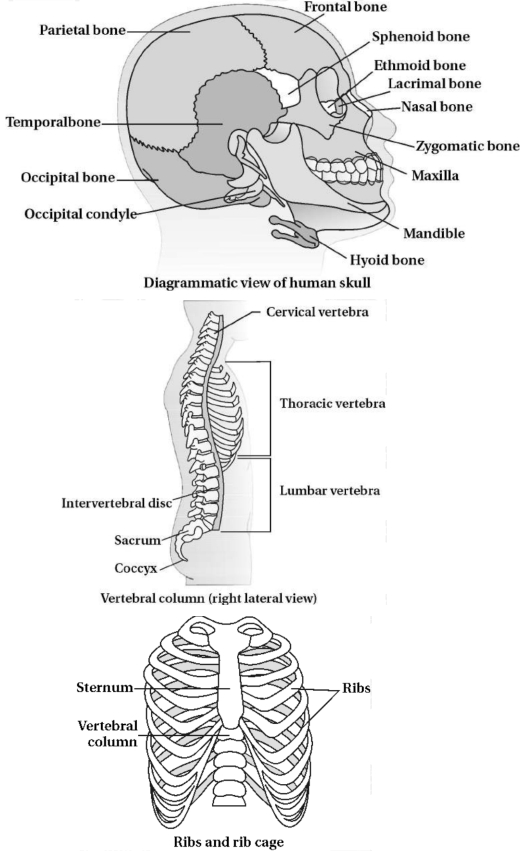
0 likes
View Solution145
Easy
How many bones are present in the cranium? Name them.
Solution
(A) The cranium is composed of $8$ flat bones. These bones are fused together to form a protective box for the brain known as the cranium.
The $8$ bones that form the cranium are:
$1$ Frontal bone
$2$ Parietal bones
$2$ Temporal bones
$1$ Occipital bone
$1$ Sphenoid bone
$1$ Ethmoid bone
Total: $8$ bones.
The $8$ bones that form the cranium are:
$1$ Frontal bone
$2$ Parietal bones
$2$ Temporal bones
$1$ Occipital bone
$1$ Sphenoid bone
$1$ Ethmoid bone
Total: $8$ bones.
0 likes
View Solution146
Easy
Write a short note on the vertebral column.
Solution
(N/A) The vertebral column is formed by $26$ serially arranged units called vertebrae and is dorsally placed.
It extends from the base of the skull and constitutes the main framework of the trunk.
Each vertebra has a central hollow portion (neural canal) through which the spinal cord passes.
The vertebral column is differentiated into the following regions:
$(a)$ Cervical vertebrae $(7)$
$(b)$ Thoracic vertebrae $(12)$
$(c)$ Lumbar vertebrae $(5)$
$(d)$ Sacral vertebrae ($1$ fused)
$(e)$ Coccygeal vertebrae ($1$ fused)
The first vertebra is the atlas and it articulates with the occipital condyles. The second vertebra is the axis.
Functions: The vertebral column protects the spinal cord,supports the head,and serves as the point of attachment for the ribs and musculature of the back. It helps in maintaining posture while standing or walking.
It extends from the base of the skull and constitutes the main framework of the trunk.
Each vertebra has a central hollow portion (neural canal) through which the spinal cord passes.
The vertebral column is differentiated into the following regions:
$(a)$ Cervical vertebrae $(7)$
$(b)$ Thoracic vertebrae $(12)$
$(c)$ Lumbar vertebrae $(5)$
$(d)$ Sacral vertebrae ($1$ fused)
$(e)$ Coccygeal vertebrae ($1$ fused)
The first vertebra is the atlas and it articulates with the occipital condyles. The second vertebra is the axis.
Functions: The vertebral column protects the spinal cord,supports the head,and serves as the point of attachment for the ribs and musculature of the back. It helps in maintaining posture while standing or walking.
0 likes
View Solution147
Easy
With respect to the rib cage,explain the following: $(a)$ Bicephalic ribs,$(b)$ True ribs,$(c)$ Floating ribs.
Solution
(N/A) Bicephalic ribs: Each rib has two articulation surfaces on its dorsal side,hence it is known as a bicephalic rib.
$(b)$ True ribs: The first $7$ pairs of ribs are called true ribs. Dorsally,they are attached to the thoracic vertebrae,and ventrally,they are connected to the sternum by hyaline cartilage.
$(c)$ Floating ribs: The last $2$ pairs of ribs ($11^{th}$ and $12^{th}$ pairs) do not articulate ventrally with the sternum,so they are called floating ribs.
$(b)$ True ribs: The first $7$ pairs of ribs are called true ribs. Dorsally,they are attached to the thoracic vertebrae,and ventrally,they are connected to the sternum by hyaline cartilage.
$(c)$ Floating ribs: The last $2$ pairs of ribs ($11^{th}$ and $12^{th}$ pairs) do not articulate ventrally with the sternum,so they are called floating ribs.
0 likes
View Solution148
Medium
An elderly woman slipped in the bathroom and had severe pain in her lower back. After $X-ray$ examination,doctors told her it is due to a slipped disc. What does that mean? How does it affect our health?
Solution
(N/A) $\Rightarrow$ $A$ slipped disc (herniated disc) is a medical condition where the soft,jelly-like center of an intervertebral disc pushes out through a tear in the tougher exterior (annulus fibrosus).
$\Rightarrow$ Intervertebral discs are located between the centra of adjacent vertebrae from the second cervical vertebra to the sacrum. They act as shock absorbers and facilitate the movement of the vertebral column.
$\Rightarrow$ When a disc slips,it can compress nearby spinal nerves. In the lower back (lumbar region),this often compresses the sciatic nerve,leading to severe pain radiating down the leg (sciatica),numbness,and muscle weakness in the lower body.
$\Rightarrow$ Intervertebral discs are located between the centra of adjacent vertebrae from the second cervical vertebra to the sacrum. They act as shock absorbers and facilitate the movement of the vertebral column.
$\Rightarrow$ When a disc slips,it can compress nearby spinal nerves. In the lower back (lumbar region),this often compresses the sciatic nerve,leading to severe pain radiating down the leg (sciatica),numbness,and muscle weakness in the lower body.
0 likes
View Solution149
EasyMCQ
Analogy type questions:
$(1)$ Striated muscles : Voluntary muscles :: Visceral muscles : .........
$(2)$ In the face : $22$ bones :: In the vertebral column : .......
$(1)$ Striated muscles : Voluntary muscles :: Visceral muscles : .........
$(2)$ In the face : $22$ bones :: In the vertebral column : .......
A
Smooth muscles,$33$ vertebrae
B
Involuntary muscles,$26$ vertebrae
C
Cardiac muscles,$24$ vertebrae
D
Skeletal muscles,$30$ vertebrae
Solution
(B) $(1)$ Visceral muscles are also known as smooth muscles and are involuntary in nature. Therefore,the answer is involuntary muscles.
$(2)$ The human skull (cranium + facial bones) has $22$ bones. The adult human vertebral column consists of $26$ vertebrae (cervical,thoracic,lumbar,sacral,and coccygeal).
$(2)$ The human skull (cranium + facial bones) has $22$ bones. The adult human vertebral column consists of $26$ vertebrae (cervical,thoracic,lumbar,sacral,and coccygeal).
0 likes
View Solution150
Easy
Analogy type questions:
$(1)$ The first vertebra is called the $Atlas$ vertebra.
$(2)$ Bones contain $Calcium$ salts.
$(1)$ The first vertebra is called the $Atlas$ vertebra.
$(2)$ Bones contain $Calcium$ salts.
Solution
(N/A) $(1)$ The first cervical vertebra $(C1)$ is known as the $Atlas$ vertebra,which supports the head.
$(2)$ The matrix of bones is rich in $Calcium$ salts (specifically $Calcium$ phosphate and $Calcium$ carbonate),which provide hardness and strength to the skeletal system.
$(2)$ The matrix of bones is rich in $Calcium$ salts (specifically $Calcium$ phosphate and $Calcium$ carbonate),which provide hardness and strength to the skeletal system.
0 likes
View SolutionLocomotion and Movement — Axial skeleton · Frequently Asked Questions
1Are these Locomotion and Movement questions useful for JEE and NEET?
Yes. All questions in this section are mapped to JEE Main and NEET exam patterns. Previous year questions from JEE Main, NEET, GUJCET and state-level exams are included with full solutions.
2Can I switch to Hindi or Gujarati for these questions?
Yes. Use the language tabs in the hero section or the sidebar to view the same questions and solutions in English, Hindi or Gujarati.
3How do I generate a question paper from this subtopic?
Use the Vedclass Exam Paper Generator — select the chapter and subtopic, set difficulty, and generate Sets A, B, C, D automatically. First 3 chapters of every subject are free.
Vedclass Products
For Students
Vedclass Test Series
Mock tests in real JEE/NEET style with performance analysis. 5-day free trial.
Start Free TrialFor Teachers
Exam Paper Generator
Generate Set A/B/C/D papers from this chapter in 2 minutes. 3 chapters free.
Try FreeFor Institutes
Online Exam Module
Live online exams with unlimited students, 360° analytics & white-label branding.
See DemoFor Teachers & Institutes
Generate a Locomotion and Movement Exam Paper in 2 Minutes
Select subtopic & difficulty — Sets A, B, C, D auto-generated with No Repeat logic.
First 3 chapters of every subject are free — no payment required.