
A English
Thymus Questions in English
Class 11 Biology · Chemical Coordination and Integration · Thymus
53+
Questions
English
Language
100%
With Solutions
Showing 49 of 53 questions in English
1
MediumMCQ
If the thymus gland of an infant is removed,which of the following will not form?
A
$T$-lymphocytes
B
$B$-lymphocytes
C
Erythrocytes
D
Granulocytes
Solution
(A) The thymus gland is the primary lymphoid organ responsible for the maturation and differentiation of $T$-lymphocytes. If the thymus gland is surgically removed in an infant,the body will fail to produce mature $T$-lymphocytes,leading to a severe deficiency in cell-mediated immunity. Therefore,the correct option is $A$.
0 likes
View Solution2
MediumMCQ
According to one of the theories of ageing, the decline and disappearance of which gland by late middle age is the primary cause of ageing?
A
Parathyroid
B
Thyroid
C
Thymus
D
Posterior lobe of pituitary
Solution
(C) The correct answer is $(C)$. According to the immunity theory of ageing, there is a direct link between the ageing process and the gradual involution (disappearance) of the thymus gland by late middle age in humans.
The thymus gland plays a crucial role in the development of the immune system by maturing $T$-lymphocytes.
As the thymus gland degenerates with age, the body's natural defense mechanism against foreign pathogens weakens, and the production of abnormal $(defective)$ cells increases, which contributes to the physiological decline associated with ageing.
The thymus gland plays a crucial role in the development of the immune system by maturing $T$-lymphocytes.
As the thymus gland degenerates with age, the body's natural defense mechanism against foreign pathogens weakens, and the production of abnormal $(defective)$ cells increases, which contributes to the physiological decline associated with ageing.
0 likes
View Solution3
MediumMCQ
Which of the following is related to the production of lymphocytes and antibodies?
A
Thymus
B
Hypothalamus
C
Thyroid
D
Leydig cells
Solution
(A) The $Thymus$ is a lobed organ located near the heart and beneath the breastbone.
It plays a crucial role in the development of the immune system.
It acts as the primary lymphoid organ where $T$-lymphocytes mature.
Additionally,the $Thymus$ secretes peptide hormones called $Thymosins$,which play a major role in the differentiation of $T$-lymphocytes,providing cell-mediated immunity,and also promote the production of antibodies to provide humoral immunity.
It plays a crucial role in the development of the immune system.
It acts as the primary lymphoid organ where $T$-lymphocytes mature.
Additionally,the $Thymus$ secretes peptide hormones called $Thymosins$,which play a major role in the differentiation of $T$-lymphocytes,providing cell-mediated immunity,and also promote the production of antibodies to provide humoral immunity.
0 likes
View Solution4
MediumMCQ
Which endocrine gland becomes inactive in old age?
A
Adrenal
B
Pineal
C
Thymus
D
Pituitary
Solution
(C) The $Thymus$ gland is well-developed in newborn children and continues to grow until the age of puberty.
After puberty,it begins to undergo involution (shrinking) and eventually becomes almost inactive or disappears in old age.
Therefore,the correct option is $(c)$.
After puberty,it begins to undergo involution (shrinking) and eventually becomes almost inactive or disappears in old age.
Therefore,the correct option is $(c)$.
0 likes
View Solution5
MediumMCQ
$T$-cells are lymphocytes which produce cellular immunity. These are developed from:
A
Thymus
B
Liver
C
Spleen
D
Endothelium of blood vessels
Solution
(A) $T$-lymphocytes are a type of white blood cell that plays a central role in cell-mediated immunity.
They originate from hematopoietic stem cells in the bone marrow.
After production,these immature cells migrate to the thymus gland,where they mature,differentiate,and become immunocompetent.
Therefore,the thymus is the primary site for the development and maturation of $T$-cells.
They originate from hematopoietic stem cells in the bone marrow.
After production,these immature cells migrate to the thymus gland,where they mature,differentiate,and become immunocompetent.
Therefore,the thymus is the primary site for the development and maturation of $T$-cells.
0 likes
View Solution6
MediumMCQ
If the thymus gland of a newborn child is removed by surgery,which of the following will it fail to produce?
A
Monocytes
B
$B$-lymphocytes
C
$T$-lymphocytes
D
Basophils
Solution
(C) The thymus gland is the primary lymphoid organ where $T$-lymphocytes mature and differentiate.
If the thymus gland is removed from a newborn child,the maturation process of $T$-lymphocytes will be severely affected,leading to a failure in the production of functional $T$-lymphocytes.
$B$-lymphocytes mature in the bone marrow,while monocytes and basophils are types of white blood cells produced in the bone marrow that do not require the thymus for their development.
If the thymus gland is removed from a newborn child,the maturation process of $T$-lymphocytes will be severely affected,leading to a failure in the production of functional $T$-lymphocytes.
$B$-lymphocytes mature in the bone marrow,while monocytes and basophils are types of white blood cells produced in the bone marrow that do not require the thymus for their development.
0 likes
View Solution7
MediumMCQ
What will happen if the thymus gland is injured in a child?
A
Decrease in the level of hemoglobin in the blood
B
Decrease in the production of stem cells
C
Decrease in antibody-mediated immunity
D
Decrease in cell-mediated immunity
Solution
(D) The thymus gland is the primary lymphoid organ where $T$-lymphocytes mature and differentiate.
$T$-lymphocytes are responsible for cell-mediated immunity $(CMI)$.
If the thymus gland is injured or removed in a child,the maturation of $T$-lymphocytes will be severely impaired.
Consequently,the body's ability to mount a cell-mediated immune response will be significantly reduced,leading to a decrease in cell-mediated immunity.
$T$-lymphocytes are responsible for cell-mediated immunity $(CMI)$.
If the thymus gland is injured or removed in a child,the maturation of $T$-lymphocytes will be severely impaired.
Consequently,the body's ability to mount a cell-mediated immune response will be significantly reduced,leading to a decrease in cell-mediated immunity.
0 likes
View Solution8
MediumMCQ
What does thymosin stimulate?
A
Milk secretion
B
Erythrocytes
C
$T$-lymphocytes
D
Melanocytes
Solution
(C) The thymus gland secretes a peptide hormone called thymosin.
Thymosin plays a major role in the differentiation of $T$-lymphocytes,which provide cell-mediated immunity.
In addition,thymosin also promotes the production of antibodies to provide humoral immunity.
Therefore,the correct option is $C$.
Thymosin plays a major role in the differentiation of $T$-lymphocytes,which provide cell-mediated immunity.
In addition,thymosin also promotes the production of antibodies to provide humoral immunity.
Therefore,the correct option is $C$.
0 likes
View Solution9
MediumMCQ
What is the likely outcome if a 'thymectomy' is performed in an adult?
A
Immune system is destroyed
B
Immediate death
C
No adverse reaction occurs
D
Myasthenia gravis
Solution
(C) The thymus gland is the primary site for the maturation of $T$-lymphocytes. In children,the thymus is very active and plays a crucial role in the development of the immune system. However,in adults,the thymus undergoes atrophy (involution) and becomes significantly less active. Therefore,performing a 'thymectomy' (surgical removal of the thymus) in an adult does not result in any significant adverse reaction or loss of immune function,as the immune system is already fully developed and the thymus is largely inactive.
0 likes
View Solution10
MediumMCQ
Which gland decreases in size with increasing age?
A
Thyroid
B
Adrenal
C
Thymus
D
Pituitary
Solution
(C) The $Thymus$ gland is a lobular structure located between the lungs behind the sternum on the ventral side of the aorta. It plays a major role in the development of the immune system. The $Thymus$ gland is quite large at the time of birth but gradually shrinks in size with increasing age. By the time of puberty,it becomes significantly degenerated,which is why immune responses of older individuals become weaker.
0 likes
View Solution11
MediumMCQ
According to the modern theory of aging,our body gradually loses its ability to resist bacteria and pathogens. This process is caused by the gradual disappearance (atrophy) of which organ?
A
Spleen
B
Thymus gland
C
Pituitary gland
D
Parathyroid gland
Solution
(B) The $Thymus$ gland is a lobular structure located between the lungs behind the sternum on the ventral side of the aorta.
It plays a major role in the development of the immune system.
The $Thymus$ secretes peptide hormones called $Thymosins$,which play a major role in the differentiation of $T$-lymphocytes,which provide cell-mediated immunity.
In addition,$Thymosins$ also promote the production of antibodies to provide humoral immunity.
As individuals grow older,the $Thymus$ gland undergoes gradual degeneration (atrophy) and is replaced by fat.
As a result,the production of $Thymosins$ decreases,leading to a weaker immune response in older individuals,making them more susceptible to infections.
It plays a major role in the development of the immune system.
The $Thymus$ secretes peptide hormones called $Thymosins$,which play a major role in the differentiation of $T$-lymphocytes,which provide cell-mediated immunity.
In addition,$Thymosins$ also promote the production of antibodies to provide humoral immunity.
As individuals grow older,the $Thymus$ gland undergoes gradual degeneration (atrophy) and is replaced by fat.
As a result,the production of $Thymosins$ decreases,leading to a weaker immune response in older individuals,making them more susceptible to infections.
0 likes
View Solution12
EasyMCQ
The function of the thymus in $Homo$ $sapiens$ is primarily associated with which of the following?
A
Reproduction
B
Immunology
C
Calcium balance
D
Blood clotting
Solution
(B) The thymus gland plays a crucial role in the development of the immune system.
It is the primary site for the maturation and differentiation of $T$-lymphocytes.
These $T$-lymphocytes are essential for cell-mediated immunity.
Therefore,the function of the thymus is primarily associated with immunology.
It is the primary site for the maturation and differentiation of $T$-lymphocytes.
These $T$-lymphocytes are essential for cell-mediated immunity.
Therefore,the function of the thymus is primarily associated with immunology.
0 likes
View Solution13
EasyMCQ
The thymus gland in mammals is primarily associated with which of the following?
A
Regulation of body temperature
B
Body growth
C
Immunological function
D
Secretion of thyrotropin
Solution
(C) The thymus gland is a specialized primary lymphoid organ of the immune system.
It plays a vital role in the development and maturation of $T$-lymphocytes (or $T$-cells),which are essential for cell-mediated immunity.
Therefore,the thymus is primarily associated with immunological functions.
It plays a vital role in the development and maturation of $T$-lymphocytes (or $T$-cells),which are essential for cell-mediated immunity.
Therefore,the thymus is primarily associated with immunological functions.
0 likes
View Solution14
MediumMCQ
Which endocrine gland is not ectodermal in origin?
A
Pineal gland
B
Anterior pituitary
C
Adrenal medulla
D
Thymus
Solution
(D) The endocrine glands are derived from different germ layers during embryonic development.
$1$. The $Pineal$ $gland$,$Anterior$ $pituitary$,and $Adrenal$ $medulla$ are all derived from the $Ectoderm$.
$2$. The $Thymus$ gland is derived from the $Endoderm$ (specifically from the pharyngeal pouches).
Therefore,the $Thymus$ is not ectodermal in origin.
$1$. The $Pineal$ $gland$,$Anterior$ $pituitary$,and $Adrenal$ $medulla$ are all derived from the $Ectoderm$.
$2$. The $Thymus$ gland is derived from the $Endoderm$ (specifically from the pharyngeal pouches).
Therefore,the $Thymus$ is not ectodermal in origin.
0 likes
View Solution15
EasyMCQ
Which gland undergoes atrophy in adults?
A
Pancreas
B
Thymus
C
Thyroid
D
Adrenal
Solution
(B) The $Thymus$ gland is a lobular structure located between the lungs behind the sternum on the ventral side of the aorta.
It plays a major role in the development of the immune system.
This gland secretes the peptide hormones called $Thymosins$.
$Thymosins$ play a major role in the differentiation of $T$-lymphocytes,which provide cell-mediated immunity.
In addition,$Thymosins$ also promote the production of antibodies to provide humoral immunity.
$Thymus$ is degenerated in old individuals resulting in a decreased production of $Thymosins$,which leads to a weaker immune response in the elderly.
It plays a major role in the development of the immune system.
This gland secretes the peptide hormones called $Thymosins$.
$Thymosins$ play a major role in the differentiation of $T$-lymphocytes,which provide cell-mediated immunity.
In addition,$Thymosins$ also promote the production of antibodies to provide humoral immunity.
$Thymus$ is degenerated in old individuals resulting in a decreased production of $Thymosins$,which leads to a weaker immune response in the elderly.
0 likes
View Solution16
EasyMCQ
The thymus gland develops from the embryonic ..........
A
Mesoderm
B
Endoderm
C
Ectoderm
D
All of these
Solution
(B) The thymus gland is a specialized primary lymphoid organ of the immune system.
It originates from the endodermal lining of the third pharyngeal pouch during embryonic development.
Therefore,the correct embryonic layer from which the thymus gland develops is the endoderm.
It originates from the endodermal lining of the third pharyngeal pouch during embryonic development.
Therefore,the correct embryonic layer from which the thymus gland develops is the endoderm.
0 likes
View Solution17
EasyMCQ
Where are Hassall's corpuscles found?
A
Pineal gland
B
Thymus gland
C
Thyroid gland
D
Adrenal gland
Solution
(B) Hassall's corpuscles,also known as thymic corpuscles,are structures found in the medulla of the thymus gland.
They consist of concentric layers of epithelial reticular cells.
These structures are a characteristic feature of the thymus and play a role in the maturation of $T$-lymphocytes.
They consist of concentric layers of epithelial reticular cells.
These structures are a characteristic feature of the thymus and play a role in the maturation of $T$-lymphocytes.
0 likes
View Solution18
MediumMCQ
Which of the following is $NOT$ associated with the thymus gland?
A
It is a primary lymphoid organ.
B
Lymphocytes mature here.
C
It becomes very small at puberty.
D
It removes microorganisms from the blood.
Solution
(D) The thymus gland is a primary lymphoid organ where $T$-lymphocytes mature. It is quite large at the time of birth but keeps reducing in size with age and becomes very small by the time puberty is attained. The function of removing microorganisms from the blood is performed by the spleen,which acts as a filter for the blood by trapping blood-borne microorganisms. Therefore,option $D$ is not associated with the thymus gland.
0 likes
View Solution19
MediumMCQ
At the time of birth,the thymus gland is:
A
Small in size.
B
Large in size.
C
Differentiated.
D
Located in the neck region.
Solution
(B) The thymus gland is a primary lymphoid organ that plays a crucial role in the development of the immune system. At the time of birth,the thymus is relatively large in size. As an individual ages,the thymus gland undergoes a process called involution,where it gradually shrinks and is replaced by adipose (fat) tissue. Therefore,it is largest during childhood and becomes smaller as one reaches adulthood.
0 likes
View Solution20
EasyMCQ
Which structure gradually becomes smaller with increasing age?
A
Spleen
B
Lymph node
C
Bone marrow
D
Thymus
Solution
(D) The $Thymus$ is a primary lymphoid organ that plays a crucial role in the development and maturation of $T$-lymphocytes. It is quite large at the time of birth but gradually undergoes atrophy (shrinks in size) as a person ages. This process is known as involution,which is why the $Thymus$ becomes smaller with increasing age.
0 likes
View Solution21
EasyMCQ
$T-$ lymphocytes are:
A
Associated with antigens.
B
Mature in the bone marrow.
C
Act as phagocytes.
D
Mature in the thymus.
Solution
(D) $T-$ lymphocytes are a type of white blood cell that plays a central role in cell-mediated immunity.
They originate from stem cells in the bone marrow.
After production,they migrate to the thymus gland,where they undergo maturation and differentiation.
Therefore,the correct statement is that they mature in the thymus.
They originate from stem cells in the bone marrow.
After production,they migrate to the thymus gland,where they undergo maturation and differentiation.
Therefore,the correct statement is that they mature in the thymus.
0 likes
View Solution22
MediumMCQ
The location of the thymus is .........
A
Below the breastbone
B
In the neck region
C
Below the heart
D
In the bone marrow
Solution
(A) The thymus is a primary lymphoid organ located near the heart and beneath the breastbone (sternum). It plays a crucial role in the development and maturation of $T$-lymphocytes. Therefore,the correct location is below the breastbone.
0 likes
View Solution23
EasyMCQ
Which organ is a lobed organ located near the heart and beneath the breastbone?
A
Bone marrow
B
Spleen
C
Thymus
D
Appendix
Solution
(C) The $Thymus$ is a lobed organ located near the heart and beneath the breastbone (sternum).
It plays a crucial role in the development of the immune system.
It is the primary lymphoid organ where $T$-lymphocytes mature and differentiate.
The size of the $Thymus$ is quite large at the time of birth but keeps reducing in size with age and by the time of puberty, it attains a very small size.
It plays a crucial role in the development of the immune system.
It is the primary lymphoid organ where $T$-lymphocytes mature and differentiate.
The size of the $Thymus$ is quite large at the time of birth but keeps reducing in size with age and by the time of puberty, it attains a very small size.
0 likes
View Solution24
EasyMCQ
Which tissue is large at birth and gradually shrinks as one ages?
A
Thymus
B
Thyroid
C
Bone marrow
D
Lymph node
Solution
(A) The $Thymus$ is a primary lymphoid organ that plays a crucial role in the development and maturation of $T$-lymphocytes. It is relatively large at the time of birth but gradually undergoes atrophy (shrinks) as an individual reaches puberty and continues to decrease in size with age.
0 likes
View Solution25
EasyMCQ
Which gland gradually decreases in size with increasing age?
A
Spleen
B
Thymus
C
Thyroid
D
Tonsils
Solution
(B) The $Thymus$ gland is a primary lymphoid organ located near the heart. It is quite large at the time of birth but gradually shrinks in size as a person ages,a process known as involution. By adulthood,it is significantly reduced in size and replaced largely by adipose tissue.
0 likes
View Solution26
MediumMCQ
Which of the following glands is associated with the occurrence of sarcoma-type cancer?
A
Adrenal gland
B
Thyroid gland
C
Thymus gland
D
Lymph node
Solution
(C) Sarcoma is a type of cancer that arises from mesenchymal tissues,such as connective tissues,bones,cartilage,fat,muscle,or blood vessels. Among the given options,the thymus gland is a lymphoid organ that contains connective tissue elements and can be a site for thymic sarcomas. While carcinomas are more common in glandular tissues,sarcomas specifically involve the supporting tissues of these organs.
0 likes
View Solution27
MediumMCQ
Damage of thymus in a child may lead to
A
Increase of cell-mediated immunity
B
Reduction in the hemoglobin content in blood
C
Reduction in the amount of plasma proteins
D
Decrease of immunity
Solution
(D) The thymus is a primary lymphoid organ where $T$-lymphocytes mature and differentiate.
In children,the thymus plays a crucial role in the development of the immune system.
Damage to the thymus results in a failure of $T$-lymphocytes to mature,which significantly impairs the cell-mediated immune response.
Since the immune system is compromised,the overall immunity of the child decreases.
In children,the thymus plays a crucial role in the development of the immune system.
Damage to the thymus results in a failure of $T$-lymphocytes to mature,which significantly impairs the cell-mediated immune response.
Since the immune system is compromised,the overall immunity of the child decreases.
0 likes
View Solution28
MediumMCQ
Which of the following glands is responsible for immunity in humans?
A
Adrenal gland
B
Thymus
C
Parathyroid gland
D
Thyroid gland
Solution
(B) The $Thymus$ gland plays a vital role in the development of the immune system.
It is a lobular structure located between the lungs behind the sternum on the ventral side of the aorta.
It secretes a peptide hormone called $Thymosin$.
$Thymosins$ play a major role in the differentiation of $T$-lymphocytes,which provide cell-mediated immunity.
Additionally,$Thymosins$ also promote the production of antibodies to provide humoral immunity.
It is a lobular structure located between the lungs behind the sternum on the ventral side of the aorta.
It secretes a peptide hormone called $Thymosin$.
$Thymosins$ play a major role in the differentiation of $T$-lymphocytes,which provide cell-mediated immunity.
Additionally,$Thymosins$ also promote the production of antibodies to provide humoral immunity.
0 likes
View Solution29
MediumMCQ
The thymus gland secretes which of the following hormones?
A
Parathormone
B
Thymosins
C
Thyroxine
D
Insulin
Solution
(B) The thymus gland is a specialized primary lymphoid organ that plays a crucial role in the development of the immune system.
It secretes a peptide hormone called $Thymosins$.
$Thymosins$ play a major role in the differentiation of $T$-lymphocytes,which provide cell-mediated immunity.
They also promote the production of antibodies to provide humoral immunity.
Therefore,the correct option is $B$.
It secretes a peptide hormone called $Thymosins$.
$Thymosins$ play a major role in the differentiation of $T$-lymphocytes,which provide cell-mediated immunity.
They also promote the production of antibodies to provide humoral immunity.
Therefore,the correct option is $B$.
0 likes
View Solution30
MediumMCQ
It simulates the development and differentiation of $T-$lymphocytes,which provide cell-mediated immunity.
A
Hormones of the gland located on the lateral side
B
Hormones of the gland located between both lungs
C
Hormones of the gland located in a bony cavity
D
Hormones produced from interstitial cells
Solution
(B) The gland responsible for the development and differentiation of $T-$lymphocytes is the thymus.
$T-$lymphocytes provide cell-mediated immunity.
The thymus is a lobular structure located between the lungs and behind the sternum on the ventral side of the aorta.
Therefore,the correct answer is the hormones of the gland located between both lungs (thymus).
$T-$lymphocytes provide cell-mediated immunity.
The thymus is a lobular structure located between the lungs and behind the sternum on the ventral side of the aorta.
Therefore,the correct answer is the hormones of the gland located between both lungs (thymus).
0 likes
View Solution31
EasyMCQ
Which one of the following four glands is correctly matched with the accompanying description?
A
Thyroid $-$ Hyperactivity in young children causes cretinism
B
Thymus $-$ Starts undergoing atrophy after puberty
C
Parathyroid $-$ Secretes parathormone,which promotes movement of calcium ions from blood into bones during calcification
D
Pancreas $-$ Delta cells of the 'islets of Langerhans' secrete a hormone,which stimulates glycolysis in liver
Solution
(B) The thymus is an organ located in the upper anterior portion of the chest cavity just behind the sternum.
The thymus continues to grow between birth and puberty and then begins to atrophy.
Proportional to thymic size,thymic activity is most active before puberty.
Upon atrophy,the size and activity are dramatically reduced,and the organ is primarily replaced with fat.
The atrophy is due to the increased circulating level of sex hormones,and chemical or physical castration of an adult results in the thymus increasing in size and activity.
In contrast,other options are incorrect: Thyroid hyperactivity causes hyperthyroidism,not cretinism (which is caused by hypothyroidism); Parathormone increases blood calcium levels by mobilizing it from bones; and Delta cells of the pancreas secrete somatostatin,not a hormone that stimulates glycolysis.
The thymus continues to grow between birth and puberty and then begins to atrophy.
Proportional to thymic size,thymic activity is most active before puberty.
Upon atrophy,the size and activity are dramatically reduced,and the organ is primarily replaced with fat.
The atrophy is due to the increased circulating level of sex hormones,and chemical or physical castration of an adult results in the thymus increasing in size and activity.
In contrast,other options are incorrect: Thyroid hyperactivity causes hyperthyroidism,not cretinism (which is caused by hypothyroidism); Parathormone increases blood calcium levels by mobilizing it from bones; and Delta cells of the pancreas secrete somatostatin,not a hormone that stimulates glycolysis.
0 likes
View Solution32
MediumMCQ
Which endocrine gland is called 'the Throne of immunity'?
A
Spleen
B
Thymus
C
Pineal
D
Adrenal medulla
Solution
(B) The thymus gland is known as the 'Throne of immunity' because it plays a vital role in the development of the immune system.
It is the primary site for the maturation and differentiation of $T-$lymphocytes (or $T-$cells).
These $T-$cells are essential for cell-mediated immunity and also help in regulating the production of antibodies by $B-$cells.
It is the primary site for the maturation and differentiation of $T-$lymphocytes (or $T-$cells).
These $T-$cells are essential for cell-mediated immunity and also help in regulating the production of antibodies by $B-$cells.
0 likes
View Solution33
Medium
Mention the location of the thymus gland in the body and state its importance.
Solution
(N/A) The thymus gland is a lobular structure located between the lungs, behind the sternum, on the ventral side of the aorta.
The thymus plays a major role in the development of the immune system.
The thymus gland secretes a peptide hormone called thymosins.
Thymosins play a major role in the differentiation of $T$-lymphocytes, which provide cell-mediated immunity.
Thymosins also promote the production of antibodies to provide humoral immunity.
The thymus degenerates in old individuals, resulting in a decreased production of thymosins. As a result, the immune responses of old persons become weak.
The thymus plays a major role in the development of the immune system.
The thymus gland secretes a peptide hormone called thymosins.
Thymosins play a major role in the differentiation of $T$-lymphocytes, which provide cell-mediated immunity.
Thymosins also promote the production of antibodies to provide humoral immunity.
The thymus degenerates in old individuals, resulting in a decreased production of thymosins. As a result, the immune responses of old persons become weak.
0 likes
View Solution34
MediumMCQ
Name the hormone that helps in cell-mediated immunity.
A
Thyroxine
B
Thymosin
C
Insulin
D
Adrenaline
Solution
(B) Thymosin hormone plays a significant role in the development and differentiation of $T$-lymphocytes,which are responsible for providing cell-mediated immunity.
0 likes
View Solution35
MediumMCQ
Old people have a weak immune system. What could be the reason?
A
Hyperactivity of the thymus gland
B
Degeneration of the thymus gland
C
Increased production of thymosin
D
Overproduction of leucocytes
Solution
(B) The thymus gland is located on the dorsal side of the heart and the dorsal aorta.
It secretes the hormone thymosin,which plays a major role in the differentiation of $T$-lymphocytes,which provide cell-mediated immunity.
In older individuals,the thymus gland undergoes gradual atrophy or degeneration.
As a result,the production of thymosin decreases,leading to a weakened immune system in old people.
It secretes the hormone thymosin,which plays a major role in the differentiation of $T$-lymphocytes,which provide cell-mediated immunity.
In older individuals,the thymus gland undergoes gradual atrophy or degeneration.
As a result,the production of thymosin decreases,leading to a weakened immune system in old people.
0 likes
View Solution36
MediumMCQ
What would happen to the immune system if the thymus gland is removed from the body of a person?
A
The immune system will become stronger.
B
The immune system will become weak.
C
The immune system will remain unaffected.
D
The person will develop immunity against all diseases.
Solution
(B) The thymus is a primary lymphoid organ.
- In the thymus gland,immature lymphocytes differentiate into antigen-sensitive lymphocytes.
If the thymus gland is removed from the body of a person,the immune system becomes weak. As a result,the person's body becomes prone to infectious diseases.
- In the thymus gland,immature lymphocytes differentiate into antigen-sensitive lymphocytes.
If the thymus gland is removed from the body of a person,the immune system becomes weak. As a result,the person's body becomes prone to infectious diseases.
0 likes
View Solution37
MediumMCQ
The thymus gland releases which hormone?
A
$T_{4}$
B
$T_{3}$
C
$Thymosins$
D
$TCT$
Solution
(C) The thymus gland secretes a group of peptide hormones known as thymosins.
Thymosins play a major role in the differentiation of $T$-lymphocytes,which provide cell-mediated immunity.
Additionally,thymosins promote the production of antibodies to provide humoral immunity.
Thymosins play a major role in the differentiation of $T$-lymphocytes,which provide cell-mediated immunity.
Additionally,thymosins promote the production of antibodies to provide humoral immunity.
0 likes
View Solution38
MediumMCQ
Myasthenia gravis is related to which hormone?
A
Thyroid hormone
B
Calcitonin hormone
C
Thymosine hormone
D
Parathormone
Solution
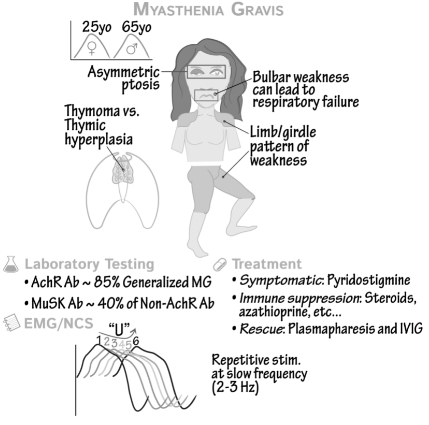
(C) Myasthenia gravis is an autoimmune disorder that affects the neuromuscular junction. It is often associated with abnormalities of the thymus gland,such as thymoma or thymic hyperplasia. The thymus gland secretes the hormone thymosine,which plays a crucial role in the development and maturation of $T$-lymphocytes. While the exact mechanism involves the production of autoantibodies against acetylcholine receptors,the condition is clinically and pathologically linked to the thymus gland and its hormonal environment.
0 likes
View Solution39
MediumMCQ
Damage to thymus in a child may lead to
A
$A$ reduction in haemoglobin content of blood.
B
$A$ reduction in stem cell production.
C
Loss of antibody-mediated immunity
D
Loss of cell-mediated immunity.
Solution
(D) The thymus gland is a primary lymphoid organ that plays a crucial role in the development of the immune system. It secretes hormones such as thymosin,thymic humoral factor,thymic factor,and thymopoietin.
These hormones are essential for the maturation and differentiation of $T$-lymphocytes.
$T$-lymphocytes are responsible for cell-mediated immunity $(CMI)$,which involves the direct destruction of infected cells and pathogens.
Therefore,damage to the thymus in a child would impair the maturation of $T$-lymphocytes,leading to a loss of cell-mediated immunity.
These hormones are essential for the maturation and differentiation of $T$-lymphocytes.
$T$-lymphocytes are responsible for cell-mediated immunity $(CMI)$,which involves the direct destruction of infected cells and pathogens.
Therefore,damage to the thymus in a child would impair the maturation of $T$-lymphocytes,leading to a loss of cell-mediated immunity.
0 likes
View Solution40
MediumMCQ
The thymus gland is a lobular structure located on the $A$ side of the aorta and plays a significant role in the development of the $B$ system.
Choose the correct combination of $A$ and $B$.
Choose the correct combination of $A$ and $B$.
A
$A$-ventral,$B$-immune
B
$A$-lateral,$B$-circulatory
C
$A$-dorsal,$B$-immune
D
$A$-dorsal,$B$-circulatory
Solution
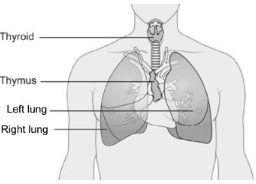
(A) The thymus gland is a lobular structure located between the lungs,behind the sternum,on the ventral side of the aorta.
It plays a significant role in the development of the immune system by promoting the differentiation of $T$-lymphocytes.
Therefore,the correct combination is $A$-ventral and $B$-immune.
It plays a significant role in the development of the immune system by promoting the differentiation of $T$-lymphocytes.
Therefore,the correct combination is $A$-ventral and $B$-immune.
0 likes
View Solution41
EasyMCQ
Mammalian thymus is mainly concerned with
A
Regulation of body temperature
B
Regulation of body growth
C
Immunological functions
D
Secretion of thyrotropin
Solution
(C) The thymus gland is the primary site for the maturation of $T-$lymphocytes,which play a crucial role in the body's immune system.
It is often referred to as the 'Training School' of $T-$lymphocytes,where they differentiate and become immunocompetent.
Therefore,the thymus is primarily concerned with immunological functions.
It is often referred to as the 'Training School' of $T-$lymphocytes,where they differentiate and become immunocompetent.
Therefore,the thymus is primarily concerned with immunological functions.
0 likes
View Solution42
MediumMCQ
Which of the following gland grows to the maximum size at puberty and then diminishes gradually?
A
Thymus
B
Pituitary
C
Thyroid
D
Adrenal
Solution
(A) The thymus gland is located on the dorsal side of the heart and the aorta. It plays a major role in the development of the immune system. It grows to its maximum size during puberty and then gradually undergoes atrophy (degeneration) as age increases,leading to a decrease in the production of thymosins.
0 likes
View Solution43
MediumMCQ
The thymus is a lobed organ located near the $...A...$ and beneath the $...B...$. The most appropriate combination for $A$ and $B$ is:
A
$A-heart; B-breast bone$
B
$A-liver; B-ribs$
C
$A-heart; B-ribs$
D
$A-intestine; B-ribs$
Solution
(A) The thymus is a specialized primary lymphoid organ.
It is a lobed organ located near the heart and beneath the breast bone (sternum).
It plays a crucial role in the development and maturation of $T-lymphocytes$ (or $T-cells$).
Therefore,the correct combination is $A-heart$ and $B-breast bone$.
It is a lobed organ located near the heart and beneath the breast bone (sternum).
It plays a crucial role in the development and maturation of $T-lymphocytes$ (or $T-cells$).
Therefore,the correct combination is $A-heart$ and $B-breast bone$.
0 likes
View Solution44
MediumMCQ
Damage to the thymus in a child may lead to:
A
Loss of cell-mediated immunity
B
$A$ reduction in the haemoglobin content in blood
C
$A$ reduction in the amount of plasma proteins
D
Loss of antibody-mediated immunity
Solution
(A) The thymus is the primary lymphoid organ where $T$-lymphocytes mature.
Immature lymphocytes produced in the bone marrow migrate to the thymus.
In the thymus,these cells differentiate and mature into functional $T$-lymphocytes,which are responsible for cell-mediated immunity.
Therefore,if the thymus is damaged in a child,the maturation of $T$-lymphocytes is impaired,leading to a loss of cell-mediated immunity.
Immature lymphocytes produced in the bone marrow migrate to the thymus.
In the thymus,these cells differentiate and mature into functional $T$-lymphocytes,which are responsible for cell-mediated immunity.
Therefore,if the thymus is damaged in a child,the maturation of $T$-lymphocytes is impaired,leading to a loss of cell-mediated immunity.
0 likes
View Solution45
MediumMCQ
Surgical removal of the thymus of a newborn shall result in the failure to produce:
A
$Basophils$
B
$Neutrophils$
C
$B-lymphocytes$
D
$T-lymphocytes$
Solution
(D) The surgical removal of the thymus in a newborn results in the failure to produce $T-lymphocytes$.
Thymus is the primary lymphoid organ that provides the essential micro-environment for the development,differentiation,and maturation of $T-lymphocytes$.
Thymus is the primary lymphoid organ that provides the essential micro-environment for the development,differentiation,and maturation of $T-lymphocytes$.
0 likes
View Solution46
Medium
Write in detail about the thymus.
Solution
(N/A) The thymus is a lobed organ located near the heart and beneath the breastbone (sternum).
The thymus is quite large at the time of birth,but it gradually reduces in size with age,and by the time puberty is attained,it reduces to a very small size.
Both the bone marrow and the thymus provide a microenvironment for the development and maturation of $T$-lymphocytes.
The stem cells of the bone marrow,which give rise to $T$-lymphocytes,must pass through the tissue of the thymus gland before they become fully functional.
In the thymus,they develop into cells called thymocytes. Some of the thymocytes mature into $T$-cells.
These $T$-cells leave the thymus gland and enter the bloodstream. Some remain in the blood,while others migrate to the tissue fluid,lymph nodes,and other organs such as the spleen.
The thymus is quite large at the time of birth,but it gradually reduces in size with age,and by the time puberty is attained,it reduces to a very small size.
Both the bone marrow and the thymus provide a microenvironment for the development and maturation of $T$-lymphocytes.
The stem cells of the bone marrow,which give rise to $T$-lymphocytes,must pass through the tissue of the thymus gland before they become fully functional.
In the thymus,they develop into cells called thymocytes. Some of the thymocytes mature into $T$-cells.
These $T$-cells leave the thymus gland and enter the bloodstream. Some remain in the blood,while others migrate to the tissue fluid,lymph nodes,and other organs such as the spleen.
0 likes
View Solution47
EasyMCQ
Which of the following glands is associated with immunity?
A
Thymus
B
Pineal gland
C
Thyroid gland
D
Parathyroid gland
Solution
(A) The $Thymus$ gland plays a crucial role in the development of the immune system.
It is the primary site for the maturation and differentiation of $T$-lymphocytes,which are essential for cell-mediated immunity.
As an individual ages,the $Thymus$ gland gradually degenerates,which is why immune responses become weaker in older individuals.
It is the primary site for the maturation and differentiation of $T$-lymphocytes,which are essential for cell-mediated immunity.
As an individual ages,the $Thymus$ gland gradually degenerates,which is why immune responses become weaker in older individuals.
0 likes
View Solution48
EasyMCQ
The size of this gland varies significantly with the age of the individual.
A
Pineal gland
B
Thyroid gland
C
Parathyroid gland
D
Thymus gland
Solution
(D) The $Thymus$ gland is a lobulated organ located near the heart and the aorta. It plays a major role in the development of the immune system. The $Thymus$ gland is quite large at the time of birth but gradually shrinks in size as an individual ages,a process known as involution. By the time of puberty,it becomes significantly smaller,and in older individuals,it is replaced largely by adipose tissue.
0 likes
View Solution49
EasyMCQ
The size of this organ is large at the time of birth,but it gradually shrinks as age increases.
A
Spleen
B
Thymus
C
Tonsils
D
Appendix
Solution
(B) The $Thymus$ is a primary lymphoid organ that plays a crucial role in the development and maturation of $T$-lymphocytes. It is quite large at the time of birth but gradually undergoes atrophy (shrinking) as a person reaches puberty and continues to decrease in size throughout adulthood.
0 likes
View SolutionChemical Coordination and Integration — Thymus · Frequently Asked Questions
1Are these Chemical Coordination and Integration questions useful for JEE and NEET?
Yes. All questions in this section are mapped to JEE Main and NEET exam patterns. Previous year questions from JEE Main, NEET, GUJCET and state-level exams are included with full solutions.
2Can I switch to Hindi or Gujarati for these questions?
Yes. Use the language tabs in the hero section or the sidebar to view the same questions and solutions in English, Hindi or Gujarati.
3How do I generate a question paper from this subtopic?
Use the Vedclass Exam Paper Generator — select the chapter and subtopic, set difficulty, and generate Sets A, B, C, D automatically. First 3 chapters of every subject are free.
Vedclass Products
For Students
Vedclass Test Series
Mock tests in real JEE/NEET style with performance analysis. 5-day free trial.
Start Free TrialFor Teachers
Exam Paper Generator
Generate Set A/B/C/D papers from this chapter in 2 minutes. 3 chapters free.
Try FreeFor Institutes
Online Exam Module
Live online exams with unlimited students, 360° analytics & white-label branding.
See DemoFor Teachers & Institutes
Generate a Chemical Coordination and Integration Exam Paper in 2 Minutes
Select subtopic & difficulty — Sets A, B, C, D auto-generated with No Repeat logic.
First 3 chapters of every subject are free — no payment required.