
A English
Parathyroid Gland Questions in English
Class 11 Biology · Chemical Coordination and Integration · Parathyroid Gland
64+
Questions
English
Language
100%
With Solutions
Showing 14 of 64 questions in English
51
MediumMCQ
The number of parathyroid glands present on the back side of the thyroid gland is
A
$2$
B
$3$
C
$4$
D
$5$
Solution
(C) In humans,there are $4$ parathyroid glands present on the back side of the thyroid gland.
These glands are arranged as one pair in each of the two lobes of the thyroid gland.
These glands are arranged as one pair in each of the two lobes of the thyroid gland.
0 likes
View Solution52
MediumMCQ
Which of the following given organs are influenced by the activity of $PTH$?
The option containing all correct answers is
$I$. Kidney $II$. Bone $III$. Muscle $IV$. Intestine $V$. Brain
The option containing all correct answers is
$I$. Kidney $II$. Bone $III$. Muscle $IV$. Intestine $V$. Brain
A
$I, II, III$ and $IV$
B
$I, II, III$ and $V$
C
$I, IV$ and $V$
D
$II, III, IV$ and $V$
Solution
(A) The Parathyroid Hormone $(PTH)$ is a peptide hormone secreted by the parathyroid glands.
$(i)$ $PTH$ acts on bones and stimulates the process of bone resorption (dissolution/demineralization),which releases calcium into the blood.
$(ii)$ $PTH$ acts on the kidneys to stimulate the reabsorption of calcium from the renal tubules and suppresses the reabsorption of phosphate.
$(iii)$ $PTH$ increases the absorption of calcium from the digested food in the intestine.
$(iv)$ $PTH$ also influences muscle and nerve activity by maintaining calcium homeostasis,which is essential for proper neuromuscular function.
Therefore,$PTH$ influences the Kidney $(I)$,Bone $(II)$,Muscle $(III)$,and Intestine $(IV)$. The Brain $(V)$ is not directly regulated by $PTH$ in the same manner as the other organs listed.
Thus,the correct option is $A$.
$(i)$ $PTH$ acts on bones and stimulates the process of bone resorption (dissolution/demineralization),which releases calcium into the blood.
$(ii)$ $PTH$ acts on the kidneys to stimulate the reabsorption of calcium from the renal tubules and suppresses the reabsorption of phosphate.
$(iii)$ $PTH$ increases the absorption of calcium from the digested food in the intestine.
$(iv)$ $PTH$ also influences muscle and nerve activity by maintaining calcium homeostasis,which is essential for proper neuromuscular function.
Therefore,$PTH$ influences the Kidney $(I)$,Bone $(II)$,Muscle $(III)$,and Intestine $(IV)$. The Brain $(V)$ is not directly regulated by $PTH$ in the same manner as the other organs listed.
Thus,the correct option is $A$.
0 likes
View Solution53
MediumMCQ
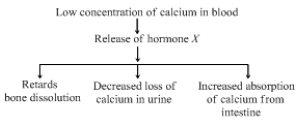
Name the hormone $X$ based on the provided flow chart.
A
$PTH$
B
$TCT$
C
$ADH$
D
$ACTH$
Solution
(A) The flow chart shows that hormone $X$ is released in response to low blood calcium levels and acts to increase calcium levels in the blood.
$TCT$ (Thyrocalcitonin) is a hormone secreted by the thyroid gland that lowers blood calcium levels.
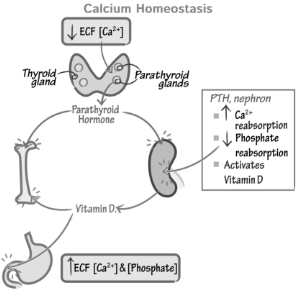
$PTH$ (Parathyroid Hormone) is secreted by the parathyroid glands in response to low blood calcium levels. It acts to increase blood calcium levels by stimulating bone resorption (dissolution),increasing calcium reabsorption by the renal tubules,and increasing calcium absorption from the digested food in the intestine.
Therefore,the hormone $X$ is $PTH$.
$TCT$ (Thyrocalcitonin) is a hormone secreted by the thyroid gland that lowers blood calcium levels.
$PTH$ (Parathyroid Hormone) is secreted by the parathyroid glands in response to low blood calcium levels. It acts to increase blood calcium levels by stimulating bone resorption (dissolution),increasing calcium reabsorption by the renal tubules,and increasing calcium absorption from the digested food in the intestine.
Therefore,the hormone $X$ is $PTH$.
0 likes
View Solution54
MediumMCQ
Ram has a high level of calcium in his blood. An excess of which hormone can cause this effect?
A
Thyrocalcitonin
B
Growth hormone
C
Parathormone
D
Insulin
Solution
(C) Ram has a high level of calcium in his blood (hypercalcemia).
This condition is primarily caused by an excess of $Parathormone$ $(PTH)$,which is secreted by the parathyroid glands.
$PTH$ increases blood calcium levels by stimulating osteoclast activity (bone resorption),increasing calcium reabsorption in the renal tubules,and promoting calcium absorption from the digestive tract.
$Thyrocalcitonin$ $(TCT)$ has an antagonistic effect to $PTH$,meaning it lowers blood calcium levels.
Growth hormone and insulin do not primarily regulate blood calcium levels in this manner.
This condition is primarily caused by an excess of $Parathormone$ $(PTH)$,which is secreted by the parathyroid glands.
$PTH$ increases blood calcium levels by stimulating osteoclast activity (bone resorption),increasing calcium reabsorption in the renal tubules,and promoting calcium absorption from the digestive tract.
$Thyrocalcitonin$ $(TCT)$ has an antagonistic effect to $PTH$,meaning it lowers blood calcium levels.
Growth hormone and insulin do not primarily regulate blood calcium levels in this manner.
0 likes
View Solution55
MediumMCQ
Increase in the excitability of nerves and muscles leading to sustained contraction of the muscles of larynx,face,hand and feet is due to
A
Hyperactivity of thyroid
B
Hyperactivity of parathyroid
C
Hypoactivity of thyroid
D
Hypoactivity of parathyroid
Solution
(D) The excitability of nerves and muscles is regulated by the concentration of ions,particularly $Ca^{2+}$.
Parathyroid hormone $(PTH)$ is a hypercalcemic hormone,meaning it increases blood $Ca^{2+}$ levels by stimulating bone resorption (osteoclast activity).
$A$ decrease in $PTH$ activity (hypoactivity) leads to hypocalcemia,which is a low level of $Ca^{2+}$ in the blood.
Low levels of $Ca^{2+}$ lower the threshold for nerve impulse generation,thereby increasing the excitability of nerves and muscles.
This increased excitability results in sustained contractions or spasms of the muscles of the larynx,face,hands,and feet,a condition known as tetany.
Parathyroid hormone $(PTH)$ is a hypercalcemic hormone,meaning it increases blood $Ca^{2+}$ levels by stimulating bone resorption (osteoclast activity).
$A$ decrease in $PTH$ activity (hypoactivity) leads to hypocalcemia,which is a low level of $Ca^{2+}$ in the blood.
Low levels of $Ca^{2+}$ lower the threshold for nerve impulse generation,thereby increasing the excitability of nerves and muscles.
This increased excitability results in sustained contractions or spasms of the muscles of the larynx,face,hands,and feet,a condition known as tetany.
0 likes
View Solution56
MediumMCQ
Which of the following are not the effects of Parathyroid hormone $(PTH)$?
$(a)$ Stimulates the process of bone resorption
$(b)$ Decreases $Ca^{2+}$ level in blood
$(c)$ Reabsorption of $Ca^{2+}$ by renal tubules
$(d)$ Decreases the absorption of $Ca^{2+}$ from digested food
$(e)$ Increases metabolism of carbohydrates
Choose the most appropriate answer from the options given below:
$(a)$ Stimulates the process of bone resorption
$(b)$ Decreases $Ca^{2+}$ level in blood
$(c)$ Reabsorption of $Ca^{2+}$ by renal tubules
$(d)$ Decreases the absorption of $Ca^{2+}$ from digested food
$(e)$ Increases metabolism of carbohydrates
Choose the most appropriate answer from the options given below:
A
$(b), (d)$ and $(e)$ only
B
$(a)$ and $(e)$ only
C
$(b)$ and $(c)$ only
D
$(a)$ and $(c)$ only
Solution
(A) Parathyroid hormone $(PTH)$ is a peptide hormone secreted by the parathyroid gland that plays a crucial role in calcium homeostasis.
$1$. It stimulates the process of bone resorption (demineralization),which releases calcium into the blood. Thus,statement $(a)$ is an effect of $PTH$.
$2$. It increases $Ca^{2+}$ levels in the blood (hypercalcemic hormone). Thus,statement $(b)$ is $NOT$ an effect of $PTH$.
$3$. It stimulates the reabsorption of $Ca^{2+}$ by the renal tubules. Thus,statement $(c)$ is an effect of $PTH$.
$4$. It increases the absorption of $Ca^{2+}$ from digested food by stimulating the synthesis of active Vitamin $D$. Thus,statement $(d)$ is $NOT$ an effect of $PTH$.
$5$. $PTH$ does not directly increase the metabolism of carbohydrates. Thus,statement $(e)$ is $NOT$ an effect of $PTH$.
Therefore,the statements that are $NOT$ the effects of $PTH$ are $(b), (d)$,and $(e)$.
$1$. It stimulates the process of bone resorption (demineralization),which releases calcium into the blood. Thus,statement $(a)$ is an effect of $PTH$.
$2$. It increases $Ca^{2+}$ levels in the blood (hypercalcemic hormone). Thus,statement $(b)$ is $NOT$ an effect of $PTH$.
$3$. It stimulates the reabsorption of $Ca^{2+}$ by the renal tubules. Thus,statement $(c)$ is an effect of $PTH$.
$4$. It increases the absorption of $Ca^{2+}$ from digested food by stimulating the synthesis of active Vitamin $D$. Thus,statement $(d)$ is $NOT$ an effect of $PTH$.
$5$. $PTH$ does not directly increase the metabolism of carbohydrates. Thus,statement $(e)$ is $NOT$ an effect of $PTH$.
Therefore,the statements that are $NOT$ the effects of $PTH$ are $(b), (d)$,and $(e)$.
0 likes
View Solution57
MediumMCQ
Which of the following hormone levels,when decreased,leads to tetany?
A
$PTH$
B
$TCT$
C
$T_3$
D
$T_4$
Solution
(A) Tetany is a condition characterized by involuntary muscle contractions or spasms.
It is primarily caused by hypocalcemia,which is a low level of calcium in the blood.
$PTH$ (Parathyroid Hormone) is responsible for increasing blood calcium levels by stimulating bone resorption and calcium reabsorption in the kidneys.
$A$ deficiency or decreased level of $PTH$ leads to low blood calcium levels $(hypocalcemia)$,which causes increased neuromuscular excitability,resulting in tetany.
It is primarily caused by hypocalcemia,which is a low level of calcium in the blood.
$PTH$ (Parathyroid Hormone) is responsible for increasing blood calcium levels by stimulating bone resorption and calcium reabsorption in the kidneys.
$A$ deficiency or decreased level of $PTH$ leads to low blood calcium levels $(hypocalcemia)$,which causes increased neuromuscular excitability,resulting in tetany.
0 likes
View Solution58
EasyMCQ
Which of the following hormones is hypercalcemic?
A
$PTH$
B
$MSH$
C
$TCT$
D
Thymosin
Solution
(A) The hormone $PTH$ (Parathyroid Hormone) is known as a hypercalcemic hormone.
It increases the levels of calcium ions $(Ca^{2+})$ in the blood.
It acts on bones and stimulates the process of bone resorption (dissolution/demineralization).
It also stimulates the reabsorption of $Ca^{2+}$ by the renal tubules and increases $Ca^{2+}$ absorption from the digested food in the intestine.
It increases the levels of calcium ions $(Ca^{2+})$ in the blood.
It acts on bones and stimulates the process of bone resorption (dissolution/demineralization).
It also stimulates the reabsorption of $Ca^{2+}$ by the renal tubules and increases $Ca^{2+}$ absorption from the digested food in the intestine.
0 likes
View Solution59
MediumMCQ
Which of these endocrine glands is present in the greatest number?
A
Pituitary gland
B
Hypothalamus
C
Parathyroid gland
D
Thymus
Solution
(C) The human body contains one pituitary gland,one hypothalamus,and one thymus gland.
However,there are four parathyroid glands located on the back side of the thyroid gland (two pairs).
Therefore,in terms of number,the parathyroid glands are the most numerous among the options provided.
However,there are four parathyroid glands located on the back side of the thyroid gland (two pairs).
Therefore,in terms of number,the parathyroid glands are the most numerous among the options provided.
0 likes
View Solution60
MediumMCQ
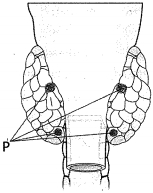
What is the function of the glands shown in the figure?
A
Increases blood sugar level
B
Increases water level in blood
C
Increases calcium level in blood
D
All of the above
Solution
(C) The figure shows the thyroid gland with four small glands embedded on its posterior surface,labeled as '$P$'. These are the parathyroid glands.
Parathyroid glands secrete a peptide hormone called Parathyroid Hormone $(PTH)$.
The main function of $PTH$ is to increase the $Ca^{2+}$ levels in the blood by acting on bones (stimulating bone resorption),kidneys (increasing reabsorption of calcium),and the intestine (increasing absorption of calcium from digested food).
Therefore,the correct function is to increase the calcium level in the blood.
Parathyroid glands secrete a peptide hormone called Parathyroid Hormone $(PTH)$.
The main function of $PTH$ is to increase the $Ca^{2+}$ levels in the blood by acting on bones (stimulating bone resorption),kidneys (increasing reabsorption of calcium),and the intestine (increasing absorption of calcium from digested food).
Therefore,the correct function is to increase the calcium level in the blood.
0 likes
View Solution61
MediumMCQ
What happens when the secretion of $PTH$ (Parathyroid Hormone) decreases?
A
Calcium ions in the blood increase.
B
Calcium ions in the blood decrease.
C
Glucose levels in the blood increase.
D
Glucose levels in the blood decrease.
Solution
(B) $PTH$ (Parathyroid Hormone) is a peptide hormone secreted by the parathyroid glands. Its primary function is to increase the level of calcium ions $(Ca^{2+})$ in the blood. It acts on bones to stimulate the process of bone resorption (dissolution/demineralization) and also stimulates the reabsorption of $Ca^{2+}$ by the renal tubules and increases $Ca^{2+}$ absorption from the digested food. Therefore,if the secretion of $PTH$ decreases (hypoparathyroidism),the blood calcium levels will drop,leading to hypocalcemia.
0 likes
View Solution62
MediumMCQ
Hypoparathyroidism can cause:
A
Renal lithiasis
B
Cretinism
C
Tetany
D
Osteoporosis
Solution
(C) Hypoparathyroidism is a condition characterized by low levels of parathyroid hormone $(PTH)$.
$PTH$ is responsible for increasing blood calcium levels by stimulating bone resorption and increasing calcium reabsorption in the kidneys.
When $PTH$ levels are low,blood calcium levels drop significantly (hypocalcemia).
This reduction in blood calcium leads to increased neuromuscular excitability,resulting in involuntary muscle spasms or contractions known as tetany.
$PTH$ is responsible for increasing blood calcium levels by stimulating bone resorption and increasing calcium reabsorption in the kidneys.
When $PTH$ levels are low,blood calcium levels drop significantly (hypocalcemia).
This reduction in blood calcium leads to increased neuromuscular excitability,resulting in involuntary muscle spasms or contractions known as tetany.
0 likes
View Solution63
EasyMCQ
Demineralization of bone resulting in softening,bending,and fracture of bones,common in women who have reached menopause,is called < u> i and is caused due to < u> ii .
A
$i$ - Myxoedema,$ii$ - hyposecretion of thyroxine hormone
B
$i$ - Acromegaly,$ii$ - hyposecretion of Growth hormone
C
$i$ - Osteoporosis,$ii$ - hypersecretion of parathormone
D
$i$ - Grave's disease,$ii$ - hypersecretion of calcitonin
Solution
(C) The condition described is $Osteoporosis$,which is characterized by a decrease in bone mass and increased fragility of bones.
It is common in post-menopausal women due to a decrease in estrogen levels,which leads to increased bone resorption.
Parathormone $(PTH)$ is a hormone that increases blood calcium levels by stimulating bone resorption (demineralization).
Therefore,excessive secretion $(hypersecretion)$ of parathormone leads to excessive removal of calcium from the bones,causing them to become soft and brittle.
It is common in post-menopausal women due to a decrease in estrogen levels,which leads to increased bone resorption.
Parathormone $(PTH)$ is a hormone that increases blood calcium levels by stimulating bone resorption (demineralization).
Therefore,excessive secretion $(hypersecretion)$ of parathormone leads to excessive removal of calcium from the bones,causing them to become soft and brittle.
0 likes
View Solution64
EasyMCQ
Which hormone is known as the hypercalcemic hormone?
A
Aldosterone
B
Calcitriol
C
$PTH$
D
$TCT$
Solution
(C) The hormone $PTH$ (Parathyroid Hormone) is known as a hypercalcemic hormone.
It increases the blood calcium levels $(Ca^{2+})$ in the body.
$PTH$ acts on bones and stimulates the process of bone resorption (dissolution/demineralization).
It also stimulates the reabsorption of $Ca^{2+}$ by the renal tubules and increases $Ca^{2+}$ absorption from the digested food in the intestine.
Conversely,$TCT$ (Thyrocalcitonin) is a hypocalcemic hormone that lowers blood calcium levels.
It increases the blood calcium levels $(Ca^{2+})$ in the body.
$PTH$ acts on bones and stimulates the process of bone resorption (dissolution/demineralization).
It also stimulates the reabsorption of $Ca^{2+}$ by the renal tubules and increases $Ca^{2+}$ absorption from the digested food in the intestine.
Conversely,$TCT$ (Thyrocalcitonin) is a hypocalcemic hormone that lowers blood calcium levels.
0 likes
View SolutionChemical Coordination and Integration — Parathyroid Gland · Frequently Asked Questions
1Are these Chemical Coordination and Integration questions useful for JEE and NEET?
Yes. All questions in this section are mapped to JEE Main and NEET exam patterns. Previous year questions from JEE Main, NEET, GUJCET and state-level exams are included with full solutions.
2Can I switch to Hindi or Gujarati for these questions?
Yes. Use the language tabs in the hero section or the sidebar to view the same questions and solutions in English, Hindi or Gujarati.
3How do I generate a question paper from this subtopic?
Use the Vedclass Exam Paper Generator — select the chapter and subtopic, set difficulty, and generate Sets A, B, C, D automatically. First 3 chapters of every subject are free.
Vedclass Products
For Students
Vedclass Test Series
Mock tests in real JEE/NEET style with performance analysis. 5-day free trial.
Start Free TrialFor Teachers
Exam Paper Generator
Generate Set A/B/C/D papers from this chapter in 2 minutes. 3 chapters free.
Try FreeFor Institutes
Online Exam Module
Live online exams with unlimited students, 360° analytics & white-label branding.
See DemoFor Teachers & Institutes
Generate a Chemical Coordination and Integration Exam Paper in 2 Minutes
Select subtopic & difficulty — Sets A, B, C, D auto-generated with No Repeat logic.
First 3 chapters of every subject are free — no payment required.