
A English
Mix Examples-Chemical Coordination and Integration Questions in English
Class 11 Biology · Chemical Coordination and Integration · Mix Examples-Chemical Coordination and Integration
103+
Questions
English
Language
100%
With Solutions
Showing 50 of 103 questions in English
51
DifficultMCQ
Match the following hormones with the respective diseases:
Select the correct option.
| $(a)$ Insulin | $(i)$ Addison's disease |
| $(b)$ Thyroxin | $(ii)$ Diabetes insipidus |
| $(c)$ Corticoids | $(iii)$ Acromegaly |
| $(d)$ Growth Hormone | $(iv)$ Goitre |
| $(v)$ Diabetes mellitus |
Select the correct option.
A
$(v), (i), (ii), (iii)$
B
$(ii), (iv), (iii), (i)$
C
$(v), (iv), (i), (iii)$
D
$(ii), (iv), (i), (iii)$
Solution
(C) The correct matches are as follows:
$1$. Insulin: Deficiency or resistance leads to $Diabetes \text{ } mellitus$ $(a-v)$.
$2$. Thyroxin: Deficiency leads to $Goitre$ $(b-iv)$.
$3$. Corticoids: Deficiency of glucocorticoids/mineralocorticoids leads to $Addison's \text{ } disease$ $(c-i)$.
$4$. Growth Hormone: Hypersecretion in adults leads to $Acromegaly$ $(d-iii)$.
Therefore,the correct sequence is $(a-v, b-iv, c-i, d-iii)$.
$1$. Insulin: Deficiency or resistance leads to $Diabetes \text{ } mellitus$ $(a-v)$.
$2$. Thyroxin: Deficiency leads to $Goitre$ $(b-iv)$.
$3$. Corticoids: Deficiency of glucocorticoids/mineralocorticoids leads to $Addison's \text{ } disease$ $(c-i)$.
$4$. Growth Hormone: Hypersecretion in adults leads to $Acromegaly$ $(d-iii)$.
Therefore,the correct sequence is $(a-v, b-iv, c-i, d-iii)$.
0 likes
View Solution52
MediumMCQ
Which of the following matches is correct?
A
Hormone $\to$ Oxytocin,Effect $\to$ Milk ejection hormone
B
Hormone $\to$ Glucagon,Effect $\to$ Decreases blood sugar level
C
Hormone $\to$ Adrenaline,Effect $\to$ Decreases heart rate
D
Hormone $\to$ Thyroxine,Effect $\to$ Decreases $BMR$
Solution
(A) Oxytocin is a hormone secreted by the posterior pituitary that causes contraction of the smooth muscles of the myometrium during childbirth and the ejection of milk from the mammary glands.
Glucagon is secreted by the $\alpha$-cells of the Islets of Langerhans in the pancreas. Its main function is to increase blood glucose levels.
Adrenaline (epinephrine) is secreted by the adrenal medulla. It increases the rate and force of the heartbeat.
The thyroid gland secretes thyroxine,which regulates the basal metabolic rate $(BMR)$.
Glucagon is secreted by the $\alpha$-cells of the Islets of Langerhans in the pancreas. Its main function is to increase blood glucose levels.
Adrenaline (epinephrine) is secreted by the adrenal medulla. It increases the rate and force of the heartbeat.
The thyroid gland secretes thyroxine,which regulates the basal metabolic rate $(BMR)$.
0 likes
View Solution53
Medium
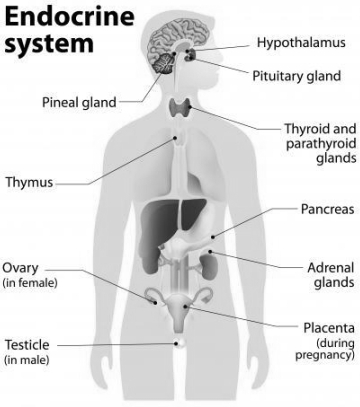
Diagrammatically indicate the location of the various endocrine glands in our body.
Solution
(N/A) The endocrine system consists of various glands that secrete hormones directly into the bloodstream. The major endocrine glands and their locations are as follows:
$1$. Hypothalamus: Located at the base of the brain.
$2$. Pituitary gland: Located just below the hypothalamus in the brain.
$3$. Pineal gland: Located on the dorsal side of the forebrain.
$4$. Thyroid and parathyroid glands: Located on either side of the trachea in the neck region.
$5$. Thymus: Located between the lungs behind the sternum.
$6$. Adrenal glands: Located on the top of each kidney.
$7$. Pancreas: Located behind the stomach.
$8$. Gonads (Ovary in females and Testis in males): Located in the pelvic region.
$9$. Placenta: Develops during pregnancy to support the fetus.
$1$. Hypothalamus: Located at the base of the brain.
$2$. Pituitary gland: Located just below the hypothalamus in the brain.
$3$. Pineal gland: Located on the dorsal side of the forebrain.
$4$. Thyroid and parathyroid glands: Located on either side of the trachea in the neck region.
$5$. Thymus: Located between the lungs behind the sternum.
$6$. Adrenal glands: Located on the top of each kidney.
$7$. Pancreas: Located behind the stomach.
$8$. Gonads (Ovary in females and Testis in males): Located in the pelvic region.
$9$. Placenta: Develops during pregnancy to support the fetus.
0 likes
View Solution54
Difficult
Write short notes on the functions of the following hormones: (Any four)
$(a)$ Parathyroid hormones $(PTH)$
$(b)$ Thyroid hormones
$(c)$ Thymosin
$(d)$ Androgens
$(e)$ Estrogens
$(f)$ Insulin and Glucagon
$(a)$ Parathyroid hormones $(PTH)$
$(b)$ Thyroid hormones
$(c)$ Thymosin
$(d)$ Androgens
$(e)$ Estrogens
$(f)$ Insulin and Glucagon
Solution
(A) Parathyroid hormone $(PTH)$ increases the level of calcium ions in the blood by acting on bones and kidneys.
$(b)$ Thyroid hormones $(T_3$ and $T_4)$ regulate the basal metabolic rate,support the process of red blood cell formation,and control the metabolism of carbohydrates,proteins,and fats.
$(c)$ Thymosin plays a major role in the differentiation of $T$-lymphocytes,which provide cell-mediated immunity,and promotes the production of antibodies.
$(d)$ Androgens regulate the development,maturation,and functions of the male accessory sex organs and stimulate muscular growth,facial and axillary hair,and aggressiveness.
$(e)$ Estrogens produce wide-ranging actions such as stimulation of growth and activities of female secondary sex organs,development of growing ovarian follicles,and appearance of female secondary sex characters.
$(f)$ Insulin acts mainly on hepatocytes and adipocytes to enhance cellular glucose uptake and utilization,thereby lowering blood glucose levels. Glucagon acts mainly on the liver cells and stimulates glycogenolysis,resulting in an increased blood sugar level.
$(b)$ Thyroid hormones $(T_3$ and $T_4)$ regulate the basal metabolic rate,support the process of red blood cell formation,and control the metabolism of carbohydrates,proteins,and fats.
$(c)$ Thymosin plays a major role in the differentiation of $T$-lymphocytes,which provide cell-mediated immunity,and promotes the production of antibodies.
$(d)$ Androgens regulate the development,maturation,and functions of the male accessory sex organs and stimulate muscular growth,facial and axillary hair,and aggressiveness.
$(e)$ Estrogens produce wide-ranging actions such as stimulation of growth and activities of female secondary sex organs,development of growing ovarian follicles,and appearance of female secondary sex characters.
$(f)$ Insulin acts mainly on hepatocytes and adipocytes to enhance cellular glucose uptake and utilization,thereby lowering blood glucose levels. Glucagon acts mainly on the liver cells and stimulates glycogenolysis,resulting in an increased blood sugar level.
0 likes
View Solution55
Medium
Provide the differences between the following:
$(1)$ Neural system and Endocrine system
$(2)$ Hormones of adrenal cortex and Hormones of adrenal medulla
$(3)$ Thyroid hormones and Parathyroid hormones
$(1)$ Neural system and Endocrine system
$(2)$ Hormones of adrenal cortex and Hormones of adrenal medulla
$(3)$ Thyroid hormones and Parathyroid hormones
Solution
(N/A) $(1)$
$(2)$
$(3)$
| Neural system | Endocrine system |
| $(1)$ Neurotransmitters are released due to nerve impulse stimulation. | $(1)$ Transported by blood throughout the body. |
| $(2)$ Primarily affects muscles and glands. | $(2)$ Induces changes in metabolic processes. |
| $(3)$ Rapid conduction of signals. | $(3)$ Slower response (seconds to days). |
| $(4)$ Reaction time is very short. | $(4)$ Reaction period is comparatively longer. |
$(2)$
| Hormones of adrenal cortex | Hormones of adrenal medulla |
| $(1)$ Steroid hormones. | $(1)$ Catecholamine hormones. |
| $(2)$ Affects kidney and various tissues. | $(2)$ Affects cardiac tissue and smooth muscles. |
| $(3)$ Regulates water-electrolyte balance and glucose metabolism. | $(3)$ Stimulates metabolic activities during stress. |
| $(4)$ Examples: Cortisol,Aldosterone. | $(4)$ Examples: Adrenaline,Noradrenaline. |
$(3)$
| Thyroid hormone | Parathyroid hormone |
| $(1)$ Main hormone is Thyroxine $(T_4)$. | $(1)$ Main hormone is Parathyroid hormone $(PTH)$. |
| $(2)$ Iodinated amino acid derivative. | $(2)$ Peptide hormone. |
| $(3)$ Increases basal metabolic rate. | $(3)$ Increases $Ca^{2+}$ level in the blood. |
| $(4)$ Hyposecretion causes cretinism or myxedema. | $(4)$ Hyposecretion causes tetany (muscle spasms). |
0 likes
View Solution56
Medium
Differentiate between the following:
$(1)$ Hormones of testis and Hormones of ovaries
$(2)$ Hormones and Enzymes
$(1)$ Hormones of testis and Hormones of ovaries
$(2)$ Hormones and Enzymes
Solution
(N/A) $(1)$ Differences between Hormones of testis and Hormones of ovaries:
$(2)$ Differences between Hormones and Enzymes:
| Hormones of testis | Hormones of ovaries |
| $(1)$ The main hormone is testosterone. | $(1)$ Estrogen and progesterone are included. |
| $(2)$ Induces the process of spermatogenesis. | $(2)$ Induces the process of oogenesis. |
| $(3)$ Responsible for secondary sexual characters in males. | $(3)$ Induces secondary sexual characters in females. |
| $(4)$ Promotes the development of male reproductive organs. | $(4)$ Promotes the development of female reproductive organs. |
$(2)$ Differences between Hormones and Enzymes:
| Hormones | Enzymes |
| $(1)$ Site of production and site of action are different. | $(1)$ Site of production and site of action are often the same. |
| $(2)$ They are proteinaceous, steroid, or biogenic amine in nature. | $(2)$ They are primarily proteinaceous in nature. |
| $(3)$ Their effect is generally slow and long-lasting. | $(3)$ Their effect is generally fast and transient. |
| $(4)$ They are consumed or degraded after performing their function. | $(4)$ They are not consumed or degraded during the reaction. |
0 likes
View Solution57
Medium
Give scientific reasons:
$(1)$ Hormones are regulatory chemicals.
$(2)$ Less secretion of thyroxine results in stunted growth of a person.
$(3)$ Deficiency of insulin results in diabetes mellitus.
$(4)$ Pancreas is an exocrine and endocrine gland.
$(1)$ Hormones are regulatory chemicals.
$(2)$ Less secretion of thyroxine results in stunted growth of a person.
$(3)$ Deficiency of insulin results in diabetes mellitus.
$(4)$ Pancreas is an exocrine and endocrine gland.
Solution
(D) $(1)$ Hormones regulate various physiological processes through two methods. Some physiological activities are performed by the release of stimulating chemicals,while some inhibitory chemicals regulate the rate,amount,and type of activities. Thus,they regulate various physiological activities by stimulating or inhibitory actions,hence they are called regulatory chemicals.
$(2)$ Deficiency of thyroxine hormone results in rough,abnormal skin,a thick tongue,and faulty respiration. If such deficiency is observed during development,it leads to cretinism (dwarfism and mental retardation). In adults,it causes myxedema,characterized by an abnormal face and inflammation of body parts. Thus,reduced secretion of thyroxine significantly affects the growth and metabolism of an individual.
$(3)$ Lack of insulin or reduced secretion leads to an increase in blood glucose levels (hyperglycemia). Excess sugar is excreted in the urine (glycosuria). Symptoms include increased thirst (polydipsia),increased hunger (polyphagia),and frequent urination (polyuria). Long-term effects include damage to the heart,kidneys,and eyes. These are the characteristic symptoms of diabetes mellitus.
$(4)$ Pancreatic acini found in the pancreas secrete pancreatic juice containing digestive enzymes,which is transported via the pancreatic duct to the duodenum. Thus,due to the presence of a duct,it functions as an exocrine gland. The Islets of Langerhans secrete hormones like insulin and glucagon,which are released directly into the blood to reach target organs. Thus,it also acts as an endocrine gland.
$(2)$ Deficiency of thyroxine hormone results in rough,abnormal skin,a thick tongue,and faulty respiration. If such deficiency is observed during development,it leads to cretinism (dwarfism and mental retardation). In adults,it causes myxedema,characterized by an abnormal face and inflammation of body parts. Thus,reduced secretion of thyroxine significantly affects the growth and metabolism of an individual.
$(3)$ Lack of insulin or reduced secretion leads to an increase in blood glucose levels (hyperglycemia). Excess sugar is excreted in the urine (glycosuria). Symptoms include increased thirst (polydipsia),increased hunger (polyphagia),and frequent urination (polyuria). Long-term effects include damage to the heart,kidneys,and eyes. These are the characteristic symptoms of diabetes mellitus.
$(4)$ Pancreatic acini found in the pancreas secrete pancreatic juice containing digestive enzymes,which is transported via the pancreatic duct to the duodenum. Thus,due to the presence of a duct,it functions as an exocrine gland. The Islets of Langerhans secrete hormones like insulin and glucagon,which are released directly into the blood to reach target organs. Thus,it also acts as an endocrine gland.
0 likes
View Solution58
Medium
Identify the difference between the following pairs:
$(1)$ Neural system - Endocrine system
$(2)$ Oxytocin - Vasopressin
$(3)$ Dwarfism - Gigantism
$(4)$ $FSH - LH$
$(1)$ Neural system - Endocrine system
$(2)$ Oxytocin - Vasopressin
$(3)$ Dwarfism - Gigantism
$(4)$ $FSH - LH$
Solution
(A) $(1)$ $\text{Neural system}$: Uses neurotransmitters for rapid,short-lived responses.
$\text{Endocrine system}$: Uses hormones for slower,long-lasting physiological effects.
$(2)$ $\text{Oxytocin}$: Stimulates uterine contractions during childbirth and milk ejection.
$\text{Vasopressin}$: Also known as $\text{ADH}$,it stimulates the reabsorption of $H_2O$ and electrolytes by the distal tubules of the kidney.
$(3)$ $\text{Dwarfism}$: Caused by the hyposecretion of growth hormone $(GH)$ during childhood,leading to stunted growth.
$\text{Gigantism}$: Caused by the hypersecretion of growth hormone $(GH)$ during childhood,leading to abnormal overgrowth of the body.
$(4)$ $FSH$ $(\text{Follicle Stimulating Hormone})$: Stimulates the growth and development of ovarian follicles in females and spermatogenesis in males.
$LH$ $(\text{Luteinizing Hormone})$: Induces ovulation of fully mature follicles and maintains the corpus luteum in females; stimulates the synthesis and secretion of androgens in males.
$\text{Endocrine system}$: Uses hormones for slower,long-lasting physiological effects.
$(2)$ $\text{Oxytocin}$: Stimulates uterine contractions during childbirth and milk ejection.
$\text{Vasopressin}$: Also known as $\text{ADH}$,it stimulates the reabsorption of $H_2O$ and electrolytes by the distal tubules of the kidney.
$(3)$ $\text{Dwarfism}$: Caused by the hyposecretion of growth hormone $(GH)$ during childhood,leading to stunted growth.
$\text{Gigantism}$: Caused by the hypersecretion of growth hormone $(GH)$ during childhood,leading to abnormal overgrowth of the body.
$(4)$ $FSH$ $(\text{Follicle Stimulating Hormone})$: Stimulates the growth and development of ovarian follicles in females and spermatogenesis in males.
$LH$ $(\text{Luteinizing Hormone})$: Induces ovulation of fully mature follicles and maintains the corpus luteum in females; stimulates the synthesis and secretion of androgens in males.
0 likes
View Solution59
EasyMCQ
Identify the differences between the following pairs of biological terms:
$(1)$ $RH - IH$
$(2)$ Diabetes insipidus - Diabetes mellitus
$(3)$ Testosterone - Progesterone
$(4)$ Atrial Natriuretic Factor $(ANF)$ - Erythropoietin
$(1)$ $RH - IH$
$(2)$ Diabetes insipidus - Diabetes mellitus
$(3)$ Testosterone - Progesterone
$(4)$ Atrial Natriuretic Factor $(ANF)$ - Erythropoietin
A
Hormonal functions
B
Metabolic disorders
C
Sex hormones
D
Regulatory factors
Solution
(N/A) $(1)$ $RH$ (Releasing Hormone): Stimulates the secretion of pituitary hormones.
$IH$ (Inhibitory Hormone): Inhibits the secretion of pituitary hormones.
$(2)$ Diabetes insipidus: Caused by the deficiency of $ADH$ (Vasopressin),leading to frequent urination.
Diabetes mellitus: Caused by the deficiency of insulin,leading to high blood glucose levels and excretion of glucose in the urine.
$(3)$ Testosterone: Primary male sex hormone responsible for the development of male secondary sexual characters.
Progesterone: Primary female sex hormone responsible for the maintenance of the endometrium and secondary sexual characters.
$(4)$ Atrial Natriuretic Factor $(ANF)$: Secreted by the atrial wall of the heart,it acts to reduce blood pressure.
Erythropoietin: Secreted by the $JG$ cells of the kidney,it stimulates the production of $RBCs$ (erythropoiesis).
$IH$ (Inhibitory Hormone): Inhibits the secretion of pituitary hormones.
$(2)$ Diabetes insipidus: Caused by the deficiency of $ADH$ (Vasopressin),leading to frequent urination.
Diabetes mellitus: Caused by the deficiency of insulin,leading to high blood glucose levels and excretion of glucose in the urine.
$(3)$ Testosterone: Primary male sex hormone responsible for the development of male secondary sexual characters.
Progesterone: Primary female sex hormone responsible for the maintenance of the endometrium and secondary sexual characters.
$(4)$ Atrial Natriuretic Factor $(ANF)$: Secreted by the atrial wall of the heart,it acts to reduce blood pressure.
Erythropoietin: Secreted by the $JG$ cells of the kidney,it stimulates the production of $RBCs$ (erythropoiesis).
0 likes
View Solution60
Medium
There are many endocrine glands in the human body. Name the glands which are absent in males and the ones absent in females.
Solution
(N/A) In males, the $Ovary$ is absent.
In females, the $Testis$ is absent.
In males, a pair of $Testes$ is present in the scrotal sac, which functions as a primary sex organ as well as an endocrine gland. This gland is absent in females.
A pair of $Ovaries$ is present in the abdominal cavity of females. It serves as the female reproductive organ as well as an endocrine gland, producing hormones like $Estrogen$ and $Progesterone$. In males, $Ovaries$ are absent.
In females, the $Testis$ is absent.
In males, a pair of $Testes$ is present in the scrotal sac, which functions as a primary sex organ as well as an endocrine gland. This gland is absent in females.
A pair of $Ovaries$ is present in the abdominal cavity of females. It serves as the female reproductive organ as well as an endocrine gland, producing hormones like $Estrogen$ and $Progesterone$. In males, $Ovaries$ are absent.
0 likes
View Solution61
MediumMCQ
What is coordination?
A
The process of cell division
B
The process through which two or more organs interact and complement the functions of one another
C
The process of energy production in cells
D
The process of waste removal from the body
Solution
(B) Coordination is the process through which two or more organs interact and complement the functions of one another.
In living organisms,the functions of various organs and organ systems must be coordinated to maintain homeostasis and ensure the survival of the organism.
In living organisms,the functions of various organs and organ systems must be coordinated to maintain homeostasis and ensure the survival of the organism.
0 likes
View Solution62
Medium
Calcium plays a very important role in the formation of bones. Write about the role of endocrine glands and hormones responsible for maintaining calcium homeostasis.
Solution
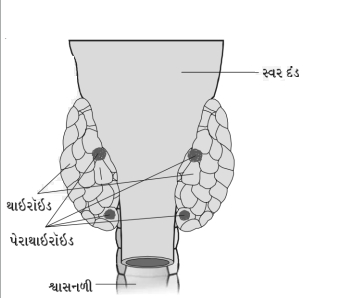
$(i)$ Parathyroid gland secretes Parathyroid Hormone $(PTH)$,which maintains the balance of $Ca^{++}$ and $PO_4^{3-}$ in blood and other tissues. It induces the transport of calcium from bones into the blood and increases the reabsorption of $Ca^{++}$ by the kidneys and intestine.
(ii) Thyroid gland secretes Thyrocalcitonin $(TCT)$ hormone. It inhibits the release of $Ca^{++}$ from bone and lowers blood calcium levels; thus,it acts against $PTH$ and maintains the homeostasis of $Ca^{++}$.
(ii) Thyroid gland secretes Thyrocalcitonin $(TCT)$ hormone. It inhibits the release of $Ca^{++}$ from bone and lowers blood calcium levels; thus,it acts against $PTH$ and maintains the homeostasis of $Ca^{++}$.
0 likes
View Solution63
MediumMCQ
Complete the following analogies:
$1$. Antidiuretic hormone : Diabetes insipidus :: $\beta$-cells of pancreas : ......
$2$. Corpus luteum : Progesterone :: Leydig cells : ......
$3$. $GIP$ : Gastric inhibitory peptide :: $CCK$ : ......
$1$. Antidiuretic hormone : Diabetes insipidus :: $\beta$-cells of pancreas : ......
$2$. Corpus luteum : Progesterone :: Leydig cells : ......
$3$. $GIP$ : Gastric inhibitory peptide :: $CCK$ : ......
A
Diabetes mellitus,Testosterone,Cholecystokinin
B
Diabetes mellitus,Estrogen,Cholecystokinin
C
Diabetes insipidus,Testosterone,Gastrin
D
Diabetes mellitus,Progesterone,Secretin
Solution
(A) $1$. Antidiuretic hormone $(ADH)$ deficiency leads to Diabetes insipidus. Similarly,the destruction or dysfunction of $\beta$-cells of the pancreas leads to Diabetes mellitus.
$2$. Corpus luteum secretes the hormone Progesterone. Similarly,Leydig cells (interstitial cells) of the testes secrete the hormone Testosterone.
$3$. $GIP$ stands for Gastric inhibitory peptide. Similarly,$CCK$ stands for Cholecystokinin.
$2$. Corpus luteum secretes the hormone Progesterone. Similarly,Leydig cells (interstitial cells) of the testes secrete the hormone Testosterone.
$3$. $GIP$ stands for Gastric inhibitory peptide. Similarly,$CCK$ stands for Cholecystokinin.
0 likes
View Solution64
Medium
Complete the following analogy-based questions:
$1$. Juxtaglomerular cells of kidney : Erythropoietin :: Atrial wall of heart : .....
$2$. Follicle : Estrogen :: Corpus luteum : .....
$3$. Decrease in glucose utilization at cellular level : Hyperglycemia :: Decrease in blood glucose level : .....
$4$. $\alpha$-cells of pancreas : Glucagon :: $\beta$-cells of pancreas : .....
$1$. Juxtaglomerular cells of kidney : Erythropoietin :: Atrial wall of heart : .....
$2$. Follicle : Estrogen :: Corpus luteum : .....
$3$. Decrease in glucose utilization at cellular level : Hyperglycemia :: Decrease in blood glucose level : .....
$4$. $\alpha$-cells of pancreas : Glucagon :: $\beta$-cells of pancreas : .....
Solution
(A-D) $1$. The atrial wall of the heart secretes Atrial Natriuretic Factor $(ANF)$ in response to increased blood pressure.
$2$. The ovarian follicle secretes estrogen,while the corpus luteum primarily secretes progesterone.
$3$. $A$ decrease in cellular glucose utilization leads to hyperglycemia (high blood sugar),whereas a decrease in blood glucose levels is known as hypoglycemia.
$4$. The $\alpha$-cells of the pancreas secrete glucagon,while the $\beta$-cells of the pancreas secrete insulin.
$2$. The ovarian follicle secretes estrogen,while the corpus luteum primarily secretes progesterone.
$3$. $A$ decrease in cellular glucose utilization leads to hyperglycemia (high blood sugar),whereas a decrease in blood glucose levels is known as hypoglycemia.
$4$. The $\alpha$-cells of the pancreas secrete glucagon,while the $\beta$-cells of the pancreas secrete insulin.
0 likes
View Solution65
Easy
Select the correct option for the following statements:
$(1)$ Hyposecretion of growth hormone leads to gigantism / dwarfism.
$(2)$ Glucocorticoids are steroid / protein type hormones.
$(3)$ In females,luteinizing hormone induces ovulation / inhibits ovulation from the Graafian follicle.
$(1)$ Hyposecretion of growth hormone leads to gigantism / dwarfism.
$(2)$ Glucocorticoids are steroid / protein type hormones.
$(3)$ In females,luteinizing hormone induces ovulation / inhibits ovulation from the Graafian follicle.
Solution
(DWARFISM, STEROID, INDUCES OVULATION) $(1)$ Hyposecretion of growth hormone leads to dwarfism,whereas hypersecretion leads to gigantism.
$(2)$ Glucocorticoids are steroid hormones derived from cholesterol.
$(3)$ Luteinizing hormone $(LH)$ induces ovulation of the fully mature follicles (Graafian follicles) in females.
$(2)$ Glucocorticoids are steroid hormones derived from cholesterol.
$(3)$ Luteinizing hormone $(LH)$ induces ovulation of the fully mature follicles (Graafian follicles) in females.
0 likes
View Solution66
Easy
Select the correct option:
$(1)$ Thyrocalcitonin maintains the level of sodium / calcium in the blood.
$(2)$ Thymosin of the thymus gland is a steroid / peptide hormone.
$(3)$ The adrenal cortex secretes many hormones. They are commonly called corticoids / catecholamines.
$(4)$ Glucagon / Insulin is secreted from the $\alpha$-cells of the pancreas.
$(1)$ Thyrocalcitonin maintains the level of sodium / calcium in the blood.
$(2)$ Thymosin of the thymus gland is a steroid / peptide hormone.
$(3)$ The adrenal cortex secretes many hormones. They are commonly called corticoids / catecholamines.
$(4)$ Glucagon / Insulin is secreted from the $\alpha$-cells of the pancreas.
Solution
(CALCIUM, PEPTIDE, CORTICOIDS, GLUCAGON) $(1)$ Thyrocalcitonin $(TCT)$ is a hormone secreted by the thyroid gland that regulates blood calcium levels.
$(2)$ Thymosin is a peptide hormone secreted by the thymus gland.
$(3)$ The adrenal cortex secretes hormones known as corticoids,while catecholamines (like adrenaline) are secreted by the adrenal medulla.
$(4)$ The $\alpha$-cells of the pancreas secrete glucagon,whereas $\beta$-cells secrete insulin.
$(2)$ Thymosin is a peptide hormone secreted by the thymus gland.
$(3)$ The adrenal cortex secretes hormones known as corticoids,while catecholamines (like adrenaline) are secreted by the adrenal medulla.
$(4)$ The $\alpha$-cells of the pancreas secrete glucagon,whereas $\beta$-cells secrete insulin.
0 likes
View Solution67
EasyMCQ
Which are the common functions of the nervous and endocrine systems?
A
Regulation of body activities
B
Coordination of body functions
C
Integration of organ systems
D
All of the above
Solution
(D) The nervous and endocrine systems both work together to maintain homeostasis in the body.
$1$. They are responsible for the regulation of various physiological activities.
$2$. They provide coordination between different organ systems to ensure the body functions as an integrated unit.
$3$. Since nerve fibers do not innervate all cells of the body,the endocrine system complements the nervous system by providing chemical signals (hormones) that reach all cells via the blood,ensuring continuous regulation of cellular functions.
$1$. They are responsible for the regulation of various physiological activities.
$2$. They provide coordination between different organ systems to ensure the body functions as an integrated unit.
$3$. Since nerve fibers do not innervate all cells of the body,the endocrine system complements the nervous system by providing chemical signals (hormones) that reach all cells via the blood,ensuring continuous regulation of cellular functions.
0 likes
View Solution68
EasyMCQ
Match the following columns and select the correct option.
| Column-$I$ | Column-$II$ |
| $(a)$ Pituitary gland | $(i)$ Grave's disease |
| $(b)$ Thyroid gland | $(ii)$ Diabetes mellitus |
| $(c)$ Adrenal gland | $(iii)$ Diabetes insipidus |
| $(d)$ Pancreas | $(iv)$ Addison's disease |
A
$(ii), (i), (iv), (iii)$
B
$(iv), (iii), (i), (ii)$
C
$(iii), (ii), (i), (iv)$
D
$(iii), (i), (iv), (ii)$
Solution
(D) The correct matches are as follows:
$(a)$ Pituitary gland: Deficiency of antidiuretic hormone $(ADH)$ leads to Diabetes insipidus $(iii)$.
$(b)$ Thyroid gland: Hyperthyroidism leads to Grave's disease $(i)$.
$(c)$ Adrenal gland: Hyposecretion of glucocorticoids leads to Addison's disease $(iv)$.
$(d)$ Pancreas: Deficiency of insulin leads to Diabetes mellitus $(ii)$.
Therefore, the correct sequence is $(a)-(iii), (b)-(i), (c)-(iv), (d)-(ii)$.
$(a)$ Pituitary gland: Deficiency of antidiuretic hormone $(ADH)$ leads to Diabetes insipidus $(iii)$.
$(b)$ Thyroid gland: Hyperthyroidism leads to Grave's disease $(i)$.
$(c)$ Adrenal gland: Hyposecretion of glucocorticoids leads to Addison's disease $(iv)$.
$(d)$ Pancreas: Deficiency of insulin leads to Diabetes mellitus $(ii)$.
Therefore, the correct sequence is $(a)-(iii), (b)-(i), (c)-(iv), (d)-(ii)$.
0 likes
View Solution69
MediumMCQ
Match the columns and select the correct option:
| Column-$I$ | Column-$II$ |
|---|---|
| $(a)$ Pituitary gland | $(i)$ Graves' disease |
| $(b)$ Thyroid gland | $(ii)$ Diabetes mellitus |
| $(c)$ Adrenal gland | $(iii)$ Diabetes insipidus |
| $(d)$ Pancreas | $(iv)$ Addison's disease |
A
$(iv), (iii), (i), (ii)$
B
$(iii), (ii), (i), (iv)$
C
$(iii), (i), (iv), (ii)$
D
$(ii), (i), (iv), (iii)$
Solution
(C) The correct matches are as follows:
$1$. Pituitary gland: Hyposecretion of $ADH$ (vasopressin) from the posterior pituitary leads to Diabetes insipidus $(a-iii)$.
$2$. Thyroid gland: Hyperthyroidism,often caused by Graves' disease,leads to an enlarged thyroid gland $(b-i)$.
$3$. Adrenal gland: Hyposecretion of glucocorticoids and mineralocorticoids from the adrenal cortex causes Addison's disease $(c-iv)$.
$4$. Pancreas: Hyposecretion of insulin from the beta cells of the Islets of Langerhans leads to Diabetes mellitus $(d-ii)$.
Therefore,the correct sequence is $(a-iii, b-i, c-iv, d-ii)$.
$1$. Pituitary gland: Hyposecretion of $ADH$ (vasopressin) from the posterior pituitary leads to Diabetes insipidus $(a-iii)$.
$2$. Thyroid gland: Hyperthyroidism,often caused by Graves' disease,leads to an enlarged thyroid gland $(b-i)$.
$3$. Adrenal gland: Hyposecretion of glucocorticoids and mineralocorticoids from the adrenal cortex causes Addison's disease $(c-iv)$.
$4$. Pancreas: Hyposecretion of insulin from the beta cells of the Islets of Langerhans leads to Diabetes mellitus $(d-ii)$.
Therefore,the correct sequence is $(a-iii, b-i, c-iv, d-ii)$.
0 likes
View Solution70
MediumMCQ
Match the following columns:
| Column-$I$ | Column-$II$ |
| $(1)$ Progesterone | $(a)$ Testis |
| $(2)$ Testosterone | $(b)$ Placenta |
| $(3)$ Oxytocin | $(c)$ Ovary |
| $(4)$ Relaxin | $(d)$ Pituitary |
A
$1-b, 2-a, 3-d, 4-c$
B
$1-c, 2-a, 3-d, 4-b$
C
$1-c, 2-a, 3-b, 4-d$
D
$1-b, 2-a, 3-c, 4-d$
Solution
(B) The correct matches are as follows:
$(1)$ Progesterone is primarily secreted by the corpus luteum in the ovary and later by the placenta during pregnancy. However, in the given options, the most specific association for Progesterone is the ovary $(c)$.
$(2)$ Testosterone is the primary male sex hormone secreted by the Leydig cells of the testis $(a)$.
$(3)$ Oxytocin is synthesized by the hypothalamus and released by the posterior pituitary gland $(d)$.
$(4)$ Relaxin is a hormone secreted by the ovary and the placenta $(b)$ during the later stages of pregnancy to facilitate childbirth.
Thus, the correct sequence is $1-c, 2-a, 3-d, 4-b$.
$(1)$ Progesterone is primarily secreted by the corpus luteum in the ovary and later by the placenta during pregnancy. However, in the given options, the most specific association for Progesterone is the ovary $(c)$.
$(2)$ Testosterone is the primary male sex hormone secreted by the Leydig cells of the testis $(a)$.
$(3)$ Oxytocin is synthesized by the hypothalamus and released by the posterior pituitary gland $(d)$.
$(4)$ Relaxin is a hormone secreted by the ovary and the placenta $(b)$ during the later stages of pregnancy to facilitate childbirth.
Thus, the correct sequence is $1-c, 2-a, 3-d, 4-b$.
0 likes
View Solution71
MediumMCQ
Which of the following organ systems jointly coordinate and integrate all the activities of the body organs?
A
Neural system and sensory system
B
Digestive system and respiratory system
C
Neural system and endocrine system
D
Circulatory system and respiratory system
Solution
(C) The neural system and the endocrine system are the two primary systems that work together to coordinate and integrate the activities of various body organs. The neural system provides a rapid,point-to-point coordination through electrical impulses,while the endocrine system provides a slower,chemical-based coordination through hormones.
0 likes
View Solution72
MediumMCQ
Given below is an incomplete table about certain hormones, their source glands, and one major effect on the human body.
Identify the correct option for the three blanks $A$, $B$, and $C$.
Identify the correct option for the three blanks $A$, $B$, and $C$.
| Gland | Secretion | Effect on Body |
| $A$ | Oestrogen | Maintenance of secondary sexual characters |
| Alpha cells of islets of Langerhans | $B$ | Raises blood sugar level |
| Anterior pituitary | $C$ | Over secretion leads to gigantism |
A
| $A$ | $B$ | $C$ |
| Placenta | Insulin | Vasopressin |
B
| $A$ | $B$ | $C$ |
| Ovary | Insulin | Calcitonin |
C
| $A$ | $B$ | $C$ |
| Placenta | Glucagon | Calcitonin |
D
| $A$ | $B$ | $C$ |
| Ovary | Glucagon | Growth hormone |
Solution
(D) The ovary is the primary female sex organ that produces the female gamete (ovum) and several steroid hormones. Oestrogens are responsible for the appearance of female secondary sexual characters and the development of mammary glands.
Alpha cells of the islets of Langerhans in the pancreas secrete a peptide hormone called glucagon. It plays an important role in maintaining normal blood glucose levels by stimulating glycogenolysis in the liver, which increases blood sugar (hyperglycemia).
The anterior pituitary (pars distalis) secretes Growth Hormone $(GH)$. Over-secretion of $GH$ stimulates abnormal body growth, leading to gigantism, while low secretion results in stunted growth (pituitary dwarfism).
Therefore, $A$ = Ovary, $B$ = Glucagon, and $C$ = Growth hormone.
Alpha cells of the islets of Langerhans in the pancreas secrete a peptide hormone called glucagon. It plays an important role in maintaining normal blood glucose levels by stimulating glycogenolysis in the liver, which increases blood sugar (hyperglycemia).
The anterior pituitary (pars distalis) secretes Growth Hormone $(GH)$. Over-secretion of $GH$ stimulates abnormal body growth, leading to gigantism, while low secretion results in stunted growth (pituitary dwarfism).
Therefore, $A$ = Ovary, $B$ = Glucagon, and $C$ = Growth hormone.
0 likes
View Solution73
MediumMCQ
Which of the following statements are true or false?
$I$. Calcitonin regulates the metabolism of calcium.
$II$. Oxytocin stimulates contraction of uterine muscles during birth.
$III$. Grave's disease is caused by the malfunctioning of the adrenal gland.
$IV$. $ADH$ stimulates the absorption of water and increases urine production.
$I$. Calcitonin regulates the metabolism of calcium.
$II$. Oxytocin stimulates contraction of uterine muscles during birth.
$III$. Grave's disease is caused by the malfunctioning of the adrenal gland.
$IV$. $ADH$ stimulates the absorption of water and increases urine production.
A
$I$ and $III$ are true; $II$ and $IV$ are false
B
$I$ and $II$ are true; $III$ and $IV$ are false
C
$I$ and $IV$ are false; $II$ and $III$ are true
D
$I$,$II$,and $III$ are true; $IV$ is false
Solution
(B) $I$. Calcitonin regulates calcium metabolism by lowering blood calcium levels. This statement is true.
$II$. Oxytocin acts on the smooth muscles of the uterus and stimulates their contraction during childbirth. This statement is true.
$III$. Grave's disease is an autoimmune disorder caused by the hypersecretion of thyroid hormones,not the adrenal gland. This statement is false.
$IV$. $ADH$ (Antidiuretic Hormone) stimulates the reabsorption of water from the distal convoluted tubules and collecting ducts of the nephrons,which decreases urine production (concentrated urine). This statement is false.
Therefore,statements $I$ and $II$ are true,while $III$ and $IV$ are false.
$II$. Oxytocin acts on the smooth muscles of the uterus and stimulates their contraction during childbirth. This statement is true.
$III$. Grave's disease is an autoimmune disorder caused by the hypersecretion of thyroid hormones,not the adrenal gland. This statement is false.
$IV$. $ADH$ (Antidiuretic Hormone) stimulates the reabsorption of water from the distal convoluted tubules and collecting ducts of the nephrons,which decreases urine production (concentrated urine). This statement is false.
Therefore,statements $I$ and $II$ are true,while $III$ and $IV$ are false.
0 likes
View Solution74
EasyMCQ
Polydipsia means $A$. Polyphagia means $B$. Glycosuria means $C$. Choose the correct option for $A, B$ and $C$.
A
$A$-Excessive thirst,$B$-Excessive eating,$C$-Glucose in urine
B
$A$-Excessive thirst,$B$-Urine in glucose,$C$-Excessive eating
C
$A$-Excessive eating,$B$-Urine in glucose,$C$-Excessive thirst
D
$A$-Excessive eating,$B$-Glucose in urine,$C$-Excessive thirst
Solution
(A) Diabetes mellitus occurs due to the hyposecretion of insulin.
It is characterized by:
$(i)$ Hyperglycemia: High level of blood glucose ($300$ to $1200 \, mg/100 \, mL$).
$(ii)$ Polyuria: Excessive urination.
$(iii)$ Polydipsia: Excessive thirst.
$(iv)$ Glycosuria: Presence of glucose in urine.
$(v)$ Polyphagia: Excessive eating.
$(vi)$ Increased oxidation of fat.
$(vii)$ Loss of body weight and tiredness.
$(viii)$ Dehydration.
Therefore,Polydipsia is excessive thirst $(A)$,Polyphagia is excessive eating $(B)$,and Glycosuria is glucose in urine $(C)$.
It is characterized by:
$(i)$ Hyperglycemia: High level of blood glucose ($300$ to $1200 \, mg/100 \, mL$).
$(ii)$ Polyuria: Excessive urination.
$(iii)$ Polydipsia: Excessive thirst.
$(iv)$ Glycosuria: Presence of glucose in urine.
$(v)$ Polyphagia: Excessive eating.
$(vi)$ Increased oxidation of fat.
$(vii)$ Loss of body weight and tiredness.
$(viii)$ Dehydration.
Therefore,Polydipsia is excessive thirst $(A)$,Polyphagia is excessive eating $(B)$,and Glycosuria is glucose in urine $(C)$.
0 likes
View Solution75
MediumMCQ
$I.$ Somatostatin inhibits intestinal absorption of glucose.
$II.$ Leydig cells secrete progesterone.
$III.$ Melatonin is secreted by the pineal gland.
$IV.$ Myxoedema is a thyroid disorder.
$V.$ Neurohypophysis secretes $ACTH$.
Select the correct statements and choose the option.
$II.$ Leydig cells secrete progesterone.
$III.$ Melatonin is secreted by the pineal gland.
$IV.$ Myxoedema is a thyroid disorder.
$V.$ Neurohypophysis secretes $ACTH$.
Select the correct statements and choose the option.
A
$I, III$ and $IV$
B
$II, III$ and $V$
C
$I, IV$ and $V$
D
$II, IV$ and $V$
Solution
(A) $I.$ Somatostatin inhibits the release of various hormones and also slows down the absorption of nutrients like glucose in the intestine. This statement is correct.
$II.$ Leydig cells secrete testosterone,not progesterone. This statement is incorrect.
$III.$ Melatonin is secreted by the pineal gland,which regulates the $24$-hour (diurnal) rhythm of our body. This statement is correct.
$IV.$ Myxoedema is a condition caused by hypothyroidism in adults,characterized by swelling and lethargy. This statement is correct.
$V.$ The neurohypophysis (posterior pituitary) stores and releases oxytocin and vasopressin $(ADH)$,while $ACTH$ is secreted by the adenohypophysis (anterior pituitary). This statement is incorrect.
Therefore,statements $I, III,$ and $IV$ are correct.
$II.$ Leydig cells secrete testosterone,not progesterone. This statement is incorrect.
$III.$ Melatonin is secreted by the pineal gland,which regulates the $24$-hour (diurnal) rhythm of our body. This statement is correct.
$IV.$ Myxoedema is a condition caused by hypothyroidism in adults,characterized by swelling and lethargy. This statement is correct.
$V.$ The neurohypophysis (posterior pituitary) stores and releases oxytocin and vasopressin $(ADH)$,while $ACTH$ is secreted by the adenohypophysis (anterior pituitary). This statement is incorrect.
Therefore,statements $I, III,$ and $IV$ are correct.
0 likes
View Solution76
MediumMCQ
Find the odd one out with respect to the gland and its secretions.
A
Glucocorticoids,Mineralocorticoids,Sexcorticoids
B
Nor-epinephrine,Epinephrine,Adrenaline
C
Relaxin,Oestrogen,Progesterone
D
Insulin,Glucagon,Thymosin
Solution
(D) To identify the odd one out,we must match the hormones with their respective glands:
$1$. Adrenal cortex secretes Glucocorticoids,Mineralocorticoids,and Sexcorticoids.
$2$. Adrenal medulla secretes Epinephrine (Adrenaline) and Nor-epinephrine (Nor-adrenaline).
$3$. Ovary secretes Relaxin,Oestrogen,and Progesterone.
$4$. Pancreas secretes Insulin and Glucagon,while Thymus secretes Thymosin.
Option $D$ is the odd one because it combines hormones from two different glands (Pancreas and Thymus),whereas all other options contain hormones secreted by a single gland.
$1$. Adrenal cortex secretes Glucocorticoids,Mineralocorticoids,and Sexcorticoids.
$2$. Adrenal medulla secretes Epinephrine (Adrenaline) and Nor-epinephrine (Nor-adrenaline).
$3$. Ovary secretes Relaxin,Oestrogen,and Progesterone.
$4$. Pancreas secretes Insulin and Glucagon,while Thymus secretes Thymosin.
Option $D$ is the odd one because it combines hormones from two different glands (Pancreas and Thymus),whereas all other options contain hormones secreted by a single gland.
0 likes
View Solution77
MediumMCQ
Consider the following statements about insulin:
$I$. Human insulin is made up of $51$ amino acids arranged in two polypeptide chains.
$II$. The two polypeptide chains are interconnected by two disulphide bridges.
$III$. In mammals,including humans,insulin is synthesized as a pro-hormone,which contains an extra stretch called the $C$-peptide.
$IV$. $C$-peptide is not present in the mature insulin.
Which of the statements given above are correct?
$I$. Human insulin is made up of $51$ amino acids arranged in two polypeptide chains.
$II$. The two polypeptide chains are interconnected by two disulphide bridges.
$III$. In mammals,including humans,insulin is synthesized as a pro-hormone,which contains an extra stretch called the $C$-peptide.
$IV$. $C$-peptide is not present in the mature insulin.
Which of the statements given above are correct?
A
$I$,$II$ and $III$
B
$I$,$III$ and $IV$
C
$II$,$III$ and $IV$
D
$I$,$II$,$III$ and $IV$
Solution
(D) Human insulin consists of $51$ amino acids arranged in two polypeptide chains: Chain $A$ with $21$ amino acids and Chain $B$ with $30$ amino acids.
These two chains are interconnected by two disulphide bridges ($S-S$ linkages).
Insulin is synthesized as a pro-hormone called proinsulin,which contains an extra polypeptide segment known as the $C$-peptide.
During the maturation process,the $C$-peptide is removed,and therefore,it is not present in the mature,functional insulin molecule.
All four statements ($I$,$II$,$III$,and $IV$) are scientifically correct.
These two chains are interconnected by two disulphide bridges ($S-S$ linkages).
Insulin is synthesized as a pro-hormone called proinsulin,which contains an extra polypeptide segment known as the $C$-peptide.
During the maturation process,the $C$-peptide is removed,and therefore,it is not present in the mature,functional insulin molecule.
All four statements ($I$,$II$,$III$,and $IV$) are scientifically correct.
0 likes
View Solution78
MediumMCQ
Which of the following human organ systems are responsible for control and coordination?
$I -$ Endocrine system,$II -$ Digestive system,$III -$ Skeletal system,$IV -$ Nervous system,$V -$ Excretory system
$I -$ Endocrine system,$II -$ Digestive system,$III -$ Skeletal system,$IV -$ Nervous system,$V -$ Excretory system
A
$I$
B
$I, IV$
C
$I, II, IV$
D
$I, III, IV, V$
Solution
(B) In the human body, the $Nervous$ system and the $Endocrine$ system work together to provide control and coordination.
$1$. The $Nervous$ system provides an organized network of point-to-point connections for a quick coordination.
$2$. The $Endocrine$ system provides chemical integration through hormones, which helps in the regulation of physiological functions.
Therefore, both $I$ (Endocrine system) and $IV$ (Nervous system) are responsible for control and coordination.
$1$. The $Nervous$ system provides an organized network of point-to-point connections for a quick coordination.
$2$. The $Endocrine$ system provides chemical integration through hormones, which helps in the regulation of physiological functions.
Therefore, both $I$ (Endocrine system) and $IV$ (Nervous system) are responsible for control and coordination.
0 likes
View Solution79
MediumMCQ
Which system is responsible for the chemical control and coordination of our body?
A
Nervous system
B
Endocrine system
C
Digestive system
D
Excretory system
Solution
(B) The human body is regulated and coordinated by two systems: the nervous system and the endocrine system.
$1$. The nervous system provides point-to-point rapid coordination among organs through electrical impulses.
$2$. The endocrine system provides chemical coordination through hormones,which are secreted by endocrine glands and travel through the blood to target organs.
Therefore,chemical control and coordination is primarily the function of the endocrine system.
$1$. The nervous system provides point-to-point rapid coordination among organs through electrical impulses.
$2$. The endocrine system provides chemical coordination through hormones,which are secreted by endocrine glands and travel through the blood to target organs.
Therefore,chemical control and coordination is primarily the function of the endocrine system.
0 likes
View Solution80
MediumMCQ
The control and coordination of our body by cells is performed by which of the following?
A
Neural system
B
Endocrine system
C
Digestive system
D
Both $A$ and $B$
Solution
(D) The control and coordination of the human body are primarily managed by two systems: the $Neural \text{ } system$ and the $Endocrine \text{ } system$.
$1$. The $Neural \text{ } system$ provides an organized network of point-to-point connections for a quick coordination.
$2$. The $Endocrine \text{ } system$ provides chemical integration through hormones.
Therefore, both systems work together to maintain homeostasis and coordinate bodily functions.
$1$. The $Neural \text{ } system$ provides an organized network of point-to-point connections for a quick coordination.
$2$. The $Endocrine \text{ } system$ provides chemical integration through hormones.
Therefore, both systems work together to maintain homeostasis and coordinate bodily functions.
0 likes
View Solution81
MediumMCQ
Select the correct option regarding the endocrine systems of invertebrates and vertebrates.
A
Invertebrates - Simple endocrine system with few hormones; Vertebrates - Complex endocrine system with many hormones.
B
Invertebrates - Complex endocrine system with many hormones; Vertebrates - Simple endocrine system with few hormones.
C
Invertebrates - Endocrine system absent; Vertebrates - Simple endocrine system with few hormones.
D
Invertebrates - Endocrine system absent; Vertebrates - Complex endocrine system with many hormones.
Solution
(A) In the animal kingdom,the endocrine system shows an evolutionary trend.
Invertebrates possess a very simple endocrine system with only a few hormones that regulate a limited number of physiological functions.
In contrast,vertebrates have developed a much more complex endocrine system,which involves a large number of hormones that regulate a wide range of physiological processes,including metabolism,growth,development,and reproduction.
Invertebrates possess a very simple endocrine system with only a few hormones that regulate a limited number of physiological functions.
In contrast,vertebrates have developed a much more complex endocrine system,which involves a large number of hormones that regulate a wide range of physiological processes,including metabolism,growth,development,and reproduction.
0 likes
View Solution82
MediumMCQ
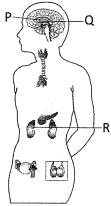
Identify the endocrine glands $P, Q,$ and $R$ in the given figure.
$\quad\quad\quad P \quad\quad\quad Q\quad\quad\quad R$
$\quad\quad\quad P \quad\quad\quad Q\quad\quad\quad R$
A
Pituitary $\quad$ Hypothalamus $\quad$ Adrenal
B
Hypothalamus $\quad$ Pituitary $\quad$ Pancreas
C
Hypothalamus $\quad$ Pineal $\quad$ Pancreas
D
Hypothalamus $\quad$ Pineal $\quad$ Adrenal
Solution
(A) Based on the anatomical position in the human body:
$1$. $P$ points to the Hypothalamus,which is located at the base of the diencephalon.
$2$. $Q$ points to the Pituitary gland,which is attached to the hypothalamus by a stalk.
$3$. $R$ points to the Adrenal gland,which is located on the superior aspect of each kidney.
Therefore,the correct sequence is Hypothalamus,Pituitary,and Adrenal.
$1$. $P$ points to the Hypothalamus,which is located at the base of the diencephalon.
$2$. $Q$ points to the Pituitary gland,which is attached to the hypothalamus by a stalk.
$3$. $R$ points to the Adrenal gland,which is located on the superior aspect of each kidney.
Therefore,the correct sequence is Hypothalamus,Pituitary,and Adrenal.
0 likes
View Solution83
MediumMCQ
How many endocrine glands are located in the brain region?
A
$1$
B
$2$
C
$3$
D
$4$
Solution
(C) The endocrine glands located in the brain region are:
$1$. Hypothalamus (often considered the master controller of the endocrine system).
$2$. Pineal gland.
$3$. Pituitary gland.
Therefore,there are $3$ endocrine glands located in the brain region.
$1$. Hypothalamus (often considered the master controller of the endocrine system).
$2$. Pineal gland.
$3$. Pituitary gland.
Therefore,there are $3$ endocrine glands located in the brain region.
0 likes
View Solution84
MediumMCQ
Select the correct sequence of endocrine glands from the head downwards.
A
Pineal $\rightarrow$ Thymus $\rightarrow$ Thyroid $\rightarrow$ Pancreas $\rightarrow$ Gonads
B
Pineal $\rightarrow$ Thyroid $\rightarrow$ Thymus $\rightarrow$ Pancreas $\rightarrow$ Gonads
C
Pineal $\rightarrow$ Pancreas $\rightarrow$ Thyroid $\rightarrow$ Thymus $\rightarrow$ Gonads
D
Pineal $\rightarrow$ Thymus $\rightarrow$ Pancreas $\rightarrow$ Thyroid $\rightarrow$ Gonads
Solution
(B) The anatomical positions of the endocrine glands in the human body from the head downwards are as follows:
$1$. Pineal gland: Located in the epithalamus of the brain.
$2$. Thyroid gland: Located in the neck region,anterior to the trachea.
$3$. Thymus gland: Located in the upper chest,behind the sternum.
$4$. Pancreas: Located in the abdominal cavity,behind the stomach.
$5$. Gonads (Testes/Ovaries): Located in the pelvic region.
Therefore,the correct sequence is Pineal $\rightarrow$ Thyroid $\rightarrow$ Thymus $\rightarrow$ Pancreas $\rightarrow$ Gonads.
$1$. Pineal gland: Located in the epithalamus of the brain.
$2$. Thyroid gland: Located in the neck region,anterior to the trachea.
$3$. Thymus gland: Located in the upper chest,behind the sternum.
$4$. Pancreas: Located in the abdominal cavity,behind the stomach.
$5$. Gonads (Testes/Ovaries): Located in the pelvic region.
Therefore,the correct sequence is Pineal $\rightarrow$ Thyroid $\rightarrow$ Thymus $\rightarrow$ Pancreas $\rightarrow$ Gonads.
0 likes
View Solution85
MediumMCQ
Match the following columns:
| Column-$I$ | Column-$II$ |
| $P$. Anterior Pituitary | $I$. $MSH$ |
| $Q$. Intermediate Pituitary | $II$. $ADH$ |
| $R$. Posterior Pituitary | $III$. $LH$ |
| $IV$. $FSH$ | |
| $V$. $GH$ | |
| $VI$. Oxytocin | |
| $VII$. $PRL$ | |
| $VIII$. $TSH$ | |
| $IX$. $ACTH$ |
A
$(P - II, VI), (Q - I), (R - III, IV, V, VII, VIII, IX)$
B
$(P - III, IV, V, VII, VIII, IX), (Q - I), (R - II, VI)$
C
$(P - I, III, IV, V, VIII, IX), (Q - II), (R - VI, VII)$
D
$(P - VI, VII), (Q - II), (R - I, III, IV, V, VIII, IX)$
Solution
(B) The pituitary gland is divided into three parts: the anterior pituitary (adenohypophysis),the intermediate pituitary (pars intermedia),and the posterior pituitary (neurohypophysis).
$1$. The anterior pituitary $(P)$ secretes $GH$ $(V)$,$PRL$ $(VII)$,$TSH$ $(VIII)$,$ACTH$ $(IX)$,$LH$ $(III)$,and $FSH$ $(IV)$.
$2$. The intermediate pituitary $(Q)$ secretes $MSH$ $(I)$.
$3$. The posterior pituitary $(R)$ stores and releases $ADH$ $(II)$ and Oxytocin $(VI)$,which are synthesized by the hypothalamus.
Therefore,the correct match is $(P - III, IV, V, VII, VIII, IX), (Q - I), (R - II, VI)$.
$1$. The anterior pituitary $(P)$ secretes $GH$ $(V)$,$PRL$ $(VII)$,$TSH$ $(VIII)$,$ACTH$ $(IX)$,$LH$ $(III)$,and $FSH$ $(IV)$.
$2$. The intermediate pituitary $(Q)$ secretes $MSH$ $(I)$.
$3$. The posterior pituitary $(R)$ stores and releases $ADH$ $(II)$ and Oxytocin $(VI)$,which are synthesized by the hypothalamus.
Therefore,the correct match is $(P - III, IV, V, VII, VIII, IX), (Q - I), (R - II, VI)$.
0 likes
View Solution86
EasyMCQ
Match the following columns:
| Column-$I$ (Gland) | Column-$II$ (Hormone) |
|---|---|
| $P$. Thyroid gland | $I$. $PTH$ |
| $Q$. Parathyroid gland | $II$. Melatonin |
| $R$. Thymus | $III$. Thymosin |
| $S$. Pineal gland | $IV$. $T_3$ |
A
$(P-I), (Q-IV), (R-III), (S-II)$
B
$(P-IV), (Q-I), (R-III), (S-II)$
C
$(P-I), (Q-IV), (R-II), (S-III)$
D
$(P-IV), (Q-I), (R-II), (S-III)$
Solution
(B) The correct matches are as follows:
$P$. Thyroid gland secretes $T_3$ (Triiodothyronine) and $T_4$ (Thyroxine). Thus,$P-IV$.
$Q$. Parathyroid gland secretes $PTH$ (Parathyroid hormone). Thus,$Q-I$.
$R$. Thymus gland secretes Thymosin. Thus,$R-III$.
$S$. Pineal gland secretes Melatonin. Thus,$S-II$.
Therefore,the correct sequence is $(P-IV), (Q-I), (R-III), (S-II)$.
$P$. Thyroid gland secretes $T_3$ (Triiodothyronine) and $T_4$ (Thyroxine). Thus,$P-IV$.
$Q$. Parathyroid gland secretes $PTH$ (Parathyroid hormone). Thus,$Q-I$.
$R$. Thymus gland secretes Thymosin. Thus,$R-III$.
$S$. Pineal gland secretes Melatonin. Thus,$S-II$.
Therefore,the correct sequence is $(P-IV), (Q-I), (R-III), (S-II)$.
0 likes
View Solution87
MediumMCQ
How many of the following organs are included in both the endocrine system and the reproductive system?
Kidney,Ovary,Stomach,Small intestine,Pancreas,Testis
Kidney,Ovary,Stomach,Small intestine,Pancreas,Testis
A
$2$
B
$3$
C
$4$
D
$5$
Solution
(A) The organs listed are: Kidney,Ovary,Stomach,Small intestine,Pancreas,and Testis.
$1$. Kidney: Produces hormones (erythropoietin,renin) but is part of the excretory system.
$2$. Ovary: Produces hormones (estrogen,progesterone) and is part of the reproductive system.
$3$. Stomach: Produces hormones (gastrin,secretin) but is part of the digestive system.
$4$. Small intestine: Produces hormones ($CCK$,secretin) but is part of the digestive system.
$5$. Pancreas: Produces hormones (insulin,glucagon) but is part of the digestive system.
$6$. Testis: Produces hormones (testosterone) and is part of the reproductive system.
Among these,only the Ovary and Testis are part of both the endocrine system (due to hormone secretion) and the reproductive system.
Therefore,the count is $2$.
$1$. Kidney: Produces hormones (erythropoietin,renin) but is part of the excretory system.
$2$. Ovary: Produces hormones (estrogen,progesterone) and is part of the reproductive system.
$3$. Stomach: Produces hormones (gastrin,secretin) but is part of the digestive system.
$4$. Small intestine: Produces hormones ($CCK$,secretin) but is part of the digestive system.
$5$. Pancreas: Produces hormones (insulin,glucagon) but is part of the digestive system.
$6$. Testis: Produces hormones (testosterone) and is part of the reproductive system.
Among these,only the Ovary and Testis are part of both the endocrine system (due to hormone secretion) and the reproductive system.
Therefore,the count is $2$.
0 likes
View Solution88
MediumMCQ
Match List-$I$ with List-$II$.
Choose the correct answer from the options given below:
| List-$I$ | List-$II$ |
| $A$. $CCK$ | $I$. Kidney |
| $B$. $GIP$ | $II$. Heart |
| $C$. $ANF$ | $III$. Gastric gland |
| $D$. $ADH$ | $IV$. Pancreas |
Choose the correct answer from the options given below:
A
$A-IV, B-III, C-II, D-I$
B
$A-IV, B-III, C-II, D-I$
C
$A-III, B-II, C-IV, D-I$
D
$A-II, B-IV, C-I, D-III$
Solution
(B) The correct matching is as follows:
- $CCK$ (Cholecystokinin) acts on the pancreas to stimulate the secretion of pancreatic enzymes. Thus, $A-IV$.
- $GIP$ (Gastric Inhibitory Peptide) acts on the gastric glands to inhibit gastric secretion and motility. Thus, $B-III$.
- $ANF$ (Atrial Natriuretic Factor) is released from the atrial wall of the heart. Thus, $C-II$.
- $ADH$ (Anti-diuretic hormone) acts mainly on the kidney to stimulate the reabsorption of water and electrolytes. Thus, $D-I$.
Therefore, the correct sequence is $A-IV, B-III, C-II, D-I$, which corresponds to option $B$.
- $CCK$ (Cholecystokinin) acts on the pancreas to stimulate the secretion of pancreatic enzymes. Thus, $A-IV$.
- $GIP$ (Gastric Inhibitory Peptide) acts on the gastric glands to inhibit gastric secretion and motility. Thus, $B-III$.
- $ANF$ (Atrial Natriuretic Factor) is released from the atrial wall of the heart. Thus, $C-II$.
- $ADH$ (Anti-diuretic hormone) acts mainly on the kidney to stimulate the reabsorption of water and electrolytes. Thus, $D-I$.
Therefore, the correct sequence is $A-IV, B-III, C-II, D-I$, which corresponds to option $B$.
0 likes
View Solution89
MediumMCQ
Given below are two statements: one is labelled as Assertion $A$ and the other is labelled as Reason $R$:
Assertion $A$: $FSH$ acts upon ovarian follicles in female and Leydig cells in male.
Reason $R$: Growing ovarian follicles secrete estrogen in female while interstitial cells secrete androgen in male human being.
In the light of the above statements,choose the correct answer from the options given below:
Assertion $A$: $FSH$ acts upon ovarian follicles in female and Leydig cells in male.
Reason $R$: Growing ovarian follicles secrete estrogen in female while interstitial cells secrete androgen in male human being.
In the light of the above statements,choose the correct answer from the options given below:
A
Both $A$ and $R$ are true but $R$ is $NOT$ the correct explanation of $A$.
B
$A$ is true but $R$ is false.
C
$A$ is false but $R$ is true.
D
Both $A$ and $R$ are true and $R$ is the correct explanation of $A$.
Solution
(C) The correct answer is option $C$ ($A$ is false but $R$ is true).
$FSH$ (Follicle Stimulating Hormone) acts on the ovarian follicles in females to stimulate their growth and development.
In males,$FSH$ acts on the Sertoli cells to stimulate spermatogenesis,whereas $LH$ (Luteinizing Hormone) acts on the Leydig cells (interstitial cells) to stimulate the secretion of androgens.
Therefore,the statement in Assertion $A$ is false because $FSH$ does not act on Leydig cells.
Reason $R$ is true because growing ovarian follicles do secrete estrogen in females,and interstitial cells (Leydig cells) do secrete androgens in males.
$FSH$ (Follicle Stimulating Hormone) acts on the ovarian follicles in females to stimulate their growth and development.
In males,$FSH$ acts on the Sertoli cells to stimulate spermatogenesis,whereas $LH$ (Luteinizing Hormone) acts on the Leydig cells (interstitial cells) to stimulate the secretion of androgens.
Therefore,the statement in Assertion $A$ is false because $FSH$ does not act on Leydig cells.
Reason $R$ is true because growing ovarian follicles do secrete estrogen in females,and interstitial cells (Leydig cells) do secrete androgens in males.
0 likes
View Solution90
MediumMCQ
Match List-$I$ with List-$II$ and choose the correct answer from the options given below:
| List-$I$ | List-$II$ |
| $A$. Exophthalmic goiter | $I$. Excess secretion of cortisol,moon face,hyperglycemia. |
| $B$. Acromegaly | $II$. Hypo-secretion of thyroid hormone and stunted growth. |
| $C$. Cushing's syndrome | $III$. Hyper-secretion of thyroid hormone,protruding eye balls. |
| $D$. Cretinism | $IV$. Excessive secretion of growth hormone. |
A
$A-IV, B-II, C-I, D-III$
B
$A-III, B-IV, C-II, D-I$
C
$A-III, B-IV, C-I, D-II$
D
$A-I, B-III, C-II, D-IV$
Solution
$(C)$ The correct matching is as follows:
$A$. Exophthalmic goiter $(III)$: Caused by hyper-secretion of thyroid hormone,leading to protruding eye balls.
$B$. Acromegaly $(IV)$: Caused by excessive secretion of growth hormone in adults.
$C$. Cushing's syndrome $(I)$: Caused by excess secretion of cortisol,resulting in moon face and hyperglycemia.
$D$. Cretinism $(II)$: Caused by hypo-secretion of thyroid hormone during development,leading to stunted growth.
Therefore,the correct sequence is $A-III, B-IV, C-I, D-II$,which corresponds to option $(C)$.
$A$. Exophthalmic goiter $(III)$: Caused by hyper-secretion of thyroid hormone,leading to protruding eye balls.
$B$. Acromegaly $(IV)$: Caused by excessive secretion of growth hormone in adults.
$C$. Cushing's syndrome $(I)$: Caused by excess secretion of cortisol,resulting in moon face and hyperglycemia.
$D$. Cretinism $(II)$: Caused by hypo-secretion of thyroid hormone during development,leading to stunted growth.
Therefore,the correct sequence is $A-III, B-IV, C-I, D-II$,which corresponds to option $(C)$.
0 likes
View Solution91
EasyMCQ
Given below are two statements:
Statement-$I$: Insulin acts mainly on hepatocytes and adipocytes.
Statement-$II$: Catecholamines are secreted in response to stress of any kind and during emergency situations.
In the light of the above statements,choose the most appropriate answer from the options given below.
Statement-$I$: Insulin acts mainly on hepatocytes and adipocytes.
Statement-$II$: Catecholamines are secreted in response to stress of any kind and during emergency situations.
In the light of the above statements,choose the most appropriate answer from the options given below.
A
Both statement-$I$ and statement-$II$ are correct
B
Both statement-$I$ and statement-$II$ are incorrect
C
Statement-$I$ is incorrect and statement-$II$ is correct
D
Statement-$I$ is correct and statement-$II$ is incorrect
Solution
(A) Statement-$I$ is correct: Insulin is a peptide hormone that regulates glucose homeostasis. It acts primarily on hepatocytes (liver cells) and adipocytes (fat cells) to enhance cellular glucose uptake and utilization.
Statement-$II$ is correct: Catecholamines,such as adrenaline (epinephrine) and noradrenaline (norepinephrine),are secreted by the adrenal medulla in response to stress of any kind and during emergency situations,often referred to as the 'fight-or-flight' response.
Therefore,both statements are correct.
Statement-$II$ is correct: Catecholamines,such as adrenaline (epinephrine) and noradrenaline (norepinephrine),are secreted by the adrenal medulla in response to stress of any kind and during emergency situations,often referred to as the 'fight-or-flight' response.
Therefore,both statements are correct.
0 likes
View Solution92
EasyMCQ
The hypothalamic hormones reach the pituitary gland through$:-$
A
Hypothalamic duct
B
Axons
C
Portal system
D
Both $(B)$ and $(C)$
Solution
(D) The hypothalamus regulates the pituitary gland through two distinct mechanisms:
$1$. The hormones destined for the posterior pituitary (neurohypophysis) are synthesized in the hypothalamic neurons and transported along their axons to be stored and released in the posterior pituitary.
$2$. The hormones destined for the anterior pituitary (adenohypophysis) are released into a specialized vascular connection known as the hypothalamic-hypophyseal portal system,which carries them directly to the anterior pituitary.
Since both pathways are utilized for different parts of the pituitary gland,the correct answer is $D$.
$1$. The hormones destined for the posterior pituitary (neurohypophysis) are synthesized in the hypothalamic neurons and transported along their axons to be stored and released in the posterior pituitary.
$2$. The hormones destined for the anterior pituitary (adenohypophysis) are released into a specialized vascular connection known as the hypothalamic-hypophyseal portal system,which carries them directly to the anterior pituitary.
Since both pathways are utilized for different parts of the pituitary gland,the correct answer is $D$.
0 likes
View Solution93
DifficultMCQ
Read the following statements and choose how many are incorrect?
$A.$ Neurohypophysis stores and secretes $3$ hormones.
$B.$ Prolactin level remains high for $6$ months after parturition.
$C.$ Calcitonin and parathormones maintain blood calcium level.
$D.$ Cortisol is secreted during stressful conditions.
$A.$ Neurohypophysis stores and secretes $3$ hormones.
$B.$ Prolactin level remains high for $6$ months after parturition.
$C.$ Calcitonin and parathormones maintain blood calcium level.
$D.$ Cortisol is secreted during stressful conditions.
A
$3$
B
$4$
C
$2$
D
$1$
Solution
(C) Let us analyze each statement:
$A.$ Incorrect. The neurohypophysis (posterior pituitary) stores and releases only $2$ hormones: oxytocin and vasopressin $(ADH)$,not $3$.
$B.$ Incorrect. While prolactin levels are elevated during lactation,they do not remain high for $6$ months post-parturition; the levels fluctuate based on the frequency of suckling.
$C.$ Correct. Calcitonin (from the thyroid gland) and parathormone (from the parathyroid gland) act antagonistically to regulate blood calcium levels.
$D.$ Correct. Cortisol is a glucocorticoid secreted by the adrenal cortex,often referred to as a 'stress hormone' as it is released in response to stress.
Therefore,statements $A$ and $B$ are incorrect. The total number of incorrect statements is $2$.
$A.$ Incorrect. The neurohypophysis (posterior pituitary) stores and releases only $2$ hormones: oxytocin and vasopressin $(ADH)$,not $3$.
$B.$ Incorrect. While prolactin levels are elevated during lactation,they do not remain high for $6$ months post-parturition; the levels fluctuate based on the frequency of suckling.
$C.$ Correct. Calcitonin (from the thyroid gland) and parathormone (from the parathyroid gland) act antagonistically to regulate blood calcium levels.
$D.$ Correct. Cortisol is a glucocorticoid secreted by the adrenal cortex,often referred to as a 'stress hormone' as it is released in response to stress.
Therefore,statements $A$ and $B$ are incorrect. The total number of incorrect statements is $2$.
0 likes
View Solution94
MediumMCQ
Statement-$I$: Melatonin helps in maintaining the normal rhythms of sleep-wake cycle and body temperature.
Statement-$II$: Thymosin plays a major role in the differentiation of $T$-lymphocytes.
Choose the correct answer from the options given below.
Statement-$II$: Thymosin plays a major role in the differentiation of $T$-lymphocytes.
Choose the correct answer from the options given below.
A
Statement-$I$ is correct but Statement-$II$ is incorrect
B
Statement-$I$ is incorrect but Statement-$II$ is correct
C
Both Statement-$I$ and $II$ are correct
D
Both Statement-$I$ and $II$ are incorrect
Solution
(A) Statement-$I$ is correct: Melatonin is secreted by the pineal gland and plays a very important role in the regulation of a $24$-hour (diurnal) rhythm of our body,such as the sleep-wake cycle and body temperature.
Statement-$II$ is incorrect: Thymosins are peptide hormones secreted by the thymus gland. They play a major role in the differentiation of $T$-lymphocytes,which provide cell-mediated immunity. $B$-lymphocytes are responsible for humoral immunity and differentiate in the bone marrow,not under the influence of thymosin.
Statement-$II$ is incorrect: Thymosins are peptide hormones secreted by the thymus gland. They play a major role in the differentiation of $T$-lymphocytes,which provide cell-mediated immunity. $B$-lymphocytes are responsible for humoral immunity and differentiate in the bone marrow,not under the influence of thymosin.
0 likes
View Solution95
MediumMCQ
Choose the correct option.
| $A$. Growth hormone | $i$. Osteoporosis |
| $B$. Thyroxin | $ii$. Diabetes mellitus |
| $C$. Parathormone | $iii$. Cretinism |
| $D$. Insulin | $iv$. Acromegaly |
A
$A-iv, B-iii, C-ii, D-i$
B
$A-iv, B-ii, C-iii, D-i$
C
$A-iv, B-i, C-ii, D-iii$
D
$A-iv, B-iii, C-i, D-ii$
Solution
(D) The correct matching is as follows:
$1$. Growth hormone: Excess secretion in adults leads to $Acromegaly$ $(A-iv)$.
$2$. Thyroxin: Deficiency in children leads to $Cretinism$ $(B-iii)$.
$3$. Parathormone: Deficiency leads to a decrease in blood calcium, which can cause $Osteoporosis$ or tetany $(C-i)$.
$4$. Insulin: Deficiency leads to $Diabetes \text{ } mellitus$ $(D-ii)$.
Therefore, the correct sequence is $A-iv, B-iii, C-i, D-ii$.
$1$. Growth hormone: Excess secretion in adults leads to $Acromegaly$ $(A-iv)$.
$2$. Thyroxin: Deficiency in children leads to $Cretinism$ $(B-iii)$.
$3$. Parathormone: Deficiency leads to a decrease in blood calcium, which can cause $Osteoporosis$ or tetany $(C-i)$.
$4$. Insulin: Deficiency leads to $Diabetes \text{ } mellitus$ $(D-ii)$.
Therefore, the correct sequence is $A-iv, B-iii, C-i, D-ii$.
0 likes
View Solution96
EasyMCQ
Match the hormones given in Column $I$ with their source gland in Column $II$.
Choose the correct option from below:
| Column $I$ | Column $II$ |
| $i$. Oxytocin | $a$. Adrenal medulla |
| $ii$. Melatonin | $b$. Thyroid gland |
| $iii$. Catecholamines | $c$. Pineal gland |
| $iv$. Calcitonin | $d$. Hypothalamus |
Choose the correct option from below:
A
$i-a, ii-c, iii-d, iv-b$
B
$i-d, ii-a, iii-b, iv-c$
C
$i-d, ii-c, iii-a, iv-b$
D
$i-c, ii-d, iii-a, iv-b$
Solution
(C) $i$. Oxytocin is synthesized by the hypothalamus and stored/released by the posterior pituitary gland. Thus,$i-d$.
$ii$. Melatonin is secreted by the pineal gland. Thus,$ii-c$.
$iii$. Catecholamines (like adrenaline and noradrenaline) are secreted by the adrenal medulla. Thus,$iii-a$.
$iv$. Calcitonin is secreted by the thyroid gland. Thus,$iv-b$.
Therefore,the correct matching is $i-d, ii-c, iii-a, iv-b$.
$ii$. Melatonin is secreted by the pineal gland. Thus,$ii-c$.
$iii$. Catecholamines (like adrenaline and noradrenaline) are secreted by the adrenal medulla. Thus,$iii-a$.
$iv$. Calcitonin is secreted by the thyroid gland. Thus,$iv-b$.
Therefore,the correct matching is $i-d, ii-c, iii-a, iv-b$.
0 likes
View Solution97
EasyMCQ
Match the diseases in Column $I$ with their respective causes given in Column $II$:
Select the correct option from the following:
| Column $I$ | Column $II$ |
|---|---|
| $i$. Alzheimer's disease | $a$. Oversecretion of Growth Hormone from pituitary gland in adults. |
| $ii$. Diabetes mellitus | $b$. Degeneration of dopamine-producing neurons in $CNS$. |
| $iii$. Acromegaly | $c$. Underactivity of Beta cells of pancreas. |
| $iv$. Parkinson's disease | $d$. Degeneration of cholinergic and other neurons in $CNS$. |
Select the correct option from the following:
A
$i-d, ii-c, iii-b, iv-a$
B
$i-d, ii-c, iii-a, iv-b$
C
$i-b, ii-c, iii-a, iv-d$
D
$i-a, ii-b, iii-d, iv-c$
Solution
(B) The correct matching is as follows:
$i$. Alzheimer's disease is caused by the degeneration of cholinergic and other neurons in the $CNS$ $(i-d)$.
$ii$. Diabetes mellitus is caused by the underactivity or deficiency of insulin produced by the Beta cells of the pancreas $(ii-c)$.
$iii$. Acromegaly is caused by the oversecretion of Growth Hormone $(GH)$ from the pituitary gland in adults $(iii-a)$.
$iv$. Parkinson's disease is caused by the degeneration of dopamine-producing neurons in the $CNS$ $(iv-b)$.
Therefore,the correct sequence is $i-d, ii-c, iii-a, iv-b$.
$i$. Alzheimer's disease is caused by the degeneration of cholinergic and other neurons in the $CNS$ $(i-d)$.
$ii$. Diabetes mellitus is caused by the underactivity or deficiency of insulin produced by the Beta cells of the pancreas $(ii-c)$.
$iii$. Acromegaly is caused by the oversecretion of Growth Hormone $(GH)$ from the pituitary gland in adults $(iii-a)$.
$iv$. Parkinson's disease is caused by the degeneration of dopamine-producing neurons in the $CNS$ $(iv-b)$.
Therefore,the correct sequence is $i-d, ii-c, iii-a, iv-b$.
0 likes
View Solution98
EasyMCQ
Match the name of the hormone in Column-$I$ with its source of secretion in Column-$II$ and its function in Column-$III$.
| Column-$I$ | Column-$II$ $\&$ Column-$III$ |
| $(a)$ Prolactin | $(m)$ Pituitary gland,$(q)$ Development of lactiferous tubules |
| $(b)$ Estrogens | $(l)$ Graafian follicle,$(r)$ Secondary sexual characters in females |
| $(c)$ GnRH | $(n)$ Hypothalamus,$(s)$ Stimulates release of $FSH$ |
| $(d)$ Androgen | $(o)$ Interstitial cells,$(p)$ Secondary sexual characters of males |
A
$(a)-(m)-(q), (b)-(l)-(r), (c)-(o)-(p), (d)-(n)-(s)$
B
$(a)-(m)-(q), (b)-(l)-(r), (c)-(n)-(s), (d)-(o)-(p)$
C
$(a)-(l)-(r), (b)-(m)-(q), (c)-(n)-(s), (d)-(o)-(p)$
D
$(a)-(l)-(r), (b)-(m)-(q), (c)-(d)-(p), (d)-(n)-(s)$
Solution
(B) The correct matching is as follows:
$(a)$ Prolactin is secreted by the Pituitary gland $(m)$ and it helps in the development of lactiferous tubules $(q)$.
$(b)$ Estrogens are secreted by the Graafian follicle $(l)$ and are responsible for the development of secondary sexual characters in females $(r)$.
$(c)$ $GnRH$ (Gonadotropin-releasing hormone) is secreted by the Hypothalamus $(n)$ and it stimulates the release of $FSH$ and $LH$ $(s)$.
$(d)$ Androgen is secreted by the Interstitial cells $(o)$ and it is responsible for the development of secondary sexual characters in males $(p)$.
Thus,the correct sequence is $(a)-(m)-(q), (b)-(l)-(r), (c)-(n)-(s), (d)-(o)-(p)$.
$(a)$ Prolactin is secreted by the Pituitary gland $(m)$ and it helps in the development of lactiferous tubules $(q)$.
$(b)$ Estrogens are secreted by the Graafian follicle $(l)$ and are responsible for the development of secondary sexual characters in females $(r)$.
$(c)$ $GnRH$ (Gonadotropin-releasing hormone) is secreted by the Hypothalamus $(n)$ and it stimulates the release of $FSH$ and $LH$ $(s)$.
$(d)$ Androgen is secreted by the Interstitial cells $(o)$ and it is responsible for the development of secondary sexual characters in males $(p)$.
Thus,the correct sequence is $(a)-(m)-(q), (b)-(l)-(r), (c)-(n)-(s), (d)-(o)-(p)$.
0 likes
View Solution99
EasyMCQ
Type $II$ $(NIDDM)$ hyperglycemia is caused due to . . . . . .
$(a)$ Failure of insulin to facilitate the movement of glucose into cells.
$(b)$ Reduced sensitivity to insulin.
$(c)$ Under-activity of beta cells resulting in increased secretion of insulin.
$(d)$ Reduced reabsorption of water and increased urine output.
Select the correct option given below.
$(a)$ Failure of insulin to facilitate the movement of glucose into cells.
$(b)$ Reduced sensitivity to insulin.
$(c)$ Under-activity of beta cells resulting in increased secretion of insulin.
$(d)$ Reduced reabsorption of water and increased urine output.
Select the correct option given below.
A
$(b)$ and $(c)$ only
B
$(a)$ and $(d)$ only
C
$(a)$ and $(b)$ only
D
$(c)$ and $(d)$ only
Solution
(C) Type $II$ Diabetes Mellitus $(NIDDM)$ is characterized by insulin resistance,where cells do not respond effectively to insulin,leading to a failure in glucose uptake ($a$ and $b$).
Option $(c)$ is incorrect because under-activity of beta cells leads to decreased,not increased,insulin secretion.
Option $(d)$ describes symptoms related to Diabetes Insipidus,which is caused by a deficiency of $ADH$ (Vasopressin),not $NIDDM$.
Option $(c)$ is incorrect because under-activity of beta cells leads to decreased,not increased,insulin secretion.
Option $(d)$ describes symptoms related to Diabetes Insipidus,which is caused by a deficiency of $ADH$ (Vasopressin),not $NIDDM$.
0 likes
View Solution100
EasyMCQ
Given below are two statements. Read them and choose the correct pair below.
Statement-$I$: Melatonin regulates the sleep-wake cycle,body temperature,metabolism,and reproductive cycles.
Statement-$II$: Thyroxin increases the action of neurotransmitters and supports the $RBC$ production.
Statement-$I$: Melatonin regulates the sleep-wake cycle,body temperature,metabolism,and reproductive cycles.
Statement-$II$: Thyroxin increases the action of neurotransmitters and supports the $RBC$ production.
A
Statement-$I$ is incorrect but Statement-$II$ is correct.
B
Statement-$I$ is correct but Statement-$II$ is incorrect.
C
Both Statement-$I$ and Statement-$II$ are correct.
D
Both Statement-$I$ and Statement-$II$ are incorrect.
Solution
(B) Statement-$I$ is correct: Melatonin is secreted by the pineal gland and plays a very important role in the regulation of a $24$-hour (diurnal) rhythm of our body,such as the sleep-wake cycle,body temperature,metabolism,pigmentation,the menstrual cycle,and our defense capability.
Statement-$II$ is incorrect: Thyroxin (secreted by the thyroid gland) regulates the basal metabolic rate,supports the process of red blood cell formation (erythropoiesis),and controls the metabolism of carbohydrates,proteins,and fats. However,it is adrenaline and noradrenaline that increase the action of neurotransmitters,not thyroxin.
Statement-$II$ is incorrect: Thyroxin (secreted by the thyroid gland) regulates the basal metabolic rate,supports the process of red blood cell formation (erythropoiesis),and controls the metabolism of carbohydrates,proteins,and fats. However,it is adrenaline and noradrenaline that increase the action of neurotransmitters,not thyroxin.
0 likes
View SolutionChemical Coordination and Integration — Mix Examples-Chemical Coordination and Integration · Frequently Asked Questions
1Are these Chemical Coordination and Integration questions useful for JEE and NEET?
Yes. All questions in this section are mapped to JEE Main and NEET exam patterns. Previous year questions from JEE Main, NEET, GUJCET and state-level exams are included with full solutions.
2Can I switch to Hindi or Gujarati for these questions?
Yes. Use the language tabs in the hero section or the sidebar to view the same questions and solutions in English, Hindi or Gujarati.
3How do I generate a question paper from this subtopic?
Use the Vedclass Exam Paper Generator — select the chapter and subtopic, set difficulty, and generate Sets A, B, C, D automatically. First 3 chapters of every subject are free.
Vedclass Products
For Students
Vedclass Test Series
Mock tests in real JEE/NEET style with performance analysis. 5-day free trial.
Start Free TrialFor Teachers
Exam Paper Generator
Generate Set A/B/C/D papers from this chapter in 2 minutes. 3 chapters free.
Try FreeFor Institutes
Online Exam Module
Live online exams with unlimited students, 360° analytics & white-label branding.
See DemoFor Teachers & Institutes
Generate a Chemical Coordination and Integration Exam Paper in 2 Minutes
Select subtopic & difficulty — Sets A, B, C, D auto-generated with No Repeat logic.
First 3 chapters of every subject are free — no payment required.