
A English
Flagella and Cytoskeleton Questions in English
Class 11 Biology · Cell: The Unit of Life · Flagella and Cytoskeleton
79+
Questions
English
Language
100%
With Solutions
Showing 29 of 79 questions in English
51
MediumMCQ
An elaborate network of filamentous proteinaceous structures present in the cytoplasm which helps in the maintenance of cell shape is called
A
thylakoid
B
endoplasmic reticulum
C
plasmalemma
D
cytoskeleton
Solution
(D) The cytoskeleton is an elaborate network of filamentous proteinaceous structures consisting of microtubules,microfilaments,and intermediate filaments present in the cytoplasm. It plays a crucial role in various functions such as mechanical support,motility,and the maintenance of the shape of the cell. Therefore,the correct option is $(d)$.
0 likes
View Solution52
EasyMCQ
Cytoskeleton is made up of
A
callose deposits
B
cellulosic microfibrils
C
proteinaceous filaments
D
calcium carbonate granules
Solution
(C) The correct answer is $C$.
The cytoskeleton is an elaborate network of proteinaceous filaments present in the cytoplasm of eukaryotic cells.
It is primarily composed of three types of protein filaments:
$1$. Microtubules (made of tubulin protein).
$2$. Microfilaments (made of actin and myosin proteins).
$3$. Intermediate filaments (made of proteins like keratin,vimentin,desmin,and lamin).
These structures provide mechanical support,motility,and maintenance of the cell shape.
The cytoskeleton is an elaborate network of proteinaceous filaments present in the cytoplasm of eukaryotic cells.
It is primarily composed of three types of protein filaments:
$1$. Microtubules (made of tubulin protein).
$2$. Microfilaments (made of actin and myosin proteins).
$3$. Intermediate filaments (made of proteins like keratin,vimentin,desmin,and lamin).
These structures provide mechanical support,motility,and maintenance of the cell shape.
0 likes
View Solution53
EasyMCQ
What is the microtubule arrangement found in the flagella of both animal and plant cells?
A
$9+0$
B
$9+2$
C
$9+6$
D
$9+1$
Solution
(B) Both animal and plant flagella (and cilia) exhibit a characteristic $9+2$ arrangement of microtubules.
This structure consists of nine peripheral doublets of microtubules arranged in a circle surrounding two central single microtubules.
This $9+2$ axonemal structure is a conserved feature in eukaryotic flagella and cilia.
This structure consists of nine peripheral doublets of microtubules arranged in a circle surrounding two central single microtubules.
This $9+2$ axonemal structure is a conserved feature in eukaryotic flagella and cilia.
0 likes
View Solution54
MediumMCQ
How many types of filaments are included in the cytoskeleton structure?
A
Three
B
Two
C
Four
D
Five
Solution
(A) The cytoskeleton is an elaborate network of filamentous proteinaceous structures present in the cytoplasm.
It consists of three main types of protein filaments:
$1$. Microtubules (composed of tubulin protein).
$2$. Microfilaments (composed of actin protein).
$3$. Intermediate filaments (composed of various fibrous proteins).
Therefore,there are $3$ types of filaments in the cytoskeleton.
It consists of three main types of protein filaments:
$1$. Microtubules (composed of tubulin protein).
$2$. Microfilaments (composed of actin protein).
$3$. Intermediate filaments (composed of various fibrous proteins).
Therefore,there are $3$ types of filaments in the cytoskeleton.
0 likes
View Solution55
MediumMCQ
How many microtubules are present in the peripheral region of flagella?
A
$9$
B
$20$
C
$18$
D
$11$
Solution
(C) The axoneme of a eukaryotic flagellum typically shows a $9+2$ arrangement of microtubules.
In this structure,there are $9$ doublet microtubules arranged in the peripheral region.
Additionally,there are $2$ singlet microtubules located in the central region.
Therefore,the number of microtubules in the peripheral region is $9$ doublets,which equals $18$ individual microtubules $(9 \times 2 = 18)$.
In this structure,there are $9$ doublet microtubules arranged in the peripheral region.
Additionally,there are $2$ singlet microtubules located in the central region.
Therefore,the number of microtubules in the peripheral region is $9$ doublets,which equals $18$ individual microtubules $(9 \times 2 = 18)$.
0 likes
View Solution56
MediumMCQ
Microtubules are associated with ............ .
A
Cell division
B
Membrane organization
C
Muscle contraction
D
$DNA$ recognition
Solution
(A) Microtubules are structural components of the cytoskeleton,composed of tubulin proteins.
They play a crucial role in cell division by forming the spindle apparatus,which helps in the separation of chromosomes during mitosis and meiosis.
They are also involved in maintaining cell shape and intracellular transport.
Therefore,the correct option is $A$.
They play a crucial role in cell division by forming the spindle apparatus,which helps in the separation of chromosomes during mitosis and meiosis.
They are also involved in maintaining cell shape and intracellular transport.
Therefore,the correct option is $A$.
0 likes
View Solution57
MediumMCQ
How do the flagella of prokaryotic and eukaryotic cells differ?
A
In their role for cell movement and locomotion
B
In their location within the cell and their mechanism of action
C
In the arrangement of microtubules and the type of movement
D
Based on the organization of microtubules and their function
Solution
(C) Prokaryotic flagella are structurally different from eukaryotic flagella.
$1$. Prokaryotic flagella are composed of the protein $flagellin$ and do not contain microtubules. They move in a rotary motion.
$2$. Eukaryotic flagella are composed of the protein $tubulin$ and exhibit a characteristic $9+2$ arrangement of microtubules. They move in a whip-like or bending motion.
$3$. Therefore,the primary difference lies in the arrangement of microtubules and the type of movement they exhibit.
$1$. Prokaryotic flagella are composed of the protein $flagellin$ and do not contain microtubules. They move in a rotary motion.
$2$. Eukaryotic flagella are composed of the protein $tubulin$ and exhibit a characteristic $9+2$ arrangement of microtubules. They move in a whip-like or bending motion.
$3$. Therefore,the primary difference lies in the arrangement of microtubules and the type of movement they exhibit.
0 likes
View Solution58
EasyMCQ
What is the cytoskeleton composed of?
A
Deposition of cellulose
B
Cellulosic microfibrils
C
Proteinaceous filaments
D
Calcium carbonate particles
Solution
(C) The cytoskeleton is an elaborate network of proteinaceous filaments present in the cytoplasm of eukaryotic cells. It is primarily composed of three types of structures: microtubules,microfilaments,and intermediate filaments. These structures are made of proteins like tubulin and actin,which provide mechanical support,motility,and maintenance of the shape of the cell.
0 likes
View Solution59
MediumMCQ
Which component of the cytoskeleton is $6 \ nm$ in diameter and composed of a single type of monomer?
A
Microtubules
B
Microfilaments
C
Intermediate filaments
D
Lamellae
Solution
(B) The cytoskeleton consists of three main types of protein filaments: microtubules,microfilaments,and intermediate filaments.
$1$. Microtubules have a diameter of approximately $25 \ nm$ and are composed of tubulin dimers.
$2$. Intermediate filaments have a diameter of $8-12 \ nm$ and are composed of various fibrous proteins.
$3$. Microfilaments (also known as actin filaments) have a diameter of approximately $6 \ nm$ and are composed of a single type of monomer called actin ($G$-actin).
Therefore,the component with a $6 \ nm$ diameter made of a single type of monomer is the microfilament.
$1$. Microtubules have a diameter of approximately $25 \ nm$ and are composed of tubulin dimers.
$2$. Intermediate filaments have a diameter of $8-12 \ nm$ and are composed of various fibrous proteins.
$3$. Microfilaments (also known as actin filaments) have a diameter of approximately $6 \ nm$ and are composed of a single type of monomer called actin ($G$-actin).
Therefore,the component with a $6 \ nm$ diameter made of a single type of monomer is the microfilament.
0 likes
View Solution60
MediumMCQ
Assertion : Eukaryotic cells have the ability to adopt a variety of shapes and carry out directed movements.
Reason : There are three principal types of protein filaments-microfilaments,microtubules and intermediate filaments,which constitute the cytoskeleton.
Reason : There are three principal types of protein filaments-microfilaments,microtubules and intermediate filaments,which constitute the cytoskeleton.
A
If both Assertion and Reason are correct and the Reason is a correct explanation of the Assertion.
B
If both Assertion and Reason are correct but Reason is not a correct explanation of the Assertion.
C
If the Assertion is correct but Reason is incorrect.
D
If both the Assertion and Reason are incorrect.
Solution
(A) Eukaryotic cells possess a complex network of proteinaceous filaments in the cytoplasm collectively called the cytoskeleton.
This cytoskeleton is composed of three principal types of protein filaments: $1$. Microfilaments,$2$. Microtubules,and $3$. Intermediate filaments.
These structures provide mechanical support,maintain the characteristic shape of the cell,and facilitate intracellular transport and directed cell movements.
Therefore,the presence of the cytoskeleton is the direct reason why eukaryotic cells can adopt various shapes and perform directed movements.
This cytoskeleton is composed of three principal types of protein filaments: $1$. Microfilaments,$2$. Microtubules,and $3$. Intermediate filaments.
These structures provide mechanical support,maintain the characteristic shape of the cell,and facilitate intracellular transport and directed cell movements.
Therefore,the presence of the cytoskeleton is the direct reason why eukaryotic cells can adopt various shapes and perform directed movements.
0 likes
View Solution61
Easy
Write a note on Flagella,Pili,and Fimbriae.
Solution
(N/A) $\Rightarrow$ Flagella: Bacterial cells may be motile or non-motile. If motile,they possess thin filamentous extensions from their cell wall called flagella. Bacteria show a range in the number and arrangement of flagella. $A$ bacterial flagellum is composed of three parts: filament,hook,and basal body. The filament is the longest portion and extends from the cell surface to the outside.
$\Rightarrow$ Pili: Pili are elongated,tubular structures made of a special protein. They are surface structures but do not play a role in motility.
$\Rightarrow$ Fimbriae: Fimbriae are small,bristle-like fibers sprouting out of the cell. In some bacteria,they are known to help attach the bacteria to rocks in streams and also to host tissues.
$\Rightarrow$ Pili: Pili are elongated,tubular structures made of a special protein. They are surface structures but do not play a role in motility.
$\Rightarrow$ Fimbriae: Fimbriae are small,bristle-like fibers sprouting out of the cell. In some bacteria,they are known to help attach the bacteria to rocks in streams and also to host tissues.
0 likes
View Solution62
Easy
What is Cytoskeleton? Give information about its components,structure,and function.
Solution
(N/A) $\Rightarrow$ An elaborate network of filamentous proteinaceous structures present in the cytoplasm is collectively referred to as the cytoskeleton. It is involved in many functions such as mechanical support,motility,and maintenance of the shape of the cell.
$\Rightarrow$ The cytoskeleton is formed by three types of fibers: Microfilaments,Microtubules,and Intermediate filaments.
$\Rightarrow$ Microfilaments are made up of proteins like Actin. They are scattered or arranged in parallel or in a network. They possess functions like amoeboid motion,movement or rotation of protoplasm,and translocation of materials. They are associated with cell motion or changes in the form of cells.
$\Rightarrow$ Microtubules are hollow tubes made up of tubulin protein. They help in maintaining the shape of the cell,cell motion,and cellular transport of materials. They are required for the translocation of chromosomes during cell division.
$\Rightarrow$ Intermediate filaments are durable,strong protein fibers. They form a basket-like structure of fibers and provide support to other fibers.
$\Rightarrow$ The cytoskeleton is formed by three types of fibers: Microfilaments,Microtubules,and Intermediate filaments.
$\Rightarrow$ Microfilaments are made up of proteins like Actin. They are scattered or arranged in parallel or in a network. They possess functions like amoeboid motion,movement or rotation of protoplasm,and translocation of materials. They are associated with cell motion or changes in the form of cells.
$\Rightarrow$ Microtubules are hollow tubes made up of tubulin protein. They help in maintaining the shape of the cell,cell motion,and cellular transport of materials. They are required for the translocation of chromosomes during cell division.
$\Rightarrow$ Intermediate filaments are durable,strong protein fibers. They form a basket-like structure of fibers and provide support to other fibers.
0 likes
View Solution63
MediumMCQ
Microtubules,motor proteins,and actin filaments are all part of which of the following cell organelles?
A
chloroplasts
B
Golgi apparatus
C
cytoskeleton
D
cell membrane
Solution
(C) The cytoskeleton is an elaborate network of filamentous proteinaceous structures consisting of microtubules,microfilaments (actin filaments),and intermediate filaments present in the cytoplasm.
It provides structural support,maintains the shape of the cell,and facilitates motility of the cell and intracellular transport via motor proteins.
It provides structural support,maintains the shape of the cell,and facilitates motility of the cell and intracellular transport via motor proteins.
0 likes
View Solution64
MediumMCQ
$A$ component of cytoskeleton is
A
Microtubule
B
Bone
C
Chitin
D
Cartilage
Solution
(A) Microtubules are the largest cytoskeletal filaments in cells and are found throughout the cytoplasm.
They are filamentous intracellular structures responsible for various kinds of movements in all eukaryotic cells.
They are involved in nuclear and cell division,organization of intracellular structure,and intracellular transport,as well as ciliary and flagellar motility.
They are formed by the polymerization of a dimer of two globular proteins,$\alpha$-tubulin and $\beta$-tubulin.
They are filamentous intracellular structures responsible for various kinds of movements in all eukaryotic cells.
They are involved in nuclear and cell division,organization of intracellular structure,and intracellular transport,as well as ciliary and flagellar motility.
They are formed by the polymerization of a dimer of two globular proteins,$\alpha$-tubulin and $\beta$-tubulin.
0 likes
View Solution65
MediumMCQ
The cytoskeleton is a proteinaceous network of fibres in the cytoplasm. It is involved in
A
mechanical support.
B
motility.
C
maintenance of cell-shape.
D
all of these
Solution
(D) The cytoskeleton is a complex network of proteinaceous filaments present in the cytoplasm of a cell.
It plays a crucial role in providing mechanical support to the cell.
It is responsible for maintaining the characteristic shape of the cell.
It is also involved in various types of cell motility and intracellular transport.
Therefore,all the given options are correct functions of the cytoskeleton.
It plays a crucial role in providing mechanical support to the cell.
It is responsible for maintaining the characteristic shape of the cell.
It is also involved in various types of cell motility and intracellular transport.
Therefore,all the given options are correct functions of the cytoskeleton.
0 likes
View Solution66
MediumMCQ
Prokaryotic and eukaryotic flagella differ in the
A
type of movement and placement.
B
location and mode of functioning.
C
microtubular structure and function.
D
microtubular organization and type of movement.
Solution
(D) Prokaryotic flagella are composed of the protein flagellin and have a rotary movement. They lack a $9+2$ microtubular arrangement.
Eukaryotic flagella are composed of tubulin protein,possess a $9+2$ microtubular organization,and exhibit a whip-like (bending) movement.
Therefore,they differ significantly in their microtubular organization and the type of movement they perform.
Eukaryotic flagella are composed of tubulin protein,possess a $9+2$ microtubular organization,and exhibit a whip-like (bending) movement.
Therefore,they differ significantly in their microtubular organization and the type of movement they perform.
0 likes
View Solution67
MediumMCQ
Microfilaments perform all the following functions,except
A
Provide support to plasma membrane
B
Involved in cyclosis
C
Help in cell plate method during cell division
D
Help in pseudopodia formation
Solution
(C) Microfilaments are composed of actin proteins and are involved in maintaining cell shape,cyclosis (cytoplasmic streaming),and pseudopodia formation. However,the formation of the cell plate during cytokinesis in plant cells is primarily mediated by the phragmoplast,which is derived from Golgi vesicles and $ER$ elements,not directly by microfilaments.
0 likes
View Solution68
MediumMCQ
Identify all the proteins that constitute the eukaryotic flagellum.
A
Nexin,tubulin and flagellin
B
Tubulin,nexin,dynein and flagellin
C
Actin,myosin,dynein,nexin and tubulin
D
Dynein,tubulin and nexin
Solution
(D) The eukaryotic flagellum is composed of a $9+2$ arrangement of microtubules,which are made of the protein $tubulin$.
These microtubules are connected by $nexin$ links and utilize $dynein$ arms to facilitate movement through $ATP$ hydrolysis.
$Flagellin$ is the protein found specifically in prokaryotic flagella,not eukaryotic ones.
Therefore,the proteins that make up the eukaryotic flagellum are $dynein$,$tubulin$,and $nexin$.
These microtubules are connected by $nexin$ links and utilize $dynein$ arms to facilitate movement through $ATP$ hydrolysis.
$Flagellin$ is the protein found specifically in prokaryotic flagella,not eukaryotic ones.
Therefore,the proteins that make up the eukaryotic flagellum are $dynein$,$tubulin$,and $nexin$.
0 likes
View Solution69
EasyMCQ
$9+2$ organisation is present in
A
Flagella of bacteria
B
Flagella and cilia of eukaryotic cell
C
Basal body
D
Centriole and basal body
Solution
(B) The $9+2$ arrangement of microtubules is a characteristic feature of the axoneme in eukaryotic cilia and flagella.
In this arrangement,there are $9$ peripheral doublets of microtubules and $2$ central single microtubules.
In contrast,centrioles and basal bodies exhibit a $9+0$ arrangement,where $9$ peripheral triplets are present but there are no central microtubules.
In this arrangement,there are $9$ peripheral doublets of microtubules and $2$ central single microtubules.
In contrast,centrioles and basal bodies exhibit a $9+0$ arrangement,where $9$ peripheral triplets are present but there are no central microtubules.
0 likes
View Solution70
EasyMCQ
The spindles are formed of
A
Chromosome
B
Actin
C
Microtubules
D
Myosin
Solution
(C) Spindles are composed of microtubules. Microtubules are cytoskeletal components made of tubulin protein,which organize and separate chromosomes during cell division (mitosis and meiosis).
0 likes
View Solution71
EasyMCQ
Spindle fibre is made up of
A
Humulin
B
Intermediate filament
C
Flagellin
D
Tubulin
Solution
(D) Microtubules are hollow, cylindrical structures built from $Tubulin$ protein.
The mitotic spindle, which is involved in the separation of replicated chromosomes during mitosis, is an assembly of microtubules.
The mitotic spindle, which is involved in the separation of replicated chromosomes during mitosis, is an assembly of microtubules.
0 likes
View Solution72
EasyMCQ
Spindle fibres are made up of
A
Actin
B
Myosin
C
Alpha & beta tubulin
D
Flagellin
Solution
(C) Spindle fibres are composed of microtubules.
Microtubules are cylindrical structures formed by the polymerization of globular protein subunits known as tubulin.
Specifically,these are composed of $\alpha$-tubulin and $\beta$-tubulin dimers.
Therefore,spindle fibres are made up of $\alpha$ and $\beta$ tubulin proteins.
Microtubules are cylindrical structures formed by the polymerization of globular protein subunits known as tubulin.
Specifically,these are composed of $\alpha$-tubulin and $\beta$-tubulin dimers.
Therefore,spindle fibres are made up of $\alpha$ and $\beta$ tubulin proteins.
0 likes
View Solution73
EasyMCQ
The filament,hook,and basal body are parts of $.........$.
A
Cilia
B
Flagella
C
Pili
D
Fimbriae
Solution
(B) The bacterial flagellum is composed of three main parts: the filament,the hook,and the basal body.
$1$. The filament is the longest portion and extends from the cell surface to the outside.
$2$. The hook connects the filament to the basal body.
$3$. The basal body is a motor-like structure embedded in the cell envelope that anchors the flagellum and provides the rotational force.
Therefore,these three components are characteristic parts of the bacterial flagella.
$1$. The filament is the longest portion and extends from the cell surface to the outside.
$2$. The hook connects the filament to the basal body.
$3$. The basal body is a motor-like structure embedded in the cell envelope that anchors the flagellum and provides the rotational force.
Therefore,these three components are characteristic parts of the bacterial flagella.
0 likes
View Solution74
MediumMCQ
Which of the following structures are involved in motility?
$I -$ Pili,$II -$ Flagella,$III -$ Fimbriae
$I -$ Pili,$II -$ Flagella,$III -$ Fimbriae
A
$I, II, III$
B
Only $II$
C
$I, III$
D
Only $III$
Solution
(B) In prokaryotic cells,the flagella are the primary structures responsible for motility.
$I -$ Pili are elongated tubular structures made of a special protein,primarily involved in conjugation (transfer of $DNA$).
$II -$ Flagella are thin,filamentous extensions from the cell wall that act as propellers to provide motility to the bacteria.
$III -$ Fimbriae are small bristle-like fibers sprouting out of the cell,which help in attaching bacteria to rocks in streams and also to the host tissues.
Therefore,only the flagella are involved in motility.
$I -$ Pili are elongated tubular structures made of a special protein,primarily involved in conjugation (transfer of $DNA$).
$II -$ Flagella are thin,filamentous extensions from the cell wall that act as propellers to provide motility to the bacteria.
$III -$ Fimbriae are small bristle-like fibers sprouting out of the cell,which help in attaching bacteria to rocks in streams and also to the host tissues.
Therefore,only the flagella are involved in motility.
0 likes
View Solution75
MediumMCQ
The cytoskeleton is made up of $.............$.
A
Carbohydrates
B
Proteins
C
Lipids
D
Nucleic acids
Solution
(B) The cytoskeleton is an elaborate network of filamentous proteinaceous structures present in the cytoplasm.
It is primarily composed of three types of protein filaments: microtubules (made of tubulin),microfilaments (made of actin),and intermediate filaments (made of various fibrous proteins).
Therefore,the cytoskeleton is composed of proteins.
It is primarily composed of three types of protein filaments: microtubules (made of tubulin),microfilaments (made of actin),and intermediate filaments (made of various fibrous proteins).
Therefore,the cytoskeleton is composed of proteins.
0 likes
View Solution76
EasyMCQ
How many types of components are present in the cytoskeleton?
A
$1$
B
$2$
C
$3$
D
$4$
Solution
(C) The cytoskeleton is an elaborate network of filamentous proteinaceous structures present in the cytoplasm. It consists of $3$ main types of components:
$1$. Microtubules
$2$. Microfilaments (Actin filaments)
$3$. Intermediate filaments.
Therefore,the correct answer is $3$.
$1$. Microtubules
$2$. Microfilaments (Actin filaments)
$3$. Intermediate filaments.
Therefore,the correct answer is $3$.
0 likes
View Solution77
MediumMCQ
What are the functions of the cytoskeleton?
A
Mechanical support
B
Motility
C
Maintenance of the shape of the cell
D
All of the above
Solution
(D) The cytoskeleton is an elaborate network of filamentous proteinaceous structures consisting of microtubules,microfilaments,and intermediate filaments present in the cytoplasm.
Its primary functions include:
$1$. Mechanical support: It provides structural integrity to the cell.
$2$. Motility: It is involved in cell movement and the movement of organelles within the cell.
$3$. Maintenance of the shape of the cell: It helps the cell maintain its characteristic shape and morphology.
Therefore,all the given options are correct functions of the cytoskeleton.
Its primary functions include:
$1$. Mechanical support: It provides structural integrity to the cell.
$2$. Motility: It is involved in cell movement and the movement of organelles within the cell.
$3$. Maintenance of the shape of the cell: It helps the cell maintain its characteristic shape and morphology.
Therefore,all the given options are correct functions of the cytoskeleton.
0 likes
View Solution78
MediumMCQ
Which of the following functions is carried out by the cytoskeleton in a cell?
A
Transportation
B
Nuclear division
C
Protein synthesis
D
Motility
Solution
(D) An elaborate network of filamentous proteinaceous structures consisting of microtubules,microfilaments,and intermediate filaments present in the cytoplasm is collectively referred to as the cytoskeleton.
It is involved in many functions such as mechanical support,motility,and maintenance of the shape of the cell.
It is involved in many functions such as mechanical support,motility,and maintenance of the shape of the cell.
0 likes
View Solution79
EasyMCQ
In the diagram below,identify the part which connects the peripheral microtubules to the central sheath.
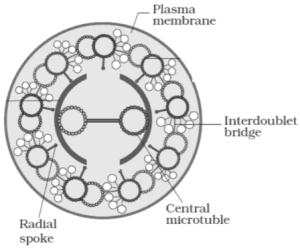
A
Radial spoke
B
Plasma membrane
C
Interdoublet bridge
D
Central microtubule
Solution
(A) The correct answer is $(A)$ Radial spoke.
In the structure of cilia and flagella,the axoneme consists of a $9+2$ arrangement of microtubules.
The peripheral microtubule doublets are connected to the central sheath,which surrounds the two central microtubules,by structures known as radial spokes.
There are $9$ radial spokes in total,one extending from each peripheral doublet to the central sheath.
In the structure of cilia and flagella,the axoneme consists of a $9+2$ arrangement of microtubules.
The peripheral microtubule doublets are connected to the central sheath,which surrounds the two central microtubules,by structures known as radial spokes.
There are $9$ radial spokes in total,one extending from each peripheral doublet to the central sheath.
0 likes
View SolutionCell: The Unit of Life — Flagella and Cytoskeleton · Frequently Asked Questions
1Are these Cell: The Unit of Life questions useful for JEE and NEET?
Yes. All questions in this section are mapped to JEE Main and NEET exam patterns. Previous year questions from JEE Main, NEET, GUJCET and state-level exams are included with full solutions.
2Can I switch to Hindi or Gujarati for these questions?
Yes. Use the language tabs in the hero section or the sidebar to view the same questions and solutions in English, Hindi or Gujarati.
3How do I generate a question paper from this subtopic?
Use the Vedclass Exam Paper Generator — select the chapter and subtopic, set difficulty, and generate Sets A, B, C, D automatically. First 3 chapters of every subject are free.
Vedclass Products
For Students
Vedclass Test Series
Mock tests in real JEE/NEET style with performance analysis. 5-day free trial.
Start Free TrialFor Teachers
Exam Paper Generator
Generate Set A/B/C/D papers from this chapter in 2 minutes. 3 chapters free.
Try FreeFor Institutes
Online Exam Module
Live online exams with unlimited students, 360° analytics & white-label branding.
See DemoFor Teachers & Institutes
Generate a Cell: The Unit of Life Exam Paper in 2 Minutes
Select subtopic & difficulty — Sets A, B, C, D auto-generated with No Repeat logic.
First 3 chapters of every subject are free — no payment required.