
A English
Flagella and Cytoskeleton Questions in English
Class 11 Biology · Cell: The Unit of Life · Flagella and Cytoskeleton
79+
Questions
English
Language
100%
With Solutions
Showing 50 of 79 questions in English
1
MediumMCQ
Microtubules are involved in which of the following processes?
A
Cell division
B
$DNA$ recognition
C
Muscle contraction
D
Membrane architecture
Solution
(A) Microtubules are essential components of the cytoskeleton. During cell division,they form the spindle fibers that attach to the kinetochores of chromosomes to facilitate their movement and segregation into daughter cells. Therefore,they play a critical role in cell division.
0 likes
View Solution2
MediumMCQ
Which one of the following is mainly concerned with spindle fibre formation?
A
Sphaerosomes
B
Microtubules
C
Golgi bodies
D
Endoplasmic reticulum
Solution
(B) Spindle fibres are essential structures formed during cell division (mitosis and meiosis) to separate chromosomes.
These fibres are composed of proteinaceous structures called microtubules.
Microtubules are cylindrical polymers of tubulin protein that provide structural support and facilitate the movement of chromosomes towards the poles of the cell.
Therefore,microtubules are the primary components involved in the formation of the spindle apparatus.
These fibres are composed of proteinaceous structures called microtubules.
Microtubules are cylindrical polymers of tubulin protein that provide structural support and facilitate the movement of chromosomes towards the poles of the cell.
Therefore,microtubules are the primary components involved in the formation of the spindle apparatus.
0 likes
View Solution3
EasyMCQ
Microtubules were discovered by
A
De Robertis and Franchi
B
Watson and Crick
C
Jacob and Monod
D
Zinder and Lederberg
Solution
(A) Microtubules are cylindrical structures found in the cytoplasm of eukaryotic cells. They were first observed and described by $De$ $Robertis$ and $Franchi$ in $1953$ using electron microscopy in nerve cells. Therefore,the correct option is $A$.
0 likes
View Solution4
MediumMCQ
Eukaryotic cells possess a cytoskeleton composed of:
A
Microtubules,microfilaments and cytoplasm
B
Microtubules,microfilaments and protoplasm
C
Microtubules,microfilaments and intermediate filaments
D
None of the above
Solution
(C) The cytoskeleton of eukaryotic cells is an elaborate network of proteinaceous filaments present in the cytoplasm.
It is primarily composed of three types of protein structures:
$1$. Microtubules (composed of tubulin protein).
$2$. Microfilaments (composed of actin protein).
$3$. Intermediate filaments (composed of various fibrous proteins).
Since option $C$ in the original list was incomplete,the standard definition includes intermediate filaments. Given the provided choices,if we must select the most accurate components,the cytoskeleton consists of these three proteinaceous structures.
It is primarily composed of three types of protein structures:
$1$. Microtubules (composed of tubulin protein).
$2$. Microfilaments (composed of actin protein).
$3$. Intermediate filaments (composed of various fibrous proteins).
Since option $C$ in the original list was incomplete,the standard definition includes intermediate filaments. Given the provided choices,if we must select the most accurate components,the cytoskeleton consists of these three proteinaceous structures.
0 likes
View Solution5
EasyMCQ
The diameter of a microtubule fibre is:
A
$10$ $nm$
B
$21-25$ $nm$
C
$15-20$ $nm$
D
$26-30$ $nm$
Solution
(B) Microtubules are hollow,cylindrical structures composed of polymerized $\alpha$-tubulin and $\beta$-tubulin dimers.
These structures are essential components of the cytoskeleton.
The outer diameter of a typical microtubule is approximately $25$ $nm$,while the inner diameter is about $15$ $nm$.
Therefore,the range of $21-25$ $nm$ is the standard accepted value for the diameter of a microtubule fibre.
These structures are essential components of the cytoskeleton.
The outer diameter of a typical microtubule is approximately $25$ $nm$,while the inner diameter is about $15$ $nm$.
Therefore,the range of $21-25$ $nm$ is the standard accepted value for the diameter of a microtubule fibre.
0 likes
View Solution6
MediumMCQ
The cellular role for microtubule is
A
Protein synthesis
B
Intracellular communication
C
Digestion of aged organelles
D
Cell destruction during development
Solution
(B) Microtubules are components of the cytoskeleton.
They play a crucial role in maintaining the cell shape,intracellular transport,and cell division (spindle formation).
Among the given options,intracellular communication (or transport) is facilitated by the cytoskeleton,which acts as a track for motor proteins to move vesicles and organelles within the cell.
They play a crucial role in maintaining the cell shape,intracellular transport,and cell division (spindle formation).
Among the given options,intracellular communication (or transport) is facilitated by the cytoskeleton,which acts as a track for motor proteins to move vesicles and organelles within the cell.
0 likes
View Solution7
MediumMCQ
Tubulin protein occurs in
A
Rough endoplasmic reticulum
B
Microtubules
C
Thylakoids
D
Digestive enzymes
Solution
(B) Tubulin is a globular protein that is the primary structural component of microtubules.
Microtubules are cylindrical structures found in the cytoplasm of eukaryotic cells,forming part of the cytoskeleton.
They play a crucial role in maintaining cell shape,intracellular transport,and the formation of the mitotic spindle during cell division.
Therefore,the correct option is $B$.
Microtubules are cylindrical structures found in the cytoplasm of eukaryotic cells,forming part of the cytoskeleton.
They play a crucial role in maintaining cell shape,intracellular transport,and the formation of the mitotic spindle during cell division.
Therefore,the correct option is $B$.
0 likes
View Solution8
MediumMCQ
Flagella of prokaryotic and eukaryotic cells differ in
A
Microtubular organization and type of movement
B
Microtubular organization and function
C
Type of movement and placement in cell
D
Location in cell and mode of functioning
Solution
(A) Prokaryotic flagella are composed of the protein $flagellin$ and lack a $9+2$ microtubular arrangement. They move in a rotary motion.
Eukaryotic flagella are composed of the protein $tubulin$ and possess a characteristic $9+2$ microtubular organization. They exhibit a whip-like or bending motion.
Therefore,they differ primarily in their microtubular organization and their type of movement.
Eukaryotic flagella are composed of the protein $tubulin$ and possess a characteristic $9+2$ microtubular organization. They exhibit a whip-like or bending motion.
Therefore,they differ primarily in their microtubular organization and their type of movement.
0 likes
View Solution9
MediumMCQ
What is the difference between the flagella of prokaryotic and eukaryotic cells?
A
Microtubular structure and function
B
Type of movement and location in the cell
C
Location in the cell and mechanism of action
D
Microtubular structure and type of movement
Solution
(D) The flagella of prokaryotic and eukaryotic cells differ significantly in their structure and mechanism of movement.
$1$. Prokaryotic flagella are composed of the protein flagellin and lack a microtubular arrangement. They move in a rotary motion.
$2$. Eukaryotic flagella are composed of tubulin proteins arranged in a $9+2$ microtubular structure. They exhibit a whip-like or bending motion.
Therefore,the primary differences lie in their microtubular structure and the type of movement they perform.
$1$. Prokaryotic flagella are composed of the protein flagellin and lack a microtubular arrangement. They move in a rotary motion.
$2$. Eukaryotic flagella are composed of tubulin proteins arranged in a $9+2$ microtubular structure. They exhibit a whip-like or bending motion.
Therefore,the primary differences lie in their microtubular structure and the type of movement they perform.
0 likes
View Solution10
MediumMCQ
An elaborate network of filamentous proteinaceous structures present in the cytoplasm that helps in the maintenance of cell shape is called ......
A
Endoplasmic reticulum
B
Cytoskeleton
C
Thylakoid
D
Cell membrane
Solution
(B) The cytoskeleton is an elaborate network of filamentous proteinaceous structures consisting of microtubules,microfilaments,and intermediate filaments present in the cytoplasm. It is involved in many functions such as mechanical support,motility,and maintenance of the shape of the cell. Therefore,the correct option is $B$.
0 likes
View Solution11
MediumMCQ
Which of the following does not contain $tubulin$ protein?
A
Flagella
B
Cilia
C
Plasma membrane
D
Microtubules
Solution
(C) The $tubulin$ protein is the primary structural component of microtubules,which form the core structure (axoneme) of cilia and flagella.
$1$. $Cilia$ and $flagella$ are hair-like outgrowths of the cell membrane and their core,called the $axoneme$,possesses a number of microtubules running parallel to the long axis.
$2$. $Microtubules$ are themselves composed of $tubulin$ protein.
$3$. The $plasma$ $membrane$ is a lipid bilayer composed of phospholipids,cholesterol,and various membrane proteins (like integral and peripheral proteins),but it does not contain $tubulin$ as a structural component.
Therefore,the correct option is $C$.
$1$. $Cilia$ and $flagella$ are hair-like outgrowths of the cell membrane and their core,called the $axoneme$,possesses a number of microtubules running parallel to the long axis.
$2$. $Microtubules$ are themselves composed of $tubulin$ protein.
$3$. The $plasma$ $membrane$ is a lipid bilayer composed of phospholipids,cholesterol,and various membrane proteins (like integral and peripheral proteins),but it does not contain $tubulin$ as a structural component.
Therefore,the correct option is $C$.
0 likes
View Solution12
MediumMCQ
What is the cytoskeleton composed of?
A
Proteinaceous filaments
B
Calcium carbonate granules
C
Callose deposits
D
Cellulosic microfibrils
Solution
(A) The cytoskeleton is an elaborate network of proteinaceous filaments present in the cytoplasm of eukaryotic cells. It is primarily composed of three types of protein filaments: $1.$ Microtubules (made of tubulin),$2.$ Microfilaments (made of actin),and $3.$ Intermediate filaments (made of various fibrous proteins). These structures provide mechanical support,motility,and maintenance of the shape of the cell.
0 likes
View Solution13
MediumMCQ
Actin filaments are present in:
A
Cilia
B
Flagella
C
Carbohydrates
D
Microfilaments
Solution
(D) Actin filaments,also known as microfilaments,are protein filaments in the cytoplasm of eukaryotic cells that form part of the cytoskeleton. They are primarily composed of polymers of the protein actin. Cilia and flagella,on the other hand,are primarily composed of microtubules (tubulin protein). Therefore,actin filaments are synonymous with microfilaments.
0 likes
View Solution14
EasyMCQ
Which of the following is associated with cell division?
A
Microsome
B
Microbody
C
Microtubule
D
Microfilament
Solution
(C) Microtubules are essential components of the cytoskeleton that play a critical role in cell division. During mitosis and meiosis, they form the spindle fibers that attach to the kinetochores of chromosomes to facilitate their movement and segregation to opposite poles of the cell. Therefore, $C$ is the correct option.
0 likes
View Solution15
EasyMCQ
Which of the following structures are involved in the composition of a flagellum?
A
Basal body
B
Filament
C
Pili
D
Both $A$ and $B$
Solution
(D) The bacterial flagellum is composed of three main parts: the basal body,the hook,and the filament.
$1$. The basal body is a rod-like structure embedded in the cell envelope.
$2$. The hook connects the basal body to the filament.
$3$. The filament is the longest portion and extends from the cell surface to the outside.
Therefore,both the basal body and the filament are parts of the flagellum structure.
$1$. The basal body is a rod-like structure embedded in the cell envelope.
$2$. The hook connects the basal body to the filament.
$3$. The filament is the longest portion and extends from the cell surface to the outside.
Therefore,both the basal body and the filament are parts of the flagellum structure.
0 likes
View Solution16
MediumMCQ
The filament of the flagellum is composed of which protein?
A
Collagen
B
Flagellin
C
Cholesterol
D
Glycocalyx
Solution
(B) The bacterial flagellum is composed of three main parts: the basal body,the hook,and the filament. The filament is the longest portion and extends from the cell surface to the outside. It is composed of a protein called $Flagellin$.
0 likes
View Solution17
MediumMCQ
Which of the following is a function of microtubules?
A
Cellular motility
B
Intracellular transport of materials
C
Movement of chromosomes
D
All of the above
Solution
(D) Microtubules are the main components of the cytoskeleton.
They assist in cellular motility (such as the movement of cilia and flagella).
They provide a pathway for the transport of materials within the cell.
During cell division, they form spindle fibers that help move chromosomes toward opposite poles of the cell.
Therefore, all the given options are correct.
They assist in cellular motility (such as the movement of cilia and flagella).
They provide a pathway for the transport of materials within the cell.
During cell division, they form spindle fibers that help move chromosomes toward opposite poles of the cell.
Therefore, all the given options are correct.
0 likes
View Solution18
MediumMCQ
Which component of the cytoskeleton is responsible for the movement of chromosomes?
A
Microfilaments
B
Microtubules
C
Intermediate filaments
D
All of the above
Solution
(B) The cytoskeleton is composed of three main types of protein filaments: microfilaments,microtubules,and intermediate filaments.
Microtubules are hollow tubes made of tubulin proteins.
During cell division (mitosis and meiosis),microtubules form the spindle apparatus.
The spindle fibers,which are composed of microtubules,attach to the kinetochores of chromosomes and are responsible for the segregation and movement of chromosomes to opposite poles of the cell.
Microtubules are hollow tubes made of tubulin proteins.
During cell division (mitosis and meiosis),microtubules form the spindle apparatus.
The spindle fibers,which are composed of microtubules,attach to the kinetochores of chromosomes and are responsible for the segregation and movement of chromosomes to opposite poles of the cell.
0 likes
View Solution19
MediumMCQ
.......... are composed of globular protein tubulin.
A
Microfilaments
B
Microtubules
C
Intermediate filaments
D
Cytoskeleton
Solution
(B) Microtubules are hollow,cylindrical structures found in the cytoplasm of eukaryotic cells.
They are composed of polymerized dimers of $\alpha$-tubulin and $\beta$-tubulin proteins.
These structures are essential components of the cytoskeleton and play a crucial role in maintaining cell shape,intracellular transport,and the formation of the mitotic spindle during cell division.
They are composed of polymerized dimers of $\alpha$-tubulin and $\beta$-tubulin proteins.
These structures are essential components of the cytoskeleton and play a crucial role in maintaining cell shape,intracellular transport,and the formation of the mitotic spindle during cell division.
0 likes
View Solution20
EasyMCQ
The hollow filament of the flagellum is composed of which protein?
A
Actin
B
Flagellin
C
Histone
D
Keratin
Solution
(B) The flagellum is a hair-like appendage that provides motility to many bacteria. The structure of the bacterial flagellum consists of three main parts: the basal body,the hook,and the filament. The filament is the longest portion and extends from the cell surface to the exterior. It is composed of a globular protein called $Flagellin$ arranged in a helical structure.
0 likes
View Solution21
EasyMCQ
Tubulin is a:
A
Fibrous protein.
B
Flat plate-like protein.
C
Globular protein.
D
Crystalline protein.
Solution
(C) Tubulin is a protein that polymerizes into long chains or filaments that form microtubules, which are components of the cytoskeleton. Structurally, tubulin molecules are $\alpha$-tubulin and $\beta$-tubulin, which are globular proteins. These globular subunits assemble to form the hollow cylindrical structure of microtubules.
0 likes
View Solution22
EasyMCQ
Microfilaments are composed of which type of protein?
A
Actin
B
Fibrinogen
C
Tubulin
D
Myosin
Solution
(A) Microfilaments (also known as actin filaments) are the thinnest components of the cytoskeleton.
They are primarily composed of polymers of the protein $Actin$.
$Tubulin$ is the protein that forms microtubules,while $Myosin$ is a motor protein that interacts with actin filaments during muscle contraction.
$Fibrinogen$ is a blood plasma protein involved in clotting.
Therefore,the correct option is $A$.
They are primarily composed of polymers of the protein $Actin$.
$Tubulin$ is the protein that forms microtubules,while $Myosin$ is a motor protein that interacts with actin filaments during muscle contraction.
$Fibrinogen$ is a blood plasma protein involved in clotting.
Therefore,the correct option is $A$.
0 likes
View Solution23
EasyMCQ
The cytoskeleton is composed of which types of filaments?
A
Microfilaments
B
Microtubules
C
Intermediate filaments
D
All of the above
Solution
(D) The cytoskeleton is an elaborate network of filamentous proteinaceous structures present in the cytoplasm. It is primarily composed of three types of protein filaments:
$1$. Microtubules: These are hollow tubes made of tubulin protein.
$2$. Microfilaments: These are thin,solid rods made of actin protein.
$3$. Intermediate filaments: These are fibrous proteins that provide structural support.
Therefore,all these components collectively form the cytoskeleton.
$1$. Microtubules: These are hollow tubes made of tubulin protein.
$2$. Microfilaments: These are thin,solid rods made of actin protein.
$3$. Intermediate filaments: These are fibrous proteins that provide structural support.
Therefore,all these components collectively form the cytoskeleton.
0 likes
View Solution24
EasyMCQ
Which of the following is not associated with the structure of the cytoskeleton?
A
Microfilaments
B
Microtubules
C
Intermediate tubules
D
Intermediate filaments
Solution
(C) The cytoskeleton is an elaborate network of filamentous proteinaceous structures present in the cytoplasm,which is involved in many functions such as mechanical support,motility,and maintenance of the shape of the cell.
It consists of three main types of protein fibers:
$1$. Microfilaments (actin filaments)
$2$. Microtubules
$3$. Intermediate filaments
'Intermediate tubules' are not a recognized component of the cytoskeleton. Therefore,option $C$ is the correct answer.
It consists of three main types of protein fibers:
$1$. Microfilaments (actin filaments)
$2$. Microtubules
$3$. Intermediate filaments
'Intermediate tubules' are not a recognized component of the cytoskeleton. Therefore,option $C$ is the correct answer.
0 likes
View Solution25
EasyMCQ
Which filaments are composed of actin-like proteins?
A
Microfilaments
B
Microtubules
C
Intermediate filaments
D
Intermediate tubules
Solution
(A) Microfilaments are thin,thread-like protein fibers found in the cytoplasm of eukaryotic cells. They are primarily composed of the protein actin. These filaments play a crucial role in cell motility,maintenance of cell shape,and muscle contraction.
0 likes
View Solution26
EasyMCQ
Which of the following fibers are associated with the change in cell shape?
A
Intermediate filaments
B
Microtubules
C
Microfilaments
D
Endoplasmic reticulum
Solution
(C) The cytoskeleton of a cell is composed of three main types of protein fibers: microtubules,microfilaments,and intermediate filaments.
Microfilaments (also known as actin filaments) are thin,flexible protein fibers composed of actin subunits.
They play a crucial role in maintaining and changing the shape of the cell,as well as in cell motility and muscle contraction.
Therefore,microfilaments are the primary structures associated with the change in cell shape.
Microfilaments (also known as actin filaments) are thin,flexible protein fibers composed of actin subunits.
They play a crucial role in maintaining and changing the shape of the cell,as well as in cell motility and muscle contraction.
Therefore,microfilaments are the primary structures associated with the change in cell shape.
0 likes
View Solution27
MediumMCQ
Which of the following functions is $NOT$ associated with microfilaments?
A
Amoeboid movement
B
Cytoplasmic streaming
C
Intracellular transport
D
Chromosome movement
Solution
(D) Microfilaments are composed of actin proteins and are involved in various cellular processes such as amoeboid movement,cytoplasmic streaming,and maintaining cell shape.
Chromosome movement during cell division (mitosis and meiosis) is primarily mediated by microtubules,which form the spindle fibers,not by microfilaments.
Therefore,chromosome movement is not associated with microfilaments.
Chromosome movement during cell division (mitosis and meiosis) is primarily mediated by microtubules,which form the spindle fibers,not by microfilaments.
Therefore,chromosome movement is not associated with microfilaments.
0 likes
View Solution28
EasyMCQ
Hollow cylindrical structures composed of tubulin protein are:
A
Microfilaments
B
Microtubules
C
Intermediate tubules
D
Intermediate filaments
Solution
(B) Microtubules are hollow,cylindrical structures found in the cytoplasm of eukaryotic cells.
They are composed of polymerized dimers of $\alpha$-tubulin and $\beta$-tubulin proteins.
These structures play a crucial role in maintaining cell shape,intracellular transport,and the formation of the mitotic spindle during cell division.
They are composed of polymerized dimers of $\alpha$-tubulin and $\beta$-tubulin proteins.
These structures play a crucial role in maintaining cell shape,intracellular transport,and the formation of the mitotic spindle during cell division.
0 likes
View Solution29
MediumMCQ
Which of the following are strong and durable protein filaments?
A
Microtubules
B
Cristae
C
Intermediate filaments
D
Vesicles
Solution
(C) The cytoskeleton of a cell is composed of three main types of protein filaments: microtubules,microfilaments,and intermediate filaments.
Intermediate filaments are composed of various fibrous proteins such as keratin,vimentin,and lamins.
They are characterized by their high tensile strength and durability,which provide structural support to the cell and maintain its shape under mechanical stress.
Microtubules are involved in intracellular transport and cell division,while microfilaments are primarily involved in cell motility and contraction.
Therefore,intermediate filaments are the most stable and durable components of the cytoskeleton.
Intermediate filaments are composed of various fibrous proteins such as keratin,vimentin,and lamins.
They are characterized by their high tensile strength and durability,which provide structural support to the cell and maintain its shape under mechanical stress.
Microtubules are involved in intracellular transport and cell division,while microfilaments are primarily involved in cell motility and contraction.
Therefore,intermediate filaments are the most stable and durable components of the cytoskeleton.
0 likes
View Solution30
MediumMCQ
Which of the following forms a basket of filaments?
A
Endoplasmic reticulum
B
Mitochondria
C
Microtubules
D
Intermediate filaments
Solution
(C) The $Microtubules$ are structural components of the cytoskeleton. In certain cells, such as the $Heliozoans$ (sun animalcules), they form a radial array known as an axopodium, which is often described as a 'basket of filaments' or a 'basket-like' structure that supports the cell's shape and aids in prey capture.
0 likes
View Solution31
MediumMCQ
Which organelle is found on the free surface of the cell?
A
Centriole
B
Ribosomes
C
Flagella
D
Mitochondria
Solution
(C) The $Flagella$ (and $Cilia$) are hair-like outgrowths of the cell membrane.
They are present on the free surface of the cell and are involved in movement or locomotion.
$Centrioles$ are found within the centrosome in the cytoplasm.
$Ribosomes$ are found in the cytoplasm or attached to the $Rough$ $Endoplasmic$ $Reticulum$.
$Mitochondria$ are membrane-bound organelles found within the cytoplasm.
They are present on the free surface of the cell and are involved in movement or locomotion.
$Centrioles$ are found within the centrosome in the cytoplasm.
$Ribosomes$ are found in the cytoplasm or attached to the $Rough$ $Endoplasmic$ $Reticulum$.
$Mitochondria$ are membrane-bound organelles found within the cytoplasm.
0 likes
View Solution32
MediumMCQ
Match the following columns correctly:
| Column $I$ (Filament) | Column $II$ (Structure $\&$ Function) |
|---|---|
| $(a)$ Microfilaments | $(i)$ Strong and fibrous proteins; provide support to filaments and tubules |
| $(b)$ Microtubules | $(ii)$ Actin proteins; responsible for cytoplasmic streaming |
| $(c)$ Intermediate filaments | $(iii)$ Globular tubulin proteins; responsible for chromosome movement |
A
$(a)-(ii); (b)-(iii); (c)-(i)$
B
$(a)-(ii); (b)-(i); (c)-(iii)$
C
$(a)-(iii); (b)-(i); (c)-(ii)$
D
$(a)-(i); (b)-(ii); (c)-(iii)$
Solution
(A) The correct matching is as follows:
$1$. Microfilaments $(a)$ are composed of actin proteins and are responsible for cytoplasmic streaming $(ii)$.
$2$. Microtubules $(b)$ are composed of globular tubulin proteins and are responsible for chromosome movement $(iii)$.
$3$. Intermediate filaments $(c)$ are made of strong,fibrous proteins and provide structural support to filaments and tubules $(i)$.
Therefore,the correct sequence is $(a)-(ii); (b)-(iii); (c)-(i)$.
$1$. Microfilaments $(a)$ are composed of actin proteins and are responsible for cytoplasmic streaming $(ii)$.
$2$. Microtubules $(b)$ are composed of globular tubulin proteins and are responsible for chromosome movement $(iii)$.
$3$. Intermediate filaments $(c)$ are made of strong,fibrous proteins and provide structural support to filaments and tubules $(i)$.
Therefore,the correct sequence is $(a)-(ii); (b)-(iii); (c)-(i)$.
0 likes
View Solution33
MediumMCQ
$S$ - Statement: The cytoskeleton is composed of three types of filaments: microfilaments, microtubules, and intermediate filaments.
$R$ - Reason: Microtubules are hollow tubes made of the globular protein tubulin.
$R$ - Reason: Microtubules are hollow tubes made of the globular protein tubulin.
A
$S$ and $R$ are both true, and $R$ is the correct explanation of $S$.
B
$S$ and $R$ are both true, but $R$ is not the correct explanation of $S$.
C
$S$ is true and $R$ is false.
D
$S$ is false and $R$ is true.
Solution
(B) The cytoskeleton is an elaborate network of proteinaceous filaments consisting of microtubules, microfilaments, and intermediate filaments present in the cytoplasm.
Thus, statement $S$ is correct.
Microtubules are indeed hollow, cylindrical structures composed of polymerized globular protein subunits called tubulin ($\alpha$ and $\beta$ tubulin).
Thus, statement $R$ is correct.
However, the reason $R$ describes the structure of microtubules specifically, whereas statement $S$ describes the composition of the cytoskeleton as a whole. Therefore, $R$ does not explain why the cytoskeleton is composed of these three specific types of filaments.
Hence, both are true, but $R$ is not the correct explanation of $S$.
Thus, statement $S$ is correct.
Microtubules are indeed hollow, cylindrical structures composed of polymerized globular protein subunits called tubulin ($\alpha$ and $\beta$ tubulin).
Thus, statement $R$ is correct.
However, the reason $R$ describes the structure of microtubules specifically, whereas statement $S$ describes the composition of the cytoskeleton as a whole. Therefore, $R$ does not explain why the cytoskeleton is composed of these three specific types of filaments.
Hence, both are true, but $R$ is not the correct explanation of $S$.
0 likes
View Solution34
MediumMCQ
Statement $X$ : The cytoskeleton is composed of three types of filaments: microfilaments,microtubules,and intermediate filaments.
Statement $Y$ : Microtubules are hollow tubes made of globular protein tubulin.
Statement $Y$ : Microtubules are hollow tubes made of globular protein tubulin.
A
Both Statement $X$ and Statement $Y$ are true. Statement $Y$ is not the correct explanation of Statement $X$.
B
Both Statement $X$ and Statement $Y$ are true. Statement $Y$ is the correct explanation of Statement $X$.
C
Both Statement $X$ and Statement $Y$ are false.
D
Statement $Y$ is false and Statement $X$ is true.
Solution
(A) The cytoskeleton is an elaborate network of proteinaceous filaments consisting of microtubules,microfilaments,and intermediate filaments present in the cytoplasm.
Thus,Statement $X$ is true.
Microtubules are indeed hollow,cylindrical structures composed of polymerized globular protein subunits known as tubulin.
Thus,Statement $Y$ is true.
However,Statement $Y$ describes the structure of one component of the cytoskeleton (microtubules) but does not explain why the cytoskeleton is composed of three specific types of filaments (the reason for the composition of the cytoskeleton as a whole).
Therefore,Statement $Y$ is not the correct explanation for Statement $X$.
Thus,Statement $X$ is true.
Microtubules are indeed hollow,cylindrical structures composed of polymerized globular protein subunits known as tubulin.
Thus,Statement $Y$ is true.
However,Statement $Y$ describes the structure of one component of the cytoskeleton (microtubules) but does not explain why the cytoskeleton is composed of three specific types of filaments (the reason for the composition of the cytoskeleton as a whole).
Therefore,Statement $Y$ is not the correct explanation for Statement $X$.
0 likes
View Solution35
EasyMCQ
Which of the following structures participate in the formation of the cytoskeleton?
A
Microfilaments
B
Microtubules
C
Intermediate filaments
D
All of the above $(A), (B), (C)$
Solution
(D) The cytoskeleton is an elaborate network of filamentous proteinaceous structures present in the cytoplasm.
It is primarily composed of three types of protein filaments:
$1$. Microtubules: These are hollow tubes made of tubulin protein.
$2$. Microfilaments: These are thin,solid rods made of actin protein.
$3$. Intermediate filaments: These are fibrous proteins that provide structural support.
All three of these structures collectively form the cytoskeleton,which is involved in many functions such as mechanical support,motility,and maintenance of the shape of the cell.
It is primarily composed of three types of protein filaments:
$1$. Microtubules: These are hollow tubes made of tubulin protein.
$2$. Microfilaments: These are thin,solid rods made of actin protein.
$3$. Intermediate filaments: These are fibrous proteins that provide structural support.
All three of these structures collectively form the cytoskeleton,which is involved in many functions such as mechanical support,motility,and maintenance of the shape of the cell.
0 likes
View Solution36
EasyMCQ
Microfilaments are composed of which substance?
A
Protein
B
Lipid
C
Carbohydrate
D
Nucleic acid
Solution
(A) Microfilaments are solid,rod-like structures found in the cytoplasm of eukaryotic cells. They are primarily composed of the contractile protein known as $Actin$. These filaments play a crucial role in cell motility,maintenance of cell shape,and cytokinesis.
0 likes
View Solution37
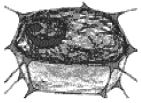
EasyMCQ
What does the following figure represent?
A
Only microfilaments
B
Only microtubules
C
Only intermediate filaments
D
Cytoskeleton
Solution
(D) The provided figure illustrates the cytoskeleton of a cell. The cytoskeleton is an elaborate network of filamentous proteinaceous structures consisting of microtubules,microfilaments,and intermediate filaments present in the cytoplasm. It is involved in many functions such as mechanical support,motility,and maintenance of the shape of the cell.
0 likes
View Solution38
EasyMCQ
What is the cytoskeleton of a eukaryotic cell composed of?
A
Golgi apparatus
B
Microtubules and microfilaments
C
Tubulin protein
D
Both $(B)$ and $(C)$
Solution
(D) The cytoskeleton of a eukaryotic cell is an elaborate network of filamentous proteinaceous structures present in the cytoplasm.
It is primarily composed of three types of structures: microtubules,microfilaments,and intermediate filaments.
Microtubules are composed of tubulin proteins.
Therefore,the cytoskeleton consists of both microtubules (which are made of tubulin) and microfilaments.
Thus,option $(D)$ is the correct answer.
It is primarily composed of three types of structures: microtubules,microfilaments,and intermediate filaments.
Microtubules are composed of tubulin proteins.
Therefore,the cytoskeleton consists of both microtubules (which are made of tubulin) and microfilaments.
Thus,option $(D)$ is the correct answer.
0 likes
View Solution39
EasyMCQ
Microtubules are primarily composed of which protein?
A
Actin
B
Keratin
C
Tubulin
D
Myosin
Solution
(C) Microtubules are structural components of the cytoskeleton found in eukaryotic cells.
They are composed of globular protein subunits called $\alpha$-tubulin and $\beta$-tubulin.
These subunits polymerize to form hollow, cylindrical structures that provide structural support, facilitate intracellular transport, and form the spindle apparatus during cell division.
Therefore, the correct answer is $C$ (Tubulin).
They are composed of globular protein subunits called $\alpha$-tubulin and $\beta$-tubulin.
These subunits polymerize to form hollow, cylindrical structures that provide structural support, facilitate intracellular transport, and form the spindle apparatus during cell division.
Therefore, the correct answer is $C$ (Tubulin).
0 likes
View Solution40
EasyMCQ
What is the cytoskeleton composed of?
A
Callose
B
Cellulosic microfibrils
C
Proteinaceous filaments
D
Granules of $CaCO_3$
Solution
(C) The cytoskeleton is an elaborate network of proteinaceous filaments present in the cytoplasm of eukaryotic cells. It is primarily composed of microtubules,microfilaments,and intermediate filaments,all of which are made of proteins. These structures provide mechanical support,motility,and maintenance of the shape of the cell.
0 likes
View Solution41
EasyMCQ
The structure made of $flagellin$ protein in bacteria is responsible for:
A
Conjugation
B
Locomotion
C
Heredity
D
Respiration
Solution
(B) In bacteria,the $flagellum$ is the primary organelle responsible for motility or locomotion. The bacterial $flagellum$ is composed of a protein called $flagellin$. Therefore,the structure made of $flagellin$ protein is responsible for locomotion.
0 likes
View Solution42
MediumMCQ
Which filaments are responsible for cellular motility?
A
Intermediate filaments
B
Microfilaments
C
Microtubules
D
Both $(B)$ and $(C)$
Solution
(D) Cellular motility is primarily driven by the cytoskeleton components.
Microfilaments (actin filaments) are involved in cell shape,cytoplasmic streaming,and amoeboid movement.
Microtubules are essential for the movement of cilia,flagella,and the separation of chromosomes during cell division.
Therefore,both microfilaments and microtubules play significant roles in various types of cellular motility.
Microfilaments (actin filaments) are involved in cell shape,cytoplasmic streaming,and amoeboid movement.
Microtubules are essential for the movement of cilia,flagella,and the separation of chromosomes during cell division.
Therefore,both microfilaments and microtubules play significant roles in various types of cellular motility.
0 likes
View Solution43
MediumMCQ
Which of the following is useful for locomotion in $Amoeba$?
A
Microtubules
B
Microfilaments
C
Intermediate filaments
D
All of the above $(A, B, \text{ and } C)$
Solution
(B) Locomotion in $Amoeba$ occurs through the formation of pseudopodia.
Pseudopodia are temporary extensions of the cytoplasm.
The formation and retraction of pseudopodia involve the dynamic reorganization of the cytoskeleton.
Specifically, microfilaments (composed of actin) play a crucial role in the cytoplasmic streaming and the structural changes required for pseudopodia formation.
While microtubules and intermediate filaments are part of the cytoskeleton, microfilaments are the primary components involved in amoeboid movement.
Pseudopodia are temporary extensions of the cytoplasm.
The formation and retraction of pseudopodia involve the dynamic reorganization of the cytoskeleton.
Specifically, microfilaments (composed of actin) play a crucial role in the cytoplasmic streaming and the structural changes required for pseudopodia formation.
While microtubules and intermediate filaments are part of the cytoskeleton, microfilaments are the primary components involved in amoeboid movement.
0 likes
View Solution44
EasyMCQ
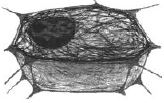
The given figure represents which structure of the cell?
A
Plasma membrane
B
Cytoskeleton
C
Glycocalyx
D
Cell wall
Solution
(B) The provided figure shows a network of filamentous proteinaceous structures present in the cytoplasm of a cell,which is known as the cytoskeleton.
The cytoskeleton is an intricate network of protein filaments,such as microtubules,microfilaments,and intermediate filaments,that extends throughout the cytoplasm.
It is involved in many functions such as mechanical support,motility,and maintenance of the shape of the cell.
Therefore,the correct option is $B$.
The cytoskeleton is an intricate network of protein filaments,such as microtubules,microfilaments,and intermediate filaments,that extends throughout the cytoplasm.
It is involved in many functions such as mechanical support,motility,and maintenance of the shape of the cell.
Therefore,the correct option is $B$.
0 likes
View Solution45
MediumMCQ
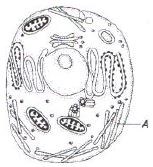
In the given figure,what is the structure labeled '$A$' made of?
A
Actin
B
Tubulin
C
Troponin
D
Glycocalyx
Solution
(B) The structure labeled '$A$' in the provided diagram of an animal cell represents the cytoskeleton,specifically the microtubules.
Microtubules are hollow,cylindrical structures composed of polymerized protein subunits known as tubulin.
These structures are essential for maintaining cell shape,intracellular transport,and forming the spindle apparatus during cell division.
Microtubules are hollow,cylindrical structures composed of polymerized protein subunits known as tubulin.
These structures are essential for maintaining cell shape,intracellular transport,and forming the spindle apparatus during cell division.
0 likes
View Solution46
EasyMCQ
What are spindle fibers composed of?
A
Lipids
B
Proteins
C
Pectin
D
Cellulose
Solution
(B) Spindle fibers are composed of microtubules,which are primarily made of the protein tubulin. During cell division,these fibers form the spindle apparatus that helps in the separation of chromosomes. Therefore,they are proteinaceous in nature.
0 likes
View Solution47
EasyMCQ
Microtubules are involved in:
A
Cell division
B
Muscle contraction
C
Membrane structure
D
$DNA$ determination
Solution
(A) Microtubules are cytoskeletal components made of tubulin proteins. They play a crucial role in cell division by forming the spindle apparatus,which helps in the separation of chromosomes during mitosis and meiosis. Therefore,they are primarily involved in cell division.
0 likes
View Solution48
MediumMCQ
The motile bacteria are able to move by
A
fimbriae
B
flagella
C
cilia
D
pili
Solution
(B) : Flagellum is the organ of motility in bacteria.
Bacterial flagella are unistranded,equivalent to a single microtubular fiber,and are composed of a protein called flagellin.
They perform rotatory movements to facilitate locomotion.
Bacterial flagella are unistranded,equivalent to a single microtubular fiber,and are composed of a protein called flagellin.
They perform rotatory movements to facilitate locomotion.
0 likes
View Solution49
MediumMCQ
Microtubules are the constituents of
A
centrioles,spindle fibres and chromatin
B
centrosome,nucleosome and centrioles
C
cilia,flagella and peroxisomes
D
spindle fibres,centrioles and cilia
Solution
(D) Microtubules are unbranched,hollow,submicroscopic tubules composed of the protein $tubulin$. They are dynamic structures that can undergo rapid growth or dissolution at their ends through the assembly or disassembly of monomers. Microtubules are essential components of the cytoskeleton and are found in various specialized structures,including $centrioles$,$basal$ $bodies$,$cilia$,$flagella$,$spindle$ $fibres$,and $chromosome$ $fibres$. Therefore,option $D$ is the correct answer.
0 likes
View Solution50
EasyMCQ
The solid linear cytoskeletal elements having a diameter of $6 \ nm$ and made up of a single type of monomer are known as
A
microtubules
B
microfilaments
C
intermediate filaments
D
lamins
Solution
(B) The correct answer is $(b)$.
Microfilaments (also known as actin filaments) are solid,linear cytoskeletal elements with a diameter of approximately $6 \ nm$.
They are composed of a single type of globular protein monomer called $G$-actin,which polymerizes to form $F$-actin filaments.
Microtubules are hollow structures with a diameter of about $24 \ nm$ made of tubulin.
Intermediate filaments have a diameter of about $8-10 \ nm$ and are composed of various fibrous proteins.
Microfilaments (also known as actin filaments) are solid,linear cytoskeletal elements with a diameter of approximately $6 \ nm$.
They are composed of a single type of globular protein monomer called $G$-actin,which polymerizes to form $F$-actin filaments.
Microtubules are hollow structures with a diameter of about $24 \ nm$ made of tubulin.
Intermediate filaments have a diameter of about $8-10 \ nm$ and are composed of various fibrous proteins.
0 likes
View SolutionCell: The Unit of Life — Flagella and Cytoskeleton · Frequently Asked Questions
1Are these Cell: The Unit of Life questions useful for JEE and NEET?
Yes. All questions in this section are mapped to JEE Main and NEET exam patterns. Previous year questions from JEE Main, NEET, GUJCET and state-level exams are included with full solutions.
2Can I switch to Hindi or Gujarati for these questions?
Yes. Use the language tabs in the hero section or the sidebar to view the same questions and solutions in English, Hindi or Gujarati.
3How do I generate a question paper from this subtopic?
Use the Vedclass Exam Paper Generator — select the chapter and subtopic, set difficulty, and generate Sets A, B, C, D automatically. First 3 chapters of every subject are free.
Vedclass Products
For Students
Vedclass Test Series
Mock tests in real JEE/NEET style with performance analysis. 5-day free trial.
Start Free TrialFor Teachers
Exam Paper Generator
Generate Set A/B/C/D papers from this chapter in 2 minutes. 3 chapters free.
Try FreeFor Institutes
Online Exam Module
Live online exams with unlimited students, 360° analytics & white-label branding.
See DemoFor Teachers & Institutes
Generate a Cell: The Unit of Life Exam Paper in 2 Minutes
Select subtopic & difficulty — Sets A, B, C, D auto-generated with No Repeat logic.
First 3 chapters of every subject are free — no payment required.