
A English
Human Respiratory System Questions in English
Class 11 Biology · Breathing and Exchange of Gases · Human Respiratory System
220+
Questions
English
Language
100%
With Solutions
Showing 50 of 220 questions in English
101
EasyMCQ
The wall of the alveoli is composed of which type of tissue?
A
Simple squamous epithelium
B
Simple cuboidal epithelium
C
Pseudostratified epithelium
D
Simple columnar epithelium
Solution
(A) The alveoli are the primary sites for the exchange of gases in the lungs.
To facilitate efficient diffusion of gases ($O_2$ and $CO_2$),the wall of the alveoli must be extremely thin.
This wall is composed of a single layer of thin,flattened cells known as simple squamous epithelium.
Therefore,the correct option is $A$.
To facilitate efficient diffusion of gases ($O_2$ and $CO_2$),the wall of the alveoli must be extremely thin.
This wall is composed of a single layer of thin,flattened cells known as simple squamous epithelium.
Therefore,the correct option is $A$.
0 likes
View Solution102
EasyMCQ
Where are the vocal cords found?
A
Pharynx
B
Larynx
C
Glottis
D
Trachea
Solution
(B) The $Larynx$ (also known as the sound box) is a cartilaginous box which helps in sound production. Inside the $Larynx$,there are two elastic vocal cords that vibrate to produce sound. Therefore,the vocal cords are located within the $Larynx$.
0 likes
View Solution103
EasyMCQ
In a rabbit,the lungs are divided into how many lobes?
A
Right $4$ and left $2$ lobes
B
Right $2$ and left $3$ lobes
C
Right $2$ and left $2$ lobes
D
None of these
Solution
(A) In a rabbit,the respiratory system consists of two lungs located in the thoracic cavity. The right lung is divided into $4$ lobes,while the left lung is divided into $2$ lobes. Therefore,the correct arrangement is right $4$ and left $2$ lobes.
0 likes
View Solution104
MediumMCQ
The lungs of humans and rabbits are . . . . . . .
A
Absorptive lungs
B
Pressure lungs
C
Aquatic lungs
D
None of these
Solution
(B) The lungs of humans and rabbits are known as $pressure$ $lungs$ (or $aspiration$ $lungs$).
This is because they function by creating a negative pressure within the thoracic cavity to draw air into the lungs,a process known as negative pressure breathing.
Therefore,the correct option is $B$.
This is because they function by creating a negative pressure within the thoracic cavity to draw air into the lungs,a process known as negative pressure breathing.
Therefore,the correct option is $B$.
0 likes
View Solution105
MediumMCQ
The roof of the nasal cavity is formed by which bone?
A
Nasal
B
Ethmoid
C
Maxilla
D
Vomer
Solution
(B) The nasal cavity is a complex structure within the skull. The roof of the nasal cavity is primarily formed by the cribriform plate of the $Ethmoid$ bone. This plate contains numerous small perforations that allow the olfactory nerves to pass from the nasal cavity to the brain. Therefore,the correct answer is $B$.
0 likes
View Solution106
EasyMCQ
What is the epiglottis made of?
A
Hyaline cartilage
B
Calcified cartilage
C
Both
D
Elastic cartilage
Solution
(D) The epiglottis is a thin,leaf-shaped flap of tissue located at the entrance of the larynx. It is composed primarily of elastic cartilage,which provides the necessary flexibility to bend over the glottis during swallowing to prevent food from entering the trachea. Unlike hyaline cartilage,elastic cartilage contains a network of elastic fibers,allowing it to maintain its shape while being highly flexible.
0 likes
View Solution107
EasyMCQ
Which respiratory pigment contains $Fe$ and is red in color?
A
Hemocyanin (Mollusca)
B
Hemoglobin (Most vertebrates)
C
Chlorocruorin (Some Annelids)
D
None of these
Solution
(B) Hemoglobin is a respiratory pigment found in the blood of most vertebrates.
It is a conjugated protein consisting of a protein part called globin and a non-protein prosthetic group called heme.
The heme group contains an iron atom $(Fe^{2+})$ at its center,which gives the blood its characteristic red color and allows it to bind with oxygen.
It is a conjugated protein consisting of a protein part called globin and a non-protein prosthetic group called heme.
The heme group contains an iron atom $(Fe^{2+})$ at its center,which gives the blood its characteristic red color and allows it to bind with oxygen.
0 likes
View Solution108
EasyMCQ
Which structure is composed of yellow elastic cartilage?
A
Thyroid cartilage
B
Cricoid cartilage
C
Epiglottis
D
Tracheal rings
Solution
(C) Yellow elastic cartilage is a type of cartilage that contains numerous elastic fibers in its matrix,providing both flexibility and support.
Among the given options,the epiglottis is composed of yellow elastic cartilage,which allows it to bend and return to its original shape during swallowing.
Thyroid cartilage,cricoid cartilage,and tracheal rings are primarily composed of hyaline cartilage.
Among the given options,the epiglottis is composed of yellow elastic cartilage,which allows it to bend and return to its original shape during swallowing.
Thyroid cartilage,cricoid cartilage,and tracheal rings are primarily composed of hyaline cartilage.
0 likes
View Solution109
MediumMCQ
The largest cartilage of the larynx is an example of which type of cartilage?
A
Calcified cartilage
B
Elastic cartilage
C
Fibrous cartilage
D
Hyaline cartilage
Solution
(D) The larynx (voice box) is composed of several cartilages. The largest among these is the thyroid cartilage.
All major cartilages of the larynx,including the thyroid,cricoid,and arytenoid cartilages,are composed of hyaline cartilage.
Hyaline cartilage is the most abundant type of cartilage in the body and provides structural support while remaining flexible.
Therefore,the correct answer is $D$ (Hyaline cartilage).
All major cartilages of the larynx,including the thyroid,cricoid,and arytenoid cartilages,are composed of hyaline cartilage.
Hyaline cartilage is the most abundant type of cartilage in the body and provides structural support while remaining flexible.
Therefore,the correct answer is $D$ (Hyaline cartilage).
0 likes
View Solution110
MediumMCQ
The inner surface of the larynx is lined by:
A
Stratified ciliated columnar epithelium
B
Stratified squamous epithelium
C
Stratified cuboidal epithelium
D
Stratified columnar epithelium
Solution
(B) The larynx, specifically the vocal cords and parts of the epiglottis, is subjected to significant mechanical stress during phonation and swallowing. To protect the underlying tissues from abrasion, the inner surface of the larynx is lined with $Stratified \text{ } squamous \text{ } epithelium$. While the respiratory tract is generally lined with pseudostratified ciliated columnar epithelium, the areas of the larynx that experience high friction are covered by stratified squamous epithelium.
0 likes
View Solution111
MediumMCQ
The alveoli contain ..........
A
Yellow fibrous connective tissue
B
White fibrous connective tissue
C
Fibrous connective tissue
D
Adipose connective tissue
Solution
(A) The walls of the alveoli in the lungs are highly elastic to facilitate the expansion and recoil during the process of breathing. This elasticity is provided by the presence of yellow fibrous connective tissue,which contains abundant elastin fibers.
0 likes
View Solution112
EasyMCQ
The phagocytic cells of the pulmonary alveoli are called ...... .
A
Melanocytes
B
Dust cells (Macrophages)
C
Dust particles
D
Microglial cells
Solution
(B) The phagocytic cells present in the pulmonary alveoli are known as $Dust \ cells$ or $Alveolar \ macrophages$.
These cells are derived from monocytes and are responsible for engulfing foreign particles,such as dust,bacteria,and other debris that reach the lungs through inhalation,thereby protecting the respiratory surface.
These cells are derived from monocytes and are responsible for engulfing foreign particles,such as dust,bacteria,and other debris that reach the lungs through inhalation,thereby protecting the respiratory surface.
0 likes
View Solution113
MediumMCQ
In which animal does the tongue help in thermoregulation?
A
Rabbit
B
Dog
C
Human
D
Cow
Solution
(B) Thermoregulation is the process that allows an organism to maintain its core internal temperature. In dogs,the tongue plays a crucial role in thermoregulation through a process called panting. When a dog is hot,it pants,which increases the evaporation of water from the moist surface of the tongue and respiratory tract,thereby cooling the blood circulating through the tongue before it returns to the rest of the body.
0 likes
View Solution114
EasyMCQ
In which of the following is the diaphragm found?
A
Crocodile
B
Kangaroo
C
Ostrich
D
None of these
Solution
(B) The diaphragm is a characteristic muscular partition that separates the thoracic cavity from the abdominal cavity. It is a unique feature found exclusively in mammals. Among the given options,the kangaroo is a mammal,while the crocodile is a reptile and the ostrich is a bird. Therefore,the diaphragm is present in the kangaroo.
0 likes
View Solution115
EasyMCQ
Which of the following is used as a unique and characteristic feature of the mammalian body?
A
Four-chambered heart
B
Rib cage
C
Homeothermy
D
Diaphragm
Solution
(D) The presence of a $Diaphragm$ is a unique and characteristic feature of mammals. It is a muscular partition that separates the thoracic cavity from the abdominal cavity and plays a crucial role in respiration. While other features like a four-chambered heart and homeothermy are also present in mammals, they are shared with other groups (e.g., birds), whereas the $Diaphragm$ is exclusive to mammals.
0 likes
View Solution116
MediumMCQ
Two friends are eating together on a dining table. One of them suddenly starts coughing while swallowing some food. This coughing would have been due to improper movement of
A
epiglottis
B
diaphragm
C
neck
D
tongue
Solution
(A) : This coughing occurs due to the improper movement of the epiglottis.
The epiglottis is a thin,cartilaginous flap located in the laryngopharynx,which is the lower part of the pharynx.
During the act of swallowing,the epiglottis acts as a lid to cover the glottis (the opening of the trachea or windpipe) to prevent food particles from entering the respiratory tract.
If the epiglottis does not close properly while swallowing,some food particles may enter the trachea,triggering a sudden coughing reflex to expel the foreign material.
The epiglottis is a thin,cartilaginous flap located in the laryngopharynx,which is the lower part of the pharynx.
During the act of swallowing,the epiglottis acts as a lid to cover the glottis (the opening of the trachea or windpipe) to prevent food particles from entering the respiratory tract.
If the epiglottis does not close properly while swallowing,some food particles may enter the trachea,triggering a sudden coughing reflex to expel the foreign material.
0 likes
View Solution117
EasyMCQ
The figure shows a diagrammatic view of the human respiratory system with labels $A, B, C$,and $D$. Select the option which gives the correct identification and main function and/or characteristic.
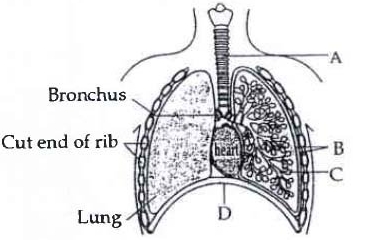
A
$C$ - Alveoli - Thin-walled vascular bag-like structures for the exchange of gases.
B
$D$ - Lower end of lungs - Diaphragm pulls it down during inspiration.
C
$A$ - Trachea - Long tube supported by complete cartilaginous rings for conducting inspired air.
D
$B$ - Pleural membrane - Surrounds ribs on both sides to provide a cushion against rubbing.
Solution
(A) The correct option is $A$.
In the given figure,$A$ represents the trachea. It is supported by incomplete cartilaginous rings which prevent its collapse during inspiration.
$B$ represents the pleural membrane,which encloses the lungs.
$C$ represents the alveoli. They are thin-walled sacs having an extensive network of capillaries for gaseous exchange.
$D$ represents the diaphragm,which is a dome-shaped muscular structure that helps in breathing.
In the given figure,$A$ represents the trachea. It is supported by incomplete cartilaginous rings which prevent its collapse during inspiration.
$B$ represents the pleural membrane,which encloses the lungs.
$C$ represents the alveoli. They are thin-walled sacs having an extensive network of capillaries for gaseous exchange.
$D$ represents the diaphragm,which is a dome-shaped muscular structure that helps in breathing.
0 likes
View Solution118
EasyMCQ
Identify the odd one out from the following structures.
A
Trachea
B
Oesophagus
C
Mouth
D
Stomach
Solution
(A) The $Trachea$ is a part of the respiratory system,which is responsible for the exchange of gases.
In contrast,the $Mouth$,$Oesophagus$,and $Stomach$ are all integral components of the human digestive system,which is responsible for the ingestion,breakdown,and absorption of food.
Therefore,the $Trachea$ is the odd one out.
In contrast,the $Mouth$,$Oesophagus$,and $Stomach$ are all integral components of the human digestive system,which is responsible for the ingestion,breakdown,and absorption of food.
Therefore,the $Trachea$ is the odd one out.
0 likes
View Solution119
EasyMCQ
Air is breathed through which of the following pathways?
A
$Trachea \rightarrow Lungs \rightarrow Larynx \rightarrow Pharynx \rightarrow Alveoli$
B
$Nose \rightarrow Larynx \rightarrow Pharynx \rightarrow Bronchus \rightarrow Alveoli \rightarrow Bronchioles$
C
$Nostrils \rightarrow Pharynx \rightarrow Larynx \rightarrow Trachea \rightarrow Bronchi \rightarrow Bronchioles \rightarrow Alveoli$
D
$Nose \rightarrow Mouth \rightarrow Lungs$
Solution
(C) The correct pathway for the movement of air during inhalation is as follows:
$1$. Air enters through the $Nostrils$.
$2$. It passes into the $Pharynx$ (the common passage for air and food).
$3$. It then moves into the $Larynx$ (voice box).
$4$. From the $Larynx$,it enters the $Trachea$ (windpipe).
$5$. The $Trachea$ divides into $Bronchi$,which further branch into $Bronchioles$.
$6$. Finally,the air reaches the $Alveoli$,where the exchange of gases occurs.
Therefore,the correct sequence is $Nostrils \rightarrow Pharynx \rightarrow Larynx \rightarrow Trachea \rightarrow Bronchi \rightarrow Bronchioles \rightarrow Alveoli$.
$1$. Air enters through the $Nostrils$.
$2$. It passes into the $Pharynx$ (the common passage for air and food).
$3$. It then moves into the $Larynx$ (voice box).
$4$. From the $Larynx$,it enters the $Trachea$ (windpipe).
$5$. The $Trachea$ divides into $Bronchi$,which further branch into $Bronchioles$.
$6$. Finally,the air reaches the $Alveoli$,where the exchange of gases occurs.
Therefore,the correct sequence is $Nostrils \rightarrow Pharynx \rightarrow Larynx \rightarrow Trachea \rightarrow Bronchi \rightarrow Bronchioles \rightarrow Alveoli$.
0 likes
View Solution120
MediumMCQ
The outer pleural membrane is in close contact with the .....
A
Surface of lungs
B
Thoracic lining
C
Alveoli
D
None of the above
Solution
(B) The lungs are covered by a double-layered membrane called the pleura.
The outer pleural membrane is in close contact with the thoracic lining (inner wall of the thoracic cavity).
The inner pleural membrane is in close contact with the lung surface.
Therefore,the correct option is $B$.
The outer pleural membrane is in close contact with the thoracic lining (inner wall of the thoracic cavity).
The inner pleural membrane is in close contact with the lung surface.
Therefore,the correct option is $B$.
0 likes
View Solution121
MediumMCQ
The thoracic chamber is formed of ........
A
Ribs and sternum
B
Ribs and vertebral column
C
Sternum and diaphragm
D
Vertebral column,sternum,ribs and diaphragm
Solution
(D) The thoracic chamber is an airtight chamber that protects the lungs and heart.
It is anatomically formed by:
$1$. Dorsally by the vertebral column.
$2$. Ventrally by the sternum.
$3$. Laterally by the ribs.
$4$. On the lower side by the dome-shaped diaphragm.
Therefore,the correct answer is option $D$.
It is anatomically formed by:
$1$. Dorsally by the vertebral column.
$2$. Ventrally by the sternum.
$3$. Laterally by the ribs.
$4$. On the lower side by the dome-shaped diaphragm.
Therefore,the correct answer is option $D$.
0 likes
View Solution122
MediumMCQ
....... are the primary sites of exchange of gases.
A
Alveoli
B
Bronchiole
C
Lungs
D
Bronchus
Solution
(A) The $Alveoli$ are the primary sites of exchange of gases in the human respiratory system.
These are thin-walled,bag-like structures at the end of the bronchioles.
Oxygen diffuses from the $Alveoli$ into the blood,and carbon dioxide diffuses from the blood into the $Alveoli$ due to partial pressure gradients.
These are thin-walled,bag-like structures at the end of the bronchioles.
Oxygen diffuses from the $Alveoli$ into the blood,and carbon dioxide diffuses from the blood into the $Alveoli$ due to partial pressure gradients.
0 likes
View Solution123
MediumMCQ
Intercostal muscles occur in
A
abdomen
B
thigh
C
ribs
D
diaphragm
Solution
(C) Intercostal muscles are a group of muscles that run between the ribs and help form and move the chest wall.
They are primarily involved in the mechanical aspect of breathing.
There are two main types: external intercostal muscles,which lift the rib cage to increase thoracic volume during inspiration,and internal intercostal muscles,which help in forced expiration.
Therefore,they are located in the rib cage.
They are primarily involved in the mechanical aspect of breathing.
There are two main types: external intercostal muscles,which lift the rib cage to increase thoracic volume during inspiration,and internal intercostal muscles,which help in forced expiration.
Therefore,they are located in the rib cage.
0 likes
View Solution124
EasyMCQ
It prevents the entry of food into the larynx.
A
Alveoli
B
Glottis
C
Epiglottis
D
Nasopharynx
Solution
(C) The $Epiglottis$ is a thin,cartilaginous flap located at the base of the tongue.
During the act of swallowing (deglutition),the $Epiglottis$ folds down to cover the $Glottis$ (the opening of the larynx).
This action effectively prevents the entry of food or liquid into the respiratory tract (larynx and trachea),thereby protecting the lungs from aspiration.
During the act of swallowing (deglutition),the $Epiglottis$ folds down to cover the $Glottis$ (the opening of the larynx).
This action effectively prevents the entry of food or liquid into the respiratory tract (larynx and trachea),thereby protecting the lungs from aspiration.
0 likes
View Solution125
MediumMCQ
The larynx is present between which of the following structures?
A
Epiglottis and glottis
B
Trachea and bronchiole
C
Epiglottis and trachea
D
Bronchus and epiglottis
Solution
(C) The larynx,also known as the sound box,is a cartilaginous structure located in the neck.
It is situated superiorly to the trachea and inferior to the pharynx.
The epiglottis is a flap-like structure that covers the glottis (the opening of the larynx) during swallowing to prevent food from entering the respiratory tract.
Therefore,the larynx is positioned between the epiglottis (at the level of the pharynx) and the trachea.
It is situated superiorly to the trachea and inferior to the pharynx.
The epiglottis is a flap-like structure that covers the glottis (the opening of the larynx) during swallowing to prevent food from entering the respiratory tract.
Therefore,the larynx is positioned between the epiglottis (at the level of the pharynx) and the trachea.
0 likes
View Solution126
MediumMCQ
Identify $X$ from the figure.
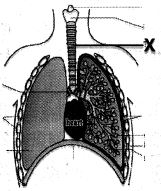
A
Larynx
B
Trachea
C
Epiglottis
D
Oesophagus
Solution
(B) In the provided diagram of the human respiratory system,the structure labeled as $X$ represents the trachea.
The trachea is a straight tube extending up to the mid-thoracic cavity,which divides at the level of the $5^{th}$ thoracic vertebra into a right and left primary bronchus.
It is supported by incomplete cartilaginous rings that prevent it from collapsing.
The trachea is a straight tube extending up to the mid-thoracic cavity,which divides at the level of the $5^{th}$ thoracic vertebra into a right and left primary bronchus.
It is supported by incomplete cartilaginous rings that prevent it from collapsing.
0 likes
View Solution127
MediumMCQ
Because of....... the layer of epithelial cells in the stomach of chordates is not damaged.
A
Mucous secretion
B
Acidic medium
C
Dilute $HCl$
D
Renin secretion
Solution
(A) The stomach lining is protected from the highly acidic environment (caused by $HCl$) and the digestive action of pepsin by a thick layer of mucus.
This mucus is secreted by the goblet cells present in the gastric epithelium.
It forms a physical and chemical barrier that prevents the self-digestion of the stomach wall by its own gastric juices.
This mucus is secreted by the goblet cells present in the gastric epithelium.
It forms a physical and chemical barrier that prevents the self-digestion of the stomach wall by its own gastric juices.
0 likes
View Solution128
MediumMCQ
Which structure opens into the alveolar sac?
A
Primary bronchus
B
Terminal bronchiole
C
Tertiary bronchus
D
None of the above
Solution
(D) The respiratory system in humans consists of a branching network of tubes.
Air enters through the trachea,which divides into primary,secondary,and tertiary bronchi.
These bronchi further divide into bronchioles.
The terminal bronchioles give rise to respiratory bronchioles,which then lead to alveolar ducts.
These alveolar ducts finally open into the alveolar sacs (or alveoli).
Since none of the options $A$,$B$,or $C$ represent the structure that directly opens into the alveolar sac (which is the alveolar duct),the correct answer is $D$.
Air enters through the trachea,which divides into primary,secondary,and tertiary bronchi.
These bronchi further divide into bronchioles.
The terminal bronchioles give rise to respiratory bronchioles,which then lead to alveolar ducts.
These alveolar ducts finally open into the alveolar sacs (or alveoli).
Since none of the options $A$,$B$,or $C$ represent the structure that directly opens into the alveolar sac (which is the alveolar duct),the correct answer is $D$.
0 likes
View Solution129
MediumMCQ
Choose the correct sentences for the conducting part of the respiratory system.
$(I)$ Transports the atmospheric air to the alveoli.
$(II)$ Clears it from foreign particles.
$(III)$ Humidifies the air.
$(IV)$ Brings the air to body temperature.
$(I)$ Transports the atmospheric air to the alveoli.
$(II)$ Clears it from foreign particles.
$(III)$ Humidifies the air.
$(IV)$ Brings the air to body temperature.
A
Only $I, II, III$
B
Only $I, IV$
C
Only $II, III$
D
$I, II, III, IV$
Solution
(D) The conducting part of the human respiratory system includes the external nostrils,nasal passage,pharynx,larynx,trachea,bronchi,and bronchioles.
Its primary functions are:
$1$. Transporting atmospheric air to the alveoli.
$2$. Clearing the air of foreign particles.
$3$. Humidifying the air.
$4$. Bringing the air to body temperature.
Since all four statements describe the functions of the conducting part,the correct option is $D$.
Its primary functions are:
$1$. Transporting atmospheric air to the alveoli.
$2$. Clearing the air of foreign particles.
$3$. Humidifying the air.
$4$. Bringing the air to body temperature.
Since all four statements describe the functions of the conducting part,the correct option is $D$.
0 likes
View Solution130
MediumMCQ
Choose the incorrect statement.
A
Nasal chamber opens into the nasopharynx.
B
Larynx is a bony box.
C
During swallowing,the epiglottis prevents the entry of food into the larynx.
D
The trachea divides at the level of the $5^{th}$ thoracic vertebra.
Solution
(B) The correct answer is $B$. The larynx is a cartilaginous box,not a bony box. It is also known as the sound box. The other statements are correct: the nasal chamber opens into the nasopharynx,the epiglottis acts as a flap to prevent food from entering the glottis (larynx) during swallowing,and the trachea bifurcates into right and left primary bronchi at the level of the $5^{th}$ thoracic vertebra.
0 likes
View Solution131
MediumMCQ
Cornea transplant in humans is almost never rejected. This is because
A
its cells are least penetrable by bacteria
B
it has no blood supply
C
it is composed of strong cells
D
it is keratinised
Solution
(B) The cornea is an avascular structure,meaning it has no direct blood supply.
Because the immune system's cells (such as $T$-lymphocytes) reach tissues primarily through the bloodstream,the lack of blood vessels in the cornea creates an 'immune privilege' zone.
This prevents the immune system from easily recognizing and attacking the transplanted corneal tissue,making rejection extremely rare.
Because the immune system's cells (such as $T$-lymphocytes) reach tissues primarily through the bloodstream,the lack of blood vessels in the cornea creates an 'immune privilege' zone.
This prevents the immune system from easily recognizing and attacking the transplanted corneal tissue,making rejection extremely rare.
0 likes
View Solution132
MediumMCQ
Intercostal muscles are found in ...........
A
Rat
B
Thigh
C
Ribs
D
Diaphragm
Solution
(C) Intercostal muscles are a group of muscles that run between the ribs and help form and move the chest wall. They are primarily involved in the mechanical aspect of breathing by helping to expand and shrink the size of the chest cavity. Therefore,they are associated with the ribs.
0 likes
View Solution133
EasyMCQ
The epithelium of the alveoli in the lungs is .......... .
A
Non-ciliated columnar
B
Non-ciliated squamous
C
Ciliated columnar
D
Ciliated squamous
Solution
(B) The alveoli in the lungs are the primary sites for the exchange of gases.
To facilitate efficient diffusion of gases,the wall of the alveoli must be extremely thin.
This is achieved by a single layer of flat,thin,and scale-like cells known as squamous epithelium.
Since these cells do not possess cilia,the epithelium of the alveoli is classified as non-ciliated squamous epithelium.
To facilitate efficient diffusion of gases,the wall of the alveoli must be extremely thin.
This is achieved by a single layer of flat,thin,and scale-like cells known as squamous epithelium.
Since these cells do not possess cilia,the epithelium of the alveoli is classified as non-ciliated squamous epithelium.
0 likes
View Solution134
MediumMCQ
The path of air during respiration is:
A
Bronchi - Lungs - Larynx - Pharynx - Alveoli
B
Nose - Larynx - Pharynx - Bronchi - Alveoli - Bronchioles
C
External nostrils - Pharynx - Larynx - Trachea - Bronchi - Bronchioles - Alveoli
D
Nose - Mouth - Lungs
Solution
(C) The human respiratory system follows a specific anatomical pathway for the movement of air.
$1$. Air enters through the $External$ $nostrils$.
$2$. It passes into the $Pharynx$ (the common passage for food and air).
$3$. It then enters the $Larynx$ (the sound box).
$4$. From the $Larynx$,air moves into the $Trachea$ (windpipe).
$5$. The $Trachea$ divides into $Bronchi$,which further divide into smaller $Bronchioles$.
$6$. Finally,the air reaches the $Alveoli$,where the actual exchange of gases occurs.
$1$. Air enters through the $External$ $nostrils$.
$2$. It passes into the $Pharynx$ (the common passage for food and air).
$3$. It then enters the $Larynx$ (the sound box).
$4$. From the $Larynx$,air moves into the $Trachea$ (windpipe).
$5$. The $Trachea$ divides into $Bronchi$,which further divide into smaller $Bronchioles$.
$6$. Finally,the air reaches the $Alveoli$,where the actual exchange of gases occurs.
0 likes
View Solution135
MediumMCQ
Two friends are eating together at a dining table. One of them suddenly starts coughing while swallowing food. This coughing action is likely due to the improper movement of the .......... .
A
Epiglottis
B
Diaphragm
C
Larynx
D
Tongue
Solution
(A) The $Epiglottis$ is a thin,cartilaginous flap that covers the glottis (the opening of the windpipe or trachea) during the act of swallowing.
When we swallow food,the $Epiglottis$ closes the trachea to prevent food particles from entering the respiratory tract.
If a person talks or laughs while swallowing,the $Epiglottis$ may not close properly,allowing food to enter the trachea.
This triggers a reflex action,causing the person to cough to expel the food particles from the airway.
When we swallow food,the $Epiglottis$ closes the trachea to prevent food particles from entering the respiratory tract.
If a person talks or laughs while swallowing,the $Epiglottis$ may not close properly,allowing food to enter the trachea.
This triggers a reflex action,causing the person to cough to expel the food particles from the airway.
0 likes
View Solution136
MediumMCQ
The given figure shows the human respiratory system with structures labeled $A, B, C,$ and $D$. Which of the following options correctly identifies the structure and its main function or characteristic?
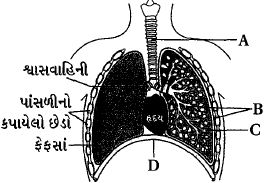
A
$D -$ Lower end of lungs - The diaphragm pulls it downwards during respiration.
B
$A -$ Trachea - It is a long tube supported by cartilaginous rings and is useful for breathing.
C
$B -$ Pleural membrane - It provides a friction-free cushion-like covering for the ribs on both sides.
D
$C -$ Alveoli - It is a thin-walled,capillary-rich,bag-like structure that performs gas exchange.
Solution
(D) Based on the provided diagram of the human respiratory system:
$A$ represents the Trachea,which is a straight tube extending up to the mid-thoracic cavity,supported by incomplete cartilaginous rings.
$B$ represents the Pleural membranes,which enclose the lungs and reduce friction on the lung surface.
$C$ represents the Alveoli,which are the primary sites of gas exchange,characterized by thin,irregular-walled,and vascularized bag-like structures.
$D$ represents the Diaphragm,which is a dome-shaped muscular partition that separates the thoracic cavity from the abdominal cavity and plays a crucial role in breathing mechanics.
Option $D$ correctly identifies $C$ as the alveoli,which are thin-walled,capillary-rich structures essential for the exchange of gases.
$A$ represents the Trachea,which is a straight tube extending up to the mid-thoracic cavity,supported by incomplete cartilaginous rings.
$B$ represents the Pleural membranes,which enclose the lungs and reduce friction on the lung surface.
$C$ represents the Alveoli,which are the primary sites of gas exchange,characterized by thin,irregular-walled,and vascularized bag-like structures.
$D$ represents the Diaphragm,which is a dome-shaped muscular partition that separates the thoracic cavity from the abdominal cavity and plays a crucial role in breathing mechanics.
Option $D$ correctly identifies $C$ as the alveoli,which are thin-walled,capillary-rich structures essential for the exchange of gases.
0 likes
View Solution137
EasyMCQ
The much developed larynx of a human male is called:
A
Aristotle's lantern
B
Syrinx
C
Adam's apple
D
Muller's organ
Solution
(C) The larynx is a cartilaginous box that helps in sound production and is therefore known as the sound box. In human males, the larynx becomes more prominent during puberty due to the influence of androgens, and this enlarged structure is commonly referred to as the $Adam's apple$.
0 likes
View Solution138
Easy
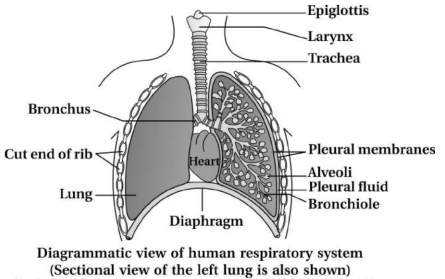
Describe various parts of the human respiratory system.
Solution
(N/A) The human respiratory system consists of the nose,pharynx,larynx,trachea,bronchi,and lungs.
$(1)$ Nose: The nose is a raised structure on the face. It is divided into external nostrils,nasal chamber,and internal nostrils.
$(a)$ External nostrils: $A$ pair of openings located above the upper lip.
$(b)$ Nasal chamber: The internal cavity divided by a nasal septum. It is categorized into three regions: $(i)$ Vestibular,$(ii)$ Respiratory,and $(iii)$ Olfactory.
$(2)$ Pharynx: $A$ $13 \ cm$ long tube acting as a common passage for food and air. It is divided into $(a)$ Nasopharynx,$(b)$ Oropharynx (bucco-pharynx),and $(c)$ Laryngopharynx.
$(3)$ Larynx: Known as the sound box. It contains the glottis,which is covered by a cartilaginous flap called the epiglottis to prevent food entry during swallowing. It contains vocal cords for sound production.
$(4)$ Trachea: $A$ straight tube,$12.5 \ cm$ long and $2.5 \ cm$ in diameter. It extends to the mid-thoracic cavity and divides at the level of the $5^{th}$ thoracic vertebra into right and left primary bronchi. It is supported by '$C$'-shaped cartilaginous rings.
$(5)$ Bronchi and Bronchioles: The primary bronchi branch into secondary and tertiary bronchi,which further divide into bronchioles,eventually leading to alveoli. This network is called the bronchial tree.
$(6)$ Lungs: $A$ pair of cone-shaped organs in the thoracic cavity,protected by the rib cage and diaphragm.
Internal Structure: Lungs are covered by a double-layered pleural membrane with pleural fluid in between to reduce friction. The system is divided into the conducting part (nostrils to terminal bronchioles) and the respiratory/exchange part (alveoli and their ducts). The thoracic chamber is an air-tight space formed by the vertebral column,sternum,ribs,and diaphragm,allowing for breathing through volume changes.
$(1)$ Nose: The nose is a raised structure on the face. It is divided into external nostrils,nasal chamber,and internal nostrils.
$(a)$ External nostrils: $A$ pair of openings located above the upper lip.
$(b)$ Nasal chamber: The internal cavity divided by a nasal septum. It is categorized into three regions: $(i)$ Vestibular,$(ii)$ Respiratory,and $(iii)$ Olfactory.
$(2)$ Pharynx: $A$ $13 \ cm$ long tube acting as a common passage for food and air. It is divided into $(a)$ Nasopharynx,$(b)$ Oropharynx (bucco-pharynx),and $(c)$ Laryngopharynx.
$(3)$ Larynx: Known as the sound box. It contains the glottis,which is covered by a cartilaginous flap called the epiglottis to prevent food entry during swallowing. It contains vocal cords for sound production.
$(4)$ Trachea: $A$ straight tube,$12.5 \ cm$ long and $2.5 \ cm$ in diameter. It extends to the mid-thoracic cavity and divides at the level of the $5^{th}$ thoracic vertebra into right and left primary bronchi. It is supported by '$C$'-shaped cartilaginous rings.
$(5)$ Bronchi and Bronchioles: The primary bronchi branch into secondary and tertiary bronchi,which further divide into bronchioles,eventually leading to alveoli. This network is called the bronchial tree.
$(6)$ Lungs: $A$ pair of cone-shaped organs in the thoracic cavity,protected by the rib cage and diaphragm.
| Feature | Right Lung | Left Lung |
| Size | Thick,short,heavy | Thin,narrow,long,light |
| Lobes | Three lobes | Two lobes |
| Aortic arch | Absent | Present |
Internal Structure: Lungs are covered by a double-layered pleural membrane with pleural fluid in between to reduce friction. The system is divided into the conducting part (nostrils to terminal bronchioles) and the respiratory/exchange part (alveoli and their ducts). The thoracic chamber is an air-tight space formed by the vertebral column,sternum,ribs,and diaphragm,allowing for breathing through volume changes.
0 likes
View Solution139
Easy
Draw a labelled diagram of the human respiratory system.
Solution
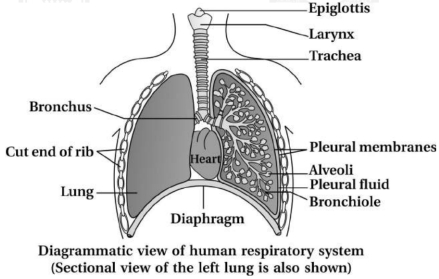
The human respiratory system consists of a conducting part and a respiratory or exchange part. The conducting part includes the external nostrils,nasal passage,pharynx,larynx,trachea,bronchi,and bronchioles. The exchange part consists of the alveoli and their ducts. The lungs are situated in the thoracic chamber,which is anatomically an air-tight chamber. The thoracic chamber is formed dorsally by the vertebral column,ventrally by the sternum,laterally by the ribs,and on the lower side by the dome-shaped diaphragm. The lungs are covered by a double-layered pleura,with pleural fluid between them to reduce friction on the lung surface. The diagram shows the structural organization of these components.
0 likes
View Solution140
Easy
Definition / Explanation: $(1)$ Alveoli
Solution
(N/A) Alveoli are the primary sites of gaseous exchange in the lungs. Each alveolus forms a bag-like or cavity-like structure,which is surrounded by a network of very thin pulmonary capillaries. The wall of the alveolus is composed of a single layer of squamous epithelial cells,which facilitates the diffusion of gases ($O_2$ and $CO_2$) between the air and the blood.
0 likes
View Solution141
Easy
Define the location and function of the following structures:
$(1)$ Epiglottis
$(2)$ Intercostal muscles
$(1)$ Epiglottis
$(2)$ Intercostal muscles
Solution
(N/A) $(1)$ Epiglottis:
Location: It is a thin,leaf-like flap composed of elastic cartilage,attached to the entrance of the larynx.
Function: It remains open during normal breathing but closes the glottis during the process of swallowing to prevent food from entering the trachea.
$(2)$ Intercostal muscles:
Location: These muscles are situated between the ribs.
Function: They play a crucial role in the mechanics of breathing by creating pressure differences between the lungs and the atmosphere,facilitating inspiration and expiration.
Location: It is a thin,leaf-like flap composed of elastic cartilage,attached to the entrance of the larynx.
Function: It remains open during normal breathing but closes the glottis during the process of swallowing to prevent food from entering the trachea.
$(2)$ Intercostal muscles:
Location: These muscles are situated between the ribs.
Function: They play a crucial role in the mechanics of breathing by creating pressure differences between the lungs and the atmosphere,facilitating inspiration and expiration.
0 likes
View Solution142
Medium
Analogy type questions:
$(1)$ Sponges,Coelenterates : Respiration through entire body surface :: Insects : ....
$(2)$ Larynx : Cartilaginous box :: Epiglottis : .......
$(1)$ Sponges,Coelenterates : Respiration through entire body surface :: Insects : ....
$(2)$ Larynx : Cartilaginous box :: Epiglottis : .......
Solution
(A) $(1)$ In sponges and coelenterates,respiration occurs via simple diffusion across the entire body surface. Similarly,insects respire through a network of tubes called tracheal tubes (tracheae).
$(2)$ The larynx is known as the cartilaginous box (sound box). The epiglottis is a thin,cartilaginous flap that prevents the entry of food into the glottis during swallowing.
$(2)$ The larynx is known as the cartilaginous box (sound box). The epiglottis is a thin,cartilaginous flap that prevents the entry of food into the glottis during swallowing.
0 likes
View Solution143
EasyMCQ
Name the three main parts of the pharynx.
A
Nasopharynx,Oropharynx,Laryngopharynx
B
Nasopharynx,Oropharynx,Hypopharynx
C
Nasopharynx,Laryngopharynx,Epipharynx
D
Oropharynx,Laryngopharynx,Hypopharynx
Solution
(A) The pharynx is a common passage for food and air. It is anatomically divided into three distinct parts:
$(i)$ Nasopharynx: The upper part located behind the nasal cavity.
$(ii)$ Oropharynx: The middle part located behind the oral cavity.
$(iii)$ Laryngopharynx: The lower part located behind the larynx.
$(i)$ Nasopharynx: The upper part located behind the nasal cavity.
$(ii)$ Oropharynx: The middle part located behind the oral cavity.
$(iii)$ Laryngopharynx: The lower part located behind the larynx.
0 likes
View Solution144
MediumMCQ
Which are the three regions of the nasal chamber?
A
Vestibular,Respiratory,and Olfactory regions
B
Vestibular,Pharyngeal,and Olfactory regions
C
Respiratory,Laryngeal,and Olfactory regions
D
Vestibular,Respiratory,and Laryngeal regions
Solution
(A) Each nasal chamber is divided into three distinct regions:
$(i)$ Vestibular region: The anterior part lined with skin and hairs to filter dust particles.
$(ii)$ Respiratory region: The middle part,which is highly vascularized to warm and humidify the inhaled air.
$(iii)$ Olfactory region: The superior part,which contains specialized sensory cells for the sense of smell.
$(i)$ Vestibular region: The anterior part lined with skin and hairs to filter dust particles.
$(ii)$ Respiratory region: The middle part,which is highly vascularized to warm and humidify the inhaled air.
$(iii)$ Olfactory region: The superior part,which contains specialized sensory cells for the sense of smell.
0 likes
View Solution145
EasyMCQ
What is the length of the pharynx (in $cm$)?
A
$10$
B
$12$
C
$13$
D
$15$
Solution
(C) The pharynx is a muscular tube that serves as a common passage for both air and food.
It is approximately $13 \ cm$ in length in an average adult human.
It is approximately $13 \ cm$ in length in an average adult human.
0 likes
View Solution146
EasyMCQ
Which are the main parts of the pharynx?
A
Nasopharynx,Oropharynx,Laryngopharynx
B
Nasopharynx,Buccopharynx,Laryngopharynx
C
Oropharynx,Laryngopharynx,Trachea
D
Nasopharynx,Oropharynx,Glottis
Solution
(A) The pharynx is divided into three main parts:
$(a)$ Nasopharynx: It is the uppermost region of the pharynx,located behind the nasal cavity.
$(b)$ Oropharynx: It is the middle region of the pharynx,located behind the oral cavity (buccal cavity).
$(c)$ Laryngopharynx: It is the lowermost region of the pharynx,which connects to the larynx in the front and the esophagus at the back.
$(a)$ Nasopharynx: It is the uppermost region of the pharynx,located behind the nasal cavity.
$(b)$ Oropharynx: It is the middle region of the pharynx,located behind the oral cavity (buccal cavity).
$(c)$ Laryngopharynx: It is the lowermost region of the pharynx,which connects to the larynx in the front and the esophagus at the back.
0 likes
View Solution147
MediumMCQ
What is the function of the epiglottis?
A
To produce sound
B
To prevent food from entering the larynx
C
To support the trachea
D
To exchange gases
Solution
(B) The epiglottis is a thin,leaf-shaped flap of elastic cartilage located at the upper opening of the larynx.
During the process of swallowing,the epiglottis folds down to cover the glottis (the opening of the larynx).
This action effectively prevents food and liquid particles from entering the respiratory tract (larynx and trachea),thereby ensuring they pass into the esophagus instead.
During the process of swallowing,the epiglottis folds down to cover the glottis (the opening of the larynx).
This action effectively prevents food and liquid particles from entering the respiratory tract (larynx and trachea),thereby ensuring they pass into the esophagus instead.
0 likes
View Solution148
EasyMCQ
What is the length and diameter of the trachea?
A
Length $10 \,cm$, diameter $2.0 \,cm$
B
Length $12.5 \,cm$, diameter $2.5 \,cm$
C
Length $15 \,cm$, diameter $3.0 \,cm$
D
Length $11 \,cm$, diameter $1.5 \,cm$
Solution
(B) The trachea (windpipe) is a cartilaginous tube that connects the larynx to the bronchi of the lungs.
It is approximately $12.5 \,cm$ in length and has a diameter of about $2.5 \,cm$.
It is approximately $12.5 \,cm$ in length and has a diameter of about $2.5 \,cm$.
0 likes
View Solution149
MediumMCQ
Which structure is seen in the trachea so that the respiratory tract remains open?
A
$C$-shaped cartilaginous rings
B
Bony rings
C
Muscular rings
D
Fibrous rings
Solution
(A) The trachea is supported by $C$-shaped cartilaginous rings that are spaced at short intervals along its length. These rings provide structural support and prevent the trachea from collapsing,ensuring that the respiratory tract remains open for the passage of air.
0 likes
View Solution150
MediumMCQ
What is called the bronchial tree?
A
The network of alveoli
B
The branching network of bronchi and bronchioles
C
The structure of the larynx
D
The pleural membranes
Solution
(B) The bronchial tree refers to the branching system of airways in the lungs.
It begins with the trachea,which divides into two primary bronchi.
These primary bronchi further divide into secondary and tertiary bronchi,and finally into smaller bronchioles.
This extensive branching pattern resembles an inverted tree,hence it is called the bronchial tree.
It begins with the trachea,which divides into two primary bronchi.
These primary bronchi further divide into secondary and tertiary bronchi,and finally into smaller bronchioles.
This extensive branching pattern resembles an inverted tree,hence it is called the bronchial tree.
0 likes
View SolutionBreathing and Exchange of Gases — Human Respiratory System · Frequently Asked Questions
1Are these Breathing and Exchange of Gases questions useful for JEE and NEET?
Yes. All questions in this section are mapped to JEE Main and NEET exam patterns. Previous year questions from JEE Main, NEET, GUJCET and state-level exams are included with full solutions.
2Can I switch to Hindi or Gujarati for these questions?
Yes. Use the language tabs in the hero section or the sidebar to view the same questions and solutions in English, Hindi or Gujarati.
3How do I generate a question paper from this subtopic?
Use the Vedclass Exam Paper Generator — select the chapter and subtopic, set difficulty, and generate Sets A, B, C, D automatically. First 3 chapters of every subject are free.
Vedclass Products
For Students
Vedclass Test Series
Mock tests in real JEE/NEET style with performance analysis. 5-day free trial.
Start Free TrialFor Teachers
Exam Paper Generator
Generate Set A/B/C/D papers from this chapter in 2 minutes. 3 chapters free.
Try FreeFor Institutes
Online Exam Module
Live online exams with unlimited students, 360° analytics & white-label branding.
See DemoFor Teachers & Institutes
Generate a Breathing and Exchange of Gases Exam Paper in 2 Minutes
Select subtopic & difficulty — Sets A, B, C, D auto-generated with No Repeat logic.
First 3 chapters of every subject are free — no payment required.