
A English
Human Respiratory System Questions in English
Class 11 Biology · Breathing and Exchange of Gases · Human Respiratory System
220+
Questions
English
Language
100%
With Solutions
Showing 50 of 220 questions in English
151
Easy
Give the exact location of the lungs.
Solution
(N/A) The lungs are a pair of cone-shaped organs located in the thoracic cavity. They are situated on either side of the heart and are protected by the rib cage. The diaphragm is located below the lungs,forming the floor of the thoracic cavity.
0 likes
View Solution152
MediumMCQ
What is the function of the liquid present between the pleural membranes?
A
It provides nutrition to the lungs.
B
It reduces friction on the lung surface.
C
It helps in the exchange of gases.
D
It prevents the lungs from collapsing.
Solution
(B) The space between the two pleural membranes is filled with pleural fluid.
This fluid acts as a lubricant,which reduces friction on the lung surface during breathing movements.
Additionally,it protects the lungs against mechanical shocks.
This fluid acts as a lubricant,which reduces friction on the lung surface during breathing movements.
Additionally,it protects the lungs against mechanical shocks.
0 likes
View Solution153
Medium
$A$ fluid-filled double-membranous layer surrounds the lungs. Name it and mention its important function.
Solution
(N/A) The lungs are covered by a double-layered membrane known as the pleura,with pleural fluid present between these two layers.
Its primary function is to reduce friction on the lung surface during breathing movements.
Its primary function is to reduce friction on the lung surface during breathing movements.
0 likes
View Solution154
EasyMCQ
What is the function of ciliated epithelium in the trachea?
A
Absorption of nutrients
B
Removal of dust particles and foreign substances
C
Secretion of digestive enzymes
D
Exchange of gases
Solution
(B) The ciliated epithelium in the trachea consists of cells with hair-like projections called cilia. The coordinated rhythmic movements of these cilia help in trapping and moving dust particles,mucus,and other foreign substances inhaled with atmospheric air out of the respiratory tract,thereby keeping the airways clean.
0 likes
View Solution155
EasyMCQ
Trapped dust particles are pushed out of the respiratory tract by:
A
Squamous epithelium
B
Glandular epithelium
C
Ciliated epithelium
D
Compound epithelium
Solution
(C) Columnar or cuboidal epithelial cells that bear cilia on their free surface are called ciliated epithelium.
The cilia remain in rhythmic motion and create a current to transport materials that come in contact with them.
In the respiratory tract,this movement helps in expelling mucus and trapped dust particles towards the outside.
The cilia remain in rhythmic motion and create a current to transport materials that come in contact with them.
In the respiratory tract,this movement helps in expelling mucus and trapped dust particles towards the outside.
0 likes
View Solution156
MediumMCQ
The outer wall of the guard cell in a sunflower is
A
Thin and elastic
B
Thick and elastic
C
Thin and inelastic
D
Thick and inelastic
Solution
(A) Sunflower is a dicot plant. In the guard cells of dicot plants,the outer wall (away from the stomatal pore) is thin and elastic,while the inner wall (towards the stomatal pore) is thick and inelastic. This structural difference allows the guard cells to bulge outwards when turgid,thereby opening the stomatal pore.
0 likes
View Solution157
EasyMCQ
During the intake of food,what prevents the entry of food into the glottis (opening of the windpipe)?
A
The glottis itself prevents the entry of food.
B
Food entry is prevented by the air present in the windpipe.
C
Food entry into the glottis is prevented by the annular rings of the pharynx.
D
Food entry into the glottis is prevented by the epiglottis.
Solution
(D) The pharynx is a common passage for both food and air. The lower part of the pharynx leads to the esophagus (food pipe) posteriorly and the larynx (voice box) anteriorly.
The opening of the larynx is known as the glottis.
$A$ thin,leaf-like cartilaginous flap called the epiglottis is present at the opening of the glottis.
During the act of swallowing (deglutition),the epiglottis closes the glottis to prevent the entry of food particles into the windpipe,ensuring they pass into the esophagus.
The opening of the larynx is known as the glottis.
$A$ thin,leaf-like cartilaginous flap called the epiglottis is present at the opening of the glottis.
During the act of swallowing (deglutition),the epiglottis closes the glottis to prevent the entry of food particles into the windpipe,ensuring they pass into the esophagus.
0 likes
View Solution158
EasyMCQ
Which one serves as a passage for both food and air?
A
Larynx
B
Pharynx
C
Gullet
D
Glottis
Solution
(B) The pharynx is a muscular tube that acts as a common passage for both food and air. It is divided into three parts: the nasopharynx,the oropharynx,and the laryngopharynx. The oropharynx serves as a common pathway for both food and air,as it connects the oral cavity to the oesophagus and the larynx.
0 likes
View Solution159
EasyMCQ
The common passage for food and air is
A
Oesophagus
B
Pharynx
C
Trachea
D
Glottis
Solution
(B) The $Pharynx$ is a common passage for both food and air.
$Oesophagus$: It is the food pipe that carries food to the stomach.
$Trachea$: It is the windpipe that carries air to the lungs.
$Glottis$: It is the opening of the larynx,which remains covered by the epiglottis during swallowing to prevent food from entering the windpipe.
$Oesophagus$: It is the food pipe that carries food to the stomach.
$Trachea$: It is the windpipe that carries air to the lungs.
$Glottis$: It is the opening of the larynx,which remains covered by the epiglottis during swallowing to prevent food from entering the windpipe.
0 likes
View Solution160
MediumMCQ
Which of the following statements is false?
A
The conducting part of the respiratory system transports the atmospheric air to the alveoli.
B
The conducting part of the respiratory system clears the air of foreign particles,humidifies it,and brings it to body temperature.
C
The exchange part of the respiratory system is the actual site where $O_2$ and $CO_2$ exchange takes place.
D
None of the above.
Solution
(D) The conducting part of the human respiratory system includes the external nostrils,nasal passage,pharynx,larynx,trachea,bronchi,and bronchioles. Its primary functions are to transport atmospheric air to the alveoli,clear it of foreign particles,humidify it,and bring it to body temperature. The exchange part consists of the alveoli and their ducts,which are the actual sites of $O_2$ and $CO_2$ diffusion between blood and atmospheric air. Since all the statements provided ($A$,$B$,and $C$) are scientifically correct,the false statement is none of the above.
0 likes
View Solution161
EasyMCQ
The $Larynx$ is present between:
A
Epiglottis and glottis
B
Trachea and bronchiole
C
Epiglottis and trachea
D
Bronchus and epiglottis
Solution
(C) The $Larynx$,also known as the sound box,is a cartilaginous structure located in the neck.
It is positioned superiorly to the trachea and inferiorly to the pharynx (specifically,it is guarded by the epiglottis).
Therefore,the $Larynx$ is situated between the epiglottis and the trachea.
It is positioned superiorly to the trachea and inferiorly to the pharynx (specifically,it is guarded by the epiglottis).
Therefore,the $Larynx$ is situated between the epiglottis and the trachea.
0 likes
View Solution162
MediumMCQ
Friction on the lung surface is reduced by:
A
Double layered pleura
B
Single layered pleura
C
Ribs covering lungs
D
Mucous membrane surrounding the lungs
Solution
(A) Humans have two lungs,which are covered by a double membrane called the pleura,with pleural fluid present between them.
This pleural fluid acts as a lubricant and reduces the friction on the lung surface during breathing movements.
The outer pleural membrane is in close contact with the thoracic lining,whereas the inner pleural membrane is in contact with the lung surface.
This pleural fluid acts as a lubricant and reduces the friction on the lung surface during breathing movements.
The outer pleural membrane is in close contact with the thoracic lining,whereas the inner pleural membrane is in contact with the lung surface.
0 likes
View Solution163
MediumMCQ
Pleural membrane is the covering of
A
Heart
B
Lung
C
Liver
D
All of these
Solution
(B) The lungs are situated in the thoracic chamber and are protected by a double-layered membrane known as the pleura. The outer pleural membrane is in close contact with the thoracic lining,while the inner pleural membrane is in contact with the lung surface. Between these two membranes lies the pleural fluid,which reduces friction on the lung surface.
0 likes
View Solution164
MediumMCQ
The correct sequence of the air passage in humans is:
A
Nose $\rightarrow$ Larynx $\rightarrow$ Pharynx $\rightarrow$ Bronchioles $\rightarrow$ Alveoli
B
Nose $\rightarrow$ Pharynx $\rightarrow$ Larynx $\rightarrow$ Bronchioles $\rightarrow$ Bronchi
C
Nose $\rightarrow$ Pharynx $\rightarrow$ Larynx $\rightarrow$ Bronchioles $\rightarrow$ Trachea
D
External nostril $\rightarrow$ Nasal passage $\rightarrow$ Internal nostril $\rightarrow$ Pharynx $\rightarrow$ Larynx $\rightarrow$ Trachea $\rightarrow$ Bronchi $\rightarrow$ Bronchioles $\rightarrow$ Alveoli
Solution
(D) The air passage in humans follows a specific anatomical sequence:
$1$. External nostrils: Air enters through these openings.
$2$. Nasal passage: Leads from the nostrils to the internal nares.
$3$. Pharynx: The common passage for air and food.
$4$. Larynx: The voice box,which leads to the trachea.
$5$. Trachea: $A$ straight tube extending up to the mid-thoracic cavity.
$6$. Bronchi: The trachea divides into right and left primary bronchi.
$7$. Bronchioles: Bronchi undergo repeated divisions to form secondary,tertiary bronchi,and finally bronchioles.
$8$. Alveoli: The terminal bronchioles end in thin,irregular-walled,vascularized,bag-like structures called alveoli,where gas exchange occurs.
Therefore,the correct sequence is: External nostril $\rightarrow$ Nasal passage $\rightarrow$ Internal nostril $\rightarrow$ Pharynx $\rightarrow$ Larynx $\rightarrow$ Trachea $\rightarrow$ Bronchi $\rightarrow$ Bronchioles $\rightarrow$ Alveoli.
$1$. External nostrils: Air enters through these openings.
$2$. Nasal passage: Leads from the nostrils to the internal nares.
$3$. Pharynx: The common passage for air and food.
$4$. Larynx: The voice box,which leads to the trachea.
$5$. Trachea: $A$ straight tube extending up to the mid-thoracic cavity.
$6$. Bronchi: The trachea divides into right and left primary bronchi.
$7$. Bronchioles: Bronchi undergo repeated divisions to form secondary,tertiary bronchi,and finally bronchioles.
$8$. Alveoli: The terminal bronchioles end in thin,irregular-walled,vascularized,bag-like structures called alveoli,where gas exchange occurs.
Therefore,the correct sequence is: External nostril $\rightarrow$ Nasal passage $\rightarrow$ Internal nostril $\rightarrow$ Pharynx $\rightarrow$ Larynx $\rightarrow$ Trachea $\rightarrow$ Bronchi $\rightarrow$ Bronchioles $\rightarrow$ Alveoli.
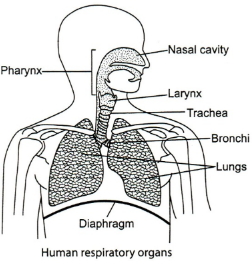
0 likes
View Solution165
MediumMCQ
Which portion of the human respiratory system is called the sound box?
A
Larynx
B
Trachea
C
Nasopharynx
D
Glottis
Solution
(A) The $Larynx$ is a cartilaginous box that helps in sound production and is therefore called the sound box.
Until puberty, there is little difference in the size of the $Larynx$ in males and females.
Thereafter, it grows larger and becomes prominent in males, which is why it is called $Adam's$ $apple$ in men.
It is the upper part of the respiratory tract located in the neck region.
Until puberty, there is little difference in the size of the $Larynx$ in males and females.
Thereafter, it grows larger and becomes prominent in males, which is why it is called $Adam's$ $apple$ in men.
It is the upper part of the respiratory tract located in the neck region.
0 likes
View Solution166
MediumMCQ
Identify the component of the respiratory system which displays the features given below and choose the correct option:
$I.$ Double layered
$II.$ Fluid contained in it reduces the friction on the lung surface
$III.$ Its outer layer is in contact with the thoracic wall
$IV.$ Its inner layer is in contact with the lungs
$I.$ Double layered
$II.$ Fluid contained in it reduces the friction on the lung surface
$III.$ Its outer layer is in contact with the thoracic wall
$IV.$ Its inner layer is in contact with the lungs
A
Visceral layer
B
Peritoneum cavity
C
Visceral organs
D
Pleura
Solution
(D) Humans have two lungs,which are covered by a double-layered pleura with pleural fluid between them.
Pleural fluid reduces the friction on the lung surface.
The outer pleural membrane is in close contact with the thoracic lining,whereas the inner pleural membrane is in contact with the lung surface.
Therefore,the structure described by all these features is the pleura.
Pleural fluid reduces the friction on the lung surface.
The outer pleural membrane is in close contact with the thoracic lining,whereas the inner pleural membrane is in contact with the lung surface.
Therefore,the structure described by all these features is the pleura.
0 likes
View Solution167
EasyMCQ
Which one of the following has the smallest diameter?
A
Right primary bronchus
B
Left primary bronchus
C
Trachea
D
Respiratory bronchiole
Solution
(D) The human respiratory system follows a branching pattern that decreases in diameter as it progresses deeper into the lungs.
$1$. The $Trachea$ is the largest airway, which divides into the right and left primary bronchi.
$2$. The $Primary \text{ } bronchi$ further divide into secondary and tertiary bronchi, and then into bronchioles.
$3$. The $Respiratory \text{ } bronchiole$ is the final part of the conducting system before the alveolar ducts and alveoli, and it possesses the smallest diameter among the given options.
Therefore, the correct answer is $D$.
$1$. The $Trachea$ is the largest airway, which divides into the right and left primary bronchi.
$2$. The $Primary \text{ } bronchi$ further divide into secondary and tertiary bronchi, and then into bronchioles.
$3$. The $Respiratory \text{ } bronchiole$ is the final part of the conducting system before the alveolar ducts and alveoli, and it possesses the smallest diameter among the given options.
Therefore, the correct answer is $D$.
0 likes
View Solution168
MediumMCQ
Which of the following structures is present inside the larynx of the respiratory system?
A
Glottis
B
Epiglottis
C
Vocal cords
D
None of these
Solution
(C) The correct answer is $C$.
$Vocal$ $cords$ are two pairs of folds of mucous membrane that extend into the lumen from the sides of the larynx.
These cords vibrate when air passes through them,which is responsible for the production of sound during respiration.
$Vocal$ $cords$ are two pairs of folds of mucous membrane that extend into the lumen from the sides of the larynx.
These cords vibrate when air passes through them,which is responsible for the production of sound during respiration.
0 likes
View Solution169
MediumMCQ
Vocal cords occur in
A
Pharynx
B
Larynx
C
Glottis
D
Bronchial
Solution
(B) The larynx,also known as the sound box,is a cartilaginous structure located at the top of the trachea. It contains the vocal cords,which vibrate to produce sound as air passes through them during expiration.
0 likes
View Solution170
MediumMCQ
At which thoracic vertebra does the trachea divide into right and left primary bronchi?
A
$5$
B
$6$
C
$9$
D
$4$
Solution
(A) The trachea is a straight tube extending up to the mid-thoracic cavity.
It divides at the level of the $5th$ thoracic vertebra into the right and left primary bronchi.
Each bronchus undergoes repeated divisions to form secondary and tertiary bronchi,eventually ending in very thin terminal bronchioles.
It divides at the level of the $5th$ thoracic vertebra into the right and left primary bronchi.
Each bronchus undergoes repeated divisions to form secondary and tertiary bronchi,eventually ending in very thin terminal bronchioles.
0 likes
View Solution171
EasyMCQ
'$XX$' is a part of the respiratory system that contains $C$-shaped rings of hyaline cartilage. '$XX$' is lined with ciliated,pseudostratified columnar epithelium. Identify '$XX$'.
A
Nasopharynx
B
Glottis
C
Larynx
D
Trachea
Solution
(D) The trachea,also known as the windpipe,is a tube that connects the larynx to the bronchi. It is characterized by the presence of $16-20$ $C$-shaped rings of hyaline cartilage,which prevent the airway from collapsing. The inner lining of the trachea consists of ciliated,pseudostratified columnar epithelium,which helps in trapping and moving dust particles and mucus out of the respiratory tract. Therefore,the correct answer is Trachea.
0 likes
View Solution172
EasyMCQ
Why does the air in the nasal cavity get warmed?
A
Because of the presence of many hairs present in the nasal cavity
B
Because the nasal cavity has a very good blood supply
C
Because the nasal cavity has a mucous membrane
D
All of the above
Solution
(B) The nasal cavity is the first part of the respiratory system. It opens to the exterior through nostrils.
Small hairs present in the cavity help to filter dust particles and other foreign matter.
The air in the nasal cavity gets warmed because the nasal cavity has a very rich blood supply.
This process ensures that the air is warmed and moistened before it enters the lungs.
Small hairs present in the cavity help to filter dust particles and other foreign matter.
The air in the nasal cavity gets warmed because the nasal cavity has a very rich blood supply.
This process ensures that the air is warmed and moistened before it enters the lungs.
0 likes
View Solution173
EasyMCQ
Lungs have a large number of narrow tubes called
A
Alveoli
B
Bronchi
C
Bronchioles
D
Tracheae
Solution
(C) Bronchioles are formed by the branching of tertiary bronchi.
Bronchioles further divide into terminal bronchioles and respiratory bronchioles.
Unlike bronchi,bronchioles are characterized by the absence of cartilaginous rings.
Bronchioles further divide into terminal bronchioles and respiratory bronchioles.
Unlike bronchi,bronchioles are characterized by the absence of cartilaginous rings.
0 likes
View Solution174
MediumMCQ
Air entering the lungs is
A
Warm and filtered
B
Contains only oxygen
C
Cool and filtered
D
Enriched with $CO_{2}$ and $NO_{2}$
Solution
(A) Air entering the lungs is warm and filtered.
Nasal Cavity: It is the first part of the respiratory system. It opens to the exterior through nostrils. The small hairs present in the cavity help to filter the particles of dust and other foreign matter. The air in the nasal cavity gets warmed (because the nasal cavity has a very good blood supply) and moistened before it enters the lungs.
Nasal Cavity: It is the first part of the respiratory system. It opens to the exterior through nostrils. The small hairs present in the cavity help to filter the particles of dust and other foreign matter. The air in the nasal cavity gets warmed (because the nasal cavity has a very good blood supply) and moistened before it enters the lungs.
0 likes
View Solution175
MediumMCQ
The total surface area of the human lungs,specifically the respiratory surface area provided by the alveoli,is approximately: (in $; m^{2}$)
A
$1$
B
$10$
C
$100$
D
$1000$
Solution
(C) The human respiratory system is designed to maximize the surface area for gas exchange.
While the bronchioles themselves are conducting airways,the question refers to the total respiratory surface area provided by the millions of alveoli in the lungs.
Scientific estimates place the total surface area of the human lungs at approximately $80$ to $100\; m^{2}$ when fully expanded.
Therefore,$100\; m^{2}$ is the most accurate approximation among the given options.
While the bronchioles themselves are conducting airways,the question refers to the total respiratory surface area provided by the millions of alveoli in the lungs.
Scientific estimates place the total surface area of the human lungs at approximately $80$ to $100\; m^{2}$ when fully expanded.
Therefore,$100\; m^{2}$ is the most accurate approximation among the given options.
0 likes
View Solution176
EasyMCQ
Identify which respiratory structure possesses the following features and choose the correct option accordingly.
$I.$ Found in mammals
$II.$ Highly muscular and fibrous partition,elevated towards the thorax like a dome
$III.$ Separates thoracic and abdominal cavity
$I.$ Found in mammals
$II.$ Highly muscular and fibrous partition,elevated towards the thorax like a dome
$III.$ Separates thoracic and abdominal cavity
A
Pleural membrane
B
Phrenic muscle
C
Diaphragm
D
Mediastinum
Solution
(C) The $Diaphragm$ is a characteristic feature of mammals.
It is a highly muscular and fibrous partition that is elevated towards the thorax in a dome-like shape.
Its primary function is to assist in the process of respiration by changing the volume of the thoracic cavity.
It acts as a physical barrier that separates the thoracic cavity from the abdominal cavity.
It is also known as the phrenic muscle.
It is a highly muscular and fibrous partition that is elevated towards the thorax in a dome-like shape.
Its primary function is to assist in the process of respiration by changing the volume of the thoracic cavity.
It acts as a physical barrier that separates the thoracic cavity from the abdominal cavity.
It is also known as the phrenic muscle.
0 likes
View Solution177
MediumMCQ
During swallowing,the glottis can be covered by a thin elastic cartilaginous flap called $A$ to prevent the entry of food into the larynx. The trachea is a straight tube extending up to the $B$ cavity,which divides at the level of the $5^{th}$ thoracic vertebra into right and left primary $C$. Choose the correct option for $A, B$,and $C$ from the given four options to complete the above statement with reference to the $NCERT$ textbook.
A
$A-$ epiglottis,$B-$ bronchi,$C-$ bronchioles
B
$A-$ epiglottis,$B-$ mid-thoracic,$C-$ bronchi
C
$A-$ epiglottis,$B-$ hind-thoracic,$C-$ bronchi
D
$A-$ epiglottis,$B-$ pre-thoracic,$C-$ bronchi
Solution
(B) $1$. During swallowing,the glottis is covered by a thin,elastic,cartilaginous flap known as the epiglottis $(A)$ to prevent food from entering the larynx.
$2$. The trachea is a straight tube that extends up to the mid-thoracic $(B)$ cavity.
$3$. The trachea divides at the level of the $5^{th}$ thoracic vertebra into right and left primary bronchi $(C)$.
$2$. The trachea is a straight tube that extends up to the mid-thoracic $(B)$ cavity.
$3$. The trachea divides at the level of the $5^{th}$ thoracic vertebra into right and left primary bronchi $(C)$.
0 likes
View Solution178
MediumMCQ
Which of the following statements is true regarding the human respiratory system?
A
Tracheal rings are of hyaline cartilage
B
Dorsal side of the thoracic chamber is formed by sternum
C
Expiration occurs when there is negative pressure in the lungs
D
Inspiration occurs when there is positive pressure in the lungs
Solution
(A) The trachea is a straight tube extending up to the mid-thoracic cavity. It is supported by '$C$'-shaped rings of hyaline cartilage,which prevent the trachea from collapsing.
Option '$A$' is correct because the tracheal rings are indeed composed of hyaline cartilage.
Option '$B$' is incorrect because the dorsal side of the thoracic chamber is formed by the vertebral column,while the sternum forms the ventral side.
Option '$C$' is incorrect because expiration occurs when the intra-pulmonary pressure is higher than the atmospheric pressure.
Option '$D$' is incorrect because inspiration occurs when the intra-pulmonary pressure is less than the atmospheric pressure (negative pressure).
Option '$A$' is correct because the tracheal rings are indeed composed of hyaline cartilage.
Option '$B$' is incorrect because the dorsal side of the thoracic chamber is formed by the vertebral column,while the sternum forms the ventral side.
Option '$C$' is incorrect because expiration occurs when the intra-pulmonary pressure is higher than the atmospheric pressure.
Option '$D$' is incorrect because inspiration occurs when the intra-pulmonary pressure is less than the atmospheric pressure (negative pressure).
0 likes
View Solution179
MediumMCQ
Which of the following has the most well-developed respiratory system?
A
Mammals
B
Invertebrates
C
Amphibians
D
Hemichordates
Solution
(A) The respiratory system is most well-developed in mammals among the given options.
Mammals possess a complex respiratory system consisting of a pair of lungs with a large surface area,facilitated by the presence of alveoli,which allows for efficient gas exchange to meet their high metabolic demands.
In contrast,invertebrates often rely on simple diffusion or tracheal systems,hemichordates use gills or body surfaces,and amphibians have less efficient lungs supplemented by cutaneous respiration.
Mammals possess a complex respiratory system consisting of a pair of lungs with a large surface area,facilitated by the presence of alveoli,which allows for efficient gas exchange to meet their high metabolic demands.
In contrast,invertebrates often rely on simple diffusion or tracheal systems,hemichordates use gills or body surfaces,and amphibians have less efficient lungs supplemented by cutaneous respiration.
0 likes
View Solution180
MediumMCQ
Which structure in the human respiratory system is involved in the conditioning of air?
A
Internal nares
B
Nasal chamber
C
Larynx
D
Trachea
Solution
(B) $(1)$ Mucus secreted by goblet cells and glands makes the surface sticky,which helps in trapping dust particles present in the inspired air.
$(2)$ Moisture from the epithelium adds humidity to the air.
$(3)$ The nasal chamber helps in bringing the temperature of the incoming air to the body temperature.
$(2)$ Moisture from the epithelium adds humidity to the air.
$(3)$ The nasal chamber helps in bringing the temperature of the incoming air to the body temperature.
0 likes
View Solution181
MediumMCQ
$A$ thin-elastic cartilaginous flap which prevents the entry of food into the larynx is known as
A
Glottis
B
Wind pipe
C
Epiglottis
D
Bronchiole
Solution
(C) The $Epiglottis$ is a thin,elastic,cartilaginous flap located at the entrance of the larynx.
During the act of swallowing,the $Epiglottis$ moves to cover the $Glottis$ (the opening of the windpipe),thereby preventing food particles from entering the respiratory tract and ensuring they pass into the esophagus.
During the act of swallowing,the $Epiglottis$ moves to cover the $Glottis$ (the opening of the windpipe),thereby preventing food particles from entering the respiratory tract and ensuring they pass into the esophagus.
0 likes
View Solution182
MediumMCQ
At which level of thoracic vertebra does the trachea divide?
A
$2^{\text{nd}}$ thoracic vertebra
B
$5^{\text{th}}$ thoracic vertebra
C
$3^{\text{rd}}$ thoracic vertebra
D
$4^{\text{th}}$ thoracic vertebra
Solution
(B) The trachea is a straight tube extending up to the mid-thoracic cavity.
It divides at the level of the $5^{\text{th}}$ thoracic vertebra into right and left primary bronchi.
It divides at the level of the $5^{\text{th}}$ thoracic vertebra into right and left primary bronchi.
0 likes
View Solution183
MediumMCQ
The trachea divides into right and left:
A
Secondary bronchi
B
Tertiary bronchi
C
Bronchioles
D
Primary bronchi
Solution
(D) The trachea is a straight tube extending up to the mid-thoracic cavity,which divides at the level of the $5^{\text{th}}$ thoracic vertebra into a right and left primary bronchus.
0 likes
View Solution184
EasyMCQ
Which membrane covers the lungs and provides protection?
A
Pericardium
B
Renal capsule
C
Pleura
D
Epineurium
Solution
(C) The lungs are enclosed in a double-layered membrane known as the $Pleura$.
$Pericardium$ is the protective membrane that covers the heart.
$Renal$ $capsule$ is the tough fibrous layer surrounding the kidney.
$Epineurium$ is the outermost layer of connective tissue that surrounds a peripheral nerve.
Therefore,the correct answer is $Pleura$.
$Pericardium$ is the protective membrane that covers the heart.
$Renal$ $capsule$ is the tough fibrous layer surrounding the kidney.
$Epineurium$ is the outermost layer of connective tissue that surrounds a peripheral nerve.
Therefore,the correct answer is $Pleura$.
0 likes
View Solution185
MediumMCQ
Where are lungs situated in the human body?
A
Abdominal cavity
B
Thoracic cavity
C
Coelomic cavity
D
Pleural cavity
Solution
(B) Humans possess a pair of lungs that are situated within an air-tight chamber known as the thoracic cavity or chest cavity.
0 likes
View Solution186
MediumMCQ
$A$ pair of external nostrils present in humans opens out
A
Below the upper lips
B
Above the upper lips
C
Between upper and lower lips
D
Above the larynx
Solution
(B) In humans,the respiratory system begins with a pair of external nostrils. These nostrils are located above the upper lips and serve as the entry point for air into the nasal cavity. Therefore,the correct option is $B$.
0 likes
View Solution187
MediumMCQ
What are the characteristics of alveoli?
A
Very thin,irregular-walled,and highly vascularized
B
Thick and smooth membrane
C
Network of blood capillaries and thick-walled
D
Thick,regular-walled,and lack of blood vessels
Solution
(A) The alveolar membrane is very thin,irregular,and richly supplied with blood vessels (highly vascularized).
This structure facilitates the rapid and efficient exchange of gases between the air in the alveoli and the blood in the capillaries.
This structure facilitates the rapid and efficient exchange of gases between the air in the alveoli and the blood in the capillaries.
0 likes
View Solution188
MediumMCQ
Ventrally and laterally,the thoracic chamber is formed by
A
Diaphragm and sternum respectively
B
Ribs and sternum respectively
C
Sternum and ribs respectively
D
Vertebral column and diaphragm respectively
Solution
(C) The thoracic chamber is an airtight chamber formed as follows:
$1$. Dorsally: By the vertebral column.
$2$. Ventrally: By the sternum.
$3$. Laterally: By the ribs.
$4$. On the lower side: By the dome-shaped diaphragm.
Therefore,ventrally it is formed by the sternum and laterally it is formed by the ribs.
$1$. Dorsally: By the vertebral column.
$2$. Ventrally: By the sternum.
$3$. Laterally: By the ribs.
$4$. On the lower side: By the dome-shaped diaphragm.
Therefore,ventrally it is formed by the sternum and laterally it is formed by the ribs.
0 likes
View Solution189
EasyMCQ
Diaphragm is a dome-shaped muscular structure which separates
A
Coelomic cavity from pelvic cavity
B
Pleural cavity from thoracic cavity
C
Thoracic cavity from abdominal cavity
D
Pelvic cavity from abdominal cavity
Solution
(C) The thoracic cavity is closed at the bottom by the diaphragm.
It is a dome-shaped muscular structure that separates the thoracic cavity from the abdominal cavity,which contains most of the digestive organs.
It is a dome-shaped muscular structure that separates the thoracic cavity from the abdominal cavity,which contains most of the digestive organs.
0 likes
View Solution190
EasyMCQ
Adam's apple is another name for
A
Sound box in birds
B
Sound box in man
C
Epiglottis
D
Thyroid cartilage
Solution
(D) The Adam's apple refers to the laryngeal prominence formed by the thyroid cartilage of the larynx.
It is composed of hyaline cartilage.
It is typically more prominent in adult males due to the influence of testosterone during puberty,which causes the larynx to grow larger and the thyroid cartilage to tilt at a sharper angle.
It is composed of hyaline cartilage.
It is typically more prominent in adult males due to the influence of testosterone during puberty,which causes the larynx to grow larger and the thyroid cartilage to tilt at a sharper angle.
0 likes
View Solution191
EasyMCQ
The ring-like cartilage of the larynx is known as:
A
Thyroid cartilage
B
Arytenoid cartilage
C
Cricoid cartilage
D
Cartilage of Santorini
Solution
(C) The $Cricoid$ cartilage has a signet ring-like structure that lies below the $Thyroid$ cartilage. It is composed of $hyaline$ cartilage and forms the lower part of the larynx.
0 likes
View Solution192
EasyMCQ
Number of alveoli in the human lungs has been estimated to be approximately
A
$100$ million
B
$300$ million
C
$125$ million
D
$300$ billion
Solution
(B) The human lungs contain a vast network of air sacs known as alveoli,which are the primary sites for gas exchange.
Scientific estimates indicate that there are approximately $300$ million alveoli in the human lungs,providing a massive surface area for the diffusion of oxygen and carbon dioxide.
Scientific estimates indicate that there are approximately $300$ million alveoli in the human lungs,providing a massive surface area for the diffusion of oxygen and carbon dioxide.
0 likes
View Solution193
EasyMCQ
In humans,the oblique fissure is present in
A
Right lung
B
Left lung
C
Both of these
D
None of these
Solution
(C) The human right lung is divided into three lobes (superior,middle,and inferior) by two fissures: the oblique fissure and the horizontal fissure. The human left lung is divided into two lobes (superior and inferior) by a single oblique fissure. Therefore,the oblique fissure is present in both lungs.
0 likes
View Solution194
EasyMCQ
The sound-producing organ of a bird is:
A
Larynx
B
Syrinx
C
Oropharynx
D
Nasopharynx
Solution
(B) In birds,the larynx does not possess vocal cords. The syrinx is the specialized organ that produces sound and is located at the bifurcation of the trachea and the bronchi.
0 likes
View Solution195
EasyMCQ
Which organ is common to both the digestive and respiratory systems?
A
Oesophagus
B
Pharynx
C
Mouth
D
All of the above
Solution
(B) The $Pharynx$ is a muscular tube that serves as a common passage for both air and food.
It connects the nasal cavity and the oral cavity to the larynx and the oesophagus,respectively.
Therefore,it acts as a shared organ for both the digestive and respiratory systems.
It connects the nasal cavity and the oral cavity to the larynx and the oesophagus,respectively.
Therefore,it acts as a shared organ for both the digestive and respiratory systems.
0 likes
View Solution196
EasyMCQ
Which of the following organs is not a part of the abdominal cavity?
A
Stomach
B
Small intestine
C
Large intestine
D
Oesophagus
Solution
(D) The abdominal cavity is the space that holds the majority of the digestive organs,including the stomach,small intestine,and large intestine.
The oesophagus is a muscular tube that connects the pharynx to the stomach.
It passes through the neck and the thoracic cavity (chest cavity) before entering the abdominal cavity through the diaphragm.
Therefore,the oesophagus is primarily located in the thoracic cavity,not the abdominal cavity.
The oesophagus is a muscular tube that connects the pharynx to the stomach.
It passes through the neck and the thoracic cavity (chest cavity) before entering the abdominal cavity through the diaphragm.
Therefore,the oesophagus is primarily located in the thoracic cavity,not the abdominal cavity.
0 likes
View Solution197
MediumMCQ
Which of the following organisms possesses the most developed respiratory system?
A
Fish
B
Amphibians
C
Birds
D
Mammals
Solution
(D) Mammals possess the most developed respiratory system among vertebrates.
They utilize a highly efficient diaphragm-driven ventilation mechanism,which allows for a large surface area for gas exchange within the lungs (alveoli).
While birds have a very efficient system with air sacs,mammals are generally considered to have the most complex and highly developed respiratory structures for maintaining high metabolic rates.
They utilize a highly efficient diaphragm-driven ventilation mechanism,which allows for a large surface area for gas exchange within the lungs (alveoli).
While birds have a very efficient system with air sacs,mammals are generally considered to have the most complex and highly developed respiratory structures for maintaining high metabolic rates.
0 likes
View Solution198
EasyMCQ
The diagram of the human respiratory system is given below. What are $P$ and $Q$?
$\quad P \quad\quad Q$
$\quad P \quad\quad Q$
A
Larynx $\quad$ Diaphragm
B
Epiglottis $\quad$ Diaphragm
C
Epiglottis $\quad$ Pleural membrane
D
Larynx $\quad$ Pleural membrane
Solution
(A) In the standard diagram of the human respiratory system:
$P$ represents the $Larynx$ (voice box), which is located at the top of the trachea.
$Q$ represents the $Diaphragm$, which is a dome-shaped muscular partition separating the thorax from the abdomen and plays a crucial role in breathing.
Therefore, the correct identification is $P = \text{Larynx}$ and $Q = \text{Diaphragm}$.
$P$ represents the $Larynx$ (voice box), which is located at the top of the trachea.
$Q$ represents the $Diaphragm$, which is a dome-shaped muscular partition separating the thorax from the abdomen and plays a crucial role in breathing.
Therefore, the correct identification is $P = \text{Larynx}$ and $Q = \text{Diaphragm}$.
0 likes
View Solution199
EasyMCQ
Which of the following sequences is correct for the human respiratory system?
A
External nostrils $\rightarrow$ Nasal cavity $\rightarrow$ Internal nostrils $\rightarrow$ Larynx $\rightarrow$ Pharynx $\rightarrow$ Trachea $\rightarrow$ Primary bronchi $\rightarrow$ Secondary bronchi $\rightarrow$ Tertiary bronchi $\rightarrow$ Terminal bronchiole $\rightarrow$ Alveoli
B
External nostrils $\rightarrow$ Nasal cavity $\rightarrow$ Internal nostrils $\rightarrow$ Pharynx $\rightarrow$ Larynx $\rightarrow$ Trachea $\rightarrow$ Primary bronchi $\rightarrow$ Secondary bronchi $\rightarrow$ Tertiary bronchi $\rightarrow$ Terminal bronchiole $\rightarrow$ Alveoli
C
External nostrils $\rightarrow$ Nasal cavity $\rightarrow$ Internal nostrils $\rightarrow$ Pharynx $\rightarrow$ Trachea $\rightarrow$ Larynx $\rightarrow$ Primary bronchi $\rightarrow$ Secondary bronchi $\rightarrow$ Tertiary bronchi $\rightarrow$ Terminal bronchiole $\rightarrow$ Alveoli
D
None of these
Solution
(B) The correct pathway of air in the human respiratory system is as follows:
$1$. External nostrils (entry point).
$2$. Nasal cavity.
$3$. Internal nostrils (nasopharynx region).
$4$. Pharynx (common passage for food and air).
$5$. Larynx (sound box,which leads to the trachea).
$6$. Trachea (windpipe).
$7$. Primary bronchi.
$8$. Secondary bronchi.
$9$. Tertiary bronchi.
$10$. Terminal bronchiole.
$11$. Alveoli (site of gas exchange).
Therefore,the sequence in option $B$ is correct.
$1$. External nostrils (entry point).
$2$. Nasal cavity.
$3$. Internal nostrils (nasopharynx region).
$4$. Pharynx (common passage for food and air).
$5$. Larynx (sound box,which leads to the trachea).
$6$. Trachea (windpipe).
$7$. Primary bronchi.
$8$. Secondary bronchi.
$9$. Tertiary bronchi.
$10$. Terminal bronchiole.
$11$. Alveoli (site of gas exchange).
Therefore,the sequence in option $B$ is correct.
0 likes
View Solution200
MediumMCQ
Select the correct option for the trachea.
A
It is a straight tube.
B
It extends up to the mid-thoracic cavity.
C
It divides into right and left primary bronchi at the level of the $5$th thoracic vertebra.
D
All of the above.
Solution
(D) The trachea (windpipe) is a straight tube extending up to the mid-thoracic cavity.
It divides at the level of the $5$th thoracic vertebra into a right and left primary bronchi.
Therefore,all the given statements are correct.
It divides at the level of the $5$th thoracic vertebra into a right and left primary bronchi.
Therefore,all the given statements are correct.
0 likes
View SolutionBreathing and Exchange of Gases — Human Respiratory System · Frequently Asked Questions
1Are these Breathing and Exchange of Gases questions useful for JEE and NEET?
Yes. All questions in this section are mapped to JEE Main and NEET exam patterns. Previous year questions from JEE Main, NEET, GUJCET and state-level exams are included with full solutions.
2Can I switch to Hindi or Gujarati for these questions?
Yes. Use the language tabs in the hero section or the sidebar to view the same questions and solutions in English, Hindi or Gujarati.
3How do I generate a question paper from this subtopic?
Use the Vedclass Exam Paper Generator — select the chapter and subtopic, set difficulty, and generate Sets A, B, C, D automatically. First 3 chapters of every subject are free.
Vedclass Products
For Students
Vedclass Test Series
Mock tests in real JEE/NEET style with performance analysis. 5-day free trial.
Start Free TrialFor Teachers
Exam Paper Generator
Generate Set A/B/C/D papers from this chapter in 2 minutes. 3 chapters free.
Try FreeFor Institutes
Online Exam Module
Live online exams with unlimited students, 360° analytics & white-label branding.
See DemoFor Teachers & Institutes
Generate a Breathing and Exchange of Gases Exam Paper in 2 Minutes
Select subtopic & difficulty — Sets A, B, C, D auto-generated with No Repeat logic.
First 3 chapters of every subject are free — no payment required.