
A English
Co-Factors Questions in English
Class 11 Biology · Biomolecules · Co-Factors
134+
Questions
English
Language
100%
With Solutions
Showing 34 of 134 questions in English
101
EasyMCQ
$Zinc$ is the co-factor for the proteolytic enzyme carboxypeptidase.
A
Copper
B
Zinc
C
Boron
D
Chlorine
Solution
(B) Carboxypeptidase is a proteolytic enzyme that requires a metal ion as a co-factor for its catalytic activity.
$Zinc$ $(Zn^{2+})$ acts as a vital co-factor for carboxypeptidase,where it coordinates with the active site to facilitate the hydrolysis of peptide bonds.
Therefore,the correct option is $B$.
$Zinc$ $(Zn^{2+})$ acts as a vital co-factor for carboxypeptidase,where it coordinates with the active site to facilitate the hydrolysis of peptide bonds.
Therefore,the correct option is $B$.
0 likes
View Solution102
MediumMCQ
Match the following columns:
Select the correct sequence for $A-B-C$.
| Column-$I$ | Column-$II$ |
| $A$. Prosthetic group | $1$. $NAD$ |
| $B$. Cofactor | $2$. Haem |
| $C$. Coenzyme | $3$. $Zn^{2+}$ ion |
Select the correct sequence for $A-B-C$.
A
$2 - 3 - 1$
B
$1 - 2 - 3$
C
$3 - 1 - 2$
D
$2 - 1 - 3$
Solution
(A) $1$. Prosthetic groups are organic compounds that are tightly bound to the apoenzyme. For example,Haem is the prosthetic group in peroxidase and catalase.
$2$. Cofactors are non-protein constituents that are bound to the enzyme to make the enzyme catalytically active. Metal ions like $Zn^{2+}$ act as cofactors.
$3$. Coenzymes are organic compounds whose association with the apoenzyme is only transient,usually occurring during the course of catalysis. $NAD$ (Nicotinamide adenine dinucleotide) is a common coenzyme.
$4$. Therefore,the correct matching is $A-2, B-3, C-1$.
$2$. Cofactors are non-protein constituents that are bound to the enzyme to make the enzyme catalytically active. Metal ions like $Zn^{2+}$ act as cofactors.
$3$. Coenzymes are organic compounds whose association with the apoenzyme is only transient,usually occurring during the course of catalysis. $NAD$ (Nicotinamide adenine dinucleotide) is a common coenzyme.
$4$. Therefore,the correct matching is $A-2, B-3, C-1$.
0 likes
View Solution103
MediumMCQ
Which of the following is not a part of an enzyme but activates the enzyme?
A
$K^+$
B
$C$
C
$N$
D
$Si$
Solution
(A) Many enzymes require non-protein components for their activity. These are called cofactors. Cofactors can be prosthetic groups,co-enzymes,or metal ions. Metal ions form coordination bonds with side chains at the active site and at the same time form one or more coordination bonds with the substrate. $K^+$ (potassium ion) is a well-known metal ion cofactor that activates several enzymes,such as pyruvate kinase,which is involved in glycolysis. Therefore,$K^+$ is not a part of the enzyme structure itself but is essential for its catalytic activity.
0 likes
View Solution104
MediumMCQ
$A$ coenzyme,which is a part of the holoenzyme,is -
A
$A$ loosely bound inorganic part
B
An auxiliary,non-protein,tightly bound substance
C
$A$ loosely bound organic part
D
None of the above
Solution
(C) An enzyme is composed of a protein part called the apoenzyme and a non-protein part called the cofactor.
Cofactors are of three types:
$1$. Prosthetic groups: These are organic compounds that are tightly bound to the apoenzyme.
$2$. Coenzymes: These are organic compounds that are loosely bound to the apoenzyme,often acting as transient carriers of chemical groups.
$3$. Metal ions: These are inorganic ions that form coordination bonds with side chains of the apoenzyme.
Therefore,a coenzyme is defined as a loosely bound organic cofactor.
Cofactors are of three types:
$1$. Prosthetic groups: These are organic compounds that are tightly bound to the apoenzyme.
$2$. Coenzymes: These are organic compounds that are loosely bound to the apoenzyme,often acting as transient carriers of chemical groups.
$3$. Metal ions: These are inorganic ions that form coordination bonds with side chains of the apoenzyme.
Therefore,a coenzyme is defined as a loosely bound organic cofactor.
0 likes
View Solution105
MediumMCQ
What is an enzyme called when it is bound to an organic substance that is essential for its activity?
A
Holoenzyme
B
Apoenzyme
C
Isoenzyme
D
Coenzyme
Solution
(A) An enzyme that requires a non-protein organic component for its catalytic activity is known as a $Holoenzyme$.
$1$. The protein portion of the enzyme is called the $Apoenzyme$.
$2$. The non-protein organic substance that binds to the $Apoenzyme$ to make it active is called a $Coenzyme$.
$3$. When the $Apoenzyme$ and the $Coenzyme$ (or other cofactors) are combined,the complete,active enzyme complex is referred to as a $Holoenzyme$.
$1$. The protein portion of the enzyme is called the $Apoenzyme$.
$2$. The non-protein organic substance that binds to the $Apoenzyme$ to make it active is called a $Coenzyme$.
$3$. When the $Apoenzyme$ and the $Coenzyme$ (or other cofactors) are combined,the complete,active enzyme complex is referred to as a $Holoenzyme$.
0 likes
View Solution106
EasyMCQ
Which of the following are essential chemical components of many coenzymes?
A
Proteins
B
Nucleic acids
C
Carbohydrates
D
Vitamins
Solution
(D) Coenzymes are organic non-protein compounds that bind with an enzyme to catalyze a reaction. Many vitamins,particularly the $B$-complex vitamins (such as $B_1, B_2, B_6, B_{12}$,niacin,and pantothenic acid),serve as essential chemical components or precursors for the synthesis of coenzymes like $NAD^+$,$FAD$,and $CoA$. Therefore,vitamins are crucial for the functional activity of many enzymes.
0 likes
View Solution107
EasyMCQ
Consider the following statements:
$(A)$ Coenzyme or metal ion that is tightly bound to enzyme protein is called prosthetic group.
$(B)$ $A$ complete catalytic active enzyme with its bound prosthetic group is called apoenzyme.
Select the correct option.
$(A)$ Coenzyme or metal ion that is tightly bound to enzyme protein is called prosthetic group.
$(B)$ $A$ complete catalytic active enzyme with its bound prosthetic group is called apoenzyme.
Select the correct option.
A
Both $(A)$ and $(B)$ are true.
B
$(A)$ is true and $(B)$ is false.
C
Both $(A)$ and $(B)$ are false.
D
$(A)$ is false and $(B)$ is true.
Solution
(B) Statement $(A)$ is true: Prosthetic groups are organic compounds or metal ions that are tightly bound to the apoenzyme (the protein part of the enzyme).
Statement $(B)$ is false: $A$ complete,catalytically active enzyme consisting of the protein part (apoenzyme) and its non-protein cofactor (such as a prosthetic group) is called a holoenzyme,not an apoenzyme. The apoenzyme refers specifically to the inactive protein portion of the enzyme.
Statement $(B)$ is false: $A$ complete,catalytically active enzyme consisting of the protein part (apoenzyme) and its non-protein cofactor (such as a prosthetic group) is called a holoenzyme,not an apoenzyme. The apoenzyme refers specifically to the inactive protein portion of the enzyme.
0 likes
View Solution108
MediumMCQ
Assertion: Coenzymes serve as co-factors in a number of different enzyme-catalyzed reactions.
Reason: Coenzymes and prosthetic groups are cofactors.
Reason: Coenzymes and prosthetic groups are cofactors.
A
If both Assertion and Reason are correct and the Reason is a correct explanation of the Assertion.
B
If both Assertion and Reason are correct but Reason is not a correct explanation of the Assertion.
C
If the Assertion is correct but Reason is incorrect.
D
If both the Assertion and Reason are incorrect.
Solution
(A) Cofactors are non-protein components that are essential for the catalytic activity of enzymes. They can be classified into three types: prosthetic groups,coenzymes,and metal ions.
Prosthetic groups are organic compounds that are tightly bound to the apoenzyme.
Coenzymes are also organic compounds,but their association with the apoenzyme is only transient,usually occurring during the course of catalysis.
Both coenzymes and prosthetic groups are indeed types of cofactors. Therefore,the assertion is correct,and the reason is also correct. Furthermore,the reason provides the classification context that explains why coenzymes are considered cofactors.
Prosthetic groups are organic compounds that are tightly bound to the apoenzyme.
Coenzymes are also organic compounds,but their association with the apoenzyme is only transient,usually occurring during the course of catalysis.
Both coenzymes and prosthetic groups are indeed types of cofactors. Therefore,the assertion is correct,and the reason is also correct. Furthermore,the reason provides the classification context that explains why coenzymes are considered cofactors.
0 likes
View Solution109
MediumMCQ
Assertion : $A$ co-enzyme or metal ion that is very tightly bound to enzyme protein is called a prosthetic group.
Reason : $A$ complete,catalytically active enzyme together with its bound prosthetic group is called an apoenzyme.
Reason : $A$ complete,catalytically active enzyme together with its bound prosthetic group is called an apoenzyme.
A
If both Assertion and Reason are correct and the Reason is a correct explanation of the Assertion.
B
If both Assertion and Reason are correct but Reason is not a correct explanation of the Assertion.
C
If the Assertion is correct but Reason is incorrect.
D
If both the Assertion and Reason are incorrect.
Solution
(C) The Assertion is correct: $A$ prosthetic group is an organic compound or metal ion that is tightly bound to the apoenzyme (protein portion) and remains associated with it throughout the catalytic cycle.
The Reason is incorrect: $A$ complete,catalytically active enzyme consisting of the protein part (apoenzyme) and the non-protein part (co-factor/prosthetic group) is called a holoenzyme,not an apoenzyme. An apoenzyme is only the protein portion of the enzyme.
The Reason is incorrect: $A$ complete,catalytically active enzyme consisting of the protein part (apoenzyme) and the non-protein part (co-factor/prosthetic group) is called a holoenzyme,not an apoenzyme. An apoenzyme is only the protein portion of the enzyme.
0 likes
View Solution110
MediumMCQ
Prosthetic groups differ from co-enzymes in that
A
they require metal ions for their activity.
B
they (prosthetic groups) are tightly bound to apoenzymes.
C
their association with apoenzymes is transient.
D
they can serve as co-factors in a number of enzyme-catalyzed reactions.
Solution
(B) Co-factors are non-protein constituents that are bound to the enzyme to make the enzyme catalytically active.
They are classified into three types: prosthetic groups,co-enzymes,and metal ions.
Prosthetic groups are organic compounds that are tightly bound to the apoenzyme (the protein portion of the enzyme).
For example,in peroxidase and catalase,which catalyze the breakdown of hydrogen peroxide to water and oxygen,heme is the prosthetic group and it is a part of the active site of the enzyme.
In contrast,co-enzymes are also organic compounds,but their association with the apoenzyme is only transient,usually occurring during the course of catalysis.
Therefore,the fundamental difference is that prosthetic groups are tightly bound,whereas co-enzymes are loosely or transiently bound.
They are classified into three types: prosthetic groups,co-enzymes,and metal ions.
Prosthetic groups are organic compounds that are tightly bound to the apoenzyme (the protein portion of the enzyme).
For example,in peroxidase and catalase,which catalyze the breakdown of hydrogen peroxide to water and oxygen,heme is the prosthetic group and it is a part of the active site of the enzyme.
In contrast,co-enzymes are also organic compounds,but their association with the apoenzyme is only transient,usually occurring during the course of catalysis.
Therefore,the fundamental difference is that prosthetic groups are tightly bound,whereas co-enzymes are loosely or transiently bound.
0 likes
View Solution111
Medium
What are co-factors? Describe their types.
Solution
(N/A) $\rightarrow$ Enzymes are composed of one or several polypeptide chains. Generally,non-protein constituents called co-factors are bound to the enzyme to make it catalytically active.
$\rightarrow$ The protein portion of the enzyme is called the apoenzyme.
$\rightarrow$ Three kinds of co-factors are identified:
$\rightarrow$ $(1)$ Prosthetic groups,$(2)$ Co-enzymes,$(3)$ Metal ions.
$\rightarrow$ $(1)$ Prosthetic groups: These are organic compounds that are tightly bound to the apoenzyme. For example,in peroxidase and catalase,which catalyze the breakdown of hydrogen peroxide to $H_{2}O$ and $O_{2}$,haem $(Fe^{++})$ is the prosthetic group and is a part of the active site of the enzyme.
$\rightarrow$ $(2)$ Co-enzymes: These are also organic compounds,but they are associated temporarily with the apoenzyme.
$\rightarrow$ They serve as co-factors in a number of different enzyme-catalyzed reactions.
$\rightarrow$ Many co-enzymes have vitamins as their components; for example,co-enzyme nicotinamide adenine dinucleotide $(NAD)$ and $NADP$ contain the vitamin niacin.
$\rightarrow$ $(3)$ Metal ions: These are essential for the activity of many enzymes. They form coordination bonds with side chains at the active site and simultaneously form one or more coordination bonds with the substrate. For example,zinc is a co-factor for the enzyme carboxypeptidase. Catalytic activity is lost when the co-factor is removed from the enzyme.
$\rightarrow$ The protein portion of the enzyme is called the apoenzyme.
$\rightarrow$ Three kinds of co-factors are identified:
$\rightarrow$ $(1)$ Prosthetic groups,$(2)$ Co-enzymes,$(3)$ Metal ions.
$\rightarrow$ $(1)$ Prosthetic groups: These are organic compounds that are tightly bound to the apoenzyme. For example,in peroxidase and catalase,which catalyze the breakdown of hydrogen peroxide to $H_{2}O$ and $O_{2}$,haem $(Fe^{++})$ is the prosthetic group and is a part of the active site of the enzyme.
$\rightarrow$ $(2)$ Co-enzymes: These are also organic compounds,but they are associated temporarily with the apoenzyme.
$\rightarrow$ They serve as co-factors in a number of different enzyme-catalyzed reactions.
$\rightarrow$ Many co-enzymes have vitamins as their components; for example,co-enzyme nicotinamide adenine dinucleotide $(NAD)$ and $NADP$ contain the vitamin niacin.
$\rightarrow$ $(3)$ Metal ions: These are essential for the activity of many enzymes. They form coordination bonds with side chains at the active site and simultaneously form one or more coordination bonds with the substrate. For example,zinc is a co-factor for the enzyme carboxypeptidase. Catalytic activity is lost when the co-factor is removed from the enzyme.
0 likes
View Solution112
MediumMCQ
The coenzymes $NAD$ and $NADP$ contain which vitamin derivative?
A
Niacin
B
Riboflavin
C
Thiamine
D
Pyridoxine
Solution
(A) The coenzymes $NAD$ $(Nicotinamide \ Adenine \ Dinucleotide)$ and $NADP$ $(Nicotinamide \ Adenine \ Dinucleotide \ Phosphate)$ are essential for cellular respiration and metabolic processes.
These coenzymes are derived from the vitamin $Niacin$ (also known as Vitamin $B_3$ or Nicotinic acid).
Riboflavin is the precursor for $FAD$ and $FMN$,not $NAD$ or $NADP$.
These coenzymes are derived from the vitamin $Niacin$ (also known as Vitamin $B_3$ or Nicotinic acid).
Riboflavin is the precursor for $FAD$ and $FMN$,not $NAD$ or $NADP$.
0 likes
View Solution113
MediumMCQ
How are prosthetic groups different from co-factors?
A
Prosthetic groups are inorganic,while co-factors are organic.
B
Prosthetic groups are tightly bound to the apoenzyme,whereas other co-factors may be loosely bound.
C
Prosthetic groups are always proteins,while co-factors are non-proteins.
D
There is no difference between prosthetic groups and co-factors.
Solution
(B) Co-factors are non-protein components that bind to an apoenzyme to make the enzyme catalytically active. They are classified into three types: prosthetic groups,co-enzymes,and metal ions.
$1$. Prosthetic groups are organic compounds that are tightly or strongly bound to the apoenzyme (e.g.,heme in peroxidase and catalase).
$2$. Co-enzymes are organic compounds that associate with the apoenzyme only during the course of catalysis and are usually loosely bound (e.g.,$NAD$ and $NADP$).
$3$. Metal ions form coordination bonds with side chains at the active site and also form one or more coordination bonds with the substrate (e.g.,$Zn^{2+}$ in carboxypeptidase).
Thus,the primary difference is that prosthetic groups are permanently and strongly attached to the apoenzyme,whereas other co-factors (like co-enzymes) are often loosely associated.
$1$. Prosthetic groups are organic compounds that are tightly or strongly bound to the apoenzyme (e.g.,heme in peroxidase and catalase).
$2$. Co-enzymes are organic compounds that associate with the apoenzyme only during the course of catalysis and are usually loosely bound (e.g.,$NAD$ and $NADP$).
$3$. Metal ions form coordination bonds with side chains at the active site and also form one or more coordination bonds with the substrate (e.g.,$Zn^{2+}$ in carboxypeptidase).
Thus,the primary difference is that prosthetic groups are permanently and strongly attached to the apoenzyme,whereas other co-factors (like co-enzymes) are often loosely associated.
0 likes
View Solution114
Medium
Provide the full names of the following biological molecules:
$(1)$ $FAD$
$(2)$ $NAD$
$(1)$ $FAD$
$(2)$ $NAD$
Solution
(N/A) $(1)$ $FAD$ stands for Flavin Adenine Dinucleotide. It acts as a redox cofactor involved in several important metabolic reactions in the cell.
$(2)$ $NAD$ stands for Nicotinamide Adenine Dinucleotide. It is a coenzyme found in all living cells and is essential for energy metabolism,acting as an electron carrier in cellular respiration.
$(2)$ $NAD$ stands for Nicotinamide Adenine Dinucleotide. It is a coenzyme found in all living cells and is essential for energy metabolism,acting as an electron carrier in cellular respiration.
0 likes
View Solution115
EasyMCQ
Organic compounds that are tightly bound to apoenzyme are known as:
A
Prosthetic group
B
Apoenzyme
C
Metal ions
D
Co-enzymes
Solution
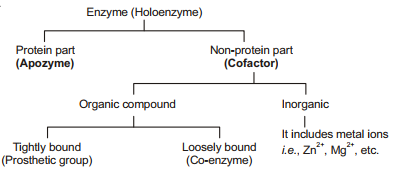
(A) The catalytic activity of many enzymes is dependent on the presence of certain non-protein constituents called cofactors.
Cofactors are of three types:
$1$. Prosthetic groups: These are organic compounds that are tightly bound to the apoenzyme (the protein portion of the enzyme). For example,heme is a prosthetic group in peroxidase and catalase.
$2$. Co-enzymes: These are organic compounds that are loosely bound to the apoenzyme. Their association with the apoenzyme is usually transient,occurring during the course of catalysis.
$3$. Metal ions: These are inorganic cofactors that form coordination bonds with side chains at the active site and at the same time form one or more coordination bonds with the substrate,e.g.,$Zn^{2+}$ in carboxypeptidase.
Therefore,organic compounds that are tightly bound to the apoenzyme are called prosthetic groups.
Cofactors are of three types:
$1$. Prosthetic groups: These are organic compounds that are tightly bound to the apoenzyme (the protein portion of the enzyme). For example,heme is a prosthetic group in peroxidase and catalase.
$2$. Co-enzymes: These are organic compounds that are loosely bound to the apoenzyme. Their association with the apoenzyme is usually transient,occurring during the course of catalysis.
$3$. Metal ions: These are inorganic cofactors that form coordination bonds with side chains at the active site and at the same time form one or more coordination bonds with the substrate,e.g.,$Zn^{2+}$ in carboxypeptidase.
Therefore,organic compounds that are tightly bound to the apoenzyme are called prosthetic groups.
0 likes
View Solution116
MediumMCQ
The non-protein part of an enzyme is known as:
A
Apoenzyme
B
Cofactor
C
Inorganic catalyst
D
Active site
Solution
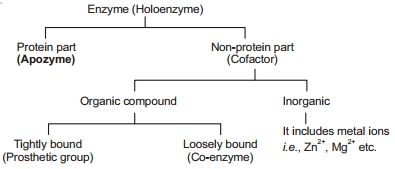
(B) An enzyme is often composed of a protein part and a non-protein part. The complete,catalytically active enzyme is called a $Holoenzyme$.
The protein portion of the enzyme is referred to as the $Apoenzyme$.
The non-protein portion,which is essential for the catalytic activity of the enzyme,is known as the $Cofactor$.
Therefore,the correct option is $B$.
The protein portion of the enzyme is referred to as the $Apoenzyme$.
The non-protein portion,which is essential for the catalytic activity of the enzyme,is known as the $Cofactor$.
Therefore,the correct option is $B$.
0 likes
View Solution117
MediumMCQ
$A$ : Cofactor of an enzyme may be a prosthetic group.
$R$ : $NAD$ derived from niacin is a co-enzyme.
$R$ : $NAD$ derived from niacin is a co-enzyme.
A
Assertion and Reason both are correct and Reason is the correct explanation of Assertion.
B
Assertion and Reason both are correct but Reason is not the correct explanation of Assertion.
C
Assertion is correct,but Reason is incorrect.
D
Both Assertion and Reason are incorrect.
Solution
(B) The Assertion is correct: $A$ cofactor can be a prosthetic group,which is an organic compound tightly bound to the apoenzyme (protein part).
The Reason is also correct: $NAD$ (Nicotinamide Adenine Dinucleotide) is derived from the vitamin niacin (Vitamin $B_3$) and functions as a co-enzyme,which is a type of cofactor that binds transiently to the enzyme.
However,the Reason does not explain why a cofactor can be a prosthetic group; they are two separate facts about enzyme cofactors. Therefore,both are correct,but the Reason is not the correct explanation of the Assertion.
The Reason is also correct: $NAD$ (Nicotinamide Adenine Dinucleotide) is derived from the vitamin niacin (Vitamin $B_3$) and functions as a co-enzyme,which is a type of cofactor that binds transiently to the enzyme.
However,the Reason does not explain why a cofactor can be a prosthetic group; they are two separate facts about enzyme cofactors. Therefore,both are correct,but the Reason is not the correct explanation of the Assertion.
0 likes
View Solution118
MediumMCQ
The major role of minor elements (trace elements) inside living organisms is to act as:
A
Constituents
B
Binder of cell structure
C
Cofactors of enzymes
D
Building blocks of important amino acids
Solution
(C) Although trace elements are required in small quantities for various physiological functions,most of them play a significant role as cofactors for enzymes.
For example,$Zn^{2+}$ acts as a cofactor for enzymes like carbonic anhydrase,alcohol dehydrogenase,and various carboxypeptidases,which are essential for metabolic reactions.
For example,$Zn^{2+}$ acts as a cofactor for enzymes like carbonic anhydrase,alcohol dehydrogenase,and various carboxypeptidases,which are essential for metabolic reactions.
0 likes
View Solution119
MediumMCQ
The similarity between $NAD^{+}$ and $NADP^{+}$ is that
A
Take up one electron at a time
B
Take up two protons at a time
C
Take up two electrons at a time
D
Give up one proton at a time
Solution
(C) $NAD^{+}$ and $NADP^{+}$ act as coenzymes in metabolic reactions.
They both function as electron carriers.
During the reduction process,each molecule accepts two electrons and one proton $(H^{+})$ to form $NADH$ and $NADPH$ respectively,while releasing one proton into the medium.
They both function as electron carriers.
During the reduction process,each molecule accepts two electrons and one proton $(H^{+})$ to form $NADH$ and $NADPH$ respectively,while releasing one proton into the medium.
0 likes
View Solution120
MediumMCQ
Which one is true for $ATP$?
A
$ATP$ is a prosthetic part of an enzyme
B
$ATP$ is an enzyme
C
$ATP$ is an organic ion of an enzyme
D
$ATP$ is a coenzyme
Solution
(D) $ATP$ (Adenosine Triphosphate) acts as a coenzyme. $A$ coenzyme is a small,non-protein organic molecule that binds loosely to an enzyme and is essential for its catalytic activity. It functions as a carrier of chemical energy or functional groups during metabolic reactions.
0 likes
View Solution121
MediumMCQ
Which one is not true about vitamins?
A
Vitamins are organic catalysts
B
Vitamins are indispensable for life
C
Vitamins act as a source of energy
D
Tocopherol is anti-sterility vitamin
Solution
(C) Vitamins are organic compounds of varying complexity that do not provide energy to the body.
Instead,they regulate metabolic activities and energy-yielding reactions by acting as organic catalysts or cofactors for enzymes.
Since they are essential for normal physiological functions but are not oxidized to produce energy,the statement that vitamins act as a source of energy is incorrect.
Instead,they regulate metabolic activities and energy-yielding reactions by acting as organic catalysts or cofactors for enzymes.
Since they are essential for normal physiological functions but are not oxidized to produce energy,the statement that vitamins act as a source of energy is incorrect.
0 likes
View Solution122
EasyMCQ
$FAD$ coenzyme is derived from:
A
Vitamin-$B_{1}$
B
Vitamin-$B_{3}$
C
Vitamin-$B_{2}$
D
Cyanocobalamin
Solution
(C) Flavin Adenine Dinucleotide $(FAD)$ is a coenzyme derived from riboflavin,which is also known as Vitamin-$B_{2}$.
Coenzymes are organic non-protein components that assist enzymes in catalyzing biochemical reactions.
$FAD$ acts as an electron carrier in various metabolic pathways,such as the Krebs cycle and the electron transport chain,by accepting two hydrogen atoms to become $FADH_{2}$.
Coenzymes are organic non-protein components that assist enzymes in catalyzing biochemical reactions.
$FAD$ acts as an electron carrier in various metabolic pathways,such as the Krebs cycle and the electron transport chain,by accepting two hydrogen atoms to become $FADH_{2}$.
0 likes
View Solution123
EasyMCQ
Which one is the cofactor of carbonic anhydrase?
A
Iron
B
Zinc
C
Copper
D
Magnesium
Solution
(B) Carbonic anhydrase is an enzyme that catalyzes the reversible reaction between carbon dioxide $(CO_2)$ and water $(H_2O)$ to form carbonic acid $(H_2CO_3)$ in the red blood cells $(RBCs)$.
Zinc $(Zn^{2+})$ acts as an essential cofactor for the activity of the carbonic anhydrase enzyme.
Zinc $(Zn^{2+})$ acts as an essential cofactor for the activity of the carbonic anhydrase enzyme.
0 likes
View Solution124
MediumMCQ
The $..........$ type of cofactor is tightly bound to the apoenzyme, whereas the $.........$ type of cofactor is loosely bound to the apoenzyme.
A
Prosthetic group, Metal ion
B
Metal ion, Prosthetic group
C
Co-enzyme, Prosthetic group
D
Prosthetic group, Co-enzyme
Solution
(D) Cofactors are non-protein constituents that are bound to the enzyme to make the apoenzyme catalytically active.
$1$. Prosthetic groups are organic compounds and are distinguished from other cofactors in that they are tightly bound to the apoenzyme.
$2$. Co-enzymes are also organic compounds but their association with the apoenzyme is only transient, usually occurring during the course of catalysis (loosely bound).
$3$. Therefore, the correct sequence is Prosthetic group (tightly bound) and Co-enzyme (loosely bound).
$1$. Prosthetic groups are organic compounds and are distinguished from other cofactors in that they are tightly bound to the apoenzyme.
$2$. Co-enzymes are also organic compounds but their association with the apoenzyme is only transient, usually occurring during the course of catalysis (loosely bound).
$3$. Therefore, the correct sequence is Prosthetic group (tightly bound) and Co-enzyme (loosely bound).
0 likes
View Solution125
EasyMCQ
$NAD$ and $NADP$ contain which vitamin?
A
Vitamin $B_1$
B
Vitamin $B_3$
C
Vitamin $B_2$
D
Vitamin $B_5$
Solution
(B) $NAD$ (Nicotinamide Adenine Dinucleotide) and $NADP$ (Nicotinamide Adenine Dinucleotide Phosphate) are essential coenzymes involved in cellular metabolism.
These coenzymes are derivatives of the vitamin Niacin,which is also known as Vitamin $B_3$.
Specifically,the nicotinamide moiety in these molecules is derived from Vitamin $B_3$.
These coenzymes are derivatives of the vitamin Niacin,which is also known as Vitamin $B_3$.
Specifically,the nicotinamide moiety in these molecules is derived from Vitamin $B_3$.
0 likes
View Solution126
MediumMCQ
Match the following columns:
| Column-$I$ (Enzymes) | Column-$II$ (Co-factors) |
|---|---|
| $P$. Catalase,Peroxidase | $I$. $Fe$ |
| $Q$. Carboxypeptidase | $II$. $NAD$ |
| $R$. Alcohol dehydrogenase | $III$. $Zn$ |
A
$(P-II), (Q-III), (R-I)$
B
$(P-I), (Q-III), (R-II)$
C
$(P-III), (Q-I), (R-II)$
D
$(P-II), (Q-I), (R-III)$
Solution
(B) The correct matching is as follows:
$1$. Catalase and Peroxidase are enzymes that break down hydrogen peroxide. They contain Iron $(Fe)$ as a co-factor. Thus,$P-I$.
$2$. Carboxypeptidase is a zinc-containing metalloenzyme. Thus,$Q-III$.
$3$. Alcohol dehydrogenase requires $NAD$ (Nicotinamide Adenine Dinucleotide) as a co-enzyme. Thus,$R-II$.
Therefore,the correct sequence is $(P-I), (Q-III), (R-II)$.
$1$. Catalase and Peroxidase are enzymes that break down hydrogen peroxide. They contain Iron $(Fe)$ as a co-factor. Thus,$P-I$.
$2$. Carboxypeptidase is a zinc-containing metalloenzyme. Thus,$Q-III$.
$3$. Alcohol dehydrogenase requires $NAD$ (Nicotinamide Adenine Dinucleotide) as a co-enzyme. Thus,$R-II$.
Therefore,the correct sequence is $(P-I), (Q-III), (R-II)$.
0 likes
View Solution127
MediumMCQ
What is the cofactor of the most abundant enzyme in the biosphere?
A
$Mo$
B
$Zn^{+2}$
C
$Mg^{+2}$
D
Phosphorus
Solution
(C) The most abundant enzyme in the biosphere is $RuBisCO$ (Ribulose$-1,5-$bisphosphate carboxylase-oxygenase).
$RuBisCO$ is a key enzyme in the Calvin cycle of photosynthesis.
This enzyme requires $Mg^{+2}$ ions as a cofactor for its catalytic activity.
Therefore,the correct option is $C$.
$RuBisCO$ is a key enzyme in the Calvin cycle of photosynthesis.
This enzyme requires $Mg^{+2}$ ions as a cofactor for its catalytic activity.
Therefore,the correct option is $C$.
0 likes
View Solution128
EasyMCQ
Match the following columns:
| Column-$I$ (Enzymes) | Column-$II$ (Cofactors/Activators) |
|---|---|
| $P$. Catalase | $I$. Molybdenum |
| $Q$. Carboxylase | $II$. Zinc |
| $R$. Nitrogenase,Nitrate reductase | $III$. Iron |
A
$(P-III), (Q-II), (R-I)$
B
$(P-II), (Q-III), (R-I)$
C
$(P-I), (Q-III), (R-II)$
D
$(P-III), (Q-I), (R-II)$
Solution
(A) The correct matches are as follows:
$1$. Catalase $(P)$ requires Iron $(III)$ as a cofactor for its activity.
$2$. Carboxylase $(Q)$ requires Zinc $(II)$ as a cofactor for its activity.
$3$. Nitrogenase and Nitrate reductase $(R)$ require Molybdenum $(I)$ as a cofactor for their activity.
Therefore,the correct sequence is $(P-III), (Q-II), (R-I)$.
$1$. Catalase $(P)$ requires Iron $(III)$ as a cofactor for its activity.
$2$. Carboxylase $(Q)$ requires Zinc $(II)$ as a cofactor for its activity.
$3$. Nitrogenase and Nitrate reductase $(R)$ require Molybdenum $(I)$ as a cofactor for their activity.
Therefore,the correct sequence is $(P-III), (Q-II), (R-I)$.
0 likes
View Solution129
MediumMCQ
The cofactor of the enzyme carboxypeptidase is:
A
Niacin
B
Flavin
C
Haem
D
Zinc
Solution
(D) The correct answer is option $D$ because the cofactor of the enzyme carboxypeptidase is $Zinc$ $(Zn^{2+})$.
$Niacin$ is a vitamin that acts as a precursor for coenzymes like $NAD$ and $NADP$.
$Flavin$ is a component of coenzymes like $FAD$ and $FMN$.
$Haem$ is the prosthetic group found in enzymes such as peroxidase and catalase.
Therefore, $Zinc$ is the essential metal ion cofactor required for the catalytic activity of carboxypeptidase.
$Niacin$ is a vitamin that acts as a precursor for coenzymes like $NAD$ and $NADP$.
$Flavin$ is a component of coenzymes like $FAD$ and $FMN$.
$Haem$ is the prosthetic group found in enzymes such as peroxidase and catalase.
Therefore, $Zinc$ is the essential metal ion cofactor required for the catalytic activity of carboxypeptidase.
0 likes
View Solution130
EasyMCQ
Which one of the following enzymes contains 'Haem' as the prosthetic group?
A
RuBisCo
B
Carbonic anhydrase
C
Succinate dehydrogenase
D
Catalase
Solution
(D) prosthetic group is a non-protein organic molecule that is tightly bound to the apoenzyme to form a functional holoenzyme.
'Haem' is an iron-containing porphyrin ring that acts as a prosthetic group in enzymes like Catalase and Peroxidase.
Catalase catalyzes the decomposition of hydrogen peroxide $(H_2O_2)$ into water and oxygen.
RuBisCo uses $Mg^{2+}$ as a cofactor.
Carbonic anhydrase uses $Zn^{2+}$ as a cofactor.
Succinate dehydrogenase uses $FAD$ as a prosthetic group.
Therefore,the correct option is $D$.
'Haem' is an iron-containing porphyrin ring that acts as a prosthetic group in enzymes like Catalase and Peroxidase.
Catalase catalyzes the decomposition of hydrogen peroxide $(H_2O_2)$ into water and oxygen.
RuBisCo uses $Mg^{2+}$ as a cofactor.
Carbonic anhydrase uses $Zn^{2+}$ as a cofactor.
Succinate dehydrogenase uses $FAD$ as a prosthetic group.
Therefore,the correct option is $D$.
0 likes
View Solution131
EasyMCQ
$.........$ is a cofactor for the proteolytic enzyme carboxypeptidase.
A
$Cn$
B
$Zn$
C
$Mg$
D
$Fe$
Solution
(B) Carboxypeptidase is a proteolytic enzyme that catalyzes the hydrolysis of peptide bonds.
It requires a metal ion as a cofactor to function effectively.
$Zn^{2+}$ (Zinc) acts as a crucial cofactor for the enzyme carboxypeptidase,which is essential for its catalytic activity.
Therefore,the correct option is $B$.
It requires a metal ion as a cofactor to function effectively.
$Zn^{2+}$ (Zinc) acts as a crucial cofactor for the enzyme carboxypeptidase,which is essential for its catalytic activity.
Therefore,the correct option is $B$.
0 likes
View Solution132
EasyMCQ
Catalytic activity of carboxypeptidase is lost upon removal of which co-factor?
A
Coenzyme
B
Prosthetic group
C
$Cu^{2+}$
D
$Zn^{2+}$
Solution
(D) Carboxypeptidase is a metalloenzyme that requires a metal ion as a co-factor for its catalytic activity.
Specifically,it contains a $Zn^{2+}$ ion at its active site,which is essential for the hydrolysis of peptide bonds.
If the $Zn^{2+}$ ion is removed,the enzyme loses its structural integrity and catalytic function.
Therefore,the correct co-factor is $Zn^{2+}$.
Specifically,it contains a $Zn^{2+}$ ion at its active site,which is essential for the hydrolysis of peptide bonds.
If the $Zn^{2+}$ ion is removed,the enzyme loses its structural integrity and catalytic function.
Therefore,the correct co-factor is $Zn^{2+}$.
0 likes
View Solution133
EasyMCQ
Enzyme enolase catalyzes the conversion of $2$-$PGA$ to Phosphoenolpyruvic acid in the presence of . . . . . . which is the cofactor.
A
$Mn^{2+}$
B
$Fe^{2+}$
C
$Mg^{2+}$
D
$Zn^{2+}$
Solution
(C) The enzyme enolase is involved in the glycolytic pathway,specifically in the conversion of $2$-phosphoglycerate ($2$-$PGA$) to phosphoenolpyruvate $(PEP)$.
This reaction requires magnesium ions $(Mg^{2+})$ as a necessary cofactor for its catalytic activity.
Magnesium ions act as essential activators for many enzymes involved in respiration and energy metabolism.
This reaction requires magnesium ions $(Mg^{2+})$ as a necessary cofactor for its catalytic activity.
Magnesium ions act as essential activators for many enzymes involved in respiration and energy metabolism.
0 likes
View Solution134
EasyMCQ
With reference to enzymes, which one of the following statements is true?
A
Apoenzyme = Holoenzyme + Coenzyme
B
Holoenzyme = Apoenzyme + Coenzyme
C
Coenzyme = Apoenzyme + Holoenzyme
D
Holoenzyme = Coenzyme - Apoenzyme
Solution
(B) The correct answer is $B$.
An enzyme is composed of an apoenzyme (the protein part) and a coenzyme (a non-protein organic molecule).
Together, they form the holoenzyme, which is the active form of the enzyme capable of catalyzing biochemical reactions.
Therefore, the relationship is defined as: $\text{Holoenzyme} = \text{Apoenzyme} + \text{Coenzyme}$.
An enzyme is composed of an apoenzyme (the protein part) and a coenzyme (a non-protein organic molecule).
Together, they form the holoenzyme, which is the active form of the enzyme capable of catalyzing biochemical reactions.
Therefore, the relationship is defined as: $\text{Holoenzyme} = \text{Apoenzyme} + \text{Coenzyme}$.
0 likes
View SolutionBiomolecules — Co-Factors · Frequently Asked Questions
1Are these Biomolecules questions useful for JEE and NEET?
Yes. All questions in this section are mapped to JEE Main and NEET exam patterns. Previous year questions from JEE Main, NEET, GUJCET and state-level exams are included with full solutions.
2Can I switch to Hindi or Gujarati for these questions?
Yes. Use the language tabs in the hero section or the sidebar to view the same questions and solutions in English, Hindi or Gujarati.
3How do I generate a question paper from this subtopic?
Use the Vedclass Exam Paper Generator — select the chapter and subtopic, set difficulty, and generate Sets A, B, C, D automatically. First 3 chapters of every subject are free.
Vedclass Products
For Students
Vedclass Test Series
Mock tests in real JEE/NEET style with performance analysis. 5-day free trial.
Start Free TrialFor Teachers
Exam Paper Generator
Generate Set A/B/C/D papers from this chapter in 2 minutes. 3 chapters free.
Try FreeFor Institutes
Online Exam Module
Live online exams with unlimited students, 360° analytics & white-label branding.
See DemoFor Teachers & Institutes
Generate a Biomolecules Exam Paper in 2 Minutes
Select subtopic & difficulty — Sets A, B, C, D auto-generated with No Repeat logic.
First 3 chapters of every subject are free — no payment required.