
A English
Biomacromolecuals Questions in English
Class 11 Biology · Biomolecules · Biomacromolecuals
71+
Questions
English
Language
100%
With Solutions
Showing 21 of 71 questions in English
51
MediumMCQ
$A$ - Polysaccharides are long chains of sugars.
$R$ - Cellulose is an important component of the plant cell wall.
$R$ - Cellulose is an important component of the plant cell wall.
A
$A$ and $R$ are both true.
B
$A$ and $R$ are both false.
C
$A$ is true and $R$ is false.
D
$A$ is false and $R$ is true.
Solution
(A) Assertion $(A)$: Polysaccharides are indeed long chains of monosaccharides (sugars) linked together by glycosidic bonds. This statement is true.
Reason $(R)$: Cellulose is a structural polysaccharide made of glucose units and is a major structural component of the plant cell wall. This statement is also true.
Since both statements are scientifically accurate,the correct option is that both $A$ and $R$ are true.
Reason $(R)$: Cellulose is a structural polysaccharide made of glucose units and is a major structural component of the plant cell wall. This statement is also true.
Since both statements are scientifically accurate,the correct option is that both $A$ and $R$ are true.
0 likes
View Solution52
MediumMCQ
Which of the following is a macromolecule?
A
Amino acid
B
Protein
C
Monosaccharide
D
Glucose
Solution
(B) Macromolecules are large,complex molecules with a high molecular weight,typically formed by the polymerization of smaller subunits called monomers.
In biological systems,proteins,polysaccharides,and nucleic acids are classified as macromolecules.
Amino acids are the monomers of proteins.
Monosaccharides,such as glucose,are the monomers of polysaccharides.
Therefore,among the given options,$Protein$ is a macromolecule.
In biological systems,proteins,polysaccharides,and nucleic acids are classified as macromolecules.
Amino acids are the monomers of proteins.
Monosaccharides,such as glucose,are the monomers of polysaccharides.
Therefore,among the given options,$Protein$ is a macromolecule.
0 likes
View Solution53
EasyMCQ
The currency of the cell is:
A
$ATP$
B
$GLUT-4$
C
$DNA$
D
$RNA$
Solution
(A) $ATP$ (Adenosine Triphosphate) is known as the energy currency of the cell.
It stores chemical energy in its high-energy phosphate bonds.
When the cell requires energy for various metabolic processes,$ATP$ is hydrolyzed to $ADP$ (Adenosine Diphosphate) and inorganic phosphate,releasing energy.
It stores chemical energy in its high-energy phosphate bonds.
When the cell requires energy for various metabolic processes,$ATP$ is hydrolyzed to $ADP$ (Adenosine Diphosphate) and inorganic phosphate,releasing energy.
0 likes
View Solution54
Medium
What are macromolecules? Give examples.
Solution
(N/A) Macromolecules are large,complex molecules that exist in a colloidal state within the intercellular fluid. They are formed by the polymerization of micromolecules,which are molecules with low molecular weight. Common examples of macromolecules include polysaccharides,proteins,and nucleic acids.
0 likes
View Solution55
Medium
What are micro and macro biomolecules? Explain with examples.
Solution
$\rightarrow$ All those compounds found in the acid-soluble pool have molecular weights ranging from $18$ to $800$ Daltons (Da). These are known as micromolecules or biomolecules of low molecular weight.
$\rightarrow$ The acid-insoluble fraction contains four types of organic compounds: proteins, nucleic acids, polysaccharides, and lipids. With the exception of lipids, these have molecular weights in the range of $10,000$ Daltons and above. These are known as biomacromolecules.
$\rightarrow$ Biomolecules are classified based on their molecular weight: $(i)$ Micromolecules (molecular weight $ < 1000$ Daltons) and $(ii)$ Biomacromolecules (molecular weight $ > 1000$ Daltons).
$\rightarrow$ The molecules in the insoluble fraction, except for lipids, are polymeric substances.
$\rightarrow$ Lipids are small molecular weight compounds but are found in the acid-insoluble fraction because they form vesicles during tissue grinding, which are not water-soluble.
$\rightarrow$ Average composition of cells:
$\rightarrow$ The acid-insoluble fraction contains four types of organic compounds: proteins, nucleic acids, polysaccharides, and lipids. With the exception of lipids, these have molecular weights in the range of $10,000$ Daltons and above. These are known as biomacromolecules.
$\rightarrow$ Biomolecules are classified based on their molecular weight: $(i)$ Micromolecules (molecular weight $ < 1000$ Daltons) and $(ii)$ Biomacromolecules (molecular weight $ > 1000$ Daltons).
$\rightarrow$ The molecules in the insoluble fraction, except for lipids, are polymeric substances.
$\rightarrow$ Lipids are small molecular weight compounds but are found in the acid-insoluble fraction because they form vesicles during tissue grinding, which are not water-soluble.
$\rightarrow$ Average composition of cells:
| Component | % of the total cellular mass |
| Water | $70-90$ |
| Proteins | $10-15$ |
| Carbohydrates | $3$ |
| Lipids | $2$ |
| Nucleic acids | $5-7$ |
| Ions | $1$ |
0 likes
View Solution56
Medium
Which types of linkages are formed between different monomers to form polymers? Explain the various types of linkages with examples.
Solution
(N/A) $\rightarrow$ In a polypeptide or a protein, amino acids are linked by a peptide bond, which is formed when the carboxyl $(-COOH)$ group of one amino acid reacts with the amino $(-NH_2)$ group of the next amino acid with the elimination of a water molecule (dehydration).
$\rightarrow$ In a polysaccharide, the individual monosaccharides are linked by a glycosidic bond. This bond is also formed by dehydration between two carbon atoms of two adjacent monosaccharides.
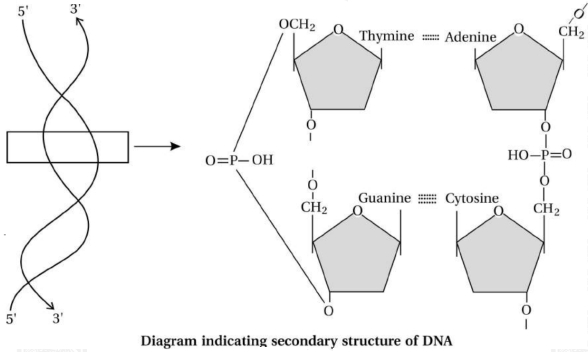
$\rightarrow$ In a nucleic acid, a phosphate moiety links the $3'$-carbon of one sugar of one nucleotide to the $5'$-carbon of the sugar of the succeeding nucleotide. The bond between the phosphate and hydroxyl group of the sugar is an ester bond. As there is one such ester bond on either side, it is called a phosphodiester bond.
$\rightarrow$ Nucleic acids exhibit a wide variety of secondary structures, such as the Watson-Crick model of $DNA$, where two polynucleotide strands are anti-parallel and held together by hydrogen bonds between nitrogenous bases ($A=T$ with two hydrogen bonds, $G \equiv C$ with three hydrogen bonds).
$\rightarrow$ In a polysaccharide, the individual monosaccharides are linked by a glycosidic bond. This bond is also formed by dehydration between two carbon atoms of two adjacent monosaccharides.
$\rightarrow$ In a nucleic acid, a phosphate moiety links the $3'$-carbon of one sugar of one nucleotide to the $5'$-carbon of the sugar of the succeeding nucleotide. The bond between the phosphate and hydroxyl group of the sugar is an ester bond. As there is one such ester bond on either side, it is called a phosphodiester bond.
$\rightarrow$ Nucleic acids exhibit a wide variety of secondary structures, such as the Watson-Crick model of $DNA$, where two polynucleotide strands are anti-parallel and held together by hydrogen bonds between nitrogenous bases ($A=T$ with two hydrogen bonds, $G \equiv C$ with three hydrogen bonds).
0 likes
View Solution57
Easy
Give a scientific reason: Although the molecular weight of lipids is less than $1000 \text{ Dalton}$,they are included in biomacromolecules.
Solution
(D) $\Rightarrow$ Compounds with a molecular weight less than $1000 \text{ Dalton}$ are classified as micromolecules,while those with a higher molecular weight are called macromolecules.
$\Rightarrow$ Proteins,nucleic acids,and polysaccharides are true macromolecules found in the acid-insoluble fraction.
$\Rightarrow$ Lipids have a molecular weight of less than $1000 \text{ Dalton}$,which would typically classify them as micromolecules.
$\Rightarrow$ However,during the process of grinding tissue in trichloroacetic acid,the cell membrane and other membranes are broken into vesicles that are not water-soluble.
$\Rightarrow$ Consequently,these lipid-containing vesicles are separated along with the acid-insoluble fraction (macromolecules) rather than the acid-soluble pool. Therefore,they are studied along with biomacromolecules.
$\Rightarrow$ Proteins,nucleic acids,and polysaccharides are true macromolecules found in the acid-insoluble fraction.
$\Rightarrow$ Lipids have a molecular weight of less than $1000 \text{ Dalton}$,which would typically classify them as micromolecules.
$\Rightarrow$ However,during the process of grinding tissue in trichloroacetic acid,the cell membrane and other membranes are broken into vesicles that are not water-soluble.
$\Rightarrow$ Consequently,these lipid-containing vesicles are separated along with the acid-insoluble fraction (macromolecules) rather than the acid-soluble pool. Therefore,they are studied along with biomacromolecules.
0 likes
View Solution58
Medium
What is the need for macromolecules in living organisms?
Solution
(N/A) The basic needs of all living organisms are essentially the same. They require macromolecules such as carbohydrates,proteins,and fats,along with water and minerals,for their growth,development,and metabolic activities. These macromolecules serve as energy sources and structural components of cells.
0 likes
View Solution59
EasyMCQ
$A$ cellulose molecule is formed by the polymerisation of glucose. The number of glucose molecules present in a cellulose is
A
$600$
B
$6000$
C
$60,000$
D
$60$
Solution
(B) Cellulose is a polysaccharide consisting of a linear chain of several hundred to many thousands of $\beta$-$D$-glucose units.
In biological contexts,a typical cellulose molecule is formed by the polymerisation of approximately $6000$ molecules of $\beta$-glucose linked by $\beta-1, 4$-glycosidic bonds.
In biological contexts,a typical cellulose molecule is formed by the polymerisation of approximately $6000$ molecules of $\beta$-glucose linked by $\beta-1, 4$-glycosidic bonds.
0 likes
View Solution60
EasyMCQ
Which of the following is true for vitamin-$C$?
A
Also called as ascorbic acid
B
Also called as fumaric acid
C
Obtained from citrus fruits
D
Both $(a)$ and $(c)$
Solution
(D) Vitamin-$C$ is chemically known as ascorbic acid.
It is primarily obtained from citrus fruits such as lemon,orange,amla,and guava.
Vitamin-$C$ plays a crucial role in the formation of normal collagen,bone matrix,tooth dentine,and other extracellular materials.
It is essential for the growth and maintenance of connective tissues,cartilages,bones,and teeth.
It is primarily obtained from citrus fruits such as lemon,orange,amla,and guava.
Vitamin-$C$ plays a crucial role in the formation of normal collagen,bone matrix,tooth dentine,and other extracellular materials.
It is essential for the growth and maintenance of connective tissues,cartilages,bones,and teeth.
0 likes
View Solution61
Medium
Explain the term "Energy Currency". Which substance acts as energy currency in plants and animals?
Solution
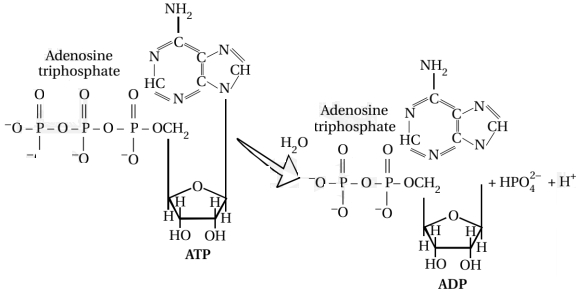
(N/A) The term "Energy Currency" refers to a molecule that stores and provides energy for various cellular processes. $ATP$ (Adenosine Triphosphate) is known as the energy currency of the cell because it stores energy in its high-energy phosphate bonds, which can be readily released when needed.
In plants and animals, $ATP$ acts as the primary energy currency. While other molecules like $GTP$, $CTP$, and $UTP$ can also act as energy donors, $ATP$ is the most universal.
The hydrolysis of $ATP$ into $ADP$ and inorganic phosphate $(Pi)$ releases approximately $7.3 \text{ kcal/mol}$ of energy, which powers various biochemical processes.
$ATP$ functions effectively as an energy carrier because:
$(i)$ Energy is stored in small, manageable packets, minimizing energy loss during transport.
$(ii)$ It can be easily transported from the site of production to the site of utilization within the cell.
$(iii)$ It provides a continuous and immediate supply of energy for essential cellular tasks.
In plants and animals, $ATP$ acts as the primary energy currency. While other molecules like $GTP$, $CTP$, and $UTP$ can also act as energy donors, $ATP$ is the most universal.
The hydrolysis of $ATP$ into $ADP$ and inorganic phosphate $(Pi)$ releases approximately $7.3 \text{ kcal/mol}$ of energy, which powers various biochemical processes.
$ATP$ functions effectively as an energy carrier because:
$(i)$ Energy is stored in small, manageable packets, minimizing energy loss during transport.
$(ii)$ It can be easily transported from the site of production to the site of utilization within the cell.
$(iii)$ It provides a continuous and immediate supply of energy for essential cellular tasks.
0 likes
View Solution62
MediumMCQ
Select the correct option for the biomolecules found in living organisms.
Classification of biomolecules from a chemical perspective $- P$
Classification of biomolecules from a biological perspective $- Q$
Classification of biomolecules from a chemical perspective $- P$
Classification of biomolecules from a biological perspective $- Q$
| Option | $P$ (Chemical Perspective) | $Q$ (Biological Perspective) |
|---|---|---|
| $A$ | Aldehydes,ketones,aromatic compounds | Amino acids,nucleotide bases,fatty acids |
| $B$ | Amino acids,nucleotide bases,fatty acids | Aldehydes,ketones,aromatic compounds |
| $C$ | Amino acids,ketones,aromatic compounds | Aldehydes,nucleotide bases,fatty acids |
| $D$ | Aldehydes,nucleotide bases,fatty acids | Amino acids,ketones,aromatic compounds |
A
$A$
B
$B$
C
$C$
D
$D$
Solution
(A) From a chemical perspective $(P)$,biomolecules are classified based on their functional groups and chemical structures,such as aldehydes,ketones,and aromatic compounds.
From a biological perspective $(Q)$,biomolecules are classified based on their role as building blocks of life,such as amino acids (for proteins),nucleotide bases (for nucleic acids),and fatty acids (for lipids).
Therefore,the correct classification is $P$ = Aldehydes,ketones,aromatic compounds and $Q$ = Amino acids,nucleotide bases,fatty acids. This corresponds to option $A$.
From a biological perspective $(Q)$,biomolecules are classified based on their role as building blocks of life,such as amino acids (for proteins),nucleotide bases (for nucleic acids),and fatty acids (for lipids).
Therefore,the correct classification is $P$ = Aldehydes,ketones,aromatic compounds and $Q$ = Amino acids,nucleotide bases,fatty acids. This corresponds to option $A$.
0 likes
View Solution63
MediumMCQ
Polysaccharides are isolated in which fraction during chemical analysis of living tissues?
A
Acid-soluble pool
B
Acid-insoluble fraction
C
Residue
D
$B$ or $C$
Solution
(D) During the chemical analysis of living tissues using trichloroacetic acid $(Cl_3CCOOH)$,the tissue is ground to form a slurry.
When this slurry is filtered,two fractions are obtained:
$1$. The filtrate,which is the acid-soluble pool,contains small molecular weight compounds (monomers like amino acids,sugars,nucleotides).
$2$. The retentate,which is the acid-insoluble fraction (also called the residue),contains macromolecules like polysaccharides,proteins,nucleic acids,and lipids.
Since polysaccharides are macromolecules,they are found in the acid-insoluble fraction,which is also referred to as the residue.
Therefore,both $B$ and $C$ refer to the same fraction.
When this slurry is filtered,two fractions are obtained:
$1$. The filtrate,which is the acid-soluble pool,contains small molecular weight compounds (monomers like amino acids,sugars,nucleotides).
$2$. The retentate,which is the acid-insoluble fraction (also called the residue),contains macromolecules like polysaccharides,proteins,nucleic acids,and lipids.
Since polysaccharides are macromolecules,they are found in the acid-insoluble fraction,which is also referred to as the residue.
Therefore,both $B$ and $C$ refer to the same fraction.
0 likes
View Solution64
MediumMCQ
Select the incorrect statement for cellulose.
A
It is the main component of the plant cell wall.
B
Paper made from plant pulp is cellulose.
C
Cellulose is a heteropolymer.
D
Cotton fibers are cellulose.
Solution
(C) Cellulose is a homopolymer composed exclusively of $D$-glucose units linked by $\beta-1,4$-glycosidic bonds.
Since it consists of only one type of monomer unit,it is classified as a homopolymer,not a heteropolymer.
Therefore,the statement '$C$' is incorrect.
All other statements are correct: Cellulose is the primary structural component of plant cell walls,paper is derived from plant pulp (cellulose),and cotton fibers are nearly pure cellulose.
Since it consists of only one type of monomer unit,it is classified as a homopolymer,not a heteropolymer.
Therefore,the statement '$C$' is incorrect.
All other statements are correct: Cellulose is the primary structural component of plant cell walls,paper is derived from plant pulp (cellulose),and cotton fibers are nearly pure cellulose.
0 likes
View Solution65
MediumMCQ
Select the correct option for the following:
Biomolecules found in the acid-soluble pool $- P$
Biomolecules found in the acid-insoluble fraction $- Q$
Biomolecules found in the acid-soluble pool $- P$
Biomolecules found in the acid-insoluble fraction $- Q$
A
Micro-biomolecules,Macro-biomolecules
B
Micro-biomolecules,Micro-biomolecules
C
Macro-biomolecules,Micro-biomolecules
D
Macro-biomolecules,Macro-biomolecules
Solution
(A) When tissues are ground in trichloroacetic acid $(TCA)$,the chemical analysis results in two fractions.
$1$. The filtrate,which is the acid-soluble pool,contains small molecular weight compounds known as micro-biomolecules (e.g.,amino acids,simple sugars,nucleotides).
$2$. The retentate,which is the acid-insoluble fraction,contains large molecular weight compounds known as macro-biomolecules (e.g.,proteins,nucleic acids,polysaccharides,lipids).
Therefore,$P$ represents micro-biomolecules and $Q$ represents macro-biomolecules.
$1$. The filtrate,which is the acid-soluble pool,contains small molecular weight compounds known as micro-biomolecules (e.g.,amino acids,simple sugars,nucleotides).
$2$. The retentate,which is the acid-insoluble fraction,contains large molecular weight compounds known as macro-biomolecules (e.g.,proteins,nucleic acids,polysaccharides,lipids).
Therefore,$P$ represents micro-biomolecules and $Q$ represents macro-biomolecules.
0 likes
View Solution66
EasyMCQ
Which molecule acts as the energy currency in a living organism?
A
$ATP$
B
$NAD$
C
$NADP$
D
$FAD$
Solution
(A) $ATP$ (Adenosine Triphosphate) is known as the energy currency of the cell.
It stores energy in its high-energy phosphate bonds.
When the cell requires energy for various metabolic processes,$ATP$ is hydrolyzed into $ADP$ (Adenosine Diphosphate) and inorganic phosphate,releasing the stored energy.
It stores energy in its high-energy phosphate bonds.
When the cell requires energy for various metabolic processes,$ATP$ is hydrolyzed into $ADP$ (Adenosine Diphosphate) and inorganic phosphate,releasing the stored energy.
0 likes
View Solution67
EasyMCQ
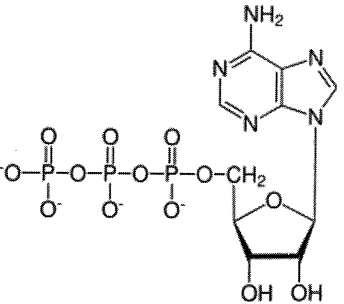
Identify the molecule shown below.
A
$ADP$
B
$NADP$
C
$FMN$
D
$ATP$
Solution
(D) The molecule shown in the image consists of an adenine base,a ribose sugar,and three phosphate groups attached to the sugar.
This structure is characteristic of Adenosine Triphosphate $(ATP)$.
$ADP$ (Adenosine Diphosphate) would have only two phosphate groups.
$NADP$ (Nicotinamide Adenine Dinucleotide Phosphate) has a more complex structure involving a nicotinamide ring.
$FMN$ (Flavin Mononucleotide) is a derivative of riboflavin and has a different structure.
This structure is characteristic of Adenosine Triphosphate $(ATP)$.
$ADP$ (Adenosine Diphosphate) would have only two phosphate groups.
$NADP$ (Nicotinamide Adenine Dinucleotide Phosphate) has a more complex structure involving a nicotinamide ring.
$FMN$ (Flavin Mononucleotide) is a derivative of riboflavin and has a different structure.
0 likes
View Solution68
MediumMCQ
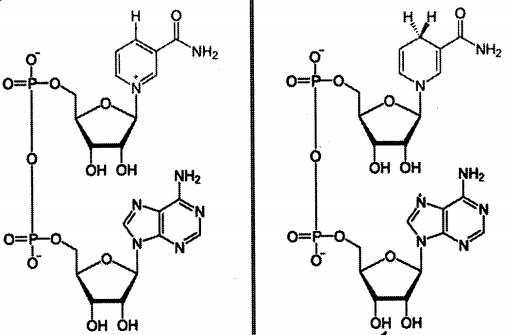
Identify the molecules given below.
A
$NADH \quad NAD^+$
B
$FADH \quad FAD^+$
C
$FAD^+ \quad FADH$
D
$NAD^+ \quad NADH$
Solution
(D) The image shows the oxidized and reduced forms of Nicotinamide Adenine Dinucleotide $(NAD)$.
In the left structure,the nicotinamide ring has a positive charge on the nitrogen atom,indicating the oxidized form,which is $NAD^+$.
In the right structure,the nicotinamide ring has gained two hydrogen atoms (one as a hydride ion),resulting in the reduced form,which is $NADH$.
Therefore,the correct sequence is $NAD^+$ and $NADH$.
In the left structure,the nicotinamide ring has a positive charge on the nitrogen atom,indicating the oxidized form,which is $NAD^+$.
In the right structure,the nicotinamide ring has gained two hydrogen atoms (one as a hydride ion),resulting in the reduced form,which is $NADH$.
Therefore,the correct sequence is $NAD^+$ and $NADH$.
0 likes
View Solution69
EasyMCQ
Which of the following is not a biomacromolecule?
A
Protein
B
Lipid
C
Nucleic acid
D
Polysaccharide
Solution
(B) Biomacromolecules are organic compounds with a high molecular weight,typically exceeding $10,000 \ Da$.
Proteins,nucleic acids,and polysaccharides are polymers formed by the linkage of many monomeric units,thus qualifying as macromolecules.
Lipids,although often found in the acid-insoluble fraction along with macromolecules,have a molecular weight generally less than $800 \ Da$.
Therefore,lipids are not considered true biomacromolecules.
Proteins,nucleic acids,and polysaccharides are polymers formed by the linkage of many monomeric units,thus qualifying as macromolecules.
Lipids,although often found in the acid-insoluble fraction along with macromolecules,have a molecular weight generally less than $800 \ Da$.
Therefore,lipids are not considered true biomacromolecules.
0 likes
View Solution70
DifficultMCQ
Which of the following is a biomacromolecule?
A
Cellulose
B
Haemoglobin
C
Phospholipid
D
Both $1$ and $2$
Solution
(D) Biomacromolecules are organic compounds with a molecular weight generally exceeding $10,000$ Daltons.
Cellulose is a polysaccharide (a polymer of glucose) and is considered a biomacromolecule.
Haemoglobin is a protein (a polymer of amino acids) with a high molecular weight,thus it is also a biomacromolecule.
Phospholipids have a lower molecular weight compared to polysaccharides and proteins,so they are generally classified as lipids rather than biomacromolecules.
Therefore,both Cellulose and Haemoglobin are biomacromolecules.
Cellulose is a polysaccharide (a polymer of glucose) and is considered a biomacromolecule.
Haemoglobin is a protein (a polymer of amino acids) with a high molecular weight,thus it is also a biomacromolecule.
Phospholipids have a lower molecular weight compared to polysaccharides and proteins,so they are generally classified as lipids rather than biomacromolecules.
Therefore,both Cellulose and Haemoglobin are biomacromolecules.
0 likes
View Solution71
EasyMCQ
Various properties of water are due to . . . . . . .
A
hydrogen bonds between water molecules
B
peptide bonds between water molecules
C
glycosidic bonds between water molecules
D
disulphide bonds between water molecules
Solution
(A) Water $(H_2O)$ is a polar molecule due to the electronegativity difference between oxygen and hydrogen atoms.
This polarity allows the formation of hydrogen bonds between adjacent water molecules.
These hydrogen bonds are responsible for unique properties of water such as high specific heat,cohesion,adhesion,surface tension,and its role as a universal solvent.
Peptide bonds are found in proteins,glycosidic bonds in carbohydrates,and disulphide bonds in protein tertiary structures,none of which are present between water molecules.
This polarity allows the formation of hydrogen bonds between adjacent water molecules.
These hydrogen bonds are responsible for unique properties of water such as high specific heat,cohesion,adhesion,surface tension,and its role as a universal solvent.
Peptide bonds are found in proteins,glycosidic bonds in carbohydrates,and disulphide bonds in protein tertiary structures,none of which are present between water molecules.
0 likes
View SolutionBiomolecules — Biomacromolecuals · Frequently Asked Questions
1Are these Biomolecules questions useful for JEE and NEET?
Yes. All questions in this section are mapped to JEE Main and NEET exam patterns. Previous year questions from JEE Main, NEET, GUJCET and state-level exams are included with full solutions.
2Can I switch to Hindi or Gujarati for these questions?
Yes. Use the language tabs in the hero section or the sidebar to view the same questions and solutions in English, Hindi or Gujarati.
3How do I generate a question paper from this subtopic?
Use the Vedclass Exam Paper Generator — select the chapter and subtopic, set difficulty, and generate Sets A, B, C, D automatically. First 3 chapters of every subject are free.
Vedclass Products
For Students
Vedclass Test Series
Mock tests in real JEE/NEET style with performance analysis. 5-day free trial.
Start Free TrialFor Teachers
Exam Paper Generator
Generate Set A/B/C/D papers from this chapter in 2 minutes. 3 chapters free.
Try FreeFor Institutes
Online Exam Module
Live online exams with unlimited students, 360° analytics & white-label branding.
See DemoFor Teachers & Institutes
Generate a Biomolecules Exam Paper in 2 Minutes
Select subtopic & difficulty — Sets A, B, C, D auto-generated with No Repeat logic.
First 3 chapters of every subject are free — no payment required.