
A English
Phylum-Mollusca Questions in English
Class 11 Biology · Animal Kingdom · Phylum-Mollusca
131+
Questions
English
Language
100%
With Solutions
Showing 31 of 131 questions in English
101
MediumMCQ
Which of the following groups correctly pairs a phylum with its three examples?
A
Platyhelminthes: Planaria,Schistosoma,Enterobius
B
Mollusca: Loligo,Teredo,Octopus
C
Porifera: Spongilla,Euplectella,Pennatula
D
Coelenterata: Bonellia,Physalia,Aurelia
Solution
(B) $1$. In option $A$,$Enterobius$ belongs to the phylum Aschelminthes (Nematoda),not Platyhelminthes.
$2$. In option $B$,$Loligo$ (Squid),$Teredo$ (Shipworm),and $Octopus$ (Devil fish) all belong to the phylum Mollusca. This is the correct pairing.
$3$. In option $C$,$Pennatula$ (Sea pen) belongs to the phylum Coelenterata (Cnidaria),not Porifera.
$4$. In option $D$,$Bonellia$ belongs to the phylum Annelida,not Coelenterata.
$2$. In option $B$,$Loligo$ (Squid),$Teredo$ (Shipworm),and $Octopus$ (Devil fish) all belong to the phylum Mollusca. This is the correct pairing.
$3$. In option $C$,$Pennatula$ (Sea pen) belongs to the phylum Coelenterata (Cnidaria),not Porifera.
$4$. In option $D$,$Bonellia$ belongs to the phylum Annelida,not Coelenterata.
0 likes
View Solution102
MediumMCQ
Assertion : Torsion can be seen in ctenidium.
Reason : Ctenidium acts as the respiratory organ.
Reason : Ctenidium acts as the respiratory organ.
A
If both Assertion and Reason are correct and the Reason is a correct explanation of the Assertion.
B
If both Assertion and Reason are correct but Reason is not a correct explanation of the Assertion.
C
If the Assertion is correct but Reason is incorrect.
D
If both the Assertion and Reason are incorrect.
Solution
(B) Ctenidium is a comb-like respiratory organ found in mollusks,particularly gastropods.
During the larval development of gastropods,a process called $Torsion$ occurs,which involves a $180^{\circ}$ rotation of the visceral mass,mantle,and shell.
As a result of this torsion,the ctenidium (along with the anus and mantle cavity) shifts from its original posterior position to an anterior position.
Therefore,the assertion that torsion is seen in the ctenidium is correct.
The reason that the ctenidium acts as a respiratory organ is also a correct biological fact.
However,the process of torsion is a developmental phenomenon and is not caused by the fact that the ctenidium functions as a respiratory organ.
Thus,both statements are correct,but the reason is not the correct explanation for the assertion.
During the larval development of gastropods,a process called $Torsion$ occurs,which involves a $180^{\circ}$ rotation of the visceral mass,mantle,and shell.
As a result of this torsion,the ctenidium (along with the anus and mantle cavity) shifts from its original posterior position to an anterior position.
Therefore,the assertion that torsion is seen in the ctenidium is correct.
The reason that the ctenidium acts as a respiratory organ is also a correct biological fact.
However,the process of torsion is a developmental phenomenon and is not caused by the fact that the ctenidium functions as a respiratory organ.
Thus,both statements are correct,but the reason is not the correct explanation for the assertion.
0 likes
View Solution103
Medium
Write the general characteristics of phylum Mollusca.
Solution
(N/A) $\rightarrow$ Mollusca is the second largest animal phylum.
$\rightarrow$ Molluscs are terrestrial or aquatic (marine or fresh water) and possess an organ-system level of organization.
$\rightarrow$ They are bilaterally symmetrical, triploblastic, and coelomate animals.
$\rightarrow$ The body is covered by a calcareous shell and is unsegmented, with a distinct head, muscular foot, and visceral hump.
$\rightarrow$ The space between the hump and the mantle is called the mantle cavity, in which feather-like gills are present.
$\rightarrow$ These gills perform respiratory and excretory functions.
$\rightarrow$ The anterior head region has sensory tentacles.
$\rightarrow$ The mouth contains a file-like rasping organ for feeding, called the radula.
$\rightarrow$ They are usually dioecious and oviparous, with indirect development.
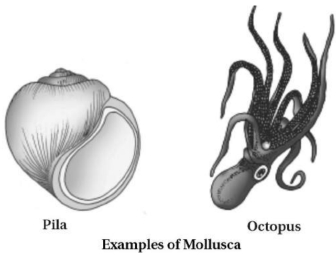
$\rightarrow$ Examples: Pila (Apple snail), Pinctada (Pearl oyster), Sepia (Cuttlefish), Loligo (Squid), Octopus (Devil fish), Aplysia (Sea hare), Dentalium (Tusk shell), and Chaetopleura (Chiton).
$\rightarrow$ Molluscs are terrestrial or aquatic (marine or fresh water) and possess an organ-system level of organization.
$\rightarrow$ They are bilaterally symmetrical, triploblastic, and coelomate animals.
$\rightarrow$ The body is covered by a calcareous shell and is unsegmented, with a distinct head, muscular foot, and visceral hump.
$\rightarrow$ The space between the hump and the mantle is called the mantle cavity, in which feather-like gills are present.
$\rightarrow$ These gills perform respiratory and excretory functions.
$\rightarrow$ The anterior head region has sensory tentacles.
$\rightarrow$ The mouth contains a file-like rasping organ for feeding, called the radula.
$\rightarrow$ They are usually dioecious and oviparous, with indirect development.
$\rightarrow$ Examples: Pila (Apple snail), Pinctada (Pearl oyster), Sepia (Cuttlefish), Loligo (Squid), Octopus (Devil fish), Aplysia (Sea hare), Dentalium (Tusk shell), and Chaetopleura (Chiton).
0 likes
View Solution104
MediumMCQ
Mollusca is
A
Triploblastic,Acoelomate
B
Triploblastic,coelomate
C
Diploblastic,Acoelomate
D
Diploblastic,coelomate
Solution
(B) Phylum-$Mollusca$ is the second largest phylum of animals.
These organisms are triploblastic,meaning they possess three germ layers (ectoderm,mesoderm,and endoderm).
They are coelomate,meaning they possess a true body cavity lined by mesoderm.
They exhibit an organ-system level of body organization.
These organisms are triploblastic,meaning they possess three germ layers (ectoderm,mesoderm,and endoderm).
They are coelomate,meaning they possess a true body cavity lined by mesoderm.
They exhibit an organ-system level of body organization.
0 likes
View Solution105
MediumMCQ
The generic name of tusk shell is
A
Dentalium
B
Chaetoderma
C
Chiton
D
Neopilina
Solution
(A) The generic name of tusk shell is $Dentalium$. It belongs to the phylum $Mollusca$ and the class $Scaphopoda$. These organisms are characterized by a tubular,tusk-shaped shell that is open at both ends.
0 likes
View Solution106
MediumMCQ
The body of an animal belonging to phylum-$Mollusca$ is divided into:
A
Head,thorax and abdomen
B
Head,muscular foot and abdomen
C
Head,thorax and visceral hump
D
Head,muscular foot and visceral hump
Solution
(D) The body of animals belonging to phylum-$Arthropoda$ is divided into head,thorax,and abdomen.
In contrast,the body of animals belonging to phylum-$Mollusca$ is unsegmented with a distinct head,a muscular foot,and a visceral hump.
In contrast,the body of animals belonging to phylum-$Mollusca$ is unsegmented with a distinct head,a muscular foot,and a visceral hump.
0 likes
View Solution107
MediumMCQ
The development of $Mollusca$ is:
A
With a larva named $trochophore$
B
Always direct without larval stages
C
With a larval stage called $glochidium$
D
With a larval stage called $wriggler$
Solution
(A) The development in $Mollusca$ can be direct or indirect. In many marine mollusks,the development includes a free-swimming larval stage known as a $trochophore$ larva. Some species also exhibit other larval forms such as the $veliger$ or $glochidium$ (in freshwater mussels). Therefore,the presence of a $trochophore$ larva is a characteristic feature of many mollusks.
0 likes
View Solution108
MediumMCQ
The feeding organ in phylum-$Mollusca$ is
A
Ctenedia
B
Undulating membrane
C
Sucker
D
Radula
Solution
(D) The feeding organ in phylum-$Mollusca$ is a $Radula$.
It is a file-like rasping organ used for feeding.
$Ctenedia$ are respiratory organs (gills) in mollusks.
Undulating membranes and suckers are structures found in other groups like protozoans or parasitic worms,not as the primary feeding organ of mollusks.
It is a file-like rasping organ used for feeding.
$Ctenedia$ are respiratory organs (gills) in mollusks.
Undulating membranes and suckers are structures found in other groups like protozoans or parasitic worms,not as the primary feeding organ of mollusks.
0 likes
View Solution109
MediumMCQ
The phylum-$Mollusca$ lacks which one of the following?
A
Visceral hump
B
Malpighian tubules
C
Gills
D
Radula
Solution
(B) Phylum-$Mollusca$ lacks $Malpighian$ tubules.
$Malpighian$ tubules are the excretory organs found in phylum-$Arthropoda$ (specifically in insects).
In contrast,mollusks possess feather-like gills located in the mantle cavity,which serve the functions of both respiration and excretion.
$Malpighian$ tubules are the excretory organs found in phylum-$Arthropoda$ (specifically in insects).
In contrast,mollusks possess feather-like gills located in the mantle cavity,which serve the functions of both respiration and excretion.
0 likes
View Solution110
MediumMCQ
In $Mollusca$,the $osphradium$ has the function of
A
Reproduction
B
Respiration
C
Testing physical and chemical qualities of water and food
D
Excretion
Solution
(C) The $osphradium$ is a specialized sensory organ found in molluscs,particularly in aquatic gastropods and bivalves.
It functions primarily as a chemoreceptor and mechanoreceptor.
Its main role is to test the physical and chemical properties of the water entering the mantle cavity,which helps in detecting the quality of food and identifying potential predators or environmental changes.
It is typically located at the base of the gills (ctenidia).
It functions primarily as a chemoreceptor and mechanoreceptor.
Its main role is to test the physical and chemical properties of the water entering the mantle cavity,which helps in detecting the quality of food and identifying potential predators or environmental changes.
It is typically located at the base of the gills (ctenidia).
0 likes
View Solution111
MediumMCQ
The body of molluscs is:
A
Unsegmented
B
Covered by a calcareous shell
C
Divided into a distinct head,muscular foot,and visceral hump
D
All of these
Solution
(D) The phylum $Mollusca$ is characterized by several key features:
$1$. The body is typically unsegmented.
$2$. The body is often covered by a calcareous shell (made of $CaCO_3$).
$3$. The body is divided into three distinct regions: a head,a muscular foot,and a visceral hump (or visceral mass).
Since all these statements are correct,the correct option is $D$.
$1$. The body is typically unsegmented.
$2$. The body is often covered by a calcareous shell (made of $CaCO_3$).
$3$. The body is divided into three distinct regions: a head,a muscular foot,and a visceral hump (or visceral mass).
Since all these statements are correct,the correct option is $D$.
0 likes
View Solution112
MediumMCQ
Which of the following structures helps in excretion and respiration in molluscs?
A
Nephridia
B
Feather-like gills
C
Flame cells
D
Tentacles
Solution
(B) In molluscs,the mantle cavity contains feather-like gills (ctenidia). These structures are specialized for gaseous exchange (respiration) and also play a significant role in the process of excretion.
0 likes
View Solution113
EasyMCQ
Radula is meant for
A
Sensation
B
Feeding
C
Egg laying
D
Protection from predators
Solution
(B) The mouth of molluscs contains a file-like rasping organ with transverse rows of chitinous teeth,which is called the radula.
Radula serves as a feeding or rasping organ in molluscs.
Radula serves as a feeding or rasping organ in molluscs.
0 likes
View Solution114
MediumMCQ
The eye of which molluscan group resembles the vertebrate eye?
A
Bivalvia
B
Gastropoda
C
Pelecypoda
D
Cephalopoda
Solution
(D) Cephalopod molluscs possess complex,camera-type eyes that are structurally and functionally analogous to the eyes of vertebrates.
This is a classic example of convergent evolution,where unrelated groups evolve similar traits to adapt to similar environmental pressures.
This is a classic example of convergent evolution,where unrelated groups evolve similar traits to adapt to similar environmental pressures.
0 likes
View Solution115
EasyMCQ
Radula is
A
Larval form of coelenterates (cnidarians)
B
File-like rasping organ of molluscs
C
Larval form of annelids
D
Uncovered structure present with echinoderms
Solution
(B) Radula is a file-like rasping organ found in the mouth of molluscs,which bears transverse rows of chitinous teeth.
Radula is primarily used for feeding purposes.
Radula is primarily used for feeding purposes.
0 likes
View Solution116
MediumMCQ
In which group of molluscs is torsion a very important event in the life history?
A
Gastropods
B
Bivalves
C
Cephalopods
D
Monoplacophora
Solution
(A) In $Gastropod$ molluscs, the early embryo is symmetrical with an anterior mouth and a posterior anus. However, during development, the visceral mass rotates $180^{\circ}$ relative to the head and foot, bringing the anus near the mouth; this process is known as torsion. As a result, the adult $Gastropod$ becomes asymmetrical.
0 likes
View Solution117
MediumMCQ
Which one of the following classes of phylum $Mollusca$ is incorrectly matched with its general characteristics?
A
$Gastropoda$ - Larvae are bilaterally symmetrical; but in adults,the twisting of viscera makes them lose this symmetry. Some,like land snails and slugs (a shell-less form),live on land.
B
$Bivalvia$ - They are sedentary filter feeders.
C
$Cephalopoda$ - They are at the apex of invertebrate evolution in terms of learned behaviour they exhibit. The eyes are image-forming,somewhat similar to ours.
D
$Pelecypoda$ - They have sensory tentacles and their foot is reduced into a tongue-shaped structure which helps them to burrow into the sea floor.
Solution
(D) $Pelecypoda$ (also known as $Bivalvia$) lack a distinct head,tentacles,eyes,jaws,and radula.
Their foot is typically hatchet-shaped and extends between the mantle lobes,used for burrowing into the substrate.
They are primarily filter feeders.
In contrast,the class $Scaphopoda$ possesses prehensile sensory tentacles on the head,and their foot is conical-shaped,adapted for digging.
Therefore,the description provided for $Pelecypoda$ is incorrect.
Their foot is typically hatchet-shaped and extends between the mantle lobes,used for burrowing into the substrate.
They are primarily filter feeders.
In contrast,the class $Scaphopoda$ possesses prehensile sensory tentacles on the head,and their foot is conical-shaped,adapted for digging.
Therefore,the description provided for $Pelecypoda$ is incorrect.
0 likes
View Solution118
MediumMCQ
$A$ : Radula is a rasping organ found in all molluscs.
$R$ : It is made up of vitrodentine.
$R$ : It is made up of vitrodentine.
A
Assertion and Reason both are correct and Reason is the correct explanation of Assertion.
B
Assertion and Reason both are correct but Reason is not the correct explanation of Assertion.
C
Assertion is correct,but Reason is incorrect.
D
Both Assertion and Reason are incorrect.
Solution
(D) The Assertion is false because the radula is not present in all molluscs. Specifically,the radula is absent in the class $Pelecypoda$ (also known as $Bivalvia$).
The Reason is also false because the radula is not made of vitrodentine; instead,it is a ribbon-like structure that bears transverse rows of chitinous teeth.
Therefore,both the Assertion and the Reason are incorrect.
The Reason is also false because the radula is not made of vitrodentine; instead,it is a ribbon-like structure that bears transverse rows of chitinous teeth.
Therefore,both the Assertion and the Reason are incorrect.
0 likes
View Solution119
MediumMCQ
There is no capillary system in most invertebrates,except in:
A
Crustaceans
B
Cephalopods
C
Insects
D
Gastropods
Solution
(B) Most invertebrates possess an open circulatory system where blood flows into open spaces called sinuses,lacking a capillary network. However,$Cephalopods$ (such as squids and octopuses) possess a closed circulatory system,which includes a well-developed capillary network to facilitate efficient gas exchange and nutrient transport.
0 likes
View Solution120
EasyMCQ
The connecting link between $Annelida$ and $Mollusca$ is:
A
Peripatus
B
Lepidosiren
C
Neopilina
D
Protopterus
Solution
(C) connecting link is an organism that exhibits characteristics of two different taxonomic groups,indicating an evolutionary relationship.
$Neopilina$ is a primitive mollusk that shows segmented body structures,which is a characteristic feature of $Annelida$,while also possessing typical molluscan features like a shell and a mantle.
Therefore,$Neopilina$ serves as a connecting link between the phylum $Annelida$ and $Mollusca$.
$Neopilina$ is a primitive mollusk that shows segmented body structures,which is a characteristic feature of $Annelida$,while also possessing typical molluscan features like a shell and a mantle.
Therefore,$Neopilina$ serves as a connecting link between the phylum $Annelida$ and $Mollusca$.
0 likes
View Solution121
EasyMCQ
What is the location and function of the radula?
A
Location: Mantle cavity; Function: Respiration
B
Location: Mouth; Function: Rasping organ for feeding
C
Location: Foot; Function: Locomotion
D
Location: Visceral hump; Function: Digestion
Solution
(B) $\rightarrow$ Location: The mouth of mollusks contains a file-like rasping organ known as the radula.
$\rightarrow$ Function: It acts as a rasping organ that assists in the process of feeding by scraping food particles.
$\rightarrow$ Function: It acts as a rasping organ that assists in the process of feeding by scraping food particles.
0 likes
View Solution122
EasyMCQ
What is the role of radula in molluscs?
A
Locomotion
B
Feeding and boring
C
Respiration
D
Excretion
Solution
(B) The radula is a file-like,rasping organ present in the buccal cavity of most molluscs.
It functions primarily in feeding by scraping or rasping food particles.
Additionally,it is used for boring or creating depressions in rocks,which these animals often use as a habitat or shelter.
It functions primarily in feeding by scraping or rasping food particles.
Additionally,it is used for boring or creating depressions in rocks,which these animals often use as a habitat or shelter.
0 likes
View Solution123
EasyMCQ
Which is the second largest phylum in the animal kingdom?
A
Arthropoda
B
Mollusca
C
Echinodermata
D
Hemichordata
Solution
(B) The animal kingdom is classified into various phyla based on their characteristics.
Arthropoda is the largest phylum,comprising approximately two-thirds of all named species on Earth.
Mollusca is the second largest phylum in the animal kingdom,characterized by a soft body,often protected by a calcareous shell.
Arthropoda is the largest phylum,comprising approximately two-thirds of all named species on Earth.
Mollusca is the second largest phylum in the animal kingdom,characterized by a soft body,often protected by a calcareous shell.
0 likes
View Solution124
MediumMCQ
Identify the function of the feather-like gills present in snails.
A
Respiration
B
Excretion
C
Digestion
D
Both $A$ and $B$
Solution
(D) Snails belong to the phylum $Mollusca$.
In mollusks,the mantle cavity contains feather-like gills (ctenidia).
These gills serve two primary functions: they are involved in respiration (gas exchange) and also play a role in excretion.
Therefore,both respiration and excretion are the correct functions.
In mollusks,the mantle cavity contains feather-like gills (ctenidia).
These gills serve two primary functions: they are involved in respiration (gas exchange) and also play a role in excretion.
Therefore,both respiration and excretion are the correct functions.
0 likes
View Solution125
MediumMCQ
In $Mollusca$,the radula is a part of the:
A
Digestive system
B
Excretory system
C
Nervous system
D
Skeletal system
Solution
(A) The radula is a file-like rasping organ present in the mouth of mollusks.
It is used for feeding and is a characteristic feature of the phylum $Mollusca$.
Since it is involved in the process of ingestion and food processing,it is considered a part of the digestive system.
It is used for feeding and is a characteristic feature of the phylum $Mollusca$.
Since it is involved in the process of ingestion and food processing,it is considered a part of the digestive system.
0 likes
View Solution126
MediumMCQ
Which phylum is characterized by the presence of a head,a muscular foot,and a visceral hump?
A
Chordata
B
Hemichordata
C
Echinodermata
D
Mollusca
Solution
(D) The phylum $Mollusca$ is the second-largest animal phylum.
Its body is unsegmented with a distinct head,a muscular foot,and a visceral hump.
$A$ soft and spongy layer of skin forms a mantle over the visceral hump.
The space between the hump and the mantle is called the mantle cavity in which feather-like gills are present.
Its body is unsegmented with a distinct head,a muscular foot,and a visceral hump.
$A$ soft and spongy layer of skin forms a mantle over the visceral hump.
The space between the hump and the mantle is called the mantle cavity in which feather-like gills are present.
0 likes
View Solution127
MediumMCQ
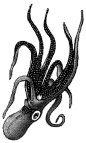
Identify the symmetry of the animal shown in the image.
A
Radial symmetry
B
Bilateral symmetry
C
Asymmetry
D
None of these
Solution
(B) The animal shown in the image is an Octopus,which belongs to the phylum Mollusca.
Most mollusks,including cephalopods like the Octopus,exhibit bilateral symmetry,meaning their body can be divided into two identical left and right halves along a single plane.
Most mollusks,including cephalopods like the Octopus,exhibit bilateral symmetry,meaning their body can be divided into two identical left and right halves along a single plane.
0 likes
View Solution128
MediumMCQ
In which phylum is the body unsegmented with a distinct head,muscular foot,and visceral hump?
A
Mollusca
B
Echinodermata
C
Hemichordata
D
Annelida
Solution
(A) The phylum $Mollusca$ is characterized by an unsegmented body with a distinct head,a muscular foot,and a visceral hump.
These organisms typically have a mantle cavity and a shell (though not always present).
$Echinodermata$ are characterized by a water vascular system and radial symmetry in adults.
$Hemichordata$ are worm-like marine animals with a proboscis,collar,and trunk.
$Annelida$ are characterized by a segmented body (metamerism).
These organisms typically have a mantle cavity and a shell (though not always present).
$Echinodermata$ are characterized by a water vascular system and radial symmetry in adults.
$Hemichordata$ are worm-like marine animals with a proboscis,collar,and trunk.
$Annelida$ are characterized by a segmented body (metamerism).
0 likes
View Solution129
EasyMCQ
$A$ file-like rasping organ called radula is found in $-$
A
Sepia
B
Asterias
C
Balanoglossus
D
Musca
Solution
(A) The radula is a specialized anatomical structure found in the phylum $Mollusca$.
It is a file-like,rasping organ used for feeding,which helps in scraping food particles.
Among the given options,$Sepia$ belongs to the class $Cephalopoda$ of the phylum $Mollusca$.
$Asterias$ belongs to the phylum $Echinodermata$,$Balanoglossus$ belongs to the phylum $Hemichordata$,and $Musca$ belongs to the phylum $Arthropoda$ (class $Insecta$).
Therefore,the correct answer is $Sepia$.
It is a file-like,rasping organ used for feeding,which helps in scraping food particles.
Among the given options,$Sepia$ belongs to the class $Cephalopoda$ of the phylum $Mollusca$.
$Asterias$ belongs to the phylum $Echinodermata$,$Balanoglossus$ belongs to the phylum $Hemichordata$,and $Musca$ belongs to the phylum $Arthropoda$ (class $Insecta$).
Therefore,the correct answer is $Sepia$.
0 likes
View Solution130
MediumMCQ
Radula is a file-like rasping organ for feeding in $-$
A
Echinodermata
B
Annelida
C
Mollusca
D
Hemichordata
Solution
(C) The $Radula$ is a unique anatomical structure found in the phylum $Mollusca$ (except in bivalves).
It is a chitinous,ribbon-like structure equipped with rows of small teeth,which functions as a file-like rasping organ used for scraping or cutting food particles.
Therefore,the correct answer is $Mollusca$.
It is a chitinous,ribbon-like structure equipped with rows of small teeth,which functions as a file-like rasping organ used for scraping or cutting food particles.
Therefore,the correct answer is $Mollusca$.
0 likes
View Solution131
EasyMCQ
In which animal is the body divided into a head,muscular foot,and visceral hump?
A
Starfish
B
Balanoglossus
C
Snail
D
Locust
Solution
(C) The body of mollusks is unsegmented with a distinct head,muscular foot,and visceral hump. Among the given options,the $Snail$ belongs to the Phylum $Mollusca$. $Starfish$ belongs to $Echinodermata$,$Balanoglossus$ belongs to $Hemichordata$,and $Locust$ belongs to $Arthropoda$. Therefore,the correct answer is $Snail$.
0 likes
View SolutionAnimal Kingdom — Phylum-Mollusca · Frequently Asked Questions
1Are these Animal Kingdom questions useful for JEE and NEET?
Yes. All questions in this section are mapped to JEE Main and NEET exam patterns. Previous year questions from JEE Main, NEET, GUJCET and state-level exams are included with full solutions.
2Can I switch to Hindi or Gujarati for these questions?
Yes. Use the language tabs in the hero section or the sidebar to view the same questions and solutions in English, Hindi or Gujarati.
3How do I generate a question paper from this subtopic?
Use the Vedclass Exam Paper Generator — select the chapter and subtopic, set difficulty, and generate Sets A, B, C, D automatically. First 3 chapters of every subject are free.
Vedclass Products
For Students
Vedclass Test Series
Mock tests in real JEE/NEET style with performance analysis. 5-day free trial.
Start Free TrialFor Teachers
Exam Paper Generator
Generate Set A/B/C/D papers from this chapter in 2 minutes. 3 chapters free.
Try FreeFor Institutes
Online Exam Module
Live online exams with unlimited students, 360° analytics & white-label branding.
See DemoFor Teachers & Institutes
Generate a Animal Kingdom Exam Paper in 2 Minutes
Select subtopic & difficulty — Sets A, B, C, D auto-generated with No Repeat logic.
First 3 chapters of every subject are free — no payment required.