
A English
Phylum-Arthropoda Questions in English
Class 11 Biology · Animal Kingdom · Phylum-Arthropoda
238+
Questions
English
Language
100%
With Solutions
Showing 50 of 238 questions in English
151
EasyMCQ
Silverfish is included in which of the following phyla?
A
Arthropoda
B
Echinodermata
C
Pisces
D
Mammalia
Solution
(A) Silverfish ($Lepisma$ $saccharina$) is a small,wingless insect.
Insects belong to the phylum $Arthropoda$ because they possess jointed appendages and a chitinous exoskeleton.
Despite its name,it is not a fish $(Pisces)$ but an invertebrate belonging to the class $Insecta$ under the phylum $Arthropoda$.
Insects belong to the phylum $Arthropoda$ because they possess jointed appendages and a chitinous exoskeleton.
Despite its name,it is not a fish $(Pisces)$ but an invertebrate belonging to the class $Insecta$ under the phylum $Arthropoda$.
0 likes
View Solution152
MediumMCQ
In which of the following animal phyla is the blood volume high,pressure low,and flow irregular?
A
Arthropoda
B
Amphibia
C
Annelida
D
Reptilia
Solution
(A) In the phylum $Arthropoda$,the circulatory system is of the open type. In an open circulatory system,blood is pumped out of the heart into blood spaces or sinuses called $haemocoel$. Because the blood is not confined to vessels,it flows at a low pressure,the volume of blood is relatively high,and the flow is irregular as it bathes the tissues directly.
0 likes
View Solution153
EasyMCQ
The sensory organs of prawns are .........
A
Chemoreceptors and tangoreceptors
B
Statocysts
C
Auditory organs
D
All of the above
Solution
(D) In prawns (Crustacea),the sensory organs include:
$1$. Chemoreceptors and tangoreceptors: These are present on the antennae and antennules to detect chemical changes and touch.
$2$. Statocysts: These are balancing organs located at the base of the antennules.
$3$. Auditory organs: Prawns possess sensory structures that respond to vibrations in the water.
Therefore,all the listed options are sensory organs found in prawns.
$1$. Chemoreceptors and tangoreceptors: These are present on the antennae and antennules to detect chemical changes and touch.
$2$. Statocysts: These are balancing organs located at the base of the antennules.
$3$. Auditory organs: Prawns possess sensory structures that respond to vibrations in the water.
Therefore,all the listed options are sensory organs found in prawns.
0 likes
View Solution154
EasyMCQ
The cephalothorax is a structure formed by the fusion of:
A
Head and abdomen
B
Head and thorax
C
Abdomen and thorax
D
Fluid present in the head region
Solution
(B) The cephalothorax is a body region found in many arthropods,such as crustaceans and arachnids. It is formed by the fusion of the head $(cephalon)$ and the thorax $(thorax)$. This fused structure provides a rigid protective covering for the vital organs located in the anterior part of the body.
0 likes
View Solution155
MediumMCQ
Which group of animals reproduces by parthenogenesis?
A
Arthropoda
B
Mollusca
C
Annelida
D
Nematoda
Solution
(A) Parthenogenesis is a form of asexual reproduction in which an embryo develops from an unfertilized egg. In the phylum $Arthropoda$,specifically within the class $Insecta$ (e.g.,honey bees,aphids),parthenogenesis is a well-documented phenomenon. Therefore,the correct group is $Arthropoda$.
0 likes
View Solution156
EasyMCQ
The respiratory pigment in crustaceans is:
A
Hemoglobin
B
Myoglobin
C
Hemocyanin
D
Phycocyanin
Solution
(C) Crustaceans,which belong to the phylum $Arthropoda$,typically use $Hemocyanin$ as their respiratory pigment.
$Hemocyanin$ is a copper-containing protein that turns blue when oxygenated.
Unlike $Hemoglobin$,which contains iron and is found in red blood cells,$Hemocyanin$ is dissolved directly in the hemolymph of these organisms.
$Hemocyanin$ is a copper-containing protein that turns blue when oxygenated.
Unlike $Hemoglobin$,which contains iron and is found in red blood cells,$Hemocyanin$ is dissolved directly in the hemolymph of these organisms.
0 likes
View Solution157
MediumMCQ
Which of the following animals contains $Hemocyanin$ as a respiratory pigment?
A
Earthworm
B
Cockroach
C
Frog
D
Prawn
Solution
(D) $Hemocyanin$ is a copper-containing respiratory pigment that gives blood a blue color when oxygenated.
It is commonly found in the hemolymph of many mollusks and arthropods,such as crustaceans (e.g.,prawns,crabs,and lobsters).
Earthworms use $Hemoglobin$ (dissolved in plasma).
Cockroaches have an open circulatory system without respiratory pigments in their hemolymph.
Frogs use $Hemoglobin$ (contained in red blood cells).
Therefore,the correct answer is $Prawn$.
It is commonly found in the hemolymph of many mollusks and arthropods,such as crustaceans (e.g.,prawns,crabs,and lobsters).
Earthworms use $Hemoglobin$ (dissolved in plasma).
Cockroaches have an open circulatory system without respiratory pigments in their hemolymph.
Frogs use $Hemoglobin$ (contained in red blood cells).
Therefore,the correct answer is $Prawn$.
0 likes
View Solution158
EasyMCQ
In crustaceans,the respiratory pigment is ..........
A
Hemoglobin
B
Myoglobin
C
Hemocyanin
D
Tyrosine
Solution
(C) In crustaceans (a group of arthropods),the respiratory pigment is $Hemocyanin$.
$Hemocyanin$ is a copper-containing protein that binds to oxygen and gives the blood a blue color when oxygenated.
Unlike hemoglobin,which contains iron and is found in red blood cells,hemocyanin is dissolved directly in the hemolymph of crustaceans.
$Hemocyanin$ is a copper-containing protein that binds to oxygen and gives the blood a blue color when oxygenated.
Unlike hemoglobin,which contains iron and is found in red blood cells,hemocyanin is dissolved directly in the hemolymph of crustaceans.
0 likes
View Solution159
MediumMCQ
Which of the following features is not present in the Phylum Arthropoda?
A
Parapodia
B
Jointed appendages
C
Chitinous exoskeleton
D
Metameric segmentation
Solution
(A) : Parapodia are flattened,fleshy,lateral outgrowths of the body wall found in $Annelida$. These are not present in $Arthropoda$. $Arthropoda$ are characterized by jointed appendages,a chitinous exoskeleton,and metameric segmentation. Parapodia serve the purpose of locomotion and respiration in annelids like $Nereis$.
0 likes
View Solution160
MediumMCQ
Which of the following characteristics is mainly responsible for the diversification of insects on land?
A
Exoskeleton
B
Eyes
C
Segmentation
D
Bilateral symmetry
Solution
(A) : The exoskeleton,composed of a chitinous cuticle,is the primary factor that has enabled insects to colonize land and diversify into almost all possible habitats. It provides essential protection,structural support,and significantly helps in preventing desiccation (water loss).
0 likes
View Solution161
EasyMCQ
One of the representatives of Phylum $Arthropoda$ is
A
puffer fish
B
flying fish
C
cuttle fish
D
silver fish
Solution
(D) : Phylum $Arthropoda$ is the largest phylum of $Animalia$ which includes insects.
Examples include $Apis$,silkworm,$Laccifer$,silver fish $(Lepisma)$,locust,etc.
Puffer fish and flying fish $(Exocoetus)$ are examples of superclass $Pisces$,while cuttle fish $(Sepia)$ belongs to phylum $Mollusca$.
Examples include $Apis$,silkworm,$Laccifer$,silver fish $(Lepisma)$,locust,etc.
Puffer fish and flying fish $(Exocoetus)$ are examples of superclass $Pisces$,while cuttle fish $(Sepia)$ belongs to phylum $Mollusca$.
0 likes
View Solution162
MediumMCQ
Which one of the following phyla is correctly matched with its two general characteristics?
A
Echinodermata: pentamerous radial symmetry and mostly internal fertilization
B
Mollusca: normally oviparous and development through a trochophore or veliger larva
C
Arthropoda: body divided into head,thorax and abdomen and respiration by tracheae
D
Chordata: notochord at some stage and separate anal and urinary openings to the outside
Solution
(C) is the correct answer. Arthropoda is the largest phylum of Kingdom Animalia,characterized by a chitinous exoskeleton. The body is typically divided into three distinct regions: head,thorax,and abdomen. Respiration in terrestrial arthropods occurs through specialized structures such as tracheae,book lungs,or book gills.
0 likes
View Solution163
MediumMCQ
Two common characters found in centipede,cockroach,and crab are
A
book lungs and antennae
B
compound eyes and anal cerci
C
jointed legs and chitinous exoskeleton
D
green gland and tracheae
Solution
(C) : Centipede,cockroach,and crab all belong to the phylum $Arthropoda$,which is characterized by the presence of jointed legs and a chitinous exoskeleton.
Arthropods possess a bilaterally symmetrical and metamerically segmented body with a haemocoel and an open blood vascular system.
Arthropods possess a bilaterally symmetrical and metamerically segmented body with a haemocoel and an open blood vascular system.
0 likes
View Solution164
MediumMCQ
Choose the false pair.
A
Lepidopterans - armyworm
B
Coleopterans - beetles
C
Insects - Crab
D
Dipterans - Mosquitoes
Solution
(C) The classification of insects based on their orders is as follows:
$1$. Lepidopterans include tobacco budworm and armyworm.
$2$. Coleopterans include beetles.
$3$. Dipterans include flies and mosquitoes.
$4$. Crabs belong to the phylum Arthropoda but are classified under the class Crustacea,not Insecta. Therefore,the pair 'Insects - Crab' is false.
$1$. Lepidopterans include tobacco budworm and armyworm.
$2$. Coleopterans include beetles.
$3$. Dipterans include flies and mosquitoes.
$4$. Crabs belong to the phylum Arthropoda but are classified under the class Crustacea,not Insecta. Therefore,the pair 'Insects - Crab' is false.
0 likes
View Solution165
MediumMCQ
What is the phylum of the class $Insecta$?
A
Chordata
B
Diptera
C
Arthropoda
D
Musca
Solution
(C) The classification hierarchy of organisms is organized into categories: Kingdom,Phylum,Class,Order,Family,Genus,and Species.
$Insecta$ is a class within the phylum $Arthropoda$.
$Diptera$ is an order within the class $Insecta$.
$Musca$ is a genus within the family $Muscidae$.
Therefore,the correct phylum for $Insecta$ is $Arthropoda$.
$Insecta$ is a class within the phylum $Arthropoda$.
$Diptera$ is an order within the class $Insecta$.
$Musca$ is a genus within the family $Muscidae$.
Therefore,the correct phylum for $Insecta$ is $Arthropoda$.
0 likes
View Solution166
MediumMCQ
Which group of animals belongs to the same phylum?
A
Earthworm,Liver fluke,Tapeworm
B
Prawn,Scorpion,Locusta
C
Sponge,Sea anemone,Starfish
D
Malarial parasite,Amoeba,Mosquito
Solution
(B) To determine the correct group,we must identify the phylum for each organism:
$1$. Option $A$: Earthworm (Annelida),Liver fluke (Platyhelminthes),Tapeworm (Platyhelminthes). These do not belong to the same phylum.
$2$. Option $B$: Prawn (Arthropoda),Scorpion (Arthropoda),Locusta (Arthropoda). All these organisms belong to the phylum $Arthropoda$.
$3$. Option $C$: Sponge (Porifera),Sea anemone (Cnidaria),Starfish (Echinodermata). These belong to different phyla.
$4$. Option $D$: Malarial parasite (Protozoa),Amoeba (Protozoa),Mosquito (Arthropoda). These belong to different phyla.
Therefore,the correct group is $B$.
$1$. Option $A$: Earthworm (Annelida),Liver fluke (Platyhelminthes),Tapeworm (Platyhelminthes). These do not belong to the same phylum.
$2$. Option $B$: Prawn (Arthropoda),Scorpion (Arthropoda),Locusta (Arthropoda). All these organisms belong to the phylum $Arthropoda$.
$3$. Option $C$: Sponge (Porifera),Sea anemone (Cnidaria),Starfish (Echinodermata). These belong to different phyla.
$4$. Option $D$: Malarial parasite (Protozoa),Amoeba (Protozoa),Mosquito (Arthropoda). These belong to different phyla.
Therefore,the correct group is $B$.
0 likes
View Solution167
EasyMCQ
One of the representatives of phylum $Arthropoda$ is:
A
Silverfish
B
Pufferfish
C
Flying fish
D
Cuttlefish
Solution
(A) The phylum $Arthropoda$ includes animals with jointed appendages and a chitinous exoskeleton.
$Silverfish$ ($Lepisma$ $saccharina$) is a wingless insect belonging to the class $Insecta$ of the phylum $Arthropoda$.
$Pufferfish$ is a bony fish belonging to the phylum $Chordata$.
$Flying$ $fish$ $(Exocoetus)$ is a bony fish belonging to the phylum $Chordata$.
$Cuttlefish$ $(Sepia)$ is a mollusk belonging to the phylum $Mollusca$.
Therefore,the correct representative of $Arthropoda$ is $Silverfish$.
$Silverfish$ ($Lepisma$ $saccharina$) is a wingless insect belonging to the class $Insecta$ of the phylum $Arthropoda$.
$Pufferfish$ is a bony fish belonging to the phylum $Chordata$.
$Flying$ $fish$ $(Exocoetus)$ is a bony fish belonging to the phylum $Chordata$.
$Cuttlefish$ $(Sepia)$ is a mollusk belonging to the phylum $Mollusca$.
Therefore,the correct representative of $Arthropoda$ is $Silverfish$.
0 likes
View Solution168
MediumMCQ
Which animal in the phylum $Arthropoda$ acts as a vector?
A
$Locusta$
B
$Anopheles$
C
$Limulus$
D
All of the above
Solution
(B) In the phylum $Arthropoda$,vectors are organisms that transmit pathogens from one host to another.
$Anopheles$ is a genus of mosquitoes belonging to the phylum $Arthropoda$ and class $Insecta$.
$Anopheles$ mosquitoes act as vectors for the transmission of the malaria parasite $(Plasmodium)$.
$Locusta$ (locust) is a gregarious pest,and $Limulus$ (king crab) is a living fossil; neither acts as a disease vector.
Therefore,the correct option is $B$.
$Anopheles$ is a genus of mosquitoes belonging to the phylum $Arthropoda$ and class $Insecta$.
$Anopheles$ mosquitoes act as vectors for the transmission of the malaria parasite $(Plasmodium)$.
$Locusta$ (locust) is a gregarious pest,and $Limulus$ (king crab) is a living fossil; neither acts as a disease vector.
Therefore,the correct option is $B$.
0 likes
View Solution169
MediumMCQ
Cockroach is included in the ............ phylum.
A
Hemichordata
B
Chordata
C
Mollusca
D
Arthropoda
Solution
(D) The cockroach belongs to the phylum $Arthropoda$.
$Arthropoda$ is the largest phylum in the animal kingdom.
Key characteristics of $Arthropoda$ include jointed appendages,a chitinous exoskeleton,and a segmented body.
Cockroaches are specifically classified under the class $Insecta$ within the phylum $Arthropoda$.
$Arthropoda$ is the largest phylum in the animal kingdom.
Key characteristics of $Arthropoda$ include jointed appendages,a chitinous exoskeleton,and a segmented body.
Cockroaches are specifically classified under the class $Insecta$ within the phylum $Arthropoda$.
0 likes
View Solution170
EasyMCQ
Ecdysis (moulting) is the shedding of $..........$.
A
Stratum corneum
B
Epidermis
C
Endodermis
D
Stratum malpighii
Solution
(B) Ecdysis,also known as moulting,is the process of shedding the old exoskeleton or cuticle in arthropods and some other invertebrates.
In these organisms,the outer layer of the body,which is the epidermis (specifically the cuticle secreted by the epidermis),must be shed to allow for growth.
Therefore,ecdysis is the shedding of the epidermis or its derivatives (cuticle).
In these organisms,the outer layer of the body,which is the epidermis (specifically the cuticle secreted by the epidermis),must be shed to allow for growth.
Therefore,ecdysis is the shedding of the epidermis or its derivatives (cuticle).
0 likes
View Solution171
MediumMCQ
In many arthropods,the head and thorax are fused to form a cephalothorax. However,in which of the following classes of animals is the body divided into head,thorax,and abdomen?
A
Insecta
B
Myriapoda
C
Crustacea
D
Arachnida and Crustacea
Solution
(A) In the phylum $Arthropoda$,the body is typically divided into three regions: head,thorax,and abdomen.
In the class $Insecta$ (Hexapoda),the body is clearly segmented into these three distinct regions.
In contrast,many members of the classes $Crustacea$ and $Arachnida$ exhibit a fused head and thorax,known as a cephalothorax.
In the class $Insecta$ (Hexapoda),the body is clearly segmented into these three distinct regions.
In contrast,many members of the classes $Crustacea$ and $Arachnida$ exhibit a fused head and thorax,known as a cephalothorax.
0 likes
View Solution172
MediumMCQ
Which two common features are found in centipedes,cockroaches,and crabs?
A
Jointed appendages and chitinous exoskeleton
B
Green glands and tracheae
C
Book lungs and antennae
D
Compound eyes and anal cerci
Solution
(A) Centipedes,cockroaches,and crabs all belong to the phylum $Arthropoda$.
Key characteristics of the phylum $Arthropoda$ include the presence of jointed appendages ($arthros$ = joint,$poda$ = foot) and a tough,protective chitinous exoskeleton.
Green glands are specific to some crustaceans,tracheae are found in insects and myriapods,and book lungs are found in arachnids,but jointed appendages and a chitinous exoskeleton are universal features across all these classes within the phylum $Arthropoda$.
Key characteristics of the phylum $Arthropoda$ include the presence of jointed appendages ($arthros$ = joint,$poda$ = foot) and a tough,protective chitinous exoskeleton.
Green glands are specific to some crustaceans,tracheae are found in insects and myriapods,and book lungs are found in arachnids,but jointed appendages and a chitinous exoskeleton are universal features across all these classes within the phylum $Arthropoda$.
0 likes
View Solution173
MediumMCQ
Which of the following pairs correctly matches the phylum with its given characteristics?
A
Arthropoda $-$ Body divided into head,thorax,and abdomen,and respiration occurs through tracheae.
B
Chordata $-$ Notochord present during some stage and the anus and reproductive tract open into a common cloaca.
C
Echinodermata $-$ Pentamerous radial symmetry and primarily internal fertilization.
D
Mollusca $-$ Generally oviparous and development occurs through trochophore or veliger larvae.
Solution
(A) The correct answer is $A$.
$1$. In the phylum $Arthropoda$,the body is typically divided into head,thorax,and abdomen,and respiration occurs through specialized structures called tracheae.
$2$. In $Chordata$,while a notochord is present,the anus and reproductive tract do not always open into a common cloaca; this is specific to certain groups like amphibians or birds,not a general characteristic of the entire phylum.
$3$. $Echinodermata$ exhibit pentamerous radial symmetry in adults,but fertilization is primarily external,not internal.
$4$. While many $Mollusca$ are oviparous and have larval stages,option $A$ provides the most definitive and accurate anatomical description characteristic of the phylum $Arthropoda$.
$1$. In the phylum $Arthropoda$,the body is typically divided into head,thorax,and abdomen,and respiration occurs through specialized structures called tracheae.
$2$. In $Chordata$,while a notochord is present,the anus and reproductive tract do not always open into a common cloaca; this is specific to certain groups like amphibians or birds,not a general characteristic of the entire phylum.
$3$. $Echinodermata$ exhibit pentamerous radial symmetry in adults,but fertilization is primarily external,not internal.
$4$. While many $Mollusca$ are oviparous and have larval stages,option $A$ provides the most definitive and accurate anatomical description characteristic of the phylum $Arthropoda$.
0 likes
View Solution174
MediumMCQ
Which of the following sets of organisms is correctly classified?
A
Ant-eater,Sea-urchin,Sea-cucumber - Echinodermata
B
Flying fish,Sepia,Silverfish - Pisces
C
Centipede,Millipede,Spider,Scorpion - Insecta
D
Housefly,Butterfly,Tsetse fly,Silverfish - Insecta
Solution
(D) To determine the correct classification:
$A$. Ant-eater is a mammal,Sea-urchin and Sea-cucumber are Echinoderms. This set is incorrect.
$B$. Flying fish is a fish,Sepia is a Mollusc,and Silverfish is an insect. This set is incorrect.
$C$. Centipede,Millipede,Spider,and Scorpion are Arthropods but belong to different classes (Chilopoda,Diplopoda,Arachnida). They are not all insects. This set is incorrect.
$D$. Housefly,Butterfly,Tsetse fly,and Silverfish all belong to the class $Insecta$ of the phylum $Arthropoda$. This set is correct.
$A$. Ant-eater is a mammal,Sea-urchin and Sea-cucumber are Echinoderms. This set is incorrect.
$B$. Flying fish is a fish,Sepia is a Mollusc,and Silverfish is an insect. This set is incorrect.
$C$. Centipede,Millipede,Spider,and Scorpion are Arthropods but belong to different classes (Chilopoda,Diplopoda,Arachnida). They are not all insects. This set is incorrect.
$D$. Housefly,Butterfly,Tsetse fly,and Silverfish all belong to the class $Insecta$ of the phylum $Arthropoda$. This set is correct.
0 likes
View Solution175
EasyMCQ
Which of the following animals belongs to the phylum $Arthropoda$?
A
Flying fish
B
Sepia (Cuttlefish)
C
Silverfish
D
Pufferfish
Solution
(C) The phylum $Arthropoda$ includes animals with jointed appendages and a chitinous exoskeleton.
$A$. Flying fish $(Exocoetus)$ belongs to the phylum $Chordata$ (Class: $Osteichthyes$).
$B$. Sepia (Cuttlefish) belongs to the phylum $Mollusca$ (Class: $Cephalopoda$).
$C$. Silverfish $(Lepisma)$ is an insect,which belongs to the phylum $Arthropoda$ (Class: $Insecta$).
$D$. Pufferfish belongs to the phylum $Chordata$ (Class: $Osteichthyes$).
Therefore,the correct option is $C$.
$A$. Flying fish $(Exocoetus)$ belongs to the phylum $Chordata$ (Class: $Osteichthyes$).
$B$. Sepia (Cuttlefish) belongs to the phylum $Mollusca$ (Class: $Cephalopoda$).
$C$. Silverfish $(Lepisma)$ is an insect,which belongs to the phylum $Arthropoda$ (Class: $Insecta$).
$D$. Pufferfish belongs to the phylum $Chordata$ (Class: $Osteichthyes$).
Therefore,the correct option is $C$.
0 likes
View Solution176
MediumMCQ
Which of the following groups of animals belongs to the same phylum?
A
Sponge,Sea Anemone,Starfish
B
Malarial parasite,Amoeba,Mosquito
C
Earthworm,Pinworm,Tapeworm
D
Prawn,Scorpion,Locust
Solution
(D) To determine the correct group,let us analyze the phylum of each animal:
$A$. Sponge (Porifera),Sea Anemone (Cnidaria),Starfish (Echinodermata) - Different phyla.
$B$. Malarial parasite (Protozoa),Amoeba (Protozoa),Mosquito (Arthropoda) - Different phyla.
$C$. Earthworm (Annelida),Pinworm (Aschelminthes),Tapeworm (Platyhelminthes) - Different phyla.
$D$. Prawn (Arthropoda),Scorpion (Arthropoda),Locust (Arthropoda) - All belong to the phylum $Arthropoda$.
Therefore,the correct group is $D$.
$A$. Sponge (Porifera),Sea Anemone (Cnidaria),Starfish (Echinodermata) - Different phyla.
$B$. Malarial parasite (Protozoa),Amoeba (Protozoa),Mosquito (Arthropoda) - Different phyla.
$C$. Earthworm (Annelida),Pinworm (Aschelminthes),Tapeworm (Platyhelminthes) - Different phyla.
$D$. Prawn (Arthropoda),Scorpion (Arthropoda),Locust (Arthropoda) - All belong to the phylum $Arthropoda$.
Therefore,the correct group is $D$.
0 likes
View Solution177
MediumMCQ
Which of the following characteristics is $NOT$ found in animals of the phylum Arthropoda?
A
Metameric segmentation
B
Parapodia
C
Jointed appendages
D
Chitinous exoskeleton
Solution
(B) The phylum $Arthropoda$ is characterized by the presence of jointed appendages,a chitinous exoskeleton,and metameric segmentation (metamerism).
Parapodia are lateral appendages found in the phylum $Annelida$ (specifically in class $Polychaeta$,like $Nereis$),which are used for swimming and respiration.
Therefore,parapodia are not a characteristic feature of arthropods.
Parapodia are lateral appendages found in the phylum $Annelida$ (specifically in class $Polychaeta$,like $Nereis$),which are used for swimming and respiration.
Therefore,parapodia are not a characteristic feature of arthropods.
0 likes
View Solution178
EasyMCQ
Peripatus is a connecting link between . . . . . . .
A
Ctenophora and Platyhelminthes
B
Mollusca and Echinodermata
C
Annelida and Arthropoda
D
Cnidaria and Porifera
Solution
(C) Peripatus is a genus of velvet worms in the phylum Onychophora.
It exhibits characteristics of both the phylum $Annelida$ (such as segmented bodies,thin cuticle,and segmentally arranged nephridia) and the phylum $Arthropoda$ (such as tracheal respiration,open circulatory system,and jointed appendages).
Therefore,it serves as a living connecting link between $Annelida$ and $Arthropoda$.
It exhibits characteristics of both the phylum $Annelida$ (such as segmented bodies,thin cuticle,and segmentally arranged nephridia) and the phylum $Arthropoda$ (such as tracheal respiration,open circulatory system,and jointed appendages).
Therefore,it serves as a living connecting link between $Annelida$ and $Arthropoda$.
0 likes
View Solution179
EasyMCQ
Ticks and mites are actually
A
arachnids
B
crustaceans
C
insects
D
myriapods
Solution
(A) Ticks and mites belong to the class $Arachnida$ within the phylum $Arthropoda$. Other members of this class include scorpions and spiders,which are characterized by having four pairs of walking legs and lacking antennae.
0 likes
View Solution180
Difficult
What are the reasons that you can think of for the arthropods to constitute the largest group of the animal kingdom?
Solution
(N/A) The phylum $Arthropoda$ consists of more than two-thirds of the animal species on Earth.
The reasons for the success of arthropods are as follows:
$1$. Jointed appendages allow for greater mobility and versatility on land.
$2$. $A$ hard exoskeleton made of $chitin$ provides structural support and protection against predators and environmental stress.
$3$. The waxy,hard exoskeleton significantly reduces water loss from the body,making them highly adapted to diverse terrestrial conditions.
$4$. They possess a variety of sensory organs and complex behavioral patterns that aid in survival.
The reasons for the success of arthropods are as follows:
$1$. Jointed appendages allow for greater mobility and versatility on land.
$2$. $A$ hard exoskeleton made of $chitin$ provides structural support and protection against predators and environmental stress.
$3$. The waxy,hard exoskeleton significantly reduces water loss from the body,making them highly adapted to diverse terrestrial conditions.
$4$. They possess a variety of sensory organs and complex behavioral patterns that aid in survival.
1 likes
View Solution181
EasyMCQ
Identify the phylum shown in the image and provide its key characteristics.
A
Phylum: Arthropoda. Characteristics: Jointed appendages,chitinous exoskeleton,and segmented body.
B
Phylum: Mollusca. Characteristics: Soft body,mantle,and muscular foot.
C
Phylum: Annelida. Characteristics: Metamerically segmented body and closed circulatory system.
D
Phylum: Echinodermata. Characteristics: Water vascular system and radial symmetry.
Solution
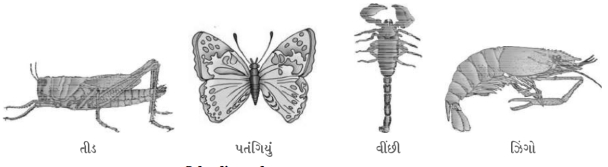
(A) The image displays organisms belonging to the phylum $Arthropoda$ (Locust,Butterfly,Scorpion,and Prawn).
Key characteristics of phylum $Arthropoda$ include:
$1$. They have an organ-system level of body organization.
$2$. They are bilaterally symmetrical,triploblastic,segmented,and coelomate animals.
$3$. The body is covered by a chitinous exoskeleton.
$4$. The body consists of head,thorax,and abdomen.
$5$. They have jointed appendages (arthros = joint,poda = appendages).
$6$. Respiration takes place through gills,book gills,book lungs,or tracheal system.
$7$. Circulatory system is of open type.
$8$. Sensory organs like antennae,eyes (compound and simple),statocysts,or balance organs are present.
$9$. Excretion takes place through Malpighian tubules.
$10$. They are mostly dioecious,and fertilization is usually internal.
Key characteristics of phylum $Arthropoda$ include:
$1$. They have an organ-system level of body organization.
$2$. They are bilaterally symmetrical,triploblastic,segmented,and coelomate animals.
$3$. The body is covered by a chitinous exoskeleton.
$4$. The body consists of head,thorax,and abdomen.
$5$. They have jointed appendages (arthros = joint,poda = appendages).
$6$. Respiration takes place through gills,book gills,book lungs,or tracheal system.
$7$. Circulatory system is of open type.
$8$. Sensory organs like antennae,eyes (compound and simple),statocysts,or balance organs are present.
$9$. Excretion takes place through Malpighian tubules.
$10$. They are mostly dioecious,and fertilization is usually internal.
0 likes
View Solution182
Easy
Describe the largest phylum of Animalia.
Solution
(N/A) $\rightarrow$ Arthropoda is the largest phylum of Animalia which includes insects.
$\rightarrow$ Over two-thirds of all named species on earth are arthropods.
$\rightarrow$ They have organ-system level of organisation.
$\rightarrow$ They are bilaterally symmetrical,triploblastic,segmented and coelomate animals.
$\rightarrow$ The body of arthropods is covered by chitinous exoskeleton.
$\rightarrow$ The body consists of head,thorax and abdomen.
$\rightarrow$ They have jointed appendages (arthros-joint,poda-appendages).
$\rightarrow$ Respiratory organs are gills,book gills,book lungs or tracheal system.
$\rightarrow$ Circulatory system is of open type.
$\rightarrow$ Sensory organs like antennae,eyes (compound and simple),statocysts or balance organs are present.
$\rightarrow$ Excretion takes place through malpighian tubules.
$\rightarrow$ They are mostly dioecious.
$\rightarrow$ Fertilisation is usually internal.
$\rightarrow$ They are mostly oviparous.
$\rightarrow$ Development may be direct or indirect.
$\rightarrow$ Examples: Economically important insects -
$\rightarrow$ Apis (Honey bee)
$\rightarrow$ Bombyx (Silkworm)
$\rightarrow$ Laccifer (Lac insect)
$\rightarrow$ Over two-thirds of all named species on earth are arthropods.
$\rightarrow$ They have organ-system level of organisation.
$\rightarrow$ They are bilaterally symmetrical,triploblastic,segmented and coelomate animals.
$\rightarrow$ The body of arthropods is covered by chitinous exoskeleton.
$\rightarrow$ The body consists of head,thorax and abdomen.
$\rightarrow$ They have jointed appendages (arthros-joint,poda-appendages).
$\rightarrow$ Respiratory organs are gills,book gills,book lungs or tracheal system.
$\rightarrow$ Circulatory system is of open type.
$\rightarrow$ Sensory organs like antennae,eyes (compound and simple),statocysts or balance organs are present.
$\rightarrow$ Excretion takes place through malpighian tubules.
$\rightarrow$ They are mostly dioecious.
$\rightarrow$ Fertilisation is usually internal.
$\rightarrow$ They are mostly oviparous.
$\rightarrow$ Development may be direct or indirect.
$\rightarrow$ Examples: Economically important insects -
$\rightarrow$ Apis (Honey bee)
$\rightarrow$ Bombyx (Silkworm)
$\rightarrow$ Laccifer (Lac insect)
0 likes
View Solution183
EasyMCQ
In which animals is an open circulatory system seen?
A
Arthropods and Molluscs
B
Annelids and Chordates
C
Amphibians and Reptiles
D
Birds and Mammals
Solution
(A) An open circulatory system is a type of circulatory system where the blood is pumped into body cavities (hemocoel) and the tissues are bathed in blood directly. This type of circulatory system is characteristic of Arthropods and most Molluscs.
0 likes
View Solution184
Medium
Write a short note on Phylum Arthropoda.
Solution
(N/A) $\rightarrow$ Arthropoda is the largest phylum of Kingdom Animalia,which includes insects.
$\rightarrow$ Over two-thirds of all named species on earth are arthropods.
$\rightarrow$ They exhibit an organ-system level of body organization.
$\rightarrow$ They are bilaterally symmetrical,triploblastic,segmented,and coelomate animals.
$\rightarrow$ The body of arthropods is covered by a chitinous exoskeleton.
$\rightarrow$ The body consists of a head,thorax,and abdomen.
$\rightarrow$ They possess jointed appendages (arthros = joint,poda = appendages).
$\rightarrow$ Respiratory organs include gills,book gills,book lungs,or a tracheal system.
$\rightarrow$ The circulatory system is of the open type.
$\rightarrow$ Sensory organs like antennae,eyes (compound and simple),and statocysts (balance organs) are present.
$\rightarrow$ Excretion takes place through Malpighian tubules.
$\rightarrow$ They are mostly dioecious.
$\rightarrow$ Fertilization is usually internal.
$\rightarrow$ They are mostly oviparous.
$\rightarrow$ Development may be direct or indirect.
$\rightarrow$ Examples of economically important insects:
$\rightarrow$ $Apis$ (Honey bee)
$\rightarrow$ $Bombyx$ (Silkworm)
$\rightarrow$ $Laccifer$ (Lac insect)
$\rightarrow$ Over two-thirds of all named species on earth are arthropods.
$\rightarrow$ They exhibit an organ-system level of body organization.
$\rightarrow$ They are bilaterally symmetrical,triploblastic,segmented,and coelomate animals.
$\rightarrow$ The body of arthropods is covered by a chitinous exoskeleton.
$\rightarrow$ The body consists of a head,thorax,and abdomen.
$\rightarrow$ They possess jointed appendages (arthros = joint,poda = appendages).
$\rightarrow$ Respiratory organs include gills,book gills,book lungs,or a tracheal system.
$\rightarrow$ The circulatory system is of the open type.
$\rightarrow$ Sensory organs like antennae,eyes (compound and simple),and statocysts (balance organs) are present.
$\rightarrow$ Excretion takes place through Malpighian tubules.
$\rightarrow$ They are mostly dioecious.
$\rightarrow$ Fertilization is usually internal.
$\rightarrow$ They are mostly oviparous.
$\rightarrow$ Development may be direct or indirect.
$\rightarrow$ Examples of economically important insects:
$\rightarrow$ $Apis$ (Honey bee)
$\rightarrow$ $Bombyx$ (Silkworm)
$\rightarrow$ $Laccifer$ (Lac insect)
0 likes
View Solution185
MediumMCQ
Which of the following organisms is included in the order $Coleoptera$?
A
Tobacco budworms
B
Armyworms
C
Mosquitoes
D
Beetles
Solution
(D) The order $Coleoptera$ consists of insects commonly known as beetles.
$Tobacco$ $budworms$ and $armyworms$ belong to the order $Lepidoptera$.
$Mosquitoes$ belong to the order $Diptera$.
Therefore,$Beetles$ are the organisms that fall under the order $Coleoptera$.
$Tobacco$ $budworms$ and $armyworms$ belong to the order $Lepidoptera$.
$Mosquitoes$ belong to the order $Diptera$.
Therefore,$Beetles$ are the organisms that fall under the order $Coleoptera$.
0 likes
View Solution186
MediumMCQ
Arthropods are characterized by
A
Jointed appendages
B
Open blood vascular system
C
Triploblastic
D
All of the above
Solution
(D) Arthropoda is the largest phylum in the animal kingdom.
Arthropods are characterized by several key features,including a bilaterally symmetrical body,being triploblastic,and having metamerically segmented bodies.
They possess jointed appendages,which is the defining characteristic of the phylum (the name Arthropoda is derived from 'arthros' meaning joint and 'poda' meaning foot).
Additionally,they have an open circulatory system where the blood flows into body cavities (hemocoel).
Since all the given options are correct features of Arthropoda,the correct answer is $D$.
Arthropods are characterized by several key features,including a bilaterally symmetrical body,being triploblastic,and having metamerically segmented bodies.
They possess jointed appendages,which is the defining characteristic of the phylum (the name Arthropoda is derived from 'arthros' meaning joint and 'poda' meaning foot).
Additionally,they have an open circulatory system where the blood flows into body cavities (hemocoel).
Since all the given options are correct features of Arthropoda,the correct answer is $D$.
0 likes
View Solution187
MediumMCQ
Exoskeleton of which phylum consists of a chitinous cuticle?
A
Annelida
B
Porifera
C
Arthropoda
D
Echinodermata
Solution
(C) The exoskeleton of members of the phylum $Arthropoda$ is composed of a tough,chitinous cuticle.
This cuticle provides protection and support for the body.
As the organism grows,it must periodically shed this exoskeleton in a process known as $ecdysis$ or molting to allow for further growth and development.
This cuticle provides protection and support for the body.
As the organism grows,it must periodically shed this exoskeleton in a process known as $ecdysis$ or molting to allow for further growth and development.
0 likes
View Solution188
MediumMCQ
Scorpion belongs to a class to which one of the following also belongs?
A
Ticks
B
Crabs
C
Both $(A)$ and $(B)$
D
Cockroaches
Solution
(A) Scorpion belongs to the class $Arachnida$ of the phylum $Arthropoda$.
Ticks also belong to the class $Arachnida$.
Crabs belong to the class $Crustacea$.
Cockroaches belong to the class $Insecta$.
Therefore,the correct answer is ticks.
Ticks also belong to the class $Arachnida$.
Crabs belong to the class $Crustacea$.
Cockroaches belong to the class $Insecta$.
Therefore,the correct answer is ticks.
0 likes
View Solution189
MediumMCQ
Choose the correct option regarding the size of animal phyla.
A
Phylum-Mollusca is the third largest phylum.
B
Phylum-Arthropoda is the second largest phylum.
C
Phylum-Mollusca is the largest phylum.
D
Phylum-Arthropoda is the largest phylum of Animalia.
Solution
(D) Phylum-$Arthropoda$ is the largest phylum of the animal kingdom,accounting for over two-thirds of all named species on Earth.
Phylum-$Mollusca$ is the second largest phylum in the animal kingdom.
Phylum-$Mollusca$ is the second largest phylum in the animal kingdom.
0 likes
View Solution190
EasyMCQ
Among the following,which are colonial insects?
A
Locusts
B
Mosquitoes
C
White ants
D
Bed bugs
Solution
(C) White ants,also known as termites,are social,colonial,and polymorphic insects. They live in highly organized colonies with a division of labor among different castes such as workers,soldiers,and reproductives.
0 likes
View Solution191
MediumMCQ
Book lungs and book gills are found in which of the following animals,respectively?
A
Prawns and lobsters
B
Cockroaches and cuttle fish
C
Pila and crabs
D
Scorpion and king crabs
Solution
(D) Book lungs are specialized respiratory organs found in arachnids like scorpions.
Book gills are specialized respiratory structures found in aquatic arthropods like king crabs (Limulus).
Book gills are specialized respiratory structures found in aquatic arthropods like king crabs (Limulus).
0 likes
View Solution192
MediumMCQ
The organ that assists in sound production in mosquitoes is
A
Hairy appendages
B
Mouth parts
C
Hemielytra
D
Halteres
Solution
(D) In mosquitoes and other Dipteran insects,the metathorax bears a pair of small,club-shaped structures known as $Halteres$. These organs act as gyroscopic sensors that help in maintaining balance during flight. While they are primarily sensory organs for stabilization,in some species,they are also associated with the production of the characteristic buzzing sound heard during flight.
0 likes
View Solution193
EasyMCQ
Butterfly belongs to which order?
A
Homoptera
B
Procoptera
C
Hemiptera
D
Lepidoptera
Solution
(D) The classification of insects is based on their morphological characteristics and evolutionary history.
$1$. $Lepidoptera$: This order includes butterflies and moths,characterized by wings covered with tiny scales.
$2$. $Hemiptera$: This order includes true bugs,such as $Cimex$ (bed bug).
$3$. $Homoptera$: This order includes insects like $Aphis$ (aphids).
Therefore,the butterfly belongs to the order $Lepidoptera$.
$1$. $Lepidoptera$: This order includes butterflies and moths,characterized by wings covered with tiny scales.
$2$. $Hemiptera$: This order includes true bugs,such as $Cimex$ (bed bug).
$3$. $Homoptera$: This order includes insects like $Aphis$ (aphids).
Therefore,the butterfly belongs to the order $Lepidoptera$.
0 likes
View Solution194
MediumMCQ
Bilateral symmetry,metameric segmentation,coelom and open circulatory system are the features of
A
Annelida
B
Arthropoda
C
Mollusca
D
Echinodermata
Solution
(B) The members of phylum-$Arthropoda$ exhibit bilateral symmetry,three germ layers in the body wall,external metamerism,jointed and paired appendages,a haemocoel,and an open type of circulatory system with a dorsal heart.
0 likes
View Solution195
MediumMCQ
Maximum diversity is found in which of the following phylum?
A
Chordata
B
Arthropoda
C
Protozoa
D
Annelida
Solution
(B) Phylum-$Arthropoda$ is the largest phylum of the animal kingdom.
It includes about $900,000$ species found in all types of habitats.
These species constitute approximately $70 \%$ of all the known animal species on Earth.
It includes about $900,000$ species found in all types of habitats.
These species constitute approximately $70 \%$ of all the known animal species on Earth.
0 likes
View Solution196
MediumMCQ
What is true about $Scorpion$,$cockroach$ and $silver$ $fish$?
A
They all have jointed paired appendages
B
They all possess dorsal heart
C
None of them is aquatic
D
They all belong to the same phylum
Solution
(A) $Scorpion$ $(Arachnida)$,$cockroach$ $(Insecta)$,and $silver$ $fish$ $(Insecta)$ all belong to the phylum $Arthropoda$.
$Arthropods$ are characterized by the presence of jointed appendages,which is a defining feature of this phylum.
Therefore,the statement that they all have jointed paired appendages is correct.
$Arthropods$ are characterized by the presence of jointed appendages,which is a defining feature of this phylum.
Therefore,the statement that they all have jointed paired appendages is correct.
0 likes
View Solution197
EasyMCQ
Animals that do not belong to class-$Crustacea$ include
A
Lobster and $Daphnia$
B
Millipede and Centipede
C
Crab and shrimp
D
None of the above
Solution
(B) Class-$Crustacea$ includes organisms such as $Daphnia$,crab,prawn,lobster,and shrimp.
Millipede (e.g.,$Julus$) belongs to the class-$Diplopoda$.
Centipede (e.g.,$Scolopendra$) belongs to the class-$Chilopoda$.
Therefore,millipede and centipede are the animals that do not belong to class-$Crustacea$.
Millipede (e.g.,$Julus$) belongs to the class-$Diplopoda$.
Centipede (e.g.,$Scolopendra$) belongs to the class-$Chilopoda$.
Therefore,millipede and centipede are the animals that do not belong to class-$Crustacea$.
0 likes
View Solution198
EasyMCQ
Class-$Crustacea$ have the following features:
A
Tracheae and Malpighian tubules
B
Tracheae and green glands
C
Book gills and coxal glands
D
Gills and antennal glands
Solution
(D) Animals belonging to class-$Crustacea$ (a subphylum of $Arthropoda$) typically respire through their body surface or specialized respiratory organs known as gills.
Excretion in these organisms is primarily carried out by specialized structures called antennal glands,which are also known as green glands.
Therefore,the characteristic features for respiration and excretion in $Crustacea$ are gills and antennal glands.
Excretion in these organisms is primarily carried out by specialized structures called antennal glands,which are also known as green glands.
Therefore,the characteristic features for respiration and excretion in $Crustacea$ are gills and antennal glands.
0 likes
View Solution199
MediumMCQ
Taxonomically,which of the following sets belongs to the phylum Arthropoda?
A
Cuttlefish,jellyfish,silverfish
B
Bat,pigeon,kite
C
Lobsters,spider,shrimps
D
Oyster,otter,octopus
Solution
(C) The phylum Arthropoda is characterized by jointed appendages and a chitinous exoskeleton.
Among the given options,lobsters,spiders,and shrimps all belong to the phylum Arthropoda.
Cuttlefish (Mollusca),jellyfish (Cnidaria),and silverfish (Arthropoda) are a mixed group.
Bats (Mammalia),pigeons (Aves),and kites (Aves) are Chordates.
Oysters (Mollusca),otters (Mammalia),and octopuses (Mollusca) are also not all Arthropods.
Among the given options,lobsters,spiders,and shrimps all belong to the phylum Arthropoda.
Cuttlefish (Mollusca),jellyfish (Cnidaria),and silverfish (Arthropoda) are a mixed group.
Bats (Mammalia),pigeons (Aves),and kites (Aves) are Chordates.
Oysters (Mollusca),otters (Mammalia),and octopuses (Mollusca) are also not all Arthropods.
0 likes
View Solution200
MediumMCQ
Mark the incorrect statement regarding the phylum $Arthropoda$.
A
Open type of circulatory system
B
Bilaterally symmetrical,coelomate animals
C
Diploblastic with head,thorax and abdomen
D
Presence of $Malpighian$ tubules and antennae
Solution
(C) The incorrect statement is $(c)$.
Arthropods are triploblastic animals,not diploblastic.
While it is true that their body is divided into head,thorax,and abdomen,the classification of them as diploblastic is scientifically incorrect.
Arthropods are triploblastic animals,not diploblastic.
While it is true that their body is divided into head,thorax,and abdomen,the classification of them as diploblastic is scientifically incorrect.
0 likes
View SolutionAnimal Kingdom — Phylum-Arthropoda · Frequently Asked Questions
1Are these Animal Kingdom questions useful for JEE and NEET?
Yes. All questions in this section are mapped to JEE Main and NEET exam patterns. Previous year questions from JEE Main, NEET, GUJCET and state-level exams are included with full solutions.
2Can I switch to Hindi or Gujarati for these questions?
Yes. Use the language tabs in the hero section or the sidebar to view the same questions and solutions in English, Hindi or Gujarati.
3How do I generate a question paper from this subtopic?
Use the Vedclass Exam Paper Generator — select the chapter and subtopic, set difficulty, and generate Sets A, B, C, D automatically. First 3 chapters of every subject are free.
Vedclass Products
For Students
Vedclass Test Series
Mock tests in real JEE/NEET style with performance analysis. 5-day free trial.
Start Free TrialFor Teachers
Exam Paper Generator
Generate Set A/B/C/D papers from this chapter in 2 minutes. 3 chapters free.
Try FreeFor Institutes
Online Exam Module
Live online exams with unlimited students, 360° analytics & white-label branding.
See DemoFor Teachers & Institutes
Generate a Animal Kingdom Exam Paper in 2 Minutes
Select subtopic & difficulty — Sets A, B, C, D auto-generated with No Repeat logic.
First 3 chapters of every subject are free — no payment required.