
A English
Class - Cyclostomata Questions in English
Class 11 Biology · Animal Kingdom · Class - Cyclostomata
78+
Questions
English
Language
100%
With Solutions
Showing 28 of 78 questions in English
51
EasyMCQ
Which one of the following pairs of animals comprises 'jawless fishes'?
A
Mackerels and Rohu
B
Lampreys and hagfishes
C
Hippocampus and hagfishes
D
Lampreys and Dolphins
Solution
(B) The animals belonging to the class $Cyclostomata$ are characterized by being jawless fishes.
These organisms have a sucking and circular mouth without jaws.
$Lampreys$ $(Petromyzon)$ and $Hagfishes$ $(Myxine)$ are the two primary examples of $Cyclostomata$ mentioned in the $NCERT$ textbook.
Therefore,the correct pair is $Lampreys$ and $Hagfishes$.
These organisms have a sucking and circular mouth without jaws.
$Lampreys$ $(Petromyzon)$ and $Hagfishes$ $(Myxine)$ are the two primary examples of $Cyclostomata$ mentioned in the $NCERT$ textbook.
Therefore,the correct pair is $Lampreys$ and $Hagfishes$.
0 likes
View Solution52
EasyMCQ
$A$ jawless fish,which lays eggs in fresh water and whose larvae after metamorphosis return to the ocean is
A
Catla
B
Flying Fish
C
Petromyzon
D
Pterophyllum
Solution
(C) The organism described is $Petromyzon$ (Lamprey).
$Petromyzon$ belongs to the class $Cyclostomata$,which are jawless vertebrates.
They are known for their unique life cycle: they migrate from the ocean to fresh water for spawning (anadromous migration).
After spawning,they die,and their larvae,after metamorphosis,return to the ocean.
$Petromyzon$ belongs to the class $Cyclostomata$,which are jawless vertebrates.
They are known for their unique life cycle: they migrate from the ocean to fresh water for spawning (anadromous migration).
After spawning,they die,and their larvae,after metamorphosis,return to the ocean.
0 likes
View Solution53
MediumMCQ
Which jawless fish lays eggs in freshwater,and after metamorphosis,its $Ammocoetes$ larvae return to the ocean?
A
Petromyzon
B
Eptatretus
C
Myxine
D
Neomyxine
Solution
(A) $Petromyzon$ (Lamprey) is a jawless fish belonging to the class $Cyclostomata$.
It exhibits anadromous migration,meaning it migrates from the ocean to freshwater for spawning.
After spawning,the adults die,and the larvae,known as $Ammocoetes$ larvae,undergo metamorphosis and eventually return to the ocean.
It exhibits anadromous migration,meaning it migrates from the ocean to freshwater for spawning.
After spawning,the adults die,and the larvae,known as $Ammocoetes$ larvae,undergo metamorphosis and eventually return to the ocean.
0 likes
View Solution54
MediumMCQ
Select the correct statement.
A
All reptiles have a three-chambered heart.
B
All fishes have gills covered by an operculum.
C
All mammals are viviparous.
D
All cyclostomes lack jaws and paired fins.
Solution
(D) $1$. Option $A$ is incorrect because crocodiles have a four-chambered heart.
$2$. Option $B$ is incorrect because cartilaginous fishes (Chondrichthyes) do not have an operculum.
$3$. Option $C$ is incorrect because some mammals like the platypus and echidna are oviparous.
$4$. Option $D$ is correct because members of the class Cyclostomata are characterized by the absence of jaws and paired fins.
$2$. Option $B$ is incorrect because cartilaginous fishes (Chondrichthyes) do not have an operculum.
$3$. Option $C$ is incorrect because some mammals like the platypus and echidna are oviparous.
$4$. Option $D$ is correct because members of the class Cyclostomata are characterized by the absence of jaws and paired fins.
0 likes
View Solution55
EasyMCQ
Which of the following does not come under the class Mammalia?
A
Flying fox
B
Hedgehog
C
Manatee
D
Lamprey
Solution
(D) lamprey (sometimes also called as lamprey eel) is a jawless fish that belongs to the class $Cyclostomata$.
Lampreys possess a toothed,funnel-like sucking mouth and have scaleless,slimy skin with seven pairs of circular gill slits on each side.
They are well known as ectoparasites that bore into the flesh of other fish to suck their blood.
In contrast,Flying fox $(Pteropus)$,Hedgehog $(Erinaceus)$,and Manatee $(Trichechus)$ are all members of the class $Mammalia$.
Lampreys possess a toothed,funnel-like sucking mouth and have scaleless,slimy skin with seven pairs of circular gill slits on each side.
They are well known as ectoparasites that bore into the flesh of other fish to suck their blood.
In contrast,Flying fox $(Pteropus)$,Hedgehog $(Erinaceus)$,and Manatee $(Trichechus)$ are all members of the class $Mammalia$.
0 likes
View Solution56
Medium
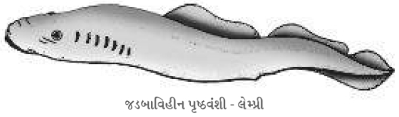
Write the characteristics of class $Cyclostomata$.
Solution
(N/A) The characteristics of class $Cyclostomata$ are as follows:
$1$. All living members of the class $Cyclostomata$ are ectoparasites on some fishes.
$2$. They have an elongated body bearing $6-15$ pairs of gill slits for respiration.
$3$. $Cyclostomes$ have a sucking and circular mouth without jaws.
$4$. Their body is devoid of scales and paired fins.
$5$. The cranium and vertebral column are cartilaginous.
$6$. Circulation is of the closed type.
$7$. $Cyclostomes$ are marine but migrate for spawning to fresh water. After spawning,within a few days,they die. Their larvae,after metamorphosis,return to the ocean.
$1$. All living members of the class $Cyclostomata$ are ectoparasites on some fishes.
$2$. They have an elongated body bearing $6-15$ pairs of gill slits for respiration.
$3$. $Cyclostomes$ have a sucking and circular mouth without jaws.
$4$. Their body is devoid of scales and paired fins.
$5$. The cranium and vertebral column are cartilaginous.
$6$. Circulation is of the closed type.
$7$. $Cyclostomes$ are marine but migrate for spawning to fresh water. After spawning,within a few days,they die. Their larvae,after metamorphosis,return to the ocean.
0 likes
View Solution57
Medium
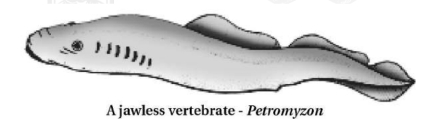
Write a short note on class Cyclostomata.
Solution
(N/A) $\rightarrow$ All living members of the class Cyclostomata are ectoparasites on some fishes.
$\rightarrow$ They have an elongated body bearing $6-15$ pairs of gill slits for respiration.
$\rightarrow$ Cyclostomes have a sucking and circular mouth without jaws.
$\rightarrow$ Their body is devoid of scales and paired fins.
$\rightarrow$ The cranium and vertebral column are cartilaginous.
$\rightarrow$ Circulation is of the closed type.
$\rightarrow$ Cyclostomes are marine but migrate for spawning to fresh water.
$\rightarrow$ After spawning,within a few days,they die.
$\rightarrow$ Their larvae,after metamorphosis,return to the ocean.
$\rightarrow$ Examples: Petromyzon (Lamprey) and Myxine (Hagfish).
$\rightarrow$ They have an elongated body bearing $6-15$ pairs of gill slits for respiration.
$\rightarrow$ Cyclostomes have a sucking and circular mouth without jaws.
$\rightarrow$ Their body is devoid of scales and paired fins.
$\rightarrow$ The cranium and vertebral column are cartilaginous.
$\rightarrow$ Circulation is of the closed type.
$\rightarrow$ Cyclostomes are marine but migrate for spawning to fresh water.
$\rightarrow$ After spawning,within a few days,they die.
$\rightarrow$ Their larvae,after metamorphosis,return to the ocean.
$\rightarrow$ Examples: Petromyzon (Lamprey) and Myxine (Hagfish).
0 likes
View Solution58
MediumMCQ
Petromyzon belongs to
A
Agnatha
B
Gnathostomata
C
Protochordata
D
Euchordata
Solution
(A) $Petromyzon$ (lamprey) is a jawless vertebrate.
It belongs to the phylum $Chordata$,subphylum $Vertebrata$,and division $Agnatha$ (which includes jawless vertebrates).
Therefore,the correct classification for $Petromyzon$ is $Agnatha$.
It belongs to the phylum $Chordata$,subphylum $Vertebrata$,and division $Agnatha$ (which includes jawless vertebrates).
Therefore,the correct classification for $Petromyzon$ is $Agnatha$.
0 likes
View Solution59
MediumMCQ
The jawless vertebrate is
A
Crocodile
B
Loris
C
Hyla
D
Petromyzon
Solution
(D) $Petromyzon$ is a jawless vertebrate belonging to the class $Cyclostomata$.
These organisms are characterized by having a circular,sucking mouth without jaws.
$Petromyzon$ is commonly known as the sea lamprey.
These organisms are characterized by having a circular,sucking mouth without jaws.
$Petromyzon$ is commonly known as the sea lamprey.
0 likes
View Solution60
MediumMCQ
Cyclostomata belongs to which division?
A
Pisces
B
Agnatha
C
Acraniata
D
Tetrapoda
Solution
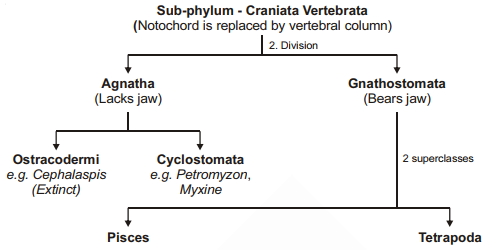
(B) According to the classification of sub-phylum $Vertebrata$ (Craniata),the sub-phylum is divided into two divisions based on the presence or absence of jaws:
$1$. $Agnatha$: These are jawless vertebrates. $Cyclostomata$ belongs to this division.
$2$. $Gnathostomata$: These are jawed vertebrates,which are further divided into superclasses $Pisces$ and $Tetrapoda$.
Therefore,$Cyclostomata$ belongs to the division $Agnatha$.
$1$. $Agnatha$: These are jawless vertebrates. $Cyclostomata$ belongs to this division.
$2$. $Gnathostomata$: These are jawed vertebrates,which are further divided into superclasses $Pisces$ and $Tetrapoda$.
Therefore,$Cyclostomata$ belongs to the division $Agnatha$.
0 likes
View Solution61
EasyMCQ
The correct classification of $Myxine$ is:
A
$Chordata \rightarrow Craniata \rightarrow Agnatha \rightarrow Cyclostomata$
B
$Chordata \rightarrow Acraniata \rightarrow Protochordata \rightarrow Cephalochordata$
C
$Chordata \rightarrow Cephalochordata \rightarrow Cyclostomata$
D
$Chordata \rightarrow Craniata \rightarrow Vertebrata \rightarrow Ostracodermi$
Solution
(A) $Myxine$ is a member of the class $Cyclostomata$.
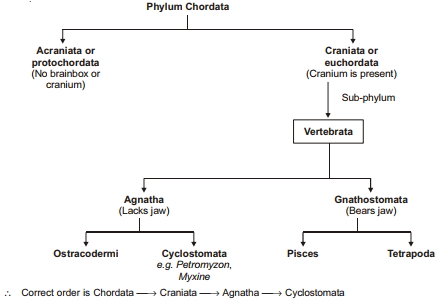
According to the taxonomic hierarchy of Phylum $Chordata$:
$1$. Phylum $Chordata$ is divided into $Acraniata$ and $Craniata$.
$2$. $Myxine$ belongs to $Craniata$ (as it possesses a cranium).
$3$. Within $Craniata$,it falls under the division $Agnatha$ (jawless vertebrates).
$4$. Finally,it is classified under the class $Cyclostomata$.
Therefore,the correct hierarchical classification is $Chordata \rightarrow Craniata \rightarrow Agnatha \rightarrow Cyclostomata$.
According to the taxonomic hierarchy of Phylum $Chordata$:
$1$. Phylum $Chordata$ is divided into $Acraniata$ and $Craniata$.
$2$. $Myxine$ belongs to $Craniata$ (as it possesses a cranium).
$3$. Within $Craniata$,it falls under the division $Agnatha$ (jawless vertebrates).
$4$. Finally,it is classified under the class $Cyclostomata$.
Therefore,the correct hierarchical classification is $Chordata \rightarrow Craniata \rightarrow Agnatha \rightarrow Cyclostomata$.
0 likes
View Solution62
EasyMCQ
The lamprey $(Petromyzon)$ is included in the same taxonomic class as the
A
$Cephalaspis$
B
$Ambystoma$
C
$Neoceratodus$
D
Hagfish $(Myxine)$
Solution
(D) Lamprey $(Petromyzon)$ and Hagfish $(Myxine)$ both belong to the class $Cyclostomata$,which is part of the division $Agnatha$ and sub-phylum $Vertebrata$. These organisms are characterized by having a circular,sucking mouth and lacking jaws.
0 likes
View Solution63
MediumMCQ
Which of the following statements is not true for $Agnatha$ members?
A
They include hagfishes and lampreys
B
They have notochord throughout their lives
C
They are known as cyclostomes
D
They have bony skeletons
Solution
(D) $Agnatha$ are jawless vertebrates in which the notochord persists throughout life.
$Agnatha$ is divided into two classes: $Ostracodermi$ and $Cyclostomata$.
Examples of cyclostomes are Hagfish $(Myxine)$ and Lamprey $(Petromyzon)$.
$Agnatha$ members do not possess an exoskeleton and have a cartilaginous vertebral column.
Therefore,$Agnatha$ members lack a bony skeleton.
$Agnatha$ is divided into two classes: $Ostracodermi$ and $Cyclostomata$.
Examples of cyclostomes are Hagfish $(Myxine)$ and Lamprey $(Petromyzon)$.
$Agnatha$ members do not possess an exoskeleton and have a cartilaginous vertebral column.
Therefore,$Agnatha$ members lack a bony skeleton.
0 likes
View Solution64
EasyMCQ
The larva of $Petromyzon$ is known as
A
Ammocoete
B
Tornaria
C
Axolotl
D
Bipinnaria
Solution
(A) Development is indirect in lamprey $(Petromyzon)$.
The larva of the lamprey is called the $Ammocoete$ larva.
The $Ammocoete$ larva is similar to the adult $Amphioxus$,hence the $Ammocoete$ larva acts as a connecting link between cephalochordates and cyclostomes.
The larva of the lamprey is called the $Ammocoete$ larva.
The $Ammocoete$ larva is similar to the adult $Amphioxus$,hence the $Ammocoete$ larva acts as a connecting link between cephalochordates and cyclostomes.
0 likes
View Solution65
EasyMCQ
Lamprey is
A
Catadromous
B
Anadromous
C
Both $(a)$ and $(b)$
D
None of these
Solution
(B) Lamprey $(Petromyzon)$ are marine organisms,but adult lampreys migrate to fresh water for spawning.
Such migration from the sea to a river for breeding is known as anadromous migration.
Such migration from the sea to a river for breeding is known as anadromous migration.
0 likes
View Solution66
MediumMCQ
All the following statements are correct about $Petromyzon$ (Lamprey) except:
A
$Lampreys$ are marine and migrate for spawning into rivers (Anadromous).
B
Their characteristic ammocoete larvae after metamorphosis migrate back to the ocean.
C
After spawning,the adult lamprey stops feeding and migrates back to the ocean where it lives.
D
It is a sanguivorous ectoparasite on other fishes.
Solution
(C) The correct answer is $C$.
$Petromyzon$ (Lamprey) is a marine cyclostome that exhibits anadromous migration,meaning it migrates from the ocean to fresh water (rivers) for spawning.
After spawning,the adult lamprey dies within a few days and does not migrate back to the ocean.
The ammocoete larva,after metamorphosis,migrates from the river to the ocean.
$Petromyzon$ possesses a circular,suctorial mouth and acts as a sanguivorous (blood-sucking) ectoparasite on other fishes.
$Petromyzon$ (Lamprey) is a marine cyclostome that exhibits anadromous migration,meaning it migrates from the ocean to fresh water (rivers) for spawning.
After spawning,the adult lamprey dies within a few days and does not migrate back to the ocean.
The ammocoete larva,after metamorphosis,migrates from the river to the ocean.
$Petromyzon$ possesses a circular,suctorial mouth and acts as a sanguivorous (blood-sucking) ectoparasite on other fishes.
0 likes
View Solution67
Medium
Describe reproduction in Cyclostomata.
Solution
(N/A) $\rightarrow$ Cyclostomes are marine but migrate to fresh water for spawning.
$\rightarrow$ After spawning,they die within a few days.
$\rightarrow$ Their larvae,after metamorphosis,return to the ocean.
$\rightarrow$ Examples: $Petromyzon$ (Lamprey) and $Myxine$ (Hagfish).
$\rightarrow$ After spawning,they die within a few days.
$\rightarrow$ Their larvae,after metamorphosis,return to the ocean.
$\rightarrow$ Examples: $Petromyzon$ (Lamprey) and $Myxine$ (Hagfish).
0 likes
View Solution68
EasyMCQ
Which group of chordates possess sucking and circular mouth without jaws?
A
Chondrichthyes
B
Osteichthyes
C
Cyclostomata
D
Reptilia
Solution
(C) The group of chordates that possess a sucking and circular mouth without jaws is known as $Cyclostomata$.
$Cyclostomata$ are characterized by the absence of jaws (agnathans).
They have an elongated body bearing $6-15$ pairs of gill slits for respiration.
Their mouth is circular and suctorial,which helps them attach to other fishes as ectoparasites.
$Cyclostomata$ are characterized by the absence of jaws (agnathans).
They have an elongated body bearing $6-15$ pairs of gill slits for respiration.
Their mouth is circular and suctorial,which helps them attach to other fishes as ectoparasites.
0 likes
View Solution69
EasyMCQ
What is the number of gill slits in a hagfish?
A
$6-15$
B
$12-30$
C
$8-18$
D
$16-36$
Solution
(A) Hagfish (class $Myxini$) are primitive jawless marine vertebrates. Unlike other vertebrates,they possess a variable number of gill slits depending on the species. The number of gill slits in hagfish typically ranges from $6$ to $15$ pairs. These slits are used for respiration and are a characteristic feature of their anatomy.
0 likes
View Solution70
MediumMCQ
Which of the following statements are correct for Cyclostomata?
$I$ - They have a sucking and circular mouth without jaws.
$II$ - Their body is devoid of scales and paired fins.
$III$ - Their cranium and vertebral column are cartilaginous.
$IV$ - They have a closed type of circulatory system.
$V$ - Cyclostomes live in freshwater,but migrate to the ocean for spawning.
$VI$ - They show direct development.
$I$ - They have a sucking and circular mouth without jaws.
$II$ - Their body is devoid of scales and paired fins.
$III$ - Their cranium and vertebral column are cartilaginous.
$IV$ - They have a closed type of circulatory system.
$V$ - Cyclostomes live in freshwater,but migrate to the ocean for spawning.
$VI$ - They show direct development.
A
$I, II, III, IV, V$
B
$I, II, IV$
C
$II, III, IV$
D
$I, II, IV, V$
Solution
(B) The characteristics of Class $Cyclostomata$ are as follows:
$1$. They are ectoparasites on some fishes.
$2$. They have an elongated body bearing $6-15$ pairs of gill slits for respiration.
$3$. They have a sucking and circular mouth without jaws ($I$ is correct).
$4$. Their body is devoid of scales and paired fins ($II$ is correct).
$5$. Cranium and vertebral column are cartilaginous (not bony,so $III$ is incorrect).
$6$. Circulation is of closed type ($IV$ is correct).
$7$. Cyclostomes are marine but migrate for spawning to freshwater. After spawning,within a few days,they die. Their larvae,after metamorphosis,return to the ocean ($V$ is incorrect as it states they live in freshwater and spawn in the ocean,which is the reverse).
$8$. They show indirect development (larval stage is present,so $VI$ is incorrect).
Therefore,the correct statements are $I, II,$ and $IV$.
$1$. They are ectoparasites on some fishes.
$2$. They have an elongated body bearing $6-15$ pairs of gill slits for respiration.
$3$. They have a sucking and circular mouth without jaws ($I$ is correct).
$4$. Their body is devoid of scales and paired fins ($II$ is correct).
$5$. Cranium and vertebral column are cartilaginous (not bony,so $III$ is incorrect).
$6$. Circulation is of closed type ($IV$ is correct).
$7$. Cyclostomes are marine but migrate for spawning to freshwater. After spawning,within a few days,they die. Their larvae,after metamorphosis,return to the ocean ($V$ is incorrect as it states they live in freshwater and spawn in the ocean,which is the reverse).
$8$. They show indirect development (larval stage is present,so $VI$ is incorrect).
Therefore,the correct statements are $I, II,$ and $IV$.
0 likes
View Solution71
MediumMCQ
Select the incorrect statements with respect to Cyclostomes:
$(a)$ They lack scales and paired fins.
$(b)$ They have a circular mouth with jaws.
$(c)$ They bear $6-15$ pairs of gills.
$(d)$ They migrate to deep sea for spawning.
Choose the most appropriate answer from the options given below:
$(a)$ They lack scales and paired fins.
$(b)$ They have a circular mouth with jaws.
$(c)$ They bear $6-15$ pairs of gills.
$(d)$ They migrate to deep sea for spawning.
Choose the most appropriate answer from the options given below:
A
$(a)$ and $(b)$ only
B
$(b)$ and $(c)$ only
C
$(b)$ and $(d)$ only
D
$(a)$ and $(d)$ only
Solution
(C) Cyclostomes are a group of jawless vertebrates.
Statement $(a)$ is correct: They lack scales and paired fins.
Statement $(b)$ is incorrect: They have a circular mouth,but they are jawless (agnathans).
Statement $(c)$ is correct: They bear $6-15$ pairs of gill slits for respiration.
Statement $(d)$ is incorrect: Cyclostomes are marine but migrate to fresh water for spawning (anadromous migration),after which they die.
Therefore,statements $(b)$ and $(d)$ are incorrect.
Statement $(a)$ is correct: They lack scales and paired fins.
Statement $(b)$ is incorrect: They have a circular mouth,but they are jawless (agnathans).
Statement $(c)$ is correct: They bear $6-15$ pairs of gill slits for respiration.
Statement $(d)$ is incorrect: Cyclostomes are marine but migrate to fresh water for spawning (anadromous migration),after which they die.
Therefore,statements $(b)$ and $(d)$ are incorrect.
0 likes
View Solution72
MediumMCQ
All living members of the class Cyclostomata are:
A
Free living
B
Endoparasite
C
Symbiotic
D
Ectoparasite
Solution
(D) The class $Cyclostomata$ consists of jawless vertebrates.
All living members of this class are $Ectoparasites$ on some fishes.
They possess a circular,sucking mouth without jaws,which they use to attach to the body of host fishes to feed on their blood and flesh.
Therefore,the correct option is $D$.
All living members of this class are $Ectoparasites$ on some fishes.
They possess a circular,sucking mouth without jaws,which they use to attach to the body of host fishes to feed on their blood and flesh.
Therefore,the correct option is $D$.
0 likes
View Solution73
MediumMCQ
Assertion: Cyclostomates are marine but migrate for spawning to fresh water.
Reason: After spawning,within a few days they die. Their larvae after metamorphosis return to the ocean.
Reason: After spawning,within a few days they die. Their larvae after metamorphosis return to the ocean.
A
Both Assertion and Reason are true and Reason is the correct explanation of Assertion.
B
Both Assertion and Reason are true but Reason is not the correct explanation of Assertion.
C
Assertion is true but Reason is false.
D
Assertion and Reason both are false.
Solution
(A) Cyclostomates (e.g.,Petromyzon or Lamprey) are marine organisms that exhibit anadromous migration.
They migrate from the ocean to fresh water specifically for the purpose of spawning (laying eggs).
After spawning,they die within a few days.
Their larvae,after undergoing metamorphosis,return to the ocean.
Since the migration to fresh water is directly linked to the spawning process mentioned in the reason,the reason provides a correct explanation for the assertion.
They migrate from the ocean to fresh water specifically for the purpose of spawning (laying eggs).
After spawning,they die within a few days.
Their larvae,after undergoing metamorphosis,return to the ocean.
Since the migration to fresh water is directly linked to the spawning process mentioned in the reason,the reason provides a correct explanation for the assertion.
0 likes
View Solution74
MediumMCQ
Ventral muscular heart,kidneys for excretion and osmoregulation,and paired appendages are found in all of the following $EXCEPT$:
A
Labeo
B
Balaenoptera
C
Petromyzon
D
Rana
Solution
(C) The features mentioned (ventral muscular heart,kidneys for excretion/osmoregulation,and paired appendages) are characteristic of most Gnathostomes (jawed vertebrates).
$1$. $Labeo$ (a bony fish) possesses these features.
$2$. $Balaenoptera$ (a whale,mammal) possesses these features.
$3$. $Rana$ (a frog,amphibian) possesses these features.
$4$. $Petromyzon$ (a lamprey) belongs to the class Cyclostomata. Cyclostomes are jawless vertebrates $(Agnatha)$ and lack paired appendages (fins or limbs). Therefore,$Petromyzon$ is the exception.
$1$. $Labeo$ (a bony fish) possesses these features.
$2$. $Balaenoptera$ (a whale,mammal) possesses these features.
$3$. $Rana$ (a frog,amphibian) possesses these features.
$4$. $Petromyzon$ (a lamprey) belongs to the class Cyclostomata. Cyclostomes are jawless vertebrates $(Agnatha)$ and lack paired appendages (fins or limbs). Therefore,$Petromyzon$ is the exception.
0 likes
View Solution75
EasyMCQ
Which of the following pair of animals are jawless fishes?
A
Magur & Flying fish
B
Lamprey & Eel
C
Rohu & Dog fish
D
Hag fish & Lamprey
Solution
(D) The class $Cyclostomata$ includes animals that are characterized by having a sucking and circular mouth without jaws.
These organisms are known as jawless fishes.
$Hagfish$ $(Myxine)$ and $Lamprey$ $(Petromyzon)$ are the primary examples of $Cyclostomata$.
Other options like $Magur$,$Flying$ $fish$,$Eel$,$Rohu$,and $Dog$ $fish$ belong to the classes $Chondrichthyes$ or $Osteichthyes$,which possess jaws.
These organisms are known as jawless fishes.
$Hagfish$ $(Myxine)$ and $Lamprey$ $(Petromyzon)$ are the primary examples of $Cyclostomata$.
Other options like $Magur$,$Flying$ $fish$,$Eel$,$Rohu$,and $Dog$ $fish$ belong to the classes $Chondrichthyes$ or $Osteichthyes$,which possess jaws.
0 likes
View Solution76
EasyMCQ
Identify the correct option for $Cyclostomata$ $:-$
A
Development indirect,$6-15$ pairs of gill slits,ectoparasites on some fishes
B
Development indirect,viviparous,$6-15$ pairs of gill slits,scales and paired fins present
C
Jawless,scales absent,only paired fins are present
D
Both paired and unpaired fins are present,ventral mouth,$6-15$ pairs of gill slits
Solution
(A) The class $Cyclostomata$ includes jawless vertebrates.
Key characteristics include:
$1$. They have an elongated body bearing $6-15$ pairs of gill slits for respiration.
$2$. They lack jaws (agnathans) and do not possess scales or paired fins.
$3$. Their body is devoid of scales and paired fins.
$4$. They are often ectoparasites on some fishes.
$5$. Their circulation is of the closed type.
$6$. They are marine but migrate for spawning to fresh water. After spawning,within a few days,they die. Their larvae,after metamorphosis,return to the ocean. Thus,the development is indirect.
Comparing the options,option $A$ correctly describes the key features: indirect development,$6-15$ pairs of gill slits,and ectoparasitic nature.
Key characteristics include:
$1$. They have an elongated body bearing $6-15$ pairs of gill slits for respiration.
$2$. They lack jaws (agnathans) and do not possess scales or paired fins.
$3$. Their body is devoid of scales and paired fins.
$4$. They are often ectoparasites on some fishes.
$5$. Their circulation is of the closed type.
$6$. They are marine but migrate for spawning to fresh water. After spawning,within a few days,they die. Their larvae,after metamorphosis,return to the ocean. Thus,the development is indirect.
Comparing the options,option $A$ correctly describes the key features: indirect development,$6-15$ pairs of gill slits,and ectoparasitic nature.
0 likes
View Solution77
MediumMCQ
Statement $- I :-$ All living members of class $Cyclostomata$ are ectoparasites on some fishes.
Statement $- II :-$ $Cyclostomata$ have a sucking and circular mouth without jaws.
Statement $- II :-$ $Cyclostomata$ have a sucking and circular mouth without jaws.
A
Both statements are correct.
B
Both statements are incorrect.
C
Only statement $- I$ is correct,$II$ is incorrect.
D
Only statement $- II$ is correct,$I$ is incorrect.
Solution
(A) Statement $- I$ is correct because all living members of the class $Cyclostomata$ are known to be ectoparasites on some fishes.
Statement $- II$ is correct because the name $Cyclostomata$ itself implies 'circular mouth' ($cyclo$ = circular,$stoma$ = mouth). They lack jaws (agnathans) and possess a sucking and circular mouth used for attachment to their hosts.
Statement $- II$ is correct because the name $Cyclostomata$ itself implies 'circular mouth' ($cyclo$ = circular,$stoma$ = mouth). They lack jaws (agnathans) and possess a sucking and circular mouth used for attachment to their hosts.
0 likes
View Solution78
MediumMCQ
$A$ group of researchers procured some fish-like animals and upon investigation the following characters were observed: $A$. Endoskeleton was made of cartilage. $B$. Ectoparasitic; as they were found attached on fish skin with their circular sucking mouth. $C$. Paired fins and scales were absent,but $7$ pairs of gill slits were present. Which of the following species of animals did they consider to fit best with these characters?
A
$(1)$ $Scoliodon$ sp.
B
$(2)$ $Exocoetus$ sp.
C
$(3)$ $Petromyzon$ sp.
D
$(4)$ $Branchiostoma$ sp.
Solution
(C) The characters described are:
$1$. Endoskeleton is cartilaginous.
$2$. Ectoparasitic nature with a circular,suctorial mouth.
$3$. Absence of paired fins and scales.
$4$. Presence of $6-15$ pairs of gill slits for respiration.
These features are diagnostic of the class $Cyclostomata$. Among the given options,$Petromyzon$ (lamprey) belongs to this class. $Scoliodon$ is a cartilaginous fish (Chondrichthyes),$Exocoetus$ is a bony fish (Osteichthyes),and $Branchiostoma$ is a cephalochordate.
$1$. Endoskeleton is cartilaginous.
$2$. Ectoparasitic nature with a circular,suctorial mouth.
$3$. Absence of paired fins and scales.
$4$. Presence of $6-15$ pairs of gill slits for respiration.
These features are diagnostic of the class $Cyclostomata$. Among the given options,$Petromyzon$ (lamprey) belongs to this class. $Scoliodon$ is a cartilaginous fish (Chondrichthyes),$Exocoetus$ is a bony fish (Osteichthyes),and $Branchiostoma$ is a cephalochordate.
0 likes
View SolutionAnimal Kingdom — Class - Cyclostomata · Frequently Asked Questions
1Are these Animal Kingdom questions useful for JEE and NEET?
Yes. All questions in this section are mapped to JEE Main and NEET exam patterns. Previous year questions from JEE Main, NEET, GUJCET and state-level exams are included with full solutions.
2Can I switch to Hindi or Gujarati for these questions?
Yes. Use the language tabs in the hero section or the sidebar to view the same questions and solutions in English, Hindi or Gujarati.
3How do I generate a question paper from this subtopic?
Use the Vedclass Exam Paper Generator — select the chapter and subtopic, set difficulty, and generate Sets A, B, C, D automatically. First 3 chapters of every subject are free.
Vedclass Products
For Students
Vedclass Test Series
Mock tests in real JEE/NEET style with performance analysis. 5-day free trial.
Start Free TrialFor Teachers
Exam Paper Generator
Generate Set A/B/C/D papers from this chapter in 2 minutes. 3 chapters free.
Try FreeFor Institutes
Online Exam Module
Live online exams with unlimited students, 360° analytics & white-label branding.
See DemoFor Teachers & Institutes
Generate a Animal Kingdom Exam Paper in 2 Minutes
Select subtopic & difficulty — Sets A, B, C, D auto-generated with No Repeat logic.
First 3 chapters of every subject are free — no payment required.