
A English
Class-Aves Questions in English
Class 11 Biology · Animal Kingdom · Class-Aves
153+
Questions
English
Language
100%
With Solutions
Showing 50 of 153 questions in English
101
MediumMCQ
Assertion $(X)$: Birds can consume food very quickly.
Reason $(Y)$: They possess a crop.
Reason $(Y)$: They possess a crop.
A
Reason $(Y)$ is incorrect for Assertion $(X)$.
B
Reason $(Y)$ is correct for Assertion $(X)$.
C
Both Assertion $(X)$ and Reason $(Y)$ are incorrect.
D
Assertion $(X)$ and Reason $(Y)$ are not consistent.
Solution
(B) Birds belong to the class $Aves$.
They possess a digestive system that includes a specialized structure called a 'crop'.
The crop is an expanded part of the esophagus used for the temporary storage of food.
This adaptation allows birds to ingest large amounts of food rapidly,which is then gradually passed into the stomach for digestion.
Therefore,the assertion that birds consume food quickly is correct,and the reason that they possess a crop is the correct explanation for this behavior.
They possess a digestive system that includes a specialized structure called a 'crop'.
The crop is an expanded part of the esophagus used for the temporary storage of food.
This adaptation allows birds to ingest large amounts of food rapidly,which is then gradually passed into the stomach for digestion.
Therefore,the assertion that birds consume food quickly is correct,and the reason that they possess a crop is the correct explanation for this behavior.
0 likes
View Solution102
EasyMCQ
Which of the following characteristics apply to penguins?
$(P)$ Presence of crop and gizzard
$(Q)$ Internal fertilization and viviparity
$(R)$ Absence of teeth
$(S)$ Open circulatory system
$(P)$ Presence of crop and gizzard
$(Q)$ Internal fertilization and viviparity
$(R)$ Absence of teeth
$(S)$ Open circulatory system
A
$Q, R, S$
B
$P, Q$
C
$P, R$
D
$P, R, S$
Solution
(C) Penguins belong to the class $Aves$ (birds).
$(P)$ Birds possess a digestive tract with a crop (for storage) and a gizzard (for grinding food). This is a characteristic feature of $Aves$.
$(Q)$ Birds exhibit internal fertilization,but they are oviparous (egg-laying),not viviparous. Thus,$(Q)$ is incorrect.
$(R)$ Modern birds,including penguins,lack teeth. Their jaws are modified into a beak. This is correct.
$(S)$ Birds have a closed circulatory system,not an open one. Thus,$(S)$ is incorrect.
Therefore,the correct characteristics are $(P)$ and $(R)$.
$(P)$ Birds possess a digestive tract with a crop (for storage) and a gizzard (for grinding food). This is a characteristic feature of $Aves$.
$(Q)$ Birds exhibit internal fertilization,but they are oviparous (egg-laying),not viviparous. Thus,$(Q)$ is incorrect.
$(R)$ Modern birds,including penguins,lack teeth. Their jaws are modified into a beak. This is correct.
$(S)$ Birds have a closed circulatory system,not an open one. Thus,$(S)$ is incorrect.
Therefore,the correct characteristics are $(P)$ and $(R)$.
0 likes
View Solution103
EasyMCQ
To which family does the pigeon belong?
A
Poaceae
B
Megascolecidae
C
Blattidae
D
Columbidae
Solution
(D) The pigeon belongs to the family $Columbidae$.
$Poaceae$ is a family of grasses.
$Megascolecidae$ is a family of earthworms.
$Blattidae$ is a family of cockroaches.
$Poaceae$ is a family of grasses.
$Megascolecidae$ is a family of earthworms.
$Blattidae$ is a family of cockroaches.
0 likes
View Solution104
EasyMCQ
Which family includes birds?
A
Blattidae
B
Columbidae
C
Ranidae
D
Megascolecidae
Solution
(B) The family $Columbidae$ belongs to the order $Columbiformes$ and includes birds such as pigeons and doves.
$Blattidae$ is a family of cockroaches.
$Ranidae$ is a family of true frogs.
$Megascolecidae$ is a family of earthworms.
$Blattidae$ is a family of cockroaches.
$Ranidae$ is a family of true frogs.
$Megascolecidae$ is a family of earthworms.
0 likes
View Solution105
EasyMCQ
To which life are birds adapted?
A
Aquatic life
B
Terrestrial life
C
Aerial life
D
None of these
Solution
(C) Birds are primarily adapted for $Aerial$ life (flight). Their body structure, including hollow bones ($pneumatic$ bones), streamlined body shape, wings, and powerful flight muscles, is specifically evolved to support flight in the air.
0 likes
View Solution106
MediumMCQ
Which one of the following in birds indicates their reptilian ancestry?
A
Two special chambers,crop and gizzard,in their digestive tract
B
Eggs with a calcareous shell
C
Scales on their hind limbs
D
Four-chambered heart
Solution
(C) : Birds have originated from ancestral reptilian stock. These two classes share many common features that link the two groups. The evidence of the reptilian ancestry of birds is provided by their comparative anatomy,embryology,and palaeontology.
One of the key features is that all birds possess horny epidermal scales confined to the lower parts of their legs and feet,which are structurally identical to the epidermal scales found in reptiles.
One of the key features is that all birds possess horny epidermal scales confined to the lower parts of their legs and feet,which are structurally identical to the epidermal scales found in reptiles.
0 likes
View Solution107
MediumMCQ
The forelimbs are modified into wings in
A
Platypus
B
Panthera leo
C
Aptenodytes
D
Alligator
Solution
(C) The forelimbs of birds are modified into wings to facilitate flight.
Among the given options,$Aptenodytes$ (commonly known as the penguin) belongs to the class $Aves$.
Although penguins are flightless birds,their forelimbs are still structurally modified into wings (flippers) used for swimming.
$Platypus$ is a mammal,$Panthera leo$ (lion) is a mammal,and $Alligator$ is a reptile.
Therefore,the correct option is $C$.
Among the given options,$Aptenodytes$ (commonly known as the penguin) belongs to the class $Aves$.
Although penguins are flightless birds,their forelimbs are still structurally modified into wings (flippers) used for swimming.
$Platypus$ is a mammal,$Panthera leo$ (lion) is a mammal,and $Alligator$ is a reptile.
Therefore,the correct option is $C$.
0 likes
View Solution108
EasyMCQ
The vertebrae of birds are . . . . . . .
A
Acoelous
B
Heterocoelous
C
Amphicoelous
D
Procoelous
Solution
(B) The vertebrae of birds are $Heterocoelous$.
In $Heterocoelous$ vertebrae,the centrum is saddle-shaped at both ends,which allows for significant flexibility and movement of the neck,enabling birds to turn their heads in various directions.
In $Heterocoelous$ vertebrae,the centrum is saddle-shaped at both ends,which allows for significant flexibility and movement of the neck,enabling birds to turn their heads in various directions.
0 likes
View Solution109
MediumMCQ
The feet of a kingfisher are adapted for ...............
A
Wading
B
Perching
C
Running
D
Clutching
Solution
(B) Kingfishers are birds that typically hunt fish by diving into water. Their feet are adapted for perching on branches or other structures while waiting for prey. Unlike wading birds (which have long legs for walking in shallow water) or running birds (which have strong legs for terrestrial locomotion),the kingfisher's feet are small and syndactyl,specifically suited for gripping branches.
0 likes
View Solution110
EasyMCQ
The flight muscles of birds are attached to the $..........$.
A
Clavicle
B
Sternum
C
Scapula
D
Coracoid
Solution
(B) In birds,the flight muscles (pectoral muscles) are very powerful and are attached to a large,keel-shaped extension of the sternum known as the $carina$ or $keel$. This structure provides a large surface area for the attachment of these muscles,which are essential for the flapping movement of wings during flight.
0 likes
View Solution111
EasyMCQ
The voice box of birds is known as $..........$.
A
Pygostyle
B
Larynx
C
Syrinx
D
Synsacrum
Solution
(C) The voice box of birds is called the $Syrinx$.
It is a specialized vocal organ located at the base of the trachea in birds.
Unlike mammals,which use the $Larynx$ to produce sound,birds use the $Syrinx$ to generate complex vocalizations and songs.
It is a specialized vocal organ located at the base of the trachea in birds.
Unlike mammals,which use the $Larynx$ to produce sound,birds use the $Syrinx$ to generate complex vocalizations and songs.
0 likes
View Solution112
EasyMCQ
What is common among Ostrich,Kiwi,and Penguin?
A
Running birds
B
Migratory birds
C
Flightless birds
D
Four-toed birds
Solution
(C) Ostrich $(Struthio)$,Kiwi $(Apteryx)$,and Penguin $(Aptenodytes)$ are all examples of flightless birds. These birds have evolved to lose the ability to fly due to various evolutionary adaptations,such as reduced wing size and the absence of a keel on the sternum,which is necessary for the attachment of large flight muscles. Therefore,the common characteristic among them is that they are flightless birds.
0 likes
View Solution113
EasyMCQ
The flightless bird $Casuarius$ (Cassowary) is found in:
A
Mauritius
B
Australia
C
New Zealand
D
Indonesia
Solution
(B) The genus $Casuarius$,commonly known as the Cassowary,is a large flightless bird belonging to the family $Casuariidae$.
These birds are native to the tropical rainforests of New Guinea,nearby islands,and northeastern Australia.
Among the given options,Australia is the primary region where these birds are naturally found and well-documented.
These birds are native to the tropical rainforests of New Guinea,nearby islands,and northeastern Australia.
Among the given options,Australia is the primary region where these birds are naturally found and well-documented.
0 likes
View Solution114
DifficultMCQ
Pneumatic bones can be found in:
A
Pigeon
B
House lizard
C
Frog tadpole
D
Flying fish
Solution
(A) Pneumatic bones are hollow,air-filled bones that reduce body weight,which is an essential adaptation for flight in birds.
Among the given options,the pigeon ($Columba$ $livia$) belongs to the class $Aves$.
Birds possess pneumatic bones to facilitate flight.
Therefore,the correct answer is $A$.
Among the given options,the pigeon ($Columba$ $livia$) belongs to the class $Aves$.
Birds possess pneumatic bones to facilitate flight.
Therefore,the correct answer is $A$.
0 likes
View Solution115
MediumMCQ
Long bones are hollow and connected by air passages; these are the characteristics of ......... .
A
Aves
B
Mammals
C
Reptiles
D
Terrestrial vertebrates
Solution
(A) The presence of hollow long bones that are connected by air passages is known as pneumatic bones.
These pneumatic bones are a characteristic feature of birds (Class $Aves$).
This adaptation helps in reducing body weight,which facilitates flight.
These pneumatic bones are a characteristic feature of birds (Class $Aves$).
This adaptation helps in reducing body weight,which facilitates flight.
0 likes
View Solution116
MediumMCQ
Which of the following is $NOT$ found in birds?
A
Hind limbs
B
Pectoral girdle
C
Pelvic girdle
D
Forelimbs
Solution
(D) In birds $(Class-Aves)$,the forelimbs are modified into wings for flight. Therefore,they do not possess typical forelimbs as seen in other tetrapods. Instead,they have wings. Hind limbs are present and adapted for walking,swimming,or perching. Both pectoral and pelvic girdles are present to support the wings and hind limbs,respectively.
0 likes
View Solution117
MediumMCQ
Which of the following features in birds indicates their reptilian ancestry?
A
Scales on hind limbs
B
Four-chambered heart
C
Two additional chambers,crop and gizzard,in the digestive tract
D
Eggs with calcareous shells
Solution
(A) Birds share several anatomical features with reptiles,which are considered evidence of their evolutionary origin from reptilian ancestors.
One of the most prominent features is the presence of epidermal scales on their hind limbs,which are homologous to the scales found on the skin of reptiles.
While birds have a four-chambered heart and lay eggs with calcareous shells,these are adaptations or traits shared with other groups or evolved independently.
The presence of scales on the hind limbs is a direct morphological link to their reptilian ancestors.
One of the most prominent features is the presence of epidermal scales on their hind limbs,which are homologous to the scales found on the skin of reptiles.
While birds have a four-chambered heart and lay eggs with calcareous shells,these are adaptations or traits shared with other groups or evolved independently.
The presence of scales on the hind limbs is a direct morphological link to their reptilian ancestors.
0 likes
View Solution118
MediumMCQ
Identify the vertebrate group of animals characterized by crop and gizzard in its digestive system.
A
Osteichthyes
B
Amphibia
C
Aves
D
Reptilia
Solution
(C) The digestive tract of birds $(Aves)$ has additional chambers,the crop and the gizzard.
$1$. The crop is a specialized pouch used for the storage of food.
$2$. The gizzard is a thick-walled,muscular organ used for grinding food,which compensates for the lack of teeth in birds.
Therefore,the correct group is $Aves$.
$1$. The crop is a specialized pouch used for the storage of food.
$2$. The gizzard is a thick-walled,muscular organ used for grinding food,which compensates for the lack of teeth in birds.
Therefore,the correct group is $Aves$.
0 likes
View Solution119
MediumMCQ
Assertion : Birds have one ovary.
Reason : This reduces the body weight for flight.
Reason : This reduces the body weight for flight.
A
If both Assertion and Reason are correct and the Reason is a correct explanation of the Assertion.
B
If both Assertion and Reason are correct but Reason is not a correct explanation of the Assertion.
C
If the Assertion is correct but Reason is incorrect.
D
If both the Assertion and Reason are incorrect.
Solution
(A) Birds typically possess only a single functional ovary (the left one) as an evolutionary adaptation to reduce body weight,which facilitates efficient flight. Therefore,the assertion is correct,and the reason provides a valid explanation for this anatomical feature.
0 likes
View Solution120
EasyMCQ
The 'wishbone' in birds is formed from the bones of:
A
Shoulder girdle
B
Hip girdle
C
Keeled sternum
D
Skull bones
Solution
(A) In birds,the two clavicles fuse with a single inter-clavicle to form a $V$-shaped bone known as the 'wishbone' or 'furcula' (also called the 'merrythought' bone). This structure is part of the pectoral girdle,which is also known as the shoulder girdle.
0 likes
View Solution121
Medium
What are the modifications that are observed in birds that help them fly?
Solution
(N/A) Birds have undergone many structural adaptations to suit their aerial life. Some of these adaptations are as follows:
$1$. Streamlined body for rapid and smooth movement.
$2$. Covering of feathers for insulation.
$3$. Forelimbs modified into wings and hind limbs used for walking,perching,and swimming.
$4$. Presence of pneumatic (hollow) bones to reduce body weight.
$5$. Presence of additional air sacs to supplement respiration.
$1$. Streamlined body for rapid and smooth movement.
$2$. Covering of feathers for insulation.
$3$. Forelimbs modified into wings and hind limbs used for walking,perching,and swimming.
$4$. Presence of pneumatic (hollow) bones to reduce body weight.
$5$. Presence of additional air sacs to supplement respiration.
0 likes
View Solution122
Easy
Give scientific reasons: Birds can fly for long distances continuously.
Solution
(N/A) $1$. The flight muscles of birds are composed of red muscle fibers.
$2$. These fibers contain a high concentration of myoglobin,which acts as an oxygen-storing pigment.
$3$. Red muscles are rich in mitochondria,which facilitate aerobic respiration to produce large amounts of $ATP$.
$4$. Due to the efficient aerobic metabolism and high $ATP$ production,these muscles do not get fatigued easily,allowing birds to fly continuously for long distances.
$2$. These fibers contain a high concentration of myoglobin,which acts as an oxygen-storing pigment.
$3$. Red muscles are rich in mitochondria,which facilitate aerobic respiration to produce large amounts of $ATP$.
$4$. Due to the efficient aerobic metabolism and high $ATP$ production,these muscles do not get fatigued easily,allowing birds to fly continuously for long distances.
0 likes
View Solution123
Easy
Write the characteristic features of class $Aves$.
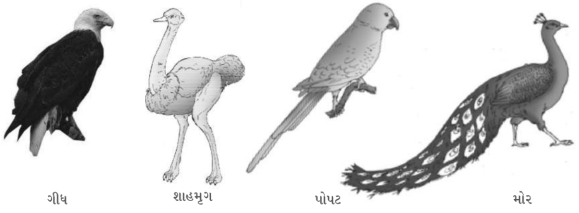
Solution
(N/A) The characteristic features of class $Aves$ (birds) are as follows:
$1$. Presence of feathers: Most of them can fly,except for flightless birds (e.g.,$Struthio$ or Ostrich).
$2$. Beak: They possess a beak.
$3$. Forelimbs: Modified into wings.
$4$. Hind limbs: Generally have scales and are modified for walking,swimming,or clasping tree branches.
$5$. Skin: Dry without glands,except for the oil gland at the base of the tail.
$6$. Endoskeleton: Fully ossified (bony) and the long bones are hollow with air cavities (pneumatic bones).
$7$. Digestive tract: Contains additional chambers,the crop and gizzard.
$8$. Heart: Completely four-chambered.
$9$. Thermoregulation: They are warm-blooded $(homoiothermous)$ animals,meaning they maintain a constant body temperature.
$10$. Respiration: By lungs. Air sacs connected to the lungs supplement respiration.
$11$. Reproduction: Sexes are separate,and fertilization is internal.
$1$. Presence of feathers: Most of them can fly,except for flightless birds (e.g.,$Struthio$ or Ostrich).
$2$. Beak: They possess a beak.
$3$. Forelimbs: Modified into wings.
$4$. Hind limbs: Generally have scales and are modified for walking,swimming,or clasping tree branches.
$5$. Skin: Dry without glands,except for the oil gland at the base of the tail.
$6$. Endoskeleton: Fully ossified (bony) and the long bones are hollow with air cavities (pneumatic bones).
$7$. Digestive tract: Contains additional chambers,the crop and gizzard.
$8$. Heart: Completely four-chambered.
$9$. Thermoregulation: They are warm-blooded $(homoiothermous)$ animals,meaning they maintain a constant body temperature.
$10$. Respiration: By lungs. Air sacs connected to the lungs supplement respiration.
$11$. Reproduction: Sexes are separate,and fertilization is internal.
0 likes
View Solution124
Medium
What are the adaptations observed in birds that help them in flight?
Solution
(N/A) The adaptations in birds that facilitate flight are as follows:
$1$. The jaws are modified into a beak.
$2$. The forelimbs are modified into wings.
$3$. The endoskeleton is fully ossified (bony),and the long bones are hollow with air cavities,known as pneumatic bones.
$4$. They are homeothermic (warm-blooded) animals,and feathers act as insulators to maintain body temperature.
$5$. The presence of air sacs connected to the lungs supplements respiration and reduces body weight,aiding in flight.
$1$. The jaws are modified into a beak.
$2$. The forelimbs are modified into wings.
$3$. The endoskeleton is fully ossified (bony),and the long bones are hollow with air cavities,known as pneumatic bones.
$4$. They are homeothermic (warm-blooded) animals,and feathers act as insulators to maintain body temperature.
$5$. The presence of air sacs connected to the lungs supplements respiration and reduces body weight,aiding in flight.
0 likes
View Solution125
Medium
Give scientific reason: Birds show adaptations for flight.
Solution
(N/A) $\rightarrow$ Forelimbs are modified into wings to facilitate flight.
$\rightarrow$ The body is streamlined,which reduces air resistance during flight.
$\rightarrow$ Bones are pneumatic (hollow and air-filled),which reduces body weight.
$\rightarrow$ Respiration occurs through lungs,which are supplemented by air sacs that provide extra buoyancy and efficient oxygen supply for high-energy flight.
$\rightarrow$ The body is streamlined,which reduces air resistance during flight.
$\rightarrow$ Bones are pneumatic (hollow and air-filled),which reduces body weight.
$\rightarrow$ Respiration occurs through lungs,which are supplemented by air sacs that provide extra buoyancy and efficient oxygen supply for high-energy flight.
0 likes
View Solution126
MediumMCQ
Which organisms are capable of thermoregulation and osmoregulation?
A
Amphibians
B
Reptiles
C
Birds
D
Fishes
Solution
(C) The ability to maintain a constant internal environment despite changes in the external environment is known as homeostasis. This includes thermoregulation (maintaining constant body temperature) and osmoregulation (maintaining constant osmotic concentration).
Birds and mammals are endotherms,meaning they can maintain a constant body temperature and regulate their internal osmotic balance regardless of the external environmental conditions.
Among the given options,birds (Aves) are capable of both thermoregulation and osmoregulation.
Birds and mammals are endotherms,meaning they can maintain a constant body temperature and regulate their internal osmotic balance regardless of the external environmental conditions.
Among the given options,birds (Aves) are capable of both thermoregulation and osmoregulation.
0 likes
View Solution127
MediumMCQ
The character of birds without exception is
A
Omnivorous
B
Flying wings
C
Beak without teeth
D
Lay eggs with calcareous shell
Solution
(C) The beak or bill of birds is formed due to the modification and elongation of the jaw bones. $A$ defining characteristic of all birds is that their beak never bears teeth. While other options like flight,diet,or egg-laying habits may have exceptions among certain species of birds (e.g.,flightless birds like ostriches),the absence of teeth in the beak is a universal feature of all extant birds.
0 likes
View Solution128
EasyMCQ
Bone marrow is absent in
A
Reptiles
B
Amphibians
C
Aves
D
Mammals
Solution
(C) The bones of birds,such as the ostrich and owl,are hollow and are known as pneumatic bones,meaning bone marrow is absent in them.
This is a specialized adaptation for the aerial life of birds,which reduces their body weight to facilitate flight.
This is a specialized adaptation for the aerial life of birds,which reduces their body weight to facilitate flight.
0 likes
View Solution129
EasyMCQ
Preen glands occur on
A
Reptilia
B
Aves
C
Pisces
D
Mammalia
Solution
(B) Preen glands,also known as uropygial glands,are specialized oil-secreting glands found in birds. They are located at the base of the tail. The oil secreted by these glands is used by birds to preen their feathers,which helps to keep the feathers waterproof and in good condition.
0 likes
View Solution130
MediumMCQ
Which of the following is a flightless bird?
A
Columba and Corvus splendens
B
Struthio and Penguin
C
Tyto and Psittacula
D
All of the above
Solution
(B) Struthio is the ostrich,which is a large,fast-running bird that cannot fly.
Penguins are also flightless birds that are highly adapted for swimming in aquatic environments,particularly in polar regions.
Therefore,both Struthio and Penguin are examples of flightless birds.
Penguins are also flightless birds that are highly adapted for swimming in aquatic environments,particularly in polar regions.
Therefore,both Struthio and Penguin are examples of flightless birds.
0 likes
View Solution131
MediumMCQ
Which of the following is true of $Aves$?
A
They are poikilotherms and have a three-chambered heart.
B
Tiny pebbles eaten by some birds are used in crushing food.
C
They have $10$ pairs of cranial nerves.
D
All of the above.
Solution
(B) $Aves$ (birds) are homeotherms (warm-blooded) and possess a four-chambered heart,so option $A$ is incorrect.
Birds have $12$ pairs of cranial nerves,not $10$,so option $C$ is incorrect.
$Aves$ possess a specialized digestive system including a crop for storage and a gizzard for grinding food.
Birds often ingest small pebbles (grit) which are stored in the muscular gizzard to assist in the mechanical breakdown (crushing) of food particles.
Therefore,the statement regarding tiny pebbles is correct.
Birds have $12$ pairs of cranial nerves,not $10$,so option $C$ is incorrect.
$Aves$ possess a specialized digestive system including a crop for storage and a gizzard for grinding food.
Birds often ingest small pebbles (grit) which are stored in the muscular gizzard to assist in the mechanical breakdown (crushing) of food particles.
Therefore,the statement regarding tiny pebbles is correct.
0 likes
View Solution132
EasyMCQ
Hollow bones are characteristic of
A
Reptiles
B
Birds
C
Mammals
D
Fishes
Solution
(B) Hollow bones,also known as pneumatic bones,are a characteristic feature of birds (Aves).
These bones are filled with air sacs instead of bone marrow,which reduces the body weight of the bird and facilitates flight.
These bones are filled with air sacs instead of bone marrow,which reduces the body weight of the bird and facilitates flight.
0 likes
View Solution133
EasyMCQ
The largest bird is:
A
Emu
B
Penguin
C
Kiwi
D
Ostrich
Solution
(D) The $Ostrich$ ($Struthio$ $camelus$) is the largest and heaviest living bird on Earth.
It is a flightless bird native to Africa.
An adult $Ostrich$ can reach a height of up to $2.7$ meters and weigh over $150$ kg.
Therefore, the correct option is $D$.
It is a flightless bird native to Africa.
An adult $Ostrich$ can reach a height of up to $2.7$ meters and weigh over $150$ kg.
Therefore, the correct option is $D$.
0 likes
View Solution134
DifficultMCQ
Which one of the following organisms bears hollow and pneumatic long bones?
A
Neophron
B
Hemidactylus
C
Macropus
D
Ornithorhynchus
Solution
(A) The presence of hollow and pneumatic (air-filled) long bones is a characteristic adaptation of birds (Class $Aves$) to reduce body weight for flight.
Among the given options,$Neophron$ (vulture) belongs to the class $Aves$.
$Hemidactylus$ (wall lizard) is a reptile,$Macropus$ (kangaroo) is a mammal,and $Ornithorhynchus$ (platypus) is a monotreme mammal. None of these possess pneumatic bones.
Among the given options,$Neophron$ (vulture) belongs to the class $Aves$.
$Hemidactylus$ (wall lizard) is a reptile,$Macropus$ (kangaroo) is a mammal,and $Ornithorhynchus$ (platypus) is a monotreme mammal. None of these possess pneumatic bones.
0 likes
View Solution135
MediumMCQ
Read the following statement and choose the correct characteristic feature of $Aves$.
A
Skin of birds have glands.
B
Air sacs help in excretion.
C
Heart is having three auricle and one ventricle.
D
Preen gland is present at the base of tail.
Solution
(D) The skin of $Aves$ is dry and devoid of glands,except for the oil gland (preen gland) located at the base of the tail,which is used for the lubrication of feathers.
Air sacs in $Aves$ are connected to the lungs and assist in respiration,not excretion.
Excretion in $Aves$ is performed by the kidneys.
The heart of birds is completely four-chambered,consisting of two atria and two ventricles.
Air sacs in $Aves$ are connected to the lungs and assist in respiration,not excretion.
Excretion in $Aves$ is performed by the kidneys.
The heart of birds is completely four-chambered,consisting of two atria and two ventricles.
0 likes
View Solution136
MediumMCQ
Choose the option which comprises of oviparous animals.
A
Ostrich,eagle,whale
B
Bat,pigeon,crow
C
Parrot,vulture,sparrow
D
Kite,platypus,kangaroo
Solution
(C) Oviparous animals are those that lay eggs. Birds $(Aves)$ are characteristically oviparous.
$A$. Ostrich and eagle are birds (oviparous),but whale is a mammal (viviparous).
$B$. Pigeon and crow are birds (oviparous),but bat is a mammal (viviparous).
$C$. Parrot,vulture,and sparrow are all birds,hence they are all oviparous.
$D$. Kite is a bird (oviparous),but platypus and kangaroo are mammals (platypus is oviparous,but kangaroo is viviparous). Since the option must comprise entirely of oviparous animals,$C$ is the correct choice.
$A$. Ostrich and eagle are birds (oviparous),but whale is a mammal (viviparous).
$B$. Pigeon and crow are birds (oviparous),but bat is a mammal (viviparous).
$C$. Parrot,vulture,and sparrow are all birds,hence they are all oviparous.
$D$. Kite is a bird (oviparous),but platypus and kangaroo are mammals (platypus is oviparous,but kangaroo is viviparous). Since the option must comprise entirely of oviparous animals,$C$ is the correct choice.
0 likes
View Solution137
MediumMCQ
The largest living flightless bird is:
A
Eagle
B
Rhea
C
Humming bird
D
Ostrich
Solution
(D) The Ostrich $(Struthio)$ belongs to the superorder $Ratitae$,subclass $Neornithes$,and class $Aves$.
It is recognized as the largest living flightless bird in the world.
It is recognized as the largest living flightless bird in the world.
0 likes
View Solution138
MediumMCQ
All of the following Avian characters are correct,except:
A
Bones do not have bone marrow
B
Scales are present only in the hindlimbs region
C
In females,right ovary is atrophied
D
Beak possesses homodont teeth
Solution
(D) Birds possess hollow pneumatic bones that are filled with air cavities,meaning they lack bone marrow.
Scales are indeed present only on the hindlimbs of birds.
In female birds,the right ovary is typically atrophied or vestigial to reduce body weight for flight.
Birds have a beak that is modified from their jaws,and it is entirely toothless. Therefore,the statement that the beak possesses homodont teeth is incorrect.
Scales are indeed present only on the hindlimbs of birds.
In female birds,the right ovary is typically atrophied or vestigial to reduce body weight for flight.
Birds have a beak that is modified from their jaws,and it is entirely toothless. Therefore,the statement that the beak possesses homodont teeth is incorrect.
0 likes
View Solution139
EasyMCQ
Tail vertebrae of birds are fused to form
A
Pygostyle
B
Coccyx
C
Urostyle
D
Synsacrum
Solution
(A) Pygostyle: In birds,$3$ or $4$ tail vertebrae fuse to form a single structure called the pygostyle.
Coccyx: Four or five coccygeal bones in the final segment of the vertebral column in humans and apes unite together to form a small vestigial tail bone called the coccyx.
Urostyle: $A$ long bone formed by the fusion of vertebrae at the base of the vertebral column in some lower vertebrates,e.g.,frogs and toads.
Synsacrum: $A$ fused bone formed by the fusion of posterior thoracic,lumbar,and anterior caudal vertebrae in Aves.
Coccyx: Four or five coccygeal bones in the final segment of the vertebral column in humans and apes unite together to form a small vestigial tail bone called the coccyx.
Urostyle: $A$ long bone formed by the fusion of vertebrae at the base of the vertebral column in some lower vertebrates,e.g.,frogs and toads.
Synsacrum: $A$ fused bone formed by the fusion of posterior thoracic,lumbar,and anterior caudal vertebrae in Aves.
0 likes
View Solution140
EasyMCQ
Aves are:
A
Ammonotelic
B
Uricotelic
C
Ureotelic
D
Both $(a)$ and $(c)$
Solution
(B) The primary excretory product in birds $(Aves)$ is uric acid.
Uric acid is relatively insoluble in water and is excreted in the form of a paste or pellet,which helps in water conservation.
This mode of excretion is known as uricotelism.
Uricotelism is highly advantageous for land vertebrates that lay shelled eggs,as it allows the embryo to store nitrogenous waste within the egg without causing toxicity or requiring large amounts of water.
Uric acid is relatively insoluble in water and is excreted in the form of a paste or pellet,which helps in water conservation.
This mode of excretion is known as uricotelism.
Uricotelism is highly advantageous for land vertebrates that lay shelled eggs,as it allows the embryo to store nitrogenous waste within the egg without causing toxicity or requiring large amounts of water.
0 likes
View Solution141
MediumMCQ
$A$: All birds,except the one like Koel (cuckoo),build nests for retiring and taking rest during night time.
$R$: Koel lays eggs in the nests of tailor bird.
$R$: Koel lays eggs in the nests of tailor bird.
A
Assertion and Reason both are correct and Reason is the correct explanation of Assertion.
B
Assertion and Reason both are correct but Reason is not the correct explanation of Assertion.
C
Assertion is correct,but Reason is incorrect.
D
Both Assertion and Reason are incorrect.
Solution
(C) The Assertion is correct because most birds build nests for resting and protection during the night,whereas the Koel (Cuckoo) does not build its own nest.
The Reason is incorrect because the Koel exhibits a behavior known as Brood Parasitism,where it typically lays its eggs in the nest of a Crow,not a Tailor bird.
The Reason is incorrect because the Koel exhibits a behavior known as Brood Parasitism,where it typically lays its eggs in the nest of a Crow,not a Tailor bird.
0 likes
View Solution142
Medium
Give a scientific reason: Pneumatic bones are present in birds.
Solution
(N/A) $\rightarrow$ Pneumatic bones are hollow bones that contain air-filled cavities.
$\rightarrow$ These cavities significantly reduce the overall body weight of the bird,which is essential for flight.
$\rightarrow$ Therefore,the presence of pneumatic bones is a crucial flight adaptation in birds.
$\rightarrow$ These cavities significantly reduce the overall body weight of the bird,which is essential for flight.
$\rightarrow$ Therefore,the presence of pneumatic bones is a crucial flight adaptation in birds.
0 likes
View Solution143
Medium
Give scientific reason: Birds show adaptations for flight.
Solution
(N/A) $\rightarrow$ Forelimbs are modified into wings to facilitate flight.
$\rightarrow$ The body is streamlined,which reduces air resistance during flight.
$\rightarrow$ Bones are pneumatic (hollow and air-filled),which reduces body weight and aids in flight.
$\rightarrow$ Respiration occurs through lungs,which are supplemented by air sacs that provide extra buoyancy and efficient oxygen supply during flight.
$\rightarrow$ The body is streamlined,which reduces air resistance during flight.
$\rightarrow$ Bones are pneumatic (hollow and air-filled),which reduces body weight and aids in flight.
$\rightarrow$ Respiration occurs through lungs,which are supplemented by air sacs that provide extra buoyancy and efficient oxygen supply during flight.
0 likes
View Solution144
EasyMCQ
What is the importance of pneumatic bones and air sacs in Aves?
A
They help in digestion and excretion.
B
They help in flight and respiration.
C
They help in thermoregulation and reproduction.
D
They help in protection and camouflage.
Solution
(B) $(i)$ Pneumatic bones are hollow and light,which reduces body weight and helps in flight.
$(ii)$ Air sacs are connected to the lungs and supplement respiration,ensuring a continuous supply of oxygen and providing buoyancy to the birds.
$(ii)$ Air sacs are connected to the lungs and supplement respiration,ensuring a continuous supply of oxygen and providing buoyancy to the birds.
0 likes
View Solution145
MediumMCQ
What is the role of feathers in birds?
A
Flight assistance
B
Thermoregulation
C
Mating displays
D
All of the above
Solution
(D) The roles of feathers in birds are as follows:
$(a)$ They create an airfoil shape for the wings,which provides lift during flight.
$(b)$ They help in maintaining body temperature by providing insulation.
$(c)$ They play an important role in mating displays and sexual selection.
$(a)$ They create an airfoil shape for the wings,which provides lift during flight.
$(b)$ They help in maintaining body temperature by providing insulation.
$(c)$ They play an important role in mating displays and sexual selection.
0 likes
View Solution146
MediumMCQ
In which of the following animals,the digestive tract has additional chambers like crop and gizzard?
A
Bufo,Balaenoptera,Bangarus
B
Catla,Columba,Crocodilus
C
Pavo,Psittacula,Corvus
D
Corvus,Columba,Chameleon
Solution
(C) The presence of additional chambers in the digestive tract,specifically the $crop$ (for storage) and $gizzard$ (for grinding),is a characteristic feature of birds (Class $Aves$).
$Pavo$ (Peacock),$Psittacula$ (Parrot),and $Corvus$ (Crow) are all members of the class $Aves$.
$Bufo$ is an amphibian,$Balaenoptera$ is a mammal,$Bangarus$ is a reptile,$Catla$ is a fish,$Crocodilus$ is a reptile,and $Chameleon$ is a reptile. None of these possess a $crop$ or $gizzard$ in their digestive system.
$Pavo$ (Peacock),$Psittacula$ (Parrot),and $Corvus$ (Crow) are all members of the class $Aves$.
$Bufo$ is an amphibian,$Balaenoptera$ is a mammal,$Bangarus$ is a reptile,$Catla$ is a fish,$Crocodilus$ is a reptile,and $Chameleon$ is a reptile. None of these possess a $crop$ or $gizzard$ in their digestive system.
0 likes
View Solution147
MediumMCQ
Which adaptation is present in birds $(Aves)$ for flight?
A
Air sacs connected to lungs
B
Pneumatic (hollow) bones
C
Streamlined body
D
All of the above
Solution
(D) Birds $(Aves)$ exhibit several adaptations for flight:
$1$. Air sacs: These are connected to the lungs and supplement respiration,providing extra buoyancy and oxygen supply.
$2$. Pneumatic bones: Their bones are hollow and filled with air,which reduces body weight significantly.
$3$. Streamlined body: This shape reduces air resistance during flight.
Therefore,all the listed adaptations are essential for avian flight.
$1$. Air sacs: These are connected to the lungs and supplement respiration,providing extra buoyancy and oxygen supply.
$2$. Pneumatic bones: Their bones are hollow and filled with air,which reduces body weight significantly.
$3$. Streamlined body: This shape reduces air resistance during flight.
Therefore,all the listed adaptations are essential for avian flight.
0 likes
View Solution148
MediumMCQ
Which of the following birds cannot fly?
A
B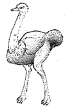
C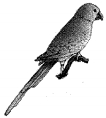
D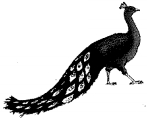
Solution
(B) The bird that cannot fly among the given options is the Ostrich ($Struthio$ $camelus$).
Ostrich is a flightless bird belonging to the class Aves.
It has reduced wings and powerful legs adapted for running,which makes it incapable of flight.
In contrast,Eagles,Parrots,and Peacocks are capable of flight.
Ostrich is a flightless bird belonging to the class Aves.
It has reduced wings and powerful legs adapted for running,which makes it incapable of flight.
In contrast,Eagles,Parrots,and Peacocks are capable of flight.
0 likes
View Solution149
MediumMCQ
Select the incorrect statement for $Aves$.
A
The skin is dry without glands except for the oil gland at the base of the tail.
B
The heart is four-chambered.
C
The hind limbs are modified into wings.
D
They are warm-blooded (homoiothermous) animals.
Solution
(C) In class $Aves$ (birds),the forelimbs are modified into wings,not the hind limbs.
- The hind limbs generally have scales and are modified for walking,swimming,or clasping the tree branches.
- The skin is dry without glands except for the oil gland at the base of the tail.
- The heart is completely four-chambered.
- They are warm-blooded animals,meaning they are able to maintain a constant body temperature.
- Therefore,the statement that hind limbs are modified into wings is incorrect.
- The hind limbs generally have scales and are modified for walking,swimming,or clasping the tree branches.
- The skin is dry without glands except for the oil gland at the base of the tail.
- The heart is completely four-chambered.
- They are warm-blooded animals,meaning they are able to maintain a constant body temperature.
- Therefore,the statement that hind limbs are modified into wings is incorrect.
0 likes
View Solution150
MediumMCQ
The characteristic feature of birds which makes them different from reptiles is $-$
A
Homoeothermic nature
B
Post anal tail
C
Vertebral column
D
Viviparity
Solution
(A) Birds $(Class-Aves)$ are warm-blooded or homoeothermic animals,meaning they can maintain a constant body temperature regardless of the environmental temperature.
In contrast,reptiles $(Class-Reptilia)$ are cold-blooded or poikilothermic,meaning their body temperature fluctuates with the environment.
Post-anal tail,vertebral column,and other features are common to both groups,and most birds are oviparous,not viviparous.
In contrast,reptiles $(Class-Reptilia)$ are cold-blooded or poikilothermic,meaning their body temperature fluctuates with the environment.
Post-anal tail,vertebral column,and other features are common to both groups,and most birds are oviparous,not viviparous.
0 likes
View SolutionAnimal Kingdom — Class-Aves · Frequently Asked Questions
1Are these Animal Kingdom questions useful for JEE and NEET?
Yes. All questions in this section are mapped to JEE Main and NEET exam patterns. Previous year questions from JEE Main, NEET, GUJCET and state-level exams are included with full solutions.
2Can I switch to Hindi or Gujarati for these questions?
Yes. Use the language tabs in the hero section or the sidebar to view the same questions and solutions in English, Hindi or Gujarati.
3How do I generate a question paper from this subtopic?
Use the Vedclass Exam Paper Generator — select the chapter and subtopic, set difficulty, and generate Sets A, B, C, D automatically. First 3 chapters of every subject are free.
Vedclass Products
For Students
Vedclass Test Series
Mock tests in real JEE/NEET style with performance analysis. 5-day free trial.
Start Free TrialFor Teachers
Exam Paper Generator
Generate Set A/B/C/D papers from this chapter in 2 minutes. 3 chapters free.
Try FreeFor Institutes
Online Exam Module
Live online exams with unlimited students, 360° analytics & white-label branding.
See DemoFor Teachers & Institutes
Generate a Animal Kingdom Exam Paper in 2 Minutes
Select subtopic & difficulty — Sets A, B, C, D auto-generated with No Repeat logic.
First 3 chapters of every subject are free — no payment required.