
A English
Class-Amphibia Questions in English
Class 11 Biology · Animal Kingdom · Class-Amphibia
123+
Questions
English
Language
100%
With Solutions
Showing 50 of 123 questions in English
51
EasyMCQ
Frogs are classified as amphibians because:
A
They do not possess a tail.
B
They possess lungs.
C
Their tadpoles are aquatic in nature.
D
They live on both land and in water.
Solution
(D) Amphibians are a class of vertebrates that are characterized by their ability to live both on land and in water. The term 'amphibian' is derived from the Greek words 'amphi' (meaning both) and 'bios' (meaning life). Frogs belong to this class because they have a dual mode of life,typically inhabiting moist terrestrial environments while requiring water for reproduction and the development of their larval stages.
0 likes
View Solution52
DifficultMCQ
Which of the following is $NOT$ a characteristic feature of a frog?
A
Thin,moist,and glandular skin
B
Aquatic reproduction
C
Amniotic egg
D
Cutaneous respiration
Solution
(C) Frogs belong to the class $Amphibia$.
Key characteristics of amphibians include:
$1$. They have thin,moist,and glandular skin without scales,which facilitates cutaneous respiration.
$2$. They require water for reproduction because their eggs lack a protective shell and would dry out on land.
$3$. They are anamniotes,meaning they do not produce an amniotic egg.
An amniotic egg is a characteristic feature of reptiles,birds,and mammals (collectively called amniotes),which allows them to reproduce on land.
Therefore,the presence of an amniotic egg is $NOT$ a characteristic of a frog.
Key characteristics of amphibians include:
$1$. They have thin,moist,and glandular skin without scales,which facilitates cutaneous respiration.
$2$. They require water for reproduction because their eggs lack a protective shell and would dry out on land.
$3$. They are anamniotes,meaning they do not produce an amniotic egg.
An amniotic egg is a characteristic feature of reptiles,birds,and mammals (collectively called amniotes),which allows them to reproduce on land.
Therefore,the presence of an amniotic egg is $NOT$ a characteristic of a frog.
0 likes
View Solution53
EasyMCQ
To which order does the frog belong?
A
Urodela
B
Apoda
C
Caudata
D
Anura
Solution
(D) Frogs belong to the class $Amphibia$.
Within the class $Amphibia$,they are classified under the order $Anura$ (also known as $Salientia$).
$Anura$ is characterized by the absence of a tail in the adult stage and specialized hind limbs for jumping.
$Urodela$ and $Caudata$ are synonymous and refer to tailed amphibians like salamanders.
$Apoda$ (or $Gymnophiona$) refers to limbless amphibians like caecilians.
Within the class $Amphibia$,they are classified under the order $Anura$ (also known as $Salientia$).
$Anura$ is characterized by the absence of a tail in the adult stage and specialized hind limbs for jumping.
$Urodela$ and $Caudata$ are synonymous and refer to tailed amphibians like salamanders.
$Apoda$ (or $Gymnophiona$) refers to limbless amphibians like caecilians.
0 likes
View Solution54
MediumMCQ
Which of the following is $NOT$ true for the $Axolotl$ larva?
$(I)$ It exhibits neoteny and paedogenesis.
$(II)$ The absence of thyroxine affects metamorphosis.
$(III)$ It is a hemichordate larva.
$(I)$ It exhibits neoteny and paedogenesis.
$(II)$ The absence of thyroxine affects metamorphosis.
$(III)$ It is a hemichordate larva.
A
$(I), (II)$ and $(III)$
B
$(I)$ and $(II)$
C
$(II)$ and $(III)$
D
$(III)$
Solution
(D) The $Axolotl$ larva is the larval stage of the tiger salamander ($Ambystoma$ $mexicanum$).
$(I)$ $Axolotl$ larvae exhibit neoteny (retention of larval traits in adulthood) and paedogenesis (reproduction in the larval stage). This statement is true.
$(II)$ Metamorphosis in $Axolotl$ is dependent on the thyroid hormone thyroxine. Its absence prevents metamorphosis,allowing the larva to reach sexual maturity while retaining gills. This statement is true.
$(III)$ $Axolotl$ is an amphibian (chordate),not a hemichordate. Hemichordates are a separate phylum (e.g.,$Balanoglossus$). Therefore,this statement is false.
$(I)$ $Axolotl$ larvae exhibit neoteny (retention of larval traits in adulthood) and paedogenesis (reproduction in the larval stage). This statement is true.
$(II)$ Metamorphosis in $Axolotl$ is dependent on the thyroid hormone thyroxine. Its absence prevents metamorphosis,allowing the larva to reach sexual maturity while retaining gills. This statement is true.
$(III)$ $Axolotl$ is an amphibian (chordate),not a hemichordate. Hemichordates are a separate phylum (e.g.,$Balanoglossus$). Therefore,this statement is false.
0 likes
View Solution55
EasyMCQ
Which of the following is a class of the phylum Chordata?
A
Protozoa
B
Amphibia
C
Porifera
D
Echinodermata
Solution
(B) The phylum $Chordata$ is divided into several classes. Among the given options,$Amphibia$ is a class belonging to the subphylum $Vertebrata$ within the phylum $Chordata$.
$Protozoa$ is a group of protists,$Porifera$ is a separate phylum (sponges),and $Echinodermata$ is also a separate phylum.
$Protozoa$ is a group of protists,$Porifera$ is a separate phylum (sponges),and $Echinodermata$ is also a separate phylum.
0 likes
View Solution56
EasyMCQ
The class of animals that live in both water and on land is known as:
A
Reptilia
B
Amphibia
C
Aves
D
Pisces
Solution
(B) The class $Amphibia$ includes animals that are adapted to live in both aquatic and terrestrial habitats. The term 'amphibian' is derived from the Greek words 'amphi' (meaning dual) and 'bios' (meaning life),indicating their ability to survive in both water and on land. Most amphibians have an aquatic larval stage (e.g.,tadpoles) and a terrestrial adult stage.
0 likes
View Solution57
EasyMCQ
In which of the following organisms is the skin moist and acts as a respiratory organ?
A
Reptiles
B
Aves
C
Amphibians
D
Pisces
Solution
(C) The correct answer is $C$ (Amphibians).
In $Amphibians$,the skin is moist and lacks scales.
They perform cutaneous respiration,meaning the skin acts as a respiratory organ to facilitate gas exchange.
This is a characteristic feature of the class $Amphibia$.
In $Amphibians$,the skin is moist and lacks scales.
They perform cutaneous respiration,meaning the skin acts as a respiratory organ to facilitate gas exchange.
This is a characteristic feature of the class $Amphibia$.
0 likes
View Solution58
EasyMCQ
Body divided into head and trunk:
A
Reptiles
B
Aves
C
Mammals
D
Amphibians
Solution
(D) The body of amphibians is divisible into head and trunk. Many amphibians also possess a tail,but it is not a primary division of the main body structure like the head and trunk. In contrast,reptiles,birds,and mammals typically have a body divided into head,neck,trunk,and tail (or specific variations thereof). Therefore,the correct answer is $Amphibians$.
0 likes
View Solution59
EasyMCQ
Which of the following classes of animals lacks an external ear (pinna)?
A
Amphibia
B
Reptilia
C
Aves
D
Mammalia
Solution
(A) In the class $Amphibia$,the external ear is absent. Instead,a $tympanum$ represents the ear,which is a membrane that receives sound vibrations. In contrast,$Mammalia$ possess an external ear or $pinna$.
0 likes
View Solution60
MediumMCQ
What does not open into the cloaca in amphibians?
A
Reproductive tract
B
Urinary tract
C
Alimentary canal
D
Circulatory tract
Solution
(D) In amphibians,the cloaca is a common chamber into which the digestive,urinary,and reproductive tracts open. The circulatory system is a closed system and does not have any connection or opening into the cloaca. Therefore,the circulatory tract does not open into the cloaca.
0 likes
View Solution61
EasyMCQ
Which of the following animals has a three-chambered heart?
A
Pigeon
B
Platypus
C
Frog
D
Shark
Solution
(C) The heart of a $Frog$ (Class $Amphibia$) is three-chambered,consisting of two atria and one ventricle.
- $Pigeon$ (Class $Aves$) has a four-chambered heart.
- $Platypus$ (Class $Mammalia$) has a four-chambered heart.
- $Shark$ (Class $Chondrichthyes$) has a two-chambered heart.
- $Pigeon$ (Class $Aves$) has a four-chambered heart.
- $Platypus$ (Class $Mammalia$) has a four-chambered heart.
- $Shark$ (Class $Chondrichthyes$) has a two-chambered heart.
0 likes
View Solution62
MediumMCQ
Which of the following vertebrates exhibits metamorphosis?
A
Crocodile
B
Penguin
C
Platypus
D
Salamander
Solution
(D) Metamorphosis is a biological process by which an animal physically develops after birth or hatching, involving a conspicuous and relatively abrupt change in the animal's body structure through cell growth and differentiation.
Among the given options, the $Salamander$ (an amphibian) undergoes metamorphosis, typically transitioning from an aquatic larval stage with gills to a terrestrial or semi-aquatic adult stage with lungs.
Crocodiles, penguins, and platypuses are amniotes and do not undergo metamorphosis in their life cycle.
Among the given options, the $Salamander$ (an amphibian) undergoes metamorphosis, typically transitioning from an aquatic larval stage with gills to a terrestrial or semi-aquatic adult stage with lungs.
Crocodiles, penguins, and platypuses are amniotes and do not undergo metamorphosis in their life cycle.
0 likes
View Solution63
EasyMCQ
$Assertion (S)$: In amphibians,the skin is thin,moist,and highly vascularized.
$Reason (R)$: Amphibians perform cutaneous respiration through their skin.
$Reason (R)$: Amphibians perform cutaneous respiration through their skin.
A
$S$ and $R$ are both true,and $R$ is the correct explanation of $S$.
B
$S$ and $R$ are both true,but $R$ is not the correct explanation of $S$.
C
$S$ is true and $R$ is false.
D
$S$ is false and $R$ is true.
Solution
(A) $1$. Amphibians (class $Amphibia$) possess a thin,moist,and highly vascularized skin to facilitate gas exchange.
$2$. Because the skin is thin and rich in blood capillaries,it allows for efficient diffusion of oxygen and carbon dioxide.
$3$. This process of breathing through the skin is known as cutaneous respiration.
$4$. Therefore,the moist and vascular nature of the skin $(S)$ is the structural adaptation that enables cutaneous respiration $(R)$.
$5$. Thus,$R$ is the correct explanation of $S$.
$2$. Because the skin is thin and rich in blood capillaries,it allows for efficient diffusion of oxygen and carbon dioxide.
$3$. This process of breathing through the skin is known as cutaneous respiration.
$4$. Therefore,the moist and vascular nature of the skin $(S)$ is the structural adaptation that enables cutaneous respiration $(R)$.
$5$. Thus,$R$ is the correct explanation of $S$.
0 likes
View Solution64
DifficultMCQ
$S$ - Statement: $Capelle$ classified frogs and $Ichthyophis$ into $Amphibia$.
$R$ - Reason: Frogs and $Ichthyophis$ possess a three-chambered heart.
$R$ - Reason: Frogs and $Ichthyophis$ possess a three-chambered heart.
A
$S$ and $R$ are both true,and $R$ is the correct explanation of $S$.
B
$S$ and $R$ are both true,but $R$ is not the correct explanation of $S$.
C
$S$ is true and $R$ is false.
D
$S$ is false and $R$ is true.
Solution
(B) The statement $S$ is true because $Capelle$ (and other taxonomists) classified organisms like frogs $(Rana)$ and $Ichthyophis$ (a limbless amphibian) under the class $Amphibia$ based on their shared characteristics.
The reason $R$ is also true because amphibians,including frogs and $Ichthyophis$,possess a three-chambered heart (two atria and one ventricle).
However,the classification of these organisms into $Amphibia$ is based on multiple shared characteristics such as moist skin,lack of scales,and aquatic/terrestrial life cycle,not solely on the presence of a three-chambered heart. Therefore,$R$ is a true statement but not the specific reason for their classification into $Amphibia$.
The reason $R$ is also true because amphibians,including frogs and $Ichthyophis$,possess a three-chambered heart (two atria and one ventricle).
However,the classification of these organisms into $Amphibia$ is based on multiple shared characteristics such as moist skin,lack of scales,and aquatic/terrestrial life cycle,not solely on the presence of a three-chambered heart. Therefore,$R$ is a true statement but not the specific reason for their classification into $Amphibia$.
0 likes
View Solution65
EasyMCQ
Which of the following is a characteristic of $Amphibia$?
A
Presence of scales
B
Presence of air bladders
C
Presence of poison glands
D
Absence of scales,moist skin
Solution
(D) The class $Amphibia$ is characterized by the following features:
$1$. They have a moist skin without scales.
$2$. They possess a three-chambered heart.
$3$. They are cold-blooded (poikilothermic) animals.
$4$. Respiration occurs through lungs,skin,or gills.
$5$. The eyes have eyelids,and a tympanum represents the ear.
Therefore,the absence of scales and the presence of moist skin is a defining characteristic of amphibians.
$1$. They have a moist skin without scales.
$2$. They possess a three-chambered heart.
$3$. They are cold-blooded (poikilothermic) animals.
$4$. Respiration occurs through lungs,skin,or gills.
$5$. The eyes have eyelids,and a tympanum represents the ear.
Therefore,the absence of scales and the presence of moist skin is a defining characteristic of amphibians.
0 likes
View Solution66
EasyMCQ
Ichthyophis is a/an .........
A
Limbless amphibian
B
Reptile
C
Lizard
D
Fish
Solution
(A) $Ichthyophis$ belongs to the class $Amphibia$ and the order $Gymnophiona$ (or $Apoda$).
These organisms are characterized by the absence of limbs,which is why they are referred to as limbless amphibians.
Despite the name $Ichthyophis$ (which sounds like 'fish'),it is not a fish but a vertebrate belonging to the class $Amphibia$.
These organisms are characterized by the absence of limbs,which is why they are referred to as limbless amphibians.
Despite the name $Ichthyophis$ (which sounds like 'fish'),it is not a fish but a vertebrate belonging to the class $Amphibia$.
0 likes
View Solution67
EasyMCQ
Which of the following vertebrates respires through its skin?
A
Fish
B
Frog
C
Crocodile
D
Whale
Solution
(B) Amphibians like the $Frog$ $(Rana \, tigrina)$ exhibit cutaneous respiration, meaning they can exchange gases through their moist skin.
In $Frog$, the skin is highly vascularized and kept moist, which facilitates the diffusion of $O_2$ and $CO_2$ directly between the blood and the environment.
Fish respire through gills, while crocodiles and whales are air-breathing vertebrates that use lungs for respiration.
In $Frog$, the skin is highly vascularized and kept moist, which facilitates the diffusion of $O_2$ and $CO_2$ directly between the blood and the environment.
Fish respire through gills, while crocodiles and whales are air-breathing vertebrates that use lungs for respiration.
0 likes
View Solution68
EasyMCQ
In this class,the cloaca serves as a common opening for the digestive,urinary,and reproductive tracts.
A
Aves
B
Amphibia
C
Reptilia
D
Mammalia
Solution
(B) In the class $Amphibia$,the digestive,urinary,and reproductive tracts open into a common chamber called the cloaca,which opens to the exterior. This is a characteristic feature of amphibians,as well as birds and reptiles,but among the given options,$Amphibia$ is the most standard answer for this specific anatomical feature in introductory biology contexts.
0 likes
View Solution69
EasyMCQ
Animals of this class possess only the inner ear and middle ear.
A
Reptilia
B
Amphibia
C
Aves
D
Mammalia
Solution
(B) In the class $Amphibia$,the ear is represented by the tympanum,which is an external membrane,and the inner ear. They lack an external ear (pinna). The middle ear is present,but the external ear is absent. Therefore,they only possess the inner ear and middle ear structures.
0 likes
View Solution70
EasyMCQ
Which class of animals lives in both water and on land?
A
Reptilia
B
Amphibia
C
Aves
D
Pisces
Solution
(B) The class $Amphibia$ includes animals that are adapted to live in both aquatic and terrestrial habitats. The term 'amphibian' is derived from the Greek words 'amphi' (meaning dual) and 'bios' (meaning life),reflecting their ability to survive in both water and on land. Most amphibians undergo metamorphosis,starting their life cycle in water (using gills) and transitioning to land as adults (using lungs and skin for respiration).
0 likes
View Solution71
EasyMCQ
Which of the following is a limbless amphibian?
A
Frog
B
Salamander
C
Ichthyophis
D
Eel
Solution
(C) The class $Amphibia$ is divided into three orders: $Anura$ (frogs and toads),$Urodela$ (salamanders and newts),and $Gymnophiona$ or $Apoda$ (caecilians).
$Ichthyophis$ belongs to the order $Gymnophiona$,which are characterized by being limbless amphibians.
Frogs and salamanders possess limbs,while $Eel$ is a type of fish,not an amphibian.
$Ichthyophis$ belongs to the order $Gymnophiona$,which are characterized by being limbless amphibians.
Frogs and salamanders possess limbs,while $Eel$ is a type of fish,not an amphibian.
0 likes
View Solution72
EasyMCQ
To which class does Ichthyophis belong?
A
Reptilia
B
Amphibia
C
Mollusca
D
Annelida
Solution
(B) Ichthyophis is a genus of limbless amphibians,commonly known as caecilians.
They belong to the class $Amphibia$ and the order $Gymnophiona$ (or $Apoda$).
These organisms are adapted for burrowing and are found in tropical regions.
They belong to the class $Amphibia$ and the order $Gymnophiona$ (or $Apoda$).
These organisms are adapted for burrowing and are found in tropical regions.
0 likes
View Solution73
EasyMCQ
Which of the following lacks an exoskeleton?
A
Snake
B
Crow
C
Catla
D
Frog
Solution
(D) The exoskeleton refers to the external covering that provides protection and support to an organism.
$A$. Snakes have scales,which are epidermal derivatives forming an exoskeleton.
$B$. Crows are birds and possess feathers,which are epidermal derivatives forming an exoskeleton.
$C$. Catla is a bony fish; it possesses scales,which are dermal derivatives forming an exoskeleton.
$D$. Frogs belong to the class $Amphibia$. Their skin is smooth,moist,and glandular,and they lack any form of external skeletal structures like scales,feathers,or hair. Therefore,they lack an exoskeleton.
$A$. Snakes have scales,which are epidermal derivatives forming an exoskeleton.
$B$. Crows are birds and possess feathers,which are epidermal derivatives forming an exoskeleton.
$C$. Catla is a bony fish; it possesses scales,which are dermal derivatives forming an exoskeleton.
$D$. Frogs belong to the class $Amphibia$. Their skin is smooth,moist,and glandular,and they lack any form of external skeletal structures like scales,feathers,or hair. Therefore,they lack an exoskeleton.
0 likes
View Solution74
EasyMCQ
Which of the following animals has a body divided into head,neck,trunk,and tail?
A
Salamander
B
Lizard
C
Ichthyophis
D
Frog
Solution
(A) The body of a $Salamander$ (an amphibian of the order $Urodela$) is distinctly divided into a head,neck,trunk,and tail.
In contrast,frogs and toads (order $Anura$) lack a neck and tail in their adult stage.
$Ichthyophis$ (a caecilian) has a worm-like body without limbs.
Lizards are reptiles,and while they have a tail,the classification of body regions in $Salamander$ is a classic textbook example for $Amphibia$.
In contrast,frogs and toads (order $Anura$) lack a neck and tail in their adult stage.
$Ichthyophis$ (a caecilian) has a worm-like body without limbs.
Lizards are reptiles,and while they have a tail,the classification of body regions in $Salamander$ is a classic textbook example for $Amphibia$.
0 likes
View Solution75
EasyMCQ
Which animal possesses a three-chambered heart consisting of two atria and one ventricle?
A
Crocodile
B
Salamander
C
Peacock
D
Labeo
Solution
(B) The heart structure varies across different classes of vertebrates.
$1$. $A$ $3$-chambered heart,consisting of two atria and one ventricle,is a characteristic feature of most amphibians and reptiles (except crocodiles).
$2$. Among the given options,the Salamander belongs to the class Amphibia,which typically has a $3$-chambered heart.
$3$. Crocodiles have a $4$-chambered heart.
$4$. Peacocks (birds) and Labeo (fish) have $4$-chambered and $2$-chambered hearts,respectively.
Therefore,the correct answer is the Salamander.
$1$. $A$ $3$-chambered heart,consisting of two atria and one ventricle,is a characteristic feature of most amphibians and reptiles (except crocodiles).
$2$. Among the given options,the Salamander belongs to the class Amphibia,which typically has a $3$-chambered heart.
$3$. Crocodiles have a $4$-chambered heart.
$4$. Peacocks (birds) and Labeo (fish) have $4$-chambered and $2$-chambered hearts,respectively.
Therefore,the correct answer is the Salamander.
0 likes
View Solution76
EasyMCQ
Which of the following is absent in a $Salamander$?
A
Gills
B
Exoskeleton
C
External ear
D
All of the above
0 likes
View Solution77
MediumMCQ
Which of the following animals can live in both land and water?
A
Ichthyophis
B
Ray fish
C
Labeo
D
Hagfish
Solution
(A) The correct answer is $A$. Ichthyophis is a genus of caecilians,which are limbless amphibians. Amphibians are characterized by their ability to live in both aquatic and terrestrial environments. Ray fish,Labeo,and Hagfish are aquatic organisms (fishes) that cannot survive on land.
0 likes
View Solution78
EasyMCQ
Which class is the first class of vertebrates?
A
Aves
B
Reptilia
C
Mammalia
D
Amphibia
Solution
(D) The classification of vertebrates ($Subphylum$ $Vertebrata$) begins with the class $Cyclostomata$ (jawless fishes),followed by $Chondrichthyes$ (cartilaginous fishes) and $Osteichthyes$ (bony fishes). Among the tetrapods (four-limbed vertebrates),the class $Amphibia$ is considered the first class to have evolved to live on land,although they are still dependent on water for reproduction. Therefore,in the context of terrestrial vertebrates,$Amphibia$ is the first class.
0 likes
View Solution79
EasyMCQ
In which class of animals is the body divided into head and trunk?
A
Mammalia
B
Amphibia
C
Cyclostomata
D
Reptilia
Solution
(B) In the class $Amphibia$,the body is divisible into head and trunk. Some members of this class may also possess a tail. Other classes like $Mammalia$ and $Reptilia$ typically have a body divided into head,neck,and trunk (or head,neck,trunk,and tail),while $Cyclostomata$ have an elongated,eel-like body without paired fins or a distinct neck.
0 likes
View Solution80
EasyMCQ
Which animal undergoes development through metamorphosis after fertilization?
A
Platypus
B
Seahorse
C
Ostrich
D
Frog
Solution
(D) Metamorphosis is a biological process by which an animal physically develops after birth or hatching,involving a conspicuous and relatively abrupt change in the animal's body structure through cell growth and differentiation. Among the given options,the frog $(Amphibia)$ undergoes metamorphosis. The life cycle of a frog includes a larval stage known as a tadpole,which is aquatic and breathes through gills,eventually transforming into an adult frog that is terrestrial or semi-aquatic and breathes through lungs. The other options (Platypus,Seahorse,and Ostrich) do not undergo metamorphosis; their young ones resemble the adults at birth or hatching.
0 likes
View Solution81
EasyMCQ
$A$: $Ichthyophis$ is a poikilothermic animal.
$R$: Amphibians maintain their body temperature with the changing temperature of the environment.
$R$: Amphibians maintain their body temperature with the changing temperature of the environment.
A
$A$ and $R$ are true and $R$ is the correct explanation of $A$.
B
$A$ and $R$ are true,but $R$ is not the correct explanation of $A$.
C
$A$ is true and $R$ is false.
D
$A$ is false and $R$ is true.
Solution
(C) $Ichthyophis$ belongs to the class $Amphibia$.
Amphibians are poikilothermic (cold-blooded) animals,meaning they cannot regulate their internal body temperature and it fluctuates with the environmental temperature.
Therefore,statement $A$ is true.
Statement $R$ claims that amphibians maintain their body temperature with the changing environment,which is incorrect because 'maintaining' implies homeostasis (like endotherms),whereas they actually 'conform' to the environment.
Thus,$A$ is true and $R$ is false.
Amphibians are poikilothermic (cold-blooded) animals,meaning they cannot regulate their internal body temperature and it fluctuates with the environmental temperature.
Therefore,statement $A$ is true.
Statement $R$ claims that amphibians maintain their body temperature with the changing environment,which is incorrect because 'maintaining' implies homeostasis (like endotherms),whereas they actually 'conform' to the environment.
Thus,$A$ is true and $R$ is false.
0 likes
View Solution82
MediumMCQ
Statement $X$: The skin of amphibians acts as a respiratory organ.
Statement $Y$: Amphibians lack an exoskeleton and have moist skin.
Statement $Y$: Amphibians lack an exoskeleton and have moist skin.
A
Statement $Y$ is the correct reason for Statement $X$.
B
Statement $Y$ is an incorrect reason for Statement $X$.
C
Statement $X$ is false. Statement $Y$ is irrelevant.
D
Both Statement $X$ and Statement $Y$ are false.
Solution
(A) Amphibians are characterized by having moist,glandular skin that lacks an exoskeleton (scales,feathers,or hair).
Because their skin is moist and highly vascularized,it allows for the exchange of gases (oxygen and carbon dioxide) directly with the environment,a process known as cutaneous respiration.
Therefore,the absence of an exoskeleton and the presence of moist skin are the specific adaptations that allow the skin to function as a respiratory organ.
Thus,Statement $Y$ is the correct reason for Statement $X$.
Because their skin is moist and highly vascularized,it allows for the exchange of gases (oxygen and carbon dioxide) directly with the environment,a process known as cutaneous respiration.
Therefore,the absence of an exoskeleton and the presence of moist skin are the specific adaptations that allow the skin to function as a respiratory organ.
Thus,Statement $Y$ is the correct reason for Statement $X$.
0 likes
View Solution83
MediumMCQ
Annual migration does not occur in the case of
A
arctic tern
B
salmon
C
siberian crane
D
salamander
Solution
(D) : Migration is the seasonal movement of complete populations of animals to a more favourable environment.
It is common in mammals (e.g.,porpoises),fish (e.g.,eels and salmon),and some insects,but is most marked in birds.
The arctic tern,for example,migrates annually from its breeding ground in the Arctic circle to the Antarctic.
Salmon usually migrate from marine to fresh water to spawn.
The siberian crane breeds in arctic Russia in Yakutia and western Siberia and is a long-distance migrant.
Salamander is an amphibian with a slender body,short legs,and a long tail.
Outside the breeding season,they are seldom seen as they spend most of their time underground and do not perform annual long-distance migrations.
It is common in mammals (e.g.,porpoises),fish (e.g.,eels and salmon),and some insects,but is most marked in birds.
The arctic tern,for example,migrates annually from its breeding ground in the Arctic circle to the Antarctic.
Salmon usually migrate from marine to fresh water to spawn.
The siberian crane breeds in arctic Russia in Yakutia and western Siberia and is a long-distance migrant.
Salamander is an amphibian with a slender body,short legs,and a long tail.
Outside the breeding season,they are seldom seen as they spend most of their time underground and do not perform annual long-distance migrations.
0 likes
View Solution84
MediumMCQ
Which statement is wrong about $Amphibia$?
A
They have two pairs of limbs.
B
Body is divided into head and trunk.
C
Skin is moist and eyes have eyelids.
D
Heart is two chambered (One auricle and one ventricle).
Solution
(D) The class $Amphibia$ includes animals that can live in both aquatic and terrestrial habitats.
Most of them have two pairs of limbs.
The body is divisible into head and trunk (tail may be present in some).
Their skin is moist (without scales) and eyes have eyelids.
The heart in amphibians is three-chambered,consisting of two auricles and one ventricle.
Therefore,the statement that the heart is two-chambered is incorrect.
Most of them have two pairs of limbs.
The body is divisible into head and trunk (tail may be present in some).
Their skin is moist (without scales) and eyes have eyelids.
The heart in amphibians is three-chambered,consisting of two auricles and one ventricle.
Therefore,the statement that the heart is two-chambered is incorrect.
0 likes
View Solution85
MediumMCQ
Which statement is correct for the given figure?
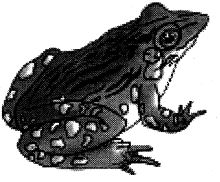
A
Notochord is converted into the spinal cord.
B
Notochord is not produced.
C
Germinal layers are not formed.
D
Notochord is only found during the embryonic period.
Solution
(D) The figure shows a frog,which belongs to the class $Amphibia$ and the phylum $Chordata$.
In all chordates,a notochord is present at some stage of their life cycle.
In vertebrates (like frogs),the notochord is present during the embryonic period and is replaced by the vertebral column in the adult stage.
Therefore,the notochord is only found during the embryonic period in these organisms.
In all chordates,a notochord is present at some stage of their life cycle.
In vertebrates (like frogs),the notochord is present during the embryonic period and is replaced by the vertebral column in the adult stage.
Therefore,the notochord is only found during the embryonic period in these organisms.
0 likes
View Solution86
MediumMCQ
Choose the correct sentence for $Amphibia$.
A
Fertilization is external and development is indirect.
B
They are oviparous or viviparous.
C
The animal dies after breeding.
D
The skin is scaly.
Solution
(A) The class $Amphibia$ includes animals that can live in both aquatic and terrestrial habitats.
Most amphibians are oviparous,meaning they lay eggs.
Fertilization is external in most amphibians,where eggs and sperm are released into the water.
The development is indirect,meaning they pass through a larval stage (e.g.,tadpole) before reaching the adult form.
Option $A$ is correct because fertilization is external and development is indirect.
Option $B$ is incorrect because they are generally oviparous,not viviparous.
Option $C$ is incorrect as this is not a characteristic feature of amphibians.
Option $D$ is incorrect because amphibians have moist skin without scales.
Most amphibians are oviparous,meaning they lay eggs.
Fertilization is external in most amphibians,where eggs and sperm are released into the water.
The development is indirect,meaning they pass through a larval stage (e.g.,tadpole) before reaching the adult form.
Option $A$ is correct because fertilization is external and development is indirect.
Option $B$ is incorrect because they are generally oviparous,not viviparous.
Option $C$ is incorrect as this is not a characteristic feature of amphibians.
Option $D$ is incorrect because amphibians have moist skin without scales.
0 likes
View Solution87
MediumMCQ
Identify the amphibian from the following options.
A
Ichthyophis
B
Angel fish
C
Fighting fish
D
Dog fish
Solution
(A) The class $Amphibia$ includes animals that can live in both aquatic and terrestrial habitats.
$Ichthyophis$ is a limbless amphibian belonging to the order $Gymnophiona$ (or $Apoda$).
Angel fish $(Pterophyllum)$,Fighting fish $(Betta)$,and Dog fish $(Scoliodon)$ are all members of the class $Pisces$ (fish).
$Ichthyophis$ is a limbless amphibian belonging to the order $Gymnophiona$ (or $Apoda$).
Angel fish $(Pterophyllum)$,Fighting fish $(Betta)$,and Dog fish $(Scoliodon)$ are all members of the class $Pisces$ (fish).
0 likes
View Solution88
EasyMCQ
$Necturus$ is commonly known as:
A
Hellbender
B
Congoeel
C
Mudpuppy
D
Blind worm
Solution
(C) $Necturus$ is a genus of aquatic salamanders in the family $Proteidae$.
They are commonly known as $Mudpuppies$ because of the mistaken belief that they make a barking sound like a dog.
$Hellbender$ refers to $Cryptobranchus$ $alleganiensis$.
$Congoeel$ refers to $Amphiuma$.
$Blind$ $worm$ refers to $Anguis$ $fragilis$ (a legless lizard) or $Caecilians$ (amphibians).
They are commonly known as $Mudpuppies$ because of the mistaken belief that they make a barking sound like a dog.
$Hellbender$ refers to $Cryptobranchus$ $alleganiensis$.
$Congoeel$ refers to $Amphiuma$.
$Blind$ $worm$ refers to $Anguis$ $fragilis$ (a legless lizard) or $Caecilians$ (amphibians).
0 likes
View Solution89
EasyMCQ
The Fire-bellied toad is known as ........
A
Amphiuma
B
Bombinator
C
Necturus
D
Salamander
Solution
(B) The Fire-bellied toad belongs to the genus $Bombinator$ (also commonly referred to as $Bombina$). These toads are known for their bright red or orange coloration on their bellies,which serves as a warning signal to predators (aposematism). Therefore,the correct option is $B$.
0 likes
View Solution90
EasyMCQ
Which of the following is not a true amphibian?
A
Salamander
B
Toad
C
Turtle
D
Frog
Solution
(C) Amphibians belong to the class $Amphibia$ and are characterized by their ability to live in both aquatic and terrestrial habitats. They typically have moist skin,lack scales,and undergo metamorphosis.
$A$. Salamanders are amphibians (Order $Urodela$).
$B$. Toads are amphibians (Order $Anura$).
$C$. Turtles belong to the class $Reptilia$. They have dry,scaly skin and lay amniotic eggs on land,which distinguishes them from amphibians.
$D$. Frogs are amphibians (Order $Anura$).
Therefore,the turtle is not an amphibian.
$A$. Salamanders are amphibians (Order $Urodela$).
$B$. Toads are amphibians (Order $Anura$).
$C$. Turtles belong to the class $Reptilia$. They have dry,scaly skin and lay amniotic eggs on land,which distinguishes them from amphibians.
$D$. Frogs are amphibians (Order $Anura$).
Therefore,the turtle is not an amphibian.
0 likes
View Solution91
Easy
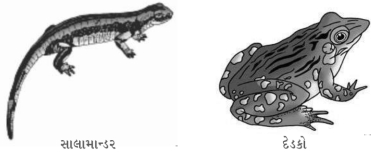
Describe the class Amphibia.
Solution
(N/A) As the name indicates (Gr.,Amphi : dual,bios : life),amphibians can live in aquatic as well as terrestrial habitats.
$\rightarrow$ Most of them have two pairs of limbs.
$\rightarrow$ The body is divisible into head and trunk.
$\rightarrow$ $A$ tail may be present in some.
$\rightarrow$ The amphibian skin is moist (without scales).
$\rightarrow$ The eyes have eyelids.
$\rightarrow$ $A$ tympanum represents the ear.
$\rightarrow$ The alimentary canal,urinary and reproductive tracts open into a common chamber called the cloaca,which opens to the exterior.
$\rightarrow$ Respiration is by gills,lungs,and through the skin.
$\rightarrow$ The heart is three-chambered (two auricles and one ventricle).
$\rightarrow$ These are cold-blooded (poikilothermic) animals.
$\rightarrow$ Sexes are separate.
$\rightarrow$ Fertilization is external. They are oviparous and development is indirect.
$\rightarrow$ Most of them have two pairs of limbs.
$\rightarrow$ The body is divisible into head and trunk.
$\rightarrow$ $A$ tail may be present in some.
$\rightarrow$ The amphibian skin is moist (without scales).
$\rightarrow$ The eyes have eyelids.
$\rightarrow$ $A$ tympanum represents the ear.
$\rightarrow$ The alimentary canal,urinary and reproductive tracts open into a common chamber called the cloaca,which opens to the exterior.
$\rightarrow$ Respiration is by gills,lungs,and through the skin.
$\rightarrow$ The heart is three-chambered (two auricles and one ventricle).
$\rightarrow$ These are cold-blooded (poikilothermic) animals.
$\rightarrow$ Sexes are separate.
$\rightarrow$ Fertilization is external. They are oviparous and development is indirect.
0 likes
View Solution92
EasyMCQ
Differentiate between Bisexual and Amphibia.
A
Bisexual refers to an organism having both male and female reproductive organs,while Amphibia is a class of vertebrates.
B
Bisexual is a reproductive condition,whereas Amphibia is a taxonomic classification.
C
Bisexual organisms can self-fertilize,while Amphibia require aquatic environments for reproduction.
D
All of the above.
Solution
(D) $1$. $Bisexual$ (or hermaphrodite) refers to an organism that possesses both male and female reproductive organs in the same individual (e.g.,earthworms,tapeworms).
$2$. $Amphibia$ is a biological class of ectothermic,tetrapod vertebrates that typically start life in water (larval stage) and transition to land as adults.
$3$. The primary difference is that $Bisexual$ describes a reproductive strategy or condition,while $Amphibia$ describes a specific group of animals within the kingdom $Animalia$.
$2$. $Amphibia$ is a biological class of ectothermic,tetrapod vertebrates that typically start life in water (larval stage) and transition to land as adults.
$3$. The primary difference is that $Bisexual$ describes a reproductive strategy or condition,while $Amphibia$ describes a specific group of animals within the kingdom $Animalia$.
0 likes
View Solution93
Medium
Provide the definitions for the following biological terms:
$(i)$ Bisexual
$(ii)$ Amphibia
$(i)$ Bisexual
$(ii)$ Amphibia
Solution
(N/A) $(i)$ Bisexual: An organism that possesses both male and female reproductive organs (e.g.,earthworms,sponges,tapeworms). These are also known as hermaphrodites.
$(ii)$ Amphibia: $A$ class of vertebrates that are adapted to live both on land and in water. They are ectothermic (cold-blooded),typically have a moist skin without scales,and undergo metamorphosis during their life cycle (e.g.,frogs,toads,salamanders).
$(ii)$ Amphibia: $A$ class of vertebrates that are adapted to live both on land and in water. They are ectothermic (cold-blooded),typically have a moist skin without scales,and undergo metamorphosis during their life cycle (e.g.,frogs,toads,salamanders).
0 likes
View Solution94
EasyMCQ
Where does syngamy occur in frogs?
A
Inside the body
B
In the external water medium
C
In the air medium
D
In the soil medium
Solution
(B) In frogs,fertilization is external. This means that syngamy (the fusion of male and female gametes) occurs outside the body of the organism,specifically in the surrounding water medium. The female releases eggs into the water,and the male releases sperm over them,leading to external fertilization.
0 likes
View Solution95
MediumMCQ
Which of the following animals lay eggs that dry up in the presence of sunlight?
A
Reptiles
B
Mammals
C
Amphibians
D
All of the above
Solution
(C) Amphibians are animals that typically lay their eggs in water or moist environments.
Their eggs lack a protective,waterproof shell (like the amniotic egg found in reptiles and birds).
Therefore,if these eggs are exposed to direct sunlight or dry conditions,they lose moisture rapidly and dry up,leading to the death of the embryo.
Thus,amphibians are dependent on water for their reproductive cycle.
Their eggs lack a protective,waterproof shell (like the amniotic egg found in reptiles and birds).
Therefore,if these eggs are exposed to direct sunlight or dry conditions,they lose moisture rapidly and dry up,leading to the death of the embryo.
Thus,amphibians are dependent on water for their reproductive cycle.
0 likes
View Solution96
EasyMCQ
The Indian salamander is:
A
Siren
B
Tylototriton
C
Ambystoma
D
Necturus
Solution
(B) $Tylototriton$ $verrucosus$, commonly known as the Indian salamander, belongs to the order $Urodela$.
0 likes
View Solution97
EasyMCQ
Columella auris is found in
A
Rabbit
B
Frog
C
Man
D
All of these
Solution
(B) The middle ear of a frog consists of only a single rod-shaped bone called $Columella$ $auris$, which extends across the tympanic chamber from the tympanic membrane to the $fenestra$ $ovalis$.
$Columella$ $auris$ is also present in reptiles and birds.
It functions to transmit sound vibrations to the inner ear and is homologous to the $stapes$ bone found in mammals.
$Columella$ $auris$ is also present in reptiles and birds.
It functions to transmit sound vibrations to the inner ear and is homologous to the $stapes$ bone found in mammals.
0 likes
View Solution98
MediumMCQ
The limbless amphibian is
A
$Ichthyophis$
B
$Hyla$
C
$Rana$
D
$Salamandra$
Solution
(A) $Ichthyophis$ belongs to the order $Gymnophiona$,class $Amphibia$ of the phylum $Chordata$.
The members of this order are limbless,blind,elongated,worm-like,burrowing tropical forms and are commonly known as caecilians.
The members of this order are limbless,blind,elongated,worm-like,burrowing tropical forms and are commonly known as caecilians.
0 likes
View Solution99
EasyMCQ
$Salamandra$ belongs to which order?
A
Apoda
B
Urodela
C
Anura
D
None of these
Solution
(B) $Salamandra$,commonly known as the spotted salamander,belongs to the order $Urodela$ (also known as $Caudata$) within the class $Amphibia$.
$Urodela$ is characterized by amphibians that retain a tail throughout their adult life.
$Urodela$ is characterized by amphibians that retain a tail throughout their adult life.
0 likes
View Solution100
EasyMCQ
The most powerful poison produced by vertebrates is
A
Paratotoxin
B
Hypotoxin
C
Haemotoxin
D
Batrachotoxin
Solution
(D) Batrachotoxin is a potent neurotoxin produced by poison dart frogs of the genus $Dendrobates$. It is considered the most powerful nerve poison produced by vertebrates.
0 likes
View SolutionAnimal Kingdom — Class-Amphibia · Frequently Asked Questions
1Are these Animal Kingdom questions useful for JEE and NEET?
Yes. All questions in this section are mapped to JEE Main and NEET exam patterns. Previous year questions from JEE Main, NEET, GUJCET and state-level exams are included with full solutions.
2Can I switch to Hindi or Gujarati for these questions?
Yes. Use the language tabs in the hero section or the sidebar to view the same questions and solutions in English, Hindi or Gujarati.
3How do I generate a question paper from this subtopic?
Use the Vedclass Exam Paper Generator — select the chapter and subtopic, set difficulty, and generate Sets A, B, C, D automatically. First 3 chapters of every subject are free.
Vedclass Products
For Students
Vedclass Test Series
Mock tests in real JEE/NEET style with performance analysis. 5-day free trial.
Start Free TrialFor Teachers
Exam Paper Generator
Generate Set A/B/C/D papers from this chapter in 2 minutes. 3 chapters free.
Try FreeFor Institutes
Online Exam Module
Live online exams with unlimited students, 360° analytics & white-label branding.
See DemoFor Teachers & Institutes
Generate a Animal Kingdom Exam Paper in 2 Minutes
Select subtopic & difficulty — Sets A, B, C, D auto-generated with No Repeat logic.
First 3 chapters of every subject are free — no payment required.