
A English
Internal structure of stem Questions in English
Class 11 Biology · Anatomy of Flowering Plants · Internal structure of stem
128+
Questions
English
Language
100%
With Solutions
Showing 28 of 128 questions in English
101
MediumMCQ
Vascular bundles are conjoint,collateral,endarch and lack cambium between xylem and phloem in all,but not in:
A
Maize
B
Barley
C
Wheat
D
Sunflower
Solution
(D) Vascular bundles that lack cambium between xylem and phloem are known as closed vascular bundles,which are characteristic of monocot stems. Maize,Barley,and Wheat are monocots and possess closed vascular bundles. Sunflower is a dicot plant,and its stems possess open vascular bundles,meaning cambium is present between the xylem and phloem,allowing for secondary growth.
0 likes
View Solution102
MediumMCQ
Select a set having correct match.
| Dicot stem | Monocot stem |
A
$Sclerenchymatous$ hypodermis - $Collenchymatous$ hypodermis
B
$Parenchymatous$ pericycle - $Sclerenchymatous$ pericycle
C
Epidermis with trichomes - Water containing cavities in vascular bundles
D
Oval bundles - Wedge shaped bundles
Solution
$(C)$ In a $Dicot$ stem, the epidermis typically possesses trichomes (multicellular hairs).
In a $Monocot$ stem, the vascular bundles are scattered and often contain water-containing cavities (lysigenous cavities) within the xylem.
Therefore, option $C$ represents the correct match for the anatomical features of $Dicot$ and $Monocot$ stems respectively.
In a $Monocot$ stem, the vascular bundles are scattered and often contain water-containing cavities (lysigenous cavities) within the xylem.
Therefore, option $C$ represents the correct match for the anatomical features of $Dicot$ and $Monocot$ stems respectively.
0 likes
View Solution103
MediumMCQ
Monocot stem differs from dicot stem in having
A
Endarch xylem element
B
Collateral $V.B.$
C
Well developed pith
D
Scattered vascular bundles
Solution
(D) In monocot stems,the vascular bundles are scattered throughout the ground tissue,whereas in dicot stems,they are arranged in a ring. Additionally,monocot stems lack a distinct pith and cortex,unlike dicot stems which have a well-developed pith.
0 likes
View Solution104
MediumMCQ
$A$: Endodermis is present between the general cortex and pericycle in maize stem. $R$: Eustele is present in maize stem.
A
Assertion and Reason both are correct and Reason is the correct explanation of Assertion.
B
Assertion and Reason both are correct but Reason is not the correct explanation of Assertion.
C
Assertion is correct,but Reason is incorrect.
D
Both Assertion and Reason are incorrect.
Solution
(D) Maize ($Zea$ $mays$) is a monocotyledonous plant. In monocot stems,the endodermis is usually absent or not well-defined. Therefore,the Assertion is incorrect.
Monocot stems possess an atactostele (scattered vascular bundles),whereas a eustele (vascular bundles arranged in a ring) is a characteristic feature of dicot stems. Therefore,the Reason is also incorrect.
Thus,both Assertion and Reason are incorrect.
Monocot stems possess an atactostele (scattered vascular bundles),whereas a eustele (vascular bundles arranged in a ring) is a characteristic feature of dicot stems. Therefore,the Reason is also incorrect.
Thus,both Assertion and Reason are incorrect.
0 likes
View Solution105
EasyMCQ
Submerged hydrophytes show
A
Stomata
B
Abundant air sacs
C
Well developed mechanical tissue
D
Secondary growth
Solution
(B) Plants that live in an abundance of water are called hydrophytes.
Hydrophytic plants that remain completely under water are called submerged hydrophytes.
These plants possess extensively developed air spaces (aerenchyma) in their roots,stems,and leaves to facilitate buoyancy and gas exchange.
$e.g.,$ $Hydrilla$,$Vallisneria$,$Ceratophyllum$,$Utricularia$,etc.
Hydrophytic plants that remain completely under water are called submerged hydrophytes.
These plants possess extensively developed air spaces (aerenchyma) in their roots,stems,and leaves to facilitate buoyancy and gas exchange.
$e.g.,$ $Hydrilla$,$Vallisneria$,$Ceratophyllum$,$Utricularia$,etc.
0 likes
View Solution106
MediumMCQ
If the protoxylem is towards the center and the metaxylem is towards the periphery,the arrangement of xylem is called $.........$.
A
Exarch
B
Endarch
C
Mesarch
D
None of these
Solution
(B) In plants,the arrangement of xylem is classified based on the position of protoxylem and metaxylem.
$1$. $Endarch$: The protoxylem lies towards the center (pith) and the metaxylem lies towards the periphery. This is characteristic of stems.
$2$. $Exarch$: The protoxylem lies towards the periphery and the metaxylem lies towards the center. This is characteristic of roots.
$3$. $Mesarch$: The protoxylem is surrounded by metaxylem on all sides.
Since the question states that the protoxylem is towards the center,the correct arrangement is $Endarch$.
$1$. $Endarch$: The protoxylem lies towards the center (pith) and the metaxylem lies towards the periphery. This is characteristic of stems.
$2$. $Exarch$: The protoxylem lies towards the periphery and the metaxylem lies towards the center. This is characteristic of roots.
$3$. $Mesarch$: The protoxylem is surrounded by metaxylem on all sides.
Since the question states that the protoxylem is towards the center,the correct arrangement is $Endarch$.
0 likes
View Solution107
MediumMCQ
In how many of the following plant organs are open vascular bundles found? Dicot root,Dicot stem,Monocot root,Monocot stem,Dicot leaf,Monocot leaf.
A
$1$
B
$3$
C
$4$
D
$5$
Solution
(A) Open vascular bundles are those that contain cambium between the xylem and phloem,allowing for secondary growth.
$1$. Dicot root: Vascular bundles are radial and closed.
$2$. Dicot stem: Vascular bundles are conjoint,collateral,and open (contain cambium).
$3$. Monocot root: Vascular bundles are radial and closed.
$4$. Monocot stem: Vascular bundles are conjoint,collateral,and closed (no cambium).
$5$. Dicot leaf: Vascular bundles are closed.
$6$. Monocot leaf: Vascular bundles are closed.
Only the Dicot stem possesses open vascular bundles. Therefore,the count is $1$.
$1$. Dicot root: Vascular bundles are radial and closed.
$2$. Dicot stem: Vascular bundles are conjoint,collateral,and open (contain cambium).
$3$. Monocot root: Vascular bundles are radial and closed.
$4$. Monocot stem: Vascular bundles are conjoint,collateral,and closed (no cambium).
$5$. Dicot leaf: Vascular bundles are closed.
$6$. Monocot leaf: Vascular bundles are closed.
Only the Dicot stem possesses open vascular bundles. Therefore,the count is $1$.
0 likes
View Solution108
MediumMCQ
In which of the following are radial vascular bundles and conjoint vascular bundles found,respectively?
A
Radial vascular bundles = Monocot root,Conjoint vascular bundles = Monocot stem
B
Radial vascular bundles = Dicot root,Conjoint vascular bundles = Monocot root
C
Radial vascular bundles = Monocot leaf,Conjoint vascular bundles = Dicot leaf
D
Radial vascular bundles = Dicot leaf,Conjoint vascular bundles = Monocot leaf
Solution
(A) $1$. Radial vascular bundles: In these bundles,xylem and phloem are arranged in an alternate manner on different radii. This arrangement is characteristic of roots (both monocot and dicot).
$2$. Conjoint vascular bundles: In these bundles,xylem and phloem are jointly situated at the same radius. This arrangement is characteristic of stems and leaves.
$3$. Therefore,radial vascular bundles are found in roots (e.g.,Monocot root),and conjoint vascular bundles are found in stems (e.g.,Monocot stem).
$4$. Thus,the correct option is $A$.
$2$. Conjoint vascular bundles: In these bundles,xylem and phloem are jointly situated at the same radius. This arrangement is characteristic of stems and leaves.
$3$. Therefore,radial vascular bundles are found in roots (e.g.,Monocot root),and conjoint vascular bundles are found in stems (e.g.,Monocot stem).
$4$. Thus,the correct option is $A$.
0 likes
View Solution109
MediumMCQ
Which structures are present in the epidermis of the stem?
A
Cuticle
B
Trichomes
C
Stomata
D
All of the above
Solution
(D) The epidermis is the outermost layer of the stem.
It is covered by a thin,waxy layer called the $Cuticle$ to prevent water loss.
It also contains $Trichomes$ (epidermal hairs) which are multicellular outgrowths.
$Stomata$ are also present in the epidermis of the stem to facilitate gaseous exchange.
Therefore,all these structures are characteristic features of the stem epidermis.
It is covered by a thin,waxy layer called the $Cuticle$ to prevent water loss.
It also contains $Trichomes$ (epidermal hairs) which are multicellular outgrowths.
$Stomata$ are also present in the epidermis of the stem to facilitate gaseous exchange.
Therefore,all these structures are characteristic features of the stem epidermis.
0 likes
View Solution110
MediumMCQ
Select the correct option regarding the pericycle of dicot stem and dicot root.
| Option | Pericycle of Dicot Stem | Pericycle of Dicot Root |
| $A$ | Parenchymatous | Parenchymatous |
| $B$ | Sclerenchymatous | Sclerenchymatous |
| $C$ | Sclerenchymatous | Parenchymatous |
| $D$ | Parenchymatous | Sclerenchymatous |
A
$A$
B
$B$
C
$C$
D
$D$
Solution
$(C)$ In a dicot stem, the pericycle is present above the phloem in the form of semi-lunar patches of sclerenchyma. Therefore, it is sclerenchymatous.
In a dicot root, the pericycle is the layer next to the endodermis and is composed of thin-walled parenchymatous cells. It is responsible for the initiation of lateral roots and part of the vascular cambium during secondary growth.
Thus, the correct match is that the dicot stem pericycle is sclerenchymatous and the dicot root pericycle is parenchymatous, which corresponds to option $C$.
In a dicot root, the pericycle is the layer next to the endodermis and is composed of thin-walled parenchymatous cells. It is responsible for the initiation of lateral roots and part of the vascular cambium during secondary growth.
Thus, the correct match is that the dicot stem pericycle is sclerenchymatous and the dicot root pericycle is parenchymatous, which corresponds to option $C$.
0 likes
View Solution111
MediumMCQ
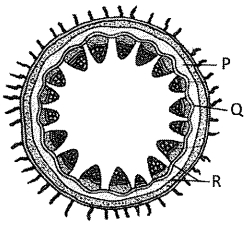
Identify $P, Q,$ and $R$ in the given internal structure.
A
$P=$ Hypodermis,$Q=$ Pericycle,$R=$ Medullary ray
B
$P=$ Parenchyma,$Q=$ Pericycle,$R=$ Medullary ray
C
$P=$ Epidermis,$Q=$ Medullary ray,$R=$ Pith
D
$P=$ Epidermis,$Q=$ Medullary ray,$R=$ Endodermis
Solution
(A) The provided diagram represents the transverse section of a dicot stem.
In a dicot stem:
$P$ points to the Hypodermis,which is the layer just below the epidermis.
$Q$ points to the Pericycle,which is present above the phloem.
$R$ points to the Medullary ray,which is the radial strip of parenchyma cells between the vascular bundles.
Therefore,the correct identification is $P=$ Hypodermis,$Q=$ Pericycle,$R=$ Medullary ray.
In a dicot stem:
$P$ points to the Hypodermis,which is the layer just below the epidermis.
$Q$ points to the Pericycle,which is present above the phloem.
$R$ points to the Medullary ray,which is the radial strip of parenchyma cells between the vascular bundles.
Therefore,the correct identification is $P=$ Hypodermis,$Q=$ Pericycle,$R=$ Medullary ray.
0 likes
View Solution112
MediumMCQ
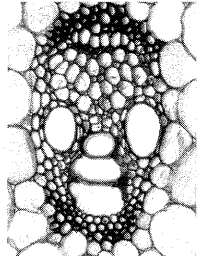
In which organ is this type of vascular bundle found?
A
Monocot root
B
Monocot stem
C
Monocot leaf
D
$B$ and $C$ both
Solution
(B) The provided image shows a closed,collateral vascular bundle with a $Y$-shaped arrangement of xylem vessels,which is characteristic of a monocot stem. In monocot stems,vascular bundles are scattered and closed (lacking cambium). Monocot leaves also have closed vascular bundles,but the specific 'monkey face' appearance of the xylem vessels (two large metaxylem vessels and smaller protoxylem vessels) is a classic diagnostic feature of a monocot stem cross-section.
0 likes
View Solution113
MediumMCQ
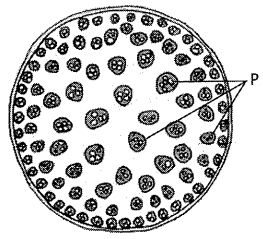
Select the correct option for the given figure.
A
Epidermis
B
Hypodermis
C
Vascular bundle
D
Ground tissue
Solution
(C) The provided figure shows a transverse section of a monocot stem. In a monocot stem,the vascular bundles are scattered throughout the ground tissue. The label '$P$' points to these scattered vascular bundles. Therefore,the correct option is 'Vascular bundle'.
0 likes
View Solution114
MediumMCQ
Conjoint,collateral,and open vascular bundles are characteristic of:
A
Monocot root
B
Monocot stem
C
Dicot root
D
Dicot stem
Solution
(D) Vascular bundles are described as 'conjoint' when xylem and phloem are present on the same radius. They are 'collateral' when phloem lies towards the outer side and xylem towards the inner side. They are 'open' when a strip of cambium is present between xylem and phloem,which allows for secondary growth. These features are characteristic of the dicot stem.
0 likes
View Solution115
MediumMCQ
In which of the following,the cortex,endodermis,pericycle,and pith are not clearly distinguishable?
A
Monocot root
B
Monocot stem
C
Dicot root
D
Dicot stem
Solution
(B) In a $Monocot$ stem,the vascular bundles are scattered in the ground tissue. The ground tissue is not differentiated into distinct regions like cortex,endodermis,pericycle,and pith. In contrast,these regions are well-defined in dicot stems and roots.
0 likes
View Solution116
MediumMCQ
Find the statement that is $\text{NOT}$ correct with regard to the structure of monocot stem.
A
Hypodermis is parenchymatous
B
Vascular bundles are scattered.
C
Vascular bundles are conjoint and closed.
D
Phloem parenchyma is absent.
Solution
(A) In a monocot stem,the hypodermis is typically sclerenchymatous,not parenchymatous. This layer provides mechanical support to the stem.
- Vascular bundles are scattered throughout the ground tissue.
- Vascular bundles are conjoint (xylem and phloem together) and closed (no cambium present).
- Phloem parenchyma is generally absent in the vascular bundles of monocot stems.
Therefore,the statement 'Hypodermis is parenchymatous' is incorrect.
- Vascular bundles are scattered throughout the ground tissue.
- Vascular bundles are conjoint (xylem and phloem together) and closed (no cambium present).
- Phloem parenchyma is generally absent in the vascular bundles of monocot stems.
Therefore,the statement 'Hypodermis is parenchymatous' is incorrect.
0 likes
View Solution117
MediumMCQ
Water cavity is found in -
A
Maize root
B
Sunflower stem
C
Sunflower root
D
Maize stem
Solution
(D) In the vascular bundles of monocot stems like $Maize$ ($Zea$ $mays$),the protoxylem elements disintegrate to form a lysigenous cavity known as the water cavity or protoxylem lacuna. This cavity helps in the conduction of water. Therefore,the water cavity is characteristic of the monocot stem.
0 likes
View Solution118
MediumMCQ
The endodermis of dicot stem is also referred to as $-$
A
Bundle sheath
B
Casparian strip
C
Conjunctive tissue
D
Starch sheath
Solution
(D) In dicot stems,the innermost layer of the cortex is known as the endodermis.
This layer is rich in starch grains and is therefore commonly referred to as the $Starch \ sheath$.
It serves as a storage site for starch and helps in the regulation of water and solute movement.
Therefore,the correct option is $D$.
This layer is rich in starch grains and is therefore commonly referred to as the $Starch \ sheath$.
It serves as a storage site for starch and helps in the regulation of water and solute movement.
Therefore,the correct option is $D$.
0 likes
View Solution119
MediumMCQ
Pericycle and endodermis are not found in
A
Dicot stem
B
Dicot root
C
Monocot stem
D
Monocot root
Solution
(C) In plants,the anatomical structure varies between roots and stems.
$1$. In roots (both dicot and monocot),the endodermis and pericycle are present as distinct layers. The endodermis is the innermost layer of the cortex,and the pericycle is located just inside the endodermis.
$2$. In stems,the organization is different. In a dicot stem,the endodermis is often referred to as the starch sheath,but it is not always clearly defined as a continuous layer.
$3$. However,in a monocot stem,the vascular bundles are scattered throughout the ground tissue,and there is no distinct endodermis or pericycle layer surrounding the vascular tissue.
Therefore,pericycle and endodermis are not found in the monocot stem.
$1$. In roots (both dicot and monocot),the endodermis and pericycle are present as distinct layers. The endodermis is the innermost layer of the cortex,and the pericycle is located just inside the endodermis.
$2$. In stems,the organization is different. In a dicot stem,the endodermis is often referred to as the starch sheath,but it is not always clearly defined as a continuous layer.
$3$. However,in a monocot stem,the vascular bundles are scattered throughout the ground tissue,and there is no distinct endodermis or pericycle layer surrounding the vascular tissue.
Therefore,pericycle and endodermis are not found in the monocot stem.
0 likes
View Solution120
EasyMCQ
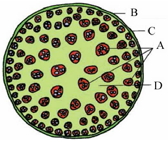
Identify $A, B, C$ and $D$ in the given figure of a monocot stem cross-section.
A
$A -$ Vascular bundle,$B -$ Epidermis,$C -$ Hypodermis,$D -$ Ground tissue
B
$A -$ Hypodermis,$B -$ Epidermis,$C -$ Ground tissue,$D -$ Vascular bundle
C
$A -$ Ground tissue,$B -$ Epidermis,$C -$ Hypodermis,$D -$ Vascular bundle
D
$A -$ Vascular bundle,$B -$ Hypodermis,$C -$ Epidermis,$D -$ Ground tissue
Solution
(A) The provided figure represents the transverse section of a monocot stem.
$1$. $A$ points to the vascular bundles,which are scattered throughout the ground tissue.
$2$. $B$ points to the outermost layer,the epidermis.
$3$. $C$ points to the hypodermis,which is located just below the epidermis.
$4$. $D$ points to the ground tissue,which fills the space between the vascular bundles.
Therefore,the correct identification is $A -$ Vascular bundle,$B -$ Epidermis,$C -$ Hypodermis,$D -$ Ground tissue.
$1$. $A$ points to the vascular bundles,which are scattered throughout the ground tissue.
$2$. $B$ points to the outermost layer,the epidermis.
$3$. $C$ points to the hypodermis,which is located just below the epidermis.
$4$. $D$ points to the ground tissue,which fills the space between the vascular bundles.
Therefore,the correct identification is $A -$ Vascular bundle,$B -$ Epidermis,$C -$ Hypodermis,$D -$ Ground tissue.
0 likes
View Solution121
MediumMCQ
Select the correct option regarding the following statements.
A
Monocot stems and leaves possess radial vascular bundles.
B
Dicot stems possess conjoint collateral open vascular bundles.
C
Roots always possess radial and open vascular bundles.
D
Monocot stems possess conjoint bicollateral closed vascular bundles.
Solution
(B) $1$. In $Monocot$ stems,vascular bundles are conjoint,collateral,and closed (lacking cambium).
$2$. In $Dicot$ stems,vascular bundles are conjoint,collateral,and open (possessing cambium).
$3$. In roots,vascular bundles are always radial,meaning xylem and phloem are arranged in alternate radii,and they are closed (lacking cambium).
$4$. Therefore,statement $B$ is correct because $Dicot$ stems contain open vascular bundles,which allow for secondary growth.
$2$. In $Dicot$ stems,vascular bundles are conjoint,collateral,and open (possessing cambium).
$3$. In roots,vascular bundles are always radial,meaning xylem and phloem are arranged in alternate radii,and they are closed (lacking cambium).
$4$. Therefore,statement $B$ is correct because $Dicot$ stems contain open vascular bundles,which allow for secondary growth.
0 likes
View Solution122
MediumMCQ
Collenchymatous hypodermis occurs in $:-$
A
Dicot roots
B
Dicot stem
C
Monocot stem
D
Petiols
Solution
(B) The hypodermis is the layer of cells located just below the epidermis.
In dicot stems,the hypodermis is typically composed of collenchyma cells,which provide mechanical support and flexibility to the young stem.
In contrast,monocot stems usually have a sclerenchymatous hypodermis,and roots generally lack a distinct hypodermis.
Therefore,the correct answer is $B$ (Dicot stem).
In dicot stems,the hypodermis is typically composed of collenchyma cells,which provide mechanical support and flexibility to the young stem.
In contrast,monocot stems usually have a sclerenchymatous hypodermis,and roots generally lack a distinct hypodermis.
Therefore,the correct answer is $B$ (Dicot stem).
0 likes
View Solution123
MediumMCQ
The 'ring' arrangement of vascular bundles is a characteristic of $:$
A
dicot leaf
B
monocot stem
C
dicot stem
D
monocot root
Solution
(C) In a $dicot$ stem,the vascular bundles are arranged in a ring around the pith.
This arrangement is a diagnostic feature of $dicot$ stems.
In contrast,$monocot$ stems have scattered vascular bundles throughout the ground tissue.
$Dicot$ leaves have a dorsiventral structure with vascular bundles in the veins,and $monocot$ roots have a radial arrangement of vascular bundles.
This arrangement is a diagnostic feature of $dicot$ stems.
In contrast,$monocot$ stems have scattered vascular bundles throughout the ground tissue.
$Dicot$ leaves have a dorsiventral structure with vascular bundles in the veins,and $monocot$ roots have a radial arrangement of vascular bundles.
0 likes
View Solution124
MediumMCQ
The transverse section of a plant material shows the following anatomical features under microscope $:-$
$(a)$ Collenchymatous hypodermis
$(b)$ Sclerenchymatous pericycle located just above phloem bundles in semi-lunar patches.
$(c)$ Vascular bundles are arranged in a ring.
$(d)$ Vascular bundles are conjoint & open.
Plant material should be :
$(a)$ Collenchymatous hypodermis
$(b)$ Sclerenchymatous pericycle located just above phloem bundles in semi-lunar patches.
$(c)$ Vascular bundles are arranged in a ring.
$(d)$ Vascular bundles are conjoint & open.
Plant material should be :
A
Dicotyledonous stem
B
Monocotyledonous stem
C
Monocotyledonous root
D
Dicotyledonous root
Solution
(A) The anatomical features described are characteristic of a $Dicotyledonous$ stem.
$(1)$ $Collenchymatous$ hypodermis is a typical feature of $Dicot$ stems, providing mechanical strength.
$(2)$ $Sclerenchymatous$ pericycle in the form of semi-lunar patches above the phloem is a diagnostic feature of $Dicot$ stems.
$(3)$ Vascular bundles arranged in a ring is a hallmark of $Dicot$ stems.
$(4)$ $Conjoint$ and $open$ vascular bundles (possessing cambium) allow for secondary growth, which is characteristic of $Dicot$ stems.
Therefore, the correct answer is $Dicotyledonous$ stem.
$(1)$ $Collenchymatous$ hypodermis is a typical feature of $Dicot$ stems, providing mechanical strength.
$(2)$ $Sclerenchymatous$ pericycle in the form of semi-lunar patches above the phloem is a diagnostic feature of $Dicot$ stems.
$(3)$ Vascular bundles arranged in a ring is a hallmark of $Dicot$ stems.
$(4)$ $Conjoint$ and $open$ vascular bundles (possessing cambium) allow for secondary growth, which is characteristic of $Dicot$ stems.
Therefore, the correct answer is $Dicotyledonous$ stem.
0 likes
View Solution125
MediumMCQ
Which of the following parts of a dicot stem contains tissue that provides mechanical strength to the young stem?
A
Endodermis
B
Hypodermis
C
Cortex
D
Pith
Solution
(B) In a dicot stem,the hypodermis is located just below the epidermis.
It consists of collenchyma cells.
Collenchyma is a living mechanical tissue that provides tensile strength and flexibility to the young,growing stem.
Therefore,the hypodermis is responsible for providing mechanical strength to the young stem.
It consists of collenchyma cells.
Collenchyma is a living mechanical tissue that provides tensile strength and flexibility to the young,growing stem.
Therefore,the hypodermis is responsible for providing mechanical strength to the young stem.
0 likes
View Solution126
MediumMCQ
Starch sheath and bundle cap are found in the internal structure of:
A
Dicotyledonous root
B
Monocotyledonous stem
C
Dicotyledonous stem
D
Monocotyledonous root
Solution
(C) In the internal structure of a $Dicotyledonous$ stem, the innermost layer of the cortex is called the endodermis. Because the cells of the endodermis are rich in starch grains, it is also referred to as the $Starch$ $sheath$.
Additionally, the patches of $Sclerenchyma$ cells present above the phloem bundles are known as $Bundle$ $cap$.
Additionally, the patches of $Sclerenchyma$ cells present above the phloem bundles are known as $Bundle$ $cap$.
0 likes
View Solution127
MediumMCQ
Innumerable vascular bundles,lack of cambium and lack of a well demarcated pith is found in:
A
Maize stem
B
Sunflower stem
C
Maize root
D
Pea root
Solution
(A) The characteristics described—innumerable scattered vascular bundles,absence of cambium (closed bundles),and lack of a well-demarcated pith—are diagnostic features of a monocot stem.
Among the given options,the $Maize$ stem is a monocot stem.
In contrast,the $Sunflower$ stem is a dicot stem,which possesses a ring-like arrangement of vascular bundles,presence of cambium,and a distinct pith.
Roots (both monocot and dicot) typically have a radial arrangement of vascular bundles,not scattered ones.
Among the given options,the $Maize$ stem is a monocot stem.
In contrast,the $Sunflower$ stem is a dicot stem,which possesses a ring-like arrangement of vascular bundles,presence of cambium,and a distinct pith.
Roots (both monocot and dicot) typically have a radial arrangement of vascular bundles,not scattered ones.
0 likes
View Solution128
EasyMCQ
$A$ student observed the $T.S.$ of a plant organ slide under a microscope. He observed the vascular bundles in the stelar region as conjoint,collateral,and open. Based on these features of the vascular bundle,identify the correct option from below.
A
Monocot Root
B
Monocot stem
C
Dicot Root
D
Dicot Stem
Solution
(D) The vascular bundles are described as conjoint,collateral,and open.
$1$. Conjoint: Xylem and phloem are present on the same radius.
$2$. Collateral: Phloem is located towards the outer side and xylem towards the inner side.
$3$. Open: The presence of cambium between xylem and phloem allows for secondary growth.
These characteristics are diagnostic features of a Dicot Stem.
In contrast,Monocot stems have closed vascular bundles (no cambium),and roots have radial vascular bundles (xylem and phloem on different radii).
$1$. Conjoint: Xylem and phloem are present on the same radius.
$2$. Collateral: Phloem is located towards the outer side and xylem towards the inner side.
$3$. Open: The presence of cambium between xylem and phloem allows for secondary growth.
These characteristics are diagnostic features of a Dicot Stem.
In contrast,Monocot stems have closed vascular bundles (no cambium),and roots have radial vascular bundles (xylem and phloem on different radii).
0 likes
View SolutionAnatomy of Flowering Plants — Internal structure of stem · Frequently Asked Questions
1Are these Anatomy of Flowering Plants questions useful for JEE and NEET?
Yes. All questions in this section are mapped to JEE Main and NEET exam patterns. Previous year questions from JEE Main, NEET, GUJCET and state-level exams are included with full solutions.
2Can I switch to Hindi or Gujarati for these questions?
Yes. Use the language tabs in the hero section or the sidebar to view the same questions and solutions in English, Hindi or Gujarati.
3How do I generate a question paper from this subtopic?
Use the Vedclass Exam Paper Generator — select the chapter and subtopic, set difficulty, and generate Sets A, B, C, D automatically. First 3 chapters of every subject are free.
Vedclass Products
For Students
Vedclass Test Series
Mock tests in real JEE/NEET style with performance analysis. 5-day free trial.
Start Free TrialFor Teachers
Exam Paper Generator
Generate Set A/B/C/D papers from this chapter in 2 minutes. 3 chapters free.
Try FreeFor Institutes
Online Exam Module
Live online exams with unlimited students, 360° analytics & white-label branding.
See DemoFor Teachers & Institutes
Generate a Anatomy of Flowering Plants Exam Paper in 2 Minutes
Select subtopic & difficulty — Sets A, B, C, D auto-generated with No Repeat logic.
First 3 chapters of every subject are free — no payment required.