
A English
Internal structure of stem Questions in English
Class 11 Biology · Anatomy of Flowering Plants · Internal structure of stem
128+
Questions
English
Language
100%
With Solutions
Showing 50 of 128 questions in English
51
MediumMCQ
Statement-$1$: The endodermis in a dicot stem is also known as the starch sheath.
Statement-$2$: The cells of the endodermis are rich in starch grains.
Statement-$2$: The cells of the endodermis are rich in starch grains.
A
Statement-$1$ is true,Statement-$2$ is true. Statement-$2$ is not the correct explanation of Statement-$1$.
B
Statement-$1$ is false,Statement-$2$ is true.
C
Statement-$1$ is true,Statement-$2$ is false.
D
Statement-$1$ is true,Statement-$2$ is true. Statement-$2$ is the correct explanation of Statement-$1$.
Solution
(D) In dicot stems,the innermost layer of the cortex is called the endodermis.
The cells of the endodermis are rich in starch grains,and this layer is therefore referred to as the starch sheath.
Since the presence of starch grains is the reason why it is called the starch sheath,Statement-$2$ provides the correct explanation for Statement-$1$.
Therefore,both statements are true and Statement-$2$ is the correct explanation of Statement-$1$.
The cells of the endodermis are rich in starch grains,and this layer is therefore referred to as the starch sheath.
Since the presence of starch grains is the reason why it is called the starch sheath,Statement-$2$ provides the correct explanation for Statement-$1$.
Therefore,both statements are true and Statement-$2$ is the correct explanation of Statement-$1$.
0 likes
View Solution52
EasyMCQ
Bicollateral vascular bundles are found in .......
A
Malvaceae
B
Cucurbitaceae
C
Liliaceae
D
Poaceae
Solution
(B) Bicollateral vascular bundles are a type of conjoint vascular bundle where the phloem is present on both the outer and inner sides of the xylem. These are characteristic of the family $Cucurbitaceae$. In these bundles,two patches of phloem are present,one towards the periphery and one towards the center,separated by xylem.
0 likes
View Solution53
MediumMCQ
$A$ common difference between the stem and the root is that the xylem in the stem is ...... .
A
Endarch
B
Exarch
C
Mesarch
D
Centrarch
Solution
(A) In the stem,the protoxylem lies towards the center (pith) and the metaxylem lies towards the periphery of the organ. This arrangement of primary xylem is called $Endarch$.
In contrast,in the roots,the protoxylem lies towards the periphery and the metaxylem lies towards the center. This arrangement is called $Exarch$.
Therefore,the characteristic feature of the stem is the $Endarch$ condition.
In contrast,in the roots,the protoxylem lies towards the periphery and the metaxylem lies towards the center. This arrangement is called $Exarch$.
Therefore,the characteristic feature of the stem is the $Endarch$ condition.
0 likes
View Solution54
EasyMCQ
In which plant are the vascular bundles scattered in the ground tissue,and each vascular bundle is surrounded by a sclerenchymatous bundle sheath?
A
Maize
B
Sunflower
C
Gram
D
Banyan
Solution
(A) The characteristics described,such as scattered vascular bundles in the ground tissue and the presence of a sclerenchymatous bundle sheath around each vascular bundle,are typical features of $Monocot$ stems.
Among the given options,$Maize$ ($Zea$ $mays$) is a $Monocot$ plant.
In contrast,$Sunflower$,$Gram$,and $Banyan$ are $Dicot$ plants,which typically have vascular bundles arranged in a ring.
Among the given options,$Maize$ ($Zea$ $mays$) is a $Monocot$ plant.
In contrast,$Sunflower$,$Gram$,and $Banyan$ are $Dicot$ plants,which typically have vascular bundles arranged in a ring.
0 likes
View Solution55
MediumMCQ
In the stem of $Cucurbita$,the vascular bundles are .......
A
Bicollateral and open
B
Bicollateral and closed
C
Collateral and open
D
Collateral and closed
Solution
(A) In the stem of $Cucurbita$ (a member of the $Cucurbitaceae$ family),the vascular bundles are arranged in a specific manner.
They are described as $Bicollateral$ because the phloem is present on both the outer and inner sides of the xylem.
They are also $Open$ because a strip of cambium is present between the xylem and phloem,allowing for secondary growth.
Therefore,the correct description is $Bicollateral$ and $Open$.
They are described as $Bicollateral$ because the phloem is present on both the outer and inner sides of the xylem.
They are also $Open$ because a strip of cambium is present between the xylem and phloem,allowing for secondary growth.
Therefore,the correct description is $Bicollateral$ and $Open$.
0 likes
View Solution56
MediumMCQ
$A$ hard hypodermis is found in . . . . . . .
A
Wheat stem
B
Sunflower stem
C
Sunflower root
D
Both $(A)$ and $(C)$
Solution
(A) In monocot stems like wheat,the hypodermis is composed of sclerenchyma cells,which provide mechanical strength and are referred to as a hard hypodermis.
In dicot stems like sunflower,the hypodermis is composed of collenchyma cells,which provide flexibility and are referred to as a soft hypodermis.
Roots generally do not possess a hypodermis.
Therefore,the correct answer is wheat stem.
In dicot stems like sunflower,the hypodermis is composed of collenchyma cells,which provide flexibility and are referred to as a soft hypodermis.
Roots generally do not possess a hypodermis.
Therefore,the correct answer is wheat stem.
0 likes
View Solution57
MediumMCQ
Vascular bundles in monocotyledons are considered closed because
A
there are no vessels with perforations
B
xylem is surrounded all around by phloem
C
a bundle sheath surrounds each bundle
D
cambium is absent
Solution
(D) In plants,vascular bundles are classified as open or closed based on the presence or absence of cambium.
In dicotyledonous stems,vascular bundles contain cambium between the xylem and phloem,which allows for secondary growth; these are called open vascular bundles.
In monocotyledonous stems,the cambium is absent between the xylem and phloem,meaning they cannot undergo secondary growth.
Therefore,vascular bundles in monocotyledons are referred to as closed vascular bundles.
In dicotyledonous stems,vascular bundles contain cambium between the xylem and phloem,which allows for secondary growth; these are called open vascular bundles.
In monocotyledonous stems,the cambium is absent between the xylem and phloem,meaning they cannot undergo secondary growth.
Therefore,vascular bundles in monocotyledons are referred to as closed vascular bundles.
0 likes
View Solution58
MediumMCQ
Water-containing cavities in vascular bundles are found in
A
sunflower
B
maize
C
Cycas
D
Pinus
Solution
(B) In monocot stems like $maize$ ($Zea$ $mays$),the vascular bundles are conjoint,collateral,and closed. $A$ characteristic feature of these vascular bundles is the presence of a lysigenous water-containing cavity (also known as a protoxylem lacuna or lysigenous cavity) formed by the disintegration of the protoxylem elements and the surrounding parenchyma cells during the growth of the stem.
0 likes
View Solution59
EasyMCQ
Closed vascular bundles lack
A
ground tissue
B
conjunctive tissue
C
cambium
D
pith
Solution
(C) : Vascular bundles consist of complex tissues,the phloem and xylem. In dicots,cambium is present between the xylem and phloem,which helps in secondary growth; this type of vascular bundle is called open. In monocots,cambium is absent,so these are called closed vascular bundles.
0 likes
View Solution60
MediumMCQ
In $Barley$ stem,vascular bundles are:
A
closed and scattered
B
open and in a ring
C
closed and radial
D
open and scattered
Solution
(A) $Barley$ is a monocotyledonous plant.
In monocot stems,the vascular bundles are conjoint,collateral,and closed because the cambium is absent.
These vascular bundles are scattered throughout the ground tissue.
In monocot stems,the vascular bundles are conjoint,collateral,and closed because the cambium is absent.
These vascular bundles are scattered throughout the ground tissue.
0 likes
View Solution61
MediumMCQ
In ......... vascular bundles,they are surrounded by a sclerenchymatous bundle sheath.
A
Monocot root
B
Monocotyledonous stem
C
Dicotyledonous stem
D
Dicotyledonous root
Solution
(B) In monocotyledonous stems,the vascular bundles are scattered in the ground tissue.
Each vascular bundle is conjoint,collateral,and closed.
These vascular bundles are surrounded by a sclerenchymatous bundle sheath,which provides mechanical support to the stem.
Each vascular bundle is conjoint,collateral,and closed.
These vascular bundles are surrounded by a sclerenchymatous bundle sheath,which provides mechanical support to the stem.
0 likes
View Solution62
MediumMCQ
The innermost layer of the cortex,which is also known as the starch sheath,is:
A
Endodermis
B
Epidermis
C
Pericycle
D
Pith
Solution
(A) In the anatomy of a dicot stem,the cortex is divided into three sub-zones: the hypodermis,the cortical layers,and the innermost layer known as the endodermis.
The cells of the endodermis are rich in starch grains,which is why this layer is frequently referred to as the starch sheath.
Therefore,the correct option is $A$.
The cells of the endodermis are rich in starch grains,which is why this layer is frequently referred to as the starch sheath.
Therefore,the correct option is $A$.
0 likes
View Solution63
MediumMCQ
Match the following:
| Column-$I$ | Column-$II$ |
| $(1)$ Monocot stem | $(a)$ Bulliform cells |
| $(2)$ Monocot root | $(b)$ Casparian strips |
| $(3)$ Monocot leaf | $(c)$ Polyarch xylem bundles |
| $(d)$ Vascular bundles conjoint and closed |
A
$(1-d), (2-c), (3-b)$
B
$(1-a), (2-c), (3-d)$
C
$(1-c), (2-d), (3-a)$
D
$(1-d), (2-c), (3-a)$
Solution
(D) The correct matches are as follows:
$(1)$ Monocot stem: Vascular bundles are conjoint and closed $(d)$.
$(2)$ Monocot root: Typically exhibits polyarch xylem bundles $(c)$.
$(3)$ Monocot leaf: Contains bulliform cells $(a)$ which help in leaf rolling to minimize water loss.
Therefore,the correct matching is $(1-d), (2-c), (3-a)$.
$(1)$ Monocot stem: Vascular bundles are conjoint and closed $(d)$.
$(2)$ Monocot root: Typically exhibits polyarch xylem bundles $(c)$.
$(3)$ Monocot leaf: Contains bulliform cells $(a)$ which help in leaf rolling to minimize water loss.
Therefore,the correct matching is $(1-d), (2-c), (3-a)$.
0 likes
View Solution64
EasyMCQ
Which layer in dicot stem is rich in starch grains?
A
Epidermis
B
Endodermis
C
Pericycle
D
Cortex
Solution
(B) In a dicot stem, the innermost layer of the cortex is known as the $Endodermis$.
This layer is composed of barrel-shaped cells and is rich in starch grains.
Due to the presence of abundant starch, the $Endodermis$ in the dicot stem is often referred to as the $Starch \text{ } sheath$.
This layer is composed of barrel-shaped cells and is rich in starch grains.
Due to the presence of abundant starch, the $Endodermis$ in the dicot stem is often referred to as the $Starch \text{ } sheath$.
0 likes
View Solution65
MediumMCQ
In monocot stem,vascular bundles are.
A
Conjoint and closed
B
Conjoint and open
C
Radial
D
Absent
Solution
(A) In monocot stems,the vascular bundles are scattered in the ground tissue.
Each vascular bundle is conjoint,meaning both xylem and phloem are present in the same bundle.
They are closed,which means there is no cambium present between the xylem and phloem,preventing secondary growth.
Therefore,the correct description for monocot stem vascular bundles is conjoint and closed.
Each vascular bundle is conjoint,meaning both xylem and phloem are present in the same bundle.
They are closed,which means there is no cambium present between the xylem and phloem,preventing secondary growth.
Therefore,the correct description for monocot stem vascular bundles is conjoint and closed.
0 likes
View Solution66
MediumMCQ
Vascular bundles in monocotyledons are considered closed because:
A
Cambium is absent
B
there are no vessels with perforations
C
Xylem is surrounded all around by phloem
D
$A$ bundle sheath surrounds each bundle
Solution
(A) In plants,vascular bundles are classified as open or closed based on the presence or absence of cambium.
Open vascular bundles contain cambium between the xylem and phloem,which allows for secondary growth,and are characteristic of dicotyledons.
Closed vascular bundles lack cambium between the xylem and phloem,meaning they cannot undergo secondary growth,which is a characteristic feature of monocotyledons.
Therefore,the correct reason is that cambium is absent.
Open vascular bundles contain cambium between the xylem and phloem,which allows for secondary growth,and are characteristic of dicotyledons.
Closed vascular bundles lack cambium between the xylem and phloem,meaning they cannot undergo secondary growth,which is a characteristic feature of monocotyledons.
Therefore,the correct reason is that cambium is absent.
0 likes
View Solution67
MediumMCQ
In which of the following is the cortex not differentiated into the hypodermis and general cortex?
A
Monocot stem
B
Dicot stem
C
Monocot root
D
Dicot root
Solution
(A) In a $Monocot$ stem,the ground tissue consists of a mass of parenchyma cells with no clear differentiation into hypodermis,cortex,endodermis,pericycle,and pith. The vascular bundles are scattered throughout the ground tissue. In contrast,$Dicot$ stems and roots show clear differentiation of the cortex into various zones like hypodermis,general cortex,and endodermis.
0 likes
View Solution68
EasyMCQ
In the stem of maize $(Zea \ mays)$,the vascular bundles are ........... .
A
Open and scattered
B
Closed and scattered
C
Open and arranged in a ring
D
Closed and radial
Solution
(B) Maize $(Zea \ mays)$ is a monocotyledonous plant.
In monocot stems,the vascular bundles are numerous,scattered throughout the ground tissue,and are surrounded by a sclerenchymatous bundle sheath.
Each vascular bundle is 'closed',meaning it lacks a cambium between the xylem and phloem,which prevents secondary growth.
Therefore,the vascular bundles in a maize stem are closed and scattered.
In monocot stems,the vascular bundles are numerous,scattered throughout the ground tissue,and are surrounded by a sclerenchymatous bundle sheath.
Each vascular bundle is 'closed',meaning it lacks a cambium between the xylem and phloem,which prevents secondary growth.
Therefore,the vascular bundles in a maize stem are closed and scattered.
0 likes
View Solution69
MediumMCQ
You are given two pieces of old dicot stem and root. Which of the following anatomical features will be useful to distinguish between them?
A
Secondary xylem
B
Secondary phloem
C
Protoxylem
D
Cortex region
Solution
(C) In dicot stems and roots,secondary growth occurs,which makes them look similar in older stages. However,the arrangement of $Protoxylem$ remains a diagnostic feature. In the dicot stem,the $Protoxylem$ is located towards the center (endarch condition),whereas in the dicot root,the $Protoxylem$ is located towards the periphery (exarch condition). This difference persists even after secondary growth,making it the most reliable feature to distinguish between the two.
0 likes
View Solution70
MediumMCQ
The ringing (girdling) experiment cannot be performed on sugarcane because:
A
Its phloem is located internal to the xylem.
B
Its stem surface is covered with a waxy layer.
C
Its vascular bundles are not arranged in a ring.
D
Its stem is very thin.
Solution
(C) The ringing or girdling experiment involves removing a ring of bark (phloem) from the stem to demonstrate that phloem is responsible for the translocation of food.
In dicot stems,vascular bundles are arranged in a ring,allowing for the easy removal of the phloem layer without damaging the xylem.
However,in monocots like sugarcane,the vascular bundles are scattered throughout the ground tissue rather than being arranged in a ring.
Therefore,it is impossible to remove a ring of phloem without also damaging the xylem and other tissues,making the experiment ineffective.
In dicot stems,vascular bundles are arranged in a ring,allowing for the easy removal of the phloem layer without damaging the xylem.
However,in monocots like sugarcane,the vascular bundles are scattered throughout the ground tissue rather than being arranged in a ring.
Therefore,it is impossible to remove a ring of phloem without also damaging the xylem and other tissues,making the experiment ineffective.
0 likes
View Solution71
MediumMCQ
Two cross-sections of stem and root appear simple,when viewed by the naked eye. But under a microscope,they can be differentiated by:
A
exarch condition of root and stem
B
endarch condition of stem and root
C
endarch condition of root and exarch condition of stem
D
endarch condition of stem and exarch condition of root
Solution
(D) The cross-sections of stem and root appear simple when viewed by the naked eye,but under a microscope,they can be differentiated by the $endarch$ condition in the stem and the $exarch$ condition in the root.
In the $endarch$ condition,the $protoxylem$ is present towards the center of the stem,while the $metaxylem$ is towards the periphery.
In the $exarch$ condition,the $protoxylem$ is present towards the periphery (pericycle) and the $metaxylem$ is towards the center of the root.
In the $endarch$ condition,the $protoxylem$ is present towards the center of the stem,while the $metaxylem$ is towards the periphery.
In the $exarch$ condition,the $protoxylem$ is present towards the periphery (pericycle) and the $metaxylem$ is towards the center of the root.
0 likes
View Solution72
MediumMCQ
In stems,the protoxylem lies towards the . . . . . . and the metaxylem lies towards the . . . . . . of the organ.
A
centre; periphery
B
periphery; centre
C
periphery; periphery
D
centre; centre
Solution
(A) The first formed primary xylem elements are called protoxylem and the later formed primary xylem is called metaxylem.
In stems,the protoxylem lies towards the centre (pith) and the metaxylem lies towards the periphery of the organ.
This arrangement of primary xylem is known as endarch.
In stems,the protoxylem lies towards the centre (pith) and the metaxylem lies towards the periphery of the organ.
This arrangement of primary xylem is known as endarch.
0 likes
View Solution73
MediumMCQ
Assertion : In collateral vascular bundles,phloem is situated towards the inner side.
Reason : In monocot stem,cambium is present.
Reason : In monocot stem,cambium is present.
A
If both Assertion and Reason are correct and the Reason is a correct explanation of the Assertion.
B
If both Assertion and Reason are correct but Reason is not a correct explanation of the Assertion.
C
If the Assertion is correct but Reason is incorrect.
D
If both the Assertion and Reason are incorrect.
Solution
(D) In collateral vascular bundles,the phloem is situated towards the outer side,while the xylem is situated towards the inner side. Therefore,the Assertion is incorrect.
In monocot stems,the vascular bundles are closed,meaning cambium is absent. Therefore,the Reason is also incorrect.
Since both the Assertion and the Reason are false,the correct option is $D$.
In monocot stems,the vascular bundles are closed,meaning cambium is absent. Therefore,the Reason is also incorrect.
Since both the Assertion and the Reason are false,the correct option is $D$.
0 likes
View Solution74
Difficult
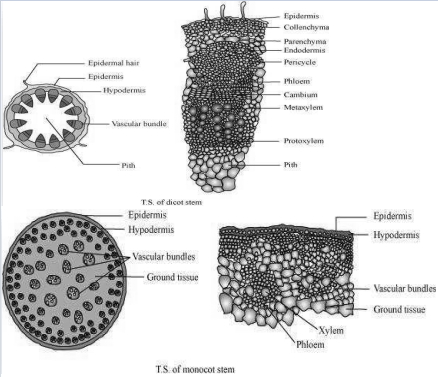
Cut a transverse section of a young stem of a plant from your school garden and observe it under the microscope. How would you ascertain whether it is a monocot stem or a dicot stem? Give reasons.
Solution
(N/A) To distinguish between a monocot and a dicot stem,observe the arrangement and structure of the vascular bundles:
$1$. Dicot Stem:
- Vascular bundles are conjoint,collateral,and open (possess cambium).
- They are arranged in a distinct ring.
- The ground tissue is well-differentiated into hypodermis,cortex,endodermis,pericycle,and a central pith.
$2$. Monocot Stem:
- Vascular bundles are conjoint,collateral,and closed (lack cambium).
- They are scattered throughout the ground tissue.
- Each vascular bundle is surrounded by a sclerenchymatous bundle sheath.
- Phloem parenchyma is absent,and water-containing cavities are often present within the bundles.
$1$. Dicot Stem:
- Vascular bundles are conjoint,collateral,and open (possess cambium).
- They are arranged in a distinct ring.
- The ground tissue is well-differentiated into hypodermis,cortex,endodermis,pericycle,and a central pith.
$2$. Monocot Stem:
- Vascular bundles are conjoint,collateral,and closed (lack cambium).
- They are scattered throughout the ground tissue.
- Each vascular bundle is surrounded by a sclerenchymatous bundle sheath.
- Phloem parenchyma is absent,and water-containing cavities are often present within the bundles.
0 likes
View Solution75
EasyMCQ
The transverse section of a plant material shows the following anatomical features: $(a)$ the vascular bundles are conjoint,scattered,and surrounded by sclerenchymatous bundle sheaths,$(b)$ phloem parenchyma is absent. What will you identify it as?
A
Dicot stem
B
Monocot stem
C
Dicot root
D
Monocot root
Solution
(B) The monocot stem is characterized by conjoint,collateral,and closed vascular bundles,which are scattered in the ground tissue.
Each vascular bundle is surrounded by a sclerenchymatous bundle sheath.
Additionally,phloem parenchyma is absent in monocot stems.
Therefore,the given features are diagnostic of a monocot stem.
Each vascular bundle is surrounded by a sclerenchymatous bundle sheath.
Additionally,phloem parenchyma is absent in monocot stems.
Therefore,the given features are diagnostic of a monocot stem.
0 likes
View Solution76
Easy
Describe the internal structure of a young dicot stem (e.g.,sunflower).
Solution
(N/A) $\rightarrow$ Sunflower is an annual plant with an erect stem.
$\rightarrow$ $A$ transverse section $(TS)$ of a young sunflower stem reveals the following structures:
$(1)$ Epidermis: The outermost protective layer,one cell thick,composed of parenchyma cells. The outer wall is covered with a thin cuticle. It may bear trichomes and a few stomata for gas exchange.
$(2)$ Cortex: Comprises three parts: hypodermis,main cortex,and endodermis.
$(i)$ Hypodermis: Located just below the epidermis,consisting of $3-4$ layers of collenchyma cells. These cells have thickened walls due to cellulose and pectin deposition and lack intercellular spaces. It provides mechanical support.
$(ii)$ Main Cortex: Located below the hypodermis,made of parenchymatous tissue with conspicuous intercellular spaces. The cell walls are thin and cellulosic. Resin ducts may be present in this region. These cells store water and food.
$(iii)$ Endodermis: The innermost layer of the cortex,single-layered,with barrel-shaped parenchymatous cells. These cells contain starch grains,hence it is often called the starch sheath.
$(3)$ Stele: Includes the pericycle,vascular bundles,medullary rays,and pith.
$(i)$ Pericycle: Located inside the endodermis,it is multilayered and composed of sclerenchyma and parenchyma. Sclerenchyma patches located above the vascular bundles are called bundle caps.
$(ii)$ Vascular Bundles: In a sunflower stem,there are $20-25$ vascular bundles arranged in a ring. Each bundle is conjoint,open (possessing cambium),and endarch (protoxylem towards the center).
$\rightarrow$ $A$ transverse section $(TS)$ of a young sunflower stem reveals the following structures:
$(1)$ Epidermis: The outermost protective layer,one cell thick,composed of parenchyma cells. The outer wall is covered with a thin cuticle. It may bear trichomes and a few stomata for gas exchange.
$(2)$ Cortex: Comprises three parts: hypodermis,main cortex,and endodermis.
$(i)$ Hypodermis: Located just below the epidermis,consisting of $3-4$ layers of collenchyma cells. These cells have thickened walls due to cellulose and pectin deposition and lack intercellular spaces. It provides mechanical support.
$(ii)$ Main Cortex: Located below the hypodermis,made of parenchymatous tissue with conspicuous intercellular spaces. The cell walls are thin and cellulosic. Resin ducts may be present in this region. These cells store water and food.
$(iii)$ Endodermis: The innermost layer of the cortex,single-layered,with barrel-shaped parenchymatous cells. These cells contain starch grains,hence it is often called the starch sheath.
$(3)$ Stele: Includes the pericycle,vascular bundles,medullary rays,and pith.
$(i)$ Pericycle: Located inside the endodermis,it is multilayered and composed of sclerenchyma and parenchyma. Sclerenchyma patches located above the vascular bundles are called bundle caps.
$(ii)$ Vascular Bundles: In a sunflower stem,there are $20-25$ vascular bundles arranged in a ring. Each bundle is conjoint,open (possessing cambium),and endarch (protoxylem towards the center).
0 likes
View Solution77
Easy
Describe the internal structure of a monocot (Maize) stem.
Solution
(N/A) $\rightarrow$ Maize is a monocot plant. When a thin section of its stem is observed under a microscope,the following parts are seen: $(1)$ Epidermis,$(2)$ Ground tissue,$(3)$ Vascular bundles.
$(1)$ Epidermis: It is the outermost layer,consisting of a single layer of parenchymatous cells. The outer walls of these cells are cuticularized.
$\rightarrow$ No stem appendages are produced from this layer,so its surface is soft. Stomata can be seen in this layer. This layer functions in protection and gas exchange.
$(2)$ Ground Tissue: Unlike a dicot stem,distinct regions like cortex,endodermis,and pericycle are not found in the ground tissue.
$\rightarrow$ At the outermost side of the ground tissue,the hypodermis is located. It is made up of two or three layers of sclerenchyma tissue. These cells are non-living and lignified,providing mechanical support to the stem.
$\rightarrow$ Inside the hypodermis,thin-walled parenchyma is located,where vascular bundles are embedded. The ground tissue cells towards the center are comparatively larger and have intercellular spaces.
$(3)$ Vascular Bundles: In a maize stem,numerous vascular bundles are scattered throughout the ground tissue. Peripheral vascular bundles are generally smaller,more numerous,and arranged closer to each other. They are surrounded by a sclerenchymatous bundle sheath.
$\rightarrow$ Centrally located vascular bundles are fewer in number and spaced further apart. Each vascular bundle is surrounded by a sclerenchymatous bundle sheath,making them fibro-vascular bundles.
$\rightarrow$ Each vascular bundle is conjoint,collateral,and closed (lacking cambium).
$\rightarrow$ In the vascular bundles,phloem tissue lies outside and xylem tissue lies inside,arranged in a '$V$' shape.
$\rightarrow$ Phloem tissue: Located outside in a '$V$' shape. Phloem parenchyma is absent.
$\rightarrow$ Xylem tissue: Arranged in the shape of the English alphabet '$V$'. It typically contains three to four vessels. Two large vessels are known as metaxylem,located at the two upper ends of the '$V$',while the protoxylem is located at the base of the '$V$'.
$(1)$ Epidermis: It is the outermost layer,consisting of a single layer of parenchymatous cells. The outer walls of these cells are cuticularized.
$\rightarrow$ No stem appendages are produced from this layer,so its surface is soft. Stomata can be seen in this layer. This layer functions in protection and gas exchange.
$(2)$ Ground Tissue: Unlike a dicot stem,distinct regions like cortex,endodermis,and pericycle are not found in the ground tissue.
$\rightarrow$ At the outermost side of the ground tissue,the hypodermis is located. It is made up of two or three layers of sclerenchyma tissue. These cells are non-living and lignified,providing mechanical support to the stem.
$\rightarrow$ Inside the hypodermis,thin-walled parenchyma is located,where vascular bundles are embedded. The ground tissue cells towards the center are comparatively larger and have intercellular spaces.
$(3)$ Vascular Bundles: In a maize stem,numerous vascular bundles are scattered throughout the ground tissue. Peripheral vascular bundles are generally smaller,more numerous,and arranged closer to each other. They are surrounded by a sclerenchymatous bundle sheath.
$\rightarrow$ Centrally located vascular bundles are fewer in number and spaced further apart. Each vascular bundle is surrounded by a sclerenchymatous bundle sheath,making them fibro-vascular bundles.
$\rightarrow$ Each vascular bundle is conjoint,collateral,and closed (lacking cambium).
$\rightarrow$ In the vascular bundles,phloem tissue lies outside and xylem tissue lies inside,arranged in a '$V$' shape.
$\rightarrow$ Phloem tissue: Located outside in a '$V$' shape. Phloem parenchyma is absent.
$\rightarrow$ Xylem tissue: Arranged in the shape of the English alphabet '$V$'. It typically contains three to four vessels. Two large vessels are known as metaxylem,located at the two upper ends of the '$V$',while the protoxylem is located at the base of the '$V$'.
0 likes
View Solution78
MediumMCQ
Describe the epidermis of a maize stem.
A
It is multi-layered and covered with thick trichomes.
B
It is a single-layered structure composed of parenchyma cells,covered by a cuticle.
C
It contains numerous stomata and is devoid of a cuticle.
D
It is composed of sclerenchyma cells and lacks a cuticle.
Solution
(B) The epidermis is the outermost layer of the maize stem.
It is a single-layered structure composed of parenchyma cells.
The outer walls of these cells are covered by a layer of cuticle.
Trichomes (stem hairs) are generally absent on the epidermis of a maize stem,making its surface smooth.
The primary functions of the epidermis are protection of internal tissues and regulation of gas exchange.
It is a single-layered structure composed of parenchyma cells.
The outer walls of these cells are covered by a layer of cuticle.
Trichomes (stem hairs) are generally absent on the epidermis of a maize stem,making its surface smooth.
The primary functions of the epidermis are protection of internal tissues and regulation of gas exchange.
0 likes
View Solution79
Easy
Describe the internal structure of a sunflower stem.
Solution
(N/A) Sunflower is an annual plant with a herbaceous stem.
$A$ transverse section of a stained young sunflower stem,when observed under a microscope,reveals the following structures: $(1)$ Epidermis,$(2)$ Cortex,$(3)$ Stele.
$(1)$ Epidermis: It is the outermost protective layer,consisting of a single layer of parenchymatous cells. The outer walls of these cells are covered with a thin layer of cuticle. Multicellular stem hairs (trichomes) arise from these cells. Stomata are present between the cells,which facilitate gaseous exchange.
$(2)$ Cortex: The cortex is divided into three regions: Hypodermis,Main Cortex,and Endodermis.
$(i)$ Hypodermis: The region just below the epidermis is the hypodermis. It consists of $3-4$ layers of collenchyma tissue. The cell walls are thickened with cellulose and pectin. Intercellular spaces are absent. This tissue provides mechanical support.
(ii) Main Cortex: Located below the hypodermis,this region is composed of parenchyma tissue with abundant intercellular spaces. The cell walls are thin and made of cellulose. This region contains resin ducts. The cells store water and food.
(iii) Endodermis: The innermost layer of the cortex is the endodermis,which is single-layered. The cells are barrel-shaped. Since these cells contain starch grains,this layer is also known as the starch sheath.
$(3)$ Stele: The stele includes the pericycle,vascular bundles,and pith.
$(i)$ Pericycle: Located internal to the endodermis,it is multilayered and consists of alternating patches of sclerenchyma and parenchyma. The sclerenchyma patches located above the vascular bundles are called bundle caps.
(ii) Vascular Bundles: In a sunflower stem,$20-25$ vascular bundles are arranged in a ring. Each bundle is conjoint,collateral,and open. The xylem development is endarch. The vascular bundle consists of phloem,cambium,and xylem. The cambium present between the phloem and xylem is called fascicular cambium,which allows for secondary growth.
$A$ transverse section of a stained young sunflower stem,when observed under a microscope,reveals the following structures: $(1)$ Epidermis,$(2)$ Cortex,$(3)$ Stele.
$(1)$ Epidermis: It is the outermost protective layer,consisting of a single layer of parenchymatous cells. The outer walls of these cells are covered with a thin layer of cuticle. Multicellular stem hairs (trichomes) arise from these cells. Stomata are present between the cells,which facilitate gaseous exchange.
$(2)$ Cortex: The cortex is divided into three regions: Hypodermis,Main Cortex,and Endodermis.
$(i)$ Hypodermis: The region just below the epidermis is the hypodermis. It consists of $3-4$ layers of collenchyma tissue. The cell walls are thickened with cellulose and pectin. Intercellular spaces are absent. This tissue provides mechanical support.
(ii) Main Cortex: Located below the hypodermis,this region is composed of parenchyma tissue with abundant intercellular spaces. The cell walls are thin and made of cellulose. This region contains resin ducts. The cells store water and food.
(iii) Endodermis: The innermost layer of the cortex is the endodermis,which is single-layered. The cells are barrel-shaped. Since these cells contain starch grains,this layer is also known as the starch sheath.
$(3)$ Stele: The stele includes the pericycle,vascular bundles,and pith.
$(i)$ Pericycle: Located internal to the endodermis,it is multilayered and consists of alternating patches of sclerenchyma and parenchyma. The sclerenchyma patches located above the vascular bundles are called bundle caps.
(ii) Vascular Bundles: In a sunflower stem,$20-25$ vascular bundles are arranged in a ring. Each bundle is conjoint,collateral,and open. The xylem development is endarch. The vascular bundle consists of phloem,cambium,and xylem. The cambium present between the phloem and xylem is called fascicular cambium,which allows for secondary growth.
0 likes
View Solution80
EasyMCQ
Complete the following analogy-type questions:
$(i)$ Root : Root hair :: Stem : ...........
$(ii)$ Dicot stem : Open vascular bundle :: Monocot stem : ...........
$(i)$ Root : Root hair :: Stem : ...........
$(ii)$ Dicot stem : Open vascular bundle :: Monocot stem : ...........
A
$(i)$ Trichome,$(ii)$ Closed
B
$(i)$ Stomata,$(ii)$ Open
C
$(i)$ Trichome,$(ii)$ Open
D
$(i)$ Stomata,$(ii)$ Closed
Solution
(A) $(i)$ In roots,root hairs are unicellular extensions of the epidermis. Similarly,in stems,the epidermal outgrowths are called trichomes.
$(ii)$ In dicot stems,the vascular bundles contain cambium between xylem and phloem,making them 'open' vascular bundles. In monocot stems,cambium is absent,making them 'closed' vascular bundles.
$(ii)$ In dicot stems,the vascular bundles contain cambium between xylem and phloem,making them 'open' vascular bundles. In monocot stems,cambium is absent,making them 'closed' vascular bundles.
0 likes
View Solution81
EasyMCQ
Select the correct option$(s)$ from the following statements:
$(i)$ Fibers are thin-walled,elongated,and pointed cells.
$(ii)$ Water-containing cavities (lysigenous cavities) are found in the vascular bundles of monocot stems.
$(i)$ Fibers are thin-walled,elongated,and pointed cells.
$(ii)$ Water-containing cavities (lysigenous cavities) are found in the vascular bundles of monocot stems.
A
Only $(i)$ is correct.
B
Only $(ii)$ is correct.
C
Both $(i)$ and $(ii)$ are correct.
D
Both $(i)$ and $(ii)$ are incorrect.
Solution
(B) $(i)$ Statement $(i)$ is incorrect because fibers are typically thick-walled,lignified,and dead cells,not thin-walled.
$(ii)$ Statement $(ii)$ is correct because in monocot stems (e.g.,maize),the vascular bundles contain water-containing cavities known as lysigenous cavities,which are formed by the dissolution of protoxylem elements.
$(ii)$ Statement $(ii)$ is correct because in monocot stems (e.g.,maize),the vascular bundles contain water-containing cavities known as lysigenous cavities,which are formed by the dissolution of protoxylem elements.
0 likes
View Solution82
MediumMCQ
Choose the correct option from the following:
In $ \text{monocot} / \text{dicot} $ stem, the vascular bundles are arranged in a ring.
In $ \text{monocot} / \text{dicot} $ stem, the vascular bundles are arranged in a ring.
A
Monocot stem
B
Dicot stem
C
Both
D
None
Solution
(B) In $ \text{dicot} $ stems, the vascular bundles are arranged in a ring.
In contrast, in $ \text{monocot} $ stems, the vascular bundles are scattered throughout the ground tissue.
In contrast, in $ \text{monocot} $ stems, the vascular bundles are scattered throughout the ground tissue.
0 likes
View Solution83
MediumMCQ
Describe the characteristics of the maize stem epidermis.
A
It is multi-layered and covered with thick trichomes.
B
It is a single layer of parenchymatous cells with a cuticularized outer wall.
C
It contains numerous multicellular hairs and glands.
D
It is composed of sclerenchymatous cells for mechanical support.
Solution
(B) $\Rightarrow$ The epidermis is the outermost layer of the maize stem.
$\Rightarrow$ It consists of a single layer of parenchymatous cells.
$\Rightarrow$ The outer walls of these cells are cuticularized to prevent water loss.
$\Rightarrow$ No stem appendages (like trichomes) are produced from this layer,making the surface smooth.
$\Rightarrow$ Stomata are present in this layer,which facilitate gas exchange and transpiration.
$\Rightarrow$ The primary functions of the epidermis are protection of internal tissues and regulation of gas exchange.
$\Rightarrow$ It consists of a single layer of parenchymatous cells.
$\Rightarrow$ The outer walls of these cells are cuticularized to prevent water loss.
$\Rightarrow$ No stem appendages (like trichomes) are produced from this layer,making the surface smooth.
$\Rightarrow$ Stomata are present in this layer,which facilitate gas exchange and transpiration.
$\Rightarrow$ The primary functions of the epidermis are protection of internal tissues and regulation of gas exchange.
0 likes
View Solution84
EasyMCQ
The transverse section of a plant shows the following anatomical features:
$(a)$ Large number of scattered vascular bundles surrounded by bundle sheath.
$(b)$ Large conspicuous parenchymatous ground tissue.
$(c)$ Vascular bundles conjoint and closed.
$(d)$ Phloem parenchyma absent.
Identify the category of plant and its part.
$(a)$ Large number of scattered vascular bundles surrounded by bundle sheath.
$(b)$ Large conspicuous parenchymatous ground tissue.
$(c)$ Vascular bundles conjoint and closed.
$(d)$ Phloem parenchyma absent.
Identify the category of plant and its part.
A
Dicotyledonous root
B
Monocotyledonous stem
C
Monocotyledonous root
D
Dicotyledonous stem
Solution
$(B)$ The anatomical features described are characteristic of a $Monocotyledonous$ stem:
$1$. Scattered vascular bundles: In monocot stems, vascular bundles are scattered throughout the ground tissue.
$2$. Bundle sheath: Each vascular bundle is surrounded by a sclerenchymatous bundle sheath.
$3$. Ground tissue: The ground tissue is large, conspicuous, and parenchymatous.
$4$. Conjoint and closed vascular bundles: The bundles are conjoint (xylem and phloem together) and closed (no cambium present, so secondary growth does not occur).
$5$. Phloem parenchyma: Phloem parenchyma is typically absent in monocot stems.
Therefore, the correct option is $B$.
$1$. Scattered vascular bundles: In monocot stems, vascular bundles are scattered throughout the ground tissue.
$2$. Bundle sheath: Each vascular bundle is surrounded by a sclerenchymatous bundle sheath.
$3$. Ground tissue: The ground tissue is large, conspicuous, and parenchymatous.
$4$. Conjoint and closed vascular bundles: The bundles are conjoint (xylem and phloem together) and closed (no cambium present, so secondary growth does not occur).
$5$. Phloem parenchyma: Phloem parenchyma is typically absent in monocot stems.
Therefore, the correct option is $B$.
0 likes
View Solution85
MediumMCQ
$A$ transverse section of a plant part shows the following characteristics:
$(a)$ Numerous,scattered vascular bundles,each surrounded by a bundle sheath.
$(b)$ $A$ large,conspicuous parenchymatous ground tissue.
$(c)$ Conjoint and closed vascular bundles.
$(d)$ Absence of phloem parenchyma.
Identify the type of plant and the part:
$(a)$ Numerous,scattered vascular bundles,each surrounded by a bundle sheath.
$(b)$ $A$ large,conspicuous parenchymatous ground tissue.
$(c)$ Conjoint and closed vascular bundles.
$(d)$ Absence of phloem parenchyma.
Identify the type of plant and the part:
A
Monocot stem
B
Monocot root
C
Dicot stem
D
Dicot root
Solution
(A) The characteristics described are typical of a monocot stem:
$1$. Scattered vascular bundles are a hallmark of monocot stems.
$2$. The presence of a bundle sheath around vascular bundles is common in monocots.
$3$. Vascular bundles are conjoint (xylem and phloem together) and closed (no cambium present,hence no secondary growth).
$4$. Phloem parenchyma is absent in monocot stems.
$5$. The ground tissue is undifferentiated and parenchymatous.
Therefore,the correct option is $A$.
$1$. Scattered vascular bundles are a hallmark of monocot stems.
$2$. The presence of a bundle sheath around vascular bundles is common in monocots.
$3$. Vascular bundles are conjoint (xylem and phloem together) and closed (no cambium present,hence no secondary growth).
$4$. Phloem parenchyma is absent in monocot stems.
$5$. The ground tissue is undifferentiated and parenchymatous.
Therefore,the correct option is $A$.
0 likes
View Solution86
MediumMCQ
Conjoint collateral closed vascular bundle is found in
A
Monocot stem
B
Monocot root
C
Dicot stem
D
Dicot root
Solution
(A) In monocot stems,the vascular bundles are described as conjoint,collateral,and closed.
Conjoint means xylem and phloem are present in the same bundle.
Collateral means phloem is located on the outer side and xylem on the inner side.
Closed means cambium is absent between xylem and phloem,which prevents secondary growth.
Conjoint means xylem and phloem are present in the same bundle.
Collateral means phloem is located on the outer side and xylem on the inner side.
Closed means cambium is absent between xylem and phloem,which prevents secondary growth.
0 likes
View Solution87
MediumMCQ
The ring arrangement of vascular bundles is the characteristic feature of
A
Dicot root
B
Monocot root
C
Monocot stem
D
Dicot stem
Solution
(D) The ring arrangement of vascular bundles is a characteristic feature of the dicot stem.
In dicot stems,the vascular bundles are arranged in a ring around the pith.
Each vascular bundle is conjoint,collateral,open (possessing cambium),and exhibits endarch protoxylem.
In dicot stems,the vascular bundles are arranged in a ring around the pith.
Each vascular bundle is conjoint,collateral,open (possessing cambium),and exhibits endarch protoxylem.
0 likes
View Solution88
MediumMCQ
In a dicotyledonous stem,the sequence of tissues from the outside to the inside is
A
Phellem-pericycle-endodermis-phloem
B
Phellem-phloem-endodermis-pericycle
C
Phellem-endodermis-pericycle-phloem
D
Pericycle-phellem-endodermis-phloem
Solution
(C) In a dicotyledonous stem,the anatomical arrangement of tissues from the periphery (outside) towards the center (inside) is as follows:
$1$. Phellem (Cork): The outermost protective layer formed by the cork cambium.
$2$. Endodermis: The layer located inner to the cortex.
$3$. Pericycle: The layer situated between the endodermis and the vascular bundles.
$4$. Phloem: The vascular tissue responsible for food transport,located inner to the pericycle.
$5$. Xylem: The innermost vascular tissue.
Therefore,the correct sequence is Phellem $\rightarrow$ endodermis $\rightarrow$ pericycle $\rightarrow$ phloem $\rightarrow$ xylem.
$1$. Phellem (Cork): The outermost protective layer formed by the cork cambium.
$2$. Endodermis: The layer located inner to the cortex.
$3$. Pericycle: The layer situated between the endodermis and the vascular bundles.
$4$. Phloem: The vascular tissue responsible for food transport,located inner to the pericycle.
$5$. Xylem: The innermost vascular tissue.
Therefore,the correct sequence is Phellem $\rightarrow$ endodermis $\rightarrow$ pericycle $\rightarrow$ phloem $\rightarrow$ xylem.
0 likes
View Solution89
MediumMCQ
Epidermis covered with cuticle,bearing trichomes and few stomata is the characteristic feature of
A
Root
B
Dicot stem
C
Vascular bundle
D
Monocot stem
Solution
(B) The transverse section of a typical young dicotyledonous stem shows that the epidermis is the outermost protective layer of the stem,covered with a thin layer of cuticle. It may bear trichomes and a few stomata.
0 likes
View Solution90
MediumMCQ
Cortex consists of three sub-zones in dicot stem,they are
$I.$ hypodermis $II.$ cortical layer
$III.$ pericycle $IV.$ endodermis $V.$ epidermis
$I.$ hypodermis $II.$ cortical layer
$III.$ pericycle $IV.$ endodermis $V.$ epidermis
A
All except $I$ and $II$
B
All except $II$ and $III$
C
All except $IV$ and $V$
D
All except $III$ and $V$
Solution
(D) The cortex in a dicot stem is located between the epidermis and the stele. It consists of three sub-zones:
$1$. Hypodermis: Located just below the epidermis,composed of collenchyma cells.
$2$. Cortical layers: Located below the hypodermis,composed of thin-walled parenchyma cells.
$3$. Endodermis: The innermost layer of the cortex.
Therefore,the cortex consists of $I$ (hypodermis),$II$ (cortical layers),and $IV$ (endodermis). The epidermis $(V)$ is the outermost layer of the stem,and the pericycle $(III)$ is part of the stele,not the cortex. Thus,the correct answer is all except $III$ and $V$.
$1$. Hypodermis: Located just below the epidermis,composed of collenchyma cells.
$2$. Cortical layers: Located below the hypodermis,composed of thin-walled parenchyma cells.
$3$. Endodermis: The innermost layer of the cortex.
Therefore,the cortex consists of $I$ (hypodermis),$II$ (cortical layers),and $IV$ (endodermis). The epidermis $(V)$ is the outermost layer of the stem,and the pericycle $(III)$ is part of the stele,not the cortex. Thus,the correct answer is all except $III$ and $V$.
0 likes
View Solution91
MediumMCQ
In monocot stem,which of the following is absent?
A
Endodermis
B
Hypodermis
C
Cortex
D
Both $(A)$ and $(B)$
Solution
(D) In a monocot stem,the ground tissue is not differentiated into distinct regions like cortex,endodermis,pericycle,and pith. Instead,it consists of a mass of parenchyma cells. Therefore,the endodermis and cortex are absent as distinct layers in the monocot stem. The hypodermis is present (usually sclerenchymatous). Thus,endodermis and cortex are the structures that are absent.
0 likes
View Solution92
MediumMCQ
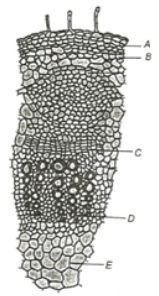
Identify $A$ to $E$ in the given diagram of a Dicot stem and choose the correct option.
A
$A-$ Collenchyma,$B-$ Sclerenchyma,$C-$ Cambium,$D-$ Protoxylem,$E-$ Pith
B
$A-$ Sclerenchyma,$B-$ Collenchyma,$C-$ Cambium,$D-$ Protoxylem,$E-$ Pith
C
$A-$ Parenchyma,$B-$ Collenchyma,$C-$ Cambium,$D-$ Protoxylem,$E-$ Pith
D
$A-$ Collenchyma,$B-$ Parenchyma,$C-$ Cambium,$D-$ Protoxylem,$E-$ Pith
Solution
(D) The given diagram represents the transverse section $(T.S.)$ of a Dicot stem.
$A$ represents Collenchyma,which is present just below the epidermis.
$B$ represents Parenchyma,which forms the cortex.
$C$ represents the Cambium,which is located between the xylem and phloem.
$D$ represents Protoxylem,which is the first-formed xylem.
$E$ represents the Pith,which is the central part of the stem.
Therefore,the correct sequence is $A-$ Collenchyma,$B-$ Parenchyma,$C-$ Cambium,$D-$ Protoxylem,$E-$ Pith.
$A$ represents Collenchyma,which is present just below the epidermis.
$B$ represents Parenchyma,which forms the cortex.
$C$ represents the Cambium,which is located between the xylem and phloem.
$D$ represents Protoxylem,which is the first-formed xylem.
$E$ represents the Pith,which is the central part of the stem.
Therefore,the correct sequence is $A-$ Collenchyma,$B-$ Parenchyma,$C-$ Cambium,$D-$ Protoxylem,$E-$ Pith.
0 likes
View Solution93
MediumMCQ
Identify the plant parts whose transverse section shows a clear and prominent pith.
A
Dicot and monocot stems
B
Dicot stem and monocot root
C
Dicot and monocot roots
D
Dicot stem and dicot root
Solution
(B) In plant anatomy,the pith (medulla) consists of parenchymatous cells located in the center of the stem or root.
$1$. In $Dicot$ stems,a large,well-developed,and prominent pith is present in the center.
$2$. In $Monocot$ roots,a large and well-developed pith is also present.
$3$. In $Dicot$ roots,the pith is generally small or absent,and the center is occupied by the xylem.
$4$. In $Monocot$ stems,the vascular bundles are scattered throughout the ground tissue,and there is no distinct pith.
Therefore,a clear and prominent pith is characteristic of the $Dicot$ stem and $Monocot$ root.
$1$. In $Dicot$ stems,a large,well-developed,and prominent pith is present in the center.
$2$. In $Monocot$ roots,a large and well-developed pith is also present.
$3$. In $Dicot$ roots,the pith is generally small or absent,and the center is occupied by the xylem.
$4$. In $Monocot$ stems,the vascular bundles are scattered throughout the ground tissue,and there is no distinct pith.
Therefore,a clear and prominent pith is characteristic of the $Dicot$ stem and $Monocot$ root.
0 likes
View Solution94
EasyMCQ
Vessels are absent in this angiosperm.
A
Mangifera
B
Magnolia
C
Dillenia
D
Drimys
Solution
(D) Vessels are specialized water-conducting cells found in most angiosperms. However,they are absent in some primitive angiosperms,such as $Drimys$. These plants are referred to as homoxylous angiosperms because their xylem consists only of tracheids.
0 likes
View Solution95
MediumMCQ
Which of the following is true for the endarch type of primary xylem?
A
Protoxylem lies towards the periphery of the organ.
B
Metaxylem lies towards the periphery of the organ.
C
Metaxylem lies towards the pith of the organ.
D
Protophloem lies towards the pith of the organ.
Solution
(B) In the endarch condition of primary xylem,the protoxylem lies towards the center (pith) and the metaxylem lies towards the periphery of the organ. This arrangement is a characteristic feature of stems in both dicot and monocot plants.
0 likes
View Solution96
MediumMCQ
Vascular bundles surrounded by a sclerenchymatous bundle sheath is a feature of
A
Dicot root
B
Monocot root
C
Dicot stem
D
Monocot stem
Solution
(D) In monocot stems,the vascular bundles are scattered in the ground tissue. Each vascular bundle is surrounded by a layer of sclerenchymatous cells known as the bundle sheath. This is a characteristic anatomical feature of monocot stems.
0 likes
View Solution97
MediumMCQ
Vascular bundles of monocot stem are surrounded by which of the following?
A
Sclerenchymatous bundle sheath
B
Pericycle
C
Pith
D
Cortex
Solution
(A) In monocot stems,the vascular bundles are scattered in the ground tissue. Each vascular bundle is surrounded by a layer of sclerenchymatous cells known as the bundle sheath. Therefore,the correct answer is the sclerenchymatous bundle sheath.
0 likes
View Solution98
MediumMCQ
Which of the following is not true for the vascular bundles of monocotyledonous stems?
A
Scattered in the ground tissue
B
Possess water-containing cavities
C
Ring arrangement
D
Conjoint and closed
Solution
(C) In monocotyledonous stems,the vascular bundles are scattered throughout the ground tissue. Each vascular bundle is conjoint,collateral,and closed (lacking cambium). Additionally,they contain water-containing cavities known as lysigenous cavities or protoxylem lacunae. The 'ring' arrangement of vascular bundles is a characteristic feature of dicotyledonous stems,not monocotyledonous stems. Therefore,the statement that they have a 'ring' arrangement is incorrect.
0 likes
View Solution99
MediumMCQ
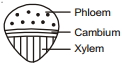
The vascular bundles in the stems of most of dicots are conjoint,collateral and open. In each of these bundles
A
Xylem and phloem are on the same radius with phloem towards the pith and xylem towards the pericycle without a strip of cambium between them.
B
Xylem and phloem are on the same radius with xylem situated towards the pith and phloem situated towards the pericycle and a strip of cambium separates the two.
C
Xylem completely surrounds the phloem on all sides but the two are separated by the cambium.
D
Phloem completely surrounds the xylem and a strip of cambium separates the two.
Solution
(B) In dicot stems,the vascular bundles are described as conjoint,collateral,and open.
Conjoint means xylem and phloem are present on the same radius.
Collateral means phloem is located towards the outer side (pericycle) and xylem is located towards the inner side (pith).
Open means a strip of cambium is present between the xylem and phloem,which allows for secondary growth.
Therefore,option $B$ is correct.
Conjoint means xylem and phloem are present on the same radius.
Collateral means phloem is located towards the outer side (pericycle) and xylem is located towards the inner side (pith).
Open means a strip of cambium is present between the xylem and phloem,which allows for secondary growth.
Therefore,option $B$ is correct.
0 likes
View Solution100
MediumMCQ
Which of the following is not true for a monocot stem?
A
Sclerenchymatous hypodermis
B
Presence of water canals in pith
C
Conjoint,collateral,closed vascular bundles
D
Presence of bundle sheath
Solution
(D) In a typical monocot stem,the vascular bundles are scattered,conjoint,collateral,and closed (lacking cambium). The hypodermis is sclerenchymatous. However,the presence of a 'water canal' (lysigenous cavity) is a characteristic feature found within the vascular bundles themselves,not in the pith. Furthermore,monocot stems typically lack a distinct bundle sheath surrounding the vascular bundles,which is a characteristic feature of monocot leaves. Therefore,the statement 'Presence of bundle sheath' is not true for a monocot stem.
0 likes
View SolutionAnatomy of Flowering Plants — Internal structure of stem · Frequently Asked Questions
1Are these Anatomy of Flowering Plants questions useful for JEE and NEET?
Yes. All questions in this section are mapped to JEE Main and NEET exam patterns. Previous year questions from JEE Main, NEET, GUJCET and state-level exams are included with full solutions.
2Can I switch to Hindi or Gujarati for these questions?
Yes. Use the language tabs in the hero section or the sidebar to view the same questions and solutions in English, Hindi or Gujarati.
3How do I generate a question paper from this subtopic?
Use the Vedclass Exam Paper Generator — select the chapter and subtopic, set difficulty, and generate Sets A, B, C, D automatically. First 3 chapters of every subject are free.
Vedclass Products
For Students
Vedclass Test Series
Mock tests in real JEE/NEET style with performance analysis. 5-day free trial.
Start Free TrialFor Teachers
Exam Paper Generator
Generate Set A/B/C/D papers from this chapter in 2 minutes. 3 chapters free.
Try FreeFor Institutes
Online Exam Module
Live online exams with unlimited students, 360° analytics & white-label branding.
See DemoFor Teachers & Institutes
Generate a Anatomy of Flowering Plants Exam Paper in 2 Minutes
Select subtopic & difficulty — Sets A, B, C, D auto-generated with No Repeat logic.
First 3 chapters of every subject are free — no payment required.