
A English
Mix Examples - Our Environment Questions in English
Class 10 Science · Our Environment · Mix Examples - Our Environment
181+
Questions
English
Language
100%
With Solutions
Showing 50 of 181 questions in English
1
EasyMCQ
Which one of the following is an artificial ecosystem?
A
Crop field
B
Pond
C
Lake
D
Forest
Solution
(A) An ecosystem is a community of living organisms in conjunction with the non-living components of their environment,interacting as a system.
Artificial ecosystems are those that are created and maintained by human beings.
$A$ crop field is an example of an artificial ecosystem because it is created by humans for agricultural purposes and requires human intervention (like irrigation,weeding,and pest control) to maintain its structure and productivity.
In contrast,ponds,lakes,and forests are examples of natural ecosystems that exist and function without human interference.
Artificial ecosystems are those that are created and maintained by human beings.
$A$ crop field is an example of an artificial ecosystem because it is created by humans for agricultural purposes and requires human intervention (like irrigation,weeding,and pest control) to maintain its structure and productivity.
In contrast,ponds,lakes,and forests are examples of natural ecosystems that exist and function without human interference.
0 likes
View Solution2
EasyMCQ
In a food chain,the third trophic level is always occupied by
A
herbivores
B
carnivores
C
decomposers
D
producers
Solution
(B) In a food chain,the trophic levels are organized as follows:
$1$. The first trophic level $(T_1)$ is occupied by producers (autotrophs) like plants.
$2$. The second trophic level $(T_2)$ is occupied by primary consumers (herbivores) that feed on producers.
$3$. The third trophic level $(T_3)$ is occupied by secondary consumers (carnivores) that feed on herbivores.
Therefore,the third trophic level is always occupied by carnivores.
$1$. The first trophic level $(T_1)$ is occupied by producers (autotrophs) like plants.
$2$. The second trophic level $(T_2)$ is occupied by primary consumers (herbivores) that feed on producers.
$3$. The third trophic level $(T_3)$ is occupied by secondary consumers (carnivores) that feed on herbivores.
Therefore,the third trophic level is always occupied by carnivores.
0 likes
View Solution3
EasyMCQ
An ecosystem includes
A
all living organisms
B
non-living objects
C
both living organisms and non-living objects
D
sometimes living organisms and sometimes non-living objects
Solution
(C) An ecosystem is a structural and functional unit of nature where living organisms interact among themselves and also with the surrounding physical environment.
It consists of two main components:
$1$. Biotic components: These include all living organisms such as plants,animals,and microorganisms.
$2$. Abiotic components: These include non-living physical and chemical factors such as sunlight,temperature,water,soil,and air.
Therefore,an ecosystem includes both living organisms and non-living objects.
It consists of two main components:
$1$. Biotic components: These include all living organisms such as plants,animals,and microorganisms.
$2$. Abiotic components: These include non-living physical and chemical factors such as sunlight,temperature,water,soil,and air.
Therefore,an ecosystem includes both living organisms and non-living objects.
0 likes
View Solution4
EasyMCQ
In the given food chain,suppose the amount of energy at the fourth trophic level is $5 \, kJ$,what will be the energy available at the producer level (in $, kJ$)?
Grass $\to$ Grasshopper $\to$ Frog $\to$ Snake $\to$ Hawk
Grass $\to$ Grasshopper $\to$ Frog $\to$ Snake $\to$ Hawk
A
$5$
B
$50$
C
$500$
D
$5000$
Solution
(D) According to the $10\%$ Law of energy transfer in an ecosystem,only $10\%$ of the energy is transferred from one trophic level to the next,while $90\%$ is lost as heat.
Let the energy at the producer level $(T_1)$ be $E$.
$T_1$ (Grass) = $E$
$T_2$ (Grasshopper) = $E \times 0.1$
$T_3$ (Frog) = $E \times 0.1 \times 0.1 = E \times 0.01$
$T_4$ (Snake) = $E \times 0.1 \times 0.1 \times 0.1 = E \times 0.001$
Given that the energy at the fourth trophic level $(T_4)$ is $5 \, kJ$:
$E \times 0.001 = 5 \, kJ$
$E = 5 / 0.001 = 5000 \, kJ$
Therefore,the energy available at the producer level is $5000 \, kJ$.
Let the energy at the producer level $(T_1)$ be $E$.
$T_1$ (Grass) = $E$
$T_2$ (Grasshopper) = $E \times 0.1$
$T_3$ (Frog) = $E \times 0.1 \times 0.1 = E \times 0.01$
$T_4$ (Snake) = $E \times 0.1 \times 0.1 \times 0.1 = E \times 0.001$
Given that the energy at the fourth trophic level $(T_4)$ is $5 \, kJ$:
$E \times 0.001 = 5 \, kJ$
$E = 5 / 0.001 = 5000 \, kJ$
Therefore,the energy available at the producer level is $5000 \, kJ$.
0 likes
View Solution5
MediumMCQ
Accumulation of non-biodegradable pesticides in the food chain in increasing amount at each higher trophic level is known as
A
biomagnification
B
pollution
C
eutrophication
D
accumulation
Solution
(A) Biomagnification is the process where the concentration of non-biodegradable substances,such as pesticides (e.g.,$DDT$),increases at each successive trophic level in a food chain.
This occurs because these substances cannot be broken down by organisms and are passed on to the next level in higher concentrations.
Therefore,the correct answer is $A$.
This occurs because these substances cannot be broken down by organisms and are passed on to the next level in higher concentrations.
Therefore,the correct answer is $A$.
0 likes
View Solution6
EasyMCQ
Depletion of ozone is mainly due to
A
chlorofluorocarbon compounds
B
carbon monoxide
C
methane
D
pesticides
Solution
(A) The depletion of the ozone layer is primarily caused by chlorofluorocarbons $(CFCs)$.
$CFCs$ are synthetic chemical compounds that contain chlorine,fluorine,and carbon. When released into the atmosphere,they rise to the stratosphere where they are broken down by ultraviolet radiation,releasing chlorine atoms.
These chlorine atoms act as catalysts to break down ozone molecules $(O_3)$ into oxygen $(O_2)$ and atomic oxygen $(O)$,thereby thinning the ozone layer.
$CFCs$ are commonly used in refrigerators,air conditioners,and aerosol sprays.
$CFCs$ are synthetic chemical compounds that contain chlorine,fluorine,and carbon. When released into the atmosphere,they rise to the stratosphere where they are broken down by ultraviolet radiation,releasing chlorine atoms.
These chlorine atoms act as catalysts to break down ozone molecules $(O_3)$ into oxygen $(O_2)$ and atomic oxygen $(O)$,thereby thinning the ozone layer.
$CFCs$ are commonly used in refrigerators,air conditioners,and aerosol sprays.
0 likes
View Solution7
MediumMCQ
Organisms which synthesise carbohydrates from inorganic compounds using radiant energy are called
A
decomposers
B
herbivores
C
producers
D
carnivores
Solution
(C) Organisms that use radiant energy (sunlight) to synthesize carbohydrates (food) from inorganic compounds (like $CO_2$ and $H_2O$) through the process of photosynthesis are known as producers or autotrophs.
These organisms,primarily green plants,algae,and certain bacteria,form the first trophic level in an ecosystem.
Decomposers break down organic matter,while herbivores and carnivores are consumers that depend on other organisms for food.
These organisms,primarily green plants,algae,and certain bacteria,form the first trophic level in an ecosystem.
Decomposers break down organic matter,while herbivores and carnivores are consumers that depend on other organisms for food.
0 likes
View Solution8
EasyMCQ
In an ecosystem,the $10\%$ of energy available for transfer from one trophic level to the next is in the form of
A
heat energy
B
light energy
C
mechanical energy
D
chemical energy
Solution
(D) According to the $10\%$ Law proposed by Lindeman,only about $10\%$ of the energy entering a particular trophic level of organisms is available for transfer to the next higher trophic level.
This energy is stored in the biomass of the organisms in the form of chemical energy (organic compounds like carbohydrates,proteins,and fats).
The remaining $90\%$ of the energy is lost to the environment as heat during metabolic processes or used for the organism's own life activities.
This energy is stored in the biomass of the organisms in the form of chemical energy (organic compounds like carbohydrates,proteins,and fats).
The remaining $90\%$ of the energy is lost to the environment as heat during metabolic processes or used for the organism's own life activities.
0 likes
View Solution9
MediumMCQ
Organisms of a higher trophic level which feed on several types of organisms belonging to a lower trophic level constitute the
A
food web
B
ecological pyramid
C
ecosystem
D
food chain
Solution
(A) $food \text{ } chain$ represents a single linear pathway of energy flow through an ecosystem.
However, in nature, organisms often feed on multiple sources from different trophic levels.
When these multiple food chains become interconnected, they form a complex network known as a $food \text{ } web$.
Since organisms at a higher trophic level feed on several types of organisms from lower levels, this interconnected feeding relationship is defined as a $food \text{ } web$.
However, in nature, organisms often feed on multiple sources from different trophic levels.
When these multiple food chains become interconnected, they form a complex network known as a $food \text{ } web$.
Since organisms at a higher trophic level feed on several types of organisms from lower levels, this interconnected feeding relationship is defined as a $food \text{ } web$.
0 likes
View Solution10
MediumMCQ
Flow of energy in an ecosystem is always
A
bidirectional
B
unidirectional
C
multi-directional
D
no specific direction
Solution
(B) In an ecosystem, energy enters from the sun in the form of solar radiation. Producers (plants) capture this energy and convert it into chemical energy through photosynthesis. As energy moves from one trophic level to the next (e.g., from producers to primary consumers, then to secondary consumers), a significant portion of energy is lost as heat at each step, according to the $10\%$ law of energy transfer. Because energy cannot be recycled or reused by the producers once it is lost as heat, the flow of energy in an ecosystem is always unidirectional.
0 likes
View Solution11
MediumMCQ
Excessive exposure of humans to $UV$-rays results in:
$(i)$ Damage to immune system
$(ii)$ Damage to lungs
$(iii)$ Skin cancer
$(iv)$ Peptic ulcers
$(i)$ Damage to immune system
$(ii)$ Damage to lungs
$(iii)$ Skin cancer
$(iv)$ Peptic ulcers
A
$(i)$ and $(ii)$
B
$(ii)$ and $(iv)$
C
$(i)$ and $(iii)$
D
$(iii)$ and $(iv)$
Solution
(C) Excessive exposure to $UV$-rays (ultraviolet radiation) has harmful effects on human health.
$(i)$ $UV$-rays can suppress the immune system,making the body more susceptible to infections.
$(ii)$ $UV$-rays primarily affect the skin and eyes; they do not cause direct damage to the lungs.
$(iii)$ $UV$-rays are a known carcinogen and prolonged exposure leads to $DNA$ damage in skin cells,resulting in skin cancer.
$(iv)$ Peptic ulcers are typically caused by bacterial infections (like $H. pylori$) or excessive use of NSAIDs,not by $UV$-rays.
Therefore,the correct effects are $(i)$ and $(iii)$.
$(i)$ $UV$-rays can suppress the immune system,making the body more susceptible to infections.
$(ii)$ $UV$-rays primarily affect the skin and eyes; they do not cause direct damage to the lungs.
$(iii)$ $UV$-rays are a known carcinogen and prolonged exposure leads to $DNA$ damage in skin cells,resulting in skin cancer.
$(iv)$ Peptic ulcers are typically caused by bacterial infections (like $H. pylori$) or excessive use of NSAIDs,not by $UV$-rays.
Therefore,the correct effects are $(i)$ and $(iii)$.
0 likes
View Solution12
MediumMCQ
In the following groups of materials,which group$(s)$ contains only non-biodegradable items?
$(i)$ Wood,paper,leather
$(ii)$ Polythene,detergent,$PVC$
$(iii)$ Plastic,detergent,grass
$(iv)$ Plastic,bakelite,$DDT$
$(i)$ Wood,paper,leather
$(ii)$ Polythene,detergent,$PVC$
$(iii)$ Plastic,detergent,grass
$(iv)$ Plastic,bakelite,$DDT$
A
$(iii)$
B
$(iv)$
C
$(i)$ and $(iii)$
D
$(ii)$ and $(iv)$
Solution
(D) Non-biodegradable substances are those that cannot be broken down by biological processes (microorganisms).
$(i)$ Wood,paper,and leather are biodegradable.
$(ii)$ Polythene,detergent,and $PVC$ are non-biodegradable.
$(iii)$ Plastic and detergent are non-biodegradable,but grass is biodegradable.
$(iv)$ Plastic,bakelite,and $DDT$ are non-biodegradable.
Therefore,groups $(ii)$ and $(iv)$ contain only non-biodegradable items.
$(i)$ Wood,paper,and leather are biodegradable.
$(ii)$ Polythene,detergent,and $PVC$ are non-biodegradable.
$(iii)$ Plastic and detergent are non-biodegradable,but grass is biodegradable.
$(iv)$ Plastic,bakelite,and $DDT$ are non-biodegradable.
Therefore,groups $(ii)$ and $(iv)$ contain only non-biodegradable items.
0 likes
View Solution13
EasyMCQ
Which of the following limits the number of trophic levels in a food chain?
A
Decrease in energy at higher trophic levels
B
Sufficient food supply
C
Polluted air
D
Water
Solution
(A) The number of trophic levels in a food chain is limited by the $10\%$ law of energy transfer. According to this law,only about $10\%$ of the energy available at one trophic level is transferred to the next higher trophic level. The remaining energy is lost as heat during metabolic activities. As a result,after $3$ to $4$ trophic levels,the amount of energy remaining is insufficient to support the survival of organisms at the next level. Therefore,the decrease in energy at higher trophic levels acts as a limiting factor.
0 likes
View Solution14
MediumMCQ
Which of the following statements is incorrect?
A
All green plants and blue-green algae are producers.
B
Green plants get their food from organic compounds.
C
Producers prepare their own food from inorganic compounds.
D
Plants convert solar energy into chemical energy.
Solution
(B) The correct answer is $B$. Green plants are autotrophs,meaning they synthesize their own food through the process of photosynthesis. They use inorganic compounds such as carbon dioxide $(CO_2)$ and water $(H_2O)$ in the presence of sunlight and chlorophyll to produce organic compounds (glucose). Therefore,they do not obtain food from organic compounds; rather,they produce organic compounds from inorganic ones. Statement $A$ is correct as they are primary producers. Statement $C$ is correct as they use inorganic raw materials. Statement $D$ is correct as photosynthesis involves the conversion of solar energy into chemical energy stored in glucose.
0 likes
View Solution15
MediumMCQ
Which group of organisms are not constituents of a food chain?
$(i)$ Grass,lion,rabbit,wolf
$(ii)$ Plankton,man,fish,grasshopper
$(iii)$ Wolf,grass,snake,tiger
$(iv)$ Frog,snake,eagle,grass,grasshopper
$(i)$ Grass,lion,rabbit,wolf
$(ii)$ Plankton,man,fish,grasshopper
$(iii)$ Wolf,grass,snake,tiger
$(iv)$ Frog,snake,eagle,grass,grasshopper
A
$(i)$ and $(iii)$
B
$(iii)$ and $(iv)$
C
$(ii)$ and $(iii)$
D
$(i)$ and $(iv)$
Solution
(C) food chain represents a linear sequence of organisms where nutrients and energy are transferred from one organism to another.
$(i)$ Grass $\rightarrow$ Rabbit $\rightarrow$ Wolf $\rightarrow$ Lion. This is a valid food chain.
$(ii)$ Plankton $\rightarrow$ Fish $\rightarrow$ Man. Grasshopper is a terrestrial herbivore and does not fit in this aquatic food chain. Thus,this group is not a valid food chain.
$(iii)$ Grass $\rightarrow$ Snake $\rightarrow$ Wolf $\rightarrow$ Tiger. This is not a valid food chain because a snake (carnivore) cannot eat grass (producer),and a wolf does not typically eat snakes in this sequence. Thus,this group is not a valid food chain.
$(iv)$ Grass $\rightarrow$ Grasshopper $\rightarrow$ Frog $\rightarrow$ Snake $\rightarrow$ Eagle. This is a valid food chain.
Therefore,groups $(ii)$ and $(iii)$ are not constituents of a valid food chain.
$(i)$ Grass $\rightarrow$ Rabbit $\rightarrow$ Wolf $\rightarrow$ Lion. This is a valid food chain.
$(ii)$ Plankton $\rightarrow$ Fish $\rightarrow$ Man. Grasshopper is a terrestrial herbivore and does not fit in this aquatic food chain. Thus,this group is not a valid food chain.
$(iii)$ Grass $\rightarrow$ Snake $\rightarrow$ Wolf $\rightarrow$ Tiger. This is not a valid food chain because a snake (carnivore) cannot eat grass (producer),and a wolf does not typically eat snakes in this sequence. Thus,this group is not a valid food chain.
$(iv)$ Grass $\rightarrow$ Grasshopper $\rightarrow$ Frog $\rightarrow$ Snake $\rightarrow$ Eagle. This is a valid food chain.
Therefore,groups $(ii)$ and $(iii)$ are not constituents of a valid food chain.
0 likes
View Solution16
MediumMCQ
The percentage of solar radiation absorbed by all the green plants for the process of photosynthesis is about (in $\%$)
A
$10$
B
$5$
C
$8$
D
$1$
Solution
(D) The sun is the ultimate source of energy for all ecosystems on Earth.
Green plants (producers) capture only a small fraction of the total solar radiation incident on Earth.
It is estimated that green plants capture approximately $1\%$ of the solar energy available to them and convert it into chemical energy through the process of photosynthesis.
This energy then flows through the various trophic levels of the food chain.
Green plants (producers) capture only a small fraction of the total solar radiation incident on Earth.
It is estimated that green plants capture approximately $1\%$ of the solar energy available to them and convert it into chemical energy through the process of photosynthesis.
This energy then flows through the various trophic levels of the food chain.
0 likes
View Solution17
MediumMCQ
In the given figure,the various trophic levels are shown in a pyramid. At which trophic level is maximum energy available?
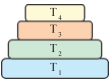
A
$T_1$
B
$T_2$
C
$T_4$
D
$T_3$
Solution
(A) According to the $10\%$ law of energy transfer in an ecosystem,only $10\%$ of the energy is transferred from one trophic level to the next higher trophic level.
Therefore,the maximum amount of energy is available at the first trophic level $(T_1)$,which consists of producers (plants).
As we move up the pyramid from $T_1$ to $T_4$,the amount of available energy decreases significantly at each successive level.
Therefore,the maximum amount of energy is available at the first trophic level $(T_1)$,which consists of producers (plants).
As we move up the pyramid from $T_1$ to $T_4$,the amount of available energy decreases significantly at each successive level.
0 likes
View Solution18
MediumMCQ
What will happen if the deer is missing in the food chain given below?
Grass $\to$ Deer $\to$ Tiger
Grass $\to$ Deer $\to$ Tiger
A
The population of tiger increases
B
The population of tiger decreases and the population of grass increases
C
Tiger will start eating grass
D
The population of grass decreases
Solution
(B) In the given food chain,Grass $\to$ Deer $\to$ Tiger,the deer acts as the primary consumer and the sole source of food for the tiger.
If the deer is removed from this ecosystem,the tiger will lose its food source,leading to a decline in the tiger population due to starvation.
Simultaneously,since the deer (the primary consumer) is no longer present to graze on the grass,the grass population will increase due to the lack of predation/consumption.
If the deer is removed from this ecosystem,the tiger will lose its food source,leading to a decline in the tiger population due to starvation.
Simultaneously,since the deer (the primary consumer) is no longer present to graze on the grass,the grass population will increase due to the lack of predation/consumption.
0 likes
View Solution19
EasyMCQ
What is the role of decomposers in an ecosystem?
A
Convert inorganic material to simpler forms.
B
Convert inorganic materials into organic compounds.
C
Convert organic material to inorganic forms.
D
Do not breakdown organic compounds.
Solution
(C) Decomposers,such as bacteria and fungi,play a crucial role in an ecosystem by breaking down complex organic matter (dead plants and animals) into simpler inorganic substances.
These inorganic substances,such as minerals and nutrients,are released back into the soil and atmosphere.
This process is essential for nutrient cycling,as it makes these nutrients available again for producers (plants) to use for growth.
Therefore,the correct role is to convert organic material to inorganic forms.
These inorganic substances,such as minerals and nutrients,are released back into the soil and atmosphere.
This process is essential for nutrient cycling,as it makes these nutrients available again for producers (plants) to use for growth.
Therefore,the correct role is to convert organic material to inorganic forms.
0 likes
View Solution20
MediumMCQ
If a grasshopper is eaten by a frog,then the energy transfer will be from
A
producer to decomposer
B
producer to primary consumer
C
secondary consumer to primary consumer
D
primary consumer to secondary consumer
Solution
(D) In an ecosystem,the energy flow follows a specific trophic level sequence.
$1$. Producers (plants) are at the first trophic level.
$2$. Primary consumers (herbivores like grasshoppers) feed on producers and occupy the second trophic level.
$3$. Secondary consumers (carnivores like frogs) feed on primary consumers and occupy the third trophic level.
When a grasshopper is eaten by a frog,the energy is transferred from the grasshopper (primary consumer) to the frog (secondary consumer).
$1$. Producers (plants) are at the first trophic level.
$2$. Primary consumers (herbivores like grasshoppers) feed on producers and occupy the second trophic level.
$3$. Secondary consumers (carnivores like frogs) feed on primary consumers and occupy the third trophic level.
When a grasshopper is eaten by a frog,the energy is transferred from the grasshopper (primary consumer) to the frog (secondary consumer).
0 likes
View Solution21
EasyMCQ
Disposable plastic plates should not be used because
A
they are made of non-biodegradable materials
B
they are made of toxic materials
C
they are made of biodegradable materials
D
they are made of materials with light weight
Solution
(A) Disposable plastic plates are made of synthetic polymers that are non-biodegradable.
This means they cannot be broken down by biological processes or microorganisms into simpler,harmless substances.
As a result,they persist in the environment for a very long time,leading to pollution and ecological damage.
Therefore,the correct reason is that they are made of non-biodegradable materials.
This means they cannot be broken down by biological processes or microorganisms into simpler,harmless substances.
As a result,they persist in the environment for a very long time,leading to pollution and ecological damage.
Therefore,the correct reason is that they are made of non-biodegradable materials.
0 likes
View Solution22
EasyMCQ
Why is improper disposal of waste a curse to the environment?
A
It leads to the accumulation of non-biodegradable substances.
B
It causes pollution of air,water,and soil.
C
It poses health risks to living organisms.
D
All of the above.
Solution
(D) Improper disposal of waste is considered a curse because it leads to the accumulation of non-biodegradable materials in the ecosystem.
It causes severe pollution of air,water,and soil,which degrades the quality of natural resources.
Furthermore,it poses significant health risks to all living organisms by introducing toxic substances into the food chain.
It causes severe pollution of air,water,and soil,which degrades the quality of natural resources.
Furthermore,it poses significant health risks to all living organisms by introducing toxic substances into the food chain.
0 likes
View Solution23
Easy
Write the common food chain of a pond ecosystem.
Solution
(N/A) common food chain in a pond ecosystem is as follows:
Phytoplankton (producers) $\to $ Zooplankton (primary consumers) $\to $ Small fish (secondary consumers) $\to $ Large fish or birds (tertiary consumers).
This sequence represents the flow of energy from producers to various levels of consumers within the aquatic environment.
Phytoplankton (producers) $\to $ Zooplankton (primary consumers) $\to $ Small fish (secondary consumers) $\to $ Large fish or birds (tertiary consumers).
This sequence represents the flow of energy from producers to various levels of consumers within the aquatic environment.
0 likes
View Solution24
EasyMCQ
What are the advantages of cloth bags over plastic bags during shopping?
A
They are durable and can carry more weight.
B
They are made of biodegradable materials.
C
They do not pollute the environment and can be reused.
D
All of the above.
Solution
(D) Cloth bags offer several advantages over plastic bags:
$(a)$ Durability: Cloth bags are stronger and capable of carrying more items compared to plastic bags.
$(b)$ Biodegradability: Cloth is made from natural fibers like cotton or jute,which are biodegradable and do not persist in the environment.
$(c)$ Environmental Impact: Unlike plastic,which takes hundreds of years to decompose and releases toxic chemicals,cloth bags do not pollute the environment.
$(d)$ Reusability: Cloth bags can be washed and reused multiple times,reducing the need for single-use bags.
$(a)$ Durability: Cloth bags are stronger and capable of carrying more items compared to plastic bags.
$(b)$ Biodegradability: Cloth is made from natural fibers like cotton or jute,which are biodegradable and do not persist in the environment.
$(c)$ Environmental Impact: Unlike plastic,which takes hundreds of years to decompose and releases toxic chemicals,cloth bags do not pollute the environment.
$(d)$ Reusability: Cloth bags can be washed and reused multiple times,reducing the need for single-use bags.
0 likes
View Solution25
EasyMCQ
Why are crop fields known as artificial ecosystems?
A
They are created by nature.
B
They are managed and maintained by humans.
C
They contain only one type of organism.
D
They do not have any abiotic components.
Solution
(B) Crop fields are considered artificial ecosystems because they are created and maintained by humans.
Unlike natural ecosystems,the biotic components (such as specific crops) and abiotic components (such as water supply,fertilizers,and soil management) are manipulated and controlled by human intervention to achieve specific agricultural yields.
Unlike natural ecosystems,the biotic components (such as specific crops) and abiotic components (such as water supply,fertilizers,and soil management) are manipulated and controlled by human intervention to achieve specific agricultural yields.
0 likes
View Solution26
Easy
Differentiate between biodegradable and non-biodegradable substances. Cite examples.
Solution
(N/A) Biodegradable substances are materials that can be broken down into simpler,harmless substances by the action of biological processes,such as the activity of microorganisms like bacteria and fungi.
Examples include wood,paper,vegetable peels,and animal waste.
Non-biodegradable substances are materials that cannot be broken down or decomposed by biological processes into simpler substances.
These substances persist in the environment for a long time and often cause pollution.
Examples include plastic,glass,$DDT$,and heavy metals.
Examples include wood,paper,vegetable peels,and animal waste.
Non-biodegradable substances are materials that cannot be broken down or decomposed by biological processes into simpler substances.
These substances persist in the environment for a long time and often cause pollution.
Examples include plastic,glass,$DDT$,and heavy metals.
0 likes
View Solution27
Easy
Suggest one word for each of the following statements/definitions:
$(a)$ The physical and biological world where we live in
$(b)$ Each level of food chain where transfer of energy takes place
$(c)$ The physical factors like temperature,rainfall,wind and soil of an ecosystem
$(d)$ Organisms which depend on the producers either directly or indirectly for food
$(a)$ The physical and biological world where we live in
$(b)$ Each level of food chain where transfer of energy takes place
$(c)$ The physical factors like temperature,rainfall,wind and soil of an ecosystem
$(d)$ Organisms which depend on the producers either directly or indirectly for food
Solution
(N/A) Environment: The surroundings or conditions in which a person,animal,or plant lives or operates.
$(b)$ Trophic level: Each step or level in a food chain where energy transfer occurs.
$(c)$ Abiotic factors: The non-living chemical and physical parts of the environment that affect living organisms and the functioning of ecosystems.
$(d)$ Consumers: Organisms that cannot produce their own food and must eat other plants or animals for energy.
$(b)$ Trophic level: Each step or level in a food chain where energy transfer occurs.
$(c)$ Abiotic factors: The non-living chemical and physical parts of the environment that affect living organisms and the functioning of ecosystems.
$(d)$ Consumers: Organisms that cannot produce their own food and must eat other plants or animals for energy.
0 likes
View Solution28
Medium
Explain the role of decomposers in the environment.
Solution
(N/A) Decomposers,such as bacteria and fungi,break down dead and decaying organic matter into simpler substances.
By doing so,they release essential nutrients back into the soil,which can then be reused by plants.
Therefore,decomposers play a crucial role in nutrient cycling and maintaining the balance of the ecosystem.
By doing so,they release essential nutrients back into the soil,which can then be reused by plants.
Therefore,decomposers play a crucial role in nutrient cycling and maintaining the balance of the ecosystem.
0 likes
View Solution29
EasyMCQ
Select the mismatched pair in the following and correct it.
$(a)$ Biomagnification — Accumulation of chemicals at the successive trophic levels of a food chain
$(b)$ Ecosystem — Biotic components of environment
$(c)$ Aquarium — $A$ man-made ecosystem
$(d)$ Parasites — Organisms which obtain food from other living organisms
$(a)$ Biomagnification — Accumulation of chemicals at the successive trophic levels of a food chain
$(b)$ Ecosystem — Biotic components of environment
$(c)$ Aquarium — $A$ man-made ecosystem
$(d)$ Parasites — Organisms which obtain food from other living organisms
A
Biomagnification — Accumulation of chemicals at the successive trophic levels of a food chain
B
Ecosystem — Biotic components of environment
C
Aquarium — $A$ man-made ecosystem
D
Parasites — Organisms which obtain food from other living organisms
Solution
(B) The mismatched pair is $(b)$.
An ecosystem is defined as a functional unit of nature where living organisms interact among themselves and also with the surrounding physical (abiotic) environment.
Therefore,an ecosystem consists of both biotic (living) and abiotic (non-living) components of the environment.
Corrected pair: $(b)$ Ecosystem — Biotic and abiotic components of the environment.
An ecosystem is defined as a functional unit of nature where living organisms interact among themselves and also with the surrounding physical (abiotic) environment.
Therefore,an ecosystem consists of both biotic (living) and abiotic (non-living) components of the environment.
Corrected pair: $(b)$ Ecosystem — Biotic and abiotic components of the environment.
0 likes
View Solution30
MediumMCQ
We do not clean ponds or lakes,but an aquarium needs to be cleaned. Why?
A
Ponds are larger than aquariums.
B
Aquariums are artificial and incomplete ecosystems,whereas ponds are natural and self-sustaining ecosystems.
C
Ponds contain more fish than aquariums.
D
Aquariums do not have plants.
Solution
(B) An aquarium is an artificial and incomplete ecosystem. It lacks the complex food chains,decomposers,and natural nutrient cycling processes that are present in a pond or lake.
In contrast,a pond or lake is a natural,self-sustaining,and complete ecosystem where biological processes maintain the balance of the environment without human intervention.
In contrast,a pond or lake is a natural,self-sustaining,and complete ecosystem where biological processes maintain the balance of the environment without human intervention.
0 likes
View Solution31
Medium
Indicate the flow of energy in an ecosystem. Why is it unidirectional? Justify.
Solution
(N/A) The flow of energy in an ecosystem follows the path: $\text{Sun} \to \text{Producer} \to \text{Herbivore} \to \text{Carnivore}$.
This flow is considered unidirectional because energy is transferred from one trophic level to the next and cannot revert to the previous level.
Justification: According to the $10\%$ law of energy transfer,a significant amount of energy is lost as heat at each trophic level. Because the energy available at higher trophic levels is much lower than at lower levels,the energy cannot flow backward from a higher trophic level to a lower one.
This flow is considered unidirectional because energy is transferred from one trophic level to the next and cannot revert to the previous level.
Justification: According to the $10\%$ law of energy transfer,a significant amount of energy is lost as heat at each trophic level. Because the energy available at higher trophic levels is much lower than at lower levels,the energy cannot flow backward from a higher trophic level to a lower one.
0 likes
View Solution32
Medium
What are decomposers? What will be the consequence of their absence in an ecosystem?
Solution
(N/A) Decomposers are microorganisms,such as bacteria and fungi,that break down complex organic matter from dead plants and animals into simpler inorganic substances.
These inorganic substances are released into the soil and are reused by plants for growth.
In the absence of decomposers,the recycling of nutrients in the biosphere would stop.
Dead organic matter would accumulate,leading to the depletion of essential nutrients in the soil and the eventual collapse of the ecosystem.
These inorganic substances are released into the soil and are reused by plants for growth.
In the absence of decomposers,the recycling of nutrients in the biosphere would stop.
Dead organic matter would accumulate,leading to the depletion of essential nutrients in the soil and the eventual collapse of the ecosystem.
0 likes
View Solution33
Easy
Suggest any four activities in daily life which are eco-friendly.
Solution
(N/A) $(i)$ Separation of biodegradable and non-biodegradable waste.
$(ii)$ Gardening and planting trees.
$(iii)$ Use of cloth bags or paper bags instead of polythene or plastic bags.
$(iv)$ Use of organic compost and vermicompost instead of chemical fertilizers.
$(v)$ Harvesting rainwater to conserve water resources.
$(ii)$ Gardening and planting trees.
$(iii)$ Use of cloth bags or paper bags instead of polythene or plastic bags.
$(iv)$ Use of organic compost and vermicompost instead of chemical fertilizers.
$(v)$ Harvesting rainwater to conserve water resources.
0 likes
View Solution34
Medium
Give two differences between food chain and food web.
Solution
(N/A)
| Food chain | Food web |
| $(a)$ $A$ food chain is a linear sequence of organisms where nutrients and energy are transferred from one organism to another. | $(a)$ $A$ food web is a complex network of interconnected food chains that shows the multiple feeding relationships in an ecosystem. |
| $(b)$ In a food chain,an organism at a higher trophic level feeds on only one specific type of organism from the lower trophic level. | $(b)$ In a food web,an organism at a higher trophic level can feed on various types of organisms from different lower trophic levels. |
0 likes
View Solution35
Medium
Name the wastes which are generated in your house daily. What measures would you take for their disposal?
Solution
(N/A) The wastes generated in a house daily include:
$(a)$ Kitchen wastes (leftover food,vegetable/fruit peels).
$(b)$ Paper wastes (newspapers,bags,envelopes).
$(c)$ Plastic bags and packaging materials.
$(d)$ Dust and sweepings.
Measures for disposal:
$(a)$ Segregation: Separate waste into biodegradable (kitchen waste,peels) and non-biodegradable (plastic,glass) categories.
$(b)$ Composting: Prepare a compost pit for biodegradable kitchen wastes to convert them into manure.
$(c)$ Recycling: Send paper wastes and recyclable plastics to recycling centers.
$(d)$ Reuse: Reuse plastic bags and containers whenever possible.
$(e)$ Proper Disposal: Dispose of non-recyclable waste in designated municipal bins.
$(a)$ Kitchen wastes (leftover food,vegetable/fruit peels).
$(b)$ Paper wastes (newspapers,bags,envelopes).
$(c)$ Plastic bags and packaging materials.
$(d)$ Dust and sweepings.
Measures for disposal:
$(a)$ Segregation: Separate waste into biodegradable (kitchen waste,peels) and non-biodegradable (plastic,glass) categories.
$(b)$ Composting: Prepare a compost pit for biodegradable kitchen wastes to convert them into manure.
$(c)$ Recycling: Send paper wastes and recyclable plastics to recycling centers.
$(d)$ Reuse: Reuse plastic bags and containers whenever possible.
$(e)$ Proper Disposal: Dispose of non-recyclable waste in designated municipal bins.
0 likes
View Solution36
Easy
Suggest suitable mechanism$(s)$ for waste management in fertiliser industries.
Solution
(N/A) The waste management in fertiliser industries involves the following mechanisms:
$1$. Control of air pollution: Installation of scrubbers and electrostatic precipitators to remove harmful gases and particulate matter from industrial emissions.
$2$. Effluent treatment: Industrial wastewater must be treated in an Effluent Treatment Plant $(ETP)$ to neutralize chemicals and remove toxic pollutants before discharging it into the surrounding environment.
$1$. Control of air pollution: Installation of scrubbers and electrostatic precipitators to remove harmful gases and particulate matter from industrial emissions.
$2$. Effluent treatment: Industrial wastewater must be treated in an Effluent Treatment Plant $(ETP)$ to neutralize chemicals and remove toxic pollutants before discharging it into the surrounding environment.
0 likes
View Solution37
Easy
What are the by-products of fertiliser industries? How do they affect the environment?
Solution
(N/A) The by-products of fertiliser industries primarily include harmful gases such as sulfur dioxide $(SO_2)$ and nitrogen oxides $(NO_x)$.
These gases are released into the atmosphere,leading to severe air pollution.
When these gases react with water vapor in the atmosphere,they form sulfuric acid and nitric acid,which fall to the Earth as acid rain.
Acid rain damages soil fertility,harms aquatic life in water bodies,and causes corrosion to buildings and monuments.
These gases are released into the atmosphere,leading to severe air pollution.
When these gases react with water vapor in the atmosphere,they form sulfuric acid and nitric acid,which fall to the Earth as acid rain.
Acid rain damages soil fertility,harms aquatic life in water bodies,and causes corrosion to buildings and monuments.
0 likes
View Solution38
Medium
Explain some harmful effects of agricultural practices on the environment.
Solution
(N/A) Excessive use of fertilisers changes the chemistry of soil and kills useful microbes.
$(b)$ Excessive use of non-biodegradable chemical pesticides leads to biological magnification.
$(c)$ Extensive cropping causes loss of soil fertility.
$(d)$ Excess use of groundwater for agriculture lowers the water table.
$(e)$ Damage to natural ecosystems and habitats.
$(b)$ Excessive use of non-biodegradable chemical pesticides leads to biological magnification.
$(c)$ Extensive cropping causes loss of soil fertility.
$(d)$ Excess use of groundwater for agriculture lowers the water table.
$(e)$ Damage to natural ecosystems and habitats.
0 likes
View Solution39
EasyMCQ
In a food chain consisting of grass,insect,frog,and snake,what is the trophic level of the frog?
A
First trophic level
B
Second trophic level
C
Third trophic level
D
Fourth trophic level
Solution
(C) The food chain is represented as: Grass (Producer) $\rightarrow$ Insect (Primary Consumer) $\rightarrow$ Frog (Secondary Consumer) $\rightarrow$ Snake (Tertiary Consumer).
In this sequence,the grass occupies the $1^{\text{st}}$ trophic level.
The insect occupies the $2^{\text{nd}}$ trophic level.
The frog occupies the $3^{\text{rd}}$ trophic level.
The snake occupies the $4^{\text{th}}$ trophic level.
Therefore,the frog is at the $3^{\text{rd}}$ trophic level.
In this sequence,the grass occupies the $1^{\text{st}}$ trophic level.
The insect occupies the $2^{\text{nd}}$ trophic level.
The frog occupies the $3^{\text{rd}}$ trophic level.
The snake occupies the $4^{\text{th}}$ trophic level.
Therefore,the frog is at the $3^{\text{rd}}$ trophic level.
0 likes
View Solution40
Easy
Give one protective function of forests.
Solution
(N/A) Forests act as a natural sink for carbon dioxide and help in reducing atmospheric pollution by absorbing harmful gases and trapping dust particles.
0 likes
View Solution41
EasyMCQ
What will be the amount of energy available to the organisms of the $2^{\text{nd}}$ trophic level of a food chain,if the energy available at the first trophic level is $10,000 \, J$?
A
$100 \, J$
B
$1,000 \, J$
C
$10,000 \, J$
D
$10 \, J$
Solution
(B) According to the $10\%$ Law of energy transfer in an ecosystem,only $10\%$ of the energy available at one trophic level is transferred to the next higher trophic level.
Given that the energy at the $1^{\text{st}}$ trophic level (producers) is $10,000 \, J$.
Energy at the $2^{\text{nd}}$ trophic level = $10\%$ of $10,000 \, J$.
Calculation: $(10 / 100) \times 10,000 = 1,000 \, J$.
Therefore,the energy available to the organisms of the $2^{\text{nd}}$ trophic level is $1,000 \, J$.
Given that the energy at the $1^{\text{st}}$ trophic level (producers) is $10,000 \, J$.
Energy at the $2^{\text{nd}}$ trophic level = $10\%$ of $10,000 \, J$.
Calculation: $(10 / 100) \times 10,000 = 1,000 \, J$.
Therefore,the energy available to the organisms of the $2^{\text{nd}}$ trophic level is $1,000 \, J$.
0 likes
View Solution42
EasyMCQ
The first trophic level in a food chain is always a green plant. Why?
A
They are producers.
B
They are consumers.
C
They are decomposers.
D
They are parasites.
Solution
(A) The first trophic level in a food chain is always a green plant because they are producers.
Only green plants possess chlorophyll,which allows them to capture radiant energy from the sun.
Through the process of photosynthesis,they convert this solar energy into chemical energy stored in the form of glucose (food).
Since all other organisms in a food chain depend on this stored chemical energy for their survival,plants must occupy the first trophic level.
Only green plants possess chlorophyll,which allows them to capture radiant energy from the sun.
Through the process of photosynthesis,they convert this solar energy into chemical energy stored in the form of glucose (food).
Since all other organisms in a food chain depend on this stored chemical energy for their survival,plants must occupy the first trophic level.
0 likes
View Solution43
EasyMCQ
Which of the following are always at the second trophic level of food chains?
A
Carnivores
B
Autotrophs
C
Herbivores
D
Decomposers
Solution
(C) In a food chain,the first trophic level is occupied by producers (autotrophs) which synthesize their own food. Herbivores,which feed directly on these producers,always occupy the second trophic level. Carnivores occupy the third or higher trophic levels depending on the food chain structure.
0 likes
View Solution44
EasyMCQ
In an ecosystem,rats feed on grains. Name the trophic level to which the rats belong.
A
First trophic level
B
Second trophic level
C
Third trophic level
D
Fourth trophic level
Solution
(B) In an ecosystem,the food chain starts with producers (plants/grains) which occupy the $First$ trophic level.
Rats feed directly on grains,making them primary consumers.
Primary consumers occupy the $Second$ trophic level in a food chain.
Rats feed directly on grains,making them primary consumers.
Primary consumers occupy the $Second$ trophic level in a food chain.
0 likes
View Solution45
Easy
What is the physical environment of an ecosystem called? Give one example.
Solution
(N/A) The physical environment of an ecosystem is known as the abiotic or non-living component of the ecosystem.
It consists of various physical and chemical factors that influence the survival of living organisms.
Examples include temperature,rainfall,wind,soil,and minerals. (Any one of these can be cited as an example.)
It consists of various physical and chemical factors that influence the survival of living organisms.
Examples include temperature,rainfall,wind,soil,and minerals. (Any one of these can be cited as an example.)
0 likes
View Solution46
EasyMCQ
How does the concentration of a pesticide change once it enters a food chain?
A
It decreases at each trophic level.
B
It remains constant at each trophic level.
C
It increases at each trophic level.
D
It is eliminated at the first trophic level.
Solution
(C) The phenomenon where harmful chemicals like pesticides accumulate in the tissues of organisms at higher trophic levels is known as biomagnification.
Once a pesticide enters a food chain,it is not broken down or excreted easily.
As a result,its concentration increases progressively at each successive trophic level,reaching the highest levels in the top carnivores.
Once a pesticide enters a food chain,it is not broken down or excreted easily.
As a result,its concentration increases progressively at each successive trophic level,reaching the highest levels in the top carnivores.
0 likes
View Solution47
EasyMCQ
What would be the consequence if all the herbivores are removed from a grassland ecosystem?
A
The population of carnivores will increase.
B
The population of producers will decrease due to overgrazing.
C
The carnivores will die due to lack of food,and the producers will increase uncontrollably.
D
The ecosystem will remain balanced.
Solution
(C) In a grassland ecosystem,herbivores act as the primary consumers that feed on producers (plants).
If all herbivores are removed,the carnivores (secondary and tertiary consumers) will lose their source of food and eventually die out.
Simultaneously,the producers will no longer be consumed,leading to an uncontrolled increase in their population,which disrupts the ecological balance.
If all herbivores are removed,the carnivores (secondary and tertiary consumers) will lose their source of food and eventually die out.
Simultaneously,the producers will no longer be consumed,leading to an uncontrolled increase in their population,which disrupts the ecological balance.
0 likes
View Solution48
Easy
Write the appropriate names of the trophic levels $Z$ and $X$ in the figure given below.
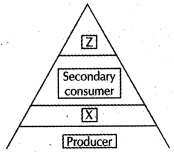
Solution
(N/A) In an ecological pyramid,the trophic levels are arranged from the base to the apex.
$1$. The base level consists of Producers.
$2$. The level above the producers is $X$,which represents the Primary consumers (herbivores).
$3$. The level above the primary consumers is the Secondary consumers.
$4$. The top level $Z$ represents the Tertiary consumers (carnivores).
Therefore,$X$ is Primary consumers and $Z$ is Tertiary consumers.
$1$. The base level consists of Producers.
$2$. The level above the producers is $X$,which represents the Primary consumers (herbivores).
$3$. The level above the primary consumers is the Secondary consumers.
$4$. The top level $Z$ represents the Tertiary consumers (carnivores).
Therefore,$X$ is Primary consumers and $Z$ is Tertiary consumers.
0 likes
View Solution49
Easy
State a way to prevent the accumulation of harmful chemicals in our bodies.
Solution
(N/A) The accumulation of harmful chemicals in our bodies,a process known as biological magnification,can be prevented by minimizing the use of pesticides and chemical fertilizers in agriculture. Instead,adopting organic farming practices and using natural pest control methods helps reduce the entry of these toxic substances into the food chain.
0 likes
View Solution50
EasyMCQ
During heavy rain in a village,rainwater carried excessive fertilizers to a pond. How will it affect the fish population in the pond in the long run?
A
The fish population will increase due to more food.
B
The fish population will decrease due to oxygen depletion.
C
The fish population will remain unaffected.
D
The fish population will migrate to other water bodies.
Solution
(B) The process described is known as eutrophication.
$1$. Excessive fertilizers (rich in nitrates and phosphates) enter the pond,leading to an overgrowth of algae (algal bloom).
$2$. When these algae die,decomposers consume large amounts of dissolved oxygen in the water to break them down.
$3$. This leads to a significant decrease in the dissolved oxygen levels in the pond.
$4$. Consequently,the fish population will decrease in the long run due to the lack of oxygen required for their survival.
$1$. Excessive fertilizers (rich in nitrates and phosphates) enter the pond,leading to an overgrowth of algae (algal bloom).
$2$. When these algae die,decomposers consume large amounts of dissolved oxygen in the water to break them down.
$3$. This leads to a significant decrease in the dissolved oxygen levels in the pond.
$4$. Consequently,the fish population will decrease in the long run due to the lack of oxygen required for their survival.
0 likes
View SolutionOur Environment — Mix Examples - Our Environment · Frequently Asked Questions
1Are these Our Environment questions useful for JEE and NEET?
Yes. All questions in this section are mapped to JEE Main and NEET exam patterns. Previous year questions from JEE Main, NEET, GUJCET and state-level exams are included with full solutions.
2Can I switch to Hindi or Gujarati for these questions?
Yes. Use the language tabs in the hero section or the sidebar to view the same questions and solutions in English, Hindi or Gujarati.
3How do I generate a question paper from this subtopic?
Use the Vedclass Exam Paper Generator — select the chapter and subtopic, set difficulty, and generate Sets A, B, C, D automatically. First 3 chapters of every subject are free.
Vedclass Products
For Students
Vedclass Test Series
Mock tests in real JEE/NEET style with performance analysis. 5-day free trial.
Start Free TrialFor Teachers
Exam Paper Generator
Generate Set A/B/C/D papers from this chapter in 2 minutes. 3 chapters free.
Try FreeFor Institutes
Online Exam Module
Live online exams with unlimited students, 360° analytics & white-label branding.
See DemoFor Teachers & Institutes
Generate a Our Environment Exam Paper in 2 Minutes
Select subtopic & difficulty — Sets A, B, C, D auto-generated with No Repeat logic.
First 3 chapters of every subject are free — no payment required.