
A English
Mix Examples - Our Environment Questions in English
Class 10 Science · Our Environment · Mix Examples - Our Environment
181+
Questions
English
Language
100%
With Solutions
Showing 50 of 181 questions in English
101
Easy
Name two gases which are considered to be better than $CFCs$ and cause less damage to the ozone layer.
Solution
(N/A) The two gases considered to be better alternatives to $CFCs$ (Chlorofluorocarbons) due to their lower ozone depletion potential are:
$(i)$ Hydrofluorocarbons $(HFCs)$: These compounds contain hydrogen,fluorine,and carbon. They do not contain chlorine,which is the primary element responsible for ozone destruction in $CFCs$.
$(ii)$ Perfluorocarbons $(PFCs)$: These are compounds consisting only of carbon and fluorine atoms. They are chemically inert and have a significantly lower impact on the ozone layer compared to $CFCs$.
$(i)$ Hydrofluorocarbons $(HFCs)$: These compounds contain hydrogen,fluorine,and carbon. They do not contain chlorine,which is the primary element responsible for ozone destruction in $CFCs$.
$(ii)$ Perfluorocarbons $(PFCs)$: These are compounds consisting only of carbon and fluorine atoms. They are chemically inert and have a significantly lower impact on the ozone layer compared to $CFCs$.
0 likes
View Solution102
EasyMCQ
The depletion of the ozone layer is a cause of concern. Why?
A
It increases global warming.
B
It allows harmful ultraviolet $(UV)$ radiation to reach the Earth's surface.
C
It leads to acid rain.
D
It causes the melting of polar ice caps.
Solution
(B) The ozone layer in the stratosphere acts as a shield by absorbing harmful ultraviolet $(UV)$ radiation from the sun.
Depletion of this layer allows these high-energy $UV$ rays to penetrate the Earth's atmosphere and reach the surface.
Exposure to these rays causes serious health hazards in human beings,such as skin cancer,cataracts,and damage to the immune system.
Depletion of this layer allows these high-energy $UV$ rays to penetrate the Earth's atmosphere and reach the surface.
Exposure to these rays causes serious health hazards in human beings,such as skin cancer,cataracts,and damage to the immune system.
0 likes
View Solution103
MediumMCQ
Non-biodegradable materials do not break down by the action of microorganisms. Will there be any effect of heat and pressure if they remain buried under the land for a long time?
A
Yes,they decompose completely.
B
Yes,they undergo chemical changes and leach harmful substances into the soil.
C
No,they remain completely inert and unchanged.
D
No,they turn into useful minerals.
Solution
(B) Yes,there is an effect of heat and pressure on non-biodegradable materials.
Although they do not break down through microbial action,prolonged exposure to heat and pressure under the soil can cause physical and chemical degradation.
This process often leads to the leaching of toxic chemicals and additives present in these materials into the surrounding soil and groundwater.
Consequently,this results in soil pollution and potential contamination of the water table.
Although they do not break down through microbial action,prolonged exposure to heat and pressure under the soil can cause physical and chemical degradation.
This process often leads to the leaching of toxic chemicals and additives present in these materials into the surrounding soil and groundwater.
Consequently,this results in soil pollution and potential contamination of the water table.
0 likes
View Solution104
EasyMCQ
At one trophic level,an average of $10 \%$ of the energy taken is turned into its own body and made available for the next level of consumers. What happens to the rest of $90 \%$ of the energy?
A
It is stored as chemical energy.
B
It is lost as heat to the environment.
C
It is used for reproduction.
D
It is converted into biomass.
Solution
(B) According to the $10 \%$ Law of energy transfer in an ecosystem,only $10 \%$ of the energy available at one trophic level is transferred to the next trophic level.
The remaining $90 \%$ of the energy is lost to the environment.
This energy is primarily used by the organism for its own metabolic activities (such as respiration,movement,and growth) and is eventually released into the environment as heat.
The remaining $90 \%$ of the energy is lost to the environment.
This energy is primarily used by the organism for its own metabolic activities (such as respiration,movement,and growth) and is eventually released into the environment as heat.
0 likes
View Solution105
Medium
There is a need to dispose of waste in a proper manner. Justify this statement by giving reasons.
Solution
(N/A) There is a need to dispose of waste in a proper manner because:
$(i)$ To stop pollution: Waste should be disposed of properly to prevent land and water pollution.
$(ii)$ To prevent diseases: If waste is disposed of improperly,it may cause diseases like cholera,dengue,typhoid,pneumonia,etc. To prevent such diseases,we need to dispose of waste in a proper way.
$(i)$ To stop pollution: Waste should be disposed of properly to prevent land and water pollution.
$(ii)$ To prevent diseases: If waste is disposed of improperly,it may cause diseases like cholera,dengue,typhoid,pneumonia,etc. To prevent such diseases,we need to dispose of waste in a proper way.
0 likes
View Solution106
Medium
Distinguish between food chain and food web.
Solution
(N/A)
| Food chain | Food web |
| $1$. It is a straight sequence of organisms which depicts 'who eats whom'. | $1$. It is a complex network of many food chains existing in an ecosystem. |
| $2$. Food chain does not have any cross linkages. | $2$. Food web has many cross linkages. |
0 likes
View Solution107
EasyMCQ
Larger animals kill smaller animals in the forest,eat whatever they can,and leave the rest in the forest,but the forest is never found full of dead animals. What happens to the bodies of these dead animals?
A
They are buried by the soil.
B
They are decomposed by decomposers like bacteria and fungi.
C
They are eaten by other larger animals.
D
They evaporate into the atmosphere.
Solution
(B) The bodies of dead animals are acted upon by decomposers such as bacteria and fungi (saprophytes).
These organisms break down the complex organic matter of the dead bodies into simple inorganic nutrients.
These nutrients are released back into the soil,which acts as a nutrient pool.
Plants absorb these nutrients from the soil for their growth,thereby completing the nutrient cycle in the ecosystem.
These organisms break down the complex organic matter of the dead bodies into simple inorganic nutrients.
These nutrients are released back into the soil,which acts as a nutrient pool.
Plants absorb these nutrients from the soil for their growth,thereby completing the nutrient cycle in the ecosystem.
0 likes
View Solution108
Medium
Explain how harmful chemicals enter our body. Write the name given to such a phenomenon.
Solution
(N/A) Harmful chemicals enter our bodies through the food chain. When these chemicals are sprayed in agricultural fields,they are often non-biodegradable,meaning they persist in the environment and may wash into water bodies. When human beings consume agricultural products or aquatic organisms such as fish or prawns,these chemicals are transferred and accumulate in their bodies at higher concentrations.
This phenomenon is called 'biological magnification' or 'biomagnification'.
This phenomenon is called 'biological magnification' or 'biomagnification'.
0 likes
View Solution109
Medium
Though the kulhads are made up of clay,which is an eco-friendly substance,their use has been discontinued in trains nowadays. Give reasons which lead to the discontinuance of this practice.
Solution
(N/A) Kulhads have been discontinued in trains nowadays because:
$1$. They are made up of the top layer of soil,which is the most fertile layer. Excessive use of kulhads would deplete this fertile layer,which is essential for agriculture.
$2$. Kulhads are neither recyclable nor reusable; therefore,their use was discontinued to prevent environmental degradation and resource depletion.
$1$. They are made up of the top layer of soil,which is the most fertile layer. Excessive use of kulhads would deplete this fertile layer,which is essential for agriculture.
$2$. Kulhads are neither recyclable nor reusable; therefore,their use was discontinued to prevent environmental degradation and resource depletion.
0 likes
View Solution110
Medium
You are advised to use eco-friendly appliances like refrigerators and $ACs$. Giving reasons,explain how these devices cause harm to the environment.
Solution
(N/A) Devices like refrigerators and $ACs$ affect the environment in the following ways:
$1$. They release chlorofluorocarbons $(CFCs)$,which are among the most harmful greenhouse gases and are primarily responsible for ozone layer depletion.
$2$. They consume a significant amount of electricity,which leads to the increased burning of fossil fuels like coal and natural gas,thereby contributing to global warming and resource depletion.
$1$. They release chlorofluorocarbons $(CFCs)$,which are among the most harmful greenhouse gases and are primarily responsible for ozone layer depletion.
$2$. They consume a significant amount of electricity,which leads to the increased burning of fossil fuels like coal and natural gas,thereby contributing to global warming and resource depletion.
0 likes
View Solution111
Medium
What is the difference between the food habits of organisms belonging to the second and fourth trophic levels? Give one example of organisms belonging to each of these two trophic levels.
Solution
(N/A) Differences between the Second Trophic Level and the Fourth Trophic Level:
| Second Trophic Level | Fourth Trophic Level |
| $1$. The organisms of this trophic level are herbivores. | $1$. The organisms of this trophic level are carnivores. |
| $2$. They obtain more energy as they are closer to the producers. Example: $Deer, Rabbit, Grasshopper$. | $2$. They obtain less energy because they are further away from the producers. Example: $Snake, Peacock, Hawk$. |
0 likes
View Solution112
Medium
In the food chain
Grass $\rightarrow$ Deer $\rightarrow$ Lion
operating in a forest,what will happen if all the
$(a)$ lions are removed?
$(b)$ deers are removed?
Grass $\rightarrow$ Deer $\rightarrow$ Lion
operating in a forest,what will happen if all the
$(a)$ lions are removed?
$(b)$ deers are removed?
Solution
(N/A) If all lions are removed,the population of deer will increase significantly due to the lack of predators. This overpopulation will lead to overgrazing,causing a depletion of grass,which may eventually result in soil erosion.
$(b)$ If all deer are removed,the lions will lose their primary food source,leading to a decline in the lion population due to starvation. Conversely,the amount of grass will increase as there are no herbivores to consume it.
$(b)$ If all deer are removed,the lions will lose their primary food source,leading to a decline in the lion population due to starvation. Conversely,the amount of grass will increase as there are no herbivores to consume it.
0 likes
View Solution113
Easy
Why do food chains generally consist of only three or four steps?
Solution
(N/A) According to the $10\%$ law of energy transfer, only about $10\%$ of the energy available at one trophic level is transferred to the next higher trophic level.
Because so little energy is available for the next level of consumers, food chains generally consist of only three or four steps.
The loss of energy at each step is so significant that very little usable energy remains after four trophic levels to support a fifth level.
Because so little energy is available for the next level of consumers, food chains generally consist of only three or four steps.
The loss of energy at each step is so significant that very little usable energy remains after four trophic levels to support a fifth level.
0 likes
View Solution114
EasyMCQ
Organisms of a higher trophic level which feed on several types of organisms belonging to a lower trophic level constitute the
A
ecological pyramid
B
food web
C
ecosystem
D
food chain
Solution
(B) $food \text{ } chain$ is a linear sequence of organisms through which energy is transferred.
However, in nature, organisms rarely feed on only one type of organism.
Most organisms feed on multiple types of organisms from lower trophic levels, creating a complex, interconnected network of feeding relationships.
This interconnected network of multiple food chains is known as a $food \text{ } web$.
However, in nature, organisms rarely feed on only one type of organism.
Most organisms feed on multiple types of organisms from lower trophic levels, creating a complex, interconnected network of feeding relationships.
This interconnected network of multiple food chains is known as a $food \text{ } web$.
0 likes
View Solution115
EasyMCQ
Flow of energy in an ecosystem is always
A
bidirectional
B
multidirectional
C
unidirectional
D
no specific direction
Solution
(C) In an ecosystem, energy enters from the sun and is captured by producers (plants) through photosynthesis.
As energy moves from one trophic level to the next (e.g., from producers to primary consumers, then to secondary consumers), a significant portion of energy is lost as heat at each step, according to the $10\%$ law.
Because energy cannot be recycled or reused by the producers once it is lost as heat, the flow of energy is strictly unidirectional, moving from the sun to producers and then to higher trophic levels.
As energy moves from one trophic level to the next (e.g., from producers to primary consumers, then to secondary consumers), a significant portion of energy is lost as heat at each step, according to the $10\%$ law.
Because energy cannot be recycled or reused by the producers once it is lost as heat, the flow of energy is strictly unidirectional, moving from the sun to producers and then to higher trophic levels.
0 likes
View Solution116
EasyMCQ
Disposable plastic plates should not be used because
A
they are made of materials with light weight
B
they are made of toxic materials
C
they are made of biodegradable materials
D
they are made of non-biodegradable materials
Solution
(D) Disposable plastic plates are made of synthetic polymers that are non-biodegradable.
This means they cannot be broken down by microorganisms into simpler,harmless substances in the environment.
As a result,they accumulate in the environment,leading to pollution and posing a threat to ecosystems and wildlife.
Therefore,the correct option is $D$.
This means they cannot be broken down by microorganisms into simpler,harmless substances in the environment.
As a result,they accumulate in the environment,leading to pollution and posing a threat to ecosystems and wildlife.
Therefore,the correct option is $D$.
0 likes
View Solution117
EasyMCQ
Depletion of ozone is mainly due to
A
chlorofluorocarbon compounds
B
carbon monoxide
C
methane
D
pesticides
Solution
(A) The depletion of the ozone layer is primarily caused by the release of chlorofluorocarbons $(CFCs)$ into the atmosphere.
These compounds are used in refrigerators,air conditioners,and aerosol sprays.
When $CFCs$ reach the stratosphere,they are broken down by ultraviolet radiation,releasing chlorine atoms.
These chlorine atoms act as catalysts in the destruction of ozone $(O_3)$ molecules,converting them into oxygen $(O_2)$,which leads to the thinning of the ozone layer.
These compounds are used in refrigerators,air conditioners,and aerosol sprays.
When $CFCs$ reach the stratosphere,they are broken down by ultraviolet radiation,releasing chlorine atoms.
These chlorine atoms act as catalysts in the destruction of ozone $(O_3)$ molecules,converting them into oxygen $(O_2)$,which leads to the thinning of the ozone layer.
0 likes
View Solution118
EasyMCQ
Organisms which synthesise carbohydrates from inorganic compounds using radiant energy are called
A
decomposers
B
producers
C
herbivores
D
carnivores
Solution
(B) Organisms that synthesize carbohydrates (food) from inorganic compounds like $CO_2$ and $H_2O$ using radiant energy (sunlight) are known as producers or autotrophs.
These organisms,primarily green plants,algae,and some bacteria,form the first trophic level in an ecosystem by converting solar energy into chemical energy.
These organisms,primarily green plants,algae,and some bacteria,form the first trophic level in an ecosystem by converting solar energy into chemical energy.
0 likes
View Solution119
MediumMCQ
In an ecosystem,the $10 \%$ of energy available for transfer from one trophic level to the next is in the form of
A
heat energy
B
light energy
C
chemical energy
D
mechanical energy
Solution
(C) According to the $10 \%$ Law proposed by Lindeman,only about $10 \%$ of the energy entering a particular trophic level of organisms is available for transfer to the next higher trophic level.
This energy is stored in the biomass of the organisms in the form of chemical energy (organic compounds like carbohydrates,proteins,and fats).
The remaining $90 \%$ of the energy is lost to the environment as heat during metabolic processes or used for the organism's own life activities.
This energy is stored in the biomass of the organisms in the form of chemical energy (organic compounds like carbohydrates,proteins,and fats).
The remaining $90 \%$ of the energy is lost to the environment as heat during metabolic processes or used for the organism's own life activities.
0 likes
View Solution120
MediumMCQ
What will happen if deer is missing in the food chain given below?
Grass $\rightarrow$ Deer $\rightarrow$ Tiger
Grass $\rightarrow$ Deer $\rightarrow$ Tiger
A
the population of tiger increases
B
the population of grass decreases
C
tiger will start eating grass
D
the population of tiger decreases and the population of grass increases.
Solution
(D) In the given food chain,Grass $\rightarrow$ Deer $\rightarrow$ Tiger,the deer acts as the primary consumer and the tiger acts as the secondary consumer.
If the deer is removed from this food chain,the tiger will lose its primary source of food,leading to a decrease in the tiger population due to starvation.
Simultaneously,since the deer (which consumes grass) is no longer present to graze,the grass population will increase due to the lack of predation.
Therefore,the correct consequence is that the population of tiger decreases and the population of grass increases.
If the deer is removed from this food chain,the tiger will lose its primary source of food,leading to a decrease in the tiger population due to starvation.
Simultaneously,since the deer (which consumes grass) is no longer present to graze,the grass population will increase due to the lack of predation.
Therefore,the correct consequence is that the population of tiger decreases and the population of grass increases.
0 likes
View Solution121
EasyMCQ
The decomposers in an ecosystem
A
convert organic material to inorganic forms
B
convert inorganic material to simpler forms
C
convert inorganic materials into organic compounds
D
do not breakdown organic compounds
Solution
(A) Decomposers are organisms,such as bacteria and fungi,that break down dead and decaying organic matter.
During this process,they decompose complex organic substances into simpler inorganic substances (like minerals,carbon dioxide,and water) that can be reused by producers in the ecosystem.
Therefore,they play a crucial role in nutrient cycling by converting organic material into inorganic forms.
During this process,they decompose complex organic substances into simpler inorganic substances (like minerals,carbon dioxide,and water) that can be reused by producers in the ecosystem.
Therefore,they play a crucial role in nutrient cycling by converting organic material into inorganic forms.
0 likes
View Solution122
EasyMCQ
In a food chain,the third trophic level is always occupied by
A
herbivores
B
carnivores
C
decomposers
D
producers
Solution
(B) In a food chain,the trophic levels are organized as follows:
$1$. The first trophic level $(T_1)$ is occupied by producers (plants),which synthesize their own food.
$2$. The second trophic level $(T_2)$ is occupied by primary consumers (herbivores),which feed on producers.
$3$. The third trophic level $(T_3)$ is occupied by secondary consumers (carnivores),which feed on herbivores.
Therefore,the third trophic level is always occupied by carnivores.
$1$. The first trophic level $(T_1)$ is occupied by producers (plants),which synthesize their own food.
$2$. The second trophic level $(T_2)$ is occupied by primary consumers (herbivores),which feed on producers.
$3$. The third trophic level $(T_3)$ is occupied by secondary consumers (carnivores),which feed on herbivores.
Therefore,the third trophic level is always occupied by carnivores.
0 likes
View Solution123
EasyMCQ
An ecosystem includes
A
all living organisms
B
non-living objects
C
both living organisms and non-living objects
D
sometimes living organisms and sometimes non-living objects
Solution
(C) An ecosystem is a structural and functional unit of nature where living organisms interact among themselves and also with the surrounding physical environment.
It consists of two main components:
$1$. Biotic components: These include all living organisms such as plants,animals,and microorganisms.
$2$. Abiotic components: These include non-living physical factors such as sunlight,temperature,water,soil,and air.
Therefore,an ecosystem includes both living organisms and non-living objects.
It consists of two main components:
$1$. Biotic components: These include all living organisms such as plants,animals,and microorganisms.
$2$. Abiotic components: These include non-living physical factors such as sunlight,temperature,water,soil,and air.
Therefore,an ecosystem includes both living organisms and non-living objects.
0 likes
View Solution124
MediumMCQ
Which of the following limits the number of trophic levels in a food chain?
A
water
B
polluted air
C
deficient food supply
D
decrease in energy at higher trophic levels
Solution
(D) The number of trophic levels in a food chain is limited by the $10\%$ law of energy transfer.
According to this law,only about $10\%$ of the energy available at one trophic level is transferred to the next higher trophic level.
The remaining $90\%$ of energy is lost as heat to the environment or used for metabolic activities by the organisms.
Due to this significant loss of energy at each step,there is very little energy left to support a higher trophic level after $3$ to $4$ transfers.
Therefore,the decrease in energy at higher trophic levels acts as a limiting factor for the length of a food chain.
According to this law,only about $10\%$ of the energy available at one trophic level is transferred to the next higher trophic level.
The remaining $90\%$ of energy is lost as heat to the environment or used for metabolic activities by the organisms.
Due to this significant loss of energy at each step,there is very little energy left to support a higher trophic level after $3$ to $4$ transfers.
Therefore,the decrease in energy at higher trophic levels acts as a limiting factor for the length of a food chain.
0 likes
View Solution125
MediumMCQ
In the given food chain,suppose the amount of energy at the fourth trophic level is $5 \, kJ$,what will be the energy available at the producer level? (in $kJ$)
Grass $\rightarrow$ Grasshopper $\rightarrow$ Frog $\rightarrow$ Snake $\rightarrow$ Hawk
Grass $\rightarrow$ Grasshopper $\rightarrow$ Frog $\rightarrow$ Snake $\rightarrow$ Hawk
A
$5000$
B
$5$
C
$50$
D
$500$
Solution
(A) According to the $10\%$ law of energy transfer in an ecosystem,only $10\%$ of the energy available at one trophic level is transferred to the next higher trophic level.
In the given food chain: Grass (Producer,$T_1$) $\rightarrow$ Grasshopper $(T_2)$ $\rightarrow$ Frog $(T_3)$ $\rightarrow$ Snake $(T_4)$ $\rightarrow$ Hawk $(T_5)$.
The fourth trophic level $(T_4)$ is the Snake.
Given: Energy at $T_4 = 5 \, kJ$.
To find the energy at the producer level $(T_1)$,we move backwards by multiplying by $10$ for each step:
Energy at $T_3 = 5 \times 10 = 50 \, kJ$.
Energy at $T_2 = 50 \times 10 = 500 \, kJ$.
Energy at $T_1$ (Producer) $= 500 \times 10 = 5000 \, kJ$.
Therefore,the energy available at the producer level is $5000 \, kJ$.
In the given food chain: Grass (Producer,$T_1$) $\rightarrow$ Grasshopper $(T_2)$ $\rightarrow$ Frog $(T_3)$ $\rightarrow$ Snake $(T_4)$ $\rightarrow$ Hawk $(T_5)$.
The fourth trophic level $(T_4)$ is the Snake.
Given: Energy at $T_4 = 5 \, kJ$.
To find the energy at the producer level $(T_1)$,we move backwards by multiplying by $10$ for each step:
Energy at $T_3 = 5 \times 10 = 50 \, kJ$.
Energy at $T_2 = 50 \times 10 = 500 \, kJ$.
Energy at $T_1$ (Producer) $= 500 \times 10 = 5000 \, kJ$.
Therefore,the energy available at the producer level is $5000 \, kJ$.
0 likes
View Solution126
EasyMCQ
Accumulation of non-biodegradable pesticides in the food chain in increasing amount at each higher trophic level is known as
A
eutrophication
B
biomagnification
C
pollution
D
accumulation
Solution
(B) Biomagnification is the process where the concentration of non-biodegradable substances,such as pesticides (e.g.,$DDT$),increases at each successive trophic level in a food chain.
This occurs because these substances cannot be broken down by organisms and are stored in their tissues,leading to higher concentrations as they move up the food chain from producers to top consumers.
This occurs because these substances cannot be broken down by organisms and are stored in their tissues,leading to higher concentrations as they move up the food chain from producers to top consumers.
0 likes
View Solution127
EasyMCQ
Which one of the following is an artificial ecosystem?
A
Pond
B
Lake
C
Crop field
D
Forest
Solution
(C) An ecosystem is a community of living organisms in conjunction with the non-living components of their environment, interacting as a system.
Artificial ecosystems are those created and maintained by human beings.
$A$ $crop$ $field$ is an example of an artificial ecosystem because it is created and managed by humans for agricultural purposes.
In contrast, ponds, lakes, and forests are examples of natural ecosystems as they occur and function without human intervention.
Artificial ecosystems are those created and maintained by human beings.
$A$ $crop$ $field$ is an example of an artificial ecosystem because it is created and managed by humans for agricultural purposes.
In contrast, ponds, lakes, and forests are examples of natural ecosystems as they occur and function without human intervention.
0 likes
View Solution128
EasyMCQ
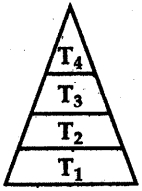
In the given figure,the various trophic levels are shown in the form of a pyramid. At which trophic level is maximum energy available and at which trophic level is the maximum number of organisms present?
A
$T_1$ and $T_1$
B
$T_4$ and $T_4$
C
$T_1$ and $T_4$
D
$T_4$ and $T_1$
Solution
(A) In an ecological pyramid,the base represents the first trophic level $(T_1)$,which consists of producers (plants).
According to the $10\%$ law of energy transfer,energy decreases as we move up the trophic levels. Therefore,the maximum energy is available at the base,which is $T_1$.
Similarly,in a typical pyramid of numbers,the number of organisms is highest at the producer level $(T_1)$ and decreases as we move towards the higher trophic levels $(T_2, T_3, T_4)$.
Thus,both maximum energy and the maximum number of organisms are present at the $T_1$ trophic level.
According to the $10\%$ law of energy transfer,energy decreases as we move up the trophic levels. Therefore,the maximum energy is available at the base,which is $T_1$.
Similarly,in a typical pyramid of numbers,the number of organisms is highest at the producer level $(T_1)$ and decreases as we move towards the higher trophic levels $(T_2, T_3, T_4)$.
Thus,both maximum energy and the maximum number of organisms are present at the $T_1$ trophic level.
0 likes
View Solution129
EasyMCQ
The length and complexity of food chains remain mostly the same.
A
True
B
False
Solution
(B) The statement is $False$.
Food chains vary significantly in length and complexity depending on the ecosystem.
Some food chains may consist of only two or three trophic levels (e.g., grass $\rightarrow$ deer $\rightarrow$ lion), while others can be much longer and more complex, involving many interconnected organisms in a food web.
Energy loss at each trophic level (as per the $10\%$ law) limits the length of food chains, but the specific structure and complexity are determined by the biodiversity and environmental conditions of the habitat.
Food chains vary significantly in length and complexity depending on the ecosystem.
Some food chains may consist of only two or three trophic levels (e.g., grass $\rightarrow$ deer $\rightarrow$ lion), while others can be much longer and more complex, involving many interconnected organisms in a food web.
Energy loss at each trophic level (as per the $10\%$ law) limits the length of food chains, but the specific structure and complexity are determined by the biodiversity and environmental conditions of the habitat.
0 likes
View Solution130
EasyMCQ
The flow of energy in a food chain is in both the directions.
A
True
B
False
Solution
(B) The flow of energy in an ecosystem is always unidirectional or one-way.
Energy enters the ecosystem from the sun and is captured by producers (plants) through photosynthesis.
It then moves from producers to consumers (herbivores,carnivores,etc.) and is eventually lost as heat at each trophic level.
Energy is never recycled back to the sun or to the previous trophic level,which is why the flow is unidirectional.
Energy enters the ecosystem from the sun and is captured by producers (plants) through photosynthesis.
It then moves from producers to consumers (herbivores,carnivores,etc.) and is eventually lost as heat at each trophic level.
Energy is never recycled back to the sun or to the previous trophic level,which is why the flow is unidirectional.
0 likes
View Solution131
EasyMCQ
The flow of organic matter in a food chain is unidirectional.
A
True
B
False
C
Cannot be determined
D
None of the above
Solution
(B) The statement is False. In a food chain,energy flow is unidirectional,but organic matter (nutrients) follows a cyclic path. Organic matter is recycled through the ecosystem by decomposers,which break down dead organic material and return nutrients to the soil,where they are again taken up by producers.
0 likes
View Solution132
EasyMCQ
$15 \%$ can be taken as the average value for the amount of organic matter that is present at each step and reaches the next level of consumers.
A
True
B
False
Solution
(B) The statement is False. According to the $10 \%$ Law of energy transfer in an ecosystem,only about $10 \%$ of the energy available at one trophic level is transferred to the next trophic level as organic matter. The remaining $90 \%$ is lost to the environment as heat or used by the organism for its own metabolic processes.
0 likes
View Solution133
EasyMCQ
The green plants capture about $10 \%$ of the energy of sunlight that falls on their leaves and convert it into food energy.
A
True
B
False
Solution
(B) The statement is False.
Green plants (producers) capture only about $1 \%$ of the energy of sunlight that falls on their leaves and convert it into food energy through the process of photosynthesis.
The $10 \%$ law of energy transfer,proposed by Lindeman,states that only $10 \%$ of the energy available at one trophic level is transferred to the next higher trophic level.
Green plants (producers) capture only about $1 \%$ of the energy of sunlight that falls on their leaves and convert it into food energy through the process of photosynthesis.
The $10 \%$ law of energy transfer,proposed by Lindeman,states that only $10 \%$ of the energy available at one trophic level is transferred to the next higher trophic level.
0 likes
View Solution134
EasyMCQ
There are generally a greater number of individuals at the lower trophic levels of an ecosystem.
A
True
B
False
Solution
(A) In an ecosystem, energy flows from producers to consumers. According to the $10\%$ law of energy transfer, only about $10\%$ of the energy is transferred from one trophic level to the next. Due to this significant loss of energy, the number of organisms that can be supported decreases as we move up the food chain. Therefore, the base of the pyramid (producers) typically contains the highest number of individuals, while the top trophic levels (apex predators) contain the fewest.
0 likes
View Solution135
EasyMCQ
Harmful chemicals enter into our body through biological magnification.
A
True
B
False
Solution
(A) Biological magnification (or biomagnification) refers to the increase in the concentration of toxic substances,such as pesticides or heavy metals,at successive trophic levels in a food chain.
Since humans are often at the top of the food chain,these harmful chemicals accumulate in our bodies in higher concentrations compared to other organisms,making the statement True.
Since humans are often at the top of the food chain,these harmful chemicals accumulate in our bodies in higher concentrations compared to other organisms,making the statement True.
0 likes
View Solution136
EasyMCQ
In any food chain,an average of $10 \%$ of the food eaten is turned into the body mass of an organism and made available for the next level of consumers.
A
True
B
False
Solution
(A) According to the $10 \%$ Law proposed by Lindeman in $1942$,only about $10 \%$ of the energy entering a particular trophic level of organisms is stored as biomass and is available for transfer to the next higher trophic level.
Most of the energy is lost as heat to the environment during metabolic activities like respiration,movement,and digestion.
Therefore,the statement is True.
Most of the energy is lost as heat to the environment during metabolic activities like respiration,movement,and digestion.
Therefore,the statement is True.
0 likes
View Solution137
EasyMCQ
Which of the following is an example of biodegradable waste?
A
Vegetables and Fruit
B
Glass
C
Plastic
D
Metal
Solution
(A) Biodegradable waste refers to organic materials that can be broken down by microorganisms like bacteria and fungi into simpler substances.
Vegetables and fruit are organic materials derived from plants,which easily decompose in the environment.
Glass,plastic,and metal are non-biodegradable materials because they cannot be broken down by biological processes and persist in the environment for a long time.
Vegetables and fruit are organic materials derived from plants,which easily decompose in the environment.
Glass,plastic,and metal are non-biodegradable materials because they cannot be broken down by biological processes and persist in the environment for a long time.
0 likes
View Solution138
EasyMCQ
Which of the following is an example of non-biodegradable waste?
A
Fruits
B
Vegetables
C
Paper
D
Polythene
Solution
(D) Non-biodegradable wastes are those substances that cannot be broken down into simpler,harmless substances by the action of microorganisms (like bacteria or fungi).
Polythene is a synthetic polymer (plastic) that does not decompose naturally in the environment.
In contrast,fruits,vegetables,and paper are biodegradable as they are organic materials that can be decomposed by biological processes.
Polythene is a synthetic polymer (plastic) that does not decompose naturally in the environment.
In contrast,fruits,vegetables,and paper are biodegradable as they are organic materials that can be decomposed by biological processes.
0 likes
View Solution139
EasyMCQ
An ecosystem is an interacting system made up of $.......$
A
organisms and their physical surroundings
B
producers and consumers
C
producers and their physical surroundings
D
consumers and their physical surroundings
Solution
(A) An ecosystem is defined as a functional unit of nature where living organisms interact among themselves and also with the surrounding physical environment.
It consists of two main components: biotic components (all living organisms like producers,consumers,and decomposers) and abiotic components (physical surroundings like sunlight,temperature,water,soil,etc.).
Therefore,an ecosystem is an interacting system made up of organisms and their physical surroundings.
It consists of two main components: biotic components (all living organisms like producers,consumers,and decomposers) and abiotic components (physical surroundings like sunlight,temperature,water,soil,etc.).
Therefore,an ecosystem is an interacting system made up of organisms and their physical surroundings.
0 likes
View Solution140
EasyMCQ
The structural and functional unit of the environment is known as $......$
A
food chain
B
food web
C
ecosystem
D
none of these
Solution
(C) An ecosystem is defined as the structural and functional unit of the environment.
It consists of a community of living organisms (biotic components) interacting with the non-living (abiotic) components of their environment.
Through these interactions,energy flow and nutrient cycling occur,which maintain the stability of the environment.
It consists of a community of living organisms (biotic components) interacting with the non-living (abiotic) components of their environment.
Through these interactions,energy flow and nutrient cycling occur,which maintain the stability of the environment.
0 likes
View Solution141
EasyMCQ
First order consumers are ...
A
Carnivores
B
Herbivores
C
Decomposers
D
Omnivores
Solution
(B) In an ecosystem,consumers are classified based on their food source.
$1$. Primary consumers (First order consumers) are organisms that feed directly on producers (plants).
$2$. Since plants are producers,organisms that eat plants are known as herbivores.
$3$. Therefore,first order consumers are herbivores.
$1$. Primary consumers (First order consumers) are organisms that feed directly on producers (plants).
$2$. Since plants are producers,organisms that eat plants are known as herbivores.
$3$. Therefore,first order consumers are herbivores.
0 likes
View Solution142
EasyMCQ
Omnivores consume $.....$
A
only plants
B
only animals
C
both plants and animals
D
microorganisms
Solution
(C) Omnivores are organisms that have the ability to obtain energy and nutrients from materials originating from both plant and animal sources.
They are primary,secondary,or tertiary consumers in a food chain.
Examples include humans,bears,and crows.
Therefore,the correct option is $C$.
They are primary,secondary,or tertiary consumers in a food chain.
Examples include humans,bears,and crows.
Therefore,the correct option is $C$.
0 likes
View Solution143
EasyMCQ
Edaphic factors are included in $......$
A
abiotic components
B
biotic components
C
producers
D
consumers
Solution
(A) Edaphic factors refer to the physical and chemical properties of the soil,such as soil texture,pH,mineral content,and water-holding capacity.
These factors are non-living components of an ecosystem.
In ecology,non-living components are classified as abiotic components.
Therefore,edaphic factors are included in abiotic components.
These factors are non-living components of an ecosystem.
In ecology,non-living components are classified as abiotic components.
Therefore,edaphic factors are included in abiotic components.
0 likes
View Solution144
EasyMCQ
How many molecules of ozone can be decomposed by one atom of chlorine?
A
$10,000$
B
$1,00,000$
C
$10,00,000$
D
$1000$
Solution
(B) Chlorine atoms act as catalysts in the depletion of the ozone layer.
One atom of chlorine can destroy approximately $1,00,000$ molecules of ozone $(O_3)$ through a chain reaction process.
In this process,the chlorine atom is not consumed but continues to react with ozone molecules repeatedly.
Therefore,the correct option is $B$.
One atom of chlorine can destroy approximately $1,00,000$ molecules of ozone $(O_3)$ through a chain reaction process.
In this process,the chlorine atom is not consumed but continues to react with ozone molecules repeatedly.
Therefore,the correct option is $B$.
0 likes
View Solution145
EasyMCQ
The most important compound which accounts for almost $80\%$ of the total depletion of the ozone layer is $.........$
A
Chloride ion
B
Sulphide ion
C
Chlorofluorocarbon
D
Magnesium ion
Solution
(C) Chlorofluorocarbons $(CFCs)$ are synthetic compounds used in refrigerators,air conditioners,and aerosol sprays.
When $CFCs$ reach the upper atmosphere,they are broken down by ultraviolet radiation,releasing chlorine atoms.
These chlorine atoms act as catalysts in the destruction of ozone $(O_3)$ molecules.
It is estimated that $CFCs$ are responsible for approximately $80\%$ of the total depletion of the ozone layer.
When $CFCs$ reach the upper atmosphere,they are broken down by ultraviolet radiation,releasing chlorine atoms.
These chlorine atoms act as catalysts in the destruction of ozone $(O_3)$ molecules.
It is estimated that $CFCs$ are responsible for approximately $80\%$ of the total depletion of the ozone layer.
0 likes
View Solution146
EasyMCQ
$A$ biological community and its associated physical components interact to form a system. What is this system called?
A
Ecosystem
B
Transport system
C
Species
D
Population
Solution
(A) An ecosystem consists of biotic components (biological community) and abiotic components (physical factors like sunlight,temperature,water,soil,etc.) that interact with each other to form a functional unit.
Therefore,the correct term for this system is an ecosystem.
Therefore,the correct term for this system is an ecosystem.
0 likes
View Solution147
EasyMCQ
Producers,consumers,and decomposers are which type of components of an ecosystem?
A
Abiotic
B
Biotic
C
Terrestrial
D
Aquatic
Solution
(B) An ecosystem consists of two main components: Abiotic and Biotic components.
$1$. Abiotic components include non-living factors like sunlight,temperature,water,and soil.
$2$. Biotic components include all living organisms within the ecosystem.
$3$. Producers (plants),consumers (animals),and decomposers (bacteria and fungi) are all living organisms,therefore they are classified as Biotic components.
$1$. Abiotic components include non-living factors like sunlight,temperature,water,and soil.
$2$. Biotic components include all living organisms within the ecosystem.
$3$. Producers (plants),consumers (animals),and decomposers (bacteria and fungi) are all living organisms,therefore they are classified as Biotic components.
0 likes
View Solution148
EasyMCQ
Which of the following is not included in a freshwater ecosystem?
A
River
B
Lake
C
Pond
D
Sea
Solution
(D) freshwater ecosystem consists of water bodies with low salt concentrations,such as rivers,lakes,and ponds. $A$ sea is a marine ecosystem characterized by high salt concentrations. Therefore,the sea is not a freshwater ecosystem.
0 likes
View Solution149
EasyMCQ
Three of the following components belong to one group,while one component is different from the group. Which component is the odd one out?
A
Soil
B
Decomposers
C
Light
D
Temperature
Solution
(B) In an ecosystem,components are broadly classified into two categories: $1.$ Abiotic components (non-living) and $2.$ Biotic components (living).
- Soil,Light,and Temperature are all abiotic components of the environment.
- Decomposers are biotic components (living organisms like bacteria and fungi) that break down organic matter.
- Therefore,Decomposers is the odd one out.
- Soil,Light,and Temperature are all abiotic components of the environment.
- Decomposers are biotic components (living organisms like bacteria and fungi) that break down organic matter.
- Therefore,Decomposers is the odd one out.
0 likes
View Solution150
EasyMCQ
Which of the following organisms is a producer?
A
Human
B
Deer
C
Snake
D
Algae
Solution
(D) Producers are organisms that can produce their own food through photosynthesis,such as plants,algae,and some bacteria.
In the given options,humans,deer,and snakes are consumers (heterotrophs) that depend on other organisms for food.
Algae are photosynthetic organisms that produce their own food,thus they are classified as producers.
In the given options,humans,deer,and snakes are consumers (heterotrophs) that depend on other organisms for food.
Algae are photosynthetic organisms that produce their own food,thus they are classified as producers.
0 likes
View SolutionOur Environment — Mix Examples - Our Environment · Frequently Asked Questions
1Are these Our Environment questions useful for JEE and NEET?
Yes. All questions in this section are mapped to JEE Main and NEET exam patterns. Previous year questions from JEE Main, NEET, GUJCET and state-level exams are included with full solutions.
2Can I switch to Hindi or Gujarati for these questions?
Yes. Use the language tabs in the hero section or the sidebar to view the same questions and solutions in English, Hindi or Gujarati.
3How do I generate a question paper from this subtopic?
Use the Vedclass Exam Paper Generator — select the chapter and subtopic, set difficulty, and generate Sets A, B, C, D automatically. First 3 chapters of every subject are free.
Vedclass Products
For Students
Vedclass Test Series
Mock tests in real JEE/NEET style with performance analysis. 5-day free trial.
Start Free TrialFor Teachers
Exam Paper Generator
Generate Set A/B/C/D papers from this chapter in 2 minutes. 3 chapters free.
Try FreeFor Institutes
Online Exam Module
Live online exams with unlimited students, 360° analytics & white-label branding.
See DemoFor Teachers & Institutes
Generate a Our Environment Exam Paper in 2 Minutes
Select subtopic & difficulty — Sets A, B, C, D auto-generated with No Repeat logic.
First 3 chapters of every subject are free — no payment required.