
A English
Mix Examples - Our Environment Questions in English
Class 10 Science · Our Environment · Mix Examples - Our Environment
181+
Questions
English
Language
100%
With Solutions
Showing 50 of 181 questions in English
51
Easy
"Flow of energy is unidirectional." Name the first two components of the environment involved in this flow of energy from the sun.
Solution
(N/A) The flow of energy in an ecosystem begins with the sun. The first two components involved in this process are:
$1$. Producers (Autotrophs): These are green plants that capture solar energy and convert it into chemical energy through the process of photosynthesis.
$2$. Primary Consumers (Herbivores): These organisms obtain energy by feeding directly on the producers.
$1$. Producers (Autotrophs): These are green plants that capture solar energy and convert it into chemical energy through the process of photosynthesis.
$2$. Primary Consumers (Herbivores): These organisms obtain energy by feeding directly on the producers.
0 likes
View Solution52
Easy
Mention one negative effect of our affluent lifestyle on the environment.
Solution
(N/A) Our affluent lifestyle leads to the excessive consumption of natural resources and the generation of large amounts of waste,which results in environmental pollution and the degradation of ecosystems.
0 likes
View Solution53
Easy
Name two gases which have replaced $CFCs$.
Solution
(N/A) The gases that have replaced $CFCs$ (Chlorofluorocarbons) due to their ozone-depleting potential include:
$(i)$ Hydrofluorocarbons $(HFCs)$
$(ii)$ Perfluorocarbons $(PFCs)$
$(iii)$ Isobutane
Any two of these can be considered as correct answers.
$(i)$ Hydrofluorocarbons $(HFCs)$
$(ii)$ Perfluorocarbons $(PFCs)$
$(iii)$ Isobutane
Any two of these can be considered as correct answers.
0 likes
View Solution54
Easy
Which chemical is used in fire extinguishers? How is it harmful?
Solution
(N/A) The chemical commonly used in fire extinguishers,particularly in the past,is Chlorofluorocarbons $(CFCs)$ or Halons.
$CFCs$ are harmful because they are responsible for the depletion of the ozone layer in the stratosphere.
When these chemicals reach the upper atmosphere,they are broken down by ultraviolet radiation,releasing chlorine atoms.
These chlorine atoms react with ozone $(O_3)$ molecules,breaking them down into oxygen $(O_2)$,thereby thinning the protective ozone layer that shields the Earth from harmful ultraviolet radiation.
$CFCs$ are harmful because they are responsible for the depletion of the ozone layer in the stratosphere.
When these chemicals reach the upper atmosphere,they are broken down by ultraviolet radiation,releasing chlorine atoms.
These chlorine atoms react with ozone $(O_3)$ molecules,breaking them down into oxygen $(O_2)$,thereby thinning the protective ozone layer that shields the Earth from harmful ultraviolet radiation.
0 likes
View Solution55
Easy
Define ecosystem.
Solution
(N/A) An ecosystem is a functional unit of nature where living organisms interact among themselves and with the surrounding physical (abiotic) environment. It comprises both biotic components (plants,animals,microorganisms) and abiotic components (sunlight,temperature,water,soil,air) that function together as a system.
0 likes
View Solution56
Easy
Write any two consequences if decomposers are removed from the ecosystem.
Solution
(N/A) If decomposers are removed from the ecosystem,the following consequences will occur:
$(i)$ Dead organic matter,such as dead plants and animals,will accumulate in the environment because there will be no organisms to break them down.
$(ii)$ The recycling of nutrients will stop,leading to the depletion of essential minerals in the soil. Consequently,the soil will lose its fertility,and plant growth will be severely hindered.
$(i)$ Dead organic matter,such as dead plants and animals,will accumulate in the environment because there will be no organisms to break them down.
$(ii)$ The recycling of nutrients will stop,leading to the depletion of essential minerals in the soil. Consequently,the soil will lose its fertility,and plant growth will be severely hindered.
0 likes
View Solution57
EasyMCQ
What are the two main components of our environment?
A
Living and Non-living
B
Biotic and Abiotic
C
Atmosphere and Lithosphere
D
Plants and Animals
Solution
(B) The two main components of our environment are:
$(i)$ Biotic components: These include all living organisms such as plants,animals,bacteria,and fungi.
$(ii)$ Abiotic components: These include all non-living physical and chemical factors such as soil,air,water,sunlight,and temperature.
$(i)$ Biotic components: These include all living organisms such as plants,animals,bacteria,and fungi.
$(ii)$ Abiotic components: These include all non-living physical and chemical factors such as soil,air,water,sunlight,and temperature.
0 likes
View Solution58
EasyMCQ
What will happen to the garbage,and dead plants and animals in the absence of decomposers?
A
The waste will be recycled naturally.
B
The soil will become more fertile.
C
The garbage and dead remains will accumulate,leading to pollution and loss of soil fertility.
D
The ecosystem will become more balanced.
Solution
(C) In the absence of decomposers,the process of breaking down complex organic matter into simpler substances will stop.
As a result,garbage and dead remains of plants and animals will accumulate in the environment.
This accumulation will lead to environmental pollution,foul odors,and the spread of diseases.
Furthermore,the natural replenishment of soil nutrients will not take place,leading to a decrease in soil fertility over time.
As a result,garbage and dead remains of plants and animals will accumulate in the environment.
This accumulation will lead to environmental pollution,foul odors,and the spread of diseases.
Furthermore,the natural replenishment of soil nutrients will not take place,leading to a decrease in soil fertility over time.
0 likes
View Solution59
EasyMCQ
Why are green plants called 'producers'?
A
They consume other organisms.
B
They produce their own food using sunlight and chlorophyll.
C
They decompose dead organic matter.
D
They depend on animals for energy.
Solution
(B) Green plants are called 'producers' because they possess chlorophyll,which allows them to capture solar energy.
They use this energy to convert inorganic substances like $CO_2$ and $H_2O$ into organic food (glucose) through the process of photosynthesis.
Since they synthesize their own food,they are known as autotrophs or producers.
They use this energy to convert inorganic substances like $CO_2$ and $H_2O$ into organic food (glucose) through the process of photosynthesis.
Since they synthesize their own food,they are known as autotrophs or producers.
0 likes
View Solution60
EasyMCQ
Which compounds are responsible for the depletion of the ozone layer?
A
Chlorofluorocarbons (CFCs)
B
Carbon dioxide
C
Methane
D
Oxygen
Solution
(A) The depletion of the ozone layer is primarily caused by the release of certain chemical compounds into the atmosphere:
$(i)$ Chlorofluorocarbons (CFCs) and fluorocarbons: These are widely used in refrigerators and air conditioners.
$(ii)$ Free chlorine atoms: Released from CFCs upon exposure to ultraviolet radiation,these atoms react with ozone $(O_3)$ to break it down into oxygen $(O_2)$.
$(iii)$ Aerosols: Certain propellants used in aerosol sprays also contribute to ozone depletion.
$(i)$ Chlorofluorocarbons (CFCs) and fluorocarbons: These are widely used in refrigerators and air conditioners.
$(ii)$ Free chlorine atoms: Released from CFCs upon exposure to ultraviolet radiation,these atoms react with ozone $(O_3)$ to break it down into oxygen $(O_2)$.
$(iii)$ Aerosols: Certain propellants used in aerosol sprays also contribute to ozone depletion.
0 likes
View Solution61
Easy
Draw a food chain which operates in a forest ecosystem.
Solution
(N/A) food chain represents the flow of energy from one trophic level to another. In a forest ecosystem,a typical food chain is:
Grass (Producer) $\rightarrow$ Deer (Primary Consumer) $\rightarrow$ Tiger (Secondary/Tertiary Consumer).
Grass (Producer) $\rightarrow$ Deer (Primary Consumer) $\rightarrow$ Tiger (Secondary/Tertiary Consumer).
0 likes
View Solution62
EasyMCQ
Give the full form of $CFC$.
A
Chlorofluorocarbon
B
Carbonfluorochloride
C
Chlorofluorochloride
D
Carbonfluorocarbon
Solution
(A) The full form of $CFC$ is Chlorofluorocarbon.
These are organic compounds that contain carbon,chlorine,and fluorine,produced as a volatile derivative of methane,ethane,and propane.
These are organic compounds that contain carbon,chlorine,and fluorine,produced as a volatile derivative of methane,ethane,and propane.
0 likes
View Solution63
MediumMCQ
In a certain study conducted on the occurrence of $DDT$ along food chains in an ecosystem,the concentration of $DDT$ in grass was found to be $0.5\, ppm$ (parts per million),in sheep it was $2\, ppm$,and in man it was $10\, ppm$. Why was the concentration of $DDT$ maximum in the case of man?
A
Man is at the highest trophic level.
B
Man consumes more food.
C
$DDT$ is easily excreted by man.
D
$DDT$ is biodegradable.
Solution
(A) $DDT$ is a non-biodegradable chemical substance that cannot be broken down by biological processes.
It accumulates at each successive trophic level in a food chain,a phenomenon known as biological magnification or biomagnification.
Since man occupies the highest trophic level in this food chain,the concentration of $DDT$ is found to be the maximum in man due to the cumulative effect of its intake from lower trophic levels.
It accumulates at each successive trophic level in a food chain,a phenomenon known as biological magnification or biomagnification.
Since man occupies the highest trophic level in this food chain,the concentration of $DDT$ is found to be the maximum in man due to the cumulative effect of its intake from lower trophic levels.
0 likes
View Solution64
Easy
Ozone is deadly poisonous,still it performs an essential function. How?
Solution
(N/A) Ozone $(O_3)$ is a gas that is highly toxic to living organisms if inhaled directly. However,it performs a vital function by forming the ozone layer in the upper atmosphere (stratosphere). This layer acts as a protective shield that absorbs harmful $UV$ (ultraviolet) radiation from the sun,preventing it from reaching the Earth's surface. Without this layer,$UV$ rays would cause severe damage to living organisms,including skin cancer and cataracts in humans.
0 likes
View Solution65
Easy
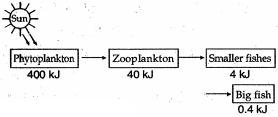
What is depicted in the scheme shown below?
Solution
(N/A) The scheme illustrates an aquatic food chain.
It demonstrates the $10 \%$ law of energy transfer,which states that only $10 \%$ of the energy available at one trophic level is transferred to the next higher trophic level.
In this example:
- Phytoplankton $(400 \text{ kJ})$ $\rightarrow$ Zooplankton $(40 \text{ kJ})$
- Zooplankton $(40 \text{ kJ})$ $\rightarrow$ Smaller fishes $(4 \text{ kJ})$
- Smaller fishes $(4 \text{ kJ})$ $\rightarrow$ Big fish $(0.4 \text{ kJ})$
Each step shows a $10 \%$ transfer of energy from the previous level.
It demonstrates the $10 \%$ law of energy transfer,which states that only $10 \%$ of the energy available at one trophic level is transferred to the next higher trophic level.
In this example:
- Phytoplankton $(400 \text{ kJ})$ $\rightarrow$ Zooplankton $(40 \text{ kJ})$
- Zooplankton $(40 \text{ kJ})$ $\rightarrow$ Smaller fishes $(4 \text{ kJ})$
- Smaller fishes $(4 \text{ kJ})$ $\rightarrow$ Big fish $(0.4 \text{ kJ})$
Each step shows a $10 \%$ transfer of energy from the previous level.
0 likes
View Solution66
Easy
List two man-made ecosystems.
Solution
(N/A) Man-made ecosystems are those ecosystems which are created and maintained by human beings. Examples include:
$1$. $Aquarium$
$2$. $Crop \ land$
$3$. $Park$
$4$. $Garden$
$1$. $Aquarium$
$2$. $Crop \ land$
$3$. $Park$
$4$. $Garden$
0 likes
View Solution67
EasyMCQ
"Save the Tiger" campaign is being overemphasized these days by our Government. What may be the possible reason?
A
To increase the number of tourists in national parks.
B
To maintain ecological balance in nature and to preserve the gene pool.
C
To provide employment to forest rangers.
D
To promote the national animal globally.
Solution
(B) The primary reason for the "Save the Tiger" campaign is to maintain ecological balance. Tigers are apex predators in the food chain; their presence regulates the population of herbivores, which in turn prevents overgrazing and maintains the health of forest ecosystems. Additionally, protecting tigers helps in preserving the genetic diversity (gene pool) of the species, preventing extinction.
0 likes
View Solution68
Easy
Why are plastics non-biodegradable substances?
Solution
(N/A) Plastics are considered non-biodegradable because they are synthetic polymers composed of long,complex chains of molecules.
These chemical structures are highly stable and resistant to natural degradation processes.
Microorganisms,such as bacteria and fungi,lack the specific enzymes required to break down the strong carbon-carbon bonds in plastic molecules.
Consequently,plastics persist in the environment for hundreds of years without being decomposed by biological agents.
These chemical structures are highly stable and resistant to natural degradation processes.
Microorganisms,such as bacteria and fungi,lack the specific enzymes required to break down the strong carbon-carbon bonds in plastic molecules.
Consequently,plastics persist in the environment for hundreds of years without being decomposed by biological agents.
0 likes
View Solution69
EasyMCQ
Mention the role of microorganisms like bacteria and fungi in the ecosystem.
A
They act as producers.
B
They act as decomposers.
C
They act as primary consumers.
D
They act as top carnivores.
Solution
(B) Microorganisms like bacteria and fungi act as decomposers in the ecosystem.
They break down the dead remains and waste products of organisms into simpler substances.
This process helps in recycling nutrients back into the soil,which are then reused by plants.
They break down the dead remains and waste products of organisms into simpler substances.
This process helps in recycling nutrients back into the soil,which are then reused by plants.
0 likes
View Solution70
MediumMCQ
In the following food chain,grass provides $4000 \ J$ of energy to the grasshopper. How much energy will be available to the snake and the frog? Grass $\rightarrow$ Grasshopper $\rightarrow$ Frog $\rightarrow$ Snake.
A
Frog: $400 \ J$,Snake: $40 \ J$
B
Frog: $40 \ J$,Snake: $4 \ J$
C
Frog: $400 \ J$,Snake: $4 \ J$
D
Frog: $4 \ J$,Snake: $40 \ J$
Solution
(B) According to the $10 \%$ law of energy transfer in an ecosystem,only $10 \%$ of the energy available at one trophic level is transferred to the next higher trophic level.
Given: Energy at the producer level (Grass) = $4000 \ J$.
$1$. Energy available to the primary consumer (Grasshopper) = $10 \%$ of $4000 \ J = 400 \ J$.
$2$. Energy available to the secondary consumer (Frog) = $10 \%$ of $400 \ J = 40 \ J$.
$3$. Energy available to the tertiary consumer (Snake) = $10 \%$ of $40 \ J = 4 \ J$.
Therefore,the energy available to the frog is $40 \ J$ and to the snake is $4 \ J$.
Given: Energy at the producer level (Grass) = $4000 \ J$.
$1$. Energy available to the primary consumer (Grasshopper) = $10 \%$ of $4000 \ J = 400 \ J$.
$2$. Energy available to the secondary consumer (Frog) = $10 \%$ of $400 \ J = 40 \ J$.
$3$. Energy available to the tertiary consumer (Snake) = $10 \%$ of $40 \ J = 4 \ J$.
Therefore,the energy available to the frog is $40 \ J$ and to the snake is $4 \ J$.
0 likes
View Solution71
MediumMCQ
What is meant by 'non-biodegradable' waste? Identify biodegradable waste from the following:
Empty packet of chips,empty plastic bottle of mineral water,empty paper box of sweets,empty tin of a cold drink.
Empty packet of chips,empty plastic bottle of mineral water,empty paper box of sweets,empty tin of a cold drink.
A
Empty packet of chips
B
Empty plastic bottle of mineral water
C
Empty paper box of sweets
D
Empty tin of a cold drink
Solution
(C) Non-biodegradable waste refers to substances that cannot be broken down or decomposed by biological processes (such as the action of bacteria or other saprophytes).
Among the given items:
$1$. Empty packet of chips (Plastic/Aluminium foil) - Non-biodegradable.
$2$. Empty plastic bottle of mineral water - Non-biodegradable.
$3$. Empty paper box of sweets - Biodegradable (made of cellulose/plant material).
$4$. Empty tin of a cold drink - Non-biodegradable.
Therefore,the biodegradable waste is the empty paper box of sweets.
Among the given items:
$1$. Empty packet of chips (Plastic/Aluminium foil) - Non-biodegradable.
$2$. Empty plastic bottle of mineral water - Non-biodegradable.
$3$. Empty paper box of sweets - Biodegradable (made of cellulose/plant material).
$4$. Empty tin of a cold drink - Non-biodegradable.
Therefore,the biodegradable waste is the empty paper box of sweets.
0 likes
View Solution72
Easy
What is meant by biological magnification?
Solution
(N/A) Biological magnification,also known as biomagnification,refers to the progressive increase in the concentration of non-biodegradable chemicals (such as pesticides or heavy metals) at each successive trophic level in a food chain. This occurs because these substances are not broken down by organisms and are passed on to the next level in higher concentrations.
0 likes
View Solution73
EasyMCQ
Consider a food chain consisting of wheat, rat, snakes, and peacock. What will happen if all the snakes are killed?
A
The population of rats will decrease.
B
The population of peacocks will increase.
C
The population of rats will increase and the population of peacocks will decrease.
D
There will be no effect on the food chain.
Solution
(C) In the given food chain: $Wheat \rightarrow Rat \rightarrow Snake \rightarrow Peacock$.
If all the snakes are killed, the primary predator of the rats is removed, leading to an uncontrolled increase in the rat population.
Due to the lack of food (snakes), the population of peacocks will decrease significantly as they will starve.
Therefore, the removal of an intermediate trophic level disrupts the entire ecosystem balance.
If all the snakes are killed, the primary predator of the rats is removed, leading to an uncontrolled increase in the rat population.
Due to the lack of food (snakes), the population of peacocks will decrease significantly as they will starve.
Therefore, the removal of an intermediate trophic level disrupts the entire ecosystem balance.
0 likes
View Solution74
Easy
Choose one consumer each that belongs to the second and third trophic levels from the organisms given below:
Eagle,frog,tiger,rabbit,fox
Eagle,frog,tiger,rabbit,fox
Solution
(A) The trophic levels in an ecosystem are defined by the position an organism occupies in a food chain.
$(i)$ Second trophic level: These are primary consumers (herbivores) that feed directly on producers. Among the given organisms,the rabbit is a herbivore.
$(ii)$ Third trophic level: These are secondary consumers (carnivores) that feed on primary consumers. Among the given organisms,the frog and fox act as secondary consumers in various food chains.
$(i)$ Second trophic level: These are primary consumers (herbivores) that feed directly on producers. Among the given organisms,the rabbit is a herbivore.
$(ii)$ Third trophic level: These are secondary consumers (carnivores) that feed on primary consumers. Among the given organisms,the frog and fox act as secondary consumers in various food chains.
0 likes
View Solution75
EasyMCQ
What happens during the first step of ozone formation in the atmosphere?
A
Oxygen molecules split into two oxygen atoms by $UV$ rays.
B
Oxygen atoms combine with oxygen molecules.
C
Ozone molecules break down into oxygen.
D
Oxygen atoms combine to form oxygen molecules.
Solution
(A) In the first step of ozone formation,high-energy $UV$ radiation breaks down the diatomic oxygen molecule $(O_2)$ into two individual oxygen atoms $(O + O)$.
0 likes
View Solution76
EasyMCQ
Why are non-biodegradable substances not broken down by microbes?
A
They are toxic to microbes.
B
Microbes lack the specific enzymes required to break them down.
C
They are too large to be ingested by microbes.
D
They do not provide energy to microbes.
Solution
(B) Microbial enzymes are highly specific in their action. They have evolved to break down natural organic materials found in the environment. Man-made substances,such as plastics,synthetic polymers,and certain pesticides,have chemical structures that do not match the active sites of these enzymes. Consequently,microbes cannot catalyze the decomposition of these non-biodegradable materials.
0 likes
View Solution77
Easy
Compare the advantages of cloth bags over polythene bags.
Solution
(N/A) Cloth bags are biodegradable,meaning they can be broken down by the action of bacteria or other saprophytes. In contrast,polythene bags are non-biodegradable and persist in the environment for a long time,causing significant harm to the ecosystem.
0 likes
View Solution78
Medium
Pesticides like $DDT$ which are sprayed to kill pests on crops are found to be present in the soil,groundwater,water bodies etc. Explain how do they reach these places.
Solution
(N/A) Soil: Pesticides are used to protect crops from pests. When sprayed on plants,they eventually settle into the soil particles.
Groundwater: Through the process of irrigation and rainwater runoff,these pesticides present in the soil leach into the lower layers of the earth and contaminate the groundwater.
Water bodies: Pesticides reach water bodies like rivers,canals,and ponds through surface runoff from agricultural fields,or when contaminated agricultural waste and wastewater are discharged into these water sources.
Groundwater: Through the process of irrigation and rainwater runoff,these pesticides present in the soil leach into the lower layers of the earth and contaminate the groundwater.
Water bodies: Pesticides reach water bodies like rivers,canals,and ponds through surface runoff from agricultural fields,or when contaminated agricultural waste and wastewater are discharged into these water sources.
0 likes
View Solution79
Medium
Aquariums need to be cleaned once in a while,whereas ponds or lakes do not require any cleaning. Explain.
Solution
(N/A) An aquarium is an artificial and incomplete ecosystem. It lacks the necessary decomposers and a balanced food chain to break down waste products effectively.
In contrast,ponds and lakes are natural,self-sustaining ecosystems. They contain a diverse range of producers,consumers,and decomposers (such as bacteria and fungi) that naturally recycle waste materials and maintain ecological balance.
In contrast,ponds and lakes are natural,self-sustaining ecosystems. They contain a diverse range of producers,consumers,and decomposers (such as bacteria and fungi) that naturally recycle waste materials and maintain ecological balance.
0 likes
View Solution80
Medium
Accumulation of harmful chemicals in our body can be avoided. Explain how this can be achieved.
Solution
(N/A) Accumulation of harmful chemicals in our body can be avoided by taking the following steps:
$(1)$ Wash vegetables and fruits thoroughly with clean water to remove surface pesticides and chemicals.
$(2)$ Soak vegetables and fruits in salt water for a few minutes before cooking to help leach out residual chemicals.
$(3)$ Boil vegetables where possible,as heat can help break down or remove certain pesticide residues.
$(4)$ Promote and use organic farming products,as they are grown without the use of synthetic chemical fertilizers and pesticides.
$(1)$ Wash vegetables and fruits thoroughly with clean water to remove surface pesticides and chemicals.
$(2)$ Soak vegetables and fruits in salt water for a few minutes before cooking to help leach out residual chemicals.
$(3)$ Boil vegetables where possible,as heat can help break down or remove certain pesticide residues.
$(4)$ Promote and use organic farming products,as they are grown without the use of synthetic chemical fertilizers and pesticides.
0 likes
View Solution81
EasyMCQ
What will happen if all the deers are removed in the given food chain?
Plants $\rightarrow$ Deers $\rightarrow$ Tigers
Plants $\rightarrow$ Deers $\rightarrow$ Tigers
A
Tigers will increase in number.
B
Plants will decrease in number.
C
Tigers will die due to lack of food and plants will increase in number.
D
The food chain will remain unaffected.
Solution
(C) If deers are removed from the given food chain,the following consequences will occur:
$1$. Tigers will not survive because their primary source of food (deers) is removed.
$2$. The population of plants will increase significantly because the primary consumer (deers) that feeds on them is no longer present.
$1$. Tigers will not survive because their primary source of food (deers) is removed.
$2$. The population of plants will increase significantly because the primary consumer (deers) that feeds on them is no longer present.
0 likes
View Solution82
Easy
Food web increases the stability of an ecosystem. Justify.
Solution
(N/A) food web depicts the complex feeding connections within an ecological community. It consists of many interconnected food chains. If any one organism becomes endangered or extinct,the organisms that depend on it for food have alternative options available for their survival. This redundancy prevents the collapse of the food chain and,in this way,a food web increases the overall stability of an ecosystem.
0 likes
View Solution83
Medium
State with reason any two possible consequences of the elimination of decomposers from the Earth.
Solution
(N/A) Two possible consequences of the elimination of decomposers from the Earth are:
$(1)$ Accumulation of complex organic waste: Without decomposers,dead plants and animals would not be broken down into simpler substances. This would lead to the accumulation of organic waste,causing severe land,water,and air pollution.
$(2)$ Disruption of nutrient cycling: Decomposers are essential for recycling nutrients back into the soil. Without them,the soil would lose its fertility as essential minerals would remain locked in dead organic matter,preventing the growth of plants,which are the primary producers and the foundation of the ecosystem.
$(1)$ Accumulation of complex organic waste: Without decomposers,dead plants and animals would not be broken down into simpler substances. This would lead to the accumulation of organic waste,causing severe land,water,and air pollution.
$(2)$ Disruption of nutrient cycling: Decomposers are essential for recycling nutrients back into the soil. Without them,the soil would lose its fertility as essential minerals would remain locked in dead organic matter,preventing the growth of plants,which are the primary producers and the foundation of the ecosystem.
0 likes
View Solution84
Easy
State two methods to get rid of non-biodegradable wastes.
Solution
(N/A) $1$. Reduce the use of non-biodegradable materials: For example,use paper or cloth bags instead of plastic bags to carry items.
$2$. Recycling: Non-biodegradable wastes like plastic,metal,and glass should be sent to factories for recycling so they can be processed into new products.
$2$. Recycling: Non-biodegradable wastes like plastic,metal,and glass should be sent to factories for recycling so they can be processed into new products.
0 likes
View Solution85
Medium
Define a food web. State its significance for an ecosystem.
Solution
(N/A) food web is a complex network of interconnected food chains that shows the feeding relationships among various organisms in an ecosystem.
Significance for an ecosystem:
$1$. It maintains ecological balance by ensuring the interdependence of different organisms.
$2$. It provides stability to the ecosystem by offering alternative food sources for consumers if one population declines.
$3$. It helps in the flow of energy and the cycling of nutrients through different trophic levels.
Significance for an ecosystem:
$1$. It maintains ecological balance by ensuring the interdependence of different organisms.
$2$. It provides stability to the ecosystem by offering alternative food sources for consumers if one population declines.
$3$. It helps in the flow of energy and the cycling of nutrients through different trophic levels.
0 likes
View Solution86
Easy
Write two methods to reduce the use of pesticides.
Solution
(N/A) $(i)$ Using improved seeds which are capable of resisting pests.
$(ii)$ Using specific herbs such as $Neem$ during the storage of food grains to prevent pest infestation.
$(ii)$ Using specific herbs such as $Neem$ during the storage of food grains to prevent pest infestation.
0 likes
View Solution87
Easy
Write two characteristic features of energy flow in an ecosystem.
Solution
(N/A) $(i)$ The flow of energy is unidirectional, meaning it moves from producers to consumers and cannot be reversed.
$(ii)$ There is a significant loss of energy as heat at each trophic level, following the $10\%$ law, which limits the number of trophic levels in a food chain.
$(ii)$ There is a significant loss of energy as heat at each trophic level, following the $10\%$ law, which limits the number of trophic levels in a food chain.
0 likes
View Solution88
Easy
$(a)$ What percentage of energy available at the producer level is transferred at successive trophic level in a food chain?
$(b)$ What percentage of the solar energy is trapped and utilised by the plants?
$(b)$ What percentage of the solar energy is trapped and utilised by the plants?
Solution
(N/A) According to the $10 \%$ Law of energy transfer,only $10 \%$ of the energy available at one trophic level is transferred to the next higher trophic level.
$(b)$ Green plants (producers) capture approximately $1 \%$ of the solar energy falling on their leaves and convert it into food energy through the process of photosynthesis.
$(b)$ Green plants (producers) capture approximately $1 \%$ of the solar energy falling on their leaves and convert it into food energy through the process of photosynthesis.
0 likes
View Solution89
MediumMCQ
What would happen if the number of carnivores decreases in an ecosystem?
A
Herbivore population will decrease.
B
Autotrophs will increase.
C
Herbivore population will increase,leading to overgrazing and ecosystem imbalance.
D
The ecosystem will become more stable.
Solution
(C) $(i)$ The population of herbivores will increase beyond control because their natural predators are reduced.
$(ii)$ Autotrophs (producers) will disappear from the earth due to overgrazing by the unchecked herbivore population.
$(iii)$ Both these factors will disrupt food chains and food webs,ultimately leading to the collapse or severe imbalance of the ecosystem.
$(ii)$ Autotrophs (producers) will disappear from the earth due to overgrazing by the unchecked herbivore population.
$(iii)$ Both these factors will disrupt food chains and food webs,ultimately leading to the collapse or severe imbalance of the ecosystem.
0 likes
View Solution90
Medium
State the direction of flow of energy in a food chain. Can food and energy from a trophic level move back to the previous level? Give reasons for your answer.
Solution
(N/A) $(i)$ The flow of energy in a food chain is unidirectional, moving from producers to primary consumers, then to secondary consumers, and finally to top carnivores.
$(ii)$ No, food and energy cannot move back to the previous trophic level. This is because energy is lost as heat at each trophic level during metabolic activities, as per the $10\%$ law of energy transfer. Once energy is transferred to a higher trophic level, it is no longer available to the previous level.
$(ii)$ No, food and energy cannot move back to the previous trophic level. This is because energy is lost as heat at each trophic level during metabolic activities, as per the $10\%$ law of energy transfer. Once energy is transferred to a higher trophic level, it is no longer available to the previous level.
0 likes
View Solution91
Medium
Mention the differences between food habits of organisms belonging to the first and third trophic level. Give one example of each of them.
Solution
(N/A)
| First Trophic Level | Third Trophic Level |
| $1$. The organisms of this trophic level are plants,also known as producers. | $1$. The organisms of this trophic level are animals,also known as secondary consumers. |
| $2$. They transform solar energy into chemical energy via photosynthesis. Example: Grass (all green plants). | $2$. They obtain chemical energy by consuming primary consumers (herbivores). Example: Carnivores (e.g.,Lion). |
0 likes
View Solution92
Medium
List two causes of depletion of the ozone layer. Mention any two harmful effects of the depletion of this layer.
Solution
(N/A) Two causes of the depletion of the ozone layer are:
$(i)$ Use of $CFCs$ (Chlorofluorocarbons) in refrigeration.
$(ii)$ Use of $CFCs$ in fire extinguishers and aerosol sprayers.
The harmful effects of the depletion of the ozone layer are:
$(i)$ Due to the depletion of the ozone layer,$UV$ radiations reach the Earth. These $UV$ radiations cause skin cancer,damage to eyes,and harm the immune system.
$(ii)$ This depletion of the ozone layer may also lead to variations in global rainfall,ecological disturbances,and a decrease in global food supplies.
$(i)$ Use of $CFCs$ (Chlorofluorocarbons) in refrigeration.
$(ii)$ Use of $CFCs$ in fire extinguishers and aerosol sprayers.
The harmful effects of the depletion of the ozone layer are:
$(i)$ Due to the depletion of the ozone layer,$UV$ radiations reach the Earth. These $UV$ radiations cause skin cancer,damage to eyes,and harm the immune system.
$(ii)$ This depletion of the ozone layer may also lead to variations in global rainfall,ecological disturbances,and a decrease in global food supplies.
0 likes
View Solution93
Medium
$(i)$ What is the height of the ozone layer from the equator?
$(ii)$ Name the rays against which the ozone layer provides protection.
$(iii)$ Name one effect of the depletion of the ozone layer.
$(ii)$ Name the rays against which the ozone layer provides protection.
$(iii)$ Name one effect of the depletion of the ozone layer.
Solution
(N/A) $(i)$ The ozone layer is located at a height of approximately $10$ to $16 \, km$ from the equator.
$(ii)$ The ozone layer provides protection against harmful $UV$ (ultraviolet) rays.
$(iii)$ One major effect of the depletion of the ozone layer is an increase in the risk of skin cancer and cataracts in humans due to increased exposure to $UV$ radiation.
$(ii)$ The ozone layer provides protection against harmful $UV$ (ultraviolet) rays.
$(iii)$ One major effect of the depletion of the ozone layer is an increase in the risk of skin cancer and cataracts in humans due to increased exposure to $UV$ radiation.
0 likes
View Solution94
Medium
Differentiate between autotrophs,heterotrophs,and decomposers and give one example of each.
Solution
(N/A) Autotrophs: Organisms that can synthesize their own food from simple inorganic substances like $CO_2$ and $H_2O$ using sunlight and chlorophyll are called autotrophs.
Example: All green plants.
Heterotrophs: Organisms that cannot synthesize their own food through photosynthesis and depend on other organisms for their nutritional requirements are called heterotrophs.
Example: All animals.
Decomposers: Organisms that break down complex organic matter present in dead remains of plants and animals into simpler substances are called decomposers.
Example: Bacteria and Fungi.
Example: All green plants.
Heterotrophs: Organisms that cannot synthesize their own food through photosynthesis and depend on other organisms for their nutritional requirements are called heterotrophs.
Example: All animals.
Decomposers: Organisms that break down complex organic matter present in dead remains of plants and animals into simpler substances are called decomposers.
Example: Bacteria and Fungi.
0 likes
View Solution95
Medium
$(a)$ What is an ecosystem? List its two main components.
$(b)$ We do not clean ponds or lakes,but an aquarium needs to be cleaned regularly. Explain.
$(b)$ We do not clean ponds or lakes,but an aquarium needs to be cleaned regularly. Explain.
Solution
(N/A) An ecosystem is a self-sustaining functional unit consisting of living (biotic) and non-living (abiotic) components that interact with each other.
The two main components are:
$1$. Biotic components: Includes all living organisms like plants,animals,and microorganisms.
$2$. Abiotic components: Includes non-living physical factors like light,soil,temperature,humidity,wind,and air.
$(b)$ $A$ pond or lake is a natural,self-sustaining,and complete ecosystem where natural decomposers efficiently recycle waste and maintain the balance of the environment.
In contrast,an aquarium is an artificial and incomplete ecosystem. It lacks the necessary natural decomposers and the complex food web required to break down waste products effectively. Therefore,an aquarium requires regular cleaning to remove waste and maintain the health of the organisms living within it.
The two main components are:
$1$. Biotic components: Includes all living organisms like plants,animals,and microorganisms.
$2$. Abiotic components: Includes non-living physical factors like light,soil,temperature,humidity,wind,and air.
$(b)$ $A$ pond or lake is a natural,self-sustaining,and complete ecosystem where natural decomposers efficiently recycle waste and maintain the balance of the environment.
In contrast,an aquarium is an artificial and incomplete ecosystem. It lacks the necessary natural decomposers and the complex food web required to break down waste products effectively. Therefore,an aquarium requires regular cleaning to remove waste and maintain the health of the organisms living within it.
0 likes
View Solution96
Medium
"Energy flow in a food chain is unidirectional." Justify this statement. Explain how the pesticides enter a food chain and subsequently get into our body.
Solution
(N/A) The flow of energy in a food chain is unidirectional because energy captured by autotrophs (producers) from the sun is passed to successive trophic levels and is never returned to the previous level or the sun.
As energy moves through trophic levels, a significant portion is lost as heat at each step, making it unavailable for the previous level.
Pesticides are non-biodegradable chemicals used to protect crops. When these chemicals are washed into the soil or water bodies, they are absorbed by plants along with water and minerals.
Since these chemicals cannot be broken down by biological processes, they accumulate at each trophic level in a process called biological magnification. As humans are often at the top of the food chain, these pesticides eventually enter and accumulate in our bodies.
As energy moves through trophic levels, a significant portion is lost as heat at each step, making it unavailable for the previous level.
Pesticides are non-biodegradable chemicals used to protect crops. When these chemicals are washed into the soil or water bodies, they are absorbed by plants along with water and minerals.
Since these chemicals cannot be broken down by biological processes, they accumulate at each trophic level in a process called biological magnification. As humans are often at the top of the food chain, these pesticides eventually enter and accumulate in our bodies.
0 likes
View Solution97
Medium
State one important function of ozone layer in the atmosphere. How is it formed there? Which compounds are responsible for the depletion of ozone layer? How do these compounds enter into the atmosphere?
Solution
(N/A) The ozone layer in the upper atmosphere acts as a shield by protecting living organisms from harmful $UV$ radiations.
Formation of ozone layer:
Ozone at higher levels of the atmosphere is formed by the action of $UV$ radiations on oxygen $(O_2)$ molecules. High-energy $UV$ radiations split molecular oxygen $(O_2)$ into free oxygen $(O)$ atoms. These atoms then combine with molecular oxygen to form ozone $(O_3)$:
$O_2 \xrightarrow{UV} O + O$
$O + O_2 \longrightarrow O_3$
Compounds responsible for depletion:
Chlorofluorocarbons $(CFCs)$ are the primary compounds responsible for the depletion of the ozone layer.
Entry into the atmosphere:
These compounds enter the atmosphere through human-made sources such as aerosol sprays,refrigerants in refrigerators,air conditioners,and fire extinguishers that utilize $CFCs$.
Formation of ozone layer:
Ozone at higher levels of the atmosphere is formed by the action of $UV$ radiations on oxygen $(O_2)$ molecules. High-energy $UV$ radiations split molecular oxygen $(O_2)$ into free oxygen $(O)$ atoms. These atoms then combine with molecular oxygen to form ozone $(O_3)$:
$O_2 \xrightarrow{UV} O + O$
$O + O_2 \longrightarrow O_3$
Compounds responsible for depletion:
Chlorofluorocarbons $(CFCs)$ are the primary compounds responsible for the depletion of the ozone layer.
Entry into the atmosphere:
These compounds enter the atmosphere through human-made sources such as aerosol sprays,refrigerants in refrigerators,air conditioners,and fire extinguishers that utilize $CFCs$.
0 likes
View Solution98
Medium
Distinguish between biodegradable and non-biodegradable substances. List two effects of each of them on our environment.
Solution
(N/A)
Effects of biodegradable substances:
$(1)$ During decomposition,they may release foul-smelling gases like methane and hydrogen sulphide.
$(2)$ If not managed properly,they can become breeding grounds for disease-causing microorganisms.
Effects of non-biodegradable substances:
$(1)$ They persist in the environment for a long time,leading to bioaccumulation and biomagnification in the food chain.
$(2)$ They cause long-term pollution of soil,air,and water,and occupy significant land space for disposal.
| Biodegradable substances | Non-biodegradable substances |
|---|---|
| $1$. Substances that are broken down by biological processes are called biodegradable. | $1$. Substances that are not broken down by biological processes are called non-biodegradable. |
| $2$. These substances are naturally recycled and do not accumulate in the environment. | $2$. These substances persist in the environment for a long time and require large dumping sites. |
Effects of biodegradable substances:
$(1)$ During decomposition,they may release foul-smelling gases like methane and hydrogen sulphide.
$(2)$ If not managed properly,they can become breeding grounds for disease-causing microorganisms.
Effects of non-biodegradable substances:
$(1)$ They persist in the environment for a long time,leading to bioaccumulation and biomagnification in the food chain.
$(2)$ They cause long-term pollution of soil,air,and water,and occupy significant land space for disposal.
0 likes
View Solution99
Medium
Write any two consequences if decomposers are removed from the ecosystem.
Solution
(N/A) $(i)$ The natural recycling of nutrients will stop,leading to a disruption in the flow of nutrients within the ecosystem.
(ii) Dead organic matter will accumulate,causing pollution and preventing the replenishment of the soil with essential minerals.
(ii) Dead organic matter will accumulate,causing pollution and preventing the replenishment of the soil with essential minerals.
0 likes
View Solution100
Easy
Name two chemicals which are responsible for the thinning of the ozone layer.
Solution
(N/A) The two primary chemicals responsible for the thinning of the ozone layer are:
$(i)$ Chlorofluorocarbons $(CFCs)$
$(ii)$ Hydrochlorofluorocarbons $(HCFCs)$
Other substances like Hydrobromofluorocarbons $(HBFCs)$ and Halons also contribute to ozone depletion.
$(i)$ Chlorofluorocarbons $(CFCs)$
$(ii)$ Hydrochlorofluorocarbons $(HCFCs)$
Other substances like Hydrobromofluorocarbons $(HBFCs)$ and Halons also contribute to ozone depletion.
0 likes
View SolutionOur Environment — Mix Examples - Our Environment · Frequently Asked Questions
1Are these Our Environment questions useful for JEE and NEET?
Yes. All questions in this section are mapped to JEE Main and NEET exam patterns. Previous year questions from JEE Main, NEET, GUJCET and state-level exams are included with full solutions.
2Can I switch to Hindi or Gujarati for these questions?
Yes. Use the language tabs in the hero section or the sidebar to view the same questions and solutions in English, Hindi or Gujarati.
3How do I generate a question paper from this subtopic?
Use the Vedclass Exam Paper Generator — select the chapter and subtopic, set difficulty, and generate Sets A, B, C, D automatically. First 3 chapters of every subject are free.
Vedclass Products
For Students
Vedclass Test Series
Mock tests in real JEE/NEET style with performance analysis. 5-day free trial.
Start Free TrialFor Teachers
Exam Paper Generator
Generate Set A/B/C/D papers from this chapter in 2 minutes. 3 chapters free.
Try FreeFor Institutes
Online Exam Module
Live online exams with unlimited students, 360° analytics & white-label branding.
See DemoFor Teachers & Institutes
Generate a Our Environment Exam Paper in 2 Minutes
Select subtopic & difficulty — Sets A, B, C, D auto-generated with No Repeat logic.
First 3 chapters of every subject are free — no payment required.