
A English
Mix Examples - Acids, Bases and Salts Questions in English
Class 10 Science · Acids, Bases and Salts · Mix Examples - Acids, Bases and Salts
277+
Questions
English
Language
100%
With Solutions
Showing 50 of 277 questions in English
1
MediumMCQ
What happens when a solution of an acid is mixed with a solution of a base in a test tube?
$(i)$ The temperature of the solution increases
$(ii)$ The temperature of the solution decreases
$(iii)$ The temperature of the solution remains the same
$(iv)$ Salt formation takes place
$(i)$ The temperature of the solution increases
$(ii)$ The temperature of the solution decreases
$(iii)$ The temperature of the solution remains the same
$(iv)$ Salt formation takes place
A
$(i)$ and $(iv)$
B
$(i)$ and $(iii)$
C
$(ii)$ and $(iii)$
D
$(i)$ only
Solution
(A) When an acid reacts with a base,a neutralization reaction occurs.
This reaction is exothermic in nature,meaning it releases heat energy into the surroundings,which causes the temperature of the solution to increase.
As a result of the neutralization reaction,salt and water are produced $(Acid + Base \rightarrow Salt + Water)$.
Therefore,both statement $(i)$ (temperature increases) and statement $(iv)$ (salt formation takes place) are correct.
This reaction is exothermic in nature,meaning it releases heat energy into the surroundings,which causes the temperature of the solution to increase.
As a result of the neutralization reaction,salt and water are produced $(Acid + Base \rightarrow Salt + Water)$.
Therefore,both statement $(i)$ (temperature increases) and statement $(iv)$ (salt formation takes place) are correct.
0 likes
View Solution2
MediumMCQ
An aqueous solution turns red litmus solution blue. Excess addition of which of the following solution would reverse the change?
A
Baking powder
B
Hydrochloric acid
C
Ammonium hydroxide solution
D
Lime
Solution
(B) solution that turns red litmus blue is basic in nature.
To reverse this change, we need to neutralize the base by adding an acid.
Among the given options, $Hydrochloric acid$ $(HCl)$ is a strong acid.
Adding an excess of $HCl$ will neutralize the basic solution and turn the blue litmus back to red.
To reverse this change, we need to neutralize the base by adding an acid.
Among the given options, $Hydrochloric acid$ $(HCl)$ is a strong acid.
Adding an excess of $HCl$ will neutralize the basic solution and turn the blue litmus back to red.
0 likes
View Solution3
MediumMCQ
During the preparation of hydrogen chloride gas on a humid day,the gas is usually passed through the guard tube containing calcium chloride. The role of calcium chloride taken in the guard tube is to
A
absorb the evolved gas
B
moisten the gas
C
absorb moisture from the gas
D
absorb $Cl^-$ ions from the evolved gas
Solution
(C) Calcium chloride $(CaCl_2)$ is a well-known dehydrating agent or desiccant.
When hydrogen chloride $(HCl)$ gas is prepared,it may contain water vapor,especially on a humid day.
To obtain dry $HCl$ gas,it is passed through a guard tube containing anhydrous calcium chloride.
This substance absorbs the moisture (water vapor) present in the gas,ensuring that the resulting $HCl$ gas is dry.
When hydrogen chloride $(HCl)$ gas is prepared,it may contain water vapor,especially on a humid day.
To obtain dry $HCl$ gas,it is passed through a guard tube containing anhydrous calcium chloride.
This substance absorbs the moisture (water vapor) present in the gas,ensuring that the resulting $HCl$ gas is dry.
0 likes
View Solution4
EasyMCQ
Which of the following salts does not contain water of crystallisation?
A
Blue vitriol
B
Gypsum
C
Washing soda
D
Baking soda
Solution
(D) Water of crystallisation is the fixed number of water molecules present in one formula unit of a salt.
$1$. Blue vitriol is $CuSO_4 \cdot 5H_2O$, which contains $5$ molecules of water of crystallisation.
$2$. Gypsum is $CaSO_4 \cdot 2H_2O$, which contains $2$ molecules of water of crystallisation.
$3$. Washing soda is $Na_2CO_3 \cdot 10H_2O$, which contains $10$ molecules of water of crystallisation.
$4$. Baking soda is $NaHCO_3$, which does not contain any water of crystallisation.
Therefore, the correct option is $D$.
$1$. Blue vitriol is $CuSO_4 \cdot 5H_2O$, which contains $5$ molecules of water of crystallisation.
$2$. Gypsum is $CaSO_4 \cdot 2H_2O$, which contains $2$ molecules of water of crystallisation.
$3$. Washing soda is $Na_2CO_3 \cdot 10H_2O$, which contains $10$ molecules of water of crystallisation.
$4$. Baking soda is $NaHCO_3$, which does not contain any water of crystallisation.
Therefore, the correct option is $D$.
0 likes
View Solution5
MediumMCQ
Sodium carbonate is a basic salt because it is a salt of
A
weak acid and strong base
B
weak acid and weak base
C
strong acid and weak base
D
strong acid and strong base
Solution
(A) Sodium carbonate $(Na_2CO_3)$ is formed by the neutralization reaction between sodium hydroxide $(NaOH)$ and carbonic acid $(H_2CO_3)$.
$NaOH$ is a strong base,while $H_2CO_3$ is a weak acid.
When a strong base reacts with a weak acid,the resulting salt is basic in nature because the strong base dominates the properties of the salt.
Therefore,sodium carbonate is a basic salt.
$NaOH$ is a strong base,while $H_2CO_3$ is a weak acid.
When a strong base reacts with a weak acid,the resulting salt is basic in nature because the strong base dominates the properties of the salt.
Therefore,sodium carbonate is a basic salt.
0 likes
View Solution6
EasyMCQ
Calcium phosphate is present in tooth enamel. Its nature is
A
acidic
B
basic
C
neutral
D
amphoteric
Solution
(B) Tooth enamel is made up of calcium phosphate,which is the hardest substance in the human body.
Calcium phosphate is a salt formed by the reaction of a strong base (calcium hydroxide) and a weak acid (phosphoric acid).
Since it is a salt of a strong base and a weak acid,its chemical nature is basic.
Calcium phosphate is a salt formed by the reaction of a strong base (calcium hydroxide) and a weak acid (phosphoric acid).
Since it is a salt of a strong base and a weak acid,its chemical nature is basic.
0 likes
View Solution7
MediumMCQ
$A$ sample of soil is mixed with water and allowed to settle. The clear supernatant solution turns the pH paper yellowish-orange. Which of the following would change the colour of this pH paper to greenish-blue?
A
Lemon juice
B
Vinegar
C
An antacid
D
Common salt
Solution
(C) The pH paper turning yellowish-orange indicates that the soil solution is acidic (pH < $7$).
To change the colour of the pH paper to greenish-blue,we need to add a substance that is basic (alkaline) in nature (pH > $7$).
$A$. Lemon juice is acidic.
$B$. Vinegar is acidic.
$C$. An antacid is basic (alkaline) and neutralizes the acid,shifting the pH towards the basic range (greenish-blue).
$D$. Common salt is neutral.
To change the colour of the pH paper to greenish-blue,we need to add a substance that is basic (alkaline) in nature (pH > $7$).
$A$. Lemon juice is acidic.
$B$. Vinegar is acidic.
$C$. An antacid is basic (alkaline) and neutralizes the acid,shifting the pH towards the basic range (greenish-blue).
$D$. Common salt is neutral.
0 likes
View Solution8
EasyMCQ
Which of the following gives the correct increasing order of acidic strength?
A
Hydrochloric acid < Water < Acetic acid
B
Water < Hydrochloric acid < Acetic acid
C
Acetic acid < Hydrochloric acid < Water
D
Water < Acetic acid < Hydrochloric acid
Solution
(D) The acidic strength of a substance is determined by its ability to donate $H^+$ ions in an aqueous solution.
$1$. Hydrochloric acid $(HCl)$ is a strong acid that dissociates completely in water.
$2$. Acetic acid $(CH_3COOH)$ is a weak organic acid that dissociates partially.
$3$. Water $(H_2O)$ is neutral and acts as a very weak acid compared to the others.
Therefore, the increasing order of acidic strength is: $\text{Water} < \text{Acetic acid} < \text{Hydrochloric acid}$.
$1$. Hydrochloric acid $(HCl)$ is a strong acid that dissociates completely in water.
$2$. Acetic acid $(CH_3COOH)$ is a weak organic acid that dissociates partially.
$3$. Water $(H_2O)$ is neutral and acts as a very weak acid compared to the others.
Therefore, the increasing order of acidic strength is: $\text{Water} < \text{Acetic acid} < \text{Hydrochloric acid}$.
0 likes
View Solution9
MediumMCQ
If a few drops of a concentrated acid accidentally spill over the hand of a student,what should be done?
A
Wash the hand immediately with plenty of water and apply a paste of sodium hydrogencarbonate.
B
Wash the hand with saline solution.
C
After washing with plenty of water,apply a solution of sodium hydroxide on the hand.
D
Neutralize the acid with a strong alkali.
Solution
(A) When a concentrated acid spills on the skin,the immediate priority is to dilute and remove the acid to prevent further tissue damage.
$1$. Wash the affected area immediately with plenty of running water to dilute the acid.
$2$. After washing,apply a mild base like sodium hydrogencarbonate $(NaHCO_3)$ paste. This helps to neutralize any remaining traces of acid on the skin.
$3$. Using a strong alkali (like $NaOH$) is dangerous because it can cause severe chemical burns itself.
Therefore,the correct action is to wash with water and apply a mild base like sodium hydrogencarbonate.
$1$. Wash the affected area immediately with plenty of running water to dilute the acid.
$2$. After washing,apply a mild base like sodium hydrogencarbonate $(NaHCO_3)$ paste. This helps to neutralize any remaining traces of acid on the skin.
$3$. Using a strong alkali (like $NaOH$) is dangerous because it can cause severe chemical burns itself.
Therefore,the correct action is to wash with water and apply a mild base like sodium hydrogencarbonate.
0 likes
View Solution10
DifficultMCQ
Sodium hydrogencarbonate when added to acetic acid evolves a gas. Which of the following statements are true about the gas evolved?
$(i)$ It turns lime water milky
$(ii)$ It extinguishes a burning splinter
$(iii)$ It dissolves in a solution of sodium hydroxide
$(iv)$ It has a pungent odour
$(i)$ It turns lime water milky
$(ii)$ It extinguishes a burning splinter
$(iii)$ It dissolves in a solution of sodium hydroxide
$(iv)$ It has a pungent odour
A
$(i)$ and $(ii)$
B
$(i)$,$(ii)$ and $(iii)$
C
$(ii)$,$(iii)$ and $(iv)$
D
$(i)$ and $(iv)$
Solution
(B) When sodium hydrogencarbonate $(NaHCO_3)$ reacts with acetic acid $(CH_3COOH)$,it produces sodium acetate,water,and carbon dioxide $(CO_2)$ gas.
The chemical reaction is: $CH_3COOH + NaHCO_3 \rightarrow CH_3COONa + H_2O + CO_2$.
Properties of $CO_2$ gas:
$(i)$ It turns lime water milky due to the formation of calcium carbonate $(CaCO_3)$. This is a true statement.
$(ii)$ It does not support combustion,so it extinguishes a burning splinter. This is a true statement.
$(iii)$ It is an acidic oxide and reacts with sodium hydroxide $(NaOH)$ to form sodium carbonate and water. This is a true statement.
$(iv)$ $CO_2$ is an odourless gas,so it does not have a pungent odour. This is a false statement.
Therefore,statements $(i)$,$(ii)$,and $(iii)$ are correct.
The chemical reaction is: $CH_3COOH + NaHCO_3 \rightarrow CH_3COONa + H_2O + CO_2$.
Properties of $CO_2$ gas:
$(i)$ It turns lime water milky due to the formation of calcium carbonate $(CaCO_3)$. This is a true statement.
$(ii)$ It does not support combustion,so it extinguishes a burning splinter. This is a true statement.
$(iii)$ It is an acidic oxide and reacts with sodium hydroxide $(NaOH)$ to form sodium carbonate and water. This is a true statement.
$(iv)$ $CO_2$ is an odourless gas,so it does not have a pungent odour. This is a false statement.
Therefore,statements $(i)$,$(ii)$,and $(iii)$ are correct.
0 likes
View Solution11
MediumMCQ
Common salt, besides being used in the kitchen, can also be used as the raw material for making:
$(i)$ Washing soda
$(ii)$ Bleaching powder
$(iii)$ Baking soda
$(iv)$ Slaked lime
$(i)$ Washing soda
$(ii)$ Bleaching powder
$(iii)$ Baking soda
$(iv)$ Slaked lime
A
$(i)$ and $(ii)$
B
$(i)$, $(ii)$ and $(iii)$
C
$(ii)$ and $(iii)$
D
$(i)$, $(iii)$ and $(iv)$
Solution
(B) Common salt $(NaCl)$ is a crucial raw material for various chemicals:
$1$. Washing soda $(Na_2CO_3 \cdot 10H_2O)$ is produced from $NaCl$ via the Solvay process.
$2$. Bleaching powder $(CaOCl_2)$ is produced by the action of chlorine on dry slaked lime, where chlorine is obtained from the electrolysis of brine ($NaCl$ solution).
$3$. Baking soda $(NaHCO_3)$ is produced from $NaCl$, $NH_3$, $H_2O$, and $CO_2$.
$4$. Slaked lime $(Ca(OH)_2)$ is produced by adding water to quicklime $(CaO)$, not from common salt.
Therefore, $(i)$, $(ii)$, and $(iii)$ are correct.
$1$. Washing soda $(Na_2CO_3 \cdot 10H_2O)$ is produced from $NaCl$ via the Solvay process.
$2$. Bleaching powder $(CaOCl_2)$ is produced by the action of chlorine on dry slaked lime, where chlorine is obtained from the electrolysis of brine ($NaCl$ solution).
$3$. Baking soda $(NaHCO_3)$ is produced from $NaCl$, $NH_3$, $H_2O$, and $CO_2$.
$4$. Slaked lime $(Ca(OH)_2)$ is produced by adding water to quicklime $(CaO)$, not from common salt.
Therefore, $(i)$, $(ii)$, and $(iii)$ are correct.
0 likes
View Solution12
MediumMCQ
One of the constituents of baking powder is sodium hydrogencarbonate, the other constituent is
A
hydrochloric acid
B
sulphuric acid
C
acetic acid
D
tartaric acid
Solution
(D) Baking powder is a mixture of sodium hydrogencarbonate $(NaHCO_3)$ and a mild edible acid, such as tartaric acid.
When baking powder is heated or mixed with water, the following reaction takes place:
$NaHCO_3 + H^+ \text{ (from acid)} \rightarrow CO_2 + H_2O + \text{Sodium salt of acid}$.
The carbon dioxide produced during this reaction causes bread or cake to rise, making them soft and spongy.
Tartaric acid is used because it is a weak acid that does not make the food taste sour.
When baking powder is heated or mixed with water, the following reaction takes place:
$NaHCO_3 + H^+ \text{ (from acid)} \rightarrow CO_2 + H_2O + \text{Sodium salt of acid}$.
The carbon dioxide produced during this reaction causes bread or cake to rise, making them soft and spongy.
Tartaric acid is used because it is a weak acid that does not make the food taste sour.
0 likes
View Solution13
EasyMCQ
To protect against tooth decay,we are advised to brush our teeth regularly. The nature of the toothpaste commonly used is:
A
basic
B
neutral
C
acidic
D
corrosive
Solution
(A) Tooth decay is caused by the production of acids in the mouth by bacteria,which break down leftover food particles. These acids lower the $pH$ of the mouth,causing the tooth enamel to corrode.
To neutralize these acids and prevent decay,we use toothpaste. Toothpaste is generally basic (alkaline) in nature. When it reacts with the acids in the mouth,it neutralizes them,thereby protecting the teeth from decay.
To neutralize these acids and prevent decay,we use toothpaste. Toothpaste is generally basic (alkaline) in nature. When it reacts with the acids in the mouth,it neutralizes them,thereby protecting the teeth from decay.
0 likes
View Solution14
MediumMCQ
Which of the following statements is correct about an aqueous solution of an acid and of a base?
$(i)$ Higher the $pH$,stronger the acid
$(ii)$ Higher the $pH$,weaker the acid
$(iii)$ Lower the $pH$,stronger the base
$(iv)$ Lower the $pH$,weaker the base
$(i)$ Higher the $pH$,stronger the acid
$(ii)$ Higher the $pH$,weaker the acid
$(iii)$ Lower the $pH$,stronger the base
$(iv)$ Lower the $pH$,weaker the base
A
$(i)$ and $(iii)$
B
$(ii)$ and $(iv)$
C
$(i)$ and $(iv)$
D
$(ii)$ and $(iii)$
Solution
(B) The $pH$ scale measures the acidity or alkalinity of an aqueous solution.
For acids,the $pH$ value is inversely proportional to the concentration of hydrogen ions $(H^+)$. $A$ lower $pH$ indicates a higher concentration of $H^+$ ions,meaning a stronger acid. Therefore,statement $(ii)$ is correct: Higher the $pH$,weaker the acid.
For bases,the $pH$ value is directly proportional to the concentration of hydroxide ions $(OH^-)$. $A$ higher $pH$ indicates a higher concentration of $OH^-$ ions,meaning a stronger base. Conversely,a lower $pH$ indicates a lower concentration of $OH^-$ ions,meaning a weaker base. Therefore,statement $(iv)$ is correct: Lower the $pH$,weaker the base.
Thus,statements $(ii)$ and $(iv)$ are correct.
For acids,the $pH$ value is inversely proportional to the concentration of hydrogen ions $(H^+)$. $A$ lower $pH$ indicates a higher concentration of $H^+$ ions,meaning a stronger acid. Therefore,statement $(ii)$ is correct: Higher the $pH$,weaker the acid.
For bases,the $pH$ value is directly proportional to the concentration of hydroxide ions $(OH^-)$. $A$ higher $pH$ indicates a higher concentration of $OH^-$ ions,meaning a stronger base. Conversely,a lower $pH$ indicates a lower concentration of $OH^-$ ions,meaning a weaker base. Therefore,statement $(iv)$ is correct: Lower the $pH$,weaker the base.
Thus,statements $(ii)$ and $(iv)$ are correct.
0 likes
View Solution15
MediumMCQ
The $pH$ of the gastric juices released during digestion is
A
equal to $7$
B
more than $7$
C
less than $7$
D
equal to $0$
Solution
(C) The stomach lining secretes gastric juice,which contains hydrochloric acid $(HCl)$.
$HCl$ is a strong acid that helps in the digestion of food by creating an acidic environment for enzymes like pepsin to function.
Since the gastric juice is acidic,its $pH$ value is always less than $7$.
$HCl$ is a strong acid that helps in the digestion of food by creating an acidic environment for enzymes like pepsin to function.
Since the gastric juice is acidic,its $pH$ value is always less than $7$.
0 likes
View Solution16
MediumMCQ
Which of the following phenomena occur when a small amount of acid is added to water?
A
$(i)$ and $(ii)$
B
$(ii)$ and $(iv)$
C
$(ii)$ and $(iii)$
D
$(i)$ and $(iii)$
Solution
(D) When a small amount of acid is added to water,the following processes occur:
$1$. Ionisation: The acid molecules dissociate into their respective ions (e.g.,$HCl \rightarrow H^+ + Cl^-$). This is the process of ionisation.
$2$. Dilution: Adding water to an acid or adding a small amount of acid to a large volume of water decreases the concentration of $H_3O^+$ ions per unit volume,which is known as dilution.
Therefore,both ionisation and dilution occur.
$1$. Ionisation: The acid molecules dissociate into their respective ions (e.g.,$HCl \rightarrow H^+ + Cl^-$). This is the process of ionisation.
$2$. Dilution: Adding water to an acid or adding a small amount of acid to a large volume of water decreases the concentration of $H_3O^+$ ions per unit volume,which is known as dilution.
Therefore,both ionisation and dilution occur.
0 likes
View Solution17
EasyMCQ
Which one of the following can be used as an acid-base indicator by a visually impaired student?
A
Vanilla essence
B
Turmeric
C
Litmus
D
Petunia leaves
Solution
(A) An acid-base indicator that can be used by a visually impaired student is known as an olfactory indicator.
Olfactory indicators are substances whose smell changes in acidic or basic media.
Vanilla essence is an olfactory indicator.
In an acidic medium,the characteristic smell of vanilla essence is retained,whereas in a basic medium,the smell is destroyed.
Turmeric,litmus,and petunia leaves are visual indicators that require sight to observe color changes.
Olfactory indicators are substances whose smell changes in acidic or basic media.
Vanilla essence is an olfactory indicator.
In an acidic medium,the characteristic smell of vanilla essence is retained,whereas in a basic medium,the smell is destroyed.
Turmeric,litmus,and petunia leaves are visual indicators that require sight to observe color changes.
0 likes
View Solution18
EasyMCQ
Which of the following substances will not give carbon dioxide on treatment with dilute acid?
A
Marble
B
Lime
C
Baking soda
D
Limestone
Solution
(B) Marble $(CaCO_3)$,Baking soda $(NaHCO_3)$,and Limestone $(CaCO_3)$ are carbonates or bicarbonates. When these react with dilute acids,they release carbon dioxide $(CO_2)$ gas.
For example: $CaCO_3 + 2HCl \rightarrow CaCl_2 + H_2O + CO_2 \uparrow$.
Lime $(CaO)$,also known as quicklime,is a metal oxide. When it reacts with dilute acid,it undergoes a neutralization reaction to form salt and water,but it does not release carbon dioxide gas.
Reaction: $CaO + 2HCl \rightarrow CaCl_2 + H_2O$.
For example: $CaCO_3 + 2HCl \rightarrow CaCl_2 + H_2O + CO_2 \uparrow$.
Lime $(CaO)$,also known as quicklime,is a metal oxide. When it reacts with dilute acid,it undergoes a neutralization reaction to form salt and water,but it does not release carbon dioxide gas.
Reaction: $CaO + 2HCl \rightarrow CaCl_2 + H_2O$.
0 likes
View Solution19
EasyMCQ
Which of the following is acidic in nature?
A
Lime water
B
Human blood
C
Lime juice
D
Antacid
Solution
(C) An acidic substance is one that has a $pH$ value less than $7$.
$1$. Lime water is a solution of calcium hydroxide,which is basic in nature.
$2$. Human blood is slightly basic,with a $pH$ range of approximately $7.35$ to $7.45$.
$3$. Lime juice contains citric acid,which gives it an acidic nature $(pH < 7)$.
$4$. Antacids are basic substances used to neutralize excess stomach acid.
Therefore,lime juice is the correct answer.
$1$. Lime water is a solution of calcium hydroxide,which is basic in nature.
$2$. Human blood is slightly basic,with a $pH$ range of approximately $7.35$ to $7.45$.
$3$. Lime juice contains citric acid,which gives it an acidic nature $(pH < 7)$.
$4$. Antacids are basic substances used to neutralize excess stomach acid.
Therefore,lime juice is the correct answer.
0 likes
View Solution20
DifficultMCQ
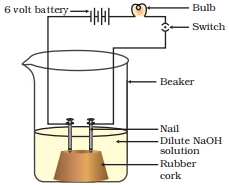
In an attempt to demonstrate electrical conductivity through an electrolyte,the following apparatus was set up. Which among the following statement$(s)$ is(are) correct?
$(i)$ Bulb will not glow because electrolyte is not acidic.
$(ii)$ Bulb will glow because $NaOH$ is a strong base and furnishes ions for conduction.
$(iii)$ Bulb will not glow because circuit is incomplete.
$(iv)$ Bulb will not glow because it depends upon the type of electrolytic solution.
Solution: The apparatus shows a beaker containing a dilute $NaOH$ solution with two nails fixed on a rubber cork. $NaOH$ is a strong base that dissociates completely in water to provide $Na^+$ and $OH^-$ ions. These free ions act as charge carriers,allowing the electric current to flow through the solution and complete the circuit. Therefore,the bulb will glow. Statement $(ii)$ is correct.
$(i)$ Bulb will not glow because electrolyte is not acidic.
$(ii)$ Bulb will glow because $NaOH$ is a strong base and furnishes ions for conduction.
$(iii)$ Bulb will not glow because circuit is incomplete.
$(iv)$ Bulb will not glow because it depends upon the type of electrolytic solution.
Solution: The apparatus shows a beaker containing a dilute $NaOH$ solution with two nails fixed on a rubber cork. $NaOH$ is a strong base that dissociates completely in water to provide $Na^+$ and $OH^-$ ions. These free ions act as charge carriers,allowing the electric current to flow through the solution and complete the circuit. Therefore,the bulb will glow. Statement $(ii)$ is correct.
A
$(i)$ and $(iii)$
B
$(ii)$ and $(iv)$
C
$(iv)$ only
D
$(ii)$ only
1 likes
View Solution21
MediumMCQ
Which of the following is used for the dissolution of gold?
A
Aqua regia
B
Sulphuric acid
C
Nitric acid
D
Hydrochloric acid
Solution
(A) Aqua regia is a freshly prepared mixture of concentrated hydrochloric acid $(HCl)$ and concentrated nitric acid $(HNO_3)$ in the ratio of $3:1$ respectively.
It is a highly corrosive,fuming liquid that is one of the few reagents capable of dissolving noble metals like gold and platinum.
Gold does not dissolve in either acid alone,but the combination produces nitrosyl chloride $(NOCl)$ and chlorine $(Cl_2)$,which react with gold to form soluble gold chloride $(AuCl_3)$.
It is a highly corrosive,fuming liquid that is one of the few reagents capable of dissolving noble metals like gold and platinum.
Gold does not dissolve in either acid alone,but the combination produces nitrosyl chloride $(NOCl)$ and chlorine $(Cl_2)$,which react with gold to form soluble gold chloride $(AuCl_3)$.
0 likes
View Solution22
EasyMCQ
Which of the following is not a mineral acid?
A
Hydrochloric acid
B
Citric acid
C
Sulphuric acid
D
Nitric acid
Solution
(B) Mineral acids are acids derived from inorganic compounds,typically through chemical processes. Examples include $HCl$,$H_2SO_4$,and $HNO_3$.
Organic acids are acids that occur naturally in plants and animals. Citric acid is an organic acid found in citrus fruits like lemons and oranges.
Therefore,citric acid is not a mineral acid.
Organic acids are acids that occur naturally in plants and animals. Citric acid is an organic acid found in citrus fruits like lemons and oranges.
Therefore,citric acid is not a mineral acid.
0 likes
View Solution23
MediumMCQ
Which among the following is not a base?
A
$NaOH$
B
$KOH$
C
$C_2H_5OH$
D
$NH_4OH$
Solution
(C) $C_2H_5OH$ is not a base.
$C_2H_5OH$ (ethyl alcohol) contains an $-OH$ group,but it does not dissociate to release $OH^-$ ions in an aqueous solution.
Bases are substances that release $OH^-$ ions in water.
Since $C_2H_5OH$ does not act as a proton acceptor or $OH^-$ donor,it is classified as an alcohol,not a base.
$C_2H_5OH$ (ethyl alcohol) contains an $-OH$ group,but it does not dissociate to release $OH^-$ ions in an aqueous solution.
Bases are substances that release $OH^-$ ions in water.
Since $C_2H_5OH$ does not act as a proton acceptor or $OH^-$ donor,it is classified as an alcohol,not a base.
0 likes
View Solution24
MediumMCQ
Which of the following statements is not correct?
A
All metal carbonates react with acid to give a salt,water and carbon dioxide.
B
Some non-metal oxides react with water to form an acid.
C
Some metals react with acids to give salt and hydrogen.
D
All metal oxides react with water to give salt and acid.
Solution
(D) $1$. Metal carbonates react with acids to produce salt,water,and $CO_2$ gas. This is a correct statement.
$2$. Non-metal oxides (like $SO_2$,$CO_2$) are acidic in nature and react with water to form acids (like $H_2SO_3$,$H_2CO_3$). This is a correct statement.
$3$. Many reactive metals (like $Zn$,$Fe$) react with dilute acids to produce salt and hydrogen gas. This is a correct statement.
$4$. Metal oxides are generally basic in nature. While some (like alkali metal oxides) react with water to form bases (alkalis),they do not react with water to form salt and acid. Therefore,this statement is incorrect.
$2$. Non-metal oxides (like $SO_2$,$CO_2$) are acidic in nature and react with water to form acids (like $H_2SO_3$,$H_2CO_3$). This is a correct statement.
$3$. Many reactive metals (like $Zn$,$Fe$) react with dilute acids to produce salt and hydrogen gas. This is a correct statement.
$4$. Metal oxides are generally basic in nature. While some (like alkali metal oxides) react with water to form bases (alkalis),they do not react with water to form salt and acid. Therefore,this statement is incorrect.
0 likes
View Solution25
MediumMCQ
Match the chemical substances given in Column $(A)$ with their appropriate application given in Column $(B)$.
| Column $(A)$ | Column $(B)$ |
| $(A)$ Bleaching powder | $(i)$ Preparation of glass |
| $(B)$ Baking soda | $(ii)$ Production of $H_2$ and $Cl_2$ |
| $(C)$ Washing soda | $(iii)$ Decolourisation |
| $(D)$ Sodium chloride | $(iv)$ Antacid |
A
$A-(iii), B-(iv), C-(i), D-(ii)$
B
$A-(iii), B-(ii), C-(iv), D-(i)$
C
$A-(ii), B-(i), C-(iv), D-(iii)$
D
$A-(ii), B-(iv), C-(i), D-(iii)$
Solution
$(A)$ The correct matches are as follows:
$1$. Bleaching powder $(CaOCl_2)$ is used for decolourisation (bleaching action) in the textile and paper industries. Thus, $(A)-(iii)$.
$2$. Baking soda $(NaHCO_3)$ is used as an antacid to neutralize excess stomach acid. Thus, $(B)-(iv)$.
$3$. Washing soda $(Na_2CO_3 \cdot 10H_2O)$ is used in the glass, soap, and paper industries. Thus, $(C)-(i)$.
$4$. Sodium chloride $(NaCl)$ is used in the chlor-alkali process for the production of $H_2$ and $Cl_2$ gases. Thus, $(D)-(ii)$.
Therefore, the correct sequence is $A-(iii), B-(iv), C-(i), D-(ii)$.
$1$. Bleaching powder $(CaOCl_2)$ is used for decolourisation (bleaching action) in the textile and paper industries. Thus, $(A)-(iii)$.
$2$. Baking soda $(NaHCO_3)$ is used as an antacid to neutralize excess stomach acid. Thus, $(B)-(iv)$.
$3$. Washing soda $(Na_2CO_3 \cdot 10H_2O)$ is used in the glass, soap, and paper industries. Thus, $(C)-(i)$.
$4$. Sodium chloride $(NaCl)$ is used in the chlor-alkali process for the production of $H_2$ and $Cl_2$ gases. Thus, $(D)-(ii)$.
Therefore, the correct sequence is $A-(iii), B-(iv), C-(i), D-(ii)$.
0 likes
View Solution26
MediumMCQ
Equal volumes of hydrochloric acid and sodium hydroxide solutions of the same concentration are mixed. The $pH$ of the resulting solution is checked with a $pH$ paper. What would be the colour obtained? (You may use the colour guide given in the figure.)

A
Red
B
Yellowish green
C
Yellow
D
Blue
Solution
(B) Hydrochloric acid $(HCl)$ is a strong acid and sodium hydroxide $(NaOH)$ is a strong base.
When equal volumes of $HCl$ and $NaOH$ of the same concentration are mixed,they undergo a neutralization reaction to form sodium chloride $(NaCl)$ and water $(H_2O)$.
The chemical equation is: $HCl(aq) + NaOH(aq) \rightarrow NaCl(aq) + H_2O(l)$.
Since both are strong and in equal amounts,the resulting solution is neutral,having a $pH$ of $7$.
According to the provided $pH$ colour chart,a $pH$ of $7$ corresponds to a yellowish-green colour.
When equal volumes of $HCl$ and $NaOH$ of the same concentration are mixed,they undergo a neutralization reaction to form sodium chloride $(NaCl)$ and water $(H_2O)$.
The chemical equation is: $HCl(aq) + NaOH(aq) \rightarrow NaCl(aq) + H_2O(l)$.
Since both are strong and in equal amounts,the resulting solution is neutral,having a $pH$ of $7$.
According to the provided $pH$ colour chart,a $pH$ of $7$ corresponds to a yellowish-green colour.
0 likes
View Solution27
MediumMCQ
Which of the following is(are) true when $HCl(g)$ is passed through water?
$(i)$ It does not ionise in the solution as it is a covalent compound.
$(ii)$ It ionises in the solution.
$(iii)$ It gives both hydrogen and hydroxyl ion in the solution.
$(iv)$ It forms hydronium ion in the solution due to the combination of hydrogen ion with water molecule.
$(i)$ It does not ionise in the solution as it is a covalent compound.
$(ii)$ It ionises in the solution.
$(iii)$ It gives both hydrogen and hydroxyl ion in the solution.
$(iv)$ It forms hydronium ion in the solution due to the combination of hydrogen ion with water molecule.
A
$(i)$ only
B
$(iii)$ only
C
$(ii)$ and $(iv)$
D
$(iii)$ and $(iv)$
Solution
(C) When $HCl(g)$ is passed through water,it undergoes ionization because water acts as a polar solvent.
$HCl + H_2O \rightarrow H_3O^+ + Cl^-$.
Statement $(ii)$ is true because $HCl$ ionizes in water.
Statement $(iv)$ is true because the $H^+$ ion produced combines with $H_2O$ to form the hydronium ion $(H_3O^+)$.
Statement $(i)$ is false because it does ionize.
Statement $(iii)$ is false because it does not produce hydroxyl ions $(OH^-)$ in the solution.
$HCl + H_2O \rightarrow H_3O^+ + Cl^-$.
Statement $(ii)$ is true because $HCl$ ionizes in water.
Statement $(iv)$ is true because the $H^+$ ion produced combines with $H_2O$ to form the hydronium ion $(H_3O^+)$.
Statement $(i)$ is false because it does ionize.
Statement $(iii)$ is false because it does not produce hydroxyl ions $(OH^-)$ in the solution.
0 likes
View Solution28
EasyMCQ
Which of the following statements is true for acids?
A
Bitter and change red litmus to blue
B
Sour and change red litmus to blue
C
Bitter and change blue litmus to red
D
Sour and change blue litmus to red
Solution
(D) Acids are chemical substances that have a sour taste.
They turn blue litmus paper into red.
Bases,on the other hand,are bitter in taste and turn red litmus paper into blue.
Therefore,the correct statement for acids is that they are sour and change blue litmus to red.
They turn blue litmus paper into red.
Bases,on the other hand,are bitter in taste and turn red litmus paper into blue.
Therefore,the correct statement for acids is that they are sour and change blue litmus to red.
0 likes
View Solution29
EasyMCQ
Which of the following are present in a dilute aqueous solution of hydrochloric acid?
A
$H_{3}O^{+} + Cl^{-}$
B
$H_{3}O^{+} + OH^{-}$
C
$Cl^{-} + OH^{-}$
D
Unionised $HCl$
Solution
(A) Hydrochloric acid $(HCl)$ is a strong acid that undergoes complete dissociation in an aqueous solution.
When $HCl$ is dissolved in water,it reacts with water molecules to form hydronium ions $(H_{3}O^{+})$ and chloride ions $(Cl^{-})$.
The dissociation reaction is represented as: $HCl(aq) + H_{2}O(l) \rightarrow H_{3}O^{+}(aq) + Cl^{-}(aq)$.
Since it is a strong acid,almost all $HCl$ molecules dissociate into ions,leaving negligible amounts of unionised $HCl$ in a dilute solution.
Therefore,the primary species present in the solution are $H_{3}O^{+}$ and $Cl^{-}$.
When $HCl$ is dissolved in water,it reacts with water molecules to form hydronium ions $(H_{3}O^{+})$ and chloride ions $(Cl^{-})$.
The dissociation reaction is represented as: $HCl(aq) + H_{2}O(l) \rightarrow H_{3}O^{+}(aq) + Cl^{-}(aq)$.
Since it is a strong acid,almost all $HCl$ molecules dissociate into ions,leaving negligible amounts of unionised $HCl$ in a dilute solution.
Therefore,the primary species present in the solution are $H_{3}O^{+}$ and $Cl^{-}$.
0 likes
View Solution30
MediumMCQ
Identify the correct representation of the reaction occurring during the chlor-alkali process.
A
$2 NaCl (l) + 2 H_2O (l) \rightarrow 2 NaOH (l) + Cl_2 (g) + H_2 (g)$
B
$2 NaCl (aq) + 2 H_2O (l) \rightarrow 2 NaOH (aq) + Cl_2 (g) + H_2 (g)$
C
$2 NaCl (aq) + 2 H_2O (l) \rightarrow 2 NaOH (aq) + Cl_2 (aq) + H_2 (aq)$
D
$2 NaCl (aq) + 2 H_2O (aq) \rightarrow 2 NaOH (aq) + Cl_2 (g) + H_2 (g)$
Solution
(B) The chlor-alkali process is the electrolysis of an aqueous solution of sodium chloride (brine).
In this process,electricity is passed through a concentrated aqueous solution of $NaCl$ (brine).
This results in the decomposition of $NaCl$ to form sodium hydroxide $(NaOH)$,chlorine gas $(Cl_2)$,and hydrogen gas $(H_2)$.
The chemical equation is: $2 NaCl (aq) + 2 H_2O (l) \rightarrow 2 NaOH (aq) + Cl_2 (g) + H_2 (g)$.
Therefore,option $B$ is the correct representation.
In this process,electricity is passed through a concentrated aqueous solution of $NaCl$ (brine).
This results in the decomposition of $NaCl$ to form sodium hydroxide $(NaOH)$,chlorine gas $(Cl_2)$,and hydrogen gas $(H_2)$.
The chemical equation is: $2 NaCl (aq) + 2 H_2O (l) \rightarrow 2 NaOH (aq) + Cl_2 (g) + H_2 (g)$.
Therefore,option $B$ is the correct representation.
0 likes
View Solution31
MediumMCQ
Match the acids given in Column $(A)$ with their correct source given in Column $(B)$.
| Column $(A)$ | Column $(B)$ |
| $(a)$ Lactic acid | $(i)$ Tomato |
| $(b)$ Acetic acid | $(ii)$ Lemon |
| $(c)$ Citric acid | $(iii)$ Vinegar |
| $(d)$ Oxalic acid | $(iv)$ Curd |
A
$(a)-(iv), (b)-(iii), (c)-(i), (d)-(ii)$
B
$(a)-(iii), (b)-(ii), (c)-(i), (d)-(iv)$
C
$(a)-(iv), (b)-(iii), (c)-(ii), (d)-(i)$
D
$(a)-(ii), (b)-(i), (c)-(iii), (d)-(iv)$
Solution
(C) The correct matches are as follows:
$(a)$ Lactic acid is found in $(iv)$ Curd.
$(b)$ Acetic acid is found in $(iii)$ Vinegar.
$(c)$ Citric acid is found in $(ii)$ Lemon.
$(d)$ Oxalic acid is found in $(i)$ Tomato.
Therefore, the correct sequence is $(a)-(iv), (b)-(iii), (c)-(ii), (d)-(i)$.
$(a)$ Lactic acid is found in $(iv)$ Curd.
$(b)$ Acetic acid is found in $(iii)$ Vinegar.
$(c)$ Citric acid is found in $(ii)$ Lemon.
$(d)$ Oxalic acid is found in $(i)$ Tomato.
Therefore, the correct sequence is $(a)-(iv), (b)-(iii), (c)-(ii), (d)-(i)$.
0 likes
View Solution32
MediumMCQ
Match the important chemicals given in Column $(A)$ with the chemical formulae given in Column $(B)$.
| Column $(A)$ | Column $(B)$ |
| $(a)$ Plaster of Paris | $(i)$ $Ca(OH)_{2}$ |
| $(b)$ Gypsum | $(ii)$ $CaSO_{4} \cdot 1/2 H_{2}O$ |
| $(c)$ Bleaching Powder | $(iii)$ $CaSO_{4} \cdot 2H_{2}O$ |
| $(d)$ Slaked Lime | $(iv)$ $CaOCl_{2}$ |
A
$(a)-(iv), (b)-(iii), (c)-(i), (d)-(ii)$
B
$(a)-(iv), (b)-(iii), (c)-(ii), (d)-(i)$
C
$(a)-(ii), (b)-(i), (c)-(iii), (d)-(iv)$
D
$(a)-(ii), (b)-(iii), (c)-(iv), (d)-(i)$
Solution
(D) The correct matches are as follows:
$(a)$ Plaster of Paris is $CaSO_{4} \cdot 1/2 H_{2}O$ $(ii)$.
$(b)$ Gypsum is $CaSO_{4} \cdot 2H_{2}O$ $(iii)$.
$(c)$ Bleaching Powder is $CaOCl_{2}$ $(iv)$.
$(d)$ Slaked Lime is $Ca(OH)_{2}$ $(i)$.
Therefore, the correct sequence is $(a)-(ii), (b)-(iii), (c)-(iv), (d)-(i)$.
$(a)$ Plaster of Paris is $CaSO_{4} \cdot 1/2 H_{2}O$ $(ii)$.
$(b)$ Gypsum is $CaSO_{4} \cdot 2H_{2}O$ $(iii)$.
$(c)$ Bleaching Powder is $CaOCl_{2}$ $(iv)$.
$(d)$ Slaked Lime is $Ca(OH)_{2}$ $(i)$.
Therefore, the correct sequence is $(a)-(ii), (b)-(iii), (c)-(iv), (d)-(i)$.
0 likes
View Solution33
Medium
What will be the action of the following substances on litmus paper? Dry $HCl$ gas,Moistened $NH_3$ gas,Lemon juice,Carbonated soft drink,Curd,Soap solution.
Solution
(N/A) The action of these substances on litmus paper depends on their acidic or basic nature. Acids turn blue litmus red,while bases turn red litmus blue. Dry $HCl$ gas does not show acidic properties because it lacks $H^+$ ions in the absence of water. Moistened $NH_3$ gas acts as a base $(NH_4OH)$. Lemon juice,carbonated soft drinks,and curd are acidic. Soap solution is basic.
| Substance | Action on Litmus paper |
| Dry $HCl$ gas | No change |
| Moistened $NH_3$ gas | Turns red to blue |
| Lemon juice | Turns blue to red |
| Carbonated soft drink | Turns blue to red |
| Curd | Turns blue to red |
| Soap solution | Turns red to blue |
0 likes
View Solution34
Medium
Name the acid present in ant sting and give its chemical formula. Also,suggest a common method to get relief from the discomfort caused by the ant sting.
Solution
(N/A) The acid present in an ant sting is methanoic acid,also known as formic acid.
The chemical formula for methanoic acid is $HCOOH$.
To get relief from the irritation caused by the ant sting,one should apply a mild base,such as baking soda $(NaHCO_3)$,to the affected area. The base neutralizes the acidic effect of the sting,providing relief.
The chemical formula for methanoic acid is $HCOOH$.
To get relief from the irritation caused by the ant sting,one should apply a mild base,such as baking soda $(NaHCO_3)$,to the affected area. The base neutralizes the acidic effect of the sting,providing relief.
1 likes
View Solution35
EasyMCQ
What happens when nitric acid is added to an egg shell?
A
No reaction occurs.
B
Carbon dioxide gas is evolved.
C
Hydrogen gas is evolved.
D
The egg shell becomes harder.
Solution
(B) Egg shells are primarily composed of calcium carbonate $(CaCO_3)$.
When nitric acid $(HNO_3)$ is added to the egg shell,a chemical reaction occurs between the acid and the carbonate.
This reaction results in the evolution of carbon dioxide $(CO_2)$ gas,along with the formation of calcium nitrate and water.
The balanced chemical equation for this reaction is:
$CaCO_3 + 2HNO_3 \rightarrow Ca(NO_3)_2 + H_2O + CO_2 \uparrow$
When nitric acid $(HNO_3)$ is added to the egg shell,a chemical reaction occurs between the acid and the carbonate.
This reaction results in the evolution of carbon dioxide $(CO_2)$ gas,along with the formation of calcium nitrate and water.
The balanced chemical equation for this reaction is:
$CaCO_3 + 2HNO_3 \rightarrow Ca(NO_3)_2 + H_2O + CO_2 \uparrow$
0 likes
View Solution36
MediumMCQ
$A$ student prepared solutions of $(i)$ an acid and $(ii)$ a base in two separate beakers. She forgot to label the solutions and litmus paper is not available in the laboratory. Since both the solutions are colourless,how will she distinguish between the two?
A
By tasting the solutions.
B
By using a chemical indicator like phenolphthalein or natural indicators like turmeric or china rose.
C
By checking the smell of the solutions.
D
By observing the colour of the solutions.
Solution
(B) Since both solutions are colourless and litmus paper is unavailable,the student can use other indicators.
$1$. Phenolphthalein: It turns pink in a basic solution and remains colourless in an acidic solution.
$2$. Natural indicators: Turmeric turns reddish-brown in a base and remains yellow in an acid. China rose (Hibiscus) solution turns dark pink (magenta) in an acid and green in a base.
$1$. Phenolphthalein: It turns pink in a basic solution and remains colourless in an acidic solution.
$2$. Natural indicators: Turmeric turns reddish-brown in a base and remains yellow in an acid. China rose (Hibiscus) solution turns dark pink (magenta) in an acid and green in a base.
0 likes
View Solution37
Difficult
How would you distinguish between baking powder and washing soda by heating?
Solution
(N/A) The chemical formula of baking powder is sodium hydrogencarbonate $(NaHCO_3)$,while the chemical formula of washing soda is sodium carbonate decahydrate $(Na_2CO_3 \cdot 10H_2O)$.
When baking powder $(NaHCO_3)$ is heated,it undergoes thermal decomposition to release carbon dioxide $(CO_2)$ gas. This gas turns lime water milky.
$2NaHCO_3 \xrightarrow{\text{Heat}} Na_2CO_3 + H_2O + CO_2 \uparrow$
In contrast,washing soda $(Na_2CO_3 \cdot 10H_2O)$ loses its water of crystallization upon heating but does not release $CO_2$ gas. Therefore,it does not turn lime water milky.
$Na_2CO_3 \cdot 10H_2O \xrightarrow{\text{Heat}} Na_2CO_3 + 10H_2O$
When baking powder $(NaHCO_3)$ is heated,it undergoes thermal decomposition to release carbon dioxide $(CO_2)$ gas. This gas turns lime water milky.
$2NaHCO_3 \xrightarrow{\text{Heat}} Na_2CO_3 + H_2O + CO_2 \uparrow$
In contrast,washing soda $(Na_2CO_3 \cdot 10H_2O)$ loses its water of crystallization upon heating but does not release $CO_2$ gas. Therefore,it does not turn lime water milky.
$Na_2CO_3 \cdot 10H_2O \xrightarrow{\text{Heat}} Na_2CO_3 + 10H_2O$
0 likes
View Solution38
DifficultMCQ
Salt $A$,commonly used in bakery products,on heating gets converted into another salt $B$,which itself is used for the removal of hardness of water,and a gas $C$ is evolved. The gas $C$,when passed through lime water,turns it milky. Identify $A$,$B$,and $C$.
A
$A = NaHCO_3, B = Na_2CO_3, C = CO_2$
B
$A = Na_2CO_3, B = NaHCO_3, C = CO_2$
C
$A = NaHCO_3, B = Na_2CO_3, C = H_2O$
D
$A = Na_2CO_3, B = NaOH, C = CO_2$
Solution
(A) The salt $A$ used in bakery products is baking soda,which is sodium hydrogen carbonate $(NaHCO_3)$.
On heating,it undergoes thermal decomposition as follows:
$2NaHCO_3 \xrightarrow{\Delta} Na_2CO_3 + H_2O + CO_2 \uparrow$
Here,$B$ is sodium carbonate $(Na_2CO_3)$,which is used for the removal of permanent hardness of water.
The gas $C$ evolved is carbon dioxide $(CO_2)$.
When $CO_2$ gas is passed through lime water $[Ca(OH)_2]$,it forms calcium carbonate $(CaCO_3)$,which makes the solution milky:
$Ca(OH)_2 + CO_2 \rightarrow CaCO_3 + H_2O$
Thus,$A = NaHCO_3$,$B = Na_2CO_3$,and $C = CO_2$.
On heating,it undergoes thermal decomposition as follows:
$2NaHCO_3 \xrightarrow{\Delta} Na_2CO_3 + H_2O + CO_2 \uparrow$
Here,$B$ is sodium carbonate $(Na_2CO_3)$,which is used for the removal of permanent hardness of water.
The gas $C$ evolved is carbon dioxide $(CO_2)$.
When $CO_2$ gas is passed through lime water $[Ca(OH)_2]$,it forms calcium carbonate $(CaCO_3)$,which makes the solution milky:
$Ca(OH)_2 + CO_2 \rightarrow CaCO_3 + H_2O$
Thus,$A = NaHCO_3$,$B = Na_2CO_3$,and $C = CO_2$.
0 likes
View Solution39
Difficult
In one of the industrial processes used for the manufacture of sodium hydroxide,a gas $X$ is formed as a by-product. The gas $X$ reacts with lime water to give a compound $Y$,which is used as a bleaching agent in the chemical industry. Identify $X$ and $Y$ and provide the chemical equations for the reactions involved.
Solution
(X=CL_2, Y=CAOCL_2) In the chlor-alkali process for the manufacture of sodium hydroxide,hydrogen gas and chlorine gas $(X)$ are formed as by-products.
When chlorine gas $(X)$ reacts with dry slaked lime (lime water),it forms calcium oxychloride (bleaching powder),which is compound $Y$.
The chemical reactions are as follows:
$2NaCl(aq) + 2H_2O(l) \rightarrow 2NaOH(aq) + Cl_2(g) + H_2(g)$
Here,$X = Cl_2$ (Chlorine gas).
$Ca(OH)_2(s) + Cl_2(g) \rightarrow CaOCl_2(s) + H_2O(l)$
Here,$Y = CaOCl_2$ (Calcium oxychloride or bleaching powder).
When chlorine gas $(X)$ reacts with dry slaked lime (lime water),it forms calcium oxychloride (bleaching powder),which is compound $Y$.
The chemical reactions are as follows:
$2NaCl(aq) + 2H_2O(l) \rightarrow 2NaOH(aq) + Cl_2(g) + H_2(g)$
Here,$X = Cl_2$ (Chlorine gas).
$Ca(OH)_2(s) + Cl_2(g) \rightarrow CaOCl_2(s) + H_2O(l)$
Here,$Y = CaOCl_2$ (Calcium oxychloride or bleaching powder).
0 likes
View Solution40
Difficult
Fill in the missing data in the following table:
| Name of the salt | Formula | Base | Acid |
| $(i)$ Ammonium chloride | $NH_{4}Cl$ | $NH_{4}OH$ | - |
| $(ii)$ Copper sulphate | - | - | $H_{2}SO_{4}$ |
| $(iii)$ Sodium chloride | $NaCl$ | $NaOH$ | - |
| $(iv)$ Magnesium nitrate | $Mg(NO_{3})_{2}$ | - | $HNO_{3}$ |
| $(v)$ Potassium sulphate | $K_{2}SO_{4}$ | - | - |
| $(vi)$ Calcium nitrate | $Ca(NO_{3})_{2}$ | $Ca(OH)_{2}$ | - |
Solution
(N/A) To identify the acid and base from which a salt is formed, we look at the cation (from the base) and the anion (from the acid). The completed table is as follows:
| Name of the salt | Formula | Base | Acid |
| $(i)$ Ammonium chloride | $NH_{4}Cl$ | $NH_{4}OH$ | $HCl$ |
| $(ii)$ Copper sulphate | $CuSO_{4}$ | $Cu(OH)_{2}$ | $H_{2}SO_{4}$ |
| $(iii)$ Sodium chloride | $NaCl$ | $NaOH$ | $HCl$ |
| $(iv)$ Magnesium nitrate | $Mg(NO_{3})_{2}$ | $Mg(OH)_{2}$ | $HNO_{3}$ |
| $(v)$ Potassium sulphate | $K_{2}SO_{4}$ | $KOH$ | $H_{2}SO_{4}$ |
| $(vi)$ Calcium nitrate | $Ca(NO_{3})_{2}$ | $Ca(OH)_{2}$ | $HNO_{3}$ |
0 likes
View Solution41
Easy
What are strong and weak acids? In the following list of acids,separate strong acids from weak acids: Hydrochloric acid,citric acid,acetic acid,nitric acid,formic acid,sulphuric acid.
Solution
(N/A) Strong acids are those that ionize completely in aqueous solutions to provide a high concentration of hydronium ions $(H_3O^+)$.
Weak acids are those that ionize only partially in aqueous solutions,providing a much lower concentration of $H_3O^+$ ions compared to strong acids of the same molar concentration.
Strong acids: Hydrochloric acid $(HCl)$,sulphuric acid $(H_2SO_4)$,nitric acid $(HNO_3)$.
Weak acids: Citric acid,acetic acid $(CH_3COOH)$,formic acid $(HCOOH)$.
Weak acids are those that ionize only partially in aqueous solutions,providing a much lower concentration of $H_3O^+$ ions compared to strong acids of the same molar concentration.
Strong acids: Hydrochloric acid $(HCl)$,sulphuric acid $(H_2SO_4)$,nitric acid $(HNO_3)$.
Weak acids: Citric acid,acetic acid $(CH_3COOH)$,formic acid $(HCOOH)$.
0 likes
View Solution42
Medium
When $Zn$ metal is treated with a dilute solution of a strong acid,a gas is evolved,which is utilised in the hydrogenation of oil. Name the gas evolved. Write the chemical equation of the reaction involved and also write a test to detect the gas formed.
Solution
(N/A) When $Zn$ reacts with a dilute solution of a strong acid (such as $HCl$),it forms a salt and hydrogen gas $(H_2)$ is evolved.
The chemical equation is: $Zn(s) + 2HCl(aq) \rightarrow ZnCl_2(aq) + H_2(g) \uparrow$.
Test to detect the gas: When a burning splinter is brought near the mouth of the test tube containing the gas,it burns with a characteristic 'pop' sound,which confirms the presence of hydrogen gas.
The chemical equation is: $Zn(s) + 2HCl(aq) \rightarrow ZnCl_2(aq) + H_2(g) \uparrow$.
Test to detect the gas: When a burning splinter is brought near the mouth of the test tube containing the gas,it burns with a characteristic 'pop' sound,which confirms the presence of hydrogen gas.
0 likes
View Solution43
Difficult
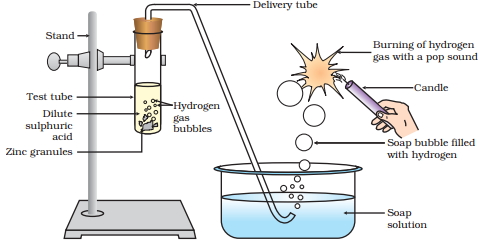
In the following schematic diagram for the preparation of hydrogen gas as shown in the Figure,what would happen if the following changes are made?
$(a)$ In place of zinc granules,the same amount of zinc dust is taken in the test tube.
$(b)$ Instead of dilute sulphuric acid,dilute hydrochloric acid is taken.
$(c)$ In place of zinc,copper turnings are taken.
$(d)$ Sodium hydroxide is taken in place of dilute sulphuric acid and the tube is heated.
$(a)$ In place of zinc granules,the same amount of zinc dust is taken in the test tube.
$(b)$ Instead of dilute sulphuric acid,dilute hydrochloric acid is taken.
$(c)$ In place of zinc,copper turnings are taken.
$(d)$ Sodium hydroxide is taken in place of dilute sulphuric acid and the tube is heated.
Solution
(N/A) Hydrogen gas will evolve with greater speed because zinc dust has a larger surface area compared to zinc granules,which increases the rate of reaction.
$(b)$ Almost the same amount of hydrogen gas will be evolved as both are strong mineral acids.
$(c)$ Hydrogen gas will not be evolved because copper is less reactive than hydrogen and cannot displace it from the acid.
$(d)$ If sodium hydroxide is taken,hydrogen gas will be evolved upon heating:
$Zn + 2NaOH \to Na_2ZnO_2 + H_2$ (Sodium zincate is formed along with hydrogen gas).
$(b)$ Almost the same amount of hydrogen gas will be evolved as both are strong mineral acids.
$(c)$ Hydrogen gas will not be evolved because copper is less reactive than hydrogen and cannot displace it from the acid.
$(d)$ If sodium hydroxide is taken,hydrogen gas will be evolved upon heating:
$Zn + 2NaOH \to Na_2ZnO_2 + H_2$ (Sodium zincate is formed along with hydrogen gas).
0 likes
View Solution44
Medium
For making cake,baking powder is used. If at home your mother uses baking soda instead of baking powder in the cake,
$(a)$ how will it affect the taste of the cake and why?
$(b)$ how can baking soda be converted into baking powder?
$(c)$ what is the role of tartaric acid added to baking soda?
$(a)$ how will it affect the taste of the cake and why?
$(b)$ how can baking soda be converted into baking powder?
$(c)$ what is the role of tartaric acid added to baking soda?
Solution
(A-D) Baking soda is sodium hydrogencarbonate $(NaHCO_3)$. On heating,it decomposes to form sodium carbonate $(Na_2CO_3)$,which is bitter in taste.
$2NaHCO_3 \xrightarrow{\text{Heat}} Na_2CO_3 + H_2O + CO_2$
$(b)$ Baking soda can be converted into baking powder by adding an appropriate amount of a mild edible acid,such as tartaric acid,to it.
$(c)$ The role of tartaric acid is to neutralize the sodium carbonate produced during heating. This prevents the cake from tasting bitter.
$2NaHCO_3 \xrightarrow{\text{Heat}} Na_2CO_3 + H_2O + CO_2$
$(b)$ Baking soda can be converted into baking powder by adding an appropriate amount of a mild edible acid,such as tartaric acid,to it.
$(c)$ The role of tartaric acid is to neutralize the sodium carbonate produced during heating. This prevents the cake from tasting bitter.
1 likes
View Solution45
Medium
$A$ metal carbonate $X$ on reacting with an acid gives a gas which when passed through a solution $Y$ gives the carbonate back. On the other hand,a gas $G$ that is obtained at anode during electrolysis of brine is passed on dry $Y$,it gives a compound $Z$,used for disinfecting drinking water. Identify $X$,$Y$,$G$ and $Z$.
Solution
(X=CACO3, Y=CA(OH)2, G=CL2, Z=CAOCL2) $1$. The gas evolved at the anode during the electrolysis of brine ($NaCl$ solution) is chlorine gas $(G = Cl_2)$.
$2$. When chlorine gas is passed over dry slaked lime $(Y = Ca(OH)_2)$,it produces bleaching powder $(Z = CaOCl_2)$,which is used for disinfecting drinking water.
$3$. The reaction is: $Ca(OH)_2 + Cl_2 \rightarrow CaOCl_2 + H_2O$.
$4$. Since $Y$ is calcium hydroxide,the metal carbonate $X$ is calcium carbonate $(CaCO_3)$.
$5$. When $CaCO_3$ reacts with an acid (e.g.,$HCl$),it releases $CO_2$ gas: $CaCO_3 + 2HCl \rightarrow CaCl_2 + H_2O + CO_2$.
$6$. When this $CO_2$ is passed through lime water $(Ca(OH)_2)$,it turns milky due to the formation of $CaCO_3$: $Ca(OH)_2 + CO_2 \rightarrow CaCO_3 + H_2O$.
$2$. When chlorine gas is passed over dry slaked lime $(Y = Ca(OH)_2)$,it produces bleaching powder $(Z = CaOCl_2)$,which is used for disinfecting drinking water.
$3$. The reaction is: $Ca(OH)_2 + Cl_2 \rightarrow CaOCl_2 + H_2O$.
$4$. Since $Y$ is calcium hydroxide,the metal carbonate $X$ is calcium carbonate $(CaCO_3)$.
$5$. When $CaCO_3$ reacts with an acid (e.g.,$HCl$),it releases $CO_2$ gas: $CaCO_3 + 2HCl \rightarrow CaCl_2 + H_2O + CO_2$.
$6$. When this $CO_2$ is passed through lime water $(Ca(OH)_2)$,it turns milky due to the formation of $CaCO_3$: $Ca(OH)_2 + CO_2 \rightarrow CaCO_3 + H_2O$.
0 likes
View Solution46
Medium
$A$ dry pellet of a common base $B$,when kept in open,absorbs moisture and turns sticky. The compound is also a by-product of the chlor-alkali process. Identify $B$. What type of reaction occurs when $B$ is treated with an acidic oxide? Write a balanced chemical equation for one such reaction.
Solution
(N/A) The common base $B$ is Sodium hydroxide $(NaOH)$. It is a deliquescent substance,meaning it absorbs moisture from the atmosphere and becomes sticky.
The reaction between a base and an acidic oxide is a neutralization reaction,which produces salt and water.
When $NaOH$ reacts with carbon dioxide $(CO_2)$,which is an acidic oxide,the balanced chemical equation is:
$2NaOH + CO_2 \rightarrow Na_2CO_3 + H_2O$
The reaction between a base and an acidic oxide is a neutralization reaction,which produces salt and water.
When $NaOH$ reacts with carbon dioxide $(CO_2)$,which is an acidic oxide,the balanced chemical equation is:
$2NaOH + CO_2 \rightarrow Na_2CO_3 + H_2O$
0 likes
View Solution47
Difficult
$A$ sulphate salt of a Group $2$ element of the Periodic Table is a white,soft substance,which can be moulded into different shapes by making its dough. When this compound is left in the open for some time,it becomes a hard solid mass and cannot be used for moulding purposes. Identify the sulphate salt and explain why it shows such behavior. Provide the chemical reaction involved.
Solution
(A) The substance described is Plaster of Paris. Its chemical name is calcium sulphate hemihydrate $(CaSO_4 \cdot \frac{1}{2} H_2O)$.
It is a soft powder that,when mixed with water,forms a dough that can be moulded into various shapes. When left in the open,it absorbs moisture from the atmosphere and undergoes a rehydration process to form gypsum $(CaSO_4 \cdot 2H_2O)$,which is a hard solid mass.
The chemical reaction is:
$CaSO_4 \cdot \frac{1}{2} H_2O + 1\frac{1}{2} H_2O \rightarrow CaSO_4 \cdot 2H_2O$
(Plaster of Paris) + (Water) $\rightarrow$ (Gypsum)
It is a soft powder that,when mixed with water,forms a dough that can be moulded into various shapes. When left in the open,it absorbs moisture from the atmosphere and undergoes a rehydration process to form gypsum $(CaSO_4 \cdot 2H_2O)$,which is a hard solid mass.
The chemical reaction is:
$CaSO_4 \cdot \frac{1}{2} H_2O + 1\frac{1}{2} H_2O \rightarrow CaSO_4 \cdot 2H_2O$
(Plaster of Paris) + (Water) $\rightarrow$ (Gypsum)
0 likes
View Solution48
Medium
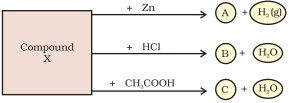
Identify the compound $X$ on the basis of the reactions given below. Also,write the name and chemical formulae of $A$,$B$ and $C$.
Solution
(N/A) Based on the given reactions:
$1$. $X + Zn \rightarrow A + H_2(g)$: $A$ base reacts with zinc to produce hydrogen gas. Thus,$X$ is a base,$NaOH$.
$2$. $X + HCl \rightarrow B + H_2O$: $A$ base reacts with an acid to form salt and water (neutralization). Thus,$B$ is $NaCl$.
$3$. $X + CH_3COOH \rightarrow C + H_2O$: $A$ base reacts with acetic acid to form salt and water. Thus,$C$ is $CH_3COONa$.
Final identifications:
$X = NaOH$ (Sodium hydroxide)
$A = Na_2ZnO_2$ (Sodium zincate)
$B = NaCl$ (Sodium chloride)
$C = CH_3COONa$ (Sodium acetate)
$1$. $X + Zn \rightarrow A + H_2(g)$: $A$ base reacts with zinc to produce hydrogen gas. Thus,$X$ is a base,$NaOH$.
$2$. $X + HCl \rightarrow B + H_2O$: $A$ base reacts with an acid to form salt and water (neutralization). Thus,$B$ is $NaCl$.
$3$. $X + CH_3COOH \rightarrow C + H_2O$: $A$ base reacts with acetic acid to form salt and water. Thus,$C$ is $CH_3COONa$.
Final identifications:
$X = NaOH$ (Sodium hydroxide)
$A = Na_2ZnO_2$ (Sodium zincate)
$B = NaCl$ (Sodium chloride)
$C = CH_3COONa$ (Sodium acetate)
0 likes
View Solution49
Medium
Three acidic solutions $A, B$ and $C$ have $pH = 0, 3$ and $5$ respectively.
$(i)$ Which solution has the highest concentration of $H^{+}$ ions?
$(ii)$ Which solution has the lowest concentration of $H^{+}$ ions?
$(i)$ Which solution has the highest concentration of $H^{+}$ ions?
$(ii)$ Which solution has the lowest concentration of $H^{+}$ ions?
Solution
(A) $(i)$ Solution $A$ with $pH = 0$ has the highest concentration of $H^{+}$ ions because $pH$ is inversely proportional to the concentration of $H^{+}$ ions $(pH = -\log[H^{+}])$.
$(ii)$ Solution $C$ with $pH = 5$ has the lowest concentration of $H^{+}$ ions because it has the highest $pH$ value among the given solutions.
$(ii)$ Solution $C$ with $pH = 5$ has the lowest concentration of $H^{+}$ ions because it has the highest $pH$ value among the given solutions.
0 likes
View Solution50
EasyMCQ
What is meant by $p$ and $H$ in $pH$?
A
$p$ stands for power and $H$ stands for hydrogen.
B
$p$ stands for potenz and $H$ stands for hydrogen.
C
$p$ stands for potential and $H$ stands for helium.
D
$p$ stands for proton and $H$ stands for hydroxide.
Solution
(B) In the term $pH$,the letter $p$ stands for the German word 'potenz',which means power or potential.
$H$ stands for the hydrogen ion concentration in the solution.
Therefore,$pH$ is defined as the negative logarithm of the hydrogen ion concentration,representing the power of hydrogen.
$H$ stands for the hydrogen ion concentration in the solution.
Therefore,$pH$ is defined as the negative logarithm of the hydrogen ion concentration,representing the power of hydrogen.
0 likes
View SolutionAcids, Bases and Salts — Mix Examples - Acids, Bases and Salts · Frequently Asked Questions
1Are these Acids, Bases and Salts questions useful for JEE and NEET?
Yes. All questions in this section are mapped to JEE Main and NEET exam patterns. Previous year questions from JEE Main, NEET, GUJCET and state-level exams are included with full solutions.
2Can I switch to Hindi or Gujarati for these questions?
Yes. Use the language tabs in the hero section or the sidebar to view the same questions and solutions in English, Hindi or Gujarati.
3How do I generate a question paper from this subtopic?
Use the Vedclass Exam Paper Generator — select the chapter and subtopic, set difficulty, and generate Sets A, B, C, D automatically. First 3 chapters of every subject are free.
Vedclass Products
For Students
Vedclass Test Series
Mock tests in real JEE/NEET style with performance analysis. 5-day free trial.
Start Free TrialFor Teachers
Exam Paper Generator
Generate Set A/B/C/D papers from this chapter in 2 minutes. 3 chapters free.
Try FreeFor Institutes
Online Exam Module
Live online exams with unlimited students, 360° analytics & white-label branding.
See DemoFor Teachers & Institutes
Generate a Acids, Bases and Salts Exam Paper in 2 Minutes
Select subtopic & difficulty — Sets A, B, C, D auto-generated with No Repeat logic.
First 3 chapters of every subject are free — no payment required.