
A English
Textbook - Acids, Bases and Salts Questions in English
Class 10 Science · Acids, Bases and Salts · Textbook - Acids, Bases and Salts
35+
Questions
English
Language
100%
With Solutions
Showing 35 of 35 questions in English
1
EasyMCQ
Why should curd and sour substances not be kept in brass and copper vessels?
A
They react with the metal to form toxic salts.
B
They neutralize the metal surface.
C
They cause the vessels to melt.
D
They increase the nutritional value of the food.
Solution
(A) Curd and other sour substances contain acids. When these substances are kept in brass and copper vessels,the acids react with the metal to form metallic salts and release hydrogen gas. These metallic salts are toxic and can cause food poisoning,thereby spoiling the food.
0 likes
View Solution2
Medium
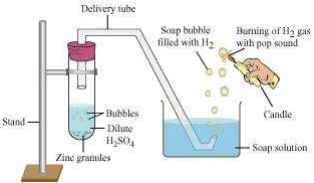
Which gas is usually liberated when an acid reacts with a metal? Illustrate with an example. How will you test for the presence of this gas?
Solution
(N/A) Hydrogen gas $(H_2)$ is usually liberated when an acid reacts with a metal.
Example: When zinc granules react with dilute sulfuric acid $(H_2SO_4)$,zinc sulfate $(ZnSO_4)$ and hydrogen gas are produced.
The chemical equation is:
$Zn(s) + H_2SO_4(aq) \to ZnSO_4(aq) + H_2(g) \uparrow$
Test for Hydrogen gas:
To test for the presence of hydrogen gas,pass the gas produced through a soap solution. Bubbles are formed in the soap solution,which contain hydrogen gas. When a burning candle is brought near these soap bubbles,the gas burns with a 'pop' sound,which confirms the presence of hydrogen gas.
Example: When zinc granules react with dilute sulfuric acid $(H_2SO_4)$,zinc sulfate $(ZnSO_4)$ and hydrogen gas are produced.
The chemical equation is:
$Zn(s) + H_2SO_4(aq) \to ZnSO_4(aq) + H_2(g) \uparrow$
Test for Hydrogen gas:
To test for the presence of hydrogen gas,pass the gas produced through a soap solution. Bubbles are formed in the soap solution,which contain hydrogen gas. When a burning candle is brought near these soap bubbles,the gas burns with a 'pop' sound,which confirms the presence of hydrogen gas.
0 likes
View Solution3
Medium
Metal compound $A$ reacts with dilute hydrochloric acid to produce effervescence. The gas evolved extinguishes a burning candle. Write a balanced chemical equation for the reaction if one of the compounds formed is calcium chloride.
Solution
(N/A) The gas that extinguishes a burning candle is carbon dioxide $(CO_2)$. Since the reaction produces $CO_2$ and calcium chloride $(CaCl_2)$ from a metal compound $A$ and hydrochloric acid $(HCl)$,the metal compound $A$ must be calcium carbonate $(CaCO_3)$.
The balanced chemical equation is:
$CaCO_{3(s)} + 2HCl_{(aq)} \rightarrow CaCl_{2(aq)} + CO_{2(g)} + H_2O_{(l)}$
The balanced chemical equation is:
$CaCO_{3(s)} + 2HCl_{(aq)} \rightarrow CaCl_{2(aq)} + CO_{2(g)} + H_2O_{(l)}$
0 likes
View Solution4
Medium
Why do $HCl$,$HNO_3$,etc.,show acidic characters in aqueous solutions while solutions of compounds like alcohol and glucose do not show acidic character?
Solution
(N/A) The dissociation of $HCl$ or $HNO_3$ to form hydrogen ions occurs only in the presence of water.
Hydrogen ions $(H^+)$ combine with $H_2O$ to form hydronium ions $(H_3O^+)$,which are responsible for acidic properties.
The reactions are as follows:
$HCl_{(aq)} \rightarrow H^+_{(aq)} + Cl^-_{(aq)}$
$H^+_{(aq)} + H_2O_{(l)} \rightarrow H_3O^+_{(aq)}$
Although aqueous solutions of glucose and alcohol contain hydrogen atoms in their molecular structure,these hydrogen atoms do not dissociate into $H^+$ ions in water.
Since they do not release hydrogen ions in solution,they do not exhibit acidic character.
Hydrogen ions $(H^+)$ combine with $H_2O$ to form hydronium ions $(H_3O^+)$,which are responsible for acidic properties.
The reactions are as follows:
$HCl_{(aq)} \rightarrow H^+_{(aq)} + Cl^-_{(aq)}$
$H^+_{(aq)} + H_2O_{(l)} \rightarrow H_3O^+_{(aq)}$
Although aqueous solutions of glucose and alcohol contain hydrogen atoms in their molecular structure,these hydrogen atoms do not dissociate into $H^+$ ions in water.
Since they do not release hydrogen ions in solution,they do not exhibit acidic character.
0 likes
View Solution5
EasyMCQ
Why does an aqueous solution of an acid conduct electricity?
A
Due to the presence of free electrons.
B
Due to the presence of free ions.
C
Due to the presence of molecules.
D
Due to the presence of covalent bonds.
Solution
(B) Acids are substances that dissociate in an aqueous solution to produce hydrogen ions $(H^+)$ and corresponding anions.
These free ions act as charge carriers in the solution.
Since electricity is the flow of charge,the movement of these ions allows the aqueous solution of an acid to conduct electricity.
These free ions act as charge carriers in the solution.
Since electricity is the flow of charge,the movement of these ions allows the aqueous solution of an acid to conduct electricity.
1 likes
View Solution6
EasyMCQ
Why does dry $HCl$ gas not change the colour of the dry litmus paper?
A
It is not acidic in nature.
B
It does not contain $H^+$ ions in the gaseous state.
C
It is a covalent compound.
D
It requires a catalyst to react.
Solution
(B) The colour of litmus paper is changed by the presence of hydrogen ions $(H^+)$.
Dry $HCl$ gas does not contain free $H^+$ ions.
An acid only dissociates to release $H^+$ ions when it is in an aqueous solution.
Since the $HCl$ gas is dry and the litmus paper is also dry,no dissociation occurs,and therefore,the colour of the litmus paper does not change.
Dry $HCl$ gas does not contain free $H^+$ ions.
An acid only dissociates to release $H^+$ ions when it is in an aqueous solution.
Since the $HCl$ gas is dry and the litmus paper is also dry,no dissociation occurs,and therefore,the colour of the litmus paper does not change.
0 likes
View Solution7
MediumMCQ
While diluting an acid,why is it recommended that the acid should be added to water and not water to the acid?
A
To prevent the acid from becoming too concentrated.
B
To ensure the acid does not evaporate.
C
To prevent the mixture from splashing out due to the highly exothermic nature of the reaction.
D
To maintain the chemical properties of the acid.
Solution
(C) The process of dissolving a concentrated acid in water is a highly exothermic reaction,meaning it releases a large amount of heat.
If water is added to a concentrated acid,the heat generated may cause the mixture to splash out and cause severe acid burns.
Additionally,the glass container may break due to excessive local heating.
Therefore,it is always recommended to add acid slowly to water with constant stirring.
If water is added to a concentrated acid,the heat generated may cause the mixture to splash out and cause severe acid burns.
Additionally,the glass container may break due to excessive local heating.
Therefore,it is always recommended to add acid slowly to water with constant stirring.
0 likes
View Solution8
EasyMCQ
How is the concentration of hydronium ions $(H_3O^+)$ affected when a solution of an acid is diluted?
A
It increases.
B
It decreases.
C
It remains unchanged.
D
It becomes zero.
Solution
(B) When an acid is diluted by adding water,the number of hydronium ions $(H_3O^+)$ per unit volume decreases.
This process is known as dilution.
As the volume of the solution increases due to the addition of water,the concentration of the acid decreases,resulting in a lower concentration of $(H_3O^+)$ ions.
This process is known as dilution.
As the volume of the solution increases due to the addition of water,the concentration of the acid decreases,resulting in a lower concentration of $(H_3O^+)$ ions.
0 likes
View Solution9
EasyMCQ
How is the concentration of hydroxide ions $(OH^-)$ affected when excess base is dissolved in a solution of sodium hydroxide?
A
It increases
B
It decreases
C
It remains the same
D
It becomes zero
Solution
(A) When an excess base is dissolved in a solution of sodium hydroxide $(NaOH)$,it releases more hydroxide ions $(OH^-)$ into the solution.
Since sodium hydroxide is a strong base that dissociates completely,adding more base increases the total number of $(OH^-)$ ions per unit volume.
Therefore,the concentration of hydroxide ions $(OH^-)$ increases.
Since sodium hydroxide is a strong base that dissociates completely,adding more base increases the total number of $(OH^-)$ ions per unit volume.
Therefore,the concentration of hydroxide ions $(OH^-)$ increases.
0 likes
View Solution10
Medium
You have two solutions,$A$ and $B$. The $pH$ of solution $A$ is $6$ and the $pH$ of solution $B$ is $8$. Which solution has a higher hydrogen ion concentration? Which of these is acidic and which one is basic?
Solution
(A) The $pH$ scale measures the acidity or alkalinity of a solution.
$A$ $pH$ value of less than $7$ indicates an acidic solution,while a $pH$ value greater than $7$ indicates a basic (alkaline) solution.
Since the $pH$ of solution $A$ is $6$ $(< 7)$,it is acidic.
Since the $pH$ of solution $B$ is $8$ $(> 7)$,it is basic.
The concentration of hydrogen ions $[H^+]$ is inversely proportional to the $pH$ value.
Therefore,solution $A$ with a lower $pH$ $(6)$ has a higher hydrogen ion concentration than solution $B$ with a higher $pH$ $(8)$.
$A$ $pH$ value of less than $7$ indicates an acidic solution,while a $pH$ value greater than $7$ indicates a basic (alkaline) solution.
Since the $pH$ of solution $A$ is $6$ $(< 7)$,it is acidic.
Since the $pH$ of solution $B$ is $8$ $(> 7)$,it is basic.
The concentration of hydrogen ions $[H^+]$ is inversely proportional to the $pH$ value.
Therefore,solution $A$ with a lower $pH$ $(6)$ has a higher hydrogen ion concentration than solution $B$ with a higher $pH$ $(8)$.
1 likes
View Solution11
EasyMCQ
What effect does the concentration of $H^+_{(aq)}$ ions have on the nature of the solution?
A
Increase in $H^+$ concentration makes the solution more acidic.
B
Increase in $H^+$ concentration makes the solution more basic.
C
Decrease in $H^+$ concentration makes the solution more acidic.
D
Concentration of $H^+$ ions has no effect on the nature of the solution.
Solution
(A) The nature of a solution is directly dependent on the concentration of $H^+_{(aq)}$ ions.
$1$. When the concentration of $H^+_{(aq)}$ ions increases,the solution becomes more acidic.
$2$. Conversely,when the concentration of $H^+_{(aq)}$ ions decreases,the relative concentration of $OH^-$ ions increases,making the solution more basic.
$1$. When the concentration of $H^+_{(aq)}$ ions increases,the solution becomes more acidic.
$2$. Conversely,when the concentration of $H^+_{(aq)}$ ions decreases,the relative concentration of $OH^-$ ions increases,making the solution more basic.
0 likes
View Solution12
Easy
Do basic solutions also have $H^+_{(aq)}$ ions? If yes,then why are these basic?
Solution
(N/A) Yes,basic solutions also contain $H^+_{(aq)}$ ions. However,their concentration is significantly lower than the concentration of $OH^-$ ions. Because the concentration of $OH^-$ ions is higher than that of $H^+_{(aq)}$ ions,the solution exhibits basic properties.
0 likes
View Solution13
MediumMCQ
Under what soil condition do you think a farmer would treat the soil of his fields with quick lime $(CaO)$,slaked lime $(Ca(OH)_2)$,or chalk $(CaCO_3)$?
A
When the soil is too basic.
B
When the soil is too acidic.
C
When the soil is neutral.
D
When the soil is waterlogged.
Solution
(B) The substances mentioned,such as quick lime $(CaO)$,slaked lime $(Ca(OH)_2)$,and chalk $(CaCO_3)$,are basic in nature.
If the soil is too acidic,it becomes unsuitable for the growth of many crops.
To neutralize the excess acidity and improve the soil quality for cultivation,a farmer adds these basic substances to the field.
Therefore,the farmer treats the soil with these substances when the soil is too acidic.
If the soil is too acidic,it becomes unsuitable for the growth of many crops.
To neutralize the excess acidity and improve the soil quality for cultivation,a farmer adds these basic substances to the field.
Therefore,the farmer treats the soil with these substances when the soil is too acidic.
0 likes
View Solution14
EasyMCQ
What is the common name of the compound $CaOCl_2$?
A
Baking soda
B
Bleaching powder
C
Washing soda
D
Plaster of Paris
Solution
(B) The chemical formula $CaOCl_2$ represents Calcium oxychloride.
Its common name is bleaching powder.
It is widely used for disinfecting water and bleaching cotton and linen in the textile industry.
Its common name is bleaching powder.
It is widely used for disinfecting water and bleaching cotton and linen in the textile industry.
0 likes
View Solution15
EasyMCQ
Name the substance which on treatment with chlorine yields bleaching powder.
A
$Al_2O_3$
B
$CaO$
C
$Ca(OH)_2$
D
$CaCO_3$
Solution
(C) Calcium hydroxide,represented by the chemical formula $Ca(OH)_2$,reacts with chlorine gas $(Cl_2)$ to produce bleaching powder,which is chemically known as calcium oxychloride $(CaOCl_2)$. The chemical equation for this reaction is: $Ca(OH)_2 + Cl_2 \rightarrow CaOCl_2 + H_2O$.
1 likes
View Solution16
EasyMCQ
Name the sodium compound which is used for softening hard water.
A
$Mg(OH)_2$
B
$Ca(OH)_2$
C
$Al_2O_3$
D
$Na_2CO_3 \cdot 10H_2O$
Solution
(D) Washing soda,chemically known as sodium carbonate decahydrate $(Na_2CO_3 \cdot 10H_2O)$,is used for softening hard water. It reacts with the calcium and magnesium salts present in hard water to form insoluble precipitates,thereby removing the hardness.
0 likes
View Solution17
Medium
What will happen if a solution of sodium hydrogencarbonate is heated? Give the equation of the reaction involved.
Solution
(N/A) When a solution of sodium hydrogencarbonate $(NaHCO_3)$ is heated,it undergoes thermal decomposition to form sodium carbonate $(Na_2CO_3)$,water $(H_2O)$,and carbon dioxide $(CO_2)$ gas.
The chemical equation for this reaction is:
$2NaHCO_3(s) \xrightarrow{\Delta} Na_2CO_3(s) + H_2O(l) + CO_2(g) \uparrow$
The chemical equation for this reaction is:
$2NaHCO_3(s) \xrightarrow{\Delta} Na_2CO_3(s) + H_2O(l) + CO_2(g) \uparrow$
0 likes
View Solution18
Medium
Write an equation to show the reaction between Plaster of Paris and water.
Solution
(N/A) The chemical equation for the reaction of Plaster of Paris and water is as follows:
$CaSO_4 \cdot \frac{1}{2}H_2O + 1\frac{1}{2}H_2O \rightarrow CaSO_4 \cdot 2H_2O$
In this reaction,Plaster of Paris (calcium sulphate hemihydrate) reacts with water to form Gypsum (calcium sulphate dihydrate),which is a hard solid mass.
$CaSO_4 \cdot \frac{1}{2}H_2O + 1\frac{1}{2}H_2O \rightarrow CaSO_4 \cdot 2H_2O$
In this reaction,Plaster of Paris (calcium sulphate hemihydrate) reacts with water to form Gypsum (calcium sulphate dihydrate),which is a hard solid mass.
0 likes
View Solution19
EasyMCQ
$A$ solution turns red litmus blue,its $pH$ is likely to be
A
$1$
B
$4$
C
$10$
D
$5$
Solution
(C) Bases turn red litmus blue,while acids turn blue litmus red.
$A$ basic solution has a $pH$ value greater than $7$.
Since the given solution turns red litmus blue,it is basic in nature.
Therefore,its $pH$ is likely to be $10$ (as $10 > 7$).
$A$ basic solution has a $pH$ value greater than $7$.
Since the given solution turns red litmus blue,it is basic in nature.
Therefore,its $pH$ is likely to be $10$ (as $10 > 7$).
1 likes
View Solution20
EasyMCQ
$A$ solution reacts with crushed egg-shells to give a gas that turns lime water milky. The solution contains:
A
$NaCl$
B
$LiCl$
C
$KCl$
D
$HCl$
Solution
(D) Crushed egg-shells consist mainly of calcium carbonate $(CaCO_3)$.
When an acid,such as hydrochloric acid $(HCl)$,reacts with calcium carbonate,it produces carbon dioxide gas $(CO_2)$.
The reaction is: $CaCO_3 + 2HCl \rightarrow CaCl_2 + H_2O + CO_2 \uparrow$.
Carbon dioxide gas turns lime water $(Ca(OH)_2)$ milky due to the formation of insoluble calcium carbonate $(CaCO_3)$.
Therefore,the solution must contain $HCl$.
When an acid,such as hydrochloric acid $(HCl)$,reacts with calcium carbonate,it produces carbon dioxide gas $(CO_2)$.
The reaction is: $CaCO_3 + 2HCl \rightarrow CaCl_2 + H_2O + CO_2 \uparrow$.
Carbon dioxide gas turns lime water $(Ca(OH)_2)$ milky due to the formation of insoluble calcium carbonate $(CaCO_3)$.
Therefore,the solution must contain $HCl$.
0 likes
View Solution21
MediumMCQ
$10 \,mL$ of a solution of $NaOH$ is found to be completely neutralized by $8 \,mL$ of a given solution of $HCl$. If we take $20 \,mL$ of the same solution of $NaOH$,the amount of $HCl$ solution (the same solution as before) required to neutralize it will be ...... $mL$.
A
$16$
B
$4$
C
$8$
D
$12$
Solution
(A) According to the law of stoichiometry,the neutralization reaction between $NaOH$ and $HCl$ occurs in a fixed ratio.
Given that $10 \,mL$ of $NaOH$ requires $8 \,mL$ of $HCl$ for complete neutralization.
If the volume of $NaOH$ is doubled to $20 \,mL$,the amount of $HCl$ required will also be doubled proportionally.
Calculation: $(20 \,mL \,NaOH / 10 \,mL \,NaOH) \times 8 \,mL \,HCl = 2 \times 8 \,mL = 16 \,mL$.
Therefore,$16 \,mL$ of $HCl$ solution is required.
Given that $10 \,mL$ of $NaOH$ requires $8 \,mL$ of $HCl$ for complete neutralization.
If the volume of $NaOH$ is doubled to $20 \,mL$,the amount of $HCl$ required will also be doubled proportionally.
Calculation: $(20 \,mL \,NaOH / 10 \,mL \,NaOH) \times 8 \,mL \,HCl = 2 \times 8 \,mL = 16 \,mL$.
Therefore,$16 \,mL$ of $HCl$ solution is required.
0 likes
View Solution22
EasyMCQ
Which one of the following types of medicines is used for treating indigestion?
A
Antibiotic
B
Antacid
C
Analgesic
D
Antiseptic
Solution
(B) Indigestion is caused by the production of excess acid in the stomach. Antacids are mild bases that neutralize this excess acid,thereby providing relief from pain and irritation. Therefore,antacids are used for treating indigestion.
0 likes
View Solution23
Medium
Write word equations and then balanced chemical equations for the reactions taking place when:
$(a)$ Dilute sulphuric acid reacts with zinc granules.
$(b)$ Dilute hydrochloric acid reacts with magnesium ribbon.
$(a)$ Dilute sulphuric acid reacts with zinc granules.
$(b)$ Dilute hydrochloric acid reacts with magnesium ribbon.
Solution
(N/A) Word equation: $\text{Sulphuric acid} + \text{Zinc} \rightarrow \text{Zinc sulphate} + \text{Hydrogen}$
Balanced equation: $H_2SO_{4(aq)} + Zn_{(s)} \rightarrow ZnSO_{4(aq)} + H_{2(g)}$
$(b)$ Word equation: $\text{Hydrochloric acid} + \text{Magnesium} \rightarrow \text{Magnesium chloride} + \text{Hydrogen}$
Balanced equation: $2HCl_{(aq)} + Mg_{(s)} \rightarrow MgCl_{2(aq)} + H_{2(g)}$
Balanced equation: $H_2SO_{4(aq)} + Zn_{(s)} \rightarrow ZnSO_{4(aq)} + H_{2(g)}$
$(b)$ Word equation: $\text{Hydrochloric acid} + \text{Magnesium} \rightarrow \text{Magnesium chloride} + \text{Hydrogen}$
Balanced equation: $2HCl_{(aq)} + Mg_{(s)} \rightarrow MgCl_{2(aq)} + H_{2(g)}$
0 likes
View Solution24
Medium
Compounds such as alcohols and glucose also contain hydrogen but are not categorized as acids. Describe an activity to prove that they do not show acidic character.
.jpg)
Solution
(N/A) $1$. Take two iron nails and fix them on a rubber cork. Place the cork in a $100\,mL$ beaker.
$2$. Connect the nails to the two terminals of a $6\,V$ battery through a bulb and a switch.
$3$. Pour some dilute $HCl$ into the beaker and switch on the current. The bulb will glow,indicating that $HCl$ conducts electricity due to the presence of $H^+$ ions.
$4$. Repeat the same experiment using glucose solution and alcohol solution separately.
$5$. Observation: The bulb does not glow in the case of glucose and alcohol solutions.
$6$. Conclusion: Glucose and alcohol do not dissociate into ions in aqueous solution. Since they do not produce $H^+$ ions,they do not show acidic properties,even though they contain hydrogen.
$2$. Connect the nails to the two terminals of a $6\,V$ battery through a bulb and a switch.
$3$. Pour some dilute $HCl$ into the beaker and switch on the current. The bulb will glow,indicating that $HCl$ conducts electricity due to the presence of $H^+$ ions.
$4$. Repeat the same experiment using glucose solution and alcohol solution separately.
$5$. Observation: The bulb does not glow in the case of glucose and alcohol solutions.
$6$. Conclusion: Glucose and alcohol do not dissociate into ions in aqueous solution. Since they do not produce $H^+$ ions,they do not show acidic properties,even though they contain hydrogen.
0 likes
View Solution25
MediumMCQ
Why does distilled water not conduct electricity,whereas rain water does?
A
Distilled water contains ions.
B
Rain water is acidic.
C
Distilled water is free of dissolved salts/ions.
D
Rain water is pure.
Solution
(C) Distilled water is a pure form of water and is devoid of any dissolved ionic species. Since electricity conduction requires the movement of ions,distilled water does not conduct electricity.
Rain water,while falling through the atmosphere,dissolves gases like $CO_2$ and $SO_2$ to form acids (like carbonic acid and sulfuric acid). These acids dissociate into ions,which allow the rain water to conduct electricity.
Rain water,while falling through the atmosphere,dissolves gases like $CO_2$ and $SO_2$ to form acids (like carbonic acid and sulfuric acid). These acids dissociate into ions,which allow the rain water to conduct electricity.
0 likes
View Solution26
EasyMCQ
Why do acids not show acidic behaviour in the absence of water?
A
They do not dissociate into ions.
B
They are not soluble in water.
C
They react with water to form bases.
D
They become neutral in the absence of water.
Solution
(A) Acids do not show acidic behaviour in the absence of water because the dissociation of hydrogen ions $(H^+)$ from an acid occurs only in the presence of water.
It is the presence of these hydrogen ions $(H^+)$ that is responsible for the acidic behaviour of the substance.
In the absence of water,the acid molecules do not release $H^+$ ions,and therefore,they do not exhibit acidic properties.
It is the presence of these hydrogen ions $(H^+)$ that is responsible for the acidic behaviour of the substance.
In the absence of water,the acid molecules do not release $H^+$ ions,and therefore,they do not exhibit acidic properties.
0 likes
View Solution27
Medium
Five solutions $A, B, C, D$ and $E$ when tested with universal indicator showed $pH$ values of $4, 1, 11, 7$ and $9$,respectively. Which solution is:
$(a)$ neutral?
$(b)$ strongly alkaline?
$(c)$ strongly acidic?
$(d)$ weakly acidic?
$(e)$ weakly alkaline?
Arrange the $pH$ values in increasing order of hydrogen-ion concentration.
$(a)$ neutral?
$(b)$ strongly alkaline?
$(c)$ strongly acidic?
$(d)$ weakly acidic?
$(e)$ weakly alkaline?
Arrange the $pH$ values in increasing order of hydrogen-ion concentration.
Solution
(A) Neutral: Solution $D$ $(pH = 7)$.
$(b)$ Strongly alkaline: Solution $C$ $(pH = 11)$.
$(c)$ Strongly acidic: Solution $B$ $(pH = 1)$.
$(d)$ Weakly acidic: Solution $A$ $(pH = 4)$.
$(e)$ Weakly alkaline: Solution $E$ $(pH = 9)$.
The concentration of hydrogen ions $[H^+]$ is inversely proportional to the $pH$ value. Therefore,the increasing order of hydrogen-ion concentration is:
$pH \, 11 < pH \, 9 < pH \, 7 < pH \, 4 < pH \, 1$ (i.e.,$C < E < D < A < B$).
$(b)$ Strongly alkaline: Solution $C$ $(pH = 11)$.
$(c)$ Strongly acidic: Solution $B$ $(pH = 1)$.
$(d)$ Weakly acidic: Solution $A$ $(pH = 4)$.
$(e)$ Weakly alkaline: Solution $E$ $(pH = 9)$.
The concentration of hydrogen ions $[H^+]$ is inversely proportional to the $pH$ value. Therefore,the increasing order of hydrogen-ion concentration is:
$pH \, 11 < pH \, 9 < pH \, 7 < pH \, 4 < pH \, 1$ (i.e.,$C < E < D < A < B$).
0 likes
View Solution28
Medium
Equal lengths of magnesium ribbons are taken in test tubes $A$ and $B$. Hydrochloric acid $(HCl)$ is added to test tube $A$,while acetic acid $(CH_3COOH)$ is added to test tube $B$. The amount and concentration taken for both the acids are the same. In which test tube will the fizzing occur more vigorously and why?
Solution
(A) The fizzing will occur more vigorously in test tube $A$,to which hydrochloric acid $(HCl)$ is added.
This is because $HCl$ is a strong acid,whereas $CH_3COOH$ is a weak acid.
Strong acids dissociate completely in water to produce a higher concentration of hydrogen ions $(H^+)$ compared to weak acids.
Since the reaction between magnesium and acid depends on the concentration of $H^+$ ions,the reaction in test tube $A$ proceeds at a faster rate,resulting in more vigorous evolution of hydrogen gas.
This is because $HCl$ is a strong acid,whereas $CH_3COOH$ is a weak acid.
Strong acids dissociate completely in water to produce a higher concentration of hydrogen ions $(H^+)$ compared to weak acids.
Since the reaction between magnesium and acid depends on the concentration of $H^+$ ions,the reaction in test tube $A$ proceeds at a faster rate,resulting in more vigorous evolution of hydrogen gas.
1 likes
View Solution29
Easy
Fresh milk has a $pH$ of $6$. How do you think the $pH$ will change as it turns into curd? Explain your answer.
Solution
(N/A) The $pH$ of fresh milk is $6$. As milk turns into curd,the process involves the fermentation of lactose sugar into lactic acid by bacteria such as $Lactobacillus$. Since lactic acid is acidic in nature,the concentration of hydrogen ions $(H^+)$ increases in the solution. Consequently,the $pH$ value will decrease to below $6$ as the milk becomes more acidic.
1 likes
View Solution30
Medium
$A$ milkman adds a very small amount of baking soda to fresh milk.
$(a)$ Why does he shift the $pH$ of the fresh milk from $6$ to slightly alkaline?
$(b)$ Why does this milk take a long time to set as curd?
$(a)$ Why does he shift the $pH$ of the fresh milk from $6$ to slightly alkaline?
$(b)$ Why does this milk take a long time to set as curd?
Solution
(N/A) The milkman shifts the $pH$ of the fresh milk from $6$ to slightly alkaline to prevent the milk from turning sour quickly. In an alkaline condition,the growth of lactic acid-producing bacteria is inhibited,which prevents the milk from spoiling.
$(b)$ Since this milk is slightly basic,the lactic acid produced by bacteria during the fermentation process is neutralized by the added baking soda. Therefore,it takes a longer time for the milk to reach the required acidity level to set as curd.
$(b)$ Since this milk is slightly basic,the lactic acid produced by bacteria during the fermentation process is neutralized by the added baking soda. Therefore,it takes a longer time for the milk to reach the required acidity level to set as curd.
2 likes
View Solution31
Medium
Plaster of Paris should be stored in a moisture-proof container. Explain why?
Solution
(N/A) Plaster of Paris $(POP)$ should be stored in a moisture-proof container because it is a powdery substance that reacts with atmospheric moisture to form a hard,solid mass known as gypsum.
The chemical reaction is as follows:
$CaSO_4 \cdot \frac{1}{2}H_2O + 1\frac{1}{2}H_2O \rightarrow CaSO_4 \cdot 2H_2O$ (Gypsum,a hard solid).
The chemical reaction is as follows:
$CaSO_4 \cdot \frac{1}{2}H_2O + 1\frac{1}{2}H_2O \rightarrow CaSO_4 \cdot 2H_2O$ (Gypsum,a hard solid).
0 likes
View Solution32
MediumMCQ
What is a neutralization reaction? Give two examples.
A
$A$ reaction between an acid and a base to form salt and water.
B
$A$ reaction between a metal and an acid.
C
$A$ reaction between a non-metal and a base.
D
$A$ reaction between two salts.
Solution
(A) reaction in which an acid and a base react with each other to produce salt and water is termed as a neutralization reaction. In this reaction,energy is evolved in the form of heat.
Example $(i)$: The reaction between sodium hydroxide $(NaOH)$ and hydrochloric acid $(HCl)$:
$NaOH + HCl \rightarrow NaCl + H_2O$
Example $(ii)$: During indigestion,caused by the production of excess hydrochloric acid in the stomach,we take an antacid like milk of magnesia $(Mg(OH)_2)$. The antacid neutralizes the excess acid and provides relief.
$Mg(OH)_2 + 2HCl \rightarrow MgCl_2 + 2H_2O$
Example $(i)$: The reaction between sodium hydroxide $(NaOH)$ and hydrochloric acid $(HCl)$:
$NaOH + HCl \rightarrow NaCl + H_2O$
Example $(ii)$: During indigestion,caused by the production of excess hydrochloric acid in the stomach,we take an antacid like milk of magnesia $(Mg(OH)_2)$. The antacid neutralizes the excess acid and provides relief.
$Mg(OH)_2 + 2HCl \rightarrow MgCl_2 + 2H_2O$
2 likes
View Solution33
Medium
Give two important uses of washing soda and baking soda.
Solution
(N/A) Two important uses of washing soda and baking soda are as follows:
$(1)$ Washing soda:
$(a)$ It is used in glass,soap,and paper industries.
$(b)$ It is used to remove permanent hardness of water.
$(2)$ Baking soda:
$(a)$ It is used as baking powder. Baking powder is a mixture of baking soda and a mild acid known as tartaric acid. When it is heated or mixed in water,it releases $CO_{2}$ that makes bread or cake fluffy.
$(b)$ It is used in soda-acid fire extinguishers.
$(1)$ Washing soda:
$(a)$ It is used in glass,soap,and paper industries.
$(b)$ It is used to remove permanent hardness of water.
$(2)$ Baking soda:
$(a)$ It is used as baking powder. Baking powder is a mixture of baking soda and a mild acid known as tartaric acid. When it is heated or mixed in water,it releases $CO_{2}$ that makes bread or cake fluffy.
$(b)$ It is used in soda-acid fire extinguishers.
0 likes
View Solution34
Medium
Write word equations and then balanced chemical equations for the reactions taking place when:
$(a)$ Dilute sulphuric acid reacts with aluminium powder.
$(b)$ Dilute hydrochloric acid reacts with iron filings.
$(a)$ Dilute sulphuric acid reacts with aluminium powder.
$(b)$ Dilute hydrochloric acid reacts with iron filings.
Solution
(N/A) Word equation: $\text{Sulphuric acid} + \text{Aluminium} \rightarrow \text{Aluminium sulphate} + \text{Hydrogen}$
Balanced equation: $3H_{2}SO_{4(aq)} + 2Al_{(s)} \rightarrow Al_{2}(SO_{4})_{3(aq)} + 3H_{2(g)}$
$(b)$ Word equation: $\text{Hydrochloric acid} + \text{Iron} \rightarrow \text{Iron(II) chloride} + \text{Hydrogen}$
Balanced equation: $Fe_{(s)} + 2HCl_{(aq)} \rightarrow FeCl_{2(aq)} + H_{2(g)}$
Balanced equation: $3H_{2}SO_{4(aq)} + 2Al_{(s)} \rightarrow Al_{2}(SO_{4})_{3(aq)} + 3H_{2(g)}$
$(b)$ Word equation: $\text{Hydrochloric acid} + \text{Iron} \rightarrow \text{Iron(II) chloride} + \text{Hydrogen}$
Balanced equation: $Fe_{(s)} + 2HCl_{(aq)} \rightarrow FeCl_{2(aq)} + H_{2(g)}$
0 likes
View Solution35
Difficult
You have been provided with three test tubes. One of them contains distilled water,and the other two contain an acidic solution and a basic solution,respectively. If you are given only red litmus paper,how will you identify the contents of each test tube?
Solution
(N/A) $1$. Place a drop of each solution on the red litmus paper. The solution that turns the red litmus paper blue is the basic solution.
$2$. Now,we have two test tubes left: one containing distilled water (neutral) and the other containing an acidic solution.
$3$. Take the identified basic solution and mix a drop of it with a drop of each of the two remaining unknown solutions separately.
$4$. Test these mixtures with the red litmus paper. The mixture that turns the red litmus paper blue indicates that the added solution was neutral (distilled water),as the basic property remains dominant.
$5$. The mixture that does not change the colour of the red litmus paper indicates that the added solution was acidic,as the acid neutralized the base.
$2$. Now,we have two test tubes left: one containing distilled water (neutral) and the other containing an acidic solution.
$3$. Take the identified basic solution and mix a drop of it with a drop of each of the two remaining unknown solutions separately.
$4$. Test these mixtures with the red litmus paper. The mixture that turns the red litmus paper blue indicates that the added solution was neutral (distilled water),as the basic property remains dominant.
$5$. The mixture that does not change the colour of the red litmus paper indicates that the added solution was acidic,as the acid neutralized the base.
0 likes
View SolutionAcids, Bases and Salts — Textbook - Acids, Bases and Salts · Frequently Asked Questions
1Are these Acids, Bases and Salts questions useful for JEE and NEET?
Yes. All questions in this section are mapped to JEE Main and NEET exam patterns. Previous year questions from JEE Main, NEET, GUJCET and state-level exams are included with full solutions.
2Can I switch to Hindi or Gujarati for these questions?
Yes. Use the language tabs in the hero section or the sidebar to view the same questions and solutions in English, Hindi or Gujarati.
3How do I generate a question paper from this subtopic?
Use the Vedclass Exam Paper Generator — select the chapter and subtopic, set difficulty, and generate Sets A, B, C, D automatically. First 3 chapters of every subject are free.
Vedclass Products
For Students
Vedclass Test Series
Mock tests in real JEE/NEET style with performance analysis. 5-day free trial.
Start Free TrialFor Teachers
Exam Paper Generator
Generate Set A/B/C/D papers from this chapter in 2 minutes. 3 chapters free.
Try FreeFor Institutes
Online Exam Module
Live online exams with unlimited students, 360° analytics & white-label branding.
See DemoFor Teachers & Institutes
Generate a Acids, Bases and Salts Exam Paper in 2 Minutes
Select subtopic & difficulty — Sets A, B, C, D auto-generated with No Repeat logic.
First 3 chapters of every subject are free — no payment required.