
A English
Mix Examples - Quadratic Equations Questions in English
Class 10 Mathematics · Quadratic Equations · Mix Examples - Quadratic Equations
373+
Questions
English
Language
100%
With Solutions
Showing 50 of 373 questions in English
201
Easy
Find the discriminant of the following quadratic equation and hence determine the nature of the roots of the equation: $3x^{2} + x - 2 = 0$.
Solution
(D) Comparing the given equation $3x^{2} + x - 2 = 0$ with the standard form $ax^{2} + bx + c = 0$,we get:
$a = 3, b = 1, c = -2$.
The discriminant $D$ is given by the formula $D = b^{2} - 4ac$.
Substituting the values:
$D = (1)^{2} - 4(3)(-2)$
$D = 1 + 24 = 25$.
Since $D = 25 > 0$,the discriminant is positive and a perfect square.
Therefore,the quadratic equation has two distinct real and rational roots.
$a = 3, b = 1, c = -2$.
The discriminant $D$ is given by the formula $D = b^{2} - 4ac$.
Substituting the values:
$D = (1)^{2} - 4(3)(-2)$
$D = 1 + 24 = 25$.
Since $D = 25 > 0$,the discriminant is positive and a perfect square.
Therefore,the quadratic equation has two distinct real and rational roots.
0 likes
View Solution202
Easy
Find the discriminant of the following quadratic equation and hence determine the nature of the roots of the equation: $x^{2}+5x+5=0$
Solution
(N/A) Comparing the given equation $x^{2}+5x+5=0$ with the standard quadratic form $ax^{2}+bx+c=0$,we get:
$a=1, b=5, c=5$
The discriminant $D$ is given by the formula $D = b^{2}-4ac$.
Substituting the values:
$D = (5)^{2} - 4(1)(5)$
$D = 25 - 20$
$D = 5$
Since $D > 0$,the quadratic equation has two distinct real roots. Furthermore,since $5$ is not a perfect square,the roots are irrational.
$a=1, b=5, c=5$
The discriminant $D$ is given by the formula $D = b^{2}-4ac$.
Substituting the values:
$D = (5)^{2} - 4(1)(5)$
$D = 25 - 20$
$D = 5$
Since $D > 0$,the quadratic equation has two distinct real roots. Furthermore,since $5$ is not a perfect square,the roots are irrational.
0 likes
View Solution203
EasyMCQ
Find the discriminant of the following quadratic equation and hence determine the nature of the roots of the equation: $4x^{2} + x - 3 = 0$
A
Real and equal roots
B
Real and distinct roots
C
No real roots
D
Imaginary roots
Solution
(B) Comparing the given equation $4x^{2} + x - 3 = 0$ with the standard form $ax^{2} + bx + c = 0$:
Here,$a = 4$,$b = 1$,and $c = -3$.
The discriminant $D$ is given by the formula $D = b^{2} - 4ac$.
Substituting the values,we get $D = (1)^{2} - 4(4)(-3)$.
$D = 1 + 48 = 49$.
Since $D = 49 > 0$,the quadratic equation has two distinct real roots.
Furthermore,since $49$ is a perfect square,the roots are rational.
Here,$a = 4$,$b = 1$,and $c = -3$.
The discriminant $D$ is given by the formula $D = b^{2} - 4ac$.
Substituting the values,we get $D = (1)^{2} - 4(4)(-3)$.
$D = 1 + 48 = 49$.
Since $D = 49 > 0$,the quadratic equation has two distinct real roots.
Furthermore,since $49$ is a perfect square,the roots are rational.
0 likes
View Solution204
Easy
Find the discriminant of the following quadratic equation and hence determine the nature of the roots of the equation: $4x^{2} + 11x + 10 = 0$
Solution
(D) Comparing the given equation $4x^{2} + 11x + 10 = 0$ with the standard form $ax^{2} + bx + c = 0$,we get:
$a = 4, b = 11, c = 10$
The discriminant $D$ is given by the formula $D = b^{2} - 4ac$.
Substituting the values:
$D = (11)^{2} - 4(4)(10)$
$D = 121 - 160$
$D = -39$
Since $D < 0$,the quadratic equation has no real roots.
$a = 4, b = 11, c = 10$
The discriminant $D$ is given by the formula $D = b^{2} - 4ac$.
Substituting the values:
$D = (11)^{2} - 4(4)(10)$
$D = 121 - 160$
$D = -39$
Since $D < 0$,the quadratic equation has no real roots.
0 likes
View Solution205
EasyMCQ
Find the discriminant of the following quadratic equation and hence determine the nature of the roots of the equation: $4x^{2} + 12x + 9 = 0$.
A
Real and distinct roots
B
Real and equal roots
C
No real roots
D
Imaginary roots
Solution
(B) Comparing the given equation $4x^{2} + 12x + 9 = 0$ with the standard form $ax^{2} + bx + c = 0$,we get:
$a = 4, b = 12, c = 9$.
The discriminant $D$ is given by the formula $D = b^{2} - 4ac$.
Substituting the values:
$D = (12)^{2} - 4(4)(9)$
$D = 144 - 144$
$D = 0$.
Since the discriminant $D = 0$,the quadratic equation has real and equal (repeated) roots.
$a = 4, b = 12, c = 9$.
The discriminant $D$ is given by the formula $D = b^{2} - 4ac$.
Substituting the values:
$D = (12)^{2} - 4(4)(9)$
$D = 144 - 144$
$D = 0$.
Since the discriminant $D = 0$,the quadratic equation has real and equal (repeated) roots.
0 likes
View Solution206
Easy
Find the discriminant of the following quadratic equation and hence determine the nature of its roots: $x^{2}-2 \sqrt{2} x+1=0$
Solution
(D) Comparing the given equation $x^{2}-2 \sqrt{2} x+1=0$ with the standard form $ax^{2}+bx+c=0$,we get:
$a=1, b=-2 \sqrt{2}, c=1$
The discriminant $D$ is given by the formula $D=b^{2}-4ac$.
Substituting the values:
$D=(-2 \sqrt{2})^{2}-4(1)(1)$
$D=(4 \times 2)-4$
$D=8-4=4$
Since $D > 0$,the quadratic equation has two distinct real roots.
$a=1, b=-2 \sqrt{2}, c=1$
The discriminant $D$ is given by the formula $D=b^{2}-4ac$.
Substituting the values:
$D=(-2 \sqrt{2})^{2}-4(1)(1)$
$D=(4 \times 2)-4$
$D=8-4=4$
Since $D > 0$,the quadratic equation has two distinct real roots.
0 likes
View Solution207
DifficultMCQ
If the following quadratic equation has two equal and real roots,then find the value of $k$: $(k+1) x^{2}-2(k+3) x+(2 k+3)=0$
A
$-3, 2$
B
$3, 2$
C
$3, -2$
D
$-3, -2$
Solution
(C) Comparing the equation $(k+1) x^{2}-2(k+3) x+(2 k+3)=0$ with the standard form $ax^{2}+bx+c=0$,we get:
$a = k+1, b = -2(k+3), c = 2k+3$
Since the quadratic equation has two equal and real roots,the discriminant $D$ must be zero.
$D = b^{2} - 4ac = 0$
$(-2(k+3))^{2} - 4(k+1)(2k+3) = 0$
$4(k^{2} + 6k + 9) - 4(2k^{2} + 3k + 2k + 3) = 0$
Divide by $4$:
$(k^{2} + 6k + 9) - (2k^{2} + 5k + 3) = 0$
$k^{2} + 6k + 9 - 2k^{2} - 5k - 3 = 0$
$-k^{2} + k + 6 = 0$
$k^{2} - k - 6 = 0$
$(k-3)(k+2) = 0$
Therefore,$k = 3$ or $k = -2$.
$a = k+1, b = -2(k+3), c = 2k+3$
Since the quadratic equation has two equal and real roots,the discriminant $D$ must be zero.
$D = b^{2} - 4ac = 0$
$(-2(k+3))^{2} - 4(k+1)(2k+3) = 0$
$4(k^{2} + 6k + 9) - 4(2k^{2} + 3k + 2k + 3) = 0$
Divide by $4$:
$(k^{2} + 6k + 9) - (2k^{2} + 5k + 3) = 0$
$k^{2} + 6k + 9 - 2k^{2} - 5k - 3 = 0$
$-k^{2} + k + 6 = 0$
$k^{2} - k - 6 = 0$
$(k-3)(k+2) = 0$
Therefore,$k = 3$ or $k = -2$.
0 likes
View Solution208
DifficultMCQ
If the following quadratic equation has two equal and real roots,then find the value of $k$: $x^{2}-(k+10)x+9(k+1)=0$.
A
$18$
B
$10$
C
$7$
D
$8$
Solution
(D) Comparing the given quadratic equation $x^{2}-(k+10)x+9(k+1)=0$ with the standard form $ax^{2}+bx+c=0$,we get:
$a=1, b=-(k+10), c=9(k+1)$.
Since the quadratic equation has two equal and real roots,the discriminant $D$ must be equal to $0$.
$D = b^{2}-4ac = 0$
Substituting the values:
$( -(k+10) )^{2} - 4(1)(9(k+1)) = 0$
$(k+10)^{2} - 36(k+1) = 0$
$k^{2} + 20k + 100 - 36k - 36 = 0$
$k^{2} - 16k + 64 = 0$
This is a perfect square trinomial:
$(k-8)^{2} = 0$
Taking the square root on both sides:
$k-8 = 0$
$k = 8$
Therefore,the value of $k$ is $8$.
$a=1, b=-(k+10), c=9(k+1)$.
Since the quadratic equation has two equal and real roots,the discriminant $D$ must be equal to $0$.
$D = b^{2}-4ac = 0$
Substituting the values:
$( -(k+10) )^{2} - 4(1)(9(k+1)) = 0$
$(k+10)^{2} - 36(k+1) = 0$
$k^{2} + 20k + 100 - 36k - 36 = 0$
$k^{2} - 16k + 64 = 0$
This is a perfect square trinomial:
$(k-8)^{2} = 0$
Taking the square root on both sides:
$k-8 = 0$
$k = 8$
Therefore,the value of $k$ is $8$.
0 likes
View Solution209
MediumMCQ
Find the discriminant of the following quadratic equation and hence determine the nature of the roots of the equation: $\frac{1}{4} x^{2} - 2x + 1 = 0$.
A
Discriminant = $4$,Roots are real and distinct
B
Discriminant = $0$,Roots are real and equal
C
Discriminant = $-4$,Roots are not real
D
Discriminant = $1$,Roots are real and distinct
Solution
(B) The given quadratic equation is $\frac{1}{4} x^{2} - 2x + 1 = 0$.
Comparing this with the standard form $ax^{2} + bx + c = 0$,we get $a = \frac{1}{4}$,$b = -2$,and $c = 1$.
The discriminant $D$ is given by the formula $D = b^{2} - 4ac$.
Substituting the values: $D = (-2)^{2} - 4(\frac{1}{4})(1)$.
$D = 4 - 1 = 3$.
Since $D > 0$,the roots of the equation are real and distinct.
Comparing this with the standard form $ax^{2} + bx + c = 0$,we get $a = \frac{1}{4}$,$b = -2$,and $c = 1$.
The discriminant $D$ is given by the formula $D = b^{2} - 4ac$.
Substituting the values: $D = (-2)^{2} - 4(\frac{1}{4})(1)$.
$D = 4 - 1 = 3$.
Since $D > 0$,the roots of the equation are real and distinct.
0 likes
View Solution210
Medium
Find the discriminant of the following quadratic equation and hence determine the nature of the roots of the equation: $x(x - 5) = 36$.
Solution
(D) The given equation is $x(x - 5) = 36$.
Expanding the equation: $x^2 - 5x = 36$.
Rearranging into the standard form $ax^2 + bx + c = 0$: $x^2 - 5x - 36 = 0$.
Here,$a = 1$,$b = -5$,and $c = -36$.
The discriminant $D$ is given by the formula $D = b^2 - 4ac$.
Substituting the values: $D = (-5)^2 - 4(1)(-36)$.
$D = 25 + 144 = 169$.
Since $D > 0$ and $169$ is a perfect square,the roots are real,rational,and distinct.
Expanding the equation: $x^2 - 5x = 36$.
Rearranging into the standard form $ax^2 + bx + c = 0$: $x^2 - 5x - 36 = 0$.
Here,$a = 1$,$b = -5$,and $c = -36$.
The discriminant $D$ is given by the formula $D = b^2 - 4ac$.
Substituting the values: $D = (-5)^2 - 4(1)(-36)$.
$D = 25 + 144 = 169$.
Since $D > 0$ and $169$ is a perfect square,the roots are real,rational,and distinct.
0 likes
View Solution211
Easy
Find the discriminant of the following quadratic equation and hence determine the nature of the roots of the equation: $5x^{2} - 6x + 2 = 0$.
Solution
(D) For a quadratic equation of the form $ax^{2} + bx + c = 0$,the discriminant $D$ is given by $D = b^{2} - 4ac$.
Here,$a = 5$,$b = -6$,and $c = 2$.
Substituting these values into the formula: $D = (-6)^{2} - 4(5)(2)$.
$D = 36 - 40 = -4$.
Since the discriminant $D < 0$,the equation has no real roots.
Here,$a = 5$,$b = -6$,and $c = 2$.
Substituting these values into the formula: $D = (-6)^{2} - 4(5)(2)$.
$D = 36 - 40 = -4$.
Since the discriminant $D < 0$,the equation has no real roots.
0 likes
View Solution212
Easy
Find the discriminant of the following quadratic equation and hence determine the nature of the roots of the equation: $5x^{2} - 4\sqrt{5}x + 4 = 0$.
Solution
(B) The given quadratic equation is $5x^{2} - 4\sqrt{5}x + 4 = 0$.
Comparing this with the standard form $ax^{2} + bx + c = 0$,we get $a = 5$,$b = -4\sqrt{5}$,and $c = 4$.
The discriminant $D$ is given by the formula $D = b^{2} - 4ac$.
Substituting the values,we get $D = (-4\sqrt{5})^{2} - 4(5)(4)$.
$D = (16 \times 5) - 80 = 80 - 80 = 0$.
Since the discriminant $D = 0$,the roots of the quadratic equation are real and equal.
Comparing this with the standard form $ax^{2} + bx + c = 0$,we get $a = 5$,$b = -4\sqrt{5}$,and $c = 4$.
The discriminant $D$ is given by the formula $D = b^{2} - 4ac$.
Substituting the values,we get $D = (-4\sqrt{5})^{2} - 4(5)(4)$.
$D = (16 \times 5) - 80 = 80 - 80 = 0$.
Since the discriminant $D = 0$,the roots of the quadratic equation are real and equal.
0 likes
View Solution213
Easy
Find the discriminant of the following quadratic equation and hence determine the nature of the roots of the equation: $3x^{2} - 18x + 27 = 0$.
Solution
(A) The given quadratic equation is $3x^{2} - 18x + 27 = 0$.
Comparing this with the standard form $ax^{2} + bx + c = 0$,we get $a = 3$,$b = -18$,and $c = 27$.
The discriminant $D$ is given by the formula $D = b^{2} - 4ac$.
Substituting the values: $D = (-18)^{2} - 4(3)(27)$.
$D = 324 - 324 = 0$.
Since the discriminant $D = 0$,the roots of the quadratic equation are real,rational,and equal.
Comparing this with the standard form $ax^{2} + bx + c = 0$,we get $a = 3$,$b = -18$,and $c = 27$.
The discriminant $D$ is given by the formula $D = b^{2} - 4ac$.
Substituting the values: $D = (-18)^{2} - 4(3)(27)$.
$D = 324 - 324 = 0$.
Since the discriminant $D = 0$,the roots of the quadratic equation are real,rational,and equal.
0 likes
View Solution214
Easy
Find the discriminant of the following quadratic equation and hence determine the nature of the roots of the equation: $x^{2} + x - 3 = 0$
Solution
(A) For the quadratic equation $ax^{2} + bx + c = 0$,the discriminant $D$ is given by $D = b^{2} - 4ac$.
Comparing $x^{2} + x - 3 = 0$ with the standard form,we have $a = 1, b = 1, c = -3$.
Substituting these values into the formula:
$D = (1)^{2} - 4(1)(-3)$
$D = 1 + 12 = 13$.
Since $D > 0$,the roots of the equation are real and distinct.
Comparing $x^{2} + x - 3 = 0$ with the standard form,we have $a = 1, b = 1, c = -3$.
Substituting these values into the formula:
$D = (1)^{2} - 4(1)(-3)$
$D = 1 + 12 = 13$.
Since $D > 0$,the roots of the equation are real and distinct.
0 likes
View Solution215
EasyMCQ
Find the discriminant of the following quadratic equation and hence determine the nature of the roots of the equation: $x^{2} = 9$.
A
Discriminant = $36$,Roots are real,rational,and distinct.
B
Discriminant = $0$,Roots are real and equal.
C
Discriminant = $-36$,Roots are imaginary.
D
Discriminant = $9$,Roots are real and distinct.
Solution
(A) The given quadratic equation is $x^{2} = 9$,which can be written in the standard form $ax^{2} + bx + c = 0$ as $x^{2} + 0x - 9 = 0$.
Here,$a = 1$,$b = 0$,and $c = -9$.
The discriminant $D$ is given by the formula $D = b^{2} - 4ac$.
Substituting the values,we get $D = (0)^{2} - 4(1)(-9) = 0 + 36 = 36$.
Since $D > 0$ and $D$ is a perfect square $(6^{2} = 36)$,the roots of the equation are real,rational,and distinct.
Here,$a = 1$,$b = 0$,and $c = -9$.
The discriminant $D$ is given by the formula $D = b^{2} - 4ac$.
Substituting the values,we get $D = (0)^{2} - 4(1)(-9) = 0 + 36 = 36$.
Since $D > 0$ and $D$ is a perfect square $(6^{2} = 36)$,the roots of the equation are real,rational,and distinct.
0 likes
View Solution216
Easy
Find the discriminant of the following quadratic equation and hence determine the nature of the roots of the equation: $x^{2}-2x-15=0$.
Solution
(D) The given quadratic equation is $x^{2}-2x-15=0$.
Comparing this with the standard form $ax^{2}+bx+c=0$,we get $a=1$,$b=-2$,and $c=-15$.
The discriminant $D$ is given by the formula $D = b^{2}-4ac$.
Substituting the values: $D = (-2)^{2} - 4(1)(-15) = 4 + 60 = 64$.
Since $D > 0$ and $D$ is a perfect square $(8^{2} = 64)$,the roots of the equation are real,rational,and distinct.
Comparing this with the standard form $ax^{2}+bx+c=0$,we get $a=1$,$b=-2$,and $c=-15$.
The discriminant $D$ is given by the formula $D = b^{2}-4ac$.
Substituting the values: $D = (-2)^{2} - 4(1)(-15) = 4 + 60 = 64$.
Since $D > 0$ and $D$ is a perfect square $(8^{2} = 64)$,the roots of the equation are real,rational,and distinct.
0 likes
View Solution217
Easy
Find the discriminant of the following quadratic equation and hence determine the nature of the roots of the equation: $4x^{2}-6x+2=0$.
Solution
(A) For the quadratic equation $ax^{2}+bx+c=0$,the discriminant $D$ is given by $D = b^{2}-4ac$.
Comparing $4x^{2}-6x+2=0$ with the standard form,we get $a=4$,$b=-6$,and $c=2$.
Substituting these values into the formula: $D = (-6)^{2} - 4(4)(2) = 36 - 32 = 4$.
Since $D > 0$ and $D$ is a perfect square,the roots are real,rational,and distinct.
Comparing $4x^{2}-6x+2=0$ with the standard form,we get $a=4$,$b=-6$,and $c=2$.
Substituting these values into the formula: $D = (-6)^{2} - 4(4)(2) = 36 - 32 = 4$.
Since $D > 0$ and $D$ is a perfect square,the roots are real,rational,and distinct.
0 likes
View Solution218
Medium
Find the discriminant of the following quadratic equation and hence determine the nature of the roots of the equation: $x^{2} + x + \frac{1}{4} = 0$.
Solution
(D) For the quadratic equation $ax^{2} + bx + c = 0$,the discriminant $D$ is given by $D = b^{2} - 4ac$.
Comparing $x^{2} + x + \frac{1}{4} = 0$ with the standard form,we have $a = 1$,$b = 1$,and $c = \frac{1}{4}$.
Substituting these values into the formula: $D = (1)^{2} - 4(1)(\frac{1}{4}) = 1 - 1 = 0$.
Since the discriminant $D = 0$,the roots of the quadratic equation are real,rational,and equal.
Comparing $x^{2} + x + \frac{1}{4} = 0$ with the standard form,we have $a = 1$,$b = 1$,and $c = \frac{1}{4}$.
Substituting these values into the formula: $D = (1)^{2} - 4(1)(\frac{1}{4}) = 1 - 1 = 0$.
Since the discriminant $D = 0$,the roots of the quadratic equation are real,rational,and equal.
0 likes
View Solution219
MediumMCQ
If the following quadratic equation has two equal and real roots,then find the value of $k$: $k x^{2} - 24 x + 16 = 0$.
A
$10$
B
$0$
C
$9$
D
$7$
Solution
(C) For a quadratic equation of the form $ax^{2} + bx + c = 0$,the roots are equal and real if the discriminant $D = b^{2} - 4ac = 0$.
Given the equation $k x^{2} - 24 x + 16 = 0$,we have $a = k$,$b = -24$,and $c = 16$.
Substituting these values into the discriminant formula:
$(-24)^{2} - 4(k)(16) = 0$
$576 - 64k = 0$
$64k = 576$
$k = \frac{576}{64}$
$k = 9$.
Therefore,the value of $k$ is $9$.
Given the equation $k x^{2} - 24 x + 16 = 0$,we have $a = k$,$b = -24$,and $c = 16$.
Substituting these values into the discriminant formula:
$(-24)^{2} - 4(k)(16) = 0$
$576 - 64k = 0$
$64k = 576$
$k = \frac{576}{64}$
$k = 9$.
Therefore,the value of $k$ is $9$.
0 likes
View Solution220
MediumMCQ
If the following quadratic equation has two equal and real roots,then find the value of $k$: $x^{2} + 2kx + 4 = 0$.
A
$\pm 5$
B
$\pm 1$
C
$\pm 4$
D
$\pm 2$
Solution
(D) For a quadratic equation of the form $ax^{2} + bx + c = 0$ to have two equal and real roots,its discriminant $D$ must be equal to $0$.
Here,$a = 1$,$b = 2k$,and $c = 4$.
The discriminant $D = b^{2} - 4ac$.
Setting $D = 0$,we get $(2k)^{2} - 4(1)(4) = 0$.
$4k^{2} - 16 = 0$.
$4k^{2} = 16$.
$k^{2} = 4$.
Taking the square root on both sides,we get $k = \pm 2$.
Here,$a = 1$,$b = 2k$,and $c = 4$.
The discriminant $D = b^{2} - 4ac$.
Setting $D = 0$,we get $(2k)^{2} - 4(1)(4) = 0$.
$4k^{2} - 16 = 0$.
$4k^{2} = 16$.
$k^{2} = 4$.
Taking the square root on both sides,we get $k = \pm 2$.
0 likes
View Solution221
MediumMCQ
If the following quadratic equation has two equal and real roots,then find the value of $k$: $3x^{2} - 18x + k = 0$.
A
$27$
B
$20$
C
$15$
D
$14$
Solution
(A) For a quadratic equation of the form $ax^{2} + bx + c = 0$,the roots are equal and real if the discriminant $D = b^{2} - 4ac = 0$.
Given the equation $3x^{2} - 18x + k = 0$,we identify the coefficients: $a = 3$,$b = -18$,and $c = k$.
Substituting these values into the discriminant formula:
$D = (-18)^{2} - 4(3)(k) = 0$
$324 - 12k = 0$
$12k = 324$
$k = \frac{324}{12} = 27$.
Therefore,the value of $k$ is $27$.
Given the equation $3x^{2} - 18x + k = 0$,we identify the coefficients: $a = 3$,$b = -18$,and $c = k$.
Substituting these values into the discriminant formula:
$D = (-18)^{2} - 4(3)(k) = 0$
$324 - 12k = 0$
$12k = 324$
$k = \frac{324}{12} = 27$.
Therefore,the value of $k$ is $27$.
0 likes
View Solution222
MediumMCQ
If the following quadratic equation has two equal and real roots,then find the value of $k$: $x(4 - kx) = 3 - 2x$.
A
$7$
B
$3$
C
$0$
D
$6$
Solution
(B) The given equation is $x(4 - kx) = 3 - 2x$.
Expanding the equation: $4x - kx^2 = 3 - 2x$.
Rearranging the terms to form the standard quadratic equation $ax^2 + bx + c = 0$: $kx^2 - 6x + 3 = 0$.
For a quadratic equation to have two equal and real roots,the discriminant $D = b^2 - 4ac$ must be equal to $0$.
Here,$a = k$,$b = -6$,and $c = 3$.
Substituting these values into the discriminant formula: $(-6)^2 - 4(k)(3) = 0$.
$36 - 12k = 0$.
$12k = 36$.
$k = 3$.
Expanding the equation: $4x - kx^2 = 3 - 2x$.
Rearranging the terms to form the standard quadratic equation $ax^2 + bx + c = 0$: $kx^2 - 6x + 3 = 0$.
For a quadratic equation to have two equal and real roots,the discriminant $D = b^2 - 4ac$ must be equal to $0$.
Here,$a = k$,$b = -6$,and $c = 3$.
Substituting these values into the discriminant formula: $(-6)^2 - 4(k)(3) = 0$.
$36 - 12k = 0$.
$12k = 36$.
$k = 3$.
0 likes
View Solution223
MediumMCQ
If the following quadratic equation has two equal and real roots,then find the value of $k$: $16x^{2} - 40x + \frac{k-1}{2} = 0$.
A
$10$
B
$0$
C
$51$
D
$44$
Solution
(C) For a quadratic equation of the form $ax^{2} + bx + c = 0$,the roots are equal and real if the discriminant $D = b^{2} - 4ac = 0$.
Given the equation: $16x^{2} - 40x + \frac{k-1}{2} = 0$.
Here,$a = 16$,$b = -40$,and $c = \frac{k-1}{2}$.
Substituting these values into the discriminant formula:
$(-40)^{2} - 4(16)\left(\frac{k-1}{2}\right) = 0$
$1600 - 64\left(\frac{k-1}{2}\right) = 0$
$1600 - 32(k-1) = 0$
$1600 - 32k + 32 = 0$
$1632 = 32k$
$k = \frac{1632}{32} = 51$.
Thus,the value of $k$ is $51$.
Given the equation: $16x^{2} - 40x + \frac{k-1}{2} = 0$.
Here,$a = 16$,$b = -40$,and $c = \frac{k-1}{2}$.
Substituting these values into the discriminant formula:
$(-40)^{2} - 4(16)\left(\frac{k-1}{2}\right) = 0$
$1600 - 64\left(\frac{k-1}{2}\right) = 0$
$1600 - 32(k-1) = 0$
$1600 - 32k + 32 = 0$
$1632 = 32k$
$k = \frac{1632}{32} = 51$.
Thus,the value of $k$ is $51$.
0 likes
View Solution224
MediumMCQ
If the following quadratic equation has two equal and real roots,then find the value of $k$: $x^{2} - kx + 25 = 0$.
A
$10$
B
$-10$
C
$10$ and $-10$
D
$0$
Solution
(C) For a quadratic equation of the form $ax^{2} + bx + c = 0$,the roots are equal and real if the discriminant $D = b^{2} - 4ac = 0$.
Given equation: $x^{2} - kx + 25 = 0$.
Here,$a = 1$,$b = -k$,and $c = 25$.
Substituting these values into the discriminant formula:
$(-k)^{2} - 4(1)(25) = 0$
$k^{2} - 100 = 0$
$k^{2} = 100$
$k = \pm \sqrt{100}$
$k = 10$ or $k = -10$.
Thus,the values of $k$ are $10$ and $-10$.
Given equation: $x^{2} - kx + 25 = 0$.
Here,$a = 1$,$b = -k$,and $c = 25$.
Substituting these values into the discriminant formula:
$(-k)^{2} - 4(1)(25) = 0$
$k^{2} - 100 = 0$
$k^{2} = 100$
$k = \pm \sqrt{100}$
$k = 10$ or $k = -10$.
Thus,the values of $k$ are $10$ and $-10$.
0 likes
View Solution225
MediumMCQ
If the following quadratic equation has two equal and real roots,then find the value of $k$: $5x^{2} - 2kx + 20 = 0$.
A
$10$ and $-10$
B
$-10$ and $-10$
C
$10$ and $10$
D
$-10$ and $10$
Solution
(A) For a quadratic equation of the form $ax^{2} + bx + c = 0$,the roots are equal and real if the discriminant $D = b^{2} - 4ac = 0$.
Given equation: $5x^{2} - 2kx + 20 = 0$.
Here,$a = 5$,$b = -2k$,and $c = 20$.
Substituting these values into the discriminant formula:
$(-2k)^{2} - 4(5)(20) = 0$
$4k^{2} - 400 = 0$
$4k^{2} = 400$
$k^{2} = 100$
$k = \pm 10$.
Thus,the values of $k$ are $10$ and $-10$.
Given equation: $5x^{2} - 2kx + 20 = 0$.
Here,$a = 5$,$b = -2k$,and $c = 20$.
Substituting these values into the discriminant formula:
$(-2k)^{2} - 4(5)(20) = 0$
$4k^{2} - 400 = 0$
$4k^{2} = 400$
$k^{2} = 100$
$k = \pm 10$.
Thus,the values of $k$ are $10$ and $-10$.
0 likes
View Solution226
MediumMCQ
If the following quadratic equation has two equal and real roots,then find the value of $k$: $(k+1)x^2 - 2(k-1)x + 1 = 0$.
A
$0$ and $3$
B
$1$ and $2$
C
$7$ and $-3$
D
$3$ and $-4$
Solution
(A) For a quadratic equation $ax^2 + bx + c = 0$ to have two equal and real roots,the discriminant $D = b^2 - 4ac$ must be equal to $0$.
Here,$a = (k+1)$,$b = -2(k-1)$,and $c = 1$.
Substituting these values into the discriminant formula:
$D = [-2(k-1)]^2 - 4(k+1)(1) = 0$
$4(k-1)^2 - 4(k+1) = 0$
Dividing by $4$:
$(k-1)^2 - (k+1) = 0$
$k^2 - 2k + 1 - k - 1 = 0$
$k^2 - 3k = 0$
$k(k-3) = 0$
Therefore,$k = 0$ or $k = 3$.
Here,$a = (k+1)$,$b = -2(k-1)$,and $c = 1$.
Substituting these values into the discriminant formula:
$D = [-2(k-1)]^2 - 4(k+1)(1) = 0$
$4(k-1)^2 - 4(k+1) = 0$
Dividing by $4$:
$(k-1)^2 - (k+1) = 0$
$k^2 - 2k + 1 - k - 1 = 0$
$k^2 - 3k = 0$
$k(k-3) = 0$
Therefore,$k = 0$ or $k = 3$.
0 likes
View Solution227
MediumMCQ
If the following quadratic equation has two equal and real roots,then find the value of $k$: $2kx^2 - 8x + k = 0$.
A
$6\sqrt{2}$ and $3\sqrt{2}$
B
$3\sqrt{2}$ and $3\sqrt{2}$
C
$-2\sqrt{2}$ and $2\sqrt{2}$
D
$9\sqrt{3}$ and $2\sqrt{3}$
Solution
(C) For a quadratic equation $ax^2 + bx + c = 0$ to have two equal and real roots,the discriminant $D$ must be equal to $0$.
$D = b^2 - 4ac = 0$
Here,$a = 2k$,$b = -8$,and $c = k$.
Substituting these values into the discriminant formula:
$(-8)^2 - 4(2k)(k) = 0$
$64 - 8k^2 = 0$
$8k^2 = 64$
$k^2 = 8$
$k = \pm\sqrt{8}$
$k = \pm 2\sqrt{2}$
Thus,the values of $k$ are $-2\sqrt{2}$ and $2\sqrt{2}$.
$D = b^2 - 4ac = 0$
Here,$a = 2k$,$b = -8$,and $c = k$.
Substituting these values into the discriminant formula:
$(-8)^2 - 4(2k)(k) = 0$
$64 - 8k^2 = 0$
$8k^2 = 64$
$k^2 = 8$
$k = \pm\sqrt{8}$
$k = \pm 2\sqrt{2}$
Thus,the values of $k$ are $-2\sqrt{2}$ and $2\sqrt{2}$.
0 likes
View Solution228
MediumMCQ
If the following quadratic equation has two equal and real roots,then find the value of $k$: $4x^{2} - 5x + k = 0$.
A
$\frac{25}{49}$
B
$\frac{5}{15}$
C
$\frac{13}{10}$
D
$\frac{25}{16}$
Solution
(D) For a quadratic equation of the form $ax^{2} + bx + c = 0$,the roots are equal and real if the discriminant $D = b^{2} - 4ac = 0$.
Given the equation $4x^{2} - 5x + k = 0$,we have $a = 4$,$b = -5$,and $c = k$.
Substituting these values into the discriminant formula:
$D = (-5)^{2} - 4(4)(k) = 0$
$25 - 16k = 0$
$16k = 25$
$k = \frac{25}{16}$
Given the equation $4x^{2} - 5x + k = 0$,we have $a = 4$,$b = -5$,and $c = k$.
Substituting these values into the discriminant formula:
$D = (-5)^{2} - 4(4)(k) = 0$
$25 - 16k = 0$
$16k = 25$
$k = \frac{25}{16}$
0 likes
View Solution229
MediumMCQ
If the following quadratic equation has two equal and real roots,then find the value of $k$: $k x^{2} - 2 \sqrt{5} x + 4 = 0$.
A
$\frac{5}{4}$
B
$\frac{15}{3}$
C
$\frac{4}{1}$
D
$\frac{10}{3}$
Solution
(A) For a quadratic equation of the form $ax^{2} + bx + c = 0$,the roots are equal and real if the discriminant $D = b^{2} - 4ac = 0$.
Given equation: $k x^{2} - 2 \sqrt{5} x + 4 = 0$.
Here,$a = k$,$b = -2 \sqrt{5}$,and $c = 4$.
Substituting these values into the discriminant formula:
$(-2 \sqrt{5})^{2} - 4(k)(4) = 0$
$(4 \times 5) - 16k = 0$
$20 - 16k = 0$
$16k = 20$
$k = \frac{20}{16} = \frac{5}{4}$.
Given equation: $k x^{2} - 2 \sqrt{5} x + 4 = 0$.
Here,$a = k$,$b = -2 \sqrt{5}$,and $c = 4$.
Substituting these values into the discriminant formula:
$(-2 \sqrt{5})^{2} - 4(k)(4) = 0$
$(4 \times 5) - 16k = 0$
$20 - 16k = 0$
$16k = 20$
$k = \frac{20}{16} = \frac{5}{4}$.
0 likes
View Solution230
DifficultMCQ
The length of the hypotenuse of an isosceles right-angled triangle is $8 \, cm$. Find the length of the other two sides.
A
$3 \sqrt{3}$
B
$4 \sqrt{2}$
C
$7 \sqrt{2}$
D
$12 \sqrt{3}$
Solution
(B) In an isosceles right-angled triangle,the two sides containing the right angle are equal in length.
Let the length of each of these sides be $x \, cm$.
By the Pythagoras theorem,in a right-angled triangle,the square of the hypotenuse is equal to the sum of the squares of the other two sides.
Therefore,$(x)^2 + (x)^2 = (8)^2$.
$2x^2 = 64$.
$x^2 = 32$.
$x = \sqrt{32} = \sqrt{16 \times 2} = 4 \sqrt{2} \, cm$.
Since the length cannot be negative,the length of each of the other two sides is $4 \sqrt{2} \, cm$.
Let the length of each of these sides be $x \, cm$.
By the Pythagoras theorem,in a right-angled triangle,the square of the hypotenuse is equal to the sum of the squares of the other two sides.
Therefore,$(x)^2 + (x)^2 = (8)^2$.
$2x^2 = 64$.
$x^2 = 32$.
$x = \sqrt{32} = \sqrt{16 \times 2} = 4 \sqrt{2} \, cm$.
Since the length cannot be negative,the length of each of the other two sides is $4 \sqrt{2} \, cm$.
0 likes
View Solution231
DifficultMCQ
The length of a rectangle is $2\,cm$ less than $3$ times its breadth. If its area is $280\,cm^2$,then find its length.
A
$0$
B
$-28$
C
$28$
D
$10$
Solution
(C) Let the breadth of the rectangle be $x\,cm$.
Then,by the given condition,the length of the rectangle is $(3x - 2)\,cm$.
Now,by the data,the area of the rectangle is $280\,cm^2$.
$\therefore$ Area of rectangle $= 280$
$\therefore$ Length $\times$ Breadth $= 280$
$\therefore (3x - 2)(x) = 280$
$\therefore 3x^2 - 2x = 280$
$\therefore 3x^2 - 2x - 280 = 0$
$\therefore (3x + 28)(x - 10) = 0$
$\therefore 3x + 28 = 0$ or $x - 10 = 0$
$\therefore x = -\frac{28}{3}$ or $x = 10$
As $x$ is the breadth of a rectangle,it cannot be negative.
$\therefore x = -\frac{28}{3}$ is not possible.
$\therefore x = 10$
Now,the length of the rectangle $= 3x - 2 = 3(10) - 2 = 28\,cm$.
Hence,the length of the given rectangle is $28\,cm$.
Then,by the given condition,the length of the rectangle is $(3x - 2)\,cm$.
Now,by the data,the area of the rectangle is $280\,cm^2$.
$\therefore$ Area of rectangle $= 280$
$\therefore$ Length $\times$ Breadth $= 280$
$\therefore (3x - 2)(x) = 280$
$\therefore 3x^2 - 2x = 280$
$\therefore 3x^2 - 2x - 280 = 0$
$\therefore (3x + 28)(x - 10) = 0$
$\therefore 3x + 28 = 0$ or $x - 10 = 0$
$\therefore x = -\frac{28}{3}$ or $x = 10$
As $x$ is the breadth of a rectangle,it cannot be negative.
$\therefore x = -\frac{28}{3}$ is not possible.
$\therefore x = 10$
Now,the length of the rectangle $= 3x - 2 = 3(10) - 2 = 28\,cm$.
Hence,the length of the given rectangle is $28\,cm$.
0 likes
View Solution232
DifficultMCQ
The speed of the flow of a river is $3 \, km/hr$. $A$ motorboat goes $12 \, km$ downstream and comes back in a total time of $3$ hours. Find the speed of the motorboat in still water. (The speed of flow of water is less than the speed of the boat.)
A
$12$
B
$1$
C
$8$
D
$9$
Solution
(D) Let the speed of the motorboat in still water be $x \, km/hr$.
Therefore,the speed of the motorboat going downstream is $(x+3) \, km/hr$ and its speed going upstream is $(x-3) \, km/hr$.
Hence,the time taken to cover $12 \, km$ downstream is $\frac{12}{x+3}$ hours and the time taken to cover the same distance,i.e.,$12 \, km$ to come back upstream is $\frac{12}{x-3}$ hours.
According to the problem,the total time taken is $3$ hours.
$\frac{12}{x+3} + \frac{12}{x-3} = 3$
$12(x-3) + 12(x+3) = 3(x+3)(x-3)$
$12x - 36 + 12x + 36 = 3(x^2 - 9)$
$24x = 3x^2 - 27$
$3x^2 - 24x - 27 = 0$
Dividing by $3$,we get $x^2 - 8x - 9 = 0$.
$(x-9)(x+1) = 0$
$x = 9$ or $x = -1$.
Since the speed cannot be negative,$x = 9 \, km/hr$.
Therefore,the speed of the motorboat going downstream is $(x+3) \, km/hr$ and its speed going upstream is $(x-3) \, km/hr$.
Hence,the time taken to cover $12 \, km$ downstream is $\frac{12}{x+3}$ hours and the time taken to cover the same distance,i.e.,$12 \, km$ to come back upstream is $\frac{12}{x-3}$ hours.
According to the problem,the total time taken is $3$ hours.
$\frac{12}{x+3} + \frac{12}{x-3} = 3$
$12(x-3) + 12(x+3) = 3(x+3)(x-3)$
$12x - 36 + 12x + 36 = 3(x^2 - 9)$
$24x = 3x^2 - 27$
$3x^2 - 24x - 27 = 0$
Dividing by $3$,we get $x^2 - 8x - 9 = 0$.
$(x-9)(x+1) = 0$
$x = 9$ or $x = -1$.
Since the speed cannot be negative,$x = 9 \, km/hr$.
0 likes
View Solution233
DifficultMCQ
Find two consecutive even positive integers,the sum of whose squares is $244$.
A
$10$ and $12$
B
$55$ and $31$
C
$15$ and $23$
D
$14$ and $7$
Solution
(A) Let the smaller of two consecutive even positive integers be $x$.
Then,the greater even positive integer is $x+2$.
According to the problem,the sum of their squares is $244$.
$\therefore x^{2} + (x+2)^{2} = 244$
$\therefore x^{2} + x^{2} + 4x + 4 = 244$
$\therefore 2x^{2} + 4x + 4 - 244 = 0$
$\therefore 2x^{2} + 4x - 240 = 0$
Dividing the equation by $2$,we get:
$\therefore x^{2} + 2x - 120 = 0$
Factoring the quadratic equation:
$\therefore (x+12)(x-10) = 0$
$\therefore x+12 = 0$ or $x-10 = 0$
$\therefore x = -12$ or $x = 10$
Since the required numbers are positive integers,$x = -12$ is not possible.
Therefore,$x = 10$.
The smaller number is $10$ and the greater number is $10+2 = 12$.
Hence,the required consecutive even positive integers are $10$ and $12$.
Then,the greater even positive integer is $x+2$.
According to the problem,the sum of their squares is $244$.
$\therefore x^{2} + (x+2)^{2} = 244$
$\therefore x^{2} + x^{2} + 4x + 4 = 244$
$\therefore 2x^{2} + 4x + 4 - 244 = 0$
$\therefore 2x^{2} + 4x - 240 = 0$
Dividing the equation by $2$,we get:
$\therefore x^{2} + 2x - 120 = 0$
Factoring the quadratic equation:
$\therefore (x+12)(x-10) = 0$
$\therefore x+12 = 0$ or $x-10 = 0$
$\therefore x = -12$ or $x = 10$
Since the required numbers are positive integers,$x = -12$ is not possible.
Therefore,$x = 10$.
The smaller number is $10$ and the greater number is $10+2 = 12$.
Hence,the required consecutive even positive integers are $10$ and $12$.
0 likes
View Solution234
DifficultMCQ
The sum of a non-zero number and its reciprocal is $\frac{10}{3}$. Find the numbers.
A
$10$ and $\frac{7}{5}$
B
$3$ and $\frac{1}{3}$
C
$9$ and $\frac{1}{6}$
D
$13$ and $\frac{1}{5}$
Solution
(B) Let the required non-zero number be $x$.
Then,its reciprocal is $\frac{1}{x}$.
According to the problem,their sum is $\frac{10}{3}$.
So,$x + \frac{1}{x} = \frac{10}{3}$.
Multiplying the entire equation by $3x$,we get $3x^2 + 3 = 10x$.
Rearranging the terms,we get the quadratic equation $3x^2 - 10x + 3 = 0$.
Factoring the quadratic equation: $3x^2 - 9x - x + 3 = 0$.
$3x(x - 3) - 1(x - 3) = 0$.
$(3x - 1)(x - 3) = 0$.
This gives $x = \frac{1}{3}$ or $x = 3$.
If the number is $3$,its reciprocal is $\frac{1}{3}$. If the number is $\frac{1}{3}$,its reciprocal is $3$.
Thus,the required numbers are $3$ and $\frac{1}{3}$.
Then,its reciprocal is $\frac{1}{x}$.
According to the problem,their sum is $\frac{10}{3}$.
So,$x + \frac{1}{x} = \frac{10}{3}$.
Multiplying the entire equation by $3x$,we get $3x^2 + 3 = 10x$.
Rearranging the terms,we get the quadratic equation $3x^2 - 10x + 3 = 0$.
Factoring the quadratic equation: $3x^2 - 9x - x + 3 = 0$.
$3x(x - 3) - 1(x - 3) = 0$.
$(3x - 1)(x - 3) = 0$.
This gives $x = \frac{1}{3}$ or $x = 3$.
If the number is $3$,its reciprocal is $\frac{1}{3}$. If the number is $\frac{1}{3}$,its reciprocal is $3$.
Thus,the required numbers are $3$ and $\frac{1}{3}$.
0 likes
View Solution235
DifficultMCQ
$A$ two-digit number is such that the product of its digits is $6$. When $9$ is subtracted from the number,the resulting number is the number obtained by interchanging the digits. Find the original number.
A
$12$
B
$23$
C
$32$
D
$17$
Solution
(C) Let the digit at the ten's place be $x$.
Since the product of the digits is $6$,the digit at the unit's place is $\frac{6}{x}$.
The original number is $10x + \frac{6}{x}$.
When the digits are interchanged,the new number is $10(\frac{6}{x}) + x = \frac{60}{x} + x$.
According to the problem,subtracting $9$ from the original number gives the new number:
$10x + \frac{6}{x} - 9 = \frac{60}{x} + x$
Multiply the entire equation by $x$:
$10x^2 + 6 - 9x = 60 + x^2$
$9x^2 - 9x - 54 = 0$
Divide by $9$:
$x^2 - x - 6 = 0$
$(x - 3)(x + 2) = 0$
Since a digit cannot be negative,$x = 3$.
The original number is $10(3) + \frac{6}{3} = 30 + 2 = 32$.
Since the product of the digits is $6$,the digit at the unit's place is $\frac{6}{x}$.
The original number is $10x + \frac{6}{x}$.
When the digits are interchanged,the new number is $10(\frac{6}{x}) + x = \frac{60}{x} + x$.
According to the problem,subtracting $9$ from the original number gives the new number:
$10x + \frac{6}{x} - 9 = \frac{60}{x} + x$
Multiply the entire equation by $x$:
$10x^2 + 6 - 9x = 60 + x^2$
$9x^2 - 9x - 54 = 0$
Divide by $9$:
$x^2 - x - 6 = 0$
$(x - 3)(x + 2) = 0$
Since a digit cannot be negative,$x = 3$.
The original number is $10(3) + \frac{6}{3} = 30 + 2 = 32$.
0 likes
View Solution236
DifficultMCQ
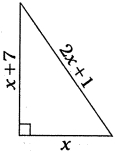
The hypotenuse of a garden in the shape of a right triangle is $1$ metre more than twice the shortest side. If the longer side containing the right angle is $7$ metres more than the shorter side,find the sides of the garden.
A
$10\,m, 5\,m, 3\,m$
B
$22\,m, 9\,m, 13\,m$
C
$14\,m, 23\,m, 10\,m$
D
$8\,m, 15\,m, 17\,m$
Solution
(D) Let the shorter side among the sides containing the right angle (i.e.,base) be $x$ metres.
Then,the other side containing the right angle (i.e.,altitude) is $(x+7)$ metres and the hypotenuse is $(2x+1)$ metres.
By Pythagoras' theorem,$(\text{Hypotenuse})^2 = (\text{Base})^2 + (\text{Altitude})^2$.
Therefore,$(2x+1)^2 = x^2 + (x+7)^2$.
$4x^2 + 4x + 1 = x^2 + x^2 + 14x + 49$.
$4x^2 + 4x + 1 = 2x^2 + 14x + 49$.
$2x^2 - 10x - 48 = 0$.
Dividing by $2$,we get $x^2 - 5x - 24 = 0$.
$(x-8)(x+3) = 0$.
So,$x=8$ or $x=-3$.
Since the side of a triangle cannot be negative,$x=8$.
Thus,the base is $8\,m$,the altitude is $8+7=15\,m$,and the hypotenuse is $2(8)+1=17\,m$.
The sides of the garden are $8\,m, 15\,m$ and $17\,m$.
Then,the other side containing the right angle (i.e.,altitude) is $(x+7)$ metres and the hypotenuse is $(2x+1)$ metres.
By Pythagoras' theorem,$(\text{Hypotenuse})^2 = (\text{Base})^2 + (\text{Altitude})^2$.
Therefore,$(2x+1)^2 = x^2 + (x+7)^2$.
$4x^2 + 4x + 1 = x^2 + x^2 + 14x + 49$.
$4x^2 + 4x + 1 = 2x^2 + 14x + 49$.
$2x^2 - 10x - 48 = 0$.
Dividing by $2$,we get $x^2 - 5x - 24 = 0$.
$(x-8)(x+3) = 0$.
So,$x=8$ or $x=-3$.
Since the side of a triangle cannot be negative,$x=8$.
Thus,the base is $8\,m$,the altitude is $8+7=15\,m$,and the hypotenuse is $2(8)+1=17\,m$.
The sides of the garden are $8\,m, 15\,m$ and $17\,m$.
0 likes
View Solution237
MediumMCQ
The product of Virat Kohli's age $8$ years ago and $6$ years later is $680$. Find his present age.
A
$28$
B
$14$
C
$42$
D
$51$
Solution
(A) Let the present age of Virat Kohli be $x$ years.
Age $8$ years ago was $(x - 8)$ years.
Age $6$ years later will be $(x + 6)$ years.
According to the problem,the product of these ages is $680$:
$(x - 8)(x + 6) = 680$
$x^2 + 6x - 8x - 48 = 680$
$x^2 - 2x - 48 - 680 = 0$
$x^2 - 2x - 728 = 0$
Using the quadratic formula $x = \frac{-b \pm \sqrt{b^2 - 4ac}}{2a}$,where $a = 1, b = -2, c = -728$:
$x = \frac{2 \pm \sqrt{(-2)^2 - 4(1)(-728)}}{2(1)}$
$x = \frac{2 \pm \sqrt{4 + 2912}}{2}$
$x = \frac{2 \pm \sqrt{2916}}{2}$
$x = \frac{2 \pm 54}{2}$
Since age cannot be negative,we take the positive value:
$x = \frac{2 + 54}{2} = \frac{56}{2} = 28$
Therefore,his present age is $28$ years.
Age $8$ years ago was $(x - 8)$ years.
Age $6$ years later will be $(x + 6)$ years.
According to the problem,the product of these ages is $680$:
$(x - 8)(x + 6) = 680$
$x^2 + 6x - 8x - 48 = 680$
$x^2 - 2x - 48 - 680 = 0$
$x^2 - 2x - 728 = 0$
Using the quadratic formula $x = \frac{-b \pm \sqrt{b^2 - 4ac}}{2a}$,where $a = 1, b = -2, c = -728$:
$x = \frac{2 \pm \sqrt{(-2)^2 - 4(1)(-728)}}{2(1)}$
$x = \frac{2 \pm \sqrt{4 + 2912}}{2}$
$x = \frac{2 \pm \sqrt{2916}}{2}$
$x = \frac{2 \pm 54}{2}$
Since age cannot be negative,we take the positive value:
$x = \frac{2 + 54}{2} = \frac{56}{2} = 28$
Therefore,his present age is $28$ years.
0 likes
View Solution238
MediumMCQ
$A$ car takes $60$ minutes less for a journey of $150\,km$,if its speed is increased by $5\,km/hr$ from its usual speed. Find the original speed of the car in $km/hr$.
A
$20$
B
$25$
C
$26$
D
$49$
Solution
(B) Let the original speed of the car be $x\,km/hr$.
Time taken at original speed,$T_1 = \frac{150}{x}$ hours.
New speed = $(x + 5)\,km/hr$.
Time taken at new speed,$T_2 = \frac{150}{x + 5}$ hours.
Given that the car takes $60$ minutes ($1$ hour) less,so $T_1 - T_2 = 1$.
$\frac{150}{x} - \frac{150}{x + 5} = 1$.
$150(x + 5 - x) = x(x + 5)$.
$150(5) = x^2 + 5x$.
$x^2 + 5x - 750 = 0$.
$(x + 30)(x - 25) = 0$.
Since speed cannot be negative,$x = 25\,km/hr$.
Time taken at original speed,$T_1 = \frac{150}{x}$ hours.
New speed = $(x + 5)\,km/hr$.
Time taken at new speed,$T_2 = \frac{150}{x + 5}$ hours.
Given that the car takes $60$ minutes ($1$ hour) less,so $T_1 - T_2 = 1$.
$\frac{150}{x} - \frac{150}{x + 5} = 1$.
$150(x + 5 - x) = x(x + 5)$.
$150(5) = x^2 + 5x$.
$x^2 + 5x - 750 = 0$.
$(x + 30)(x - 25) = 0$.
Since speed cannot be negative,$x = 25\,km/hr$.
0 likes
View Solution239
MediumMCQ
The speed of a motorboat in still water is $25 \text{ km/hr}$. In a river, it covers $60 \text{ km}$ downstream and the same distance upstream in a total time of $5 \text{ hours}$. Find the speed of the current of the river. (The speed of the current of the river is less than the speed of the motorboat in still water.) (in $\text{ km/hr}$)
A
$5$
B
$10$
C
$15$
D
$20$
Solution
(A) Let the speed of the current be $x \text{ km/hr}$.
Given, speed of motorboat in still water = $25 \text{ km/hr}$.
Speed downstream = $(25 + x) \text{ km/hr}$.
Speed upstream = $(25 - x) \text{ km/hr}$.
Time taken to travel $60 \text{ km}$ downstream = $\frac{60}{25 + x} \text{ hours}$.
Time taken to travel $60 \text{ km}$ upstream = $\frac{60}{25 - x} \text{ hours}$.
Total time = $5 \text{ hours}$.
So, $\frac{60}{25 + x} + \frac{60}{25 - x} = 5$.
Divide by $5$: $\frac{12}{25 + x} + \frac{12}{25 - x} = 1$.
$12(25 - x + 25 + x) = (25 + x)(25 - x)$.
$12(50) = 625 - x^2$.
$600 = 625 - x^2$.
$x^2 = 25$.
$x = 5 \text{ km/hr}$ (since speed cannot be negative).
Thus, the speed of the current is $5 \text{ km/hr}$.
Given, speed of motorboat in still water = $25 \text{ km/hr}$.
Speed downstream = $(25 + x) \text{ km/hr}$.
Speed upstream = $(25 - x) \text{ km/hr}$.
Time taken to travel $60 \text{ km}$ downstream = $\frac{60}{25 + x} \text{ hours}$.
Time taken to travel $60 \text{ km}$ upstream = $\frac{60}{25 - x} \text{ hours}$.
Total time = $5 \text{ hours}$.
So, $\frac{60}{25 + x} + \frac{60}{25 - x} = 5$.
Divide by $5$: $\frac{12}{25 + x} + \frac{12}{25 - x} = 1$.
$12(25 - x + 25 + x) = (25 + x)(25 - x)$.
$12(50) = 625 - x^2$.
$600 = 625 - x^2$.
$x^2 = 25$.
$x = 5 \text{ km/hr}$ (since speed cannot be negative).
Thus, the speed of the current is $5 \text{ km/hr}$.
0 likes
View Solution240
MediumMCQ
$120$ kites were divided equally among a certain number of children in a school. If there were $4$ children fewer,each child would have received $1$ kite more. Find the number of children.
A
$12$
B
$6$
C
$20$
D
$24$
Solution
(D) Let the number of children be $x$.
Each child receives $\frac{120}{x}$ kites.
If there are $4$ children fewer,the number of children is $(x - 4)$.
In this case,each child receives $\frac{120}{x - 4}$ kites.
According to the problem,$\frac{120}{x - 4} - \frac{120}{x} = 1$.
Multiplying by $x(x - 4)$,we get $120x - 120(x - 4) = x(x - 4)$.
$120x - 120x + 480 = x^2 - 4x$.
$x^2 - 4x - 480 = 0$.
Factoring the quadratic equation: $(x - 24)(x + 20) = 0$.
Since the number of children cannot be negative,$x = 24$.
Each child receives $\frac{120}{x}$ kites.
If there are $4$ children fewer,the number of children is $(x - 4)$.
In this case,each child receives $\frac{120}{x - 4}$ kites.
According to the problem,$\frac{120}{x - 4} - \frac{120}{x} = 1$.
Multiplying by $x(x - 4)$,we get $120x - 120(x - 4) = x(x - 4)$.
$120x - 120x + 480 = x^2 - 4x$.
$x^2 - 4x - 480 = 0$.
Factoring the quadratic equation: $(x - 24)(x + 20) = 0$.
Since the number of children cannot be negative,$x = 24$.
0 likes
View Solution241
DifficultMCQ
The difference between the lengths of the sides of a right triangle which form the right angle is $7 \, cm$. If its perimeter is $30 \, cm$,find the lengths of the sides.
A
$5 \, cm, 12 \, cm, 13 \, cm$
B
$15 \, cm, 24 \, cm, 13 \, cm$
C
$5 \, cm, 20 \, cm, 26 \, cm$
D
$10 \, cm, 22 \, cm, 26 \, cm$
Solution
(A) Let the two sides forming the right angle be $x \, cm$ and $(x + 7) \, cm$.
By the Pythagorean theorem,the hypotenuse is $\sqrt{x^2 + (x + 7)^2} = \sqrt{x^2 + x^2 + 14x + 49} = \sqrt{2x^2 + 14x + 49}$.
The perimeter is given as $30 \, cm$,so $x + (x + 7) + \sqrt{2x^2 + 14x + 49} = 30$.
$2x + 7 + \sqrt{2x^2 + 14x + 49} = 30$.
$\sqrt{2x^2 + 14x + 49} = 23 - 2x$.
Squaring both sides: $2x^2 + 14x + 49 = (23 - 2x)^2$.
$2x^2 + 14x + 49 = 529 - 92x + 4x^2$.
$2x^2 - 106x + 480 = 0$.
$x^2 - 53x + 240 = 0$.
$(x - 5)(x - 48) = 0$.
Since $x$ cannot be $48$ (as the perimeter is $30$),$x = 5$.
The sides are $5 \, cm$,$5 + 7 = 12 \, cm$,and the hypotenuse is $\sqrt{5^2 + 12^2} = \sqrt{25 + 144} = \sqrt{169} = 13 \, cm$.
By the Pythagorean theorem,the hypotenuse is $\sqrt{x^2 + (x + 7)^2} = \sqrt{x^2 + x^2 + 14x + 49} = \sqrt{2x^2 + 14x + 49}$.
The perimeter is given as $30 \, cm$,so $x + (x + 7) + \sqrt{2x^2 + 14x + 49} = 30$.
$2x + 7 + \sqrt{2x^2 + 14x + 49} = 30$.
$\sqrt{2x^2 + 14x + 49} = 23 - 2x$.
Squaring both sides: $2x^2 + 14x + 49 = (23 - 2x)^2$.
$2x^2 + 14x + 49 = 529 - 92x + 4x^2$.
$2x^2 - 106x + 480 = 0$.
$x^2 - 53x + 240 = 0$.
$(x - 5)(x - 48) = 0$.
Since $x$ cannot be $48$ (as the perimeter is $30$),$x = 5$.
The sides are $5 \, cm$,$5 + 7 = 12 \, cm$,and the hypotenuse is $\sqrt{5^2 + 12^2} = \sqrt{25 + 144} = \sqrt{169} = 13 \, cm$.
0 likes
View Solution242
DifficultMCQ
The length of a rectangular garden exceeds its breadth by $6 \, m$. If the area of the garden is $216 \, m^2$,find the length and the breadth of the garden.
A
length $: 10 \, m, \text{ breadth } : 3 \, m$
B
length $: 18 \, m, \text{ breadth } : 12 \, m$
C
length $: 20 \, m, \text{ breadth } : 13 \, m$
D
length $: 24 \, m, \text{ breadth } : 6 \, m$
Solution
(B) Let the breadth of the rectangular garden be $x \, m$.
Then,the length of the garden is $(x + 6) \, m$.
The area of the rectangle is given by $\text{length} \times \text{breadth} = 216 \, m^2$.
So,$x(x + 6) = 216$.
$x^2 + 6x - 216 = 0$.
To solve this quadratic equation,we factorize it: $x^2 + 18x - 12x - 216 = 0$.
$x(x + 18) - 12(x + 18) = 0$.
$(x - 12)(x + 18) = 0$.
Since the breadth cannot be negative,we take $x = 12$.
Thus,the breadth is $12 \, m$ and the length is $12 + 6 = 18 \, m$.
Then,the length of the garden is $(x + 6) \, m$.
The area of the rectangle is given by $\text{length} \times \text{breadth} = 216 \, m^2$.
So,$x(x + 6) = 216$.
$x^2 + 6x - 216 = 0$.
To solve this quadratic equation,we factorize it: $x^2 + 18x - 12x - 216 = 0$.
$x(x + 18) - 12(x + 18) = 0$.
$(x - 12)(x + 18) = 0$.
Since the breadth cannot be negative,we take $x = 12$.
Thus,the breadth is $12 \, m$ and the length is $12 + 6 = 18 \, m$.
0 likes
View Solution243
DifficultMCQ
While selling a flowerpot for Rs. $96$,the profit percentage is equal to its cost price in rupees. Find the cost price of the flowerpot.
A
$47$
B
$69$
C
$50$
D
$60$
Solution
(D) Let the cost price of the flowerpot be $x$ rupees.
Given that the profit percentage is equal to the cost price,the profit percentage is $x\%$.
Profit = $\frac{x}{100} \times x = \frac{x^2}{100}$.
Selling Price = Cost Price + Profit = $x + \frac{x^2}{100}$.
Given that the selling price is Rs. $96$,we have the equation: $x + \frac{x^2}{100} = 96$.
Multiplying the entire equation by $100$,we get $100x + x^2 = 9600$.
Rearranging into a standard quadratic equation: $x^2 + 100x - 9600 = 0$.
Factoring the quadratic equation: $x^2 + 160x - 60x - 9600 = 0$.
$x(x + 160) - 60(x + 160) = 0$.
$(x - 60)(x + 160) = 0$.
This gives $x = 60$ or $x = -160$.
Since the cost price cannot be negative,the cost price is Rs. $60$.
Given that the profit percentage is equal to the cost price,the profit percentage is $x\%$.
Profit = $\frac{x}{100} \times x = \frac{x^2}{100}$.
Selling Price = Cost Price + Profit = $x + \frac{x^2}{100}$.
Given that the selling price is Rs. $96$,we have the equation: $x + \frac{x^2}{100} = 96$.
Multiplying the entire equation by $100$,we get $100x + x^2 = 9600$.
Rearranging into a standard quadratic equation: $x^2 + 100x - 9600 = 0$.
Factoring the quadratic equation: $x^2 + 160x - 60x - 9600 = 0$.
$x(x + 160) - 60(x + 160) = 0$.
$(x - 60)(x + 160) = 0$.
This gives $x = 60$ or $x = -160$.
Since the cost price cannot be negative,the cost price is Rs. $60$.
0 likes
View Solution244
DifficultMCQ
While selling a pen for Rs. $24$, the loss percentage is equal to its cost price in rupees. Find the cost price of the pen.
A
Rs. $55$ or Rs. $45$
B
Rs. $50$ or Rs. $50$
C
Rs. $70$ or Rs. $30$
D
Rs. $40$ or Rs. $60$
Solution
(D) Let the cost price of the pen be $x$ rupees.
Given that the loss percentage is equal to the cost price, the loss percentage $= x\%$.
Loss $= \text{Cost Price} - \text{Selling Price} = x - 24$.
Also, $\text{Loss} = \text{Cost Price} \times \frac{\text{Loss Percentage}}{100} = x \times \frac{x}{100} = \frac{x^2}{100}$.
Equating the two expressions for loss: $x - 24 = \frac{x^2}{100}$.
$100x - 2400 = x^2$.
$x^2 - 100x + 2400 = 0$.
Factoring the quadratic equation: $(x - 60)(x - 40) = 0$.
Therefore, $x = 60$ or $x = 40$.
Thus, the cost price of the pen is Rs. $40$ or Rs. $60$.
Given that the loss percentage is equal to the cost price, the loss percentage $= x\%$.
Loss $= \text{Cost Price} - \text{Selling Price} = x - 24$.
Also, $\text{Loss} = \text{Cost Price} \times \frac{\text{Loss Percentage}}{100} = x \times \frac{x}{100} = \frac{x^2}{100}$.
Equating the two expressions for loss: $x - 24 = \frac{x^2}{100}$.
$100x - 2400 = x^2$.
$x^2 - 100x + 2400 = 0$.
Factoring the quadratic equation: $(x - 60)(x - 40) = 0$.
Therefore, $x = 60$ or $x = 40$.
Thus, the cost price of the pen is Rs. $40$ or Rs. $60$.
0 likes
View Solution245
EasyMCQ
Solve the following equation using the method of factorization: $x^{2} - 7 = 0$.
A
$-\sqrt{7}, \sqrt{7}$
B
$\sqrt{7}, \sqrt{7}$
C
$\sqrt{7}, -\sqrt{7}$
D
$-\sqrt{7}, -\sqrt{7}$
Solution
(A) Given the quadratic equation: $x^{2} - 7 = 0$.
We can rewrite this as: $x^{2} - (\sqrt{7})^{2} = 0$.
Using the algebraic identity $a^{2} - b^{2} = (a - b)(a + b)$,we get:
$(x - \sqrt{7})(x + \sqrt{7}) = 0$.
Setting each factor to zero:
$x - \sqrt{7} = 0 \implies x = \sqrt{7}$.
$x + \sqrt{7} = 0 \implies x = -\sqrt{7}$.
Thus,the solutions are $x = \sqrt{7}$ and $x = -\sqrt{7}$.
We can rewrite this as: $x^{2} - (\sqrt{7})^{2} = 0$.
Using the algebraic identity $a^{2} - b^{2} = (a - b)(a + b)$,we get:
$(x - \sqrt{7})(x + \sqrt{7}) = 0$.
Setting each factor to zero:
$x - \sqrt{7} = 0 \implies x = \sqrt{7}$.
$x + \sqrt{7} = 0 \implies x = -\sqrt{7}$.
Thus,the solutions are $x = \sqrt{7}$ and $x = -\sqrt{7}$.
0 likes
View Solution246
EasyMCQ
Solve the following quadratic equation using the method of factorization: $x^{2} + 5x - 66 = 0$.
A
$10, -6$
B
$-11, 6$
C
$7, 9$
D
$-23, 8$
Solution
(B) To solve the quadratic equation $x^{2} + 5x - 66 = 0$ by factorization,we need to find two numbers whose product is $-66$ and whose sum is $5$.
These two numbers are $11$ and $-6$,since $11 \times (-6) = -66$ and $11 + (-6) = 5$.
Now,rewrite the middle term $5x$ as $11x - 6x$:
$x^{2} + 11x - 6x - 66 = 0$
Group the terms to factorize:
$x(x + 11) - 6(x + 11) = 0$
$(x - 6)(x + 11) = 0$
Setting each factor to zero:
$x - 6 = 0 \implies x = 6$
$x + 11 = 0 \implies x = -11$
Thus,the solutions are $x = 6$ and $x = -11$.
These two numbers are $11$ and $-6$,since $11 \times (-6) = -66$ and $11 + (-6) = 5$.
Now,rewrite the middle term $5x$ as $11x - 6x$:
$x^{2} + 11x - 6x - 66 = 0$
Group the terms to factorize:
$x(x + 11) - 6(x + 11) = 0$
$(x - 6)(x + 11) = 0$
Setting each factor to zero:
$x - 6 = 0 \implies x = 6$
$x + 11 = 0 \implies x = -11$
Thus,the solutions are $x = 6$ and $x = -11$.
0 likes
View Solution247
DifficultMCQ
Solve the following equation using the method of factorization: $\frac{x-1}{x-2} + \frac{x-3}{x-4} = 3 \frac{1}{3}$ (where $x \neq 2, 4$).
A
$2, \frac{1}{2}$
B
$\frac{1}{2}, 1$
C
$5, \frac{5}{2}$
D
$-\frac{5}{3}, -2$
Solution
(C) Given equation: $\frac{x-1}{x-2} + \frac{x-3}{x-4} = \frac{10}{3}$.
Taking $LCM$ on the left side: $\frac{(x-1)(x-4) + (x-3)(x-2)}{(x-2)(x-4)} = \frac{10}{3}$.
Expanding the terms: $\frac{(x^2 - 5x + 4) + (x^2 - 5x + 6)}{x^2 - 6x + 8} = \frac{10}{3}$.
Simplifying: $\frac{2x^2 - 10x + 10}{x^2 - 6x + 8} = \frac{10}{3}$.
Dividing numerator by $2$: $\frac{2(x^2 - 5x + 5)}{x^2 - 6x + 8} = \frac{10}{3} \implies \frac{x^2 - 5x + 5}{x^2 - 6x + 8} = \frac{5}{3}$.
Cross-multiplying: $3(x^2 - 5x + 5) = 5(x^2 - 6x + 8)$.
$3x^2 - 15x + 15 = 5x^2 - 30x + 40$.
Rearranging terms: $2x^2 - 15x + 25 = 0$.
Factorizing: $2x^2 - 10x - 5x + 25 = 0 \implies 2x(x - 5) - 5(x - 5) = 0$.
$(2x - 5)(x - 5) = 0$.
Thus,$x = 5$ or $x = \frac{5}{2}$.
Taking $LCM$ on the left side: $\frac{(x-1)(x-4) + (x-3)(x-2)}{(x-2)(x-4)} = \frac{10}{3}$.
Expanding the terms: $\frac{(x^2 - 5x + 4) + (x^2 - 5x + 6)}{x^2 - 6x + 8} = \frac{10}{3}$.
Simplifying: $\frac{2x^2 - 10x + 10}{x^2 - 6x + 8} = \frac{10}{3}$.
Dividing numerator by $2$: $\frac{2(x^2 - 5x + 5)}{x^2 - 6x + 8} = \frac{10}{3} \implies \frac{x^2 - 5x + 5}{x^2 - 6x + 8} = \frac{5}{3}$.
Cross-multiplying: $3(x^2 - 5x + 5) = 5(x^2 - 6x + 8)$.
$3x^2 - 15x + 15 = 5x^2 - 30x + 40$.
Rearranging terms: $2x^2 - 15x + 25 = 0$.
Factorizing: $2x^2 - 10x - 5x + 25 = 0 \implies 2x(x - 5) - 5(x - 5) = 0$.
$(2x - 5)(x - 5) = 0$.
Thus,$x = 5$ or $x = \frac{5}{2}$.
0 likes
View Solution248
EasyMCQ
Solve the following quadratic equation using the method of factorization: $3x^{2} = -11x - 10$.
A
$-\frac{3}{2}, -\frac{1}{3}$
B
$-4, \frac{5}{3}$
C
$5, \frac{5}{2}$
D
$-\frac{5}{3}, -2$
Solution
(D) Given equation: $3x^{2} = -11x - 10$.
Rearranging the terms to standard form $ax^{2} + bx + c = 0$:
$3x^{2} + 11x + 10 = 0$.
To factorize,we need two numbers whose product is $3 \times 10 = 30$ and whose sum is $11$.
These numbers are $6$ and $5$.
Splitting the middle term:
$3x^{2} + 6x + 5x + 10 = 0$.
Grouping the terms:
$3x(x + 2) + 5(x + 2) = 0$.
$(3x + 5)(x + 2) = 0$.
Setting each factor to zero:
$3x + 5 = 0 \implies x = -\frac{5}{3}$.
$x + 2 = 0 \implies x = -2$.
Therefore,the solutions are $x = -\frac{5}{3}, -2$.
Rearranging the terms to standard form $ax^{2} + bx + c = 0$:
$3x^{2} + 11x + 10 = 0$.
To factorize,we need two numbers whose product is $3 \times 10 = 30$ and whose sum is $11$.
These numbers are $6$ and $5$.
Splitting the middle term:
$3x^{2} + 6x + 5x + 10 = 0$.
Grouping the terms:
$3x(x + 2) + 5(x + 2) = 0$.
$(3x + 5)(x + 2) = 0$.
Setting each factor to zero:
$3x + 5 = 0 \implies x = -\frac{5}{3}$.
$x + 2 = 0 \implies x = -2$.
Therefore,the solutions are $x = -\frac{5}{3}, -2$.
0 likes
View Solution249
EasyMCQ
Solve the following equation using the method of factorization: $x^{2} + (x + 5)^{2} = 625$
A
$15, -20$
B
$-15, 15$
C
$25, -15$
D
$20, -25$
Solution
(A) Given equation: $x^{2} + (x + 5)^{2} = 625$
Expand the square: $x^{2} + (x^{2} + 10x + 25) = 625$
Combine like terms: $2x^{2} + 10x + 25 = 625$
Subtract $625$ from both sides: $2x^{2} + 10x - 600 = 0$
Divide the entire equation by $2$: $x^{2} + 5x - 300 = 0$
Factorize the quadratic equation by splitting the middle term: $x^{2} + 20x - 15x - 300 = 0$
Group the terms: $x(x + 20) - 15(x + 20) = 0$
Factor out $(x + 20)$: $(x + 20)(x - 15) = 0$
Set each factor to zero: $x + 20 = 0$ or $x - 15 = 0$
Therefore,the solutions are $x = -20$ and $x = 15$.
Expand the square: $x^{2} + (x^{2} + 10x + 25) = 625$
Combine like terms: $2x^{2} + 10x + 25 = 625$
Subtract $625$ from both sides: $2x^{2} + 10x - 600 = 0$
Divide the entire equation by $2$: $x^{2} + 5x - 300 = 0$
Factorize the quadratic equation by splitting the middle term: $x^{2} + 20x - 15x - 300 = 0$
Group the terms: $x(x + 20) - 15(x + 20) = 0$
Factor out $(x + 20)$: $(x + 20)(x - 15) = 0$
Set each factor to zero: $x + 20 = 0$ or $x - 15 = 0$
Therefore,the solutions are $x = -20$ and $x = 15$.
0 likes
View Solution250
EasyMCQ
Solve the following quadratic equation using the method of factorization: $2x^2 + ax - a^2 = 0$.
A
$a, -\frac{a}{2}$
B
$-a, \frac{a}{2}$
C
$-a, -\frac{a}{2}$
D
$a, \frac{a}{2}$
Solution
(B) To solve the quadratic equation $2x^2 + ax - a^2 = 0$ by factorization,we need to split the middle term $ax$ into two parts such that their product is $(2x^2) \times (-a^2) = -2a^2x^2$ and their sum is $ax$.
We can write $ax$ as $2ax - ax$.
Substituting this into the equation: $2x^2 + 2ax - ax - a^2 = 0$.
Grouping the terms: $2x(x + a) - a(x + a) = 0$.
Factoring out the common term $(x + a)$: $(2x - a)(x + a) = 0$.
Setting each factor to zero:
$1$) $2x - a = 0 \implies 2x = a \implies x = \frac{a}{2}$.
$2$) $x + a = 0 \implies x = -a$.
Therefore,the solutions are $x = -a$ and $x = \frac{a}{2}$.
We can write $ax$ as $2ax - ax$.
Substituting this into the equation: $2x^2 + 2ax - ax - a^2 = 0$.
Grouping the terms: $2x(x + a) - a(x + a) = 0$.
Factoring out the common term $(x + a)$: $(2x - a)(x + a) = 0$.
Setting each factor to zero:
$1$) $2x - a = 0 \implies 2x = a \implies x = \frac{a}{2}$.
$2$) $x + a = 0 \implies x = -a$.
Therefore,the solutions are $x = -a$ and $x = \frac{a}{2}$.
0 likes
View SolutionQuadratic Equations — Mix Examples - Quadratic Equations · Frequently Asked Questions
1Are these Quadratic Equations questions useful for JEE and NEET?
Yes. All questions in this section are mapped to JEE Main and NEET exam patterns. Previous year questions from JEE Main, NEET, GUJCET and state-level exams are included with full solutions.
2Can I switch to Hindi or Gujarati for these questions?
Yes. Use the language tabs in the hero section or the sidebar to view the same questions and solutions in English, Hindi or Gujarati.
3How do I generate a question paper from this subtopic?
Use the Vedclass Exam Paper Generator — select the chapter and subtopic, set difficulty, and generate Sets A, B, C, D automatically. First 3 chapters of every subject are free.
Vedclass Products
For Students
Vedclass Test Series
Mock tests in real JEE/NEET style with performance analysis. 5-day free trial.
Start Free TrialFor Teachers
Exam Paper Generator
Generate Set A/B/C/D papers from this chapter in 2 minutes. 3 chapters free.
Try FreeFor Institutes
Online Exam Module
Live online exams with unlimited students, 360° analytics & white-label branding.
See DemoFor Teachers & Institutes
Generate a Quadratic Equations Exam Paper in 2 Minutes
Select subtopic & difficulty — Sets A, B, C, D auto-generated with No Repeat logic.
First 3 chapters of every subject are free — no payment required.