
A English
Textbook - Coordinate Geometry Questions in English
Class 10 Mathematics · Coordinate Geometry · Textbook - Coordinate Geometry
59+
Questions
English
Language
100%
With Solutions
Showing 9 of 59 questions in English
51
Difficult
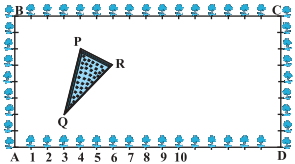
The Class $X$ students of a secondary school in Krishinagar have been allotted a rectangular plot of land for their gardening activity. Saplings of Gulmohar are planted on the boundary at a distance of $1\, m$ from each other. There is a triangular grassy lawn in the plot as shown in the Figure. The students are to sow seeds of flowering plants on the remaining area of the plot. Taking $A$ as origin,find the coordinates of the vertices of the triangle.
Solution
(N/A) Taking $A$ as the origin $(0,0)$,we consider $AD$ as the $x$-axis and $AB$ as the $y$-axis.
By observing the grid provided in the figure:
- The point $P$ is located at $4$ units along the $x$-axis and $6$ units along the $y$-axis,so its coordinates are $P(4, 6)$.
- The point $Q$ is located at $3$ units along the $x$-axis and $2$ units along the $y$-axis,so its coordinates are $Q(3, 2)$.
- The point $R$ is located at $6$ units along the $x$-axis and $5$ units along the $y$-axis,so its coordinates are $R(6, 5)$.
Thus,the coordinates of the vertices of the triangle are $P(4, 6)$,$Q(3, 2)$,and $R(6, 5)$.
By observing the grid provided in the figure:
- The point $P$ is located at $4$ units along the $x$-axis and $6$ units along the $y$-axis,so its coordinates are $P(4, 6)$.
- The point $Q$ is located at $3$ units along the $x$-axis and $2$ units along the $y$-axis,so its coordinates are $Q(3, 2)$.
- The point $R$ is located at $6$ units along the $x$-axis and $5$ units along the $y$-axis,so its coordinates are $R(6, 5)$.
Thus,the coordinates of the vertices of the triangle are $P(4, 6)$,$Q(3, 2)$,and $R(6, 5)$.
0 likes
View Solution52
Medium
The Class $X$ students of a secondary school in Krishinagar have been allotted a rectangular plot of land for their gardening activity. Saplings of Gulmohar are planted on the boundary at a distance of $1\, m$ from each other. There is a triangular grassy lawn in the plot as shown in the Figure. The students are to sow seeds of flowering plants on the remaining area of the plot.
What will be the coordinates of the vertices of $\Delta PQR$ if $C$ is the origin?
Also,calculate the area of the triangle in this case.
What will be the coordinates of the vertices of $\Delta PQR$ if $C$ is the origin?
Also,calculate the area of the triangle in this case.
Solution
(N/A) Taking $C$ as the origin $(0,0)$,$CB$ as the $x$-axis,and $CD$ as the $y$-axis:
$1$. The coordinates of the vertices are determined by counting the units from the origin $C$ along the axes.
$2$. The coordinates of the vertices $P, Q,$ and $R$ are $P(12, 2), Q(13, 6),$ and $R(10, 3)$.
$3$. The area of a triangle with vertices $(x_1, y_1), (x_2, y_2),$ and $(x_3, y_3)$ is given by:
$\text{Area} = \frac{1}{2} |x_1(y_2 - y_3) + x_2(y_3 - y_1) + x_3(y_1 - y_2)|$
$4$. Substituting the values:
$\text{Area} = \frac{1}{2} |12(6 - 3) + 13(3 - 2) + 10(2 - 6)|$
$\text{Area} = \frac{1}{2} |12(3) + 13(1) + 10(-4)|$
$\text{Area} = \frac{1}{2} |36 + 13 - 40|$
$\text{Area} = \frac{1}{2} |9| = 4.5 \text{ square units}$.
$1$. The coordinates of the vertices are determined by counting the units from the origin $C$ along the axes.
$2$. The coordinates of the vertices $P, Q,$ and $R$ are $P(12, 2), Q(13, 6),$ and $R(10, 3)$.
$3$. The area of a triangle with vertices $(x_1, y_1), (x_2, y_2),$ and $(x_3, y_3)$ is given by:
$\text{Area} = \frac{1}{2} |x_1(y_2 - y_3) + x_2(y_3 - y_1) + x_3(y_1 - y_2)|$
$4$. Substituting the values:
$\text{Area} = \frac{1}{2} |12(6 - 3) + 13(3 - 2) + 10(2 - 6)|$
$\text{Area} = \frac{1}{2} |12(3) + 13(1) + 10(-4)|$
$\text{Area} = \frac{1}{2} |36 + 13 - 40|$
$\text{Area} = \frac{1}{2} |9| = 4.5 \text{ square units}$.
0 likes
View Solution53
Difficult
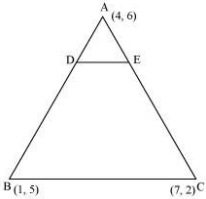
The vertices of a $\Delta ABC$ are $A(4, 6)$,$B(1, 5)$,and $C(7, 2)$. $A$ line is drawn to intersect sides $AB$ and $AC$ at $D$ and $E$ respectively,such that $\frac{AD}{AB} = \frac{AE}{AC} = \frac{1}{4}$. Calculate the area of $\Delta ADE$ and compare it with the area of $\Delta ABC$.
Solution
(1:16) Given that,$\frac{AD}{AB} = \frac{AE}{AC} = \frac{1}{4}$.
Since $\frac{AD}{AB} = \frac{AE}{AC}$,by the Converse of Thales Theorem (Basic Proportionality Theorem),$DE \parallel BC$.
Therefore,$\Delta ADE \sim \Delta ABC$ by $AA$ similarity criterion.
We know that the ratio of the areas of two similar triangles is equal to the square of the ratio of their corresponding sides.
Thus,$\frac{\text{Area}(\Delta ADE)}{\text{Area}(\Delta ABC)} = \left(\frac{AD}{AB}\right)^2 = \left(\frac{1}{4}\right)^2 = \frac{1}{16}$.
Now,calculate the area of $\Delta ABC$ using the coordinates $A(4, 6)$,$B(1, 5)$,and $C(7, 2)$:
Area $= \frac{1}{2} |x_1(y_2 - y_3) + x_2(y_3 - y_1) + x_3(y_1 - y_2)|$
Area $= \frac{1}{2} |4(5 - 2) + 1(2 - 6) + 7(6 - 5)|$
Area $= \frac{1}{2} |4(3) + 1(-4) + 7(1)| = \frac{1}{2} |12 - 4 + 7| = \frac{1}{2} |15| = 7.5$ square units.
Area of $\Delta ADE = \frac{1}{16} \times \text{Area}(\Delta ABC) = \frac{1}{16} \times 7.5 = \frac{7.5}{16} = \frac{15}{32}$ square units.
The ratio of the area of $\Delta ADE$ to the area of $\Delta ABC$ is $1:16$.
Since $\frac{AD}{AB} = \frac{AE}{AC}$,by the Converse of Thales Theorem (Basic Proportionality Theorem),$DE \parallel BC$.
Therefore,$\Delta ADE \sim \Delta ABC$ by $AA$ similarity criterion.
We know that the ratio of the areas of two similar triangles is equal to the square of the ratio of their corresponding sides.
Thus,$\frac{\text{Area}(\Delta ADE)}{\text{Area}(\Delta ABC)} = \left(\frac{AD}{AB}\right)^2 = \left(\frac{1}{4}\right)^2 = \frac{1}{16}$.
Now,calculate the area of $\Delta ABC$ using the coordinates $A(4, 6)$,$B(1, 5)$,and $C(7, 2)$:
Area $= \frac{1}{2} |x_1(y_2 - y_3) + x_2(y_3 - y_1) + x_3(y_1 - y_2)|$
Area $= \frac{1}{2} |4(5 - 2) + 1(2 - 6) + 7(6 - 5)|$
Area $= \frac{1}{2} |4(3) + 1(-4) + 7(1)| = \frac{1}{2} |12 - 4 + 7| = \frac{1}{2} |15| = 7.5$ square units.
Area of $\Delta ADE = \frac{1}{16} \times \text{Area}(\Delta ABC) = \frac{1}{16} \times 7.5 = \frac{7.5}{16} = \frac{15}{32}$ square units.
The ratio of the area of $\Delta ADE$ to the area of $\Delta ABC$ is $1:16$.
0 likes
View Solution54
Easy
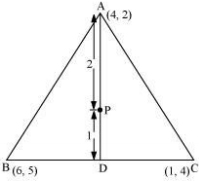
Let $A(4,2)$,$B(6,5)$,and $C(1,4)$ be the vertices of $\Delta ABC$. The median from $A$ meets $BC$ at $D$. Find the coordinates of the point $D$.
Solution
(N/A) The median $AD$ of the triangle divides the side $BC$ into two equal parts.
Therefore,$D$ is the mid-point of side $BC$.
The coordinates of the mid-point of a line segment with endpoints $(x_1, y_1)$ and $(x_2, y_2)$ are given by $\left(\frac{x_1+x_2}{2}, \frac{y_1+y_2}{2}\right)$.
Here,$B = (6, 5)$ and $C = (1, 4)$.
Coordinates of $D = \left(\frac{6+1}{2}, \frac{5+4}{2}\right) = \left(\frac{7}{2}, \frac{9}{2}\right)$ or $(3.5, 4.5)$.
Therefore,$D$ is the mid-point of side $BC$.
The coordinates of the mid-point of a line segment with endpoints $(x_1, y_1)$ and $(x_2, y_2)$ are given by $\left(\frac{x_1+x_2}{2}, \frac{y_1+y_2}{2}\right)$.
Here,$B = (6, 5)$ and $C = (1, 4)$.
Coordinates of $D = \left(\frac{6+1}{2}, \frac{5+4}{2}\right) = \left(\frac{7}{2}, \frac{9}{2}\right)$ or $(3.5, 4.5)$.
0 likes
View Solution55
Easy
Let $A(4, 2)$,$B(6, 5)$,and $C(1, 4)$ be the vertices of $\Delta ABC$. Find the coordinates of the point $P$ on the median $AD$ such that $AP : PD = 2 : 1$.
Solution
(N/A) $1$. First,find the coordinates of the midpoint $D$ of the side $BC$. Since $D$ is the midpoint of $BC$ with $B(6, 5)$ and $C(1, 4)$,the coordinates of $D$ are $\left(\frac{6+1}{2}, \frac{5+4}{2}\right) = \left(\frac{7}{2}, \frac{9}{2}\right)$.
$2$. Now,we need to find the coordinates of point $P$ that divides the line segment $AD$ in the ratio $m:n = 2:1$,where $A(4, 2)$ and $D(\frac{7}{2}, \frac{9}{2})$.
$3$. Using the section formula,the coordinates of $P$ are given by $\left(\frac{mx_2 + nx_1}{m+n}, \frac{my_2 + ny_1}{m+n}\right)$.
$4$. Substituting the values: $P = \left(\frac{2 \times \frac{7}{2} + 1 \times 4}{2+1}, \frac{2 \times \frac{9}{2} + 1 \times 2}{2+1}\right) = \left(\frac{7+4}{3}, \frac{9+2}{3}\right) = \left(\frac{11}{3}, \frac{11}{3}\right)$.
$2$. Now,we need to find the coordinates of point $P$ that divides the line segment $AD$ in the ratio $m:n = 2:1$,where $A(4, 2)$ and $D(\frac{7}{2}, \frac{9}{2})$.
$3$. Using the section formula,the coordinates of $P$ are given by $\left(\frac{mx_2 + nx_1}{m+n}, \frac{my_2 + ny_1}{m+n}\right)$.
$4$. Substituting the values: $P = \left(\frac{2 \times \frac{7}{2} + 1 \times 4}{2+1}, \frac{2 \times \frac{9}{2} + 1 \times 2}{2+1}\right) = \left(\frac{7+4}{3}, \frac{9+2}{3}\right) = \left(\frac{11}{3}, \frac{11}{3}\right)$.
0 likes
View Solution56
Medium
Let $A(4, 2)$,$B(6, 5)$,and $C(1, 4)$ be the vertices of $\Delta ABC$. Find the coordinates of points $Q$ and $R$ on medians $BE$ and $CF$ respectively such that $BQ : QE = 2 : 1$ and $CR : RF = 2 : 1$.
Solution
(N/A) The median $BE$ of the triangle divides the side $AC$ into two equal parts. Therefore,$E$ is the midpoint of side $AC$.
Coordinates of $E = \left(\frac{4+1}{2}, \frac{2+4}{2}\right) = \left(\frac{5}{2}, 3\right)$.
Point $Q$ divides the side $BE$ in a ratio $2 : 1$. Using the section formula:
Coordinates of $Q = \left(\frac{2 \times \frac{5}{2} + 1 \times 6}{2+1}, \frac{2 \times 3 + 1 \times 5}{2+1}\right) = \left(\frac{5+6}{3}, \frac{6+5}{3}\right) = \left(\frac{11}{3}, \frac{11}{3}\right)$.
The median $CF$ of the triangle divides the side $AB$ into two equal parts. Therefore,$F$ is the midpoint of side $AB$.
Coordinates of $F = \left(\frac{4+6}{2}, \frac{2+5}{2}\right) = \left(5, \frac{7}{2}\right)$.
Point $R$ divides the side $CF$ in a ratio $2 : 1$. Using the section formula:
Coordinates of $R = \left(\frac{2 \times 5 + 1 \times 1}{2+1}, \frac{2 \times \frac{7}{2} + 1 \times 4}{2+1}\right) = \left(\frac{10+1}{3}, \frac{7+4}{3}\right) = \left(\frac{11}{3}, \frac{11}{3}\right)$.
Coordinates of $E = \left(\frac{4+1}{2}, \frac{2+4}{2}\right) = \left(\frac{5}{2}, 3\right)$.
Point $Q$ divides the side $BE$ in a ratio $2 : 1$. Using the section formula:
Coordinates of $Q = \left(\frac{2 \times \frac{5}{2} + 1 \times 6}{2+1}, \frac{2 \times 3 + 1 \times 5}{2+1}\right) = \left(\frac{5+6}{3}, \frac{6+5}{3}\right) = \left(\frac{11}{3}, \frac{11}{3}\right)$.
The median $CF$ of the triangle divides the side $AB$ into two equal parts. Therefore,$F$ is the midpoint of side $AB$.
Coordinates of $F = \left(\frac{4+6}{2}, \frac{2+5}{2}\right) = \left(5, \frac{7}{2}\right)$.
Point $R$ divides the side $CF$ in a ratio $2 : 1$. Using the section formula:
Coordinates of $R = \left(\frac{2 \times 5 + 1 \times 1}{2+1}, \frac{2 \times \frac{7}{2} + 1 \times 4}{2+1}\right) = \left(\frac{10+1}{3}, \frac{7+4}{3}\right) = \left(\frac{11}{3}, \frac{11}{3}\right)$.
0 likes
View Solution57
Difficult
Let $A(4, 2)$,$B(6, 5)$,and $C(1, 4)$ be the vertices of $\Delta ABC$. What do you observe about the point $P$ which divides the median $AD$ in the ratio $2:1$?
Solution
(N/A) The coordinates of the vertices are $A(4, 2)$,$B(6, 5)$,and $C(1, 4)$.
First,find the midpoint $D$ of side $BC$ using the midpoint formula: $D = (\frac{x_1+x_2}{2}, \frac{y_1+y_2}{2}) = (\frac{6+1}{2}, \frac{5+4}{2}) = (3.5, 4.5)$.
Now,point $P$ divides the median $AD$ in the ratio $2:1$. Using the section formula $P = (\frac{mx_2+nx_1}{m+n}, \frac{my_2+ny_1}{m+n})$:
$P = (\frac{2(3.5) + 1(4)}{2+1}, \frac{2(4.5) + 1(2)}{2+1}) = (\frac{7+4}{3}, \frac{9+2}{3}) = (\frac{11}{3}, \frac{11}{3})$.
Next,calculate the centroid $G$ of $\Delta ABC$ using the formula $G = (\frac{x_1+x_2+x_3}{3}, \frac{y_1+y_2+y_3}{3})$:
$G = (\frac{4+6+1}{3}, \frac{2+5+4}{3}) = (\frac{11}{3}, \frac{11}{3})$.
Observation: The point $P$ is the same as the centroid $G$ of the triangle.
First,find the midpoint $D$ of side $BC$ using the midpoint formula: $D = (\frac{x_1+x_2}{2}, \frac{y_1+y_2}{2}) = (\frac{6+1}{2}, \frac{5+4}{2}) = (3.5, 4.5)$.
Now,point $P$ divides the median $AD$ in the ratio $2:1$. Using the section formula $P = (\frac{mx_2+nx_1}{m+n}, \frac{my_2+ny_1}{m+n})$:
$P = (\frac{2(3.5) + 1(4)}{2+1}, \frac{2(4.5) + 1(2)}{2+1}) = (\frac{7+4}{3}, \frac{9+2}{3}) = (\frac{11}{3}, \frac{11}{3})$.
Next,calculate the centroid $G$ of $\Delta ABC$ using the formula $G = (\frac{x_1+x_2+x_3}{3}, \frac{y_1+y_2+y_3}{3})$:
$G = (\frac{4+6+1}{3}, \frac{2+5+4}{3}) = (\frac{11}{3}, \frac{11}{3})$.
Observation: The point $P$ is the same as the centroid $G$ of the triangle.
0 likes
View Solution58
Medium
Let $A(4, 2), B(6, 5)$ and $C(1, 4)$ be the vertices of $\Delta ABC$. Find the coordinates of the centroid of the triangle.
Solution
(N/A) The coordinates of the centroid of a triangle with vertices $(x_1, y_1), (x_2, y_2),$ and $(x_3, y_3)$ are given by the formula:
Centroid $= \left( \frac{x_1 + x_2 + x_3}{3}, \frac{y_1 + y_2 + y_3}{3} \right)$
Given vertices are $A(4, 2), B(6, 5),$ and $C(1, 4)$.
Here,$x_1 = 4, y_1 = 2, x_2 = 6, y_2 = 5, x_3 = 1, y_3 = 4$.
Substituting these values into the formula:
Centroid $= \left( \frac{4 + 6 + 1}{3}, \frac{2 + 5 + 4}{3} \right)$
$= \left( \frac{11}{3}, \frac{11}{3} \right)$
Thus,the coordinates of the centroid are $\left( \frac{11}{3}, \frac{11}{3} \right)$.
Centroid $= \left( \frac{x_1 + x_2 + x_3}{3}, \frac{y_1 + y_2 + y_3}{3} \right)$
Given vertices are $A(4, 2), B(6, 5),$ and $C(1, 4)$.
Here,$x_1 = 4, y_1 = 2, x_2 = 6, y_2 = 5, x_3 = 1, y_3 = 4$.
Substituting these values into the formula:
Centroid $= \left( \frac{4 + 6 + 1}{3}, \frac{2 + 5 + 4}{3} \right)$
$= \left( \frac{11}{3}, \frac{11}{3} \right)$
Thus,the coordinates of the centroid are $\left( \frac{11}{3}, \frac{11}{3} \right)$.
0 likes
View Solution59
Difficult
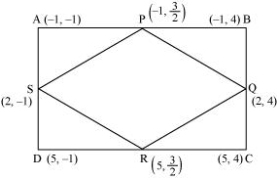
$ABCD$ is a rectangle formed by the points $A(-1, -1)$,$B(-1, 4)$,$C(5, 4)$,and $D(5, -1)$. $P, Q, R$,and $S$ are the mid-points of $AB, BC, CD$,and $DA$ respectively. Is the quadrilateral $PQRS$ a square,a rectangle,or a rhombus? Justify your answer.
Solution
(C) $P$ is the mid-point of side $AB$. Therefore,the coordinates of $P$ are $\left(\frac{-1-1}{2}, \frac{-1+4}{2}\right) = \left(-1, \frac{3}{2}\right)$.
Similarly,the coordinates of $Q, R$,and $S$ are $(2, 4)$,$\left(5, \frac{3}{2}\right)$,and $(2, -1)$ respectively.
Length of $PQ = \sqrt{(-1-2)^2 + \left(\frac{3}{2}-4\right)^2} = \sqrt{(-3)^2 + \left(-\frac{5}{2}\right)^2} = \sqrt{9 + \frac{25}{4}} = \sqrt{\frac{61}{4}}$.
Length of $QR = \sqrt{(2-5)^2 + \left(4-\frac{3}{2}\right)^2} = \sqrt{(-3)^2 + \left(\frac{5}{2}\right)^2} = \sqrt{9 + \frac{25}{4}} = \sqrt{\frac{61}{4}}$.
Length of $RS = \sqrt{(5-2)^2 + \left(\frac{3}{2}-(-1)\right)^2} = \sqrt{3^2 + \left(\frac{5}{2}\right)^2} = \sqrt{9 + \frac{25}{4}} = \sqrt{\frac{61}{4}}$.
Length of $SP = \sqrt{(2-(-1))^2 + \left(-1-\frac{3}{2}\right)^2} = \sqrt{3^2 + \left(-\frac{5}{2}\right)^2} = \sqrt{9 + \frac{25}{4}} = \sqrt{\frac{61}{4}}$.
Length of diagonal $PR = \sqrt{(-1-5)^2 + \left(\frac{3}{2}-\frac{3}{2}\right)^2} = \sqrt{(-6)^2 + 0^2} = 6$.
Length of diagonal $QS = \sqrt{(2-2)^2 + (4-(-1))^2} = \sqrt{0^2 + 5^2} = 5$.
Since all sides are equal $(PQ = QR = RS = SP = \sqrt{\frac{61}{4}})$ and the diagonals are not equal $(PR \neq QS)$,the quadrilateral $PQRS$ is a rhombus.
Similarly,the coordinates of $Q, R$,and $S$ are $(2, 4)$,$\left(5, \frac{3}{2}\right)$,and $(2, -1)$ respectively.
Length of $PQ = \sqrt{(-1-2)^2 + \left(\frac{3}{2}-4\right)^2} = \sqrt{(-3)^2 + \left(-\frac{5}{2}\right)^2} = \sqrt{9 + \frac{25}{4}} = \sqrt{\frac{61}{4}}$.
Length of $QR = \sqrt{(2-5)^2 + \left(4-\frac{3}{2}\right)^2} = \sqrt{(-3)^2 + \left(\frac{5}{2}\right)^2} = \sqrt{9 + \frac{25}{4}} = \sqrt{\frac{61}{4}}$.
Length of $RS = \sqrt{(5-2)^2 + \left(\frac{3}{2}-(-1)\right)^2} = \sqrt{3^2 + \left(\frac{5}{2}\right)^2} = \sqrt{9 + \frac{25}{4}} = \sqrt{\frac{61}{4}}$.
Length of $SP = \sqrt{(2-(-1))^2 + \left(-1-\frac{3}{2}\right)^2} = \sqrt{3^2 + \left(-\frac{5}{2}\right)^2} = \sqrt{9 + \frac{25}{4}} = \sqrt{\frac{61}{4}}$.
Length of diagonal $PR = \sqrt{(-1-5)^2 + \left(\frac{3}{2}-\frac{3}{2}\right)^2} = \sqrt{(-6)^2 + 0^2} = 6$.
Length of diagonal $QS = \sqrt{(2-2)^2 + (4-(-1))^2} = \sqrt{0^2 + 5^2} = 5$.
Since all sides are equal $(PQ = QR = RS = SP = \sqrt{\frac{61}{4}})$ and the diagonals are not equal $(PR \neq QS)$,the quadrilateral $PQRS$ is a rhombus.
0 likes
View SolutionCoordinate Geometry — Textbook - Coordinate Geometry · Frequently Asked Questions
1Are these Coordinate Geometry questions useful for JEE and NEET?
Yes. All questions in this section are mapped to JEE Main and NEET exam patterns. Previous year questions from JEE Main, NEET, GUJCET and state-level exams are included with full solutions.
2Can I switch to Hindi or Gujarati for these questions?
Yes. Use the language tabs in the hero section or the sidebar to view the same questions and solutions in English, Hindi or Gujarati.
3How do I generate a question paper from this subtopic?
Use the Vedclass Exam Paper Generator — select the chapter and subtopic, set difficulty, and generate Sets A, B, C, D automatically. First 3 chapters of every subject are free.
Vedclass Products
For Students
Vedclass Test Series
Mock tests in real JEE/NEET style with performance analysis. 5-day free trial.
Start Free TrialFor Teachers
Exam Paper Generator
Generate Set A/B/C/D papers from this chapter in 2 minutes. 3 chapters free.
Try FreeFor Institutes
Online Exam Module
Live online exams with unlimited students, 360° analytics & white-label branding.
See DemoFor Teachers & Institutes
Generate a Coordinate Geometry Exam Paper in 2 Minutes
Select subtopic & difficulty — Sets A, B, C, D auto-generated with No Repeat logic.
First 3 chapters of every subject are free — no payment required.