
A English
Textbook -Arithmetic Progressions Questions in English
Class 10 Mathematics · Arithmetic Progressions · Textbook -Arithmetic Progressions
114+
Questions
English
Language
100%
With Solutions
Showing 14 of 114 questions in English
101
DifficultMCQ
Find the sum of the first $40$ positive integers divisible by $6$.
A
$4920$
B
$4967$
C
$4939$
D
$4989$
Solution
(A) The positive integers that are divisible by $6$ are $6, 12, 18, 24, \ldots$
This sequence forms an Arithmetic Progression $(A.P.)$ where the first term $a = 6$ and the common difference $d = 6$.
We need to find the sum of the first $n = 40$ terms.
The formula for the sum of the first $n$ terms of an $A.P.$ is $S_n = \frac{n}{2}[2a + (n - 1)d]$.
Substituting the values $n = 40$,$a = 6$,and $d = 6$:
$S_{40} = \frac{40}{2}[2(6) + (40 - 1)6]$
$S_{40} = 20[12 + (39)(6)]$
$S_{40} = 20[12 + 234]$
$S_{40} = 20 \times 246$
$S_{40} = 4920$.
This sequence forms an Arithmetic Progression $(A.P.)$ where the first term $a = 6$ and the common difference $d = 6$.
We need to find the sum of the first $n = 40$ terms.
The formula for the sum of the first $n$ terms of an $A.P.$ is $S_n = \frac{n}{2}[2a + (n - 1)d]$.
Substituting the values $n = 40$,$a = 6$,and $d = 6$:
$S_{40} = \frac{40}{2}[2(6) + (40 - 1)6]$
$S_{40} = 20[12 + (39)(6)]$
$S_{40} = 20[12 + 234]$
$S_{40} = 20 \times 246$
$S_{40} = 4920$.
0 likes
View Solution102
MediumMCQ
Find the sum of the first $15$ multiples of $8.$
A
$965$
B
$960$
C
$970$
D
$975$
Solution
(B) The multiples of $8$ are $8, 16, 24, 32, \ldots$
These numbers form an Arithmetic Progression $(A.P.)$ where the first term $a = 8$ and the common difference $d = 8$.
We need to find the sum of the first $n = 15$ terms.
The formula for the sum of the first $n$ terms of an $A.P.$ is $S_n = \frac{n}{2}[2a + (n - 1)d]$.
Substituting the values: $S_{15} = \frac{15}{2}[2(8) + (15 - 1)8]$.
$S_{15} = \frac{15}{2}[16 + 14(8)]$.
$S_{15} = \frac{15}{2}[16 + 112]$.
$S_{15} = \frac{15}{2}(128)$.
$S_{15} = 15 \times 64 = 960$.
These numbers form an Arithmetic Progression $(A.P.)$ where the first term $a = 8$ and the common difference $d = 8$.
We need to find the sum of the first $n = 15$ terms.
The formula for the sum of the first $n$ terms of an $A.P.$ is $S_n = \frac{n}{2}[2a + (n - 1)d]$.
Substituting the values: $S_{15} = \frac{15}{2}[2(8) + (15 - 1)8]$.
$S_{15} = \frac{15}{2}[16 + 14(8)]$.
$S_{15} = \frac{15}{2}[16 + 112]$.
$S_{15} = \frac{15}{2}(128)$.
$S_{15} = 15 \times 64 = 960$.
0 likes
View Solution103
DifficultMCQ
Find the sum of the odd numbers between $0$ and $50$.
A
$630$
B
$635$
C
$625$
D
$620$
Solution
(C) The odd numbers between $0$ and $50$ are $1, 3, 5, 7, 9, \ldots, 49$.
These numbers form an Arithmetic Progression $(A.P.)$ where the first term $a = 1$,the common difference $d = 2$,and the last term $l = 49$.
Using the formula for the $n^{th}$ term: $l = a + (n - 1)d$.
$49 = 1 + (n - 1)2$
$48 = 2(n - 1)$
$n - 1 = 24$
$n = 25$.
Now,using the sum formula $S_n = \frac{n}{2}(a + l)$:
$S_{25} = \frac{25}{2}(1 + 49)$
$S_{25} = \frac{25}{2}(50)$
$S_{25} = 25 \times 25 = 625$.
These numbers form an Arithmetic Progression $(A.P.)$ where the first term $a = 1$,the common difference $d = 2$,and the last term $l = 49$.
Using the formula for the $n^{th}$ term: $l = a + (n - 1)d$.
$49 = 1 + (n - 1)2$
$48 = 2(n - 1)$
$n - 1 = 24$
$n = 25$.
Now,using the sum formula $S_n = \frac{n}{2}(a + l)$:
$S_{25} = \frac{25}{2}(1 + 49)$
$S_{25} = \frac{25}{2}(50)$
$S_{25} = 25 \times 25 = 625$.
0 likes
View Solution104
DifficultMCQ
$A$ contract on a construction job specifies a penalty for delay of completion beyond a certain date as follows: ₹ $200$ for the first day,₹ $250$ for the second day,₹ $300$ for the third day,etc. The penalty for each succeeding day is ₹ $50$ more than for the preceding day. How much money does the contractor have to pay as a penalty if he has delayed the work by $30$ days?
A
$27743$
B
$27891$
C
$27653$
D
$27750$
Solution
(D) It can be observed that these penalties form an Arithmetic Progression $(A.P.)$ with the first term $a = 200$ and common difference $d = 50$.
The number of days is $n = 30$.
The total penalty to be paid is the sum of the first $30$ terms of the $A.P.$,given by the formula $S_n = \frac{n}{2}[2a + (n - 1)d]$.
Substituting the values:
$S_{30} = \frac{30}{2}[2(200) + (30 - 1)50]$
$S_{30} = 15[400 + 29 \times 50]$
$S_{30} = 15[400 + 1450]$
$S_{30} = 15[1850]$
$S_{30} = 27750$
Therefore,the contractor has to pay ₹ $27750$ as a penalty.
The number of days is $n = 30$.
The total penalty to be paid is the sum of the first $30$ terms of the $A.P.$,given by the formula $S_n = \frac{n}{2}[2a + (n - 1)d]$.
Substituting the values:
$S_{30} = \frac{30}{2}[2(200) + (30 - 1)50]$
$S_{30} = 15[400 + 29 \times 50]$
$S_{30} = 15[400 + 1450]$
$S_{30} = 15[1850]$
$S_{30} = 27750$
Therefore,the contractor has to pay ₹ $27750$ as a penalty.
1 likes
View Solution105
Difficult
$A$ sum of ₹ $700$ is to be used to give seven cash prizes to students of a school for their overall academic performance. If each prize is ₹ $20$ less than its preceding prize,find the value of each of the prizes.
Solution
(N/A) Let the value of the $1^{\text{st}}$ prize be $a$.
Since each prize is ₹ $20$ less than the preceding one,the values form an Arithmetic Progression $(A.P.)$ with common difference $d = -20$.
The number of prizes is $n = 7$ and the total sum is $S_7 = 700$.
The formula for the sum of $n$ terms of an $A.P.$ is $S_n = \frac{n}{2} [2a + (n - 1)d]$.
Substituting the values: $700 = \frac{7}{2} [2a + (7 - 1)(-20)]$.
$700 = \frac{7}{2} [2a + 6(-20)]$.
$100 = \frac{1}{2} [2a - 120]$.
$100 = a - 60$.
$a = 160$.
The values of the seven prizes are:
$1^{\text{st}}$ prize: ₹ $160$
$2^{\text{nd}}$ prize: ₹ $140$
$3^{\text{rd}}$ prize: ₹ $120$
$4^{\text{th}}$ prize: ₹ $100$
$5^{\text{th}}$ prize: ₹ $80$
$6^{\text{th}}$ prize: ₹ $60$
$7^{\text{th}}$ prize: ₹ $40$.
Since each prize is ₹ $20$ less than the preceding one,the values form an Arithmetic Progression $(A.P.)$ with common difference $d = -20$.
The number of prizes is $n = 7$ and the total sum is $S_7 = 700$.
The formula for the sum of $n$ terms of an $A.P.$ is $S_n = \frac{n}{2} [2a + (n - 1)d]$.
Substituting the values: $700 = \frac{7}{2} [2a + (7 - 1)(-20)]$.
$700 = \frac{7}{2} [2a + 6(-20)]$.
$100 = \frac{1}{2} [2a - 120]$.
$100 = a - 60$.
$a = 160$.
The values of the seven prizes are:
$1^{\text{st}}$ prize: ₹ $160$
$2^{\text{nd}}$ prize: ₹ $140$
$3^{\text{rd}}$ prize: ₹ $120$
$4^{\text{th}}$ prize: ₹ $100$
$5^{\text{th}}$ prize: ₹ $80$
$6^{\text{th}}$ prize: ₹ $60$
$7^{\text{th}}$ prize: ₹ $40$.
0 likes
View Solution106
DifficultMCQ
In a school,students thought of planting trees in and around the school to reduce air pollution. It was decided that the number of trees,that each section of each class will plant,will be the same as the class,in which they are studying,e.g.,a section of Class $I$ will plant $1$ tree,a section of Class $II$ will plant $2$ trees and so on till Class $XII$. There are three sections of each class. How many trees will be planted by the students?
A
$264$
B
$234$
C
$243$
D
$213$
Solution
(B) It can be observed that the number of trees planted by the students of one section of each class forms an arithmetic progression $(AP)$.
The sequence is $1, 2, 3, 4, \dots, 12$.
Here,the first term $a = 1$ and the common difference $d = 2 - 1 = 1$.
The number of terms $n = 12$.
The sum of trees planted by one section of all classes is given by the formula $S_n = \frac{n}{2}[2a + (n - 1)d]$.
$S_{12} = \frac{12}{2}[2(1) + (12 - 1)(1)]$
$S_{12} = 6[2 + 11]$
$S_{12} = 6 \times 13 = 78$.
Since there are $3$ sections for each class,the total number of trees planted by all students is $3 \times 78 = 234$.
Therefore,the total number of trees planted by the students is $234$.
The sequence is $1, 2, 3, 4, \dots, 12$.
Here,the first term $a = 1$ and the common difference $d = 2 - 1 = 1$.
The number of terms $n = 12$.
The sum of trees planted by one section of all classes is given by the formula $S_n = \frac{n}{2}[2a + (n - 1)d]$.
$S_{12} = \frac{12}{2}[2(1) + (12 - 1)(1)]$
$S_{12} = 6[2 + 11]$
$S_{12} = 6 \times 13 = 78$.
Since there are $3$ sections for each class,the total number of trees planted by all students is $3 \times 78 = 234$.
Therefore,the total number of trees planted by the students is $234$.
0 likes
View Solution107
DifficultMCQ
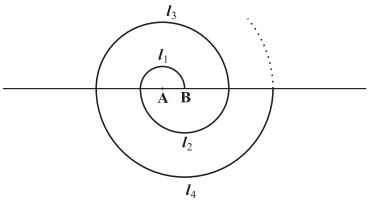
$A$ spiral is made up of successive semicircles,with centres alternately at $A$ and $B$,starting with centre at $A$,of radii $0.5 \, cm, 1.0 \, cm, 1.5 \, cm, 2.0 \, cm, \ldots$ as shown in the figure. What is the total length of such a spiral made up of thirteen consecutive semicircles? (Take $\pi = \frac{22}{7}$)
A
$141$
B
$142$
C
$143$
D
$144$
Solution
(C) The length of a semicircle is given by $l = \pi r$.
For the given radii $r_1 = 0.5 \, cm, r_2 = 1.0 \, cm, r_3 = 1.5 \, cm, \ldots$,the lengths of the successive semicircles are:
$l_1 = \pi(0.5) = 0.5\pi \, cm$
$l_2 = \pi(1.0) = 1.0\pi \, cm$
$l_3 = \pi(1.5) = 1.5\pi \, cm$
These lengths form an Arithmetic Progression $(A.P.)$ where the first term $a = 0.5\pi$ and the common difference $d = 1.0\pi - 0.5\pi = 0.5\pi$.
We need to find the sum of $n = 13$ terms.
The sum of $n$ terms of an $A.P.$ is given by $S_n = \frac{n}{2} [2a + (n - 1)d]$.
Substituting the values:
$S_{13} = \frac{13}{2} [2(0.5\pi) + (13 - 1)(0.5\pi)]$
$S_{13} = \frac{13}{2} [1.0\pi + 12(0.5\pi)]$
$S_{13} = \frac{13}{2} [1.0\pi + 6.0\pi] = \frac{13}{2} [7\pi]$
$S_{13} = \frac{91\pi}{2}$
Using $\pi = \frac{22}{7}$:
$S_{13} = \frac{91}{2} \times \frac{22}{7} = 13 \times 11 = 143 \, cm$.
Thus,the total length of the spiral is $143 \, cm$.
For the given radii $r_1 = 0.5 \, cm, r_2 = 1.0 \, cm, r_3 = 1.5 \, cm, \ldots$,the lengths of the successive semicircles are:
$l_1 = \pi(0.5) = 0.5\pi \, cm$
$l_2 = \pi(1.0) = 1.0\pi \, cm$
$l_3 = \pi(1.5) = 1.5\pi \, cm$
These lengths form an Arithmetic Progression $(A.P.)$ where the first term $a = 0.5\pi$ and the common difference $d = 1.0\pi - 0.5\pi = 0.5\pi$.
We need to find the sum of $n = 13$ terms.
The sum of $n$ terms of an $A.P.$ is given by $S_n = \frac{n}{2} [2a + (n - 1)d]$.
Substituting the values:
$S_{13} = \frac{13}{2} [2(0.5\pi) + (13 - 1)(0.5\pi)]$
$S_{13} = \frac{13}{2} [1.0\pi + 12(0.5\pi)]$
$S_{13} = \frac{13}{2} [1.0\pi + 6.0\pi] = \frac{13}{2} [7\pi]$
$S_{13} = \frac{91\pi}{2}$
Using $\pi = \frac{22}{7}$:
$S_{13} = \frac{91}{2} \times \frac{22}{7} = 13 \times 11 = 143 \, cm$.
Thus,the total length of the spiral is $143 \, cm$.
0 likes
View Solution108
Difficult
$200$ logs are stacked in the following manner: $20$ logs in the bottom row,$19$ in the next row,$18$ in the row next to it and so on (see Figure). In how many rows are the $200$ logs placed and how many logs are in the top row?

Solution
(N/A) It can be observed that the numbers of logs in rows form an $A.P.$
$20, 19, 18, \dots$
For this $A.P.$
$a = 20$
$d = a_2 - a_1 = 19 - 20 = -1$
Let a total of $200$ logs be placed in $n$ rows.
$S_n = 200$
Using the formula $S_n = \frac{n}{2}[2a + (n - 1)d]$:
$200 = \frac{n}{2}[2(20) + (n - 1)(-1)]$
$400 = n(40 - n + 1)$
$400 = n(41 - n)$
$400 = 41n - n^2$
$n^2 - 41n + 400 = 0$
$n^2 - 16n - 25n + 400 = 0$
$n(n - 16) - 25(n - 16) = 0$
$(n - 16)(n - 25) = 0$
So,$n = 16$ or $n = 25$.
Now,find the number of logs in the $n^{th}$ row using $a_n = a + (n - 1)d$:
For $n = 16$:
$a_{16} = 20 + (16 - 1)(-1) = 20 - 15 = 5$
For $n = 25$:
$a_{25} = 20 + (25 - 1)(-1) = 20 - 24 = -4$
Since the number of logs cannot be negative,$n = 25$ is rejected.
Therefore,the $200$ logs are placed in $16$ rows,and there are $5$ logs in the top row.
$20, 19, 18, \dots$
For this $A.P.$
$a = 20$
$d = a_2 - a_1 = 19 - 20 = -1$
Let a total of $200$ logs be placed in $n$ rows.
$S_n = 200$
Using the formula $S_n = \frac{n}{2}[2a + (n - 1)d]$:
$200 = \frac{n}{2}[2(20) + (n - 1)(-1)]$
$400 = n(40 - n + 1)$
$400 = n(41 - n)$
$400 = 41n - n^2$
$n^2 - 41n + 400 = 0$
$n^2 - 16n - 25n + 400 = 0$
$n(n - 16) - 25(n - 16) = 0$
$(n - 16)(n - 25) = 0$
So,$n = 16$ or $n = 25$.
Now,find the number of logs in the $n^{th}$ row using $a_n = a + (n - 1)d$:
For $n = 16$:
$a_{16} = 20 + (16 - 1)(-1) = 20 - 15 = 5$
For $n = 25$:
$a_{25} = 20 + (25 - 1)(-1) = 20 - 24 = -4$
Since the number of logs cannot be negative,$n = 25$ is rejected.
Therefore,the $200$ logs are placed in $16$ rows,and there are $5$ logs in the top row.
0 likes
View Solution109
DifficultMCQ
In a potato race,a bucket is placed at the starting point,which is $5\, m$ from the first potato,and the other potatoes are placed $3\, m$ apart in a straight line. There are ten potatoes in the line. $A$ competitor starts from the bucket,picks up the nearest potato,runs back with it,drops it in the bucket,runs back to pick up the next potato,runs to the bucket to drop it in,and she continues in the same way until all the potatoes are in the bucket. What is the total distance the competitor has to run? (in $m$)

A
$370$
B
$356$
C
$271$
D
$366$
Solution
(A) The distances of the potatoes from the bucket are $5\, m, 8\, m, 11\, m, 14\, m, \dots$
This forms an Arithmetic Progression $(A.P.)$ where the first term $a = 5$ and the common difference $d = 3$.
For each potato,the competitor runs to the potato and back to the bucket,so the distance covered for each potato is twice its distance from the bucket.
The distances to be run for each of the $10$ potatoes are $2 \times 5, 2 \times 8, 2 \times 11, 2 \times 14, \dots$
This is a new $A.P.$ with first term $a' = 10$ and common difference $d' = 6$.
The total distance is the sum of the first $10$ terms of this $A.P.$
Using the sum formula $S_n = \frac{n}{2}[2a' + (n-1)d']$:
$S_{10} = \frac{10}{2}[2(10) + (10-1)6]$
$S_{10} = 5[20 + 9 \times 6]$
$S_{10} = 5[20 + 54]$
$S_{10} = 5[74] = 370$.
Thus,the total distance the competitor has to run is $370\, m$.
This forms an Arithmetic Progression $(A.P.)$ where the first term $a = 5$ and the common difference $d = 3$.
For each potato,the competitor runs to the potato and back to the bucket,so the distance covered for each potato is twice its distance from the bucket.
The distances to be run for each of the $10$ potatoes are $2 \times 5, 2 \times 8, 2 \times 11, 2 \times 14, \dots$
This is a new $A.P.$ with first term $a' = 10$ and common difference $d' = 6$.
The total distance is the sum of the first $10$ terms of this $A.P.$
Using the sum formula $S_n = \frac{n}{2}[2a' + (n-1)d']$:
$S_{10} = \frac{10}{2}[2(10) + (10-1)6]$
$S_{10} = 5[20 + 9 \times 6]$
$S_{10} = 5[20 + 54]$
$S_{10} = 5[74] = 370$.
Thus,the total distance the competitor has to run is $370\, m$.

0 likes
View Solution110
DifficultMCQ
Which term of the $AP : 121, 117, 113, \ldots$ is its first negative term?
A
$31$
B
$32$
C
$33$
D
$34$
Solution
(B) Given $A.P.$ is $121, 117, 113, \ldots$
Here,the first term $a = 121$ and the common difference $d = 117 - 121 = -4$.
The $n^{\text{th}}$ term of an $A.P.$ is given by $a_n = a + (n - 1)d$.
Substituting the values,we get $a_n = 121 + (n - 1)(-4) = 121 - 4n + 4 = 125 - 4n$.
We want to find the first negative term,so we set $a_n < 0$.
$125 - 4n < 0$
$125 < 4n$
$n > \frac{125}{4}$
$n > 31.25$
Since $n$ must be a natural number,the smallest integer greater than $31.25$ is $32$.
Therefore,the $32^{\text{nd}}$ term is the first negative term of this $A.P.$
Here,the first term $a = 121$ and the common difference $d = 117 - 121 = -4$.
The $n^{\text{th}}$ term of an $A.P.$ is given by $a_n = a + (n - 1)d$.
Substituting the values,we get $a_n = 121 + (n - 1)(-4) = 121 - 4n + 4 = 125 - 4n$.
We want to find the first negative term,so we set $a_n < 0$.
$125 - 4n < 0$
$125 < 4n$
$n > \frac{125}{4}$
$n > 31.25$
Since $n$ must be a natural number,the smallest integer greater than $31.25$ is $32$.
Therefore,the $32^{\text{nd}}$ term is the first negative term of this $A.P.$
0 likes
View Solution111
DifficultMCQ
The sum of the third and the seventh terms of an $AP$ is $6$ and their product is $8$. Find the sum of the first sixteen terms of the $AP$.
A
$26$
B
$28$
C
$20$
D
$22$
Solution
(C) We know that the $n^{th}$ term of an $AP$ is $a_n = a + (n-1)d$.
Thus,$a_3 = a + 2d$ and $a_7 = a + 6d$.
Given $a_3 + a_7 = 6$,we have $(a + 2d) + (a + 6d) = 6$,which simplifies to $2a + 8d = 6$,or $a + 4d = 3$. So,$a = 3 - 4d$ $...(i)$.
Also,given $a_3 \times a_7 = 8$,we have $(a + 2d)(a + 6d) = 8$.
Substituting $a = 3 - 4d$ from $(i)$ into this equation:
$(3 - 4d + 2d)(3 - 4d + 6d) = 8$
$(3 - 2d)(3 + 2d) = 8$
$9 - 4d^2 = 8 \implies 4d^2 = 1 \implies d^2 = 1/4 \implies d = \pm 1/2$.
Case $1$: If $d = 1/2$,then $a = 3 - 4(1/2) = 3 - 2 = 1$.
The sum of the first $16$ terms is $S_{16} = \frac{16}{2}[2(1) + (16-1)(1/2)] = 8[2 + 7.5] = 8[9.5] = 76$.
Case $2$: If $d = -1/2$,then $a = 3 - 4(-1/2) = 3 + 2 = 5$.
The sum of the first $16$ terms is $S_{16} = \frac{16}{2}[2(5) + (16-1)(-1/2)] = 8[10 - 7.5] = 8[2.5] = 20$.
Since $20$ is one of the options,the correct answer is $20$.
Thus,$a_3 = a + 2d$ and $a_7 = a + 6d$.
Given $a_3 + a_7 = 6$,we have $(a + 2d) + (a + 6d) = 6$,which simplifies to $2a + 8d = 6$,or $a + 4d = 3$. So,$a = 3 - 4d$ $...(i)$.
Also,given $a_3 \times a_7 = 8$,we have $(a + 2d)(a + 6d) = 8$.
Substituting $a = 3 - 4d$ from $(i)$ into this equation:
$(3 - 4d + 2d)(3 - 4d + 6d) = 8$
$(3 - 2d)(3 + 2d) = 8$
$9 - 4d^2 = 8 \implies 4d^2 = 1 \implies d^2 = 1/4 \implies d = \pm 1/2$.
Case $1$: If $d = 1/2$,then $a = 3 - 4(1/2) = 3 - 2 = 1$.
The sum of the first $16$ terms is $S_{16} = \frac{16}{2}[2(1) + (16-1)(1/2)] = 8[2 + 7.5] = 8[9.5] = 76$.
Case $2$: If $d = -1/2$,then $a = 3 - 4(-1/2) = 3 + 2 = 5$.
The sum of the first $16$ terms is $S_{16} = \frac{16}{2}[2(5) + (16-1)(-1/2)] = 8[10 - 7.5] = 8[2.5] = 20$.
Since $20$ is one of the options,the correct answer is $20$.
0 likes
View Solution112
DifficultMCQ
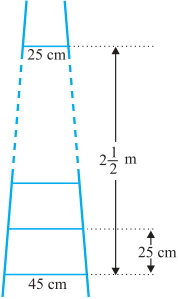
$A$ ladder has rungs $25 \, cm$ apart. (see Figure). The rungs decrease uniformly in length from $45 \, cm$ at the bottom to $25 \, cm$ at the top. If the top and the bottom rungs are $2 \frac{1}{2} \, m$ apart,what is the length of the wood required for the rungs?
A
$375$
B
$380$
C
$388$
D
$385$
Solution
(D) The rungs are placed at a distance of $25 \, cm$ from each other. The total distance between the top and bottom rung is $2 \frac{1}{2} \, m = 250 \, cm$.
The number of gaps between the rungs is $\frac{250}{25} = 10$.
Since there is a rung at both ends,the total number of rungs $n$ is $10 + 1 = 11$.
As the lengths of the rungs decrease uniformly,they form an Arithmetic Progression $(A.P.)$.
The first term $a = 45 \, cm$ and the last term $l = 25 \, cm$.
The total length of the wood required is the sum of the $A.P.$ series,given by the formula $S_n = \frac{n}{2}(a + l)$.
Substituting the values: $S_{11} = \frac{11}{2}(45 + 25) = \frac{11}{2}(70) = 11 \times 35 = 385 \, cm$.
Thus,the total length of wood required for the rungs is $385 \, cm$.
The number of gaps between the rungs is $\frac{250}{25} = 10$.
Since there is a rung at both ends,the total number of rungs $n$ is $10 + 1 = 11$.
As the lengths of the rungs decrease uniformly,they form an Arithmetic Progression $(A.P.)$.
The first term $a = 45 \, cm$ and the last term $l = 25 \, cm$.
The total length of the wood required is the sum of the $A.P.$ series,given by the formula $S_n = \frac{n}{2}(a + l)$.
Substituting the values: $S_{11} = \frac{11}{2}(45 + 25) = \frac{11}{2}(70) = 11 \times 35 = 385 \, cm$.
Thus,the total length of wood required for the rungs is $385 \, cm$.
0 likes
View Solution113
DifficultMCQ
The houses of a row are numbered consecutively from $1$ to $49$. Show that there is a value of $x$ such that the sum of the numbers of the houses preceding the house numbered $x$ is equal to the sum of the numbers of the houses following it. Find this value of $x$.
A
$35$
B
$25$
C
$39$
D
$28$
Solution
(A) The house numbers are $1, 2, 3, \ldots, 49$. This forms an Arithmetic Progression $(A.P.)$ with first term $a = 1$ and common difference $d = 1$.
Let the house number be $x$. The sum of the house numbers preceding $x$ is the sum of the first $(x-1)$ terms: $S_{x-1} = \frac{(x-1)}{2}[2a + (x-1-1)d] = \frac{x-1}{2}[2(1) + (x-2)(1)] = \frac{x(x-1)}{2}$.
The sum of the house numbers following $x$ is the total sum of $49$ houses minus the sum of the first $x$ houses: $S_{49} - S_x = \frac{49}{2}[2(1) + (49-1)(1)] - \frac{x}{2}[2(1) + (x-1)(1)] = \frac{49 \times 50}{2} - \frac{x(x+1)}{2} = 1225 - \frac{x(x+1)}{2}$.
Equating the two sums: $\frac{x(x-1)}{2} = 1225 - \frac{x(x+1)}{2}$.
Multiplying by $2$: $x^2 - x = 2450 - (x^2 + x)$.
$x^2 - x = 2450 - x^2 - x$.
$2x^2 = 2450$.
$x^2 = 1225$.
$x = \sqrt{1225} = 35$ (since $x$ must be positive).
Thus,the value of $x$ is $35$.
Let the house number be $x$. The sum of the house numbers preceding $x$ is the sum of the first $(x-1)$ terms: $S_{x-1} = \frac{(x-1)}{2}[2a + (x-1-1)d] = \frac{x-1}{2}[2(1) + (x-2)(1)] = \frac{x(x-1)}{2}$.
The sum of the house numbers following $x$ is the total sum of $49$ houses minus the sum of the first $x$ houses: $S_{49} - S_x = \frac{49}{2}[2(1) + (49-1)(1)] - \frac{x}{2}[2(1) + (x-1)(1)] = \frac{49 \times 50}{2} - \frac{x(x+1)}{2} = 1225 - \frac{x(x+1)}{2}$.
Equating the two sums: $\frac{x(x-1)}{2} = 1225 - \frac{x(x+1)}{2}$.
Multiplying by $2$: $x^2 - x = 2450 - (x^2 + x)$.
$x^2 - x = 2450 - x^2 - x$.
$2x^2 = 2450$.
$x^2 = 1225$.
$x = \sqrt{1225} = 35$ (since $x$ must be positive).
Thus,the value of $x$ is $35$.
0 likes
View Solution114
DifficultMCQ
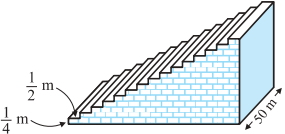
$A$ small terrace at a football ground comprises of $15$ steps each of which is $50 \, m$ long and built of solid concrete. Each step has a rise of $\frac{1}{4} \, m$ and a tread of $\frac{1}{2} \, m$. Calculate the total volume of concrete required to build the terrace (in $m^3$).
A
$700$
B
$750$
C
$725$
D
$744$
Solution
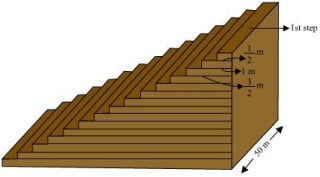
(B) From the figure,it can be observed that:
$1^{\text{st}}$ step is $\frac{1}{2} \, m$ wide,
$2^{\text{nd}}$ step is $1 \, m$ wide,
$3^{\text{rd}}$ step is $\frac{3}{2} \, m$ wide.
Therefore,the width of each step is increasing by $\frac{1}{2} \, m$ each time,whereas their height $\frac{1}{4} \, m$ and length $50 \, m$ remain the same.
Thus,the widths of these steps form an arithmetic progression: $\frac{1}{2}, 1, \frac{3}{2}, 2, \dots$
Volume of concrete in $1^{\text{st}}$ step $= \text{length} \times \text{width} \times \text{height} = 50 \times \frac{1}{2} \times \frac{1}{4} = \frac{25}{4} \, m^3$.
Volume of concrete in $2^{\text{nd}}$ step $= 50 \times 1 \times \frac{1}{4} = \frac{25}{2} \, m^3$.
Volume of concrete in $3^{\text{rd}}$ step $= 50 \times \frac{3}{2} \times \frac{1}{4} = \frac{75}{4} \, m^3$.
The volumes of concrete in these steps form an $A.P.$ with first term $a = \frac{25}{4}$ and common difference $d = \frac{25}{2} - \frac{25}{4} = \frac{25}{4}$.
The total volume for $n = 15$ steps is given by the sum $S_n = \frac{n}{2} [2a + (n - 1)d]$.
$S_{15} = \frac{15}{2} \left[ 2 \left( \frac{25}{4} \right) + (15 - 1) \left( \frac{25}{4} \right) \right]$
$S_{15} = \frac{15}{2} \left[ \frac{25}{2} + 14 \times \frac{25}{4} \right] = \frac{15}{2} \left[ \frac{25}{2} + \frac{175}{2} \right]$
$S_{15} = \frac{15}{2} \left[ \frac{200}{2} \right] = \frac{15}{2} \times 100 = 750$.
Thus,the total volume of concrete required is $750 \, m^3$.
$1^{\text{st}}$ step is $\frac{1}{2} \, m$ wide,
$2^{\text{nd}}$ step is $1 \, m$ wide,
$3^{\text{rd}}$ step is $\frac{3}{2} \, m$ wide.
Therefore,the width of each step is increasing by $\frac{1}{2} \, m$ each time,whereas their height $\frac{1}{4} \, m$ and length $50 \, m$ remain the same.
Thus,the widths of these steps form an arithmetic progression: $\frac{1}{2}, 1, \frac{3}{2}, 2, \dots$
Volume of concrete in $1^{\text{st}}$ step $= \text{length} \times \text{width} \times \text{height} = 50 \times \frac{1}{2} \times \frac{1}{4} = \frac{25}{4} \, m^3$.
Volume of concrete in $2^{\text{nd}}$ step $= 50 \times 1 \times \frac{1}{4} = \frac{25}{2} \, m^3$.
Volume of concrete in $3^{\text{rd}}$ step $= 50 \times \frac{3}{2} \times \frac{1}{4} = \frac{75}{4} \, m^3$.
The volumes of concrete in these steps form an $A.P.$ with first term $a = \frac{25}{4}$ and common difference $d = \frac{25}{2} - \frac{25}{4} = \frac{25}{4}$.
The total volume for $n = 15$ steps is given by the sum $S_n = \frac{n}{2} [2a + (n - 1)d]$.
$S_{15} = \frac{15}{2} \left[ 2 \left( \frac{25}{4} \right) + (15 - 1) \left( \frac{25}{4} \right) \right]$
$S_{15} = \frac{15}{2} \left[ \frac{25}{2} + 14 \times \frac{25}{4} \right] = \frac{15}{2} \left[ \frac{25}{2} + \frac{175}{2} \right]$
$S_{15} = \frac{15}{2} \left[ \frac{200}{2} \right] = \frac{15}{2} \times 100 = 750$.
Thus,the total volume of concrete required is $750 \, m^3$.
0 likes
View SolutionArithmetic Progressions — Textbook -Arithmetic Progressions · Frequently Asked Questions
1Are these Arithmetic Progressions questions useful for JEE and NEET?
Yes. All questions in this section are mapped to JEE Main and NEET exam patterns. Previous year questions from JEE Main, NEET, GUJCET and state-level exams are included with full solutions.
2Can I switch to Hindi or Gujarati for these questions?
Yes. Use the language tabs in the hero section or the sidebar to view the same questions and solutions in English, Hindi or Gujarati.
3How do I generate a question paper from this subtopic?
Use the Vedclass Exam Paper Generator — select the chapter and subtopic, set difficulty, and generate Sets A, B, C, D automatically. First 3 chapters of every subject are free.
Vedclass Products
For Students
Vedclass Test Series
Mock tests in real JEE/NEET style with performance analysis. 5-day free trial.
Start Free TrialFor Teachers
Exam Paper Generator
Generate Set A/B/C/D papers from this chapter in 2 minutes. 3 chapters free.
Try FreeFor Institutes
Online Exam Module
Live online exams with unlimited students, 360° analytics & white-label branding.
See DemoFor Teachers & Institutes
Generate a Arithmetic Progressions Exam Paper in 2 Minutes
Select subtopic & difficulty — Sets A, B, C, D auto-generated with No Repeat logic.
First 3 chapters of every subject are free — no payment required.