
PhysicsQ1–6 of 6 questions
Page 1 of 1 · English
1
PhysicsMediumMCQIIT JEE · 2006
$A$ monatomic ideal gas undergoes a process in which the ratio of $P$ to $V$ at any instant is constant and equals to $1$. What is the molar heat capacity of the gas?
A
$4 R / 2$
B
$3 R / 2$
C
$5 R / 2$
D
$0$
Solution
(A) For a monatomic ideal gas, the molar heat capacity $C$ for a polytropic process $PV^x = \text{constant}$ is given by $C = C_V + \frac{R}{1-x}$.
Given the process is $P/V = 1$, which implies $P = V^1$, or $PV^{-1} = \text{constant}$.
Comparing this with $PV^x = \text{constant}$, we get $x = -1$.
For a monatomic gas, the molar heat capacity at constant volume is $C_V = \frac{3R}{2}$.
Substituting the values into the formula: $C = \frac{3R}{2} + \frac{R}{1 - (-1)}$.
$C = \frac{3R}{2} + \frac{R}{2} = \frac{4R}{2} = 2R$.
Given the process is $P/V = 1$, which implies $P = V^1$, or $PV^{-1} = \text{constant}$.
Comparing this with $PV^x = \text{constant}$, we get $x = -1$.
For a monatomic gas, the molar heat capacity at constant volume is $C_V = \frac{3R}{2}$.
Substituting the values into the formula: $C = \frac{3R}{2} + \frac{R}{1 - (-1)}$.
$C = \frac{3R}{2} + \frac{R}{2} = \frac{4R}{2} = 2R$.
0 likesView Solution
2
PhysicsAdvancedMCQIIT JEE · 2006
$A$ student performs an experiment to determine the Young's modulus of a wire, exactly $2 \,m$ long, by Searle's method. In a particular reading, the student measures the extension in the length of the wire to be $0.8 \,mm$ with an uncertainty of $\pm 0.05 \,mm$ at a load of exactly $1.0 \,kg$. The student also measures the diameter of the wire to be $0.4 \,mm$ with an uncertainty of $\pm 0.01 \,mm$. Take $g=9.8 \,m/s^2$ (exact). The Young's modulus obtained from the reading is
A
$(2.0 \pm 0.3) \times 10^{11} \,N/m^2$
B
$(2.0 \pm 0.2) \times 10^{11} \,N/m^2$
C
$(2.0 \pm 0.1) \times 10^{11} \,N/m^2$
D
$(2.0 \pm 0.05) \times 10^{11} \,N/m^2$
Solution
(B) The formula for Young's modulus is $Y = \frac{FL}{Ae} = \frac{4FL}{\pi D^2 e}$.
Given: $L = 2 \,m$, $F = 1.0 \times 9.8 \,N$, $e = 0.8 \times 10^{-3} \,m$, $\Delta e = 0.05 \times 10^{-3} \,m$, $D = 0.4 \times 10^{-3} \,m$, $\Delta D = 0.01 \times 10^{-3} \,m$.
First, calculate the value of $Y$:
$Y = \frac{4 \times 9.8 \times 2}{\pi \times (0.4 \times 10^{-3})^2 \times (0.8 \times 10^{-3})} = \frac{78.4}{\pi \times 0.16 \times 10^{-6} \times 0.8 \times 10^{-3}} \approx 1.95 \times 10^{11} \,N/m^2 \approx 2.0 \times 10^{11} \,N/m^2$.
Now, calculate the relative uncertainty $\frac{\Delta Y}{Y}$:
$\frac{\Delta Y}{Y} = \frac{\Delta F}{F} + \frac{\Delta L}{L} + 2\frac{\Delta D}{D} + \frac{\Delta e}{e}$.
Since $F$ and $L$ are exact, $\frac{\Delta F}{F} = 0$ and $\frac{\Delta L}{L} = 0$.
$\frac{\Delta Y}{Y} = 2 \left( \frac{0.01}{0.4} \right) + \left( \frac{0.05}{0.8} \right) = 2(0.025) + 0.0625 = 0.05 + 0.0625 = 0.1125$.
Absolute uncertainty $\Delta Y = 0.1125 \times Y = 0.1125 \times 1.95 \times 10^{11} \approx 0.22 \times 10^{11} \,N/m^2$.
Rounding to one decimal place, $\Delta Y \approx 0.2 \times 10^{11} \,N/m^2$.
Thus, $Y = (2.0 \pm 0.2) \times 10^{11} \,N/m^2$.
Given: $L = 2 \,m$, $F = 1.0 \times 9.8 \,N$, $e = 0.8 \times 10^{-3} \,m$, $\Delta e = 0.05 \times 10^{-3} \,m$, $D = 0.4 \times 10^{-3} \,m$, $\Delta D = 0.01 \times 10^{-3} \,m$.
First, calculate the value of $Y$:
$Y = \frac{4 \times 9.8 \times 2}{\pi \times (0.4 \times 10^{-3})^2 \times (0.8 \times 10^{-3})} = \frac{78.4}{\pi \times 0.16 \times 10^{-6} \times 0.8 \times 10^{-3}} \approx 1.95 \times 10^{11} \,N/m^2 \approx 2.0 \times 10^{11} \,N/m^2$.
Now, calculate the relative uncertainty $\frac{\Delta Y}{Y}$:
$\frac{\Delta Y}{Y} = \frac{\Delta F}{F} + \frac{\Delta L}{L} + 2\frac{\Delta D}{D} + \frac{\Delta e}{e}$.
Since $F$ and $L$ are exact, $\frac{\Delta F}{F} = 0$ and $\frac{\Delta L}{L} = 0$.
$\frac{\Delta Y}{Y} = 2 \left( \frac{0.01}{0.4} \right) + \left( \frac{0.05}{0.8} \right) = 2(0.025) + 0.0625 = 0.05 + 0.0625 = 0.1125$.
Absolute uncertainty $\Delta Y = 0.1125 \times Y = 0.1125 \times 1.95 \times 10^{11} \approx 0.22 \times 10^{11} \,N/m^2$.
Rounding to one decimal place, $\Delta Y \approx 0.2 \times 10^{11} \,N/m^2$.
Thus, $Y = (2.0 \pm 0.2) \times 10^{11} \,N/m^2$.
0 likesView Solution
3
PhysicsAdvancedMCQIIT JEE · 2006
In the experiment to determine the speed of sound using a resonance column, which of the following statements is correct?
A
The prongs of the tuning fork are kept in a vertical plane.
B
The prongs of the tuning fork are kept in a horizontal plane.
C
In one of the two resonances observed, the length of the resonating air column is close to the wavelength of sound in air.
D
In one of the two resonances observed, the length of the resonating air column is close to half of the wavelength of sound in air.
Solution
(A) In a resonance column experiment, the tuning fork is held above the open end of the tube. To ensure that the sound waves propagate effectively down the tube, the prongs of the tuning fork are kept in a vertical plane.
For a tube closed at one end, the resonance occurs when the length of the air column $L$ satisfies the condition $L + e = (2n - 1) \frac{\lambda}{4}$, where $e$ is the end correction and $n = 1, 2, 3, ...$.
The first resonance occurs at $L_1 + e = \frac{\lambda}{4}$ and the second resonance occurs at $L_2 + e = \frac{3\lambda}{4}$.
Subtracting these, we get $L_2 - L_1 = \frac{\lambda}{2}$.
Thus, the difference between the lengths of the two resonating air columns is equal to half the wavelength of sound in air.
For a tube closed at one end, the resonance occurs when the length of the air column $L$ satisfies the condition $L + e = (2n - 1) \frac{\lambda}{4}$, where $e$ is the end correction and $n = 1, 2, 3, ...$.
The first resonance occurs at $L_1 + e = \frac{\lambda}{4}$ and the second resonance occurs at $L_2 + e = \frac{3\lambda}{4}$.
Subtracting these, we get $L_2 - L_1 = \frac{\lambda}{2}$.
Thus, the difference between the lengths of the two resonating air columns is equal to half the wavelength of sound in air.
0 likesView Solution
4
PhysicsAdvancedMCQIIT JEE · 2006
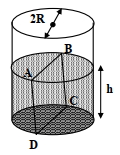
Water is filled up to a height $h$ in a beaker of radius $R$ as shown in the figure. The density of water is $\rho$,the surface tension of water is $T$ and the atmospheric pressure is $P_0$. Consider a vertical section $ABCD$ of the water column through a diameter of the beaker. The force on water on one side of this section by water on the other side of this section has magnitude
A
$\left|2 P_0 Rh+\pi R^2 \rho gh-2 RT\right|$
B
$\left|2 P_0 Rh+R \rho gh^2-2 RT\right|$
C
$\left|P_0 \pi R^2+R \rho g h^2-2 RT\right|$
D
$\left|P_0 \pi R^2+R \rho g h^2+2 RT\right|$
Solution
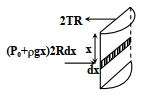
(B) Consider a vertical rectangular strip of height $dx$ at a depth $x$ from the free surface of the water. The width of this strip is the diameter of the beaker,which is $2R$.
The pressure at depth $x$ is $P(x) = P_0 + \rho g x$.
The force exerted by the pressure on this strip is $dF_p = P(x) \cdot (2R) dx = (P_0 + \rho g x) 2R dx$.
Integrating this from $x = 0$ to $x = h$,the total force due to pressure is $F_p = \int_0^h (P_0 + \rho g x) 2R dx = 2R [P_0 x + \frac{1}{2} \rho g x^2]_0^h = 2 P_0 R h + R \rho g h^2$.
Additionally,there is a force due to surface tension acting along the top edge of the section. The length of the section at the surface is $2R$,so the force due to surface tension is $F_T = T \cdot (2R) = 2RT$.
Since the surface tension force acts in the opposite direction to the pressure force,the net magnitude of the force is $F = |F_p - F_T| = |2 P_0 R h + R \rho g h^2 - 2 RT|$.
The pressure at depth $x$ is $P(x) = P_0 + \rho g x$.
The force exerted by the pressure on this strip is $dF_p = P(x) \cdot (2R) dx = (P_0 + \rho g x) 2R dx$.
Integrating this from $x = 0$ to $x = h$,the total force due to pressure is $F_p = \int_0^h (P_0 + \rho g x) 2R dx = 2R [P_0 x + \frac{1}{2} \rho g x^2]_0^h = 2 P_0 R h + R \rho g h^2$.
Additionally,there is a force due to surface tension acting along the top edge of the section. The length of the section at the surface is $2R$,so the force due to surface tension is $F_T = T \cdot (2R) = 2RT$.
Since the surface tension force acts in the opposite direction to the pressure force,the net magnitude of the force is $F = |F_p - F_T| = |2 P_0 R h + R \rho g h^2 - 2 RT|$.
0 likesView Solution
5
PhysicsAdvancedMCQIIT JEE · 2006
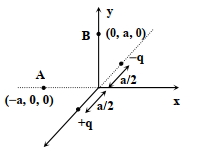
Positive and negative point charges of equal magnitude are kept at $(0, 0, a/2)$ and $(0, 0, -a/2)$,respectively. The work done by the electric field when another positive point charge is moved from $(-a, 0, 0)$ to $(0, a, 0)$ is
A
positive
B
negative
C
zero
D
depends on the path connecting the initial and final positions
Solution
(C) The given arrangement of charges is an electric dipole placed along the $z$-axis,with the positive charge at $(0, 0, a/2)$ and the negative charge at $(0, 0, -a/2)$.
The electric potential $V$ at any point $(x, y, z)$ due to an electric dipole is given by $V = \frac{1}{4\pi\epsilon_0} \frac{\vec{p} \cdot \vec{r}}{r^3}$.
For a dipole centered at the origin,the equatorial plane is the $xy$-plane $(z = 0)$.
At any point on the $xy$-plane,the distance from the positive charge is equal to the distance from the negative charge,so the potential $V$ is zero everywhere on the $xy$-plane.
The initial position is $(-a, 0, 0)$,which lies on the $xy$-plane,so $V_i = 0$.
The final position is $(0, a, 0)$,which also lies on the $xy$-plane,so $V_f = 0$.
The work done by the electric field $W_e$ is given by $W_e = -\Delta U = -q_0(V_f - V_i)$,where $q_0$ is the test charge.
Since $V_f = V_i = 0$,the work done $W_e = -q_0(0 - 0) = 0$.
The electric potential $V$ at any point $(x, y, z)$ due to an electric dipole is given by $V = \frac{1}{4\pi\epsilon_0} \frac{\vec{p} \cdot \vec{r}}{r^3}$.
For a dipole centered at the origin,the equatorial plane is the $xy$-plane $(z = 0)$.
At any point on the $xy$-plane,the distance from the positive charge is equal to the distance from the negative charge,so the potential $V$ is zero everywhere on the $xy$-plane.
The initial position is $(-a, 0, 0)$,which lies on the $xy$-plane,so $V_i = 0$.
The final position is $(0, a, 0)$,which also lies on the $xy$-plane,so $V_f = 0$.
The work done by the electric field $W_e$ is given by $W_e = -\Delta U = -q_0(V_f - V_i)$,where $q_0$ is the test charge.
Since $V_f = V_i = 0$,the work done $W_e = -q_0(0 - 0) = 0$.
0 likesView Solution
6
PhysicsMediumMCQIIT JEE · 2006
For $He^{+}$, a transition takes place from the orbit of radius $105.8 \ pm$ to the orbit of radius $26.45 \ pm$. The wavelength (in $nm$) of the emitted photon during the transition is. . . . .
[Use: Bohr radius, $a_0=52.9 \ pm$; Rydberg constant, $R_H=2.2 \times 10^{-18} \ J$; Planck's constant, $h=6.6 \times 10^{-34} \ J \ s$; Speed of light, $c=3 \times 10^8 \ m \ s^{-1}$]
[Use: Bohr radius, $a_0=52.9 \ pm$; Rydberg constant, $R_H=2.2 \times 10^{-18} \ J$; Planck's constant, $h=6.6 \times 10^{-34} \ J \ s$; Speed of light, $c=3 \times 10^8 \ m \ s^{-1}$]
A
$10$
B
$30$
C
$40$
D
$50$
Solution
(B) For a single electron system, the radius of the $n^{th}$ orbit is given by $r_n = a_0 \times \frac{n^2}{Z}$.
Given $Z=2$ for $He^{+}$.
For the initial orbit, $r_2 = 105.8 \ pm$:
$105.8 = 52.9 \times \frac{n_2^2}{2} \implies n_2^2 = \frac{105.8 \times 2}{52.9} = 4 \implies n_2 = 2$.
For the final orbit, $r_1 = 26.45 \ pm$:
$26.45 = 52.9 \times \frac{n_1^2}{2} \implies n_1^2 = \frac{26.45 \times 2}{52.9} = 1 \implies n_1 = 1$.
The transition is from $n=2$ to $n=1$.
The energy of the emitted photon is $\Delta E = R_H Z^2 \left( \frac{1}{n_1^2} - \frac{1}{n_2^2} \right)$.
$\Delta E = 2.2 \times 10^{-18} \times (2)^2 \times \left( \frac{1}{1^2} - \frac{1}{2^2} \right) = 2.2 \times 10^{-18} \times 4 \times \left( 1 - 0.25 \right) = 8.8 \times 10^{-18} \times 0.75 = 6.6 \times 10^{-18} \ J$.
Using $\Delta E = \frac{hc}{\lambda}$, we get $\lambda = \frac{hc}{\Delta E} = \frac{6.6 \times 10^{-34} \times 3 \times 10^8}{6.6 \times 10^{-18}} = 3 \times 10^{-8} \ m = 30 \ nm$.
Given $Z=2$ for $He^{+}$.
For the initial orbit, $r_2 = 105.8 \ pm$:
$105.8 = 52.9 \times \frac{n_2^2}{2} \implies n_2^2 = \frac{105.8 \times 2}{52.9} = 4 \implies n_2 = 2$.
For the final orbit, $r_1 = 26.45 \ pm$:
$26.45 = 52.9 \times \frac{n_1^2}{2} \implies n_1^2 = \frac{26.45 \times 2}{52.9} = 1 \implies n_1 = 1$.
The transition is from $n=2$ to $n=1$.
The energy of the emitted photon is $\Delta E = R_H Z^2 \left( \frac{1}{n_1^2} - \frac{1}{n_2^2} \right)$.
$\Delta E = 2.2 \times 10^{-18} \times (2)^2 \times \left( \frac{1}{1^2} - \frac{1}{2^2} \right) = 2.2 \times 10^{-18} \times 4 \times \left( 1 - 0.25 \right) = 8.8 \times 10^{-18} \times 0.75 = 6.6 \times 10^{-18} \ J$.
Using $\Delta E = \frac{hc}{\lambda}$, we get $\lambda = \frac{hc}{\Delta E} = \frac{6.6 \times 10^{-34} \times 3 \times 10^8}{6.6 \times 10^{-18}} = 3 \times 10^{-8} \ m = 30 \ nm$.
0 likesView Solution
Vedclass Products
For Students
Vedclass Test Series
Mock tests in real IIT JEE style covering Physics with performance analysis. 5-day free trial.
Start Free TrialFor Teachers
Exam Paper Generator
Generate Set A/B/C/D Physics papers from 7.5L+ questions in 2 minutes. 3 chapters free.
Try FreeFor Institutes
Online Exam Module
Run live IIT JEE mock exams with unlimited students, 360° analytics & white-label branding.
See DemoFrequently Asked Questions
How many Physics questions are in IIT JEE 2006?
There are 6 Physics questions from the IIT JEE 2006 paper on Vedclass, each with a detailed step-by-step solution in English.
Are IIT JEE 2006 Physics solutions available in English?
Yes. All solutions on this page are in English. You can also switch to English or Hindi using the language buttons above the questions.
Can I practice IIT JEE 2006 Physics as a timed test?
Yes. Use the Vedclass Test Series to attempt a full IIT JEE mock test covering Physics with time limits and instant score analysis.
Can teachers create Physics papers from IIT JEE previous year questions?
Yes. The Vedclass Exam Paper Generator lets teachers mix IIT JEE Physics questions and generate Set A/B/C/D papers in minutes.
For Teachers & Institutes
Build a Custom Physics Paper
Pick IIT JEE 2006 Physics questions, set difficulty, and generate Set A/B/C/D in 2 minutes.