
A English
Trigonometry Questions in English
Competitive Exam Quantitative Aptitude · Trigonometry · Trigonometry
648+
Questions
English
Language
100%
With Solutions
Showing 50 of 648 questions in English
301
DifficultMCQ
$\sin^4 \frac{\pi}{8} + \sin^4 \frac{3\pi}{8} + \sin^4 \frac{5\pi}{8} + \sin^4 \frac{7\pi}{8} = $
A
$\frac{1}{2}$
B
$\frac{1}{4}$
C
$\frac{3}{2}$
D
$\frac{3}{4}$
Solution
(C) Given expression: $S = \sin^4 \frac{\pi}{8} + \sin^4 \frac{3\pi}{8} + \sin^4 \frac{5\pi}{8} + \sin^4 \frac{7\pi}{8}$.
Since $\sin(\pi - \theta) = \sin \theta$,we have $\sin \frac{7\pi}{8} = \sin \frac{\pi}{8}$ and $\sin \frac{5\pi}{8} = \sin \frac{3\pi}{8}$.
Thus,$S = 2 \left( \sin^4 \frac{\pi}{8} + \sin^4 \frac{3\pi}{8} \right)$.
Using the identity $2 \sin^2 \theta = 1 - \cos 2\theta$,we have $\sin^2 \theta = \frac{1 - \cos 2\theta}{2}$.
So,$\sin^4 \theta = \left( \frac{1 - \cos 2\theta}{2} \right)^2 = \frac{1}{4} (1 - 2 \cos 2\theta + \cos^2 2\theta)$.
$S = 2 \left[ \frac{1}{4} (1 - 2 \cos \frac{\pi}{4} + \cos^2 \frac{\pi}{4}) + \frac{1}{4} (1 - 2 \cos \frac{3\pi}{4} + \cos^2 \frac{3\pi}{4}) \right]$.
$S = \frac{1}{2} \left[ (1 - 2(\frac{1}{\sqrt{2}}) + \frac{1}{2}) + (1 - 2(-\frac{1}{\sqrt{2}}) + \frac{1}{2}) \right]$.
$S = \frac{1}{2} \left[ (1 - \sqrt{2} + 0.5) + (1 + \sqrt{2} + 0.5) \right] = \frac{1}{2} [1.5 + 1.5] = \frac{1}{2} (3) = \frac{3}{2}$.
Since $\sin(\pi - \theta) = \sin \theta$,we have $\sin \frac{7\pi}{8} = \sin \frac{\pi}{8}$ and $\sin \frac{5\pi}{8} = \sin \frac{3\pi}{8}$.
Thus,$S = 2 \left( \sin^4 \frac{\pi}{8} + \sin^4 \frac{3\pi}{8} \right)$.
Using the identity $2 \sin^2 \theta = 1 - \cos 2\theta$,we have $\sin^2 \theta = \frac{1 - \cos 2\theta}{2}$.
So,$\sin^4 \theta = \left( \frac{1 - \cos 2\theta}{2} \right)^2 = \frac{1}{4} (1 - 2 \cos 2\theta + \cos^2 2\theta)$.
$S = 2 \left[ \frac{1}{4} (1 - 2 \cos \frac{\pi}{4} + \cos^2 \frac{\pi}{4}) + \frac{1}{4} (1 - 2 \cos \frac{3\pi}{4} + \cos^2 \frac{3\pi}{4}) \right]$.
$S = \frac{1}{2} \left[ (1 - 2(\frac{1}{\sqrt{2}}) + \frac{1}{2}) + (1 - 2(-\frac{1}{\sqrt{2}}) + \frac{1}{2}) \right]$.
$S = \frac{1}{2} \left[ (1 - \sqrt{2} + 0.5) + (1 + \sqrt{2} + 0.5) \right] = \frac{1}{2} [1.5 + 1.5] = \frac{1}{2} (3) = \frac{3}{2}$.
0 likes
View Solution302
DifficultMCQ
$\left( {1 + \cos \frac{\pi }{8}} \right)\,\left( {1 + \cos \frac{{3\pi }}{8}} \right)\,\left( {1 + \cos \frac{{5\pi }}{8}} \right)\,\left( {1 + \cos \frac{{7\pi }}{8}} \right) = $
A
$\frac{1}{2}$
B
$\frac{1}{4}$
C
$\frac{1}{8}$
D
$\frac{1}{{16}}$
Solution
(C) Let the given expression be $E = \left( {1 + \cos \frac{\pi }{8}} \right)\left( {1 + \cos \frac{{3\pi }}{8}} \right)\left( {1 + \cos \frac{{5\pi }}{8}} \right)\left( {1 + \cos \frac{{7\pi }}{8}} \right)$.
Since $\cos \frac{{7\pi }}{8} = \cos \left( \pi - \frac{\pi }{8} \right) = -\cos \frac{\pi }{8}$ and $\cos \frac{{5\pi }}{8} = \cos \left( \pi - \frac{{3\pi }}{8} \right) = -\cos \frac{{3\pi }}{8}$,we can rewrite the expression as:
$E = \left( {1 + \cos \frac{\pi }{8}} \right)\left( {1 - \cos \frac{\pi }{8}} \right)\left( {1 + \cos \frac{{3\pi }}{8}} \right)\left( {1 - \cos \frac{{3\pi }}{8}} \right)$
Using the identity $(1 + \cos \theta)(1 - \cos \theta) = 1 - \cos^2 \theta = \sin^2 \theta$,we get:
$E = \left( {1 - \cos^2 \frac{\pi }{8}} \right)\left( {1 - \cos^2 \frac{{3\pi }}{8}} \right) = \sin^2 \frac{\pi }{8} \sin^2 \frac{{3\pi }}{8}$
Using the identity $2 \sin A \sin B = \cos(A - B) - \cos(A + B)$:
$E = \left( \sin \frac{\pi }{8} \sin \frac{{3\pi }}{8} \right)^2 = \left( \frac{1}{2} \left( \cos \left( \frac{3\pi }{8} - \frac{\pi }{8} \right) - \cos \left( \frac{3\pi }{8} + \frac{\pi }{8} \right) \right) \right)^2$
$E = \left( \frac{1}{2} \left( \cos \frac{\pi }{4} - \cos \frac{\pi }{2} \right) \right)^2 = \left( \frac{1}{2} \left( \frac{1}{\sqrt{2}} - 0 \right) \right)^2 = \left( \frac{1}{2\sqrt{2}} \right)^2 = \frac{1}{8}$.
Since $\cos \frac{{7\pi }}{8} = \cos \left( \pi - \frac{\pi }{8} \right) = -\cos \frac{\pi }{8}$ and $\cos \frac{{5\pi }}{8} = \cos \left( \pi - \frac{{3\pi }}{8} \right) = -\cos \frac{{3\pi }}{8}$,we can rewrite the expression as:
$E = \left( {1 + \cos \frac{\pi }{8}} \right)\left( {1 - \cos \frac{\pi }{8}} \right)\left( {1 + \cos \frac{{3\pi }}{8}} \right)\left( {1 - \cos \frac{{3\pi }}{8}} \right)$
Using the identity $(1 + \cos \theta)(1 - \cos \theta) = 1 - \cos^2 \theta = \sin^2 \theta$,we get:
$E = \left( {1 - \cos^2 \frac{\pi }{8}} \right)\left( {1 - \cos^2 \frac{{3\pi }}{8}} \right) = \sin^2 \frac{\pi }{8} \sin^2 \frac{{3\pi }}{8}$
Using the identity $2 \sin A \sin B = \cos(A - B) - \cos(A + B)$:
$E = \left( \sin \frac{\pi }{8} \sin \frac{{3\pi }}{8} \right)^2 = \left( \frac{1}{2} \left( \cos \left( \frac{3\pi }{8} - \frac{\pi }{8} \right) - \cos \left( \frac{3\pi }{8} + \frac{\pi }{8} \right) \right) \right)^2$
$E = \left( \frac{1}{2} \left( \cos \frac{\pi }{4} - \cos \frac{\pi }{2} \right) \right)^2 = \left( \frac{1}{2} \left( \frac{1}{\sqrt{2}} - 0 \right) \right)^2 = \left( \frac{1}{2\sqrt{2}} \right)^2 = \frac{1}{8}$.
0 likes
View Solution303
MediumMCQ
If $A$ lies in the third quadrant and $3\tan A - 4 = 0,$ then $5\sin 2A + 3\sin A + 4\cos A = $
A
$0$
B
$-\frac{24}{5}$
C
$\frac{24}{5}$
D
$\frac{48}{5}$
Solution
(A) Given $3\tan A - 4 = 0$,so $\tan A = \frac{4}{3}$.
Since $A$ lies in the third quadrant,both $\sin A$ and $\cos A$ are negative.
Using $\tan A = \frac{4}{3}$,we can represent this as a right triangle with opposite side $4$ and adjacent side $3$. The hypotenuse is $\sqrt{4^2 + 3^2} = 5$.
Thus,$\sin A = -\frac{4}{5}$ and $\cos A = -\frac{3}{5}$.
Now,substitute these values into the expression $5\sin 2A + 3\sin A + 4\cos A$:
$5(2\sin A \cos A) + 3\sin A + 4\cos A$
$= 10\sin A \cos A + 3\sin A + 4\cos A$
$= 10\left(-\frac{4}{5}\right)\left(-\frac{3}{5}\right) + 3\left(-\frac{4}{5}\right) + 4\left(-\frac{3}{5}\right)$
$= 10\left(\frac{12}{25}\right) - \frac{12}{5} - \frac{12}{5}$
$= \frac{120}{25} - \frac{24}{5} = \frac{24}{5} - \frac{24}{5} = 0$.
Since $A$ lies in the third quadrant,both $\sin A$ and $\cos A$ are negative.
Using $\tan A = \frac{4}{3}$,we can represent this as a right triangle with opposite side $4$ and adjacent side $3$. The hypotenuse is $\sqrt{4^2 + 3^2} = 5$.
Thus,$\sin A = -\frac{4}{5}$ and $\cos A = -\frac{3}{5}$.
Now,substitute these values into the expression $5\sin 2A + 3\sin A + 4\cos A$:
$5(2\sin A \cos A) + 3\sin A + 4\cos A$
$= 10\sin A \cos A + 3\sin A + 4\cos A$
$= 10\left(-\frac{4}{5}\right)\left(-\frac{3}{5}\right) + 3\left(-\frac{4}{5}\right) + 4\left(-\frac{3}{5}\right)$
$= 10\left(\frac{12}{25}\right) - \frac{12}{5} - \frac{12}{5}$
$= \frac{120}{25} - \frac{24}{5} = \frac{24}{5} - \frac{24}{5} = 0$.
0 likes
View Solution304
DifficultMCQ
$\sqrt{2} + \sqrt{3} + \sqrt{4} + \sqrt{6}$ is equal to
A
$\cot(7.5^{\circ})$
B
$\sin(7.5^{\circ})$
C
$\sin(15^{\circ})$
D
$\cos(15^{\circ})$
Solution
(A) We know the identity $\cot(A) = \frac{1 + \cos(2A)}{\sin(2A)}$.
Let $A = 7.5^{\circ}$,then $2A = 15^{\circ}$.
Substituting $A = 7.5^{\circ}$ in the identity,we get $\cot(7.5^{\circ}) = \frac{1 + \cos(15^{\circ})}{\sin(15^{\circ})}$.
We know that $\cos(15^{\circ}) = \cos(45^{\circ} - 30^{\circ}) = \cos(45^{\circ})\cos(30^{\circ}) + \sin(45^{\circ})\sin(30^{\circ}) = \frac{1}{\sqrt{2}} \cdot \frac{\sqrt{3}}{2} + \frac{1}{\sqrt{2}} \cdot \frac{1}{2} = \frac{\sqrt{3} + 1}{2\sqrt{2}}$.
Similarly,$\sin(15^{\circ}) = \sin(45^{\circ} - 30^{\circ}) = \sin(45^{\circ})\cos(30^{\circ}) - \cos(45^{\circ})\sin(30^{\circ}) = \frac{1}{\sqrt{2}} \cdot \frac{\sqrt{3}}{2} - \frac{1}{\sqrt{2}} \cdot \frac{1}{2} = \frac{\sqrt{3} - 1}{2\sqrt{2}}$.
Substituting these values: $\cot(7.5^{\circ}) = \frac{1 + \frac{\sqrt{3} + 1}{2\sqrt{2}}}{\frac{\sqrt{3} - 1}{2\sqrt{2}}} = \frac{2\sqrt{2} + \sqrt{3} + 1}{\sqrt{3} - 1}$.
Rationalizing the denominator: $\frac{(2\sqrt{2} + \sqrt{3} + 1)(\sqrt{3} + 1)}{(\sqrt{3} - 1)(\sqrt{3} + 1)} = \frac{2\sqrt{6} + 2\sqrt{2} + 3 + \sqrt{3} + \sqrt{3} + 1}{3 - 1} = \frac{2\sqrt{6} + 2\sqrt{2} + 2\sqrt{3} + 4}{2} = \sqrt{6} + \sqrt{2} + \sqrt{3} + 2$.
Since $\sqrt{4} = 2$,the expression is $\sqrt{6} + \sqrt{2} + \sqrt{3} + \sqrt{4}$.
Let $A = 7.5^{\circ}$,then $2A = 15^{\circ}$.
Substituting $A = 7.5^{\circ}$ in the identity,we get $\cot(7.5^{\circ}) = \frac{1 + \cos(15^{\circ})}{\sin(15^{\circ})}$.
We know that $\cos(15^{\circ}) = \cos(45^{\circ} - 30^{\circ}) = \cos(45^{\circ})\cos(30^{\circ}) + \sin(45^{\circ})\sin(30^{\circ}) = \frac{1}{\sqrt{2}} \cdot \frac{\sqrt{3}}{2} + \frac{1}{\sqrt{2}} \cdot \frac{1}{2} = \frac{\sqrt{3} + 1}{2\sqrt{2}}$.
Similarly,$\sin(15^{\circ}) = \sin(45^{\circ} - 30^{\circ}) = \sin(45^{\circ})\cos(30^{\circ}) - \cos(45^{\circ})\sin(30^{\circ}) = \frac{1}{\sqrt{2}} \cdot \frac{\sqrt{3}}{2} - \frac{1}{\sqrt{2}} \cdot \frac{1}{2} = \frac{\sqrt{3} - 1}{2\sqrt{2}}$.
Substituting these values: $\cot(7.5^{\circ}) = \frac{1 + \frac{\sqrt{3} + 1}{2\sqrt{2}}}{\frac{\sqrt{3} - 1}{2\sqrt{2}}} = \frac{2\sqrt{2} + \sqrt{3} + 1}{\sqrt{3} - 1}$.
Rationalizing the denominator: $\frac{(2\sqrt{2} + \sqrt{3} + 1)(\sqrt{3} + 1)}{(\sqrt{3} - 1)(\sqrt{3} + 1)} = \frac{2\sqrt{6} + 2\sqrt{2} + 3 + \sqrt{3} + \sqrt{3} + 1}{3 - 1} = \frac{2\sqrt{6} + 2\sqrt{2} + 2\sqrt{3} + 4}{2} = \sqrt{6} + \sqrt{2} + \sqrt{3} + 2$.
Since $\sqrt{4} = 2$,the expression is $\sqrt{6} + \sqrt{2} + \sqrt{3} + \sqrt{4}$.
0 likes
View Solution305
EasyMCQ
If $\tan (A + B) = p$ and $\tan (A - B) = q,$ then the value of $\tan 2A$ in terms of $p$ and $q$ is
A
$\frac{p + q}{p - q}$
B
$\frac{p - q}{1 + pq}$
C
$\frac{p + q}{1 - pq}$
D
$\frac{1 + pq}{1 - p}$
Solution
(C) We know that $2A = (A + B) + (A - B).$
Taking the tangent on both sides,we get $\tan 2A = \tan((A + B) + (A - B)).$
Using the formula $\tan(x + y) = \frac{\tan x + \tan y}{1 - \tan x \tan y},$
we substitute $x = (A + B)$ and $y = (A - B).$
Thus,$\tan 2A = \frac{\tan(A + B) + \tan(A - B)}{1 - \tan(A + B)\tan(A - B)}.$
Substituting the given values $\tan(A + B) = p$ and $\tan(A - B) = q,$
we get $\tan 2A = \frac{p + q}{1 - pq}.$
Taking the tangent on both sides,we get $\tan 2A = \tan((A + B) + (A - B)).$
Using the formula $\tan(x + y) = \frac{\tan x + \tan y}{1 - \tan x \tan y},$
we substitute $x = (A + B)$ and $y = (A - B).$
Thus,$\tan 2A = \frac{\tan(A + B) + \tan(A - B)}{1 - \tan(A + B)\tan(A - B)}.$
Substituting the given values $\tan(A + B) = p$ and $\tan(A - B) = q,$
we get $\tan 2A = \frac{p + q}{1 - pq}.$
0 likes
View Solution306
MediumMCQ
$2\sin^2 \beta + 4\cos(\alpha + \beta)\sin \alpha \sin \beta + \cos 2(\alpha + \beta) = $
A
$\sin 2\alpha$
B
$\cos 2\beta$
C
$\cos 2\alpha$
D
$\sin 2\beta$
Solution
(C) Given expression: $E = 2\sin^2 \beta + 4\cos(\alpha + \beta)\sin \alpha \sin \beta + \cos 2(\alpha + \beta)$.
Using the identity $2\sin^2 \beta = 1 - \cos 2\beta$ and $\cos 2(\alpha + \beta) = 2\cos^2(\alpha + \beta) - 1$:
$E = (1 - \cos 2\beta) + 4\cos(\alpha + \beta)\sin \alpha \sin \beta + (2\cos^2(\alpha + \beta) - 1)$
$E = 2\cos^2(\alpha + \beta) - \cos 2\beta + 4\cos(\alpha + \beta)\sin \alpha \sin \beta$
$E = 2\cos(\alpha + \beta) [\cos(\alpha + \beta) + 2\sin \alpha \sin \beta] - \cos 2\beta$
Using $2\sin \alpha \sin \beta = \cos(\alpha - \beta) - \cos(\alpha + \beta)$:
$E = 2\cos(\alpha + \beta) [\cos(\alpha + \beta) + \cos(\alpha - \beta) - \cos(\alpha + \beta)] - \cos 2\beta$
$E = 2\cos(\alpha + \beta)\cos(\alpha - \beta) - \cos 2\beta$
Using $2\cos A \cos B = \cos(A+B) + \cos(A-B)$:
$E = [\cos 2\alpha + \cos 2\beta] - \cos 2\beta$
$E = \cos 2\alpha$.
Using the identity $2\sin^2 \beta = 1 - \cos 2\beta$ and $\cos 2(\alpha + \beta) = 2\cos^2(\alpha + \beta) - 1$:
$E = (1 - \cos 2\beta) + 4\cos(\alpha + \beta)\sin \alpha \sin \beta + (2\cos^2(\alpha + \beta) - 1)$
$E = 2\cos^2(\alpha + \beta) - \cos 2\beta + 4\cos(\alpha + \beta)\sin \alpha \sin \beta$
$E = 2\cos(\alpha + \beta) [\cos(\alpha + \beta) + 2\sin \alpha \sin \beta] - \cos 2\beta$
Using $2\sin \alpha \sin \beta = \cos(\alpha - \beta) - \cos(\alpha + \beta)$:
$E = 2\cos(\alpha + \beta) [\cos(\alpha + \beta) + \cos(\alpha - \beta) - \cos(\alpha + \beta)] - \cos 2\beta$
$E = 2\cos(\alpha + \beta)\cos(\alpha - \beta) - \cos 2\beta$
Using $2\cos A \cos B = \cos(A+B) + \cos(A-B)$:
$E = [\cos 2\alpha + \cos 2\beta] - \cos 2\beta$
$E = \cos 2\alpha$.
0 likes
View Solution307
EasyMCQ
The value of $\sin \theta + \cos \theta$ will be greatest when
A
$\theta = 30^\circ$
B
$\theta = 45^\circ$
C
$\theta = 60^\circ$
D
$\theta = 90^\circ$
Solution
(B) Let $f(\theta) = \sin \theta + \cos \theta$.
To find the maximum value,we can rewrite the expression as $f(\theta) = \sqrt{2} \left( \frac{1}{\sqrt{2}} \sin \theta + \frac{1}{\sqrt{2}} \cos \theta \right)$.
Using the identity $\sin(A+B) = \sin A \cos B + \cos A \sin B$,we get $f(\theta) = \sqrt{2} \sin(\theta + 45^\circ)$.
The maximum value of the sine function is $1$,which occurs when the angle is $90^\circ$.
Therefore,$\sin(\theta + 45^\circ) = 1$ implies $\theta + 45^\circ = 90^\circ$.
Solving for $\theta$,we get $\theta = 90^\circ - 45^\circ = 45^\circ$.
To find the maximum value,we can rewrite the expression as $f(\theta) = \sqrt{2} \left( \frac{1}{\sqrt{2}} \sin \theta + \frac{1}{\sqrt{2}} \cos \theta \right)$.
Using the identity $\sin(A+B) = \sin A \cos B + \cos A \sin B$,we get $f(\theta) = \sqrt{2} \sin(\theta + 45^\circ)$.
The maximum value of the sine function is $1$,which occurs when the angle is $90^\circ$.
Therefore,$\sin(\theta + 45^\circ) = 1$ implies $\theta + 45^\circ = 90^\circ$.
Solving for $\theta$,we get $\theta = 90^\circ - 45^\circ = 45^\circ$.
0 likes
View Solution308
EasyMCQ
If $f(x) = \cos^2 x + \sec^2 x$,then
A
$f(x) < 1$
B
$f(x) = 1$
C
$1 < f(x) < 2$
D
$f(x) \ge 2$
Solution
(D) We know that for any real number $a$,the square of a real number is always non-negative,i.e.,$(a - b)^2 \ge 0$.
This implies $a^2 + b^2 \ge 2ab$.
Let $a = \cos x$ and $b = \sec x = \frac{1}{\cos x}$.
Then,$f(x) = \cos^2 x + \sec^2 x = \cos^2 x + \frac{1}{\cos^2 x}$.
Using the Arithmetic Mean-Geometric Mean ($AM$-$GM$) inequality,we know that for positive real numbers,the arithmetic mean is greater than or equal to the geometric mean:
$\frac{\cos^2 x + \sec^2 x}{2} \ge \sqrt{\cos^2 x \cdot \sec^2 x}$.
Since $\cos^2 x \cdot \sec^2 x = \cos^2 x \cdot \frac{1}{\cos^2 x} = 1$,we have:
$\frac{f(x)}{2} \ge \sqrt{1} = 1$.
Therefore,$f(x) \ge 2$.
This implies $a^2 + b^2 \ge 2ab$.
Let $a = \cos x$ and $b = \sec x = \frac{1}{\cos x}$.
Then,$f(x) = \cos^2 x + \sec^2 x = \cos^2 x + \frac{1}{\cos^2 x}$.
Using the Arithmetic Mean-Geometric Mean ($AM$-$GM$) inequality,we know that for positive real numbers,the arithmetic mean is greater than or equal to the geometric mean:
$\frac{\cos^2 x + \sec^2 x}{2} \ge \sqrt{\cos^2 x \cdot \sec^2 x}$.
Since $\cos^2 x \cdot \sec^2 x = \cos^2 x \cdot \frac{1}{\cos^2 x} = 1$,we have:
$\frac{f(x)}{2} \ge \sqrt{1} = 1$.
Therefore,$f(x) \ge 2$.
0 likes
View Solution309
DifficultMCQ
The value of $\frac{\tan x}{\tan 3x}$,whenever defined,never lies between:
A
$1/3$ and $3$
B
$1/4$ and $4$
C
$1/5$ and $5$
D
$5$ and $6$
Solution
(A) Let $y = \frac{\tan x}{\tan 3x}$.
Using the formula $\tan 3x = \frac{3\tan x - \tan^3 x}{1 - 3\tan^2 x}$,we get:
$y = \frac{\tan x}{\frac{3\tan x - \tan^3 x}{1 - 3\tan^2 x}} = \frac{1 - 3\tan^2 x}{3 - \tan^2 x}$.
Let $t = \tan^2 x$,where $t \ge 0$ and $t \neq 3$ (since $\tan 3x$ must be defined).
Then $y = \frac{1 - 3t}{3 - t}$.
To find the range,we solve for $t$ in terms of $y$:
$y(3 - t) = 1 - 3t \implies 3y - yt = 1 - 3t \implies 3t - yt = 1 - 3y \implies t(3 - y) = 1 - 3y$.
$t = \frac{1 - 3y}{3 - y} = \frac{3y - 1}{y - 3}$.
Since $t = \tan^2 x \ge 0$,we have $\frac{3y - 1}{y - 3} \ge 0$.
Using the wavy curve method,the expression is $\ge 0$ when $y \le 1/3$ or $y \ge 3$.
Thus,$y$ never lies between $1/3$ and $3$.
Using the formula $\tan 3x = \frac{3\tan x - \tan^3 x}{1 - 3\tan^2 x}$,we get:
$y = \frac{\tan x}{\frac{3\tan x - \tan^3 x}{1 - 3\tan^2 x}} = \frac{1 - 3\tan^2 x}{3 - \tan^2 x}$.
Let $t = \tan^2 x$,where $t \ge 0$ and $t \neq 3$ (since $\tan 3x$ must be defined).
Then $y = \frac{1 - 3t}{3 - t}$.
To find the range,we solve for $t$ in terms of $y$:
$y(3 - t) = 1 - 3t \implies 3y - yt = 1 - 3t \implies 3t - yt = 1 - 3y \implies t(3 - y) = 1 - 3y$.
$t = \frac{1 - 3y}{3 - y} = \frac{3y - 1}{y - 3}$.
Since $t = \tan^2 x \ge 0$,we have $\frac{3y - 1}{y - 3} \ge 0$.
Using the wavy curve method,the expression is $\ge 0$ when $y \le 1/3$ or $y \ge 3$.
Thus,$y$ never lies between $1/3$ and $3$.
0 likes
View Solution310
MediumMCQ
$\cos 2\theta + 2\cos \theta$ is always
A
Greater than $-\frac{3}{2}$
B
Less than or equal to $\frac{3}{2}$
C
Greater than or equal to $-\frac{3}{2}$ and less than or equal to $3$
D
None of these
Solution
(C) Let $f(\theta) = \cos 2\theta + 2\cos \theta$.
Using the identity $\cos 2\theta = 2\cos^2 \theta - 1$,we get:
$f(\theta) = 2\cos^2 \theta - 1 + 2\cos \theta = 2(\cos^2 \theta + \cos \theta) - 1$.
Completing the square:
$f(\theta) = 2(\cos^2 \theta + \cos \theta + \frac{1}{4}) - 1 - \frac{1}{2} = 2(\cos \theta + \frac{1}{2})^2 - \frac{3}{2}$.
Since $-1 \le \cos \theta \le 1$,the range of $(\cos \theta + \frac{1}{2})$ is $[-\frac{1}{2}, \frac{3}{2}]$.
Thus,the range of $(\cos \theta + \frac{1}{2})^2$ is $[0, \frac{9}{4}]$.
Therefore,the range of $2(\cos \theta + \frac{1}{2})^2 - \frac{3}{2}$ is $[2(0) - \frac{3}{2}, 2(\frac{9}{4}) - \frac{3}{2}] = [-\frac{3}{2}, \frac{9}{2} - \frac{3}{2}] = [-\frac{3}{2}, 3]$.
So,the expression is always greater than or equal to $-\frac{3}{2}$ and less than or equal to $3$.
Using the identity $\cos 2\theta = 2\cos^2 \theta - 1$,we get:
$f(\theta) = 2\cos^2 \theta - 1 + 2\cos \theta = 2(\cos^2 \theta + \cos \theta) - 1$.
Completing the square:
$f(\theta) = 2(\cos^2 \theta + \cos \theta + \frac{1}{4}) - 1 - \frac{1}{2} = 2(\cos \theta + \frac{1}{2})^2 - \frac{3}{2}$.
Since $-1 \le \cos \theta \le 1$,the range of $(\cos \theta + \frac{1}{2})$ is $[-\frac{1}{2}, \frac{3}{2}]$.
Thus,the range of $(\cos \theta + \frac{1}{2})^2$ is $[0, \frac{9}{4}]$.
Therefore,the range of $2(\cos \theta + \frac{1}{2})^2 - \frac{3}{2}$ is $[2(0) - \frac{3}{2}, 2(\frac{9}{4}) - \frac{3}{2}] = [-\frac{3}{2}, \frac{9}{2} - \frac{3}{2}] = [-\frac{3}{2}, 3]$.
So,the expression is always greater than or equal to $-\frac{3}{2}$ and less than or equal to $3$.
0 likes
View Solution311
MediumMCQ
Let $A, B$ and $C$ be the angles of a plane triangle and $\tan \frac{A}{2} = \frac{1}{3}, \tan \frac{B}{2} = \frac{2}{3}$. Then $\tan \frac{C}{2}$ is equal to
A
$7/9$
B
$2/9$
C
$1/3$
D
$2/3$
Solution
(A) In a triangle $ABC$,the sum of angles is $A + B + C = \pi$.
Dividing by $2$,we get $\frac{A}{2} + \frac{B}{2} + \frac{C}{2} = \frac{\pi}{2}$,which implies $\frac{A+B}{2} = \frac{\pi}{2} - \frac{C}{2}$.
Taking the tangent on both sides,we have $\tan \left( \frac{A+B}{2} \right) = \tan \left( \frac{\pi}{2} - \frac{C}{2} \right) = \cot \frac{C}{2}$.
Using the formula $\tan(x+y) = \frac{\tan x + \tan y}{1 - \tan x \tan y}$,we get $\frac{\tan \frac{A}{2} + \tan \frac{B}{2}}{1 - \tan \frac{A}{2} \tan \frac{B}{2}} = \cot \frac{C}{2}$.
Substituting the given values $\tan \frac{A}{2} = \frac{1}{3}$ and $\tan \frac{B}{2} = \frac{2}{3}$:
$\cot \frac{C}{2} = \frac{\frac{1}{3} + \frac{2}{3}}{1 - (\frac{1}{3})(\frac{2}{3})} = \frac{1}{1 - \frac{2}{9}} = \frac{1}{\frac{7}{9}} = \frac{9}{7}$.
Since $\cot \frac{C}{2} = \frac{9}{7}$,we have $\tan \frac{C}{2} = \frac{7}{9}$.
Dividing by $2$,we get $\frac{A}{2} + \frac{B}{2} + \frac{C}{2} = \frac{\pi}{2}$,which implies $\frac{A+B}{2} = \frac{\pi}{2} - \frac{C}{2}$.
Taking the tangent on both sides,we have $\tan \left( \frac{A+B}{2} \right) = \tan \left( \frac{\pi}{2} - \frac{C}{2} \right) = \cot \frac{C}{2}$.
Using the formula $\tan(x+y) = \frac{\tan x + \tan y}{1 - \tan x \tan y}$,we get $\frac{\tan \frac{A}{2} + \tan \frac{B}{2}}{1 - \tan \frac{A}{2} \tan \frac{B}{2}} = \cot \frac{C}{2}$.
Substituting the given values $\tan \frac{A}{2} = \frac{1}{3}$ and $\tan \frac{B}{2} = \frac{2}{3}$:
$\cot \frac{C}{2} = \frac{\frac{1}{3} + \frac{2}{3}}{1 - (\frac{1}{3})(\frac{2}{3})} = \frac{1}{1 - \frac{2}{9}} = \frac{1}{\frac{7}{9}} = \frac{9}{7}$.
Since $\cot \frac{C}{2} = \frac{9}{7}$,we have $\tan \frac{C}{2} = \frac{7}{9}$.
0 likes
View Solution312
EasyMCQ
If $A + B + C = \pi$ and $\cos A = \cos B \cos C$,then $\tan B \tan C$ is equal to
A
$1/2$
B
$2$
C
$1$
D
$-1/2$
Solution
(B) Given $A + B + C = \pi$,so $A = \pi - (B + C)$.
Substituting this into the given equation $\cos A = \cos B \cos C$:
$\cos(\pi - (B + C)) = \cos B \cos C$
Using the identity $\cos(\pi - \theta) = -\cos \theta$:
$-\cos(B + C) = \cos B \cos C$
Expanding $\cos(B + C)$:
$-(\cos B \cos C - \sin B \sin C) = \cos B \cos C$
$-\cos B \cos C + \sin B \sin C = \cos B \cos C$
$\sin B \sin C = 2 \cos B \cos C$
Dividing both sides by $\cos B \cos C$ (assuming $\cos B, \cos C \neq 0$):
$\frac{\sin B \sin C}{\cos B \cos C} = 2$
$\tan B \tan C = 2$.
Substituting this into the given equation $\cos A = \cos B \cos C$:
$\cos(\pi - (B + C)) = \cos B \cos C$
Using the identity $\cos(\pi - \theta) = -\cos \theta$:
$-\cos(B + C) = \cos B \cos C$
Expanding $\cos(B + C)$:
$-(\cos B \cos C - \sin B \sin C) = \cos B \cos C$
$-\cos B \cos C + \sin B \sin C = \cos B \cos C$
$\sin B \sin C = 2 \cos B \cos C$
Dividing both sides by $\cos B \cos C$ (assuming $\cos B, \cos C \neq 0$):
$\frac{\sin B \sin C}{\cos B \cos C} = 2$
$\tan B \tan C = 2$.
0 likes
View Solution313
EasyMCQ
If $A + C = B,$ then $\tan A \tan B \tan C = $
A
$\tan A \tan B + \tan C$
B
$\tan B - \tan C - \tan A$
C
$\tan A + \tan C - \tan B$
D
$ - (\tan A \tan B + \tan C)$
Solution
(B) Given the relation $A + C = B.$
Taking the tangent on both sides,we get $\tan(A + C) = \tan B.$
Using the trigonometric identity $\tan(A + C) = \frac{\tan A + \tan C}{1 - \tan A \tan C},$
we have $\frac{\tan A + \tan C}{1 - \tan A \tan C} = \tan B.$
Cross-multiplying gives $\tan A + \tan C = \tan B(1 - \tan A \tan C).$
Expanding the right side,we get $\tan A + \tan C = \tan B - \tan A \tan B \tan C.$
Rearranging the terms to solve for $\tan A \tan B \tan C,$
we obtain $\tan A \tan B \tan C = \tan B - \tan A - \tan C.$
Taking the tangent on both sides,we get $\tan(A + C) = \tan B.$
Using the trigonometric identity $\tan(A + C) = \frac{\tan A + \tan C}{1 - \tan A \tan C},$
we have $\frac{\tan A + \tan C}{1 - \tan A \tan C} = \tan B.$
Cross-multiplying gives $\tan A + \tan C = \tan B(1 - \tan A \tan C).$
Expanding the right side,we get $\tan A + \tan C = \tan B - \tan A \tan B \tan C.$
Rearranging the terms to solve for $\tan A \tan B \tan C,$
we obtain $\tan A \tan B \tan C = \tan B - \tan A - \tan C.$
0 likes
View Solution314
DifficultMCQ
If $|\cos \theta \{\sin \theta + \sqrt{\sin^2 \theta + \sin^2 \alpha}\}| \le k$,then the value of $k$ is
A
$\sqrt{1 + \cos^2 \alpha}$
B
$\sqrt{1 + \sin^2 \alpha}$
C
$\sqrt{2 + \sin^2 \alpha}$
D
$\sqrt{2 + \cos^2 \alpha}$
Solution
(B) Let $u = \cos \theta \{\sin \theta + \sqrt{\sin^2 \theta + \sin^2 \alpha\}}$.
Rearranging the terms,we have $u - \sin \theta \cos \theta = \cos \theta \sqrt{\sin^2 \theta + \sin^2 \alpha}$.
Squaring both sides:
$(u - \sin \theta \cos \theta)^2 = \cos^2 \theta (\sin^2 \theta + \sin^2 \alpha)$.
$u^2 - 2u \sin \theta \cos \theta + \sin^2 \theta \cos^2 \theta = \sin^2 \theta \cos^2 \theta + \cos^2 \theta \sin^2 \alpha$.
$u^2 - 2u \sin \theta \cos \theta - \cos^2 \theta \sin^2 \alpha = 0$.
Dividing by $\cos^2 \theta$ (assuming $\cos \theta \neq 0$):
$u^2 \sec^2 \theta - 2u \tan \theta - \sin^2 \alpha = 0$.
Using $\sec^2 \theta = 1 + \tan^2 \theta$:
$u^2 (1 + \tan^2 \theta) - 2u \tan \theta - \sin^2 \alpha = 0$.
$u^2 \tan^2 \theta - 2u \tan \theta + (u^2 - \sin^2 \alpha) = 0$.
Since $\tan \theta$ is real,the discriminant $D \ge 0$:
$(-2u)^2 - 4(u^2)(u^2 - \sin^2 \alpha) \ge 0$.
$4u^2 - 4u^4 + 4u^2 \sin^2 \alpha \ge 0$.
Dividing by $4u^2$ (assuming $u \neq 0$):
$1 - u^2 + \sin^2 \alpha \ge 0$.
$u^2 \le 1 + \sin^2 \alpha$.
Therefore,$|u| \le \sqrt{1 + \sin^2 \alpha}$.
Thus,$k = \sqrt{1 + \sin^2 \alpha}$.
Rearranging the terms,we have $u - \sin \theta \cos \theta = \cos \theta \sqrt{\sin^2 \theta + \sin^2 \alpha}$.
Squaring both sides:
$(u - \sin \theta \cos \theta)^2 = \cos^2 \theta (\sin^2 \theta + \sin^2 \alpha)$.
$u^2 - 2u \sin \theta \cos \theta + \sin^2 \theta \cos^2 \theta = \sin^2 \theta \cos^2 \theta + \cos^2 \theta \sin^2 \alpha$.
$u^2 - 2u \sin \theta \cos \theta - \cos^2 \theta \sin^2 \alpha = 0$.
Dividing by $\cos^2 \theta$ (assuming $\cos \theta \neq 0$):
$u^2 \sec^2 \theta - 2u \tan \theta - \sin^2 \alpha = 0$.
Using $\sec^2 \theta = 1 + \tan^2 \theta$:
$u^2 (1 + \tan^2 \theta) - 2u \tan \theta - \sin^2 \alpha = 0$.
$u^2 \tan^2 \theta - 2u \tan \theta + (u^2 - \sin^2 \alpha) = 0$.
Since $\tan \theta$ is real,the discriminant $D \ge 0$:
$(-2u)^2 - 4(u^2)(u^2 - \sin^2 \alpha) \ge 0$.
$4u^2 - 4u^4 + 4u^2 \sin^2 \alpha \ge 0$.
Dividing by $4u^2$ (assuming $u \neq 0$):
$1 - u^2 + \sin^2 \alpha \ge 0$.
$u^2 \le 1 + \sin^2 \alpha$.
Therefore,$|u| \le \sqrt{1 + \sin^2 \alpha}$.
Thus,$k = \sqrt{1 + \sin^2 \alpha}$.
0 likes
View Solution315
DifficultMCQ
If $0 < x < \pi$ and $\cos x + \sin x = \frac{1}{2}$,then $\tan x$ is:
A
$\frac{1 - \sqrt{7}}{4}$
B
$\frac{4 - \sqrt{7}}{3}$
C
$-\frac{4 + \sqrt{7}}{3}$
D
$\frac{1 + \sqrt{7}}{4}$
Solution
(B) Given $\cos x + \sin x = \frac{1}{2}$.
Squaring both sides,we get $(\cos x + \sin x)^2 = (\frac{1}{2})^2$.
$\cos^2 x + \sin^2 x + 2 \sin x \cos x = \frac{1}{4}$.
Since $\cos^2 x + \sin^2 x = 1$,we have $1 + \sin 2x = \frac{1}{4}$,which implies $\sin 2x = -\frac{3}{4}$.
Since $\sin 2x < 0$ and $0 < x < \pi$,$x$ must be in the second quadrant,so $\tan x < 0$.
Using the identity $\sin 2x = \frac{2 \tan x}{1 + \tan^2 x}$,we have $\frac{2 \tan x}{1 + \tan^2 x} = -\frac{3}{4}$.
$8 \tan x = -3 - 3 \tan^2 x \Rightarrow 3 \tan^2 x + 8 \tan x + 3 = 0$.
Using the quadratic formula $\tan x = \frac{-b \pm \sqrt{b^2 - 4ac}}{2a}$,we get $\tan x = \frac{-8 \pm \sqrt{64 - 36}}{6} = \frac{-8 \pm \sqrt{28}}{6} = \frac{-8 \pm 2\sqrt{7}}{6} = \frac{-4 \pm \sqrt{7}}{3}$.
Since $\tan x < 0$ and both values are negative,we check the condition $\cos x + \sin x = \frac{1}{2}$.
For $\tan x = \frac{-4 - \sqrt{7}}{3}$,$\cos x + \sin x$ is negative,which contradicts the given condition. Thus,$\tan x = \frac{-4 + \sqrt{7}}{3}$.
Squaring both sides,we get $(\cos x + \sin x)^2 = (\frac{1}{2})^2$.
$\cos^2 x + \sin^2 x + 2 \sin x \cos x = \frac{1}{4}$.
Since $\cos^2 x + \sin^2 x = 1$,we have $1 + \sin 2x = \frac{1}{4}$,which implies $\sin 2x = -\frac{3}{4}$.
Since $\sin 2x < 0$ and $0 < x < \pi$,$x$ must be in the second quadrant,so $\tan x < 0$.
Using the identity $\sin 2x = \frac{2 \tan x}{1 + \tan^2 x}$,we have $\frac{2 \tan x}{1 + \tan^2 x} = -\frac{3}{4}$.
$8 \tan x = -3 - 3 \tan^2 x \Rightarrow 3 \tan^2 x + 8 \tan x + 3 = 0$.
Using the quadratic formula $\tan x = \frac{-b \pm \sqrt{b^2 - 4ac}}{2a}$,we get $\tan x = \frac{-8 \pm \sqrt{64 - 36}}{6} = \frac{-8 \pm \sqrt{28}}{6} = \frac{-8 \pm 2\sqrt{7}}{6} = \frac{-4 \pm \sqrt{7}}{3}$.
Since $\tan x < 0$ and both values are negative,we check the condition $\cos x + \sin x = \frac{1}{2}$.
For $\tan x = \frac{-4 - \sqrt{7}}{3}$,$\cos x + \sin x$ is negative,which contradicts the given condition. Thus,$\tan x = \frac{-4 + \sqrt{7}}{3}$.
0 likes
View Solution316
DifficultMCQ
Let $A$ and $B$ denote the statements:
$A: \cos \alpha + \cos \beta + \cos \gamma = 0$
$B: \sin \alpha + \sin \beta + \sin \gamma = 0$
If $\cos (\alpha - \beta) + \cos (\beta - \gamma) + \cos (\gamma - \alpha) = -\frac{3}{2}$,then:
$A: \cos \alpha + \cos \beta + \cos \gamma = 0$
$B: \sin \alpha + \sin \beta + \sin \gamma = 0$
If $\cos (\alpha - \beta) + \cos (\beta - \gamma) + \cos (\gamma - \alpha) = -\frac{3}{2}$,then:
A
$A$ is false and $B$ is true
B
Both are true
C
Both are false
D
$B$ is false and $A$ is true
Solution
(B) Given: $\cos (\alpha - \beta) + \cos (\beta - \gamma) + \cos (\gamma - \alpha) = -\frac{3}{2}$
Multiply by $2$: $2[\cos (\alpha - \beta) + \cos (\beta - \gamma) + \cos (\gamma - \alpha)] = -3$
$\Rightarrow 2[\cos (\alpha - \beta) + \cos (\beta - \gamma) + \cos (\gamma - \alpha)] + 3 = 0$
Since $\sin^2 \theta + \cos^2 \theta = 1$,we can write $3 = (\sin^2 \alpha + \cos^2 \alpha) + (\sin^2 \beta + \cos^2 \beta) + (\sin^2 \gamma + \cos^2 \gamma)$.
Substituting this into the equation:
$(\sin^2 \alpha + \sin^2 \beta + \sin^2 \gamma + 2\sin \alpha \sin \beta + 2\sin \beta \sin \gamma + 2\sin \gamma \sin \alpha) + (\cos^2 \alpha + \cos^2 \beta + \cos^2 \gamma + 2\cos \alpha \cos \beta + 2\cos \beta \cos \gamma + 2\cos \gamma \cos \alpha) = 0$
This simplifies to:
$(\sin \alpha + \sin \beta + \sin \gamma)^2 + (\cos \alpha + \cos \beta + \cos \gamma)^2 = 0$
Since the sum of squares is zero,each term must be zero:
$\sin \alpha + \sin \beta + \sin \gamma = 0$ and $\cos \alpha + \cos \beta + \cos \gamma = 0$
Therefore,both statements $A$ and $B$ are true.
Multiply by $2$: $2[\cos (\alpha - \beta) + \cos (\beta - \gamma) + \cos (\gamma - \alpha)] = -3$
$\Rightarrow 2[\cos (\alpha - \beta) + \cos (\beta - \gamma) + \cos (\gamma - \alpha)] + 3 = 0$
Since $\sin^2 \theta + \cos^2 \theta = 1$,we can write $3 = (\sin^2 \alpha + \cos^2 \alpha) + (\sin^2 \beta + \cos^2 \beta) + (\sin^2 \gamma + \cos^2 \gamma)$.
Substituting this into the equation:
$(\sin^2 \alpha + \sin^2 \beta + \sin^2 \gamma + 2\sin \alpha \sin \beta + 2\sin \beta \sin \gamma + 2\sin \gamma \sin \alpha) + (\cos^2 \alpha + \cos^2 \beta + \cos^2 \gamma + 2\cos \alpha \cos \beta + 2\cos \beta \cos \gamma + 2\cos \gamma \cos \alpha) = 0$
This simplifies to:
$(\sin \alpha + \sin \beta + \sin \gamma)^2 + (\cos \alpha + \cos \beta + \cos \gamma)^2 = 0$
Since the sum of squares is zero,each term must be zero:
$\sin \alpha + \sin \beta + \sin \gamma = 0$ and $\cos \alpha + \cos \beta + \cos \gamma = 0$
Therefore,both statements $A$ and $B$ are true.
0 likes
View Solution317
MediumMCQ
If $\cos(\alpha + \beta) = \frac{4}{5}$ and $\sin(\alpha - \beta) = \frac{5}{13}$,where $0 \le \alpha, \beta \le \frac{\pi}{4}$. Then $\tan 2\alpha = $
A
$\frac{16}{63}$
B
$\frac{56}{33}$
C
$\frac{28}{33}$
D
None of these
Solution
(B) Given $\cos(\alpha + \beta) = \frac{4}{5}$. Since $0 \le \alpha, \beta \le \frac{\pi}{4}$,we have $0 \le \alpha + \beta \le \frac{\pi}{2}$,so $\tan(\alpha + \beta) = \frac{3}{4}$.
Given $\sin(\alpha - \beta) = \frac{5}{13}$. Since $0 \le \alpha, \beta \le \frac{\pi}{4}$,we have $-\frac{\pi}{4} \le \alpha - \beta \le \frac{\pi}{4}$,so $\tan(\alpha - \beta) = \frac{5}{12}$.
We know that $2\alpha = (\alpha + \beta) + (\alpha - \beta)$.
Using the formula $\tan(A + B) = \frac{\tan A + \tan B}{1 - \tan A \tan B}$,we get:
$\tan 2\alpha = \tan((\alpha + \beta) + (\alpha - \beta)) = \frac{\tan(\alpha + \beta) + \tan(\alpha - \beta)}{1 - \tan(\alpha + \beta)\tan(\alpha - \beta)}$
$\tan 2\alpha = \frac{\frac{3}{4} + \frac{5}{12}}{1 - (\frac{3}{4} \times \frac{5}{12})} = \frac{\frac{9+5}{12}}{1 - \frac{15}{48}} = \frac{\frac{14}{12}}{\frac{33}{48}} = \frac{14}{12} \times \frac{48}{33} = \frac{14 \times 4}{33} = \frac{56}{33}$.
Given $\sin(\alpha - \beta) = \frac{5}{13}$. Since $0 \le \alpha, \beta \le \frac{\pi}{4}$,we have $-\frac{\pi}{4} \le \alpha - \beta \le \frac{\pi}{4}$,so $\tan(\alpha - \beta) = \frac{5}{12}$.
We know that $2\alpha = (\alpha + \beta) + (\alpha - \beta)$.
Using the formula $\tan(A + B) = \frac{\tan A + \tan B}{1 - \tan A \tan B}$,we get:
$\tan 2\alpha = \tan((\alpha + \beta) + (\alpha - \beta)) = \frac{\tan(\alpha + \beta) + \tan(\alpha - \beta)}{1 - \tan(\alpha + \beta)\tan(\alpha - \beta)}$
$\tan 2\alpha = \frac{\frac{3}{4} + \frac{5}{12}}{1 - (\frac{3}{4} \times \frac{5}{12})} = \frac{\frac{9+5}{12}}{1 - \frac{15}{48}} = \frac{\frac{14}{12}}{\frac{33}{48}} = \frac{14}{12} \times \frac{48}{33} = \frac{14 \times 4}{33} = \frac{56}{33}$.
0 likes
View Solution318
DifficultMCQ
If $A = \sin^2 x + \cos^4 x$,then for all real $x :$
A
$1 \le A \le 2$
B
$\frac{13}{16} \le A \le 1$
C
$\frac{3}{4} \le A \le 1$
D
$\frac{3}{4} \le A \le \frac{13}{16}$
Solution
(C) Given $A = \sin^2 x + \cos^4 x$.
We can write this as $A = \sin^2 x + (\cos^2 x)^2$.
Since $\sin^2 x = 1 - \cos^2 x$,let $t = \cos^2 x$,where $0 \le t \le 1$.
Then $A = (1 - t) + t^2 = t^2 - t + 1$.
This is a quadratic expression in $t$. The vertex of the parabola $f(t) = t^2 - t + 1$ occurs at $t = -b/(2a) = -(-1)/(2 \times 1) = 1/2$.
Since $1/2$ is in the interval $[0, 1]$,the minimum value is $f(1/2) = (1/2)^2 - (1/2) + 1 = 1/4 - 1/2 + 1 = 3/4$.
The maximum value occurs at the endpoints of the interval $[0, 1]$.
At $t = 0$,$f(0) = 0^2 - 0 + 1 = 1$.
At $t = 1$,$f(1) = 1^2 - 1 + 1 = 1$.
Thus,the range of $A$ is $\frac{3}{4} \le A \le 1$.
We can write this as $A = \sin^2 x + (\cos^2 x)^2$.
Since $\sin^2 x = 1 - \cos^2 x$,let $t = \cos^2 x$,where $0 \le t \le 1$.
Then $A = (1 - t) + t^2 = t^2 - t + 1$.
This is a quadratic expression in $t$. The vertex of the parabola $f(t) = t^2 - t + 1$ occurs at $t = -b/(2a) = -(-1)/(2 \times 1) = 1/2$.
Since $1/2$ is in the interval $[0, 1]$,the minimum value is $f(1/2) = (1/2)^2 - (1/2) + 1 = 1/4 - 1/2 + 1 = 3/4$.
The maximum value occurs at the endpoints of the interval $[0, 1]$.
At $t = 0$,$f(0) = 0^2 - 0 + 1 = 1$.
At $t = 1$,$f(1) = 1^2 - 1 + 1 = 1$.
Thus,the range of $A$ is $\frac{3}{4} \le A \le 1$.
0 likes
View Solution319
MediumMCQ
The expression $\frac{\tan A}{1 - \cot A} + \frac{\cot A}{1 - \tan A}$ can be written as:
A
$\sin A \cos A + 1$
B
$\sec A \csc A + 1$
C
$\tan A + \cot A$
D
$\sec A + \csc A$
Solution
(B) Given expression: $\frac{\tan A}{1 - \cot A} + \frac{\cot A}{1 - \tan A}$
Convert $\tan A$ and $\cot A$ in terms of $\sin A$ and $\cos A$:
$= \frac{\frac{\sin A}{\cos A}}{1 - \frac{\cos A}{\sin A}} + \frac{\frac{\cos A}{\sin A}}{1 - \frac{\sin A}{\cos A}}$
$= \frac{\sin^2 A}{\cos A(\sin A - \cos A)} + \frac{\cos^2 A}{\sin A(\cos A - \sin A)}$
$= \frac{\sin^2 A}{\cos A(\sin A - \cos A)} - \frac{\cos^2 A}{\sin A(\sin A - \cos A)}$
$= \frac{1}{\sin A - \cos A} \left[ \frac{\sin^3 A - \cos^3 A}{\sin A \cos A} \right]$
Using the identity $a^3 - b^3 = (a - b)(a^2 + ab + b^2)$:
$= \frac{1}{\sin A - \cos A} \left[ \frac{(\sin A - \cos A)(\sin^2 A + \sin A \cos A + \cos^2 A)}{\sin A \cos A} \right]$
$= \frac{\sin^2 A + \cos^2 A + \sin A \cos A}{\sin A \cos A}$
$= \frac{1 + \sin A \cos A}{\sin A \cos A} = \frac{1}{\sin A \cos A} + 1 = \sec A \csc A + 1$
Convert $\tan A$ and $\cot A$ in terms of $\sin A$ and $\cos A$:
$= \frac{\frac{\sin A}{\cos A}}{1 - \frac{\cos A}{\sin A}} + \frac{\frac{\cos A}{\sin A}}{1 - \frac{\sin A}{\cos A}}$
$= \frac{\sin^2 A}{\cos A(\sin A - \cos A)} + \frac{\cos^2 A}{\sin A(\cos A - \sin A)}$
$= \frac{\sin^2 A}{\cos A(\sin A - \cos A)} - \frac{\cos^2 A}{\sin A(\sin A - \cos A)}$
$= \frac{1}{\sin A - \cos A} \left[ \frac{\sin^3 A - \cos^3 A}{\sin A \cos A} \right]$
Using the identity $a^3 - b^3 = (a - b)(a^2 + ab + b^2)$:
$= \frac{1}{\sin A - \cos A} \left[ \frac{(\sin A - \cos A)(\sin^2 A + \sin A \cos A + \cos^2 A)}{\sin A \cos A} \right]$
$= \frac{\sin^2 A + \cos^2 A + \sin A \cos A}{\sin A \cos A}$
$= \frac{1 + \sin A \cos A}{\sin A \cos A} = \frac{1}{\sin A \cos A} + 1 = \sec A \csc A + 1$
0 likes
View Solution320
DifficultMCQ
Let $f_k(x) = \frac{1}{k}(\sin^k x + \cos^k x)$ where $x \in R$ and $k \ge 1$. Then $f_4(x) - f_6(x)$ is equal to:
A
$\frac{1}{4}$
B
$\frac{1}{12}$
C
$\frac{1}{6}$
D
$\frac{1}{3}$
Solution
(B) Given $f_k(x) = \frac{1}{k}(\sin^k x + \cos^k x)$.
We need to find $f_4(x) - f_6(x)$.
$f_4(x) = \frac{1}{4}(\sin^4 x + \cos^4 x) = \frac{1}{4}((\sin^2 x + \cos^2 x)^2 - 2\sin^2 x \cos^2 x) = \frac{1}{4}(1 - 2\sin^2 x \cos^2 x)$.
$f_6(x) = \frac{1}{6}(\sin^6 x + \cos^6 x) = \frac{1}{6}((\sin^2 x + \cos^2 x)(\sin^4 x + \cos^4 x - \sin^2 x \cos^2 x)) = \frac{1}{6}(1 - 3\sin^2 x \cos^2 x)$.
Now,$f_4(x) - f_6(x) = \frac{1}{4}(1 - 2\sin^2 x \cos^2 x) - \frac{1}{6}(1 - 3\sin^2 x \cos^2 x)$.
$= (\frac{1}{4} - \frac{1}{2}\sin^2 x \cos^2 x) - (\frac{1}{6} - \frac{1}{2}\sin^2 x \cos^2 x)$.
$= \frac{1}{4} - \frac{1}{6} = \frac{3 - 2}{12} = \frac{1}{12}$.
We need to find $f_4(x) - f_6(x)$.
$f_4(x) = \frac{1}{4}(\sin^4 x + \cos^4 x) = \frac{1}{4}((\sin^2 x + \cos^2 x)^2 - 2\sin^2 x \cos^2 x) = \frac{1}{4}(1 - 2\sin^2 x \cos^2 x)$.
$f_6(x) = \frac{1}{6}(\sin^6 x + \cos^6 x) = \frac{1}{6}((\sin^2 x + \cos^2 x)(\sin^4 x + \cos^4 x - \sin^2 x \cos^2 x)) = \frac{1}{6}(1 - 3\sin^2 x \cos^2 x)$.
Now,$f_4(x) - f_6(x) = \frac{1}{4}(1 - 2\sin^2 x \cos^2 x) - \frac{1}{6}(1 - 3\sin^2 x \cos^2 x)$.
$= (\frac{1}{4} - \frac{1}{2}\sin^2 x \cos^2 x) - (\frac{1}{6} - \frac{1}{2}\sin^2 x \cos^2 x)$.
$= \frac{1}{4} - \frac{1}{6} = \frac{3 - 2}{12} = \frac{1}{12}$.
0 likes
View Solution321
DifficultMCQ
If $5(\tan^2 x - \cos^2 x) = 2\cos 2x + 9$,then $\cos 4x$ is equal to
A
$-\frac{7}{9}$
B
$-\frac{3}{5}$
C
$\frac{1}{3}$
D
$\frac{2}{9}$
Solution
(A) Given equation: $5(\tan^2 x - \cos^2 x) = 2\cos 2x + 9$
Using $\cos 2x = 2\cos^2 x - 1$,we get:
$5\tan^2 x - 5\cos^2 x = 2(2\cos^2 x - 1) + 9$
$5\tan^2 x - 5\cos^2 x = 4\cos^2 x - 2 + 9$
$5\tan^2 x = 9\cos^2 x + 7$
Since $\tan^2 x = \sec^2 x - 1 = \frac{1}{\cos^2 x} - 1$,let $\cos^2 x = t$:
$5(\frac{1}{t} - 1) = 9t + 7$
$5 - 5t = 9t^2 + 7t$
$9t^2 + 12t - 5 = 0$
$(3t - 1)(3t + 5) = 0$
Since $t = \cos^2 x$ must be positive,$t = \frac{1}{3}$.
Now,$\cos 2x = 2\cos^2 x - 1 = 2(\frac{1}{3}) - 1 = -\frac{1}{3}$.
Finally,$\cos 4x = 2\cos^2 2x - 1 = 2(-\frac{1}{3})^2 - 1 = 2(\frac{1}{9}) - 1 = \frac{2}{9} - 1 = -\frac{7}{9}$.
Using $\cos 2x = 2\cos^2 x - 1$,we get:
$5\tan^2 x - 5\cos^2 x = 2(2\cos^2 x - 1) + 9$
$5\tan^2 x - 5\cos^2 x = 4\cos^2 x - 2 + 9$
$5\tan^2 x = 9\cos^2 x + 7$
Since $\tan^2 x = \sec^2 x - 1 = \frac{1}{\cos^2 x} - 1$,let $\cos^2 x = t$:
$5(\frac{1}{t} - 1) = 9t + 7$
$5 - 5t = 9t^2 + 7t$
$9t^2 + 12t - 5 = 0$
$(3t - 1)(3t + 5) = 0$
Since $t = \cos^2 x$ must be positive,$t = \frac{1}{3}$.
Now,$\cos 2x = 2\cos^2 x - 1 = 2(\frac{1}{3}) - 1 = -\frac{1}{3}$.
Finally,$\cos 4x = 2\cos^2 2x - 1 = 2(-\frac{1}{3})^2 - 1 = 2(\frac{1}{9}) - 1 = \frac{2}{9} - 1 = -\frac{7}{9}$.
0 likes
View Solution322
DifficultMCQ
If the roots of the quadratic equation $x^2 + px + q = 0$ are $\tan 30^\circ$ and $\tan 15^\circ$ respectively,then the value of $2 + q - p$ is
A
$0$
B
$1$
C
$2$
D
$3$
Solution
(D) For the quadratic equation $x^2 + px + q = 0$,the sum of the roots is $-p$ and the product of the roots is $q$.
Given roots are $\tan 30^\circ$ and $\tan 15^\circ$.
So,$-p = \tan 30^\circ + \tan 15^\circ$ and $q = \tan 30^\circ \cdot \tan 15^\circ$.
Using the identity $\tan(A + B) = \frac{\tan A + \tan B}{1 - \tan A \tan B}$,we have:
$\tan 45^\circ = \frac{\tan 30^\circ + \tan 15^\circ}{1 - \tan 30^\circ \tan 15^\circ} = 1$.
Substituting the values of $p$ and $q$:
$1 = \frac{-p}{1 - q} \Rightarrow 1 - q = -p \Rightarrow p - q = -1$.
We need to find the value of $2 + q - p$.
Since $p - q = -1$,then $q - p = 1$.
Therefore,$2 + q - p = 2 + 1 = 3$.
Given roots are $\tan 30^\circ$ and $\tan 15^\circ$.
So,$-p = \tan 30^\circ + \tan 15^\circ$ and $q = \tan 30^\circ \cdot \tan 15^\circ$.
Using the identity $\tan(A + B) = \frac{\tan A + \tan B}{1 - \tan A \tan B}$,we have:
$\tan 45^\circ = \frac{\tan 30^\circ + \tan 15^\circ}{1 - \tan 30^\circ \tan 15^\circ} = 1$.
Substituting the values of $p$ and $q$:
$1 = \frac{-p}{1 - q} \Rightarrow 1 - q = -p \Rightarrow p - q = -1$.
We need to find the value of $2 + q - p$.
Since $p - q = -1$,then $q - p = 1$.
Therefore,$2 + q - p = 2 + 1 = 3$.
0 likes
View Solution323
MediumMCQ
The value of $k$,for which $(\cos x + \sin x)^2 + k \sin x \cos x - 1 = 0$ is an identity,is
A
$-1$
B
$-2$
C
$0$
D
$1$
Solution
(B) Given the equation is an identity,it must hold true for all values of $x$.
Expanding the expression: $(\cos^2 x + \sin^2 x) + 2 \sin x \cos x + k \sin x \cos x - 1 = 0$.
Using the trigonometric identity $\cos^2 x + \sin^2 x = 1$,we substitute it into the equation:
$1 + 2 \sin x \cos x + k \sin x \cos x - 1 = 0$.
Simplifying the equation:
$(2 + k) \sin x \cos x = 0$.
For this to be an identity (true for all $x$),the coefficient of $\sin x \cos x$ must be zero.
Therefore,$2 + k = 0$,which gives $k = -2$.
Expanding the expression: $(\cos^2 x + \sin^2 x) + 2 \sin x \cos x + k \sin x \cos x - 1 = 0$.
Using the trigonometric identity $\cos^2 x + \sin^2 x = 1$,we substitute it into the equation:
$1 + 2 \sin x \cos x + k \sin x \cos x - 1 = 0$.
Simplifying the equation:
$(2 + k) \sin x \cos x = 0$.
For this to be an identity (true for all $x$),the coefficient of $\sin x \cos x$ must be zero.
Therefore,$2 + k = 0$,which gives $k = -2$.
0 likes
View Solution324
MediumMCQ
If $\tan (A - B) = 1$ and $\sec (A + B) = \frac{2}{\sqrt{3}}$,then the smallest positive value of $B$ is
A
$\frac{25}{24}\pi$
B
$\frac{19}{24}\pi$
C
$\frac{13}{24}\pi$
D
$\frac{11}{24}\pi$
Solution
(B) Given $\tan (A - B) = 1$. Since $\tan(\pi/4) = 1$,we have $A - B = \frac{\pi}{4} + n\pi$. For the smallest positive value,consider $A - B = \frac{\pi}{4}$ $(i)$.
Given $\sec (A + B) = \frac{2}{\sqrt{3}}$. Since $\sec(\pi/6) = \frac{2}{\sqrt{3}}$,we have $A + B = 2n\pi \pm \frac{\pi}{6}$.
To find the smallest positive $B$,we solve for $B$ using $B = \frac{(A+B) - (A-B)}{2}$.
Using $A + B = 2\pi - \frac{\pi}{6} = \frac{11\pi}{6}$ and $A - B = \frac{\pi}{4}$:
$2B = \frac{11\pi}{6} - \frac{\pi}{4} = \frac{22\pi - 3\pi}{12} = \frac{19\pi}{12}$.
Therefore,$B = \frac{19\pi}{24}$.
Given $\sec (A + B) = \frac{2}{\sqrt{3}}$. Since $\sec(\pi/6) = \frac{2}{\sqrt{3}}$,we have $A + B = 2n\pi \pm \frac{\pi}{6}$.
To find the smallest positive $B$,we solve for $B$ using $B = \frac{(A+B) - (A-B)}{2}$.
Using $A + B = 2\pi - \frac{\pi}{6} = \frac{11\pi}{6}$ and $A - B = \frac{\pi}{4}$:
$2B = \frac{11\pi}{6} - \frac{\pi}{4} = \frac{22\pi - 3\pi}{12} = \frac{19\pi}{12}$.
Therefore,$B = \frac{19\pi}{24}$.
0 likes
View Solution325
DifficultMCQ
If $\frac{{\sin^4 A}}{a} + \frac{{\cos^4 A}}{b} = \frac{1}{{a + b}},$ then the value of $\frac{{\sin^8 A}}{{a^3}} + \frac{{\cos^8 A}}{{b^3}}$ is equal to
A
$\frac{1}{{(a + b)^3}}$
B
$\frac{{a^3 b^3}}{{(a + b)^3}}$
C
$\frac{{a^2 b^2}}{{(a + b)^2}}$
D
None of these
Solution
(A) Given: $\frac{{\sin^4 A}}{a} + \frac{{\cos^4 A}}{b} = \frac{1}{{a + b}}$
Using the identity $\sin^2 A = \frac{{1 - \cos 2A}}{2}$ and $\cos^2 A = \frac{{1 + \cos 2A}}{2}$,we have:
$\frac{{(1 - \cos 2A)^2}}{{4a}} + \frac{{(1 + \cos 2A)^2}}{{4b}} = \frac{1}{{a + b}}$
Multiplying by $4ab(a + b)$:
$b(a + b)(1 - 2\cos 2A + \cos^2 2A) + a(a + b)(1 + 2\cos 2A + \cos^2 2A) = 4ab$
Expanding and rearranging terms:
$(a + b)^2 \cos^2 2A + 2(a + b)(a - b) \cos 2A + (a - b)^2 = 0$
This is a perfect square:
$((a + b) \cos 2A + (a - b))^2 = 0$
Thus,$\cos 2A = \frac{{b - a}}{{a + b}}$.
Now,calculate $\frac{{\sin^8 A}}{{a^3}} + \frac{{\cos^8 A}}{{b^3}}$:
$= \frac{{(1 - \cos 2A)^4}}{{16a^3}} + \frac{{(1 + \cos 2A)^4}}{{16b^3}}$
Substituting $\cos 2A = \frac{{b - a}}{{a + b}}$:
$= \frac{1}{{16a^3}} \left( 1 - \frac{{b - a}}{{a + b}} \right)^4 + \frac{1}{{16b^3}} \left( 1 + \frac{{b - a}}{{a + b}} \right)^4$
$= \frac{1}{{16a^3}} \left( \frac{{2a}}{{a + b}} \right)^4 + \frac{1}{{16b^3}} \left( \frac{{2b}}{{a + b}} \right)^4$
$= \frac{{16a^4}}{{16a^3(a + b)^4}} + \frac{{16b^4}}{{16b^3(a + b)^4}} = \frac{a + b}{{(a + b)^4}} = \frac{1}{{(a + b)^3}}$.
Using the identity $\sin^2 A = \frac{{1 - \cos 2A}}{2}$ and $\cos^2 A = \frac{{1 + \cos 2A}}{2}$,we have:
$\frac{{(1 - \cos 2A)^2}}{{4a}} + \frac{{(1 + \cos 2A)^2}}{{4b}} = \frac{1}{{a + b}}$
Multiplying by $4ab(a + b)$:
$b(a + b)(1 - 2\cos 2A + \cos^2 2A) + a(a + b)(1 + 2\cos 2A + \cos^2 2A) = 4ab$
Expanding and rearranging terms:
$(a + b)^2 \cos^2 2A + 2(a + b)(a - b) \cos 2A + (a - b)^2 = 0$
This is a perfect square:
$((a + b) \cos 2A + (a - b))^2 = 0$
Thus,$\cos 2A = \frac{{b - a}}{{a + b}}$.
Now,calculate $\frac{{\sin^8 A}}{{a^3}} + \frac{{\cos^8 A}}{{b^3}}$:
$= \frac{{(1 - \cos 2A)^4}}{{16a^3}} + \frac{{(1 + \cos 2A)^4}}{{16b^3}}$
Substituting $\cos 2A = \frac{{b - a}}{{a + b}}$:
$= \frac{1}{{16a^3}} \left( 1 - \frac{{b - a}}{{a + b}} \right)^4 + \frac{1}{{16b^3}} \left( 1 + \frac{{b - a}}{{a + b}} \right)^4$
$= \frac{1}{{16a^3}} \left( \frac{{2a}}{{a + b}} \right)^4 + \frac{1}{{16b^3}} \left( \frac{{2b}}{{a + b}} \right)^4$
$= \frac{{16a^4}}{{16a^3(a + b)^4}} + \frac{{16b^4}}{{16b^3(a + b)^4}} = \frac{a + b}{{(a + b)^4}} = \frac{1}{{(a + b)^3}}$.
0 likes
View Solution326
DifficultMCQ
If ${\sin ^3}x \sin 3x = \sum\limits_{m = 0}^n {{c_m} \cos mx} $ where ${c_0}, {c_1}, {c_2}, \dots, {c_n}$ are constants and ${c_n} \ne 0$,then the value of $n$ is
A
$15$
B
$6$
C
$1$
D
$0$
Solution
(B) We know that $\sin 3x = 3 \sin x - 4 \sin^3 x$,so $\sin^3 x = \frac{1}{4}(3 \sin x - \sin 3x)$.
Substituting this into the expression:
${\sin ^3}x \sin 3x = \frac{1}{4}(3 \sin x - \sin 3x) \sin 3x$
$= \frac{3}{4} \sin x \sin 3x - \frac{1}{4} \sin^2 3x$
Using the product-to-sum formulas $2 \sin A \sin B = \cos(A-B) - \cos(A+B)$ and $\sin^2 \theta = \frac{1 - \cos 2\theta}{2}$:
$= \frac{3}{8}(2 \sin x \sin 3x) - \frac{1}{8}(2 \sin^2 3x)$
$= \frac{3}{8}(\cos 2x - \cos 4x) - \frac{1}{8}(1 - \cos 6x)$
$= -\frac{1}{8} + \frac{3}{8} \cos 2x - \frac{3}{8} \cos 4x + \frac{1}{8} \cos 6x$
Comparing this with $\sum_{m=0}^n c_m \cos mx = c_0 + c_1 \cos x + c_2 \cos 2x + \dots + c_n \cos nx$,we see that the highest frequency term is $\cos 6x$,which implies $n = 6$.
Substituting this into the expression:
${\sin ^3}x \sin 3x = \frac{1}{4}(3 \sin x - \sin 3x) \sin 3x$
$= \frac{3}{4} \sin x \sin 3x - \frac{1}{4} \sin^2 3x$
Using the product-to-sum formulas $2 \sin A \sin B = \cos(A-B) - \cos(A+B)$ and $\sin^2 \theta = \frac{1 - \cos 2\theta}{2}$:
$= \frac{3}{8}(2 \sin x \sin 3x) - \frac{1}{8}(2 \sin^2 3x)$
$= \frac{3}{8}(\cos 2x - \cos 4x) - \frac{1}{8}(1 - \cos 6x)$
$= -\frac{1}{8} + \frac{3}{8} \cos 2x - \frac{3}{8} \cos 4x + \frac{1}{8} \cos 6x$
Comparing this with $\sum_{m=0}^n c_m \cos mx = c_0 + c_1 \cos x + c_2 \cos 2x + \dots + c_n \cos nx$,we see that the highest frequency term is $\cos 6x$,which implies $n = 6$.
0 likes
View Solution327
DifficultMCQ
For $0 < \phi < \frac{\pi}{2}$,if $x = \sum_{n=0}^\infty \cos^{2n}\phi$,$y = \sum_{n=0}^\infty \sin^{2n}\phi$,and $z = \sum_{n=0}^\infty \cos^{2n}\phi \sin^{2n}\phi$,then:
A
$xyz = xz + y$
B
$xyz = xy + z$
C
$xyz = x + y + z$
D
$xyz = x + y + z$ and $xyz = xy + z$
Solution
(D) Given the infinite geometric series:
$x = 1 + \cos^2\phi + \cos^4\phi + \dots = \frac{1}{1 - \cos^2\phi} = \frac{1}{\sin^2\phi}$
$y = 1 + \sin^2\phi + \sin^4\phi + \dots = \frac{1}{1 - \sin^2\phi} = \frac{1}{\cos^2\phi}$
$z = 1 + \cos^2\phi \sin^2\phi + \cos^4\phi \sin^4\phi + \dots = \frac{1}{1 - \cos^2\phi \sin^2\phi}$
Now,calculate $xy$:
$xy = \frac{1}{\sin^2\phi} \cdot \frac{1}{\cos^2\phi} = \frac{1}{\sin^2\phi \cos^2\phi}$
Check option $(b)$:
$xy + z = \frac{1}{\sin^2\phi \cos^2\phi} + \frac{1}{1 - \cos^2\phi \sin^2\phi} = \frac{1 - \cos^2\phi \sin^2\phi + \sin^2\phi \cos^2\phi}{\sin^2\phi \cos^2\phi (1 - \cos^2\phi \sin^2\phi)} = \frac{1}{\sin^2\phi \cos^2\phi (1 - \cos^2\phi \sin^2\phi)}$
$xyz = \left(\frac{1}{\sin^2\phi \cos^2\phi}\right) \left(\frac{1}{1 - \cos^2\phi \sin^2\phi}\right) = \frac{1}{\sin^2\phi \cos^2\phi (1 - \cos^2\phi \sin^2\phi)}$
Thus,$xyz = xy + z$ is correct.
Check option $(c)$:
$x + y + z = \frac{1}{\sin^2\phi} + \frac{1}{\cos^2\phi} + z = \frac{\cos^2\phi + \sin^2\phi}{\sin^2\phi \cos^2\phi} + z = \frac{1}{\sin^2\phi \cos^2\phi} + z = xy + z = xyz$.
Since both $(b)$ and $(c)$ are correct,option $(d)$ is the correct choice.
$x = 1 + \cos^2\phi + \cos^4\phi + \dots = \frac{1}{1 - \cos^2\phi} = \frac{1}{\sin^2\phi}$
$y = 1 + \sin^2\phi + \sin^4\phi + \dots = \frac{1}{1 - \sin^2\phi} = \frac{1}{\cos^2\phi}$
$z = 1 + \cos^2\phi \sin^2\phi + \cos^4\phi \sin^4\phi + \dots = \frac{1}{1 - \cos^2\phi \sin^2\phi}$
Now,calculate $xy$:
$xy = \frac{1}{\sin^2\phi} \cdot \frac{1}{\cos^2\phi} = \frac{1}{\sin^2\phi \cos^2\phi}$
Check option $(b)$:
$xy + z = \frac{1}{\sin^2\phi \cos^2\phi} + \frac{1}{1 - \cos^2\phi \sin^2\phi} = \frac{1 - \cos^2\phi \sin^2\phi + \sin^2\phi \cos^2\phi}{\sin^2\phi \cos^2\phi (1 - \cos^2\phi \sin^2\phi)} = \frac{1}{\sin^2\phi \cos^2\phi (1 - \cos^2\phi \sin^2\phi)}$
$xyz = \left(\frac{1}{\sin^2\phi \cos^2\phi}\right) \left(\frac{1}{1 - \cos^2\phi \sin^2\phi}\right) = \frac{1}{\sin^2\phi \cos^2\phi (1 - \cos^2\phi \sin^2\phi)}$
Thus,$xyz = xy + z$ is correct.
Check option $(c)$:
$x + y + z = \frac{1}{\sin^2\phi} + \frac{1}{\cos^2\phi} + z = \frac{\cos^2\phi + \sin^2\phi}{\sin^2\phi \cos^2\phi} + z = \frac{1}{\sin^2\phi \cos^2\phi} + z = xy + z = xyz$.
Since both $(b)$ and $(c)$ are correct,option $(d)$ is the correct choice.
0 likes
View Solution328
DifficultMCQ
For a positive integer $n$,let ${f_n}(\theta ) = \left( {\tan \frac{\theta }{2}} \right)\,(1 + \sec \theta )\,(1 + \sec 2\theta )\,(1 + \sec 4\theta ) \dots (1 + \sec {2^n}\theta ).$ Then
A
${f_2}\left( {\frac{\pi }{{16}}} \right) = 1$
B
${f_3}\left( {\frac{\pi }{{32}}} \right) = 1$
C
${f_4}\left( {\frac{\pi }{{64}}} \right) = 1$
D
All the above
Solution
(D) Given ${f_n}(\theta ) = \tan \frac{\theta }{2} (1 + \sec \theta ) (1 + \sec 2\theta ) \dots (1 + \sec {2^n}\theta ).$
Using $1 + \sec x = 1 + \frac{1}{\cos x} = \frac{\cos x + 1}{\cos x} = \frac{2\cos^2(x/2)}{\cos x}$,we have:
${f_n}(\theta ) = \frac{\sin(\theta/2)}{\cos(\theta/2)} \cdot \frac{2\cos^2(\theta/2)}{\cos \theta} \cdot \frac{2\cos^2 \theta}{\cos 2\theta} \cdot \frac{2\cos^2 2\theta}{\cos 4\theta} \dots \frac{2\cos^2(2^{n-1}\theta)}{\cos(2^n\theta)}.$
Simplifying the terms step-by-step:
${f_n}(\theta ) = \frac{2\sin(\theta/2)\cos(\theta/2)}{\cos \theta} \cdot \frac{2\cos^2 \theta}{\cos 2\theta} \dots = \frac{\sin \theta}{\cos \theta} \cdot \frac{2\cos^2 \theta}{\cos 2\theta} \dots = \tan \theta \cdot \frac{2\cos^2 \theta}{\cos 2\theta} \dots = \tan 2\theta \cdot \frac{2\cos^2 2\theta}{\cos 4\theta} \dots$
Continuing this process,we get ${f_n}(\theta ) = \tan(2^n\theta).$
For option $A$: ${f_2}(\pi/16) = \tan(2^2 \cdot \pi/16) = \tan(4\pi/16) = \tan(\pi/4) = 1.$
For option $B$: ${f_3}(\pi/32) = \tan(2^3 \cdot \pi/32) = \tan(8\pi/32) = \tan(\pi/4) = 1.$
For option $C$: ${f_4}(\pi/64) = \tan(2^4 \cdot \pi/64) = \tan(16\pi/64) = \tan(\pi/4) = 1.$
Thus,all the above are correct.
Using $1 + \sec x = 1 + \frac{1}{\cos x} = \frac{\cos x + 1}{\cos x} = \frac{2\cos^2(x/2)}{\cos x}$,we have:
${f_n}(\theta ) = \frac{\sin(\theta/2)}{\cos(\theta/2)} \cdot \frac{2\cos^2(\theta/2)}{\cos \theta} \cdot \frac{2\cos^2 \theta}{\cos 2\theta} \cdot \frac{2\cos^2 2\theta}{\cos 4\theta} \dots \frac{2\cos^2(2^{n-1}\theta)}{\cos(2^n\theta)}.$
Simplifying the terms step-by-step:
${f_n}(\theta ) = \frac{2\sin(\theta/2)\cos(\theta/2)}{\cos \theta} \cdot \frac{2\cos^2 \theta}{\cos 2\theta} \dots = \frac{\sin \theta}{\cos \theta} \cdot \frac{2\cos^2 \theta}{\cos 2\theta} \dots = \tan \theta \cdot \frac{2\cos^2 \theta}{\cos 2\theta} \dots = \tan 2\theta \cdot \frac{2\cos^2 2\theta}{\cos 4\theta} \dots$
Continuing this process,we get ${f_n}(\theta ) = \tan(2^n\theta).$
For option $A$: ${f_2}(\pi/16) = \tan(2^2 \cdot \pi/16) = \tan(4\pi/16) = \tan(\pi/4) = 1.$
For option $B$: ${f_3}(\pi/32) = \tan(2^3 \cdot \pi/32) = \tan(8\pi/32) = \tan(\pi/4) = 1.$
For option $C$: ${f_4}(\pi/64) = \tan(2^4 \cdot \pi/64) = \tan(16\pi/64) = \tan(\pi/4) = 1.$
Thus,all the above are correct.
0 likes
View Solution329
DifficultMCQ
Let $n$ be a positive integer such that $\sin \frac{\pi }{2^n} + \cos \frac{\pi }{2^n} = \frac{\sqrt{n}}{2}.$ Then
A
$6 \le n \le 8$
B
$4 < n \le 8$
C
$4 \le n < 8$
D
$4 < n < 8$
Solution
(B) Given equation: $\sin \frac{\pi }{2^n} + \cos \frac{\pi }{2^n} = \frac{\sqrt{n}}{2}$.
Multiply both sides by $\sqrt{2}$:
$\sqrt{2} \left( \sin \frac{\pi }{2^n} \cdot \frac{1}{\sqrt{2}} + \cos \frac{\pi }{2^n} \cdot \frac{1}{\sqrt{2}} \right) = \frac{\sqrt{n}}{2}$.
Using $\sin(A+B) = \sin A \cos B + \cos A \sin B$,we get:
$\sqrt{2} \sin \left( \frac{\pi }{4} + \frac{\pi }{2^n} \right) = \frac{\sqrt{n}}{2}$.
Since the maximum value of $\sin \theta$ is $1$,we have $\sin \left( \frac{\pi }{4} + \frac{\pi }{2^n} \right) \le 1$.
Therefore,$\frac{\sqrt{n}}{2} \le \sqrt{2} \implies \sqrt{n} \le 2\sqrt{2} \implies n \le 8$.
For $n=4$,$\sin \frac{\pi}{16} + \cos \frac{\pi}{16} = \sqrt{2} \sin(\frac{\pi}{4} + \frac{\pi}{16}) = \sqrt{2} \sin(\frac{5\pi}{16}) \approx \sqrt{2} \times 0.831 = 1.175$,while $\frac{\sqrt{4}}{2} = 1$. Since $1.175 > 1$,the equation holds for $n > 4$.
Thus,$4 < n \le 8$.
Multiply both sides by $\sqrt{2}$:
$\sqrt{2} \left( \sin \frac{\pi }{2^n} \cdot \frac{1}{\sqrt{2}} + \cos \frac{\pi }{2^n} \cdot \frac{1}{\sqrt{2}} \right) = \frac{\sqrt{n}}{2}$.
Using $\sin(A+B) = \sin A \cos B + \cos A \sin B$,we get:
$\sqrt{2} \sin \left( \frac{\pi }{4} + \frac{\pi }{2^n} \right) = \frac{\sqrt{n}}{2}$.
Since the maximum value of $\sin \theta$ is $1$,we have $\sin \left( \frac{\pi }{4} + \frac{\pi }{2^n} \right) \le 1$.
Therefore,$\frac{\sqrt{n}}{2} \le \sqrt{2} \implies \sqrt{n} \le 2\sqrt{2} \implies n \le 8$.
For $n=4$,$\sin \frac{\pi}{16} + \cos \frac{\pi}{16} = \sqrt{2} \sin(\frac{\pi}{4} + \frac{\pi}{16}) = \sqrt{2} \sin(\frac{5\pi}{16}) \approx \sqrt{2} \times 0.831 = 1.175$,while $\frac{\sqrt{4}}{2} = 1$. Since $1.175 > 1$,the equation holds for $n > 4$.
Thus,$4 < n \le 8$.
0 likes
View Solution330
DifficultMCQ
If $k = \sin \frac{\pi}{18} \cdot \sin \frac{5\pi}{18} \cdot \sin \frac{7\pi}{18}$,then the numerical value of $k$ is
A
$\frac{1}{4}$
B
$\frac{1}{8}$
C
$\frac{1}{16}$
D
None of these
Solution
(B) Given $k = \sin \frac{\pi}{18} \sin \frac{5\pi}{18} \sin \frac{7\pi}{18}$.
Using the identity $\sin \theta = \cos \left( \frac{\pi}{2} - \theta \right)$:
$k = \cos \left( \frac{\pi}{2} - \frac{\pi}{18} \right) \cos \left( \frac{\pi}{2} - \frac{5\pi}{18} \right) \cos \left( \frac{\pi}{2} - \frac{7\pi}{18} \right)$
$k = \cos \frac{8\pi}{18} \cos \frac{4\pi}{18} \cos \frac{2\pi}{18} = \cos \frac{4\pi}{9} \cos \frac{2\pi}{9} \cos \frac{\pi}{9}$.
Using the formula $\cos \theta \cos 2\theta \cos 4\theta = \frac{\sin 8\theta}{8 \sin \theta}$ where $\theta = \frac{\pi}{9}$:
$k = \frac{\sin \left( 8 \cdot \frac{\pi}{9} \right)}{8 \sin \frac{\pi}{9}} = \frac{\sin \frac{8\pi}{9}}{8 \sin \frac{\pi}{9}}$.
Since $\sin \frac{8\pi}{9} = \sin \left( \pi - \frac{\pi}{9} \right) = \sin \frac{\pi}{9}$:
$k = \frac{\sin \frac{\pi}{9}}{8 \sin \frac{\pi}{9}} = \frac{1}{8}$.
Using the identity $\sin \theta = \cos \left( \frac{\pi}{2} - \theta \right)$:
$k = \cos \left( \frac{\pi}{2} - \frac{\pi}{18} \right) \cos \left( \frac{\pi}{2} - \frac{5\pi}{18} \right) \cos \left( \frac{\pi}{2} - \frac{7\pi}{18} \right)$
$k = \cos \frac{8\pi}{18} \cos \frac{4\pi}{18} \cos \frac{2\pi}{18} = \cos \frac{4\pi}{9} \cos \frac{2\pi}{9} \cos \frac{\pi}{9}$.
Using the formula $\cos \theta \cos 2\theta \cos 4\theta = \frac{\sin 8\theta}{8 \sin \theta}$ where $\theta = \frac{\pi}{9}$:
$k = \frac{\sin \left( 8 \cdot \frac{\pi}{9} \right)}{8 \sin \frac{\pi}{9}} = \frac{\sin \frac{8\pi}{9}}{8 \sin \frac{\pi}{9}}$.
Since $\sin \frac{8\pi}{9} = \sin \left( \pi - \frac{\pi}{9} \right) = \sin \frac{\pi}{9}$:
$k = \frac{\sin \frac{\pi}{9}}{8 \sin \frac{\pi}{9}} = \frac{1}{8}$.
0 likes
View Solution331
DifficultMCQ
If $\alpha, \beta, \gamma, \delta$ are the smallest positive angles in ascending order of magnitude which have their sines equal to the positive quantity $k$,then the value of $4\sin \frac{\alpha}{2} + 3\sin \frac{\beta}{2} + 2\sin \frac{\gamma}{2} + \sin \frac{\delta}{2}$ is equal to
A
$2\sqrt{1 - k}$
B
$\frac{1}{2}\sqrt{1 + k}$
C
$2\sqrt{1 + k}$
D
None of these
Solution
(C) Given $\alpha < \beta < \gamma < \delta$ and $\sin \alpha = \sin \beta = \sin \gamma = \sin \delta = k$. Since these are the smallest positive angles,we have $\beta = \pi - \alpha$,$\gamma = 2\pi + \alpha$,and $\delta = 3\pi - \alpha$.
Substituting these into the expression:
$E = 4\sin \frac{\alpha}{2} + 3\sin \frac{\pi - \alpha}{2} + 2\sin \frac{2\pi + \alpha}{2} + \sin \frac{3\pi - \alpha}{2}$
$E = 4\sin \frac{\alpha}{2} + 3\sin \left( \frac{\pi}{2} - \frac{\alpha}{2} \right) + 2\sin \left( \pi + \frac{\alpha}{2} \right) + \sin \left( \frac{3\pi}{2} - \frac{\alpha}{2} \right)$
Using trigonometric identities:
$E = 4\sin \frac{\alpha}{2} + 3\cos \frac{\alpha}{2} - 2\sin \frac{\alpha}{2} - \cos \frac{\alpha}{2}$
$E = 2\sin \frac{\alpha}{2} + 2\cos \frac{\alpha}{2} = 2 \left( \sin \frac{\alpha}{2} + \cos \frac{\alpha}{2} \right)$
Squaring the expression inside the root:
$E = 2 \sqrt{(\sin \frac{\alpha}{2} + \cos \frac{\alpha}{2})^2} = 2 \sqrt{\sin^2 \frac{\alpha}{2} + \cos^2 \frac{\alpha}{2} + 2\sin \frac{\alpha}{2} \cos \frac{\alpha}{2}}$
$E = 2 \sqrt{1 + \sin \alpha} = 2 \sqrt{1 + k}$.
Substituting these into the expression:
$E = 4\sin \frac{\alpha}{2} + 3\sin \frac{\pi - \alpha}{2} + 2\sin \frac{2\pi + \alpha}{2} + \sin \frac{3\pi - \alpha}{2}$
$E = 4\sin \frac{\alpha}{2} + 3\sin \left( \frac{\pi}{2} - \frac{\alpha}{2} \right) + 2\sin \left( \pi + \frac{\alpha}{2} \right) + \sin \left( \frac{3\pi}{2} - \frac{\alpha}{2} \right)$
Using trigonometric identities:
$E = 4\sin \frac{\alpha}{2} + 3\cos \frac{\alpha}{2} - 2\sin \frac{\alpha}{2} - \cos \frac{\alpha}{2}$
$E = 2\sin \frac{\alpha}{2} + 2\cos \frac{\alpha}{2} = 2 \left( \sin \frac{\alpha}{2} + \cos \frac{\alpha}{2} \right)$
Squaring the expression inside the root:
$E = 2 \sqrt{(\sin \frac{\alpha}{2} + \cos \frac{\alpha}{2})^2} = 2 \sqrt{\sin^2 \frac{\alpha}{2} + \cos^2 \frac{\alpha}{2} + 2\sin \frac{\alpha}{2} \cos \frac{\alpha}{2}}$
$E = 2 \sqrt{1 + \sin \alpha} = 2 \sqrt{1 + k}$.
0 likes
View Solution332
MediumMCQ
If $(\sec A + \tan A)(\sec B + \tan B)(\sec C + \tan C) = (\sec A - \tan A)(\sec B - \tan B)(\sec C - \tan C),$ then each side is equal to
A
$1$
B
$-1$
C
$0$
D
$1$ or $-1$
Solution
(D) Let $L = (\sec A + \tan A)(\sec B + \tan B)(\sec C + \tan C)$ and $M = (\sec A - \tan A)(\sec B - \tan B)(\sec C - \tan C)$.
Given that $L = M$.
We know that $(\sec \theta + \tan \theta)(\sec \theta - \tan \theta) = \sec^2 \theta - \tan^2 \theta = 1$.
Multiplying $L$ and $M$,we get $LM = (\sec^2 A - \tan^2 A)(\sec^2 B - \tan^2 B)(\sec^2 C - \tan^2 C) = 1 \times 1 \times 1 = 1$.
Since $L = M$,we can substitute $M$ with $L$ in the equation $LM = 1$,which gives $L^2 = 1$.
This implies $L = 1$ or $L = -1$.
Since $L = M$,both sides are equal to $1$ or $-1$.
Given that $L = M$.
We know that $(\sec \theta + \tan \theta)(\sec \theta - \tan \theta) = \sec^2 \theta - \tan^2 \theta = 1$.
Multiplying $L$ and $M$,we get $LM = (\sec^2 A - \tan^2 A)(\sec^2 B - \tan^2 B)(\sec^2 C - \tan^2 C) = 1 \times 1 \times 1 = 1$.
Since $L = M$,we can substitute $M$ with $L$ in the equation $LM = 1$,which gives $L^2 = 1$.
This implies $L = 1$ or $L = -1$.
Since $L = M$,both sides are equal to $1$ or $-1$.
0 likes
View Solution333
DifficultMCQ
If $\tan \theta = \sqrt{\frac{3}{2}}$,the sum of the infinite series $1 + 2(1 - \cos \theta) + 3(1 - \cos \theta)^2 + 4(1 - \cos \theta)^3 + \dots \infty$ is
A
$\frac{2}{3}$
B
$\frac{\sqrt{3}}{4}$
C
$\frac{5}{2\sqrt{2}}$
D
$\frac{5}{2}$
Solution
(D) Let the given series be $S = 1 + 2x + 3x^2 + 4x^3 + \dots \infty$,where $x = (1 - \cos \theta)$.
This is an arithmetico-geometric series of the form $\sum_{n=1}^{\infty} n x^{n-1}$.
The sum of this infinite series is given by $S = (1 - x)^{-2}$ for $|x| < 1$.
Substituting $x = 1 - \cos \theta$ into the formula:
$S = (1 - (1 - \cos \theta))^{-2} = (\cos \theta)^{-2} = \sec^2 \theta$.
Using the trigonometric identity $\sec^2 \theta = 1 + \tan^2 \theta$:
$S = 1 + \tan^2 \theta$.
Given $\tan \theta = \sqrt{\frac{3}{2}}$,then $\tan^2 \theta = \frac{3}{2}$.
Therefore,$S = 1 + \frac{3}{2} = \frac{5}{2}$.
This is an arithmetico-geometric series of the form $\sum_{n=1}^{\infty} n x^{n-1}$.
The sum of this infinite series is given by $S = (1 - x)^{-2}$ for $|x| < 1$.
Substituting $x = 1 - \cos \theta$ into the formula:
$S = (1 - (1 - \cos \theta))^{-2} = (\cos \theta)^{-2} = \sec^2 \theta$.
Using the trigonometric identity $\sec^2 \theta = 1 + \tan^2 \theta$:
$S = 1 + \tan^2 \theta$.
Given $\tan \theta = \sqrt{\frac{3}{2}}$,then $\tan^2 \theta = \frac{3}{2}$.
Therefore,$S = 1 + \frac{3}{2} = \frac{5}{2}$.
0 likes
View Solution334
MediumMCQ
If ${x_1}, {x_2}, {x_3}, ..., {x_n}$ are in $A.P.$ whose common difference is $\alpha$,then the value of $\sin \alpha (\sec {x_1}\sec {x_2} + \sec {x_2}\sec {x_3} + ... + \sec {x_{n - 1}}\sec {x_n}) = $
A
$\frac{\sin (n - 1)\alpha}{\cos {x_1}\cos {x_n}}$
B
$\frac{\sin n\alpha}{\cos {x_1}\cos {x_n}}$
C
$\sin (n - 1)\alpha \cos {x_1}\cos {x_n}$
D
$\sin n\alpha \cos {x_1}\cos {x_n}$
Solution
(A) Given that ${x_1}, {x_2}, ..., {x_n}$ are in $A.P.$ with common difference $\alpha$,so ${x_{k+1}} - {x_k} = \alpha$ for all $k$.
We can write $\sin \alpha = \sin({x_{k+1}} - {x_k})$.
Thus,the expression becomes $\sum_{k=1}^{n-1} \sin \alpha \sec {x_k} \sec {x_{k+1}} = \sum_{k=1}^{n-1} \frac{\sin({x_{k+1}} - {x_k})}{\cos {x_k} \cos {x_{k+1}}}$.
Using the identity $\tan A - \tan B = \frac{\sin(A - B)}{\cos A \cos B}$,we get $\sum_{k=1}^{n-1} (\tan {x_{k+1}} - \tan {x_k})$.
This is a telescoping series: $(\tan {x_2} - \tan {x_1}) + (\tan {x_3} - \tan {x_2}) + ... + (\tan {x_n} - \tan {x_{n-1}})$.
After cancellation,we are left with $\tan {x_n} - \tan {x_1} = \frac{\sin({x_n} - {x_1})}{\cos {x_n} \cos {x_1}}$.
Since ${x_n} = {x_1} + (n-1)\alpha$,then ${x_n} - {x_1} = (n-1)\alpha$.
Therefore,the value is $\frac{\sin(n - 1)\alpha}{\cos {x_1} \cos {x_n}}$.
We can write $\sin \alpha = \sin({x_{k+1}} - {x_k})$.
Thus,the expression becomes $\sum_{k=1}^{n-1} \sin \alpha \sec {x_k} \sec {x_{k+1}} = \sum_{k=1}^{n-1} \frac{\sin({x_{k+1}} - {x_k})}{\cos {x_k} \cos {x_{k+1}}}$.
Using the identity $\tan A - \tan B = \frac{\sin(A - B)}{\cos A \cos B}$,we get $\sum_{k=1}^{n-1} (\tan {x_{k+1}} - \tan {x_k})$.
This is a telescoping series: $(\tan {x_2} - \tan {x_1}) + (\tan {x_3} - \tan {x_2}) + ... + (\tan {x_n} - \tan {x_{n-1}})$.
After cancellation,we are left with $\tan {x_n} - \tan {x_1} = \frac{\sin({x_n} - {x_1})}{\cos {x_n} \cos {x_1}}$.
Since ${x_n} = {x_1} + (n-1)\alpha$,then ${x_n} - {x_1} = (n-1)\alpha$.
Therefore,the value is $\frac{\sin(n - 1)\alpha}{\cos {x_1} \cos {x_n}}$.
0 likes
View Solution335
DifficultMCQ
Let $\alpha, \beta$ be such that $\pi < (\alpha - \beta) < 3\pi$. If $\sin \alpha + \sin \beta = -\frac{21}{65}$ and $\cos \alpha + \cos \beta = -\frac{27}{65}$,then the value of $\cos \frac{\alpha - \beta}{2}$ is
A
$-\frac{6}{65}$
B
$\frac{3}{\sqrt{130}}$
C
$\frac{6}{65}$
D
$-\frac{3}{\sqrt{130}}$
Solution
(D) Given $\sin \alpha + \sin \beta = -\frac{21}{65}$ and $\cos \alpha + \cos \beta = -\frac{27}{65}$.
Squaring and adding both equations:
$(\sin \alpha + \sin \beta)^2 + (\cos \alpha + \cos \beta)^2 = \left(-\frac{21}{65}\right)^2 + \left(-\frac{27}{65}\right)^2$
$(\sin^2 \alpha + \cos^2 \alpha) + (\sin^2 \beta + \cos^2 \beta) + 2(\sin \alpha \sin \beta + \cos \alpha \cos \beta) = \frac{441 + 729}{4225}$
$1 + 1 + 2\cos(\alpha - \beta) = \frac{1170}{4225}$
$2 + 2\cos(\alpha - \beta) = \frac{1170}{4225} = \frac{18}{65}$
$2(1 + \cos(\alpha - \beta)) = \frac{18}{65}$
$4\cos^2\left(\frac{\alpha - \beta}{2}\right) = \frac{18}{65}$
$\cos^2\left(\frac{\alpha - \beta}{2}\right) = \frac{18}{260} = \frac{9}{130}$
$\cos\left(\frac{\alpha - \beta}{2}\right) = \pm \frac{3}{\sqrt{130}}$
Since $\pi < \alpha - \beta < 3\pi$,dividing by $2$ gives $\frac{\pi}{2} < \frac{\alpha - \beta}{2} < \frac{3\pi}{2}$.
In this interval,the cosine function is negative.
Therefore,$\cos\left(\frac{\alpha - \beta}{2}\right) = -\frac{3}{\sqrt{130}}$.
Squaring and adding both equations:
$(\sin \alpha + \sin \beta)^2 + (\cos \alpha + \cos \beta)^2 = \left(-\frac{21}{65}\right)^2 + \left(-\frac{27}{65}\right)^2$
$(\sin^2 \alpha + \cos^2 \alpha) + (\sin^2 \beta + \cos^2 \beta) + 2(\sin \alpha \sin \beta + \cos \alpha \cos \beta) = \frac{441 + 729}{4225}$
$1 + 1 + 2\cos(\alpha - \beta) = \frac{1170}{4225}$
$2 + 2\cos(\alpha - \beta) = \frac{1170}{4225} = \frac{18}{65}$
$2(1 + \cos(\alpha - \beta)) = \frac{18}{65}$
$4\cos^2\left(\frac{\alpha - \beta}{2}\right) = \frac{18}{65}$
$\cos^2\left(\frac{\alpha - \beta}{2}\right) = \frac{18}{260} = \frac{9}{130}$
$\cos\left(\frac{\alpha - \beta}{2}\right) = \pm \frac{3}{\sqrt{130}}$
Since $\pi < \alpha - \beta < 3\pi$,dividing by $2$ gives $\frac{\pi}{2} < \frac{\alpha - \beta}{2} < \frac{3\pi}{2}$.
In this interval,the cosine function is negative.
Therefore,$\cos\left(\frac{\alpha - \beta}{2}\right) = -\frac{3}{\sqrt{130}}$.
0 likes
View Solution336
DifficultMCQ
If $x \cos \theta = y \cos \left( \theta + \frac{2\pi}{3} \right) = z \cos \left( \theta + \frac{4\pi}{3} \right)$,then the value of $\frac{1}{x} + \frac{1}{y} + \frac{1}{z}$ is equal to
A
$1$
B
$2$
C
$0$
D
$3 \cos \theta$
Solution
(C) Let $x \cos \theta = y \cos \left( \theta + \frac{2\pi}{3} \right) = z \cos \left( \theta + \frac{4\pi}{3} \right) = k$.
Then,$\frac{k}{x} = \cos \theta$,$\frac{k}{y} = \cos \left( \theta + \frac{2\pi}{3} \right)$,and $\frac{k}{z} = \cos \left( \theta + \frac{4\pi}{3} \right)$.
Adding these three equations,we get:
$\frac{k}{x} + \frac{k}{y} + \frac{k}{z} = \cos \theta + \cos \left( \theta + \frac{2\pi}{3} \right) + \cos \left( \theta + \frac{4\pi}{3} \right)$.
Using the sum-to-product formula $\cos A + \cos B = 2 \cos \left( \frac{A+B}{2} \right) \cos \left( \frac{A-B}{2} \right)$:
$\cos \left( \theta + \frac{2\pi}{3} \right) + \cos \left( \theta + \frac{4\pi}{3} \right) = 2 \cos \left( \frac{2\theta + 2\pi}{2} \right) \cos \left( \frac{-2\pi/3}{2} \right) = 2 \cos (\theta + \pi) \cos \left( -\frac{\pi}{3} \right)$.
Since $\cos (\theta + \pi) = -\cos \theta$ and $\cos (-\pi/3) = 1/2$,the sum becomes:
$2(-\cos \theta)(1/2) = -\cos \theta$.
Thus,$\frac{k}{x} + \frac{k}{y} + \frac{k}{z} = \cos \theta - \cos \theta = 0$.
Since $k \neq 0$,we have $\frac{1}{x} + \frac{1}{y} + \frac{1}{z} = 0$.
Then,$\frac{k}{x} = \cos \theta$,$\frac{k}{y} = \cos \left( \theta + \frac{2\pi}{3} \right)$,and $\frac{k}{z} = \cos \left( \theta + \frac{4\pi}{3} \right)$.
Adding these three equations,we get:
$\frac{k}{x} + \frac{k}{y} + \frac{k}{z} = \cos \theta + \cos \left( \theta + \frac{2\pi}{3} \right) + \cos \left( \theta + \frac{4\pi}{3} \right)$.
Using the sum-to-product formula $\cos A + \cos B = 2 \cos \left( \frac{A+B}{2} \right) \cos \left( \frac{A-B}{2} \right)$:
$\cos \left( \theta + \frac{2\pi}{3} \right) + \cos \left( \theta + \frac{4\pi}{3} \right) = 2 \cos \left( \frac{2\theta + 2\pi}{2} \right) \cos \left( \frac{-2\pi/3}{2} \right) = 2 \cos (\theta + \pi) \cos \left( -\frac{\pi}{3} \right)$.
Since $\cos (\theta + \pi) = -\cos \theta$ and $\cos (-\pi/3) = 1/2$,the sum becomes:
$2(-\cos \theta)(1/2) = -\cos \theta$.
Thus,$\frac{k}{x} + \frac{k}{y} + \frac{k}{z} = \cos \theta - \cos \theta = 0$.
Since $k \neq 0$,we have $\frac{1}{x} + \frac{1}{y} + \frac{1}{z} = 0$.
0 likes
View Solution337
DifficultMCQ
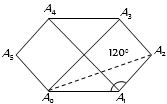
Let $A_0 A_1 A_2 A_3 A_4 A_5$ be a regular hexagon inscribed in a circle of unit radius. Then the product of the lengths of the line segments $A_0 A_1$,$A_0 A_2$,and $A_0 A_4$ is
A
$\frac{3}{4}$
B
$3\sqrt{3}$
C
$3$
D
$\frac{3\sqrt{3}}{2}$
Solution
(C) The regular hexagon $A_0 A_1 A_2 A_3 A_4 A_5$ is inscribed in a circle of radius $R = 1$.
In a regular hexagon,the side length is equal to the radius of the circumscribed circle.
Thus,$A_0 A_1 = 1$.
To find $A_0 A_2$,consider the triangle $A_0 A_1 A_2$. The interior angle of a regular hexagon is $120^\circ$.
Using the Law of Cosines in $\triangle A_0 A_1 A_2$:
$A_0 A_2^2 = A_0 A_1^2 + A_1 A_2^2 - 2(A_0 A_1)(A_1 A_2) \cos(120^\circ)$
$A_0 A_2^2 = 1^2 + 1^2 - 2(1)(1)(-\frac{1}{2}) = 1 + 1 + 1 = 3$.
So,$A_0 A_2 = \sqrt{3}$.
By symmetry,$A_0 A_4 = A_0 A_2 = \sqrt{3}$.
The product of the lengths is $A_0 A_1 \times A_0 A_2 \times A_0 A_4 = 1 \times \sqrt{3} \times \sqrt{3} = 3$.
In a regular hexagon,the side length is equal to the radius of the circumscribed circle.
Thus,$A_0 A_1 = 1$.
To find $A_0 A_2$,consider the triangle $A_0 A_1 A_2$. The interior angle of a regular hexagon is $120^\circ$.
Using the Law of Cosines in $\triangle A_0 A_1 A_2$:
$A_0 A_2^2 = A_0 A_1^2 + A_1 A_2^2 - 2(A_0 A_1)(A_1 A_2) \cos(120^\circ)$
$A_0 A_2^2 = 1^2 + 1^2 - 2(1)(1)(-\frac{1}{2}) = 1 + 1 + 1 = 3$.
So,$A_0 A_2 = \sqrt{3}$.
By symmetry,$A_0 A_4 = A_0 A_2 = \sqrt{3}$.
The product of the lengths is $A_0 A_1 \times A_0 A_2 \times A_0 A_4 = 1 \times \sqrt{3} \times \sqrt{3} = 3$.
0 likes
View Solution338
DifficultMCQ
$3\,\left[ {{{\sin }^4}\,\left( {\frac{{3\pi }}{2} - \alpha } \right) + {{\sin }^4}\,(3\pi + \alpha )} \right] - 2\,\left[ {{{\sin }^6}\,\left( {\frac{\pi }{2} + \alpha } \right) + {{\sin }^6}(5\pi - \alpha )} \right] = $
A
$0$
B
$1$
C
$3$
D
$\sin \,4\alpha + \sin \,6\alpha $
Solution
(B) Given expression: $3\left[ {{{\sin }^4}\left( {\frac{{3\pi }}{2} - \alpha } \right) + {{\sin }^4}(3\pi + \alpha )} \right] - 2\left[ {{{\sin }^6}\left( {\frac{\pi }{2} + \alpha } \right) + {{\sin }^6}(5\pi - \alpha )} \right]$
Using trigonometric reduction formulas:
$\sin(\frac{3\pi}{2} - \alpha) = -\cos \alpha$,$\sin(3\pi + \alpha) = -\sin \alpha$
$\sin(\frac{\pi}{2} + \alpha) = \cos \alpha$,$\sin(5\pi - \alpha) = \sin \alpha$
Substituting these values:
$= 3\left[ {(-\cos \alpha)^4 + (-\sin \alpha)^4} \right] - 2\left[ {(\cos \alpha)^6 + (\sin \alpha)^6} \right]$
$= 3(\cos^4 \alpha + \sin^4 \alpha) - 2(\cos^6 \alpha + \sin^6 \alpha)$
Using identities $a^2+b^2 = (a+b)^2 - 2ab$ and $a^3+b^3 = (a+b)^3 - 3ab(a+b)$:
$= 3[(\cos^2 \alpha + \sin^2 \alpha)^2 - 2\sin^2 \alpha \cos^2 \alpha] - 2[(\cos^2 \alpha + \sin^2 \alpha)^3 - 3\sin^2 \alpha \cos^2 \alpha(\cos^2 \alpha + \sin^2 \alpha)]$
Since $\sin^2 \alpha + \cos^2 \alpha = 1$:
$= 3[1 - 2\sin^2 \alpha \cos^2 \alpha] - 2[1 - 3\sin^2 \alpha \cos^2 \alpha]$
$= 3 - 6\sin^2 \alpha \cos^2 \alpha - 2 + 6\sin^2 \alpha \cos^2 \alpha$
$= 3 - 2 = 1$
Using trigonometric reduction formulas:
$\sin(\frac{3\pi}{2} - \alpha) = -\cos \alpha$,$\sin(3\pi + \alpha) = -\sin \alpha$
$\sin(\frac{\pi}{2} + \alpha) = \cos \alpha$,$\sin(5\pi - \alpha) = \sin \alpha$
Substituting these values:
$= 3\left[ {(-\cos \alpha)^4 + (-\sin \alpha)^4} \right] - 2\left[ {(\cos \alpha)^6 + (\sin \alpha)^6} \right]$
$= 3(\cos^4 \alpha + \sin^4 \alpha) - 2(\cos^6 \alpha + \sin^6 \alpha)$
Using identities $a^2+b^2 = (a+b)^2 - 2ab$ and $a^3+b^3 = (a+b)^3 - 3ab(a+b)$:
$= 3[(\cos^2 \alpha + \sin^2 \alpha)^2 - 2\sin^2 \alpha \cos^2 \alpha] - 2[(\cos^2 \alpha + \sin^2 \alpha)^3 - 3\sin^2 \alpha \cos^2 \alpha(\cos^2 \alpha + \sin^2 \alpha)]$
Since $\sin^2 \alpha + \cos^2 \alpha = 1$:
$= 3[1 - 2\sin^2 \alpha \cos^2 \alpha] - 2[1 - 3\sin^2 \alpha \cos^2 \alpha]$
$= 3 - 6\sin^2 \alpha \cos^2 \alpha - 2 + 6\sin^2 \alpha \cos^2 \alpha$
$= 3 - 2 = 1$
0 likes
View Solution339
MediumMCQ
If $\alpha \in \left( 0, \frac{\pi}{2} \right),$ then $\sqrt{x^2 + x} + \frac{\tan^2 \alpha}{\sqrt{x^2 + x}}$ is always greater than or equal to
A
$2 \tan \alpha$
B
$1$
C
$2$
D
$\sec^2 \alpha$
Solution
(A) We are given the expression $E = \sqrt{x^2 + x} + \frac{\tan^2 \alpha}{\sqrt{x^2 + x}}.$
Since $\alpha \in \left( 0, \frac{\pi}{2} \right),$ $\tan \alpha > 0,$ and for $x^2 + x > 0,$ both terms are positive.
By the Arithmetic Mean-Geometric Mean Inequality $(AM \ge GM)$,for any two positive real numbers $a$ and $b,$ $a + b \ge 2\sqrt{ab}.$
Let $a = \sqrt{x^2 + x}$ and $b = \frac{\tan^2 \alpha}{\sqrt{x^2 + x}}.$
Then $a + b \ge 2 \sqrt{\sqrt{x^2 + x} \cdot \frac{\tan^2 \alpha}{\sqrt{x^2 + x}}}.$
$a + b \ge 2 \sqrt{\tan^2 \alpha}.$
Since $\tan \alpha > 0$ for $\alpha \in \left( 0, \frac{\pi}{2} \right),$ we have $a + b \ge 2 \tan \alpha.$
Thus,the expression is always greater than or equal to $2 \tan \alpha.$
Since $\alpha \in \left( 0, \frac{\pi}{2} \right),$ $\tan \alpha > 0,$ and for $x^2 + x > 0,$ both terms are positive.
By the Arithmetic Mean-Geometric Mean Inequality $(AM \ge GM)$,for any two positive real numbers $a$ and $b,$ $a + b \ge 2\sqrt{ab}.$
Let $a = \sqrt{x^2 + x}$ and $b = \frac{\tan^2 \alpha}{\sqrt{x^2 + x}}.$
Then $a + b \ge 2 \sqrt{\sqrt{x^2 + x} \cdot \frac{\tan^2 \alpha}{\sqrt{x^2 + x}}}.$
$a + b \ge 2 \sqrt{\tan^2 \alpha}.$
Since $\tan \alpha > 0$ for $\alpha \in \left( 0, \frac{\pi}{2} \right),$ we have $a + b \ge 2 \tan \alpha.$
Thus,the expression is always greater than or equal to $2 \tan \alpha.$
0 likes
View Solution340
DifficultMCQ
The maximum value of $\cos \alpha_1 \cdot \cos \alpha_2 \cdots \cos \alpha_n$ under the restrictions $0 \le \alpha_1, \alpha_2, \dots, \alpha_n \le \frac{\pi}{2}$ and $\cot \alpha_1 \cdot \cot \alpha_2 \cdots \cot \alpha_n = 1$ is
A
$\frac{1}{2^{n/2}}$
B
$\frac{1}{2^n}$
C
$\frac{1}{2n}$
D
$1$
Solution
(A) Given that $\cot \alpha_1 \cdot \cot \alpha_2 \cdots \cot \alpha_n = 1$.
This implies $\frac{\cos \alpha_1}{\sin \alpha_1} \cdot \frac{\cos \alpha_2}{\sin \alpha_2} \cdots \frac{\cos \alpha_n}{\sin \alpha_n} = 1$,which means $\cos \alpha_1 \cdot \cos \alpha_2 \cdots \cos \alpha_n = \sin \alpha_1 \cdot \sin \alpha_2 \cdots \sin \alpha_n$.
Let $P = \cos \alpha_1 \cdot \cos \alpha_2 \cdots \cos \alpha_n$.
Then $P^2 = (\cos \alpha_1 \cdot \cos \alpha_2 \cdots \cos \alpha_n) \cdot (\sin \alpha_1 \cdot \sin \alpha_2 \cdots \sin \alpha_n)$.
Using the identity $\sin \theta \cos \theta = \frac{1}{2} \sin 2\theta$,we get $P^2 = \frac{1}{2^n} \sin 2\alpha_1 \cdot \sin 2\alpha_2 \cdots \sin 2\alpha_n$.
Since $\sin 2\alpha_i \le 1$ for all $i$,the maximum value of $P^2$ is $\frac{1}{2^n}$.
Therefore,the maximum value of $P$ is $\sqrt{\frac{1}{2^n}} = \frac{1}{2^{n/2}}$.
This implies $\frac{\cos \alpha_1}{\sin \alpha_1} \cdot \frac{\cos \alpha_2}{\sin \alpha_2} \cdots \frac{\cos \alpha_n}{\sin \alpha_n} = 1$,which means $\cos \alpha_1 \cdot \cos \alpha_2 \cdots \cos \alpha_n = \sin \alpha_1 \cdot \sin \alpha_2 \cdots \sin \alpha_n$.
Let $P = \cos \alpha_1 \cdot \cos \alpha_2 \cdots \cos \alpha_n$.
Then $P^2 = (\cos \alpha_1 \cdot \cos \alpha_2 \cdots \cos \alpha_n) \cdot (\sin \alpha_1 \cdot \sin \alpha_2 \cdots \sin \alpha_n)$.
Using the identity $\sin \theta \cos \theta = \frac{1}{2} \sin 2\theta$,we get $P^2 = \frac{1}{2^n} \sin 2\alpha_1 \cdot \sin 2\alpha_2 \cdots \sin 2\alpha_n$.
Since $\sin 2\alpha_i \le 1$ for all $i$,the maximum value of $P^2$ is $\frac{1}{2^n}$.
Therefore,the maximum value of $P$ is $\sqrt{\frac{1}{2^n}} = \frac{1}{2^{n/2}}$.
0 likes
View Solution341
DifficultMCQ
If $A = \sin^8 \theta + \cos^{14} \theta$,then for all real values of $\theta$:
A
$A \ge 1$
B
$0 < A \le 1$
C
$1 < 2A \le 3$
D
None of these
Solution
(B) Given that $A = \sin^8 \theta + \cos^{14} \theta$.
Since $0 \le \sin^2 \theta \le 1$ and $0 \le \cos^2 \theta \le 1$ for all real $\theta$,we have:
$\sin^8 \theta \le \sin^2 \theta$ and $\cos^{14} \theta \le \cos^2 \theta$.
Adding these inequalities,we get:
$A = \sin^8 \theta + \cos^{14} \theta \le \sin^2 \theta + \cos^2 \theta = 1$.
Also,since $\sin^8 \theta > 0$ and $\cos^{14} \theta > 0$ for all $\theta$ (excluding cases where one is zero,but they cannot both be zero simultaneously),$A > 0$.
Therefore,$0 < A \le 1$.
Since $0 \le \sin^2 \theta \le 1$ and $0 \le \cos^2 \theta \le 1$ for all real $\theta$,we have:
$\sin^8 \theta \le \sin^2 \theta$ and $\cos^{14} \theta \le \cos^2 \theta$.
Adding these inequalities,we get:
$A = \sin^8 \theta + \cos^{14} \theta \le \sin^2 \theta + \cos^2 \theta = 1$.
Also,since $\sin^8 \theta > 0$ and $\cos^{14} \theta > 0$ for all $\theta$ (excluding cases where one is zero,but they cannot both be zero simultaneously),$A > 0$.
Therefore,$0 < A \le 1$.
0 likes
View Solution342
DifficultMCQ
If $\theta$ is an acute angle and $\sin\theta = \frac{p - 6}{8 - p}$,then $p$ must satisfy:
A
$6 \le p < 8$
B
$6 \le p < 7$
C
$3 \le p \le 4$
D
$4 \le p < 7$
Solution
(B) Since $\theta$ is an acute angle,we have $0^\circ < \theta < 90^\circ$.
For an acute angle,the value of $\sin\theta$ must satisfy $0 \le \sin\theta < 1$.
Substituting the given expression: $0 \le \frac{p - 6}{8 - p} < 1$.
First,consider $0 \le \frac{p - 6}{8 - p}$. Since the denominator $8 - p$ must be positive for $\sin\theta$ to be defined and positive,we have $8 - p > 0$,which implies $p < 8$. For the numerator,$p - 6 \ge 0$,so $p \ge 6$.
Next,consider $\frac{p - 6}{8 - p} < 1$. Since $8 - p > 0$,we can multiply both sides by $(8 - p)$ without changing the inequality sign: $p - 6 < 8 - p$.
Adding $p$ to both sides: $2p - 6 < 8$.
Adding $6$ to both sides: $2p < 14$.
Dividing by $2$: $p < 7$.
Combining the conditions $p \ge 6$ and $p < 7$,we get $6 \le p < 7$.
For an acute angle,the value of $\sin\theta$ must satisfy $0 \le \sin\theta < 1$.
Substituting the given expression: $0 \le \frac{p - 6}{8 - p} < 1$.
First,consider $0 \le \frac{p - 6}{8 - p}$. Since the denominator $8 - p$ must be positive for $\sin\theta$ to be defined and positive,we have $8 - p > 0$,which implies $p < 8$. For the numerator,$p - 6 \ge 0$,so $p \ge 6$.
Next,consider $\frac{p - 6}{8 - p} < 1$. Since $8 - p > 0$,we can multiply both sides by $(8 - p)$ without changing the inequality sign: $p - 6 < 8 - p$.
Adding $p$ to both sides: $2p - 6 < 8$.
Adding $6$ to both sides: $2p < 14$.
Dividing by $2$: $p < 7$.
Combining the conditions $p \ge 6$ and $p < 7$,we get $6 \le p < 7$.
0 likes
View Solution343
DifficultMCQ
If $A, B, C$ are the angles of a triangle,then $\sum \frac{\cot A + \cot B}{\tan A + \tan B} = $
A
$1$
B
$2$
C
$-1$
D
$-2$
Solution
(A) Given the expression: $\sum \frac{\cot A + \cot B}{\tan A + \tan B}$.
We know that $\cot A + \cot B = \frac{\cos A}{\sin A} + \frac{\cos B}{\sin B} = \frac{\sin B \cos A + \cos B \sin A}{\sin A \sin B} = \frac{\sin(A+B)}{\sin A \sin B}$.
Similarly,$\tan A + \tan B = \frac{\sin A}{\cos A} + \frac{\sin B}{\cos B} = \frac{\sin A \cos B + \cos A \sin B}{\cos A \cos B} = \frac{\sin(A+B)}{\cos A \cos B}$.
Substituting these into the expression:
$\frac{\cot A + \cot B}{\tan A + \tan B} = \frac{\sin(A+B)}{\sin A \sin B} \times \frac{\cos A \cos B}{\sin(A+B)} = \frac{\cos A \cos B}{\sin A \sin B} = \cot A \cot B$.
Thus,the sum is $\sum \cot A \cot B = \cot A \cot B + \cot B \cot C + \cot C \cot A$.
For any triangle where $A + B + C = \pi$,the identity $\cot A \cot B + \cot B \cot C + \cot C \cot A = 1$ holds true.
Therefore,the final answer is $1$.
We know that $\cot A + \cot B = \frac{\cos A}{\sin A} + \frac{\cos B}{\sin B} = \frac{\sin B \cos A + \cos B \sin A}{\sin A \sin B} = \frac{\sin(A+B)}{\sin A \sin B}$.
Similarly,$\tan A + \tan B = \frac{\sin A}{\cos A} + \frac{\sin B}{\cos B} = \frac{\sin A \cos B + \cos A \sin B}{\cos A \cos B} = \frac{\sin(A+B)}{\cos A \cos B}$.
Substituting these into the expression:
$\frac{\cot A + \cot B}{\tan A + \tan B} = \frac{\sin(A+B)}{\sin A \sin B} \times \frac{\cos A \cos B}{\sin(A+B)} = \frac{\cos A \cos B}{\sin A \sin B} = \cot A \cot B$.
Thus,the sum is $\sum \cot A \cot B = \cot A \cot B + \cot B \cot C + \cot C \cot A$.
For any triangle where $A + B + C = \pi$,the identity $\cot A \cot B + \cot B \cot C + \cot C \cot A = 1$ holds true.
Therefore,the final answer is $1$.
0 likes
View Solution344
MediumMCQ
If $\alpha + \beta = \frac{\pi}{2}$ and $\beta + \gamma = \alpha$,then $\tan \alpha$ equals
A
$2(\tan \beta + \tan \gamma)$
B
$\tan \beta + \tan \gamma$
C
$\tan \beta + 2\tan \gamma$
D
$2\tan \beta + \tan \gamma$
Solution
(C) Given $\alpha + \beta = \frac{\pi}{2}$,we have $\beta = \frac{\pi}{2} - \alpha$,so $\tan \beta = \tan(\frac{\pi}{2} - \alpha) = \cot \alpha$.
Also,given $\beta + \gamma = \alpha$,taking $\tan$ on both sides gives $\tan(\beta + \gamma) = \tan \alpha$.
Using the formula $\tan(A + B) = \frac{\tan A + \tan B}{1 - \tan A \tan B}$,we get $\frac{\tan \beta + \tan \gamma}{1 - \tan \beta \tan \gamma} = \tan \alpha$.
Substituting $\tan \beta = \cot \alpha = \frac{1}{\tan \alpha}$,we have $\frac{\frac{1}{\tan \alpha} + \tan \gamma}{1 - \frac{1}{\tan \alpha} \tan \gamma} = \tan \alpha$.
Multiplying the numerator and denominator by $\tan \alpha$,we get $\frac{1 + \tan \alpha \tan \gamma}{\tan \alpha - \tan \gamma} = \tan \alpha$.
$1 + \tan \alpha \tan \gamma = \tan^2 \alpha - \tan \alpha \tan \gamma$.
$1 + 2\tan \alpha \tan \gamma = \tan^2 \alpha$.
Dividing by $\tan \alpha$,we get $\cot \alpha + 2\tan \gamma = \tan \alpha$.
Since $\cot \alpha = \tan \beta$,we have $\tan \alpha = \tan \beta + 2\tan \gamma$.
Also,given $\beta + \gamma = \alpha$,taking $\tan$ on both sides gives $\tan(\beta + \gamma) = \tan \alpha$.
Using the formula $\tan(A + B) = \frac{\tan A + \tan B}{1 - \tan A \tan B}$,we get $\frac{\tan \beta + \tan \gamma}{1 - \tan \beta \tan \gamma} = \tan \alpha$.
Substituting $\tan \beta = \cot \alpha = \frac{1}{\tan \alpha}$,we have $\frac{\frac{1}{\tan \alpha} + \tan \gamma}{1 - \frac{1}{\tan \alpha} \tan \gamma} = \tan \alpha$.
Multiplying the numerator and denominator by $\tan \alpha$,we get $\frac{1 + \tan \alpha \tan \gamma}{\tan \alpha - \tan \gamma} = \tan \alpha$.
$1 + \tan \alpha \tan \gamma = \tan^2 \alpha - \tan \alpha \tan \gamma$.
$1 + 2\tan \alpha \tan \gamma = \tan^2 \alpha$.
Dividing by $\tan \alpha$,we get $\cot \alpha + 2\tan \gamma = \tan \alpha$.
Since $\cot \alpha = \tan \beta$,we have $\tan \alpha = \tan \beta + 2\tan \gamma$.
0 likes
View Solution345
DifficultMCQ
If $\left| a\sin^2 \theta + b\sin \theta \cos \theta + c\cos^2 \theta - \frac{1}{2}(a + c) \right| \le \frac{1}{2}k,$ then $k^2$ is equal to
A
$b^2 + (a - c)^2$
B
$a^2 + (b - c)^2$
C
$c^2 + (a - b)^2$
D
None of these
Solution
(A) Let $E = a\sin^2 \theta + b\sin \theta \cos \theta + c\cos^2 \theta - \frac{1}{2}(a + c)$.
Using the identities $\sin^2 \theta = \frac{1 - \cos 2\theta}{2}$ and $\cos^2 \theta = \frac{1 + \cos 2\theta}{2}$:
$E = a\left( \frac{1 - \cos 2\theta}{2} \right) + b\left( \frac{\sin 2\theta}{2} \right) + c\left( \frac{1 + \cos 2\theta}{2} \right) - \frac{1}{2}(a + c)$
$E = \frac{1}{2} [a - a\cos 2\theta + b\sin 2\theta + c + c\cos 2\theta - a - c]$
$E = \frac{1}{2} [b\sin 2\theta - (a - c)\cos 2\theta]$
We know that for any expression of the form $A\sin x + B\cos x$,the range is $[-\sqrt{A^2 + B^2}, \sqrt{A^2 + B^2}]$.
Thus,$|b\sin 2\theta - (a - c)\cos 2\theta| \le \sqrt{b^2 + (a - c)^2}$.
Therefore,$|E| = \left| \frac{1}{2} [b\sin 2\theta - (a - c)\cos 2\theta] \right| \le \frac{1}{2} \sqrt{b^2 + (a - c)^2}$.
Comparing this with the given inequality $|E| \le \frac{1}{2}k$,we get $k = \sqrt{b^2 + (a - c)^2}$.
Squaring both sides,$k^2 = b^2 + (a - c)^2$.
Using the identities $\sin^2 \theta = \frac{1 - \cos 2\theta}{2}$ and $\cos^2 \theta = \frac{1 + \cos 2\theta}{2}$:
$E = a\left( \frac{1 - \cos 2\theta}{2} \right) + b\left( \frac{\sin 2\theta}{2} \right) + c\left( \frac{1 + \cos 2\theta}{2} \right) - \frac{1}{2}(a + c)$
$E = \frac{1}{2} [a - a\cos 2\theta + b\sin 2\theta + c + c\cos 2\theta - a - c]$
$E = \frac{1}{2} [b\sin 2\theta - (a - c)\cos 2\theta]$
We know that for any expression of the form $A\sin x + B\cos x$,the range is $[-\sqrt{A^2 + B^2}, \sqrt{A^2 + B^2}]$.
Thus,$|b\sin 2\theta - (a - c)\cos 2\theta| \le \sqrt{b^2 + (a - c)^2}$.
Therefore,$|E| = \left| \frac{1}{2} [b\sin 2\theta - (a - c)\cos 2\theta] \right| \le \frac{1}{2} \sqrt{b^2 + (a - c)^2}$.
Comparing this with the given inequality $|E| \le \frac{1}{2}k$,we get $k = \sqrt{b^2 + (a - c)^2}$.
Squaring both sides,$k^2 = b^2 + (a - c)^2$.
0 likes
View Solution346
MediumMCQ
If for all real values of $x$,$\frac{4x^2 + 1}{64x^2 - 96x \sin \alpha + 5} < \frac{1}{32}$,then $\alpha$ lies in the interval
A
$(0, \pi/3)$
B
$(\pi/3, 2\pi/3)$
C
$(4\pi/3, 5\pi/3)$
D
$b$ or $c$ both
Solution
(D) Given the inequality: $\frac{4x^2 + 1}{64x^2 - 96x \sin \alpha + 5} < \frac{1}{32}$.
Since the expression must hold for all real $x$,the denominator $64x^2 - 96x \sin \alpha + 5$ must be positive for all $x$ (as the numerator is always positive).
Cross-multiplying: $32(4x^2 + 1) < 64x^2 - 96x \sin \alpha + 5$.
$128x^2 + 32 < 64x^2 - 96x \sin \alpha + 5$.
$64x^2 + 96x \sin \alpha + 27 < 0$.
For this quadratic in $x$ to be negative for all $x$,the discriminant $D$ must be positive,but wait,the inequality must hold for all $x$. Actually,for the quadratic $ax^2 + bx + c < 0$ to hold for all $x$,it is impossible as $a > 0$. Re-evaluating: the expression must be negative for all $x$. This implies the quadratic $64x^2 + 96x \sin \alpha + 27$ must be less than $0$ for all $x$,which is impossible for a parabola opening upwards. The condition implies the range of the function must be less than $1/32$. The discriminant of $64x^2 + 96x \sin \alpha + 27 = 0$ must be positive for real roots to exist,allowing the expression to be negative between the roots. Thus,$D = (96 \sin \alpha)^2 - 4(64)(27) > 0$.
$9216 \sin^2 \alpha - 6912 > 0$.
$\sin^2 \alpha > \frac{6912}{9216} = \frac{3}{4}$.
$|\sin \alpha| > \frac{\sqrt{3}}{2}$.
This implies $\sin \alpha > \frac{\sqrt{3}}{2}$ or $\sin \alpha < -\frac{\sqrt{3}}{2}$.
For $\sin \alpha > \frac{\sqrt{3}}{2}$,$\alpha \in (\pi/3, 2\pi/3)$.
For $\sin \alpha < -\frac{\sqrt{3}}{2}$,$\alpha \in (4\pi/3, 5\pi/3)$.
Since the expression must hold for all real $x$,the denominator $64x^2 - 96x \sin \alpha + 5$ must be positive for all $x$ (as the numerator is always positive).
Cross-multiplying: $32(4x^2 + 1) < 64x^2 - 96x \sin \alpha + 5$.
$128x^2 + 32 < 64x^2 - 96x \sin \alpha + 5$.
$64x^2 + 96x \sin \alpha + 27 < 0$.
For this quadratic in $x$ to be negative for all $x$,the discriminant $D$ must be positive,but wait,the inequality must hold for all $x$. Actually,for the quadratic $ax^2 + bx + c < 0$ to hold for all $x$,it is impossible as $a > 0$. Re-evaluating: the expression must be negative for all $x$. This implies the quadratic $64x^2 + 96x \sin \alpha + 27$ must be less than $0$ for all $x$,which is impossible for a parabola opening upwards. The condition implies the range of the function must be less than $1/32$. The discriminant of $64x^2 + 96x \sin \alpha + 27 = 0$ must be positive for real roots to exist,allowing the expression to be negative between the roots. Thus,$D = (96 \sin \alpha)^2 - 4(64)(27) > 0$.
$9216 \sin^2 \alpha - 6912 > 0$.
$\sin^2 \alpha > \frac{6912}{9216} = \frac{3}{4}$.
$|\sin \alpha| > \frac{\sqrt{3}}{2}$.
This implies $\sin \alpha > \frac{\sqrt{3}}{2}$ or $\sin \alpha < -\frac{\sqrt{3}}{2}$.
For $\sin \alpha > \frac{\sqrt{3}}{2}$,$\alpha \in (\pi/3, 2\pi/3)$.
For $\sin \alpha < -\frac{\sqrt{3}}{2}$,$\alpha \in (4\pi/3, 5\pi/3)$.
0 likes
View Solution347
AdvancedMCQ
If $x + y = 3 - \cos 4\theta$ and $x - y = 4 \sin 2\theta$,then:
A
$x^4 + y^4 = 9$
B
$\sqrt{x} + \sqrt{y} = 16$
C
$x^3 + y^3 = 2(x^2 + y^2)$
D
$\sqrt{x} + \sqrt{y} = 2$
Solution
(D) Given equations are:
$x + y = 3 - \cos 4\theta = 3 - (1 - 2 \sin^2 2\theta) = 2 + 2 \sin^2 2\theta$
$x - y = 4 \sin 2\theta$
Adding the two equations:
$2x = 2 + 2 \sin^2 2\theta + 4 \sin 2\theta = 2(1 + 2 \sin 2\theta + \sin^2 2\theta) = 2(1 + \sin 2\theta)^2$
$x = (1 + \sin 2\theta)^2 \implies \sqrt{x} = 1 + \sin 2\theta$
Subtracting the two equations:
$2y = 2 + 2 \sin^2 2\theta - 4 \sin 2\theta = 2(1 - 2 \sin 2\theta + \sin^2 2\theta) = 2(1 - \sin 2\theta)^2$
$y = (1 - \sin 2\theta)^2 \implies \sqrt{y} = 1 - \sin 2\theta$
Adding $\sqrt{x}$ and $\sqrt{y}$:
$\sqrt{x} + \sqrt{y} = (1 + \sin 2\theta) + (1 - \sin 2\theta) = 2$
Thus,the correct option is $D$.
$x + y = 3 - \cos 4\theta = 3 - (1 - 2 \sin^2 2\theta) = 2 + 2 \sin^2 2\theta$
$x - y = 4 \sin 2\theta$
Adding the two equations:
$2x = 2 + 2 \sin^2 2\theta + 4 \sin 2\theta = 2(1 + 2 \sin 2\theta + \sin^2 2\theta) = 2(1 + \sin 2\theta)^2$
$x = (1 + \sin 2\theta)^2 \implies \sqrt{x} = 1 + \sin 2\theta$
Subtracting the two equations:
$2y = 2 + 2 \sin^2 2\theta - 4 \sin 2\theta = 2(1 - 2 \sin 2\theta + \sin^2 2\theta) = 2(1 - \sin 2\theta)^2$
$y = (1 - \sin 2\theta)^2 \implies \sqrt{y} = 1 - \sin 2\theta$
Adding $\sqrt{x}$ and $\sqrt{y}$:
$\sqrt{x} + \sqrt{y} = (1 + \sin 2\theta) + (1 - \sin 2\theta) = 2$
Thus,the correct option is $D$.
0 likes
View Solution348
AdvancedMCQ
If $\tan B = \frac{n \sin A \cos A}{1 - n \cos^2 A}$,then $\tan(A + B)$ equals
A
$\frac{\sin A}{(1 - n) \cos A}$
B
$\frac{(n - 1) \cos A}{\sin A}$
C
$\frac{\sin A}{(n - 1) \cos A}$
D
$\frac{\sin A}{(n + 1) \cos A}$
Solution
(A) We know that $\tan(A + B) = \frac{\tan A + \tan B}{1 - \tan A \tan B}$.
Substituting the given value of $\tan B = \frac{n \sin A \cos A}{1 - n \cos^2 A}$:
$\tan(A + B) = \frac{\tan A + \frac{n \sin A \cos A}{1 - n \cos^2 A}}{1 - \tan A \cdot \frac{n \sin A \cos A}{1 - n \cos^2 A}}$
$= \frac{\frac{\sin A}{\cos A} + \frac{n \sin A \cos A}{1 - n \cos^2 A}}{1 - \frac{\sin A}{\cos A} \cdot \frac{n \sin A \cos A}{1 - n \cos^2 A}}$
$= \frac{\sin A(1 - n \cos^2 A) + n \sin A \cos^2 A}{\cos A(1 - n \cos^2 A) - n \sin^2 A \cos A}$
$= \frac{\sin A - n \sin A \cos^2 A + n \sin A \cos^2 A}{\cos A(1 - n(\cos^2 A + \sin^2 A))}$
$= \frac{\sin A}{\cos A(1 - n(1))}$
$= \frac{\sin A}{(1 - n) \cos A}$.
Substituting the given value of $\tan B = \frac{n \sin A \cos A}{1 - n \cos^2 A}$:
$\tan(A + B) = \frac{\tan A + \frac{n \sin A \cos A}{1 - n \cos^2 A}}{1 - \tan A \cdot \frac{n \sin A \cos A}{1 - n \cos^2 A}}$
$= \frac{\frac{\sin A}{\cos A} + \frac{n \sin A \cos A}{1 - n \cos^2 A}}{1 - \frac{\sin A}{\cos A} \cdot \frac{n \sin A \cos A}{1 - n \cos^2 A}}$
$= \frac{\sin A(1 - n \cos^2 A) + n \sin A \cos^2 A}{\cos A(1 - n \cos^2 A) - n \sin^2 A \cos A}$
$= \frac{\sin A - n \sin A \cos^2 A + n \sin A \cos^2 A}{\cos A(1 - n(\cos^2 A + \sin^2 A))}$
$= \frac{\sin A}{\cos A(1 - n(1))}$
$= \frac{\sin A}{(1 - n) \cos A}$.
0 likes
View Solution349
AdvancedMCQ
Given $a^2 + 2a + \csc^2 \left( \frac{\pi}{2}(a + x) \right) = 0$,then which of the following holds good?
A
$a = 1; \frac{x}{2} \in I$
B
$a = -1; \frac{x}{2} \in I$
C
$a \in R; x \in \phi$
D
$a, x$ are finite but not possible to find
Solution
(B) The given equation is $a^2 + 2a + \csc^2 \left( \frac{\pi}{2}(a + x) \right) = 0$.
Adding $1$ to both sides,we get $(a^2 + 2a + 1) + \csc^2 \left( \frac{\pi}{2}(a + x) \right) = 1$.
This simplifies to $(a + 1)^2 + \csc^2 \left( \frac{\pi}{2}(a + x) \right) = 1$.
Using the identity $1 + \cot^2 \theta = \csc^2 \theta$,we can rewrite the equation as $(a + 1)^2 + 1 + \cot^2 \left( \frac{\pi}{2}(a + x) \right) = 1$.
Subtracting $1$ from both sides,we get $(a + 1)^2 + \cot^2 \left( \frac{\pi}{2}(a + x) \right) = 0$.
Since both terms are squares of real numbers,their sum can be zero only if each term is zero individually.
Thus,$(a + 1)^2 = 0 \Rightarrow a = -1$.
Substituting $a = -1$ into the second term,we get $\cot^2 \left( \frac{\pi}{2}(-1 + x) \right) = 0$.
This implies $\cot \left( \frac{\pi}{2}(x - 1) \right) = 0$.
This occurs when the argument is an odd multiple of $\frac{\pi}{2}$,i.e.,$\frac{\pi}{2}(x - 1) = (2n + 1) \frac{\pi}{2}$ for some integer $n$.
$x - 1 = 2n + 1 \Rightarrow x = 2n + 2 = 2(n + 1)$.
Thus,$\frac{x}{2} = n + 1$,which is an integer $(I)$.
Adding $1$ to both sides,we get $(a^2 + 2a + 1) + \csc^2 \left( \frac{\pi}{2}(a + x) \right) = 1$.
This simplifies to $(a + 1)^2 + \csc^2 \left( \frac{\pi}{2}(a + x) \right) = 1$.
Using the identity $1 + \cot^2 \theta = \csc^2 \theta$,we can rewrite the equation as $(a + 1)^2 + 1 + \cot^2 \left( \frac{\pi}{2}(a + x) \right) = 1$.
Subtracting $1$ from both sides,we get $(a + 1)^2 + \cot^2 \left( \frac{\pi}{2}(a + x) \right) = 0$.
Since both terms are squares of real numbers,their sum can be zero only if each term is zero individually.
Thus,$(a + 1)^2 = 0 \Rightarrow a = -1$.
Substituting $a = -1$ into the second term,we get $\cot^2 \left( \frac{\pi}{2}(-1 + x) \right) = 0$.
This implies $\cot \left( \frac{\pi}{2}(x - 1) \right) = 0$.
This occurs when the argument is an odd multiple of $\frac{\pi}{2}$,i.e.,$\frac{\pi}{2}(x - 1) = (2n + 1) \frac{\pi}{2}$ for some integer $n$.
$x - 1 = 2n + 1 \Rightarrow x = 2n + 2 = 2(n + 1)$.
Thus,$\frac{x}{2} = n + 1$,which is an integer $(I)$.
0 likes
View Solution350
AdvancedMCQ
The exact value of $\cos \frac{2\pi}{28} \csc \frac{3\pi}{28} + \cos \frac{6\pi}{28} \csc \frac{9\pi}{28} + \cos \frac{18\pi}{28} \csc \frac{27\pi}{28}$ is equal to
A
$-1/2$
B
$1/2$
C
$1$
D
$0$
Solution
(D) Let $x = \frac{\pi}{28}$. The expression is $S = \cos(2x) \csc(3x) + \cos(6x) \csc(9x) + \cos(18x) \csc(27x)$.
Consider the general term $T_k = \frac{\cos(2 \cdot 3^{k-1} x)}{\sin(3^k x)}$ for $k = 1, 2, 3$.
Using the identity $\cos(A) \csc(B) = \frac{\cos A}{\sin B}$,we multiply numerator and denominator by $\sin(3^{k-1} x)$:
$T_k = \frac{\cos(2 \cdot 3^{k-1} x) \sin(3^{k-1} x)}{\sin(3^k x) \sin(3^{k-1} x)}$.
Using $2 \sin A \cos B = \sin(A+B) - \sin(B-A)$,we get:
$T_k = \frac{1}{2} \frac{\sin(3^k x) - \sin(3^{k-1} x)}{\sin(3^k x) \sin(3^{k-1} x)} = \frac{1}{2} (\csc(3^{k-1} x) - \csc(3^k x))$.
Summing for $k=1, 2, 3$:
$S = \frac{1}{2} [(\csc x - \csc 3x) + (\csc 3x - \csc 9x) + (\csc 9x - \csc 27x)]$.
$S = \frac{1}{2} (\csc x - \csc 27x)$.
Since $27x = 27\frac{\pi}{28} = \pi - \frac{\pi}{28} = \pi - x$,we have $\csc(27x) = \csc(\pi - x) = \csc x$.
Thus,$S = \frac{1}{2} (\csc x - \csc x) = 0$.
Consider the general term $T_k = \frac{\cos(2 \cdot 3^{k-1} x)}{\sin(3^k x)}$ for $k = 1, 2, 3$.
Using the identity $\cos(A) \csc(B) = \frac{\cos A}{\sin B}$,we multiply numerator and denominator by $\sin(3^{k-1} x)$:
$T_k = \frac{\cos(2 \cdot 3^{k-1} x) \sin(3^{k-1} x)}{\sin(3^k x) \sin(3^{k-1} x)}$.
Using $2 \sin A \cos B = \sin(A+B) - \sin(B-A)$,we get:
$T_k = \frac{1}{2} \frac{\sin(3^k x) - \sin(3^{k-1} x)}{\sin(3^k x) \sin(3^{k-1} x)} = \frac{1}{2} (\csc(3^{k-1} x) - \csc(3^k x))$.
Summing for $k=1, 2, 3$:
$S = \frac{1}{2} [(\csc x - \csc 3x) + (\csc 3x - \csc 9x) + (\csc 9x - \csc 27x)]$.
$S = \frac{1}{2} (\csc x - \csc 27x)$.
Since $27x = 27\frac{\pi}{28} = \pi - \frac{\pi}{28} = \pi - x$,we have $\csc(27x) = \csc(\pi - x) = \csc x$.
Thus,$S = \frac{1}{2} (\csc x - \csc x) = 0$.
0 likes
View SolutionTrigonometry — Trigonometry · Frequently Asked Questions
1Are these Trigonometry questions useful for JEE and NEET?
Yes. All questions in this section are mapped to JEE Main and NEET exam patterns. Previous year questions from JEE Main, NEET, GUJCET and state-level exams are included with full solutions.
2Can I switch to Hindi or Gujarati for these questions?
Yes. Use the language tabs in the hero section or the sidebar to view the same questions and solutions in English, Hindi or Gujarati.
3How do I generate a question paper from this subtopic?
Use the Vedclass Exam Paper Generator — select the chapter and subtopic, set difficulty, and generate Sets A, B, C, D automatically. First 3 chapters of every subject are free.
Vedclass Products
For Students
Vedclass Test Series
Mock tests in real JEE/NEET style with performance analysis. 5-day free trial.
Start Free TrialFor Teachers
Exam Paper Generator
Generate Set A/B/C/D papers from this chapter in 2 minutes. 3 chapters free.
Try FreeFor Institutes
Online Exam Module
Live online exams with unlimited students, 360° analytics & white-label branding.
See DemoFor Teachers & Institutes
Generate a Trigonometry Exam Paper in 2 Minutes
Select subtopic & difficulty — Sets A, B, C, D auto-generated with No Repeat logic.
First 3 chapters of every subject are free — no payment required.