
A English
Trigonometry Questions in English
Competitive Exam Quantitative Aptitude · Trigonometry · Trigonometry
648+
Questions
English
Language
100%
With Solutions
Showing 48 of 648 questions in English
601
MediumMCQ
If $a \cos \theta + b \sin \theta = p$ and $a \sin \theta - b \cos \theta = q$,then the relation between $a, b, p,$ and $q$ is:
A
$a^{2} - b^{2} = p^{2} - q^{2}$
B
$a^{2} + b^{2} = p^{2} + q^{2}$
C
$a + b = p + q$
D
$a - b = p - q$
Solution
(B) Given equations are:
$a \cos \theta + b \sin \theta = p$ ....$(1)$
$a \sin \theta - b \cos \theta = q$ ....$(2)$
Squaring both equations:
$(a \cos \theta + b \sin \theta)^{2} = p^{2}$
$a^{2} \cos^{2} \theta + b^{2} \sin^{2} \theta + 2ab \sin \theta \cos \theta = p^{2}$ ....$(3)$
$(a \sin \theta - b \cos \theta)^{2} = q^{2}$
$a^{2} \sin^{2} \theta + b^{2} \cos^{2} \theta - 2ab \sin \theta \cos \theta = q^{2}$ ....$(4)$
Adding equation $(3)$ and $(4)$:
$(a^{2} \cos^{2} \theta + a^{2} \sin^{2} \theta) + (b^{2} \sin^{2} \theta + b^{2} \cos^{2} \theta) + (2ab \sin \theta \cos \theta - 2ab \sin \theta \cos \theta) = p^{2} + q^{2}$
$a^{2}(\cos^{2} \theta + \sin^{2} \theta) + b^{2}(\sin^{2} \theta + \cos^{2} \theta) = p^{2} + q^{2}$
Since $\sin^{2} \theta + \cos^{2} \theta = 1$,we get:
$a^{2} + b^{2} = p^{2} + q^{2}$
$a \cos \theta + b \sin \theta = p$ ....$(1)$
$a \sin \theta - b \cos \theta = q$ ....$(2)$
Squaring both equations:
$(a \cos \theta + b \sin \theta)^{2} = p^{2}$
$a^{2} \cos^{2} \theta + b^{2} \sin^{2} \theta + 2ab \sin \theta \cos \theta = p^{2}$ ....$(3)$
$(a \sin \theta - b \cos \theta)^{2} = q^{2}$
$a^{2} \sin^{2} \theta + b^{2} \cos^{2} \theta - 2ab \sin \theta \cos \theta = q^{2}$ ....$(4)$
Adding equation $(3)$ and $(4)$:
$(a^{2} \cos^{2} \theta + a^{2} \sin^{2} \theta) + (b^{2} \sin^{2} \theta + b^{2} \cos^{2} \theta) + (2ab \sin \theta \cos \theta - 2ab \sin \theta \cos \theta) = p^{2} + q^{2}$
$a^{2}(\cos^{2} \theta + \sin^{2} \theta) + b^{2}(\sin^{2} \theta + \cos^{2} \theta) = p^{2} + q^{2}$
Since $\sin^{2} \theta + \cos^{2} \theta = 1$,we get:
$a^{2} + b^{2} = p^{2} + q^{2}$
0 likes
View Solution602
MediumMCQ
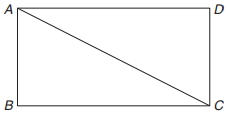
$ABCD$ is a rectangle where $AC$ is a diagonal. The value of $(\tan^2 \angle CAD + 1) \sin^2 \angle BAC$ is
A
$2$
B
$\frac{1}{4}$
C
$1$
D
$0$
Solution
(C) In a rectangle $ABCD$,the diagonal $AC$ divides the rectangle into two congruent right-angled triangles $\triangle ABC$ and $\triangle ADC$.
Let $\angle CAD = \theta$. Since $AD \parallel BC$,$\angle CAD = \angle ACB = \theta$.
Also,$\angle BAC = 90^{\circ} - \theta$.
Using the identity $1 + \tan^2 \theta = \sec^2 \theta$,the expression becomes:
$(\tan^2 \angle CAD + 1) \sin^2 \angle BAC = \sec^2 \angle CAD \cdot \sin^2 \angle BAC$
$= \frac{1}{\cos^2 \angle CAD} \cdot \sin^2 (90^{\circ} - \angle CAD)$
$= \frac{1}{\cos^2 \angle CAD} \cdot \cos^2 \angle CAD = 1$.
Let $\angle CAD = \theta$. Since $AD \parallel BC$,$\angle CAD = \angle ACB = \theta$.
Also,$\angle BAC = 90^{\circ} - \theta$.
Using the identity $1 + \tan^2 \theta = \sec^2 \theta$,the expression becomes:
$(\tan^2 \angle CAD + 1) \sin^2 \angle BAC = \sec^2 \angle CAD \cdot \sin^2 \angle BAC$
$= \frac{1}{\cos^2 \angle CAD} \cdot \sin^2 (90^{\circ} - \angle CAD)$
$= \frac{1}{\cos^2 \angle CAD} \cdot \cos^2 \angle CAD = 1$.
0 likes
View Solution603
EasyMCQ
If $\tan x = (\sin 45^{\circ})(\cos 45^{\circ}) + \sin 30^{\circ}$,then the value of $x$ is (in $^{\circ}$)
A
$30$
B
$45$
C
$60$
D
$90$
Solution
(B) Given the equation: $\tan x = \sin 45^{\circ} \cdot \cos 45^{\circ} + \sin 30^{\circ}$
Substituting the standard trigonometric values:
$\sin 45^{\circ} = \frac{1}{\sqrt{2}}$,$\cos 45^{\circ} = \frac{1}{\sqrt{2}}$,and $\sin 30^{\circ} = \frac{1}{2}$
$\tan x = \left(\frac{1}{\sqrt{2}}\right) \cdot \left(\frac{1}{\sqrt{2}}\right) + \frac{1}{2}$
$\tan x = \frac{1}{2} + \frac{1}{2}$
$\tan x = 1$
Since $\tan 45^{\circ} = 1$,we have $\tan x = \tan 45^{\circ}$
Therefore,$x = 45^{\circ}$.
Substituting the standard trigonometric values:
$\sin 45^{\circ} = \frac{1}{\sqrt{2}}$,$\cos 45^{\circ} = \frac{1}{\sqrt{2}}$,and $\sin 30^{\circ} = \frac{1}{2}$
$\tan x = \left(\frac{1}{\sqrt{2}}\right) \cdot \left(\frac{1}{\sqrt{2}}\right) + \frac{1}{2}$
$\tan x = \frac{1}{2} + \frac{1}{2}$
$\tan x = 1$
Since $\tan 45^{\circ} = 1$,we have $\tan x = \tan 45^{\circ}$
Therefore,$x = 45^{\circ}$.
0 likes
View Solution604
MediumMCQ
For any real values of $\theta$,$\sqrt{\frac{\sec \theta-1}{\sec \theta+1}} = ?$
A
$\cot \theta - \operatorname{cosec} \theta$
B
$\sec \theta - \tan \theta$
C
$\operatorname{cosec} \theta - \cot \theta$
D
$\tan \theta - \sec \theta$
Solution
(C) We start with the expression $\sqrt{\frac{\sec \theta - 1}{\sec \theta + 1}}$.
Converting $\sec \theta$ to $\frac{1}{\cos \theta}$,we get $\sqrt{\frac{\frac{1}{\cos \theta} - 1}{\frac{1}{\cos \theta} + 1}} = \sqrt{\frac{1 - \cos \theta}{1 + \cos \theta}}$.
Multiplying the numerator and denominator by $(1 - \cos \theta)$,we get $\sqrt{\frac{(1 - \cos \theta)^2}{1 - \cos^2 \theta}}$.
Using the identity $1 - \cos^2 \theta = \sin^2 \theta$,the expression becomes $\sqrt{\frac{(1 - \cos \theta)^2}{\sin^2 \theta}} = \frac{1 - \cos \theta}{\sin \theta}$.
This simplifies to $\frac{1}{\sin \theta} - \frac{\cos \theta}{\sin \theta} = \operatorname{cosec} \theta - \cot \theta$.
Converting $\sec \theta$ to $\frac{1}{\cos \theta}$,we get $\sqrt{\frac{\frac{1}{\cos \theta} - 1}{\frac{1}{\cos \theta} + 1}} = \sqrt{\frac{1 - \cos \theta}{1 + \cos \theta}}$.
Multiplying the numerator and denominator by $(1 - \cos \theta)$,we get $\sqrt{\frac{(1 - \cos \theta)^2}{1 - \cos^2 \theta}}$.
Using the identity $1 - \cos^2 \theta = \sin^2 \theta$,the expression becomes $\sqrt{\frac{(1 - \cos \theta)^2}{\sin^2 \theta}} = \frac{1 - \cos \theta}{\sin \theta}$.
This simplifies to $\frac{1}{\sin \theta} - \frac{\cos \theta}{\sin \theta} = \operatorname{cosec} \theta - \cot \theta$.
0 likes
View Solution605
MediumMCQ
If the sum and difference of two angles are $\pi$ and $\frac{\pi}{12}$ respectively,then the values of the angles in degree measure are (in $^{\circ}$)
A
$70, 65$
B
$75, 60$
C
$45, 90$
D
$80, 55$
Solution
(B) Let the two angles be $A$ and $B$,where $A > B$.
Given that the sum of the angles is $\pi$ radians.
Converting $\pi$ radians to degrees: $\pi \times \frac{180^{\circ}}{\pi} = 180^{\circ}$.
So,$A + B = 180^{\circ}$.
Given that the difference of the angles is $\frac{\pi}{12}$ radians.
Converting $\frac{\pi}{12}$ radians to degrees: $\frac{\pi}{12} \times \frac{180^{\circ}}{\pi} = 15^{\circ}$.
So,$A - B = 15^{\circ}$.
Adding the two equations: $(A + B) + (A - B) = 180^{\circ} + 15^{\circ}$.
$2A = 195^{\circ} \Rightarrow A = 97.5^{\circ}$.
Subtracting the two equations: $(A + B) - (A - B) = 180^{\circ} - 15^{\circ}$.
$2B = 165^{\circ} \Rightarrow B = 82.5^{\circ}$.
Note: The original question provided $\frac{4\pi}{4}$ (which is $\pi$) as the sum. Based on the provided options,if the sum was intended to be $135^{\circ}$ $(\frac{3\pi}{4})$,the answer would be $75^{\circ}$ and $60^{\circ}$. Assuming the sum is $135^{\circ}$ to match option $B$:
$A + B = 135^{\circ}$ and $A - B = 15^{\circ}$.
$2A = 150^{\circ} \Rightarrow A = 75^{\circ}$.
$B = 135^{\circ} - 75^{\circ} = 60^{\circ}$.
Given that the sum of the angles is $\pi$ radians.
Converting $\pi$ radians to degrees: $\pi \times \frac{180^{\circ}}{\pi} = 180^{\circ}$.
So,$A + B = 180^{\circ}$.
Given that the difference of the angles is $\frac{\pi}{12}$ radians.
Converting $\frac{\pi}{12}$ radians to degrees: $\frac{\pi}{12} \times \frac{180^{\circ}}{\pi} = 15^{\circ}$.
So,$A - B = 15^{\circ}$.
Adding the two equations: $(A + B) + (A - B) = 180^{\circ} + 15^{\circ}$.
$2A = 195^{\circ} \Rightarrow A = 97.5^{\circ}$.
Subtracting the two equations: $(A + B) - (A - B) = 180^{\circ} - 15^{\circ}$.
$2B = 165^{\circ} \Rightarrow B = 82.5^{\circ}$.
Note: The original question provided $\frac{4\pi}{4}$ (which is $\pi$) as the sum. Based on the provided options,if the sum was intended to be $135^{\circ}$ $(\frac{3\pi}{4})$,the answer would be $75^{\circ}$ and $60^{\circ}$. Assuming the sum is $135^{\circ}$ to match option $B$:
$A + B = 135^{\circ}$ and $A - B = 15^{\circ}$.
$2A = 150^{\circ} \Rightarrow A = 75^{\circ}$.
$B = 135^{\circ} - 75^{\circ} = 60^{\circ}$.
0 likes
View Solution606
DifficultMCQ
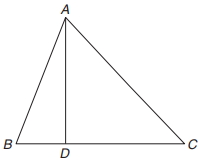
In a $\Delta ABC$,$\angle B = \frac{\pi}{3}$,$\angle C = \frac{\pi}{4}$ and $D$ divides $BC$ internally in the ratio $1:3$,then $\frac{\sin \angle BAD}{\sin \angle CAD}$ is equal to
A
$\frac{1}{\sqrt{2}}$
B
$\frac{1}{\sqrt{3}}$
C
$\frac{1}{\sqrt{6}}$
D
$\sqrt{6}$
Solution
(C) Given: $\angle B = \frac{\pi}{3}$,$\angle C = \frac{\pi}{4}$ and $\frac{BD}{DC} = \frac{1}{3}$.
In $\Delta ABD$,by the Law of Sines:
$\frac{BD}{\sin \angle BAD} = \frac{AD}{\sin \angle B}$
$\Rightarrow \frac{BD}{\sin \angle BAD} = \frac{AD}{\sin(\pi/3)} = \frac{AD}{\sqrt{3}/2}$
$\Rightarrow AD = \frac{\sqrt{3}}{2} \cdot \frac{BD}{\sin \angle BAD}$ .... $(1)$
In $\Delta ADC$,by the Law of Sines:
$\frac{DC}{\sin \angle CAD} = \frac{AD}{\sin \angle C}$
$\Rightarrow \frac{DC}{\sin \angle CAD} = \frac{AD}{\sin(\pi/4)} = \frac{AD}{1/\sqrt{2}}$
$\Rightarrow AD = \frac{1}{\sqrt{2}} \cdot \frac{DC}{\sin \angle CAD}$ .... $(2)$
Equating $(1)$ and $(2)$:
$\frac{\sqrt{3}}{2} \cdot \frac{BD}{\sin \angle BAD} = \frac{1}{\sqrt{2}} \cdot \frac{DC}{\sin \angle CAD}$
$\Rightarrow \frac{\sin \angle BAD}{\sin \angle CAD} = \frac{\sqrt{3}/2}{1/\sqrt{2}} \cdot \frac{BD}{DC}$
$\Rightarrow \frac{\sin \angle BAD}{\sin \angle CAD} = \frac{\sqrt{3}}{2} \cdot \sqrt{2} \cdot \frac{1}{3} = \frac{\sqrt{3}}{\sqrt{2} \cdot 3} = \frac{1}{\sqrt{2} \cdot \sqrt{3}} = \frac{1}{\sqrt{6}}$.
In $\Delta ABD$,by the Law of Sines:
$\frac{BD}{\sin \angle BAD} = \frac{AD}{\sin \angle B}$
$\Rightarrow \frac{BD}{\sin \angle BAD} = \frac{AD}{\sin(\pi/3)} = \frac{AD}{\sqrt{3}/2}$
$\Rightarrow AD = \frac{\sqrt{3}}{2} \cdot \frac{BD}{\sin \angle BAD}$ .... $(1)$
In $\Delta ADC$,by the Law of Sines:
$\frac{DC}{\sin \angle CAD} = \frac{AD}{\sin \angle C}$
$\Rightarrow \frac{DC}{\sin \angle CAD} = \frac{AD}{\sin(\pi/4)} = \frac{AD}{1/\sqrt{2}}$
$\Rightarrow AD = \frac{1}{\sqrt{2}} \cdot \frac{DC}{\sin \angle CAD}$ .... $(2)$
Equating $(1)$ and $(2)$:
$\frac{\sqrt{3}}{2} \cdot \frac{BD}{\sin \angle BAD} = \frac{1}{\sqrt{2}} \cdot \frac{DC}{\sin \angle CAD}$
$\Rightarrow \frac{\sin \angle BAD}{\sin \angle CAD} = \frac{\sqrt{3}/2}{1/\sqrt{2}} \cdot \frac{BD}{DC}$
$\Rightarrow \frac{\sin \angle BAD}{\sin \angle CAD} = \frac{\sqrt{3}}{2} \cdot \sqrt{2} \cdot \frac{1}{3} = \frac{\sqrt{3}}{\sqrt{2} \cdot 3} = \frac{1}{\sqrt{2} \cdot \sqrt{3}} = \frac{1}{\sqrt{6}}$.
0 likes
View Solution607
MediumMCQ
If $\sin 3A = \cos (A - 26^{\circ})$,where $3A$ is an acute angle,then the value of $A$ is (in $^{\circ}$)
A
$29$
B
$26$
C
$23$
D
$28$
Solution
(A) Given: $\sin 3A = \cos (A - 26^{\circ})$
We know that $\sin \theta = \cos (90^{\circ} - \theta)$.
Therefore,$\cos (90^{\circ} - 3A) = \cos (A - 26^{\circ})$.
Comparing the angles,we get: $90^{\circ} - 3A = A - 26^{\circ}$.
Rearranging the terms: $90^{\circ} + 26^{\circ} = 3A + A$.
$116^{\circ} = 4A$.
$A = \frac{116^{\circ}}{4} = 29^{\circ}$.
We know that $\sin \theta = \cos (90^{\circ} - \theta)$.
Therefore,$\cos (90^{\circ} - 3A) = \cos (A - 26^{\circ})$.
Comparing the angles,we get: $90^{\circ} - 3A = A - 26^{\circ}$.
Rearranging the terms: $90^{\circ} + 26^{\circ} = 3A + A$.
$116^{\circ} = 4A$.
$A = \frac{116^{\circ}}{4} = 29^{\circ}$.
0 likes
View Solution608
MediumMCQ
The value of $\sec ^{2} \theta - \frac{\sin ^{2} \theta - 2 \sin ^{4} \theta}{2 \cos ^{4} \theta - \cos ^{2} \theta}$ is
A
$1$
B
$2$
C
$-1$
D
$0$
Solution
(A) Given expression: $\sec ^{2} \theta - \frac{\sin ^{2} \theta - 2 \sin ^{4} \theta}{2 \cos ^{4} \theta - \cos ^{2} \theta}$
Factor out $\sin^2 \theta$ from the numerator and $\cos^2 \theta$ from the denominator:
$= \sec ^{2} \theta - \frac{\sin ^{2} \theta (1 - 2 \sin ^{2} \theta)}{\cos ^{2} \theta (2 \cos ^{2} \theta - 1)}$
Use the identity $\sin^2 \theta = 1 - \cos^2 \theta$ in the numerator:
$= \sec ^{2} \theta - \frac{\sin ^{2} \theta [1 - 2(1 - \cos ^{2} \theta)]}{\cos ^{2} \theta (2 \cos ^{2} \theta - 1)}$
Simplify the expression inside the bracket:
$= \sec ^{2} \theta - \frac{\sin ^{2} \theta (1 - 2 + 2 \cos ^{2} \theta)}{\cos ^{2} \theta (2 \cos ^{2} \theta - 1)}$
$= \sec ^{2} \theta - \frac{\sin ^{2} \theta (2 \cos ^{2} \theta - 1)}{\cos ^{2} \theta (2 \cos ^{2} \theta - 1)}$
Cancel the common term $(2 \cos^2 \theta - 1)$:
$= \sec ^{2} \theta - \tan ^{2} \theta$
Using the identity $\sec^2 \theta - \tan^2 \theta = 1$,the final value is $1$.
Factor out $\sin^2 \theta$ from the numerator and $\cos^2 \theta$ from the denominator:
$= \sec ^{2} \theta - \frac{\sin ^{2} \theta (1 - 2 \sin ^{2} \theta)}{\cos ^{2} \theta (2 \cos ^{2} \theta - 1)}$
Use the identity $\sin^2 \theta = 1 - \cos^2 \theta$ in the numerator:
$= \sec ^{2} \theta - \frac{\sin ^{2} \theta [1 - 2(1 - \cos ^{2} \theta)]}{\cos ^{2} \theta (2 \cos ^{2} \theta - 1)}$
Simplify the expression inside the bracket:
$= \sec ^{2} \theta - \frac{\sin ^{2} \theta (1 - 2 + 2 \cos ^{2} \theta)}{\cos ^{2} \theta (2 \cos ^{2} \theta - 1)}$
$= \sec ^{2} \theta - \frac{\sin ^{2} \theta (2 \cos ^{2} \theta - 1)}{\cos ^{2} \theta (2 \cos ^{2} \theta - 1)}$
Cancel the common term $(2 \cos^2 \theta - 1)$:
$= \sec ^{2} \theta - \tan ^{2} \theta$
Using the identity $\sec^2 \theta - \tan^2 \theta = 1$,the final value is $1$.
0 likes
View Solution609
MediumMCQ
If $x=a(\sin \theta+\cos \theta)$ and $y=b(\sin \theta-\cos \theta)$,then the value of $\frac{x^{2}}{a^{2}}+\frac{y^{2}}{b^{2}}$ is
A
$0$
B
$1$
C
$2$
D
$-2$
Solution
(C) Given: $x=a(\sin \theta+\cos \theta)$ and $y=b(\sin \theta-\cos \theta)$.
Dividing by $a$ and $b$ respectively,we get $\frac{x}{a}=\sin \theta+\cos \theta$ and $\frac{y}{b}=\sin \theta-\cos \theta$.
Now,consider the expression $\frac{x^{2}}{a^{2}}+\frac{y^{2}}{b^{2}}$.
Substituting the values,we get $(\sin \theta+\cos \theta)^{2}+(\sin \theta-\cos \theta)^{2}$.
Expanding the squares using $(A+B)^2 = A^2+B^2+2AB$ and $(A-B)^2 = A^2+B^2-2AB$,we get:
$(\sin^2 \theta + \cos^2 \theta + 2\sin \theta \cos \theta) + (\sin^2 \theta + \cos^2 \theta - 2\sin \theta \cos \theta)$.
Since $\sin^2 \theta + \cos^2 \theta = 1$,the expression simplifies to $1 + 2\sin \theta \cos \theta + 1 - 2\sin \theta \cos \theta$.
Thus,the result is $1 + 1 = 2$.
Dividing by $a$ and $b$ respectively,we get $\frac{x}{a}=\sin \theta+\cos \theta$ and $\frac{y}{b}=\sin \theta-\cos \theta$.
Now,consider the expression $\frac{x^{2}}{a^{2}}+\frac{y^{2}}{b^{2}}$.
Substituting the values,we get $(\sin \theta+\cos \theta)^{2}+(\sin \theta-\cos \theta)^{2}$.
Expanding the squares using $(A+B)^2 = A^2+B^2+2AB$ and $(A-B)^2 = A^2+B^2-2AB$,we get:
$(\sin^2 \theta + \cos^2 \theta + 2\sin \theta \cos \theta) + (\sin^2 \theta + \cos^2 \theta - 2\sin \theta \cos \theta)$.
Since $\sin^2 \theta + \cos^2 \theta = 1$,the expression simplifies to $1 + 2\sin \theta \cos \theta + 1 - 2\sin \theta \cos \theta$.
Thus,the result is $1 + 1 = 2$.
0 likes
View Solution610
EasyMCQ
If $\sin 5 \theta = \cos 20^{\circ}$ where $0^{\circ} < \theta < 90^{\circ}$,then the value of $\theta$ is (in degrees):
A
$4$
B
$22$
C
$10$
D
$14$
Solution
(D) Given the equation: $\sin 5 \theta = \cos 20^{\circ}$.
We know the trigonometric identity: $\cos A = \sin(90^{\circ} - A)$.
Applying this identity to the right side: $\cos 20^{\circ} = \sin(90^{\circ} - 20^{\circ}) = \sin 70^{\circ}$.
Now,the equation becomes: $\sin 5 \theta = \sin 70^{\circ}$.
By comparing the angles,we get: $5 \theta = 70^{\circ}$.
Solving for $\theta$: $\theta = \frac{70^{\circ}}{5} = 14^{\circ}$.
Thus,the value of $\theta$ is $14^{\circ}$.
We know the trigonometric identity: $\cos A = \sin(90^{\circ} - A)$.
Applying this identity to the right side: $\cos 20^{\circ} = \sin(90^{\circ} - 20^{\circ}) = \sin 70^{\circ}$.
Now,the equation becomes: $\sin 5 \theta = \sin 70^{\circ}$.
By comparing the angles,we get: $5 \theta = 70^{\circ}$.
Solving for $\theta$: $\theta = \frac{70^{\circ}}{5} = 14^{\circ}$.
Thus,the value of $\theta$ is $14^{\circ}$.
0 likes
View Solution611
MediumMCQ
The simplest value of $\tan 1^{\circ} \tan 2^{\circ} \tan 3^{\circ} \ldots \tan 89^{\circ}$ is
A
$\frac{1}{2}$
B
$0$
C
$1$
D
$\frac{2}{3}$
Solution
(C) We are given the expression: $\tan 1^{\circ} \tan 2^{\circ} \tan 3^{\circ} \ldots \tan 89^{\circ}$.
Using the identity $\tan(90^{\circ} - \theta) = \cot \theta$,we can rewrite the terms:
$\tan 89^{\circ} = \tan(90^{\circ} - 1^{\circ}) = \cot 1^{\circ} = \frac{1}{\tan 1^{\circ}}$.
$\tan 88^{\circ} = \tan(90^{\circ} - 2^{\circ}) = \cot 2^{\circ} = \frac{1}{\tan 2^{\circ}}$.
This pattern continues up to $\tan 46^{\circ} = \cot 44^{\circ} = \frac{1}{\tan 44^{\circ}}$.
The middle term is $\tan 45^{\circ} = 1$.
Substituting these into the product:
$(\tan 1^{\circ} \cdot \cot 1^{\circ}) \cdot (\tan 2^{\circ} \cdot \cot 2^{\circ}) \cdots (\tan 44^{\circ} \cdot \cot 44^{\circ}) \cdot \tan 45^{\circ}$.
Since $\tan \theta \cdot \cot \theta = 1$,the product becomes $1 \cdot 1 \cdots 1 \cdot 1 = 1$.
Using the identity $\tan(90^{\circ} - \theta) = \cot \theta$,we can rewrite the terms:
$\tan 89^{\circ} = \tan(90^{\circ} - 1^{\circ}) = \cot 1^{\circ} = \frac{1}{\tan 1^{\circ}}$.
$\tan 88^{\circ} = \tan(90^{\circ} - 2^{\circ}) = \cot 2^{\circ} = \frac{1}{\tan 2^{\circ}}$.
This pattern continues up to $\tan 46^{\circ} = \cot 44^{\circ} = \frac{1}{\tan 44^{\circ}}$.
The middle term is $\tan 45^{\circ} = 1$.
Substituting these into the product:
$(\tan 1^{\circ} \cdot \cot 1^{\circ}) \cdot (\tan 2^{\circ} \cdot \cot 2^{\circ}) \cdots (\tan 44^{\circ} \cdot \cot 44^{\circ}) \cdot \tan 45^{\circ}$.
Since $\tan \theta \cdot \cot \theta = 1$,the product becomes $1 \cdot 1 \cdots 1 \cdot 1 = 1$.
0 likes
View Solution612
MediumMCQ
If $(\sin \alpha + \operatorname{cosec} \alpha)^{2} + (\cos \alpha + \sec \alpha)^{2} = K + \tan^{2} \alpha + \cot^{2} \alpha$,then the value of $K$ is
A
$1$
B
$7$
C
$3$
D
$5$
Solution
(B) Given expression: $(\sin \alpha + \operatorname{cosec} \alpha)^{2} + (\cos \alpha + \sec \alpha)^{2}$
Expanding the squares using $(a+b)^{2} = a^{2} + b^{2} + 2ab$:
$= (\sin^{2} \alpha + \operatorname{cosec}^{2} \alpha + 2 \sin \alpha \operatorname{cosec} \alpha) + (\cos^{2} \alpha + \sec^{2} \alpha + 2 \cos \alpha \sec \alpha)$
Since $\sin \alpha \operatorname{cosec} \alpha = 1$ and $\cos \alpha \sec \alpha = 1$:
$= \sin^{2} \alpha + \operatorname{cosec}^{2} \alpha + 2 + \cos^{2} \alpha + \sec^{2} \alpha + 2$
$= (\sin^{2} \alpha + \cos^{2} \alpha) + \operatorname{cosec}^{2} \alpha + \sec^{2} \alpha + 4$
Using identities $\sin^{2} \alpha + \cos^{2} \alpha = 1$,$\operatorname{cosec}^{2} \alpha = 1 + \cot^{2} \alpha$,and $\sec^{2} \alpha = 1 + \tan^{2} \alpha$:
$= 1 + (1 + \cot^{2} \alpha) + (1 + \tan^{2} \alpha) + 4$
$= 7 + \tan^{2} \alpha + \cot^{2} \alpha$
Comparing this with $K + \tan^{2} \alpha + \cot^{2} \alpha$,we get $K = 7$.
Expanding the squares using $(a+b)^{2} = a^{2} + b^{2} + 2ab$:
$= (\sin^{2} \alpha + \operatorname{cosec}^{2} \alpha + 2 \sin \alpha \operatorname{cosec} \alpha) + (\cos^{2} \alpha + \sec^{2} \alpha + 2 \cos \alpha \sec \alpha)$
Since $\sin \alpha \operatorname{cosec} \alpha = 1$ and $\cos \alpha \sec \alpha = 1$:
$= \sin^{2} \alpha + \operatorname{cosec}^{2} \alpha + 2 + \cos^{2} \alpha + \sec^{2} \alpha + 2$
$= (\sin^{2} \alpha + \cos^{2} \alpha) + \operatorname{cosec}^{2} \alpha + \sec^{2} \alpha + 4$
Using identities $\sin^{2} \alpha + \cos^{2} \alpha = 1$,$\operatorname{cosec}^{2} \alpha = 1 + \cot^{2} \alpha$,and $\sec^{2} \alpha = 1 + \tan^{2} \alpha$:
$= 1 + (1 + \cot^{2} \alpha) + (1 + \tan^{2} \alpha) + 4$
$= 7 + \tan^{2} \alpha + \cot^{2} \alpha$
Comparing this with $K + \tan^{2} \alpha + \cot^{2} \alpha$,we get $K = 7$.
0 likes
View Solution613
MediumMCQ
The angle of elevation of the top of a vertical tower situated perpendicularly on a plane is observed as $60^{\circ}$ from a point $P$ on the same plane. From another point $Q$,$10\, m$ vertically above the point $P$,the angle of depression of the foot of the tower is $30^{\circ}$. The height of the tower is (in $m$)
A
$15$
B
$30$
C
$20$
D
$25$
Solution
(B) Let the height of the tower be $h$ and the distance between the tower and point $P$ be $d$.
From point $P$,the angle of elevation to the top of the tower is $60^{\circ}$,so $\tan 60^{\circ} = h / d$,which implies $d = h / \sqrt{3}$.
Point $Q$ is $10\, m$ vertically above $P$. The angle of depression to the foot of the tower is $30^{\circ}$. This forms a right-angled triangle with the height $10\, m$ and base $d$,so $\tan 30^{\circ} = 10 / d$,which implies $d = 10 / \tan 30^{\circ} = 10\sqrt{3}$.
Equating the two expressions for $d$: $h / \sqrt{3} = 10\sqrt{3}$.
Therefore,$h = 10\sqrt{3} \times \sqrt{3} = 10 \times 3 = 30\, m$.
From point $P$,the angle of elevation to the top of the tower is $60^{\circ}$,so $\tan 60^{\circ} = h / d$,which implies $d = h / \sqrt{3}$.
Point $Q$ is $10\, m$ vertically above $P$. The angle of depression to the foot of the tower is $30^{\circ}$. This forms a right-angled triangle with the height $10\, m$ and base $d$,so $\tan 30^{\circ} = 10 / d$,which implies $d = 10 / \tan 30^{\circ} = 10\sqrt{3}$.
Equating the two expressions for $d$: $h / \sqrt{3} = 10\sqrt{3}$.
Therefore,$h = 10\sqrt{3} \times \sqrt{3} = 10 \times 3 = 30\, m$.
0 likes
View Solution614
DifficultMCQ
If $\sin 21^{\circ} = \frac{x}{y},$ then $\sec 21^{\circ} - \sin 69^{\circ}$ is equal to
A
$\frac{x^{2}}{y \sqrt{y^{2}-x^{2}}}$
B
$\frac{y^{2}}{x \sqrt{y^{2}-x^{2}}}$
C
$\frac{x^{2}}{y \sqrt{x^{2}-y^{2}}}$
D
$\frac{y^{2}}{x \sqrt{x^{2}-y^{2}}}$
Solution
(A) Given $\sin 21^{\circ} = \frac{x}{y}.$
Since $\cos 21^{\circ} = \sqrt{1 - \sin^{2} 21^{\circ}},$ we have $\cos 21^{\circ} = \sqrt{1 - \frac{x^{2}}{y^{2}}} = \frac{\sqrt{y^{2}-x^{2}}}{y}.$
Now,$\sec 21^{\circ} = \frac{1}{\cos 21^{\circ}} = \frac{y}{\sqrt{y^{2}-x^{2}}}.$
Also,$\sin 69^{\circ} = \sin(90^{\circ} - 21^{\circ}) = \cos 21^{\circ} = \frac{\sqrt{y^{2}-x^{2}}}{y}.$
Therefore,$\sec 21^{\circ} - \sin 69^{\circ} = \frac{y}{\sqrt{y^{2}-x^{2}}} - \frac{\sqrt{y^{2}-x^{2}}}{y}.$
Taking the common denominator $y\sqrt{y^{2}-x^{2}},$ we get:
$= \frac{y^{2} - (y^{2}-x^{2})}{y\sqrt{y^{2}-x^{2}}} = \frac{x^{2}}{y\sqrt{y^{2}-x^{2}}}.$
Since $\cos 21^{\circ} = \sqrt{1 - \sin^{2} 21^{\circ}},$ we have $\cos 21^{\circ} = \sqrt{1 - \frac{x^{2}}{y^{2}}} = \frac{\sqrt{y^{2}-x^{2}}}{y}.$
Now,$\sec 21^{\circ} = \frac{1}{\cos 21^{\circ}} = \frac{y}{\sqrt{y^{2}-x^{2}}}.$
Also,$\sin 69^{\circ} = \sin(90^{\circ} - 21^{\circ}) = \cos 21^{\circ} = \frac{\sqrt{y^{2}-x^{2}}}{y}.$
Therefore,$\sec 21^{\circ} - \sin 69^{\circ} = \frac{y}{\sqrt{y^{2}-x^{2}}} - \frac{\sqrt{y^{2}-x^{2}}}{y}.$
Taking the common denominator $y\sqrt{y^{2}-x^{2}},$ we get:
$= \frac{y^{2} - (y^{2}-x^{2})}{y\sqrt{y^{2}-x^{2}}} = \frac{x^{2}}{y\sqrt{y^{2}-x^{2}}}.$
0 likes
View Solution615
EasyMCQ
If $\sec \alpha + \tan \alpha = 2,$ then the value of $\sin \alpha$ is (assume that $0 < \alpha < 90^{\circ}$).
A
$0.4$
B
$0.5$
C
$0.6$
D
$0.8$
Solution
(C) We know the identity $\sec^{2} \alpha - \tan^{2} \alpha = 1.$
This can be factored as $(\sec \alpha + \tan \alpha)(\sec \alpha - \tan \alpha) = 1.$
Given $\sec \alpha + \tan \alpha = 2,$ we substitute this into the identity:
$2(\sec \alpha - \tan \alpha) = 1 \implies \sec \alpha - \tan \alpha = 0.5.$
Now,add the two equations:
$(\sec \alpha + \tan \alpha) + (\sec \alpha - \tan \alpha) = 2 + 0.5 = 2.5.$
$2 \sec \alpha = 2.5 \implies \sec \alpha = 1.25 = 5/4.$
Since $\cos \alpha = 1 / \sec \alpha,$ we have $\cos \alpha = 4/5 = 0.8.$
Using $\sin^{2} \alpha + \cos^{2} \alpha = 1,$ we find $\sin^{2} \alpha = 1 - (4/5)^{2} = 1 - 16/25 = 9/25.$
Since $0 < \alpha < 90^{\circ},$ $\sin \alpha$ must be positive,so $\sin \alpha = \sqrt{9/25} = 3/5 = 0.6.$
This can be factored as $(\sec \alpha + \tan \alpha)(\sec \alpha - \tan \alpha) = 1.$
Given $\sec \alpha + \tan \alpha = 2,$ we substitute this into the identity:
$2(\sec \alpha - \tan \alpha) = 1 \implies \sec \alpha - \tan \alpha = 0.5.$
Now,add the two equations:
$(\sec \alpha + \tan \alpha) + (\sec \alpha - \tan \alpha) = 2 + 0.5 = 2.5.$
$2 \sec \alpha = 2.5 \implies \sec \alpha = 1.25 = 5/4.$
Since $\cos \alpha = 1 / \sec \alpha,$ we have $\cos \alpha = 4/5 = 0.8.$
Using $\sin^{2} \alpha + \cos^{2} \alpha = 1,$ we find $\sin^{2} \alpha = 1 - (4/5)^{2} = 1 - 16/25 = 9/25.$
Since $0 < \alpha < 90^{\circ},$ $\sin \alpha$ must be positive,so $\sin \alpha = \sqrt{9/25} = 3/5 = 0.6.$
0 likes
View Solution616
MediumMCQ
If $3 \sin \theta + 5 \cos \theta = 5$,then the value of $5 \sin \theta - 3 \cos \theta$ will be
A
$\pm 3$
B
$\pm 5$
C
$\pm 2$
D
$\pm 1$
Solution
(A) Given equations are:
$3 \sin \theta + 5 \cos \theta = 5$ ..... $(1)$
$5 \sin \theta - 3 \cos \theta = x$ ..... $(2)$
Squaring both equations and adding them:
$(3 \sin \theta + 5 \cos \theta)^2 + (5 \sin \theta - 3 \cos \theta)^2 = 5^2 + x^2$
$(9 \sin^2 \theta + 25 \cos^2 \theta + 30 \sin \theta \cos \theta) + (25 \sin^2 \theta + 9 \cos^2 \theta - 30 \sin \theta \cos \theta) = 25 + x^2$
$(9 + 25) \sin^2 \theta + (25 + 9) \cos^2 \theta = 25 + x^2$
$34(\sin^2 \theta + \cos^2 \theta) = 25 + x^2$
Since $\sin^2 \theta + \cos^2 \theta = 1$,we have:
$34 = 25 + x^2$
$x^2 = 34 - 25 = 9$
$x = \pm 3$
$3 \sin \theta + 5 \cos \theta = 5$ ..... $(1)$
$5 \sin \theta - 3 \cos \theta = x$ ..... $(2)$
Squaring both equations and adding them:
$(3 \sin \theta + 5 \cos \theta)^2 + (5 \sin \theta - 3 \cos \theta)^2 = 5^2 + x^2$
$(9 \sin^2 \theta + 25 \cos^2 \theta + 30 \sin \theta \cos \theta) + (25 \sin^2 \theta + 9 \cos^2 \theta - 30 \sin \theta \cos \theta) = 25 + x^2$
$(9 + 25) \sin^2 \theta + (25 + 9) \cos^2 \theta = 25 + x^2$
$34(\sin^2 \theta + \cos^2 \theta) = 25 + x^2$
Since $\sin^2 \theta + \cos^2 \theta = 1$,we have:
$34 = 25 + x^2$
$x^2 = 34 - 25 = 9$
$x = \pm 3$
0 likes
View Solution617
EasyMCQ
If $\theta$ is an acute angle and $\tan \theta + \cot \theta = 2$,then the value of $\tan^{5} \theta + \cot^{5} \theta$ is
A
$1$
B
$2$
C
$3$
D
$4$
Solution
(B) Given the equation: $\tan \theta + \cot \theta = 2$.
Since $\cot \theta = \frac{1}{\tan \theta}$,we can write the equation as $\tan \theta + \frac{1}{\tan \theta} = 2$.
Let $x = \tan \theta$. Then $x + \frac{1}{x} = 2$,which simplifies to $x^2 - 2x + 1 = 0$.
This is $(x - 1)^2 = 0$,which gives $x = 1$.
Therefore,$\tan \theta = 1$,which implies $\theta = 45^{\circ}$ (since $\theta$ is an acute angle).
Now,we need to find the value of $\tan^{5} \theta + \cot^{5} \theta$.
Substituting $\tan \theta = 1$ and $\cot \theta = 1$:
$1^{5} + 1^{5} = 1 + 1 = 2$.
Since $\cot \theta = \frac{1}{\tan \theta}$,we can write the equation as $\tan \theta + \frac{1}{\tan \theta} = 2$.
Let $x = \tan \theta$. Then $x + \frac{1}{x} = 2$,which simplifies to $x^2 - 2x + 1 = 0$.
This is $(x - 1)^2 = 0$,which gives $x = 1$.
Therefore,$\tan \theta = 1$,which implies $\theta = 45^{\circ}$ (since $\theta$ is an acute angle).
Now,we need to find the value of $\tan^{5} \theta + \cot^{5} \theta$.
Substituting $\tan \theta = 1$ and $\cot \theta = 1$:
$1^{5} + 1^{5} = 1 + 1 = 2$.
0 likes
View Solution618
EasyMCQ
The value of $(\sec \theta + \operatorname{cosec} \theta)$ when $\theta = 45^{\circ}$ is: (in $\sqrt{2}$)
A
$2$
B
$5$
C
$3$
D
$4$
Solution
(A) We know that $\sec \theta = \frac{1}{\cos \theta}$ and $\operatorname{cosec} \theta = \frac{1}{\sin \theta}$.
For $\theta = 45^{\circ}$, we have $\cos 45^{\circ} = \frac{1}{\sqrt{2}}$ and $\sin 45^{\circ} = \frac{1}{\sqrt{2}}$.
Therefore, $\sec 45^{\circ} = \sqrt{2}$ and $\operatorname{cosec} 45^{\circ} = \sqrt{2}$.
Substituting these values into the expression: $\sec 45^{\circ} + \operatorname{cosec} 45^{\circ} = \sqrt{2} + \sqrt{2} = 2 \sqrt{2}$.
For $\theta = 45^{\circ}$, we have $\cos 45^{\circ} = \frac{1}{\sqrt{2}}$ and $\sin 45^{\circ} = \frac{1}{\sqrt{2}}$.
Therefore, $\sec 45^{\circ} = \sqrt{2}$ and $\operatorname{cosec} 45^{\circ} = \sqrt{2}$.
Substituting these values into the expression: $\sec 45^{\circ} + \operatorname{cosec} 45^{\circ} = \sqrt{2} + \sqrt{2} = 2 \sqrt{2}$.
0 likes
View Solution619
MediumMCQ
$\frac{\tan ^{2} \theta}{\sec \theta+1}-\sec \theta$ is equal to
A
$-1$
B
$0$
C
$1$
D
None of these
Solution
(A) We know that $1 + \tan^{2} \theta = \sec^{2} \theta$,which implies $\tan^{2} \theta = \sec^{2} \theta - 1$.
Substituting this into the expression:
$\frac{\tan^{2} \theta}{\sec \theta + 1} - \sec \theta = \frac{\sec^{2} \theta - 1}{\sec \theta + 1} - \sec \theta$
Using the algebraic identity $a^{2} - b^{2} = (a - b)(a + b)$,we can write $\sec^{2} \theta - 1$ as $(\sec \theta - 1)(\sec \theta + 1)$:
$= \frac{(\sec \theta - 1)(\sec \theta + 1)}{\sec \theta + 1} - \sec \theta$
Canceling the common term $(\sec \theta + 1)$:
$= (\sec \theta - 1) - \sec \theta$
$= \sec \theta - 1 - \sec \theta = -1$.
Substituting this into the expression:
$\frac{\tan^{2} \theta}{\sec \theta + 1} - \sec \theta = \frac{\sec^{2} \theta - 1}{\sec \theta + 1} - \sec \theta$
Using the algebraic identity $a^{2} - b^{2} = (a - b)(a + b)$,we can write $\sec^{2} \theta - 1$ as $(\sec \theta - 1)(\sec \theta + 1)$:
$= \frac{(\sec \theta - 1)(\sec \theta + 1)}{\sec \theta + 1} - \sec \theta$
Canceling the common term $(\sec \theta + 1)$:
$= (\sec \theta - 1) - \sec \theta$
$= \sec \theta - 1 - \sec \theta = -1$.
0 likes
View Solution620
DifficultMCQ
$\sin ^{6} \theta+\cos ^{6} \theta$ is equal to
A
$1+3 \sin ^{2} \theta \cos ^{2} \theta$
B
$1$
C
$1-3 \sin ^{2} \theta \cos ^{2} \theta$
D
$1-3 \sin \theta \cos \theta$
Solution
(C) We know that $a^3 + b^3 = (a + b)^3 - 3ab(a + b)$.
Let $a = \sin^2 \theta$ and $b = \cos^2 \theta$.
Then,$\sin^6 \theta + \cos^6 \theta = (\sin^2 \theta)^3 + (\cos^2 \theta)^3$.
Using the identity,we get:
$\sin^6 \theta + \cos^6 \theta = (\sin^2 \theta + \cos^2 \theta)^3 - 3(\sin^2 \theta)(\cos^2 \theta)(\sin^2 \theta + \cos^2 \theta)$.
Since $\sin^2 \theta + \cos^2 \theta = 1$,we substitute this value:
$\sin^6 \theta + \cos^6 \theta = (1)^3 - 3 \sin^2 \theta \cos^2 \theta (1)$.
Therefore,$\sin^6 \theta + \cos^6 \theta = 1 - 3 \sin^2 \theta \cos^2 \theta$.
Let $a = \sin^2 \theta$ and $b = \cos^2 \theta$.
Then,$\sin^6 \theta + \cos^6 \theta = (\sin^2 \theta)^3 + (\cos^2 \theta)^3$.
Using the identity,we get:
$\sin^6 \theta + \cos^6 \theta = (\sin^2 \theta + \cos^2 \theta)^3 - 3(\sin^2 \theta)(\cos^2 \theta)(\sin^2 \theta + \cos^2 \theta)$.
Since $\sin^2 \theta + \cos^2 \theta = 1$,we substitute this value:
$\sin^6 \theta + \cos^6 \theta = (1)^3 - 3 \sin^2 \theta \cos^2 \theta (1)$.
Therefore,$\sin^6 \theta + \cos^6 \theta = 1 - 3 \sin^2 \theta \cos^2 \theta$.
0 likes
View Solution621
MediumMCQ
If $\tan \theta + \cot \theta = 2$ and $0^{\circ} < \theta < 90^{\circ}$,then the value of $\theta$ is (in $^{\circ}$)
A
$60$
B
$75$
C
$30$
D
$45$
Solution
(D) Given the equation: $\tan \theta + \cot \theta = 2$.
Since $\cot \theta = \frac{1}{\tan \theta}$,we can write: $\tan \theta + \frac{1}{\tan \theta} = 2$.
Let $x = \tan \theta$. Then $x + \frac{1}{x} = 2$.
Multiplying by $x$,we get $x^2 + 1 = 2x$,which simplifies to $x^2 - 2x + 1 = 0$.
This is a perfect square: $(x - 1)^2 = 0$.
Therefore,$x = 1$,which means $\tan \theta = 1$.
Since $0^{\circ} < \theta < 90^{\circ}$,$\tan \theta = 1$ implies $\theta = 45^{\circ}$.
Since $\cot \theta = \frac{1}{\tan \theta}$,we can write: $\tan \theta + \frac{1}{\tan \theta} = 2$.
Let $x = \tan \theta$. Then $x + \frac{1}{x} = 2$.
Multiplying by $x$,we get $x^2 + 1 = 2x$,which simplifies to $x^2 - 2x + 1 = 0$.
This is a perfect square: $(x - 1)^2 = 0$.
Therefore,$x = 1$,which means $\tan \theta = 1$.
Since $0^{\circ} < \theta < 90^{\circ}$,$\tan \theta = 1$ implies $\theta = 45^{\circ}$.
0 likes
View Solution622
DifficultMCQ
If $x \sin^{2} 60^{\circ} - \frac{3}{2} \sec 60^{\circ} \tan^{2} 30^{\circ} + \frac{4}{5} \sin^{2} 45^{\circ} \tan^{2} 60^{\circ} = 0$,then $x$ is
A
$-\frac{4}{15}$
B
$-2$
C
$-\frac{1}{15}$
D
$-4$
Solution
(A) We know that $\sin 60^{\circ} = \frac{\sqrt{3}}{2}$,$\sin 45^{\circ} = \frac{1}{\sqrt{2}}$,$\tan 30^{\circ} = \frac{1}{\sqrt{3}}$,$\sec 60^{\circ} = 2$,and $\tan 60^{\circ} = \sqrt{3}$.
Substituting these values into the given equation:
$x \left( \frac{\sqrt{3}}{2} \right)^{2} - \frac{3}{2} \times 2 \times \left( \frac{1}{\sqrt{3}} \right)^{2} + \frac{4}{5} \times \left( \frac{1}{\sqrt{2}} \right)^{2} \times (\sqrt{3})^{2} = 0$
$x \left( \frac{3}{4} \right) - 3 \times \left( \frac{1}{3} \right) + \frac{4}{5} \times \left( \frac{1}{2} \right) \times 3 = 0$
$\frac{3x}{4} - 1 + \frac{6}{5} = 0$
$\frac{3x}{4} = 1 - \frac{6}{5}$
$\frac{3x}{4} = -\frac{1}{5}$
$x = -\frac{1}{5} \times \frac{4}{3} = -\frac{4}{15}$.
Substituting these values into the given equation:
$x \left( \frac{\sqrt{3}}{2} \right)^{2} - \frac{3}{2} \times 2 \times \left( \frac{1}{\sqrt{3}} \right)^{2} + \frac{4}{5} \times \left( \frac{1}{\sqrt{2}} \right)^{2} \times (\sqrt{3})^{2} = 0$
$x \left( \frac{3}{4} \right) - 3 \times \left( \frac{1}{3} \right) + \frac{4}{5} \times \left( \frac{1}{2} \right) \times 3 = 0$
$\frac{3x}{4} - 1 + \frac{6}{5} = 0$
$\frac{3x}{4} = 1 - \frac{6}{5}$
$\frac{3x}{4} = -\frac{1}{5}$
$x = -\frac{1}{5} \times \frac{4}{3} = -\frac{4}{15}$.
0 likes
View Solution623
EasyMCQ
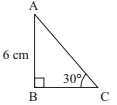
If $\Delta ABC$ is right-angled at $B$,$AB = 6$ units,and $\angle C = 30^{\circ}$,then $AC$ is equal to (in units):
A
$8$
B
$10$
C
$12$
D
$15$
Solution
(C) In the right-angled triangle $\Delta ABC$,the side $AB$ is opposite to the angle $\angle C = 30^{\circ}$,and $AC$ is the hypotenuse.
Using the trigonometric ratio for sine:
$\sin C = \frac{\text{Opposite side}}{\text{Hypotenuse}} = \frac{AB}{AC}$
Given $\angle C = 30^{\circ}$ and $AB = 6$ units:
$\sin 30^{\circ} = \frac{6}{AC}$
Since $\sin 30^{\circ} = \frac{1}{2}$,we have:
$\frac{1}{2} = \frac{6}{AC}$
$AC = 6 \times 2 = 12$ units.
Using the trigonometric ratio for sine:
$\sin C = \frac{\text{Opposite side}}{\text{Hypotenuse}} = \frac{AB}{AC}$
Given $\angle C = 30^{\circ}$ and $AB = 6$ units:
$\sin 30^{\circ} = \frac{6}{AC}$
Since $\sin 30^{\circ} = \frac{1}{2}$,we have:
$\frac{1}{2} = \frac{6}{AC}$
$AC = 6 \times 2 = 12$ units.
0 likes
View Solution624
MediumMCQ
If $7 \sin a = 24 \cos a$,then the value of $14 \tan a - 75 \cos a - 7 \sec a$ is equal to:
A
$1$
B
$2$
C
$3$
D
$4$
Solution
(B) Given the equation $7 \sin a = 24 \cos a$.
Dividing both sides by $\cos a$,we get $\frac{\sin a}{\cos a} = \tan a = \frac{24}{7}$.
Using the trigonometric identity $\sec^2 a = 1 + \tan^2 a$,we have $\sec^2 a = 1 + (\frac{24}{7})^2 = 1 + \frac{576}{49} = \frac{49 + 576}{49} = \frac{625}{49}$.
Taking the square root,$\sec a = \frac{25}{7}$.
Since $\cos a = \frac{1}{\sec a}$,we have $\cos a = \frac{7}{25}$.
Now,substitute these values into the expression $14 \tan a - 75 \cos a - 7 \sec a$:
$= 14(\frac{24}{7}) - 75(\frac{7}{25}) - 7(\frac{25}{7})$
$= 2(24) - 3(7) - 25$
$= 48 - 21 - 25$
$= 48 - 46 = 2$.
Dividing both sides by $\cos a$,we get $\frac{\sin a}{\cos a} = \tan a = \frac{24}{7}$.
Using the trigonometric identity $\sec^2 a = 1 + \tan^2 a$,we have $\sec^2 a = 1 + (\frac{24}{7})^2 = 1 + \frac{576}{49} = \frac{49 + 576}{49} = \frac{625}{49}$.
Taking the square root,$\sec a = \frac{25}{7}$.
Since $\cos a = \frac{1}{\sec a}$,we have $\cos a = \frac{7}{25}$.
Now,substitute these values into the expression $14 \tan a - 75 \cos a - 7 \sec a$:
$= 14(\frac{24}{7}) - 75(\frac{7}{25}) - 7(\frac{25}{7})$
$= 2(24) - 3(7) - 25$
$= 48 - 21 - 25$
$= 48 - 46 = 2$.
0 likes
View Solution625
MediumMCQ
The value of $x,$ which satisfies the equation $2 \operatorname{cosec}^{2} 30^{\circ} + x \sin^{2} 60^{\circ} - \frac{3}{4} \tan^{2} 30^{\circ} = 10$ is
A
$0$
B
$1$
C
$2$
D
$3$
Solution
(D) We know that $\sin 60^{\circ} = \frac{\sqrt{3}}{2}$,$\operatorname{cosec} 30^{\circ} = \frac{1}{\sin 30^{\circ}} = \frac{1}{1/2} = 2$,and $\tan 30^{\circ} = \frac{1}{\sqrt{3}}$.
Substituting these values into the given equation:
$2(2)^{2} + x(\frac{\sqrt{3}}{2})^{2} - \frac{3}{4}(\frac{1}{\sqrt{3}})^{2} = 10$
$2(4) + x(\frac{3}{4}) - \frac{3}{4}(\frac{1}{3}) = 10$
$8 + \frac{3x}{4} - \frac{1}{4} = 10$
Multiply the entire equation by $4$ to eliminate the denominators:
$32 + 3x - 1 = 40$
$31 + 3x = 40$
$3x = 40 - 31$
$3x = 9$
$x = 3$
Substituting these values into the given equation:
$2(2)^{2} + x(\frac{\sqrt{3}}{2})^{2} - \frac{3}{4}(\frac{1}{\sqrt{3}})^{2} = 10$
$2(4) + x(\frac{3}{4}) - \frac{3}{4}(\frac{1}{3}) = 10$
$8 + \frac{3x}{4} - \frac{1}{4} = 10$
Multiply the entire equation by $4$ to eliminate the denominators:
$32 + 3x - 1 = 40$
$31 + 3x = 40$
$3x = 40 - 31$
$3x = 9$
$x = 3$
0 likes
View Solution626
EasyMCQ
If $2 \sin \theta + \cos \theta = \frac{7}{3},$ then the value of $(\tan^2 \theta - \sec^2 \theta)$ is
A
$\frac{3}{7}$
B
$\frac{7}{3}$
C
$0$
D
$-1$
Solution
(D) We know the fundamental trigonometric identity: $\sec^2 \theta - \tan^2 \theta = 1.$
Rearranging this identity,we get: $\tan^2 \theta - \sec^2 \theta = -1.$
Since the expression $(\tan^2 \theta - \sec^2 \theta)$ is independent of the value of $\theta$ (provided $\theta$ is in the domain of the functions),the given equation $2 \sin \theta + \cos \theta = \frac{7}{3}$ is irrelevant to the final result.
Therefore,the value is $-1$.
Rearranging this identity,we get: $\tan^2 \theta - \sec^2 \theta = -1.$
Since the expression $(\tan^2 \theta - \sec^2 \theta)$ is independent of the value of $\theta$ (provided $\theta$ is in the domain of the functions),the given equation $2 \sin \theta + \cos \theta = \frac{7}{3}$ is irrelevant to the final result.
Therefore,the value is $-1$.
0 likes
View Solution627
DifficultMCQ
If $29 \tan \theta = 31,$ then the value of $\frac{1+2 \sin \theta \cos \theta}{1-2 \sin \theta \cos \theta}$ is equal to
A
$540$
B
$490$
C
$810$
D
$900$
Solution
(D) Given,$29 \tan \theta = 31 \implies \tan \theta = \frac{31}{29}$.
Since $\tan \theta = \frac{\sin \theta}{\cos \theta}$,we have $\frac{\sin \theta}{\cos \theta} = \frac{31}{29}$.
Using the property of ratios,we can write $\frac{\sin \theta + \cos \theta}{\sin \theta - \cos \theta} = \frac{31 + 29}{31 - 29} = \frac{60}{2} = 30$.
Now,consider the expression $\frac{1+2 \sin \theta \cos \theta}{1-2 \sin \theta \cos \theta}$.
We know that $1 = \sin^2 \theta + \cos^2 \theta$,so the expression becomes:
$\frac{\sin^2 \theta + \cos^2 \theta + 2 \sin \theta \cos \theta}{\sin^2 \theta + \cos^2 \theta - 2 \sin \theta \cos \theta} = \frac{(\sin \theta + \cos \theta)^2}{(\sin \theta - \cos \theta)^2}$.
Substituting the value found earlier:
$= \left( \frac{\sin \theta + \cos \theta}{\sin \theta - \cos \theta} \right)^2 = (30)^2 = 900$.
Since $\tan \theta = \frac{\sin \theta}{\cos \theta}$,we have $\frac{\sin \theta}{\cos \theta} = \frac{31}{29}$.
Using the property of ratios,we can write $\frac{\sin \theta + \cos \theta}{\sin \theta - \cos \theta} = \frac{31 + 29}{31 - 29} = \frac{60}{2} = 30$.
Now,consider the expression $\frac{1+2 \sin \theta \cos \theta}{1-2 \sin \theta \cos \theta}$.
We know that $1 = \sin^2 \theta + \cos^2 \theta$,so the expression becomes:
$\frac{\sin^2 \theta + \cos^2 \theta + 2 \sin \theta \cos \theta}{\sin^2 \theta + \cos^2 \theta - 2 \sin \theta \cos \theta} = \frac{(\sin \theta + \cos \theta)^2}{(\sin \theta - \cos \theta)^2}$.
Substituting the value found earlier:
$= \left( \frac{\sin \theta + \cos \theta}{\sin \theta - \cos \theta} \right)^2 = (30)^2 = 900$.
0 likes
View Solution628
DifficultMCQ
If $\sin \theta + \cos \theta = \sqrt{2} \cos \theta$,then the value of $(\cos \theta - \sin \theta)$ is
A
$\sqrt{3} \cos \theta$
B
$\sqrt{2} \sin \theta$
C
$\sqrt{2} \cos \theta$
D
$\sqrt{2} \sin \theta$
Solution
(B) Given: $\sin \theta + \cos \theta = \sqrt{2} \cos \theta$ .... $(1)$
Let $x = \cos \theta - \sin \theta$ .... $(2)$
Squaring both equations:
$(\sin \theta + \cos \theta)^2 = (\sqrt{2} \cos \theta)^2 \Rightarrow \sin^2 \theta + \cos^2 \theta + 2 \sin \theta \cos \theta = 2 \cos^2 \theta$
$1 + 2 \sin \theta \cos \theta = 2 \cos^2 \theta$ .... $(3)$
$x^2 = (\cos \theta - \sin \theta)^2 = \cos^2 \theta + \sin^2 \theta - 2 \sin \theta \cos \theta$
$x^2 = 1 - 2 \sin \theta \cos \theta$ .... $(4)$
Adding $(3)$ and $(4)$:
$1 + 2 \sin \theta \cos \theta + x^2 = 2 \cos^2 \theta + 1 - 2 \sin \theta \cos \theta$
$1 + x^2 = 2 \cos^2 \theta + 1$
$x^2 = 2 \cos^2 \theta$
Wait,let's re-evaluate: From $(1)$,$\sin \theta = (\sqrt{2} - 1) \cos \theta$.
Then $\cos \theta - \sin \theta = \cos \theta - (\sqrt{2} - 1) \cos \theta = \cos \theta (1 - \sqrt{2} + 1) = \cos \theta (2 - \sqrt{2}) = \sqrt{2} \cos \theta (\sqrt{2} - 1)$.
Alternatively,using the identity $(\sin \theta + \cos \theta)^2 + (\cos \theta - \sin \theta)^2 = 2(\sin^2 \theta + \cos^2 \theta) = 2$.
$(\sqrt{2} \cos \theta)^2 + x^2 = 2$
$2 \cos^2 \theta + x^2 = 2$
$x^2 = 2(1 - \cos^2 \theta) = 2 \sin^2 \theta$
$x = \sqrt{2} \sin \theta$.
Let $x = \cos \theta - \sin \theta$ .... $(2)$
Squaring both equations:
$(\sin \theta + \cos \theta)^2 = (\sqrt{2} \cos \theta)^2 \Rightarrow \sin^2 \theta + \cos^2 \theta + 2 \sin \theta \cos \theta = 2 \cos^2 \theta$
$1 + 2 \sin \theta \cos \theta = 2 \cos^2 \theta$ .... $(3)$
$x^2 = (\cos \theta - \sin \theta)^2 = \cos^2 \theta + \sin^2 \theta - 2 \sin \theta \cos \theta$
$x^2 = 1 - 2 \sin \theta \cos \theta$ .... $(4)$
Adding $(3)$ and $(4)$:
$1 + 2 \sin \theta \cos \theta + x^2 = 2 \cos^2 \theta + 1 - 2 \sin \theta \cos \theta$
$1 + x^2 = 2 \cos^2 \theta + 1$
$x^2 = 2 \cos^2 \theta$
Wait,let's re-evaluate: From $(1)$,$\sin \theta = (\sqrt{2} - 1) \cos \theta$.
Then $\cos \theta - \sin \theta = \cos \theta - (\sqrt{2} - 1) \cos \theta = \cos \theta (1 - \sqrt{2} + 1) = \cos \theta (2 - \sqrt{2}) = \sqrt{2} \cos \theta (\sqrt{2} - 1)$.
Alternatively,using the identity $(\sin \theta + \cos \theta)^2 + (\cos \theta - \sin \theta)^2 = 2(\sin^2 \theta + \cos^2 \theta) = 2$.
$(\sqrt{2} \cos \theta)^2 + x^2 = 2$
$2 \cos^2 \theta + x^2 = 2$
$x^2 = 2(1 - \cos^2 \theta) = 2 \sin^2 \theta$
$x = \sqrt{2} \sin \theta$.
0 likes
View Solution629
MediumMCQ
If $x \sin 45^{\circ} = y \operatorname{cosec} 30^{\circ}$,then $\frac{x^{4}}{y^{4}}$ is equal to (in $^{3}$)
A
$4$
B
$6$
C
$2$
D
$8$
Solution
(A) Given the equation: $x \sin 45^{\circ} = y \operatorname{cosec} 30^{\circ}$.
Substitute the trigonometric values: $\sin 45^{\circ} = \frac{1}{\sqrt{2}}$ and $\operatorname{cosec} 30^{\circ} = 2$.
So,$x \times \frac{1}{\sqrt{2}} = y \times 2$.
Rearranging to find the ratio $\frac{x}{y}$: $\frac{x}{y} = 2 \sqrt{2}$.
Now,calculate $\frac{x^{4}}{y^{4}}$: $\left(\frac{x}{y}\right)^{4} = (2 \sqrt{2})^{4}$.
$(2 \sqrt{2})^{4} = 2^{4} \times (\sqrt{2})^{4} = 16 \times 4 = 64$.
Since $64 = 4^{3}$,the value is $4^{3}$.
Substitute the trigonometric values: $\sin 45^{\circ} = \frac{1}{\sqrt{2}}$ and $\operatorname{cosec} 30^{\circ} = 2$.
So,$x \times \frac{1}{\sqrt{2}} = y \times 2$.
Rearranging to find the ratio $\frac{x}{y}$: $\frac{x}{y} = 2 \sqrt{2}$.
Now,calculate $\frac{x^{4}}{y^{4}}$: $\left(\frac{x}{y}\right)^{4} = (2 \sqrt{2})^{4}$.
$(2 \sqrt{2})^{4} = 2^{4} \times (\sqrt{2})^{4} = 16 \times 4 = 64$.
Since $64 = 4^{3}$,the value is $4^{3}$.
0 likes
View Solution630
MediumMCQ
If $\tan \theta + \cot \theta = 2$,then the value of $\tan^{100} \theta + \cot^{100} \theta$ is
A
$2$
B
$0$
C
$1$
D
$\sqrt{3}$
Solution
(A) Given that $\tan \theta + \cot \theta = 2$.
Since $\cot \theta = \frac{1}{\tan \theta}$,we can write the equation as $\tan \theta + \frac{1}{\tan \theta} = 2$.
Multiplying both sides by $\tan \theta$,we get $\tan^2 \theta + 1 = 2 \tan \theta$.
Rearranging the terms,we get $\tan^2 \theta - 2 \tan \theta + 1 = 0$.
This is a perfect square: $(\tan \theta - 1)^2 = 0$.
Therefore,$\tan \theta = 1$.
Since $\tan \theta = 1$,then $\cot \theta = \frac{1}{1} = 1$.
Now,substituting these values into the expression $\tan^{100} \theta + \cot^{100} \theta$,we get $1^{100} + 1^{100} = 1 + 1 = 2$.
Since $\cot \theta = \frac{1}{\tan \theta}$,we can write the equation as $\tan \theta + \frac{1}{\tan \theta} = 2$.
Multiplying both sides by $\tan \theta$,we get $\tan^2 \theta + 1 = 2 \tan \theta$.
Rearranging the terms,we get $\tan^2 \theta - 2 \tan \theta + 1 = 0$.
This is a perfect square: $(\tan \theta - 1)^2 = 0$.
Therefore,$\tan \theta = 1$.
Since $\tan \theta = 1$,then $\cot \theta = \frac{1}{1} = 1$.
Now,substituting these values into the expression $\tan^{100} \theta + \cot^{100} \theta$,we get $1^{100} + 1^{100} = 1 + 1 = 2$.
0 likes
View Solution631
MediumMCQ
$\frac{\tan \theta}{1-\cot \theta}+\frac{\cot \theta}{1-\tan \theta}$ is equal to
A
$1-\tan \theta-\cot \theta$
B
$1+\tan \theta-\cot \theta$
C
$1-\tan \theta+\cot \theta$
D
$1+\tan \theta+\cot \theta$
Solution
(D) The given expression is $\frac{\tan \theta}{1-\cot \theta}+\frac{\cot \theta}{1-\tan \theta}$.
Substitute $\cot \theta = \frac{1}{\tan \theta}$:
$= \frac{\tan \theta}{1-\frac{1}{\tan \theta}} + \frac{\frac{1}{\tan \theta}}{1-\tan \theta} = \frac{\tan^2 \theta}{\tan \theta - 1} + \frac{1}{\tan \theta(1-\tan \theta)}$.
Rewrite the second term to have a common denominator $(\tan \theta - 1)$:
$= \frac{\tan^2 \theta}{\tan \theta - 1} - \frac{1}{\tan \theta(\tan \theta - 1)}$.
Combine the fractions:
$= \frac{\tan^3 \theta - 1}{\tan \theta(\tan \theta - 1)}$.
Use the algebraic identity $a^3 - b^3 = (a-b)(a^2 + ab + b^2)$ where $a = \tan \theta$ and $b = 1$:
$= \frac{(\tan \theta - 1)(\tan^2 \theta + \tan \theta + 1)}{\tan \theta(\tan \theta - 1)}$.
Cancel the common term $(\tan \theta - 1)$:
$= \frac{\tan^2 \theta + \tan \theta + 1}{\tan \theta} = \frac{\tan^2 \theta}{\tan \theta} + \frac{\tan \theta}{\tan \theta} + \frac{1}{\tan \theta}$.
$= \tan \theta + 1 + \cot \theta = 1 + \tan \theta + \cot \theta$.
Substitute $\cot \theta = \frac{1}{\tan \theta}$:
$= \frac{\tan \theta}{1-\frac{1}{\tan \theta}} + \frac{\frac{1}{\tan \theta}}{1-\tan \theta} = \frac{\tan^2 \theta}{\tan \theta - 1} + \frac{1}{\tan \theta(1-\tan \theta)}$.
Rewrite the second term to have a common denominator $(\tan \theta - 1)$:
$= \frac{\tan^2 \theta}{\tan \theta - 1} - \frac{1}{\tan \theta(\tan \theta - 1)}$.
Combine the fractions:
$= \frac{\tan^3 \theta - 1}{\tan \theta(\tan \theta - 1)}$.
Use the algebraic identity $a^3 - b^3 = (a-b)(a^2 + ab + b^2)$ where $a = \tan \theta$ and $b = 1$:
$= \frac{(\tan \theta - 1)(\tan^2 \theta + \tan \theta + 1)}{\tan \theta(\tan \theta - 1)}$.
Cancel the common term $(\tan \theta - 1)$:
$= \frac{\tan^2 \theta + \tan \theta + 1}{\tan \theta} = \frac{\tan^2 \theta}{\tan \theta} + \frac{\tan \theta}{\tan \theta} + \frac{1}{\tan \theta}$.
$= \tan \theta + 1 + \cot \theta = 1 + \tan \theta + \cot \theta$.
0 likes
View Solution632
DifficultMCQ
If $\sec \theta = x + \frac{1}{4x}$ where $0^{\circ} < \theta < 90^{\circ}$,then $\sec \theta + \tan \theta$ is equal to:
A
$x/2$
B
$2x$
C
$x$
D
$1/(2x)$
Solution
(B) Given $\sec \theta = x + \frac{1}{4x} = \frac{4x^2 + 1}{4x}$.
We know the identity $\tan^2 \theta = \sec^2 \theta - 1$.
$\tan \theta = \sqrt{\sec^2 \theta - 1} = \sqrt{\left(x + \frac{1}{4x}\right)^2 - 1}$.
$\tan \theta = \sqrt{x^2 + 2(x)(\frac{1}{4x}) + \frac{1}{16x^2} - 1} = \sqrt{x^2 + \frac{1}{2} + \frac{1}{16x^2} - 1} = \sqrt{x^2 - \frac{1}{2} + \frac{1}{16x^2}}$.
This can be written as $\sqrt{\left(x - \frac{1}{4x}\right)^2} = x - \frac{1}{4x}$ (since $0^{\circ} < \theta < 90^{\circ}$,$\tan \theta > 0$).
Now,$\sec \theta + \tan \theta = \left(x + \frac{1}{4x}\right) + \left(x - \frac{1}{4x}\right) = 2x$.
We know the identity $\tan^2 \theta = \sec^2 \theta - 1$.
$\tan \theta = \sqrt{\sec^2 \theta - 1} = \sqrt{\left(x + \frac{1}{4x}\right)^2 - 1}$.
$\tan \theta = \sqrt{x^2 + 2(x)(\frac{1}{4x}) + \frac{1}{16x^2} - 1} = \sqrt{x^2 + \frac{1}{2} + \frac{1}{16x^2} - 1} = \sqrt{x^2 - \frac{1}{2} + \frac{1}{16x^2}}$.
This can be written as $\sqrt{\left(x - \frac{1}{4x}\right)^2} = x - \frac{1}{4x}$ (since $0^{\circ} < \theta < 90^{\circ}$,$\tan \theta > 0$).
Now,$\sec \theta + \tan \theta = \left(x + \frac{1}{4x}\right) + \left(x - \frac{1}{4x}\right) = 2x$.
0 likes
View Solution633
EasyMCQ
The circular measure of an angle of an isosceles triangle is $\frac{5 \pi}{9}$. The circular measure of one of the other angles must be
A
$\frac{5 \pi}{18}$
B
$\frac{5 \pi}{9}$
C
$\frac{2 \pi}{9}$
D
$\frac{4 \pi}{9}$
Solution
(C) The sum of all angles in a triangle is $\pi$ radians.
Given one angle is $\frac{5 \pi}{9}$.
The sum of the remaining two angles is $\pi - \frac{5 \pi}{9} = \frac{4 \pi}{9}$.
Since the triangle is isosceles,there are two possible cases:
Case $1$: The given angle is the vertex angle. Then the two base angles are equal. Each base angle $= \frac{1}{2} \times \frac{4 \pi}{9} = \frac{2 \pi}{9}$.
Case $2$: The given angle is one of the base angles. Then the other base angle is also $\frac{5 \pi}{9}$. However,the sum of two angles $\frac{5 \pi}{9} + \frac{5 \pi}{9} = \frac{10 \pi}{9}$,which is greater than $\pi$. This is impossible for a triangle.
Therefore,the other angles must be $\frac{2 \pi}{9}$.
Given one angle is $\frac{5 \pi}{9}$.
The sum of the remaining two angles is $\pi - \frac{5 \pi}{9} = \frac{4 \pi}{9}$.
Since the triangle is isosceles,there are two possible cases:
Case $1$: The given angle is the vertex angle. Then the two base angles are equal. Each base angle $= \frac{1}{2} \times \frac{4 \pi}{9} = \frac{2 \pi}{9}$.
Case $2$: The given angle is one of the base angles. Then the other base angle is also $\frac{5 \pi}{9}$. However,the sum of two angles $\frac{5 \pi}{9} + \frac{5 \pi}{9} = \frac{10 \pi}{9}$,which is greater than $\pi$. This is impossible for a triangle.
Therefore,the other angles must be $\frac{2 \pi}{9}$.
0 likes
View Solution634
DifficultMCQ
If $x = r \cos \theta \cos \phi$,$y = r \cos \theta \sin \phi$,and $z = r \sin \theta$,then the value of $x^{2} + y^{2} + z^{2}$ is
A
$r^{2}$
B
$r$
C
$\frac{1}{r^{2}}$
D
$\frac{1}{r}$
Solution
(A) Given:
$x = r \cos \theta \cos \phi$
$y = r \cos \theta \sin \phi$
$z = r \sin \theta$
Substituting these into the expression $x^{2} + y^{2} + z^{2}$:
$x^{2} + y^{2} + z^{2} = (r \cos \theta \cos \phi)^{2} + (r \cos \theta \sin \phi)^{2} + (r \sin \theta)^{2}$
$= r^{2} \cos^{2} \theta \cos^{2} \phi + r^{2} \cos^{2} \theta \sin^{2} \phi + r^{2} \sin^{2} \theta$
Factoring out $r^{2} \cos^{2} \theta$ from the first two terms:
$= r^{2} \cos^{2} \theta (\cos^{2} \phi + \sin^{2} \phi) + r^{2} \sin^{2} \theta$
Since $\cos^{2} \phi + \sin^{2} \phi = 1$:
$= r^{2} \cos^{2} \theta (1) + r^{2} \sin^{2} \theta$
$= r^{2} (\cos^{2} \theta + \sin^{2} \theta)$
Since $\cos^{2} \theta + \sin^{2} \theta = 1$:
$= r^{2} (1) = r^{2}$
$x = r \cos \theta \cos \phi$
$y = r \cos \theta \sin \phi$
$z = r \sin \theta$
Substituting these into the expression $x^{2} + y^{2} + z^{2}$:
$x^{2} + y^{2} + z^{2} = (r \cos \theta \cos \phi)^{2} + (r \cos \theta \sin \phi)^{2} + (r \sin \theta)^{2}$
$= r^{2} \cos^{2} \theta \cos^{2} \phi + r^{2} \cos^{2} \theta \sin^{2} \phi + r^{2} \sin^{2} \theta$
Factoring out $r^{2} \cos^{2} \theta$ from the first two terms:
$= r^{2} \cos^{2} \theta (\cos^{2} \phi + \sin^{2} \phi) + r^{2} \sin^{2} \theta$
Since $\cos^{2} \phi + \sin^{2} \phi = 1$:
$= r^{2} \cos^{2} \theta (1) + r^{2} \sin^{2} \theta$
$= r^{2} (\cos^{2} \theta + \sin^{2} \theta)$
Since $\cos^{2} \theta + \sin^{2} \theta = 1$:
$= r^{2} (1) = r^{2}$
0 likes
View Solution635
MediumMCQ
If $5 \cos \theta + 12 \sin \theta = 13,$ then $\tan \theta = ?$
A
$\frac{13}{12}$
B
$\frac{12}{13}$
C
$\frac{12}{5}$
D
$\frac{5}{12}$
Solution
(C) Given equation: $5 \cos \theta + 12 \sin \theta = 13$
Divide both sides by $13$:
$\frac{5}{13} \cos \theta + \frac{12}{13} \sin \theta = 1$
Let $\cos \alpha = \frac{5}{13}$ and $\sin \alpha = \frac{12}{13}$. Then $\tan \alpha = \frac{12}{5}$.
The equation becomes $\cos \alpha \cos \theta + \sin \alpha \sin \theta = 1$
$\cos(\theta - \alpha) = 1$
This implies $\theta - \alpha = 0$,so $\theta = \alpha$.
Therefore,$\tan \theta = \tan \alpha = \frac{12}{5}$.
Divide both sides by $13$:
$\frac{5}{13} \cos \theta + \frac{12}{13} \sin \theta = 1$
Let $\cos \alpha = \frac{5}{13}$ and $\sin \alpha = \frac{12}{13}$. Then $\tan \alpha = \frac{12}{5}$.
The equation becomes $\cos \alpha \cos \theta + \sin \alpha \sin \theta = 1$
$\cos(\theta - \alpha) = 1$
This implies $\theta - \alpha = 0$,so $\theta = \alpha$.
Therefore,$\tan \theta = \tan \alpha = \frac{12}{5}$.
0 likes
View Solution636
EasyMCQ
The value of $\sec ^{2} 12^{\circ}-\frac{1}{\tan ^{2} 78^{\circ}}$ is
A
$0$
B
$1$
C
$2$
D
$3$
Solution
(B) Given expression: $\sec ^{2} 12^{\circ}-\frac{1}{\tan ^{2} 78^{\circ}}$
Since $\frac{1}{\tan \theta} = \cot \theta$,the expression becomes $\sec ^{2} 12^{\circ}-\cot ^{2} 78^{\circ}$.
Using the complementary angle identity $\cot(90^{\circ} - \theta) = \tan \theta$,we have $\cot 78^{\circ} = \cot(90^{\circ} - 12^{\circ}) = \tan 12^{\circ}$.
Substituting this into the expression: $\sec ^{2} 12^{\circ}-\tan ^{2} 12^{\circ}$.
Using the trigonometric identity $\sec ^{2} \theta - \tan ^{2} \theta = 1$,the value is $1$.
Since $\frac{1}{\tan \theta} = \cot \theta$,the expression becomes $\sec ^{2} 12^{\circ}-\cot ^{2} 78^{\circ}$.
Using the complementary angle identity $\cot(90^{\circ} - \theta) = \tan \theta$,we have $\cot 78^{\circ} = \cot(90^{\circ} - 12^{\circ}) = \tan 12^{\circ}$.
Substituting this into the expression: $\sec ^{2} 12^{\circ}-\tan ^{2} 12^{\circ}$.
Using the trigonometric identity $\sec ^{2} \theta - \tan ^{2} \theta = 1$,the value is $1$.
0 likes
View Solution637
MediumMCQ
If $\tan \theta \cdot \cos 60^{\circ} = \frac{\sqrt{3}}{2}$,then the value of $\sin (\theta - 15^{\circ})$ is
A
$\frac{\sqrt{3}}{2}$
B
$\frac{1}{2}$
C
$1$
D
$\frac{1}{\sqrt{2}}$
Solution
(D) Given: $\tan \theta \cdot \cos 60^{\circ} = \frac{\sqrt{3}}{2}$
We know that $\cos 60^{\circ} = \frac{1}{2}$.
Substituting this value: $\tan \theta \times \frac{1}{2} = \frac{\sqrt{3}}{2}$
Multiplying both sides by $2$,we get: $\tan \theta = \sqrt{3}$
Since $\tan 60^{\circ} = \sqrt{3}$,we have $\theta = 60^{\circ}$.
Now,we need to find the value of $\sin (\theta - 15^{\circ})$.
Substituting $\theta = 60^{\circ}$: $\sin (60^{\circ} - 15^{\circ}) = \sin 45^{\circ}$.
Since $\sin 45^{\circ} = \frac{1}{\sqrt{2}}$,the final answer is $\frac{1}{\sqrt{2}}$.
We know that $\cos 60^{\circ} = \frac{1}{2}$.
Substituting this value: $\tan \theta \times \frac{1}{2} = \frac{\sqrt{3}}{2}$
Multiplying both sides by $2$,we get: $\tan \theta = \sqrt{3}$
Since $\tan 60^{\circ} = \sqrt{3}$,we have $\theta = 60^{\circ}$.
Now,we need to find the value of $\sin (\theta - 15^{\circ})$.
Substituting $\theta = 60^{\circ}$: $\sin (60^{\circ} - 15^{\circ}) = \sin 45^{\circ}$.
Since $\sin 45^{\circ} = \frac{1}{\sqrt{2}}$,the final answer is $\frac{1}{\sqrt{2}}$.
0 likes
View Solution638
MediumMCQ
If $\theta$ is a positive acute angle and $\tan 2\theta \cdot \tan 3\theta = 1$,then the value of $(2 \cos^2 \frac{5\theta}{2} - 1)$ is:
A
$-\frac{1}{2}$
B
$1$
C
$0$
D
$\frac{1}{2}$
Solution
(C) Given the equation $\tan 2\theta \cdot \tan 3\theta = 1$.
This can be rewritten as $\tan 3\theta = \frac{1}{\tan 2\theta} = \cot 2\theta$.
Using the identity $\cot A = \tan(90^{\circ} - A)$,we get $\tan 3\theta = \tan(90^{\circ} - 2\theta)$.
Equating the angles,$3\theta = 90^{\circ} - 2\theta$,which gives $5\theta = 90^{\circ}$,so $\theta = 18^{\circ}$.
Now,we need to find the value of $(2 \cos^2 \frac{5\theta}{2} - 1)$.
Substituting $\theta = 18^{\circ}$,we get $\frac{5\theta}{2} = \frac{5 \times 18^{\circ}}{2} = 45^{\circ}$.
Thus,the expression becomes $2 \cos^2 45^{\circ} - 1$.
Since $\cos 45^{\circ} = \frac{1}{\sqrt{2}}$,then $\cos^2 45^{\circ} = \frac{1}{2}$.
Therefore,$2 \times (\frac{1}{2}) - 1 = 1 - 1 = 0$.
This can be rewritten as $\tan 3\theta = \frac{1}{\tan 2\theta} = \cot 2\theta$.
Using the identity $\cot A = \tan(90^{\circ} - A)$,we get $\tan 3\theta = \tan(90^{\circ} - 2\theta)$.
Equating the angles,$3\theta = 90^{\circ} - 2\theta$,which gives $5\theta = 90^{\circ}$,so $\theta = 18^{\circ}$.
Now,we need to find the value of $(2 \cos^2 \frac{5\theta}{2} - 1)$.
Substituting $\theta = 18^{\circ}$,we get $\frac{5\theta}{2} = \frac{5 \times 18^{\circ}}{2} = 45^{\circ}$.
Thus,the expression becomes $2 \cos^2 45^{\circ} - 1$.
Since $\cos 45^{\circ} = \frac{1}{\sqrt{2}}$,then $\cos^2 45^{\circ} = \frac{1}{2}$.
Therefore,$2 \times (\frac{1}{2}) - 1 = 1 - 1 = 0$.
0 likes
View Solution639
DifficultMCQ
If $\sin 17^{\circ} = \frac{x}{y},$ then the value of $(\sec 17^{\circ} - \sin 73^{\circ})$ is
A
$\frac{y^{2}}{x \sqrt{y^{2}-x^{2}}}$
B
$\frac{x^{2}}{y \sqrt{y^{2}-x^{2}}}$
C
$\frac{x^{2}}{y \sqrt{x^{2}-y^{2}}}$
D
$\frac{y^{2}}{x \sqrt{x^{2}-y^{2}}}$
Solution
(B) Given that $\sin 17^{\circ} = \frac{x}{y}.$
Using the identity $\cos^{2} \theta + \sin^{2} \theta = 1,$ we find $\cos 17^{\circ} = \sqrt{1 - \sin^{2} 17^{\circ}}.$
$\cos 17^{\circ} = \sqrt{1 - \frac{x^{2}}{y^{2}}} = \sqrt{\frac{y^{2} - x^{2}}{y^{2}}} = \frac{\sqrt{y^{2} - x^{2}}}{y}.$
Therefore,$\sec 17^{\circ} = \frac{1}{\cos 17^{\circ}} = \frac{y}{\sqrt{y^{2} - x^{2}}}.$
Using the complementary angle identity $\sin(90^{\circ} - \theta) = \cos \theta,$ we have $\sin 73^{\circ} = \sin(90^{\circ} - 17^{\circ}) = \cos 17^{\circ} = \frac{\sqrt{y^{2} - x^{2}}}{y}.$
Now,calculate $(\sec 17^{\circ} - \sin 73^{\circ}) = \frac{y}{\sqrt{y^{2} - x^{2}}} - \frac{\sqrt{y^{2} - x^{2}}}{y}.$
Taking the common denominator: $\frac{y^{2} - (\sqrt{y^{2} - x^{2}})^{2}}{y \sqrt{y^{2} - x^{2}}} = \frac{y^{2} - (y^{2} - x^{2})}{y \sqrt{y^{2} - x^{2}}} = \frac{x^{2}}{y \sqrt{y^{2} - x^{2}}}.$
Using the identity $\cos^{2} \theta + \sin^{2} \theta = 1,$ we find $\cos 17^{\circ} = \sqrt{1 - \sin^{2} 17^{\circ}}.$
$\cos 17^{\circ} = \sqrt{1 - \frac{x^{2}}{y^{2}}} = \sqrt{\frac{y^{2} - x^{2}}{y^{2}}} = \frac{\sqrt{y^{2} - x^{2}}}{y}.$
Therefore,$\sec 17^{\circ} = \frac{1}{\cos 17^{\circ}} = \frac{y}{\sqrt{y^{2} - x^{2}}}.$
Using the complementary angle identity $\sin(90^{\circ} - \theta) = \cos \theta,$ we have $\sin 73^{\circ} = \sin(90^{\circ} - 17^{\circ}) = \cos 17^{\circ} = \frac{\sqrt{y^{2} - x^{2}}}{y}.$
Now,calculate $(\sec 17^{\circ} - \sin 73^{\circ}) = \frac{y}{\sqrt{y^{2} - x^{2}}} - \frac{\sqrt{y^{2} - x^{2}}}{y}.$
Taking the common denominator: $\frac{y^{2} - (\sqrt{y^{2} - x^{2}})^{2}}{y \sqrt{y^{2} - x^{2}}} = \frac{y^{2} - (y^{2} - x^{2})}{y \sqrt{y^{2} - x^{2}}} = \frac{x^{2}}{y \sqrt{y^{2} - x^{2}}}.$
0 likes
View Solution640
DifficultMCQ
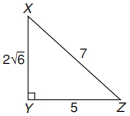
In a right-angled triangle $XYZ$,right-angled at $Y$,if $XY = 2\sqrt{6}$ and $XZ - YZ = 2$,then $\sec X + \tan X$ is
A
$\frac{1}{\sqrt{6}}$
B
$\sqrt{6}$
C
$2\sqrt{6}$
D
$\frac{\sqrt{6}}{2}$
Solution
(B) Given: $XZ - YZ = 2$ and $XY = 2\sqrt{6}$.
In right-angled triangle $XYZ$,by Pythagoras theorem:
$XY^2 + YZ^2 = XZ^2$
$(2\sqrt{6})^2 = XZ^2 - YZ^2$
$24 = (XZ - YZ)(XZ + YZ)$
Since $XZ - YZ = 2$,we have:
$24 = 2(XZ + YZ)$
$XZ + YZ = 12$
Now,we have a system of two linear equations:
$1$) $XZ - YZ = 2$
$2$) $XZ + YZ = 12$
Adding equations $(1)$ and $(2)$:
$2XZ = 14 \Rightarrow XZ = 7$
Substituting $XZ = 7$ in equation $(1)$:
$7 - YZ = 2 \Rightarrow YZ = 5$
Now,for angle $X$:
$\sec X = \frac{\text{Hypotenuse}}{\text{Adjacent side}} = \frac{XZ}{XY} = \frac{7}{2\sqrt{6}}$
$\tan X = \frac{\text{Opposite side}}{\text{Adjacent side}} = \frac{YZ}{XY} = \frac{5}{2\sqrt{6}}$
Therefore,$\sec X + \tan X = \frac{7}{2\sqrt{6}} + \frac{5}{2\sqrt{6}} = \frac{12}{2\sqrt{6}} = \frac{6}{\sqrt{6}} = \sqrt{6}$.
In right-angled triangle $XYZ$,by Pythagoras theorem:
$XY^2 + YZ^2 = XZ^2$
$(2\sqrt{6})^2 = XZ^2 - YZ^2$
$24 = (XZ - YZ)(XZ + YZ)$
Since $XZ - YZ = 2$,we have:
$24 = 2(XZ + YZ)$
$XZ + YZ = 12$
Now,we have a system of two linear equations:
$1$) $XZ - YZ = 2$
$2$) $XZ + YZ = 12$
Adding equations $(1)$ and $(2)$:
$2XZ = 14 \Rightarrow XZ = 7$
Substituting $XZ = 7$ in equation $(1)$:
$7 - YZ = 2 \Rightarrow YZ = 5$
Now,for angle $X$:
$\sec X = \frac{\text{Hypotenuse}}{\text{Adjacent side}} = \frac{XZ}{XY} = \frac{7}{2\sqrt{6}}$
$\tan X = \frac{\text{Opposite side}}{\text{Adjacent side}} = \frac{YZ}{XY} = \frac{5}{2\sqrt{6}}$
Therefore,$\sec X + \tan X = \frac{7}{2\sqrt{6}} + \frac{5}{2\sqrt{6}} = \frac{12}{2\sqrt{6}} = \frac{6}{\sqrt{6}} = \sqrt{6}$.
0 likes
View Solution641
MediumMCQ
If $0^{\circ} < \theta < 90^{\circ},$ the value of $\sin \theta + \cos \theta$ is
A
Equal to $1$
B
Greater than $1$
C
Less than $1$
D
Equal to $2$
Solution
(B) Let $Z = \sin \theta + \cos \theta$.
Squaring both sides,we get:
$Z^{2} = (\sin \theta + \cos \theta)^{2} = \sin^{2} \theta + \cos^{2} \theta + 2 \sin \theta \cos \theta$.
Since $\sin^{2} \theta + \cos^{2} \theta = 1$,we have $Z^{2} = 1 + 2 \sin \theta \cos \theta$.
For $0^{\circ} < \theta < 90^{\circ}$,both $\sin \theta$ and $\cos \theta$ are positive,so $2 \sin \theta \cos \theta > 0$.
Therefore,$Z^{2} = 1 + (\text{a positive value}) > 1$.
Taking the square root,$Z > 1$.
Thus,the value of $\sin \theta + \cos \theta$ is always greater than $1$ for $0^{\circ} < \theta < 90^{\circ}$.
Squaring both sides,we get:
$Z^{2} = (\sin \theta + \cos \theta)^{2} = \sin^{2} \theta + \cos^{2} \theta + 2 \sin \theta \cos \theta$.
Since $\sin^{2} \theta + \cos^{2} \theta = 1$,we have $Z^{2} = 1 + 2 \sin \theta \cos \theta$.
For $0^{\circ} < \theta < 90^{\circ}$,both $\sin \theta$ and $\cos \theta$ are positive,so $2 \sin \theta \cos \theta > 0$.
Therefore,$Z^{2} = 1 + (\text{a positive value}) > 1$.
Taking the square root,$Z > 1$.
Thus,the value of $\sin \theta + \cos \theta$ is always greater than $1$ for $0^{\circ} < \theta < 90^{\circ}$.
0 likes
View Solution642
MediumMCQ
The expression $\frac{\tan 57^{\circ}+\cot 37^{\circ}}{\tan 33^{\circ}+\cot 53^{\circ}}$ is equal to
A
$\tan 33^{\circ} \cot 57^{\circ}$
B
$\tan 57^{\circ} \cot 37^{\circ}$
C
$\tan 33^{\circ} \cot 53^{\circ}$
D
$\tan 53^{\circ} \cot 37^{\circ}$
Solution
(B) Given expression: $\frac{\tan 57^{\circ}+\cot 37^{\circ}}{\tan 33^{\circ}+\cot 53^{\circ}}$
Using the complementary angle identities $\tan(90^{\circ}-\theta) = \cot \theta$ and $\cot(90^{\circ}-\theta) = \tan \theta$:
$\tan 57^{\circ} = \tan(90^{\circ}-33^{\circ}) = \cot 33^{\circ}$
$\cot 37^{\circ} = \cot(90^{\circ}-53^{\circ}) = \tan 53^{\circ}$
Substituting these into the expression:
$= \frac{\cot 33^{\circ} + \tan 53^{\circ}}{\tan 33^{\circ} + \cot 53^{\circ}}$
$= \frac{\frac{1}{\tan 33^{\circ}} + \tan 53^{\circ}}{\tan 33^{\circ} + \frac{1}{\tan 53^{\circ}}}$
$= \frac{\frac{1 + \tan 33^{\circ} \tan 53^{\circ}}{\tan 33^{\circ}}}{\frac{\tan 33^{\circ} \tan 53^{\circ} + 1}{\tan 53^{\circ}}}$
$= \frac{1 + \tan 33^{\circ} \tan 53^{\circ}}{\tan 33^{\circ}} \times \frac{\tan 53^{\circ}}{1 + \tan 33^{\circ} \tan 53^{\circ}}$
$= \frac{\tan 53^{\circ}}{\tan 33^{\circ}} = \tan 53^{\circ} \cot 33^{\circ}$
Since $\tan 53^{\circ} = \cot 37^{\circ}$ and $\cot 33^{\circ} = \tan 57^{\circ}$,the expression is equal to $\tan 57^{\circ} \cot 37^{\circ}$.
Using the complementary angle identities $\tan(90^{\circ}-\theta) = \cot \theta$ and $\cot(90^{\circ}-\theta) = \tan \theta$:
$\tan 57^{\circ} = \tan(90^{\circ}-33^{\circ}) = \cot 33^{\circ}$
$\cot 37^{\circ} = \cot(90^{\circ}-53^{\circ}) = \tan 53^{\circ}$
Substituting these into the expression:
$= \frac{\cot 33^{\circ} + \tan 53^{\circ}}{\tan 33^{\circ} + \cot 53^{\circ}}$
$= \frac{\frac{1}{\tan 33^{\circ}} + \tan 53^{\circ}}{\tan 33^{\circ} + \frac{1}{\tan 53^{\circ}}}$
$= \frac{\frac{1 + \tan 33^{\circ} \tan 53^{\circ}}{\tan 33^{\circ}}}{\frac{\tan 33^{\circ} \tan 53^{\circ} + 1}{\tan 53^{\circ}}}$
$= \frac{1 + \tan 33^{\circ} \tan 53^{\circ}}{\tan 33^{\circ}} \times \frac{\tan 53^{\circ}}{1 + \tan 33^{\circ} \tan 53^{\circ}}$
$= \frac{\tan 53^{\circ}}{\tan 33^{\circ}} = \tan 53^{\circ} \cot 33^{\circ}$
Since $\tan 53^{\circ} = \cot 37^{\circ}$ and $\cot 33^{\circ} = \tan 57^{\circ}$,the expression is equal to $\tan 57^{\circ} \cot 37^{\circ}$.
0 likes
View Solution643
EasyMCQ
The minimum value of $\sin^{2} \theta + \cos^{2} \theta + \sec^{2} \theta + \operatorname{cosec}^{2} \theta + \tan^{2} \theta + \cot^{2} \theta$ is
A
$1$
B
$3$
C
$5$
D
$7$
Solution
(D) Let the expression be $E = \sin^{2} \theta + \cos^{2} \theta + \sec^{2} \theta + \operatorname{cosec}^{2} \theta + \tan^{2} \theta + \cot^{2} \theta$.
Using the identity $\sin^{2} \theta + \cos^{2} \theta = 1$,we have $E = 1 + \sec^{2} \theta + \operatorname{cosec}^{2} \theta + \tan^{2} \theta + \cot^{2} \theta$.
Using $\sec^{2} \theta = 1 + \tan^{2} \theta$ and $\operatorname{cosec}^{2} \theta = 1 + \cot^{2} \theta$,we get:
$E = 1 + (1 + \tan^{2} \theta) + (1 + \cot^{2} \theta) + \tan^{2} \theta + \cot^{2} \theta$.
$E = 3 + 2(\tan^{2} \theta + \cot^{2} \theta)$.
By the Arithmetic Mean-Geometric Mean inequality,$\tan^{2} \theta + \cot^{2} \theta \ge 2 \sqrt{\tan^{2} \theta \cdot \cot^{2} \theta} = 2(1) = 2$.
Therefore,the minimum value of $E = 3 + 2(2) = 3 + 4 = 7$.
Using the identity $\sin^{2} \theta + \cos^{2} \theta = 1$,we have $E = 1 + \sec^{2} \theta + \operatorname{cosec}^{2} \theta + \tan^{2} \theta + \cot^{2} \theta$.
Using $\sec^{2} \theta = 1 + \tan^{2} \theta$ and $\operatorname{cosec}^{2} \theta = 1 + \cot^{2} \theta$,we get:
$E = 1 + (1 + \tan^{2} \theta) + (1 + \cot^{2} \theta) + \tan^{2} \theta + \cot^{2} \theta$.
$E = 3 + 2(\tan^{2} \theta + \cot^{2} \theta)$.
By the Arithmetic Mean-Geometric Mean inequality,$\tan^{2} \theta + \cot^{2} \theta \ge 2 \sqrt{\tan^{2} \theta \cdot \cot^{2} \theta} = 2(1) = 2$.
Therefore,the minimum value of $E = 3 + 2(2) = 3 + 4 = 7$.
0 likes
View Solution644
MediumMCQ
If $2 \sin \left(\frac{\pi}{2}\right) = x^{2} + \frac{1}{x^{2}}$,then the value of $\left(x - \frac{1}{x}\right)$ is
A
$-1$
B
$2$
C
$1$
D
$0$
Solution
(D) Given the equation: $2 \sin \left(\frac{\pi}{2}\right) = x^{2} + \frac{1}{x^{2}}$.
Since $\sin \left(\frac{\pi}{2}\right) = 1$,the equation becomes $2(1) = x^{2} + \frac{1}{x^{2}}$,which simplifies to $x^{2} + \frac{1}{x^{2}} = 2$.
We know the identity $(x - \frac{1}{x})^{2} = x^{2} + \frac{1}{x^{2}} - 2$.
Substituting the value $x^{2} + \frac{1}{x^{2}} = 2$ into the identity,we get $(x - \frac{1}{x})^{2} = 2 - 2 = 0$.
Therefore,$x - \frac{1}{x} = 0$.
Since $\sin \left(\frac{\pi}{2}\right) = 1$,the equation becomes $2(1) = x^{2} + \frac{1}{x^{2}}$,which simplifies to $x^{2} + \frac{1}{x^{2}} = 2$.
We know the identity $(x - \frac{1}{x})^{2} = x^{2} + \frac{1}{x^{2}} - 2$.
Substituting the value $x^{2} + \frac{1}{x^{2}} = 2$ into the identity,we get $(x - \frac{1}{x})^{2} = 2 - 2 = 0$.
Therefore,$x - \frac{1}{x} = 0$.
0 likes
View Solution645
MediumMCQ
If $\sin ^{2} \alpha+\sin ^{2} \beta=2,$ then the value of $\cos \left(\frac{\alpha+\beta}{2}\right)$ is
A
$1$
B
$-1$
C
$0$
D
$0.5$
Solution
(C) Given that $\sin ^{2} \alpha+\sin ^{2} \beta=2$.
Since the maximum value of $\sin ^{2} \theta$ is $1$,the equation $\sin ^{2} \alpha+\sin ^{2} \beta=2$ can only hold if $\sin ^{2} \alpha=1$ and $\sin ^{2} \beta=1$.
This implies $\sin \alpha = \pm 1$ and $\sin \beta = \pm 1$.
For $\sin ^{2} \alpha=1$,$\alpha = \frac{\pi}{2}, \frac{3\pi}{2}, \dots$ and for $\sin ^{2} \beta=1$,$\beta = \frac{\pi}{2}, \frac{3\pi}{2}, \dots$.
Taking the principal values,$\alpha = \frac{\pi}{2}$ and $\beta = \frac{\pi}{2}$.
Substituting these values into the expression:
$\cos \left(\frac{\alpha+\beta}{2}\right) = \cos \left(\frac{\frac{\pi}{2}+\frac{\pi}{2}}{2}\right) = \cos \left(\frac{\pi}{2}\right) = 0$.
Since the maximum value of $\sin ^{2} \theta$ is $1$,the equation $\sin ^{2} \alpha+\sin ^{2} \beta=2$ can only hold if $\sin ^{2} \alpha=1$ and $\sin ^{2} \beta=1$.
This implies $\sin \alpha = \pm 1$ and $\sin \beta = \pm 1$.
For $\sin ^{2} \alpha=1$,$\alpha = \frac{\pi}{2}, \frac{3\pi}{2}, \dots$ and for $\sin ^{2} \beta=1$,$\beta = \frac{\pi}{2}, \frac{3\pi}{2}, \dots$.
Taking the principal values,$\alpha = \frac{\pi}{2}$ and $\beta = \frac{\pi}{2}$.
Substituting these values into the expression:
$\cos \left(\frac{\alpha+\beta}{2}\right) = \cos \left(\frac{\frac{\pi}{2}+\frac{\pi}{2}}{2}\right) = \cos \left(\frac{\pi}{2}\right) = 0$.
0 likes
View Solution646
DifficultMCQ
The value of $\cot \frac{\pi}{20} \cot \frac{3 \pi}{20} \cot \frac{5 \pi}{20} \cot \frac{7 \pi}{20} \cot \frac{9 \pi}{20}$ is
A
$-1$
B
$\frac{1}{2}$
C
$0$
D
$1$
Solution
(D) Given expression: $\cot \frac{\pi}{20} \cdot \cot \frac{3 \pi}{20} \cdot \cot \frac{5 \pi}{20} \cdot \cot \frac{7 \pi}{20} \cdot \cot \frac{9 \pi}{20}$
Since $\pi = 180^{\circ}$,we have:
$= \cot 9^{\circ} \cdot \cot 27^{\circ} \cdot \cot 45^{\circ} \cdot \cot 63^{\circ} \cdot \cot 81^{\circ}$
Using the identity $\cot(90^{\circ} - \theta) = \tan \theta$:
$= \cot 9^{\circ} \cdot \cot 27^{\circ} \cdot \cot 45^{\circ} \cdot \cot(90^{\circ} - 27^{\circ}) \cdot \cot(90^{\circ} - 9^{\circ})$
$= \cot 9^{\circ} \cdot \cot 27^{\circ} \cdot \cot 45^{\circ} \cdot \tan 27^{\circ} \cdot \tan 9^{\circ}$
Since $\tan \theta \cdot \cot \theta = 1$:
$= (\cot 9^{\circ} \cdot \tan 9^{\circ}) \cdot (\cot 27^{\circ} \cdot \tan 27^{\circ}) \cdot \cot 45^{\circ}$
$= 1 \cdot 1 \cdot 1 = 1$
Since $\pi = 180^{\circ}$,we have:
$= \cot 9^{\circ} \cdot \cot 27^{\circ} \cdot \cot 45^{\circ} \cdot \cot 63^{\circ} \cdot \cot 81^{\circ}$
Using the identity $\cot(90^{\circ} - \theta) = \tan \theta$:
$= \cot 9^{\circ} \cdot \cot 27^{\circ} \cdot \cot 45^{\circ} \cdot \cot(90^{\circ} - 27^{\circ}) \cdot \cot(90^{\circ} - 9^{\circ})$
$= \cot 9^{\circ} \cdot \cot 27^{\circ} \cdot \cot 45^{\circ} \cdot \tan 27^{\circ} \cdot \tan 9^{\circ}$
Since $\tan \theta \cdot \cot \theta = 1$:
$= (\cot 9^{\circ} \cdot \tan 9^{\circ}) \cdot (\cot 27^{\circ} \cdot \tan 27^{\circ}) \cdot \cot 45^{\circ}$
$= 1 \cdot 1 \cdot 1 = 1$
0 likes
View Solution647
DifficultMCQ
If $\sin \theta + \cos \theta = \frac{17}{13}, 0 < \theta < 90^{\circ},$ then the value of $\sin \theta - \cos \theta$ is
A
$\frac{5}{17}$
B
$\frac{3}{19}$
C
$\frac{7}{10}$
D
$\frac{7}{13}$
Solution
(D) Given: $\sin \theta + \cos \theta = \frac{17}{13}$ ..... $(1)$
Let $\sin \theta - \cos \theta = x$ ..... $(2)$
Squaring both equations:
$(\sin \theta + \cos \theta)^2 = (\frac{17}{13})^2 \Rightarrow \sin^2 \theta + \cos^2 \theta + 2 \sin \theta \cos \theta = \frac{289}{169}$
Since $\sin^2 \theta + \cos^2 \theta = 1$,we have $1 + 2 \sin \theta \cos \theta = \frac{289}{169} \Rightarrow 2 \sin \theta \cos \theta = \frac{289}{169} - 1 = \frac{120}{169}$ ..... $(3)$
Now,$x^2 = (\sin \theta - \cos \theta)^2 = \sin^2 \theta + \cos^2 \theta - 2 \sin \theta \cos \theta$
$x^2 = 1 - 2 \sin \theta \cos \theta$
Substituting the value from $(3)$:
$x^2 = 1 - \frac{120}{169} = \frac{169 - 120}{169} = \frac{49}{169}$
$x = \pm \sqrt{\frac{49}{169}} = \pm \frac{7}{13}$
Since $0 < \theta < 90^{\circ}$ and $\sin \theta + \cos \theta > 1$,the value is $\frac{7}{13}$.
Let $\sin \theta - \cos \theta = x$ ..... $(2)$
Squaring both equations:
$(\sin \theta + \cos \theta)^2 = (\frac{17}{13})^2 \Rightarrow \sin^2 \theta + \cos^2 \theta + 2 \sin \theta \cos \theta = \frac{289}{169}$
Since $\sin^2 \theta + \cos^2 \theta = 1$,we have $1 + 2 \sin \theta \cos \theta = \frac{289}{169} \Rightarrow 2 \sin \theta \cos \theta = \frac{289}{169} - 1 = \frac{120}{169}$ ..... $(3)$
Now,$x^2 = (\sin \theta - \cos \theta)^2 = \sin^2 \theta + \cos^2 \theta - 2 \sin \theta \cos \theta$
$x^2 = 1 - 2 \sin \theta \cos \theta$
Substituting the value from $(3)$:
$x^2 = 1 - \frac{120}{169} = \frac{169 - 120}{169} = \frac{49}{169}$
$x = \pm \sqrt{\frac{49}{169}} = \pm \frac{7}{13}$
Since $0 < \theta < 90^{\circ}$ and $\sin \theta + \cos \theta > 1$,the value is $\frac{7}{13}$.
0 likes
View Solution648
DifficultMCQ
If $\tan \theta \cdot \tan 2 \theta = 1,$ then the value of $\sin ^{2} 2 \theta + \tan ^{2} 2 \theta$ is equal to
A
$\frac{3}{4}$
B
$\frac{10}{3}$
C
$3 \frac{3}{4}$
D
$3$
Solution
(C) Given $\tan \theta \cdot \tan 2 \theta = 1.$
This implies $\tan \theta = \frac{1}{\tan 2 \theta} = \cot 2 \theta.$
We can write $\cot 2 \theta$ as $\tan(90^{\circ} - 2 \theta).$
So,$\tan \theta = \tan(90^{\circ} - 2 \theta).$
Equating the angles,$\theta = 90^{\circ} - 2 \theta \Rightarrow 3 \theta = 90^{\circ} \Rightarrow \theta = 30^{\circ}.$
Now,substitute $\theta = 30^{\circ}$ into the expression $\sin ^{2} 2 \theta + \tan ^{2} 2 \theta.$
This becomes $\sin ^{2} 60^{\circ} + \tan ^{2} 60^{\circ}.$
Since $\sin 60^{\circ} = \frac{\sqrt{3}}{2}$ and $\tan 60^{\circ} = \sqrt{3},$
we get $(\frac{\sqrt{3}}{2})^{2} + (\sqrt{3})^{2} = \frac{3}{4} + 3 = 3 \frac{3}{4}.$
This implies $\tan \theta = \frac{1}{\tan 2 \theta} = \cot 2 \theta.$
We can write $\cot 2 \theta$ as $\tan(90^{\circ} - 2 \theta).$
So,$\tan \theta = \tan(90^{\circ} - 2 \theta).$
Equating the angles,$\theta = 90^{\circ} - 2 \theta \Rightarrow 3 \theta = 90^{\circ} \Rightarrow \theta = 30^{\circ}.$
Now,substitute $\theta = 30^{\circ}$ into the expression $\sin ^{2} 2 \theta + \tan ^{2} 2 \theta.$
This becomes $\sin ^{2} 60^{\circ} + \tan ^{2} 60^{\circ}.$
Since $\sin 60^{\circ} = \frac{\sqrt{3}}{2}$ and $\tan 60^{\circ} = \sqrt{3},$
we get $(\frac{\sqrt{3}}{2})^{2} + (\sqrt{3})^{2} = \frac{3}{4} + 3 = 3 \frac{3}{4}.$
0 likes
View SolutionTrigonometry — Trigonometry · Frequently Asked Questions
1Are these Trigonometry questions useful for JEE and NEET?
Yes. All questions in this section are mapped to JEE Main and NEET exam patterns. Previous year questions from JEE Main, NEET, GUJCET and state-level exams are included with full solutions.
2Can I switch to Hindi or Gujarati for these questions?
Yes. Use the language tabs in the hero section or the sidebar to view the same questions and solutions in English, Hindi or Gujarati.
3How do I generate a question paper from this subtopic?
Use the Vedclass Exam Paper Generator — select the chapter and subtopic, set difficulty, and generate Sets A, B, C, D automatically. First 3 chapters of every subject are free.
Vedclass Products
For Students
Vedclass Test Series
Mock tests in real JEE/NEET style with performance analysis. 5-day free trial.
Start Free TrialFor Teachers
Exam Paper Generator
Generate Set A/B/C/D papers from this chapter in 2 minutes. 3 chapters free.
Try FreeFor Institutes
Online Exam Module
Live online exams with unlimited students, 360° analytics & white-label branding.
See DemoFor Teachers & Institutes
Generate a Trigonometry Exam Paper in 2 Minutes
Select subtopic & difficulty — Sets A, B, C, D auto-generated with No Repeat logic.
First 3 chapters of every subject are free — no payment required.