
A English
Ratio and Proportion Questions in English
Competitive Exam Quantitative Aptitude · Ratio and Proportion · Ratio and Proportion
330+
Questions
English
Language
100%
With Solutions
Showing 50 of 330 questions in English
51
MediumMCQ
$A$ mixture contains alcohol and water in the ratio $4:3$. If $5 \text{ liters}$ of water is added to the mixture,the ratio becomes $4:5$. Find the quantity of alcohol in the given mixture (in $\text{L}$).
A
$5$
B
$7.5$
C
$10$
D
$12$
Solution
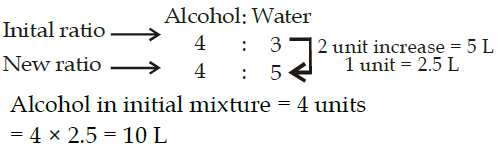
(C) Let the initial quantity of alcohol be $4x$ and water be $3x$.
When $5 \text{ liters}$ of water is added,the new quantity of water becomes $3x + 5$.
According to the problem,the new ratio of alcohol to water is $4:5$.
So,$\frac{4x}{3x + 5} = \frac{4}{5}$.
Cross-multiplying,we get $20x = 4(3x + 5)$.
$20x = 12x + 20$.
$8x = 20$.
$x = \frac{20}{8} = 2.5$.
The quantity of alcohol is $4x = 4 \times 2.5 = 10 \text{ liters}$.
When $5 \text{ liters}$ of water is added,the new quantity of water becomes $3x + 5$.
According to the problem,the new ratio of alcohol to water is $4:5$.
So,$\frac{4x}{3x + 5} = \frac{4}{5}$.
Cross-multiplying,we get $20x = 4(3x + 5)$.
$20x = 12x + 20$.
$8x = 20$.
$x = \frac{20}{8} = 2.5$.
The quantity of alcohol is $4x = 4 \times 2.5 = 10 \text{ liters}$.
0 likes
View Solution52
MediumMCQ
In a bag,there are coins of $25 \ p$,$10 \ p$,and $5 \ p$ in the ratio of $1: 2: 3$. If there are $Rs. 30$ in all,how many $5 \ p$ coins are there?
A
$50$
B
$100$
C
$150$
D
$200$
Solution
(C) Let the number of coins be $x$,$2x$,and $3x$ for $25 \ p$,$10 \ p$,and $5 \ p$ respectively.
The total value of the coins is given by:
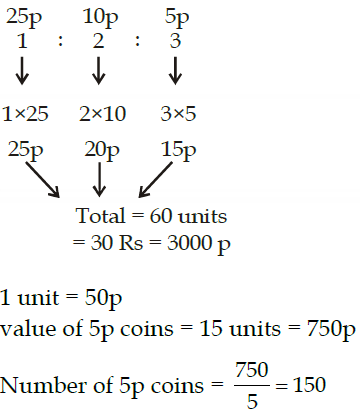
$(x \times 25) + (2x \times 10) + (3x \times 5) = 3000 \ p$ (since $Rs. 30 = 3000 \ p$)
$25x + 20x + 15x = 3000$
$60x = 3000$
$x = 3000 / 60 = 50$
The number of $5 \ p$ coins is $3x = 3 \times 50 = 150$.
The total value of the coins is given by:
$(x \times 25) + (2x \times 10) + (3x \times 5) = 3000 \ p$ (since $Rs. 30 = 3000 \ p$)
$25x + 20x + 15x = 3000$
$60x = 3000$
$x = 3000 / 60 = 50$
The number of $5 \ p$ coins is $3x = 3 \times 50 = 150$.
0 likes
View Solution53
DifficultMCQ
If $Rs. 510$ is divided among $A, B, C$ in such a way that $A$ gets $\frac{2}{3}$ of what $B$ gets and $B$ gets $\frac{1}{4}$ of what $C$ gets,then their shares are respectively:
A
$Rs. 120, Rs. 240, Rs. 150$
B
$Rs. 60, Rs. 90, Rs. 360$
C
$Rs. 150, Rs. 300, Rs. 60$
D
$Rs. 70, Rs. 90, Rs. 350$
Solution
(B) Let $C$'s share be $x$.
Then,$B$'s share $= \frac{1}{4}x$.
$A$'s share $= \frac{2}{3} \times (\frac{1}{4}x) = \frac{1}{6}x$.
The total amount is $Rs. 510$,so:
$\frac{1}{6}x + \frac{1}{4}x + x = 510$.
Taking the least common multiple $(LCM)$ of $6, 4, 1$ as $12$:
$\frac{2x + 3x + 12x}{12} = 510$.
$\frac{17x}{12} = 510$.
$17x = 510 \times 12$.
$x = \frac{510 \times 12}{17} = 30 \times 12 = 360$.
Thus,$C$'s share $= Rs. 360$.
$B$'s share $= \frac{1}{4} \times 360 = Rs. 90$.
$A$'s share $= \frac{2}{3} \times 90 = Rs. 60$.
Therefore,the shares are $Rs. 60, Rs. 90, Rs. 360$.
Then,$B$'s share $= \frac{1}{4}x$.
$A$'s share $= \frac{2}{3} \times (\frac{1}{4}x) = \frac{1}{6}x$.
The total amount is $Rs. 510$,so:
$\frac{1}{6}x + \frac{1}{4}x + x = 510$.
Taking the least common multiple $(LCM)$ of $6, 4, 1$ as $12$:
$\frac{2x + 3x + 12x}{12} = 510$.
$\frac{17x}{12} = 510$.
$17x = 510 \times 12$.
$x = \frac{510 \times 12}{17} = 30 \times 12 = 360$.
Thus,$C$'s share $= Rs. 360$.
$B$'s share $= \frac{1}{4} \times 360 = Rs. 90$.
$A$'s share $= \frac{2}{3} \times 90 = Rs. 60$.
Therefore,the shares are $Rs. 60, Rs. 90, Rs. 360$.
0 likes
View Solution54
MediumMCQ
$Rs. 366$ are divided among $A, B$ and $C$ such that $A$ gets $\frac{1}{2}$ as much as $B$ and $C$ together,and $B$ gets $\frac{2}{3}$ as much as $A$ and $C$ together. What is the share of $A$ (in $Rs.$)?
A
$122$
B
$129.60$
C
$146.60$
D
$183$
Solution
(A) Let the shares of $A, B,$ and $C$ be $A, B,$ and $C$ respectively.
Given that $A + B + C = 366$ (Equation $1$).
According to the problem,$A = \frac{1}{2}(B + C)$,which implies $2A = B + C$ (Equation $2$).
Substituting Equation $2$ into Equation $1$: $A + (B + C) = 366 \Rightarrow A + 2A = 366 \Rightarrow 3A = 366 \Rightarrow A = 122$.
Thus,the share of $A$ is $Rs. 122$.
Given that $A + B + C = 366$ (Equation $1$).
According to the problem,$A = \frac{1}{2}(B + C)$,which implies $2A = B + C$ (Equation $2$).
Substituting Equation $2$ into Equation $1$: $A + (B + C) = 366 \Rightarrow A + 2A = 366 \Rightarrow 3A = 366 \Rightarrow A = 122$.
Thus,the share of $A$ is $Rs. 122$.
0 likes
View Solution55
MediumMCQ
The ratio of the earnings of $A$ and $B$ is $4:7$. If the earnings of $A$ increase by $50\%$ and those of $B$ decrease by $25\%$,the new ratio of their earnings becomes $8:7$. What are $A$'s earnings (in $Rs.$)?
A
$21000$
B
$26000$
C
$28000$
D
Data inadequate
Solution
(D) Let the initial earnings of $A$ and $B$ be $4x$ and $7x$ respectively.
After an increase of $50\%$,the new earnings of $A = 4x \times (1 + 0.50) = 4x \times 1.5 = 6x$.
After a decrease of $25\%$,the new earnings of $B = 7x \times (1 - 0.25) = 7x \times 0.75 = 5.25x$.
The new ratio is $6x : 5.25x = 6 : 5.25 = 600 : 525 = 8 : 7$.
Since the ratio $8:7$ is consistent with the given information for any value of $x$,the specific value of $A$'s earnings cannot be determined without an absolute value provided in the problem statement.
Therefore,the data is inadequate.
After an increase of $50\%$,the new earnings of $A = 4x \times (1 + 0.50) = 4x \times 1.5 = 6x$.
After a decrease of $25\%$,the new earnings of $B = 7x \times (1 - 0.25) = 7x \times 0.75 = 5.25x$.
The new ratio is $6x : 5.25x = 6 : 5.25 = 600 : 525 = 8 : 7$.
Since the ratio $8:7$ is consistent with the given information for any value of $x$,the specific value of $A$'s earnings cannot be determined without an absolute value provided in the problem statement.
Therefore,the data is inadequate.
0 likes
View Solution56
EasyMCQ
An amount of $Rs. 735$ was divided between $A, B$ and $C$. If each of them had received $Rs. 25$ less,their shares would have been in the ratio of $1:3:2$. The money received by $C$ was
A
$195$
B
$200$
C
$225$
D
$245$
Solution
(D) Let the shares of $A, B$,and $C$ after reducing $Rs. 25$ each be $x, 3x$,and $2x$ respectively.
According to the problem,the total amount is $Rs. 735$.
If each had received $Rs. 25$ less,the total reduction would be $3 \times 25 = Rs. 75$.
So,the new total sum would be $735 - 75 = 660$.
Thus,$x + 3x + 2x = 660$.
$6x = 660 \Rightarrow x = 110$.
The share of $C$ is $2x + 25$.
Substituting $x = 110$,we get $C = 2(110) + 25 = 220 + 25 = Rs. 245$.
According to the problem,the total amount is $Rs. 735$.
If each had received $Rs. 25$ less,the total reduction would be $3 \times 25 = Rs. 75$.
So,the new total sum would be $735 - 75 = 660$.
Thus,$x + 3x + 2x = 660$.
$6x = 660 \Rightarrow x = 110$.
The share of $C$ is $2x + 25$.
Substituting $x = 110$,we get $C = 2(110) + 25 = 220 + 25 = Rs. 245$.
0 likes
View Solution57
MediumMCQ
An amount of $Rs. 2430$ is divided among $A$,$B$,and $C$ such that if their shares are reduced by $Rs. 5$,$Rs. 10$,and $Rs. 15$ respectively,the remainders are in the ratio of $3:4:5$. Then,$B$'s share was (in $Rs.$):
A
$605$
B
$790$
C
$800$
D
$810$
Solution
(D) Let the shares of $A$,$B$,and $C$ be $(3x + 5)$,$(4x + 10)$,and $(5x + 15)$ respectively.
According to the problem,the sum of these shares is $Rs. 2430$.
$(3x + 5) + (4x + 10) + (5x + 15) = 2430$
$12x + 30 = 2430$
$12x = 2430 - 30$
$12x = 2400$
$x = 200$
Now,calculate $B$'s share:
$B$'s share $= 4x + 10$
$B$'s share $= 4(200) + 10$
$B$'s share $= 800 + 10 = 810$
Thus,$B$'s share is $Rs. 810$.
According to the problem,the sum of these shares is $Rs. 2430$.
$(3x + 5) + (4x + 10) + (5x + 15) = 2430$
$12x + 30 = 2430$
$12x = 2430 - 30$
$12x = 2400$
$x = 200$
Now,calculate $B$'s share:
$B$'s share $= 4x + 10$
$B$'s share $= 4(200) + 10$
$B$'s share $= 800 + 10 = 810$
Thus,$B$'s share is $Rs. 810$.
0 likes
View Solution58
MediumMCQ
Gold is $19$ times as heavy as water and copper is $9$ times as heavy as water. In what ratio should these be mixed to get an alloy $15$ times as heavy as water?
A
$1:1$
B
$2:3$
C
$1:2$
D
$3:2$
Solution
(B) We can use the method of alligation to solve this problem.
Let the density of water be $1$.
Density of gold = $19$.
Density of copper = $9$.
Density of the required alloy = $15$.
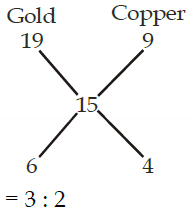
Using the alligation rule:
(Density of Gold - Mean Density) : (Mean Density - Density of Copper)
$= (19 - 15) : (15 - 9)$
$= 4 : 6$
$= 2 : 3$
Therefore,the ratio in which they should be mixed is $2:3$.
Let the density of water be $1$.
Density of gold = $19$.
Density of copper = $9$.
Density of the required alloy = $15$.
Using the alligation rule:
(Density of Gold - Mean Density) : (Mean Density - Density of Copper)
$= (19 - 15) : (15 - 9)$
$= 4 : 6$
$= 2 : 3$
Therefore,the ratio in which they should be mixed is $2:3$.
0 likes
View Solution59
DifficultMCQ
$15$ litres of mixture contains $20 \%$ alcohol and the rest water. If $3$ litres of water be mixed with it,the percentage of alcohol in the new mixture would be:
A
$15 \%$
B
$16 \frac{2}{3} \%$
C
$17 \%$
D
$18 \frac{1}{2} \%$
Solution
(B) Initial volume of mixture = $15$ litres.
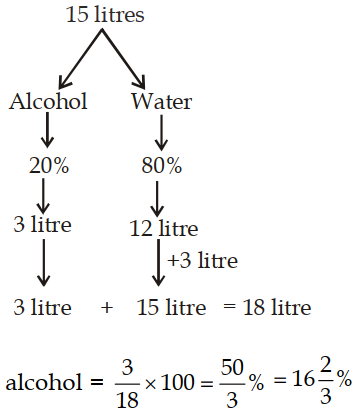
Quantity of alcohol = $20 \%$ of $15 = \frac{20}{100} \times 15 = 3$ litres.
Quantity of water = $15 - 3 = 12$ litres.
When $3$ litres of water is added,the new quantity of water = $12 + 3 = 15$ litres.
The quantity of alcohol remains the same,i.e.,$3$ litres.
Total volume of the new mixture = $3 + 15 = 18$ litres.
Percentage of alcohol in the new mixture = $(\frac{\text{Quantity of alcohol}}{\text{Total volume}}) \times 100 = (\frac{3}{18}) \times 100 = \frac{1}{6} \times 100 = \frac{50}{3} \% = 16 \frac{2}{3} \%$.
Quantity of alcohol = $20 \%$ of $15 = \frac{20}{100} \times 15 = 3$ litres.
Quantity of water = $15 - 3 = 12$ litres.
When $3$ litres of water is added,the new quantity of water = $12 + 3 = 15$ litres.
The quantity of alcohol remains the same,i.e.,$3$ litres.
Total volume of the new mixture = $3 + 15 = 18$ litres.
Percentage of alcohol in the new mixture = $(\frac{\text{Quantity of alcohol}}{\text{Total volume}}) \times 100 = (\frac{3}{18}) \times 100 = \frac{1}{6} \times 100 = \frac{50}{3} \% = 16 \frac{2}{3} \%$.
0 likes
View Solution60
DifficultMCQ
$85 \, L$ of a mixture contains milk and water in the ratio $27: 7$. How much more water (in $L$) is to be added to get a new mixture containing milk and water in the ratio $3: 1$?
A
$5$
B
$6.5$
C
$7.25$
D
$8$
Solution
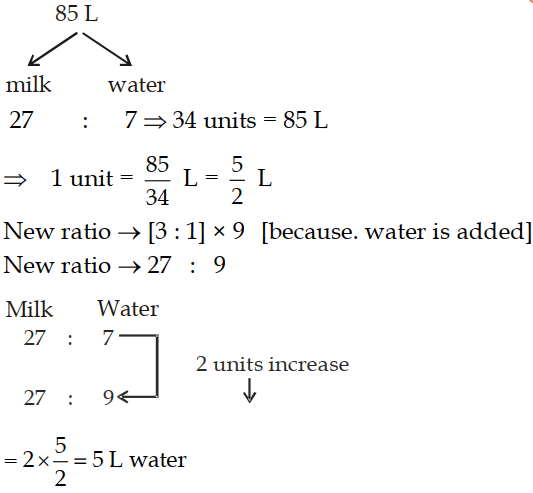
(A) Total volume of the mixture = $85 \, L$.
The ratio of milk to water is $27: 7$.
Sum of ratio terms = $27 + 7 = 34$.
Value of $1$ unit = $\frac{85}{34} \, L = 2.5 \, L$.
Initial amount of milk = $27 \times 2.5 = 67.5 \, L$.
Initial amount of water = $7 \times 2.5 = 17.5 \, L$.
Let $x$ liters of water be added to the mixture.
The new ratio of milk to water becomes $3: 1$.
So,$\frac{67.5}{17.5 + x} = \frac{3}{1}$.
$67.5 = 3 \times (17.5 + x)$.
$67.5 = 52.5 + 3x$.
$3x = 67.5 - 52.5 = 15$.
$x = \frac{15}{3} = 5 \, L$.
Therefore,$5 \, L$ of water must be added.
The ratio of milk to water is $27: 7$.
Sum of ratio terms = $27 + 7 = 34$.
Value of $1$ unit = $\frac{85}{34} \, L = 2.5 \, L$.
Initial amount of milk = $27 \times 2.5 = 67.5 \, L$.
Initial amount of water = $7 \times 2.5 = 17.5 \, L$.
Let $x$ liters of water be added to the mixture.
The new ratio of milk to water becomes $3: 1$.
So,$\frac{67.5}{17.5 + x} = \frac{3}{1}$.
$67.5 = 3 \times (17.5 + x)$.
$67.5 = 52.5 + 3x$.
$3x = 67.5 - 52.5 = 15$.
$x = \frac{15}{3} = 5 \, L$.
Therefore,$5 \, L$ of water must be added.
0 likes
View Solution61
MediumMCQ
The sides of a triangle are in the ratio $\frac{1}{2}: \frac{1}{3}: \frac{1}{4}$ and its perimeter is $104 \, cm$. The length of the longest side (in $cm$) is:
A
$52$
B
$48$
C
$32$
D
$26$
Solution
(B) The ratio of the sides is given as $\frac{1}{2}: \frac{1}{3}: \frac{1}{4}$.
To simplify this ratio,multiply each term by the least common multiple $(LCM)$ of the denominators $(2, 3, 4)$,which is $12$.
Ratio $= (\frac{1}{2} \times 12) : (\frac{1}{3} \times 12) : (\frac{1}{4} \times 12) = 6 : 4 : 3$.
Let the sides be $6x, 4x,$ and $3x$.
The perimeter of the triangle is the sum of its sides: $6x + 4x + 3x = 13x$.
Given that the perimeter is $104 \, cm$,we have $13x = 104$.
Solving for $x$: $x = \frac{104}{13} = 8$.
The longest side corresponds to the largest ratio value,which is $6x$.
Longest side $= 6 \times 8 = 48 \, cm$.
To simplify this ratio,multiply each term by the least common multiple $(LCM)$ of the denominators $(2, 3, 4)$,which is $12$.
Ratio $= (\frac{1}{2} \times 12) : (\frac{1}{3} \times 12) : (\frac{1}{4} \times 12) = 6 : 4 : 3$.
Let the sides be $6x, 4x,$ and $3x$.
The perimeter of the triangle is the sum of its sides: $6x + 4x + 3x = 13x$.
Given that the perimeter is $104 \, cm$,we have $13x = 104$.
Solving for $x$: $x = \frac{104}{13} = 8$.
The longest side corresponds to the largest ratio value,which is $6x$.
Longest side $= 6 \times 8 = 48 \, cm$.
0 likes
View Solution62
MediumMCQ
The ratio of the number of boys and girls in a school is $3:2$. If $20\%$ of the boys and $25\%$ of the girls are scholarship holders,what percentage of the students does not get the scholarship?
A
$56$
B
$70$
C
$78$
D
$80$
Solution
(C) Let the number of boys be $300$ and the number of girls be $200$. Total students $= 300 + 200 = 500$.
Number of boys who are scholarship holders $= 20\% \text{ of } 300 = \frac{20}{100} \times 300 = 60$.
Number of girls who are scholarship holders $= 25\% \text{ of } 200 = \frac{25}{100} \times 200 = 50$.
Total students who got the scholarship $= 60 + 50 = 110$.
Total students who did not get the scholarship $= 500 - 110 = 390$.
Percentage of students who did not get the scholarship $= \frac{390}{500} \times 100 = 78\%$.
Number of boys who are scholarship holders $= 20\% \text{ of } 300 = \frac{20}{100} \times 300 = 60$.
Number of girls who are scholarship holders $= 25\% \text{ of } 200 = \frac{25}{100} \times 200 = 50$.
Total students who got the scholarship $= 60 + 50 = 110$.
Total students who did not get the scholarship $= 500 - 110 = 390$.
Percentage of students who did not get the scholarship $= \frac{390}{500} \times 100 = 78\%$.
0 likes
View Solution63
DifficultMCQ
Three containers have volumes in the ratio $3:4:5$. They are full of mixtures of milk and water. The mixtures contain milk and water in the ratio of $4:1$,$3:1$,and $5:2$ respectively. The contents of all these three containers are poured into a fourth container. The ratio of milk and water in the fourth container is
A
$4:1$
B
$151:48$
C
$157:53$
D
$5:2$
Solution
(C) Let the volumes of the three containers be $3x, 4x,$ and $5x$ respectively.
In the first container,the amount of milk is $\frac{4}{5} \times 3x = \frac{12x}{5}$ and water is $\frac{1}{5} \times 3x = \frac{3x}{5}$.
In the second container,the amount of milk is $\frac{3}{4} \times 4x = 3x$ and water is $\frac{1}{4} \times 4x = x$.
In the third container,the amount of milk is $\frac{5}{7} \times 5x = \frac{25x}{7}$ and water is $\frac{2}{7} \times 5x = \frac{10x}{7}$.
Total milk in the fourth container = $\frac{12x}{5} + 3x + \frac{25x}{7} = \frac{84x + 105x + 125x}{35} = \frac{314x}{35}$.
Total water in the fourth container = $\frac{3x}{5} + x + \frac{10x}{7} = \frac{21x + 35x + 50x}{35} = \frac{106x}{35}$.
The ratio of milk to water is $\frac{314x}{35} : \frac{106x}{35} = 314 : 106 = 157 : 53$.
In the first container,the amount of milk is $\frac{4}{5} \times 3x = \frac{12x}{5}$ and water is $\frac{1}{5} \times 3x = \frac{3x}{5}$.
In the second container,the amount of milk is $\frac{3}{4} \times 4x = 3x$ and water is $\frac{1}{4} \times 4x = x$.
In the third container,the amount of milk is $\frac{5}{7} \times 5x = \frac{25x}{7}$ and water is $\frac{2}{7} \times 5x = \frac{10x}{7}$.
Total milk in the fourth container = $\frac{12x}{5} + 3x + \frac{25x}{7} = \frac{84x + 105x + 125x}{35} = \frac{314x}{35}$.
Total water in the fourth container = $\frac{3x}{5} + x + \frac{10x}{7} = \frac{21x + 35x + 50x}{35} = \frac{106x}{35}$.
The ratio of milk to water is $\frac{314x}{35} : \frac{106x}{35} = 314 : 106 = 157 : 53$.
0 likes
View Solution64
MediumMCQ
$x$ varies inversely as the square of $y$. Given that $y = 2$ when $x = 1$. The value of $x$ when $y = 6$ will be equal to:
A
$3$
B
$9$
C
$\frac{1}{3}$
D
$\frac{1}{9}$
Solution
(D) Given that $x$ varies inversely as the square of $y$,we can write the relation as $x = \frac{K}{y^2}$,where $K$ is a constant of proportionality.
Substitute the given values $x = 1$ and $y = 2$ into the equation:
$1 = \frac{K}{2^2}$
$1 = \frac{K}{4}$
$K = 4$
Now,we have the specific equation $x = \frac{4}{y^2}$.
To find the value of $x$ when $y = 6$,substitute $y = 6$ into the equation:
$x = \frac{4}{6^2}$
$x = \frac{4}{36}$
$x = \frac{1}{9}$
Substitute the given values $x = 1$ and $y = 2$ into the equation:
$1 = \frac{K}{2^2}$
$1 = \frac{K}{4}$
$K = 4$
Now,we have the specific equation $x = \frac{4}{y^2}$.
To find the value of $x$ when $y = 6$,substitute $y = 6$ into the equation:
$x = \frac{4}{6^2}$
$x = \frac{4}{36}$
$x = \frac{1}{9}$
0 likes
View Solution65
MediumMCQ
The electricity bill of a certain establishment is partly fixed and partly varies as the number of units of electricity consumed. When in a certain month $540$ units are consumed,the bill is $Rs. 1800$. In another month $620$ units are consumed and the bill is $Rs. 2040$. In yet another month $500$ units are consumed. The bill (in $Rs.$) for that month would be:
A
$1560$
B
$1680$
C
$1840$
D
$1950$
Solution
(B) Let the fixed amount be $Rs. x$ and the cost per unit be $Rs. y$.
According to the problem:
$540y + x = 1800$ $(i)$
$620y + x = 2040$ (ii)
Subtracting equation $(i)$ from equation (ii):
$(620y - 540y) + (x - x) = 2040 - 1800$
$80y = 240$
$y = 3$
Substituting $y = 3$ into equation $(i)$:
$540(3) + x = 1800$
$1620 + x = 1800$
$x = 1800 - 1620 = 180$
So,the fixed charge is $Rs. 180$ and the charge per unit is $Rs. 3$.
For $500$ units,the total bill is:
$500 \times 3 + 180 = 1500 + 180 = 1680$
Thus,the bill for $500$ units is $Rs. 1680$.
According to the problem:
$540y + x = 1800$ $(i)$
$620y + x = 2040$ (ii)
Subtracting equation $(i)$ from equation (ii):
$(620y - 540y) + (x - x) = 2040 - 1800$
$80y = 240$
$y = 3$
Substituting $y = 3$ into equation $(i)$:
$540(3) + x = 1800$
$1620 + x = 1800$
$x = 1800 - 1620 = 180$
So,the fixed charge is $Rs. 180$ and the charge per unit is $Rs. 3$.
For $500$ units,the total bill is:
$500 \times 3 + 180 = 1500 + 180 = 1680$
Thus,the bill for $500$ units is $Rs. 1680$.
0 likes
View Solution66
MediumMCQ
The ratio of the incomes of $A$ and $B$ is $5:4$ and the ratio of their expenditures is $3:2$. If at the end of the year,each saves $Rs. 1600$,then the income of $A$ is (in $Rs.$):
A
$3400$
B
$3600$
C
$4000$
D
$4400$
Solution
(C) Let the incomes of $A$ and $B$ be $5x$ and $4x$ respectively.
Let the expenditures of $A$ and $B$ be $3y$ and $2y$ respectively.
We know that $\text{Income} - \text{Expenditure} = \text{Saving}$.
For $A$: $5x - 3y = 1600$ ---$(1)$
For $B$: $4x - 2y = 1600$ ---$(2)$
To solve these equations,multiply equation $(1)$ by $2$ and equation $(2)$ by $3$:
$10x - 6y = 3200$ ---$(3)$
$12x - 6y = 4800$ ---$(4)$
Subtracting equation $(3)$ from $(4)$:
$(12x - 10x) = 4800 - 3200$
$2x = 1600$
$x = 800$
Therefore,the income of $A = 5x = 5 \times 800 = 4000$ $Rs.$
Let the expenditures of $A$ and $B$ be $3y$ and $2y$ respectively.
We know that $\text{Income} - \text{Expenditure} = \text{Saving}$.
For $A$: $5x - 3y = 1600$ ---$(1)$
For $B$: $4x - 2y = 1600$ ---$(2)$
To solve these equations,multiply equation $(1)$ by $2$ and equation $(2)$ by $3$:
$10x - 6y = 3200$ ---$(3)$
$12x - 6y = 4800$ ---$(4)$
Subtracting equation $(3)$ from $(4)$:
$(12x - 10x) = 4800 - 3200$
$2x = 1600$
$x = 800$
Therefore,the income of $A = 5x = 5 \times 800 = 4000$ $Rs.$
0 likes
View Solution67
MediumMCQ
$A$ and $B$ are two alloys of gold and copper prepared by mixing metals in the ratio $7:2$ and $7:11$ respectively. If equal quantities of the alloys are melted to form a third alloy $C$,the ratio of gold and copper in $C$ will be
A
$5:7$
B
$5:9$
C
$7:5$
D
$9:5$
Solution
(C) In alloy $A$,the ratio of gold to copper is $7:2$. The total parts are $7+2=9$.
In alloy $B$,the ratio of gold to copper is $7:11$. The total parts are $7+11=18$.
Since equal quantities of alloys $A$ and $B$ are mixed,we must make the total parts equal in both alloys.
To make the total parts equal to $18$,multiply the ratio of alloy $A$ by $2$:
Alloy $A = (7 \times 2) : (2 \times 2) = 14:4$.
Now,alloy $A$ has $14$ parts gold and $4$ parts copper (total $18$ parts).
Alloy $B$ has $7$ parts gold and $11$ parts copper (total $18$ parts).
When mixed to form alloy $C$,the total gold is $14+7=21$ and the total copper is $4+11=15$.
The ratio of gold to copper in alloy $C$ is $21:15$.
Simplifying the ratio by dividing by $3$,we get $7:5$.
In alloy $B$,the ratio of gold to copper is $7:11$. The total parts are $7+11=18$.
Since equal quantities of alloys $A$ and $B$ are mixed,we must make the total parts equal in both alloys.
To make the total parts equal to $18$,multiply the ratio of alloy $A$ by $2$:
Alloy $A = (7 \times 2) : (2 \times 2) = 14:4$.
Now,alloy $A$ has $14$ parts gold and $4$ parts copper (total $18$ parts).
Alloy $B$ has $7$ parts gold and $11$ parts copper (total $18$ parts).
When mixed to form alloy $C$,the total gold is $14+7=21$ and the total copper is $4+11=15$.
The ratio of gold to copper in alloy $C$ is $21:15$.
Simplifying the ratio by dividing by $3$,we get $7:5$.
0 likes
View Solution68
MediumMCQ
The ratio between the present ages of $P$ and $Q$ is $5:7$ respectively. If the difference between $Q$'s present age and $P$'s age after $6$ years is $2$,what is the total of $P$'s and $Q$'s present ages (in years)?
A
$48$
B
$52$
C
$56$
D
Cannot be determined
Solution
(A) Let the present ages of $P$ and $Q$ be $5x$ and $7x$ respectively.
$P$'s age after $6$ years will be $(5x + 6)$.
According to the problem,the difference between $Q$'s present age and $P$'s age after $6$ years is $2$:
$7x - (5x + 6) = 2$
$7x - 5x - 6 = 2$
$2x - 6 = 2$
$2x = 8$
$x = 4$
Now,calculate the present ages:
$P$'s present age $= 5x = 5(4) = 20$ years.
$Q$'s present age $= 7x = 7(4) = 28$ years.
The total of their present ages is $20 + 28 = 48$ years.
$P$'s age after $6$ years will be $(5x + 6)$.
According to the problem,the difference between $Q$'s present age and $P$'s age after $6$ years is $2$:
$7x - (5x + 6) = 2$
$7x - 5x - 6 = 2$
$2x - 6 = 2$
$2x = 8$
$x = 4$
Now,calculate the present ages:
$P$'s present age $= 5x = 5(4) = 20$ years.
$Q$'s present age $= 7x = 7(4) = 28$ years.
The total of their present ages is $20 + 28 = 48$ years.
0 likes
View Solution69
MediumMCQ
The ratio of the father's age to his son's age is $7:3$. The product of their ages is $756$. The ratio of their ages after $6$ years will be:
A
$5:2$
B
$2:1$
C
$11:7$
D
$13:9$
Solution
(B) Let the present ages be $7x$ and $3x$ for the father and son,respectively.
Given that the product of their ages is $756$,we have:
$7x \times 3x = 756$
$21x^2 = 756$
$x^2 = \frac{756}{21} = 36$
$x = 6$
Therefore,the present ages are:
Father: $7 \times 6 = 42$ years
Son: $3 \times 6 = 18$ years
After $6$ years,their ages will be:
Father: $42 + 6 = 48$ years
Son: $18 + 6 = 24$ years
The ratio of their ages after $6$ years will be $48:24 = 2:1$.
Given that the product of their ages is $756$,we have:
$7x \times 3x = 756$
$21x^2 = 756$
$x^2 = \frac{756}{21} = 36$
$x = 6$
Therefore,the present ages are:
Father: $7 \times 6 = 42$ years
Son: $3 \times 6 = 18$ years
After $6$ years,their ages will be:
Father: $42 + 6 = 48$ years
Son: $18 + 6 = 24$ years
The ratio of their ages after $6$ years will be $48:24 = 2:1$.
0 likes
View Solution70
MediumMCQ
The present ages of three persons are in the ratio $4: 7: 9$. Eight years ago,the sum of their ages was $56$. Find their present ages (in $years$).
A
$8, 20, 28$
B
$16, 28, 36$
C
$20, 35, 45$
D
$13, 16, 25$
Solution
(B) Let the present ages of the three persons be $4x$,$7x$,and $9x$ years respectively.
Eight years ago,each person's age was $8$ years less than their present age.
Therefore,the sum of their ages $8$ years ago was $(4x - 8) + (7x - 8) + (9x - 8) = 56$.
Simplifying the equation: $20x - 24 = 56$.
$20x = 56 + 24 = 80$.
$x = 80 / 20 = 4$.
Now,calculating their present ages:
First person: $4x = 4 \times 4 = 16$ years.
Second person: $7x = 7 \times 4 = 28$ years.
Third person: $9x = 9 \times 4 = 36$ years.
Thus,their present ages are $16, 28, 36$ years.
Eight years ago,each person's age was $8$ years less than their present age.
Therefore,the sum of their ages $8$ years ago was $(4x - 8) + (7x - 8) + (9x - 8) = 56$.
Simplifying the equation: $20x - 24 = 56$.
$20x = 56 + 24 = 80$.
$x = 80 / 20 = 4$.
Now,calculating their present ages:
First person: $4x = 4 \times 4 = 16$ years.
Second person: $7x = 7 \times 4 = 28$ years.
Third person: $9x = 9 \times 4 = 36$ years.
Thus,their present ages are $16, 28, 36$ years.
0 likes
View Solution71
MediumMCQ
The ratio of the ages of a man and his wife is $4:3$. After $4$ years,this ratio will be $9:7$. If at the time of marriage,the ratio was $5:3$,then how many years ago were they married?
A
$8$
B
$10$
C
$12$
D
$15$
Solution
(C) Let the present ages of the man and his wife be $4x$ and $3x$ respectively.
After $4$ years,their ages will be $(4x + 4)$ and $(3x + 4)$.
According to the problem,the ratio after $4$ years is $9:7$:
$\frac{4x + 4}{3x + 4} = \frac{9}{7}$
$7(4x + 4) = 9(3x + 4)$
$28x + 28 = 27x + 36$
$x = 8$
So,the present ages are: Man $= 4(8) = 32$ years,Wife $= 3(8) = 24$ years.
Let them have been married $y$ years ago. At that time,their ages were $(32 - y)$ and $(24 - y)$.
The ratio at the time of marriage was $5:3$:
$\frac{32 - y}{24 - y} = \frac{5}{3}$
$3(32 - y) = 5(24 - y)$
$96 - 3y = 120 - 5y$
$2y = 24$
$y = 12$
Therefore,they were married $12$ years ago.
After $4$ years,their ages will be $(4x + 4)$ and $(3x + 4)$.
According to the problem,the ratio after $4$ years is $9:7$:
$\frac{4x + 4}{3x + 4} = \frac{9}{7}$
$7(4x + 4) = 9(3x + 4)$
$28x + 28 = 27x + 36$
$x = 8$
So,the present ages are: Man $= 4(8) = 32$ years,Wife $= 3(8) = 24$ years.
Let them have been married $y$ years ago. At that time,their ages were $(32 - y)$ and $(24 - y)$.
The ratio at the time of marriage was $5:3$:
$\frac{32 - y}{24 - y} = \frac{5}{3}$
$3(32 - y) = 5(24 - y)$
$96 - 3y = 120 - 5y$
$2y = 24$
$y = 12$
Therefore,they were married $12$ years ago.
0 likes
View Solution72
MediumMCQ
The ratio between the present ages of $A$ and $B$ is $5:3$ respectively. The ratio between $A$'s age $4$ years ago and $B$'s age $4$ years hence is $1:1$. What is the ratio between $A$'s age $4$ years hence and $B$'s age $4$ years ago?
A
$1:3$
B
$2:1$
C
$3:1$
D
$4:1$
Solution
(C) Let the present ages of $A$ and $B$ be $5x$ and $3x$ respectively.
According to the problem:
$A$'s age $4$ years ago $= 5x - 4$
$B$'s age $4$ years hence $= 3x + 4$
Given that the ratio is $1:1$,we have:
$5x - 4 = 3x + 4$
$2x = 8$
$x = 4$
Now,calculate the required ages:
$A$'s age $4$ years hence $= 5x + 4 = 5(4) + 4 = 24$ years.
$B$'s age $4$ years ago $= 3x - 4 = 3(4) - 4 = 8$ years.
The ratio between $A$'s age $4$ years hence and $B$'s age $4$ years ago is:
$24 : 8 = 3 : 1$.
According to the problem:
$A$'s age $4$ years ago $= 5x - 4$
$B$'s age $4$ years hence $= 3x + 4$
Given that the ratio is $1:1$,we have:
$5x - 4 = 3x + 4$
$2x = 8$
$x = 4$
Now,calculate the required ages:
$A$'s age $4$ years hence $= 5x + 4 = 5(4) + 4 = 24$ years.
$B$'s age $4$ years ago $= 3x - 4 = 3(4) - 4 = 8$ years.
The ratio between $A$'s age $4$ years hence and $B$'s age $4$ years ago is:
$24 : 8 = 3 : 1$.
0 likes
View Solution73
MediumMCQ
$A$ person's present age is two-fifth of the age of his mother. After $8$ years,he will be one-half of the age of his mother. How old is the mother at present (in $years$)?
A
$32$
B
$36$
C
$40$
D
$48$
Solution
(C) Let the mother's present age be $M$ years.
The person's present age is $\frac{2}{5}M$.
After $8$ years,the mother's age will be $M + 8$ and the person's age will be $\frac{2}{5}M + 8$.
According to the problem,after $8$ years,the person's age will be one-half of the mother's age:
$\frac{2}{5}M + 8 = \frac{1}{2}(M + 8)$
Multiply both sides by $10$ to clear the fractions:
$4M + 80 = 5(M + 8)$
$4M + 80 = 5M + 40$
Rearranging the terms to solve for $M$:
$80 - 40 = 5M - 4M$
$M = 40$
Therefore,the mother's present age is $40$ years.
The person's present age is $\frac{2}{5}M$.
After $8$ years,the mother's age will be $M + 8$ and the person's age will be $\frac{2}{5}M + 8$.
According to the problem,after $8$ years,the person's age will be one-half of the mother's age:
$\frac{2}{5}M + 8 = \frac{1}{2}(M + 8)$
Multiply both sides by $10$ to clear the fractions:
$4M + 80 = 5(M + 8)$
$4M + 80 = 5M + 40$
Rearranging the terms to solve for $M$:
$80 - 40 = 5M - 4M$
$M = 40$
Therefore,the mother's present age is $40$ years.
0 likes
View Solution74
MediumMCQ
Four years ago,the father's age was three times the age of his son. The total of the ages of the father and the son after four years will be $64$ years. What is the father's age at present (in years)?
A
$32$
B
$36$
C
$44$
D
$40$
Solution
(D) Let the present ages of the father and the son be $f$ and $s$ respectively.
From the given information:
$1$. Four years ago: $(f - 4) = 3(s - 4) \Rightarrow f - 4 = 3s - 12 \Rightarrow f - 3s = -8$ ... $(i)$
$2$. After four years: $(f + 4) + (s + 4) = 64 \Rightarrow f + s + 8 = 64 \Rightarrow f + s = 56$ ... (ii)
From equation (ii),$s = 56 - f$. Substituting this into equation $(i)$:
$f - 3(56 - f) = -8$
$f - 168 + 3f = -8$
$4f = 160$
$f = 40$
Thus,the father's present age is $40$ years.
From the given information:
$1$. Four years ago: $(f - 4) = 3(s - 4) \Rightarrow f - 4 = 3s - 12 \Rightarrow f - 3s = -8$ ... $(i)$
$2$. After four years: $(f + 4) + (s + 4) = 64 \Rightarrow f + s + 8 = 64 \Rightarrow f + s = 56$ ... (ii)
From equation (ii),$s = 56 - f$. Substituting this into equation $(i)$:
$f - 3(56 - f) = -8$
$f - 168 + 3f = -8$
$4f = 160$
$f = 40$
Thus,the father's present age is $40$ years.
0 likes
View Solution75
MediumMCQ
The present ages of Reena and Usha are $24$ and $36$ years,respectively. What was the ratio between the ages of Usha and Reena $8$ years ago?
A
$7:4$
B
$4:7$
C
$11:8$
D
$8:11$
Solution
(A) The present age of Reena is $24$ years and the present age of Usha is $36$ years.
To find the ages $8$ years ago,we subtract $8$ from their present ages:
Age of Usha $8$ years ago $= 36 - 8 = 28$ years.
Age of Reena $8$ years ago $= 24 - 8 = 16$ years.
The ratio of Usha's age to Reena's age $8$ years ago is $28:16$.
Simplifying the ratio by dividing both terms by $4$,we get $7:4$.
To find the ages $8$ years ago,we subtract $8$ from their present ages:
Age of Usha $8$ years ago $= 36 - 8 = 28$ years.
Age of Reena $8$ years ago $= 24 - 8 = 16$ years.
The ratio of Usha's age to Reena's age $8$ years ago is $28:16$.
Simplifying the ratio by dividing both terms by $4$,we get $7:4$.
0 likes
View Solution76
MediumMCQ
At present,Anil is $1.5$ times Purvi's age. $8$ years hence,the respective ratio between Anil and Purvi's ages will be $25:18$. What is Purvi's present age (in years)?
A
$50$
B
$28$
C
$42$
D
$36$
Solution
(B) Let Purvi's present age be $x$ years.
Then,Anil's present age is $1.5x = \frac{3}{2}x$ years.
After $8$ years,Anil's age will be $(\frac{3}{2}x + 8)$ and Purvi's age will be $(x + 8)$.
According to the problem,the ratio of their ages after $8$ years is $25:18$:
$\frac{\frac{3}{2}x + 8}{x + 8} = \frac{25}{18}$
Multiply both sides by $18(x + 8)$:
$18(\frac{3}{2}x + 8) = 25(x + 8)$
$27x + 144 = 25x + 200$
$27x - 25x = 200 - 144$
$2x = 56$
$x = 28$
Therefore,Purvi's present age is $28$ years.
Then,Anil's present age is $1.5x = \frac{3}{2}x$ years.
After $8$ years,Anil's age will be $(\frac{3}{2}x + 8)$ and Purvi's age will be $(x + 8)$.
According to the problem,the ratio of their ages after $8$ years is $25:18$:
$\frac{\frac{3}{2}x + 8}{x + 8} = \frac{25}{18}$
Multiply both sides by $18(x + 8)$:
$18(\frac{3}{2}x + 8) = 25(x + 8)$
$27x + 144 = 25x + 200$
$27x - 25x = 200 - 144$
$2x = 56$
$x = 28$
Therefore,Purvi's present age is $28$ years.
0 likes
View Solution77
MediumMCQ
The difference between the ages of Meena and Seema is $3 \ yr$ and the ratio between their ages is $7: 8$. What is the sum of their ages (in $yr$)?
A
$43$
B
$41$
C
$45$
D
$48$
Solution
(C) Let the ages of Meena and Seema be $7x$ and $8x$ respectively.
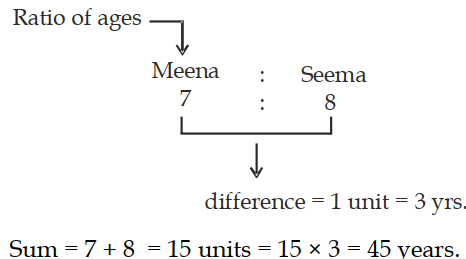
According to the problem,the difference between their ages is $3 \ yr$.
So,$8x - 7x = 3$,which gives $x = 3$.
The sum of their ages is $7x + 8x = 15x$.
Substituting the value of $x$,we get $15 \times 3 = 45 \ yr$.
According to the problem,the difference between their ages is $3 \ yr$.
So,$8x - 7x = 3$,which gives $x = 3$.
The sum of their ages is $7x + 8x = 15x$.
Substituting the value of $x$,we get $15 \times 3 = 45 \ yr$.
0 likes
View Solution78
MediumMCQ
The ratio of the present age of Manoj to that of Wasim is $3:11$. Wasim is $12 \text{ yr}$ younger than Rehana. Rehana's age after $7 \text{ yr}$ will be $85 \text{ yr}$. What is the present age (in $\text{yr}$) of Manoj's father,who is $25 \text{ yr}$ older than Manoj?
A
$43$
B
$67$
C
$45$
D
$69$
Solution
(A) Rehana's age after $7 \text{ yr}$ is $85 \text{ yr}$.
Therefore,Rehana's present age $= 85 - 7 = 78 \text{ yr}$.
Wasim is $12 \text{ yr}$ younger than Rehana,so Wasim's present age $= 78 - 12 = 66 \text{ yr}$.
The ratio of the present age of Manoj to Wasim is $3:11$.
Let Manoj's age be $3x$ and Wasim's age be $11x$.
Given $11x = 66$,so $x = 6$.
Manoj's present age $= 3 \times 6 = 18 \text{ yr}$.
Manoj's father is $25 \text{ yr}$ older than Manoj.
Therefore,the present age of Manoj's father $= 18 + 25 = 43 \text{ yr}$.
Therefore,Rehana's present age $= 85 - 7 = 78 \text{ yr}$.
Wasim is $12 \text{ yr}$ younger than Rehana,so Wasim's present age $= 78 - 12 = 66 \text{ yr}$.
The ratio of the present age of Manoj to Wasim is $3:11$.
Let Manoj's age be $3x$ and Wasim's age be $11x$.
Given $11x = 66$,so $x = 6$.
Manoj's present age $= 3 \times 6 = 18 \text{ yr}$.
Manoj's father is $25 \text{ yr}$ older than Manoj.
Therefore,the present age of Manoj's father $= 18 + 25 = 43 \text{ yr}$.
0 likes
View Solution79
MediumMCQ
The ratio between the present ages of Indira and Lizzy is $3:8$,respectively. After $8 \text{ yr}$,Indira's age will be $20 \text{ yr}$. What was Lizzy's age $5 \text{ yr}$ ago (in $\text{yr}$)?
A
$37$
B
$27$
C
$28$
D
$38$
Solution
(B) Let the present ages of Indira and Lizzy be $3x$ and $8x$ years,respectively.
According to the problem,Indira's age after $8 \text{ yr}$ will be $20 \text{ yr}$.
So,$3x + 8 = 20$.
$3x = 20 - 8 = 12$.
$x = 4$.
Therefore,the present age of Lizzy is $8x = 8 \times 4 = 32 \text{ yr}$.
Lizzy's age $5 \text{ yr}$ ago was $32 - 5 = 27 \text{ yr}$.
According to the problem,Indira's age after $8 \text{ yr}$ will be $20 \text{ yr}$.
So,$3x + 8 = 20$.
$3x = 20 - 8 = 12$.
$x = 4$.
Therefore,the present age of Lizzy is $8x = 8 \times 4 = 32 \text{ yr}$.
Lizzy's age $5 \text{ yr}$ ago was $32 - 5 = 27 \text{ yr}$.
0 likes
View Solution80
MediumMCQ
At present,Kavita is twice Sarita's age. $8 \ yr$ hence,the respective ratio between Kavita's and Sarita's ages will be $22:13$. What is Kavita's present age (in $yr$)?
A
$26$
B
$18$
C
$42$
D
$36$
Solution
(D) Let Sarita's present age be $s$ years.
Then,Kavita's present age is $2s$ years.
After $8$ years,Sarita's age will be $(s + 8)$ years and Kavita's age will be $(2s + 8)$ years.
According to the problem,the ratio of their ages after $8$ years will be $22:13$.
So,$\frac{2s + 8}{s + 8} = \frac{22}{13}$.
Cross-multiplying,we get: $13(2s + 8) = 22(s + 8)$.
$26s + 104 = 22s + 176$.
$26s - 22s = 176 - 104$.
$4s = 72$.
$s = 18$.
Therefore,Kavita's present age is $2s = 2 \times 18 = 36$ years.
Then,Kavita's present age is $2s$ years.
After $8$ years,Sarita's age will be $(s + 8)$ years and Kavita's age will be $(2s + 8)$ years.
According to the problem,the ratio of their ages after $8$ years will be $22:13$.
So,$\frac{2s + 8}{s + 8} = \frac{22}{13}$.
Cross-multiplying,we get: $13(2s + 8) = 22(s + 8)$.
$26s + 104 = 22s + 176$.
$26s - 22s = 176 - 104$.
$4s = 72$.
$s = 18$.
Therefore,Kavita's present age is $2s = 2 \times 18 = 36$ years.
0 likes
View Solution81
MediumMCQ
$10 \ yr$ before,the ratio of ages of $A$ and $B$ was $13: 17$. After $17 \ yr$ from now,the ratio of their ages will be $10: 11$. The present age of $B$ is (in $yr$):
A
$23$
B
$40$
C
$27$
D
$44$
Solution
(C) Let the ages of $A$ and $B$ $10 \ yr$ ago be $13x$ and $17x$ respectively.
Their present ages are $(13x + 10)$ and $(17x + 10)$.
After $17 \ yr$ from now,their ages will be $(13x + 10 + 17)$ and $(17x + 10 + 17)$,which simplifies to $(13x + 27)$ and $(17x + 27)$.
According to the problem,the ratio after $17 \ yr$ is $10: 11$:
$\frac{13x + 27}{17x + 27} = \frac{10}{11}$
$11(13x + 27) = 10(17x + 27)$
$143x + 297 = 170x + 270$
$297 - 270 = 170x - 143x$
$27 = 27x$
$x = 1$
Therefore,the present age of $B = 17x + 10 = 17(1) + 10 = 27 \ yr$.
Their present ages are $(13x + 10)$ and $(17x + 10)$.
After $17 \ yr$ from now,their ages will be $(13x + 10 + 17)$ and $(17x + 10 + 17)$,which simplifies to $(13x + 27)$ and $(17x + 27)$.
According to the problem,the ratio after $17 \ yr$ is $10: 11$:
$\frac{13x + 27}{17x + 27} = \frac{10}{11}$
$11(13x + 27) = 10(17x + 27)$
$143x + 297 = 170x + 270$
$297 - 270 = 170x - 143x$
$27 = 27x$
$x = 1$
Therefore,the present age of $B = 17x + 10 = 17(1) + 10 = 27 \ yr$.
0 likes
View Solution82
MediumMCQ
$A$ bag contains $10$-paise and $25$-paise coins in the ratio of $17:6$. If the total money in the bag is $Rs. 112$,the number of $10$-paise coins is:
A
$35$
B
$210$
C
$490$
D
$595$
Solution
(D) Let the number of $10$-paise coins be $17k$ and the number of $25$-paise coins be $6k$.
The total value of $10$-paise coins is $17k \times 0.10 = 1.7k$ rupees.
The total value of $25$-paise coins is $6k \times 0.25 = 1.5k$ rupees.
Given that the total money is $Rs. 112$,we have:
$1.7k + 1.5k = 112$
$3.2k = 112$
$k = \frac{112}{3.2} = 35$
Therefore,the number of $10$-paise coins is $17 \times 35 = 595$.
The total value of $10$-paise coins is $17k \times 0.10 = 1.7k$ rupees.
The total value of $25$-paise coins is $6k \times 0.25 = 1.5k$ rupees.
Given that the total money is $Rs. 112$,we have:
$1.7k + 1.5k = 112$
$3.2k = 112$
$k = \frac{112}{3.2} = 35$
Therefore,the number of $10$-paise coins is $17 \times 35 = 595$.
0 likes
View Solution83
MediumMCQ
An alloy of copper and zinc is taken in the ratio $1: 2$,and another alloy of the same metals is taken in the ratio of $2: 3$. How many parts of the two alloys must be taken to obtain a new alloy consisting of copper and zinc that are in the ratio $3: 5$?
A
$7$ and $9$
B
$5$ and $7$
C
$3$ and $5$
D
$5$ and $3$
Solution
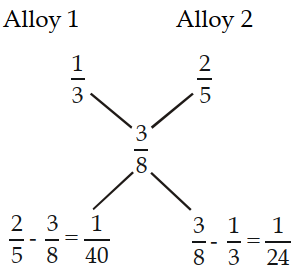
(C) Let the fraction of copper in the first alloy be $\frac{1}{3}$ and in the second alloy be $\frac{2}{5}$.
The fraction of copper in the final alloy is $\frac{3}{8}$.
Using the rule of alligation:
Difference for the first alloy: $\frac{2}{5} - \frac{3}{8} = \frac{16-15}{40} = \frac{1}{40}$.
Difference for the second alloy: $\frac{3}{8} - \frac{1}{3} = \frac{9-8}{24} = \frac{1}{24}$.
The required ratio of the two alloys is $\frac{1}{40} : \frac{1}{24} = 24 : 40 = 3 : 5$.
Thus,$3$ and $5$ parts of the two alloys must be taken.
The fraction of copper in the final alloy is $\frac{3}{8}$.
Using the rule of alligation:
Difference for the first alloy: $\frac{2}{5} - \frac{3}{8} = \frac{16-15}{40} = \frac{1}{40}$.
Difference for the second alloy: $\frac{3}{8} - \frac{1}{3} = \frac{9-8}{24} = \frac{1}{24}$.
The required ratio of the two alloys is $\frac{1}{40} : \frac{1}{24} = 24 : 40 = 3 : 5$.
Thus,$3$ and $5$ parts of the two alloys must be taken.
0 likes
View Solution84
MediumMCQ
In two alloys,gold and silver are in the ratios of $4:1$ and $1:3$. After alloying together $10 \text{ kg}$ of the first alloy,$16 \text{ kg}$ of the second,and several kilograms of pure gold,an alloy was obtained in which the ratio of gold to silver was $3:2$. Find the weight of the new alloy (in $\text{kg}$).
A
$12$
B
$19$
C
$24$
D
$35$
Solution
(D) In the first alloy of $10 \text{ kg}$ with ratio $4:1$,the amount of gold is $\frac{4}{5} \times 10 = 8 \text{ kg}$ and silver is $\frac{1}{5} \times 10 = 2 \text{ kg}$.
In the second alloy of $16 \text{ kg}$ with ratio $1:3$,the amount of gold is $\frac{1}{4} \times 16 = 4 \text{ kg}$ and silver is $\frac{3}{4} \times 16 = 12 \text{ kg}$.
Let the amount of pure gold added be $x \text{ kg}$.
Total gold in the new alloy $= 8 + 4 + x = 12 + x \text{ kg}$.
Total silver in the new alloy $= 2 + 12 = 14 \text{ kg}$.
The ratio of gold to silver in the new alloy is $3:2$,so $\frac{12 + x}{14} = \frac{3}{2}$.
$2(12 + x) = 3 \times 14 \Rightarrow 24 + 2x = 42 \Rightarrow 2x = 18 \Rightarrow x = 9 \text{ kg}$.
The total weight of the new alloy $= 10 + 16 + 9 = 35 \text{ kg}$.
In the second alloy of $16 \text{ kg}$ with ratio $1:3$,the amount of gold is $\frac{1}{4} \times 16 = 4 \text{ kg}$ and silver is $\frac{3}{4} \times 16 = 12 \text{ kg}$.
Let the amount of pure gold added be $x \text{ kg}$.
Total gold in the new alloy $= 8 + 4 + x = 12 + x \text{ kg}$.
Total silver in the new alloy $= 2 + 12 = 14 \text{ kg}$.
The ratio of gold to silver in the new alloy is $3:2$,so $\frac{12 + x}{14} = \frac{3}{2}$.
$2(12 + x) = 3 \times 14 \Rightarrow 24 + 2x = 42 \Rightarrow 2x = 18 \Rightarrow x = 9 \text{ kg}$.
The total weight of the new alloy $= 10 + 16 + 9 = 35 \text{ kg}$.
0 likes
View Solution85
MediumMCQ
$Rs. 5625$ are divided among $A, B$ and $C$ such that $A$ receives half as much as $B$ and $C$ together,and $B$ receives one-fourth as much as $A$ and $C$ together. Find the sum of $A$'s and $B$'s share together (in $Rs.$).
A
$2500$
B
$3000$
C
$1500$
D
$4000$
Solution
(B) Given: $A = \frac{1}{2}(B + C) \Rightarrow B + C = 2A$.
Since $A + B + C = 5625$,we substitute $(B + C) = 2A$: $A + 2A = 5625 \Rightarrow 3A = 5625 \Rightarrow A = 1875$.
Also given: $B = \frac{1}{4}(A + C) \Rightarrow A + C = 4B$.
Since $A + B + C = 5625$,we substitute $(A + C) = 4B$: $4B + B = 5625 \Rightarrow 5B = 5625 \Rightarrow B = 1125$.
The sum of $A$'s and $B$'s share is $A + B = 1875 + 1125 = 3000$.
Thus,the total share of $A$ and $B$ is $Rs. 3000$.
Since $A + B + C = 5625$,we substitute $(B + C) = 2A$: $A + 2A = 5625 \Rightarrow 3A = 5625 \Rightarrow A = 1875$.
Also given: $B = \frac{1}{4}(A + C) \Rightarrow A + C = 4B$.
Since $A + B + C = 5625$,we substitute $(A + C) = 4B$: $4B + B = 5625 \Rightarrow 5B = 5625 \Rightarrow B = 1125$.
The sum of $A$'s and $B$'s share is $A + B = 1875 + 1125 = 3000$.
Thus,the total share of $A$ and $B$ is $Rs. 3000$.
0 likes
View Solution86
MediumMCQ
$A$ man spends $Rs. 2310$ on an average during the first $8$ months from his income. During the next $4$ months,he spends $Rs. 1800$ on an average from his income,but he had taken a loan of $Rs. 1680$ apart from his income to meet his expenses. If he spent all that he had,what is the ratio of his average income to his average expenditure?
A
$50:53$
B
$100:103$
C
$100:109$
D
$100:107$
Solution
(D) Total expenditure for the first $8$ months $= 8 \times 2310 = 18480$.
Total expenditure for the next $4$ months $= 4 \times 1800 = 7200$.
Total expenditure for the year $= 18480 + 7200 = 25680$.
Average expenditure $= \frac{25680}{12} = 2140$.
Total income for the year $=$ Total expenditure $-$ Loan amount $= 25680 - 1680 = 24000$.
Average income $= \frac{24000}{12} = 2000$.
Ratio of average income to average expenditure $= \frac{2000}{2140} = \frac{100}{107} = 100:107$.
Total expenditure for the next $4$ months $= 4 \times 1800 = 7200$.
Total expenditure for the year $= 18480 + 7200 = 25680$.
Average expenditure $= \frac{25680}{12} = 2140$.
Total income for the year $=$ Total expenditure $-$ Loan amount $= 25680 - 1680 = 24000$.
Average income $= \frac{24000}{12} = 2000$.
Ratio of average income to average expenditure $= \frac{2000}{2140} = \frac{100}{107} = 100:107$.
0 likes
View Solution87
MediumMCQ
In a family,the ratio of expenses to savings is $5:3$. If the expenses increase by $60\%$ and the income increases by $25\%$,the savings decrease by $Rs. 3500$. Find the increased income (in $Rs.$) of the family.
A
$35000$
B
$28000$
C
$25000$
D
$18500$
Solution
(A) Let the initial expense be $5x$ and initial savings be $3x$.
Initial income = Expense + Savings = $5x + 3x = 8x$.
New expense = $5x + 60\% \text{ of } 5x = 5x + 3x = 8x$.
New income = $8x + 25\% \text{ of } 8x = 8x + 2x = 10x$.
New savings = New income - New expense = $10x - 8x = 2x$.
Decrease in savings = Initial savings - New savings = $3x - 2x = x$.
Given that the decrease is $Rs. 3500$,so $x = 3500$.
The increased income is $10x = 10 \times 3500 = Rs. 35000$.
Initial income = Expense + Savings = $5x + 3x = 8x$.
New expense = $5x + 60\% \text{ of } 5x = 5x + 3x = 8x$.
New income = $8x + 25\% \text{ of } 8x = 8x + 2x = 10x$.
New savings = New income - New expense = $10x - 8x = 2x$.
Decrease in savings = Initial savings - New savings = $3x - 2x = x$.
Given that the decrease is $Rs. 3500$,so $x = 3500$.
The increased income is $10x = 10 \times 3500 = Rs. 35000$.
0 likes
View Solution88
MediumMCQ
Arti has coins of the denomination of $Rs. 1$,$50 \text{ paise}$,and $25 \text{ paise}$ in the ratio of $12: 10: 7$. The total worth of the coins she has is $Rs. 75$. Find the number of $25 \text{ paise}$ coins.
A
$28$
B
$36$
C
$42$
D
$32$
Solution
(A) Let the number of $Rs. 1$,$50 \text{ paise}$,and $25 \text{ paise}$ coins be $12x$,$10x$,and $7x$ respectively.
The value of $12x$ coins of $Rs. 1$ is $12x \times 1 = 12x$ rupees.
The value of $10x$ coins of $50 \text{ paise}$ is $10x \times 0.5 = 5x$ rupees.
The value of $7x$ coins of $25 \text{ paise}$ is $7x \times 0.25 = 1.75x$ rupees.
According to the question,the total value is $Rs. 75$:
$12x + 5x + 1.75x = 75$
$18.75x = 75$
$x = \frac{75}{18.75} = 4$
The number of $25 \text{ paise}$ coins is $7x = 7 \times 4 = 28$.
The value of $12x$ coins of $Rs. 1$ is $12x \times 1 = 12x$ rupees.
The value of $10x$ coins of $50 \text{ paise}$ is $10x \times 0.5 = 5x$ rupees.
The value of $7x$ coins of $25 \text{ paise}$ is $7x \times 0.25 = 1.75x$ rupees.
According to the question,the total value is $Rs. 75$:
$12x + 5x + 1.75x = 75$
$18.75x = 75$
$x = \frac{75}{18.75} = 4$
The number of $25 \text{ paise}$ coins is $7x = 7 \times 4 = 28$.
0 likes
View Solution89
MediumMCQ
Two horses cost as much as $5$ dogs,$6$ dogs as much as $8$ oxen,$10$ oxen as much as $50$ sheep,$14$ sheep as much as $9$ goats. If the price of one goat is $Rs. 700$,find the cost of one horse (in $Rs.$).
A
$7900$
B
$6400$
C
$5200$
D
$7500$
Solution
(D) Let $H$ be the cost of a horse,$D$ be the cost of a dog,$O$ be the cost of an ox,$S$ be the cost of a sheep,and $G$ be the cost of a goat.
Given equations:
$2H = 5D \implies D = \frac{2}{5}H$
$6D = 8O \implies O = \frac{6}{8}D = \frac{3}{4}D$
$10O = 50S \implies S = \frac{10}{50}O = \frac{1}{5}O$
$14S = 9G \implies G = \frac{14}{9}S$
Substituting the values back to find $H$ in terms of $G$:
$S = \frac{1}{5} \times (\frac{3}{4}D) = \frac{3}{20}D$
$S = \frac{3}{20} \times (\frac{2}{5}H) = \frac{6}{100}H = \frac{3}{50}H$
$G = \frac{14}{9} \times (\frac{3}{50}H) = \frac{14}{150}H = \frac{7}{75}H$
Given $G = 700$,so $700 = \frac{7}{75}H$
$H = 700 \times \frac{75}{7} = 100 \times 75 = 7500$.
Therefore,the cost of one horse is $Rs. 7500$.
Given equations:
$2H = 5D \implies D = \frac{2}{5}H$
$6D = 8O \implies O = \frac{6}{8}D = \frac{3}{4}D$
$10O = 50S \implies S = \frac{10}{50}O = \frac{1}{5}O$
$14S = 9G \implies G = \frac{14}{9}S$
Substituting the values back to find $H$ in terms of $G$:
$S = \frac{1}{5} \times (\frac{3}{4}D) = \frac{3}{20}D$
$S = \frac{3}{20} \times (\frac{2}{5}H) = \frac{6}{100}H = \frac{3}{50}H$
$G = \frac{14}{9} \times (\frac{3}{50}H) = \frac{14}{150}H = \frac{7}{75}H$
Given $G = 700$,so $700 = \frac{7}{75}H$
$H = 700 \times \frac{75}{7} = 100 \times 75 = 7500$.
Therefore,the cost of one horse is $Rs. 7500$.
0 likes
View Solution90
EasyMCQ
$Rs. 2186$ is distributed among $A$,$B$,and $C$. If the money given to them is decreased by $Rs. 26$,$Rs. 28$,and $Rs. 32$ respectively,then the ratio of their shares becomes $9: 13: 8$. What is the amount (in $Rs.$) given to $A$?
A
$696$
B
$626$
C
$656$
D
$956$
Solution
(C) Let the shares of $A$,$B$,and $C$ after the decrease be $9x$,$13x$,and $8x$ respectively.
According to the problem,the total amount before the decrease was $Rs. 2186$.
Therefore,the equation is: $(9x + 26) + (13x + 28) + (8x + 32) = 2186$.
Combining the terms: $30x + 86 = 2186$.
$30x = 2186 - 86$.
$30x = 2100$.
$x = 2100 / 30 = 70$.
The amount given to $A$ is $9x + 26$.
Substituting $x = 70$: $9(70) + 26 = 630 + 26 = 656$.
Thus,the amount given to $A$ is $Rs. 656$.
According to the problem,the total amount before the decrease was $Rs. 2186$.
Therefore,the equation is: $(9x + 26) + (13x + 28) + (8x + 32) = 2186$.
Combining the terms: $30x + 86 = 2186$.
$30x = 2186 - 86$.
$30x = 2100$.
$x = 2100 / 30 = 70$.
The amount given to $A$ is $9x + 26$.
Substituting $x = 70$: $9(70) + 26 = 630 + 26 = 656$.
Thus,the amount given to $A$ is $Rs. 656$.
0 likes
View Solution91
MediumMCQ
$A$ year ago,the cost of Maruti and Figo were in the ratio of $3:4$. The ratio of present and past year costs of Maruti and Figo are $5:4$ and $3:2$,respectively. If the sum of their present costs is $7.8$ lacs,find the cost (in lacs) of Figo a year ago.
A
$3.2$
B
$1.6$
C
$3.5$
D
$4.0$
Solution
(A) Let the cost of Maruti and Figo a year ago be $3x$ and $4x$ respectively.
Given the ratio of present to past year cost for Maruti is $5:4$,so present cost of Maruti $(PM)$ $= \frac{5}{4} \times 3x = 3.75x$.
Given the ratio of present to past year cost for Figo is $3:2$,so present cost of Figo $(PF)$ $= \frac{3}{2} \times 4x = 6x$.
The sum of their present costs is $7.8$ lacs:
$3.75x + 6x = 7.8$
$9.75x = 7.8$
$x = \frac{7.8}{9.75} = 0.8$
The cost of Figo a year ago was $4x = 4 \times 0.8 = 3.2$ lacs.
Given the ratio of present to past year cost for Maruti is $5:4$,so present cost of Maruti $(PM)$ $= \frac{5}{4} \times 3x = 3.75x$.
Given the ratio of present to past year cost for Figo is $3:2$,so present cost of Figo $(PF)$ $= \frac{3}{2} \times 4x = 6x$.
The sum of their present costs is $7.8$ lacs:
$3.75x + 6x = 7.8$
$9.75x = 7.8$
$x = \frac{7.8}{9.75} = 0.8$
The cost of Figo a year ago was $4x = 4 \times 0.8 = 3.2$ lacs.
0 likes
View Solution92
DifficultMCQ
One year ago,the ratio between Ram's and Shyam's salaries was $3:5$. The ratios of their individual salaries of last year to the present year are $2:3$ and $4:5$ respectively. If their total salary for the present year is $Rs. 8600$,find the present salary of Ram (in $Rs.$)?
A
$3200$
B
$3600$
C
$4000$
D
$4400$
Solution
(B) Let the salaries of Ram and Shyam last year be $3x$ and $5x$ respectively.
Ram's salary ratio (last year : present year) $= 2:3$. Thus,Ram's present salary $= 3x \times (3/2) = 4.5x$.
Shyam's salary ratio (last year : present year) $= 4:5$. Thus,Shyam's present salary $= 5x \times (5/4) = 6.25x$.
The total present salary is $4.5x + 6.25x = 10.75x$.
Given $10.75x = 8600$,we find $x = 8600 / 10.75 = 800$.
Ram's present salary $= 4.5 \times 800 = Rs. 3600$.
Ram's salary ratio (last year : present year) $= 2:3$. Thus,Ram's present salary $= 3x \times (3/2) = 4.5x$.
Shyam's salary ratio (last year : present year) $= 4:5$. Thus,Shyam's present salary $= 5x \times (5/4) = 6.25x$.
The total present salary is $4.5x + 6.25x = 10.75x$.
Given $10.75x = 8600$,we find $x = 8600 / 10.75 = 800$.
Ram's present salary $= 4.5 \times 800 = Rs. 3600$.
0 likes
View Solution93
DifficultMCQ
Two candles of the same height are lighted at the same time. The first is consumed in $8 \text{ hours}$ and the second in $6 \text{ hours}$. Assuming that each candle burns at a constant rate,in how many hours after being lighted,the ratio between the height of the first and second candles becomes $2:1$?
A
$4 \text{ h}$
B
$5 \text{ h}$
C
$4 \text{ h } 30 \text{ m}$
D
$4 \text{ h } 48 \text{ m}$
Solution
(D) Let the initial height of each candle be $x$ and the time elapsed be $T$ hours.
The rate of burning for the first candle is $\frac{x}{8}$ per hour.
The rate of burning for the second candle is $\frac{x}{6}$ per hour.
After $T$ hours,the remaining height of the first candle is $x - \frac{Tx}{8} = x(1 - \frac{T}{8})$.
The remaining height of the second candle is $x - \frac{Tx}{6} = x(1 - \frac{T}{6})$.
According to the problem,the ratio of the heights is $2:1$:
$\frac{x(1 - T/8)}{x(1 - T/6)} = \frac{2}{1}$
$\frac{1 - T/8}{1 - T/6} = 2$
$1 - \frac{T}{8} = 2(1 - \frac{T}{6})$
$1 - \frac{T}{8} = 2 - \frac{T}{3}$
Rearranging the terms to solve for $T$:
$\frac{T}{3} - \frac{T}{8} = 2 - 1$
$\frac{8T - 3T}{24} = 1$
$\frac{5T}{24} = 1$
$T = \frac{24}{5} = 4.8 \text{ hours}$.
Since $0.8 \text{ hours} = 0.8 \times 60 \text{ minutes} = 48 \text{ minutes}$,the time is $4 \text{ hours } 48 \text{ minutes}$.
The rate of burning for the first candle is $\frac{x}{8}$ per hour.
The rate of burning for the second candle is $\frac{x}{6}$ per hour.
After $T$ hours,the remaining height of the first candle is $x - \frac{Tx}{8} = x(1 - \frac{T}{8})$.
The remaining height of the second candle is $x - \frac{Tx}{6} = x(1 - \frac{T}{6})$.
According to the problem,the ratio of the heights is $2:1$:
$\frac{x(1 - T/8)}{x(1 - T/6)} = \frac{2}{1}$
$\frac{1 - T/8}{1 - T/6} = 2$
$1 - \frac{T}{8} = 2(1 - \frac{T}{6})$
$1 - \frac{T}{8} = 2 - \frac{T}{3}$
Rearranging the terms to solve for $T$:
$\frac{T}{3} - \frac{T}{8} = 2 - 1$
$\frac{8T - 3T}{24} = 1$
$\frac{5T}{24} = 1$
$T = \frac{24}{5} = 4.8 \text{ hours}$.
Since $0.8 \text{ hours} = 0.8 \times 60 \text{ minutes} = 48 \text{ minutes}$,the time is $4 \text{ hours } 48 \text{ minutes}$.
0 likes
View Solution94
DifficultMCQ
The total of the daily wages of Ram,Shyam and Mohan is $Rs. 450$. If they,respectively,spend $25 \%$,$20 \%$ and $50 \%$ of their incomes,then the ratio of their savings becomes $9:8:4$. What is the income of Ram?
A
$180$
B
$190$
C
$200$
D
$175$
Solution
(A) Let the incomes of Ram,Shyam,and Mohan be $x$,$y$,and $z$ respectively.
Ram's saving $= (100 - 25) \% \text{ of } x = 75 \% \text{ of } x = \frac{3}{4}x$.
Shyam's saving $= (100 - 20) \% \text{ of } y = 80 \% \text{ of } y = \frac{4}{5}y$.
Mohan's saving $= (100 - 50) \% \text{ of } z = 50 \% \text{ of } z = \frac{1}{2}z$.
Given the ratio of savings is $9:8:4$,let their savings be $9k$,$8k$,and $4k$ respectively.
Equating the savings:
$\frac{3}{4}x = 9k \Rightarrow x = 12k$.
$\frac{4}{5}y = 8k \Rightarrow y = 10k$.
$\frac{1}{2}z = 4k \Rightarrow z = 8k$.
Given the total income is $Rs. 450$:
$x + y + z = 450 \Rightarrow 12k + 10k + 8k = 450$.
$30k = 450 \Rightarrow k = 15$.
Ram's income $= 12k = 12 \times 15 = Rs. 180$.
Ram's saving $= (100 - 25) \% \text{ of } x = 75 \% \text{ of } x = \frac{3}{4}x$.
Shyam's saving $= (100 - 20) \% \text{ of } y = 80 \% \text{ of } y = \frac{4}{5}y$.
Mohan's saving $= (100 - 50) \% \text{ of } z = 50 \% \text{ of } z = \frac{1}{2}z$.
Given the ratio of savings is $9:8:4$,let their savings be $9k$,$8k$,and $4k$ respectively.
Equating the savings:
$\frac{3}{4}x = 9k \Rightarrow x = 12k$.
$\frac{4}{5}y = 8k \Rightarrow y = 10k$.
$\frac{1}{2}z = 4k \Rightarrow z = 8k$.
Given the total income is $Rs. 450$:
$x + y + z = 450 \Rightarrow 12k + 10k + 8k = 450$.
$30k = 450 \Rightarrow k = 15$.
Ram's income $= 12k = 12 \times 15 = Rs. 180$.
0 likes
View Solution95
MediumMCQ
There is $1000 \, \text{litres}$ of milk in a pot. $100 \, \text{litres}$ of milk is taken out and the same amount of water is poured into it. Again, $200 \, \text{litres}$ of the mixture is taken out and the same amount of water is poured into it, and finally, $400 \, \text{litres}$ of the mixture is taken out and the same amount of water is poured into it. What is the amount of milk in the resulting mixture?
A
$432$
B
$436$
C
$425$
D
$438$
Solution
(A) Initial quantity of milk $= 1000 \, \text{litres}$.
Step $1$: After removing $100 \, \text{litres}$ of milk and adding $100 \, \text{litres}$ of water, the remaining milk is $900 \, \text{litres}$. The ratio of milk to water is $900:100 = 9:1$.
Step $2$: After removing $200 \, \text{litres}$ of the mixture, the amount of milk removed is $200 \times (9/10) = 180 \, \text{litres}$. Remaining milk $= 900 - 180 = 720 \, \text{litres}$. Total mixture volume remains $1000 \, \text{litres}$ (as $200 \, \text{litres}$ of water is added).
Step $3$: The new ratio of milk to water is $720:280 = 18:7$. The total parts $= 18 + 7 = 25$.
Step $4$: After removing $400 \, \text{litres}$ of the mixture, the amount of milk removed is $400 \times (18/25) = 16 \times 18 = 288 \, \text{litres}$.
Final quantity of milk $= 720 - 288 = 432 \, \text{litres}$.
Step $1$: After removing $100 \, \text{litres}$ of milk and adding $100 \, \text{litres}$ of water, the remaining milk is $900 \, \text{litres}$. The ratio of milk to water is $900:100 = 9:1$.
Step $2$: After removing $200 \, \text{litres}$ of the mixture, the amount of milk removed is $200 \times (9/10) = 180 \, \text{litres}$. Remaining milk $= 900 - 180 = 720 \, \text{litres}$. Total mixture volume remains $1000 \, \text{litres}$ (as $200 \, \text{litres}$ of water is added).
Step $3$: The new ratio of milk to water is $720:280 = 18:7$. The total parts $= 18 + 7 = 25$.
Step $4$: After removing $400 \, \text{litres}$ of the mixture, the amount of milk removed is $400 \times (18/25) = 16 \times 18 = 288 \, \text{litres}$.
Final quantity of milk $= 720 - 288 = 432 \, \text{litres}$.
0 likes
View Solution96
DifficultMCQ
On the entire Earth,the ratio between land and water is $1:2$,and in the Northern Hemisphere,this ratio is $2:3$. What will be the ratio of land to water in the Southern Hemisphere?
A
$11:4$
B
$4:11$
C
$15:4$
D
$4:15$
Solution
(B) Let the total land area be $x$ and the total water area be $2x$. The total area of the Earth is $3x$.
The area of each hemisphere (Northern and Southern) is half of the total area,which is $\frac{3x}{2}$.
In the Northern Hemisphere,the ratio of land to water is $2:3$. The total parts are $2+3=5$.
Land in the Northern Hemisphere $= \frac{2}{5} \times \frac{3x}{2} = \frac{3x}{5}$.
Water in the Northern Hemisphere $= \frac{3}{5} \times \frac{3x}{2} = \frac{9x}{10}$.
Now,calculate the land and water in the Southern Hemisphere:
Land in the Southern Hemisphere $= \text{Total Land} - \text{Land in Northern Hemisphere} = x - \frac{3x}{5} = \frac{2x}{5}$.
Water in the Southern Hemisphere $= \text{Total Water} - \text{Water in Northern Hemisphere} = 2x - \frac{9x}{10} = \frac{11x}{10}$.
The required ratio of land to water in the Southern Hemisphere is $\frac{2x/5}{11x/10} = \frac{2}{5} \times \frac{10}{11} = \frac{4}{11}$,which is $4:11$.
The area of each hemisphere (Northern and Southern) is half of the total area,which is $\frac{3x}{2}$.
In the Northern Hemisphere,the ratio of land to water is $2:3$. The total parts are $2+3=5$.
Land in the Northern Hemisphere $= \frac{2}{5} \times \frac{3x}{2} = \frac{3x}{5}$.
Water in the Northern Hemisphere $= \frac{3}{5} \times \frac{3x}{2} = \frac{9x}{10}$.
Now,calculate the land and water in the Southern Hemisphere:
Land in the Southern Hemisphere $= \text{Total Land} - \text{Land in Northern Hemisphere} = x - \frac{3x}{5} = \frac{2x}{5}$.
Water in the Southern Hemisphere $= \text{Total Water} - \text{Water in Northern Hemisphere} = 2x - \frac{9x}{10} = \frac{11x}{10}$.
The required ratio of land to water in the Southern Hemisphere is $\frac{2x/5}{11x/10} = \frac{2}{5} \times \frac{10}{11} = \frac{4}{11}$,which is $4:11$.
0 likes
View Solution97
MediumMCQ
The ratio of the incomes of $A, B$ and $C$ is $3: 7: 4$ and the ratio of their expenditures is $4: 3: 5$. If in the income of $Rs. 2400$, $A$ saves $Rs. 300$, then the savings of $B$ and $C$ respectively are:
A
$Rs. 4025$ and $Rs. 575$
B
$Rs. 1575$ and $Rs. 2625$
C
$Rs. 2750$ and $Rs. 1025$
D
$Rs. 3725$ and $Rs. 1525$
Solution
(A) Given, the ratio of incomes of $A, B, C$ is $3: 7: 4$.
Income of $A = Rs. 2400$.
Since $3$ units $= 2400$, $1$ unit $= 800$.
Income of $B = 7 \times 800 = Rs. 5600$.
Income of $C = 4 \times 800 = Rs. 3200$.
Expenditure of $A = \text{Income} - \text{Saving} = 2400 - 300 = Rs. 2100$.
The ratio of expenditures is $4: 3: 5$.
Since $4$ units $= 2100$, $1$ unit $= 525$.
Expenditure of $B = 3 \times 525 = Rs. 1575$.
Expenditure of $C = 5 \times 525 = Rs. 2625$.
Saving of $B = \text{Income of } B - \text{Expenditure of } B = 5600 - 1575 = Rs. 4025$.
Saving of $C = \text{Income of } C - \text{Expenditure of } C = 3200 - 2625 = Rs. 575$.
Income of $A = Rs. 2400$.
Since $3$ units $= 2400$, $1$ unit $= 800$.
Income of $B = 7 \times 800 = Rs. 5600$.
Income of $C = 4 \times 800 = Rs. 3200$.
Expenditure of $A = \text{Income} - \text{Saving} = 2400 - 300 = Rs. 2100$.
The ratio of expenditures is $4: 3: 5$.
Since $4$ units $= 2100$, $1$ unit $= 525$.
Expenditure of $B = 3 \times 525 = Rs. 1575$.
Expenditure of $C = 5 \times 525 = Rs. 2625$.
Saving of $B = \text{Income of } B - \text{Expenditure of } B = 5600 - 1575 = Rs. 4025$.
Saving of $C = \text{Income of } C - \text{Expenditure of } C = 3200 - 2625 = Rs. 575$.
0 likes
View Solution98
MediumMCQ
The ratio of wine and water in a drum is $3:1$. What part of the mixture is taken out and replaced with an equal amount of water so that the ratio of wine and water in the mixture becomes $1:1$?
A
$\frac{1}{4}$
B
$\frac{1}{3}$
C
$\frac{3}{4}$
D
$\frac{2}{3}$
Solution
(B) Let the initial quantity of wine be $3x$ and water be $x$. The total volume of the mixture is $4x$.
Let $y$ be the amount of mixture taken out. The amount of wine removed is $\frac{3}{4}y$ and the amount of water removed is $\frac{1}{4}y$.
After adding $y$ litres of water,the new amount of wine is $3x - \frac{3}{4}y$.
The new amount of water is $x - \frac{1}{4}y + y = x + \frac{3}{4}y$.
According to the problem,the new ratio is $1:1$,so:
$3x - \frac{3}{4}y = x + \frac{3}{4}y$
$2x = \frac{6}{4}y$
$2x = \frac{3}{2}y$
$y = \frac{4}{3}x$
Since the total initial volume is $4x$,the fraction of the mixture replaced is $\frac{y}{4x} = \frac{4x/3}{4x} = \frac{1}{3}$.
Let $y$ be the amount of mixture taken out. The amount of wine removed is $\frac{3}{4}y$ and the amount of water removed is $\frac{1}{4}y$.
After adding $y$ litres of water,the new amount of wine is $3x - \frac{3}{4}y$.
The new amount of water is $x - \frac{1}{4}y + y = x + \frac{3}{4}y$.
According to the problem,the new ratio is $1:1$,so:
$3x - \frac{3}{4}y = x + \frac{3}{4}y$
$2x = \frac{6}{4}y$
$2x = \frac{3}{2}y$
$y = \frac{4}{3}x$
Since the total initial volume is $4x$,the fraction of the mixture replaced is $\frac{y}{4x} = \frac{4x/3}{4x} = \frac{1}{3}$.
0 likes
View Solution99
DifficultMCQ
In a mixture of petrol and kerosene,the quantity of petrol is $99 \text{ litres}$. If this same quantity of petrol were present in another mixture of petrol and kerosene where the total volume is $198 \text{ litres}$ less than the actual mixture,the concentration of petrol in the actual mixture would be $13.33 \%$ less than that of the new mixture. What is the concentration (in $\%$) of petrol in the actual mixture?
A
$20$
B
$16.66$
C
$26.66$
D
$8.33$
Solution
(A) Let the total volume of the actual mixture be $V$ litres.
Quantity of petrol $= 99 \text{ litres}$.
Concentration of petrol in the actual mixture $= \frac{99}{V} \times 100 \%$.
In the new mixture,the total volume is $(V - 198) \text{ litres}$.
Concentration of petrol in the new mixture $= \frac{99}{V - 198} \times 100 \%$.
According to the problem,the concentration in the actual mixture is $13.33 \%$ (which is $\frac{40}{3} \%$) less than the new mixture:
$\frac{99}{V - 198} \times 100 - \frac{99}{V} \times 100 = \frac{40}{3}$.
Dividing by $100$:
$99 \left( \frac{1}{V - 198} - \frac{1}{V} \right) = \frac{40}{300} = \frac{2}{15}$.
$99 \left( \frac{V - (V - 198)}{V(V - 198)} \right) = \frac{2}{15}$.
$99 \times \frac{198}{V(V - 198)} = \frac{2}{15}$.
$V(V - 198) = 99 \times 99 \times 15 = 147015$.
$V^2 - 198V - 147015 = 0$.
Solving the quadratic equation,we get $V = 495$.
Actual concentration $= \frac{99}{495} \times 100 = \frac{1}{5} \times 100 = 20 \%$.
Quantity of petrol $= 99 \text{ litres}$.
Concentration of petrol in the actual mixture $= \frac{99}{V} \times 100 \%$.
In the new mixture,the total volume is $(V - 198) \text{ litres}$.
Concentration of petrol in the new mixture $= \frac{99}{V - 198} \times 100 \%$.
According to the problem,the concentration in the actual mixture is $13.33 \%$ (which is $\frac{40}{3} \%$) less than the new mixture:
$\frac{99}{V - 198} \times 100 - \frac{99}{V} \times 100 = \frac{40}{3}$.
Dividing by $100$:
$99 \left( \frac{1}{V - 198} - \frac{1}{V} \right) = \frac{40}{300} = \frac{2}{15}$.
$99 \left( \frac{V - (V - 198)}{V(V - 198)} \right) = \frac{2}{15}$.
$99 \times \frac{198}{V(V - 198)} = \frac{2}{15}$.
$V(V - 198) = 99 \times 99 \times 15 = 147015$.
$V^2 - 198V - 147015 = 0$.
Solving the quadratic equation,we get $V = 495$.
Actual concentration $= \frac{99}{495} \times 100 = \frac{1}{5} \times 100 = 20 \%$.
0 likes
View Solution100
MediumMCQ
The ratio of ages between $A$ and $B$ is $6: 5$ and the age of each $C$ and $D$ is $\frac{9}{10}$ times that of $B$. The age of $F$ is less than $A$ but greater than $B$. The ratio of ages between $B$ and $E$ is $2: 3$. Also,the age of $A$ is $3 \text{ years}$ less than $E$. What is the ratio of the ages of $A$ and $F$ if all the ages are integers?
A
$12: 11$
B
$9: 7$
C
$24: 19$
D
$12: 13$
Solution
(A) Given the ratio $A:B = 6:5$,we can write $B = \frac{5}{6}A$.
Given $B:E = 2:3$,we can write $E = \frac{3}{2}B = \frac{3}{2} \times \frac{5}{6}A = \frac{5}{4}A$.
We are given $E - A = 3$. Substituting $E = \frac{5}{4}A$,we get $\frac{5}{4}A - A = 3$,which simplifies to $\frac{1}{4}A = 3$,so $A = 12$.
Using $A = 12$,we find $B = \frac{5}{6} \times 12 = 10$ and $E = 15$.
We are given that the age of $F$ is less than $A$ $(12)$ but greater than $B$ $(10)$. Since all ages are integers,$F$ must be $11$.
Therefore,the ratio of the ages of $A$ and $F$ is $12:11$.
Given $B:E = 2:3$,we can write $E = \frac{3}{2}B = \frac{3}{2} \times \frac{5}{6}A = \frac{5}{4}A$.
We are given $E - A = 3$. Substituting $E = \frac{5}{4}A$,we get $\frac{5}{4}A - A = 3$,which simplifies to $\frac{1}{4}A = 3$,so $A = 12$.
Using $A = 12$,we find $B = \frac{5}{6} \times 12 = 10$ and $E = 15$.
We are given that the age of $F$ is less than $A$ $(12)$ but greater than $B$ $(10)$. Since all ages are integers,$F$ must be $11$.
Therefore,the ratio of the ages of $A$ and $F$ is $12:11$.
0 likes
View SolutionRatio and Proportion — Ratio and Proportion · Frequently Asked Questions
1Are these Ratio and Proportion questions useful for JEE and NEET?
Yes. All questions in this section are mapped to JEE Main and NEET exam patterns. Previous year questions from JEE Main, NEET, GUJCET and state-level exams are included with full solutions.
2Can I switch to Hindi or Gujarati for these questions?
Yes. Use the language tabs in the hero section or the sidebar to view the same questions and solutions in English, Hindi or Gujarati.
3How do I generate a question paper from this subtopic?
Use the Vedclass Exam Paper Generator — select the chapter and subtopic, set difficulty, and generate Sets A, B, C, D automatically. First 3 chapters of every subject are free.
Vedclass Products
For Students
Vedclass Test Series
Mock tests in real JEE/NEET style with performance analysis. 5-day free trial.
Start Free TrialFor Teachers
Exam Paper Generator
Generate Set A/B/C/D papers from this chapter in 2 minutes. 3 chapters free.
Try FreeFor Institutes
Online Exam Module
Live online exams with unlimited students, 360° analytics & white-label branding.
See DemoFor Teachers & Institutes
Generate a Ratio and Proportion Exam Paper in 2 Minutes
Select subtopic & difficulty — Sets A, B, C, D auto-generated with No Repeat logic.
First 3 chapters of every subject are free — no payment required.