
A English
Ratio and Proportion Questions in English
Competitive Exam Quantitative Aptitude · Ratio and Proportion · Ratio and Proportion
330+
Questions
English
Language
100%
With Solutions
Showing 50 of 330 questions in English
1
MediumMCQ
One year ago,the ratio of Ramu's and Somu's ages was $6:7$ respectively. Four years hence,their ratio will become $7:8$. How old (in years) is Somu?
A
$24$
B
$30$
C
$32$
D
$36$
Solution
(D) Let the present ages of Ramu and Somu be $R$ and $S$ respectively.
One year ago,the ratio of their ages was $(R-1) : (S-1) = 6 : 7$.
This implies $7(R-1) = 6(S-1)$,so $7R - 7 = 6S - 6$,which simplifies to $7R - 6S = 1$ (Equation $i$).
Four years hence,the ratio of their ages will be $(R+4) : (S+4) = 7 : 8$.
This implies $8(R+4) = 7(S+4)$,so $8R + 32 = 7S + 28$,which simplifies to $8R - 7S = -4$ (Equation $ii$).
To solve the system of equations:
Multiply Equation $(i)$ by $8$: $56R - 48S = 8$ (Equation $iii$).
Multiply Equation $(ii)$ by $7$: $56R - 49S = -28$ (Equation $iv$).
Subtract Equation $(iv)$ from Equation $(iii)$:
$(56R - 48S) - (56R - 49S) = 8 - (-28)$
$S = 36$.
Therefore,the present age of Somu is $36$ years.
One year ago,the ratio of their ages was $(R-1) : (S-1) = 6 : 7$.
This implies $7(R-1) = 6(S-1)$,so $7R - 7 = 6S - 6$,which simplifies to $7R - 6S = 1$ (Equation $i$).
Four years hence,the ratio of their ages will be $(R+4) : (S+4) = 7 : 8$.
This implies $8(R+4) = 7(S+4)$,so $8R + 32 = 7S + 28$,which simplifies to $8R - 7S = -4$ (Equation $ii$).
To solve the system of equations:
Multiply Equation $(i)$ by $8$: $56R - 48S = 8$ (Equation $iii$).
Multiply Equation $(ii)$ by $7$: $56R - 49S = -28$ (Equation $iv$).
Subtract Equation $(iv)$ from Equation $(iii)$:
$(56R - 48S) - (56R - 49S) = 8 - (-28)$
$S = 36$.
Therefore,the present age of Somu is $36$ years.
0 likes
View Solution2
MediumMCQ
If $33 \%$ of $A$ is equal to $55 \%$ of $B$,then find the ratio of $A$ and $B$.
A
$3:5$
B
$5:3$
C
$3:4$
D
$5:4$
Solution
(B) Given that $33 \%$ of $A = 55 \%$ of $B$.
This can be written as: $\frac{33}{100} \times A = \frac{55}{100} \times B$.
Multiplying both sides by $100$,we get: $33A = 55B$.
To find the ratio $A:B$,we rearrange the equation: $\frac{A}{B} = \frac{55}{33}$.
Simplifying the fraction by dividing both numerator and denominator by $11$,we get: $\frac{A}{B} = \frac{5}{3}$.
Therefore,the ratio of $A$ and $B$ is $5:3$.
This can be written as: $\frac{33}{100} \times A = \frac{55}{100} \times B$.
Multiplying both sides by $100$,we get: $33A = 55B$.
To find the ratio $A:B$,we rearrange the equation: $\frac{A}{B} = \frac{55}{33}$.
Simplifying the fraction by dividing both numerator and denominator by $11$,we get: $\frac{A}{B} = \frac{5}{3}$.
Therefore,the ratio of $A$ and $B$ is $5:3$.
0 likes
View Solution3
EasyMCQ
What is the value of $68 \%$ of two-fifths of $550$?
A
$149.6$
B
$150$
C
$154$
D
$158$
Solution
(A) To find the value of $68 \%$ of two-fifths of $550$,we follow these steps:
$1$. First,calculate two-fifths of $550$: $\frac{2}{5} \times 550 = 2 \times 110 = 220$.
$2$. Next,calculate $68 \%$ of the result $(220)$:
$68 \% \text{ of } 220 = \frac{68}{100} \times 220$.
$3$. Simplify the expression: $\frac{68 \times 22}{10} = \frac{1496}{10} = 149.6$.
$1$. First,calculate two-fifths of $550$: $\frac{2}{5} \times 550 = 2 \times 110 = 220$.
$2$. Next,calculate $68 \%$ of the result $(220)$:
$68 \% \text{ of } 220 = \frac{68}{100} \times 220$.
$3$. Simplify the expression: $\frac{68 \times 22}{10} = \frac{1496}{10} = 149.6$.
0 likes
View Solution4
MediumMCQ
If $24$ is deducted from $45 \%$ of a number,the result becomes $48$. What will be $\frac{3}{8}$ part of that number?
A
$140$
B
$130$
C
$145$
D
$60$
Solution
(D) Let the number be $n$.
According to the problem,$45 \%$ of $n$ minus $24$ equals $48$.
$\frac{45}{100} n - 24 = 48$
$\frac{9}{20} n = 48 + 24$
$\frac{9}{20} n = 72$
$n = 72 \times \frac{20}{9}$
$n = 8 \times 20 = 160$
Now,we need to find $\frac{3}{8}$ of the number $n$.
$\frac{3}{8} \times 160 = 3 \times 20 = 60$.
According to the problem,$45 \%$ of $n$ minus $24$ equals $48$.
$\frac{45}{100} n - 24 = 48$
$\frac{9}{20} n = 48 + 24$
$\frac{9}{20} n = 72$
$n = 72 \times \frac{20}{9}$
$n = 8 \times 20 = 160$
Now,we need to find $\frac{3}{8}$ of the number $n$.
$\frac{3}{8} \times 160 = 3 \times 20 = 60$.
0 likes
View Solution5
MediumMCQ
If $30 \%$ of a number is $190.8$,what will be $175 \%$ of that number?
A
$1113$
B
$1115$
C
$1502$
D
$1002$
Solution
(A) Let the number be $x$.
According to the problem,$30 \%$ of $x = 190.8$.
This can be written as: $\frac{30}{100} \times x = 190.8$.
Solving for $x$: $x = \frac{190.8 \times 100}{30} = \frac{19080}{30} = 636$.
Now,we need to find $175 \%$ of this number $x$.
$175 \%$ of $636 = \frac{175}{100} \times 636$.
$= 1.75 \times 636 = 1113$.
Alternatively,$175 \%$ of the number $= \frac{190.8}{30} \times 175 = 6.36 \times 175 = 1113$.
According to the problem,$30 \%$ of $x = 190.8$.
This can be written as: $\frac{30}{100} \times x = 190.8$.
Solving for $x$: $x = \frac{190.8 \times 100}{30} = \frac{19080}{30} = 636$.
Now,we need to find $175 \%$ of this number $x$.
$175 \%$ of $636 = \frac{175}{100} \times 636$.
$= 1.75 \times 636 = 1113$.
Alternatively,$175 \%$ of the number $= \frac{190.8}{30} \times 175 = 6.36 \times 175 = 1113$.
0 likes
View Solution6
MediumMCQ
What will be $32 \%$ of $(\frac{3}{8})^{th}$ of $1000$?
A
$115$
B
$125$
C
$120$
D
$129$
Solution
(C) First,calculate the $(\frac{3}{8})^{th}$ part of $1000$:
$\frac{3}{8} \times 1000 = 375$.
Now,calculate $32 \%$ of $375$:
$32 \% \text{ of } 375 = \frac{32}{100} \times 375$.
$= 0.32 \times 375 = 120$.
$\frac{3}{8} \times 1000 = 375$.
Now,calculate $32 \%$ of $375$:
$32 \% \text{ of } 375 = \frac{32}{100} \times 375$.
$= 0.32 \times 375 = 120$.
0 likes
View Solution7
MediumMCQ
Two numbers are respectively $20 \%$ and $50 \%$ more than a third number. The ratio of the two numbers is
A
$2:5$
B
$3:5$
C
$4:5$
D
$6:7$
Solution
(C) Let the third number be $x$.
The first number is $20 \%$ more than $x$,which is $x + 0.20x = 1.2x$.
The second number is $50 \%$ more than $x$,which is $x + 0.50x = 1.5x$.
The ratio of the two numbers is $\frac{1.2x}{1.5x} = \frac{1.2}{1.5} = \frac{12}{15} = \frac{4}{5}$.
Therefore,the ratio is $4:5$.
The first number is $20 \%$ more than $x$,which is $x + 0.20x = 1.2x$.
The second number is $50 \%$ more than $x$,which is $x + 0.50x = 1.5x$.
The ratio of the two numbers is $\frac{1.2x}{1.5x} = \frac{1.2}{1.5} = \frac{12}{15} = \frac{4}{5}$.
Therefore,the ratio is $4:5$.
0 likes
View Solution8
MediumMCQ
$A$ sum of money is to be distributed among $A, B, C, D$ in the proportion of $5: 2: 4: 3$. If $C$ gets $Rs. 1000$ more than $D$,what is $B$'s share (in $Rs.$)?
A
$500$
B
$1500$
C
$2000$
D
$2400$
Solution
(C) The ratio of distribution among $A, B, C, D$ is $5: 2: 4: 3$.
Let the shares of $A, B, C, D$ be $5x, 2x, 4x, 3x$ respectively.
According to the problem,$C$ gets $Rs. 1000$ more than $D$.
So,$4x - 3x = 1000$.
$x = 1000$.
$B$'s share is $2x$.
Therefore,$B$'s share $= 2 \times 1000 = Rs. 2000$.
Let the shares of $A, B, C, D$ be $5x, 2x, 4x, 3x$ respectively.
According to the problem,$C$ gets $Rs. 1000$ more than $D$.
So,$4x - 3x = 1000$.
$x = 1000$.
$B$'s share is $2x$.
Therefore,$B$'s share $= 2 \times 1000 = Rs. 2000$.
0 likes
View Solution9
MediumMCQ
If $0.75 : x :: 5 : 8,$ then $x$ is equal to
A
$1.12$
B
$1.2$
C
$1.25$
D
$1.30$
Solution
(B) Given the proportion $0.75 : x :: 5 : 8.$
This can be written as the equation $\frac{0.75}{x} = \frac{5}{8}.$
By cross-multiplying,we get $5x = 0.75 \times 8.$
Calculating the product: $5x = 6.00.$
Dividing both sides by $5$: $x = \frac{6}{5} = 1.2.$
Therefore,the value of $x$ is $1.2.$
This can be written as the equation $\frac{0.75}{x} = \frac{5}{8}.$
By cross-multiplying,we get $5x = 0.75 \times 8.$
Calculating the product: $5x = 6.00.$
Dividing both sides by $5$: $x = \frac{6}{5} = 1.2.$
Therefore,the value of $x$ is $1.2.$
0 likes
View Solution10
MediumMCQ
The sum of three numbers is $98$. If the ratio of the first to the second is $2:3$ and that of the second to the third is $5:8$,then the second number is:
A
$20$
B
$30$
C
$48$
D
$58$
Solution
(B) Let the three numbers be $I, II,$ and $III$.
Given $I + II + III = 98$.
The ratios are $I : II = 2 : 3$ and $II : III = 5 : 8$.
To combine these ratios,we make the value of $II$ common in both ratios.
Multiply the first ratio by $5$ and the second ratio by $3$:
$I : II = (2 \times 5) : (3 \times 5) = 10 : 15$
$II : III = (5 \times 3) : (8 \times 3) = 15 : 24$
Thus,the combined ratio is $I : II : III = 10 : 15 : 24$.
Let the numbers be $10x, 15x,$ and $24x$.
Sum $= 10x + 15x + 24x = 49x$.
Given $49x = 98$,so $x = 98 / 49 = 2$.
The second number is $15x = 15 \times 2 = 30$.
Given $I + II + III = 98$.
The ratios are $I : II = 2 : 3$ and $II : III = 5 : 8$.
To combine these ratios,we make the value of $II$ common in both ratios.
Multiply the first ratio by $5$ and the second ratio by $3$:
$I : II = (2 \times 5) : (3 \times 5) = 10 : 15$
$II : III = (5 \times 3) : (8 \times 3) = 15 : 24$
Thus,the combined ratio is $I : II : III = 10 : 15 : 24$.
Let the numbers be $10x, 15x,$ and $24x$.
Sum $= 10x + 15x + 24x = 49x$.
Given $49x = 98$,so $x = 98 / 49 = 2$.
The second number is $15x = 15 \times 2 = 30$.
0 likes
View Solution11
MediumMCQ
If Rs. $872$ is divided into three parts,proportional to $\frac{1}{2}: \frac{2}{3}: \frac{3}{4},$ then the first part is
A
$182$
B
$190$
C
$196$
D
$227.46$
Solution
(D) The given ratio is $\frac{1}{2}: \frac{2}{3}: \frac{3}{4}$.
To simplify the ratio,find the Least Common Multiple ($L$.$C$.$M$.) of the denominators $2, 3,$ and $4$,which is $12$.
Multiply each term of the ratio by $12$:
$\frac{1}{2} \times 12 : \frac{2}{3} \times 12 : \frac{3}{4} \times 12 = 6 : 8 : 9$.
The sum of the ratio parts is $6 + 8 + 9 = 23$.
Given that the total amount is Rs. $872$,we have $23 \text{ units} = 872$.
Therefore,$1 \text{ unit} = \frac{872}{23} \approx 37.913$.
The first part is $6 \text{ units} = 6 \times \frac{872}{23} = \frac{5232}{23} \approx 227.48$.
Rounding to the nearest provided option,the first part is $227.46$.
To simplify the ratio,find the Least Common Multiple ($L$.$C$.$M$.) of the denominators $2, 3,$ and $4$,which is $12$.
Multiply each term of the ratio by $12$:
$\frac{1}{2} \times 12 : \frac{2}{3} \times 12 : \frac{3}{4} \times 12 = 6 : 8 : 9$.
The sum of the ratio parts is $6 + 8 + 9 = 23$.
Given that the total amount is Rs. $872$,we have $23 \text{ units} = 872$.
Therefore,$1 \text{ unit} = \frac{872}{23} \approx 37.913$.
The first part is $6 \text{ units} = 6 \times \frac{872}{23} = \frac{5232}{23} \approx 227.48$.
Rounding to the nearest provided option,the first part is $227.46$.
0 likes
View Solution12
EasyMCQ
The fourth proportional to $5, 8, 15$ is
A
$18$
B
$24$
C
$19$
D
$20$
Solution
(B) To find the fourth proportional to three numbers $a, b, c$,we use the relation $a : b :: c : x$,where $x$ is the fourth proportional.
This can be written as the equation $\frac{a}{b} = \frac{c}{x}$.
Given the numbers $5, 8, 15$,we set up the proportion as $5 : 8 :: 15 : x$.
This implies $\frac{5}{8} = \frac{15}{x}$.
By cross-multiplying,we get $5x = 8 \times 15$.
$5x = 120$.
$x = \frac{120}{5} = 24$.
Therefore,the fourth proportional is $24$.
This can be written as the equation $\frac{a}{b} = \frac{c}{x}$.
Given the numbers $5, 8, 15$,we set up the proportion as $5 : 8 :: 15 : x$.
This implies $\frac{5}{8} = \frac{15}{x}$.
By cross-multiplying,we get $5x = 8 \times 15$.
$5x = 120$.
$x = \frac{120}{5} = 24$.
Therefore,the fourth proportional is $24$.
0 likes
View Solution13
MediumMCQ
Two numbers are in the ratio $3: 5$. If $9$ is subtracted from each,then the new numbers are in the ratio $12: 23$. The smaller number is:
A
$27$
B
$33$
C
$49$
D
$55$
Solution
(B) Let the two numbers be $3x$ and $5x$.
According to the problem,if $9$ is subtracted from each,the ratio becomes $12: 23$.
So,$\frac{3x - 9}{5x - 9} = \frac{12}{23}$.
Cross-multiplying gives: $23(3x - 9) = 12(5x - 9)$.
$69x - 207 = 60x - 108$.
$69x - 60x = 207 - 108$.
$9x = 99$.
$x = 11$.
The two numbers are $3x = 3 \times 11 = 33$ and $5x = 5 \times 11 = 55$.
The smaller number is $33$.
According to the problem,if $9$ is subtracted from each,the ratio becomes $12: 23$.
So,$\frac{3x - 9}{5x - 9} = \frac{12}{23}$.
Cross-multiplying gives: $23(3x - 9) = 12(5x - 9)$.
$69x - 207 = 60x - 108$.
$69x - 60x = 207 - 108$.
$9x = 99$.
$x = 11$.
The two numbers are $3x = 3 \times 11 = 33$ and $5x = 5 \times 11 = 55$.
The smaller number is $33$.
0 likes
View Solution14
MediumMCQ
If a number is reduced by $40 \%$ it becomes two-thirds of another number. What is the ratio of the second number to the first number?
A
$6:10$
B
$9:8$
C
$8:9$
D
$9:10$
Solution
(D) Let the first number be $a$ and the second number be $b$.
According to the problem,reducing the first number by $40 \%$ gives $\frac{2}{3}$ of the second number.
$a - 0.40a = \frac{2}{3}b$
$0.60a = \frac{2}{3}b$
$\frac{60}{100}a = \frac{2}{3}b$
$\frac{3}{5}a = \frac{2}{3}b$
To find the ratio of the second number $(b)$ to the first number $(a)$,we rearrange the equation:
$\frac{b}{a} = \frac{3}{5} \times \frac{3}{2} = \frac{9}{10}$
Therefore,the ratio of the second number to the first number is $9:10$.
According to the problem,reducing the first number by $40 \%$ gives $\frac{2}{3}$ of the second number.
$a - 0.40a = \frac{2}{3}b$
$0.60a = \frac{2}{3}b$
$\frac{60}{100}a = \frac{2}{3}b$
$\frac{3}{5}a = \frac{2}{3}b$
To find the ratio of the second number $(b)$ to the first number $(a)$,we rearrange the equation:
$\frac{b}{a} = \frac{3}{5} \times \frac{3}{2} = \frac{9}{10}$
Therefore,the ratio of the second number to the first number is $9:10$.
0 likes
View Solution15
MediumMCQ
If $\frac{5a+3b}{2a-3b} = \frac{23}{5}$,then the value of $a:b$ is:
A
$1:2$
B
$1:3$
C
$1:4$
D
$4:1$
Solution
(D) Given equation: $\frac{5a+3b}{2a-3b} = \frac{23}{5}$
Divide the numerator and denominator of the left side by $b$:
$\frac{5(a/b) + 3}{2(a/b) - 3} = \frac{23}{5}$
Let $\frac{a}{b} = x$. Substituting this into the equation:
$\frac{5x + 3}{2x - 3} = \frac{23}{5}$
Cross-multiply to solve for $x$:
$5(5x + 3) = 23(2x - 3)$
$25x + 15 = 46x - 69$
Rearrange the terms:
$69 + 15 = 46x - 25x$
$84 = 21x$
$x = \frac{84}{21} = 4$
Since $x = \frac{a}{b} = 4$,the ratio $a:b$ is $4:1$.
Divide the numerator and denominator of the left side by $b$:
$\frac{5(a/b) + 3}{2(a/b) - 3} = \frac{23}{5}$
Let $\frac{a}{b} = x$. Substituting this into the equation:
$\frac{5x + 3}{2x - 3} = \frac{23}{5}$
Cross-multiply to solve for $x$:
$5(5x + 3) = 23(2x - 3)$
$25x + 15 = 46x - 69$
Rearrange the terms:
$69 + 15 = 46x - 25x$
$84 = 21x$
$x = \frac{84}{21} = 4$
Since $x = \frac{a}{b} = 4$,the ratio $a:b$ is $4:1$.
0 likes
View Solution16
MediumMCQ
If $P: Q = 8: 15$ and $Q: R = 3: 2$,then find $P: Q: R$.
A
$8: 15: 7$
B
$7: 15: 8$
C
$8: 15: 10$
D
$10: 15: 8$
Solution
(C) Given ratios are $P: Q = 8: 15$ and $Q: R = 3: 2$.
To find $P: Q: R$,we need to make the value of $Q$ common in both ratios.
The value of $Q$ in the first ratio is $15$ and in the second ratio is $3$.
To make them equal,multiply the second ratio $Q: R = 3: 2$ by $5$:
$Q: R = (3 \times 5) : (2 \times 5) = 15: 10$.
Now,we have $P: Q = 8: 15$ and $Q: R = 15: 10$.
Combining these,we get $P: Q: R = 8: 15: 10$.
To find $P: Q: R$,we need to make the value of $Q$ common in both ratios.
The value of $Q$ in the first ratio is $15$ and in the second ratio is $3$.
To make them equal,multiply the second ratio $Q: R = 3: 2$ by $5$:
$Q: R = (3 \times 5) : (2 \times 5) = 15: 10$.
Now,we have $P: Q = 8: 15$ and $Q: R = 15: 10$.
Combining these,we get $P: Q: R = 8: 15: 10$.
0 likes
View Solution17
MediumMCQ
If $P: Q = 8: 15$,$Q: R = 5: 8$,and $R: S = 4: 5$,then $P: S$ is equal to
A
$4: 15$
B
$2: 15$
C
$3: 19$
D
$7: 15$
Solution
(A) To find $P: S$,we can multiply the given ratios:
$P: S = (P/Q) \times (Q/R) \times (R/S)$
$P: S = (8/15) \times (5/8) \times (4/5)$
By canceling the common terms:
$P: S = (8 \times 5 \times 4) / (15 \times 8 \times 5)$
$P: S = 4 / 15$
Therefore,$P: S = 4: 15$.
$P: S = (P/Q) \times (Q/R) \times (R/S)$
$P: S = (8/15) \times (5/8) \times (4/5)$
By canceling the common terms:
$P: S = (8 \times 5 \times 4) / (15 \times 8 \times 5)$
$P: S = 4 / 15$
Therefore,$P: S = 4: 15$.
0 likes
View Solution18
EasyMCQ
Find the $4^{th}$ proportional to $4, 16$ and $7$.
A
$28$
B
$29$
C
$22$
D
$25$
Solution
(A) Let the fourth proportional to $4, 16, 7$ be $x$.
According to the definition of proportion,we have:
$4 : 16 :: 7 : x$
This can be written as:
$\frac{4}{16} = \frac{7}{x}$
Cross-multiplying gives:
$4x = 16 \times 7$
Dividing both sides by $4$:
$x = \frac{16 \times 7}{4}$
$x = 4 \times 7$
$x = 28$
Therefore,the $4^{th}$ proportional is $28$.
According to the definition of proportion,we have:
$4 : 16 :: 7 : x$
This can be written as:
$\frac{4}{16} = \frac{7}{x}$
Cross-multiplying gives:
$4x = 16 \times 7$
Dividing both sides by $4$:
$x = \frac{16 \times 7}{4}$
$x = 4 \times 7$
$x = 28$
Therefore,the $4^{th}$ proportional is $28$.
0 likes
View Solution19
EasyMCQ
Find the mean proportional between $9$ and $64$.
A
$25$
B
$24$
C
$27$
D
$35$
Solution
(B) Let the mean proportional be $r$.
By definition,if $r$ is the mean proportional between $a$ and $b$,then $a:r :: r:b$,which implies $\frac{a}{r} = \frac{r}{b}$ or $r^2 = a \times b$.
Here,$a = 9$ and $b = 64$.
Therefore,$r^2 = 9 \times 64$.
$r = \sqrt{9 \times 64} = \sqrt{9} \times \sqrt{64} = 3 \times 8 = 24$.
Thus,the mean proportional is $24$.
By definition,if $r$ is the mean proportional between $a$ and $b$,then $a:r :: r:b$,which implies $\frac{a}{r} = \frac{r}{b}$ or $r^2 = a \times b$.
Here,$a = 9$ and $b = 64$.
Therefore,$r^2 = 9 \times 64$.
$r = \sqrt{9 \times 64} = \sqrt{9} \times \sqrt{64} = 3 \times 8 = 24$.
Thus,the mean proportional is $24$.
0 likes
View Solution20
EasyMCQ
What will be the duplicate ratio of $2: 7$?
A
$4:49$
B
$49:4$
C
$4:14$
D
$8:343$
Solution
(A) The duplicate ratio of a given ratio $a:b$ is defined as $a^2:b^2$.
For the given ratio $2:7$,the duplicate ratio is calculated as:
$2^2 : 7^2 = 4 : 49$.
Therefore,the correct option is $A$.
For the given ratio $2:7$,the duplicate ratio is calculated as:
$2^2 : 7^2 = 4 : 49$.
Therefore,the correct option is $A$.
0 likes
View Solution21
EasyMCQ
Find the sub-duplicate ratio of $81: 64$.
A
$8:9$
B
$4:9$
C
$9:8$
D
$7:8$
Solution
(C) The sub-duplicate ratio of a given ratio $a:b$ is defined as the ratio of the square roots of its terms,which is $\sqrt{a}:\sqrt{b}$.
For the given ratio $81:64$,the sub-duplicate ratio is calculated as:
$\sqrt{81}:\sqrt{64} = 9:8$.
Therefore,the correct option is $C$.
For the given ratio $81:64$,the sub-duplicate ratio is calculated as:
$\sqrt{81}:\sqrt{64} = 9:8$.
Therefore,the correct option is $C$.
0 likes
View Solution22
EasyMCQ
Find the triplicate ratio of $7:5$.
A
$125:343$
B
$343:125$
C
$344:125$
D
$343:126$
Solution
(B) The triplicate ratio of a given ratio $a:b$ is defined as $a^3:b^3$.
For the given ratio $7:5$,the triplicate ratio is calculated as:
$7^3 : 5^3 = (7 \times 7 \times 7) : (5 \times 5 \times 5) = 343 : 125$.
Therefore,the correct option is $B$.
For the given ratio $7:5$,the triplicate ratio is calculated as:
$7^3 : 5^3 = (7 \times 7 \times 7) : (5 \times 5 \times 5) = 343 : 125$.
Therefore,the correct option is $B$.
0 likes
View Solution23
EasyMCQ
What will be the inverse ratio of $17: 19$?
A
$19:17$
B
$18:17$
C
$17:18$
D
$19:5$
Solution
(A) The inverse ratio (or reciprocal ratio) of a given ratio $a:b$ is defined as $b:a$.
Given the ratio $17:19$,we identify $a = 17$ and $b = 19$.
Therefore,the inverse ratio is $19:17$.
Given the ratio $17:19$,we identify $a = 17$ and $b = 19$.
Therefore,the inverse ratio is $19:17$.
0 likes
View Solution24
EasyMCQ
Find the compound ratio of $2:7$,$5:3$,and $4:7$.
A
$147:40$
B
$40:147$
C
$147:30$
D
$30:147$
Solution
(B) The compound ratio of multiple ratios is found by multiplying all the antecedent terms together and all the consequent terms together.
For the given ratios $2:7$,$5:3$,and $4:7$:
Antecedents are $2, 5, 4$.
Consequents are $7, 3, 7$.
Compound ratio $= (2 \times 5 \times 4) : (7 \times 3 \times 7)$.
$= 40 : 147$.
For the given ratios $2:7$,$5:3$,and $4:7$:
Antecedents are $2, 5, 4$.
Consequents are $7, 3, 7$.
Compound ratio $= (2 \times 5 \times 4) : (7 \times 3 \times 7)$.
$= 40 : 147$.
0 likes
View Solution25
MediumMCQ
If $A: B = 3: 4$ and $B: C = 8: 9$,then find the value of $A: B: C$.
A
$3: 4: 5$
B
$1: 2: 3$
C
$7: 12: 17$
D
$6: 8: 9$
Solution
(D) Given ratios are $A: B = 3: 4$ and $B: C = 8: 9$.
To find $A: B: C$,we need to make the value of $B$ common in both ratios.
In the first ratio,$B = 4$. In the second ratio,$B = 8$.
To make $B$ equal,multiply the first ratio by $2$:
$A: B = (3 \times 2) : (4 \times 2) = 6: 8$.
Now,we have $A: B = 6: 8$ and $B: C = 8: 9$.
Since the value of $B$ is now $8$ in both,we can combine them:
$A: B: C = 6: 8: 9$.
To find $A: B: C$,we need to make the value of $B$ common in both ratios.
In the first ratio,$B = 4$. In the second ratio,$B = 8$.
To make $B$ equal,multiply the first ratio by $2$:
$A: B = (3 \times 2) : (4 \times 2) = 6: 8$.
Now,we have $A: B = 6: 8$ and $B: C = 8: 9$.
Since the value of $B$ is now $8$ in both,we can combine them:
$A: B: C = 6: 8: 9$.
0 likes
View Solution26
MediumMCQ
If $a: b = 3: 5$ and $b: c = 4: 7,$ then $a: c$ is equal to
A
$11:35$
B
$35:11$
C
$35:12$
D
$12:35$
Solution
(D) Given ratios are $a: b = 3: 5$ and $b: c = 4: 7.$
To find $a: c,$ we can multiply the two ratios:
$\frac{a}{c} = \frac{a}{b} \times \frac{b}{c}$
$\frac{a}{c} = \frac{3}{5} \times \frac{4}{7}$
$\frac{a}{c} = \frac{12}{35}$
Therefore,$a: c = 12: 35.$
To find $a: c,$ we can multiply the two ratios:
$\frac{a}{c} = \frac{a}{b} \times \frac{b}{c}$
$\frac{a}{c} = \frac{3}{5} \times \frac{4}{7}$
$\frac{a}{c} = \frac{12}{35}$
Therefore,$a: c = 12: 35.$
0 likes
View Solution27
MediumMCQ
If $P: Q: R = 2: 3: 4,$ then find $\frac{P}{Q}: \frac{Q}{R}: \frac{R}{P} ?$
A
$8: 9: 24$
B
$9: 8: 24$
C
$24: 8: 9$
D
$8: 24: 9$
Solution
(A) Given the ratio $P: Q: R = 2: 3: 4.$
Let $P = 2k, Q = 3k, R = 4k$ for some constant $k \neq 0.$
Now,calculate the individual ratios:
$\frac{P}{Q} = \frac{2k}{3k} = \frac{2}{3}$
$\frac{Q}{R} = \frac{3k}{4k} = \frac{3}{4}$
$\frac{R}{P} = \frac{4k}{2k} = \frac{4}{2} = 2$
Now,find the ratio $\frac{P}{Q}: \frac{Q}{R}: \frac{R}{P} = \frac{2}{3}: \frac{3}{4}: 2.$
To simplify this,multiply each term by the least common multiple $(LCM)$ of the denominators $3$ and $4$,which is $12$:
$\left(\frac{2}{3} \times 12\right): \left(\frac{3}{4} \times 12\right): (2 \times 12) = 8: 9: 24.$
Thus,the required ratio is $8: 9: 24.$
Let $P = 2k, Q = 3k, R = 4k$ for some constant $k \neq 0.$
Now,calculate the individual ratios:
$\frac{P}{Q} = \frac{2k}{3k} = \frac{2}{3}$
$\frac{Q}{R} = \frac{3k}{4k} = \frac{3}{4}$
$\frac{R}{P} = \frac{4k}{2k} = \frac{4}{2} = 2$
Now,find the ratio $\frac{P}{Q}: \frac{Q}{R}: \frac{R}{P} = \frac{2}{3}: \frac{3}{4}: 2.$
To simplify this,multiply each term by the least common multiple $(LCM)$ of the denominators $3$ and $4$,which is $12$:
$\left(\frac{2}{3} \times 12\right): \left(\frac{3}{4} \times 12\right): (2 \times 12) = 8: 9: 24.$
Thus,the required ratio is $8: 9: 24.$
0 likes
View Solution28
MediumMCQ
If $\frac{a}{3} = \frac{b}{8}$,then $(a + 3) : (b + 8)$ is equal to
A
$3:8$
B
$8:3$
C
$5:8$
D
$3:5$
Solution
(A) Given that $\frac{a}{3} = \frac{b}{8}$.
Let $\frac{a}{3} = \frac{b}{8} = k$,where $k$ is a constant.
Then $a = 3k$ and $b = 8k$.
We need to find the ratio $(a + 3) : (b + 8)$.
Substituting the values of $a$ and $b$ in terms of $k$:
$(a + 3) : (b + 8) = (3k + 3) : (8k + 8)$.
Factor out the common terms:
$(3(k + 1)) : (8(k + 1))$.
Since $k + 1 \neq 0$,we can cancel $(k + 1)$ from both sides:
Ratio $= 3 : 8$.
Let $\frac{a}{3} = \frac{b}{8} = k$,where $k$ is a constant.
Then $a = 3k$ and $b = 8k$.
We need to find the ratio $(a + 3) : (b + 8)$.
Substituting the values of $a$ and $b$ in terms of $k$:
$(a + 3) : (b + 8) = (3k + 3) : (8k + 8)$.
Factor out the common terms:
$(3(k + 1)) : (8(k + 1))$.
Since $k + 1 \neq 0$,we can cancel $(k + 1)$ from both sides:
Ratio $= 3 : 8$.
0 likes
View Solution29
MediumMCQ
The ratio of $4^{3.5} : 2^{5}$ is the same as:
A
$2:1$
B
$4:1$
C
$7:5$
D
$7:10$
Solution
(B) To find the ratio of $4^{3.5} : 2^{5}$,we first express both terms with the same base.
Since $4 = 2^{2}$,we can rewrite $4^{3.5}$ as $(2^{2})^{3.5}$.
Using the power rule $(a^{m})^{n} = a^{m \times n}$,we get $(2^{2})^{3.5} = 2^{2 \times 3.5} = 2^{7}$.
Now,the ratio becomes $2^{7} : 2^{5}$.
Using the division rule for exponents $\frac{a^{m}}{a^{n}} = a^{m-n}$,we have $\frac{2^{7}}{2^{5}} = 2^{7-5} = 2^{2} = 4$.
Thus,the ratio is $4 : 1$.
Since $4 = 2^{2}$,we can rewrite $4^{3.5}$ as $(2^{2})^{3.5}$.
Using the power rule $(a^{m})^{n} = a^{m \times n}$,we get $(2^{2})^{3.5} = 2^{2 \times 3.5} = 2^{7}$.
Now,the ratio becomes $2^{7} : 2^{5}$.
Using the division rule for exponents $\frac{a^{m}}{a^{n}} = a^{m-n}$,we have $\frac{2^{7}}{2^{5}} = 2^{7-5} = 2^{2} = 4$.
Thus,the ratio is $4 : 1$.
0 likes
View Solution30
EasyMCQ
If $2: x :: 5: 7$,then $x$ is equal to
A
$1.12$
B
$2.80$
C
$1.25$
D
$1.30$
Solution
(B) Given the proportion $2: x :: 5: 7$.
This can be written as the equation $\frac{2}{x} = \frac{5}{7}$.
By cross-multiplying,we get $5 \times x = 2 \times 7$.
$5x = 14$.
Dividing both sides by $5$,we get $x = \frac{14}{5}$.
Therefore,$x = 2.80$.
This can be written as the equation $\frac{2}{x} = \frac{5}{7}$.
By cross-multiplying,we get $5 \times x = 2 \times 7$.
$5x = 14$.
Dividing both sides by $5$,we get $x = \frac{14}{5}$.
Therefore,$x = 2.80$.
0 likes
View Solution31
DifficultMCQ
The salaries of $A, B, C$ are in the ratio $2: 3: 5$. If increments of $15\%, 10\%,$ and $20\%$ are allowed respectively in their salaries,then what will be the new ratio of their salaries?
A
$3: 3: 10$
B
$10: 11: 20$
C
$23: 33: 60$
D
$25: 27: 29$
Solution
(C) Let the initial salaries of $A, B,$ and $C$ be $2x, 3x,$ and $5x$ respectively.
New salary of $A = 2x + 15\% \text{ of } 2x = 2x + 0.3x = 2.3x$.
New salary of $B = 3x + 10\% \text{ of } 3x = 3x + 0.3x = 3.3x$.
New salary of $C = 5x + 20\% \text{ of } 5x = 5x + 1.0x = 6x$.
The new ratio of their salaries is $2.3x : 3.3x : 6x$.
To simplify,multiply each term by $10$:
$23 : 33 : 60$.
New salary of $A = 2x + 15\% \text{ of } 2x = 2x + 0.3x = 2.3x$.
New salary of $B = 3x + 10\% \text{ of } 3x = 3x + 0.3x = 3.3x$.
New salary of $C = 5x + 20\% \text{ of } 5x = 5x + 1.0x = 6x$.
The new ratio of their salaries is $2.3x : 3.3x : 6x$.
To simplify,multiply each term by $10$:
$23 : 33 : 60$.
0 likes
View Solution32
MediumMCQ
If $Rs. 782$ is divided into three parts proportional to $\frac{1}{2}: \frac{2}{3}: \frac{3}{4}$,then the first part is (in $Rs.$):
A
$182$
B
$190$
C
$196$
D
$204$
Solution
(D) First,find the $L.C.M.$ of the denominators $2, 3,$ and $4$,which is $12$.
Multiply each ratio term by $12$ to convert them into whole numbers:
$\left(\frac{1}{2} \times 12\right) : \left(\frac{2}{3} \times 12\right) : \left(\frac{3}{4} \times 12\right) = 6 : 8 : 9$.
The sum of the ratio parts is $6 + 8 + 9 = 23$.
Given that the total amount is $Rs. 782$,we have $23 \text{ units} = 782$.
Therefore,$1 \text{ unit} = \frac{782}{23} = 34$.
The first part corresponds to $6 \text{ units}$,so the first part $= 6 \times 34 = 204$.
Multiply each ratio term by $12$ to convert them into whole numbers:
$\left(\frac{1}{2} \times 12\right) : \left(\frac{2}{3} \times 12\right) : \left(\frac{3}{4} \times 12\right) = 6 : 8 : 9$.
The sum of the ratio parts is $6 + 8 + 9 = 23$.
Given that the total amount is $Rs. 782$,we have $23 \text{ units} = 782$.
Therefore,$1 \text{ unit} = \frac{782}{23} = 34$.
The first part corresponds to $6 \text{ units}$,so the first part $= 6 \times 34 = 204$.
0 likes
View Solution33
DifficultMCQ
Two numbers are in the ratio $1: 2$. If $7$ is added to both,the ratio changes to $3: 5$. The greatest number is:
A
$24$
B
$26$
C
$28$
D
$32$
Solution
(C) Let the two numbers be $x$ and $2x$ since they are in the ratio $1: 2$.
According to the problem,if $7$ is added to both,the new ratio becomes $3: 5$.
$\frac{x + 7}{2x + 7} = \frac{3}{5}$
Cross-multiplying gives:
$5(x + 7) = 3(2x + 7)$
$5x + 35 = 6x + 21$
Rearranging the terms to solve for $x$:
$35 - 21 = 6x - 5x$
$x = 14$
The two numbers are $x = 14$ and $2x = 2(14) = 28$.
The greatest number is $28$.
According to the problem,if $7$ is added to both,the new ratio becomes $3: 5$.
$\frac{x + 7}{2x + 7} = \frac{3}{5}$
Cross-multiplying gives:
$5(x + 7) = 3(2x + 7)$
$5x + 35 = 6x + 21$
Rearranging the terms to solve for $x$:
$35 - 21 = 6x - 5x$
$x = 14$
The two numbers are $x = 14$ and $2x = 2(14) = 28$.
The greatest number is $28$.
0 likes
View Solution34
MediumMCQ
The ratio of three numbers is $3:4:5$ and the sum of their squares is $1250$. The sum of the numbers is:
A
$30$
B
$50$
C
$60$
D
$90$
Solution
(C) Let the three numbers be $3x$,$4x$,and $5x$.
According to the problem,the sum of their squares is $1250$.
Therefore,$(3x)^2 + (4x)^2 + (5x)^2 = 1250$.
$9x^2 + 16x^2 + 25x^2 = 1250$.
$50x^2 = 1250$.
$x^2 = \frac{1250}{50} = 25$.
$x = 5$.
The sum of the numbers is $3x + 4x + 5x = 12x$.
Substituting the value of $x$,we get $12 \times 5 = 60$.
According to the problem,the sum of their squares is $1250$.
Therefore,$(3x)^2 + (4x)^2 + (5x)^2 = 1250$.
$9x^2 + 16x^2 + 25x^2 = 1250$.
$50x^2 = 1250$.
$x^2 = \frac{1250}{50} = 25$.
$x = 5$.
The sum of the numbers is $3x + 4x + 5x = 12x$.
Substituting the value of $x$,we get $12 \times 5 = 60$.
0 likes
View Solution35
MediumMCQ
Sachin is younger than Rahul by $4$ years. If their ages are in the respective ratio of $7:9$,how old (in years) is Sachin?
A
$16$
B
$18$
C
$14$
D
$15$
Solution
(C) Let the age of Sachin be $S$ and the age of Rahul be $R$.
Given that Sachin is $4$ years younger than Rahul:
$S = R - 4$ --- $(i)$
The ratio of their ages is $7:9$:
$\frac{S}{R} = \frac{7}{9} \Rightarrow 9S = 7R$ --- $(ii)$
Substitute $R = S + 4$ from $(i)$ into $(ii)$:
$9S = 7(S + 4)$
$9S = 7S + 28$
$2S = 28$
$S = 14$
Thus,Sachin is $14$ years old.
Shortcut method:
Ratio of Sachin to Rahul $= 7:9$.
The difference in ratio units is $9 - 7 = 2$ units.
Given difference $= 4$ years.
$2$ units $= 4$ years $\Rightarrow 1$ unit $= 2$ years.
Sachin's age $= 7$ units $= 7 \times 2 = 14$ years.
Given that Sachin is $4$ years younger than Rahul:
$S = R - 4$ --- $(i)$
The ratio of their ages is $7:9$:
$\frac{S}{R} = \frac{7}{9} \Rightarrow 9S = 7R$ --- $(ii)$
Substitute $R = S + 4$ from $(i)$ into $(ii)$:
$9S = 7(S + 4)$
$9S = 7S + 28$
$2S = 28$
$S = 14$
Thus,Sachin is $14$ years old.
Shortcut method:
Ratio of Sachin to Rahul $= 7:9$.
The difference in ratio units is $9 - 7 = 2$ units.
Given difference $= 4$ years.
$2$ units $= 4$ years $\Rightarrow 1$ unit $= 2$ years.
Sachin's age $= 7$ units $= 7 \times 2 = 14$ years.
0 likes
View Solution36
MediumMCQ
At present,the ratio between the ages of Arun and Deepak is $4:3$. After $6$ years,Arun's age will be $26$ years. What is the age (in years) of Deepak at present?
A
$12$
B
$15$
C
$19.5$
D
$21$
Solution
(B) Let the present ages of Arun and Deepak be $4x$ and $3x$ respectively,based on the given ratio $4:3$.
After $6$ years,Arun's age will be $4x + 6$.
According to the problem,Arun's age after $6$ years is $26$ years.
So,$4x + 6 = 26$.
Subtracting $6$ from both sides,we get $4x = 20$.
Dividing by $4$,we find $x = 5$.
Deepak's present age is $3x = 3 \times 5 = 15$ years.
After $6$ years,Arun's age will be $4x + 6$.
According to the problem,Arun's age after $6$ years is $26$ years.
So,$4x + 6 = 26$.
Subtracting $6$ from both sides,we get $4x = 20$.
Dividing by $4$,we find $x = 5$.
Deepak's present age is $3x = 3 \times 5 = 15$ years.
0 likes
View Solution37
DifficultMCQ
Present ages of $X$ and $Y$ are in the ratio $5: 6$ respectively. Seven years hence,this ratio will become $6: 7$ respectively. What is $X$'s present age in years?
A
$35$
B
$42$
C
$49$
D
Cannot be determined
Solution
(A) Let the present ages of $X$ and $Y$ be $5x$ and $6x$ respectively.
According to the problem,after $7$ years,the ratio of their ages will be $6: 7$.
So,the equation is: $\frac{5x + 7}{6x + 7} = \frac{6}{7}$.
By cross-multiplying,we get: $7(5x + 7) = 6(6x + 7)$.
$35x + 49 = 36x + 42$.
Rearranging the terms: $49 - 42 = 36x - 35x$.
$x = 7$.
Therefore,$X$'s present age is $5x = 5 \times 7 = 35$ years.
According to the problem,after $7$ years,the ratio of their ages will be $6: 7$.
So,the equation is: $\frac{5x + 7}{6x + 7} = \frac{6}{7}$.
By cross-multiplying,we get: $7(5x + 7) = 6(6x + 7)$.
$35x + 49 = 36x + 42$.
Rearranging the terms: $49 - 42 = 36x - 35x$.
$x = 7$.
Therefore,$X$'s present age is $5x = 5 \times 7 = 35$ years.
0 likes
View Solution38
MediumMCQ
Present ages of Sameer and Anand are in the ratio of $5 : 4$ respectively. Three years hence,the ratio of their ages will become $11 : 9$ respectively. What is Anand's present age in years?
A
$24$
B
$27$
C
$40$
D
Cannot be determined
Solution
(A) Let the present ages of Sameer and Anand be $5x$ and $4x$ respectively.
After $3$ years,their ages will be $(5x + 3)$ and $(4x + 3)$ respectively.
According to the problem,the ratio of their ages after $3$ years will be $11 : 9$.
So,$\frac{5x + 3}{4x + 3} = \frac{11}{9}$.
Cross-multiplying,we get: $9(5x + 3) = 11(4x + 3)$.
$45x + 27 = 44x + 33$.
$45x - 44x = 33 - 27$.
$x = 6$.
Anand's present age is $4x = 4 \times 6 = 24$ years.
After $3$ years,their ages will be $(5x + 3)$ and $(4x + 3)$ respectively.
According to the problem,the ratio of their ages after $3$ years will be $11 : 9$.
So,$\frac{5x + 3}{4x + 3} = \frac{11}{9}$.
Cross-multiplying,we get: $9(5x + 3) = 11(4x + 3)$.
$45x + 27 = 44x + 33$.
$45x - 44x = 33 - 27$.
$x = 6$.
Anand's present age is $4x = 4 \times 6 = 24$ years.
0 likes
View Solution39
MediumMCQ
The total of the ages of Jayant,Prem and Saransh is $93$ years. Ten years ago,the ratio of their ages was $2: 3: 4$. What is the present age (in years) of Saransh?
A
$24$
B
$32$
C
$34$
D
$38$
Solution
(D) Let the ages of Jayant,Prem,and Saransh ten years ago be $2x$,$3x$,and $4x$ respectively.
Therefore,their present ages are $(2x + 10)$,$(3x + 10)$,and $(4x + 10)$ years.
The sum of their present ages is given as $93$ years.
$(2x + 10) + (3x + 10) + (4x + 10) = 93$
$9x + 30 = 93$
$9x = 63$
$x = 7$
The present age of Saransh is $(4x + 10)$ years.
Substituting $x = 7$:
$4(7) + 10 = 28 + 10 = 38$ years.
Therefore,their present ages are $(2x + 10)$,$(3x + 10)$,and $(4x + 10)$ years.
The sum of their present ages is given as $93$ years.
$(2x + 10) + (3x + 10) + (4x + 10) = 93$
$9x + 30 = 93$
$9x = 63$
$x = 7$
The present age of Saransh is $(4x + 10)$ years.
Substituting $x = 7$:
$4(7) + 10 = 28 + 10 = 38$ years.
0 likes
View Solution40
DifficultMCQ
Hitesh is $40$ years old and Ronnie is $60$ years old. How many years ago was the ratio of their ages $3:5$?
A
$5$
B
$10$
C
$20$
D
$37$
Solution
(B) Let the number of years ago be $x$.
According to the problem,$(40 - x) / (60 - x) = 3 / 5$.
Cross-multiplying gives: $5(40 - x) = 3(60 - x)$.
$200 - 5x = 180 - 3x$.
$200 - 180 = 5x - 3x$.
$20 = 2x$.
$x = 10$.
Therefore,$10$ years ago,their ages were $30$ and $50$,which gives the ratio $30:50 = 3:5$.
According to the problem,$(40 - x) / (60 - x) = 3 / 5$.
Cross-multiplying gives: $5(40 - x) = 3(60 - x)$.
$200 - 5x = 180 - 3x$.
$200 - 180 = 5x - 3x$.
$20 = 2x$.
$x = 10$.
Therefore,$10$ years ago,their ages were $30$ and $50$,which gives the ratio $30:50 = 3:5$.
0 likes
View Solution41
DifficultMCQ
The difference between a two-digit number and the number obtained by interchanging the digits is $36$. What is the difference between the sum and the difference of the digits of the number if the ratio between the digits of the number is $1:2$?
A
$4$
B
$8$
C
$16$
D
$20$
Solution
(B) Let the tens digit be $x$ and the units digit be $y$.
The number is $10x + y$.
After interchanging the digits,the new number is $10y + x$.
Given the ratio of the digits is $x:y = 1:2$,so $y = 2x$.
The difference between the numbers is $|(10x + y) - (10y + x)| = 36$.
$|9x - 9y| = 36 \Rightarrow |x - y| = 4$.
Since $y = 2x$,we have $|x - 2x| = 4 \Rightarrow |-x| = 4 \Rightarrow x = 4$.
Then $y = 2(4) = 8$.
The number is $48$.
Sum of the digits $= x + y = 4 + 8 = 12$.
Difference of the digits $= y - x = 8 - 4 = 4$.
The difference between the sum and the difference of the digits is $12 - 4 = 8$.
The number is $10x + y$.
After interchanging the digits,the new number is $10y + x$.
Given the ratio of the digits is $x:y = 1:2$,so $y = 2x$.
The difference between the numbers is $|(10x + y) - (10y + x)| = 36$.
$|9x - 9y| = 36 \Rightarrow |x - y| = 4$.
Since $y = 2x$,we have $|x - 2x| = 4 \Rightarrow |-x| = 4 \Rightarrow x = 4$.
Then $y = 2(4) = 8$.
The number is $48$.
Sum of the digits $= x + y = 4 + 8 = 12$.
Difference of the digits $= y - x = 8 - 4 = 4$.
The difference between the sum and the difference of the digits is $12 - 4 = 8$.
0 likes
View Solution42
MediumMCQ
Seats for Mathematics,Physics and Biology in a school are in the ratio $5:7:8$. There is a proposal to increase these seats by $40\%$,$50\%$ and $75\%$ respectively. What will be the ratio of the increased seats?
A
$2:3:4$
B
$6:7:8$
C
$6:8:9$
D
$4:8:9$
Solution
(A) Let the initial number of seats for Mathematics,Physics,and Biology be $5x$,$7x$,and $8x$ respectively.
After the proposed increases of $40\%$,$50\%$,and $75\%$,the new number of seats will be:
Mathematics: $5x + (40\% \text{ of } 5x) = 5x + 2x = 7x$
Physics: $7x + (50\% \text{ of } 7x) = 7x + 3.5x = 10.5x$
Biology: $8x + (75\% \text{ of } 8x) = 8x + 6x = 14x$
The ratio of the increased seats is $7x : 10.5x : 14x$.
To simplify,multiply by $2$ to remove the decimal: $14x : 21x : 28x$.
Dividing by $7$,we get the ratio $2:3:4$.
After the proposed increases of $40\%$,$50\%$,and $75\%$,the new number of seats will be:
Mathematics: $5x + (40\% \text{ of } 5x) = 5x + 2x = 7x$
Physics: $7x + (50\% \text{ of } 7x) = 7x + 3.5x = 10.5x$
Biology: $8x + (75\% \text{ of } 8x) = 8x + 6x = 14x$
The ratio of the increased seats is $7x : 10.5x : 14x$.
To simplify,multiply by $2$ to remove the decimal: $14x : 21x : 28x$.
Dividing by $7$,we get the ratio $2:3:4$.
0 likes
View Solution43
DifficultMCQ
In a mixture of $60 \ L$,the ratio of milk and water is $2:1$. What quantity of water (in $L$) should be added so that the ratio becomes $1:3$?
A
$80$
B
$100$
C
$120$
D
$60$
Solution
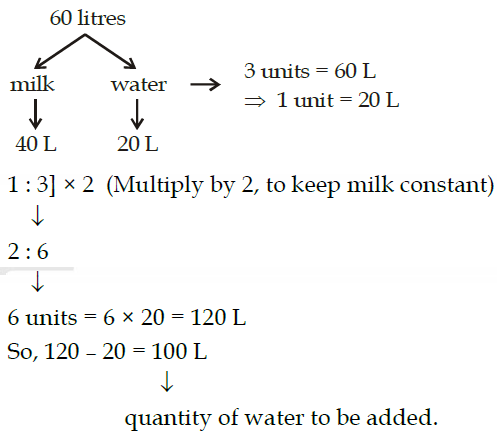
(B) Total quantity of the mixture = $60 \ L$.
The ratio of milk to water is $2:1$.
Sum of ratio parts = $2 + 1 = 3$.
Quantity of milk = $(2/3) \times 60 = 40 \ L$.
Quantity of water = $(1/3) \times 60 = 20 \ L$.
Let the quantity of water to be added be $x \ L$.
After adding water,the new quantity of water = $(20 + x) \ L$.
The new ratio of milk to water is $1:3$.
So,$40 / (20 + x) = 1 / 3$.
$40 \times 3 = 20 + x$.
$120 = 20 + x$.
$x = 120 - 20 = 100 \ L$.
Therefore,$100 \ L$ of water should be added.
The ratio of milk to water is $2:1$.
Sum of ratio parts = $2 + 1 = 3$.
Quantity of milk = $(2/3) \times 60 = 40 \ L$.
Quantity of water = $(1/3) \times 60 = 20 \ L$.
Let the quantity of water to be added be $x \ L$.
After adding water,the new quantity of water = $(20 + x) \ L$.
The new ratio of milk to water is $1:3$.
So,$40 / (20 + x) = 1 / 3$.
$40 \times 3 = 20 + x$.
$120 = 20 + x$.
$x = 120 - 20 = 100 \ L$.
Therefore,$100 \ L$ of water should be added.
0 likes
View Solution44
MediumMCQ
The ratio of the number of boys and girls in a college is $7:8$. If the percentage increase in the number of boys and girls is $20\%$ and $10\%$ respectively,what will be the new ratio?
A
$8:9$
B
$17:18$
C
$21:22$
D
Can't be determined
Solution
(C) Let the number of boys be $7x$ and the number of girls be $8x$.
After a $20\%$ increase in the number of boys,the new number of boys is $7x \times (1 + 0.20) = 7x \times 1.2 = 8.4x$.
After a $10\%$ increase in the number of girls,the new number of girls is $8x \times (1 + 0.10) = 8x \times 1.1 = 8.8x$.
The new ratio of boys to girls is $8.4x : 8.8x$.
Multiplying both sides by $10$,we get $84 : 88$.
Dividing by $4$,the simplified ratio is $21 : 22$.
After a $20\%$ increase in the number of boys,the new number of boys is $7x \times (1 + 0.20) = 7x \times 1.2 = 8.4x$.
After a $10\%$ increase in the number of girls,the new number of girls is $8x \times (1 + 0.10) = 8x \times 1.1 = 8.8x$.
The new ratio of boys to girls is $8.4x : 8.8x$.
Multiplying both sides by $10$,we get $84 : 88$.
Dividing by $4$,the simplified ratio is $21 : 22$.
0 likes
View Solution45
DifficultMCQ
Salaries of Ravi and Sumit are in the ratio $2:3$. If the salary of each is increased by $Rs. 4000$,the new ratio becomes $40:57$. What is Sumit's salary (in $Rs.$)?
A
$17000$
B
$20000$
C
$25500$
D
$34000$
Solution
(D) Let the initial salaries of Ravi and Sumit be $2x$ and $3x$ respectively.
According to the problem,the salary of each is increased by $Rs. 4000$.
New salary of Ravi $= 2x + 4000$
New salary of Sumit $= 3x + 4000$
The new ratio is given as $40:57$.
So,$\frac{2x + 4000}{3x + 4000} = \frac{40}{57}$
Cross-multiplying,we get:
$57(2x + 4000) = 40(3x + 4000)$
$114x + 228000 = 120x + 160000$
$120x - 114x = 228000 - 160000$
$6x = 68000$
$x = \frac{68000}{6} = \frac{34000}{3}$
Sumit's original salary $= 3x = 3 \times \left(\frac{34000}{3}\right) = Rs. 34000$.
According to the problem,the salary of each is increased by $Rs. 4000$.
New salary of Ravi $= 2x + 4000$
New salary of Sumit $= 3x + 4000$
The new ratio is given as $40:57$.
So,$\frac{2x + 4000}{3x + 4000} = \frac{40}{57}$
Cross-multiplying,we get:
$57(2x + 4000) = 40(3x + 4000)$
$114x + 228000 = 120x + 160000$
$120x - 114x = 228000 - 160000$
$6x = 68000$
$x = \frac{68000}{6} = \frac{34000}{3}$
Sumit's original salary $= 3x = 3 \times \left(\frac{34000}{3}\right) = Rs. 34000$.
0 likes
View Solution46
MediumMCQ
The salaries of $A, B$ and $C$ are in the ratio $2: 3: 5$. If increments of $15\%, 10\%$ and $20\%$ are allowed respectively in their salaries,then what will be the new ratio of their salaries?
A
$3: 3: 10$
B
$10: 11: 20$
C
$23: 33: 60$
D
$3: 4: 5$
Solution
(C) Let the initial salaries of $A, B$ and $C$ be $2x, 3x$ and $5x$ respectively.
After an increment of $15\%$ for $A$,the new salary is $2x \times (1 + 0.15) = 2x \times 1.15 = 2.3x$.
After an increment of $10\%$ for $B$,the new salary is $3x \times (1 + 0.10) = 3x \times 1.10 = 3.3x$.
After an increment of $20\%$ for $C$,the new salary is $5x \times (1 + 0.20) = 5x \times 1.20 = 6.0x$.
The new ratio is $2.3x : 3.3x : 6.0x$.
Multiplying by $10$ to remove decimals,we get $23 : 33 : 60$.
After an increment of $15\%$ for $A$,the new salary is $2x \times (1 + 0.15) = 2x \times 1.15 = 2.3x$.
After an increment of $10\%$ for $B$,the new salary is $3x \times (1 + 0.10) = 3x \times 1.10 = 3.3x$.
After an increment of $20\%$ for $C$,the new salary is $5x \times (1 + 0.20) = 5x \times 1.20 = 6.0x$.
The new ratio is $2.3x : 3.3x : 6.0x$.
Multiplying by $10$ to remove decimals,we get $23 : 33 : 60$.
0 likes
View Solution47
MediumMCQ
In a bag,there are coins of $25 p$,$10 p$,and $5 p$ in the ratio of $2:3:4$. If there is $Rs. 50$ in all,how many $5 p$ coins are there?
A
$50$
B
$100$
C
$150$
D
$200$
Solution
(D) Let the number of $25 p$,$10 p$,and $5 p$ coins be $2x$,$3x$,and $4x$ respectively.
The value of $25 p$ coins $= 25 \times 2x = 50x$ paise.
The value of $10 p$ coins $= 10 \times 3x = 30x$ paise.
The value of $5 p$ coins $= 5 \times 4x = 20x$ paise.
Total value $= 50x + 30x + 20x = 100x$ paise.
Since the total amount is $Rs. 50$,which is equal to $5000$ paise,we have:
$100x = 5000$
$x = 50$
The number of $5 p$ coins is $4x = 4 \times 50 = 200$.
The value of $25 p$ coins $= 25 \times 2x = 50x$ paise.
The value of $10 p$ coins $= 10 \times 3x = 30x$ paise.
The value of $5 p$ coins $= 5 \times 4x = 20x$ paise.
Total value $= 50x + 30x + 20x = 100x$ paise.
Since the total amount is $Rs. 50$,which is equal to $5000$ paise,we have:
$100x = 5000$
$x = 50$
The number of $5 p$ coins is $4x = 4 \times 50 = 200$.
0 likes
View Solution48
MediumMCQ
$A$ sum of money is divided among $C, A$ and $B$ in the ratio of $4:5:6$ and another sum of money is divided between $M$ and $N$ equally. If $B$ got $2000$ more than $M$,then how much does $C$ get (in $Rs.$)?
A
$1000$
B
$500$
C
$4000$
D
Cannot be determined
Solution
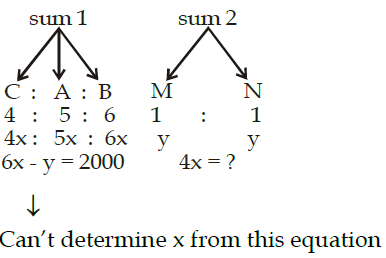
(D) Let the first sum of money be divided among $C, A$ and $B$ in the ratio $4:5:6$. Thus,$C = 4x, A = 5x, B = 6x$ for some constant $x$.
Let the second sum of money be divided between $M$ and $N$ equally. Thus,$M = y$ and $N = y$ for some constant $y$.
According to the problem,$B$ got $2000$ more than $M$,which gives the equation: $6x - y = 2000$.
We are asked to find the value of $C$,which is $4x$.
From the equation $6x - y = 2000$,we have two variables $x$ and $y$ and only one equation. Therefore,it is impossible to determine the unique value of $x$ without further information about the relationship between the two sums of money or the value of $y$.
Thus,the value of $C$ cannot be determined.
Let the second sum of money be divided between $M$ and $N$ equally. Thus,$M = y$ and $N = y$ for some constant $y$.
According to the problem,$B$ got $2000$ more than $M$,which gives the equation: $6x - y = 2000$.
We are asked to find the value of $C$,which is $4x$.
From the equation $6x - y = 2000$,we have two variables $x$ and $y$ and only one equation. Therefore,it is impossible to determine the unique value of $x$ without further information about the relationship between the two sums of money or the value of $y$.
Thus,the value of $C$ cannot be determined.
0 likes
View Solution49
MediumMCQ
Three numbers $A, B$ and $C$ are in the ratio $12: 15: 25$. If the sum of these numbers is $364$,find the ratio between the difference of $B$ and $A$ and the difference of $C$ and $B$.
A
$3:2$
B
$3:10$
C
$3:5$
D
$4:2$
Solution
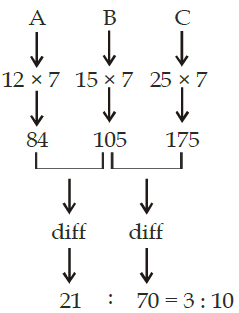
(B) Given the ratio of numbers $A : B : C = 12 : 15 : 25$.
Let the numbers be $12x, 15x$ and $25x$.
The sum of the numbers is $12x + 15x + 25x = 52x$.
Given that the sum is $364$,we have $52x = 364$.
Solving for $x$,$x = \frac{364}{52} = 7$.
The numbers are:
$A = 12 \times 7 = 84$
$B = 15 \times 7 = 105$
$C = 25 \times 7 = 175$
The difference between $B$ and $A$ is $105 - 84 = 21$.
The difference between $C$ and $B$ is $175 - 105 = 70$.
The required ratio is $21 : 70$.
Dividing both by $7$,we get $3 : 10$.
Let the numbers be $12x, 15x$ and $25x$.
The sum of the numbers is $12x + 15x + 25x = 52x$.
Given that the sum is $364$,we have $52x = 364$.
Solving for $x$,$x = \frac{364}{52} = 7$.
The numbers are:
$A = 12 \times 7 = 84$
$B = 15 \times 7 = 105$
$C = 25 \times 7 = 175$
The difference between $B$ and $A$ is $105 - 84 = 21$.
The difference between $C$ and $B$ is $175 - 105 = 70$.
The required ratio is $21 : 70$.
Dividing both by $7$,we get $3 : 10$.
0 likes
View Solution50
MediumMCQ
If $\frac{625}{x} = \frac{x}{1156}$,then what will be the value of $x$?
A
$800$
B
$850$
C
$900$
D
$950$
Solution
(B) Given the equation: $\frac{625}{x} = \frac{x}{1156}$
By cross-multiplying,we get: $x^2 = 625 \times 1156$
We know that $625 = 25^2$ and $1156 = 34^2$.
Therefore,$x^2 = 25^2 \times 34^2 = (25 \times 34)^2$.
Taking the square root on both sides: $x = 25 \times 34$.
Calculating the product: $x = 850$.
By cross-multiplying,we get: $x^2 = 625 \times 1156$
We know that $625 = 25^2$ and $1156 = 34^2$.
Therefore,$x^2 = 25^2 \times 34^2 = (25 \times 34)^2$.
Taking the square root on both sides: $x = 25 \times 34$.
Calculating the product: $x = 850$.
0 likes
View SolutionRatio and Proportion — Ratio and Proportion · Frequently Asked Questions
1Are these Ratio and Proportion questions useful for JEE and NEET?
Yes. All questions in this section are mapped to JEE Main and NEET exam patterns. Previous year questions from JEE Main, NEET, GUJCET and state-level exams are included with full solutions.
2Can I switch to Hindi or Gujarati for these questions?
Yes. Use the language tabs in the hero section or the sidebar to view the same questions and solutions in English, Hindi or Gujarati.
3How do I generate a question paper from this subtopic?
Use the Vedclass Exam Paper Generator — select the chapter and subtopic, set difficulty, and generate Sets A, B, C, D automatically. First 3 chapters of every subject are free.
Vedclass Products
For Students
Vedclass Test Series
Mock tests in real JEE/NEET style with performance analysis. 5-day free trial.
Start Free TrialFor Teachers
Exam Paper Generator
Generate Set A/B/C/D papers from this chapter in 2 minutes. 3 chapters free.
Try FreeFor Institutes
Online Exam Module
Live online exams with unlimited students, 360° analytics & white-label branding.
See DemoFor Teachers & Institutes
Generate a Ratio and Proportion Exam Paper in 2 Minutes
Select subtopic & difficulty — Sets A, B, C, D auto-generated with No Repeat logic.
First 3 chapters of every subject are free — no payment required.