
A English
Permutation and Combination Questions in English
Competitive Exam Quantitative Aptitude · Permutation and Combination · Permutation and Combination
578+
Questions
English
Language
100%
With Solutions
Showing 50 of 578 questions in English
51
MediumMCQ
How many numbers can be formed using the digits $3, 4, 5, 6, 7, 8$ that lie between $3000$ and $4000$ and are divisible by $5$,given that repetition of digits is not allowed?
A
$60$
B
$12$
C
$120$
D
$24$
Solution
(B) To form a number between $3000$ and $4000$,the thousands place must be occupied by the digit $3$.
For the number to be divisible by $5$,the units place must be occupied by $0$ or $5$. Since $0$ is not in the given set of digits,the units place must be $5$.
We have $6$ digits in total: ${3, 4, 5, 6, 7, 8}$.
Fixing $3$ at the thousands place and $5$ at the units place,we have used $2$ digits.
There are $4$ remaining digits ${4, 6, 7, 8}$ to fill the remaining $2$ places (hundreds and tens).
The number of ways to arrange $4$ remaining digits in $2$ places is given by the permutation formula $^nP_r = \frac{n!}{(n-r)!}$.
Here,$n = 4$ and $r = 2$,so $^4P_2 = \frac{4!}{(4-2)!} = \frac{4 \times 3 \times 2 \times 1}{2 \times 1} = 12$.
Therefore,there are $12$ such numbers.
For the number to be divisible by $5$,the units place must be occupied by $0$ or $5$. Since $0$ is not in the given set of digits,the units place must be $5$.
We have $6$ digits in total: ${3, 4, 5, 6, 7, 8}$.
Fixing $3$ at the thousands place and $5$ at the units place,we have used $2$ digits.
There are $4$ remaining digits ${4, 6, 7, 8}$ to fill the remaining $2$ places (hundreds and tens).
The number of ways to arrange $4$ remaining digits in $2$ places is given by the permutation formula $^nP_r = \frac{n!}{(n-r)!}$.
Here,$n = 4$ and $r = 2$,so $^4P_2 = \frac{4!}{(4-2)!} = \frac{4 \times 3 \times 2 \times 1}{2 \times 1} = 12$.
Therefore,there are $12$ such numbers.
0 likes
View Solution52
MediumMCQ
The letters of the word $MODESTY$ are written in all possible orders and these words are written out as in a dictionary,then the rank of the word $MODESTY$ is
A
$5040$
B
$720$
C
$1681$
D
$2520$
Solution
(C) The word $MODESTY$ consists of $7$ distinct letters: $D, E, M, O, S, T, Y$.
To find the rank,we arrange the letters in alphabetical order: $D, E, M, O, S, T, Y$.
$1$. Words starting with $D$: $6! = 720$ words.
$2$. Words starting with $E$: $6! = 720$ words.
$3$. Words starting with $MD$: $5! = 120$ words.
$4$. Words starting with $ME$: $5! = 120$ words.
$5$. The next word starts with $MO$. The letters remaining are $D, E, S, T, Y$. Arranging these alphabetically gives $D, E, S, T, Y$. Thus,the first word starting with $MO$ is $MODESTY$.
Rank $= 720 + 720 + 120 + 120 + 1 = 1681$.
To find the rank,we arrange the letters in alphabetical order: $D, E, M, O, S, T, Y$.
$1$. Words starting with $D$: $6! = 720$ words.
$2$. Words starting with $E$: $6! = 720$ words.
$3$. Words starting with $MD$: $5! = 120$ words.
$4$. Words starting with $ME$: $5! = 120$ words.
$5$. The next word starts with $MO$. The letters remaining are $D, E, S, T, Y$. Arranging these alphabetically gives $D, E, S, T, Y$. Thus,the first word starting with $MO$ is $MODESTY$.
Rank $= 720 + 720 + 120 + 120 + 1 = 1681$.
0 likes
View Solution53
MediumMCQ
If $a$ denotes the number of permutations of $x + 2$ things taken all at a time,$b$ the number of permutations of $x$ things taken $11$ at a time,and $c$ the number of permutations of $x - 11$ things taken all at a time such that $a = 182bc$,then the value of $x$ is
A
$15$
B
$12$
C
$10$
D
$18$
Solution
(B) Given that $a$ is the number of permutations of $x + 2$ things taken all at a time,so $a = (x + 2)!$.
$b$ is the number of permutations of $x$ things taken $11$ at a time,so $b = ^xP_{11} = \frac{x!}{(x - 11)!}$.
$c$ is the number of permutations of $x - 11$ things taken all at a time,so $c = (x - 11)!$.
Given the equation $a = 182bc$,we substitute the expressions:
$(x + 2)! = 182 \times \frac{x!}{(x - 11)!} \times (x - 11)!$
$(x + 2)! = 182 \times x!$
$(x + 2)(x + 1)x! = 182x!$
$(x + 2)(x + 1) = 182$
$x^2 + 3x + 2 = 182$
$x^2 + 3x - 180 = 0$
$(x + 15)(x - 12) = 0$
Since $x$ must be a positive integer such that $x \ge 11$ (from the definition of $^xP_{11}$),we have $x = 12$.
$b$ is the number of permutations of $x$ things taken $11$ at a time,so $b = ^xP_{11} = \frac{x!}{(x - 11)!}$.
$c$ is the number of permutations of $x - 11$ things taken all at a time,so $c = (x - 11)!$.
Given the equation $a = 182bc$,we substitute the expressions:
$(x + 2)! = 182 \times \frac{x!}{(x - 11)!} \times (x - 11)!$
$(x + 2)! = 182 \times x!$
$(x + 2)(x + 1)x! = 182x!$
$(x + 2)(x + 1) = 182$
$x^2 + 3x + 2 = 182$
$x^2 + 3x - 180 = 0$
$(x + 15)(x - 12) = 0$
Since $x$ must be a positive integer such that $x \ge 11$ (from the definition of $^xP_{11}$),we have $x = 12$.
0 likes
View Solution54
MediumMCQ
All possible four-digit numbers are formed using the digits $0, 1, 2, 3$ such that no digit is repeated. The number of even numbers among them is
A
$9$
B
$18$
C
$10$
D
None of these
Solution
(C) four-digit number is even if its unit digit is $0$ or $2$.
Case $1$: The unit digit is $0$.
The remaining $3$ positions can be filled by the remaining $3$ digits $(1, 2, 3)$ in $3! = 3 \times 2 \times 1 = 6$ ways.
Case $2$: The unit digit is $2$.
The thousands place cannot be $0$ or $2$,so it can be filled by $1$ or $3$ ($2$ ways).
The remaining $2$ positions can be filled by the remaining $2$ digits in $2! = 2 \times 1 = 2$ ways.
Total even numbers $= 6 + (2 \times 2) = 6 + 4 = 10$.
Case $1$: The unit digit is $0$.
The remaining $3$ positions can be filled by the remaining $3$ digits $(1, 2, 3)$ in $3! = 3 \times 2 \times 1 = 6$ ways.
Case $2$: The unit digit is $2$.
The thousands place cannot be $0$ or $2$,so it can be filled by $1$ or $3$ ($2$ ways).
The remaining $2$ positions can be filled by the remaining $2$ digits in $2! = 2 \times 1 = 2$ ways.
Total even numbers $= 6 + (2 \times 2) = 6 + 4 = 10$.
0 likes
View Solution55
MediumMCQ
The number of ways in which ten candidates $A_1, A_2, ....... A_{10}$ can be ranked such that $A_1$ is always above $A_{10}$ is
A
$5!$
B
$2(5!)$
C
$10!$
D
$\frac{1}{2}(10!)$
Solution
(D) The total number of ways to rank $10$ candidates without any restrictions is $10!$.
In any ranking,there are only two possibilities for the relative positions of $A_1$ and $A_{10}$: either $A_1$ is ranked above $A_{10}$,or $A_{10}$ is ranked above $A_1$.
Due to symmetry,the number of ways in which $A_1$ is above $A_{10}$ is equal to the number of ways in which $A_{10}$ is above $A_1$.
Let $N$ be the number of ways where $A_1$ is above $A_{10}$. Then,the total number of ways is $N + N = 2N = 10!$.
Therefore,$N = \frac{1}{2}(10!)$.
In any ranking,there are only two possibilities for the relative positions of $A_1$ and $A_{10}$: either $A_1$ is ranked above $A_{10}$,or $A_{10}$ is ranked above $A_1$.
Due to symmetry,the number of ways in which $A_1$ is above $A_{10}$ is equal to the number of ways in which $A_{10}$ is above $A_1$.
Let $N$ be the number of ways where $A_1$ is above $A_{10}$. Then,the total number of ways is $N + N = 2N = 10!$.
Therefore,$N = \frac{1}{2}(10!)$.
0 likes
View Solution56
EasyMCQ
All the letters of the word '$EAMCET$' are arranged in all possible ways. The number of such arrangements in which two vowels are not adjacent to each other is
A
$360$
B
$114$
C
$72$
D
$54$
Solution
(C) The word '$EAMCET$' consists of $6$ letters: $E, A, M, C, E, T$.
The vowels are $E, A, E$ (where $E$ repeats twice) and the consonants are $M, C, T$.
First,we arrange the $3$ consonants $(M, C, T)$ in $3! = 6$ ways.
These $3$ consonants create $4$ gaps (represented by underscores): $ M C T $.
We need to place the $3$ vowels $(E, A, E)$ in these $4$ gaps such that no two vowels are adjacent.
The number of ways to choose $3$ gaps out of $4$ is $^4C3 = 4$.
Since there are two identical vowels $(E)$,the number of ways to arrange $E, A, E$ in the chosen $3$ gaps is $\frac{3!}{2!} = 3$.
Total arrangements = (Ways to arrange consonants) $\times$ (Ways to choose gaps) $\times$ (Ways to arrange vowels in gaps)
Total arrangements = $6 \times 4 \times 3 = 72$.
The vowels are $E, A, E$ (where $E$ repeats twice) and the consonants are $M, C, T$.
First,we arrange the $3$ consonants $(M, C, T)$ in $3! = 6$ ways.
These $3$ consonants create $4$ gaps (represented by underscores): $ M C T $.
We need to place the $3$ vowels $(E, A, E)$ in these $4$ gaps such that no two vowels are adjacent.
The number of ways to choose $3$ gaps out of $4$ is $^4C3 = 4$.
Since there are two identical vowels $(E)$,the number of ways to arrange $E, A, E$ in the chosen $3$ gaps is $\frac{3!}{2!} = 3$.
Total arrangements = (Ways to arrange consonants) $\times$ (Ways to choose gaps) $\times$ (Ways to arrange vowels in gaps)
Total arrangements = $6 \times 4 \times 3 = 72$.
0 likes
View Solution57
EasyMCQ
In how many ways can $5$ boys and $5$ girls stand in a row so that no two girls may be together?
A
$(5!)^2$
B
$5! \times 4!$
C
$5! \times 6!$
D
$6 \times 5!$
Solution
(C) To ensure no two girls stand together,we first arrange the $5$ boys in a row. The number of ways to arrange $5$ boys is $5!$.
After arranging the boys,there are $6$ possible gaps (including the ends) where the $5$ girls can be placed: _ $B_1$ _ $B_2$ _ $B_3$ _ $B_4$ _ $B_5$ _.
The number of ways to choose $5$ gaps out of $6$ and arrange the $5$ girls in them is given by $^6P_5$.
Since $^6P_5 = \frac{6!}{(6-5)!} = 6!$,the total number of arrangements is $5! \times 6!$.
After arranging the boys,there are $6$ possible gaps (including the ends) where the $5$ girls can be placed: _ $B_1$ _ $B_2$ _ $B_3$ _ $B_4$ _ $B_5$ _.
The number of ways to choose $5$ gaps out of $6$ and arrange the $5$ girls in them is given by $^6P_5$.
Since $^6P_5 = \frac{6!}{(6-5)!} = 6!$,the total number of arrangements is $5! \times 6!$.
0 likes
View Solution58
EasyMCQ
The total number of permutations of the letters of the word "$BANANA$" is
A
$60$
B
$120$
C
$720$
D
$24$
Solution
(A) The word "$BANANA$" contains $6$ letters in total.
The frequency of each letter is: $B = 1$,$A = 3$,$N = 2$.
The total number of permutations is given by the formula $\frac{n!}{n_1! n_2! ... n_k!}$.
Substituting the values: $\frac{6!}{3! \times 2!} = \frac{720}{6 \times 2} = \frac{720}{12} = 60$.
Therefore,the total number of permutations is $60$.
The frequency of each letter is: $B = 1$,$A = 3$,$N = 2$.
The total number of permutations is given by the formula $\frac{n!}{n_1! n_2! ... n_k!}$.
Substituting the values: $\frac{6!}{3! \times 2!} = \frac{720}{6 \times 2} = \frac{720}{12} = 60$.
Therefore,the total number of permutations is $60$.
0 likes
View Solution59
MediumMCQ
The number of words which can be made out of the letters of the word $MOBILE$ when consonants always occupy odd places is
A
$20$
B
$36$
C
$30$
D
$720$
Solution
(B) The word $MOBILE$ consists of $6$ letters: $M, O, B, I, L, E$.
There are $3$ consonants $(M, B, L)$ and $3$ vowels $(O, I, E)$.
There are $6$ positions in total: $1, 2, 3, 4, 5, 6$.
The odd positions are $1, 3, 5$ (total $3$ positions).
The even positions are $2, 4, 6$ (total $3$ positions).
Since consonants must occupy odd places,the $3$ consonants can be arranged in the $3$ odd places in ${}^3P_3 = 3! = 6$ ways.
The remaining $3$ vowels can be arranged in the remaining $3$ even places in ${}^3P_3 = 3! = 6$ ways.
Total number of words $= 6 \times 6 = 36$.
There are $3$ consonants $(M, B, L)$ and $3$ vowels $(O, I, E)$.
There are $6$ positions in total: $1, 2, 3, 4, 5, 6$.
The odd positions are $1, 3, 5$ (total $3$ positions).
The even positions are $2, 4, 6$ (total $3$ positions).
Since consonants must occupy odd places,the $3$ consonants can be arranged in the $3$ odd places in ${}^3P_3 = 3! = 6$ ways.
The remaining $3$ vowels can be arranged in the remaining $3$ even places in ${}^3P_3 = 3! = 6$ ways.
Total number of words $= 6 \times 6 = 36$.
0 likes
View Solution60
EasyMCQ
How many numbers greater than $24000$ can be formed by using the digits $1, 2, 3, 4, 5$ when no digit is repeated?
A
$36$
B
$60$
C
$84$
D
$120$
Solution
(C) The given digits are $1, 2, 3, 4, 5$. We need to form $5$-digit numbers greater than $24000$.
Total $5$-digit numbers possible without repetition is $5! = 120$.
Numbers starting with $1$ (i.e.,$1xxxx$) = $4! = 24$.
Numbers starting with $21$ (i.e.,$21xxx$) = $3! = 6$.
Numbers starting with $23$ (i.e.,$23xxx$) = $3! = 6$.
Numbers starting with $24000$ are not possible since $0$ is not in the set.
Numbers starting with $24$ (i.e.,$24xxx$) where $x > 0$: The remaining digits are ${1, 3, 5}$. The numbers are $24135, 24153, 24315, 24351, 24513, 24531$. There are $3! = 6$ such numbers.
Total numbers greater than $24000$ = (Total numbers) - (Numbers starting with $1$) - (Numbers starting with $21$) - (Numbers starting with $23$) = $120 - 24 - 6 - 6 = 84$.
Total $5$-digit numbers possible without repetition is $5! = 120$.
Numbers starting with $1$ (i.e.,$1xxxx$) = $4! = 24$.
Numbers starting with $21$ (i.e.,$21xxx$) = $3! = 6$.
Numbers starting with $23$ (i.e.,$23xxx$) = $3! = 6$.
Numbers starting with $24000$ are not possible since $0$ is not in the set.
Numbers starting with $24$ (i.e.,$24xxx$) where $x > 0$: The remaining digits are ${1, 3, 5}$. The numbers are $24135, 24153, 24315, 24351, 24513, 24531$. There are $3! = 6$ such numbers.
Total numbers greater than $24000$ = (Total numbers) - (Numbers starting with $1$) - (Numbers starting with $21$) - (Numbers starting with $23$) = $120 - 24 - 6 - 6 = 84$.
0 likes
View Solution61
EasyMCQ
How many numbers greater than $100$ and divisible by $5$ can be made from the digits $3, 4, 5, 6$,if no digit is repeated?
A
$6$
B
$12$
C
$24$
D
$30$
Solution
(B) Numbers divisible by $5$ must have the digit $5$ fixed in the units place.
Case $1$: $3$-digit numbers.
The units place is fixed with $5$. The remaining $2$ places (hundreds and tens) can be filled by the remaining $3$ digits $(3, 4, 6)$ in $^3P_2$ ways.
$^3P_2 = \frac{3!}{(3-2)!} = 3 \times 2 = 6$ ways.
Case $2$: $4$-digit numbers.
The units place is fixed with $5$. The remaining $3$ places (thousands,hundreds,and tens) can be filled by the remaining $3$ digits $(3, 4, 6)$ in $^3P_3$ ways.
$^3P_3 = \frac{3!}{(3-3)!} = 3 \times 2 \times 1 = 6$ ways.
Total numbers $= 6 + 6 = 12$.
Case $1$: $3$-digit numbers.
The units place is fixed with $5$. The remaining $2$ places (hundreds and tens) can be filled by the remaining $3$ digits $(3, 4, 6)$ in $^3P_2$ ways.
$^3P_2 = \frac{3!}{(3-2)!} = 3 \times 2 = 6$ ways.
Case $2$: $4$-digit numbers.
The units place is fixed with $5$. The remaining $3$ places (thousands,hundreds,and tens) can be filled by the remaining $3$ digits $(3, 4, 6)$ in $^3P_3$ ways.
$^3P_3 = \frac{3!}{(3-3)!} = 3 \times 2 \times 1 = 6$ ways.
Total numbers $= 6 + 6 = 12$.
0 likes
View Solution62
EasyMCQ
The number of $7$-digit numbers which can be formed using the digits $1, 2, 3, 2, 3, 3, 4$ is:
A
$420$
B
$840$
C
$2520$
D
$5040$
Solution
(A) The given digits are $1, 2, 3, 2, 3, 3, 4$. The total number of digits is $n = 7$.
In these digits,the digit $3$ is repeated $3$ times and the digit $2$ is repeated $2$ times.
The number of distinct permutations of $n$ objects where $n_1$ are of one type,$n_2$ are of another type,etc.,is given by $\frac{n!}{n_1! n_2! \dots}$.
Here,$n = 7$,$n_1 = 3$ (for digit $3$),and $n_2 = 2$ (for digit $2$).
Required number of $7$-digit numbers = $\frac{7!}{3! \times 2!} = \frac{5040}{6 \times 2} = \frac{5040}{12} = 420$.
In these digits,the digit $3$ is repeated $3$ times and the digit $2$ is repeated $2$ times.
The number of distinct permutations of $n$ objects where $n_1$ are of one type,$n_2$ are of another type,etc.,is given by $\frac{n!}{n_1! n_2! \dots}$.
Here,$n = 7$,$n_1 = 3$ (for digit $3$),and $n_2 = 2$ (for digit $2$).
Required number of $7$-digit numbers = $\frac{7!}{3! \times 2!} = \frac{5040}{6 \times 2} = \frac{5040}{12} = 420$.
0 likes
View Solution63
EasyMCQ
The number of $4$-digit numbers that can be formed from the digits $0, 1, 2, 3, 4, 5, 6, 7$ such that each number contains the digit $1$ is:
A
$1225$
B
$1252$
C
$1522$
D
$1876$
Solution
(D) To find the number of $4$-digit numbers containing at least one $1$,we use the complement method:
Total $4$-digit numbers that can be formed using the digits ${0, 1, 2, 3, 4, 5, 6, 7}$ (without repetition):
The first digit cannot be $0$,so there are $7$ choices for the first place $(1-7)$.
The remaining $3$ places can be filled by the remaining $7$ digits in $^7P_3$ ways.
Total $4$-digit numbers $= 7 \times 7 \times 6 \times 5 = 1470$.
Now,find the number of $4$-digit numbers that do $NOT$ contain the digit $1$:
The digits available are ${0, 2, 3, 4, 5, 6, 7}$ (total $7$ digits).
The first digit cannot be $0$ or $1$,so there are $6$ choices $(2, 3, 4, 5, 6, 7)$.
The remaining $3$ places can be filled by the remaining $6$ digits in $^6P_3$ ways.
Numbers without $1 = 6 \times 6 \times 5 \times 4 = 720$.
Therefore,the number of $4$-digit numbers containing at least one $1 = 1470 - 720 = 750$.
Total $4$-digit numbers that can be formed using the digits ${0, 1, 2, 3, 4, 5, 6, 7}$ (without repetition):
The first digit cannot be $0$,so there are $7$ choices for the first place $(1-7)$.
The remaining $3$ places can be filled by the remaining $7$ digits in $^7P_3$ ways.
Total $4$-digit numbers $= 7 \times 7 \times 6 \times 5 = 1470$.
Now,find the number of $4$-digit numbers that do $NOT$ contain the digit $1$:
The digits available are ${0, 2, 3, 4, 5, 6, 7}$ (total $7$ digits).
The first digit cannot be $0$ or $1$,so there are $6$ choices $(2, 3, 4, 5, 6, 7)$.
The remaining $3$ places can be filled by the remaining $6$ digits in $^6P_3$ ways.
Numbers without $1 = 6 \times 6 \times 5 \times 4 = 720$.
Therefore,the number of $4$-digit numbers containing at least one $1 = 1470 - 720 = 750$.
0 likes
View Solution64
EasyMCQ
The number of $4$-digit even numbers that can be formed using $0, 1, 2, 3, 4, 5, 6$ without repetition is
A
$120$
B
$300$
C
$420$
D
$20$
Solution
(C) To form a $4$-digit even number,the units place must be filled by $0, 2, 4,$ or $6$.
Case $1$: Units place is $0$. The remaining $3$ places can be filled by the remaining $6$ digits $(1, 2, 3, 4, 5, 6)$ in $^6P_3 = 6 \times 5 \times 4 = 120$ ways.
Case $2$: Units place is $2, 4,$ or $6$ ($3$ ways). The thousands place cannot be $0$ and cannot be the digit already used in the units place. Thus,there are $7 - 2 = 5$ choices for the thousands place. The remaining $2$ places can be filled by the remaining $5$ digits in $^5P_2 = 5 \times 4 = 20$ ways. Total for this case $= 3 \times 5 \times 20 = 300$ ways.
Total number of even numbers $= 120 + 300 = 420$.
Case $1$: Units place is $0$. The remaining $3$ places can be filled by the remaining $6$ digits $(1, 2, 3, 4, 5, 6)$ in $^6P_3 = 6 \times 5 \times 4 = 120$ ways.
Case $2$: Units place is $2, 4,$ or $6$ ($3$ ways). The thousands place cannot be $0$ and cannot be the digit already used in the units place. Thus,there are $7 - 2 = 5$ choices for the thousands place. The remaining $2$ places can be filled by the remaining $5$ digits in $^5P_2 = 5 \times 4 = 20$ ways. Total for this case $= 3 \times 5 \times 20 = 300$ ways.
Total number of even numbers $= 120 + 300 = 420$.
0 likes
View Solution65
EasyMCQ
Total number of four-digit odd numbers that can be formed using $0, 1, 2, 3, 5, 7$ (repetition allowed) are
A
$216$
B
$375$
C
$400$
D
$720$
Solution
(D) To form a four-digit odd number using the digits ${0, 1, 2, 3, 5, 7}$ with repetition allowed:
$1$. The last digit (units place) must be odd to make the number odd. The available odd digits are ${1, 3, 5, 7}$. Thus,the units place can be filled in $4$ ways.
$2$. The first digit (thousands place) cannot be $0$ because the number must be a four-digit number. The available digits for this place are ${1, 2, 3, 5, 7}$. Thus,the thousands place can be filled in $5$ ways.
$3$. The second digit (hundreds place) can be any of the $6$ digits ${0, 1, 2, 3, 5, 7}$. Thus,it can be filled in $6$ ways.
$4$. The third digit (tens place) can be any of the $6$ digits ${0, 1, 2, 3, 5, 7}$. Thus,it can be filled in $6$ ways.
Using the fundamental principle of counting,the total number of such four-digit odd numbers is $5 \times 6 \times 6 \times 4 = 720$.
$1$. The last digit (units place) must be odd to make the number odd. The available odd digits are ${1, 3, 5, 7}$. Thus,the units place can be filled in $4$ ways.
$2$. The first digit (thousands place) cannot be $0$ because the number must be a four-digit number. The available digits for this place are ${1, 2, 3, 5, 7}$. Thus,the thousands place can be filled in $5$ ways.
$3$. The second digit (hundreds place) can be any of the $6$ digits ${0, 1, 2, 3, 5, 7}$. Thus,it can be filled in $6$ ways.
$4$. The third digit (tens place) can be any of the $6$ digits ${0, 1, 2, 3, 5, 7}$. Thus,it can be filled in $6$ ways.
Using the fundamental principle of counting,the total number of such four-digit odd numbers is $5 \times 6 \times 6 \times 4 = 720$.
0 likes
View Solution66
MediumMCQ
The number of arrangements of the letters of the word $BANANA$ in which two $N$s do not appear adjacently is
A
$40$
B
$60$
C
$80$
D
$100$
Solution
(A) The word $BANANA$ contains $6$ letters: $B, A, N, A, N, A$. The frequencies are: $A: 3, N: 2, B: 1$.
Total number of arrangements = $\frac{6!}{3! \times 2!} = \frac{720}{6 \times 2} = 60$.
Now,consider the case where the two $N$s are together. Treat $(NN)$ as a single unit. The letters are now ${B, A, A, A, (NN)}$.
Number of arrangements with $N$s together = $\frac{5!}{3! \times 1!} = \frac{120}{6} = 20$.
Number of arrangements where $N$s do not appear adjacently = (Total arrangements) - (Arrangements with $N$s together) = $60 - 20 = 40$.
Total number of arrangements = $\frac{6!}{3! \times 2!} = \frac{720}{6 \times 2} = 60$.
Now,consider the case where the two $N$s are together. Treat $(NN)$ as a single unit. The letters are now ${B, A, A, A, (NN)}$.
Number of arrangements with $N$s together = $\frac{5!}{3! \times 1!} = \frac{120}{6} = 20$.
Number of arrangements where $N$s do not appear adjacently = (Total arrangements) - (Arrangements with $N$s together) = $60 - 20 = 40$.
0 likes
View Solution67
EasyMCQ
The number of ways in which $5$ boys and $3$ girls can be seated in a row so that each girl is between two boys is:
A
$2880$
B
$1880$
C
$3800$
D
$2800$
Solution
(A) To ensure each girl is between two boys,we first arrange the $5$ boys in a row. The number of ways to arrange $5$ boys is $5! = 120$.
Let the boys be represented by $B$. The arrangement looks like: $\_ B \_ B \_ B \_ B \_ B \_$.
There are $4$ possible spaces between the $5$ boys where the $3$ girls can be seated to satisfy the condition that each girl is between two boys.
The number of ways to choose and arrange $3$ girls in these $4$ spaces is given by $^4P_3 = 4 \times 3 \times 2 = 24$.
Therefore,the total number of ways is $5! \times ^4P_3 = 120 \times 24 = 2880$.
Let the boys be represented by $B$. The arrangement looks like: $\_ B \_ B \_ B \_ B \_ B \_$.
There are $4$ possible spaces between the $5$ boys where the $3$ girls can be seated to satisfy the condition that each girl is between two boys.
The number of ways to choose and arrange $3$ girls in these $4$ spaces is given by $^4P_3 = 4 \times 3 \times 2 = 24$.
Therefore,the total number of ways is $5! \times ^4P_3 = 120 \times 24 = 2880$.
0 likes
View Solution68
MediumMCQ
Eleven books consisting of $5$ Mathematics,$4$ Physics,and $2$ Chemistry are placed on a shelf. The number of possible ways of arranging them on the assumption that the books of the same subject are all together is
A
$4! 2!$
B
$11!$
C
$3! 5! 4! 2!$
D
None of these
Solution
(C) There are $3$ subjects: Mathematics,Physics,and Chemistry.
Since books of the same subject must be kept together,we treat each subject group as a single unit.
There are $3$ such units (Mathematics group,Physics group,and Chemistry group),which can be arranged among themselves in $3!$ ways.
Within their respective groups,the $5$ Mathematics books can be arranged in $5!$ ways,the $4$ Physics books in $4!$ ways,and the $2$ Chemistry books in $2!$ ways.
Therefore,the total number of arrangements is $3! \times 5! \times 4! \times 2!$.
Since books of the same subject must be kept together,we treat each subject group as a single unit.
There are $3$ such units (Mathematics group,Physics group,and Chemistry group),which can be arranged among themselves in $3!$ ways.
Within their respective groups,the $5$ Mathematics books can be arranged in $5!$ ways,the $4$ Physics books in $4!$ ways,and the $2$ Chemistry books in $2!$ ways.
Therefore,the total number of arrangements is $3! \times 5! \times 4! \times 2!$.
0 likes
View Solution69
MediumMCQ
The number of words that can be formed out of the letters of the word $ARTICLE$ so that the vowels occupy even places is
A
$36$
B
$574$
C
$144$
D
$754$
Solution
(C) The word $ARTICLE$ consists of $7$ distinct letters: $A, R, T, I, C, L, E$.
There are $3$ vowels $(A, I, E)$ and $4$ consonants $(R, T, C, L)$.
In a $7$-letter word,the positions are $1, 2, 3, 4, 5, 6, 7$. The even positions are $2, 4, 6$ (total $3$ places).
The $3$ vowels must occupy these $3$ even places. The number of ways to arrange $3$ vowels in $3$ places is $^3P_3 = 3! = 6$.
The remaining $4$ consonants must occupy the $4$ odd positions $(1, 3, 5, 7)$. The number of ways to arrange $4$ consonants in $4$ places is $^4P_4 = 4! = 24$.
Total number of words = $^3P_3 \times ^4P_4 = 6 \times 24 = 144$.
There are $3$ vowels $(A, I, E)$ and $4$ consonants $(R, T, C, L)$.
In a $7$-letter word,the positions are $1, 2, 3, 4, 5, 6, 7$. The even positions are $2, 4, 6$ (total $3$ places).
The $3$ vowels must occupy these $3$ even places. The number of ways to arrange $3$ vowels in $3$ places is $^3P_3 = 3! = 6$.
The remaining $4$ consonants must occupy the $4$ odd positions $(1, 3, 5, 7)$. The number of ways to arrange $4$ consonants in $4$ places is $^4P_4 = 4! = 24$.
Total number of words = $^3P_3 \times ^4P_4 = 6 \times 24 = 144$.
0 likes
View Solution70
MediumMCQ
The number of ways in which $9$ persons can be divided into three equal groups is
A
$1680$
B
$840$
C
$560$
D
$280$
Solution
(D) To divide $9$ persons into three equal groups,we first select $3$ persons out of $9$,then $3$ out of the remaining $6$,and finally $3$ out of the remaining $3$.
The number of ways to distribute $n$ items into $k$ groups of size $m$ (where $n = km$) is given by the formula $\frac{n!}{(m!)^k \cdot k!}$.
Here,$n = 9$,$m = 3$,and $k = 3$.
Total ways $= \frac{9!}{(3!)^3 \cdot 3!} = \frac{362880}{(6)^3 \cdot 6} = \frac{362880}{216 \cdot 6} = \frac{362880}{1296} = 280$.
Therefore,the correct option is $D$.
The number of ways to distribute $n$ items into $k$ groups of size $m$ (where $n = km$) is given by the formula $\frac{n!}{(m!)^k \cdot k!}$.
Here,$n = 9$,$m = 3$,and $k = 3$.
Total ways $= \frac{9!}{(3!)^3 \cdot 3!} = \frac{362880}{(6)^3 \cdot 6} = \frac{362880}{216 \cdot 6} = \frac{362880}{1296} = 280$.
Therefore,the correct option is $D$.
0 likes
View Solution71
EasyMCQ
If a man and his wife enter a bus in which five seats are vacant,then the number of different ways in which they can be seated is
A
$2$
B
$5$
C
$20$
D
$40$
Solution
(C) There are $5$ vacant seats in the bus.
The man can choose any one of the $5$ vacant seats in $5$ different ways.
After the man is seated,there are $4$ remaining vacant seats.
The wife can choose any one of the $4$ remaining seats in $4$ different ways.
Therefore,the total number of ways they can be seated is $5 \times 4 = 20$.
The man can choose any one of the $5$ vacant seats in $5$ different ways.
After the man is seated,there are $4$ remaining vacant seats.
The wife can choose any one of the $4$ remaining seats in $4$ different ways.
Therefore,the total number of ways they can be seated is $5 \times 4 = 20$.
0 likes
View Solution72
MediumMCQ
If the letters of the word $SACHIN$ are arranged in all possible ways and these words are written out as in a dictionary,then the word $SACHIN$ appears at serial number:
A
$603$
B
$602$
C
$601$
D
$600$
Solution
(C) The letters of the word $SACHIN$ are $A, C, H, I, N, S$ in alphabetical order.
$1$. Words starting with $A$: $5! = 120$ words.
$2$. Words starting with $C$: $5! = 120$ words.
$3$. Words starting with $H$: $5! = 120$ words.
$4$. Words starting with $I$: $5! = 120$ words.
$5$. Words starting with $N$: $5! = 120$ words.
Total words before words starting with $S$ are $5 \times 120 = 600$.
The next word in the dictionary order is the first word starting with $S$,which is $SACHIN$.
Therefore,the serial number of $SACHIN$ is $600 + 1 = 601$.
$1$. Words starting with $A$: $5! = 120$ words.
$2$. Words starting with $C$: $5! = 120$ words.
$3$. Words starting with $H$: $5! = 120$ words.
$4$. Words starting with $I$: $5! = 120$ words.
$5$. Words starting with $N$: $5! = 120$ words.
Total words before words starting with $S$ are $5 \times 120 = 600$.
The next word in the dictionary order is the first word starting with $S$,which is $SACHIN$.
Therefore,the serial number of $SACHIN$ is $600 + 1 = 601$.
0 likes
View Solution73
DifficultMCQ
Let the eleven letters $A, B, \dots, K$ denote an arbitrary permutation of the integers $(1, 2, \dots, 11)$. Then, the product $(A - 1)(B - 2)(C - 3) \dots (K - 11)$ is:
A
Necessarily zero
B
Always odd
C
Always even
D
None of these
Solution
(C) The set of integers is $S = \{1, 2, 3, 4, 5, 6, 7, 8, 9, 10, 11\}$.
In this set, there are $6$ odd numbers $\{1, 3, 5, 7, 9, 11\}$ and $5$ even numbers $\{2, 4, 6, 8, 10\}$.
Let the product be $P = \prod_{i=1}^{11} (X_i - i)$, where $X_i$ is a permutation of $S$.
The sum of all terms $(X_i - i)$ is $\sum_{i=1}^{11} (X_i - i) = \sum X_i - \sum i = 0$.
For the sum of $11$ integers to be $0$ (an even number), there must be an even number of odd terms in the sum.
Since $11$ is odd, if all terms were odd, the sum would be odd. Thus, there must be at least one even term in the product.
Alternatively, consider the parity: the number of odd integers in the set is $6$. In the product, we subtract $11$ integers from $11$ integers. By the Pigeonhole Principle, since there are $6$ odd numbers being subtracted, at least one odd number must be subtracted from another odd number, resulting in an even difference.
Therefore, at least one factor $(X_i - i)$ must be even, making the entire product even.
In this set, there are $6$ odd numbers $\{1, 3, 5, 7, 9, 11\}$ and $5$ even numbers $\{2, 4, 6, 8, 10\}$.
Let the product be $P = \prod_{i=1}^{11} (X_i - i)$, where $X_i$ is a permutation of $S$.
The sum of all terms $(X_i - i)$ is $\sum_{i=1}^{11} (X_i - i) = \sum X_i - \sum i = 0$.
For the sum of $11$ integers to be $0$ (an even number), there must be an even number of odd terms in the sum.
Since $11$ is odd, if all terms were odd, the sum would be odd. Thus, there must be at least one even term in the product.
Alternatively, consider the parity: the number of odd integers in the set is $6$. In the product, we subtract $11$ integers from $11$ integers. By the Pigeonhole Principle, since there are $6$ odd numbers being subtracted, at least one odd number must be subtracted from another odd number, resulting in an even difference.
Therefore, at least one factor $(X_i - i)$ must be even, making the entire product even.
0 likes
View Solution74
DifficultMCQ
There are $4$ notes of Rs. $100$ and $5$ other notes of denominations Rs. $1$,Rs. $2$,Rs. $5$,Rs. $20$,and Rs. $50$. These notes are to be distributed among $3$ children such that each child receives at least one note of Rs. $100$. Find the total number of ways of distribution.
A
$3 \times 5^3$
B
$5 \times 3^5$
C
$3^6$
D
None of these
Solution
(C) Step $1$: Distribute the $4$ notes of Rs. $100$ among $3$ children such that each child gets at least one note. This is equivalent to finding the number of positive integer solutions to $x_1 + x_2 + x_3 = 4$,where $x_i \ge 1$. Using the stars and bars formula,the number of ways is $\binom{4-1}{3-1} = \binom{3}{2} = 3$ ways.
Step $2$: Distribute the $5$ other notes (Rs. $1, 2, 5, 20, 50$) among $3$ children. Each of these $5$ notes can be given to any of the $3$ children in $3$ ways. Thus,the total ways for these $5$ notes is $3^5$.
Step $3$: The total number of ways is the product of the ways from Step $1$ and Step $2$. However,the provided options suggest a simplification. If we consider the total distribution of $9$ notes ($4$ of Rs. $100$ and $5$ others) such that each child gets at least one Rs. $100$ note,the calculation is $3 \times 3^5 = 3^6$.
Step $2$: Distribute the $5$ other notes (Rs. $1, 2, 5, 20, 50$) among $3$ children. Each of these $5$ notes can be given to any of the $3$ children in $3$ ways. Thus,the total ways for these $5$ notes is $3^5$.
Step $3$: The total number of ways is the product of the ways from Step $1$ and Step $2$. However,the provided options suggest a simplification. If we consider the total distribution of $9$ notes ($4$ of Rs. $100$ and $5$ others) such that each child gets at least one Rs. $100$ note,the calculation is $3 \times 3^5 = 3^6$.
0 likes
View Solution75
EasyMCQ
How many numbers lying between $999$ and $10000$ can be formed with the help of the digits $0, 2, 3, 6, 7, 8$ when the digits are not to be repeated?
A
$100$
B
$200$
C
$300$
D
$400$
Solution
(C) The numbers lying between $999$ and $10000$ are all $4$-digit numbers.
We have $6$ available digits: ${0, 2, 3, 6, 7, 8}$.
Total $4$-digit numbers that can be formed using these $6$ digits (including those starting with $0$) is given by $^6P_4 = 6 \times 5 \times 4 \times 3 = 360$.
However,a $4$-digit number cannot start with $0$. If the first digit is $0$,the remaining $3$ places can be filled by the remaining $5$ digits in $^5P_3$ ways.
Number of such cases $= ^5P_3 = 5 \times 4 \times 3 = 60$.
Therefore,the required number of $4$-digit numbers $= 360 - 60 = 300$.
We have $6$ available digits: ${0, 2, 3, 6, 7, 8}$.
Total $4$-digit numbers that can be formed using these $6$ digits (including those starting with $0$) is given by $^6P_4 = 6 \times 5 \times 4 \times 3 = 360$.
However,a $4$-digit number cannot start with $0$. If the first digit is $0$,the remaining $3$ places can be filled by the remaining $5$ digits in $^5P_3$ ways.
Number of such cases $= ^5P_3 = 5 \times 4 \times 3 = 60$.
Therefore,the required number of $4$-digit numbers $= 360 - 60 = 300$.
0 likes
View Solution76
EasyMCQ
If $11$ members of a committee sit at a round table so that the President and Secretary always sit together,then the number of arrangements is
A
$10! \times 2$
B
$10!$
C
$9! \times 2$
D
None of these
Solution
(C) To arrange $11$ members at a round table such that the President and Secretary always sit together,we treat the President and Secretary as a single unit.
Now,we have $(11 - 2 + 1) = 10$ units to arrange in a circle.
The number of ways to arrange $n$ items in a circle is $(n - 1)!$.
Thus,the $10$ units can be arranged in $(10 - 1)! = 9!$ ways.
Within the single unit,the President and Secretary can interchange their positions in $2! = 2$ ways.
Therefore,the total number of arrangements is $9! \times 2$.
Now,we have $(11 - 2 + 1) = 10$ units to arrange in a circle.
The number of ways to arrange $n$ items in a circle is $(n - 1)!$.
Thus,the $10$ units can be arranged in $(10 - 1)! = 9!$ ways.
Within the single unit,the President and Secretary can interchange their positions in $2! = 2$ ways.
Therefore,the total number of arrangements is $9! \times 2$.
0 likes
View Solution77
EasyMCQ
In how many ways can $5$ keys be put in a ring?
A
$\frac{1}{2}4!$
B
$\frac{1}{2}5!$
C
$4!$
D
$5!$
Solution
(A) The number of ways to arrange $n$ distinct objects in a circle is $(n - 1)!$.
However,for arrangements like keys in a ring or beads in a necklace,the clockwise and anticlockwise arrangements are considered identical because the ring can be flipped over.
Therefore,the formula for the number of ways to arrange $n$ keys in a ring is $\frac{(n - 1)!}{2}$.
For $n = 5$ keys,the number of ways is $\frac{(5 - 1)!}{2} = \frac{4!}{2}$.
However,for arrangements like keys in a ring or beads in a necklace,the clockwise and anticlockwise arrangements are considered identical because the ring can be flipped over.
Therefore,the formula for the number of ways to arrange $n$ keys in a ring is $\frac{(n - 1)!}{2}$.
For $n = 5$ keys,the number of ways is $\frac{(5 - 1)!}{2} = \frac{4!}{2}$.
0 likes
View Solution78
EasyMCQ
In how many ways can $5$ boys and $5$ girls sit in a circle so that no two boys sit together?
A
$5! \times 5!$
B
$4! \times 5!$
C
$\frac{5! \times 5!}{2}$
D
None of these
Solution
(B) To arrange $5$ boys and $5$ girls in a circle such that no two boys sit together,we first arrange the $5$ girls in a circle.
The number of ways to arrange $n$ items in a circle is $(n-1)!$. Thus,$5$ girls can be arranged in $(5-1)! = 4!$ ways.
After arranging the girls,there are $5$ gaps created between them. To ensure no two boys sit together,we must place the $5$ boys in these $5$ gaps.
The number of ways to arrange $5$ boys in $5$ gaps is $5!$.
Therefore,the total number of ways is $4! \times 5!$.
The number of ways to arrange $n$ items in a circle is $(n-1)!$. Thus,$5$ girls can be arranged in $(5-1)! = 4!$ ways.
After arranging the girls,there are $5$ gaps created between them. To ensure no two boys sit together,we must place the $5$ boys in these $5$ gaps.
The number of ways to arrange $5$ boys in $5$ gaps is $5!$.
Therefore,the total number of ways is $4! \times 5!$.
0 likes
View Solution79
EasyMCQ
In how many ways can $12$ gentlemen sit around a round table so that three specified gentlemen are always together?
A
$9!$
B
$10!$
C
$3! \times 10!$
D
$3! \times 9!$
Solution
(D) To arrange $12$ gentlemen around a round table such that $3$ specified gentlemen are always together,we treat the $3$ specified gentlemen as a single unit.
Now,we have $(12 - 3 + 1) = 10$ units to arrange in a circle.
The number of ways to arrange $n$ items in a circle is $(n - 1)!$.
Thus,$10$ units can be arranged in $(10 - 1)! = 9!$ ways.
Within the single unit,the $3$ specified gentlemen can be arranged among themselves in $3!$ ways.
Therefore,the total number of ways is $3! \times 9!$.
Now,we have $(12 - 3 + 1) = 10$ units to arrange in a circle.
The number of ways to arrange $n$ items in a circle is $(n - 1)!$.
Thus,$10$ units can be arranged in $(10 - 1)! = 9!$ ways.
Within the single unit,the $3$ specified gentlemen can be arranged among themselves in $3!$ ways.
Therefore,the total number of ways is $3! \times 9!$.
0 likes
View Solution80
MediumMCQ
In how many ways can $15$ members of a council sit along a circular table,if the Secretary must sit on one side of the Chairman and the Deputy Secretary on the other side?
A
$2 \times 12!$
B
$24$
C
$2 \times 15!$
D
None of these
Solution
(A) To arrange $15$ members around a circular table with specific conditions,we treat the Chairman,Secretary,and Deputy Secretary as a single block.
Since the Secretary and Deputy Secretary must sit on either side of the Chairman,the block can be arranged in $2! = 2$ ways (Secretary-Chairman-Deputy Secretary or Deputy Secretary-Chairman-Secretary).
After grouping these $3$ members into $1$ unit,we have $15 - 3 + 1 = 13$ units to arrange in a circle.
The number of ways to arrange $n$ objects in a circle is $(n-1)!$.
Here,$n = 13$,so the number of circular arrangements is $(13-1)! = 12!$.
Considering the internal arrangement of the block,the total number of ways is $2 \times 12!$.
Since the Secretary and Deputy Secretary must sit on either side of the Chairman,the block can be arranged in $2! = 2$ ways (Secretary-Chairman-Deputy Secretary or Deputy Secretary-Chairman-Secretary).
After grouping these $3$ members into $1$ unit,we have $15 - 3 + 1 = 13$ units to arrange in a circle.
The number of ways to arrange $n$ objects in a circle is $(n-1)!$.
Here,$n = 13$,so the number of circular arrangements is $(13-1)! = 12!$.
Considering the internal arrangement of the block,the total number of ways is $2 \times 12!$.
0 likes
View Solution81
EasyMCQ
In how many ways can a garland be made from exactly $10$ flowers?
A
$10!$
B
$9!$
C
$2(9!)$
D
$\frac{9!}{2}$
Solution
(D) The number of ways to arrange $n$ distinct objects in a circle is $(n - 1)!$.
For a garland (or necklace),the clockwise and counter-clockwise arrangements are considered identical because the garland can be flipped over.
Therefore,the number of ways to make a garland from $n$ flowers is $\frac{(n - 1)!}{2}$.
Given $n = 10$,the number of ways is $\frac{(10 - 1)!}{2} = \frac{9!}{2}$.
For a garland (or necklace),the clockwise and counter-clockwise arrangements are considered identical because the garland can be flipped over.
Therefore,the number of ways to make a garland from $n$ flowers is $\frac{(n - 1)!}{2}$.
Given $n = 10$,the number of ways is $\frac{(10 - 1)!}{2} = \frac{9!}{2}$.
0 likes
View Solution82
MediumMCQ
$20$ persons are invited for a party. In how many different ways can they and the host be seated at a circular table,if two particular persons are to be seated on either side of the host?
A
$20!$
B
$2 \times 18!$
C
$18!$
D
None of these
Solution
(B) Total number of persons = $20$ (guests) $+ 1$ (host) $= 21$ persons.
Let the host be $H$ and the two particular persons be $P_1$ and $P_2$. Since $P_1$ and $P_2$ must sit on either side of $H$,we can treat $(P_1, H, P_2)$ as a single block.
Within this block,the arrangement can be $(P_1, H, P_2)$ or $(P_2, H, P_1)$,which is $2! = 2$ ways.
After treating the three as one unit,the remaining number of persons is $21 - 3 = 18$. Including the one block,we have $18 + 1 = 19$ units to arrange in a circle.
The number of ways to arrange $n$ items in a circle is $(n-1)!$. Here,$n = 19$,so the number of ways is $(19-1)! = 18!$.
Total ways $= 2 \times 18!$.
Let the host be $H$ and the two particular persons be $P_1$ and $P_2$. Since $P_1$ and $P_2$ must sit on either side of $H$,we can treat $(P_1, H, P_2)$ as a single block.
Within this block,the arrangement can be $(P_1, H, P_2)$ or $(P_2, H, P_1)$,which is $2! = 2$ ways.
After treating the three as one unit,the remaining number of persons is $21 - 3 = 18$. Including the one block,we have $18 + 1 = 19$ units to arrange in a circle.
The number of ways to arrange $n$ items in a circle is $(n-1)!$. Here,$n = 19$,so the number of ways is $(19-1)! = 18!$.
Total ways $= 2 \times 18!$.
0 likes
View Solution83
EasyMCQ
The number of ways in which $5$ beads of different colours form a necklace is
A
$12$
B
$24$
C
$120$
D
$60$
Solution
(A) The number of ways to arrange $n$ distinct objects in a circle is $(n - 1)!$.
For a necklace,the clockwise and anticlockwise arrangements are considered identical because the necklace can be flipped over.
Therefore,the number of ways to form a necklace with $n$ beads is $\frac{(n - 1)!}{2}$.
Given $n = 5$,the number of ways is $\frac{(5 - 1)!}{2} = \frac{4!}{2} = \frac{24}{2} = 12$.
For a necklace,the clockwise and anticlockwise arrangements are considered identical because the necklace can be flipped over.
Therefore,the number of ways to form a necklace with $n$ beads is $\frac{(n - 1)!}{2}$.
Given $n = 5$,the number of ways is $\frac{(5 - 1)!}{2} = \frac{4!}{2} = \frac{24}{2} = 12$.
0 likes
View Solution84
EasyMCQ
$n$ gentlemen can be made to sit on a round table in how many ways?
A
$\frac{1}{2}(n + 1)!$ ways
B
$(n - 1)!$ ways
C
$\frac{1}{2}(n - 1)!$ ways
D
$(n + 1)!$ ways
Solution
(B) The number of ways to arrange $n$ distinct objects in a circle is given by the formula $(n - 1)!$.
This is because in a circular arrangement,the relative positions are what matter,not the absolute positions.
By fixing one person's position to break the rotational symmetry,the remaining $(n - 1)$ people can be arranged in $(n - 1)!$ ways.
This is because in a circular arrangement,the relative positions are what matter,not the absolute positions.
By fixing one person's position to break the rotational symmetry,the remaining $(n - 1)$ people can be arranged in $(n - 1)!$ ways.
0 likes
View Solution85
MediumMCQ
The number of ways in which $5$ male and $2$ female members of a committee can be seated around a round table so that the two female are not seated together is
A
$480$
B
$600$
C
$720$
D
$840$
Solution
(A) To arrange $5$ males and $2$ females around a round table such that the $2$ females are not together,we use the gap method.
First,arrange the $5$ males around the circular table. The number of ways to arrange $n$ objects in a circle is $(n-1)!$. Thus,$5$ males can be seated in $(5-1)! = 4! = 24$ ways.
After seating the $5$ males,there are $5$ gaps created between them.
We need to place the $2$ females in these $5$ gaps so that no two females are adjacent. The number of ways to choose and arrange $2$ females in $5$ gaps is given by the permutation formula ${}^5P_2$.
${}^5P_2 = \frac{5!}{(5-2)!} = 5 \times 4 = 20$.
Therefore,the total number of ways is $24 \times 20 = 480$.
First,arrange the $5$ males around the circular table. The number of ways to arrange $n$ objects in a circle is $(n-1)!$. Thus,$5$ males can be seated in $(5-1)! = 4! = 24$ ways.
After seating the $5$ males,there are $5$ gaps created between them.
We need to place the $2$ females in these $5$ gaps so that no two females are adjacent. The number of ways to choose and arrange $2$ females in $5$ gaps is given by the permutation formula ${}^5P_2$.
${}^5P_2 = \frac{5!}{(5-2)!} = 5 \times 4 = 20$.
Therefore,the total number of ways is $24 \times 20 = 480$.
0 likes
View Solution86
EasyMCQ
In how many ways can $7$ men and $7$ women be seated around a round table such that no two women sit together?
A
$(7!)^2$
B
$7! \times 6!$
C
$(6!)^2$
D
$7!$
Solution
(B) To seat $7$ men and $7$ women around a round table such that no two women sit together,we follow these steps:
$1$. First,arrange the $7$ men around the circular table. The number of ways to arrange $n$ distinct objects in a circle is $(n-1)!$. Thus,$7$ men can be seated in $(7-1)! = 6!$ ways.
$2$. After seating the $7$ men,there are $7$ gaps created between them.
$3$. To ensure no two women sit together,we must place the $7$ women in these $7$ gaps. The number of ways to arrange $7$ women in $7$ distinct gaps is $7!$.
$4$. By the fundamental principle of counting,the total number of ways is $6! \times 7!$.
$1$. First,arrange the $7$ men around the circular table. The number of ways to arrange $n$ distinct objects in a circle is $(n-1)!$. Thus,$7$ men can be seated in $(7-1)! = 6!$ ways.
$2$. After seating the $7$ men,there are $7$ gaps created between them.
$3$. To ensure no two women sit together,we must place the $7$ women in these $7$ gaps. The number of ways to arrange $7$ women in $7$ distinct gaps is $7!$.
$4$. By the fundamental principle of counting,the total number of ways is $6! \times 7!$.
0 likes
View Solution87
EasyMCQ
The number of circular permutations of $n$ different objects is
A
$n!$
B
$n$
C
$(n - 2)!$
D
$(n - 1)!$
Solution
(D) In a linear arrangement,$n$ distinct objects can be arranged in $n!$ ways.
In a circular arrangement,rotating the arrangement does not produce a new permutation.
To account for this rotational symmetry,we fix one object in a position and arrange the remaining $(n - 1)$ objects in $(n - 1)!$ ways.
Therefore,the number of circular permutations of $n$ different objects is $(n - 1)!$.
In a circular arrangement,rotating the arrangement does not produce a new permutation.
To account for this rotational symmetry,we fix one object in a position and arrange the remaining $(n - 1)$ objects in $(n - 1)!$ ways.
Therefore,the number of circular permutations of $n$ different objects is $(n - 1)!$.
0 likes
View Solution88
EasyMCQ
The number of ways that $8$ beads of different colours can be strung as a necklace is:
A
$2520$
B
$2880$
C
$5040$
D
$4320$
Solution
(A) The number of ways to arrange $n$ distinct objects in a circle is $(n - 1)!$.
For $8$ different beads,the number of circular arrangements is $(8 - 1)! = 7! = 5040$.
In the case of a necklace,the clockwise and anticlockwise arrangements are considered identical because the necklace can be flipped over.
Therefore,the number of distinct necklaces is $\frac{(n - 1)!}{2}$.
Substituting $n = 8$,we get $\frac{7!}{2} = \frac{5040}{2} = 2520$.
For $8$ different beads,the number of circular arrangements is $(8 - 1)! = 7! = 5040$.
In the case of a necklace,the clockwise and anticlockwise arrangements are considered identical because the necklace can be flipped over.
Therefore,the number of distinct necklaces is $\frac{(n - 1)!}{2}$.
Substituting $n = 8$,we get $\frac{7!}{2} = \frac{5040}{2} = 2520$.
0 likes
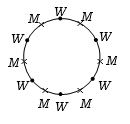
View Solution89
MediumMCQ
The number of ways in which $6$ men and $5$ women can dine at a round table if no two women are to sit together is given by
A
$6! \times 5!$
B
$30$
C
$5! \times 4!$
D
$7! \times 5!$
Solution
(A) To arrange $6$ men and $5$ women at a round table such that no two women sit together,we use the gap method.
First,arrange the $6$ men at the round table. The number of ways to arrange $n$ distinct objects in a circle is $(n-1)!$.
So,the number of ways to arrange $6$ men is $(6-1)! = 5!$.
This arrangement creates $6$ gaps between the men (including the gap between the last and first man).
Since there are $5$ women and they must not sit together,we need to place them in these $6$ available gaps.
The number of ways to choose $5$ gaps out of $6$ is $^6C_5$,and the number of ways to arrange the $5$ women in these gaps is $5!$.
Thus,the total number of ways is $5! \times ^6C_5 \times 5! = 5! \times 6 \times 5! = 6! \times 5!$.
First,arrange the $6$ men at the round table. The number of ways to arrange $n$ distinct objects in a circle is $(n-1)!$.
So,the number of ways to arrange $6$ men is $(6-1)! = 5!$.
This arrangement creates $6$ gaps between the men (including the gap between the last and first man).
Since there are $5$ women and they must not sit together,we need to place them in these $6$ available gaps.
The number of ways to choose $5$ gaps out of $6$ is $^6C_5$,and the number of ways to arrange the $5$ women in these gaps is $5!$.
Thus,the total number of ways is $5! \times ^6C_5 \times 5! = 5! \times 6 \times 5! = 6! \times 5!$.
0 likes
View Solution90
MediumMCQ
If $n$ is even and the value of $^nC_r$ is maximum,then $r = $
A
$n/2$
B
$(n+1)/2$
C
$(n-1)/2$
D
None of these
Solution
(A) The value of the binomial coefficient $^nC_r$ is maximum when $r$ is the middle term of the expansion.
For a given $n$,the value of $^nC_r$ increases as $r$ increases from $0$ to $n/2$ and decreases as $r$ increases from $n/2$ to $n$.
If $n$ is an even integer,there is only one middle term,which occurs at $r = n/2$.
Therefore,the value of $^nC_r$ is maximum when $r = n/2$.
For a given $n$,the value of $^nC_r$ increases as $r$ increases from $0$ to $n/2$ and decreases as $r$ increases from $n/2$ to $n$.
If $n$ is an even integer,there is only one middle term,which occurs at $r = n/2$.
Therefore,the value of $^nC_r$ is maximum when $r = n/2$.
0 likes
View Solution91
EasyMCQ
$A$ man has $7$ friends. In how many ways can he invite one or more of them for a tea party?
A
$128$
B
$256$
C
$127$
D
$130$
Solution
(C) For each of the $7$ friends,the man has $2$ choices: either to invite them or not to invite them.
Since there are $7$ friends,the total number of ways to invite any number of friends (including the case where no one is invited) is $2^7 = 128$.
However,the question specifies that he must invite 'one or more' friends,which means we must exclude the case where no friend is invited.
The number of ways to invite no friends is $^7C_0 = 1$.
Therefore,the required number of ways is $2^7 - 1 = 128 - 1 = 127$.
Since there are $7$ friends,the total number of ways to invite any number of friends (including the case where no one is invited) is $2^7 = 128$.
However,the question specifies that he must invite 'one or more' friends,which means we must exclude the case where no friend is invited.
The number of ways to invite no friends is $^7C_0 = 1$.
Therefore,the required number of ways is $2^7 - 1 = 128 - 1 = 127$.
0 likes
View Solution92
EasyMCQ
There are $12$ volleyball players in all in a college,out of which a team of $9$ players is to be formed. If the captain always remains the same,then in how many ways can the team be formed?
A
$36$
B
$108$
C
$99$
D
$165$
Solution
(D) Total number of players = $12$.
Number of players to be selected for the team = $9$.
Since the captain is fixed,we have already selected $1$ player.
Therefore,we need to select the remaining $9 - 1 = 8$ players from the remaining $12 - 1 = 11$ players.
The number of ways to choose $8$ players from $11$ is given by the combination formula $^{n}C_{r} = \frac{n!}{r!(n-r)!}$.
Number of ways = $^{11}C_{8} = ^{11}C_{11-8} = ^{11}C_{3}$.
$^{11}C_{3} = \frac{11 \times 10 \times 9}{3 \times 2 \times 1} = 11 \times 5 \times 3 = 165$.
Thus,the team can be formed in $165$ ways.
Number of players to be selected for the team = $9$.
Since the captain is fixed,we have already selected $1$ player.
Therefore,we need to select the remaining $9 - 1 = 8$ players from the remaining $12 - 1 = 11$ players.
The number of ways to choose $8$ players from $11$ is given by the combination formula $^{n}C_{r} = \frac{n!}{r!(n-r)!}$.
Number of ways = $^{11}C_{8} = ^{11}C_{11-8} = ^{11}C_{3}$.
$^{11}C_{3} = \frac{11 \times 10 \times 9}{3 \times 2 \times 1} = 11 \times 5 \times 3 = 165$.
Thus,the team can be formed in $165$ ways.
0 likes
View Solution93
EasyMCQ
In how many ways can a girl and a boy be selected from a group of $15$ boys and $8$ girls?
A
$15 \times 8$
B
$15 + 8$
C
$^{23}P_2$
D
$^{23}C_2$
Solution
(A) To select one boy from $15$ boys,the number of ways is $^{15}C_1 = 15$.
To select one girl from $8$ girls,the number of ways is $^{8}C_1 = 8$.
According to the fundamental principle of counting (multiplication principle),the total number of ways to select one boy and one girl is $15 \times 8$.
To select one girl from $8$ girls,the number of ways is $^{8}C_1 = 8$.
According to the fundamental principle of counting (multiplication principle),the total number of ways to select one boy and one girl is $15 \times 8$.
0 likes
View Solution94
EasyMCQ
If $^{15}C_{3r} = ^{15}C_{r+3}$,then the value of $r$ is
A
$3$
B
$4$
C
$5$
D
$8$
Solution
(A) We know that if $^nC_x = ^nC_y$,then either $x = y$ or $x + y = n$.
Given the equation $^{15}C_{3r} = ^{15}C_{r+3}$.
Case $1$: $3r = r + 3 \Rightarrow 2r = 3 \Rightarrow r = 1.5$. Since $r$ must be an integer,this case is invalid.
Case $2$: $3r + (r + 3) = 15$.
$4r + 3 = 15$.
$4r = 12$.
$r = 3$.
Given the equation $^{15}C_{3r} = ^{15}C_{r+3}$.
Case $1$: $3r = r + 3 \Rightarrow 2r = 3 \Rightarrow r = 1.5$. Since $r$ must be an integer,this case is invalid.
Case $2$: $3r + (r + 3) = 15$.
$4r + 3 = 15$.
$4r = 12$.
$r = 3$.
0 likes
View Solution95
MediumMCQ
$^{47}C_4 + \sum_{r=1}^{5} {}^{52-r}C_3 = $
A
$^{47}C_6$
B
$^{52}C_5$
C
$^{52}C_4$
D
None of these
Solution
(C) We use the Pascal's identity: $^nC_r + ^nC_{r-1} = ^{n+1}C_r$.
Expanding the summation: $^{47}C_4 + (^{51}C_3 + ^{50}C_3 + ^{49}C_3 + ^{48}C_3 + ^{47}C_3)$.
Using the identity $^{47}C_4 + ^{47}C_3 = ^{48}C_4$,the expression becomes: $^{51}C_3 + ^{50}C_3 + ^{49}C_3 + ^{48}C_3 + ^{48}C_4$.
Applying the identity again: $^{48}C_3 + ^{48}C_4 = ^{49}C_4$,so we have: $^{51}C_3 + ^{50}C_3 + ^{49}C_3 + ^{49}C_4$.
Continuing this process: $^{49}C_3 + ^{49}C_4 = ^{50}C_4$,so we have: $^{51}C_3 + ^{50}C_3 + ^{50}C_4$.
Then: $^{50}C_3 + ^{50}C_4 = ^{51}C_4$,so we have: $^{51}C_3 + ^{51}C_4$.
Finally: $^{51}C_3 + ^{51}C_4 = ^{52}C_4$.
Expanding the summation: $^{47}C_4 + (^{51}C_3 + ^{50}C_3 + ^{49}C_3 + ^{48}C_3 + ^{47}C_3)$.
Using the identity $^{47}C_4 + ^{47}C_3 = ^{48}C_4$,the expression becomes: $^{51}C_3 + ^{50}C_3 + ^{49}C_3 + ^{48}C_3 + ^{48}C_4$.
Applying the identity again: $^{48}C_3 + ^{48}C_4 = ^{49}C_4$,so we have: $^{51}C_3 + ^{50}C_3 + ^{49}C_3 + ^{49}C_4$.
Continuing this process: $^{49}C_3 + ^{49}C_4 = ^{50}C_4$,so we have: $^{51}C_3 + ^{50}C_3 + ^{50}C_4$.
Then: $^{50}C_3 + ^{50}C_4 = ^{51}C_4$,so we have: $^{51}C_3 + ^{51}C_4$.
Finally: $^{51}C_3 + ^{51}C_4 = ^{52}C_4$.
0 likes
View Solution96
MediumMCQ
$^nC_r \div ^nC_{r-1} = $
A
$\frac{n-r}{r}$
B
$\frac{n+r-1}{r}$
C
$\frac{n-r+1}{r}$
D
$\frac{n-r-1}{r}$
Solution
(C) The formula for combinations is given by $^nC_r = \frac{n!}{r!(n-r)!}$.
Now,consider the ratio:
$\frac{^nC_r}{^nC_{r-1}} = \frac{\frac{n!}{r!(n-r)!}}{\frac{n!}{(r-1)!(n-(r-1))!}}$
$= \frac{n!}{r!(n-r)!} \times \frac{(r-1)!(n-r+1)!}{n!}$
$= \frac{(r-1)!}{r!} \times \frac{(n-r+1)!}{(n-r)!}$
Since $r! = r \times (r-1)!$ and $(n-r+1)! = (n-r+1) \times (n-r)!$,we get:
$= \frac{(r-1)!}{r(r-1)!} \times \frac{(n-r+1)(n-r)!}{(n-r)!}$
$= \frac{n-r+1}{r}$
Thus,the correct option is $C$.
Now,consider the ratio:
$\frac{^nC_r}{^nC_{r-1}} = \frac{\frac{n!}{r!(n-r)!}}{\frac{n!}{(r-1)!(n-(r-1))!}}$
$= \frac{n!}{r!(n-r)!} \times \frac{(r-1)!(n-r+1)!}{n!}$
$= \frac{(r-1)!}{r!} \times \frac{(n-r+1)!}{(n-r)!}$
Since $r! = r \times (r-1)!$ and $(n-r+1)! = (n-r+1) \times (n-r)!$,we get:
$= \frac{(r-1)!}{r(r-1)!} \times \frac{(n-r+1)(n-r)!}{(n-r)!}$
$= \frac{n-r+1}{r}$
Thus,the correct option is $C$.
0 likes
View Solution97
DifficultMCQ
If $^{2n}C_3 : ^nC_2 = 44:3$,then for which of the following values of $r$,the value of $^nC_r$ will be $15$?
A
$r = 3$
B
$r = 4$
C
$r = 6$
D
$r = 5$
Solution
(B) Given the ratio: $\frac{^{2n}C_3}{^nC_2} = \frac{44}{3}$.
Expanding the combinations: $\frac{\frac{(2n)(2n-1)(2n-2)}{3 \times 2 \times 1}}{\frac{n(n-1)}{2 \times 1}} = \frac{44}{3}$.
Simplifying the expression: $\frac{(2n)(2n-1) \cdot 2(n-1)}{6} \cdot \frac{2}{n(n-1)} = \frac{44}{3}$.
$\frac{4n(2n-1)(n-1)}{6n(n-1)} = \frac{44}{3} \Rightarrow \frac{2(2n-1)}{3} = \frac{44}{3}$.
$2(2n-1) = 44 \Rightarrow 2n-1 = 22 \Rightarrow 2n = 23$ (Wait,re-evaluating: $\frac{2n(2n-1)(2n-2)}{6} \cdot \frac{2}{n(n-1)} = \frac{44}{3} \Rightarrow \frac{4n(2n-1)(n-1)}{3n(n-1)} = \frac{44}{3} \Rightarrow 4(2n-1) = 44 \Rightarrow 2n-1 = 11 \Rightarrow 2n = 12 \Rightarrow n = 6$).
Now,we need $^6C_r = 15$. Since $^6C_2 = \frac{6 \times 5}{2} = 15$ and $^6C_4 = ^6C_2 = 15$,the possible values for $r$ are $2$ or $4$. Comparing with the options,$r = 4$ is correct.
Expanding the combinations: $\frac{\frac{(2n)(2n-1)(2n-2)}{3 \times 2 \times 1}}{\frac{n(n-1)}{2 \times 1}} = \frac{44}{3}$.
Simplifying the expression: $\frac{(2n)(2n-1) \cdot 2(n-1)}{6} \cdot \frac{2}{n(n-1)} = \frac{44}{3}$.
$\frac{4n(2n-1)(n-1)}{6n(n-1)} = \frac{44}{3} \Rightarrow \frac{2(2n-1)}{3} = \frac{44}{3}$.
$2(2n-1) = 44 \Rightarrow 2n-1 = 22 \Rightarrow 2n = 23$ (Wait,re-evaluating: $\frac{2n(2n-1)(2n-2)}{6} \cdot \frac{2}{n(n-1)} = \frac{44}{3} \Rightarrow \frac{4n(2n-1)(n-1)}{3n(n-1)} = \frac{44}{3} \Rightarrow 4(2n-1) = 44 \Rightarrow 2n-1 = 11 \Rightarrow 2n = 12 \Rightarrow n = 6$).
Now,we need $^6C_r = 15$. Since $^6C_2 = \frac{6 \times 5}{2} = 15$ and $^6C_4 = ^6C_2 = 15$,the possible values for $r$ are $2$ or $4$. Comparing with the options,$r = 4$ is correct.
0 likes
View Solution98
EasyMCQ
If $2 \times {}^nC_5 = 9 \times {}^{n-2}C_5$,then the value of $n$ will be
A
$7$
B
$10$
C
$9$
D
$5$
Solution
(B) Given the equation: $2 \times {}^nC_5 = 9 \times {}^{n-2}C_5$
Using the formula ${}^nC_r = \frac{n!}{r!(n-r)!}$,we have:
$2 \times \frac{n!}{5!(n-5)!} = 9 \times \frac{(n-2)!}{5!(n-2-5)!}$
$2 \times \frac{n!}{5!(n-5)!} = 9 \times \frac{(n-2)!}{5!(n-7)!}$
Cancel $5!$ from both sides:
$2 \times \frac{n(n-1)(n-2)!}{(n-5)(n-6)(n-7)!} = 9 \times \frac{(n-2)!}{(n-7)!}$
Divide both sides by $(n-2)!$ and multiply by $(n-7)!$:
$2 \times \frac{n(n-1)}{(n-5)(n-6)} = 9$
$2(n^2 - n) = 9(n^2 - 11n + 30)$
$2n^2 - 2n = 9n^2 - 99n + 270$
$7n^2 - 97n + 270 = 0$
Solving the quadratic equation $7n^2 - 97n + 270 = 0$:
$7n^2 - 70n - 27n + 270 = 0$
$7n(n - 10) - 27(n - 10) = 0$
$(7n - 27)(n - 10) = 0$
Since $n$ must be an integer and $n \ge 7$ (for ${}^{n-2}C_5$ to be defined),we get $n = 10$.
Using the formula ${}^nC_r = \frac{n!}{r!(n-r)!}$,we have:
$2 \times \frac{n!}{5!(n-5)!} = 9 \times \frac{(n-2)!}{5!(n-2-5)!}$
$2 \times \frac{n!}{5!(n-5)!} = 9 \times \frac{(n-2)!}{5!(n-7)!}$
Cancel $5!$ from both sides:
$2 \times \frac{n(n-1)(n-2)!}{(n-5)(n-6)(n-7)!} = 9 \times \frac{(n-2)!}{(n-7)!}$
Divide both sides by $(n-2)!$ and multiply by $(n-7)!$:
$2 \times \frac{n(n-1)}{(n-5)(n-6)} = 9$
$2(n^2 - n) = 9(n^2 - 11n + 30)$
$2n^2 - 2n = 9n^2 - 99n + 270$
$7n^2 - 97n + 270 = 0$
Solving the quadratic equation $7n^2 - 97n + 270 = 0$:
$7n^2 - 70n - 27n + 270 = 0$
$7n(n - 10) - 27(n - 10) = 0$
$(7n - 27)(n - 10) = 0$
Since $n$ must be an integer and $n \ge 7$ (for ${}^{n-2}C_5$ to be defined),we get $n = 10$.
0 likes
View Solution99
MediumMCQ
If $^{n^2 - n}C_2 = ^{n^2 - n}C_{10}$,then $n = $
A
$12$
B
$4$ only
C
$-3$ only
D
$4$ or $-3$
Solution
(D) Given the equation $^{n^2 - n}C_2 = ^{n^2 - n}C_{10}$.
Using the property of combinations,if $^nC_r = ^nC_k$,then either $r = k$ or $r + k = n$.
Here,$r = 2$ and $k = 10$. Since $2 \neq 10$,we must have $r + k = n^2 - n$.
Therefore,$2 + 10 = n^2 - n$.
$12 = n^2 - n$.
$n^2 - n - 12 = 0$.
Factoring the quadratic equation: $(n - 4)(n + 3) = 0$.
Thus,$n = 4$ or $n = -3$.
Using the property of combinations,if $^nC_r = ^nC_k$,then either $r = k$ or $r + k = n$.
Here,$r = 2$ and $k = 10$. Since $2 \neq 10$,we must have $r + k = n^2 - n$.
Therefore,$2 + 10 = n^2 - n$.
$12 = n^2 - n$.
$n^2 - n - 12 = 0$.
Factoring the quadratic equation: $(n - 4)(n + 3) = 0$.
Thus,$n = 4$ or $n = -3$.
0 likes
View Solution100
MediumMCQ
If $^nC_{r-1} = 36$,$^nC_r = 84$,and $^nC_{r+1} = 126$,then the value of $r$ is
A
$1$
B
$2$
C
$3$
D
None of these
Solution
(C) We know the formula $^nC_r = \frac{n!}{r!(n-r)!}$.
First,consider the ratio $\frac{^nC_r}{^nC_{r-1}} = \frac{84}{36} = \frac{7}{3}$.
Using the property $\frac{^nC_r}{^nC_{r-1}} = \frac{n-r+1}{r}$,we get $\frac{n-r+1}{r} = \frac{7}{3} \implies 3n - 3r + 3 = 7r \implies 3n - 10r = -3$ (Equation $1$).
Next,consider the ratio $\frac{^nC_{r+1}}{^nC_r} = \frac{126}{84} = \frac{3}{2}$.
Using the property $\frac{^nC_{r+1}}{^nC_r} = \frac{n-r}{r+1}$,we get $\frac{n-r}{r+1} = \frac{3}{2} \implies 2n - 2r = 3r + 3 \implies 2n - 5r = 3$ (Equation $2$).
Multiply Equation $2$ by $2$: $4n - 10r = 6$ (Equation $3$).
Subtract Equation $1$ from Equation $3$: $(4n - 10r) - (3n - 10r) = 6 - (-3) \implies n = 9$.
Substitute $n = 9$ into Equation $2$: $2(9) - 5r = 3 \implies 18 - 5r = 3 \implies 5r = 15 \implies r = 3$.
First,consider the ratio $\frac{^nC_r}{^nC_{r-1}} = \frac{84}{36} = \frac{7}{3}$.
Using the property $\frac{^nC_r}{^nC_{r-1}} = \frac{n-r+1}{r}$,we get $\frac{n-r+1}{r} = \frac{7}{3} \implies 3n - 3r + 3 = 7r \implies 3n - 10r = -3$ (Equation $1$).
Next,consider the ratio $\frac{^nC_{r+1}}{^nC_r} = \frac{126}{84} = \frac{3}{2}$.
Using the property $\frac{^nC_{r+1}}{^nC_r} = \frac{n-r}{r+1}$,we get $\frac{n-r}{r+1} = \frac{3}{2} \implies 2n - 2r = 3r + 3 \implies 2n - 5r = 3$ (Equation $2$).
Multiply Equation $2$ by $2$: $4n - 10r = 6$ (Equation $3$).
Subtract Equation $1$ from Equation $3$: $(4n - 10r) - (3n - 10r) = 6 - (-3) \implies n = 9$.
Substitute $n = 9$ into Equation $2$: $2(9) - 5r = 3 \implies 18 - 5r = 3 \implies 5r = 15 \implies r = 3$.
0 likes
View SolutionPermutation and Combination — Permutation and Combination · Frequently Asked Questions
1Are these Permutation and Combination questions useful for JEE and NEET?
Yes. All questions in this section are mapped to JEE Main and NEET exam patterns. Previous year questions from JEE Main, NEET, GUJCET and state-level exams are included with full solutions.
2Can I switch to Hindi or Gujarati for these questions?
Yes. Use the language tabs in the hero section or the sidebar to view the same questions and solutions in English, Hindi or Gujarati.
3How do I generate a question paper from this subtopic?
Use the Vedclass Exam Paper Generator — select the chapter and subtopic, set difficulty, and generate Sets A, B, C, D automatically. First 3 chapters of every subject are free.
Vedclass Products
For Students
Vedclass Test Series
Mock tests in real JEE/NEET style with performance analysis. 5-day free trial.
Start Free TrialFor Teachers
Exam Paper Generator
Generate Set A/B/C/D papers from this chapter in 2 minutes. 3 chapters free.
Try FreeFor Institutes
Online Exam Module
Live online exams with unlimited students, 360° analytics & white-label branding.
See DemoFor Teachers & Institutes
Generate a Permutation and Combination Exam Paper in 2 Minutes
Select subtopic & difficulty — Sets A, B, C, D auto-generated with No Repeat logic.
First 3 chapters of every subject are free — no payment required.