
A English
Average Questions in English
Competitive Exam Quantitative Aptitude · Average · Average
386+
Questions
English
Language
100%
With Solutions
Showing 50 of 386 questions in English
301
EasyMCQ
The average age of four members of a family is $32$ years. If the age of a guest is included,then the average age increases by $12.5 \%$. What is the age (in years) of the guest?
A
$52$
B
$56$
C
$44$
D
$12$
Solution
(A) The initial sum of the ages of $4$ family members is $4 \times 32 = 128$ years.
The new average age after including the guest is $32 + (12.5 \% \text{ of } 32) = 32 + (0.125 \times 32) = 32 + 4 = 36$ years.
Let the age of the guest be $G$. The total number of people is now $5$.
The new average is given by $\frac{128 + G}{5} = 36$.
Multiplying both sides by $5$,we get $128 + G = 180$.
Solving for $G$,we get $G = 180 - 128 = 52$ years.
The new average age after including the guest is $32 + (12.5 \% \text{ of } 32) = 32 + (0.125 \times 32) = 32 + 4 = 36$ years.
Let the age of the guest be $G$. The total number of people is now $5$.
The new average is given by $\frac{128 + G}{5} = 36$.
Multiplying both sides by $5$,we get $128 + G = 180$.
Solving for $G$,we get $G = 180 - 128 = 52$ years.
0 likes
View Solution302
EasyMCQ
The average age of $6$ members of a family is $20$ years. If the age of a servant is included,the average age increases by $25\%$. What is the age (in years) of the servant?
A
$30$
B
$35$
C
$50$
D
$55$
Solution
(D) The initial sum of the ages of $6$ members is $6 \times 20 = 120$ years.
The new average age after including the servant is $20 + 25\% \text{ of } 20 = 20 + 5 = 25$ years.
There are now $6 + 1 = 7$ people in the family including the servant.
The total sum of the ages of $7$ people is $7 \times 25 = 175$ years.
Let the age of the servant be $S$. Then,$120 + S = 175$.
Therefore,$S = 175 - 120 = 55$ years.
The new average age after including the servant is $20 + 25\% \text{ of } 20 = 20 + 5 = 25$ years.
There are now $6 + 1 = 7$ people in the family including the servant.
The total sum of the ages of $7$ people is $7 \times 25 = 175$ years.
Let the age of the servant be $S$. Then,$120 + S = 175$.
Therefore,$S = 175 - 120 = 55$ years.
0 likes
View Solution303
EasyMCQ
The average revenue of $13$ consecutive years of a company is $Rs. 70$ lakhs. If the average of the first $7$ years is $Rs. 65$ lakhs and that of the last $7$ years is $Rs. 77$ lakhs,find the revenue for the $7^{th}$ year (in $Rs.$ lakhs).
A
$86$
B
$84$
C
$82$
D
$80$
Solution
(B) Total revenue for $13$ years $= 13 \times 70 = 910$ lakhs.
Total revenue for the first $7$ years $= 7 \times 65 = 455$ lakhs.
Total revenue for the last $7$ years $= 7 \times 77 = 539$ lakhs.
The $7^{th}$ year is included in both the first $7$ years and the last $7$ years.
Therefore,revenue of the $7^{th}$ year $= (455 + 539) - 910 = 994 - 910 = 84$ lakhs.
Total revenue for the first $7$ years $= 7 \times 65 = 455$ lakhs.
Total revenue for the last $7$ years $= 7 \times 77 = 539$ lakhs.
The $7^{th}$ year is included in both the first $7$ years and the last $7$ years.
Therefore,revenue of the $7^{th}$ year $= (455 + 539) - 910 = 994 - 910 = 84$ lakhs.
0 likes
View Solution304
DifficultMCQ
In a class,the average height of all students is $a \text{ cm}$. Among them,the average height of $10$ students is $b \text{ cm}$ and the average height of the remaining students is $c \text{ cm}$. Find the number of students in the class. (Here $a > c$ and $b > c$)
A
$\frac{a(b-c)}{a-c}$
B
$\frac{b-c}{a-c}$
C
$\frac{b-c}{10(a-c)}$
D
$\frac{10(b-c)}{a-c}$
Solution
(D) Let the total number of students be $N$. The total height of all students is $T = aN$.
The sum of heights of $10$ students is $10b$.
The number of remaining students is $(N-10)$,and their total height is $(N-10)c$.
The sum of the heights of the two groups equals the total height of the class:
$10b + (N-10)c = aN$
Expand the equation:
$10b + Nc - 10c = aN$
Rearrange to solve for $N$:
$10b - 10c = aN - Nc$
$10(b-c) = N(a-c)$
Therefore,the total number of students is:
$N = \frac{10(b-c)}{a-c}$
The sum of heights of $10$ students is $10b$.
The number of remaining students is $(N-10)$,and their total height is $(N-10)c$.
The sum of the heights of the two groups equals the total height of the class:
$10b + (N-10)c = aN$
Expand the equation:
$10b + Nc - 10c = aN$
Rearrange to solve for $N$:
$10b - 10c = aN - Nc$
$10(b-c) = N(a-c)$
Therefore,the total number of students is:
$N = \frac{10(b-c)}{a-c}$
0 likes
View Solution305
MediumMCQ
The average temperature for Monday,Tuesday,Wednesday and Thursday was $48^{\circ}$. The average temperature for Tuesday,Wednesday,Thursday and Friday was $52^{\circ}$. If the temperature on Monday was $42^{\circ}$,then the temperature on Friday was (in $degrees$):
A
$58$
B
$56$
C
$52$
D
$50$
Solution
(A) Let the temperatures on Monday,Tuesday,Wednesday,Thursday,and Friday be $M, T, W, Th,$ and $F$ respectively.
The average temperature for Monday,Tuesday,Wednesday,and Thursday is $48^{\circ}$.
So,$(M + T + W + Th) / 4 = 48$,which implies $M + T + W + Th = 48 \times 4 = 192$.
The average temperature for Tuesday,Wednesday,Thursday,and Friday is $52^{\circ}$.
So,$(T + W + Th + F) / 4 = 52$,which implies $T + W + Th + F = 52 \times 4 = 208$.
Subtracting the first equation from the second:
$(T + W + Th + F) - (M + T + W + Th) = 208 - 192$
$F - M = 16$.
Given that the temperature on Monday $(M)$ is $42^{\circ}$,we substitute this value:
$F - 42 = 16$
$F = 16 + 42 = 58$.
Therefore,the temperature on Friday was $58^{\circ}$.
The average temperature for Monday,Tuesday,Wednesday,and Thursday is $48^{\circ}$.
So,$(M + T + W + Th) / 4 = 48$,which implies $M + T + W + Th = 48 \times 4 = 192$.
The average temperature for Tuesday,Wednesday,Thursday,and Friday is $52^{\circ}$.
So,$(T + W + Th + F) / 4 = 52$,which implies $T + W + Th + F = 52 \times 4 = 208$.
Subtracting the first equation from the second:
$(T + W + Th + F) - (M + T + W + Th) = 208 - 192$
$F - M = 16$.
Given that the temperature on Monday $(M)$ is $42^{\circ}$,we substitute this value:
$F - 42 = 16$
$F = 16 + 42 = 58$.
Therefore,the temperature on Friday was $58^{\circ}$.
0 likes
View Solution306
MediumMCQ
The average marks obtained by a class of $60$ students is $65$. The average marks of half of the students is found to be $85$. The average marks of the remaining students is:
A
$35$
B
$45$
C
$55$
D
$65$
Solution
(B) Total marks of the class $= 60 \times 65 = 3900$.
Number of students in half of the class $= 60 / 2 = 30$.
Total marks of these $30$ students $= 30 \times 85 = 2550$.
Total marks of the remaining $30$ students $= 3900 - 2550 = 1350$.
Average marks of the remaining students $= 1350 / 30 = 45$.
Number of students in half of the class $= 60 / 2 = 30$.
Total marks of these $30$ students $= 30 \times 85 = 2550$.
Total marks of the remaining $30$ students $= 3900 - 2550 = 1350$.
Average marks of the remaining students $= 1350 / 30 = 45$.
0 likes
View Solution307
MediumMCQ
The average of marks obtained by $100$ candidates in a certain examination is $30$. If the average marks of passed candidates is $35$ and that of the failed candidates is $10$,what is the number of candidates who passed the examination?
A
$60$
B
$70$
C
$80$
D
$90$
Solution
(C) Let the number of passed candidates be $x$ and the number of failed candidates be $(100 - x)$.
According to the problem,the total marks obtained by all candidates is $100 \times 30 = 3000$.
The total marks obtained by passed candidates is $35x$.
The total marks obtained by failed candidates is $10(100 - x)$.
Therefore,$35x + 10(100 - x) = 3000$.
$35x + 1000 - 10x = 3000$.
$25x = 2000$.
$x = \frac{2000}{25} = 80$.
Thus,the number of candidates who passed the examination is $80$.
According to the problem,the total marks obtained by all candidates is $100 \times 30 = 3000$.
The total marks obtained by passed candidates is $35x$.
The total marks obtained by failed candidates is $10(100 - x)$.
Therefore,$35x + 10(100 - x) = 3000$.
$35x + 1000 - 10x = 3000$.
$25x = 2000$.
$x = \frac{2000}{25} = 80$.
Thus,the number of candidates who passed the examination is $80$.
0 likes
View Solution308
MediumMCQ
The average of $25$ results is $20$. The average of the first $12$ results is $15$ and that of the last $12$ results is $18$. Then,the $13^{th}$ result is:
A
$100$
B
$101$
C
$104$
D
$103$
Solution
(C) The sum of $25$ results is $25 \times 20 = 500$.
The sum of the first $12$ results is $12 \times 15 = 180$.
The sum of the last $12$ results is $12 \times 18 = 216$.
Let the $13^{th}$ result be $x$.
Therefore,the sum of all $25$ results can be expressed as: (Sum of first $12$) + ($13^{th}$ result) + (Sum of last $12$) = $500$.
$180 + x + 216 = 500$.
$x + 396 = 500$.
$x = 500 - 396$.
$x = 104$.
Thus,the $13^{th}$ result is $104$.
The sum of the first $12$ results is $12 \times 15 = 180$.
The sum of the last $12$ results is $12 \times 18 = 216$.
Let the $13^{th}$ result be $x$.
Therefore,the sum of all $25$ results can be expressed as: (Sum of first $12$) + ($13^{th}$ result) + (Sum of last $12$) = $500$.
$180 + x + 216 = 500$.
$x + 396 = 500$.
$x = 500 - 396$.
$x = 104$.
Thus,the $13^{th}$ result is $104$.
0 likes
View Solution309
EasyMCQ
The average of $100$ observations was calculated as $35$. It was found later that one of the observations was misread as $83$ instead of $53$. The correct average is: (in $.7$)
A
$32$
B
$34$
C
$35$
D
$36$
Solution
(B) Given,the number of observations $n = 100$ and the initial average = $35$.
Sum of observations = $100 \times 35 = 3500$.
Since one observation was misread as $83$ instead of $53$,we need to subtract the incorrect value and add the correct value to the sum.
Correct sum = $3500 - 83 + 53 = 3500 - 30 = 3470$.
Correct average = $\frac{\text{Correct sum}}{n} = \frac{3470}{100} = 34.7$.
Sum of observations = $100 \times 35 = 3500$.
Since one observation was misread as $83$ instead of $53$,we need to subtract the incorrect value and add the correct value to the sum.
Correct sum = $3500 - 83 + 53 = 3500 - 30 = 3470$.
Correct average = $\frac{\text{Correct sum}}{n} = \frac{3470}{100} = 34.7$.
0 likes
View Solution310
EasyMCQ
If the difference between the average of $x, y$ and $y, z$ is $12,$ then the difference between $x$ and $z$ is
A
$24$
B
$48$
C
$12$
D
$6$
Solution
(A) The average of $x$ and $y$ is given by $\frac{x+y}{2}$.
The average of $y$ and $z$ is given by $\frac{y+z}{2}$.
According to the problem,the difference between these averages is $12$:
$\frac{x+y}{2} - \frac{y+z}{2} = 12$
Multiplying the entire equation by $2$ to clear the denominator:
$(x+y) - (y+z) = 12 \times 2$
$x + y - y - z = 24$
$x - z = 24$
Therefore,the difference between $x$ and $z$ is $24$.
The average of $y$ and $z$ is given by $\frac{y+z}{2}$.
According to the problem,the difference between these averages is $12$:
$\frac{x+y}{2} - \frac{y+z}{2} = 12$
Multiplying the entire equation by $2$ to clear the denominator:
$(x+y) - (y+z) = 12 \times 2$
$x + y - y - z = 24$
$x - z = 24$
Therefore,the difference between $x$ and $z$ is $24$.
0 likes
View Solution311
EasyMCQ
The average of the first $7$ integers in a series of $13$ consecutive odd integers is $37$. What is the average of the entire series?
A
$37$
B
$39$
C
$41$
D
$43$
Solution
(D) Let the $13$ consecutive odd integers be $x, x+2, x+4, \dots, x+24$.
The average of the first $7$ integers is given as $37$.
The first $7$ integers are $x, x+2, x+4, x+6, x+8, x+10, x+12$.
The average of these $7$ integers is the middle term, which is the $4^{\text{th}}$ term: $x+6 = 37$.
Thus, $x = 31$.
The entire series consists of $13$ consecutive odd integers starting from $31$: $31, 33, 35, 37, 39, 41, 43, 45, 47, 49, 51, 53, 55$.
The average of an arithmetic progression is the middle term. For $13$ terms, the middle term is the $\frac{13+1}{2} = 7^{\text{th}}$ term.
The $7^{\text{th}}$ term is $x + (7-1) \times 2 = 31 + 12 = 43$.
Alternatively, the $7^{\text{th}}$ term is $37 + (7-4) \times 2 = 37 + 6 = 43$.
The average of the first $7$ integers is given as $37$.
The first $7$ integers are $x, x+2, x+4, x+6, x+8, x+10, x+12$.
The average of these $7$ integers is the middle term, which is the $4^{\text{th}}$ term: $x+6 = 37$.
Thus, $x = 31$.
The entire series consists of $13$ consecutive odd integers starting from $31$: $31, 33, 35, 37, 39, 41, 43, 45, 47, 49, 51, 53, 55$.
The average of an arithmetic progression is the middle term. For $13$ terms, the middle term is the $\frac{13+1}{2} = 7^{\text{th}}$ term.
The $7^{\text{th}}$ term is $x + (7-1) \times 2 = 31 + 12 = 43$.
Alternatively, the $7^{\text{th}}$ term is $37 + (7-4) \times 2 = 37 + 6 = 43$.
0 likes
View Solution312
EasyMCQ
The average marks of a class of $35$ children is $35$. The marks of one of the students,who got $35$,was incorrectly entered as $65$. What is the correct average of the class?
A
$33.76$
B
$34.14$
C
$35.24$
D
$36.50$
Solution
(B) Total number of students = $35$.
Initial average marks = $35$.
Total marks calculated initially = $35 \times 35 = 1225$.
Since the marks of one student were incorrectly entered as $65$ instead of $35$,we need to subtract the incorrect value and add the correct value.
Correct total marks = $1225 - 65 + 35 = 1195$.
Correct average = $\frac{1195}{35} \approx 34.14$.
Initial average marks = $35$.
Total marks calculated initially = $35 \times 35 = 1225$.
Since the marks of one student were incorrectly entered as $65$ instead of $35$,we need to subtract the incorrect value and add the correct value.
Correct total marks = $1225 - 65 + 35 = 1195$.
Correct average = $\frac{1195}{35} \approx 34.14$.
0 likes
View Solution313
MediumMCQ
The sum of three consecutive even numbers is $28$ more than the average of these three numbers. Then the smallest of these three numbers is
A
$6$
B
$12$
C
$14$
D
$16$
Solution
(B) Let the three consecutive even numbers be $x$,$x+2$,and $x+4$.
The sum of these numbers is $S = x + (x+2) + (x+4) = 3x + 6$.
The average of these numbers is $A = \frac{3x+6}{3} = x+2$.
According to the problem,the sum is $28$ more than the average:
$S = A + 28$
$(3x+6) = (x+2) + 28$
$3x + 6 = x + 30$
$2x = 24$
$x = 12$.
Thus,the smallest number is $12$.
The sum of these numbers is $S = x + (x+2) + (x+4) = 3x + 6$.
The average of these numbers is $A = \frac{3x+6}{3} = x+2$.
According to the problem,the sum is $28$ more than the average:
$S = A + 28$
$(3x+6) = (x+2) + 28$
$3x + 6 = x + 30$
$2x = 24$
$x = 12$.
Thus,the smallest number is $12$.
0 likes
View Solution314
MediumMCQ
The average of runs scored by a cricketer in his $99$ innings is $99$. How many runs will he have to score in his $100^{\text{th}}$ innings so that his average of runs in $100$ innings may be $100$?
A
$100$
B
$99$
C
$199$
D
$101$
Solution
(C) Let the runs scored in the $100^{\text{th}}$ innings be $x$.
Total runs scored in $99$ innings $= 99 \times 99 = 9801$.
Total runs required for an average of $100$ in $100$ innings $= 100 \times 100 = 10000$.
Runs to be scored in the $100^{\text{th}}$ innings $= 10000 - 9801 = 199$.
Total runs scored in $99$ innings $= 99 \times 99 = 9801$.
Total runs required for an average of $100$ in $100$ innings $= 100 \times 100 = 10000$.
Runs to be scored in the $100^{\text{th}}$ innings $= 10000 - 9801 = 199$.
0 likes
View Solution315
MediumMCQ
$A$ cricketer,whose bowling average was $12.4$ runs/wicket,takes $5$ wickets for $22$ runs in a match,thereby decreasing his average by $0.4$. The number of wickets taken by him before this match was:
A
$78$
B
$87$
C
$95$
D
$105$
Solution
(C) Let the number of wickets taken by the cricketer before this match be $w$.
Total runs conceded before this match = $12.4w$.
In the current match,he takes $5$ wickets for $22$ runs.
Total wickets after the match = $w + 5$.
Total runs after the match = $12.4w + 22$.
The new average is $12.4 - 0.4 = 12.0$ runs/wicket.
According to the problem:
$\frac{12.4w + 22}{w + 5} = 12.0$
$12.4w + 22 = 12(w + 5)$
$12.4w + 22 = 12w + 60$
$12.4w - 12w = 60 - 22$
$0.4w = 38$
$w = \frac{38}{0.4} = 95$.
Thus,the number of wickets taken before this match was $95$.
Total runs conceded before this match = $12.4w$.
In the current match,he takes $5$ wickets for $22$ runs.
Total wickets after the match = $w + 5$.
Total runs after the match = $12.4w + 22$.
The new average is $12.4 - 0.4 = 12.0$ runs/wicket.
According to the problem:
$\frac{12.4w + 22}{w + 5} = 12.0$
$12.4w + 22 = 12(w + 5)$
$12.4w + 22 = 12w + 60$
$12.4w - 12w = 60 - 22$
$0.4w = 38$
$w = \frac{38}{0.4} = 95$.
Thus,the number of wickets taken before this match was $95$.
0 likes
View Solution316
DifficultMCQ
The batting average for $40$ innings of a cricket player is $50$ runs. His highest score exceeds his lowest score by $172$ runs. If these two innings are excluded,the average of the remaining $38$ innings is $48$ runs. The highest score of the player is
A
$165$
B
$170$
C
$172$
D
$174$
Solution
(D) Total score of the player for $40$ innings $= 50 \times 40 = 2000$ runs.
Let the highest score be $H$ and the lowest score be $L$. Given,$H - L = 172$.
Total score of the remaining $38$ innings $= 38 \times 48 = 1824$ runs.
The sum of the highest and lowest scores is $H + L = 2000 - 1824 = 176$.
Now,we have a system of two linear equations:
$1) H + L = 176$
$2) H - L = 172$
Adding these two equations:
$(H + L) + (H - L) = 176 + 172$
$2H = 348$
$H = 174$.
Therefore,the highest score of the player is $174$.
Let the highest score be $H$ and the lowest score be $L$. Given,$H - L = 172$.
Total score of the remaining $38$ innings $= 38 \times 48 = 1824$ runs.
The sum of the highest and lowest scores is $H + L = 2000 - 1824 = 176$.
Now,we have a system of two linear equations:
$1) H + L = 176$
$2) H - L = 172$
Adding these two equations:
$(H + L) + (H - L) = 176 + 172$
$2H = 348$
$H = 174$.
Therefore,the highest score of the player is $174$.
0 likes
View Solution317
MediumMCQ
The average age of a husband,wife,and their child $3 \text{ years}$ ago was $27 \text{ years}$,and the average age of the wife and the child $5 \text{ years}$ ago was $20 \text{ years}$. The present age of the husband is (in $\text{years}$):
A
$50$
B
$40$
C
$35$
D
None of the options
Solution
(B) Let the present ages of the husband,wife,and child be $H$,$W$,and $C$ respectively.
The average age of the husband,wife,and child $3 \text{ years}$ ago was $27 \text{ years}$.
Sum of their ages $3 \text{ years}$ ago $= 27 \times 3 = 81$.
Sum of their present ages $(H + W + C) = 81 + (3 \times 3) = 81 + 9 = 90$.
The average age of the wife and child $5 \text{ years}$ ago was $20 \text{ years}$.
Sum of their ages $5 \text{ years}$ ago $= 20 \times 2 = 40$.
Sum of their present ages $(W + C) = 40 + (5 \times 2) = 40 + 10 = 50$.
Now,subtract the sum of the wife and child's present ages from the total sum:
$H = (H + W + C) - (W + C) = 90 - 50 = 40$.
Therefore,the present age of the husband is $40 \text{ years}$.
The average age of the husband,wife,and child $3 \text{ years}$ ago was $27 \text{ years}$.
Sum of their ages $3 \text{ years}$ ago $= 27 \times 3 = 81$.
Sum of their present ages $(H + W + C) = 81 + (3 \times 3) = 81 + 9 = 90$.
The average age of the wife and child $5 \text{ years}$ ago was $20 \text{ years}$.
Sum of their ages $5 \text{ years}$ ago $= 20 \times 2 = 40$.
Sum of their present ages $(W + C) = 40 + (5 \times 2) = 40 + 10 = 50$.
Now,subtract the sum of the wife and child's present ages from the total sum:
$H = (H + W + C) - (W + C) = 90 - 50 = 40$.
Therefore,the present age of the husband is $40 \text{ years}$.
0 likes
View Solution318
MediumMCQ
The average salary of all workers in a workshop is $Rs. 12000$. The average salary of $7$ technicians is $Rs. 15000$ and the average salary of the rest is $Rs. 9000$. The total number of workers in the workshop is:
A
$12$
B
$13$
C
$14$
D
$15$
Solution
(C) Let the number of remaining workers be $x$.
The total salary of all workers is the sum of the salaries of the technicians and the remaining workers.
Using the formula for average: $\text{Average} = \frac{\text{Total Sum}}{\text{Number of items}}$.
$\frac{7 \times 15000 + x \times 9000}{7 + x} = 12000$
Multiply both sides by $(7 + x)$:
$105000 + 9000x = 12000(7 + x)$
$105000 + 9000x = 84000 + 12000x$
Rearrange the terms to solve for $x$:
$105000 - 84000 = 12000x - 9000x$
$21000 = 3000x$
$x = \frac{21000}{3000} = 7$
The total number of workers is $7 + x = 7 + 7 = 14$.
The total salary of all workers is the sum of the salaries of the technicians and the remaining workers.
Using the formula for average: $\text{Average} = \frac{\text{Total Sum}}{\text{Number of items}}$.
$\frac{7 \times 15000 + x \times 9000}{7 + x} = 12000$
Multiply both sides by $(7 + x)$:
$105000 + 9000x = 12000(7 + x)$
$105000 + 9000x = 84000 + 12000x$
Rearrange the terms to solve for $x$:
$105000 - 84000 = 12000x - 9000x$
$21000 = 3000x$
$x = \frac{21000}{3000} = 7$
The total number of workers is $7 + x = 7 + 7 = 14$.
0 likes
View Solution319
MediumMCQ
The average salary of all the associates in a team is $Rs. 16000$. The average salary of $7$ senior associates is $Rs. 24000$ and the average salary of the rest is $Rs. 12000$. How many associates work in that team?
A
$21$
B
$22$
C
$23$
D
$24$
Solution
(A) Let the number of remaining associates be $x$.
The total salary of the team is the sum of the salaries of the senior associates and the remaining associates.
Total salary $= (7 \times 24000) + (x \times 12000)$.
The average salary of all associates is given by the formula: $\text{Average} = \frac{\text{Total Salary}}{\text{Total Number of Associates}}$.
Given,$16000 = \frac{(7 \times 24000) + (12000x)}{7 + x}$.
Multiplying both sides by $(7 + x)$:
$16000(7 + x) = 168000 + 12000x$.
$112000 + 16000x = 168000 + 12000x$.
Subtracting $12000x$ and $112000$ from both sides:
$4000x = 56000$.
$x = \frac{56000}{4000} = 14$.
Total number of associates $= 7 + x = 7 + 14 = 21$.
The total salary of the team is the sum of the salaries of the senior associates and the remaining associates.
Total salary $= (7 \times 24000) + (x \times 12000)$.
The average salary of all associates is given by the formula: $\text{Average} = \frac{\text{Total Salary}}{\text{Total Number of Associates}}$.
Given,$16000 = \frac{(7 \times 24000) + (12000x)}{7 + x}$.
Multiplying both sides by $(7 + x)$:
$16000(7 + x) = 168000 + 12000x$.
$112000 + 16000x = 168000 + 12000x$.
Subtracting $12000x$ and $112000$ from both sides:
$4000x = 56000$.
$x = \frac{56000}{4000} = 14$.
Total number of associates $= 7 + x = 7 + 14 = 21$.
0 likes
View Solution320
MediumMCQ
Visitors to a show were charged $Rs. 15$ each on the first day,$Rs. 7.50$ on the second day,$Rs. 2.50$ on the third day,and the total attendance on the three days was in the ratio $2:5:13$ respectively. The average charge per person for the entire three days is (in $Rs.$):
A
$5$
B
$5.50$
C
$6$
D
$7$
Solution
(A) Let the number of visitors on the three days be $2x, 5x,$ and $13x$ respectively.
Total number of visitors $= 2x + 5x + 13x = 20x$.
Total collection from the visitors $= (15 \times 2x) + (7.50 \times 5x) + (2.50 \times 13x)$.
$= 30x + 37.5x + 32.5x = 100x$.
Average charge per person $= \frac{\text{Total collection}}{\text{Total number of visitors}} = \frac{100x}{20x} = 5$.
Therefore,the average charge per person is $Rs. 5$.
Total number of visitors $= 2x + 5x + 13x = 20x$.
Total collection from the visitors $= (15 \times 2x) + (7.50 \times 5x) + (2.50 \times 13x)$.
$= 30x + 37.5x + 32.5x = 100x$.
Average charge per person $= \frac{\text{Total collection}}{\text{Total number of visitors}} = \frac{100x}{20x} = 5$.
Therefore,the average charge per person is $Rs. 5$.
0 likes
View Solution321
MediumMCQ
The average temperature of Monday,Tuesday,Wednesday and Thursday is $60^{\circ}$. The average temperature for Tuesday,Wednesday,Thursday and Friday is $63^{\circ}$. If the ratio of temperature for Monday and Friday is $21: 25,$ then what is the temperature of Friday? (in $^{\circ}$)
A
$70$
B
$73$
C
$75$
D
$78$
Solution
(C) Let the temperatures of Monday,Tuesday,Wednesday,Thursday,and Friday be $M, T, W, Th,$ and $F$ respectively.
Given,the average of $M, T, W, Th$ is $60^{\circ}$.
Sum of temperatures $(M + T + W + Th) = 60 \times 4 = 240^{\circ}$.
Given,the average of $T, W, Th, F$ is $63^{\circ}$.
Sum of temperatures $(T + W + Th + F) = 63 \times 4 = 252^{\circ}$.
Subtracting the first equation from the second:
$(T + W + Th + F) - (M + T + W + Th) = 252 - 240$
$F - M = 12^{\circ}$.
Given the ratio $M : F = 21 : 25$. Let $M = 21x$ and $F = 25x$.
Substituting these into the difference equation:
$25x - 21x = 12$
$4x = 12$
$x = 3$.
Therefore,the temperature of Friday $F = 25 \times 3 = 75^{\circ}$.
Given,the average of $M, T, W, Th$ is $60^{\circ}$.
Sum of temperatures $(M + T + W + Th) = 60 \times 4 = 240^{\circ}$.
Given,the average of $T, W, Th, F$ is $63^{\circ}$.
Sum of temperatures $(T + W + Th + F) = 63 \times 4 = 252^{\circ}$.
Subtracting the first equation from the second:
$(T + W + Th + F) - (M + T + W + Th) = 252 - 240$
$F - M = 12^{\circ}$.
Given the ratio $M : F = 21 : 25$. Let $M = 21x$ and $F = 25x$.
Substituting these into the difference equation:
$25x - 21x = 12$
$4x = 12$
$x = 3$.
Therefore,the temperature of Friday $F = 25 \times 3 = 75^{\circ}$.
0 likes
View Solution322
DifficultMCQ
Fifteen movie theatres average $600$ customers per theatre per day. If $six$ of the theatres close down but the total theatre attendance stays the same,then the average daily attendance per theatre among the remaining theatres is:
A
$900$
B
$1000$
C
$1100$
D
$1200$
Solution
(B) Total daily attendance for $15$ theatres $= 600 \times 15 = 9000$.
Since the total attendance remains the same after $6$ theatres close,the total attendance is still $9000$.
The number of remaining theatres $= 15 - 6 = 9$.
The new average daily attendance per theatre $= \frac{9000}{9} = 1000$.
Since the total attendance remains the same after $6$ theatres close,the total attendance is still $9000$.
The number of remaining theatres $= 15 - 6 = 9$.
The new average daily attendance per theatre $= \frac{9000}{9} = 1000$.
0 likes
View Solution323
MediumMCQ
Last year,$5$ companies had an average of $16$ non-working days each. If $3$ companies had $16$ non-working days each and $2$ companies had $5$ fewer non-working days each,what was the average number of non-working days for these $5$ companies last year?
A
$12$
B
$14$
C
$15$
D
$16$
Solution
(B) Total number of non-working days for $5$ companies last year is calculated as follows:
$3$ companies had $16$ non-working days each: $3 \times 16 = 48$.
$2$ companies had $5$ fewer non-working days than $16$,which is $16 - 5 = 11$ days each: $2 \times 11 = 22$.
Total non-working days $= 48 + 22 = 70$.
Average number of non-working days $= \frac{\text{Total days}}{\text{Total companies}} = \frac{70}{5} = 14$.
$3$ companies had $16$ non-working days each: $3 \times 16 = 48$.
$2$ companies had $5$ fewer non-working days than $16$,which is $16 - 5 = 11$ days each: $2 \times 11 = 22$.
Total non-working days $= 48 + 22 = 70$.
Average number of non-working days $= \frac{\text{Total days}}{\text{Total companies}} = \frac{70}{5} = 14$.
0 likes
View Solution324
MediumMCQ
On $24^{\text{th}}$ May,$2008$,the maximum temperatures of Delhi,Kolkata,and Mumbai were recorded as $35^{\circ}C$,$33^{\circ}C$,and $34^{\circ}C$ respectively. What was the maximum temperature of Chennai so that the average maximum temperature of those four cities would be $35^{\circ}C$ (in $^{\circ}C$)?
A
$34$
B
$35$
C
$36$
D
$38$
Solution
(D) Let the maximum temperature of Chennai be $x^{\circ}C$.
The average maximum temperature of the four cities is given by:
$\text{Average} = \frac{\text{Sum of temperatures}}{\text{Number of cities}}$
Given that the average is $35^{\circ}C$ for $4$ cities:
$35 = \frac{35 + 33 + 34 + x}{4}$
Multiply both sides by $4$:
$140 = 35 + 33 + 34 + x$
Sum the known temperatures:
$140 = 102 + x$
Solve for $x$:
$x = 140 - 102$
$x = 38^{\circ}C$
Therefore,the maximum temperature of Chennai was $38^{\circ}C$.
The average maximum temperature of the four cities is given by:
$\text{Average} = \frac{\text{Sum of temperatures}}{\text{Number of cities}}$
Given that the average is $35^{\circ}C$ for $4$ cities:
$35 = \frac{35 + 33 + 34 + x}{4}$
Multiply both sides by $4$:
$140 = 35 + 33 + 34 + x$
Sum the known temperatures:
$140 = 102 + x$
Solve for $x$:
$x = 140 - 102$
$x = 38^{\circ}C$
Therefore,the maximum temperature of Chennai was $38^{\circ}C$.
0 likes
View Solution325
MediumMCQ
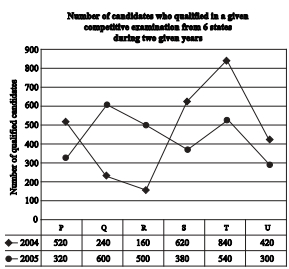
Refer to the line graph and answer the given question.
Number of candidates who qualified in a given competitive examination from $6$ states during two given years.
What is the average number of candidates who qualified in the given competitive exam from states $Q, S, T$ and $U$ in $2004$?
Number of candidates who qualified in a given competitive examination from $6$ states during two given years.
What is the average number of candidates who qualified in the given competitive exam from states $Q, S, T$ and $U$ in $2004$?
A
$530$
B
$70$
C
$550$
D
$490$
Solution
(A) To find the average number of candidates who qualified in $2004$ from states $Q, S, T,$ and $U$,we first identify the values from the provided table for the year $2004$:
State $Q = 240$
State $S = 620$
State $T = 840$
State $U = 420$
Now,calculate the sum of these candidates:
Sum $= 240 + 620 + 840 + 420 = 2120$
Since there are $4$ states,the average is:
Average $= \frac{\text{Sum}}{\text{Number of states}} = \frac{2120}{4} = 530$
Thus,the average number of candidates is $530$.
State $Q = 240$
State $S = 620$
State $T = 840$
State $U = 420$
Now,calculate the sum of these candidates:
Sum $= 240 + 620 + 840 + 420 = 2120$
Since there are $4$ states,the average is:
Average $= \frac{\text{Sum}}{\text{Number of states}} = \frac{2120}{4} = 530$
Thus,the average number of candidates is $530$.
0 likes
View Solution326
MediumMCQ
The average weight of $15$ oarsmen in a boat is increased by $1.6\, kg$ when one of the crew,who weighs $42\, kg$,is replaced by a new man. Find the weight of the new man (in $kg$).
A
$65$
B
$66$
C
$43$
D
$67$
Solution
(B) Let the average weight of the $15$ oarsmen be $A\, kg$.
Total weight of the $15$ oarsmen $= 15A\, kg$.
When a man weighing $42\, kg$ is replaced by a new man of weight $x\, kg$,the new total weight becomes $(15A - 42 + x)\, kg$.
The new average weight is $(A + 1.6)\, kg$.
Therefore,the new total weight is $15(A + 1.6)\, kg$.
Equating the two expressions for the total weight:
$15A - 42 + x = 15(A + 1.6)$
$15A - 42 + x = 15A + 24$
$x = 42 + 24$
$x = 66\, kg$.
Thus,the weight of the new man is $66\, kg$.
Total weight of the $15$ oarsmen $= 15A\, kg$.
When a man weighing $42\, kg$ is replaced by a new man of weight $x\, kg$,the new total weight becomes $(15A - 42 + x)\, kg$.
The new average weight is $(A + 1.6)\, kg$.
Therefore,the new total weight is $15(A + 1.6)\, kg$.
Equating the two expressions for the total weight:
$15A - 42 + x = 15(A + 1.6)$
$15A - 42 + x = 15A + 24$
$x = 42 + 24$
$x = 66\, kg$.
Thus,the weight of the new man is $66\, kg$.
0 likes
View Solution327
MediumMCQ
The average of five consecutive positive integers is $n$. If the next two integers are also included,the average of all these integers will
A
increase by $1.5$
B
increase by $2$
C
increase by $1$
D
remain the same
Solution
(C) Let the five consecutive integers be $x, x+1, x+2, x+3, x+4$.
The average of these five integers is given by $\frac{x + (x+1) + (x+2) + (x+3) + (x+4)}{5} = \frac{5x + 10}{5} = x + 2$.
Given that the average is $n$,so $n = x + 2$.
Now,if the next two integers ($x+5$ and $x+6$) are included,the total number of integers becomes $7$.
The sum of these seven integers is $(5x + 10) + (x+5) + (x+6) = 7x + 21$.
The new average is $\frac{7x + 21}{7} = x + 3$.
Since the original average was $n = x + 2$,the new average $x + 3$ can be written as $(x + 2) + 1 = n + 1$.
Therefore,the average increases by $1$.
The average of these five integers is given by $\frac{x + (x+1) + (x+2) + (x+3) + (x+4)}{5} = \frac{5x + 10}{5} = x + 2$.
Given that the average is $n$,so $n = x + 2$.
Now,if the next two integers ($x+5$ and $x+6$) are included,the total number of integers becomes $7$.
The sum of these seven integers is $(5x + 10) + (x+5) + (x+6) = 7x + 21$.
The new average is $\frac{7x + 21}{7} = x + 3$.
Since the original average was $n = x + 2$,the new average $x + 3$ can be written as $(x + 2) + 1 = n + 1$.
Therefore,the average increases by $1$.
0 likes
View Solution328
MediumMCQ
In an examination,the average marks obtained by the girls of a class is $85$ and the average marks obtained by the boys of the same class is $87$. If the girls and boys are in the ratio $4:5$,the average marks of the whole class (approx.) is closest to:
A
$85.9$
B
$86.5$
C
$86.4$
D
$86.1$
Solution
(D) Let the number of girls be $4x$ and the number of boys be $5x$.
The total marks obtained by girls $= 85 \times 4x = 340x$.
The total marks obtained by boys $= 87 \times 5x = 435x$.
The total number of students $= 4x + 5x = 9x$.
The average marks of the whole class $= \frac{\text{Total marks of girls} + \text{Total marks of boys}}{\text{Total number of students}}$.
Average $= \frac{340x + 435x}{9x} = \frac{775x}{9x} = \frac{775}{9}$.
Average $\approx 86.11$.
Therefore,the average marks of the whole class is closest to $86.1$.
The total marks obtained by girls $= 85 \times 4x = 340x$.
The total marks obtained by boys $= 87 \times 5x = 435x$.
The total number of students $= 4x + 5x = 9x$.
The average marks of the whole class $= \frac{\text{Total marks of girls} + \text{Total marks of boys}}{\text{Total number of students}}$.
Average $= \frac{340x + 435x}{9x} = \frac{775x}{9x} = \frac{775}{9}$.
Average $\approx 86.11$.
Therefore,the average marks of the whole class is closest to $86.1$.
0 likes
View Solution329
DifficultMCQ
Out of four numbers,the average of the first three is $16$ and that of the last three is $15$. If the last number is $20$,then the first number is:
A
$21$
B
$23$
C
$28$
D
$25$
Solution
(B) Let the $4$ numbers be $a, b, c, d$.
The average of the first three numbers $(a, b, c)$ is $16$,so:
$(a + b + c) / 3 = 16$
$a + b + c = 48$ --- (Equation $1$)
The average of the last three numbers $(b, c, d)$ is $15$,so:
$(b + c + d) / 3 = 15$
$b + c + d = 45$ --- (Equation $2$)
Subtracting Equation $2$ from Equation $1$:
$(a + b + c) - (b + c + d) = 48 - 45$
$a - d = 3$
Given that the last number $d = 20$,substitute this value into the equation:
$a - 20 = 3$
$a = 23$
Therefore,the first number is $23$.
The average of the first three numbers $(a, b, c)$ is $16$,so:
$(a + b + c) / 3 = 16$
$a + b + c = 48$ --- (Equation $1$)
The average of the last three numbers $(b, c, d)$ is $15$,so:
$(b + c + d) / 3 = 15$
$b + c + d = 45$ --- (Equation $2$)
Subtracting Equation $2$ from Equation $1$:
$(a + b + c) - (b + c + d) = 48 - 45$
$a - d = 3$
Given that the last number $d = 20$,substitute this value into the equation:
$a - 20 = 3$
$a = 23$
Therefore,the first number is $23$.
0 likes
View Solution330
MediumMCQ
$A$ librarian purchased $50$ storybooks for his library. He realized that he could get $14$ more books by spending $Rs. 76$ more,and the average price per book would be reduced by $Rs. 1$. What was the average price (in $Rs.$) of each book he initially bought?
A
$20$
B
$25$
C
$15$
D
$10$
Solution
(D) Let the initial average price of one book be $Rs. x$.
Total cost of $50$ books $= 50x$.
If he spends $Rs. 76$ more,the total cost becomes $(50x + 76)$ and the total number of books becomes $(50 + 14) = 64$.
The new average price is $(x - 1)$.
According to the problem: $\frac{50x + 76}{64} = x - 1$.
$50x + 76 = 64(x - 1)$.
$50x + 76 = 64x - 64$.
$64x - 50x = 76 + 64$.
$14x = 140$.
$x = 10$.
Therefore,the average price of each book he initially bought was $Rs. 10$.
Total cost of $50$ books $= 50x$.
If he spends $Rs. 76$ more,the total cost becomes $(50x + 76)$ and the total number of books becomes $(50 + 14) = 64$.
The new average price is $(x - 1)$.
According to the problem: $\frac{50x + 76}{64} = x - 1$.
$50x + 76 = 64(x - 1)$.
$50x + 76 = 64x - 64$.
$64x - 50x = 76 + 64$.
$14x = 140$.
$x = 10$.
Therefore,the average price of each book he initially bought was $Rs. 10$.
0 likes
View Solution331
DifficultMCQ
The average weight of $3$ men $A, B,$ and $C$ is $84 \, kg$. Another man $D$ joins the group and the average weight now becomes $80 \, kg$. If another man $E$,whose weight is $3 \, kg$ more than that of $D$,replaces $A$,then the average weight of $B, C, D,$ and $E$ becomes $79 \, kg$. The weight of $A$ in $kg$ is:
A
$80$
B
$72$
C
$70$
D
$75$
Solution
(D) The sum of weights of $A, B,$ and $C$ is $3 \times 84 = 252 \, kg$.
When $D$ joins,the total weight of $A, B, C,$ and $D$ is $4 \times 80 = 320 \, kg$.
Therefore,the weight of $D = 320 - 252 = 68 \, kg$.
The weight of $E = D + 3 = 68 + 3 = 71 \, kg$.
When $E$ replaces $A$,the new group is $B, C, D,$ and $E$. The sum of their weights is $4 \times 79 = 316 \, kg$.
So,$B + C + D + E = 316$.
Substituting the values of $D$ and $E$: $B + C + 68 + 71 = 316$.
$B + C + 139 = 316 \implies B + C = 316 - 139 = 177 \, kg$.
Since $A + B + C = 252$,we have $A + 177 = 252$.
Therefore,$A = 252 - 177 = 75 \, kg$.
When $D$ joins,the total weight of $A, B, C,$ and $D$ is $4 \times 80 = 320 \, kg$.
Therefore,the weight of $D = 320 - 252 = 68 \, kg$.
The weight of $E = D + 3 = 68 + 3 = 71 \, kg$.
When $E$ replaces $A$,the new group is $B, C, D,$ and $E$. The sum of their weights is $4 \times 79 = 316 \, kg$.
So,$B + C + D + E = 316$.
Substituting the values of $D$ and $E$: $B + C + 68 + 71 = 316$.
$B + C + 139 = 316 \implies B + C = 316 - 139 = 177 \, kg$.
Since $A + B + C = 252$,we have $A + 177 = 252$.
Therefore,$A = 252 - 177 = 75 \, kg$.
0 likes
View Solution332
DifficultMCQ
The frequency distribution data is given below. If the average age is $17 \text{ years}$,the value of $m$ is:
| Age (in years) | $8, 20, 26, 29$ |
| Number of People | $3, 2, m, 1$ |
A
$1$
B
$2$
C
$3$
D
$4$
Solution
(A) The formula for the weighted average is given by:
$\text{Average} = \frac{\sum (x_i \cdot f_i)}{\sum f_i}$
Given the data:
$\text{Sum of products} = (8 \times 3) + (20 \times 2) + (26 \times m) + (29 \times 1) = 24 + 40 + 26m + 29 = 93 + 26m$
$\text{Sum of frequencies} = 3 + 2 + m + 1 = 6 + m$
Given that the average is $17$,we have:
$17 = \frac{93 + 26m}{6 + m}$
Multiplying both sides by $(6 + m)$:
$17(6 + m) = 93 + 26m$
$102 + 17m = 93 + 26m$
Rearranging the terms to solve for $m$:
$102 - 93 = 26m - 17m$
$9 = 9m$
$m = 1$
$\text{Average} = \frac{\sum (x_i \cdot f_i)}{\sum f_i}$
Given the data:
$\text{Sum of products} = (8 \times 3) + (20 \times 2) + (26 \times m) + (29 \times 1) = 24 + 40 + 26m + 29 = 93 + 26m$
$\text{Sum of frequencies} = 3 + 2 + m + 1 = 6 + m$
Given that the average is $17$,we have:
$17 = \frac{93 + 26m}{6 + m}$
Multiplying both sides by $(6 + m)$:
$17(6 + m) = 93 + 26m$
$102 + 17m = 93 + 26m$
Rearranging the terms to solve for $m$:
$102 - 93 = 26m - 17m$
$9 = 9m$
$m = 1$
0 likes
View Solution333
DifficultMCQ
The average monthly expenditure of a family for the first four months is $Rs.\, 2570$,for the next three months $Rs.\, 2490$ and for the last five months $Rs.\, 3030$. If the family saves $Rs.\, 5320$ during the whole year,the average monthly income of the family during the year is (in $Rs.$)
A
$3000$
B
$3185$
C
$3200$
D
$3580$
Solution
(B) Total annual expenditure of the family = $(4 \times 2570) + (3 \times 2490) + (5 \times 3030)$
= $10,280 + 7,470 + 15,150 = Rs.\, 32,900$
Total annual income = Total annual expenditure + Total annual savings
= $32,900 + 5,320 = Rs.\, 38,220$
Average monthly income = $\frac{\text{Total annual income}}{12}$
= $\frac{38,220}{12} = Rs.\, 3,185$
= $10,280 + 7,470 + 15,150 = Rs.\, 32,900$
Total annual income = Total annual expenditure + Total annual savings
= $32,900 + 5,320 = Rs.\, 38,220$
Average monthly income = $\frac{\text{Total annual income}}{12}$
= $\frac{38,220}{12} = Rs.\, 3,185$
0 likes
View Solution334
DifficultMCQ
$A$ man spends $Rs. 1800$ monthly on an average for the first four months and $Rs. 2000$ monthly for the next eight months and saves $Rs. 5600$ a year. His average monthly income is (in $Rs.$)
A
$2000$
B
$2200$
C
$2400$
D
$2600$
Solution
(C) Total expenditure of the man in a year is calculated as follows:
Expenditure for the first $4$ months $= 4 \times 1800 = Rs. 7200$.
Expenditure for the next $8$ months $= 8 \times 2000 = Rs. 16000$.
Total annual expenditure $= 7200 + 16000 = Rs. 23200$.
Total annual income is the sum of total expenditure and annual savings:
Total annual income $= 23200 + 5600 = Rs. 28800$.
Average monthly income $= \frac{\text{Total annual income}}{12} = \frac{28800}{12} = Rs. 2400$.
Expenditure for the first $4$ months $= 4 \times 1800 = Rs. 7200$.
Expenditure for the next $8$ months $= 8 \times 2000 = Rs. 16000$.
Total annual expenditure $= 7200 + 16000 = Rs. 23200$.
Total annual income is the sum of total expenditure and annual savings:
Total annual income $= 23200 + 5600 = Rs. 28800$.
Average monthly income $= \frac{\text{Total annual income}}{12} = \frac{28800}{12} = Rs. 2400$.
0 likes
View Solution335
MediumMCQ
The arithmetic mean of the following numbers is $1, 2, 2, 3, 3, 3, 4, 4, 4, 4, 5, 5, 5, 5, 5, 6, 6, 6, 6, 6, 6, 7, 7, 7, 7, 7, 7, 7$.
A
$4$
B
$5$
C
$14$
D
$20$
Solution
(B) The arithmetic mean is calculated by dividing the sum of all observations by the total number of observations.
Sum of observations $= (1 \times 1) + (2 \times 2) + (3 \times 3) + (4 \times 4) + (5 \times 5) + (6 \times 6) + (7 \times 7)$
Sum $= 1 + 4 + 9 + 16 + 25 + 36 + 49 = 140$
Total number of observations $= 1 + 2 + 3 + 4 + 5 + 6 + 7 = 28$
Arithmetic Mean $= \frac{140}{28} = 5$.
Sum of observations $= (1 \times 1) + (2 \times 2) + (3 \times 3) + (4 \times 4) + (5 \times 5) + (6 \times 6) + (7 \times 7)$
Sum $= 1 + 4 + 9 + 16 + 25 + 36 + 49 = 140$
Total number of observations $= 1 + 2 + 3 + 4 + 5 + 6 + 7 = 28$
Arithmetic Mean $= \frac{140}{28} = 5$.
0 likes
View Solution336
EasyMCQ
The average of six numbers is $20$. If one number is removed,the average becomes $15$. What is the number removed?
A
$5$
B
$35$
C
$112$
D
$45$
Solution
(D) The sum of six numbers is $6 \times 20 = 120$.
After removing one number,there are five numbers remaining.
The sum of these five numbers is $5 \times 15 = 75$.
The removed number is the difference between the initial sum and the new sum.
Removed number $= 120 - 75 = 45$.
After removing one number,there are five numbers remaining.
The sum of these five numbers is $5 \times 15 = 75$.
The removed number is the difference between the initial sum and the new sum.
Removed number $= 120 - 75 = 45$.
0 likes
View Solution337
DifficultMCQ
$A$ professional institute's total expenditure on students for a particular course is partly fixed and partly varies linearly with the number of students. The average expense per student is $Rs.\,615$ when there are $24$ students and $Rs.\,465$ when there are $40$ students. What is the average expense when there are $60$ students? (in $Rs.$)
A
$370$
B
$450$
C
$350$
D
$390$
Solution
(D) Let the fixed expenditure be $x$ and the variable expenditure per student be $y$.
Total expenditure for $n$ students is given by $E = x + ny$.
The average expense per student is $A = \frac{E}{n} = \frac{x}{n} + y$.
For $24$ students,$A = 615$,so $\frac{x}{24} + y = 615 \Rightarrow x + 24y = 14760$ ...$(1)$
For $40$ students,$A = 465$,so $\frac{x}{40} + y = 465 \Rightarrow x + 40y = 18600$ ...$(2)$
Subtracting equation $(1)$ from $(2)$:
$(x + 40y) - (x + 24y) = 18600 - 14760$
$16y = 3840 \Rightarrow y = 240$.
Substituting $y = 240$ into equation $(1)$:
$x + 24(240) = 14760$
$x + 5760 = 14760 \Rightarrow x = 9000$.
For $60$ students,the average expense is:
$A = \frac{x}{60} + y = \frac{9000}{60} + 240 = 150 + 240 = 390$.
Thus,the average expense is $Rs.\,390$.
Total expenditure for $n$ students is given by $E = x + ny$.
The average expense per student is $A = \frac{E}{n} = \frac{x}{n} + y$.
For $24$ students,$A = 615$,so $\frac{x}{24} + y = 615 \Rightarrow x + 24y = 14760$ ...$(1)$
For $40$ students,$A = 465$,so $\frac{x}{40} + y = 465 \Rightarrow x + 40y = 18600$ ...$(2)$
Subtracting equation $(1)$ from $(2)$:
$(x + 40y) - (x + 24y) = 18600 - 14760$
$16y = 3840 \Rightarrow y = 240$.
Substituting $y = 240$ into equation $(1)$:
$x + 24(240) = 14760$
$x + 5760 = 14760 \Rightarrow x = 9000$.
For $60$ students,the average expense is:
$A = \frac{x}{60} + y = \frac{9000}{60} + 240 = 150 + 240 = 390$.
Thus,the average expense is $Rs.\,390$.
0 likes
View Solution338
DifficultMCQ
The average marks obtained by $40$ students of a class is $86$. If the $5$ highest marks are removed,the average reduces by $1$ mark. The average marks of the top $5$ students is
A
$92$
B
$96$
C
$93$
D
$97$
Solution
(C) Total marks of $40$ students $= 40 \times 86 = 3440$.
When the $5$ highest marks are removed,the number of students becomes $40 - 5 = 35$.
The new average is $86 - 1 = 85$.
Total marks of the remaining $35$ students $= 35 \times 85 = 2975$.
Total marks of the top $5$ students $= 3440 - 2975 = 465$.
Average marks of the top $5$ students $= \frac{465}{5} = 93$.
When the $5$ highest marks are removed,the number of students becomes $40 - 5 = 35$.
The new average is $86 - 1 = 85$.
Total marks of the remaining $35$ students $= 35 \times 85 = 2975$.
Total marks of the top $5$ students $= 3440 - 2975 = 465$.
Average marks of the top $5$ students $= \frac{465}{5} = 93$.
0 likes
View Solution339
DifficultMCQ
$A$ student finds the average of $10$ two-digit numbers. If the digits of one of the numbers are interchanged,the average increases by $3.6$. The difference between the digits of that two-digit number is:
A
$4$
B
$3$
C
$2$
D
$5$
Solution
(A) Let the average of the $10$ numbers be $y$.
Then,the sum of the $10$ numbers is $10y$.
When the digits of one number are interchanged,the new average becomes $y + 3.6$.
Therefore,the new sum of the $10$ numbers is $10(y + 3.6) = 10y + 36$.
The increase in the sum is $(10y + 36) - 10y = 36$.
Let the two-digit number be $10a + b$,where $a$ is the tens digit and $b$ is the units digit.
After interchanging the digits,the new number is $10b + a$.
The difference between the new number and the original number is $(10b + a) - (10a + b) = 9b - 9a = 9(b - a)$.
Since the increase in the total sum is $36$,we have $9(b - a) = 36$.
Dividing both sides by $9$,we get $b - a = 4$.
Then,the sum of the $10$ numbers is $10y$.
When the digits of one number are interchanged,the new average becomes $y + 3.6$.
Therefore,the new sum of the $10$ numbers is $10(y + 3.6) = 10y + 36$.
The increase in the sum is $(10y + 36) - 10y = 36$.
Let the two-digit number be $10a + b$,where $a$ is the tens digit and $b$ is the units digit.
After interchanging the digits,the new number is $10b + a$.
The difference between the new number and the original number is $(10b + a) - (10a + b) = 9b - 9a = 9(b - a)$.
Since the increase in the total sum is $36$,we have $9(b - a) = 36$.
Dividing both sides by $9$,we get $b - a = 4$.
0 likes
View Solution340
MediumMCQ
Out of $30$ teachers of a school,a teacher of age $60$ $years$ retired. In his place another teacher of age $30$ $years$ was appointed. As a result,the mean age of the teachers will
A
remain same
B
decrease by $2$ years
C
decrease by $6$ months
D
decrease by $1$ year
Solution
(D) Let the initial sum of the ages of $30$ teachers be $S$.
The initial mean age is $\frac{S}{30}$.
When a teacher of age $60$ $years$ retires and a teacher of age $30$ $years$ is appointed,the new sum of ages becomes $S - 60 + 30 = S - 30$.
The number of teachers remains $30$.
The new mean age is $\frac{S - 30}{30} = \frac{S}{30} - 1$.
Therefore,the mean age decreases by $1$ $year$.
The initial mean age is $\frac{S}{30}$.
When a teacher of age $60$ $years$ retires and a teacher of age $30$ $years$ is appointed,the new sum of ages becomes $S - 60 + 30 = S - 30$.
The number of teachers remains $30$.
The new mean age is $\frac{S - 30}{30} = \frac{S}{30} - 1$.
Therefore,the mean age decreases by $1$ $year$.
0 likes
View Solution341
DifficultMCQ
Average age of $A, B$ and $C$ is $84 \text{ years}$. When $D$ joins them,the average age becomes $80 \text{ years}$. $A$ new person,$E$,whose age is $4 \text{ years}$ more than $D$,replaces $A$ and the average of $B, C, D$ and $E$ becomes $78 \text{ years}$. What is the age of $A$ (in $\text{years}$)?
A
$80$
B
$50$
C
$60$
D
$70$
Solution
(A) The average age of $A, B$ and $C$ is $84 \text{ years}$,so $A + B + C = 84 \times 3 = 252$ ......$(1)$
When $D$ joins,the average age of $A, B, C$ and $D$ becomes $80 \text{ years}$,so $A + B + C + D = 80 \times 4 = 320$ ......$(2)$
Subtracting $(1)$ from $(2)$,we get $D = 320 - 252 = 68 \text{ years}$.
Given that $E$ is $4 \text{ years}$ older than $D$,so $E = 68 + 4 = 72 \text{ years}$.
When $E$ replaces $A$,the new average of $B, C, D$ and $E$ is $78 \text{ years}$,so $B + C + D + E = 78 \times 4 = 312$.
Substituting the values of $D$ and $E$,we get $B + C + 68 + 72 = 312$,which simplifies to $B + C + 140 = 312$,so $B + C = 172$ ......$(3)$
Finally,substituting $(3)$ into $(1)$,we get $A + 172 = 252$,so $A = 252 - 172 = 80 \text{ years}$.
When $D$ joins,the average age of $A, B, C$ and $D$ becomes $80 \text{ years}$,so $A + B + C + D = 80 \times 4 = 320$ ......$(2)$
Subtracting $(1)$ from $(2)$,we get $D = 320 - 252 = 68 \text{ years}$.
Given that $E$ is $4 \text{ years}$ older than $D$,so $E = 68 + 4 = 72 \text{ years}$.
When $E$ replaces $A$,the new average of $B, C, D$ and $E$ is $78 \text{ years}$,so $B + C + D + E = 78 \times 4 = 312$.
Substituting the values of $D$ and $E$,we get $B + C + 68 + 72 = 312$,which simplifies to $B + C + 140 = 312$,so $B + C = 172$ ......$(3)$
Finally,substituting $(3)$ into $(1)$,we get $A + 172 = 252$,so $A = 252 - 172 = 80 \text{ years}$.
0 likes
View Solution342
DifficultMCQ
The average of $50$ numbers is $38$. If two numbers,namely $45$ and $55$,are discarded,the average of the remaining numbers is
A
$36.5$
B
$37.0$
C
$37.5$
D
$37.9$
Solution
(C) Average $= \frac{\text{Sum of elements}}{\text{Number of elements}}$
Given,initial number of elements $= 50$.
Initial average $= 38$.
Sum of $50$ numbers $= 50 \times 38 = 1900$.
When two numbers $45$ and $55$ are discarded,the new sum of the remaining numbers is:
Sum $= 1900 - (45 + 55) = 1900 - 100 = 1800$.
The number of remaining elements $= 50 - 2 = 48$.
New average $= \frac{1800}{48} = 37.5$.
Given,initial number of elements $= 50$.
Initial average $= 38$.
Sum of $50$ numbers $= 50 \times 38 = 1900$.
When two numbers $45$ and $55$ are discarded,the new sum of the remaining numbers is:
Sum $= 1900 - (45 + 55) = 1900 - 100 = 1800$.
The number of remaining elements $= 50 - 2 = 48$.
New average $= \frac{1800}{48} = 37.5$.
0 likes
View Solution343
DifficultMCQ
The average salary,per head,of all the workers of an institution is $Rs.\, 60$. The average salary of $12$ officers is $Rs.\, 400$; the average salary,per head,of the rest is $Rs.\, 56$. The total number of workers in the institution is:
A
$1020$
B
$1032$
C
$1030$
D
$1035$
Solution
(B) Let the total number of workers in the institution be $Z$.
The total salary of all workers is given by the product of the average salary and the total number of workers: $60Z$.
The total salary of $12$ officers is $12 \times 400 = 4800$.
The number of remaining workers is $(Z - 12)$,and their average salary is $56$. Thus,the total salary of the remaining workers is $56(Z - 12)$.
The sum of the total salary of the officers and the remaining workers must equal the total salary of all workers:
$4800 + 56(Z - 12) = 60Z$
Expanding the equation:
$4800 + 56Z - 672 = 60Z$
$4128 + 56Z = 60Z$
$60Z - 56Z = 4128$
$4Z = 4128$
$Z = \frac{4128}{4} = 1032$
Therefore,the total number of workers in the institution is $1032$.
The total salary of all workers is given by the product of the average salary and the total number of workers: $60Z$.
The total salary of $12$ officers is $12 \times 400 = 4800$.
The number of remaining workers is $(Z - 12)$,and their average salary is $56$. Thus,the total salary of the remaining workers is $56(Z - 12)$.
The sum of the total salary of the officers and the remaining workers must equal the total salary of all workers:
$4800 + 56(Z - 12) = 60Z$
Expanding the equation:
$4800 + 56Z - 672 = 60Z$
$4128 + 56Z = 60Z$
$60Z - 56Z = 4128$
$4Z = 4128$
$Z = \frac{4128}{4} = 1032$
Therefore,the total number of workers in the institution is $1032$.
0 likes
View Solution344
DifficultMCQ
The average of first three numbers is double of the fourth number. If the average of all the four numbers is $12,$ find the $4^{th}$ number.
A
$16$
B
$\frac{48}{7}$
C
$20$
D
$\frac{18}{7}$
Solution
(B) Let the four numbers be $a, b, c,$ and $d.$
According to the problem,the average of the first three numbers is double the fourth number:
$\frac{a+b+c}{3} = 2d$
$\Rightarrow a+b+c = 6d$ ....$(1)$
The average of all four numbers is $12$:
$\frac{a+b+c+d}{4} = 12$
$\Rightarrow a+b+c+d = 48$ ....$(2)$
Substitute the value of $(a+b+c)$ from equation $(1)$ into equation $(2)$:
$6d + d = 48$
$7d = 48$
$d = \frac{48}{7}$
According to the problem,the average of the first three numbers is double the fourth number:
$\frac{a+b+c}{3} = 2d$
$\Rightarrow a+b+c = 6d$ ....$(1)$
The average of all four numbers is $12$:
$\frac{a+b+c+d}{4} = 12$
$\Rightarrow a+b+c+d = 48$ ....$(2)$
Substitute the value of $(a+b+c)$ from equation $(1)$ into equation $(2)$:
$6d + d = 48$
$7d = 48$
$d = \frac{48}{7}$
0 likes
View Solution345
EasyMCQ
If the average of $6$ consecutive even numbers is $25,$ the difference between the largest and the smallest number is
A
$18$
B
$10$
C
$12$
D
$14$
Solution
(B) Let the $6$ consecutive even numbers be $x, x+2, x+4, x+6, x+8,$ and $x+10$.
The average of these numbers is given by the sum divided by the count:
$\text{Average} = \frac{x + (x+2) + (x+4) + (x+6) + (x+8) + (x+10)}{6} = 25$
Simplify the numerator:
$\frac{6x + 30}{6} = 25$
$x + 5 = 25$
$x = 20$
The smallest number is $x = 20$ and the largest number is $x + 10 = 30$.
The difference between the largest and the smallest number is $30 - 20 = 10$.
The average of these numbers is given by the sum divided by the count:
$\text{Average} = \frac{x + (x+2) + (x+4) + (x+6) + (x+8) + (x+10)}{6} = 25$
Simplify the numerator:
$\frac{6x + 30}{6} = 25$
$x + 5 = 25$
$x = 20$
The smallest number is $x = 20$ and the largest number is $x + 10 = 30$.
The difference between the largest and the smallest number is $30 - 20 = 10$.
0 likes
View Solution346
EasyMCQ
The arithmetic mean of $100$ observations is $24$. If $6$ is added to each of the observations and then each of them is multiplied by $2.5$,find the new arithmetic mean.
A
$30$
B
$75$
C
$35$
D
$60$
Solution
(B) Let the initial arithmetic mean be $\bar{x} = 24$.
When a constant value $k$ is added to each observation,the new mean becomes $\bar{x} + k$.
Here,$k = 6$,so the new mean after addition is $24 + 6 = 30$.
When each observation is multiplied by a constant factor $m$,the new mean becomes $\text{mean} \times m$.
Here,$m = 2.5$,so the final mean is $30 \times 2.5 = 75$.
When a constant value $k$ is added to each observation,the new mean becomes $\bar{x} + k$.
Here,$k = 6$,so the new mean after addition is $24 + 6 = 30$.
When each observation is multiplied by a constant factor $m$,the new mean becomes $\text{mean} \times m$.
Here,$m = 2.5$,so the final mean is $30 \times 2.5 = 75$.
0 likes
View Solution347
MediumMCQ
Sachin Tendulkar has a certain average for $11$ innings. In the $12^{th}$ innings he scores $120$ runs and thereby increases his average by $5$ runs. His new average is
A
$60$
B
$62$
C
$65$
D
$66$
Solution
(C) Let the new average after $12$ innings be $x$ runs.
Then,the average after $11$ innings was $(x - 5)$ runs.
Total runs scored in $11$ innings $= 11(x - 5)$.
In the $12^{th}$ innings,he scores $120$ runs,so the total runs after $12$ innings $= 11(x - 5) + 120$.
According to the problem,the average after $12$ innings is $x$,so the total runs $= 12x$.
Equating the two expressions for total runs:
$11(x - 5) + 120 = 12x$
$11x - 55 + 120 = 12x$
$11x + 65 = 12x$
$x = 65$.
Therefore,his new average is $65$ runs.
Then,the average after $11$ innings was $(x - 5)$ runs.
Total runs scored in $11$ innings $= 11(x - 5)$.
In the $12^{th}$ innings,he scores $120$ runs,so the total runs after $12$ innings $= 11(x - 5) + 120$.
According to the problem,the average after $12$ innings is $x$,so the total runs $= 12x$.
Equating the two expressions for total runs:
$11(x - 5) + 120 = 12x$
$11x - 55 + 120 = 12x$
$11x + 65 = 12x$
$x = 65$.
Therefore,his new average is $65$ runs.
0 likes
View Solution348
EasyMCQ
The average of $11$ results is $50$. If the average of the first six results is $49$ and that of the last six is $52$,the sixth result is:
A
$48$
B
$50$
C
$52$
D
$56$
Solution
(D) The sum of $11$ results is $11 \times 50 = 550$.
The sum of the first $6$ results is $6 \times 49 = 294$.
The sum of the last $6$ results is $6 \times 52 = 312$.
The sixth result is counted twice when we add the sum of the first $6$ results and the last $6$ results.
Therefore,the sixth result $= (294 + 312) - 550 = 606 - 550 = 56$.
The sum of the first $6$ results is $6 \times 49 = 294$.
The sum of the last $6$ results is $6 \times 52 = 312$.
The sixth result is counted twice when we add the sum of the first $6$ results and the last $6$ results.
Therefore,the sixth result $= (294 + 312) - 550 = 606 - 550 = 56$.
0 likes
View Solution349
MediumMCQ
There are two groups $A$ and $B$ of a class,consisting of $42$ and $28$ students,respectively. If the average weight of group $A$ is $25 \, kg$ and that of group $B$ is $40 \, kg$,find the average weight of the whole class.
A
$69$
B
$31$
C
$70$
D
$30$
Solution
(B) The total weight of group $A$ is $42 \times 25 = 1050 \, kg$.
The total weight of group $B$ is $28 \times 40 = 1120 \, kg$.
The total number of students in the class is $42 + 28 = 70$.
The average weight of the whole class is calculated as the sum of total weights divided by the total number of students:
$\text{Average weight} = \frac{1050 + 1120}{70} = \frac{2170}{70} = 31 \, kg$.
The total weight of group $B$ is $28 \times 40 = 1120 \, kg$.
The total number of students in the class is $42 + 28 = 70$.
The average weight of the whole class is calculated as the sum of total weights divided by the total number of students:
$\text{Average weight} = \frac{1050 + 1120}{70} = \frac{2170}{70} = 31 \, kg$.
0 likes
View Solution350
DifficultMCQ
The average monthly salary of all the employees in an industry is $Rs. 12,000$. The average salary of male employees is $Rs. 15,000$ and that of female employees is $Rs. 8,000$. What is the ratio of male employees to female employees?
A
$5:2$
B
$3:4$
C
$4:3$
D
$2:5$
Solution
(C) Let the number of male employees be $x$ and the number of female employees be $y$.
The total salary of all employees is the sum of the total salary of male employees and the total salary of female employees.
According to the problem:
$(x + y) \times 12,000 = (x \times 15,000) + (y \times 8,000)$
Dividing both sides by $1,000$:
$(x + y) \times 12 = 15x + 8y$
Expanding the equation:
$12x + 12y = 15x + 8y$
Rearranging the terms to solve for the ratio $x/y$:
$12y - 8y = 15x - 12x$
$4y = 3x$
Therefore,the ratio of male employees to female employees is:
$\frac{x}{y} = \frac{4}{3}$ or $4:3$.
The total salary of all employees is the sum of the total salary of male employees and the total salary of female employees.
According to the problem:
$(x + y) \times 12,000 = (x \times 15,000) + (y \times 8,000)$
Dividing both sides by $1,000$:
$(x + y) \times 12 = 15x + 8y$
Expanding the equation:
$12x + 12y = 15x + 8y$
Rearranging the terms to solve for the ratio $x/y$:
$12y - 8y = 15x - 12x$
$4y = 3x$
Therefore,the ratio of male employees to female employees is:
$\frac{x}{y} = \frac{4}{3}$ or $4:3$.
0 likes
View SolutionAverage — Average · Frequently Asked Questions
1Are these Average questions useful for JEE and NEET?
Yes. All questions in this section are mapped to JEE Main and NEET exam patterns. Previous year questions from JEE Main, NEET, GUJCET and state-level exams are included with full solutions.
2Can I switch to Hindi or Gujarati for these questions?
Yes. Use the language tabs in the hero section or the sidebar to view the same questions and solutions in English, Hindi or Gujarati.
3How do I generate a question paper from this subtopic?
Use the Vedclass Exam Paper Generator — select the chapter and subtopic, set difficulty, and generate Sets A, B, C, D automatically. First 3 chapters of every subject are free.
Vedclass Products
For Students
Vedclass Test Series
Mock tests in real JEE/NEET style with performance analysis. 5-day free trial.
Start Free TrialFor Teachers
Exam Paper Generator
Generate Set A/B/C/D papers from this chapter in 2 minutes. 3 chapters free.
Try FreeFor Institutes
Online Exam Module
Live online exams with unlimited students, 360° analytics & white-label branding.
See DemoFor Teachers & Institutes
Generate a Average Exam Paper in 2 Minutes
Select subtopic & difficulty — Sets A, B, C, D auto-generated with No Repeat logic.
First 3 chapters of every subject are free — no payment required.