
A English
QUADRATIC EQUATION Questions in English
Competitive Exam Quantitative Aptitude · Algebra · QUADRATIC EQUATION
717+
Questions
English
Language
100%
With Solutions
Showing 50 of 717 questions in English
251
MediumMCQ
The solution of the inequality $2x^2 + 3x - 9 \le 0$ is given by
A
$3/2 \le x \le 3$
B
$-3 \le x \le 3/2$
C
$-3 \le x \le 3$
D
$3/2 \le x \le 2$
Solution
(B) Given inequality: $2x^2 + 3x - 9 \le 0$
Factorizing the quadratic expression: $2x^2 + 6x - 3x - 9 \le 0$
$2x(x + 3) - 3(x + 3) \le 0$
$(2x - 3)(x + 3) \le 0$
The roots of the equation $2x^2 + 3x - 9 = 0$ are $x = 3/2$ and $x = -3$.
For a quadratic expression $ax^2 + bx + c \le 0$ where $a > 0$,the solution lies between the roots,i.e.,$\text{root}_1 \le x \le \text{root}_2$.
Thus,the solution is $-3 \le x \le 3/2$.
Factorizing the quadratic expression: $2x^2 + 6x - 3x - 9 \le 0$
$2x(x + 3) - 3(x + 3) \le 0$
$(2x - 3)(x + 3) \le 0$
The roots of the equation $2x^2 + 3x - 9 = 0$ are $x = 3/2$ and $x = -3$.
For a quadratic expression $ax^2 + bx + c \le 0$ where $a > 0$,the solution lies between the roots,i.e.,$\text{root}_1 \le x \le \text{root}_2$.
Thus,the solution is $-3 \le x \le 3/2$.
0 likes
View Solution252
MediumMCQ
The value of $a$ for which the quadratic equation $3x^2 + 2(a^2 + 1)x + (a^2 - 3a + 2) = 0$ possesses roots with opposite signs,lies in
A
$(-\infty, 1)$
B
$(-\infty, 0)$
C
$(1, 2)$
D
$(\frac{3}{2}, 2)$
Solution
(C) For a quadratic equation $Ax^2 + Bx + C = 0$ to have roots with opposite signs,the product of the roots must be negative.
The product of the roots is given by $\frac{C}{A}$. Here,$A = 3$ and $C = a^2 - 3a + 2$.
Thus,we require $\frac{a^2 - 3a + 2}{3} < 0$,which implies $a^2 - 3a + 2 < 0$.
Factoring the quadratic expression,we get $(a - 1)(a - 2) < 0$.
This inequality holds when $1 < a < 2$.
Additionally,for the roots to be real,the discriminant $D = B^2 - 4AC$ must be greater than or equal to $0$. Since the product of the roots is negative,the roots are guaranteed to be real and distinct,so the discriminant condition is automatically satisfied for all $a$ in the interval $(1, 2)$.
The product of the roots is given by $\frac{C}{A}$. Here,$A = 3$ and $C = a^2 - 3a + 2$.
Thus,we require $\frac{a^2 - 3a + 2}{3} < 0$,which implies $a^2 - 3a + 2 < 0$.
Factoring the quadratic expression,we get $(a - 1)(a - 2) < 0$.
This inequality holds when $1 < a < 2$.
Additionally,for the roots to be real,the discriminant $D = B^2 - 4AC$ must be greater than or equal to $0$. Since the product of the roots is negative,the roots are guaranteed to be real and distinct,so the discriminant condition is automatically satisfied for all $a$ in the interval $(1, 2)$.
0 likes
View Solution253
DifficultMCQ
If the roots of the equation $x^2 + px + q = 0$ are $\alpha$ and $\beta$,and the roots of the equation $x^2 - xr + s = 0$ are $\alpha^4$ and $\beta^4$,then the roots of the equation $x^2 - 4qx + 2q^2 - r = 0$ will be:
A
Both negative
B
Both positive
C
Both real
D
One negative and one positive
Solution
(C) Given the roots of $x^2 + px + q = 0$ are $\alpha$ and $\beta$,we have $\alpha + \beta = -p$ and $\alpha\beta = q$.
Given the roots of $x^2 - xr + s = 0$ are $\alpha^4$ and $\beta^4$,we have $\alpha^4 + \beta^4 = r$ and $\alpha^4\beta^4 = s$.
Now,consider the discriminant $D$ of the equation $x^2 - 4qx + 2q^2 - r = 0$:
$D = (-4q)^2 - 4(1)(2q^2 - r) = 16q^2 - 8q^2 + 4r = 8q^2 + 4r$.
Substitute $q = \alpha\beta$ and $r = \alpha^4 + \beta^4$:
$D = 8(\alpha\beta)^2 + 4(\alpha^4 + \beta^4) = 4(2\alpha^2\beta^2 + \alpha^4 + \beta^4) = 4(\alpha^2 + \beta^2)^2$.
Since $(\alpha^2 + \beta^2)^2 \ge 0$ for all real $\alpha, \beta$,it follows that $D \ge 0$.
Therefore,the roots of the equation $x^2 - 4qx + 2q^2 - r = 0$ are always real.
Given the roots of $x^2 - xr + s = 0$ are $\alpha^4$ and $\beta^4$,we have $\alpha^4 + \beta^4 = r$ and $\alpha^4\beta^4 = s$.
Now,consider the discriminant $D$ of the equation $x^2 - 4qx + 2q^2 - r = 0$:
$D = (-4q)^2 - 4(1)(2q^2 - r) = 16q^2 - 8q^2 + 4r = 8q^2 + 4r$.
Substitute $q = \alpha\beta$ and $r = \alpha^4 + \beta^4$:
$D = 8(\alpha\beta)^2 + 4(\alpha^4 + \beta^4) = 4(2\alpha^2\beta^2 + \alpha^4 + \beta^4) = 4(\alpha^2 + \beta^2)^2$.
Since $(\alpha^2 + \beta^2)^2 \ge 0$ for all real $\alpha, \beta$,it follows that $D \ge 0$.
Therefore,the roots of the equation $x^2 - 4qx + 2q^2 - r = 0$ are always real.
0 likes
View Solution254
DifficultMCQ
If the expression $\left( mx - 1 + \frac{1}{x} \right)$ is always non-negative for $x > 0$,then the minimum value of $m$ must be
A
$-\frac{1}{2}$
B
$0$
C
$\frac{1}{4}$
D
$\frac{1}{2}$
Solution
(C) Given the expression $f(x) = mx - 1 + \frac{1}{x} \ge 0$ for $x > 0$.
Multiplying by $x$ (since $x > 0$),we get $mx^2 - x + 1 \ge 0$.
For a quadratic expression $ax^2 + bx + c$ to be non-negative for all $x > 0$,we must have $a > 0$ and the discriminant $D \le 0$.
Here,$a = m$,$b = -1$,and $c = 1$.
Condition $1$: $a > 0 \implies m > 0$.
Condition $2$: $D = b^2 - 4ac \le 0 \implies (-1)^2 - 4(m)(1) \le 0$.
$1 - 4m \le 0 \implies 4m \ge 1 \implies m \ge \frac{1}{4}$.
Since $m > 0$ and $m \ge \frac{1}{4}$,the minimum value of $m$ is $\frac{1}{4}$.
Multiplying by $x$ (since $x > 0$),we get $mx^2 - x + 1 \ge 0$.
For a quadratic expression $ax^2 + bx + c$ to be non-negative for all $x > 0$,we must have $a > 0$ and the discriminant $D \le 0$.
Here,$a = m$,$b = -1$,and $c = 1$.
Condition $1$: $a > 0 \implies m > 0$.
Condition $2$: $D = b^2 - 4ac \le 0 \implies (-1)^2 - 4(m)(1) \le 0$.
$1 - 4m \le 0 \implies 4m \ge 1 \implies m \ge \frac{1}{4}$.
Since $m > 0$ and $m \ge \frac{1}{4}$,the minimum value of $m$ is $\frac{1}{4}$.
0 likes
View Solution255
MediumMCQ
If the roots of the equation $a(b - c)x^2 + b(c - a)x + c(a - b) = 0$ are equal,then $a, b, c$ are in
A
$A.P.$
B
$G.P.$
C
$H.P.$
D
None of these
Solution
(C) For a quadratic equation $Ax^2 + Bx + C = 0$,the roots are equal if the discriminant $D = B^2 - 4AC = 0$.
Here,$A = a(b - c)$,$B = b(c - a)$,and $C = c(a - b)$.
Sum of coefficients: $A + B + C = a(b - c) + b(c - a) + c(a - b) = ab - ac + bc - ba + ca - cb = 0$.
Since the sum of coefficients is $0$,$x = 1$ is one of the roots.
Because the roots are equal,both roots must be $1$.
For a quadratic equation $Ax^2 + Bx + C = 0$,the product of roots is $C/A$.
Therefore,$1 \times 1 = \frac{c(a - b)}{a(b - c)}$.
$a(b - c) = c(a - b) \Rightarrow ab - ac = ac - bc$.
$ab + bc = 2ac$.
Dividing both sides by $abc$,we get $\frac{1}{c} + \frac{1}{a} = \frac{2}{b}$.
This condition implies that $a, b, c$ are in Harmonic Progression $(H.P.)$.
Here,$A = a(b - c)$,$B = b(c - a)$,and $C = c(a - b)$.
Sum of coefficients: $A + B + C = a(b - c) + b(c - a) + c(a - b) = ab - ac + bc - ba + ca - cb = 0$.
Since the sum of coefficients is $0$,$x = 1$ is one of the roots.
Because the roots are equal,both roots must be $1$.
For a quadratic equation $Ax^2 + Bx + C = 0$,the product of roots is $C/A$.
Therefore,$1 \times 1 = \frac{c(a - b)}{a(b - c)}$.
$a(b - c) = c(a - b) \Rightarrow ab - ac = ac - bc$.
$ab + bc = 2ac$.
Dividing both sides by $abc$,we get $\frac{1}{c} + \frac{1}{a} = \frac{2}{b}$.
This condition implies that $a, b, c$ are in Harmonic Progression $(H.P.)$.
0 likes
View Solution256
DifficultMCQ
If the roots of the equation $lx^2 + nx + n = 0$ are in the ratio $p:q$,then $\sqrt{\frac{p}{q}} + \sqrt{\frac{q}{p}} + \sqrt{\frac{n}{l}} = $
A
$0$
B
$2\sqrt{\frac{n}{l}}$
C
$\frac{n}{l}$
D
None of these
Solution
(A) Let the roots of the equation $lx^2 + nx + n = 0$ be $\alpha$ and $\beta$.
Given that the ratio of the roots is $\frac{\alpha}{\beta} = \frac{p}{q}$.
From the properties of quadratic equations,we have $\alpha + \beta = -\frac{n}{l}$ and $\alpha\beta = \frac{n}{l}$.
We need to evaluate $\sqrt{\frac{p}{q}} + \sqrt{\frac{q}{p}} + \sqrt{\frac{n}{l}}$.
Substituting $\frac{p}{q} = \frac{\alpha}{\beta}$ and $\frac{q}{p} = \frac{\beta}{\alpha}$,the expression becomes $\sqrt{\frac{\alpha}{\beta}} + \sqrt{\frac{\beta}{\alpha}} + \sqrt{\alpha\beta}$.
This simplifies to $\frac{\sqrt{\alpha}}{\sqrt{\beta}} + \frac{\sqrt{\beta}}{\sqrt{\alpha}} + \sqrt{\alpha\beta} = \frac{\alpha + \beta}{\sqrt{\alpha\beta}} + \sqrt{\alpha\beta}$.
Substituting the values $\alpha + \beta = -\frac{n}{l}$ and $\alpha\beta = \frac{n}{l}$,we get $\frac{-n/l}{\sqrt{n/l}} + \sqrt{n/l} = -\sqrt{\frac{n}{l}} + \sqrt{\frac{n}{l}} = 0$.
Given that the ratio of the roots is $\frac{\alpha}{\beta} = \frac{p}{q}$.
From the properties of quadratic equations,we have $\alpha + \beta = -\frac{n}{l}$ and $\alpha\beta = \frac{n}{l}$.
We need to evaluate $\sqrt{\frac{p}{q}} + \sqrt{\frac{q}{p}} + \sqrt{\frac{n}{l}}$.
Substituting $\frac{p}{q} = \frac{\alpha}{\beta}$ and $\frac{q}{p} = \frac{\beta}{\alpha}$,the expression becomes $\sqrt{\frac{\alpha}{\beta}} + \sqrt{\frac{\beta}{\alpha}} + \sqrt{\alpha\beta}$.
This simplifies to $\frac{\sqrt{\alpha}}{\sqrt{\beta}} + \frac{\sqrt{\beta}}{\sqrt{\alpha}} + \sqrt{\alpha\beta} = \frac{\alpha + \beta}{\sqrt{\alpha\beta}} + \sqrt{\alpha\beta}$.
Substituting the values $\alpha + \beta = -\frac{n}{l}$ and $\alpha\beta = \frac{n}{l}$,we get $\frac{-n/l}{\sqrt{n/l}} + \sqrt{n/l} = -\sqrt{\frac{n}{l}} + \sqrt{\frac{n}{l}} = 0$.
0 likes
View Solution257
DifficultMCQ
Two candidates attempt to solve the equation $x^2 + px + q = 0$. One starts with a wrong value of $p$ and finds the roots to be $2$ and $6$,and the other starts with a wrong value of $q$ and finds the roots to be $2$ and $-9$. The roots of the original equation are
A
$2, 3$
B
$3, 4$
C
$-2, -3$
D
$-3, -4$
Solution
(D) Let the correct equation be $x^2 + px + q = 0$ .....$(i)$
For the first candidate,the roots are $2$ and $6$. Since the error is only in $p$,the constant term $q$ is correct.
Product of roots $q = 2 \times 6 = 12$.
For the second candidate,the roots are $2$ and $-9$. Since the error is only in $q$,the coefficient $p$ is correct.
Sum of roots $= 2 + (-9) = -7 = -p$,which implies $p = 7$.
Substituting the correct values of $p$ and $q$ into equation $(i)$,we get:
$x^2 + 7x + 12 = 0$
Factorizing the quadratic equation:
$x^2 + 4x + 3x + 12 = 0$
$x(x + 4) + 3(x + 4) = 0$
$(x + 3)(x + 4) = 0$
Therefore,the roots are $x = -3$ and $x = -4$.
For the first candidate,the roots are $2$ and $6$. Since the error is only in $p$,the constant term $q$ is correct.
Product of roots $q = 2 \times 6 = 12$.
For the second candidate,the roots are $2$ and $-9$. Since the error is only in $q$,the coefficient $p$ is correct.
Sum of roots $= 2 + (-9) = -7 = -p$,which implies $p = 7$.
Substituting the correct values of $p$ and $q$ into equation $(i)$,we get:
$x^2 + 7x + 12 = 0$
Factorizing the quadratic equation:
$x^2 + 4x + 3x + 12 = 0$
$x(x + 4) + 3(x + 4) = 0$
$(x + 3)(x + 4) = 0$
Therefore,the roots are $x = -3$ and $x = -4$.
0 likes
View Solution258
DifficultMCQ
If $\alpha_1, \alpha_2$ and $\beta_1, \beta_2$ are the roots of the equations $ax^2 + bx + c = 0$ and $px^2 + qx + r = 0$ respectively,and the system of equations $\alpha_1 y + \alpha_2 z = 0$ and $\beta_1 y + \beta_2 z = 0$ has a non-zero solution,then:
A
$a^2 qc = p^2 br$
B
$b^2 pr = q^2 ac$
C
$c^2 ar = r^2 pb$
D
None of these
Solution
(B) Given that $\alpha_1, \alpha_2$ are the roots of $ax^2 + bx + c = 0$.
By Vieta's formulas,$\alpha_1 + \alpha_2 = -b/a$ and $\alpha_1 \alpha_2 = c/a$.
Similarly,$\beta_1, \beta_2$ are the roots of $px^2 + qx + r = 0$,so $\beta_1 + \beta_2 = -q/p$ and $\beta_1 \beta_2 = r/p$.
The system $\alpha_1 y + \alpha_2 z = 0$ and $\beta_1 y + \beta_2 z = 0$ has a non-zero solution if the determinant of the coefficient matrix is zero: $\alpha_1 \beta_2 - \alpha_2 \beta_1 = 0$,which implies $\alpha_1 / \beta_1 = \alpha_2 / \beta_2 = k$ (say).
Then $\alpha_1 = k \beta_1$ and $\alpha_2 = k \beta_2$.
From the sum and product of roots:
$\alpha_1 + \alpha_2 = k(\beta_1 + \beta_2) \implies -b/a = k(-q/p) \implies b/a = k(q/p) \implies k = bp/aq$.
$\alpha_1 \alpha_2 = k^2(\beta_1 \beta_2) \implies c/a = k^2(r/p)$.
Substituting $k = bp/aq$:
$c/a = (b^2 p^2 / a^2 q^2) \cdot (r/p) = (b^2 pr) / (a^2 q^2)$.
$c/a = (b^2 pr) / (a^2 q^2) \implies c = (b^2 pr) / (a q^2) \implies a q^2 c = b^2 pr$.
Thus,$b^2 pr = q^2 ac$.
By Vieta's formulas,$\alpha_1 + \alpha_2 = -b/a$ and $\alpha_1 \alpha_2 = c/a$.
Similarly,$\beta_1, \beta_2$ are the roots of $px^2 + qx + r = 0$,so $\beta_1 + \beta_2 = -q/p$ and $\beta_1 \beta_2 = r/p$.
The system $\alpha_1 y + \alpha_2 z = 0$ and $\beta_1 y + \beta_2 z = 0$ has a non-zero solution if the determinant of the coefficient matrix is zero: $\alpha_1 \beta_2 - \alpha_2 \beta_1 = 0$,which implies $\alpha_1 / \beta_1 = \alpha_2 / \beta_2 = k$ (say).
Then $\alpha_1 = k \beta_1$ and $\alpha_2 = k \beta_2$.
From the sum and product of roots:
$\alpha_1 + \alpha_2 = k(\beta_1 + \beta_2) \implies -b/a = k(-q/p) \implies b/a = k(q/p) \implies k = bp/aq$.
$\alpha_1 \alpha_2 = k^2(\beta_1 \beta_2) \implies c/a = k^2(r/p)$.
Substituting $k = bp/aq$:
$c/a = (b^2 p^2 / a^2 q^2) \cdot (r/p) = (b^2 pr) / (a^2 q^2)$.
$c/a = (b^2 pr) / (a^2 q^2) \implies c = (b^2 pr) / (a q^2) \implies a q^2 c = b^2 pr$.
Thus,$b^2 pr = q^2 ac$.
0 likes
View Solution259
DifficultMCQ
If $\alpha, \beta$ are the roots of the equation $x^2 - px + q = 0$,then the quadratic equation whose roots are $(\alpha^2 - \beta^2)(\alpha^3 - \beta^3)$ and $\alpha^3\beta^2 + \alpha^2\beta^3$ is (where $S = p[p^4 - 5p^2q + 5q^2]$ and $P = p^2q^2(p^4 - 5p^2q + 4q^2)$).
A
$x^2 - Sx + P = 0$
B
$x^2 + Sx + P = 0$
C
$x^2 + Sx - P = 0$
D
None of these
Solution
(A) Given $\alpha + \beta = p$ and $\alpha\beta = q$.
Let the roots of the required quadratic equation be $A$ and $B$.
$A = (\alpha^2 - \beta^2)(\alpha^3 - \beta^3) = (\alpha - \beta)(\alpha + \beta)(\alpha - \beta)(\alpha^2 + \alpha\beta + \beta^2) = (\alpha - \beta)^2(\alpha + \beta)(\alpha^2 + \alpha\beta + \beta^2)$.
Since $(\alpha - \beta)^2 = (\alpha + \beta)^2 - 4\alpha\beta = p^2 - 4q$ and $\alpha^2 + \alpha\beta + \beta^2 = (\alpha + \beta)^2 - \alpha\beta = p^2 - q$,we have $A = (p^2 - 4q)p(p^2 - q) = p[p^4 - 5p^2q + 4q^2]$.
$B = \alpha^3\beta^2 + \alpha^2\beta^3 = \alpha^2\beta^2(\alpha + \beta) = q^2p$.
Sum of roots $S = A + B = p[p^4 - 5p^2q + 4q^2] + pq^2 = p[p^4 - 5p^2q + 5q^2]$.
Product of roots $P = A \cdot B = p[p^4 - 5p^2q + 4q^2] \cdot pq^2 = p^2q^2(p^4 - 5p^2q + 4q^2)$.
The required quadratic equation is $x^2 - Sx + P = 0$.
Let the roots of the required quadratic equation be $A$ and $B$.
$A = (\alpha^2 - \beta^2)(\alpha^3 - \beta^3) = (\alpha - \beta)(\alpha + \beta)(\alpha - \beta)(\alpha^2 + \alpha\beta + \beta^2) = (\alpha - \beta)^2(\alpha + \beta)(\alpha^2 + \alpha\beta + \beta^2)$.
Since $(\alpha - \beta)^2 = (\alpha + \beta)^2 - 4\alpha\beta = p^2 - 4q$ and $\alpha^2 + \alpha\beta + \beta^2 = (\alpha + \beta)^2 - \alpha\beta = p^2 - q$,we have $A = (p^2 - 4q)p(p^2 - q) = p[p^4 - 5p^2q + 4q^2]$.
$B = \alpha^3\beta^2 + \alpha^2\beta^3 = \alpha^2\beta^2(\alpha + \beta) = q^2p$.
Sum of roots $S = A + B = p[p^4 - 5p^2q + 4q^2] + pq^2 = p[p^4 - 5p^2q + 5q^2]$.
Product of roots $P = A \cdot B = p[p^4 - 5p^2q + 4q^2] \cdot pq^2 = p^2q^2(p^4 - 5p^2q + 4q^2)$.
The required quadratic equation is $x^2 - Sx + P = 0$.
0 likes
View Solution260
DifficultMCQ
Two students,while solving a quadratic equation in $x$,one copied the constant term incorrectly and got the roots $3$ and $2$. The other copied the constant term and coefficient of $x^2$ correctly as $-6$ and $1$ respectively. The correct roots are:
A
$3, -2$
B
$-3, 2$
C
$-6, -1$
D
$6, -1$
Solution
(D) Let the correct quadratic equation be $ax^2 + bx + c = 0$ with roots $\alpha$ and $\beta$.
The first student copied the constant term incorrectly,but the coefficient of $x^2$ $(a=1)$ and the coefficient of $x$ $(b)$ were correct. The sum of roots is $-b/a$. Since the roots were $3$ and $2$,the sum is $3 + 2 = 5$. Thus,$-b/1 = 5$,which means $b = -5$.
The second student copied the constant term $(c = -6)$ and the coefficient of $x^2$ $(a = 1)$ correctly. The product of roots is $c/a = -6/1 = -6$.
So,we have the equation $x^2 - 5x - 6 = 0$.
Factoring the equation: $x^2 - 6x + x - 6 = 0$.
$x(x - 6) + 1(x - 6) = 0$.
$(x - 6)(x + 1) = 0$.
Therefore,the correct roots are $x = 6$ and $x = -1$.
The first student copied the constant term incorrectly,but the coefficient of $x^2$ $(a=1)$ and the coefficient of $x$ $(b)$ were correct. The sum of roots is $-b/a$. Since the roots were $3$ and $2$,the sum is $3 + 2 = 5$. Thus,$-b/1 = 5$,which means $b = -5$.
The second student copied the constant term $(c = -6)$ and the coefficient of $x^2$ $(a = 1)$ correctly. The product of roots is $c/a = -6/1 = -6$.
So,we have the equation $x^2 - 5x - 6 = 0$.
Factoring the equation: $x^2 - 6x + x - 6 = 0$.
$x(x - 6) + 1(x - 6) = 0$.
$(x - 6)(x + 1) = 0$.
Therefore,the correct roots are $x = 6$ and $x = -1$.
0 likes
View Solution261
DifficultMCQ
Let $\alpha, \beta$ be the roots of the equation $ax^2 + 2bx + c = 0$ and $\gamma, \delta$ be the roots of the equation $px^2 + 2qx + r = 0$. If $\alpha, \beta, \gamma, \delta$ are in $G.P.$,then
A
$q^2ac = b^2pr$
B
$qac = bpr$
C
$c^2pq = r^2ab$
D
$p^2ab = a^2qr$
Solution
(A) Given that $\alpha, \beta$ are roots of $ax^2 + 2bx + c = 0$,so $\alpha + \beta = -\frac{2b}{a}$ and $\alpha\beta = \frac{c}{a}$.
Given that $\gamma, \delta$ are roots of $px^2 + 2qx + r = 0$,so $\gamma + \delta = -\frac{2q}{p}$ and $\gamma\delta = \frac{r}{p}$.
Since $\alpha, \beta, \gamma, \delta$ are in $G.P.$,let the common ratio be $k$. Then $\beta = \alpha k, \gamma = \alpha k^2, \delta = \alpha k^3$.
From the roots,$\frac{\alpha\beta}{\gamma\delta} = \frac{c/a}{r/p} = \frac{cp}{ar}$.
Substituting the $G.P.$ terms: $\frac{\alpha(\alpha k)}{\alpha k^2(\alpha k^3)} = \frac{\alpha^2 k}{\alpha^2 k^5} = \frac{1}{k^4} = \frac{cp}{ar}$.
Also,$\frac{\alpha + \beta}{\gamma + \delta} = \frac{\alpha(1+k)}{\alpha k^2(1+k)} = \frac{1}{k^2}$.
Substituting the sum of roots: $\frac{-2b/a}{-2q/p} = \frac{bp}{aq} = \frac{1}{k^2}$.
Squaring this gives $\frac{b^2p^2}{a^2q^2} = \frac{1}{k^4}$.
Equating the two expressions for $\frac{1}{k^4}$: $\frac{b^2p^2}{a^2q^2} = \frac{cp}{ar}$.
Simplifying: $b^2p^2ar = a^2q^2cp \Rightarrow b^2pr = q^2ac$.
Given that $\gamma, \delta$ are roots of $px^2 + 2qx + r = 0$,so $\gamma + \delta = -\frac{2q}{p}$ and $\gamma\delta = \frac{r}{p}$.
Since $\alpha, \beta, \gamma, \delta$ are in $G.P.$,let the common ratio be $k$. Then $\beta = \alpha k, \gamma = \alpha k^2, \delta = \alpha k^3$.
From the roots,$\frac{\alpha\beta}{\gamma\delta} = \frac{c/a}{r/p} = \frac{cp}{ar}$.
Substituting the $G.P.$ terms: $\frac{\alpha(\alpha k)}{\alpha k^2(\alpha k^3)} = \frac{\alpha^2 k}{\alpha^2 k^5} = \frac{1}{k^4} = \frac{cp}{ar}$.
Also,$\frac{\alpha + \beta}{\gamma + \delta} = \frac{\alpha(1+k)}{\alpha k^2(1+k)} = \frac{1}{k^2}$.
Substituting the sum of roots: $\frac{-2b/a}{-2q/p} = \frac{bp}{aq} = \frac{1}{k^2}$.
Squaring this gives $\frac{b^2p^2}{a^2q^2} = \frac{1}{k^4}$.
Equating the two expressions for $\frac{1}{k^4}$: $\frac{b^2p^2}{a^2q^2} = \frac{cp}{ar}$.
Simplifying: $b^2p^2ar = a^2q^2cp \Rightarrow b^2pr = q^2ac$.
0 likes
View Solution262
MediumMCQ
If $\alpha$ is a root of the quadratic equation $x^2 + 6x - 2 = 0$,then another root $\beta$ is
A
$\alpha^2 + 5\alpha - 8$
B
$\frac{\alpha}{3\alpha - 1}$
C
$\frac{2\alpha^2 + 12\alpha - 6}{\alpha}$
D
All of these
Solution
(D) Given the quadratic equation $x^2 + 6x - 2 = 0$ with roots $\alpha$ and $\beta$.
From the properties of roots,$\alpha + \beta = -6$ and $\alpha\beta = -2$.
$1$. Since $\alpha$ is a root,$\alpha^2 + 6\alpha - 2 = 0$. Thus,$\alpha^2 = 2 - 6\alpha$.
Substituting this into option $(A)$: $\alpha^2 + 5\alpha - 8 = (2 - 6\alpha) + 5\alpha - 8 = -\alpha - 6$. Since $\beta = -6 - \alpha$,option $(A)$ is correct.
$2$. From $\alpha\beta = -2$,we have $\beta = -2/\alpha$. Substituting $\alpha^2 + 6\alpha - 2 = 0$ into the numerator of option $(C)$: $\frac{2(\alpha^2 + 6\alpha - 2) - 2}{\alpha} = \frac{2(0) - 2}{\alpha} = -2/\alpha$. Thus,option $(C)$ is correct.
$3$. From $\alpha + \beta = -6$ and $\alpha\beta = -2$,we have $\frac{\alpha + \beta}{\alpha\beta} = \frac{-6}{-2} = 3$. This implies $\frac{1}{\beta} + \frac{1}{\alpha} = 3$,so $\frac{\alpha + \beta}{\alpha\beta} = 3$. Rearranging for $\beta$: $\frac{1}{\beta} = 3 - \frac{1}{\alpha} = \frac{3\alpha - 1}{\alpha}$,which gives $\beta = \frac{\alpha}{3\alpha - 1}$. Thus,option $(B)$ is correct.
Since all options are equivalent to $\beta$,the correct answer is $(D)$.
From the properties of roots,$\alpha + \beta = -6$ and $\alpha\beta = -2$.
$1$. Since $\alpha$ is a root,$\alpha^2 + 6\alpha - 2 = 0$. Thus,$\alpha^2 = 2 - 6\alpha$.
Substituting this into option $(A)$: $\alpha^2 + 5\alpha - 8 = (2 - 6\alpha) + 5\alpha - 8 = -\alpha - 6$. Since $\beta = -6 - \alpha$,option $(A)$ is correct.
$2$. From $\alpha\beta = -2$,we have $\beta = -2/\alpha$. Substituting $\alpha^2 + 6\alpha - 2 = 0$ into the numerator of option $(C)$: $\frac{2(\alpha^2 + 6\alpha - 2) - 2}{\alpha} = \frac{2(0) - 2}{\alpha} = -2/\alpha$. Thus,option $(C)$ is correct.
$3$. From $\alpha + \beta = -6$ and $\alpha\beta = -2$,we have $\frac{\alpha + \beta}{\alpha\beta} = \frac{-6}{-2} = 3$. This implies $\frac{1}{\beta} + \frac{1}{\alpha} = 3$,so $\frac{\alpha + \beta}{\alpha\beta} = 3$. Rearranging for $\beta$: $\frac{1}{\beta} = 3 - \frac{1}{\alpha} = \frac{3\alpha - 1}{\alpha}$,which gives $\beta = \frac{\alpha}{3\alpha - 1}$. Thus,option $(B)$ is correct.
Since all options are equivalent to $\beta$,the correct answer is $(D)$.
0 likes
View Solution263
DifficultMCQ
In the equation ${x^3} + 3Hx + G = 0$,if $G$ and $H$ are real and ${G^2} + 4{H^3} > 0$,then the roots are
A
All real and equal
B
All real and distinct
C
One real and two imaginary
D
All real and two equal
Solution
(C) For a cubic equation of the form ${x^3} + px + q = 0$,the discriminant is given by $\Delta = - (4p^3 + 27q^2)$.
Comparing ${x^3} + 3Hx + G = 0$ with the standard form,we have $p = 3H$ and $q = G$.
The discriminant is $\Delta = - (4(3H)^3 + 27G^2) = - (108H^3 + 27G^2) = - 27(4H^3 + G^2)$.
Given that ${G^2} + 4{H^3} > 0$,it follows that $\Delta = - 27(G^2 + 4H^3) < 0$.
For a cubic equation with real coefficients,if the discriminant $\Delta < 0$,the equation has one real root and two complex conjugate (imaginary) roots.
Therefore,the correct option is $(c)$.
Comparing ${x^3} + 3Hx + G = 0$ with the standard form,we have $p = 3H$ and $q = G$.
The discriminant is $\Delta = - (4(3H)^3 + 27G^2) = - (108H^3 + 27G^2) = - 27(4H^3 + G^2)$.
Given that ${G^2} + 4{H^3} > 0$,it follows that $\Delta = - 27(G^2 + 4H^3) < 0$.
For a cubic equation with real coefficients,if the discriminant $\Delta < 0$,the equation has one real root and two complex conjugate (imaginary) roots.
Therefore,the correct option is $(c)$.
0 likes
View Solution264
DifficultMCQ
Let $\alpha, \beta$ be the roots of the quadratic equation $x^2 + px + p^3 = 0$ $(p \neq 0)$. If $(\alpha, \beta)$ is a point on the parabola $y^2 = x$,then the roots of the quadratic equation are:
A
$4, -2$
B
$-4, -2$
C
$4, 2$
D
$-4, 2$
Solution
(A) Given the quadratic equation $x^2 + px + p^3 = 0$ with roots $\alpha$ and $\beta$.
From the properties of roots,we have $\alpha + \beta = -p$ and $\alpha \beta = p^3$.
Since the point $(\alpha, \beta)$ lies on the parabola $y^2 = x$,we have $\beta^2 = \alpha$.
Substituting $\alpha = \beta^2$ into the product of roots equation: $\beta^2 \cdot \beta = p^3 \implies \beta^3 = p^3 \implies \beta = p$.
Now,substitute $\beta = p$ and $\alpha = p^2$ into the sum of roots equation $\alpha + \beta = -p$:
$p^2 + p = -p \implies p^2 + 2p = 0$.
Factoring gives $p(p + 2) = 0$. Since $p \neq 0$,we have $p = -2$.
Substituting $p = -2$ back into the roots: $\beta = p = -2$ and $\alpha = p^2 = (-2)^2 = 4$.
Thus,the roots are $4$ and $-2$.
From the properties of roots,we have $\alpha + \beta = -p$ and $\alpha \beta = p^3$.
Since the point $(\alpha, \beta)$ lies on the parabola $y^2 = x$,we have $\beta^2 = \alpha$.
Substituting $\alpha = \beta^2$ into the product of roots equation: $\beta^2 \cdot \beta = p^3 \implies \beta^3 = p^3 \implies \beta = p$.
Now,substitute $\beta = p$ and $\alpha = p^2$ into the sum of roots equation $\alpha + \beta = -p$:
$p^2 + p = -p \implies p^2 + 2p = 0$.
Factoring gives $p(p + 2) = 0$. Since $p \neq 0$,we have $p = -2$.
Substituting $p = -2$ back into the roots: $\beta = p = -2$ and $\alpha = p^2 = (-2)^2 = 4$.
Thus,the roots are $4$ and $-2$.
0 likes
View Solution265
DifficultMCQ
If $\alpha, \beta$ are the roots of $x^2 - 3x + a = 0$ and $\gamma, \delta$ are the roots of $x^2 - 12x + b = 0$,and the numbers $\alpha, \beta, \gamma, \delta$ (in that order) form an increasing $G.P.$,then:
A
$a = 3, b = 12$
B
$a = 12, b = 3$
C
$a = 2, b = 32$
D
$a = 4, b = 16$
Solution
(C) Let $r > 1$ be the common ratio of the $G.P.$ $\alpha, \beta, \gamma, \delta$.
Then $\beta = r\alpha, \gamma = r^2\alpha,$ and $\delta = r^3\alpha$.
From the properties of roots of quadratic equations:
$\alpha + \beta = \alpha(1 + r) = 3$ ..... $(i)$
$\alpha \beta = \alpha^2 r = a$ ..... $(ii)$
$\gamma + \delta = \alpha r^2(1 + r) = 12$ ..... $(iii)$
$\gamma \delta = \alpha^2 r^5 = b$ ..... $(iv)$
Dividing equation $(iii)$ by $(i)$,we get $\frac{\alpha r^2(1 + r)}{\alpha(1 + r)} = \frac{12}{3}$,which simplifies to $r^2 = 4$. Since the $G.P.$ is increasing,$r = 2$.
Substituting $r = 2$ into equation $(i)$,we get $\alpha(1 + 2) = 3$,so $\alpha = 1$.
Now,calculate $a$ and $b$:
$a = \alpha^2 r = (1)^2(2) = 2$.
$b = \alpha^2 r^5 = (1)^2(2^5) = 32$.
Thus,$a = 2$ and $b = 32$.
Then $\beta = r\alpha, \gamma = r^2\alpha,$ and $\delta = r^3\alpha$.
From the properties of roots of quadratic equations:
$\alpha + \beta = \alpha(1 + r) = 3$ ..... $(i)$
$\alpha \beta = \alpha^2 r = a$ ..... $(ii)$
$\gamma + \delta = \alpha r^2(1 + r) = 12$ ..... $(iii)$
$\gamma \delta = \alpha^2 r^5 = b$ ..... $(iv)$
Dividing equation $(iii)$ by $(i)$,we get $\frac{\alpha r^2(1 + r)}{\alpha(1 + r)} = \frac{12}{3}$,which simplifies to $r^2 = 4$. Since the $G.P.$ is increasing,$r = 2$.
Substituting $r = 2$ into equation $(i)$,we get $\alpha(1 + 2) = 3$,so $\alpha = 1$.
Now,calculate $a$ and $b$:
$a = \alpha^2 r = (1)^2(2) = 2$.
$b = \alpha^2 r^5 = (1)^2(2^5) = 32$.
Thus,$a = 2$ and $b = 32$.
0 likes
View Solution266
DifficultMCQ
The value of $a (a \ge 3)$ for which the sum of the cubes of the roots of $x^2 - (a - 2)x + (a - 3) = 0$ assumes the least value is
A
$3$
B
$4$
C
$5$
D
None of these
Solution
(A) Let the roots of the quadratic equation be $\alpha$ and $\beta$.
From the given equation $x^2 - (a - 2)x + (a - 3) = 0$,we have:
Sum of roots: $\alpha + \beta = a - 2$
Product of roots: $\alpha \beta = a - 3$
We need to minimize the sum of the cubes of the roots,$S = \alpha^3 + \beta^3$.
Using the identity $\alpha^3 + \beta^3 = (\alpha + \beta)^3 - 3\alpha \beta (\alpha + \beta)$:
$S = (a - 2)^3 - 3(a - 3)(a - 2)$
$S = (a - 2) [(a - 2)^2 - 3(a - 3)]$
$S = (a - 2) [a^2 - 4a + 4 - 3a + 9]$
$S = (a - 2) (a^2 - 7a + 13)$
$S = a^3 - 7a^2 + 13a - 2a^2 + 14a - 26$
$S = a^3 - 9a^2 + 27a - 26$
$S = (a - 3)^3 + 1$
Since $a \ge 3$,the expression $(a - 3)^3 + 1$ is minimized when $(a - 3)^3 = 0$,which occurs at $a = 3$.
From the given equation $x^2 - (a - 2)x + (a - 3) = 0$,we have:
Sum of roots: $\alpha + \beta = a - 2$
Product of roots: $\alpha \beta = a - 3$
We need to minimize the sum of the cubes of the roots,$S = \alpha^3 + \beta^3$.
Using the identity $\alpha^3 + \beta^3 = (\alpha + \beta)^3 - 3\alpha \beta (\alpha + \beta)$:
$S = (a - 2)^3 - 3(a - 3)(a - 2)$
$S = (a - 2) [(a - 2)^2 - 3(a - 3)]$
$S = (a - 2) [a^2 - 4a + 4 - 3a + 9]$
$S = (a - 2) (a^2 - 7a + 13)$
$S = a^3 - 7a^2 + 13a - 2a^2 + 14a - 26$
$S = a^3 - 9a^2 + 27a - 26$
$S = (a - 3)^3 + 1$
Since $a \ge 3$,the expression $(a - 3)^3 + 1$ is minimized when $(a - 3)^3 = 0$,which occurs at $a = 3$.
0 likes
View Solution267
MediumMCQ
If $2 + i$ is a root of the equation ${x^3} - 5{x^2} + 9x - 5 = 0$,then the other roots are
A
$1$ and $2 - i$
B
$-1$ and $3 + i$
C
$0$ and $1$
D
$-1$ and $i - 2$
Solution
(A) Given the equation is ${x^3} - 5{x^2} + 9x - 5 = 0$.
Since the coefficients of the polynomial are real,complex roots must occur in conjugate pairs.
Given one root is $z_1 = 2 + i$,therefore,another root must be $z_2 = 2 - i$.
Let the third root be $\alpha$.
According to the relation between roots and coefficients for a cubic equation $ax^3 + bx^2 + cx + d = 0$,the sum of the roots is given by $-b/a$.
Here,the sum of the roots $= (2 + i) + (2 - i) + \alpha = -(-5)/1 = 5$.
$4 + \alpha = 5 \Rightarrow \alpha = 1$.
Thus,the other roots are $1$ and $2 - i$.
Since the coefficients of the polynomial are real,complex roots must occur in conjugate pairs.
Given one root is $z_1 = 2 + i$,therefore,another root must be $z_2 = 2 - i$.
Let the third root be $\alpha$.
According to the relation between roots and coefficients for a cubic equation $ax^3 + bx^2 + cx + d = 0$,the sum of the roots is given by $-b/a$.
Here,the sum of the roots $= (2 + i) + (2 - i) + \alpha = -(-5)/1 = 5$.
$4 + \alpha = 5 \Rightarrow \alpha = 1$.
Thus,the other roots are $1$ and $2 - i$.
0 likes
View Solution268
DifficultMCQ
If $(1 - p)$ is a root of the quadratic equation $x^2 + px + (1 - p) = 0$,then its roots are:
A
$-1, 2$
B
$-1, 1$
C
$0, -1$
D
$1, 0$
Solution
(C) Given the quadratic equation $x^2 + px + (1 - p) = 0$ $(i)$.
Since $(1 - p)$ is a root,it must satisfy the equation:
$(1 - p)^2 + p(1 - p) + (1 - p) = 0$
Factor out $(1 - p)$:
$(1 - p) [(1 - p) + p + 1] = 0$
$(1 - p) [2] = 0$
This implies $1 - p = 0$,so $p = 1$.
Substitute $p = 1$ into the original equation $(i)$:
$x^2 + (1)x + (1 - 1) = 0$
$x^2 + x = 0$
$x(x + 1) = 0$
Thus,the roots are $x = 0$ and $x = -1$.
Since $(1 - p)$ is a root,it must satisfy the equation:
$(1 - p)^2 + p(1 - p) + (1 - p) = 0$
Factor out $(1 - p)$:
$(1 - p) [(1 - p) + p + 1] = 0$
$(1 - p) [2] = 0$
This implies $1 - p = 0$,so $p = 1$.
Substitute $p = 1$ into the original equation $(i)$:
$x^2 + (1)x + (1 - 1) = 0$
$x^2 + x = 0$
$x(x + 1) = 0$
Thus,the roots are $x = 0$ and $x = -1$.
0 likes
View Solution269
MediumMCQ
Let $y = \sqrt {\frac{{(x + 1)(x - 3)}}{{(x - 2)}}} $,then all real values of $x$ for which $y$ takes real values,are
A
$ - 1 \le x < 2$ or $x \ge 3$
B
$ - 1 \le x < 3$ or $x > 2$
C
$1 \le x < 2$ or $x \ge 3$
D
None
Solution
(A) For $y$ to be a real value,the expression inside the square root must be non-negative,i.e.,$\frac{(x + 1)(x - 3)}{(x - 2)} \ge 0$.
Also,the denominator cannot be zero,so $x \neq 2$.
Let $f(x) = \frac{(x + 1)(x - 3)}{(x - 2)}$. We use the wavy curve method (sign scheme) to find the intervals where $f(x) \ge 0$.
The critical points are $x = -1, 2, 3$.
Testing the intervals:
$1$) For $x \in (-1, 2)$,let $x = 0$: $f(0) = \frac{(1)(-3)}{(-2)} = \frac{3}{2} > 0$.
$2$) For $x \in (2, 3)$,let $x = 2.5$: $f(2.5) = \frac{(3.5)(-0.5)}{(0.5)} = -3.5 < 0$.
$3$) For $x \ge 3$,let $x = 4$: $f(4) = \frac{(5)(1)}{(2)} = 2.5 > 0$.
$4$) For $x \le -1$,let $x = -2$: $f(-2) = \frac{(-1)(-5)}{(-4)} = -1.25 < 0$.
Including the points where the numerator is zero $(x = -1, 3)$,the inequality holds for $-1 \le x < 2$ or $x \ge 3$.
Also,the denominator cannot be zero,so $x \neq 2$.
Let $f(x) = \frac{(x + 1)(x - 3)}{(x - 2)}$. We use the wavy curve method (sign scheme) to find the intervals where $f(x) \ge 0$.
The critical points are $x = -1, 2, 3$.
Testing the intervals:
$1$) For $x \in (-1, 2)$,let $x = 0$: $f(0) = \frac{(1)(-3)}{(-2)} = \frac{3}{2} > 0$.
$2$) For $x \in (2, 3)$,let $x = 2.5$: $f(2.5) = \frac{(3.5)(-0.5)}{(0.5)} = -3.5 < 0$.
$3$) For $x \ge 3$,let $x = 4$: $f(4) = \frac{(5)(1)}{(2)} = 2.5 > 0$.
$4$) For $x \le -1$,let $x = -2$: $f(-2) = \frac{(-1)(-5)}{(-4)} = -1.25 < 0$.
Including the points where the numerator is zero $(x = -1, 3)$,the inequality holds for $-1 \le x < 2$ or $x \ge 3$.
0 likes
View Solution270
DifficultMCQ
The solutions of the quadratic equation $(3|x| - 3)^2 = |x| + 7$ which belong to the domain of definition of the function $y = \sqrt{x(x - 3)}$ are given by
A
$\pm 1/9, \pm 2$
B
$-1/9, 2$
C
$1/9, -2$
D
$-1/9, -2$
Solution
(D) The domain of definition of the function $y = \sqrt{x(x - 3)}$ is $x(x - 3) \ge 0$,which implies $x \le 0$ or $x \ge 3$ ... $(i)$.
Given the equation $(3|x| - 3)^2 = |x| + 7$,let $t = |x|$. Then $(3t - 3)^2 = t + 7$.
Expanding the left side: $9t^2 - 18t + 9 = t + 7$.
Rearranging the terms: $9t^2 - 19t + 2 = 0$.
Factoring the quadratic: $(9t - 1)(t - 2) = 0$.
Thus,$t = 1/9$ or $t = 2$.
Since $t = |x|$,we have $|x| = 1/9$ or $|x| = 2$.
This gives $x = \pm 1/9$ or $x = \pm 2$.
Checking these values against the domain condition $(i)$ ($x \le 0$ or $x \ge 3$):
For $x = 1/9$,$1/9 \not\le 0$ and $1/9 \not\ge 3$ (Reject).
For $x = -1/9$,$-1/9 \le 0$ (Accept).
For $x = 2$,$2 \not\le 0$ and $2 \not\ge 3$ (Reject).
For $x = -2$,$-2 \le 0$ (Accept).
Therefore,the required solutions are $-1/9$ and $-2$.
Given the equation $(3|x| - 3)^2 = |x| + 7$,let $t = |x|$. Then $(3t - 3)^2 = t + 7$.
Expanding the left side: $9t^2 - 18t + 9 = t + 7$.
Rearranging the terms: $9t^2 - 19t + 2 = 0$.
Factoring the quadratic: $(9t - 1)(t - 2) = 0$.
Thus,$t = 1/9$ or $t = 2$.
Since $t = |x|$,we have $|x| = 1/9$ or $|x| = 2$.
This gives $x = \pm 1/9$ or $x = \pm 2$.
Checking these values against the domain condition $(i)$ ($x \le 0$ or $x \ge 3$):
For $x = 1/9$,$1/9 \not\le 0$ and $1/9 \not\ge 3$ (Reject).
For $x = -1/9$,$-1/9 \le 0$ (Accept).
For $x = 2$,$2 \not\le 0$ and $2 \not\ge 3$ (Reject).
For $x = -2$,$-2 \le 0$ (Accept).
Therefore,the required solutions are $-1/9$ and $-2$.
0 likes
View Solution271
DifficultMCQ
The condition that ${x^3} - 3px + 2q$ may be divisible by a factor of the form ${x^2} + 2ax + {a^2}$ is
A
$3p = 2q$
B
$3p + 2q = 0$
C
${p^3} = {q^2}$
D
$27{p^3} = 4{q^2}$
Solution
(C) Given that ${x^2} + 2ax + {a^2}$ is a factor of ${x^3} - 3px + 2q$.
Note that ${x^2} + 2ax + {a^2} = {(x + a)^2}$.
Let ${x^3} - 3px + 2q = {(x + a)^2}(x - 2a) = (x^2 + 2ax + a^2)(x - 2a)$.
Expanding the right side: $(x^2 + 2ax + a^2)(x - 2a) = x^3 - 2ax^2 + 2ax^2 - 4a^2x + a^2x - 2a^3 = x^3 - 3a^2x - 2a^3$.
Comparing this with ${x^3} - 3px + 2q$,we get:
$-3p = -3a^2 \Rightarrow p = a^2$.
$2q = -2a^3 \Rightarrow q = -a^3$.
Now,substitute $a^2 = p$ into $q = -a^3$:
$q^2 = (-a^3)^2 = a^6 = (a^2)^3 = p^3$.
Thus,the condition is ${p^3} = {q^2}$.
Note that ${x^2} + 2ax + {a^2} = {(x + a)^2}$.
Let ${x^3} - 3px + 2q = {(x + a)^2}(x - 2a) = (x^2 + 2ax + a^2)(x - 2a)$.
Expanding the right side: $(x^2 + 2ax + a^2)(x - 2a) = x^3 - 2ax^2 + 2ax^2 - 4a^2x + a^2x - 2a^3 = x^3 - 3a^2x - 2a^3$.
Comparing this with ${x^3} - 3px + 2q$,we get:
$-3p = -3a^2 \Rightarrow p = a^2$.
$2q = -2a^3 \Rightarrow q = -a^3$.
Now,substitute $a^2 = p$ into $q = -a^3$:
$q^2 = (-a^3)^2 = a^6 = (a^2)^3 = p^3$.
Thus,the condition is ${p^3} = {q^2}$.
0 likes
View Solution272
EasyMCQ
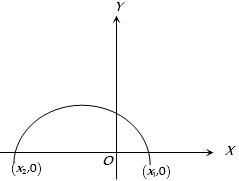
The diagram shows the graph of $y = ax^2 + bx + c$. Then:
A
$a > 0$
B
$b < 0$
C
$c > 0$
D
$b^2 - 4ac = 0$
Solution
(C) $1$. The parabola opens downwards,which implies that the coefficient of $x^2$ is negative,so $a < 0$.
$2$. The curve intersects the $y$-axis at $x = 0$. Substituting $x = 0$ into the equation $y = ax^2 + bx + c$,we get $y = c$. From the figure,the intersection point on the $y$-axis is above the origin,so $c > 0$.
$3$. The roots of the quadratic equation are $x_1$ and $x_2$. From the figure,$x_1 > 0$ and $x_2 < 0$. Since the vertex of the parabola is to the left of the $y$-axis,the sum of the roots is negative: $x_1 + x_2 < 0$. Since the sum of roots is $-b/a$,we have $-b/a < 0$,which implies $b/a > 0$. Since $a < 0$,it follows that $b < 0$.
$4$. Since the curve intersects the $x$-axis at two distinct points,the discriminant $D = b^2 - 4ac > 0$.
Comparing these findings with the options,$c > 0$ is a correct statement.
$2$. The curve intersects the $y$-axis at $x = 0$. Substituting $x = 0$ into the equation $y = ax^2 + bx + c$,we get $y = c$. From the figure,the intersection point on the $y$-axis is above the origin,so $c > 0$.
$3$. The roots of the quadratic equation are $x_1$ and $x_2$. From the figure,$x_1 > 0$ and $x_2 < 0$. Since the vertex of the parabola is to the left of the $y$-axis,the sum of the roots is negative: $x_1 + x_2 < 0$. Since the sum of roots is $-b/a$,we have $-b/a < 0$,which implies $b/a > 0$. Since $a < 0$,it follows that $b < 0$.
$4$. Since the curve intersects the $x$-axis at two distinct points,the discriminant $D = b^2 - 4ac > 0$.
Comparing these findings with the options,$c > 0$ is a correct statement.
0 likes
View Solution273
MediumMCQ
The number of values of $k$ for which the equation $x^2 - 3x + k = 0$ has two real and distinct roots lying in the interval $(0, 1)$ is:
A
$0$
B
$2$
C
$3$
D
Infinitely many
Solution
(A) Let $f(x) = x^2 - 3x + k$. For the roots $\alpha, \beta$ to be real,distinct,and lie in the interval $(0, 1)$,the following conditions must be satisfied:
$1$. Discriminant $D > 0$: $D = (-3)^2 - 4(1)(k) = 9 - 4k > 0 \implies k < 2.25$.
$2$. $f(0) > 0$: $0^2 - 3(0) + k > 0 \implies k > 0$.
$3$. $f(1) > 0$: $1^2 - 3(1) + k > 0 \implies 1 - 3 + k > 0 \implies k > 2$.
$4$. The vertex of the parabola $x = -b/(2a)$ must lie in $(0, 1)$: $x = 3/2 = 1.5$. Since $1.5$ is not in the interval $(0, 1)$,it is impossible for both roots to lie in $(0, 1)$.
Alternatively,for roots to lie in $(0, 1)$,the sum of roots $\alpha + \beta$ must satisfy $0 < \alpha + \beta < 2$. Here,$\alpha + \beta = 3$,which is not less than $2$. Therefore,no such $k$ exists.
$1$. Discriminant $D > 0$: $D = (-3)^2 - 4(1)(k) = 9 - 4k > 0 \implies k < 2.25$.
$2$. $f(0) > 0$: $0^2 - 3(0) + k > 0 \implies k > 0$.
$3$. $f(1) > 0$: $1^2 - 3(1) + k > 0 \implies 1 - 3 + k > 0 \implies k > 2$.
$4$. The vertex of the parabola $x = -b/(2a)$ must lie in $(0, 1)$: $x = 3/2 = 1.5$. Since $1.5$ is not in the interval $(0, 1)$,it is impossible for both roots to lie in $(0, 1)$.
Alternatively,for roots to lie in $(0, 1)$,the sum of roots $\alpha + \beta$ must satisfy $0 < \alpha + \beta < 2$. Here,$\alpha + \beta = 3$,which is not less than $2$. Therefore,no such $k$ exists.
0 likes
View Solution274
MediumMCQ
If $\alpha, \beta$ and $\gamma$ are the roots of $x^3 + px + q = 0$,then the value of $\alpha^3 + \beta^3 + \gamma^3$ is equal to
A
$-3q$
B
$-p$
C
$-pq$
D
$3pq$
Solution
(A) Given the cubic equation $x^3 + px + q = 0$.
Since $\alpha, \beta, \gamma$ are the roots,by Vieta's formulas:
$\alpha + \beta + \gamma = 0$ (coefficient of $x^2$ is $0$).
$\alpha\beta + \beta\gamma + \gamma\alpha = p$.
$\alpha\beta\gamma = -q$.
We know the algebraic identity: $\alpha^3 + \beta^3 + \gamma^3 - 3\alpha\beta\gamma = (\alpha + \beta + \gamma)(\alpha^2 + \beta^2 + \gamma^2 - \alpha\beta - \beta\gamma - \gamma\alpha)$.
Since $\alpha + \beta + \gamma = 0$,the right side of the identity becomes $0$.
Therefore,$\alpha^3 + \beta^3 + \gamma^3 = 3\alpha\beta\gamma$.
Substituting $\alpha\beta\gamma = -q$,we get $\alpha^3 + \beta^3 + \gamma^3 = 3(-q) = -3q$.
Since $\alpha, \beta, \gamma$ are the roots,by Vieta's formulas:
$\alpha + \beta + \gamma = 0$ (coefficient of $x^2$ is $0$).
$\alpha\beta + \beta\gamma + \gamma\alpha = p$.
$\alpha\beta\gamma = -q$.
We know the algebraic identity: $\alpha^3 + \beta^3 + \gamma^3 - 3\alpha\beta\gamma = (\alpha + \beta + \gamma)(\alpha^2 + \beta^2 + \gamma^2 - \alpha\beta - \beta\gamma - \gamma\alpha)$.
Since $\alpha + \beta + \gamma = 0$,the right side of the identity becomes $0$.
Therefore,$\alpha^3 + \beta^3 + \gamma^3 = 3\alpha\beta\gamma$.
Substituting $\alpha\beta\gamma = -q$,we get $\alpha^3 + \beta^3 + \gamma^3 = 3(-q) = -3q$.
0 likes
View Solution275
DifficultMCQ
Number of rational roots of the equation $x^{2016} - x^{2015} + x^{1008} + x^{1003} + 1 = 0$ is equal to
A
$0$
B
$1008$
C
$2015$
D
$2016$
Solution
(A) Let $x = \frac{p}{q}$ be a rational root in simplest form,where $p, q \in \mathbb{Z}$,$q > 0$,and $\gcd(p, q) = 1$.
According to the Rational Root Theorem,for a polynomial with integer coefficients $a_n x^n + \dots + a_0 = 0$,any rational root $\frac{p}{q}$ must satisfy $p \mid a_0$ and $q \mid a_n$.
Here,$a_n = 1$ and $a_0 = 1$.
Thus,$p \mid 1$ and $q \mid 1$,which implies $p, q \in \{-1, 1\}$.
Therefore,the only possible rational roots are $x = 1$ or $x = -1$.
Let $f(x) = x^{2016} - x^{2015} + x^{1008} + x^{1003} + 1$.
For $x = 1$: $f(1) = 1^{2016} - 1^{2015} + 1^{1008} + 1^{1003} + 1 = 1 - 1 + 1 + 1 + 1 = 3 \neq 0$.
For $x = -1$: $f(-1) = (-1)^{2016} - (-1)^{2015} + (-1)^{1008} + (-1)^{1003} + 1 = 1 - (-1) + 1 - 1 + 1 = 1 + 1 + 1 - 1 + 1 = 3 \neq 0$.
Since neither $1$ nor $-1$ is a root,the equation has no rational roots.
Thus,the number of rational roots is $0$.
According to the Rational Root Theorem,for a polynomial with integer coefficients $a_n x^n + \dots + a_0 = 0$,any rational root $\frac{p}{q}$ must satisfy $p \mid a_0$ and $q \mid a_n$.
Here,$a_n = 1$ and $a_0 = 1$.
Thus,$p \mid 1$ and $q \mid 1$,which implies $p, q \in \{-1, 1\}$.
Therefore,the only possible rational roots are $x = 1$ or $x = -1$.
Let $f(x) = x^{2016} - x^{2015} + x^{1008} + x^{1003} + 1$.
For $x = 1$: $f(1) = 1^{2016} - 1^{2015} + 1^{1008} + 1^{1003} + 1 = 1 - 1 + 1 + 1 + 1 = 3 \neq 0$.
For $x = -1$: $f(-1) = (-1)^{2016} - (-1)^{2015} + (-1)^{1008} + (-1)^{1003} + 1 = 1 - (-1) + 1 - 1 + 1 = 1 + 1 + 1 - 1 + 1 = 3 \neq 0$.
Since neither $1$ nor $-1$ is a root,the equation has no rational roots.
Thus,the number of rational roots is $0$.
0 likes
View Solution276
MediumMCQ
The number of real roots of the equation $\frac{P^2}{x} + \frac{Q^2}{x - 1} = 1$,where $P$ and $Q$ are non-zero real numbers,is
A
$1$
B
$2$
C
$3$
D
$4$
Solution
(B) Given the equation: $\frac{P^2}{x} + \frac{Q^2}{x - 1} = 1$.
Multiplying by $x(x - 1)$,we get: $P^2(x - 1) + Q^2x = x(x - 1)$.
Expanding the terms: $P^2x - P^2 + Q^2x = x^2 - x$.
Rearranging into a standard quadratic form $ax^2 + bx + c = 0$: $x^2 - (P^2 + Q^2 + 1)x + P^2 = 0$.
The discriminant $D$ of this quadratic equation is given by $D = b^2 - 4ac$.
Here,$a = 1$,$b = -(P^2 + Q^2 + 1)$,and $c = P^2$.
$D = (P^2 + Q^2 + 1)^2 - 4(1)(P^2) = (P^2 + Q^2 + 1)^2 - 4P^2$.
Using the identity $a^2 - b^2 = (a - b)(a + b)$,we get $D = (P^2 + Q^2 + 1 - 2P)(P^2 + Q^2 + 1 + 2P) = ((P - 1)^2 + Q^2)((P + 1)^2 + Q^2)$.
Since $P$ and $Q$ are non-zero real numbers,$D > 0$. Therefore,the equation has two distinct real roots.
Multiplying by $x(x - 1)$,we get: $P^2(x - 1) + Q^2x = x(x - 1)$.
Expanding the terms: $P^2x - P^2 + Q^2x = x^2 - x$.
Rearranging into a standard quadratic form $ax^2 + bx + c = 0$: $x^2 - (P^2 + Q^2 + 1)x + P^2 = 0$.
The discriminant $D$ of this quadratic equation is given by $D = b^2 - 4ac$.
Here,$a = 1$,$b = -(P^2 + Q^2 + 1)$,and $c = P^2$.
$D = (P^2 + Q^2 + 1)^2 - 4(1)(P^2) = (P^2 + Q^2 + 1)^2 - 4P^2$.
Using the identity $a^2 - b^2 = (a - b)(a + b)$,we get $D = (P^2 + Q^2 + 1 - 2P)(P^2 + Q^2 + 1 + 2P) = ((P - 1)^2 + Q^2)((P + 1)^2 + Q^2)$.
Since $P$ and $Q$ are non-zero real numbers,$D > 0$. Therefore,the equation has two distinct real roots.
0 likes
View Solution277
DifficultMCQ
The number of solutions of the equation $|x^2 - 2|x|| = 2^x$ is
A
$1$
B
$2$
C
$3$
D
$4$
Solution
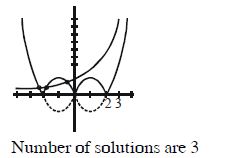
(C) To find the number of solutions for the equation $|x^2 - 2|x|| = 2^x$,we can analyze the graphs of $f(x) = |x^2 - 2|x||$ and $g(x) = 2^x$.
$1$. Analyze $f(x) = |x^2 - 2|x||$:
- Since $f(x)$ is an even function $(f(x) = f(-x))$,the graph is symmetric about the $y$-axis.
- For $x \ge 0$,$f(x) = |x^2 - 2x|$.
- The roots of $x^2 - 2x = 0$ are $x = 0$ and $x = 2$.
- Between $x = 0$ and $x = 2$,$x^2 - 2x$ is negative,so $|x^2 - 2x| = -(x^2 - 2x) = 2x - x^2$.
- For $x > 2$,$x^2 - 2x$ is positive,so $|x^2 - 2x| = x^2 - 2x$.
$2$. Analyze $g(x) = 2^x$:
- This is an exponential growth function that is always positive and strictly increasing.
$3$. Intersection points:
- By plotting both functions,we observe the intersection points.
- For $x < 0$,the exponential function $2^x$ approaches $0$ from above,while the parabola $|x^2 + 2x|$ intersects it at two points.
- For $x > 0$,the function $f(x) = |x^2 - 2x|$ intersects $g(x) = 2^x$ at exactly one point (since $2^x$ grows much faster than $x^2 - 2x$ for large $x$).
- Thus,there are a total of $3$ intersection points.
Therefore,the number of solutions is $3$.
$1$. Analyze $f(x) = |x^2 - 2|x||$:
- Since $f(x)$ is an even function $(f(x) = f(-x))$,the graph is symmetric about the $y$-axis.
- For $x \ge 0$,$f(x) = |x^2 - 2x|$.
- The roots of $x^2 - 2x = 0$ are $x = 0$ and $x = 2$.
- Between $x = 0$ and $x = 2$,$x^2 - 2x$ is negative,so $|x^2 - 2x| = -(x^2 - 2x) = 2x - x^2$.
- For $x > 2$,$x^2 - 2x$ is positive,so $|x^2 - 2x| = x^2 - 2x$.
$2$. Analyze $g(x) = 2^x$:
- This is an exponential growth function that is always positive and strictly increasing.
$3$. Intersection points:
- By plotting both functions,we observe the intersection points.
- For $x < 0$,the exponential function $2^x$ approaches $0$ from above,while the parabola $|x^2 + 2x|$ intersects it at two points.
- For $x > 0$,the function $f(x) = |x^2 - 2x|$ intersects $g(x) = 2^x$ at exactly one point (since $2^x$ grows much faster than $x^2 - 2x$ for large $x$).
- Thus,there are a total of $3$ intersection points.
Therefore,the number of solutions is $3$.
0 likes
View Solution278
DifficultMCQ
The number of solutions of the equation $2^x = x^2$ is
A
$1$
B
$2$
C
$3$
D
$4$
Solution
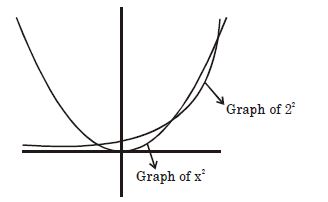
(C) To find the number of solutions for the equation $2^x = x^2$, we can analyze the intersection points of the functions $f(x) = 2^x$ and $g(x) = x^2$.
$1$. For $x < 0$: As $x$ becomes more negative, $2^x$ approaches $0$ from above, while $x^2$ increases. There is one intersection point in the interval $(-1, 0)$ because at $x = -1$, $2^{-1} = 0.5$ and $(-1)^2 = 1$, and at $x = -0.5$, $2^{-0.5} \approx 0.707$ and $(-0.5)^2 = 0.25$. Thus, there is one solution here.
$2$. For $x > 0$: We check specific integer values:
At $x = 2$, $2^2 = 4$ and $2^2 = 4$. So, $x = 2$ is a solution.
At $x = 4$, $2^4 = 16$ and $4^2 = 16$. So, $x = 4$ is a solution.
$3$. Between $x = 2$ and $x = 4$, the function $x^2$ is greater than $2^x$ (e.g., at $x = 3$, $2^3 = 8$ and $3^2 = 9$).
For $x > 4$, the exponential function $2^x$ grows much faster than the quadratic function $x^2$, so there are no more solutions for $x > 4$.
Thus, the solutions are $x = -0.766$ (approx), $x = 2$, and $x = 4$. There are a total of $3$ solutions.
$1$. For $x < 0$: As $x$ becomes more negative, $2^x$ approaches $0$ from above, while $x^2$ increases. There is one intersection point in the interval $(-1, 0)$ because at $x = -1$, $2^{-1} = 0.5$ and $(-1)^2 = 1$, and at $x = -0.5$, $2^{-0.5} \approx 0.707$ and $(-0.5)^2 = 0.25$. Thus, there is one solution here.
$2$. For $x > 0$: We check specific integer values:
At $x = 2$, $2^2 = 4$ and $2^2 = 4$. So, $x = 2$ is a solution.
At $x = 4$, $2^4 = 16$ and $4^2 = 16$. So, $x = 4$ is a solution.
$3$. Between $x = 2$ and $x = 4$, the function $x^2$ is greater than $2^x$ (e.g., at $x = 3$, $2^3 = 8$ and $3^2 = 9$).
For $x > 4$, the exponential function $2^x$ grows much faster than the quadratic function $x^2$, so there are no more solutions for $x > 4$.
Thus, the solutions are $x = -0.766$ (approx), $x = 2$, and $x = 4$. There are a total of $3$ solutions.
0 likes
View Solution279
AdvancedMCQ
If the equation $\frac{1}{x} + \frac{1}{x - 1} + \frac{1}{x - 2} = 3x^3$ has $k$ real roots,then $k$ is equal to -
A
$2$
B
$3$
C
$4$
D
$6$
Solution
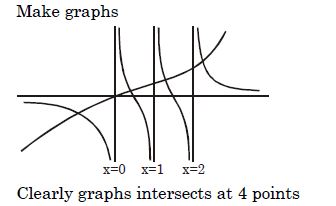
(C) Let $f(x) = \frac{1}{x} + \frac{1}{x - 1} + \frac{1}{x - 2}$ and $g(x) = 3x^3$.
We need to find the number of intersection points of the graphs of $f(x)$ and $g(x)$.
The function $f(x)$ has vertical asymptotes at $x = 0, x = 1,$ and $x = 2$.
$1$. For $x < 0$,$f(x)$ is negative and $g(x) = 3x^3$ is negative. As $x \to -\infty$,$f(x) \to 0$ and $g(x) \to -\infty$. As $x \to 0^-$,$f(x) \to -\infty$ and $g(x) \to 0$. By the Intermediate Value Theorem,there is one intersection point in $(-\infty, 0)$.
$2$. For $0 < x < 1$,$f(x)$ goes from $+\infty$ to $-\infty$. $g(x)$ is positive. There is one intersection point in $(0, 1)$.
$3$. For $1 < x < 2$,$f(x)$ goes from $+\infty$ to $-\infty$. $g(x)$ is positive. There is one intersection point in $(1, 2)$.
$4$. For $x > 2$,$f(x)$ goes from $+\infty$ to $0$ as $x \to \infty$. $g(x)$ goes from $24$ to $+\infty$. There is one intersection point in $(2, \infty)$.
Thus,there are $4$ real roots.
We need to find the number of intersection points of the graphs of $f(x)$ and $g(x)$.
The function $f(x)$ has vertical asymptotes at $x = 0, x = 1,$ and $x = 2$.
$1$. For $x < 0$,$f(x)$ is negative and $g(x) = 3x^3$ is negative. As $x \to -\infty$,$f(x) \to 0$ and $g(x) \to -\infty$. As $x \to 0^-$,$f(x) \to -\infty$ and $g(x) \to 0$. By the Intermediate Value Theorem,there is one intersection point in $(-\infty, 0)$.
$2$. For $0 < x < 1$,$f(x)$ goes from $+\infty$ to $-\infty$. $g(x)$ is positive. There is one intersection point in $(0, 1)$.
$3$. For $1 < x < 2$,$f(x)$ goes from $+\infty$ to $-\infty$. $g(x)$ is positive. There is one intersection point in $(1, 2)$.
$4$. For $x > 2$,$f(x)$ goes from $+\infty$ to $0$ as $x \to \infty$. $g(x)$ goes from $24$ to $+\infty$. There is one intersection point in $(2, \infty)$.
Thus,there are $4$ real roots.
0 likes
View Solution280
AdvancedMCQ
The value of $p$ for which the sum of the squares of the roots of the equation $x^2 - (p + 3)x + (5p - 2) = 0$ assumes its least value is:
A
$1$
B
$2$
C
$3$
D
$4$
Solution
(B) Let the roots of the quadratic equation $x^2 - (p + 3)x + (5p - 2) = 0$ be $\alpha$ and $\beta$.
From the properties of quadratic equations,we have the sum of roots $\alpha + \beta = p + 3$ and the product of roots $\alpha \beta = 5p - 2$.
We want to minimize the sum of the squares of the roots,which is $S = \alpha^2 + \beta^2$.
Using the identity $\alpha^2 + \beta^2 = (\alpha + \beta)^2 - 2\alpha \beta$,we substitute the values:
$S = (p + 3)^2 - 2(5p - 2)$
$S = p^2 + 6p + 9 - 10p + 4$
$S = p^2 - 4p + 13$
To find the minimum value,we complete the square:
$S = (p^2 - 4p + 4) + 9$
$S = (p - 2)^2 + 9$
Since $(p - 2)^2 \ge 0$,the minimum value of $S$ occurs when $p - 2 = 0$,which means $p = 2$.
From the properties of quadratic equations,we have the sum of roots $\alpha + \beta = p + 3$ and the product of roots $\alpha \beta = 5p - 2$.
We want to minimize the sum of the squares of the roots,which is $S = \alpha^2 + \beta^2$.
Using the identity $\alpha^2 + \beta^2 = (\alpha + \beta)^2 - 2\alpha \beta$,we substitute the values:
$S = (p + 3)^2 - 2(5p - 2)$
$S = p^2 + 6p + 9 - 10p + 4$
$S = p^2 - 4p + 13$
To find the minimum value,we complete the square:
$S = (p^2 - 4p + 4) + 9$
$S = (p - 2)^2 + 9$
Since $(p - 2)^2 \ge 0$,the minimum value of $S$ occurs when $p - 2 = 0$,which means $p = 2$.
0 likes
View Solution281
AdvancedMCQ
The number of solutions of the equation $\log_{\sqrt{3}}(x^3 - 1) = \log_{\sqrt{3}}(x - 1) + 2$ is:
A
$0$
B
$1$
C
$2$
D
$3$
Solution
(A) Given equation: $\log_{\sqrt{3}}(x^3 - 1) = \log_{\sqrt{3}}(x - 1) + 2$.
For the logarithmic functions to be defined,we must have $x^3 - 1 > 0$ and $x - 1 > 0$,which implies $x > 1$.
Using the property $\log_b(A) - \log_b(B) = \log_b(A/B)$,we get $\log_{\sqrt{3}}((x^3 - 1)/(x - 1)) = 2$.
Since $x^3 - 1 = (x - 1)(x^2 + x + 1)$,the equation becomes $\log_{\sqrt{3}}(x^2 + x + 1) = 2$.
Converting to exponential form: $x^2 + x + 1 = (\sqrt{3})^2 = 3$.
So,$x^2 + x - 2 = 0$.
Factoring the quadratic: $(x + 2)(x - 1) = 0$.
This gives $x = -2$ or $x = 1$.
Since the domain requires $x > 1$,both $x = -2$ and $x = 1$ are rejected.
Thus,there are $0$ solutions.
For the logarithmic functions to be defined,we must have $x^3 - 1 > 0$ and $x - 1 > 0$,which implies $x > 1$.
Using the property $\log_b(A) - \log_b(B) = \log_b(A/B)$,we get $\log_{\sqrt{3}}((x^3 - 1)/(x - 1)) = 2$.
Since $x^3 - 1 = (x - 1)(x^2 + x + 1)$,the equation becomes $\log_{\sqrt{3}}(x^2 + x + 1) = 2$.
Converting to exponential form: $x^2 + x + 1 = (\sqrt{3})^2 = 3$.
So,$x^2 + x - 2 = 0$.
Factoring the quadratic: $(x + 2)(x - 1) = 0$.
This gives $x = -2$ or $x = 1$.
Since the domain requires $x > 1$,both $x = -2$ and $x = 1$ are rejected.
Thus,there are $0$ solutions.
0 likes
View Solution282
DifficultMCQ
If the inequality $kx^2 - 2x + k \geq 0$ holds good for at least one real $x$,then the complete set of values of $k$ is
A
$[-1, 1]$
B
$(-\infty, 1]$
C
$\phi$
D
$(-1, \infty)$
Solution
(D) The given inequality is $kx^2 - 2x + k \geq 0$.
If $k = 0$,the inequality becomes $-2x \geq 0$,which implies $x \leq 0$. Since this holds for at least one real $x$,$k = 0$ is a solution.
If $k \neq 0$,we can rewrite the inequality as $k(x^2 + 1) \geq 2x$,which gives $k \geq \frac{2x}{x^2 + 1}$.
Let $f(x) = \frac{2x}{x^2 + 1}$. To find the range of $f(x)$,we analyze its derivative $f'(x) = \frac{2(x^2 + 1) - 2x(2x)}{(x^2 + 1)^2} = \frac{2 - 2x^2}{(x^2 + 1)^2}$.
Setting $f'(x) = 0$ gives $x^2 = 1$,so $x = 1$ or $x = -1$.
The maximum value is $f(1) = \frac{2}{2} = 1$ and the minimum value is $f(-1) = \frac{-2}{2} = -1$.
Thus,the range of $f(x)$ is $[-1, 1]$.
For $k \geq f(x)$ to hold for at least one $x$,$k$ must be greater than or equal to the minimum value of $f(x)$.
Therefore,$k \geq -1$. Combining this with the case $k=0$ and the condition for the quadratic to exist,the set of values is $k \in [-1, \infty) \setminus \{0\}$ is incorrect; rather,checking the boundary,the condition $k \geq -1$ covers all valid $k$ values.
If $k = 0$,the inequality becomes $-2x \geq 0$,which implies $x \leq 0$. Since this holds for at least one real $x$,$k = 0$ is a solution.
If $k \neq 0$,we can rewrite the inequality as $k(x^2 + 1) \geq 2x$,which gives $k \geq \frac{2x}{x^2 + 1}$.
Let $f(x) = \frac{2x}{x^2 + 1}$. To find the range of $f(x)$,we analyze its derivative $f'(x) = \frac{2(x^2 + 1) - 2x(2x)}{(x^2 + 1)^2} = \frac{2 - 2x^2}{(x^2 + 1)^2}$.
Setting $f'(x) = 0$ gives $x^2 = 1$,so $x = 1$ or $x = -1$.
The maximum value is $f(1) = \frac{2}{2} = 1$ and the minimum value is $f(-1) = \frac{-2}{2} = -1$.
Thus,the range of $f(x)$ is $[-1, 1]$.
For $k \geq f(x)$ to hold for at least one $x$,$k$ must be greater than or equal to the minimum value of $f(x)$.
Therefore,$k \geq -1$. Combining this with the case $k=0$ and the condition for the quadratic to exist,the set of values is $k \in [-1, \infty) \setminus \{0\}$ is incorrect; rather,checking the boundary,the condition $k \geq -1$ covers all valid $k$ values.
0 likes
View Solution283
DifficultMCQ
Sum of the solutions of the equation $[x^2] - 2x + 1 = 0$ is (where $[.]$ denotes the greatest integer function).
A
$1/2$
B
$2$
C
$3$
D
$3/2$
Solution
(C) The given equation is $[x^2] = 2x - 1$.
Since $[x^2]$ is an integer, $2x - 1$ must be an integer, which implies $2x$ is an integer.
By definition of the greatest integer function, $x^2 - 1 < [x^2] \le x^2$.
Substituting $[x^2] = 2x - 1$, we get $x^2 - 1 < 2x - 1 \le x^2$.
From $x^2 - 1 < 2x - 1$, we get $x^2 - 2x < 0$, so $x(x - 2) < 0$, which means $0 < x < 2$.
From $2x - 1 \le x^2$, we get $x^2 - 2x + 1 \ge 0$, which means $(x - 1)^2 \ge 0$, which is true for all real $x$.
Case $1$: $0 < x < 1$. Then $0 < x^2 < 1$, so $[x^2] = 0$. The equation becomes $0 - 2x + 1 = 0$, so $x = 1/2$. Since $1/2$ is in $(0, 1)$, it is a solution.
Case $2$: $1 \le x < \sqrt{2}$. Then $1 \le x^2 < 2$, so $[x^2] = 1$. The equation becomes $1 - 2x + 1 = 0$, so $2x = 2$, $x = 1$. Since $1$ is in $[1, \sqrt{2})$, it is a solution.
Case $3$: $\sqrt{2} \le x < \sqrt{3}$. Then $2 \le x^2 < 3$, so $[x^2] = 2$. The equation becomes $2 - 2x + 1 = 0$, so $2x = 3$, $x = 3/2$. Since $3/2 = 1.5$ and $\sqrt{2} \approx 1.414$, $1.5$ is in $[\sqrt{2}, \sqrt{3})$, so it is a solution.
Case $4$: $\sqrt{3} \le x < 2$. Then $3 \le x^2 < 4$, so $[x^2] = 3$. The equation becomes $3 - 2x + 1 = 0$, so $2x = 4$, $x = 2$. But $x < 2$, so this is not a solution.
The solutions are $1/2, 1, 3/2$. The sum is $1/2 + 1 + 3/2 = 3$.
Since $[x^2]$ is an integer, $2x - 1$ must be an integer, which implies $2x$ is an integer.
By definition of the greatest integer function, $x^2 - 1 < [x^2] \le x^2$.
Substituting $[x^2] = 2x - 1$, we get $x^2 - 1 < 2x - 1 \le x^2$.
From $x^2 - 1 < 2x - 1$, we get $x^2 - 2x < 0$, so $x(x - 2) < 0$, which means $0 < x < 2$.
From $2x - 1 \le x^2$, we get $x^2 - 2x + 1 \ge 0$, which means $(x - 1)^2 \ge 0$, which is true for all real $x$.
Case $1$: $0 < x < 1$. Then $0 < x^2 < 1$, so $[x^2] = 0$. The equation becomes $0 - 2x + 1 = 0$, so $x = 1/2$. Since $1/2$ is in $(0, 1)$, it is a solution.
Case $2$: $1 \le x < \sqrt{2}$. Then $1 \le x^2 < 2$, so $[x^2] = 1$. The equation becomes $1 - 2x + 1 = 0$, so $2x = 2$, $x = 1$. Since $1$ is in $[1, \sqrt{2})$, it is a solution.
Case $3$: $\sqrt{2} \le x < \sqrt{3}$. Then $2 \le x^2 < 3$, so $[x^2] = 2$. The equation becomes $2 - 2x + 1 = 0$, so $2x = 3$, $x = 3/2$. Since $3/2 = 1.5$ and $\sqrt{2} \approx 1.414$, $1.5$ is in $[\sqrt{2}, \sqrt{3})$, so it is a solution.
Case $4$: $\sqrt{3} \le x < 2$. Then $3 \le x^2 < 4$, so $[x^2] = 3$. The equation becomes $3 - 2x + 1 = 0$, so $2x = 4$, $x = 2$. But $x < 2$, so this is not a solution.
The solutions are $1/2, 1, 3/2$. The sum is $1/2 + 1 + 3/2 = 3$.
0 likes
View Solution284
DifficultMCQ
Two positive distinct numbers $a$ and $b$ each differ from their reciprocal by $1$. The value of $a + b$ is
A
$1$
B
$\sqrt{3}$
C
$\sqrt{5}$
D
$2$
Solution
(C) Let the number be $x$. According to the problem,the difference between the number and its reciprocal is $1$,so $|x - \frac{1}{x}| = 1$.
This gives two equations: $x - \frac{1}{x} = 1$ and $x - \frac{1}{x} = -1$.
For $x - \frac{1}{x} = 1$,we have $x^2 - x - 1 = 0$. Using the quadratic formula,$x = \frac{1 \pm \sqrt{1 - 4(1)(-1)}}{2} = \frac{1 \pm \sqrt{5}}{2}$. Since $x$ must be positive,$a = \frac{1 + \sqrt{5}}{2}$.
For $x - \frac{1}{x} = -1$,we have $x^2 + x - 1 = 0$. Using the quadratic formula,$x = \frac{-1 \pm \sqrt{1 - 4(1)(-1)}}{2} = \frac{-1 \pm \sqrt{5}}{2}$. Since $x$ must be positive,$b = \frac{\sqrt{5} - 1}{2}$.
The sum $a + b = \frac{1 + \sqrt{5}}{2} + \frac{\sqrt{5} - 1}{2} = \frac{1 + \sqrt{5} + \sqrt{5} - 1}{2} = \frac{2\sqrt{5}}{2} = \sqrt{5}$.
This gives two equations: $x - \frac{1}{x} = 1$ and $x - \frac{1}{x} = -1$.
For $x - \frac{1}{x} = 1$,we have $x^2 - x - 1 = 0$. Using the quadratic formula,$x = \frac{1 \pm \sqrt{1 - 4(1)(-1)}}{2} = \frac{1 \pm \sqrt{5}}{2}$. Since $x$ must be positive,$a = \frac{1 + \sqrt{5}}{2}$.
For $x - \frac{1}{x} = -1$,we have $x^2 + x - 1 = 0$. Using the quadratic formula,$x = \frac{-1 \pm \sqrt{1 - 4(1)(-1)}}{2} = \frac{-1 \pm \sqrt{5}}{2}$. Since $x$ must be positive,$b = \frac{\sqrt{5} - 1}{2}$.
The sum $a + b = \frac{1 + \sqrt{5}}{2} + \frac{\sqrt{5} - 1}{2} = \frac{1 + \sqrt{5} + \sqrt{5} - 1}{2} = \frac{2\sqrt{5}}{2} = \sqrt{5}$.
0 likes
View Solution285
DifficultMCQ
Find the sum of all integral values of $a$ such that the equation $||x - 2| - |3 - x|| = 2 - a$ has a solution.
A
$1$
B
$2$
C
$3$
D
$4$
Solution
(C) Let $f(x) = ||x - 2| - |3 - x||$.
By the triangle inequality property of absolute values,$||x - 2| - |3 - x|| \leq |(x - 2) - (3 - x)| = |2x - 5|$.
More simply,the expression $||x - 2| - |3 - x||$ represents the absolute difference between the distances of a point $x$ from $2$ and $3$.
For $x < 2$,$f(x) = |(2 - x) - (3 - x)| = |-1| = 1$.
For $2 \leq x \leq 3$,$f(x) = |(x - 2) - (3 - x)| = |2x - 5|$. As $x$ goes from $2$ to $3$,$2x - 5$ goes from $-1$ to $1$,so $|2x - 5|$ goes from $1$ to $0$ and back to $1$.
For $x > 3$,$f(x) = |(x - 2) - (x - 3)| = |1| = 1$.
Thus,the range of $f(x)$ is $[0, 1]$.
For the equation $f(x) = 2 - a$ to have a solution,we must have $0 \leq 2 - a \leq 1$.
Solving for $a$: $-2 \leq -a \leq -1$,which implies $1 \leq a \leq 2$.
The integral values of $a$ are $1$ and $2$.
The sum of these values is $1 + 2 = 3$.
By the triangle inequality property of absolute values,$||x - 2| - |3 - x|| \leq |(x - 2) - (3 - x)| = |2x - 5|$.
More simply,the expression $||x - 2| - |3 - x||$ represents the absolute difference between the distances of a point $x$ from $2$ and $3$.
For $x < 2$,$f(x) = |(2 - x) - (3 - x)| = |-1| = 1$.
For $2 \leq x \leq 3$,$f(x) = |(x - 2) - (3 - x)| = |2x - 5|$. As $x$ goes from $2$ to $3$,$2x - 5$ goes from $-1$ to $1$,so $|2x - 5|$ goes from $1$ to $0$ and back to $1$.
For $x > 3$,$f(x) = |(x - 2) - (x - 3)| = |1| = 1$.
Thus,the range of $f(x)$ is $[0, 1]$.
For the equation $f(x) = 2 - a$ to have a solution,we must have $0 \leq 2 - a \leq 1$.
Solving for $a$: $-2 \leq -a \leq -1$,which implies $1 \leq a \leq 2$.
The integral values of $a$ are $1$ and $2$.
The sum of these values is $1 + 2 = 3$.
0 likes
View Solution286
DifficultMCQ
If $\alpha$ and $\beta$ are two real numbers satisfying $\alpha^2 + \beta^2 = 5$ and $3(\alpha^5 + \beta^5) = 11(\alpha^3 + \beta^3)$,then the value of $\alpha \beta$ is:
A
$2$
B
$1$
C
$7$
D
$9$
Solution
(A) Given $\alpha^2 + \beta^2 = 5$ and $3(\alpha^5 + \beta^5) = 11(\alpha^3 + \beta^3)$.
Let $S_n = \alpha^n + \beta^n$. We have $S_2 = 5$ and $3S_5 = 11S_3$.
Using the identity $\alpha^5 + \beta^5 = (\alpha^2 + \beta^2)(\alpha^3 + \beta^3) - \alpha^2 \beta^2(\alpha + \beta)$,this is not direct. Instead,use the recurrence relation for $x^2 - px + q = 0$ where $p = \alpha + \beta$ and $q = \alpha \beta$.
Since $\alpha^2 + \beta^2 = 5$,we have $p^2 - 2q = 5$.
Also,$S_n = p S_{n-1} - q S_{n-2}$.
For $n=3$: $S_3 = p S_2 - q S_1 = 5p - qp = p(5-q)$.
For $n=5$: $S_5 = p S_4 - q S_3$.
$S_4 = (\alpha^2 + \beta^2)^2 - 2\alpha^2 \beta^2 = 25 - 2q^2$.
So,$S_5 = p(25 - 2q^2) - q(p(5-q)) = p(25 - 2q^2 - 5q + q^2) = p(25 - 5q - q^2)$.
Substitute into $3S_5 = 11S_3$:
$3p(25 - 5q - q^2) = 11p(5 - q)$.
Assuming $p \neq 0$,$3(25 - 5q - q^2) = 11(5 - q) \Rightarrow 75 - 15q - 3q^2 = 55 - 11q$.
$3q^2 + 4q - 20 = 0 \Rightarrow (3q + 10)(q - 2) = 0$.
Since $\alpha, \beta$ are real,$p^2 = 5 + 2q \ge 0$. If $q=2$,$p^2 = 9$ (real). If $q = -10/3$,$p^2 = 5 - 20/3 = -5/3$ (not real).
Thus,$\alpha \beta = 2$.
Let $S_n = \alpha^n + \beta^n$. We have $S_2 = 5$ and $3S_5 = 11S_3$.
Using the identity $\alpha^5 + \beta^5 = (\alpha^2 + \beta^2)(\alpha^3 + \beta^3) - \alpha^2 \beta^2(\alpha + \beta)$,this is not direct. Instead,use the recurrence relation for $x^2 - px + q = 0$ where $p = \alpha + \beta$ and $q = \alpha \beta$.
Since $\alpha^2 + \beta^2 = 5$,we have $p^2 - 2q = 5$.
Also,$S_n = p S_{n-1} - q S_{n-2}$.
For $n=3$: $S_3 = p S_2 - q S_1 = 5p - qp = p(5-q)$.
For $n=5$: $S_5 = p S_4 - q S_3$.
$S_4 = (\alpha^2 + \beta^2)^2 - 2\alpha^2 \beta^2 = 25 - 2q^2$.
So,$S_5 = p(25 - 2q^2) - q(p(5-q)) = p(25 - 2q^2 - 5q + q^2) = p(25 - 5q - q^2)$.
Substitute into $3S_5 = 11S_3$:
$3p(25 - 5q - q^2) = 11p(5 - q)$.
Assuming $p \neq 0$,$3(25 - 5q - q^2) = 11(5 - q) \Rightarrow 75 - 15q - 3q^2 = 55 - 11q$.
$3q^2 + 4q - 20 = 0 \Rightarrow (3q + 10)(q - 2) = 0$.
Since $\alpha, \beta$ are real,$p^2 = 5 + 2q \ge 0$. If $q=2$,$p^2 = 9$ (real). If $q = -10/3$,$p^2 = 5 - 20/3 = -5/3$ (not real).
Thus,$\alpha \beta = 2$.
0 likes
View Solution287
DifficultMCQ
If $\alpha, \beta, \gamma$ are roots of the equation $x^3 - x - 1 = 0$,then the equation whose roots are $\frac{1}{\beta + \gamma}, \frac{1}{\gamma + \alpha}, \frac{1}{\alpha + \beta}$ is:
A
$x^3 - x^2 + 1 = 0$
B
$x^3 + x^2 - 1 = 0$
C
$x^3 + x - 1 = 0$
D
$x^3 - x + 1 = 0$
Solution
(A) Given the equation $x^3 - x - 1 = 0$ with roots $\alpha, \beta, \gamma$.
From the properties of roots,the sum of roots is $\alpha + \beta + \gamma = 0$.
Therefore,we can write: $\beta + \gamma = -\alpha$,$\gamma + \alpha = -\beta$,and $\alpha + \beta = -\gamma$.
The roots of the required equation are $\frac{1}{-\alpha}, \frac{1}{-\beta}, \frac{1}{-\gamma}$,which simplifies to $-\frac{1}{\alpha}, -\frac{1}{\beta}, -\frac{1}{\gamma}$.
To find the equation with roots $-\frac{1}{x}$,we substitute $x$ with $-x$ in the original equation to get $(-x)^3 - (-x) - 1 = 0$,which is $-x^3 + x - 1 = 0$,or $x^3 - x + 1 = 0$.
Wait,let's re-evaluate: If the roots are $y = -\frac{1}{x}$,then $x = -\frac{1}{y}$.
Substituting $x = -\frac{1}{y}$ into $x^3 - x - 1 = 0$:
$(-\frac{1}{y})^3 - (-\frac{1}{y}) - 1 = 0$
$-\frac{1}{y^3} + \frac{1}{y} - 1 = 0$
Multiplying by $-y^3$: $1 - y^2 + y^3 = 0$,which is $y^3 - y^2 + 1 = 0$.
From the properties of roots,the sum of roots is $\alpha + \beta + \gamma = 0$.
Therefore,we can write: $\beta + \gamma = -\alpha$,$\gamma + \alpha = -\beta$,and $\alpha + \beta = -\gamma$.
The roots of the required equation are $\frac{1}{-\alpha}, \frac{1}{-\beta}, \frac{1}{-\gamma}$,which simplifies to $-\frac{1}{\alpha}, -\frac{1}{\beta}, -\frac{1}{\gamma}$.
To find the equation with roots $-\frac{1}{x}$,we substitute $x$ with $-x$ in the original equation to get $(-x)^3 - (-x) - 1 = 0$,which is $-x^3 + x - 1 = 0$,or $x^3 - x + 1 = 0$.
Wait,let's re-evaluate: If the roots are $y = -\frac{1}{x}$,then $x = -\frac{1}{y}$.
Substituting $x = -\frac{1}{y}$ into $x^3 - x - 1 = 0$:
$(-\frac{1}{y})^3 - (-\frac{1}{y}) - 1 = 0$
$-\frac{1}{y^3} + \frac{1}{y} - 1 = 0$
Multiplying by $-y^3$: $1 - y^2 + y^3 = 0$,which is $y^3 - y^2 + 1 = 0$.
0 likes
View Solution288
DifficultMCQ
Let $\alpha, \beta, \gamma, \delta$ be the roots of the equation $x^4 + x^2 + 1 = 0$. Then,the equation whose roots are $\alpha^2, \beta^2, \gamma^2, \delta^2$ is:
A
$x^2 + x + 1 = 0$
B
$(x^2 + x + 1)^2 = 0$
C
$(x^2 - x + 1)^2 = 0$
D
$x^4 - x^2 + 1 = 0$
Solution
(B) Given that $\alpha, \beta, \gamma, \delta$ are the roots of the equation $x^4 + x^2 + 1 = 0$.
Let $y = x^2$,which implies $x = \pm \sqrt{y}$.
Substituting $x^2 = y$ into the original equation $x^4 + x^2 + 1 = 0$,we get $(x^2)^2 + x^2 + 1 = 0$.
Replacing $x^2$ with $y$,we obtain $y^2 + y + 1 = 0$.
Since the roots of the new equation are $\alpha^2, \beta^2, \gamma^2, \delta^2$,and each root of the original equation satisfies $x^4 + x^2 + 1 = 0$,the transformation $y = x^2$ maps the four roots to two values of $y$ that satisfy $y^2 + y + 1 = 0$.
Since each root is squared,the resulting equation must account for the multiplicity of the roots. The equation $y^2 + y + 1 = 0$ has two roots,say $y_1$ and $y_2$. Since the original equation is of degree $4$,the new equation must also be of degree $4$.
Thus,the required equation is $(y^2 + y + 1)^2 = 0$,which in terms of $x$ is $(x^2 + x + 1)^2 = 0$.
Let $y = x^2$,which implies $x = \pm \sqrt{y}$.
Substituting $x^2 = y$ into the original equation $x^4 + x^2 + 1 = 0$,we get $(x^2)^2 + x^2 + 1 = 0$.
Replacing $x^2$ with $y$,we obtain $y^2 + y + 1 = 0$.
Since the roots of the new equation are $\alpha^2, \beta^2, \gamma^2, \delta^2$,and each root of the original equation satisfies $x^4 + x^2 + 1 = 0$,the transformation $y = x^2$ maps the four roots to two values of $y$ that satisfy $y^2 + y + 1 = 0$.
Since each root is squared,the resulting equation must account for the multiplicity of the roots. The equation $y^2 + y + 1 = 0$ has two roots,say $y_1$ and $y_2$. Since the original equation is of degree $4$,the new equation must also be of degree $4$.
Thus,the required equation is $(y^2 + y + 1)^2 = 0$,which in terms of $x$ is $(x^2 + x + 1)^2 = 0$.
0 likes
View Solution289
DifficultMCQ
The number of integral values of $a$ for which $x^2 - (a - 1)x + 3 = 0$ has both roots positive and $x^2 + 3x + 6 - a = 0$ has both roots negative is
A
$4$
B
$2$
C
$0$
D
$1$
Solution
(D) For $x^2 - (a - 1)x + 3 = 0$ to have both roots positive:
$1$. Discriminant $D_1 \ge 0 \Rightarrow (a - 1)^2 - 12 \ge 0 \Rightarrow (a - 1)^2 \ge 12 \Rightarrow a - 1 \ge 2\sqrt{3}$ or $a - 1 \le -2\sqrt{3}$. Since $2\sqrt{3} \approx 3.46$,$a \ge 4.46$ or $a \le -2.46$.
$2$. Sum of roots $> 0 \Rightarrow a - 1 > 0 \Rightarrow a > 1$.
$3$. Product of roots $> 0 \Rightarrow 3 > 0$ (always true).
Combining these,$a \ge 4.46$.
For $x^2 + 3x + 6 - a = 0$ to have both roots negative:
$1$. Discriminant $D_2 \ge 0 \Rightarrow 3^2 - 4(6 - a) \ge 0 \Rightarrow 9 - 24 + 4a \ge 0 \Rightarrow 4a \ge 15 \Rightarrow a \ge 3.75$.
$2$. Sum of roots $< 0 \Rightarrow -3 < 0$ (always true).
$3$. Product of roots $> 0 \Rightarrow 6 - a > 0 \Rightarrow a < 6$.
Combining these,$3.75 \le a < 6$.
Intersection of both conditions: $a \ge 4.46$ and $3.75 \le a < 6 \Rightarrow 4.46 \le a < 6$.
The integral values of $a$ are $5$. Thus,there is only $1$ such value.
$1$. Discriminant $D_1 \ge 0 \Rightarrow (a - 1)^2 - 12 \ge 0 \Rightarrow (a - 1)^2 \ge 12 \Rightarrow a - 1 \ge 2\sqrt{3}$ or $a - 1 \le -2\sqrt{3}$. Since $2\sqrt{3} \approx 3.46$,$a \ge 4.46$ or $a \le -2.46$.
$2$. Sum of roots $> 0 \Rightarrow a - 1 > 0 \Rightarrow a > 1$.
$3$. Product of roots $> 0 \Rightarrow 3 > 0$ (always true).
Combining these,$a \ge 4.46$.
For $x^2 + 3x + 6 - a = 0$ to have both roots negative:
$1$. Discriminant $D_2 \ge 0 \Rightarrow 3^2 - 4(6 - a) \ge 0 \Rightarrow 9 - 24 + 4a \ge 0 \Rightarrow 4a \ge 15 \Rightarrow a \ge 3.75$.
$2$. Sum of roots $< 0 \Rightarrow -3 < 0$ (always true).
$3$. Product of roots $> 0 \Rightarrow 6 - a > 0 \Rightarrow a < 6$.
Combining these,$3.75 \le a < 6$.
Intersection of both conditions: $a \ge 4.46$ and $3.75 \le a < 6 \Rightarrow 4.46 \le a < 6$.
The integral values of $a$ are $5$. Thus,there is only $1$ such value.
0 likes
View Solution290
MediumMCQ
If $\alpha$ and $\beta$ are the roots of $x^2 - 3x + a = 0$,where $a \in R$ and $\alpha < 1 < \beta$,then:
A
$a \in (-\infty, 9/4)$
B
$a \in (2, 9/4)$
C
$a \in (-\infty, 2)$
D
None of these
Solution
(C) Let $f(x) = x^2 - 3x + a$.
For the roots $\alpha$ and $\beta$ to satisfy the condition $\alpha < 1 < \beta$,the value of the quadratic function at $x = 1$ must be negative,i.e.,$f(1) < 0$.
Substituting $x = 1$ into the equation:
$f(1) = (1)^2 - 3(1) + a < 0$
$1 - 3 + a < 0$
$-2 + a < 0$
$a < 2$.
Since $a < 2$ automatically satisfies the condition for real roots $(D > 0)$,where $D = (-3)^2 - 4(1)(a) = 9 - 4a > 0 \Rightarrow a < 9/4$,the intersection of $a < 2$ and $a < 9/4$ is $a < 2$.
Thus,$a \in (-\infty, 2)$.
For the roots $\alpha$ and $\beta$ to satisfy the condition $\alpha < 1 < \beta$,the value of the quadratic function at $x = 1$ must be negative,i.e.,$f(1) < 0$.
Substituting $x = 1$ into the equation:
$f(1) = (1)^2 - 3(1) + a < 0$
$1 - 3 + a < 0$
$-2 + a < 0$
$a < 2$.
Since $a < 2$ automatically satisfies the condition for real roots $(D > 0)$,where $D = (-3)^2 - 4(1)(a) = 9 - 4a > 0 \Rightarrow a < 9/4$,the intersection of $a < 2$ and $a < 9/4$ is $a < 2$.
Thus,$a \in (-\infty, 2)$.
0 likes
View Solution291
DifficultMCQ
If the graph of $y = ax^2 - bx + c$ is as shown below,then the signs of $a$,$b$,and $c$ are:
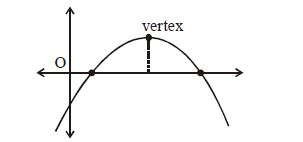
A
$a < 0, b < 0, c < 0$
B
$a < 0, b > 0, c < 0$
C
$a < 0, b < 0, c > 0$
D
$a > 0, b > 0, c < 0$
Solution
(A) $1$. The parabola opens downwards,which implies that the coefficient of $x^2$ is negative. Therefore,$a < 0$.
$2$. The $y$-intercept of the graph is where $x = 0$. Substituting $x = 0$ into the equation $y = ax^2 - bx + c$,we get $y = c$. From the graph,the $y$-intercept is below the $x$-axis,so $c < 0$.
$3$. The $x$-coordinate of the vertex of the parabola $y = ax^2 + Bx + C$ is given by $-B / (2A)$. In our equation $y = ax^2 - bx + c$,the coefficient of $x$ is $-b$. Thus,the $x$-coordinate of the vertex is $-(-b) / (2a) = b / (2a)$.
$4$. From the graph,the vertex lies to the right of the $y$-axis,meaning the $x$-coordinate of the vertex is positive. Therefore,$b / (2a) > 0$.
$5$. Since we already know $a < 0$,for the fraction $b / (2a)$ to be positive,$b$ must also be negative. Thus,$b < 0$.
$6$. Combining these,we have $a < 0, b < 0, c < 0$.
$2$. The $y$-intercept of the graph is where $x = 0$. Substituting $x = 0$ into the equation $y = ax^2 - bx + c$,we get $y = c$. From the graph,the $y$-intercept is below the $x$-axis,so $c < 0$.
$3$. The $x$-coordinate of the vertex of the parabola $y = ax^2 + Bx + C$ is given by $-B / (2A)$. In our equation $y = ax^2 - bx + c$,the coefficient of $x$ is $-b$. Thus,the $x$-coordinate of the vertex is $-(-b) / (2a) = b / (2a)$.
$4$. From the graph,the vertex lies to the right of the $y$-axis,meaning the $x$-coordinate of the vertex is positive. Therefore,$b / (2a) > 0$.
$5$. Since we already know $a < 0$,for the fraction $b / (2a)$ to be positive,$b$ must also be negative. Thus,$b < 0$.
$6$. Combining these,we have $a < 0, b < 0, c < 0$.
0 likes
View Solution292
DifficultMCQ
Let $a \ne b, c \ne 0$. If the equations $x^2 + ax + bc = 0$ and $x^2 + bx + ac = 0$ have a common root,then:
Statement $-1$: The equation of the other roots is $x^2 + cx + ab = 0$.
Statement $-2$: $a + b + c = 0$.
Statement $-1$: The equation of the other roots is $x^2 + cx + ab = 0$.
Statement $-2$: $a + b + c = 0$.
A
Statement $-1$ is true,Statement $-2$ is true; Statement $-2$ is not the correct explanation of Statement $-1$.
B
Statement $-1$ is false,Statement $-2$ is true.
C
Statement $-1$ is true,Statement $-2$ is false.
D
Statement $-1$ is true,Statement $-2$ is true; Statement $-2$ is the correct explanation of Statement $-1$.
Solution
(D) Let the roots of the equations be:
$x^2 + ax + bc = 0 \rightarrow \alpha, \beta$ $(1)$
$x^2 + bx + ac = 0 \rightarrow \alpha, \gamma$ $(2)$
Subtracting $(2)$ from $(1)$:
$(a - b)x + (bc - ac) = 0$
$(a - b)x - c(a - b) = 0$
Since $a \ne b$,we divide by $(a - b)$ to get $x = c$.
Thus,the common root is $\alpha = c$.
Substituting $x = c$ into $(1)$:
$c^2 + ac + bc = 0 \Rightarrow c(c + a + b) = 0$.
Since $c \ne 0$,we have $a + b + c = 0$.
From the product of roots in $(1)$,$\alpha \cdot \beta = bc \Rightarrow c \cdot \beta = bc \Rightarrow \beta = b$.
From the product of roots in $(2)$,$\alpha \cdot \gamma = ac \Rightarrow c \cdot \gamma = ac \Rightarrow \gamma = a$.
The equation with roots $\beta$ and $\gamma$ is $x^2 - (\beta + \gamma)x + \beta \gamma = 0$.
$x^2 - (b + a)x + ab = 0$.
Since $a + b = -c$,the equation becomes $x^2 - (-c)x + ab = 0$,which is $x^2 + cx + ab = 0$.
Both statements are true,and Statement $-2$ explains Statement $-1$.
$x^2 + ax + bc = 0 \rightarrow \alpha, \beta$ $(1)$
$x^2 + bx + ac = 0 \rightarrow \alpha, \gamma$ $(2)$
Subtracting $(2)$ from $(1)$:
$(a - b)x + (bc - ac) = 0$
$(a - b)x - c(a - b) = 0$
Since $a \ne b$,we divide by $(a - b)$ to get $x = c$.
Thus,the common root is $\alpha = c$.
Substituting $x = c$ into $(1)$:
$c^2 + ac + bc = 0 \Rightarrow c(c + a + b) = 0$.
Since $c \ne 0$,we have $a + b + c = 0$.
From the product of roots in $(1)$,$\alpha \cdot \beta = bc \Rightarrow c \cdot \beta = bc \Rightarrow \beta = b$.
From the product of roots in $(2)$,$\alpha \cdot \gamma = ac \Rightarrow c \cdot \gamma = ac \Rightarrow \gamma = a$.
The equation with roots $\beta$ and $\gamma$ is $x^2 - (\beta + \gamma)x + \beta \gamma = 0$.
$x^2 - (b + a)x + ab = 0$.
Since $a + b = -c$,the equation becomes $x^2 - (-c)x + ab = 0$,which is $x^2 + cx + ab = 0$.
Both statements are true,and Statement $-2$ explains Statement $-1$.
0 likes
View Solution293
MediumMCQ
The coefficient of $x$ in the equation $x^2 + px + q = 0$ was taken as $17$ in place of $13$. Its roots were found to be $-2$ and $-15$. The roots of the original equation are:
A
$3, 10$
B
$-3, -10$
C
$-5, -8$
D
None of these
Solution
(B) The incorrect equation is $x^2 + 17x + q = 0$.
Given that the roots of this incorrect equation are $-2$ and $-15$,we can find $q$ using the product of roots formula:
Product of roots $= (-2) \times (-15) = 30$.
Since the product of roots for $x^2 + px + q = 0$ is $q$,we have $q = 30$.
The original equation had $13$ as the coefficient of $x$,so the original equation is $x^2 + 13x + 30 = 0$.
To find the roots,we factorize: $x^2 + 10x + 3x + 30 = 0$.
$x(x + 10) + 3(x + 10) = 0$.
$(x + 3)(x + 10) = 0$.
Thus,the roots are $x = -3$ and $x = -10$.
Given that the roots of this incorrect equation are $-2$ and $-15$,we can find $q$ using the product of roots formula:
Product of roots $= (-2) \times (-15) = 30$.
Since the product of roots for $x^2 + px + q = 0$ is $q$,we have $q = 30$.
The original equation had $13$ as the coefficient of $x$,so the original equation is $x^2 + 13x + 30 = 0$.
To find the roots,we factorize: $x^2 + 10x + 3x + 30 = 0$.
$x(x + 10) + 3(x + 10) = 0$.
$(x + 3)(x + 10) = 0$.
Thus,the roots are $x = -3$ and $x = -10$.
0 likes
View Solution294
DifficultMCQ
Number of equations of the form $ax^2 + bx + 1 = 0$ having real roots,where $a, b \in \{1, 2, 3, 4\}$ is-
A
$8$
B
$7$
C
$6$
D
$3$
Solution
(B) For the quadratic equation $ax^2 + bx + 1 = 0$ to have real roots,the discriminant $D$ must be greater than or equal to $0$.
$D = b^2 - 4ac \geq 0$
Given $c = 1$,the condition becomes $b^2 - 4a \geq 0$,or $b^2 \geq 4a$.
We test the values for $b \in \{1, 2, 3, 4\}$:
$1$. If $b = 1$,$b^2 = 1$. $1 \geq 4a \Rightarrow a \leq 0.25$. No value of $a \in \{1, 2, 3, 4\}$ satisfies this.
$2$. If $b = 2$,$b^2 = 4$. $4 \geq 4a \Rightarrow a \leq 1$. Thus,$a = 1$ ($1$ solution).
$3$. If $b = 3$,$b^2 = 9$. $9 \geq 4a \Rightarrow a \leq 2.25$. Thus,$a \in \{1, 2\}$ ($2$ solutions).
$4$. If $b = 4$,$b^2 = 16$. $16 \geq 4a \Rightarrow a \leq 4$. Thus,$a \in \{1, 2, 3, 4\}$ ($4$ solutions).
Total number of equations = $0 + 1 + 2 + 4 = 7$.
$D = b^2 - 4ac \geq 0$
Given $c = 1$,the condition becomes $b^2 - 4a \geq 0$,or $b^2 \geq 4a$.
We test the values for $b \in \{1, 2, 3, 4\}$:
$1$. If $b = 1$,$b^2 = 1$. $1 \geq 4a \Rightarrow a \leq 0.25$. No value of $a \in \{1, 2, 3, 4\}$ satisfies this.
$2$. If $b = 2$,$b^2 = 4$. $4 \geq 4a \Rightarrow a \leq 1$. Thus,$a = 1$ ($1$ solution).
$3$. If $b = 3$,$b^2 = 9$. $9 \geq 4a \Rightarrow a \leq 2.25$. Thus,$a \in \{1, 2\}$ ($2$ solutions).
$4$. If $b = 4$,$b^2 = 16$. $16 \geq 4a \Rightarrow a \leq 4$. Thus,$a \in \{1, 2, 3, 4\}$ ($4$ solutions).
Total number of equations = $0 + 1 + 2 + 4 = 7$.
0 likes
View Solution295
DifficultMCQ
If $\alpha, \beta, \gamma$ are the roots of the equation $x^3 + 2x - 5 = 0$ and the equation $x^3 + bx^2 + cx + d = 0$ has roots $2\alpha + 1, 2\beta + 1, 2\gamma + 1$,then the value of $|b + c + d|$ is (where $b, c, d$ are constants):
A
$41$
B
$39$
C
$40$
D
$43$
Solution
(A) Let $y = 2\alpha + 1$,which implies $\alpha = \frac{y - 1}{2}$.
Since $\alpha$ is a root of $x^3 + 2x - 5 = 0$,we substitute $\alpha$ into the equation:
$\left(\frac{y - 1}{2}\right)^3 + 2\left(\frac{y - 1}{2}\right) - 5 = 0$
$\frac{y^3 - 3y^2 + 3y - 1}{8} + (y - 1) - 5 = 0$
Multiply the entire equation by $8$:
$y^3 - 3y^2 + 3y - 1 + 8(y - 6) = 0$
$y^3 - 3y^2 + 3y - 1 + 8y - 48 = 0$
$y^3 - 3y^2 + 11y - 49 = 0$
Comparing this with $x^3 + bx^2 + cx + d = 0$,we get $b = -3, c = 11, d = -49$.
Thus,$|b + c + d| = |-3 + 11 - 49| = |-41| = 41$.
Since $\alpha$ is a root of $x^3 + 2x - 5 = 0$,we substitute $\alpha$ into the equation:
$\left(\frac{y - 1}{2}\right)^3 + 2\left(\frac{y - 1}{2}\right) - 5 = 0$
$\frac{y^3 - 3y^2 + 3y - 1}{8} + (y - 1) - 5 = 0$
Multiply the entire equation by $8$:
$y^3 - 3y^2 + 3y - 1 + 8(y - 6) = 0$
$y^3 - 3y^2 + 3y - 1 + 8y - 48 = 0$
$y^3 - 3y^2 + 11y - 49 = 0$
Comparing this with $x^3 + bx^2 + cx + d = 0$,we get $b = -3, c = 11, d = -49$.
Thus,$|b + c + d| = |-3 + 11 - 49| = |-41| = 41$.
0 likes
View Solution296
DifficultMCQ
If $\alpha$ and $\beta$ are the roots of $x^2 - ax + b = 0$ and if $\alpha^n + \beta^n = V_n$,then -
A
$V_{n+1} = aV_n + bV_{n-1}$
B
$V_{n+1} = aV_n + aV_{n-1}$
C
$V_{n+1} = aV_n - bV_{n-1}$
D
$V_{n+1} = aV_{n-1} - bV_n$
Solution
(C) Given that $\alpha$ and $\beta$ are the roots of the quadratic equation $x^2 - ax + b = 0$.
By the properties of roots,we have the sum of roots $\alpha + \beta = a$ and the product of roots $\alpha \beta = b$.
Since $\alpha$ and $\beta$ are roots,they satisfy the equation:
$\alpha^2 - a\alpha + b = 0 \implies \alpha^2 = a\alpha - b$
$\beta^2 - a\beta + b = 0 \implies \beta^2 = a\beta - b$
Multiplying the first equation by $\alpha^{n-1}$ and the second by $\beta^{n-1}$:
$\alpha^{n+1} = a\alpha^n - b\alpha^{n-1}$
$\beta^{n+1} = a\beta^n - b\beta^{n-1}$
Adding these two equations:
$\alpha^{n+1} + \beta^{n+1} = a(\alpha^n + \beta^n) - b(\alpha^{n-1} + \beta^{n-1})$
Substituting $V_n = \alpha^n + \beta^n$,we get:
$V_{n+1} = aV_n - bV_{n-1}$.
By the properties of roots,we have the sum of roots $\alpha + \beta = a$ and the product of roots $\alpha \beta = b$.
Since $\alpha$ and $\beta$ are roots,they satisfy the equation:
$\alpha^2 - a\alpha + b = 0 \implies \alpha^2 = a\alpha - b$
$\beta^2 - a\beta + b = 0 \implies \beta^2 = a\beta - b$
Multiplying the first equation by $\alpha^{n-1}$ and the second by $\beta^{n-1}$:
$\alpha^{n+1} = a\alpha^n - b\alpha^{n-1}$
$\beta^{n+1} = a\beta^n - b\beta^{n-1}$
Adding these two equations:
$\alpha^{n+1} + \beta^{n+1} = a(\alpha^n + \beta^n) - b(\alpha^{n-1} + \beta^{n-1})$
Substituting $V_n = \alpha^n + \beta^n$,we get:
$V_{n+1} = aV_n - bV_{n-1}$.
0 likes
View Solution297
DifficultMCQ
If $z_1, z_2, z_3, z_4$ are the roots of the equation $z^4 + z^3 + z^2 + z + 1 = 0$,then $\prod_{i=1}^{4} (z_i + 2)$ is equal to:
A
$1$
B
$8$
C
$11$
D
$17$
Solution
(C) Let $P(z) = z^4 + z^3 + z^2 + z + 1 = 0$. The roots are $z_1, z_2, z_3, z_4$.
We can write $P(z) = (z - z_1)(z - z_2)(z - z_3)(z - z_4)$.
We want to find the value of $\prod_{i=1}^{4} (z_i + 2)$.
Note that $\prod_{i=1}^{4} (z_i + 2) = (-1)^4 \prod_{i=1}^{4} (-2 - z_i) = P(-2)$.
Substitute $z = -2$ into the polynomial $P(z)$:
$P(-2) = (-2)^4 + (-2)^3 + (-2)^2 + (-2) + 1$
$P(-2) = 16 - 8 + 4 - 2 + 1$
$P(-2) = 11$.
Therefore,the product is $11$.
We can write $P(z) = (z - z_1)(z - z_2)(z - z_3)(z - z_4)$.
We want to find the value of $\prod_{i=1}^{4} (z_i + 2)$.
Note that $\prod_{i=1}^{4} (z_i + 2) = (-1)^4 \prod_{i=1}^{4} (-2 - z_i) = P(-2)$.
Substitute $z = -2$ into the polynomial $P(z)$:
$P(-2) = (-2)^4 + (-2)^3 + (-2)^2 + (-2) + 1$
$P(-2) = 16 - 8 + 4 - 2 + 1$
$P(-2) = 11$.
Therefore,the product is $11$.
0 likes
View Solution298
MediumMCQ
In a cubic equation,the coefficient of $x^2$ is zero and the remaining coefficients are real. If one root is $\alpha = 3 + 4i$ and the remaining roots are $\beta$ and $\gamma$,then find the value of $\alpha \beta \gamma$.
A
$150$
B
$-150$
C
$25$
D
None of these
Solution
(B) Given that the cubic equation has real coefficients and one root is $\alpha = 3 + 4i$.
Since complex roots occur in conjugate pairs for equations with real coefficients,the second root must be $\beta = 3 - 4i$.
Let the cubic equation be $x^3 + ax^2 + bx + c = 0$. Since the coefficient of $x^2$ is zero,we have $a = 0$.
According to Vieta's formulas,the sum of the roots is $\alpha + \beta + \gamma = -a = 0$.
Substituting the known roots: $(3 + 4i) + (3 - 4i) + \gamma = 0$.
$6 + \gamma = 0$,which gives $\gamma = -6$.
The product of the roots is $\alpha \beta \gamma = (3 + 4i)(3 - 4i)(-6)$.
Calculating the product of the conjugate pair: $(3 + 4i)(3 - 4i) = 3^2 - (4i)^2 = 9 + 16 = 25$.
Therefore,$\alpha \beta \gamma = 25 \times (-6) = -150$.
Since complex roots occur in conjugate pairs for equations with real coefficients,the second root must be $\beta = 3 - 4i$.
Let the cubic equation be $x^3 + ax^2 + bx + c = 0$. Since the coefficient of $x^2$ is zero,we have $a = 0$.
According to Vieta's formulas,the sum of the roots is $\alpha + \beta + \gamma = -a = 0$.
Substituting the known roots: $(3 + 4i) + (3 - 4i) + \gamma = 0$.
$6 + \gamma = 0$,which gives $\gamma = -6$.
The product of the roots is $\alpha \beta \gamma = (3 + 4i)(3 - 4i)(-6)$.
Calculating the product of the conjugate pair: $(3 + 4i)(3 - 4i) = 3^2 - (4i)^2 = 9 + 16 = 25$.
Therefore,$\alpha \beta \gamma = 25 \times (-6) = -150$.
0 likes
View Solution299
DifficultMCQ
If exactly one root of the equation $x^2 + (a - 1)x + 2a = 0$ lies in the interval $(0, 3)$,then the set of values of $a$ is given by:
A
$(-\infty, 0) \cup (6, \infty)$
B
$(-\infty, 0] \cup (6, \infty)$
C
$(-\infty, 0] \cup [6, \infty)$
D
$(0, 6)$
Solution
(B) Let $f(x) = x^2 + (a - 1)x + 2a$. For exactly one root to lie in $(0, 3)$,we consider the following cases:
Case $1$: $f(0) \cdot f(3) < 0$
$f(0) = 2a$
$f(3) = 9 + 3(a - 1) + 2a = 9 + 3a - 3 + 2a = 5a + 6$
So,$2a(5a + 6) < 0 \Rightarrow a(5a + 6) < 0 \Rightarrow a \in (-1.2, 0)$.
Case $2$: One root is at the boundary.
If $x = 0$ is a root,$f(0) = 0 \Rightarrow 2a = 0 \Rightarrow a = 0$. The equation becomes $x^2 - x = 0$,roots are $0, 1$. Since $1 \in (0, 3)$,$a = 0$ is a solution.
If $x = 3$ is a root,$f(3) = 0 \Rightarrow 5a + 6 = 0 \Rightarrow a = -1.2$. The equation becomes $x^2 - 2.2x - 2.4 = 0$. Roots are $3$ and $-0.8$. Since only one root $3$ is not in $(0, 3)$ (it is on the boundary),we check if the other root is in $(0, 3)$. $-0.8$ is not in $(0, 3)$. Thus $a = -1.2$ is not included.
Combining these,$a \in (-1.2, 0]$.
Wait,re-evaluating the original equation $x^2 + (a-1)x + 2a = 0$:
$f(0) = 2a$,$f(3) = 9 + 3a - 3 + 2a = 5a + 6$.
$f(0)f(3) < 0 \Rightarrow 2a(5a+6) < 0 \Rightarrow a \in (-1.2, 0)$.
Checking $a=0$: $x^2-x=0 \Rightarrow x=0, 1$. Root $1 \in (0,3)$. Correct.
Checking $a=-1.2$: $x^2-2.2x-2.4=0 \Rightarrow (x-3)(x+0.8)=0$. Roots $3, -0.8$. Neither is in $(0,3)$.
Thus,the set is $(-1.2, 0]$.
Given the options provided in the prompt,there is a discrepancy. Based on the standard interpretation of such problems,the correct set is $(-1.2, 0]$.
Case $1$: $f(0) \cdot f(3) < 0$
$f(0) = 2a$
$f(3) = 9 + 3(a - 1) + 2a = 9 + 3a - 3 + 2a = 5a + 6$
So,$2a(5a + 6) < 0 \Rightarrow a(5a + 6) < 0 \Rightarrow a \in (-1.2, 0)$.
Case $2$: One root is at the boundary.
If $x = 0$ is a root,$f(0) = 0 \Rightarrow 2a = 0 \Rightarrow a = 0$. The equation becomes $x^2 - x = 0$,roots are $0, 1$. Since $1 \in (0, 3)$,$a = 0$ is a solution.
If $x = 3$ is a root,$f(3) = 0 \Rightarrow 5a + 6 = 0 \Rightarrow a = -1.2$. The equation becomes $x^2 - 2.2x - 2.4 = 0$. Roots are $3$ and $-0.8$. Since only one root $3$ is not in $(0, 3)$ (it is on the boundary),we check if the other root is in $(0, 3)$. $-0.8$ is not in $(0, 3)$. Thus $a = -1.2$ is not included.
Combining these,$a \in (-1.2, 0]$.
Wait,re-evaluating the original equation $x^2 + (a-1)x + 2a = 0$:
$f(0) = 2a$,$f(3) = 9 + 3a - 3 + 2a = 5a + 6$.
$f(0)f(3) < 0 \Rightarrow 2a(5a+6) < 0 \Rightarrow a \in (-1.2, 0)$.
Checking $a=0$: $x^2-x=0 \Rightarrow x=0, 1$. Root $1 \in (0,3)$. Correct.
Checking $a=-1.2$: $x^2-2.2x-2.4=0 \Rightarrow (x-3)(x+0.8)=0$. Roots $3, -0.8$. Neither is in $(0,3)$.
Thus,the set is $(-1.2, 0]$.
Given the options provided in the prompt,there is a discrepancy. Based on the standard interpretation of such problems,the correct set is $(-1.2, 0]$.
0 likes
View Solution300
DifficultMCQ
If $c > 0$ and the equation $3ax^2 + 4bx + c = 0$ has no real root,then :-
A
$2a + c > b$
B
$a + 2c > b$
C
$3a + c > 4b$
D
$a + 3c < b$
Solution
(C) Let $f(x) = 3ax^2 + 4bx + c$.
Since the equation $f(x) = 0$ has no real roots and $c > 0$ (which is $f(0) > 0$),the parabola $y = f(x)$ must lie entirely above the $x$-axis.
This implies that $f(x) > 0$ for all real values of $x$.
Specifically,for $x = -1$,we have $f(-1) > 0$.
Substituting $x = -1$ into the equation,we get $f(-1) = 3a(-1)^2 + 4b(-1) + c = 3a - 4b + c$.
Since $f(-1) > 0$,it follows that $3a - 4b + c > 0$.
Rearranging the terms,we get $3a + c > 4b$.
Since the equation $f(x) = 0$ has no real roots and $c > 0$ (which is $f(0) > 0$),the parabola $y = f(x)$ must lie entirely above the $x$-axis.
This implies that $f(x) > 0$ for all real values of $x$.
Specifically,for $x = -1$,we have $f(-1) > 0$.
Substituting $x = -1$ into the equation,we get $f(-1) = 3a(-1)^2 + 4b(-1) + c = 3a - 4b + c$.
Since $f(-1) > 0$,it follows that $3a - 4b + c > 0$.
Rearranging the terms,we get $3a + c > 4b$.
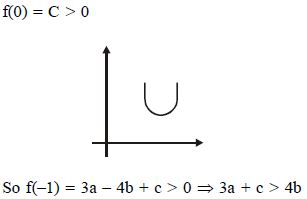
0 likes
View SolutionAlgebra — QUADRATIC EQUATION · Frequently Asked Questions
1Are these Algebra questions useful for JEE and NEET?
Yes. All questions in this section are mapped to JEE Main and NEET exam patterns. Previous year questions from JEE Main, NEET, GUJCET and state-level exams are included with full solutions.
2Can I switch to Hindi or Gujarati for these questions?
Yes. Use the language tabs in the hero section or the sidebar to view the same questions and solutions in English, Hindi or Gujarati.
3How do I generate a question paper from this subtopic?
Use the Vedclass Exam Paper Generator — select the chapter and subtopic, set difficulty, and generate Sets A, B, C, D automatically. First 3 chapters of every subject are free.
Vedclass Products
For Students
Vedclass Test Series
Mock tests in real JEE/NEET style with performance analysis. 5-day free trial.
Start Free TrialFor Teachers
Exam Paper Generator
Generate Set A/B/C/D papers from this chapter in 2 minutes. 3 chapters free.
Try FreeFor Institutes
Online Exam Module
Live online exams with unlimited students, 360° analytics & white-label branding.
See DemoFor Teachers & Institutes
Generate a Algebra Exam Paper in 2 Minutes
Select subtopic & difficulty — Sets A, B, C, D auto-generated with No Repeat logic.
First 3 chapters of every subject are free — no payment required.